
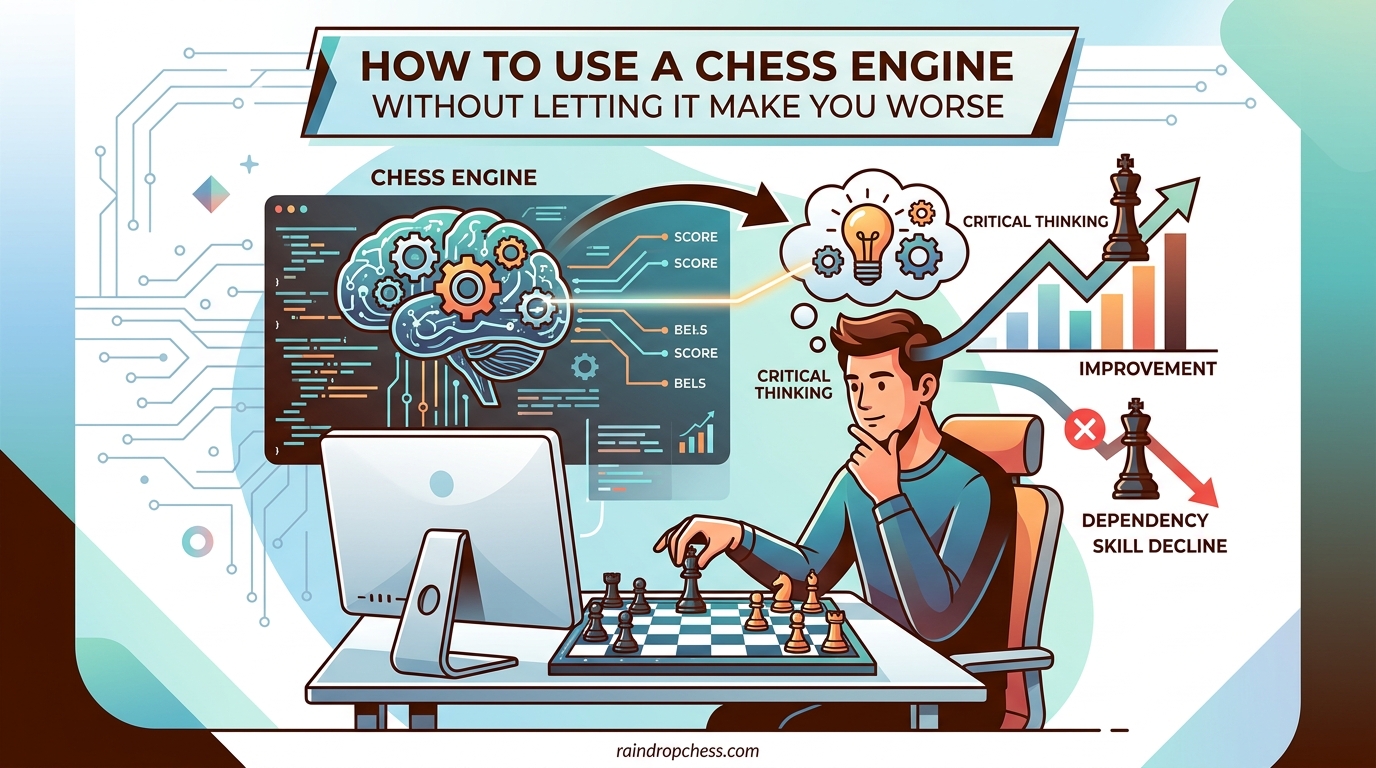
Chess engines like Stockfish are powerful tools that can accelerate your improvement dramatically. But I have watched too many players become addicted to engine analysis, only to find their over-the-board strength stagnating. Learning how to use a chess engine without letting it make you worse is one of the most important skills for any serious player. This guide will show you the exact workflow I have used with students over the past decade to build genuine chess strength while still benefiting from engine insights.
By the end of this article, you will understand why engine dependence happens, how to analyze games properly, and the specific mistakes that destroy your intuition. You will also learn alternative training methods that build the skills engines cannot teach you.
Table of Contents
Understanding the Engine Dependence Problem
Chess engine dependency develops when a player becomes reliant on external evaluation to find moves. This causes natural decision-making and intuition to deteriorate over time. You have probably seen this happen, or experienced it yourself. You spend hours with Stockfish, feeling confident in your understanding, then sit down for a rated game and cannot calculate three moves ahead without second-guessing every decision.
The psychological aspect is subtle but devastating. Engines give us certainty. They tell us that +1.2 is objectively better than +0.8. In a real game, no one gives you those numbers. You must evaluate positions based on feel, experience, and calculation. When you habitually outsource that judgment to a machine, your brain stops developing the neural pathways that make strong players strong.
From forum discussions on Reddit and Chess StackExchange, I have identified several warning signs of dangerous engine dependence:
- You feel anxious when you cannot access an engine during analysis
- You cannot commit to a move without checking evaluation first
- Your online rating climbs while your over-the-board rating stays flat
- You understand why engine moves are best but cannot find them yourself
Recognizing these patterns is the first step toward healthier engine use. The goal is not to abandon engines entirely, but to use them as a supplement to your own thinking rather than a replacement for it.
How to Analyze Games Properly with Engines
The key to avoiding engine dependence is following a structured workflow that prioritizes human analysis first. This process trains your brain while the engine corrects your blind spots. Here is the exact four-step method I recommend.
Step 1: Analyze Your Game Without the Engine First
Before touching Stockfish or any other engine, spend at least 15 to 20 minutes reviewing your game on your own. Go through move by move and ask yourself what you were thinking at each critical moment. Write down your candidate moves for key positions. This human-first analysis builds the pattern recognition and calculation skills that separate improving players from those who plateau.
During this phase, identify moments where you felt uncertain. Note positions where you spent significant time on the clock. These are your learning opportunities. The goal is to understand your own thought process before an algorithm tells you what you should have played.
Step 2: Identify Your Candidate Moves
For every critical position you identified, write down the moves you were considering during the game. Even if they turned out to be blunders, documenting your candidates is essential. This practice forces you to take ownership of your decisions. It also helps you understand whether your mistakes came from calculation errors or evaluation mistakes.
Try to generate at least two or three candidate moves for each key position. Strong players rarely play the only move they see. They compare options and select the strongest. Training yourself to find multiple candidate moves is one of the fastest ways to improve your practical results.
Step 3: Compare Your Analysis with Engine Output
Only now should you turn on the engine. Run the analysis and compare its output with your written notes. Where did your candidate moves match the engine’s top choices? Where were you completely wrong? Focus on understanding why the evaluation changed, not just what the evaluation is.
Pay attention to evaluation scores but do not obsess over them. A move that drops from +0.5 to 0.0 is not a blunder. It is a slight inaccuracy. Save your serious study for moves where the evaluation swings by more than a pawn. These represent true mistakes worth understanding.
Step 4: Focus on Mistakes, Not Perfection
The biggest trap in engine analysis is trying to understand every single move the engine prefers. This is impossible and counterproductive. Instead, focus on your actual mistakes. Use the engine to identify where you went wrong, then spend your energy understanding those positions deeply.
Blunder detection is the most valuable service an engine provides. Understanding why you missed a tactical shot or made a positional error is far more important than memorizing the engine’s preferred move order in a balanced position. Quality analysis of ten mistakes teaches more than superficial review of fifty positions.
Common Mistakes to Avoid When Using Engines
Even with good intentions, players fall into patterns that undermine their improvement. Here are the most common mistakes I see repeatedly in my coaching practice.
Checking the engine immediately after a game. This is perhaps the most common error. You finish a game and immediately run the engine to see where you went wrong. This robs you of the chance to train your own analysis skills. Always wait at least 15 minutes, ideally until the next day, before checking with an engine.
Playing engine moves without understanding them. When the engine suggests a move you do not understand, resist the urge to simply accept it. Take the time to work through the variations until the logic becomes clear. If you cannot understand why a move is best, you cannot apply that knowledge in future games.
Chasing centipawns. Some players become obsessed with tiny evaluation differences. They spend hours trying to understand why the engine prefers one winning move over another winning move. This is wasted effort. In positions where you are winning by multiple pawns, the specific path to victory matters far less than reaching winning positions consistently.
Over-focusing on accuracy percentage. Online platforms display accuracy scores after games, and many players become obsessed with achieving 90 percent or higher. This metric is misleading. You can play 90 percent accuracy by making safe, simple moves in easy positions. True strength comes from finding the best moves in complicated positions, even if your overall accuracy is lower.
Using engines during play. This should be obvious, but analyzing with an engine while playing casual games or puzzles defeats the purpose. Every position you solve with engine assistance is a lost training opportunity. Your brain needs the struggle to grow.
Building Intuition Without Engine Reliance
The ultimate goal of chess training is developing intuition that operates independently of external tools. Engines cannot teach you this directly. You must cultivate it through specific training methods.
Tactical puzzles remain the foundation. Solving hundreds of tactical puzzles builds the pattern recognition that helps you spot combinations in your own games. Use puzzle platforms that do not show you engine evaluations. Work through positions until you find the solution or give up. The struggle is where learning happens.
Blindfold analysis trains visualization. Try analyzing positions without moving the pieces on a physical or digital board. Start with simple positions and gradually increase complexity. This forces your brain to hold positions in working memory, a skill that translates directly to stronger calculation during games.
Study master games without engine assistance. When reviewing classic games, try to predict the moves before checking with an engine. Ask yourself why strong players made specific choices. This builds understanding of strategic concepts in a way that raw engine output cannot replicate.
Play longer time controls. Blitz and bullet chess are fun, but they do not provide enough time for deep calculation. Playing games with longer time controls forces you to think through positions yourself. The skills you develop in slow games transfer to faster time controls, but the reverse is rarely true.
When to Use Engines vs When to Avoid Them
Engines are tools, and like any tool, they are appropriate for some jobs but not others. Here is my guidance on when engine analysis is helpful versus harmful.
Appropriate uses: Post-game analysis after you have reviewed the game yourself, opening preparation to check specific lines, studying complex endgames where calculation is difficult, and checking your analysis of master games.
Harmful uses: Real-time analysis during games, checking positions before you have tried to solve them yourself, reviewing blitz games immediately after playing, and studying simple positions that you should understand without assistance.
Most coaches recommend waiting until you reach at least 1200 to 1400 ELO before relying heavily on engine analysis. Below this level, fundamental tactical training and pattern recognition provide better returns. Engines become most valuable when you can already spot basic tactics but need help with strategic planning and complex positions.
FAQ
Is 97% accuracy cheating in chess?
No, 97% accuracy itself is not cheating. However, consistently achieving accuracy above 95% across multiple games may indicate engine assistance during play, which is cheating. Legitimate players can occasionally reach high accuracy through good play, but doing so consistently without studying positions is suspicious. Focus on understanding moves, not the accuracy percentage.
How to use a chess engine to improve your game?
First analyze your games without the engine to build intuition. Identify your candidate moves, then check the engine to understand where you went wrong. Focus on learning from mistakes rather than memorizing engine lines. Use engines for post-game review, not during play. Combine engine analysis with tactical training and study master games.
What is the 75 rule in chess?
The 75-move rule states that a game is automatically drawn if 75 consecutive moves have been made by both players without any pawn advance or piece capture. This rule exists to prevent infinite games. It is rarely invoked in practical play as most games end before this point.
What ELO level should I be before using engines?
Most coaches recommend waiting until you reach at least 1200-1400 ELO before relying heavily on engine analysis. Below this level, fundamental tactical training and pattern recognition provide better returns. Engines become most valuable when you can already spot basic tactics but need help with strategic planning and complex positions.
Conclusion
Learning how to use a chess engine without letting it make you worse requires discipline and a clear understanding of what these tools can and cannot do. Engines are brilliant at identifying mistakes and showing objective truth. They are terrible at teaching you how to think, how to calculate, and how to develop the intuition that separates good players from great ones.
The workflow is simple but requires commitment. Analyze first, generate candidate moves, then compare with engine output. Focus on understanding your mistakes, not chasing perfect evaluations. Supplement engine work with puzzles, blindfold training, and master game study. Used correctly, Stockfish and other engines will accelerate your improvement. Used incorrectly, they will stunt your growth and leave you dependent on a crutch that is not available during your most important games.
Start implementing these principles in your next training session. Your future self, calculating confidently in time pressure with no engine in sight, will thank you.