
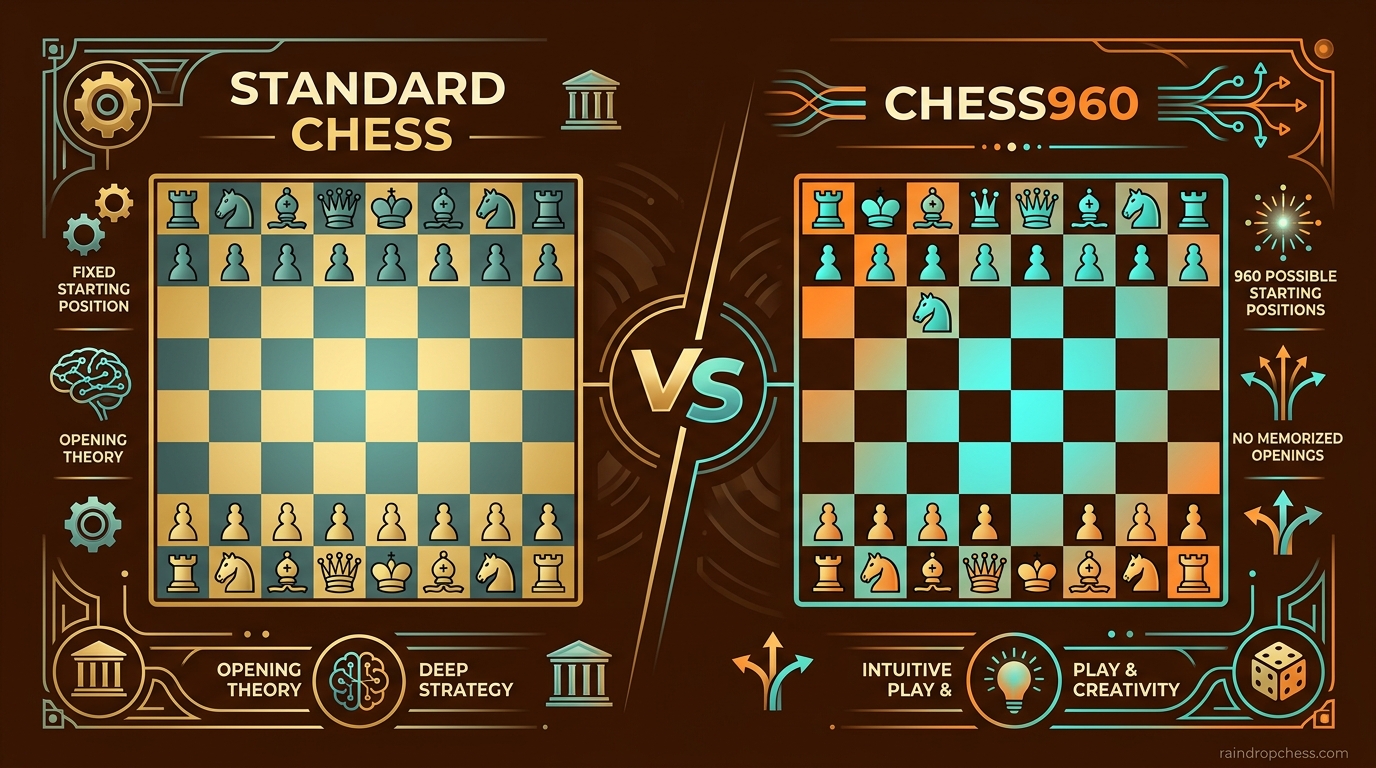
As an intermediate chess player in the 1200-1800 rating range, you have probably heard the debate: should you be investing your time in Chess960 or sticking with standard chess to become a better player? The question comes up constantly in forums, Discord servers, and chess clubs. Some players swear that Chess960 (also known as Fischer Random Chess) is the ultimate training tool for sharpening calculation and creativity. Others dismiss it as a fun distraction that will not actually help your standard chess rating. So who is right?
The honest answer is more nuanced than most players want to admit. Both formats offer real but different benefits, and the question of which one makes you better depends entirely on what skills you are trying to develop and how you approach your training. This article will break down exactly how Chess960 differs from standard chess, what the research and real player experiences reveal about skill transfer between formats, and which format you should be prioritizing based on your rating goals.
Table of Contents
What is Chess960 (Fischer Random Chess)?
Chess960 is a chess variant created by legendary world champion Bobby Fischer in 1996. The core idea was simple but revolutionary: shuffle the backRank pieces randomly while following two constraints. First, the bishops must be placed on opposite colors. Second, the king must be somewhere between the two rooks to allow castling. These rules produce exactly 960 possible starting positions, which is where the name comes from.
The important thing to understand is that all other chess rules remain exactly the same. The pieces move identically, check and checkmate work the same way, and pawns advance the same. The only meaningful difference is the starting position. This was intentional. Fischer wanted to preserve the beauty and complexity of chess while eliminating the excessive opening preparation that had come to dominate high-level play.
One of the most confusing aspects for new Chess960 players is the castling rules. Because the king can start on different squares, the castling rules were adapted. In Chess960, you can still castle kingside or queenside by moving the king two squares toward the rook, as long as no squares the king passes over are under attack. This means castling is still possible in most positions, but the exact king movement depends on where the pieces started. Once you play a few games, the castling rules become intuitive and no longer slow you down.
Chess960 is taken seriously enough that it has its own World Championship. The most recent was held in 2019, with Wesley So winning the title. This tells you that Chess960 is not just a novelty. Top grandmasters compete in it at the highest level, which means the strategic depth is very real.
How Chess960 Differs from Standard Chess
The differences between Chess960 and standard chess go far beyond just the starting position. Understanding these differences is essential for figuring out which format actually helps you improve as a player.
Opening Preparation: The Biggest Difference
In standard chess at the intermediate level and above, a enormous portion of your study time goes into opening preparation. You memorize lines, you learn typical pawn structures, and you try to get to positions where you know the best plans. This is both a strength and a weakness of standard chess. On one hand, studying openings teaches you positional principles and typical piece setups. On the other hand, it can lead to something experienced players call autopilot. You reach a familiar position and execute your prepared line without really thinking.
Chess960 eliminates opening preparation entirely. No one has memorized lines in Chess960 because no one can memorize 960 different positions plus all the resulting middlegame theory. When you play Chess960, you and your opponent both start from genuinely new territory every single game. This forces you to rely entirely on your calculation ability, pattern recognition, and strategic planning. You cannot coast on memorization.
Piece Placement and Positional Familiarity
Another significant difference is how familiar you are with piece placements. In standard chess, certain setups appear over and over. You develop expectations about where pieces belong in any given structure. In Chess960, those expectations go out the window. A knight might be sitting on the edge of the board where you would rarely find it in standard chess. The queen might start in a position that leads to unusual developing patterns.
Real player experiences illustrate this well. One Reddit user rated around 2100 in standard chess reported being only 1500-1600 in Chess960 within three weeks of regular play. This is not because they forgot how to play chess. It is because the familiar structures they had spent years internalizing simply were not there to rely on. They had to recalibrate their intuition to new piece arrangements, and that takes time even for strong players.
This phenomenon is sometimes called the raw skill gap. In standard chess, a 2100-rated player can sometimes beat a 1500-rated player without even thinking because the stronger player knows the openings so well. In Chess960, where opening knowledge provides no advantage, the rating gap narrows considerably. Both players start from pure calculation and strategic insight.
Strategic vs Tactical Emphasis
Standard chess tends to reward deep positional understanding and long-term planning. Players who excel at maneuvering pieces into optimal positions often succeed even if their tactical vision is not world-class. Chess960, by removing the opening phase, shifts the emphasis toward immediate calculation and tactical alertness. You are thrown into complex positions faster, and the need to calculate variations accurately becomes more urgent.
As one intermediate player on Reddit described it, regular chess gives you more familiar structures while Chess960 gives you fresher positions. Both formats can give you deeper insights, but the nature of those insights differs. Standard chess teaches you how to navigate established positions. Chess960 teaches you how to calculate new ones.
Does Chess960 Make You a Better Player? The Skill Transfer Analysis
This is the central question, and it deserves a direct answer backed by evidence rather than hype. Does playing Chess960 actually make you a better player at standard chess?
The answer is qualified yes, with important caveats. Chess960 can absolutely improve certain skills that transfer to standard chess, but it is not a magic training tool that will automatically elevate your game. Let us break down what transfers and what does not.
What Transfers: Calculation and Creative Thinking
The skills that most clearly transfer from Chess960 to standard chess are calculation accuracy and creative problem-solving. Because you cannot rely on opening preparation in Chess960, every game is a full middlegame battle where you must calculate variations accurately under time pressure. This intensive calculation practice sharpens your tactical vision in ways that definitely carry over to standard chess.
Chess960 also forces you to think creatively. When you cannot fall back on memorized plans, you have to generate original ideas and evaluate positions on their merits rather than on database knowledge. This creative thinking helps you find tactical shots and unusual plans in standard chess that you might otherwise miss. Levon Aronian has spoken about this benefit, noting that Chess960 makes him a more inventive player.
What Does Not Transfer: Opening Knowledge and Pattern Recognition for Standard Positions
Here is where the transfer analysis gets uncomfortable for Chess960 enthusiasts. The opening knowledge you build in standard chess does not exist in Chess960. If your primary goal is to improve your standard chess rating, spending significant time on Chess960 means you are not practicing the opening phase of standard chess, which accounts for a substantial portion of games at the intermediate level.
Similarly, the pattern recognition you develop in standard chess positions does not fully transfer. You learn to recognize typical tactical patterns in standard chess through repeated exposure. Chess960 gives you exposure to different patterns, and while some tactical ideas are universal, a lot of what makes you dangerous in a standard chess position is specific pattern familiarity that Chess960 does not build.
The Verdict on Skill Transfer
The evidence suggests that Chess960 makes you better at calculation, creativity, and tactical sharpness, but it does not directly improve your opening knowledge or your ability to navigate familiar standard chess positions. If you are a 1200-1800 player who struggles most with middlegame calculation, Chess960 is excellent training. If you are struggling with losing in the opening due to memorized theory, Chess960 will not help you there because you need to study standard chess openings specifically.
Most importantly, the fear that Chess960 creates bad habits is largely unfounded. Players worry that playing in positions without typical structures will teach them bad piece placement instincts. However, the evidence from forum discussions and player experiences suggests that any skill you build in Chess960 transfers positively to standard chess calculation, even if the specific patterns differ. The key is that Chess960 builds foundational skills like calculation accuracy and creative thinking, which are universally valuable.
Benefits of Playing Chess960
Despite the nuances in the skill transfer analysis, the benefits of playing Chess960 are real and well-documented. Here is why so many players incorporate it into their training routine.
Sharper Tactical Awareness
Chess.com’s own article on Chess960 explicitly states that it is an excellent way to sharpen your tactical and strategic skills because you have to rely heavily on them. When you cannot avoid the opening by memorizing lines, you are forced into complex middlegame positions where tactical shots are abundant. This constant exposure to tactical situations trains your pattern recognition in ways that improve your overall chess vision.
For intermediate players specifically, tactical awareness is often the difference between a 1400 and a 1600 rating. The player who can spot a fork or pin before it happens, who can calculate a sequence three moves deep accurately, has a massive edge. Chess960 is particularly effective at building this skill because every game demands it.
Eliminating Autopilot
One of the biggest problems intermediate players face is autopilot during games. You reach a familiar position and your hand just plays the prepared move without conscious thought. Sometimes this works. Often it does not, and you end up in a worse position because you did not actually evaluate what is happening on the board.
Chess960 eliminates autopilot by definition. There is no such thing as a familiar position in Chess960. Every game requires full engagement from move one. Players in forums have specifically identified this as the format’s greatest strength. One player put it simply: Chess960 forces original thinking. You cannot get away with playing on autopilot when every position is genuinely new territory.
Breaking Bad Opening Habits
Many intermediate players develop opening habits that are actively harmful to their chess development. They play opening lines without understanding why those moves are good, they develop bad piece placement instincts, or they memorize lines without learning the underlying ideas. Chess960 is an excellent corrective for these issues.
When you play Chess960, you are forced to ask fundamental questions about piece development and king safety that standard chess opening study often lets you skip. Why is this knight better on this square? Why should I prioritize this development over that one? These questions are more obvious in Chess960 because you cannot hide behind memorized theory.
Improving Calculation Under Time Pressure
Because Chess960 positions are always new and complex, they are excellent for training calculation under time pressure. Blitz and rapid games in Chess960 require you to make accurate decisions quickly, building both speed and accuracy that transfers directly to standard chess blitz and rapid games.
Drawbacks and Concerns
Chess960 is not without its concerns, and as an intermediate player considering whether to invest time in it, you deserve to know the potential downsides.
Rating Transfer and Perceived Skill Loss
The rating gap between formats is real and can be discouraging. A 2100-rated standard chess player being only 1500-1600 in Chess960 within a few weeks is a jarring experience. This does not mean you have gotten worse at chess. It means you are calibrating to a format where your standard chess opening preparation provides no advantage. If your goal is to improve your standard chess rating specifically, watching your Chess960 rating lag behind can be demoralizing if you let it affect your confidence.
Lower Popularity and Finding Opponents
Chess960 is significantly less popular among average players than standard chess. Forum discussions confirm this. One Reddit thread explicitly states that Chess960 is less popular among the average player base because it is complicated and does not reward traditional training. This means finding opponents at your skill level can be more difficult, particularly on smaller platforms. Lichess and Chess.com both have active Chess960 communities, but the player pool is smaller than standard chess.
Professional Legitimacy Concerns
While Chess960 has its own World Championship and is taken seriously at the top level, many intermediate players worry that playing Chess960 will not be taken seriously by other chess players. This concern is understandable but ultimately misplaced at the recreational level. No serious chess player will mock you for training in Chess960. In fact, many strong players incorporate it specifically because they recognize the training benefits. The concern about legitimacy is most relevant at the tournament level, where standard chess remains the primary format for career purposes.
Complexity for Improvement-Focused Players
Some players find that the additional complexity of Chess960 is a distraction from their improvement goals rather than an aid. If your specific weakness is positional chess or endgame technique, spending time on Chess960 might pull your attention away from those areas. Chess960 is excellent for tactical sharpness and calculation, but it does not specifically train endgame technique or positional maneuvering in the way that standard chess study does.
Who Should Play Chess960?
Based on all the evidence, here are concrete recommendations for which intermediate players should be investing time in Chess960.
You should play Chess960 if: You are an intermediate player who feels your calculation ability is a significant weakness. If you often see tactics a move or two later than you should, or if you struggle to evaluate complex positions accurately, Chess960 provides focused training that addresses these exact issues. You should also play Chess960 if you feel stuck in opening memorization and want a format that forces you to actually think about chess rather than recall prepared lines.
You might want to stick primarily with standard chess if: Your main goal is to improve your standard chess rating as quickly as possible, and you are currently losing games in the opening due to insufficient preparation. If that is your situation, your time is currently better spent studying standard chess openings that will directly show up in your games. You should also focus on standard chess if you are specifically working on positional concepts or endgame technique, as Chess960 does not provide targeted practice for these areas.
The ideal approach for most intermediate players: Incorporate Chess960 as a regular supplement to your standard chess training rather than a replacement. Playing one or two Chess960 games per week alongside your regular standard chess study gives you the calculation and creativity benefits without sacrificing the opening and positional knowledge that standard chess develops. This balanced approach lets you enjoy the benefits of both formats.
Chess960 vs Standard Chess: Side-by-Side Comparison
| Feature | Chess960 | Standard Chess |
|---|---|---|
| Opening Preparation Required | None – positions are always new | Extensive at intermediate level and above |
| Skill Emphasis | Calculation, tactics, creative thinking | Opening knowledge, positional understanding |
| Tactical Complexity | High from move one | Varies – often develops after opening phase |
| Autopilot Risk | None by definition | High in familiar positions |
| Rating Transfer | Standard chess rating does not directly transfer | N/A – this is the standard format |
| Popularity | Lower player base | Overwhelmingly dominant format |
| Training Benefit | Tactical sharpness, calculation accuracy, creativity | Opening knowledge, pattern recognition, positional play |
| Best For | Breaking bad habits, calculation training, creative thinking | Opening preparation, structural understanding, competitive rating |
Frequently Asked Questions
Does Chess960 actually make you better at standard chess?
Yes, but in specific ways. Chess960 improves your calculation accuracy, tactical sharpness, and creative thinking. These skills transfer to standard chess and will help you find tactics and evaluate positions more accurately. However, Chess960 does not directly improve your opening knowledge, which is a significant part of standard chess at the intermediate level. Think of Chess960 as excellent supplementary training for your calculation ability.
Is Chess960 harder to learn than standard chess?
The rules are the same, so the learning curve for how the pieces move is identical. The adjustment is in how you approach the game. Chess960 is harder in the sense that you cannot rely on opening preparation, so every game requires full calculation from move one. This adjustment is more challenging for players who have invested heavily in opening study, and easier for players who already prefer calculation-based play.
Will playing Chess960 create bad habits?
Based on player experiences and forum discussions, this fear is largely unfounded. Any skills you build in Chess960, particularly calculation accuracy and creative thinking, transfer positively to standard chess. The concern about bad piece placement habits is understandable but not supported by evidence. Players who train in Chess960 do not develop harmful habits that hurt their standard chess. Instead, they often report improved tactical awareness in regular games.
Is Chess960 worth it for improvement if I am an intermediate player?
Yes, particularly if your current weakness is calculation or if you feel stuck in opening memorization. Playing Chess960 one or two times per week alongside your regular standard chess study is an excellent way to develop calculation skills that will show up in your blitz and rapid games. However, if you are currently losing most of your games in the opening due to insufficient preparation, your priority should be standard chess opening study before adding Chess960 to your training routine.
What is the 20 40 40 rule in chess?
The 20 40 40 rule is a guideline for how to allocate your chess study time. It suggests that 20% of your study should go to openings, 40% to the middlegame, and 40% to the endgame. This rule is often cited in the context of why Chess960 can be valuable, because it reduces the need for opening study while forcing you into middlegame positions that develop your calculation skills.
Conclusion
The debate between Chess960 vs Standard Chess for improving your game ultimately has no single correct answer. Both formats offer genuine benefits, and the right choice depends on your specific weaknesses, goals, and preferences as a chess player.
Chess960 makes you better at the parts of chess that are hardest to teach through memorization: accurate calculation, creative problem-solving, and tactical awareness under time pressure. If these are your weak points, adding Chess960 to your training will produce measurable improvements in your standard chess games. Standard chess remains essential for building opening knowledge, positional understanding, and familiarity with the structures you will encounter in rated play.
For the intermediate 1200-1800 player specifically, the ideal approach is balanced. Study your standard chess openings for the positions you actually play, work on your endgame technique, and add one or two Chess960 games per week as tactical and calculation training. This approach lets you build the knowledge base you need for standard chess while simultaneously sharpening the calculation skills that will help you find tactical shots you would otherwise miss.
The bottom line is that Chess960 is not better or worse than standard chess for overall improvement. It is different. And for intermediate players willing to think carefully about their training, that difference can be exactly what you need to break through to the next level.