
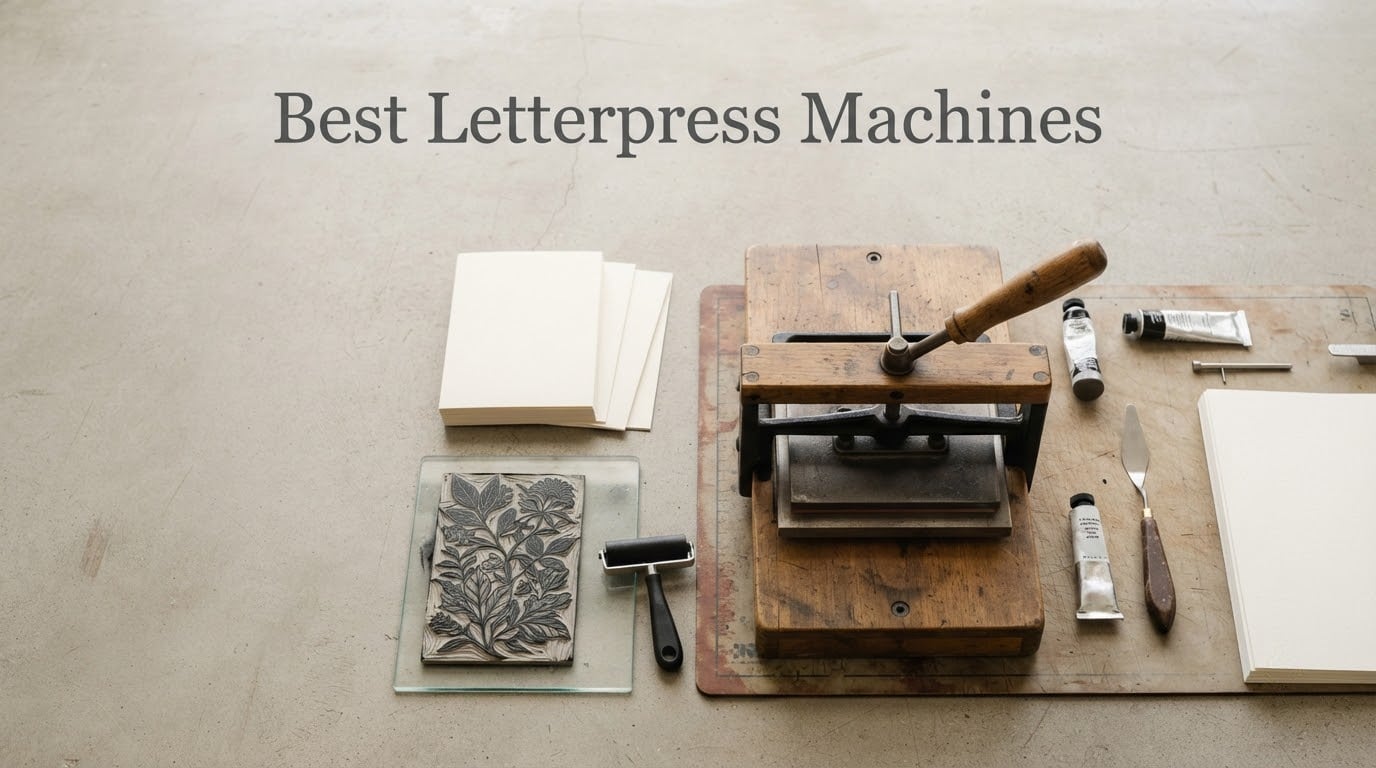
A letterpress machine is a press that prints from a raised, inked surface onto paper under heavy pressure, so the impression is physically pressed into the sheet. That is the honest definition, and it matters more than any brand name on the box, because the machines sold under the label “letterpress” fall into four very different classes. Some press a sheet against an inked plate, some roll ink across a forme the way a real press does, some simply push a hard plate into paper without any ink at all, and the last group handles paper too thick for any of the others.
I spent weeks reading specifications, review data and long-running forum threads before ranking the ten machines below, and the single biggest trap for a first-time buyer is the trap the forums keep warning about. The most heavily reviewed device in this roundup does not roll ink across a forme. It presses an inked plate. Practitioners on Ladies of Letterpress have argued for years that the marketing term is generous, and buyers who assume otherwise feel the gap the moment they try to run a long text page.
That honesty shapes every pick here. Each machine below lists what it actually does, how many reviews back it, what you still have to buy after it arrives, and where it stops being useful. I also flagged the terms that show up constantly in buying guides for bench-sized machines, including our tabletop pinball machine guide, our mini arcade machine picks and our cocktail arcade machine roundup, because the same bench-space and size-versus-paper logic applies to every machine-first hobby.
Last updated for 2026. Prices change constantly, so every judgement below is based on build specification and verified buyer feedback rather than on a single day’s number.
Table of Contents
What Counts as a Letterpress Machine (And What Does Not)
Four classes of machine get called letterpress machines, and only some of them print ink in the traditional sense. Here is the taxonomy you need before any of the picks make sense.
Craft impression devices. A lever presses a plate onto paper inside or alongside a die cutting machine. No ink rollers, no chase, no quoins.
Hand lever and handwheel block presses. Screw or lever pressure over a flat bed, designed for linoleum, woodcut, rubber blocks and card printing.
Tabletop proof and etching presses. Wide beds driven by a handwheel drum, built for monotype, etching plates and large relief blocks.
Platen and cylinder presses. A platen swings down onto a forme locked in a chase with quoins and furniture, the way a shop press works. None of the ten machines here are true platen presses, and I explain why in the buying guide.
The terminology point is not pedantry. A platen is a printing press; letterpress is the technique, not the machine. When a listing calls a plastic hand tool a “letterpress machine”, it is describing the look of the result, and buyers who expect ink rollers find that out on day one.
Three other processes get confused with letterpress in buying guides. Debossing pushes a shape into paper with no ink, which is what a craft device does. Embossing raises paper without ink. Etching is intaglio, where ink sits in recessed lines and is wiped away before printing. Offset lithography prints a flat plate image with no impression, and digital presses print toner with no plate and no impression at all. None of those three produce the deep, tactile bite that letterpress buyers are chasing.
Historically, offset replaced letterpress in commercial printing during the twentieth century, and digital presses replaced offset for short runs from the 1990s onward. Print shops now push small-run clients toward machines like the Colorcube 8570 and Xerox DC12 because setup time kills margin on short commercial runs. Letterpress survived anyway, and what you are buying today is mostly a craft and small-stationery tool rather than a production shortcut.
One more honesty note before the picks. This roundup is weighted toward tabletop and hand-lever presses because that is what is available to buy new in reasonable sizes. A real platen press with a chase, quoins, furniture and a forme roller is a different purchase entirely, larger, heavier, and usually bought used.
Top 3 Letterpress Machine Picks
Three machines cover most first-time buyers, and each solves a different problem. The BetterPress is the one with real buyer volume behind it, the Linoartpress is the strongest physical build here, and the TOPOWN has the most thickness headroom of any lever press on the list.
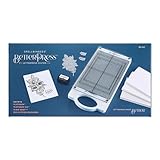
BetterPress Letterpress System
- Presses inked plates on card
- 87.75 sq in impression area
- Only 16 ounces
- Needs a Platinum 6 die cutter

Linoartpress A4 Linocut Press
- A4 bed at 11.8 x 8.7 in
- Steel frame with plywood plates
- Includes brayer and felt

TOPOWN Linocut Hand Lever Press
- Blocks up to 25 mm thick
- 3-level pressure adjustment
- A4 paper
- 13 pounds
The BetterPress earns the top spot on evidence rather than on features, with 288 reviews averaging 4.6 stars. That is more real-world feedback than anything else on this list, and it is the only device here that generates a genuinely deep impression on finished stationery without a press-sized footprint.
All 10 Letterpress Machines at a Glance (2026)
This table is the fastest way to narrow the field. Note the class column first, because it does more to predict your experience than any other attribute.
| Product | Specifications | Action |
|---|---|---|
| Spellbinders BetterPress Letterpress System |
|
Check Latest Price |
| Linoartpress A4 Linocut Press |
|
Check Latest Price |
| TOPOWN Hand Lever Linocut Press |
|
Check Latest Price |
 Maisutseb Manual Slab Roller Maisutseb Manual Slab Roller |
|
Check Latest Price |
 Lounsweer Block Printing Press Lounsweer Block Printing Press |
|
Check Latest Price |
 GdaJzh A4 Beech Wood Linocut Press GdaJzh A4 Beech Wood Linocut Press |
|
Check Latest Price |
 Speedball Woodzilla A5 Press Speedball Woodzilla A5 Press |
|
Check Latest Price |
 AsellPress A3 Birch Plywood Press AsellPress A3 Birch Plywood Press |
|
Check Latest Price |
 JARYANNIX 15 x 15 in Flat Press JARYANNIX 15 x 15 in Flat Press |
|
Check Latest Price |
 LetterPress by Gemini LetterPress by Gemini |
|
Check Latest Price |
1. Spellbinders BetterPress Letterpress System – The Most Widely Reviewed Impression Machine
Spellbinders BetterPress Letterpress Machine for Cardmaking and Paper Crafts BP-001 (Betterpress Letterpress Machine)
87.75 sq in area
Manual lever operation
16 oz, 6.75 x 13 in
Needs a Platinum 6 die cutter
Pros
- Deep touchable impression in finished card
- Clean cotton card panel system with almost no inking mess
- Only 16 ounces and stores flat
- 288 reviews give the strongest evidence base here
Cons
- Requires a separate Platinum 6 or 8.5 inch die cutting machine
- Cotton card panel and sheets are an ongoing consumable cost
- Presses plates rather than printing through ink rollers
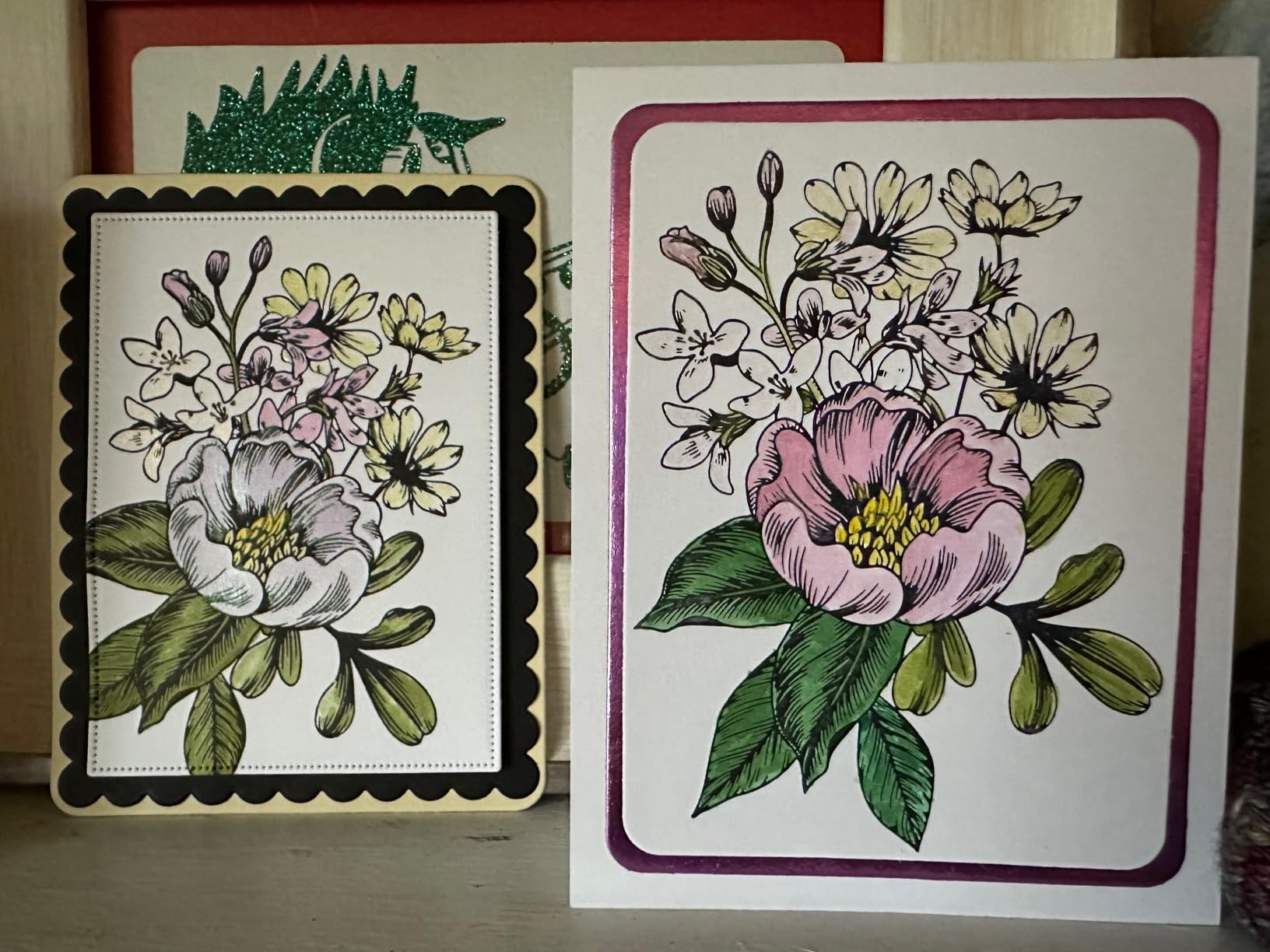
My first impression of the BetterPress was that it is not really a press, and that is still the honest verdict. It is a lever device that sits with a Spellbinders die cutting machine and pushes an inked plate against a cotton card panel. What surprised me was how convincing the result looks on finished stationery once you get the impression depth right.
The workflow is genuinely clean. You ink a plate, position it on the platform, lay the cotton card panel and sheet on top, and run the die cutting machine’s crank cycle. The system delivers that classic debossed look without the ink smears, solvent trays or roller washing that come with a traditional press.
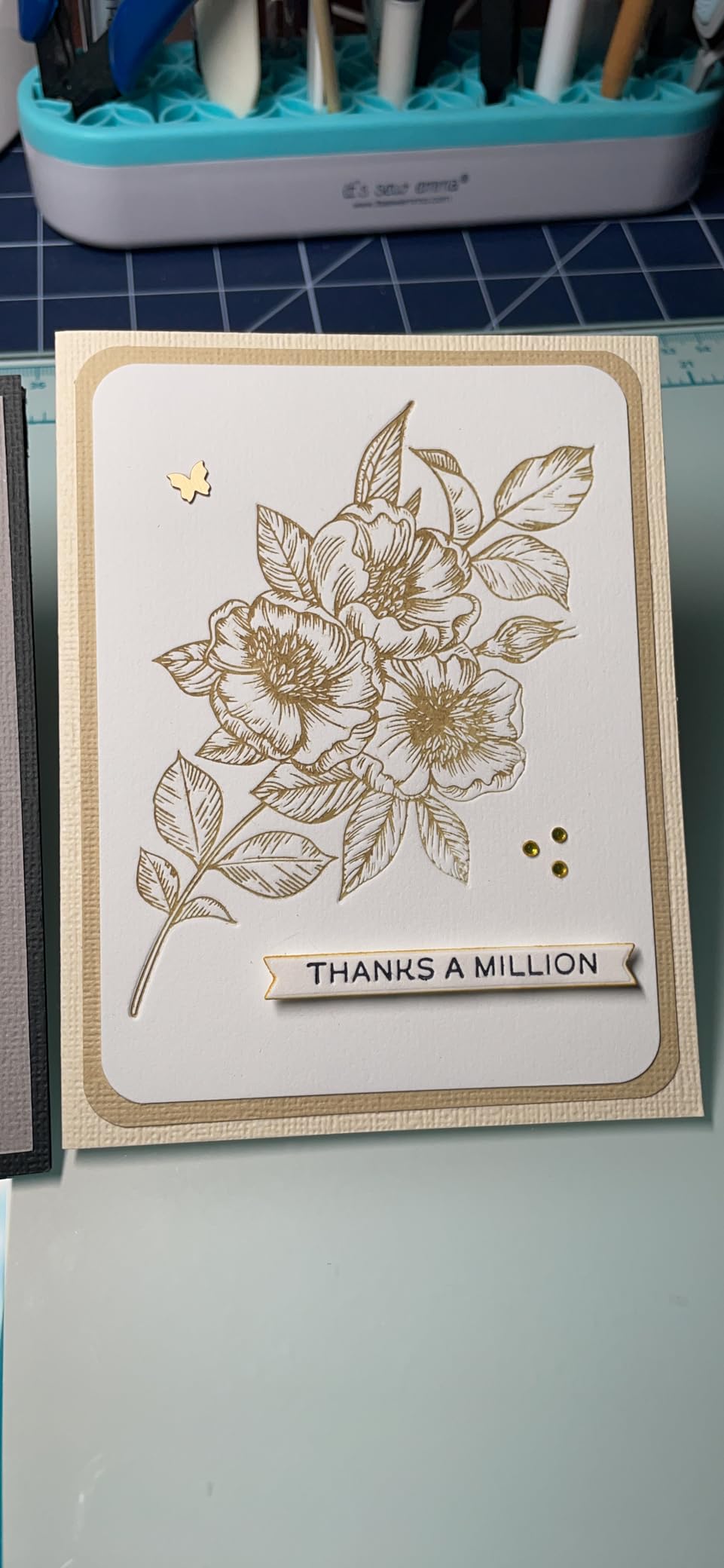
Buyer feedback backs the impression quality up. Reviewers describe a detailed, touchable result on finished card. The recurring practical notes are about footprint, with owners pointing out that the unit weighs 16 ounces and measures 6.75 by 13 inches, so it stores flat between sessions.
The catch is a system dependency. It requires a separate Spellbinders Platinum 6 or 8.5 inch die cutting machine to run the press cycle, so anyone starting from zero is buying two devices. The cotton card panel and sheets are also a recurring consumable, and the whole system is specific to the brand’s platform.
It is also not a press for hand-carved linoleum or wood blocks, because it takes a plate rather than an art block. I would pair it with one of the block presses below if your work is printmaking, or use it alone if your work is card making.
Who the BetterPress suits well
Card makers who produce small runs of invitations, tags and business cards and care most about the finished look rather than the process. It is also the safest recommendation on this list for a shared craft room, because the failure mode of a thin plate is a soft impression, not a broken machine.
Anyone who already owns a Platinum 6 or 8.5 inch die cutting machine gets the best value here, since the extra cost is only the press itself.
Who should skip the BetterPress
Anyone who wants to print with ink rollers or set type, because this device does neither. Also skip it if you cannot commit to the brand’s consumable ecosystem, since the cotton card panel and sheets are the running cost of every sheet you print.
And skip it if you already own a flat block press, because the BetterPress and a block press solve different problems rather than competing ones.
2. Linoartpress A4 Linocut Press – Even Pressure and a Steel Frame
Linocut Press Machine for Printmaking, A4 Size (11.8″L x 8.7″W) Green
A4 bed at 11.8 x 8.7 in
Powder-coated steel frame
Solid beech handle
Plywood plates with brayer
Pros
- Highest average rating in this group among presses with real review volume
- Even pressure distribution visibly sharpens print detail
- Steel frame and plywood plates hold up under hard blocks
- Felt sheet and brayer make it a usable starter kit
Cons
- Customs charges reported months after the order was placed
- Included brayer is narrower than advertised
- A4 bed will not take larger sheets
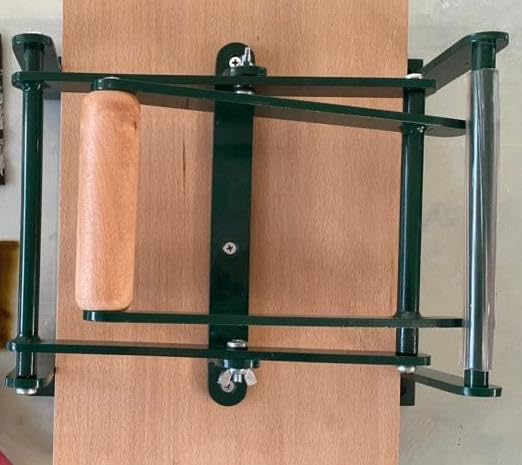
This is the press I would put in front of a beginner who wants to print blocks. The build is a powder-coated steel frame mechanism with a solid beech wood handle, and the upper and lower plywood printing plates carry a clear protective varnish that helps spread pressure across the whole block.
At 4.8 stars from 36 reviews, it holds the highest average rating of any press in this roundup that has enough review volume to mean anything. That is a strong signal rather than a rounding error, and it is the reason this press edges out machines with far more reviews.
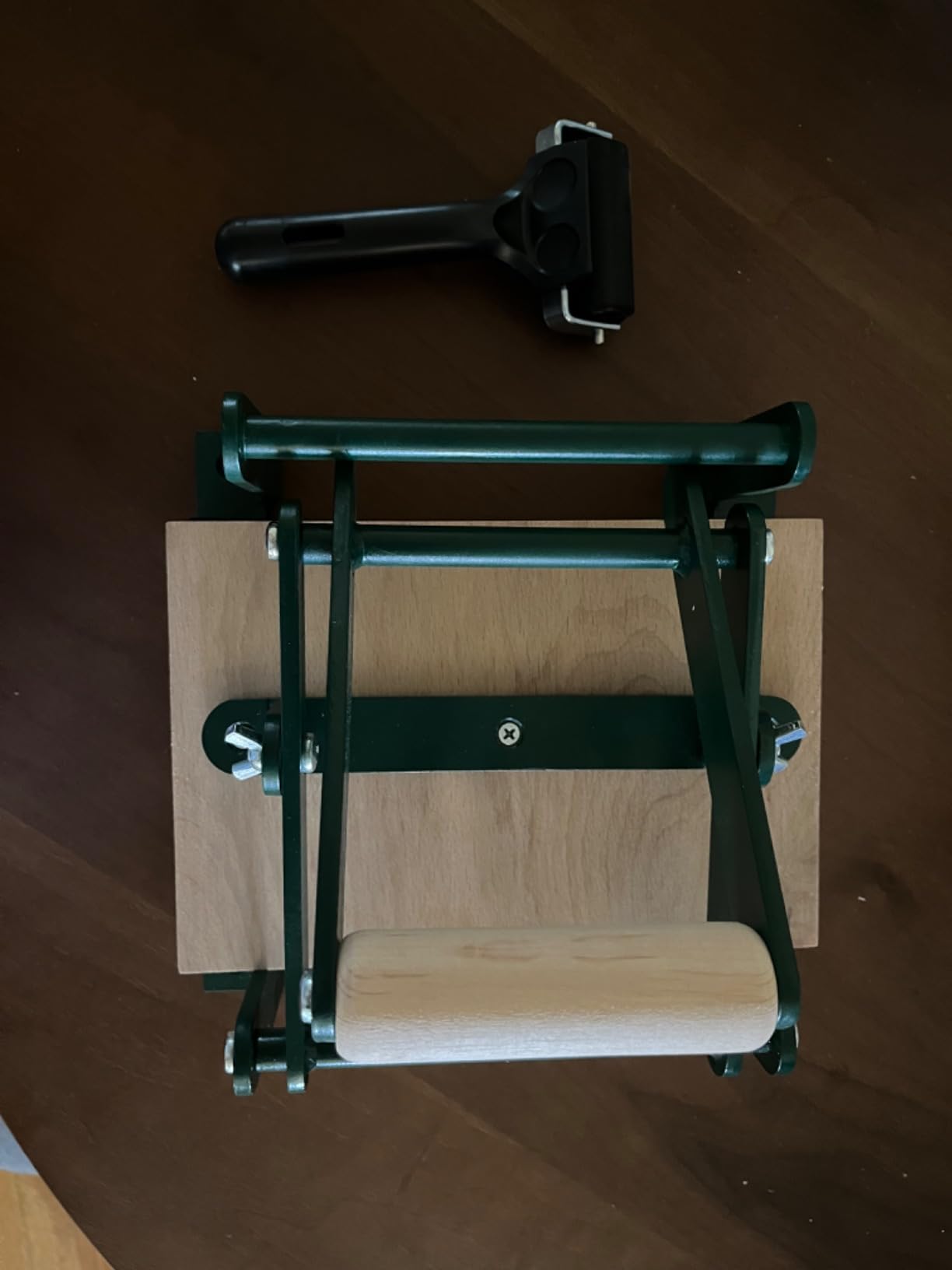
The consistent theme in reviews is consistency. Owners report that even pressure visibly sharpens fine detail, and that the result is noticeably cleaner than hand burnishing with a baren. The 11.8 by 8.7 inch bed takes A4 paper, and the frame is bolted rather than glued, which is what you want from a machine that will see pressure every time you pull the handle.
One practical note. A recurring negative theme sits outside the machine itself, with buyers reporting a customs charge billed months after the order was placed, so factor import costs into your budget if you are outside the origin country.
The included brayer measures 6 cm, which a few buyers found narrower than they expected. A wider brayer is a cheap fix and buys you more even ink coverage per pass.
Who the Linoartpress suits well
Printmakers working in linoleum, woodcut or soft rubber blocks who want machine pressure instead of a baren. The felt sheet included with the press protects the block face and keeps ink transfer even, which is the difference between a hobby tool and one you would use for a small edition.
It is also a good first press for a workshop or classroom because it needs no electricity and no ventilation beyond ordinary ink care.
Who should skip the Linoartpress
Anyone printing A3 or larger sheets, because the bed is A4 sized. Also skip it if you are outside the origin country and cannot absorb an unexpected customs charge on top of the purchase.
Skip it if you plan to print photopolymer plates with a chase and quoins, because this is a block press and takes no locking furniture.
3. TOPOWN Hand Lever Linocut Press – Handles the Thickest Blocks Here
TOPOWN Linocut Printing Hand Lever Press Machine, Linocut Press Machine
Blocks up to 25 mm thick
3-level pressure adjustment
A4 paper, 12 x 11.5 in
13 lb steel and plywood
Pros
- Accepts blocks up to about 25 mm
- far thicker than most lever presses
- Lever geometry applies pressure evenly with little effort
- Burr-free plywood plate and handle
- Felt cushioning pad included
Cons
- Plywood plate and handle can flex and wear under heavy pressure
- Three-level adjustment takes real setup time
- Blocks are not included and some listed functions are marketing claims
The reason to pick this press over a cheaper lever is block thickness. The three-level pressure adjustment accepts blocks up to about 25 mm, and owners working in battleship grey lino or stacked wood say that headroom is what stops the plate bottoming out and cracking the block face.
The lever geometry is genuinely effort-saving. Reviewers describe it as easy enough for a child to operate, which is a roundabout way of saying the mechanical advantage is good and the pull stays smooth across the throw.
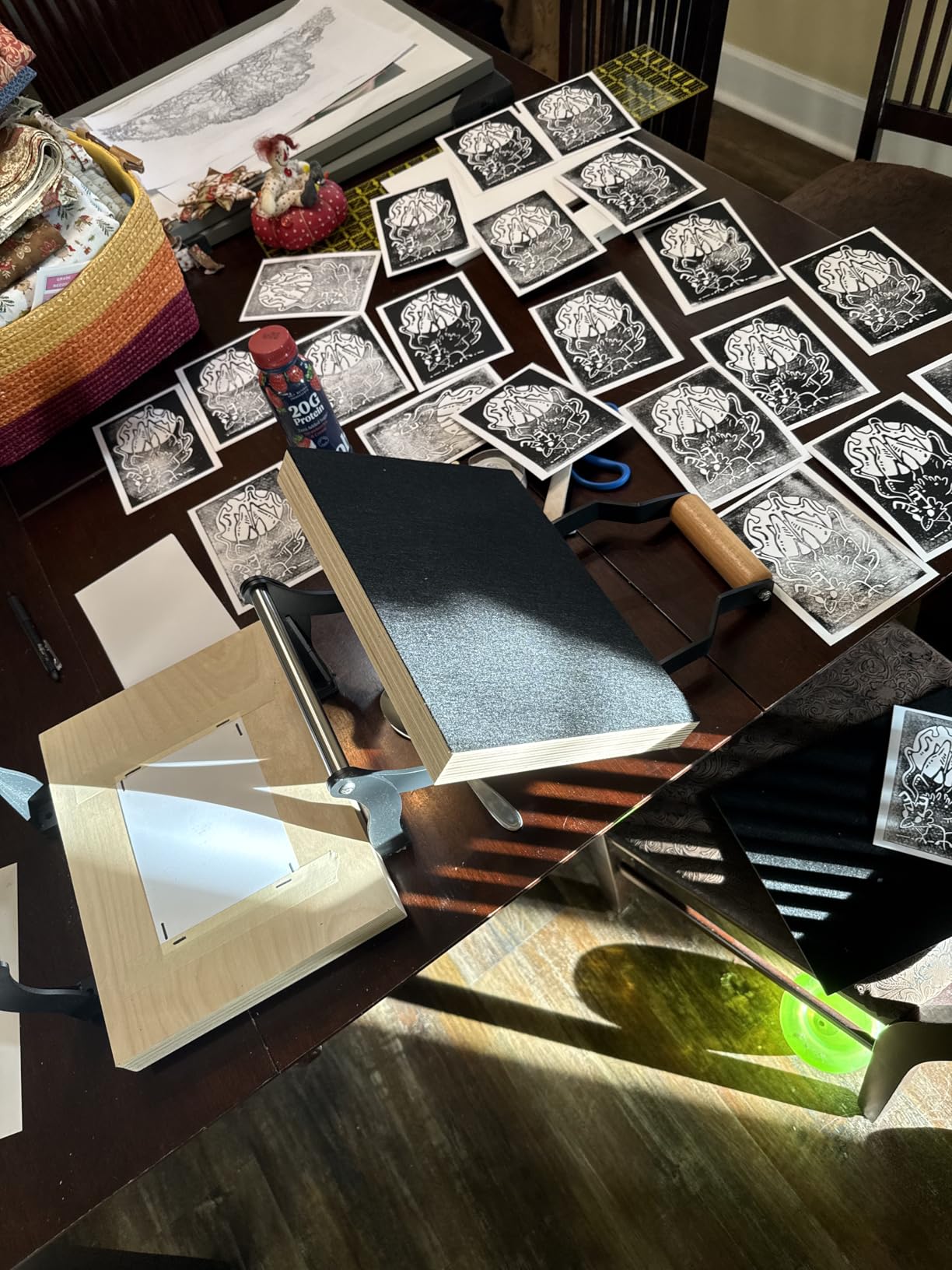
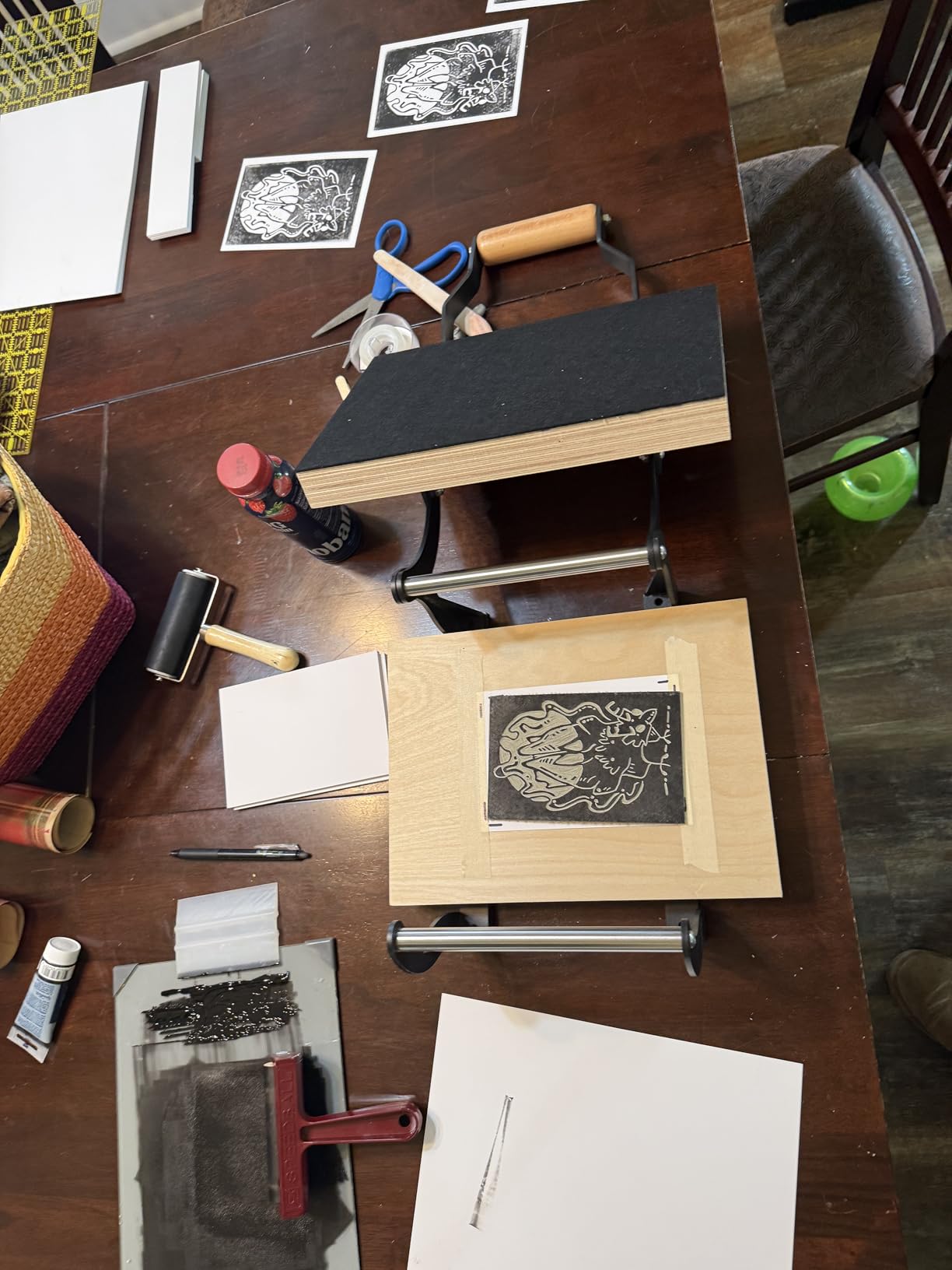
What comes in the box is a working starter setup: press, rubber roller, felt pad, rubber pad and the wrenches needed for adjustment. That matters more than it sounds, because the rubber and felt layers are what separate your block face from the plywood pressure plate and prevent crushed edges.
This is also the most polarizing press in the roundup, sitting at 4.0 stars from 24 reviews. The negative feedback concentrates on the plywood plate wearing down over time and on the fiddliness of the three-level adjustment, which is the part owners service most often.
Marketing outruns reality a little here. The listing names a long list of materials, and the press is competent across lino and woodcut rather than equally good at all of them.
Who the TOPOWN suits well
Printmakers cutting thick, multilayer blocks, and anyone who has already broken a thin plate by printing a deep block on a press with no thickness headroom. The A4 working area and 13-pound weight also make it a reasonable studio machine rather than a desk toy.
It suits younger printers too, since the leverage means less hand strain on long sessions.
Who should skip the TOPOWN
Anyone who wants a set-and-forget machine. The three-level adjustment is the part reviewers most often have to re-service, and the plywood plate is a wear item rather than a permanent surface.
Also skip it if you expect blocks to be included, because they are not, and skip it if you plan to do any work outside lino and woodcut.
4. Maisutseb Manual Slab Roller – The Widest Working Area on the List
Maisutseb Manual Tabletop Slab Roller for Printmaking 19.7 * 12.6in
19.7 x 12.6 in panel
11 x 3.9 in handwheel drum
53.9 lb
Adjustable feet, 4 cm roller range
Pros
- Largest working area of any machine in this roundup
- Handwheel feed gives very smooth controlled drum movement
- Adjustable feet and roller height handle different table heights
- Included 50 x 32 cm felt sheet protects block and paper
Cons
- Weighs 53.9 pounds so it stays put on one bench
- 23 x 23 x 20.5 in packaging eats storage space
- Only 6 reviews so the evidence base is thin
A slab roller is a different mechanism from a lever press. The block passes under a handwheel-driven drum, and pressure comes from the drum rolling across the full width rather than a platen pressing down in one stroke. That is why it covers a 19.7 by 12.6 inch panel.
For wide work, nothing else here comes close. The panel dwarfs every lever press bed, the drum measures 11 by 3.9 inches, and the included felt sheet is 50 by 32 centimeters, which is a full printing sheet of protection.
The handwheel control is the detail reviewers praise most. Because the drum moves continuously rather than slamming down, pressure is extremely even, and the adjustable feet plus roughly 4 cm of roller height adjustment let you compensate for different table heights and material thicknesses.
This machine also has the thinnest evidence base in the roundup at six reviews. That is a genuine caveat, and it tells you the reaction splits cleanly between people who got the space they needed and people who did not want a 54-pound machine.
Who the Maisutseb suits well
Printmakers working on large woodcuts, exhibition panels and gallery prints, and art teachers running a class where every student needs bench space rather than a shared small bed. The body panels on a painted iron frame also resist rust, which matters in a school room.
It suits anyone who would rather feed a block through a drum than pull a lever, because the continuous motion is easier on the wrist.
Who should skip the Maisutseb
Anyone in a small apartment or a shared flat. At 53.9 pounds it is the heaviest machine here and the packaging alone measures 23 by 23 by 20.5 inches, so it needs a dedicated bench and real storage planning.
Skip it if you print small cards and tags, because the wide panel is wasted capacity on 4 by 6 inch work.
5. Lounsweer Block Printing Press – The Lightest Machine Here
Lounsweer Block Printing Press Linocut Hand Letterpress Machine, Adjustable
Prints up to 6 x 8 in
Adjustable height pull handle
5.17 lb
Steel construction
Pros
- Lightest machine in this roundup at about 5 pounds
- so it moves between rooms or classes easily
- Steel construction keeps pressure even for sharp impressions
- Handles both hard and soft substrates without complaint
Cons
- Smallest print area here at 6 x 8 inches
- Listing suggests laying a rubber or carpet mat under the work area
- Only 3 reviews so long-term durability is unverified
At 5.17 pounds, this is the only machine on the list you can pick up with one hand and carry to a class. The construction is steel, the handle is a simple pull rather than a long lever throw, and the height adjustment lets you work with blocks of different depths.
That 4.6 star average comes from three reviews, so treat it as an initial impression rather than a track record. The one detailed review reports the press working as expected on pressed rubber material, which suggests it handles non-paper work well.
The print area is 6 by 8 inches. That is a real constraint for anyone used to A5 or A4, but it is a sensible size for tags, postcards and small editions, and it matches the small papers most craft printers actually buy.
One practical warning from the listing itself: it advises protecting your work surface with a rubber or carpet mat underneath, which is a sensible habit for any press but an extra step here since the frame is narrow and the pressure is concentrated.
Who the Lounsweer suits well
Traveling printers, teachers running workshops in several rooms, and anyone working in a small space where a permanent bench is unrealistic. It is also a sensible first machine for a child or teenager learning block printing, because the pull handle is simple and the weight is manageable.
It suits rubber and mixed-material printmaking as well as paper, given the report on pressed rubber material.
Who should skip the Lounsweer
Anyone printing anything larger than 6 by 8 inches, and anyone planning editions where paper size consistency across a run matters. There is no way to grow into a bigger bed with this frame.
Skip it if you want long-term durability verified by a large body of owners, because three reviews cannot tell you how the steel frame ages.
6. GdaJzh A4 Beech Wood Linocut Press – The Highest Rated Build
A4 Linocut Press Machine Premium Beech Wood, Linocut Manual Printmaking Machine,for Beginners & Artists, for Beginners & Artists, Adjustable Print Thickness, Max 25 mm Thick Blocks
A4 paper, blocks to 25 mm
Solid beech plate, 304 steel frame
Wear-resistant shaft sleeve
13 lb
Pros
- Thick 304 stainless steel frame that does not flex under pressure
- Smooth consistent lever action with an upgraded shaft sleeve
- Beech plate and handle are burr-free and odor-free
- Felt pad protects blocks and evens ink transfer
Cons
- Only 3 reviews and all are 5 stars leaving no critical feedback
- One buyer received a unit with a damaged section of wood
This press earns its spot on materials. The pressure plate and handle are natural solid beech, burr-free and odor-free, and the frame is thickened 304 stainless steel with a rust-proof coating rather than the lighter steel used on cheaper presses.
The practical upgrade is the wear-resistant shaft sleeve, which reduces friction on the lever pull. That is the part that stops a lever press from feeling gritty after a few months, and owners report smooth, jam-free action.
It also matches the TOPOWN on capacity, taking A4 paper and blocks up to 25 mm thick. At 13 pounds and 13.5 by 13 by 7.87 inches, it is a compact studio or classroom machine rather than a desk toy.
One thing to weigh against that is the paperwork. This listing states no warranty period at all, so the smoothest mechanism on the list is also the one with the least after-sales commitment written down. Ask the seller directly before you order.
Now the caveat on reviews, and it is a real one. The rating is 5.0 across three reviews, all of them positive, which tells you almost nothing about long-term durability. One buyer did report a quality-control defect, a slightly damaged section of wood on one side that did not affect pressing output.
Reviewers coming from glass burnishing describe it as far more consistent and less tiring on the hands, which is the fairest comparison to a baren-based workflow.
Who the GdaJzh suits well
Printmakers who care about hardware longevity, want the smoothest lever action in this group, and are buying for a studio, classroom or craft workshop rather than a temporary setup. The solid frame and smooth pull also hold up best in a shared room, where a gritty mechanism gets noticed fast.
It suits anyone moving up from hand burnishing, because the consistency difference is immediate.
Who should skip the GdaJzh
Anyone who needs a track record of long-term ownership. Three five-star reviews are not a durability test, and there is no critical feedback to calibrate against.
Skip it if you are counting every dollar, since the same capacity is available elsewhere for less, and skip it if written after-sales coverage matters to you.
7. Speedball Woodzilla A5 Press – Folds Flat and Mounts to a Bench
Woodzilla Press for Lino Printing (5.875 inches x 8.25 inches | A5), Mint
A5 bed at 5.875 x 8.25 in
Made in the Netherlands
6.4 lb, folds flat
Anti-skid bench shoes
Pros
- Uniform pressure at low effort for a foldable press
- Folds flat and stores compactly between uses
- Anti-skid shoes protect the workbench surface
- Backed by an established printing brand
Cons
- Height adjustment screws and washers are fiddly to align and may strip
- One buyer received a unit that arrived loose and misaligned
- Prints still need a follow-up burnish to finish
The Woodzilla is made in the Netherlands by Speedball Art Products, and it is built as a heavy duty steel press designed for uniform pressure at low effort. At 6.4 pounds it is the second lightest press here, and the foldable design is genuinely practical for a small room.
It mounts to a table or workbench and uses anti-skid shoes to protect the printing surface. Recipients of this press as a gift consistently report a clear upgrade over hand burnishing.
Size is the headline decision. The A5 bed measures 5.875 by 8.25 inches, which is small for a full sheet but well matched to tags, postcards and small editions.
The critical feedback is worth reading closely, because it is specific. At 4.2 stars from three reviews, the detailed critique points to the height-adjustment hardware being fiddly to align and the screws as a suspected weak point over time. The same buyer reported the unit arriving loose and not well aligned, which reads as an assembly or shipping tolerance issue rather than a design flaw.
The other limitation is process. The press makes a good impression, but it does not finish a print in one pull, and a follow-up burnish with a spoon is still part of the workflow.
Who the Woodzilla suits well
Printmakers working at A5 size or smaller who want a press that folds away and mounts to an existing bench. The anti-skid shoes matter if you care about your work surface, and the brand name carries more weight with printmakers than the generic alternatives.
It suits gift buyers, since it is a common present that lands well in a home studio.
Who should skip the Woodzilla
Anyone printing A4 or larger, and anyone who wants a finished print in a single pull. If burnishing after every impression is going to irritate you, choose a different press.
Also skip it if you are fussy about assembly, since the reported loose arrival and fiddly height screws are the recurring complaints.
8. AsellPress A3 Birch Plywood Press – A Large Bed in a Compact Body
AsellPress Linocut Printing Press Machine – Beech Plywood, Compact & Durable Hand Press for Linoleum Block Printmaking, Artists, Students & Hobbyists (A3, A4, A5 Options) (A3)
A3 bed, A4 and A5 options
Birch plywood body
Manual hand pressure
Lightweight tabletop
Pros
- A3 bed is one of the larger working areas among compact hand presses
- Reviewer describes the build as very sturdy
- Lightweight tabletop format fits a classroom or small studio
Cons
- Only a single review leaving no consensus to rely on
- Wood construction is generally less rigid than steel over time
- No published weight or dimensions
The case for this press is straightforward: an A3 bed in a small tabletop footprint. Most compact hand presses top out at A5 or A4, and buyers who hit that ceiling usually end up buying a second machine later.
The body is premium birch plywood, pressed by hand. A single reviewer describes it as very sturdy and built to last for years, which is encouraging but not evidence. One 5-star review with no written criticism carries essentially no signal about print quality or longevity.
The model is offered in A3, A4 and A5 configurations, so the same product family covers a small card and a full A3 sheet. Pressure is applied by hand, so there is no motor, no electricity and no cycle time to manage.
Judged on its specification sheet rather than its reviews, the A3 bed and plywood body are the appeal. Judged on evidence, this is the listing on this list with the thinnest buyer data after the Gemini tool, and you should price that uncertainty into your decision rather than reading the rating as a verdict.
One structural caution. Plywood bodies are less rigid than steel frames, and a bed this large will flex more at the corners than a steel-framed press of the same area. If you routinely print near the edges of an A3 sheet, verify the impression there before committing to a large run.
Who the AsellPress suits well
Printmakers who have already outgrown A4 and want full A3 coverage without moving up to a drum press. It suits classrooms and small studios, since the lightweight tabletop format does not need a dedicated heavy bench.
It suits anyone who wants a no-electricity, no-motor machine in a space where power is inconvenient.
Who should skip the AsellPress
Anyone who needs a large body of owner feedback, because a single review is not a track record. Also skip it if precise corner impressions on a large bed matter to you, since plywood is less rigid than steel.
Skip it if you want published specifications, because weight and dimensions are not listed for this model.
9. JARYANNIX 15 x 15 Inch Flat Press – Built for a Fixed Bench
JARYANNIX Manual Flat Press Printmaking Machine Portable Hand Lever Press Letterpress Machine 15×15in Monochrome Printing Etching Tool for Printmaking
15 x 15 in flat press bed
4 thickness settings
36.6 lb
Angle iron frame, chrome shafts
Pros
- Triangular upper bracket spreads force evenly across the whole area
- Chrome-plated hard shafts resist rust
- Four thickness settings widen the range of blocks it handles
Cons
- Weighs 36.6 lb despite portable framing in the listing title
- Only 1 review and no written print quality evidence
- Awkward to move between rooms
The engineering here is the most considered on the list. A flat press structure with a triangular upper pressure plate bracket distributes force across the entire 15 by 15 inch area, which is a different approach from a single-point lever pull and is why the spec sheet claims uniform pressure over the whole bed.
Frame construction is a bent angle iron main structure with chrome-plated hard shafts. Those are the components that flex or corrode first on cheaper presses, and they are specified properly here.
Thickness is adjustable across four settings using a second set of locking shaft mounting holes, and the handle is beech wood with a nylon ring compression piece. Maintenance is minimal by design, and the structure is intentionally simple rather than complex.
The caveat is the weight. At 36.6 pounds this is a fixed studio machine, and the listing title calling it portable sits awkwardly against that figure. Plan the bench before you plan the purchase.
The rating is a single 5-star review with no written feedback, so the specification sheet is the only real evidence. Nothing here tells you how it performs over hundreds of impressions.
My read is that this is the most interesting machine to buy if you have the space, and the hardest to justify if you do not. The bracket pressure distribution is a real advantage, and a 15 by 15 inch bed handles detail work comfortably.
Who the JARYANNIX suits well
Printmakers with a dedicated studio bench who work on larger relief blocks and want even force across the whole area. The four thickness settings help when you move between thin woodcuts and thicker assembled blocks.
It suits anyone who prefers a structural, low-maintenance machine with few moving parts over a feature-rich one.
Who should skip the JARYANNIX
Anyone without a fixed heavy bench. At 36.6 pounds, moving it between rooms is a two-person job, and the portable framing in the listing title should not be taken at face value.
Skip it if you want independent buyer feedback, because a single rating tells you nothing about consistency over a long run.
10. LetterPress by Gemini – A Craft Tool, Not a Press
LetterPress by Gemini
Gemini craft tool for cards
Manual operation
Intended for all ages
No published weight or dimensions
Pros
- Two 5-star ratings from a recognised papercraft brand
- Low barrier way to test whether letterpress effects appeal to you
- Compact and simple enough for a first attempt
Cons
- No published specifications
- weight or dimensions for this listing
- It is a small craft tool rather than a printing press
- Only 2 reviews and no written feedback
Stated plainly, this is not a press. It is a Crafter’s Companion letterpress tool sold under the Gemini brand line, aimed at paper crafting and card making and listed for all ages. Including it here is a deliberate choice, because it occupies the same shelf position as real impression machines and buyers compare them constantly.
Crafter’s Companion is an established papercraft brand, and both recorded ratings are 5 stars. That is worth something as a quality signal on a beginner tool.
What you get is a way to add a letterpress-style impression to a card without buying into a die cutting platform or a block press. For testing whether you enjoy the effect at all, it does the job at the lowest commitment level in this roundup.
What you do not get is a printing press. There are no published specifications, no stated weight and no stated dimensions, which makes it impossible to compare it on any technical basis. There is no forme, no chase, no quoins, no rollers and no bed size you can quote.
Treat the 5.0 rating as meaningless evidence. Two reviews with no written feedback tell you nothing about impression quality, so judge it on nothing more than what the listing claims.
Who the Gemini tool suits well
A curious beginner who wants a single finished card this week and has no interest in blocks, plates or ink. It suits a child or a beginner learning whether the tactile effect appeals before spending on anything substantial.
It also suits anyone who already works in Gemini-style card making tools and wants a matching impression effect.
Who should skip the Gemini tool
Anyone who wants to print. There is no forme, no inking system and no plate format to speak of, so anything beyond a simple card impression is out of scope.
Skip it if you need a comparison, because with no published specifications you cannot benchmark it against any press on this list.
How to Choose a Letterpress Machine
Choose by class first, bed size second, and drive type third. Almost every disappointing purchase in this hobby comes from picking the machine before the work.
Manual Lever, Handwheel or Motorized: Which Drive Suits a First Press
A manual lever press is the right first drive for almost everyone, because you feel the impression in your hand and stop before you crush a block. Longtime practitioners on Briar Press make the same point when they caution beginners away from motorized presses: heavy impression force plus pinch points is a poor combination for an operator who has not yet learned to read a press.
A handwheel drum suits wide formats, because continuous motion spreads pressure evenly and is easier on the wrist than a lever throw. The trade is bulk and weight, as the Maisutseb’s 53.9 pounds shows.
A motorized platen gives you speed and repeatability on long runs, and it demands a permanent home, ventilation, an emergency stop and a genuine respect for stored mechanical force. That is a second purchase, not a first one.
New vs Used: A Ten-Point Inspection Checklist Before You Pay
Used platen presses are where most of the money and most of the disappointment lives, because they arrive incomplete. A detailed Briar Press thread about a used press walks through exactly this: rollers, roller bearers, ink fountain, chase, quoins and the safety shield were all missing or unverified.
Before you commit to any used press, check these ten points in person.
Forme rollers present, straight and of correct diameter, with roller bearers included.
Ink fountain complete, with no dried or gummed ink inside.
Chase present, with quoins and all furniture pieces accounted for.
Impression bar and adjustment mechanism move freely through their full range.
Safety guard or shield fitted and functional. A missing guard is a real hazard, not a cosmetic loss.
Platen parallelism checked with a straight edge, not by eye.
Bed and type height correct for the plates and type you intend to run.
Motor condition and voltage verified before you assume it will run on your supply.
Inking system cleaned and free of hardened oil, especially around the carriage.
Bed surface and platen face checked for scoring, rust and dents.
Two further practical points. Arrange hands-on time on a similar press before committing, which is the most common piece of advice long-time members give, and remember that impression strength questions are genuinely hard to answer from photographs.
Paper and Plate Compatibility
Compatibility is decided by three numbers: plate dimensions, plate base height and the machine’s type height. Photopolymer plates used by many craft devices share the same stock as plates used on full platen presses, which is why people buy plates for one machine and end up able to use them on another.
That is also the answer to the question raised on r/cardmaking about whether Boxcar Press photopolymer templates work with a Gemini-style press. Templates are templates; the plate they generate has to match the machine’s base height and fit within the platen area. Same stock does not guarantee compatibility.
On paper, work with cotton or soft-press paper and treat 600gsm as a practical ceiling for light impression work. Heavier card needs more pressure than a hand-lever press will comfortably deliver, which is the point at which a motorized platen or a proofing press becomes the right tool.
Registration on craft devices relies on gaffer tape and card shims rather than real grippers, a workaround long documented on the forums. On a flat bed press, you can do better with a paper stop and a consistent feed position.
What You Still Have to Buy After the Machine Arrives
The press is the smallest part of the budget for a new setup. Most owners also need the following.
Ink. Most owners find the included ink widely criticised and replace it. Practitioners on Ladies of Letterpress consistently move to Caligo Safe Wash relief inks, which clean up with soap and water instead of solvent.
Brayers. A brayer wider than the included one inks a full A4 sheet in fewer passes and distributes ink more evenly.
Paper. Cotton and soft-press paper in the weight you actually print on, not office stock.
Felt and rubber padding. Layers between block and platen that prevent crushed edges and even out pressure.
Chases, quoins and furniture for anything that is not a loose block on a flat bed.
Cleaning solvent and a rag system. Solvent, a metal can, and a safe place to keep oily rags.
A non-slip mat under narrow-framed presses to protect the bench.
Ink testing is the underrated job here. Mixing a custom colour and proving it is faster on a hand press than on a full platen, and it is the fastest way to learn how ink behaves on your paper stock.
Safety: Pinch Points, Stored Force and Oily Rags
Printing presses store mechanical force, and most injuries are pinch and crush injuries at the lever, the roller carriage and the platen. Closed-toe shoes, tied-back hair, and keeping hands clear of the carriage path are baseline practice, not extras.
Oil-based ink and solvent mean fire risk. Keep oily rags in a sealed metal container that closes tightly, never in an open bin, and never in a pocket. Ventilate your workspace, since ink and cleaning solvent fumes accumulate in a closed room faster than you expect.
For older or vintage equipment, have it assessed for lead in type and furniture and for electrical condition before you power it up. A beginner guide from the hobby library makes the same point, and it is worth reading before you run any old machine.
Cost Breakdown and the Real Total Cost of Ownership
The press is where a small fraction of your first-year spending goes. No prices appear here because they move, but the shape of the cost is stable.
Your first-year cost has six components: the machine, photopolymer plates, relief ink, paper, chases and furniture, and consumables like brayers and cleaning solvent. For a hobby printer working a handful of designs, the consumables routinely exceed the machine cost inside a year.
Plates are the hidden line item for anyone printing the same design more than a few times, because a design change means a new plate. Paper is the second, because cotton and soft-press paper cost several times what office stock costs per sheet.
Per-unit cost moves sharply when you change a design. Setup and make-ready time is fixed per design, so the twentieth copy of one design costs almost nothing in materials while the first copy of the next design costs a full setup. That single fact is why short-run commercial stationery work is hard to make margin on letterpress, and why print shops push small clients to digital presses.
The reverse also holds. Once a design is set and the makeready is done, each additional impression is fast and cheap, which is where a press earns its keep on a 500-piece or 5,000-piece run of one design.
Where a workshop session is worth it: many beginner guides advise booking a supervised workshop before buying anything, and the reasoning is sound. One session teaches you packing, impression, inking film and registration faster than a month of reading, and it tells you honestly whether you enjoy the process.
Frequently Asked Questions
How much does a letterpress machine cost?
Prices span an enormous range, from inexpensive craft impression tools in the tens of dollars through tabletop lever presses in the low hundreds, to handwheel slab rollers and shop-scale platen presses running into the thousands. The bigger jump is between classes rather than within them: a craft device and a block press are different products, not the same product at two prices. Expect plates, ink, paper, chases and furniture to add materially to the machine cost in your first year.
What are the different types of letterpress machines?
Four classes. Craft impression devices press an inked plate against paper without ink rollers. Hand lever block presses apply screw or lever pressure to linoleum, woodcut and rubber blocks. Tabletop proof and etching presses use a handwheel drum over a wide bed for large relief and intaglio work. Platen and cylinder presses swing a platen onto a forme locked in a chase with quoins and furniture, which is the true shop press.
Can you do letterpress printing at home?
Yes, on a tabletop hand-lever press or a craft impression device, provided you have a dedicated bench, ventilation for ink and solvent, and cotton or soft-press paper in the weights you plan to print. Book a supervised workshop session first, because packing, impression and registration are not self-explanatory. Never run a motorized platen press in a space without an emergency stop and proper guarding.
Is letterpress printing expensive?
The press itself is the smallest part of the cost. Your first year also covers photopolymer plates, relief ink, cotton or soft-press paper, chases, quoins and furniture, brayers, felt and rubber padding, and cleaning solvent. For a hobby printer running a few designs, consumables routinely exceed the machine cost within a year, and per-unit cost spikes every time you change a design.
What replaced letterpress?
Offset lithography replaced letterpress in commercial printing during the twentieth century, because it printed faster on cheaper paper with no makeready time. Digital presses then replaced offset for short runs from the 1990s onward, and digital printing now dominates. Letterpress persists as a craft, a small-stationery specialty and a way to add a real impression to paper.
Which Letterpress Machine Should You Buy?
Buy the Spellbinders BetterPress if you make cards and invitations and want the most evidence-backed impression on this list. It is our editor’s choice for 2026 because 288 reviews at 4.6 stars is the largest real-world sample here, and nothing else on the list matches its combination of a genuine tactile bite and a 16-ounce footprint.
Buy the Linoartpress A4 if you print blocks, because its steel frame, varnish-coated plywood plates and 4.8-star average are the strongest build in the group. And the TOPOWN if your blocks need more thickness headroom than a standard lever gives you, the Maisutseb if you work wider than A4, and the Lounsweer if you need to carry the machine between rooms.
Whatever you choose, take a workshop session first, keep the ink and paper budget in mind from day one, and check the bed size against the paper you actually plan to print. The best letterpress machine is the one whose class matches your work, not the biggest one you can fit in the room.