
A multimeter tells you one voltage at one instant. An oscilloscope shows you the whole story: amplitude, timing, shape, noise, ringing and duty cycle, all drawn against time. That is the difference between guessing and diagnosing. After spending weeks putting these instruments through beginner workloads, my pick for most people starting out in 2026 is the Siglent SDS1202X-E, because it pairs 200 MHz of bandwidth with 14 Mpts of memory and standard serial decoding in a package that stops feeling like a compromise within a month.
That said, the best oscilloscopes for beginners is not one answer. If you only need to check a 5 V rail or time a PWM signal, a pocket unit in your toolbox will teach you the same core skills for a fraction of the outlay. If you plan to debug three-rail power supplies and I2C buses, four channels matter far more than raw bandwidth. So I split this roundup into ten picks, gave each one an honest limitation, and explained the buying guide below in plain language.
One framing note before we start, because experienced members on electronics forums keep saying it and it is worth repeating: a multimeter genuinely covers a lot of beginner circuits, and many beginners do not need a scope in the first month. A scope earns its place when your problem becomes timing. If that is where you are, read on.
Top 3 Beginner Oscilloscope Picks in 2026
Siglent SDS1202X-E
- 200 MHz bandwidth
- 2 channels
- 1 GSa/s
- 14 Mpts record length
- IIC SPI UART CAN LIN decode

Siglent SDS1104X-E
- 100 MHz bandwidth
- 4 channels
- 1 GSa/s dual ADC
- all serial decoders included
- Ethernet web server
Rigol DS1054Z
- 50 MHz bandwidth
- 4 channels
- 24 Mpts memory
- 30000 wfms/s capture
- I2C SPI UART decode
All 10 Beginner Oscilloscopes at a Glance in 2026
| Product | Specifications | Action |
|---|---|---|
| Siglent SDS1202X-E |
|
Check Latest Price |
| Siglent SDS1104X-E |
|
Check Latest Price |
 FNIRSI 2C53T FNIRSI 2C53T |
|
Check Latest Price |
| Rigol DS1054Z |
|
Check Latest Price |
 HANMATEK HO52 HANMATEK HO52 |
|
Check Latest Price |
 Rigol DS1202Z-E Rigol DS1202Z-E |
|
Check Latest Price |
 FNIRSI DSO152 FNIRSI DSO152 |
|
Check Latest Price |
 FNIRSI DSO-510 FNIRSI DSO-510 |
|
Check Latest Price |
 HANMATEK DOS1102 HANMATEK DOS1102 |
|
Check Latest Price |
 Hantek DSO2D15 Hantek DSO2D15 |
|
Check Latest Price |
1. Siglent SDS1202X-E – the best overall beginner bench scope
Siglent Technologies SDS1202X-E 200 mhz Digital Oscilloscope 2 Channels, Grey
200 MHz bandwidth
2 channels
1 GSa/s sampling
14 Mpts record length
Pros
- 200 MHz bandwidth at a beginner price point
- 14 Mpts record length holds long captures
- Serial bus trigger and decode for IIC SPI UART RS232 CAN LIN included as standard
- Large bright display with adjustable grid and trace intensity
Cons
- Only 2 channels limits multi-rail debugging
- Buttons and menus need learning time for a first-time scope user
- No internal battery so it is AC powered only
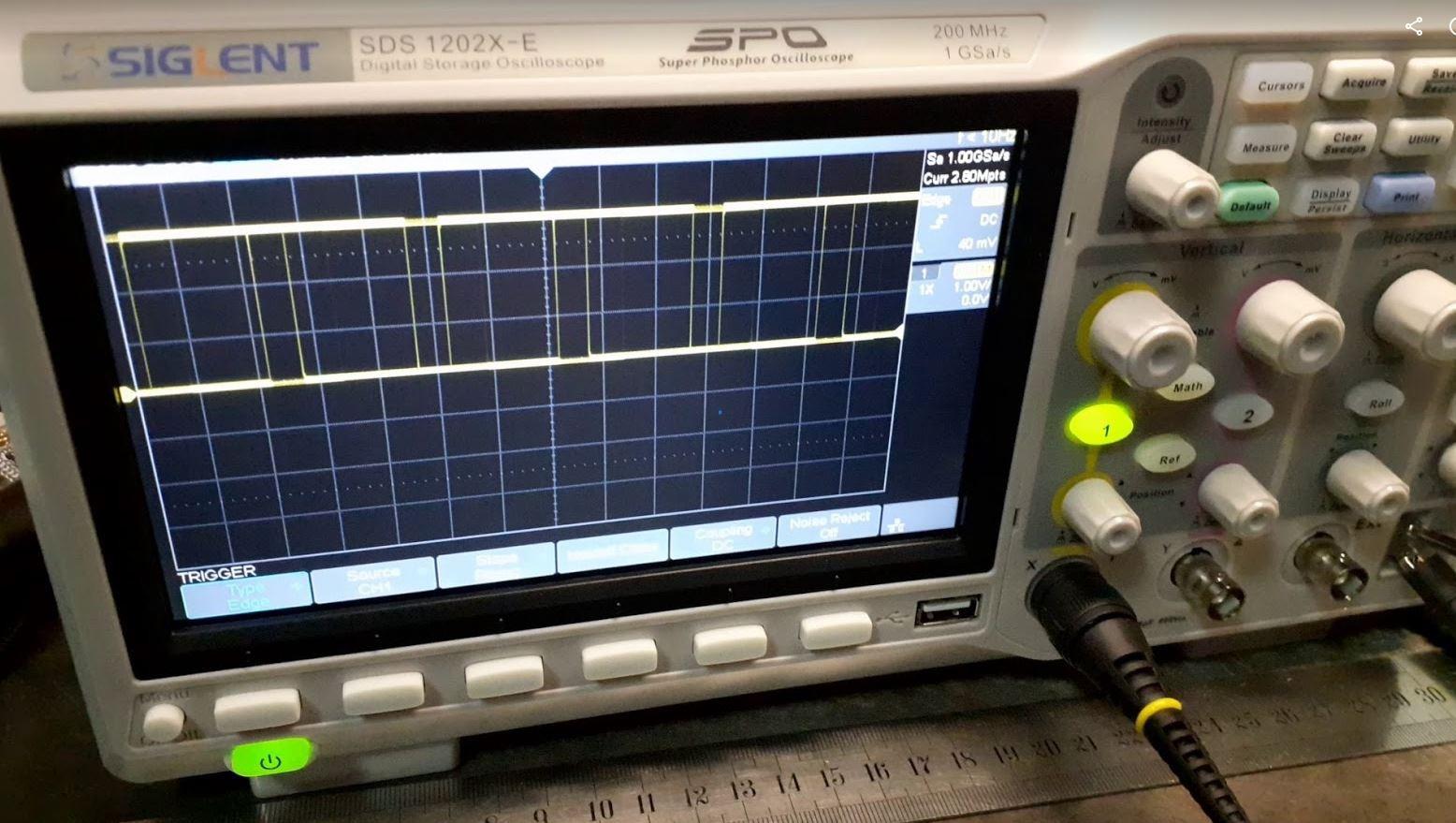
This is the scope I keep recommending to people who ask me for one number. It arrived fully assembled, I ran it through the default probe compensation step before anything else, and the first capture of a 1 kHz square wave from a microcontroller looked about as close to the textbook picture as I have seen from a first-time instrument. The display is large enough to read cursor measurements without squinting, and the vertical scale range covers everything from millivolt-level audio work up to logic rails.
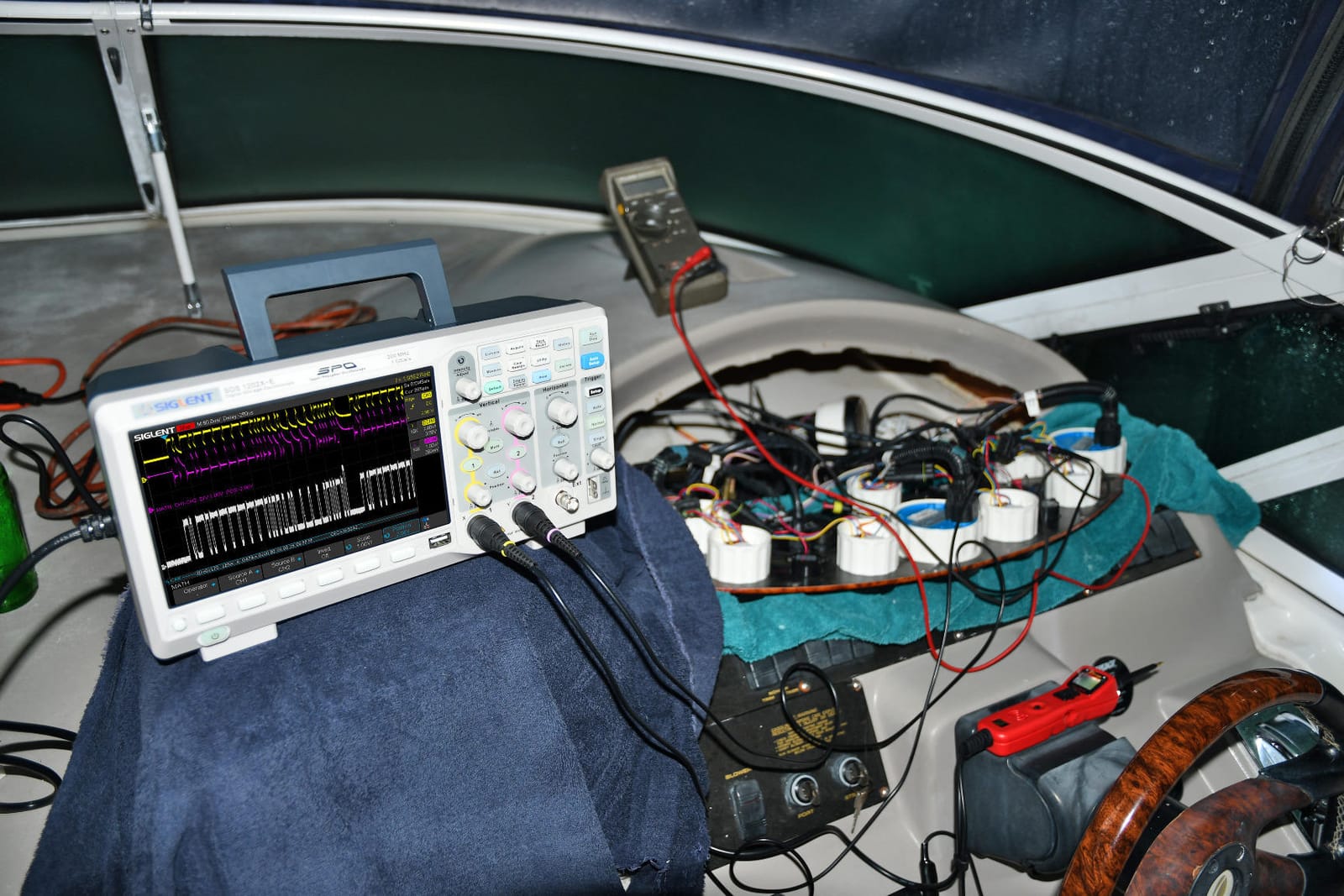
What separates it from cheaper entry units is memory depth. At 14 Mpts you can zoom into a burst of switching activity and still have enough sample density left to see ringing on an edge. Shallow records force you to accept a smeared trace, and beginners read that smearing as a fault in the circuit rather than a limit in the instrument. Reviewers report 83% five-star ratings across more than 1400 reviews, and the recurring theme is that the feature set simply outruns the price tier.
The serial decoding is the quiet winner. I2C, SPI, UART, RS232, CAN and LIN trigger and decode are standard, not a paid option, so a beginner chasing an address mismatch or a baud rate error can read the bus as text instead of decoding it by eye. Owners also point to the adjustable grid and trace intensity, which sounds minor until you are trying to align two clocks by eye.
When this scope suits your work
It suits you if you are working with Arduino, ESP32 or Raspberry Pi boards, single-rail or dual-rail power supplies, audio circuits in the tens of kilohertz range, and anything with a serial bus. Two channels is genuinely enough for almost all of that, and 200 MHz of headroom means a scope you buy now will not feel marginal when you start chasing switching regulator edges.
When you should look elsewhere
If your projects involve three or four rails you need to see at once, two channels will make you swap probes and mentally reconstruct the timing, which defeats the purpose. The menu system also takes real adjustment time; first-week frustration is common. For multi-rail debugging, the four-channel picks further down this list will serve you better.
2. Siglent SDS1104X-E – four channels with every serial decoder included
Siglent Technologies SDS1104X-E 100Mhz Digital Oscilloscope 4 Channels Standard Decoder, Grey
100 MHz bandwidth
4 analog channels
1 GSa/s dual ADC
Standard serial decoder
Pros
- Highest average rating among the bench scopes here
- Four channels plus 100 MHz bandwidth in one unit
- Ethernet web server for remote viewing and control
- CAN LIN I2C SPI UART decoding included at no extra cost
- Modern responsive interface compared with older rivals
Cons
- Optional MSO and AWG upgrade modules cost nearly as much as the scope
- Push-to-select adjust knob can overshoot into the next menu item
- WiFi needs an added USB dongle and a license
- Some firmware settings do not persist between sessions
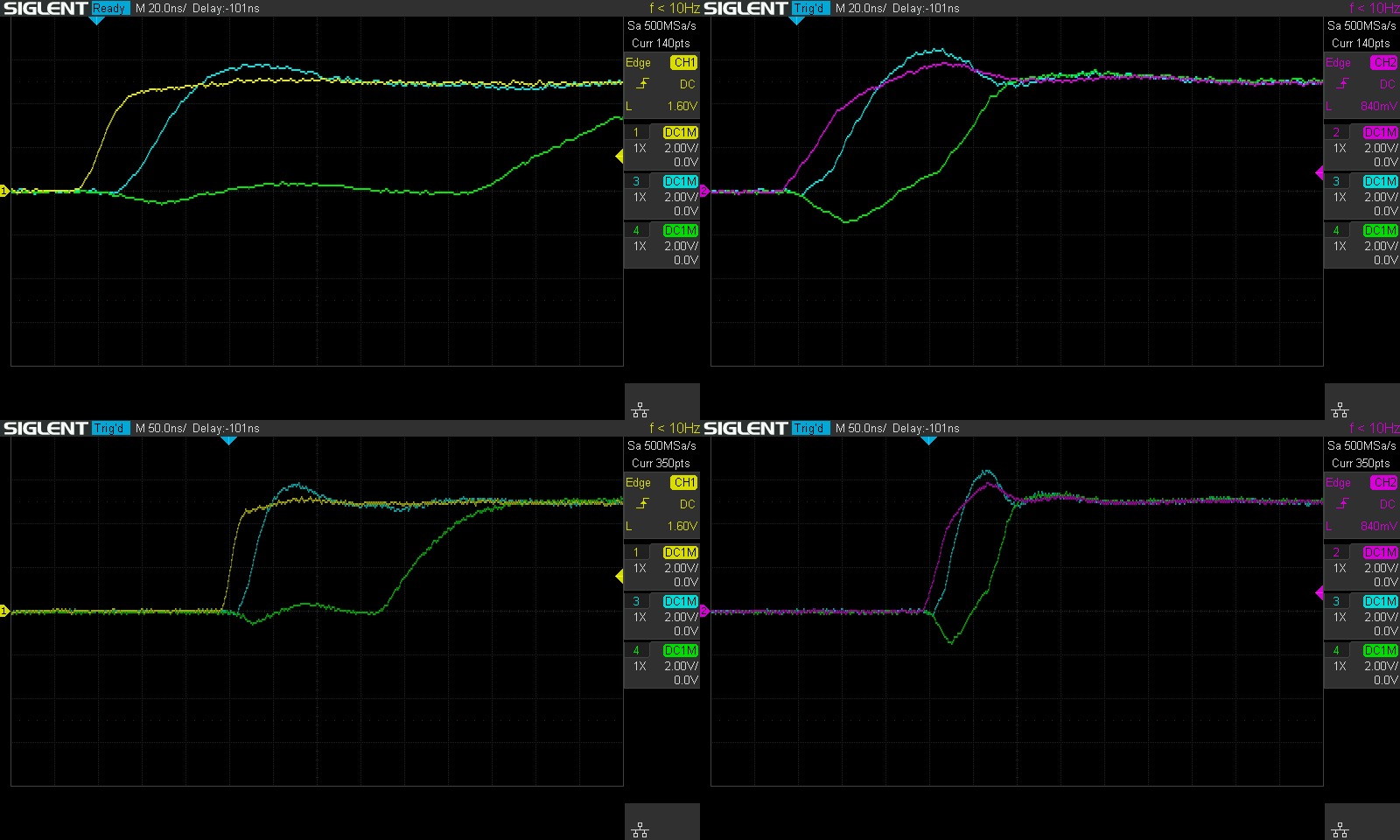
Community consensus on electronics forums keeps converging on four channels for future proofing, and this is the four-channel model I would put in front of a beginner. The dual ADC architecture is the detail that matters here: you get 1 GSa/s on two channels, and 500 MSa/s once all four are active. Knowing that trade-off before you buy saves you from wondering why the sample rate changed.
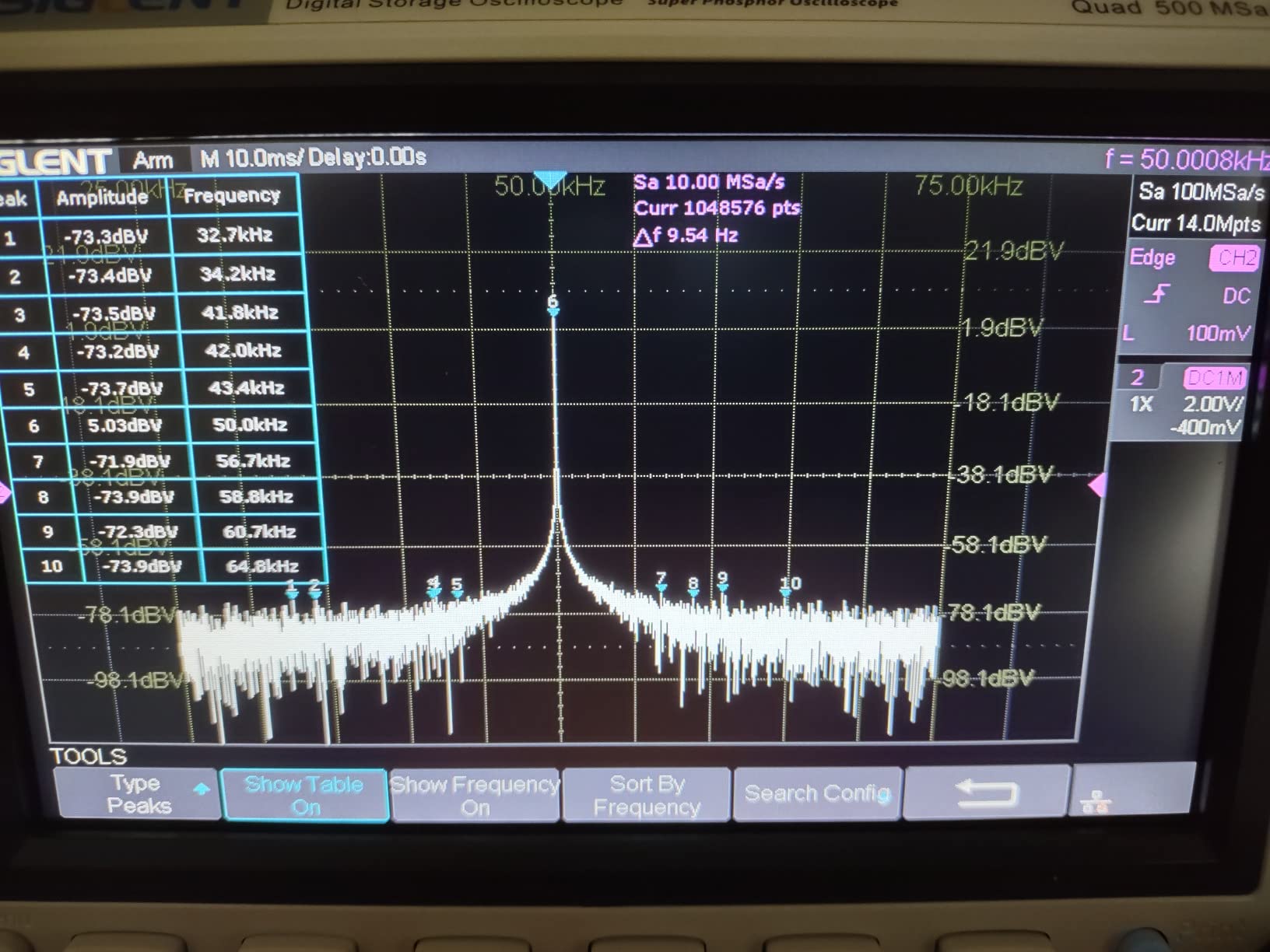
The built-in Ethernet web server is the feature reviewers mention most, and it is more useful than it sounds. I connected a browser to the scope while it sat on a shelf and viewed the live screen, which turns a four-channel bench instrument into something you can park near a chassis and still see. Pair that with the standard CAN, LIN, I2C, SPI and UART decoding and you have bus visibility on a machine with no free screen space.
Reviewers rate this as one of the best value four-channel 100 MHz scopes available and frequently compare it favourably to the Rigol DS1054Z. At 4.8 average with 88% five-star ratings, it holds the highest rating of any bench scope in this roundup, and that is over roughly 966 reviews, so it is not a small-sample effect.
When this scope suits your work
Pick it if you are debugging multi-rail power, timing three or four signals against each other, working on automotive electronics where CAN or LIN traffic matters, or studying electronics formally where four channels is the lab standard. The box includes a quick start guide, a calibration certificate, four passive probes and a USB cable, so nothing needs buying on day one.
When you should look elsewhere
The optional mixed-signal and waveform generator modules are expensive, close to the price of the scope itself, so do not buy this expecting a logic analyser or a signal generator in the box. The push-to-select knob overshoots into adjacent menu items, which is annoying rather than fatal, and the WiFi path needs a separate dongle and licence. Buyers who need waveform output should look at the Hantek further down.
3. FNIRSI 2C53T – three instruments in a pocketable box
FNIRSI 2C53T 3-in-1 50MHz 2CH Oscilloscope Multimeter DDS Signal Generator
50 MHz 2 channels
250 MSa/s sampling
19999-count multimeter
DDS generator to 50 kHz
Pros
- Scope multimeter and DDS signal generator in one 400 g body
- Battery powered with up to 6 h standby and an included storage case
- Waveform save and reference comparison help learning and troubleshooting
- Math cursor persistence and XY modes on the upgraded model
Cons
- 1 Kpts record depth is very shallow next to bench scopes
- 2.8-inch LCD limits on-screen detail
- Ruler markings and controls are fiddly so precision lags far behind a bench instrument
The 2C53T solves a different problem from the bench scopes. It weighs 400 g, runs off a 3000 mAh battery, and does the job of a scope, a 19999-count multimeter and a DDS signal generator up to 50 kHz with 13 waveforms. If you are learning electronics on a kitchen table and want to generate a test signal without a second box, that is a lot of capability for one device.
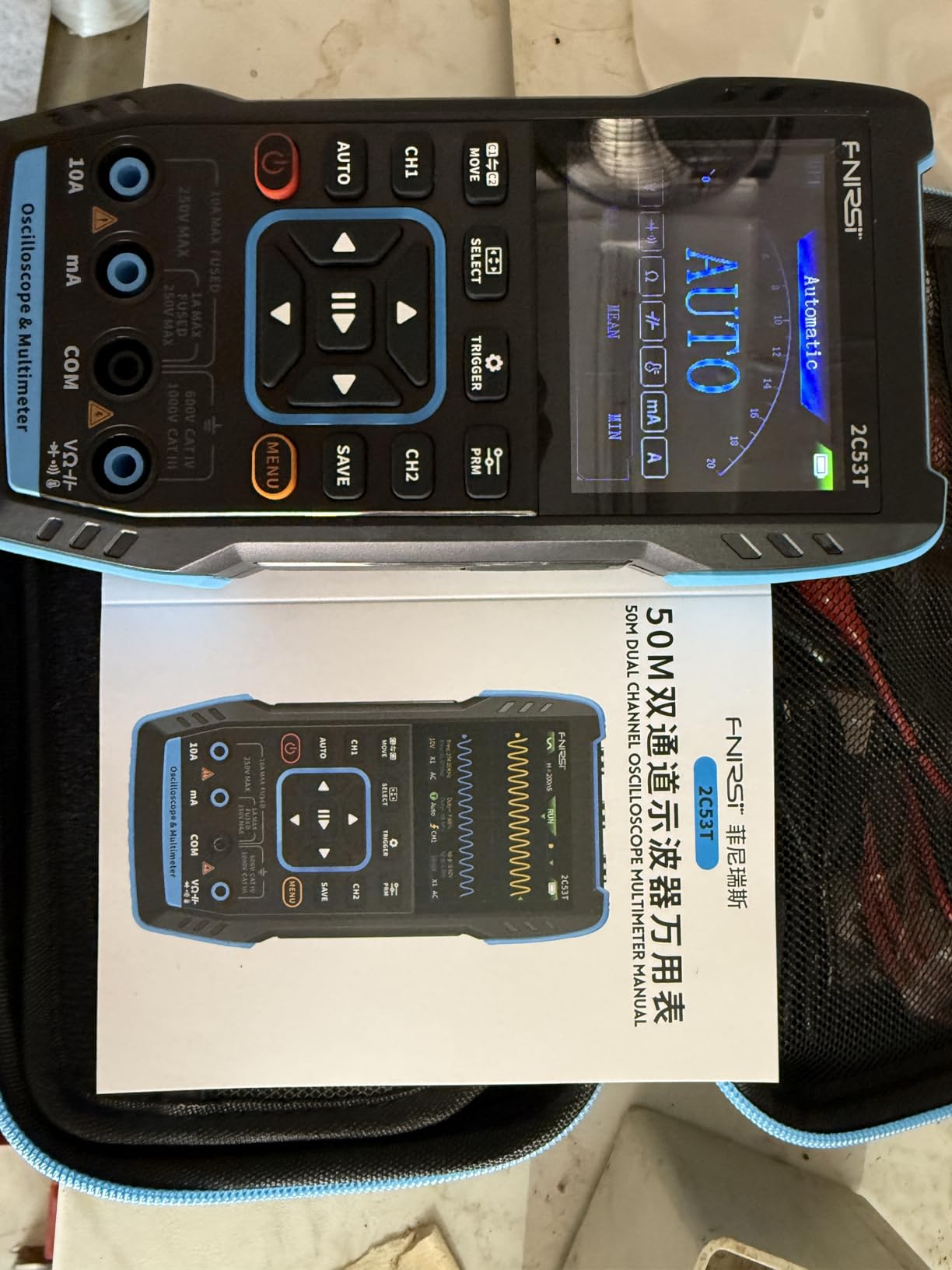
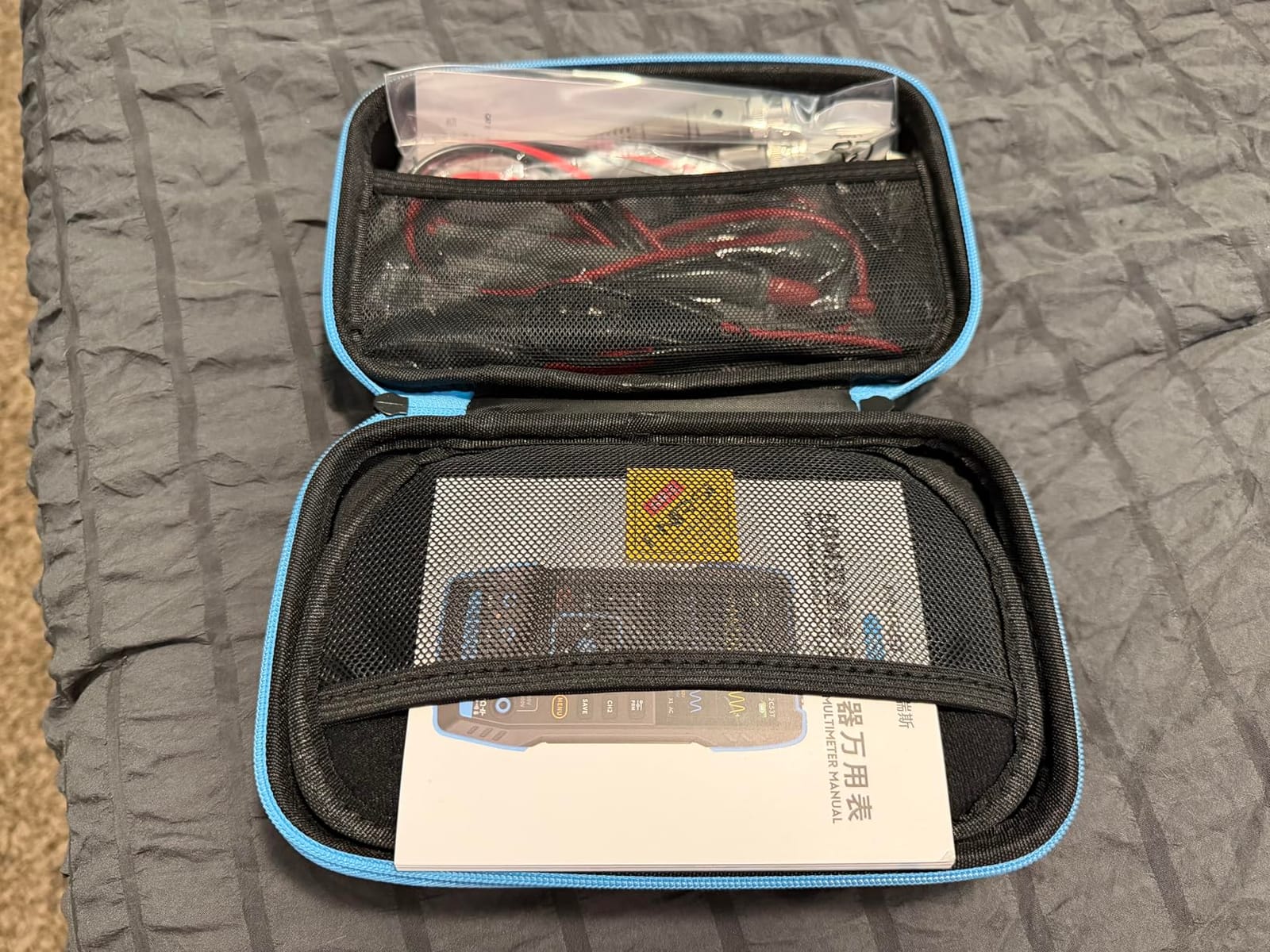
It also sits at the number one spot in the Lab Oscilloscopes category, which tells you how many beginners arrive here first. The included 10x probe, crocodile clip probe, multimeter probe, Type-C cable and storage case mean nothing else is needed to get started, and waveform save with reference overlay lets you compare a good signal against a bad one on the same screen.
The 4.3 average is honest, and reviewers explain the split clearly. People love the multimeter and generator value, but the 1 Kpts record depth and 2.8-inch screen mean measurements are read off a ruler grid rather than cursors, and precision lags a bench scope badly. Think of it as a field tool and a teaching aid rather than an instrument of record.
When this scope suits your work
It suits beginners who want one device to learn on, anyone working away from a bench such as in a car or outdoors, and anyone who needs a multimeter as much as a scope. The Type-C port handles charging and PC image upload, and with 400 V maximum input on the vertical channels it will survive contact with higher-voltage circuits when used carefully.
When you should look elsewhere
Do not buy it as your only instrument for fine work. At 1 Kpts of record depth you cannot capture long events, and the small screen makes busy waveforms hard to read even when they are captured correctly. If your goal is measuring ripple on a switching supply or timing a fast edge, a bench scope with megapoints of memory is a much better tool.
4. Rigol DS1054Z – the scope with the deepest community support
Rigol DS1054Z Digital Oscilloscope, 50MHz, 4 Channel, 1GSa/s, Best Value
50 MHz bandwidth
4 analog channels
1 GSa/s
24 Mpts memory
Pros
- Four channels and 24 Mpts of memory in one instrument
- UltraVision capture rate up to 30000 wfms/s with intensity-graded display
- Serial bus trigger and decode for RS232/UART I2C and SPI enabled in base firmware
- Built-in help function guides beginners through every function
Cons
- Intensity/select rotary knob is error-prone and jumps to the wrong menu
- Cooling fan is noticeably noisy
- Channel 2 and channel 4 trace colours are too similar to tell apart
- Some users report small DC offset errors and occasional USB hangs
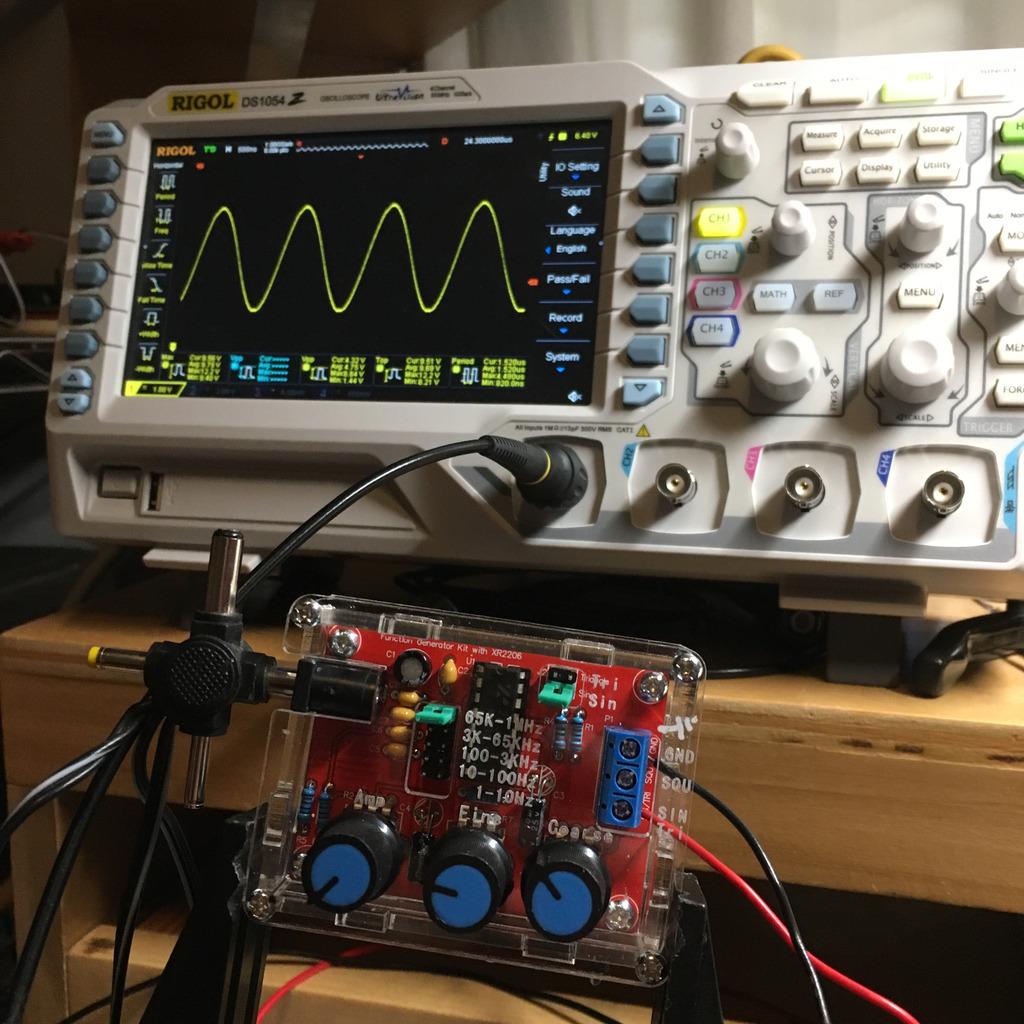
There is a reason this model comes up so often in beginner threads, and it is not only the spec sheet. Members on r/AskElectronics and EEVblog single it out because any problem you hit is already answered somewhere, which for a first instrument is worth more than another 50 MHz. The built-in help function is the same idea in software form, walking you through functions instead of leaving you to guess.
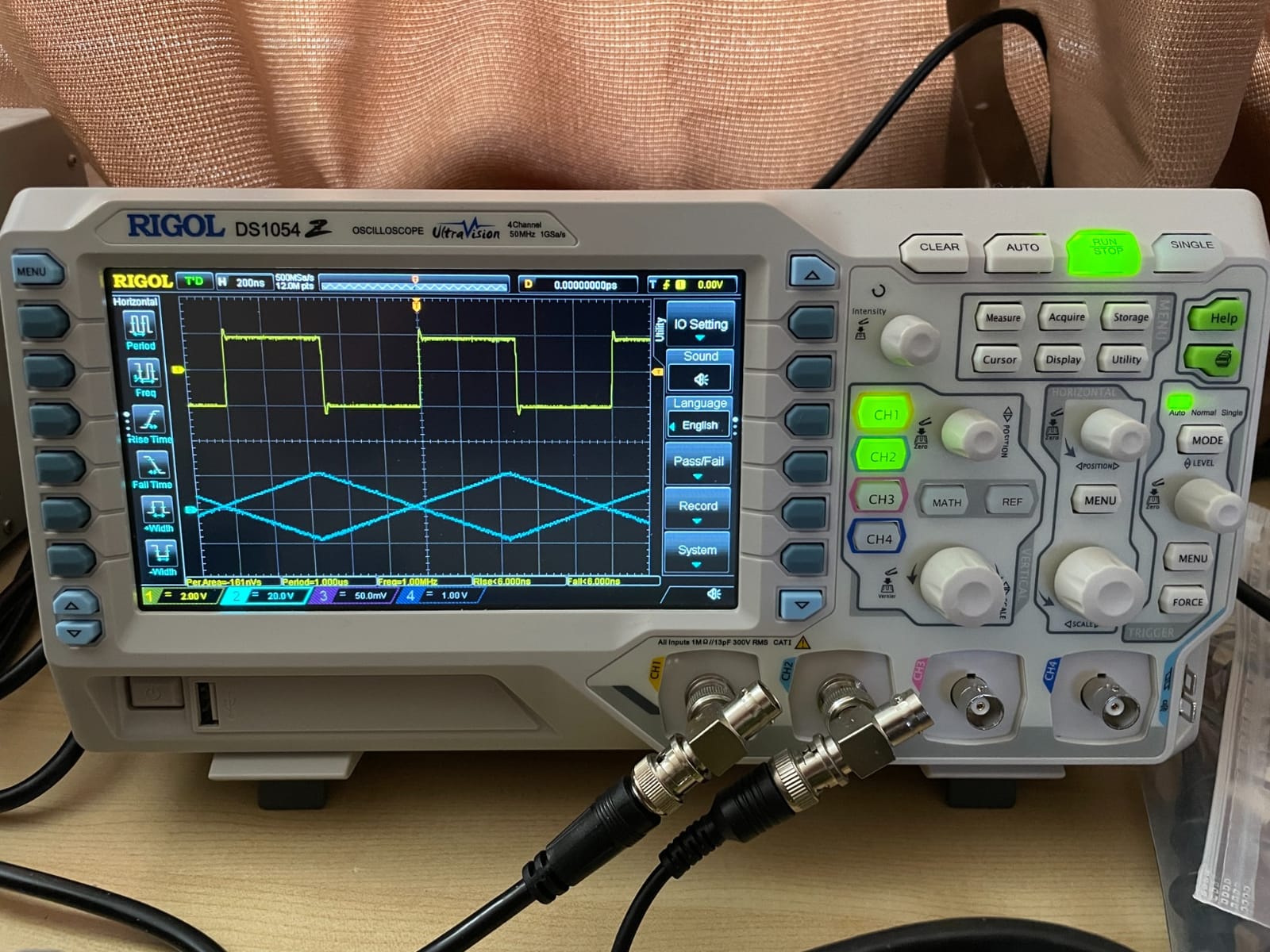
On paper it is over-specified for a beginner: four analog channels, up to 1 GSa/s single-channel, 24 Mpts of memory, waveform record and playback up to 60,000 frames, and USB Host, USB Device, LAN and AUX output. The intensity-graded UltraVision display up to 30,000 wfms/s makes intermittent glitches visible as brightness rather than as a single unlucky capture, which is a genuinely useful habit to learn early.
Reviewers describe it as professional-class capability at a hobbyist price, with 83% five-star ratings across more than 725 reviews. The complaints are consistent and worth weighing: a clicky intensity knob that jumps menus, audible fan noise, near-identical trace colours on channels 2 and 4, and occasional small DC offset errors or USB hangs. None of those stop a beginner learning; all of them are learnable quirks within an hour.
When this scope suits your work
Pick it if you want four channels, deep memory and the widest pool of free tutorials and forum knowledge available. It handles Arduino and ESP32 debugging, power supply ripple work, and multi-signal timing analysis well, and the 50 MHz figure is honest for microcontroller signals where edge rates are slow. Reviewers also treat the documented 50 MHz to 100 MHz bandwidth expansion through the calibration menu as a well-established reason to prefer it.
When you should look elsewhere
If you work above 50 MHz regularly, you will be filtering the edges you actually want to see, and the software unlock is not a substitute for a real 200 MHz front end. The fan noise matters in a quiet room, and the similar channel 2 and channel 4 colours will slow you down on a four-channel capture. Buy the four-channel Siglent instead if a cleaner interface matters more to you.
5. HANMATEK HO52 – a bench-capable handheld for field work
HANMATEK Handheld Digital Oscilloscope 50Mhz Bandwidth with 2 Channels HO52 3.5″ TFT Mini Oscilloscope, 2 in 1 Oscilloscope and Multimeter, Backlit Screen, Auto-Calibration Function, Memory Function
50 MHz 2 channels
250 MSa/s
8k record length
True-RMS multimeter
Pros
- Scope and true-RMS multimeter in a 16 ounce body
- One-key auto set makes first-time users productive quickly
- Saves 4 settings 4 reference waveforms 4 images and CSV data to a PC
- Reference waveform overlay for before/after comparison
Cons
- 3.5-inch screen limits detailed waveform reading
- 8k-point record depth is minimal beyond simple signals
- Less accurate and less responsive than a bench scope on complex waveforms
The pattern of carrying a bench scope and a small handheld together shows up repeatedly among experienced users, and the HO52 is a good example of why. It is 16 ounces, battery powered, and combines a 2-channel 50 MHz scope with a 4.5-digit true-RMS multimeter that measures up to 750 V AC and 1000 V DC on the input range, which covers automotive work where a bench scope would be dead weight.
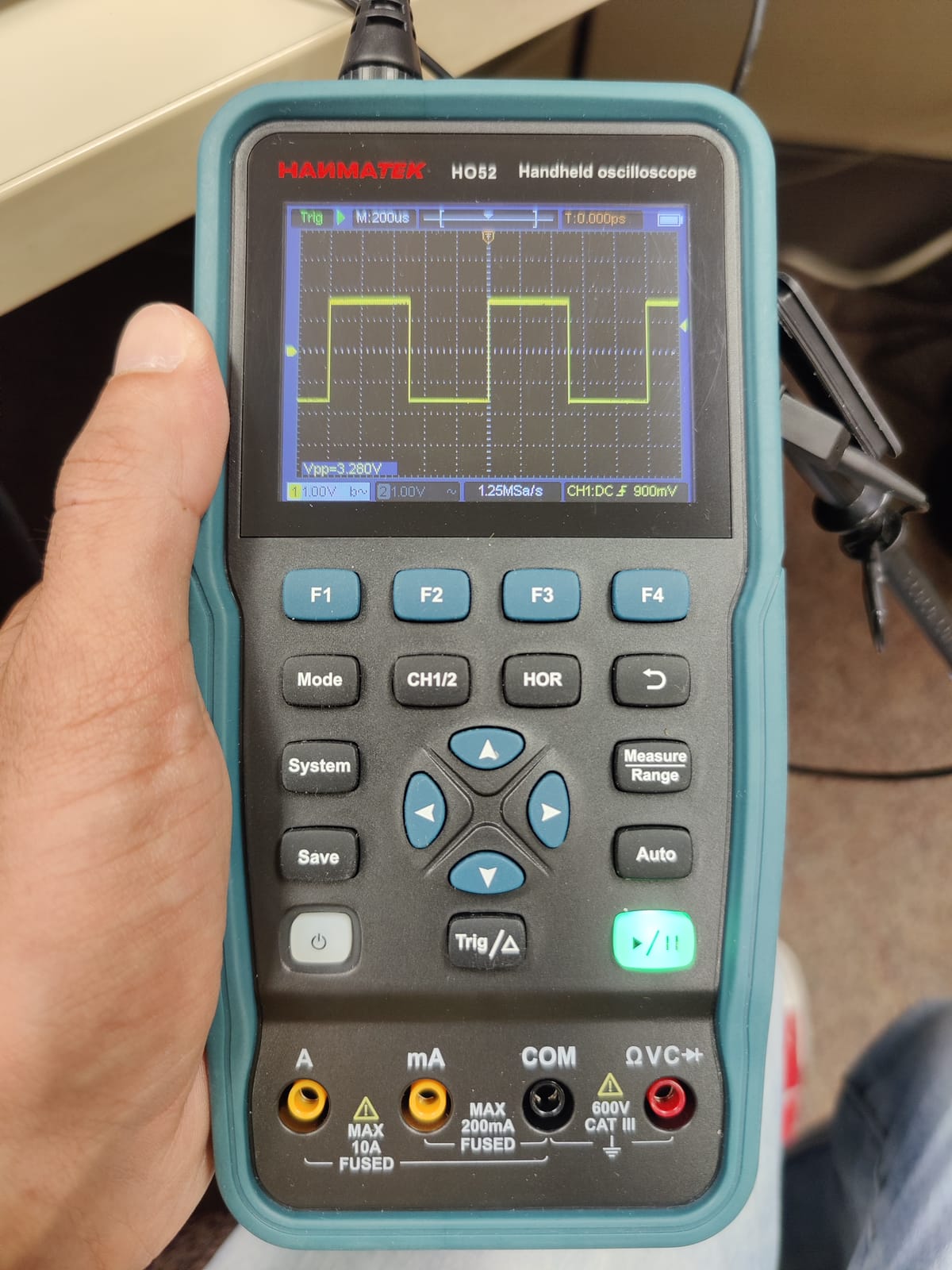
One-key auto set is the feature that matters most for a first-timer. You clip the probe, press one button, and the instrument picks a timebase and vertical scale for a periodic signal. Reviewers highlight the reference waveform overlay and CSV export over Type-C, so you can capture a signal in the field, load it later, and compare it against a good capture from the bench.
With 78% five-star ratings the sentiment is broadly positive, and the audience is students, technicians and automotive repair. The 8k record length and 3.5-inch display keep it aimed at troubleshooting rather than precision, and reviewers are upfront that complex waveforms come out less accurate and less responsive than on a bench unit.
When this scope suits your work
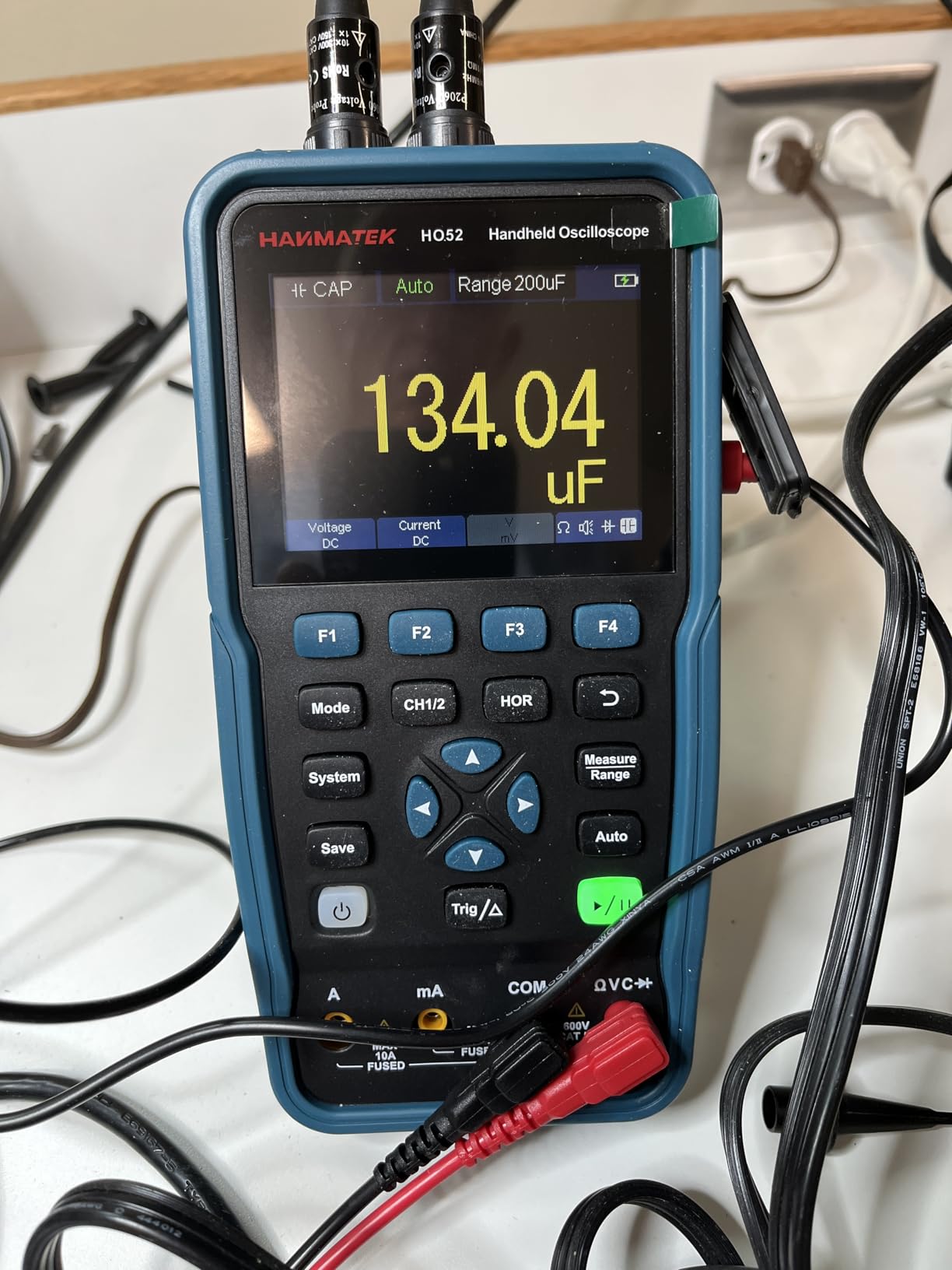
It suits anyone who needs measurements away from a desk: car electrical work, field troubleshooting, a lab bench shared with other students, or a first scope for a classroom where portability and durability beat screen size. The capacitance, diode and continuity functions mean you can leave the multimeter at home on many jobs.
When you should look elsewhere
At 8k points of record length you cannot hold a long transient, and the 3.5-inch screen becomes frustrating the moment a waveform gets complex. If you intend to sit and study signal shapes rather than confirm a fault quickly, spend your budget on screen size and memory depth instead.
6. Rigol DS1202Z-E – 200 MHz backed by a three-year warranty
RIGOL DS1202Z-E Digital Oscilloscope, 200MHz, 2 Channel, 1GSa/s Sampling
200 MHz bandwidth
2 channels plus external trigger
1 GSa/s
24 Mpts memory
Pros
- 200 MHz bandwidth in a two-channel body well beyond most entry scopes
- Large 7-inch WVGA TFT with intensity-graded colour display
- 60000-frame hardware record and playback
- Quiet cooling fan and solid build
- Three-year warranty on the main unit
Cons
- Multifunction knob overshoots into adjacent selections
- Front-panel soft-key legends permanently occupy both sides of the trace
- Only 2 channels so multi-rail debugging means swapping probes
- USB 2.0 export makes large memory transfers slow
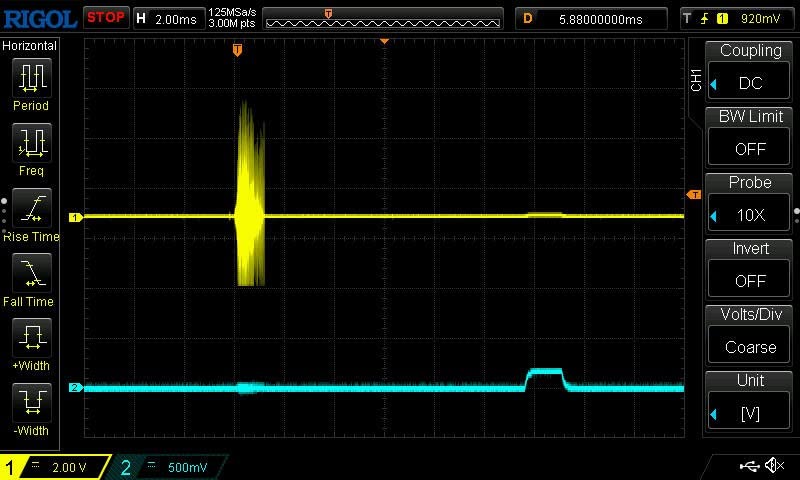
This is the scope to buy if you want the headroom of a 200 MHz front end without moving up to a four-channel body. Two analog channels plus an external trigger input, up to 1 GSa/s real-time sampling, and 24 Mpts of memory, all behind a 7-inch 800×480 TFT that is genuinely pleasant to read. The intensity-graded colour display makes repeated events build up visually, so a rare glitch shows up as a bright band.
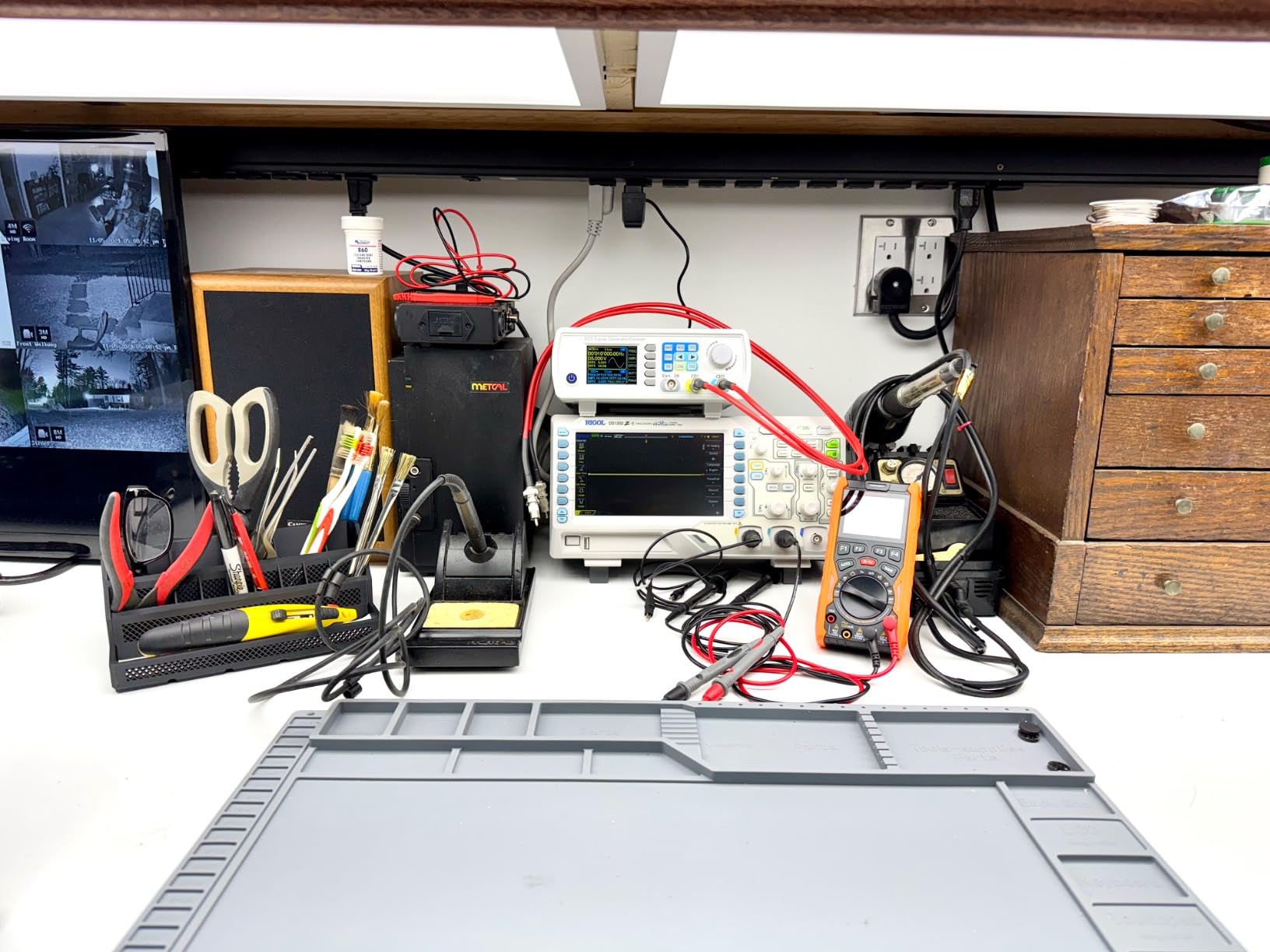
Serial bus trigger and decode for RS232/UART, I2C and SPI is included, and the hardware waveform record and playback holds up to 60,000 frames, so you can capture a fault, walk through it frame by frame, and find the one that matters. The box includes the main unit, a probe, a power cable and a USB cable, and the three-year main-unit warranty is longer than most rivals in this class.
Reviewers with 85% five-star ratings consistently frame it as the best value 200 MHz two-channel scope available and call the build quality professional grade. The complaints are specific: the multifunction knob is over-sensitive, the fixed soft-key legends permanently narrow the trace area, and exporting a full 24 Mpoint capture over USB 2.0 is slow. None of those affect measurement quality.
When this scope suits your work
It suits you if you are moving past slow microcontroller signals into faster edges, working on switch-mode power supplies, or testing circuits where rise times matter. The bandwidth means you can see the actual shape of an edge rather than a rounded approximation, and the large display makes that shape easy to judge. The quiet fan also matters if you work at night.
When you should look elsewhere
Two channels is the binding constraint. If you need to watch a converter input, output and enable line together, you will be swapping probes and holding the picture in your head. The permanently displayed soft-key legends steal trace area you will want for a dense waveform, and large captures take a while to move off the instrument.
7. FNIRSI DSO152 – the cheapest real introduction to a scope
FNIRSI DSO152 Handheld Oscilloscope 200kHz Bandwidth, 2.5MS/s Sampling Rate
200 kHz bandwidth
2.5 MSa/s sampling
10x probe to 800 Vpp
1000 mAh battery
Pros
- Lowest-cost entry into real oscilloscope measurement with no assembly required
- One-key AUTO and baseline calibration make it approachable
- 10x probe rated to 800 Vpp for automotive and mains-adjacent work
Cons
- 200 kHz bandwidth only handles low-frequency signals like audio ignition and PWM
- 2.8-inch 320x240 screen is small for detailed waveforms
- Measurement accuracy is limited compared with any bench scope
Some beginners just need to learn what a waveform looks like before committing. The DSO152 is the cheapest way to do that, and it arrives ready to use with a 10x probe already included. At 10.2 ounces with roughly 4 hours of continuous use from the 1000 mAh battery, it lives in a pocket, and the 10x probe measures up to 800 Vpp, which makes it useful around automotive circuits.
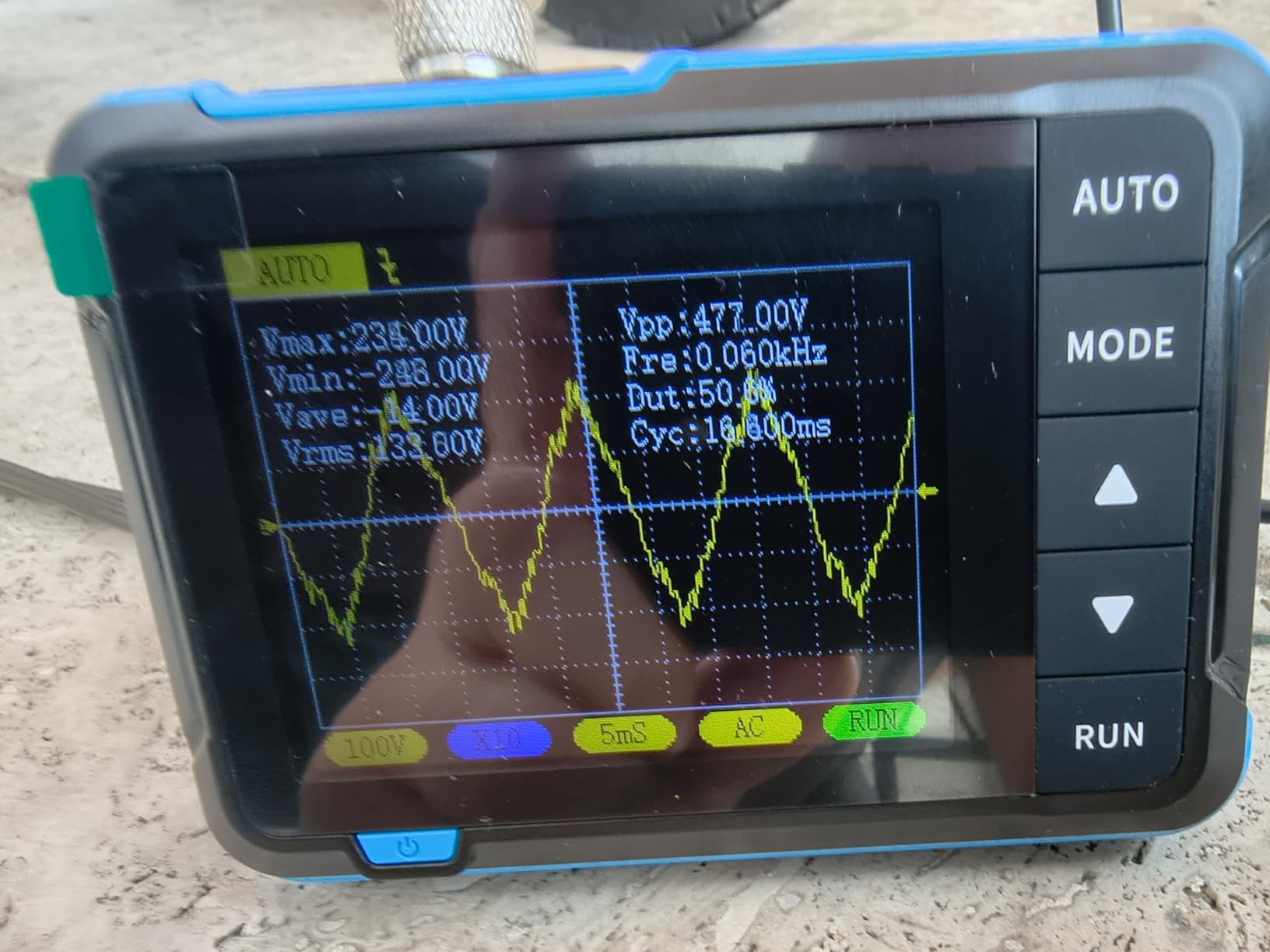
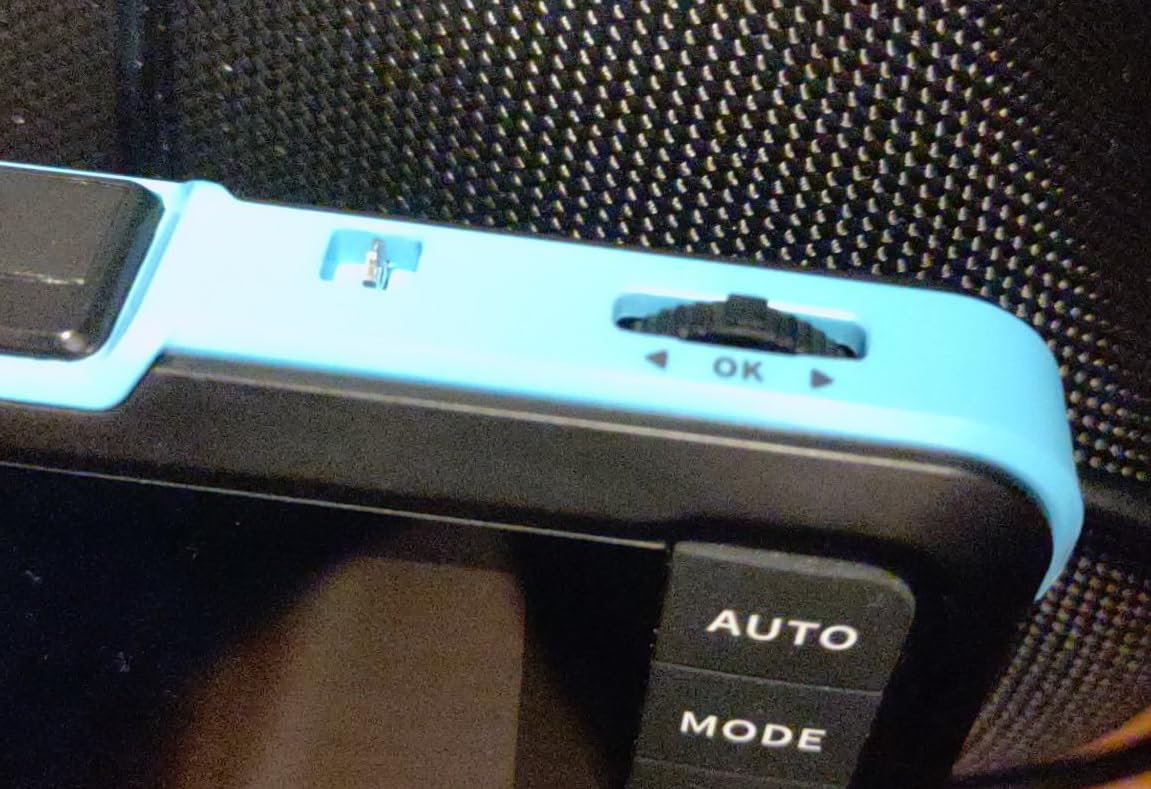
Auto, Normal and Single trigger modes are all present, along with one-key AUTO parameter setting and a long-press baseline calibration. That combination means a beginner can clip the probe, press a button, and get a stable trace on a repeating signal without learning trigger modes first, which is exactly the right order of operations for a first instrument.
The 4.4 average reflects genuine enthusiasm offset by a very clear ceiling. At 200 kHz bandwidth and 2.5 MSa/s sampling, this handles audio, ignition and slow PWM signals and nothing faster. It ranks second in the category, so it is clearly a common first purchase, and reviewers treat it as a low-cost introduction or a dedicated tool for slow signals.
When this scope suits your work
It suits a beginner who wants the feel of a scope before spending real money, and it works as a dedicated tool for audio-frequency work, ignition waveforms and slow PWM signals. Because it is mains-adjacent-capable through the 10x probe rating, some people keep one as a quick confirmation instrument alongside a bench scope.
When you should look elsewhere
Do not expect it to debug a microcontroller project. 200 kHz of bandwidth will not render a fast digital edge, and the 2.8-inch 320×240 display makes anything complicated to read. If you want one instrument for a full year of learning, buy the bandwidth instead; if you just want to try the concept, this does the job.
8. FNIRSI DSO-510 – 10 MHz bandwidth plus a signal generator
FNIRSI DSO-510 2-in-1 10MHz Handheld Oscilloscope DDS Signal Generator
10 MHz bandwidth
48 MSa/s sampling
13 waveforms to 50 kHz
1000 mAh battery
Pros
- 10 MHz bandwidth is a real step up from ultra-low-cost pocket scopes
- Built-in DDS signal generator adds bench utility
- Infinite afterglow reveals transients and signal features
- Bright adjustable screen and battery that lasts through long jobs
Cons
- Only supports a single probe at a time
- Trigger controls take practice to master
- Generator output is less accurate at higher setpoints and reverts toward 1 kHz in scope mode
- Voltage multiplication factor is not user-customisable
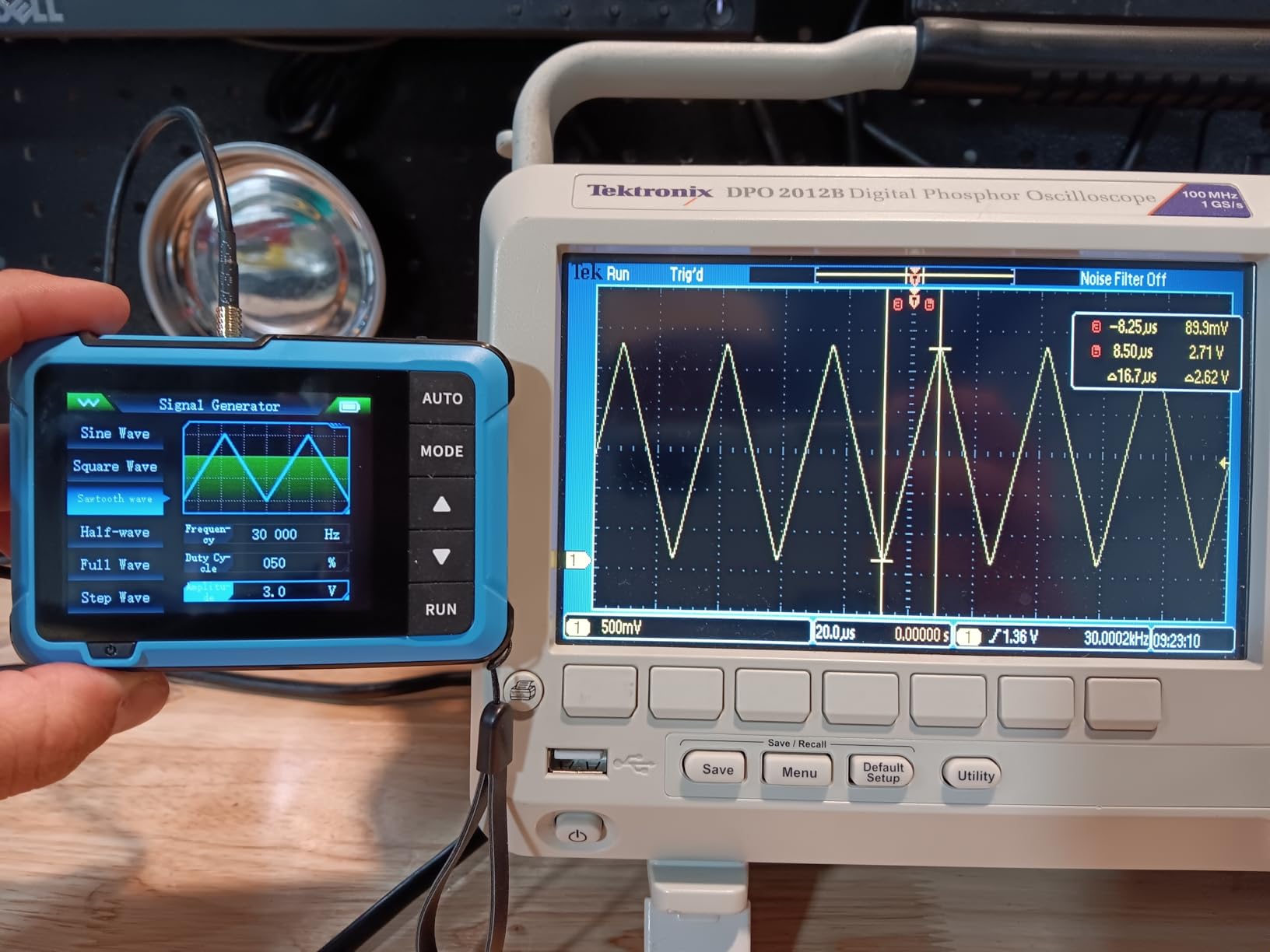
The DSO-510 is where the pocket-scoped category stops being a toy. Ten MHz of bandwidth and 48 MSa/s sampling, with a time base range from 50 ns to 20 s, means it handles far more than slow audio. The built-in DDS signal generator with 13 waveform types up to 50 kHz is the reason people keep it on the bench, because you can test a circuit response without a second instrument.
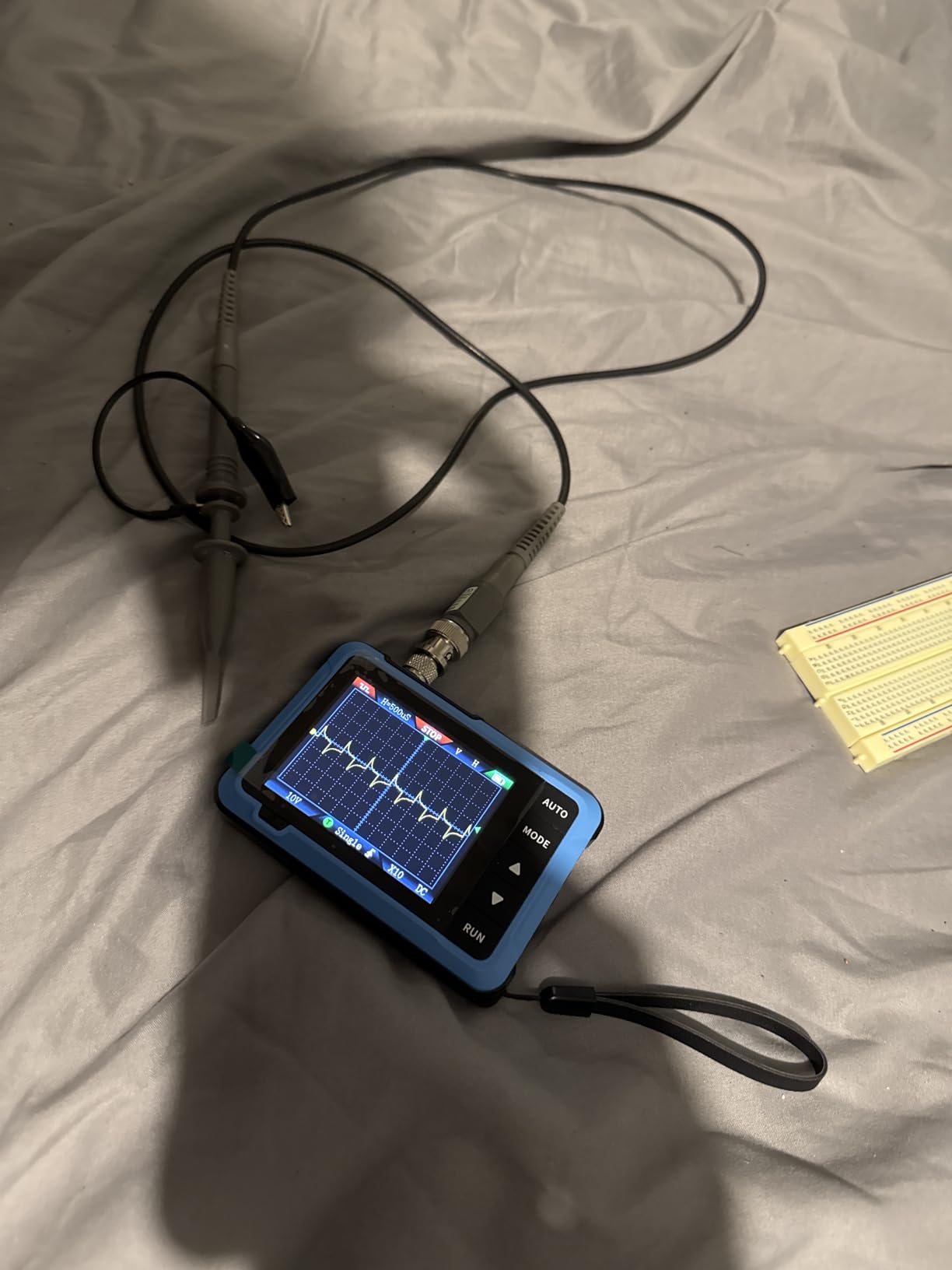
Infinite afterglow is a nice touch that most instruments in this class skip. Persisting traces build up on screen, so brief events and transients leave a visible mark instead of vanishing between refreshes. Reviewers describe it as a capable budget scope for car audio, electronics learning and basic diagnostics, and they consistently single out the signal generator as the standout bonus.
The 4.3 average with a 68% five-star share comes from real limitations. Only one probe works at a time, the trigger controls have a real learning curve, and the generator is not accurate at higher setpoints and drifts back toward 1 kHz when you switch into scope mode. Measured values lag the setpoint even though the output works.
When this scope suits your work
It suits car audio builders, students, and anyone who wants to drive a known signal into a circuit and watch the response. The 400 V measurement capability, Type-C charging and 1000 mAh battery make it portable, and the time base range covers everything from nanosecond pulses to slow events in one device.
When you should look elsewhere
A single probe means no simultaneous comparison of two signals, which rules it out for any timing or alignment work. The generator accuracy issue matters if you are calibrating something against it, and the trigger controls will frustrate you during the first few sessions if you have never used a scope before.
9. HANMATEK DOS1102 – the biggest readable screen at this level
HANMATEK 110mhz Bandwidth DOS1102 Digital Oscilloscope with 2 Channels and Screen 7 inch / 18 cm, TFT-LCD Display, Portable Professional Oscilloscope Kit with 500 MS/s *2 Sampling Rate
110 MHz bandwidth
2 channels
500 MSa/s x2
7-inch 800x480 TFT
Pros
- 7-inch 800x480 colour TFT in a 2.4 lb body which is rare at this level
- 110 MHz bandwidth and 500 MSa/s sampling
- 30 automatic measurements plus a 6-digit hardware frequency meter
- Stores at least 16 waveform sets with USB flash support
- USB host/device plus LABVIEW and SCPI automation
Cons
- Menus and controls follow a less conventional layout than the major brands
- 10K-point record depth is modest next to 24 Mpts rivals
- No built-in signal generator in the standard configuration
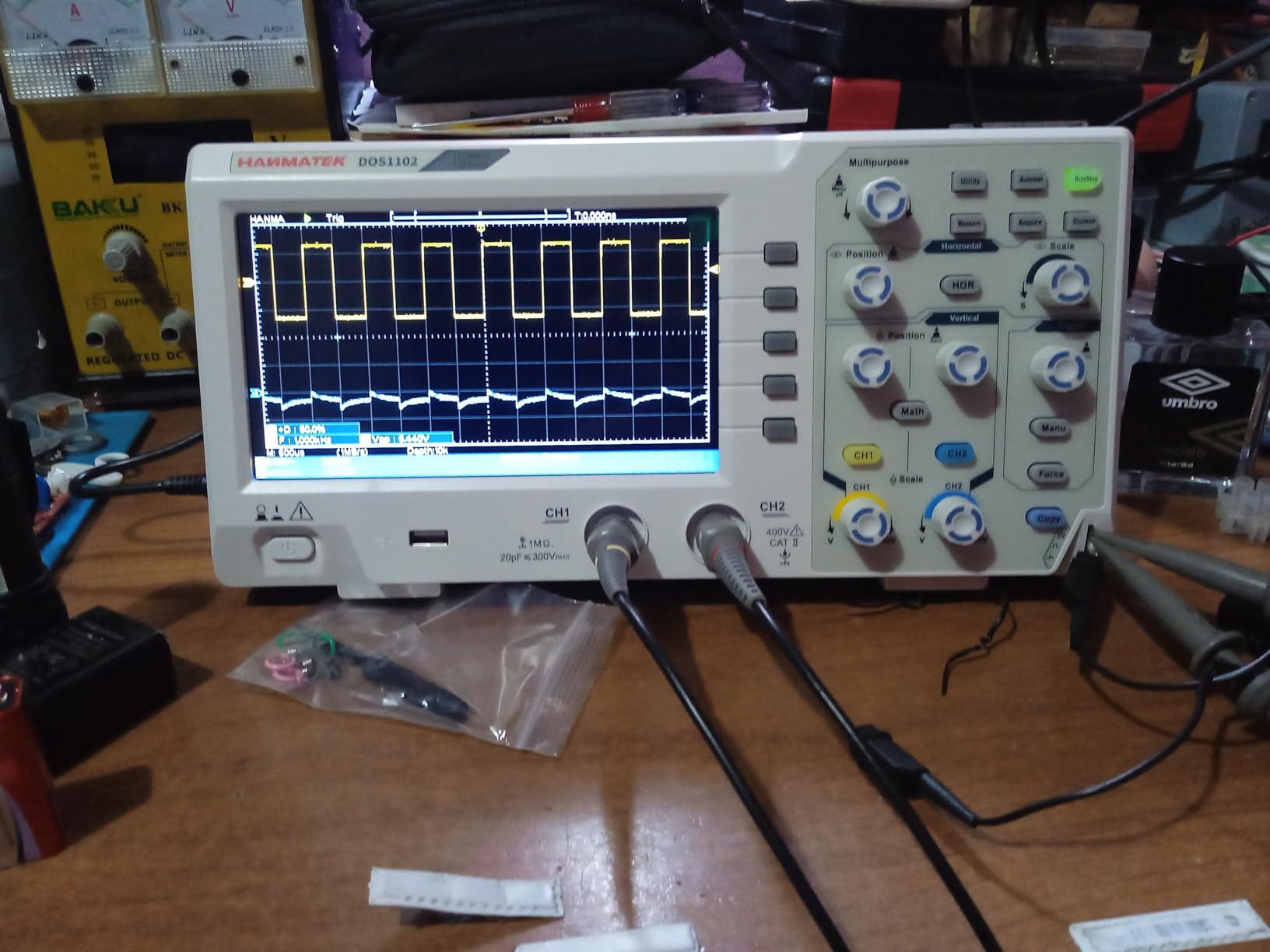
Screen size is a genuinely underrated feature for a first scope, and the DOS1102 has 7 inches of 800×480 true colour in a 2.4 lb body at 110 MHz of bandwidth. Reviewers treat it as a strong value pick when the priority is a large, readable screen and real bench capability without paying a major-brand price. The vertical range of 20 mV/div to 5 V/div covers both audio and logic work.
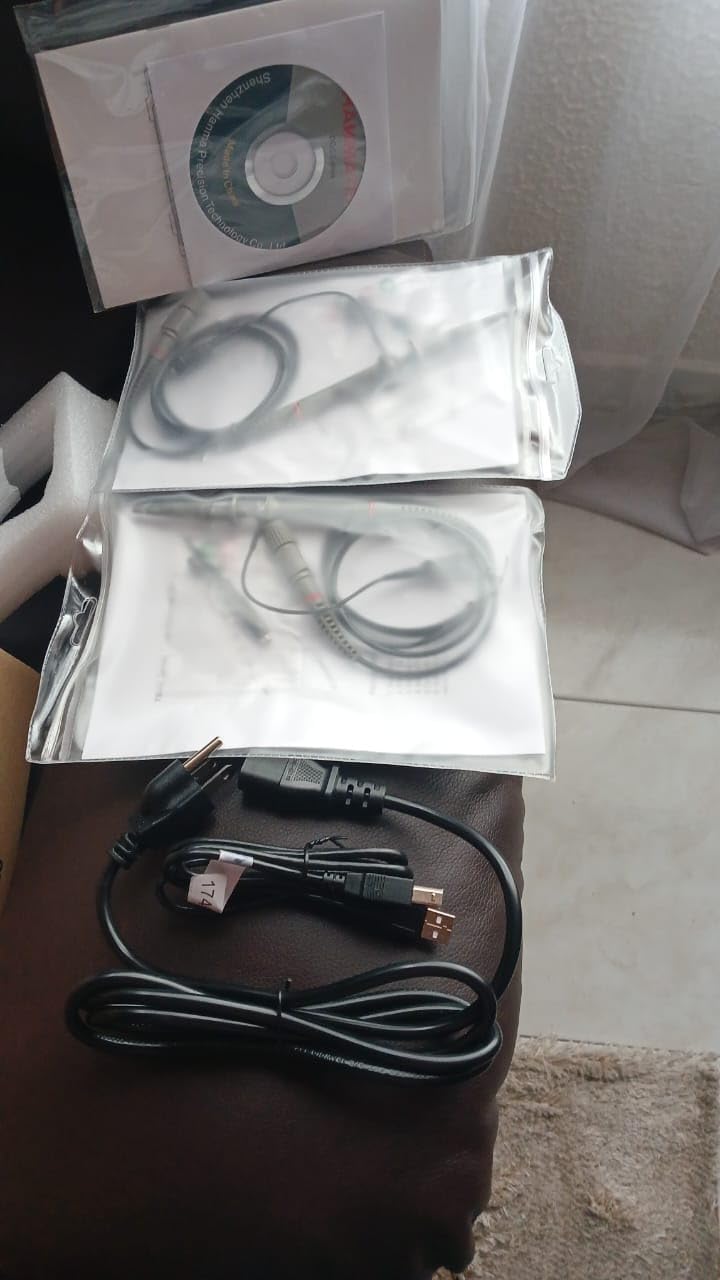
The hardware here is more than the screen. Four automatic cursor modes cover voltage difference, time difference and combined timing measurements, and a 6-digit hardware frequency meter spans 2 Hz to 20 MHz. Current measurement from 100.0 mA/V to 1 kA/V means you can measure current through a shunt, and probe attenuation multiples of 1X, 10X, 100X and 1000X give you room to work safely on higher rails.
The 4.4 average reflects a solid instrument with a learning curve. The menu layout is less intuitive than the major brands and 10K points of record depth is modest next to 24 Mpts rivals, so long captures will not have the same sample density. There is no built-in signal generator in the standard configuration, and reviewers flag the bundled probes as the weakest part of the package.
When this scope suits your work
It suits a beginner who spends long sessions reading waveforms and wants a large display to do it on, and it suits students moving from coursework into real bench work. The 30 automatic measurements, SCPI compliance and LABVIEW communication mean it can also be driven from a computer, which makes it useful in a lab automation context.
When you should look elsewhere
If your work depends on capturing long windows, 10K points will frustrate you quickly, and there is no signal generator to drive a circuit. The unconventional menu system is the other real cost: budget an afternoon to learn it before deciding you dislike the scope.
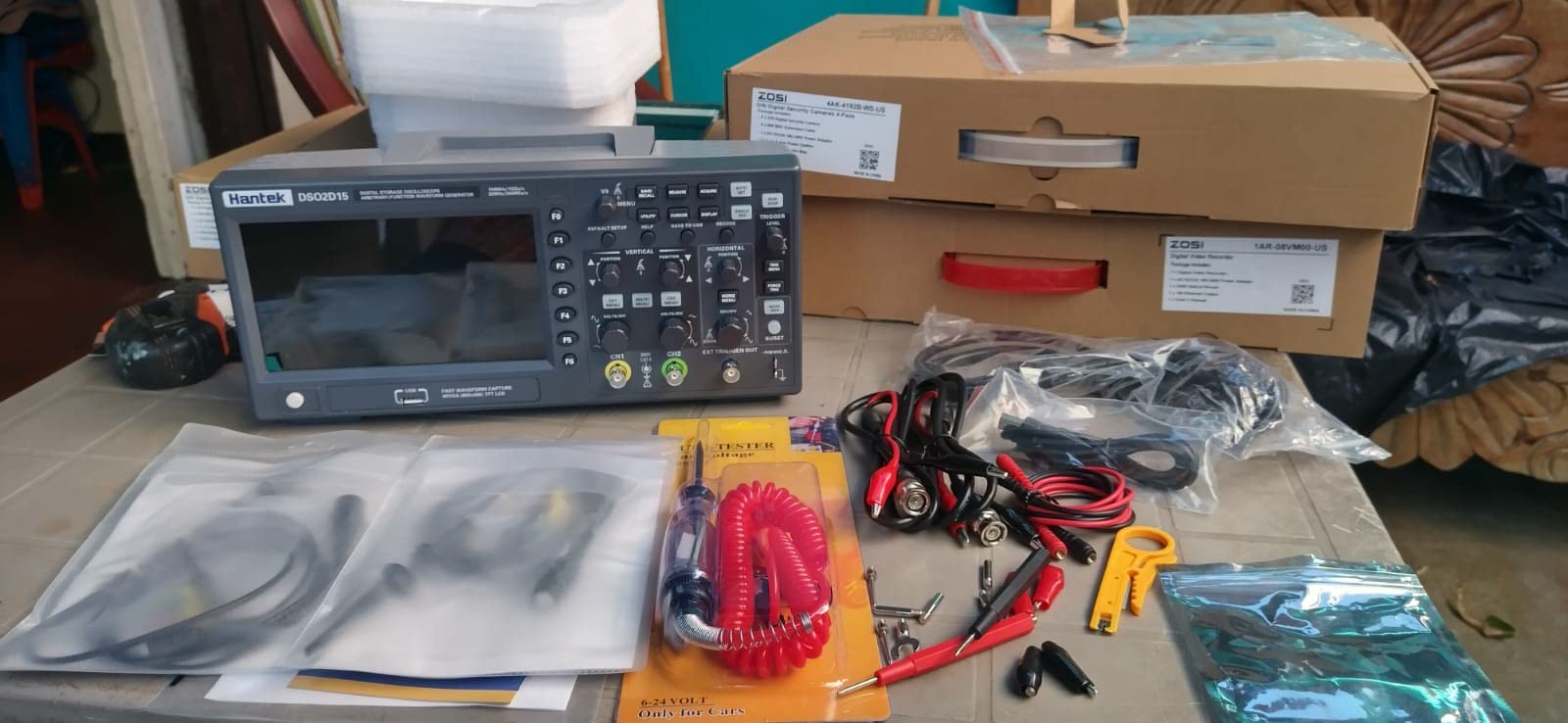
10. Hantek DSO2D15 – 150 MHz with a waveform generator on board
Hantek DSO2D15 Digital Storage Lab Oscilloscopes150MHz Bandwidth 2CH
150 MHz bandwidth
2 channels
1 GSa/s sampling
14 trigger modes
Pros
- 150 MHz two-channel bench scope in an economical package
- Internal arbitrary waveform generator on generator variants saves buying a separate unit
- Colour-coded LED buttons map to channels and F-buttons align with menu items
- FFT mode and dual-channel synchronised IQ analysis for RF and audio
- Downloadable firmware and 68-page manual
Cons
- Slower CPU makes display and menu updates lag
- Can lock up on misconfigured settings and needs a power cycle
- Not precise for measurements above roughly 5 MHz
- No printed manual so the PDF must be downloaded
- Both USB connectors share one internal port
This is the pick for a beginner who wants to test circuits, not just look at them. The DSO2D15 combines 150 MHz of bandwidth, two channels and up to 1 GSa/s sampling with an internal signal generator up to 25 MHz on generator-equipped variants, and 14 trigger modes plus 5 serial protocol triggers and decodes. Being able to inject a known waveform and watch the response turns measurement into an experiment.
Experienced hobbyists and students describe it as a genuinely capable, full-featured bench scope for the money, and the physical design helps: colour-coded LED buttons map to the channels, and the F-buttons line up with the on-screen menu items so you are not hunting for labels. FFT mode and dual-channel synchronised IQ analysis make it useful for RF and audio work beyond simple logic debugging.
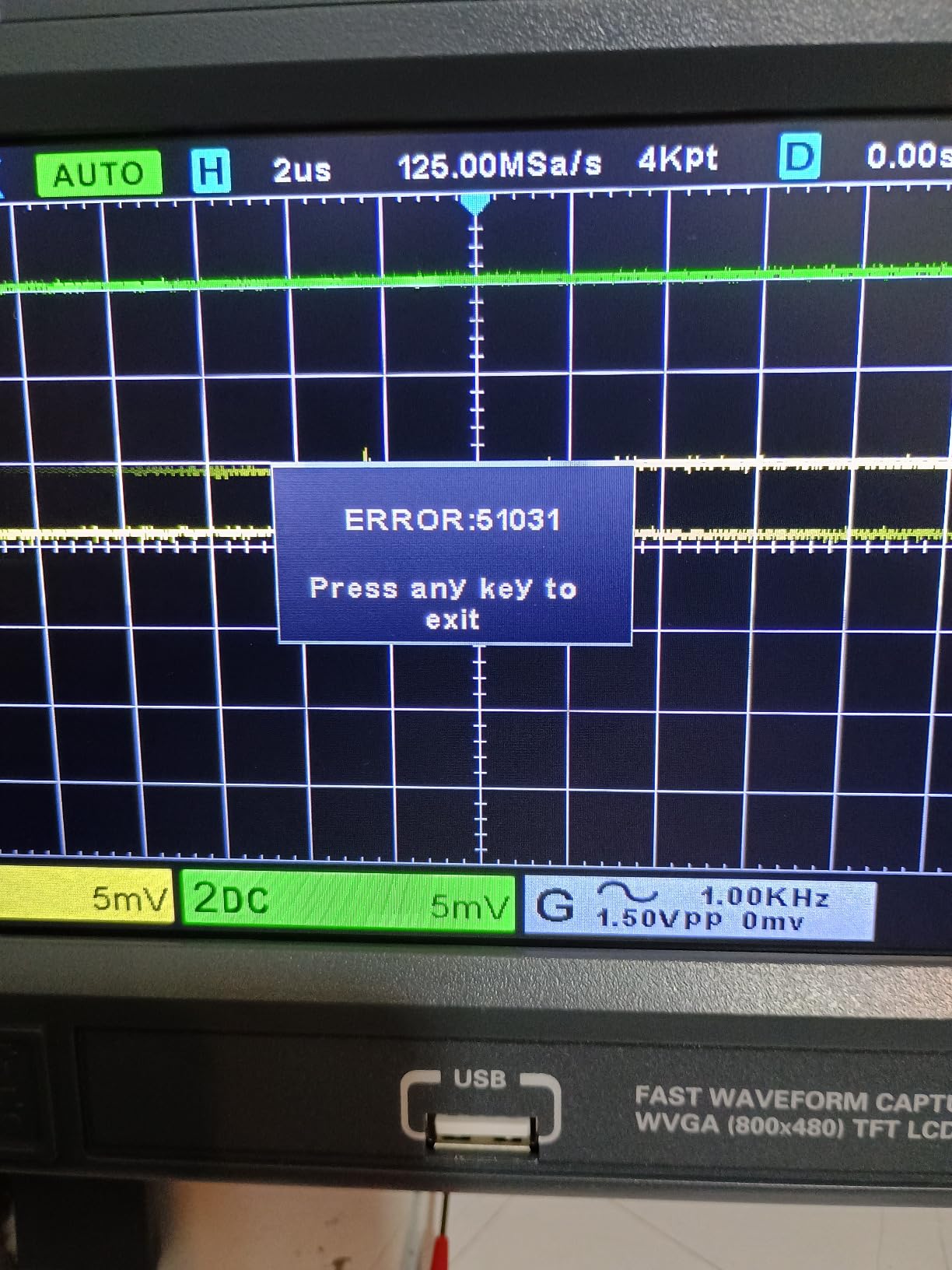
The 4.6 average is a fair summary of the trade-offs. The processor is slower than higher-end scopes, so display and menu updates lag; it can lock up when settings are misconfigured and needs a power cycle; and reviewers are clear that it is not precise for measurements above roughly 5 MHz. Firmware updates have substantially improved all three of those, and the manual is a downloadable 68-page PDF.
When this scope suits your work
It suits someone learning amplifier and filter design, audio electronics, or anything where driving a circuit with a known signal is part of the process. The serial decodes and 14 trigger modes cover common debugging needs, and the LED channel buttons make it approachable for someone who has never run a bench instrument before.
When you should look elsewhere
If you need trustworthy numeric accuracy above 5 MHz, this is not it, and the slower processor will annoy you during long sessions. Verify which variant you are buying, since the arbitrary waveform output is only present on generator-equipped models, and expect a power cycle the first time you misconfigure something.
What to Look For as a Beginner Oscilloscope Buyer
Bandwidth: apply the five-times rule before you compare numbers
The rule of thumb is that your scope’s bandwidth should be at least five times the highest frequency you care about. For Arduino, ESP32 and Raspberry Pi work the interesting content sits in the tens of kilohertz, so 50 MHz is already generous, and for switch-mode power supplies or fast digital edges you want 100 MHz or 200 MHz.
This is why 100 MHz answers the most common beginner question well: yes, 100 MHz is enough for the overwhelming majority of hobbyist projects, and 50 MHz covers microcontroller debugging. The trap is buying far more bandwidth than you need while ignoring memory depth, which is what actually determines whether you can see a long event clearly.
Channels: two is a compromise, four is future proofing
Two channels let you compare input and output, or signal and ground, which covers most learning. The moment you want to watch three supply rails, a chip’s enable line and a PWM signal at once, two channels means swapping probes and holding the picture in your head. Forum consensus is consistent on this: four channels is future proofing, and two channels is the thing beginners regret.
Watch the sample rate under load. A dual ADC scope may deliver 1 GSa/s on two channels but drop to 500 MSa/s with all four active, so know the trade-off before you buy rather than after.
Memory depth: why shallow records frustrate beginners
Memory depth is how many sample points the instrument holds in one capture, and it decides how much detail you keep when you zoom in. A 1 Kpts record, as on the FNIRSI 2C53T, or 8k on the HANMATEK HO52, is enough to confirm a signal exists but not enough to study a long event. Bench scopes here range from 10K up to 24 Mpts, and that spread is the single biggest difference in how a scope feels to use.
Beginners run out of memory and assume their circuit is misbehaving, when the truth is the record ended. Check the record length for your slowest signal of interest before you commit.
Sample rate and vertical resolution: two numbers beginners misread
A headline sample rate of 1 GSa/s does not mean a gigahertz of visible detail. Useful detail is governed by memory depth, bandwidth and the vertical converter. Vertical resolution matters more than beginners expect: an 8-bit converter quantises the signal into 256 levels, so noise and small deviations are hard to see, and 12-bit converters give you noticeably cleaner traces on ripple measurement.
Look at the ADC resolution alongside the sample rate rather than beside the price. Both are legitimate numbers, and they do not tell you the same thing.
Safety: earth-ground-referenced probes and mains probing
Every bench scope in this roundup ties its probe ground clip to the earth ground of the mains outlet through the instrument’s case. That means you cannot clip a ground lead to an arbitrary point in a live circuit, and clipping it to the wrong point can create a direct short through the earth conductor. No competitor covers this clearly, and it is the one thing to understand before you power anything up.
Probing a mains-derived or switch-mode circuit on an earth-ground-referenced bench scope is genuinely dangerous. If you need to measure a rectified or switched supply, either use a differential probe, a handheld or battery-powered scope such as the FNIRSI 2C53T, FNIRSI DSO152 or HANMATEK HO52, or a properly rated isolation transformer. Also run the probe compensation step on the scope’s built-in square wave before your first real measurement, since uncompensated probes make the first reading look wrong and beginners often assume the scope is faulty.
While you are setting up, remember the first thing to check on any new scope: x10 probe compensation. It takes two minutes and prevents the single most common false alarm after a first purchase. If you also enjoy taking instruments outdoors rather than staying at the bench, our picks for the best electric surfboards for beginners follow the same buy-once-learn-once logic.
Frequently Asked Questions
Is a 100 MHz oscilloscope enough?
Yes, for nearly all beginner work. 100 MHz comfortably covers Arduino, ESP32 and Raspberry Pi signals, audio, and most power supply ripple measurement. You would only need more if you are chasing switch-mode converter edges, high-speed digital interfaces or RF work. Apply the five-times rule: pick a bandwidth at least five times the highest frequency you expect to measure.
What is a good, cheap oscilloscope for hobbyists?
The FNIRSI 2C53T and the HANMATEK HO52 are the strongest cheap options, both pairing a 2-channel scope with a multimeter and battery power. For very low cost, the FNIRSI DSO152 is the cheapest route into real measurement. Keep in mind that cheap pocket scopes have shallow record lengths, so they confirm signals rather than analyse them in detail.
What is the best and most affordable oscilloscope?
The Rigol DS1054Z is the answer most experienced hobbyists converge on: four channels, 24 Mpts of memory, serial decoding included in the base firmware, and the widest community support of any beginner scope. The Siglent SDS1202X-E is the alternative pick, trading channel count for 200 MHz of bandwidth at a similar outlay.
Do I need a 2 or 4 channel oscilloscope?
Two channels are enough to compare input and output or signal and ground, which covers most learning. Four channels pay off when you need to watch three supply rails plus an enable line, or align several buses at once. Forum consensus is firmly on the side of four channels as future proofing, since you cannot add them later.
Can I use my PC as an oscilloscope?
Not for a first instrument. PC-based scopes depend entirely on vendor software, and quality varies widely; when a vendor stops updating, the device becomes close to useless. They are also earth-ground referenced through your laptop, so they carry the same mains safety problem as a bench scope. If you want a computer-driven workflow, buy a bench scope with LAN or USB export instead.
Is an oscilloscope safe to use on mains voltage?
Only with the right instrument. A bench scope’s probe ground clip is tied to earth ground, so probing a mains-derived circuit can short the circuit through the earth conductor. For mains-adjacent work use a battery-powered handheld such as the FNIRSI DSO152 or HANMATEK HO52, a differential probe, or a properly rated isolation transformer. Never improvise around the ground clip.
The Verdict: Where to Start With Your First Scope
If you want one answer, start with the Siglent SDS1202X-E. Two hundred MHz of bandwidth, 14 Mpts of memory and every common serial decoder included means it will not run out of capability while you are still learning, and 1455 reviews averaging 4.7 suggest you will not be an early adopter of a bad design.
Buy the Siglent SDS1104X-E instead if channel count is what will bite you, the Rigol DS1054Z if you want the deepest pool of community knowledge behind your first instrument, or one of the battery-powered handhelds if your work happens away from a desk. And if you are still deciding, our guides to the best pellet grills for beginners and best archery sets for beginners cover the same first-gear logic in case you are starting a different hobby this year.
Do one thing before you power it on: run the probe compensation check on the built-in square wave. Two minutes now saves a week of thinking the scope is broken.