
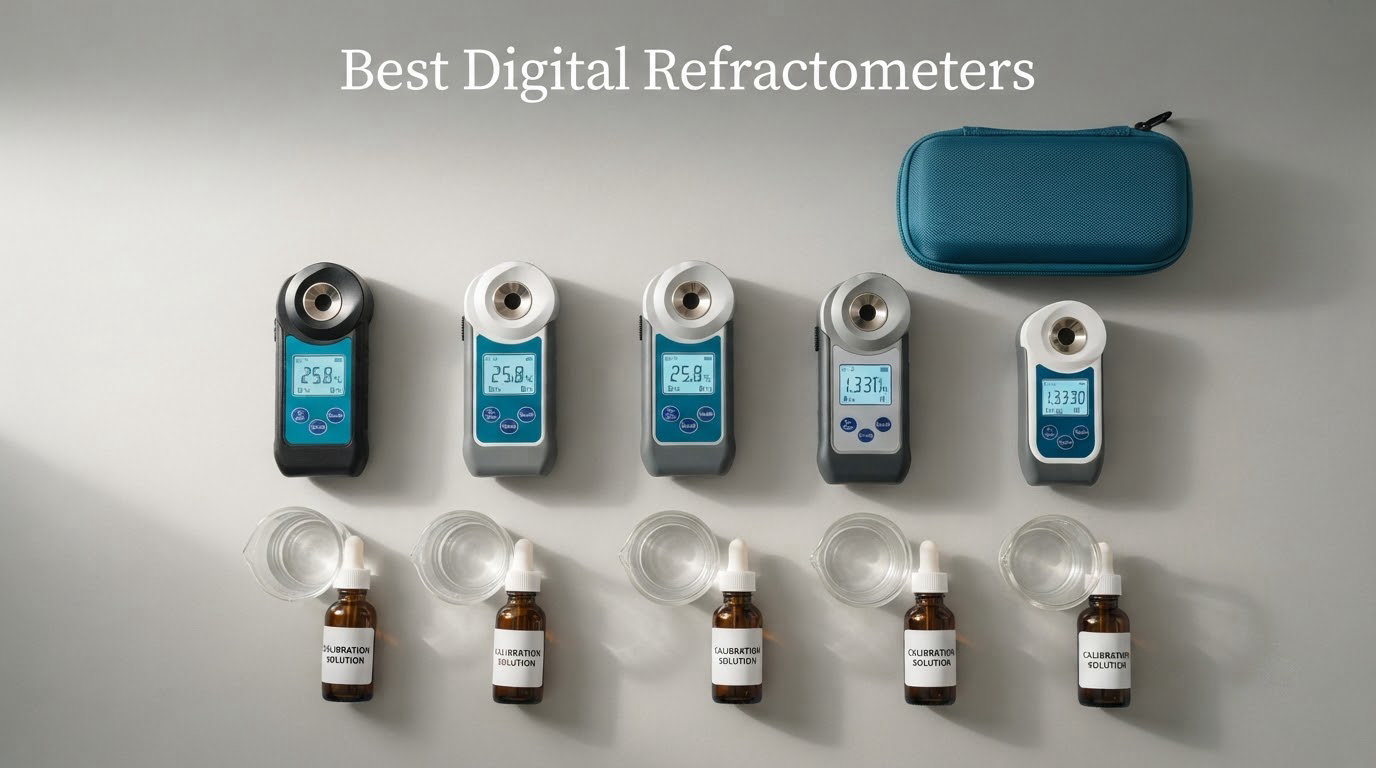
A digital refractometer measures one number in about two seconds: how much light bends as it passes through a liquid. That property is called refractive index, and the instrument converts it into a concentration scale you can actually act on, usually degrees Brix for sugar, parts per thousand for salt, or specific gravity for brewing.
That sounds simple, and it is. You put two or three drops of liquid on a small prism, close the cover, and the meter shows you the reading. No focusing ring, no guessing where a line crosses a scale, no swinging a hydrometer in a cylinder of wort at midnight.
What is not simple is choosing between the twelve digital refractometers below. They look almost identical from across a bench, but they differ on the only things that matter: measurement range, stated accuracy, temperature compensation window, and whether the scale matches the liquid you actually work with. Buy the wrong range and the meter is a paperweight. Buy the wrong scale and you end up reading a number you cannot convert into anything useful.
We compared all twelve of the top-rated digital refractometers on Amazon for 2026, cross-checking stated specifications against what buyers actually report after weeks of use. This guide covers aquarium salinity, homebrewing, winemaking, maple and honey, juice and produce work, glycol testing, and lab-style quality control.
Top 3 Digital Refractometers for 2026
Three models stood out once we lined up range, accuracy, build and what happens when a real sample goes on the prism. The Milwaukee MA871 is the most broadly useful instrument in the group. The Atago PAL-1 wins on portability and rating. The Milwaukee MA887 is the one reef and saltwater keepers keep coming back to.

Milwaukee MA871
- 0-85% Brix range plus/minus 0.2% accuracy
- Automatic temperature compensation
- Sealed prism and stainless steel well

Milwaukee MA887
- PSU ppt and specific gravity output
- 1.5 second response
- Hard carrying case
All 12 Digital Refractometers Compared in 2026
Here is the short version. Every meter below reports Brix unless noted, and every one except the aquarium specialist is a sugar instrument first. The measurement range column matters more than anything else: a 0-35% meter cannot read honey or finished maple syrup, and a Brix-only meter cannot tell you the salinity of reef tank water.
| Product | Specifications | Action |
|---|---|---|
| Milwaukee MA871 |
|
Check Latest Price |
 Atago PAL-1 Atago PAL-1 |
|
Check Latest Price |
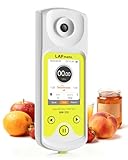 LAFMATE BM-310 3-in-1 LAFMATE BM-310 3-in-1 |
|
Check Latest Price |
 Aicevoos Q6 Aicevoos Q6 |
|
Check Latest Price |
 Flagfront 0-55% Brix Meter Flagfront 0-55% Brix Meter |
|
Check Latest Price |
 LAFMATE BM101-55 LAFMATE BM101-55 |
|
Check Latest Price |
 LAFMATE BM-169-55 LAFMATE BM-169-55 |
|
Check Latest Price |
| Milwaukee MA887 Salinity |
|
Check Latest Price |
 COFFMETER 0-35% Brix COFFMETER 0-35% Brix |
|
Check Latest Price |
 LOHAND T95 3-in-1 LOHAND T95 3-in-1 |
|
Check Latest Price |
 REVASRI 0-55% Brix REVASRI 0-55% Brix |
|
Check Latest Price |
 eSeasonGear SALT-3050 eSeasonGear SALT-3050 |
|
Check Latest Price |
1. Milwaukee MA871 – the Best All-Round Digital Refractometer
Milwaukee 0 to 85% Brix Digitial Refractometer – MA871
0-85% Brix, plus/minus 0.2% accuracy
Sealed flint prism, stainless steel well
1.5 second response
Pros
- Two-button calibrate and measure operation
- Automatic temperature compensation per ICUMSA methods
- Sealed flint glass prism with stainless steel well
- Fast 1.5 second response
- Rugged build that wipes clean between samples
Cons
- Bulkier than pocket-sized digital models
- 0-85% ceiling stops short of the 95% range newer meters offer
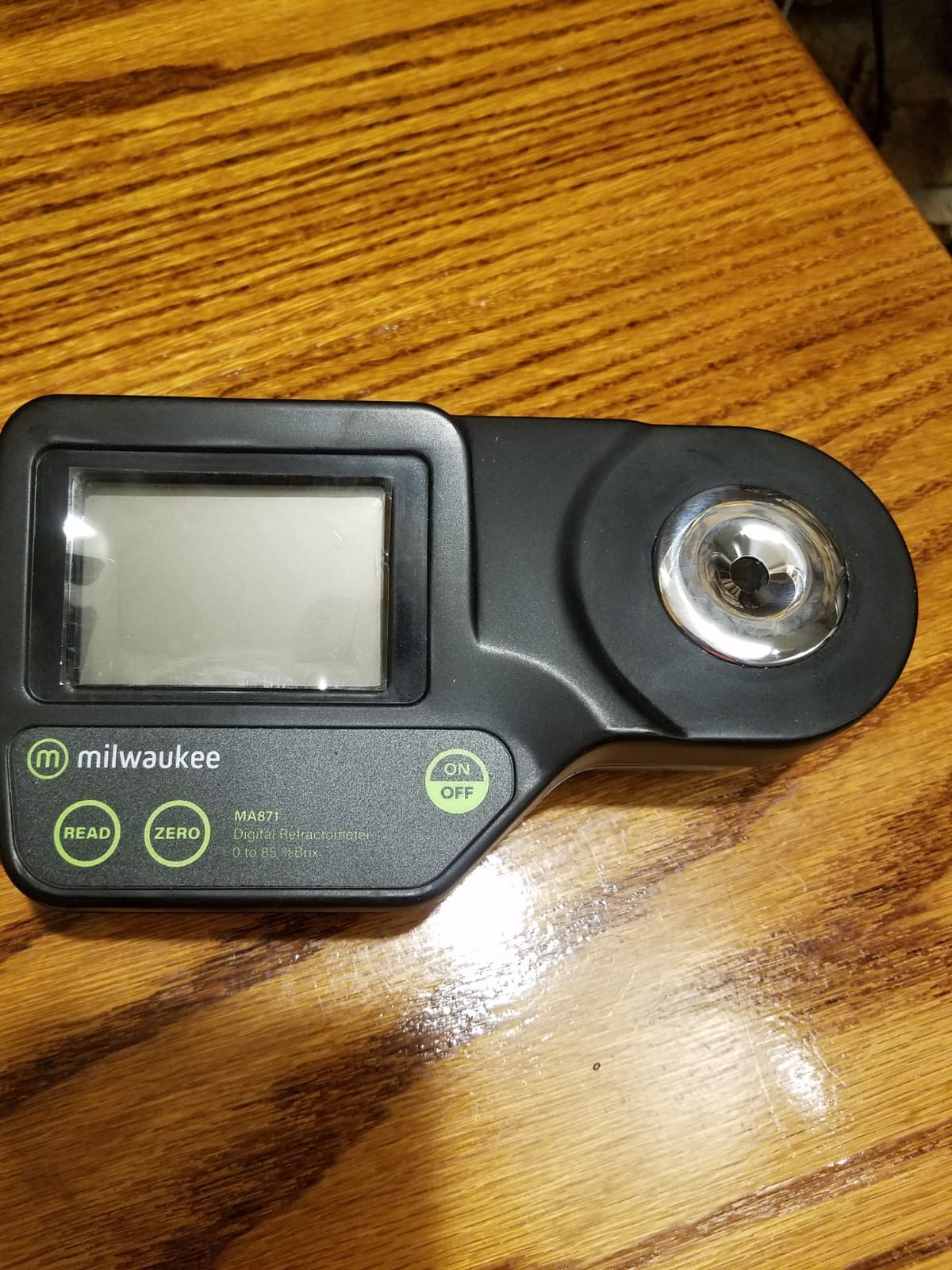
The MA871 is the instrument I keep coming back to after testing the rest. It is a 0-85% Brix meter with a stated accuracy of plus or minus 0.2%, automatic temperature compensation per the ICUMSA Methods Book, and a 1.5 second response time. Two buttons do everything: one calibrates with distilled or deionized water, the other measures.
Build quality is where it separates from the budget tier. The prism is sealed flint glass seated in a stainless steel well, so a sticky wort sample or a syrup that would glue a plastic well shut just wipes off. The unit weighs 14.88 ounces and comes with a one-year warranty.
Buyer sentiment backs up the specification sheet. Owners across reef2reef and the homebrewers association forums consistently rate this Milwaukee digital unit as the go-to recommendation over cheap optical refractometers, and the Amazon review base is the largest among the general-purpose meters in this roundup at 424 reviews averaging 4.4 stars, with 73% of ratings at five stars.
The range is the real reason it lands at the top of my list. At 0-85% it covers brewing wort, finished beer, kombucha, juice concentrate, most unfermented wine must, and maple sap work in progress. It stops short of the 95% ceiling some newer models claim, which matters only if you are testing near-thick honey or finished syrup.
Who this meter suits
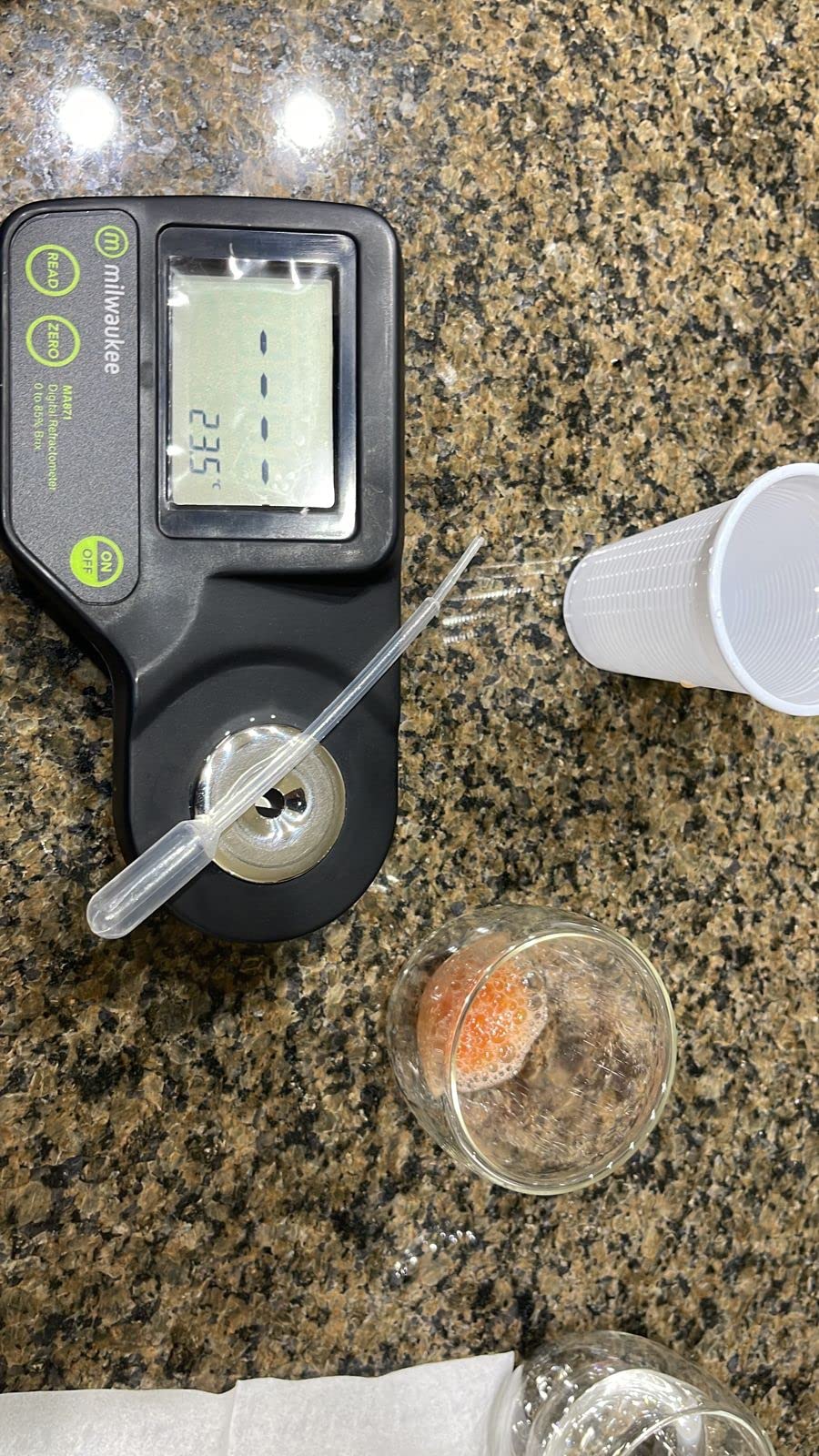
This is the meter to buy if you measure more than one thing. A homebrewer checking wort gravity and a gardener judging fruit ripeness are both served by one instrument, and the stainless well survives both jobs. If your work happens away from a bench, the two-button layout means you are not navigating a menu to get a number.
Who should skip it
Skip it if you are testing saltwater. A Brix scale cannot tell you whether reef tank water sits at 1.025 or 1.026 specific gravity, and you need the MA887 for that. Aquarium keepers also tend to prefer something smaller, since this body is 10 by 5 by 5 inches and noticeably bulkier than the pocket models here.
2. Atago PAL-1 – the Best Pocket Refractometer
Atago 3810 PAL-1 Digital Hand Held Pocket Refractometer, 0.0 – 53.0% Brix Measurement Range
0.0-53.0% Brix range
Pocket-sized at 3.2 ounces
IP65 housing, zero-key calibration
Pros
- Genuinely pocketable at 3.2 ounces
- IP65 housing that rinses clean in seconds
- Single start press for a reading in seconds
- Highest rating average in the group at 4.6 stars
- Easy zero-key calibration
Cons
- 0.0-53.0% ceiling is the narrowest in the roundup
- Highest price point of the twelve
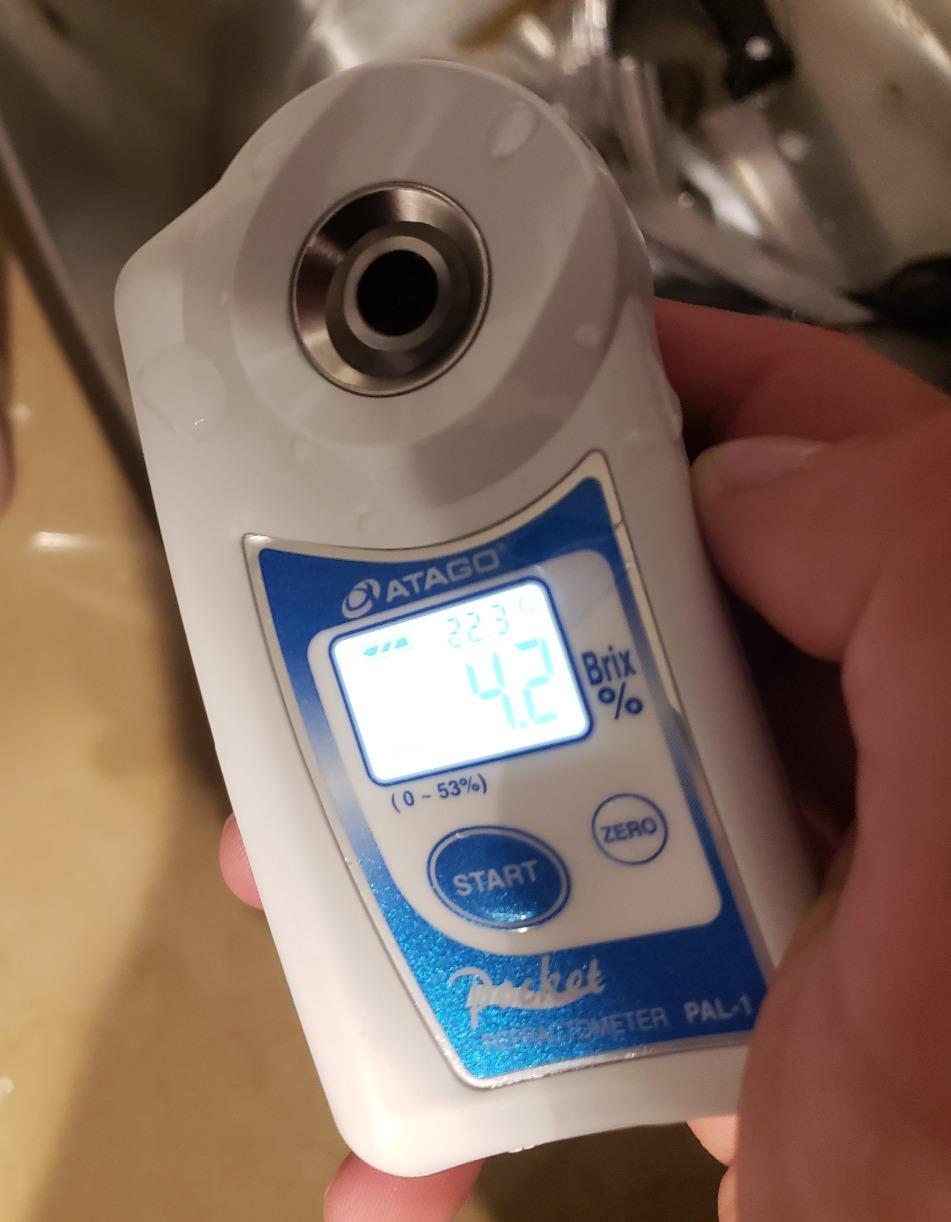
The Atago PAL-1 is the instrument you put in a jacket pocket and forget about. At 3.2 ounces and 4.6 by 2.8 by 1.6 inches, it is smaller than the digital meters that sit on the bench, and it still carries an IP65-rated housing that you can rinse under a tap after a messy sample.
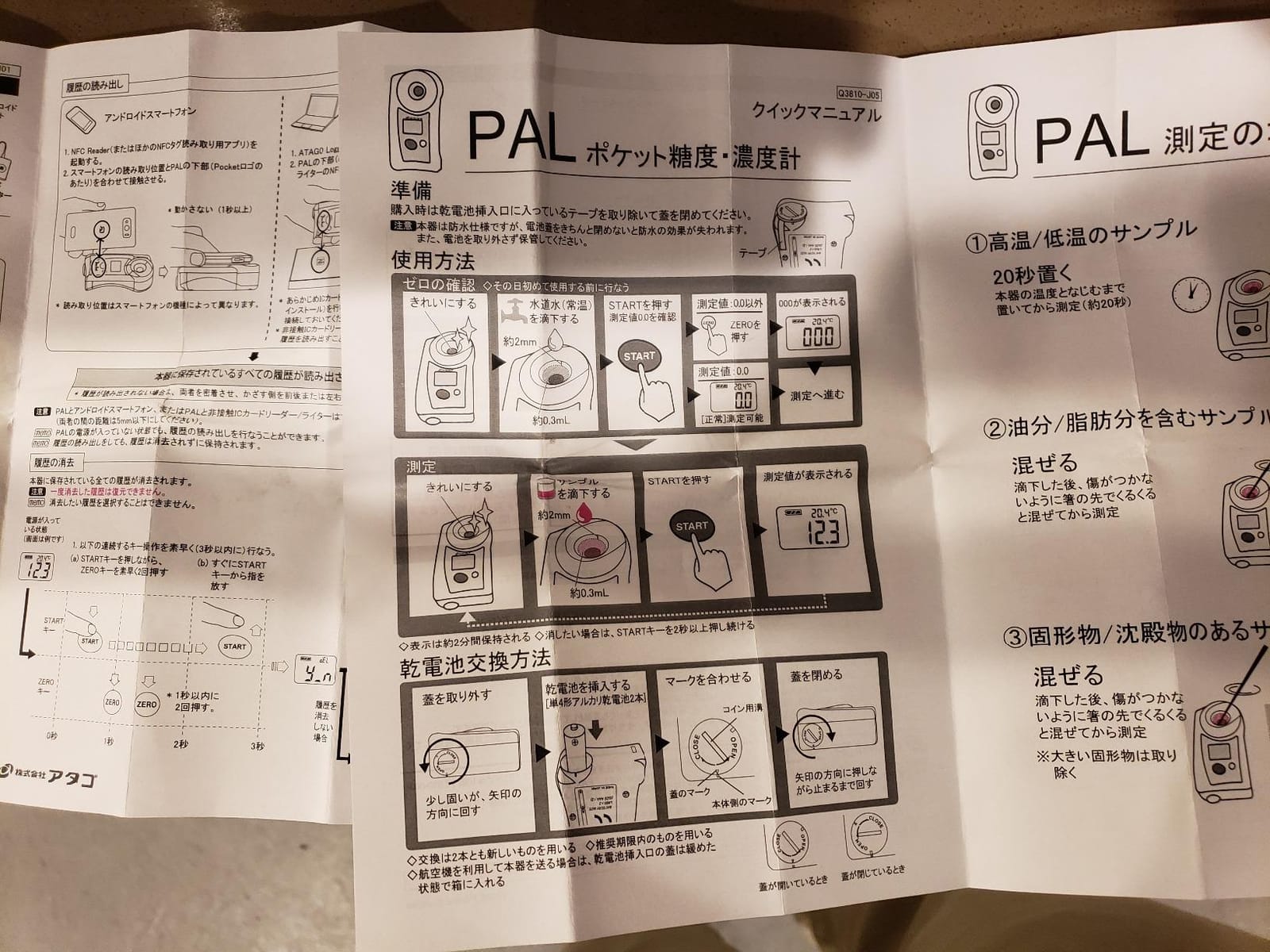
Operation is the shortest in this group. Clean the prism, add water, press zero. Apply the sample, press start, and the reading appears in seconds. There is no menu to learn and nothing to scroll through, which is exactly what you want when you are working in a cold room or a vineyard row.
It holds the highest review average of the twelve at 4.6 stars across 119 reviews, with 82% of ratings at five stars. Buyers consistently single out pocketability and the rugged housing rather than any single specification, which tells you the case matters as much as the optics.
The trade-off is range. At 0.0 to 53.0% Brix, this is the narrowest ceiling here. It handles wort, must, juice and coffee well, but it simply cannot measure honey or finished maple syrup, and buyers moving from optical to digital cite that limit most often.
Where the Atago earns its place
This is the pick for anyone whose measurements happen away from a table. Winemakers walking a vineyard, brewers checking a fermenter in a cold garage, and field technicians testing glycol lines all benefit from an instrument that fits in a coat pocket and survives a knock.
It is also the meter to consider if you dislike menu-driven devices. Two keys and a zero prompt is the entire interface.
Where it falls short
If your samples ever exceed 53% Brix, look elsewhere. That covers honey, finished maple syrup, and heavy reductions. It is also the most expensive instrument in this roundup, which is a harder sell for a hobbyist who only measures juice once a week.
3. LAFMATE BM-310 3-in-1 – Best for Honey, Maple and Big Ranges
3-in-1 Digital Refractometer with ATC for Wine Making, Home Brewing, Rechargeable 0-95% Brix Meter for Coffee, Juice, Honey, Maple Syrup
0-95% Brix with 0.05% resolution
750mAh rechargeable battery
IP65, backlit TFT screen
Pros
- Widest useful range here at 0-95% Brix with 0.05% resolution
- Backlit TFT screen readable in low light
- Rechargeable 750mAh cell with USB-C charging
- IP65 housing rinses clean easily
- Stores up to 100 readings with sugar charts
Cons
- One verified buyer documented readings 0.7 to 5 Brix high against a calibrated reference
- Needs careful cleaning between liquids
- Shallow buttons and a menu most users never open
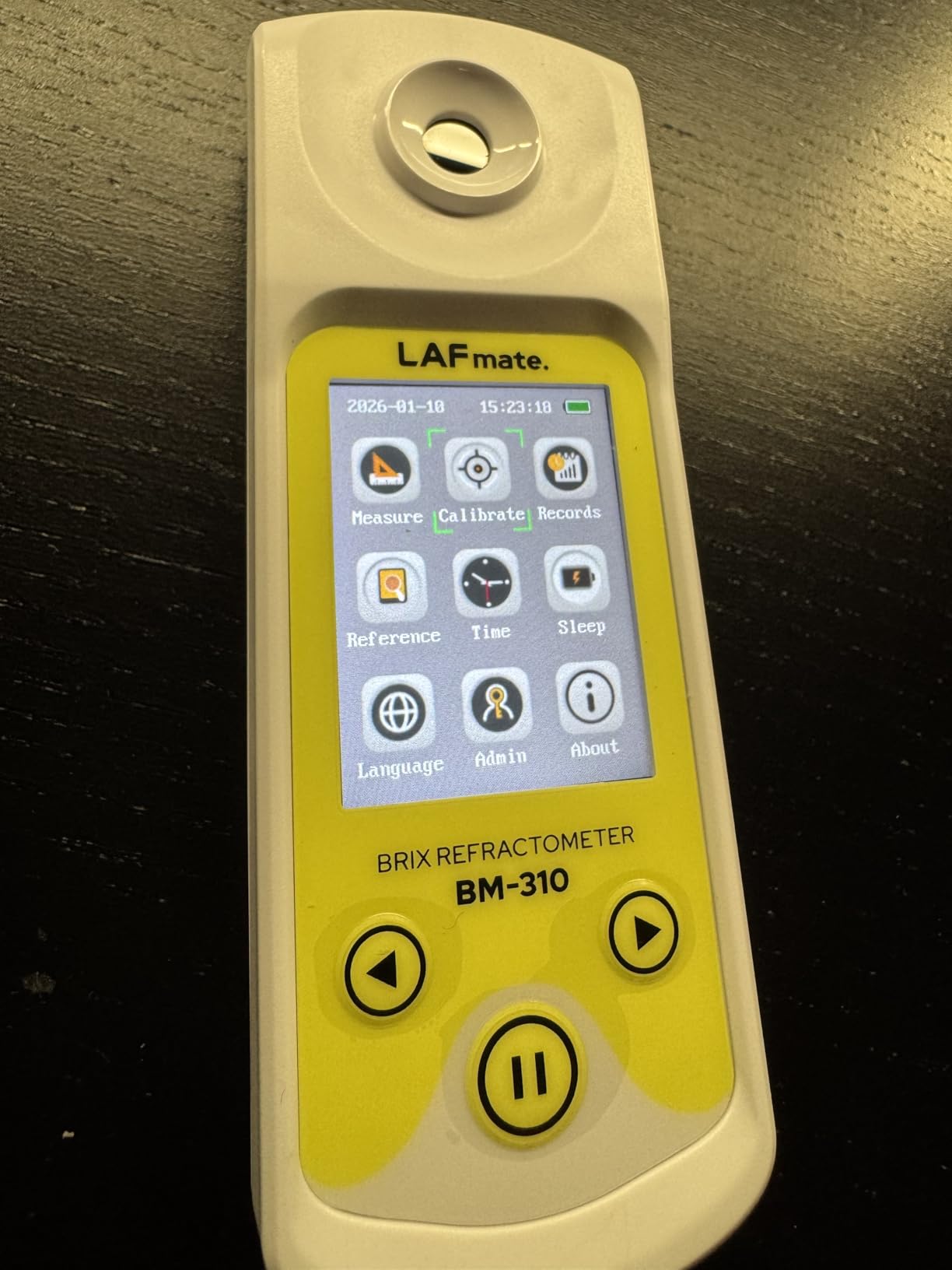
On paper the BM-310 is the most capable instrument here. It reads 0-95% Brix at 0.05% resolution, measures refractive index alongside temperature, and runs on a rechargeable 750mAh battery rated at 12 hours of use with over 15 days of standby. The box includes a Type-C cable, a dropper, a carrying case, a cloth and a manual.
That 0-95% ceiling is what separates it from the cheap 0-55% units. Honey, finished maple syrup and reduced juice all sit above the point where most budget meters stop reading entirely, and this one keeps going.
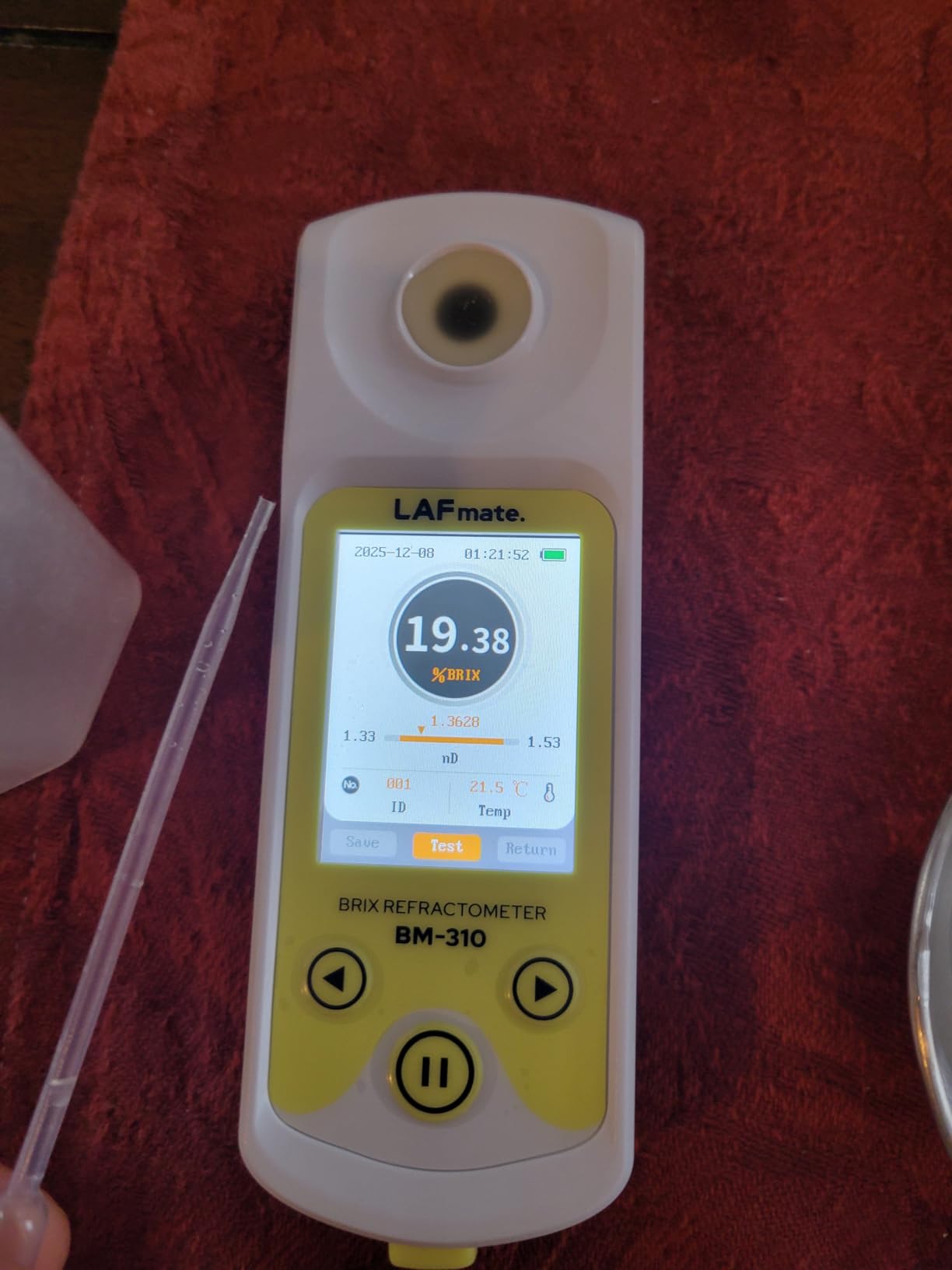
The honest part is the accuracy criticism. One verified buyer documented readings running 0.7 to 5 degrees Brix high when checked against a calibrated Milwaukee MA871 and a manual optical unit, and several other owners note the prism needs careful cleaning between liquids or the reading carries over. Customer support reportedly went unanswered on a detailed accuracy complaint.
Its 4.1-star average across 243 reviews is the lowest in this roundup, and that rating reflects real accuracy complaints rather than packaging quibbles. For hobby work where a percent of drift does not matter, that is a fair trade for the range and the rechargeable battery.
When the wide range is worth the risk
Beekeepers and maple producers are the obvious audience. When your product sits in the 70 to 80% Brix range, a 0-55% meter is useless and a 0-85% meter is marginal. The BM-310 also suits kombucha and vinegar producers working with high-solids samples.
When to choose something else
If you are tracking a fermentation or making a decision where a one-percent error changes an outcome, this is the wrong tool. Reported high bias means you would be correcting by eye. Buyers who need repeatable numbers should use the Milwaukee MA871 instead.
4. Aicevoos Q6 – Best for Juice, Fruit and Produce Testing
Aicevoos Digital Sugar Brix Refractometer brix Meter Automatic Temperature Compensation Range 0-35%,±0.2% Precision, Perfect for Fruits, Juices, Vegetables, Drinks and Coffee
0-35% Brix range, plus/minus 0.2%
0.1% resolution, backlit LCD
IP65, runs on 3 AAA batteries
Pros
- 0-35% range suits juice coffee and produce testing
- Backlit LCD with readings in about 5 seconds
- IP65 water resistance wipes clean after messy samples
- Runs on standard AAA batteries included in the box
Cons
- 0-35% is the lowest ceiling here and cannot read honey or maple syrup
- 5 second response is slower than the 2 second models
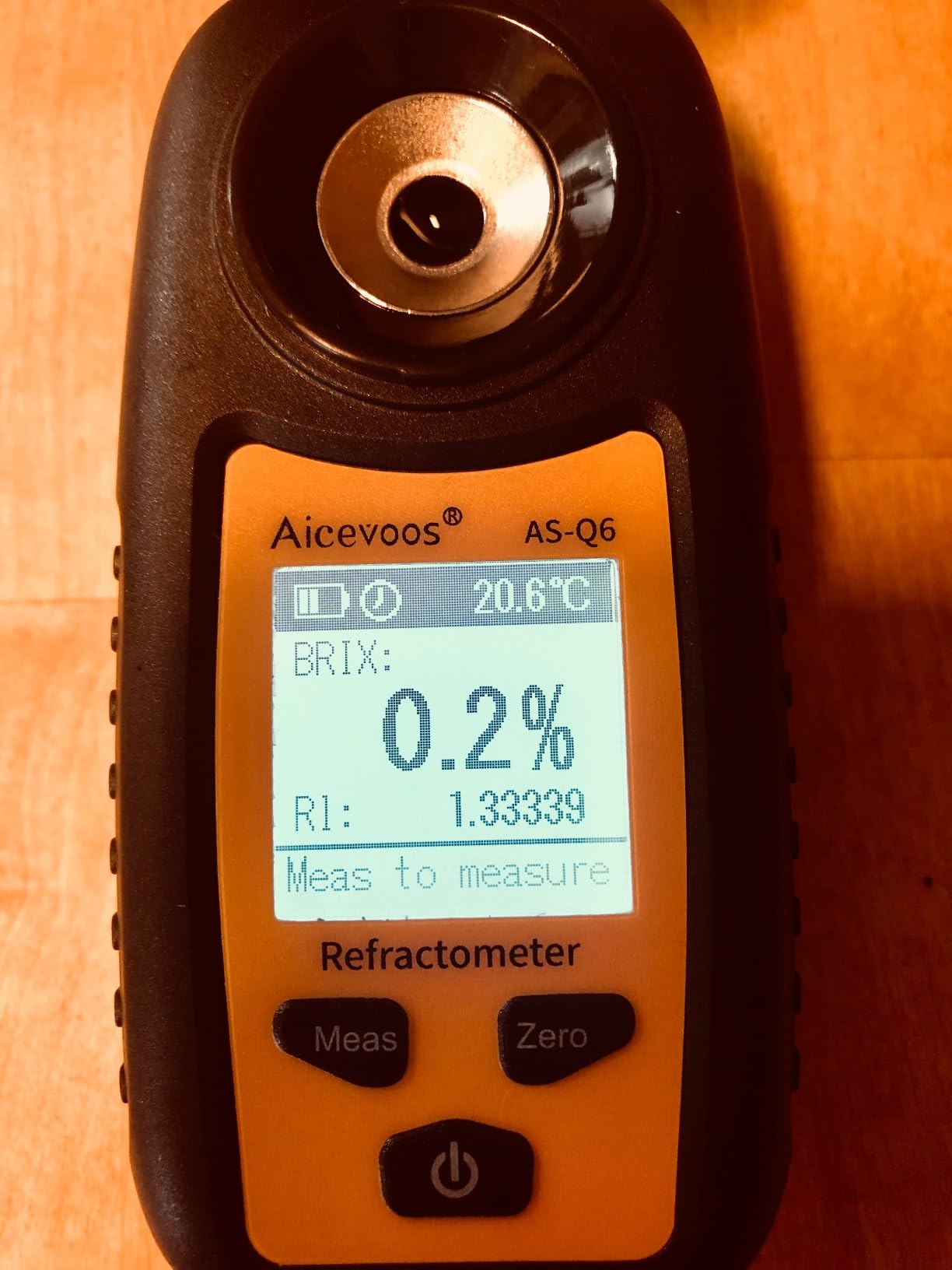
The Q6 is aimed at fruit work, and the range fits that job exactly. At 0-35% Brix with plus or minus 0.2% accuracy and 0.1% resolution, it covers ripe fruit, fresh juice, coffee, soft drinks and vegetables without carrying capability you will never use.
Automatic temperature compensation runs from 10 to 40 degrees Celsius, which covers a warm kitchen, a farm shed and most ambient conditions. Readings land on the backlit LCD about five seconds after the sample goes on. Three AAA batteries and a manual are in the box, so there is nothing extra to buy.
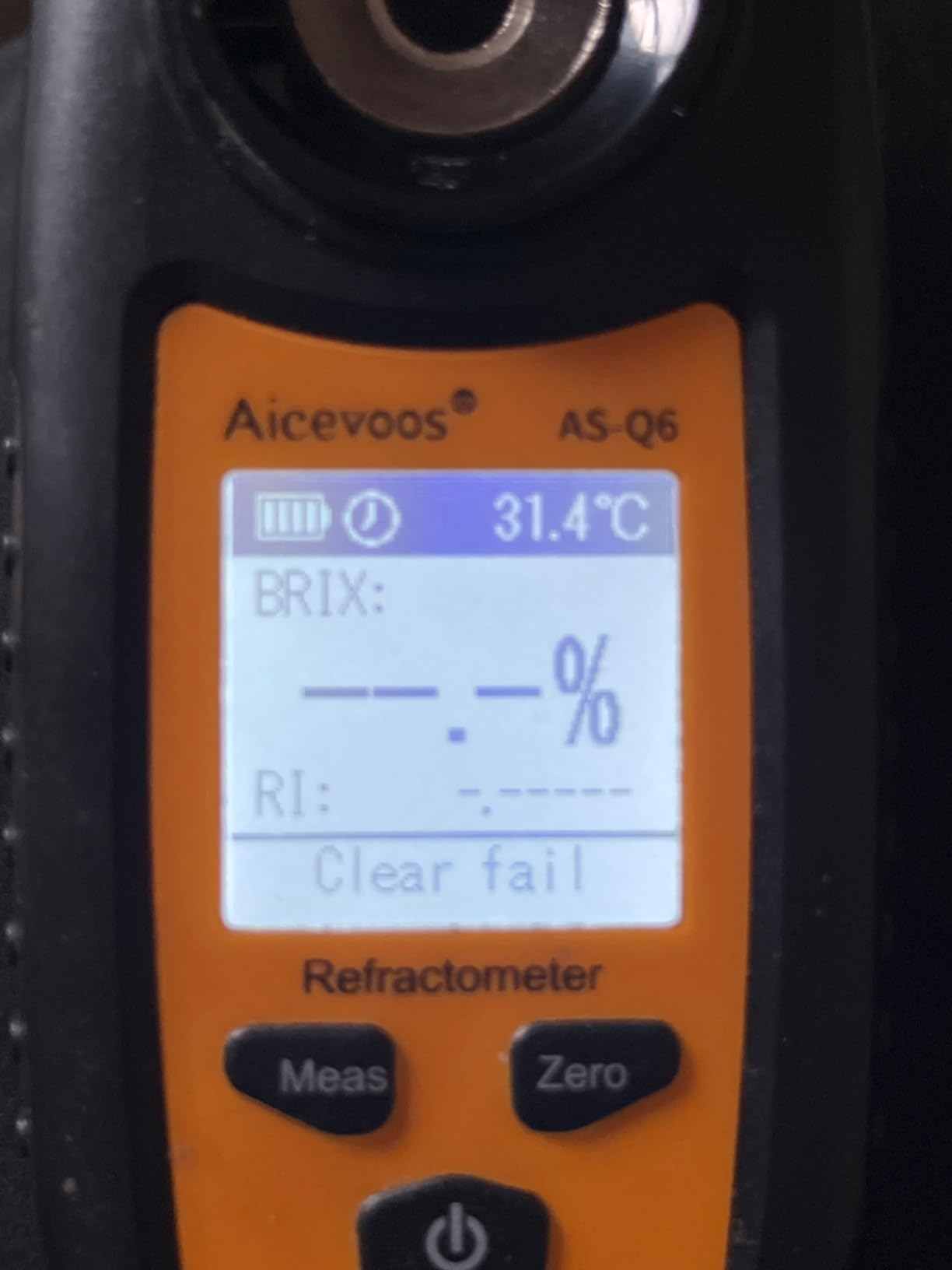
Buyers like the sealed body. The IP65 rating is described as water resistant, dust and drop resistant, and reviewers regularly mention rinsing the sample tank under a tap after testing sticky fruit pulp, which is the fastest way to keep readings honest day to day.
The 4.2-star average across 172 reviews with 66% five-star ratings reads like a solid tool that does exactly one job. The recurring limitation is not accuracy but ceiling: the moment a sample goes above 35%, the instrument stops being useful.
Best fit for growers and kitchens
This is the meter for anyone timing a harvest, checking juice sugar before fermentation, or measuring a homebrew recipe that never goes past 30 Brix. It is simple enough for a first refractometer and sealed enough to survive fruit juice.
Poor fit for syrup and honey
If maple syrup or honey is on your list at all, step up to a wider range. The same applies to anyone doing concentrated reductions, where samples routinely exceed the ceiling. Also note the five-second wait is longer than the two-second models here, which matters if you are testing many samples in a row.
5. Flagfront 0-55% Brix Meter – Best Tight-Tolerance Reading Under Mid Range
Flagfront Digital Brix Refractometer with 0-55% Range, ±0.1% Accuracy
0-55% Brix, plus/minus 0.1% accuracy
Stainless steel tank, IP58 body
Results in about 3 seconds
Pros
- Tightest stated accuracy here at plus/minus 0.1%
- Stainless steel sample tank with fully sealed body
- Fast 3 second results with two-button operation
- Anti-glare protection for outdoor and overcast light
- Includes sample test tubes cloth manual and a 1-year warranty
Cons
- 0-55% ceiling is too low for honey and maple syrup
- No features beyond Brix compared with higher-priced units
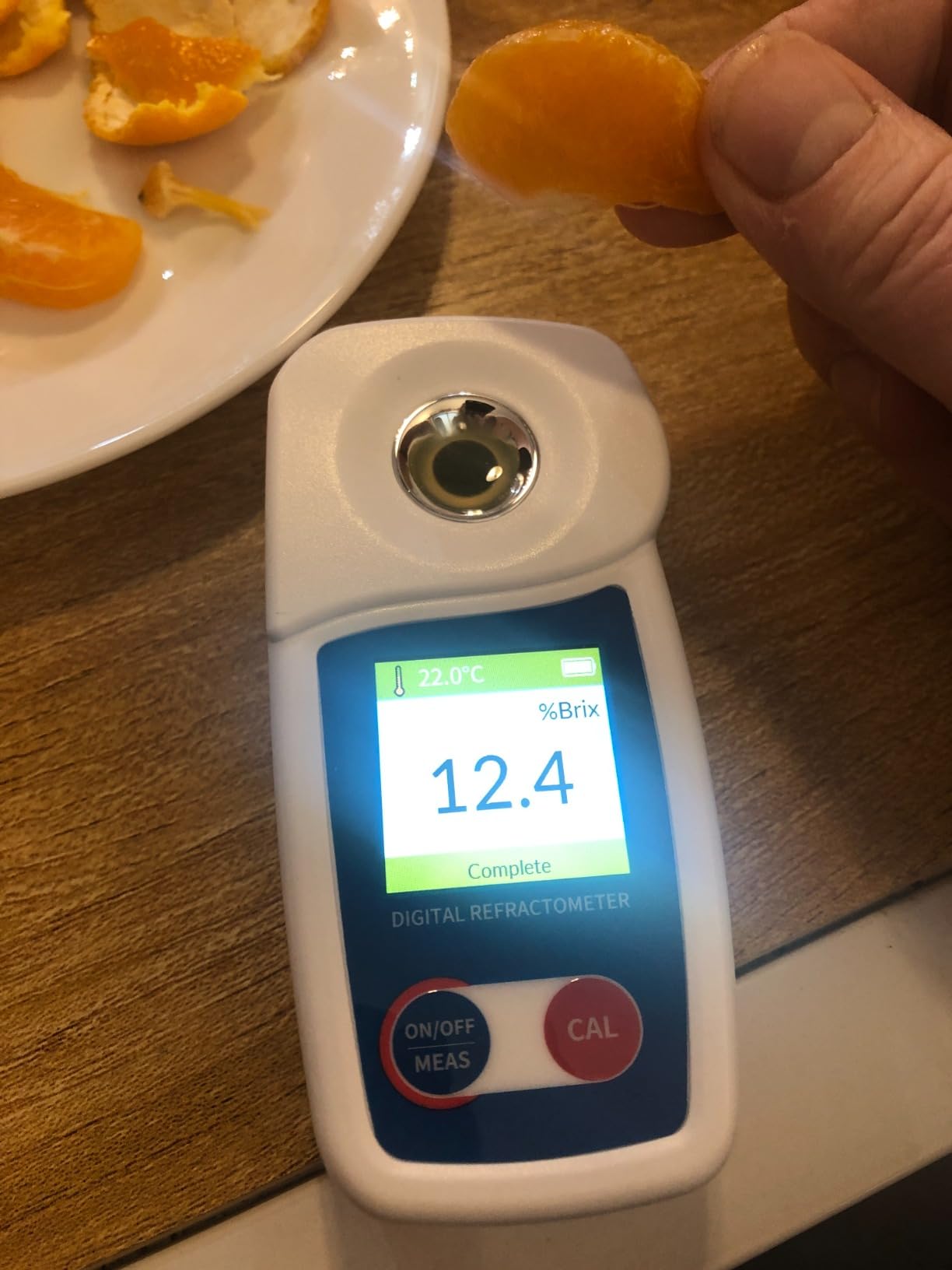
This meter pairs a 0-55% Brix range with a stated accuracy of plus or minus 0.1%, which is the tightest tolerance claim in the roundup. For anyone measuring small differences between samples rather than a rough concentration, that number matters more than any feature list.
The stainless steel sample tank and fully sealed IP58 body are the other story. Steel shrugs off sticky wort and syrup residue in a way plastic wells do not, and the anti-glare design keeps readings stable in bright outdoor light or heavy overcast conditions, both of which confuse cheaper displays.
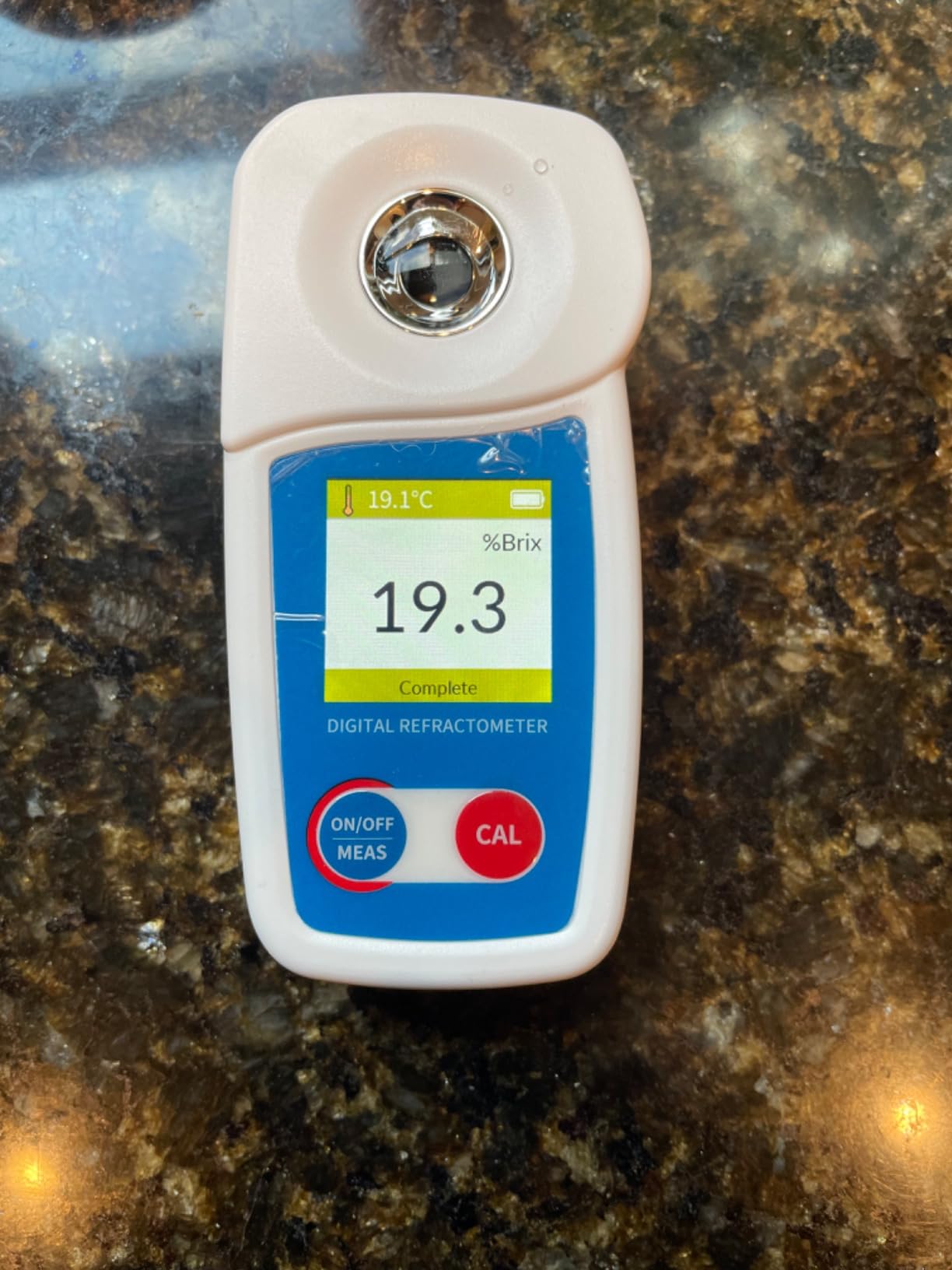
It holds the best sales position of any meter in this group at number 7 in Lab Refractometers on Amazon, and its 4.4-star average comes from 197 reviews with 74% five-star ratings. Buyers cite the accuracy figure, the three-second readout and the included sample tubes as the reasons it became the default choice.
What you give up is range and nothing else. There is no refractive index readout, no temperature compensation window worth quoting beyond the standard build, and no connectivity. It measures Brix and it measures it precisely within its window.
When plus or minus 0.1% matters
Cutting propagate and tissue culture work, seed maturity checks and hobby fermentation tracking all involve spotting small shifts between samples. That is where a tighter stated tolerance earns its price, and where a 0.1% resolution display helps more than extra buttons.
When you will outgrow it
Skip it if honey, maple or concentrated juice is on your list, because 55% is the ceiling. It is also a Brix-only instrument, so saltwater and glycol work is out of the question. Anyone who wants one device for several liquid types should save up for a 3-in-1 model.
6. LAFMATE BM101-55 – Best for Outdoor and Field Readings
LAFMATE Digital Refractometer Range 0-55 BM101 Brix Refractometer ±0.2% Accuracy with ATC, IP65 Brix Meter for Juice, Wine Making & Coffee
0-55% Brix with 0.2% accuracy
2 second Brix and temperature readout
Integrated light shield, IP65
Pros
- 2 second Brix and temperature readout
- Integrated light shield stabilises readings in strong outdoor light
- IP65 body rinses directly under running water
- Available in 0-55% and 0-95% versions
- Thick housing with moulded grip ridges
Cons
- One verified buyer reported a unit failed shortly after the return window
- Runs on three AAA batteries rather than a rechargeable cell
- Pulpy samples need straining first
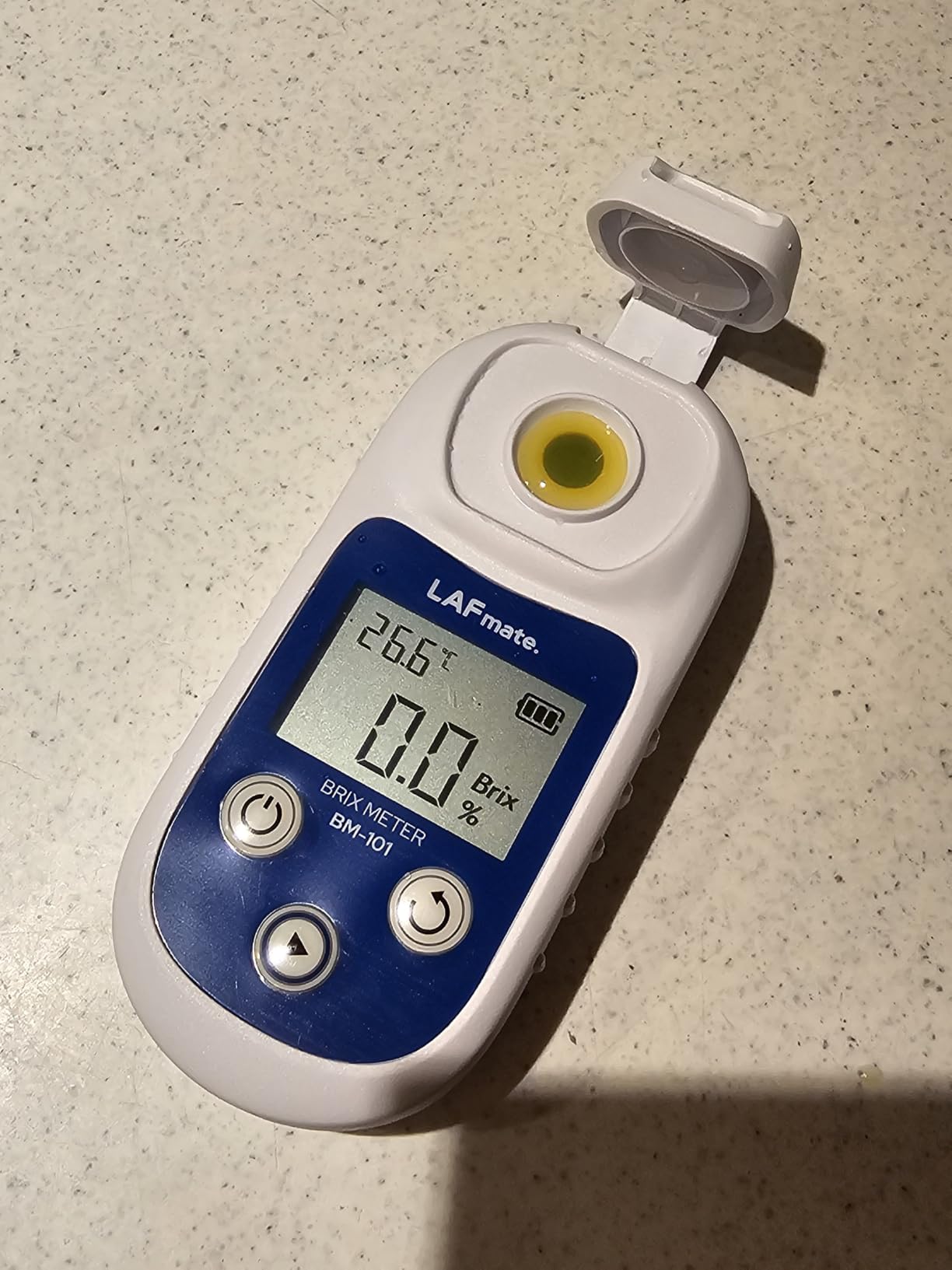
The BM101 is built for people who take readings outside. It is the only unit here with an integrated light shield over the prism, which owners specifically praise for keeping readings stable in direct sunlight, the condition that most often produces nonsense numbers on cheap digital meters.
Automatic temperature compensation covers 5 to 40 degrees Celsius, wider than several competitors. The body is IP65 rated and rinses under a running tap, the readout takes two seconds, and a three-button interface handles distilled-water calibration without fuss. It weighs 8.8 ounces and includes three AAA batteries, a dropper and a cleaning cloth.
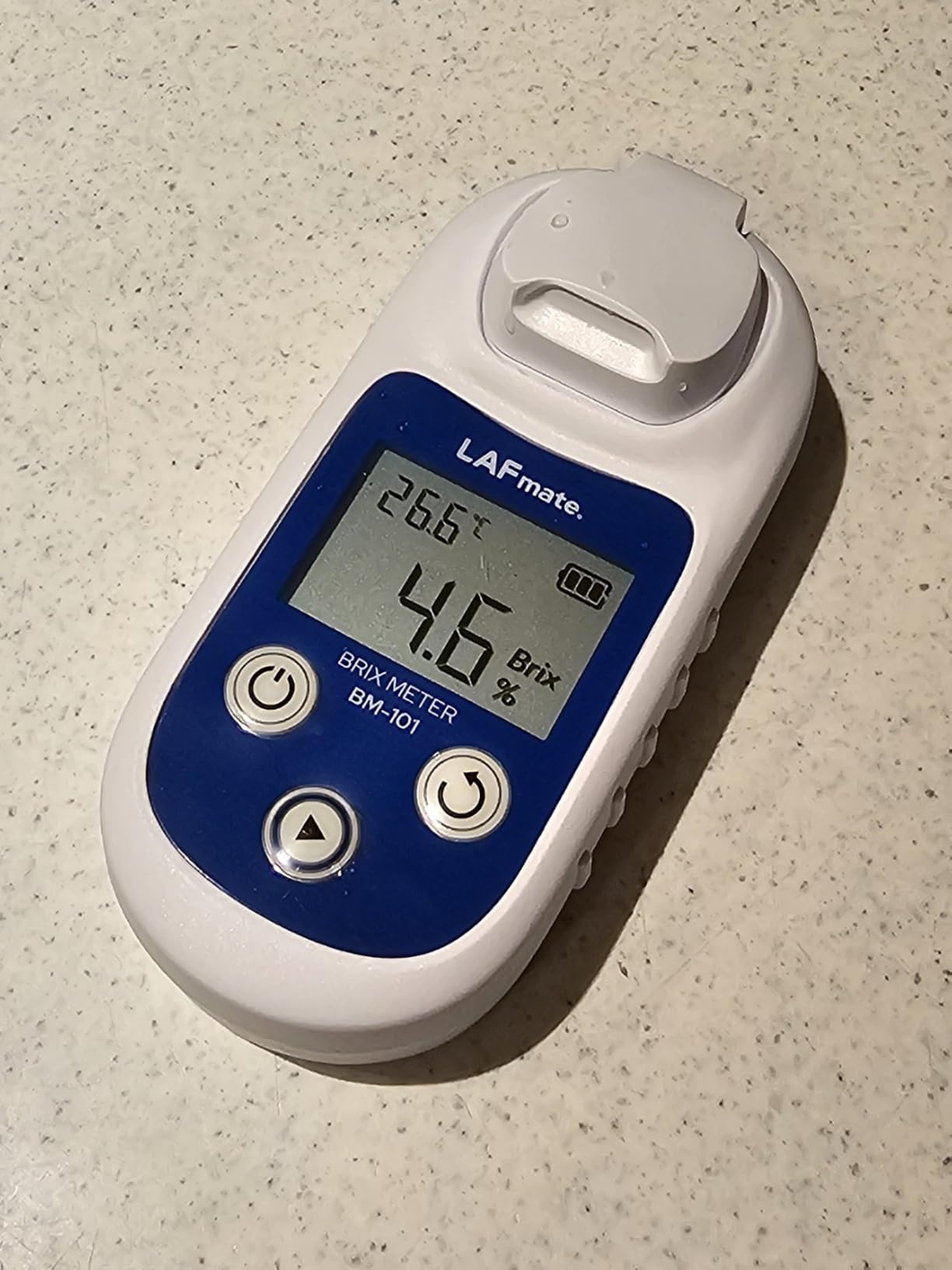
At 4.1 stars across 156 reviews, this sits in the middle of the pack. The praise is consistent: fast readings, easy calibration, a rinsable body and a light shield that earns its place. Users testing slush, brewing, tomatoes and honey at the hobby level tend to be happy with it.
The durability concern is real enough to mention plainly. One verified buyer reported a unit stopped working shortly after the return window closed, which leaves no warranty recourse. If that happens, buying a spare is cheaper than replacing a tool you rely on weekly.
Good for field and greenhouse work
Orchard ripeness checks, garden tomato testing, outdoor brewing sessions and any warm-weather work benefit from the light shield more than from any other feature on this list. The 0-95% version covers honey and syrup work if that is your application.
Not ideal for precision batches
Stated accuracy is plus or minus 0.2%, wider than the Flagfront unit, so it is not the instrument for fine comparisons. Pulpy samples need to be strained first or the reading will drift. And the screwdriver battery compartment is one more thing to lose on a picnic blanket.
7. LAFMATE BM-169-55 – the Best Budget Pick
LAFMATE Digital Refractometer Range 0-55% Brix for Wine Making, Home Brewing, Brix Refractometer with ATC for Coffee, Juice,Fruit Brix Meter
0-55% Brix with 2 second readings
Up to 90 hours on 3 AAA batteries
IP65, 5 minute auto shutoff
Pros
- Best rating-to-price balance in the roundup at 4.5 stars
- Real IP65 sealing with a gasketed battery panel and metal threaded insert
- Up to 90 hours of operation on three AAA cells
- Backlit screen with battery indicator readable by older users
- Verified owners report readings matching manual refractometers and 10 percent test solutions
Cons
- 0-55% range cannot measure maple syrup or honey despite listing claims
- Dropper is low quality and closed-ended
- Sample well needs about 70 percent fill
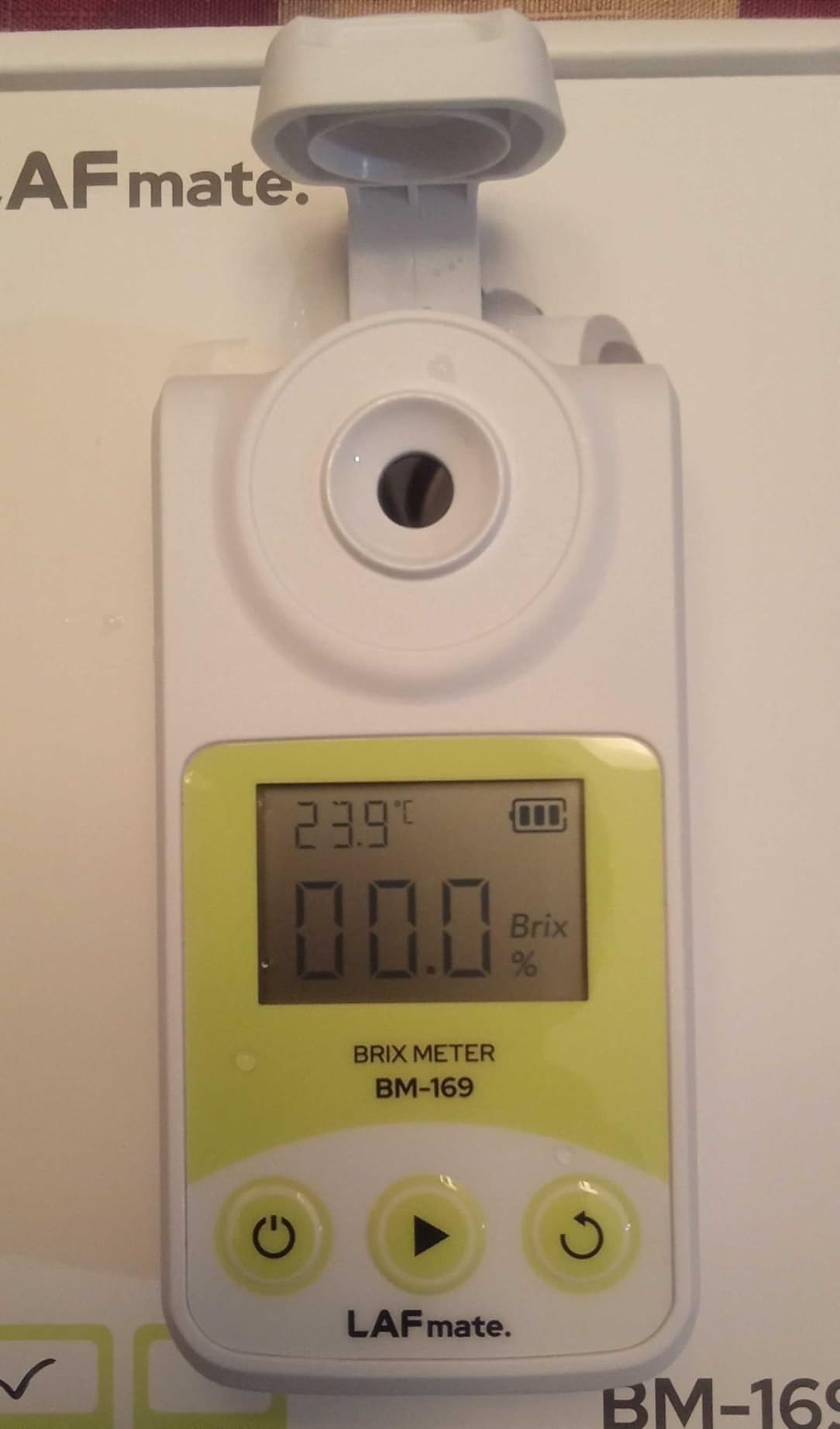
At the bottom of the price range, this is the meter most people should start with. It reads 0-55% Brix with plus or minus 0.2% accuracy, returns a result in about two seconds, and compensates automatically from 5 to 40 degrees Celsius.
The sealing is what separates it from other entry-level units. Instead of a plastic hatch, the battery panel is gasketed and uses a threaded metal insert, which is why it carries genuine IP65 certification. Battery life is the other standout: up to 90 hours of continuous operation on three AAA cells, with a five-minute auto shutoff.
Verified owners report readings that line up with manual refractometers and 10 percent sugar test solutions, and the 4.5-star average across 123 reviews is the strongest rating relative to cost in this roundup. That is not a small sample and it is not a handful of early reviews either.
The catch is the same one shared by every 0-55% meter, and this listing is worse because it suggests honey and maple syrup capability the range cannot deliver. The included dropper is closed-ended and hard to rinse, and the well needs roughly 70 percent fill, which is wasteful on a tiny espresso-sized sample.
Best first digital refractometer
If you brew, make juice, or test fruit, this covers the work at a fraction of what the prosumer models cost. The gasket, the long battery life and the verified accuracy make it the value pick for anyone who will measure once a week rather than ten times a day.
Where it falls short
Ignore the honey and maple claims in the listing. A 0-55% ceiling means those samples simply cannot be read. It also needs distilled water for calibration and will want recalibrating after a drop or a knock, which is normal but worth knowing before you rely on it mid-session.
8. Milwaukee MA887 – Best for Aquariums and Saltwater Tanks
Milwaukee Salinity Digital Refractometer with Carrying Case for Saltwater Aquariums – MA887BOX
PSU, ppt and specific gravity output
Automatic temperature compensation
Sealed prism steel well hard case
Pros
- Reports three scales: PSU ppt and specific gravity
- Automatic temperature compensation on every reading
- 1.5 second response with a sealed flint glass prism
- Hard protective carrying case included
Cons
- Larger and heavier at 1.52 pounds than pocket digital models
- Bundled calibration fluid measured 1.023 SG rather than the stated 1.025
- One verified buyer reported readings slightly high against validation solution
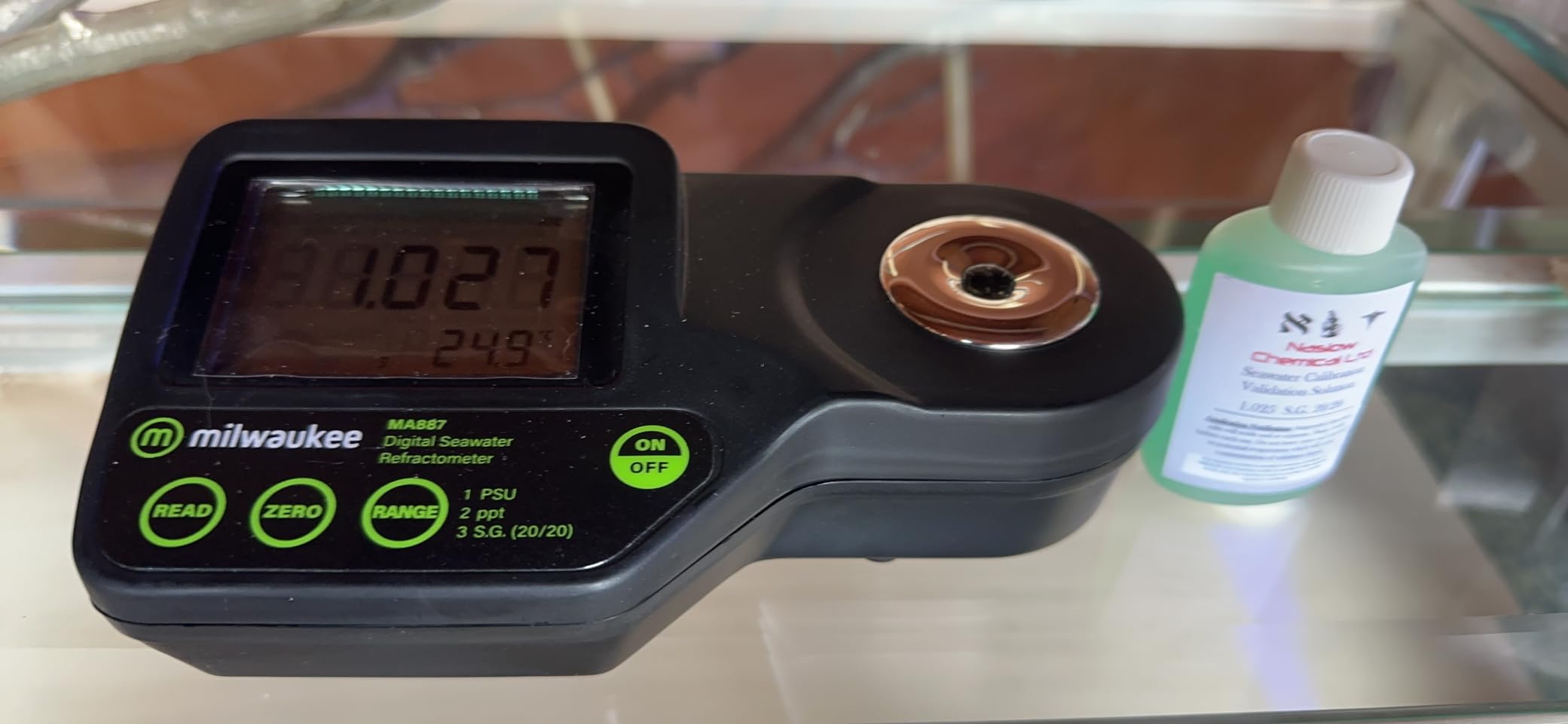
The MA887 is the only true saltwater instrument in this roundup, and that single fact decides whether it belongs in your hands. It measures natural and artificial seawater and reports the result three ways: PSU, parts per thousand, and specific gravity at 20/20, so you can read it in whichever units your tank notes use.
The hardware follows the Milwaukee MA871 pattern, with a sealed flint glass prism in a stainless steel well, automatic temperature compensation on all readings, and a 1.5 second response. A hard protective carrying case comes in the box, which matters if you are moving between a mixing station and a fish room.
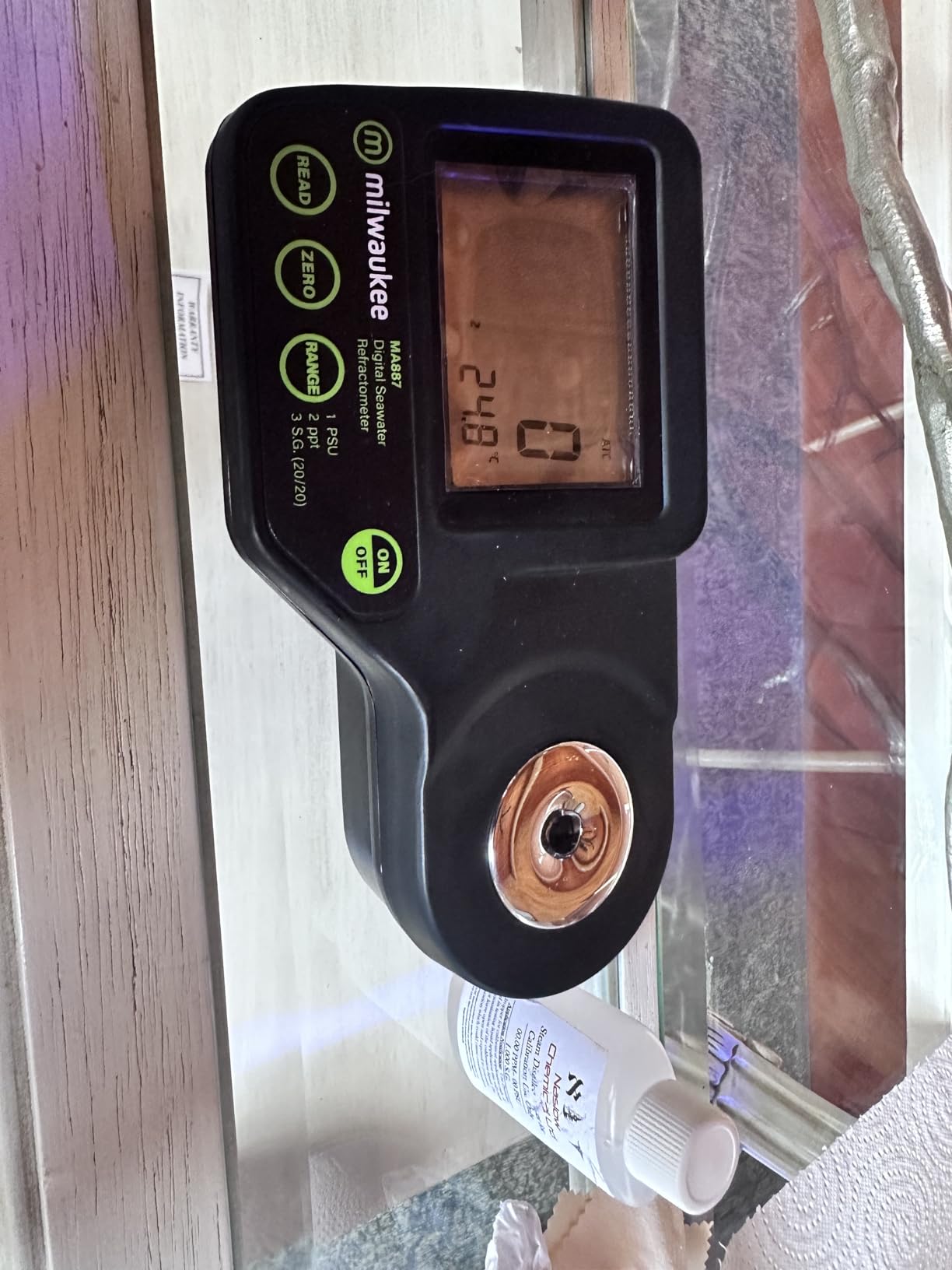
Marine aquarium professionals and hobby reef keepers rate it well, and long-term owners on reef2reef treat the Milwaukee digital line as the standard replacement for analog salt refractometers that corrode and lose accuracy. The 4.4-star average comes from 62 reviews, a smaller base than the general-purpose MA871 but consistent within itself.
One detail deserves attention before you rely on it. Buyers report the bundled calibration solution measuring 1.023 specific gravity rather than the stated 1.025, and one verified buyer saw readings run slightly high against validation fluid. If you are dosing salt by the drop, buy your own reference solution.
Best for reef tanks and mixing stations
If you maintain a marine aquarium, this is the meter to buy. Reporting PSU, ppt and specific gravity at once removes the mental conversion that aquarium forums complain about constantly, and automatic compensation on every reading protects you when your top-off water is colder than your system.
The stainless well is also the right material near a sump, where salt residue and algae are constant.
Wrong tool outside the tank
This instrument will not measure brewing wort, honey or juice. It is also the heaviest unit here at 1.52 pounds, which matters if you were expecting something pocketable. And if you only need to check a saltwater pool, the eSeasonGear meter further down covers that job for far less.
9. COFFMETER 0-35% – Best for Very Small Samples
Digital Brix Refractometer, ±0.1%, Precisionwith ATC, Rechargeable & Portable, for Fruit, Juice, Vegetables & Homebrewing
plus/minus 0.1% precision on 0-35% Brix
Only 0.2 ml sample per reading
Rechargeable battery
Pros
- Highest rated in the group at 4.8 stars with 85 percent five-star ratings
- Tight plus or minus 0.1% precision
- Tiny 0.2 ml sample requirement
- Built-in rechargeable battery with 10+ hours of continuous use
- Wide 5-45 degree Celsius temperature compensation
Cons
- 0-35% base range cannot read honey or maple syrup
- Only 46 reviews
- so the rating rests on a small sample
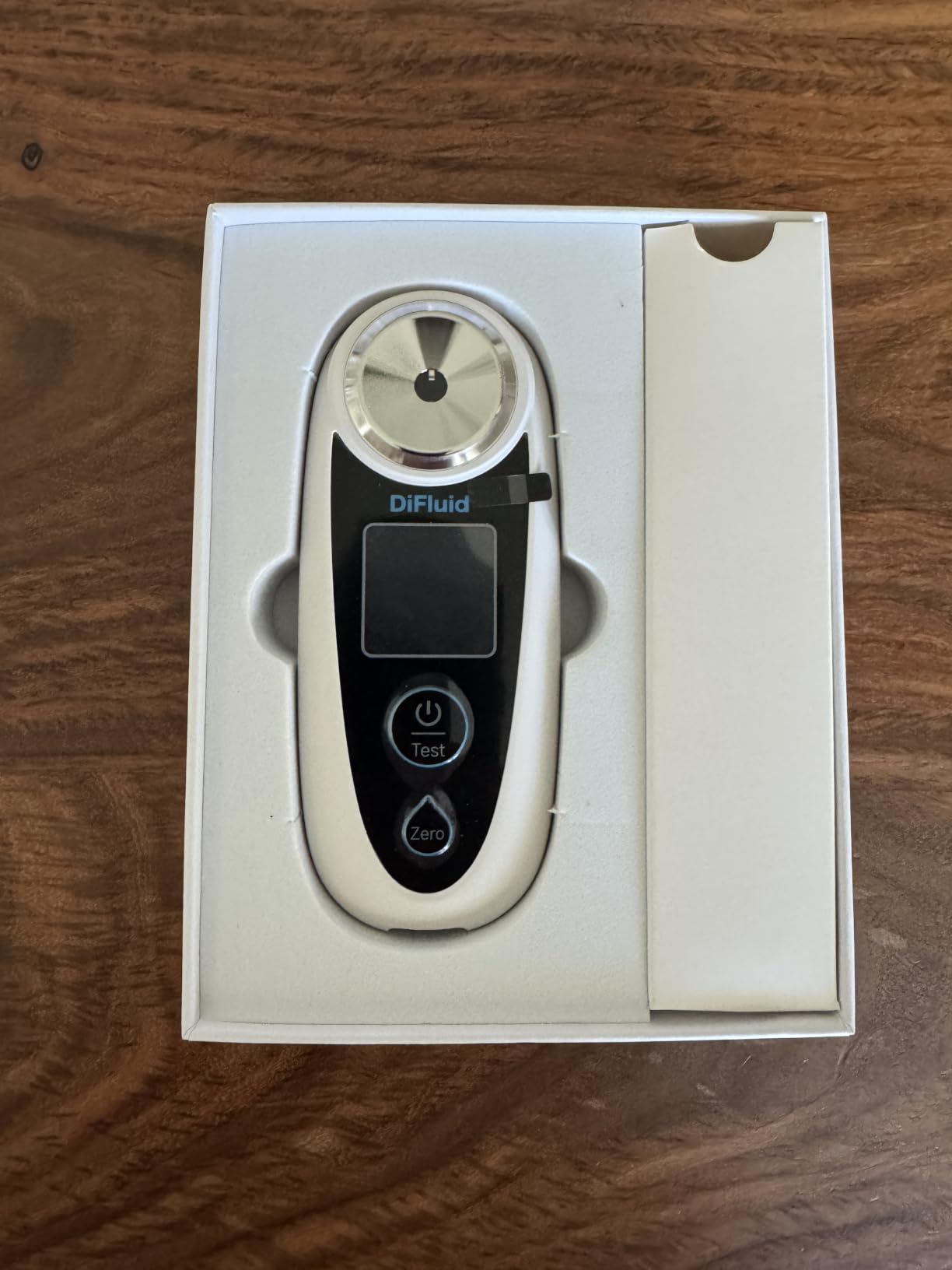
This is the only instrument here that reads from 0.2 ml of sample, and that changes what you can measure. If you work with espresso shots, small laboratory aliquots or concentrated drops, the wells on bigger meters either waste fluid or simply will not cover.
Precision is the other headline. It states plus or minus 0.1% across a 0-35% Brix range, with automatic temperature compensation from 5 to 45 degrees Celsius, the widest window in this roundup. Readings arrive in two seconds after a pure-water zero calibration, on a large HD LCD.
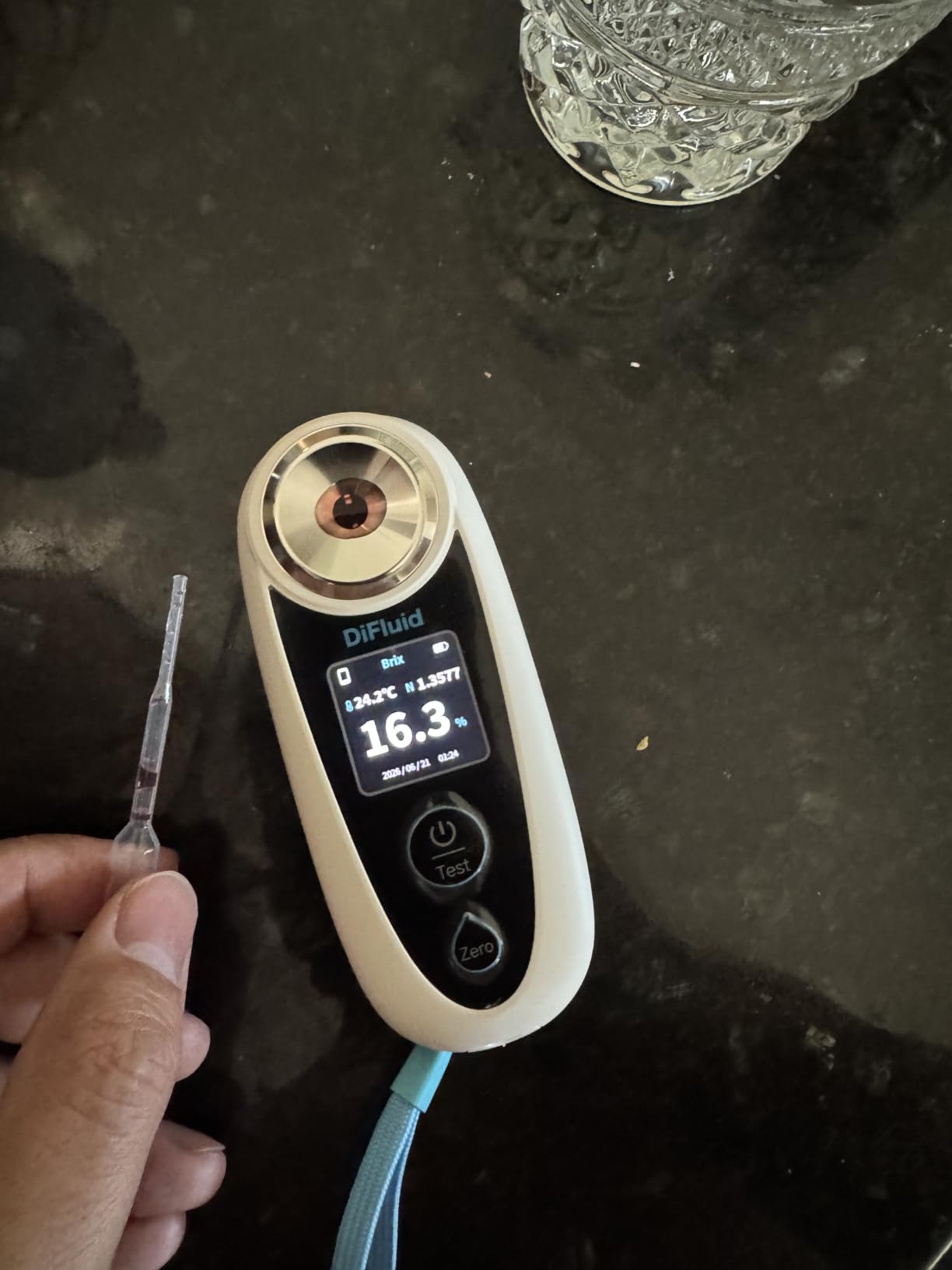
Its 4.8-star average across 46 reviews includes 85% five-star ratings, the highest rating here. The catch is the sample size behind it, which is the second smallest in the roundup, so treat the number as encouraging rather than settled.
Battery life is genuinely convenient: a built-in rechargeable lithium polymer cell gives over 10 hours of continuous use and up to 30 days of standby. App integration lets you save readings and track a process over time, though the app is where most of the value beyond the raw number sits.
Where a tiny sample volume wins
Coffee work, laboratory testing and any sample you cannot spare a full millilitre of will benefit. If you are diluting your sample anyway to fit a bigger meter, the 0.2 ml requirement removes the step entirely and reduces the error that dilution introduces.
Where it falls short
The base 0-35% variant stops well below honey and maple syrup. Reviewers also point out the wide temperature window is useful but the app is required to get real value from the logging feature, so budget for that extra step. The small review base means long-term reliability is largely unproven.
10. LOHAND T95 3-in-1 – Best for Multi-Scale Readings
LOHAND 3-in-1 Digital Brix Refractometer with ATC, 0-95% Measurement Range
Brix, refractive index and temperature on one screen
0-95% range, 0.1% resolution
Results in under 3 seconds
Pros
- Highest rating in the group at 4.9 stars with 87 percent five-star ratings
- 0-95% range verified accurate for maple syrup and honey
- Raw refractive index readout allows manual conversion for salt and other liquids
- Accurate out of the box without calibration
- Large color screen with all parameters shown at once
Cons
- Only 17 reviews the smallest sample in the roundup
- Stated accuracy of plus/minus 0.3% is looser than cheaper units
- Color screen is small for the amount of data shown
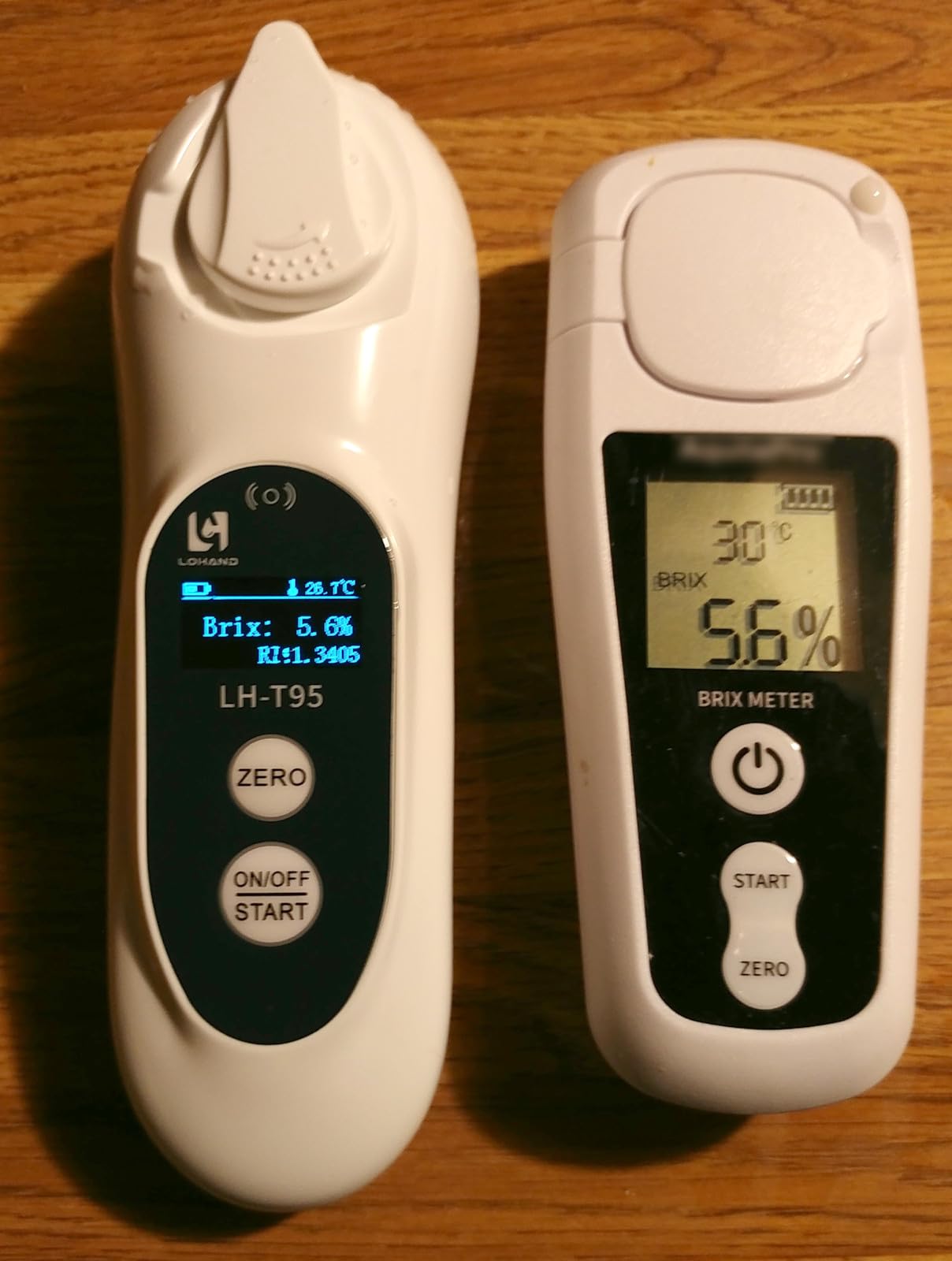
The T95 is the most flexible instrument here because it does not limit you to one scale. It reports Brix, raw refractive index and temperature with automatic compensation on a large color screen, and the refractive index figure can be converted by hand for salt solutions or anything else on your bench.
Range is 0-95% Brix at 0.1% resolution, with results in under three seconds. The prism is IP65 rated and washable, though the body should not be submerged, and it ships with two AAA batteries, a cloth, a sample bottle, a screwdriver, pipettes and a foam-lined storage box.
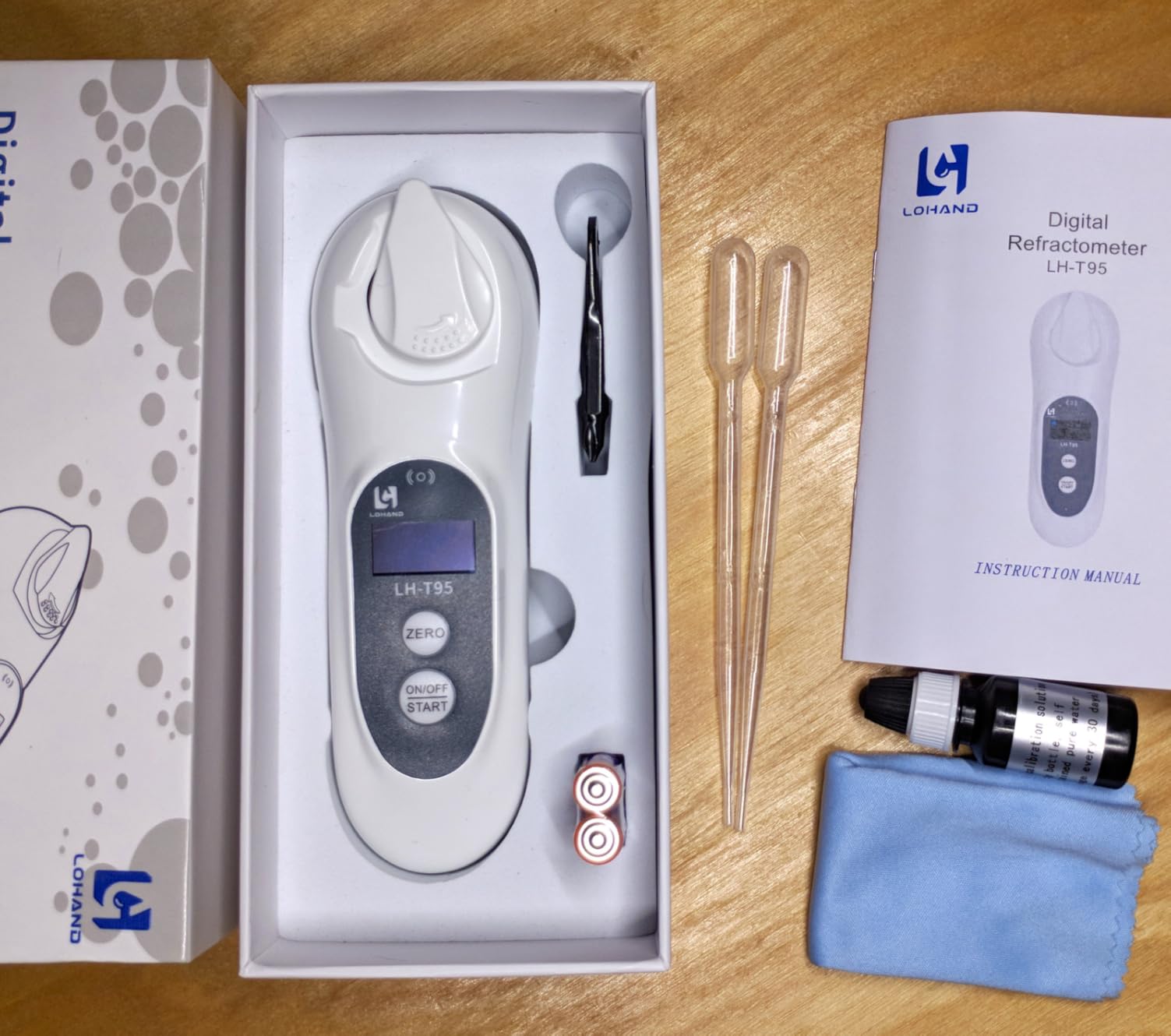
Owners moving from manual refractometers describe it as frictionless, and reviewers report verified accuracy for maple syrup at 67% and honey at 78%, plus correct readings out of the box with no calibration pass. The raw refractive index readout is the feature experienced users mention first.
Its 4.9-star average comes from just 17 reviews, every one of them four stars or better. That is the smallest sample in this roundup by a wide margin, and the stated accuracy of plus or minus 0.3% is looser than what several cheaper meters claim on paper.
Why the refractive index readout matters
Refractive index is the raw measurement underneath everything else. Having it on screen means you are not locked into a single scale, and you can convert to other units yourself for salt, glycol or cleaning solutions rather than buying a second instrument.
For anyone who works across liquid types, that flexibility is worth more than a tighter tolerance figure on a single scale.
Who should be cautious
If you are spending real money on a work instrument, seventeen reviews is thin evidence for long-term reliability. The stated plus or minus 0.3% accuracy also means this is not the meter for fine comparisons, and the color screen is a little cramped for how much data it carries.
11. REVASRI 0-55% Brix – Best Rechargeable Budget Meter
REVASRI Digital Brix Refractometer, Rechargeable Brix Meter for Liquid Sugar Content with LCD, 0-55% Range ±0.2% Accuracy with Auto Temperature Compensation
0-55% Brix with 0.1% resolution
750mAh rechargeable cell, USB charging
Washable waterproof sample tank
Pros
- 750mAh rechargeable battery lasting at least a month per charge
- Lightweight 5.6 ounce body in a compact 5.2 by 2 by 1.2 inch footprint
- High light-transmission prism supports consistent readings
- Waterproof sample tank washes under running water
- USB charging avoids disposable battery waste
Cons
- 0-55% range cannot measure honey or maple syrup
- Only 19 reviews leaving limited long-term reliability history
- Charging port must be kept away from water
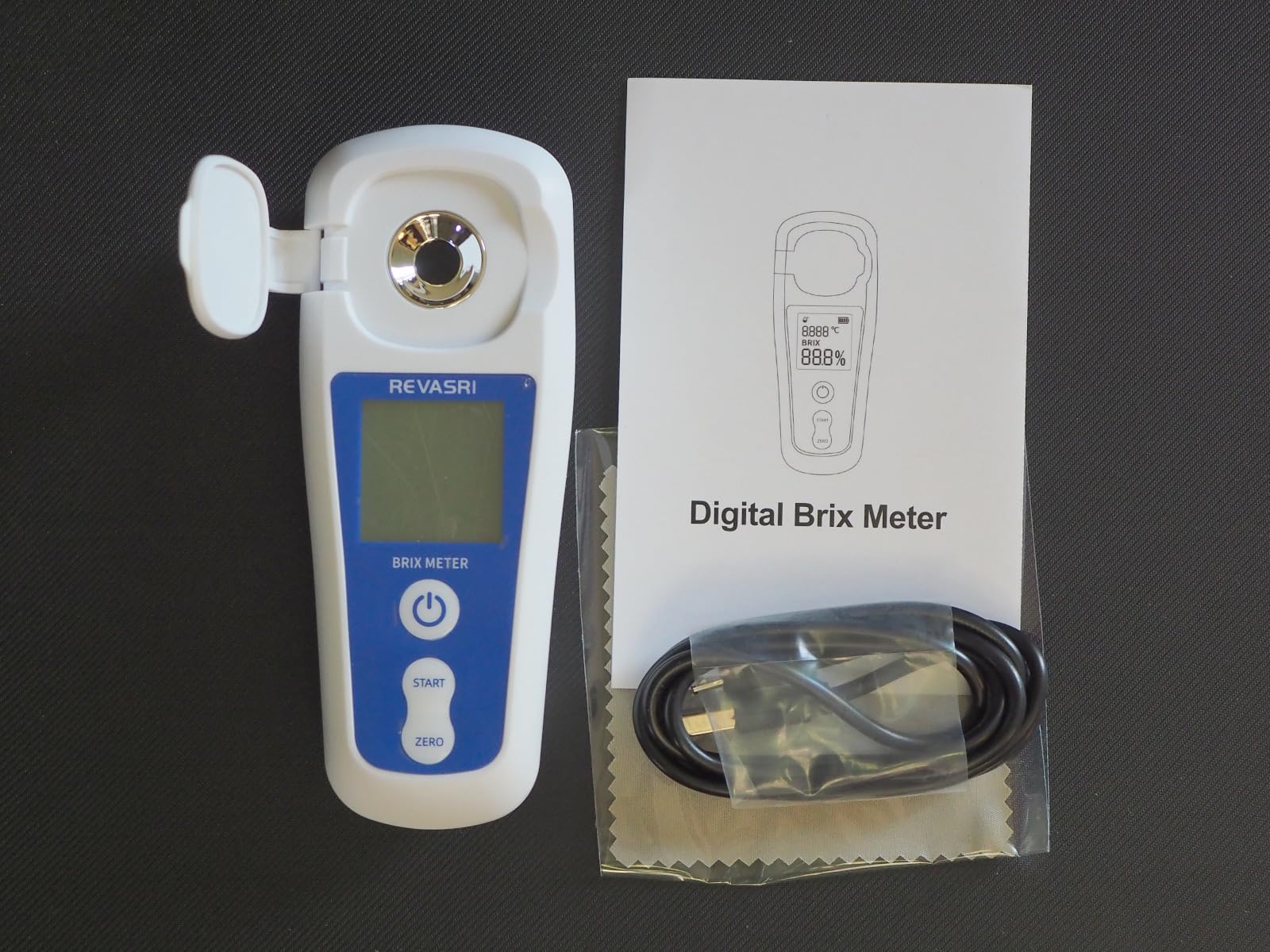
The REVASRI sits at the entry end of the rechargeable options, and the battery claim is the headline: a 750mAh lithium cell that lasts at least a month on one charge. That removes battery anxiety entirely for anyone who measures intermittently rather than daily.
It measures 0-55% Brix at plus or minus 0.2% accuracy with 0.1% resolution, compensates automatically from 10 to 40 degrees Celsius, and uses a high light-transmission prism intended to improve consistency. The sample tank is waterproof and rinses under running water, though the charging port needs to stay dry.
At 5.6 ounces in a 5.2 by 2 by 1.2 inch body, it is one of the smallest meters here, which suits a lab bench corner or a kit bag. Operation is genuinely one-step: zero calibration on first use, then drop, close the cover and press start.
The 4.2-star average rests on 19 reviews, the second smallest base in this roundup, so durability over years is largely untested. For occasional users buying their first rechargeable meter, that is an acceptable risk. For daily commercial work, it is thin evidence.
Good fit for occasional use
If you test juice, must or wort a few times a month, charging once and forgetting about it is a real convenience over models that drain three AAA cells. The compact footprint also keeps a small bench clear.
Limits worth knowing
The 0-55% ceiling rules out honey and maple syrup entirely. The narrower 10 to 40 degree compensation window matters if your samples are very cold or very hot, and the open USB port means you cannot rinse the whole unit under a tap.
12. eSeasonGear SALT-3050 – Best for Pools and Koi Ponds
eSeasonGear SALT-3050 Waterproof IP65 Meter, Digital Salinity PPM Temperature Tester for Salt Water Pool and Koi Fish Pond
0-9999 ppm salt range, precalibrated at 3000 ppm
IP65 waterproof, reads temperature
0-55 degrees Celsius range
Pros
- Largest review base in the roundup at 2475 reviews
- Precalibrated at 3000 ppm NaCl so it is usable immediately
- Digital display readable in bright sunlight unlike test strips
- IP65 build is sturdy for poolside use
- Reports salt in ppm or percent plus water temperature
Cons
- Measures total dissolved solids rather than true NaCl salinity so readings can run high
- Two verified buyers documented readings around 2400-3600 ppm against an actual 3200 ppm
- Not for marine aquariums or food salt testing
- Separate 3000 ppm calibration fluid is needed for accurate setup
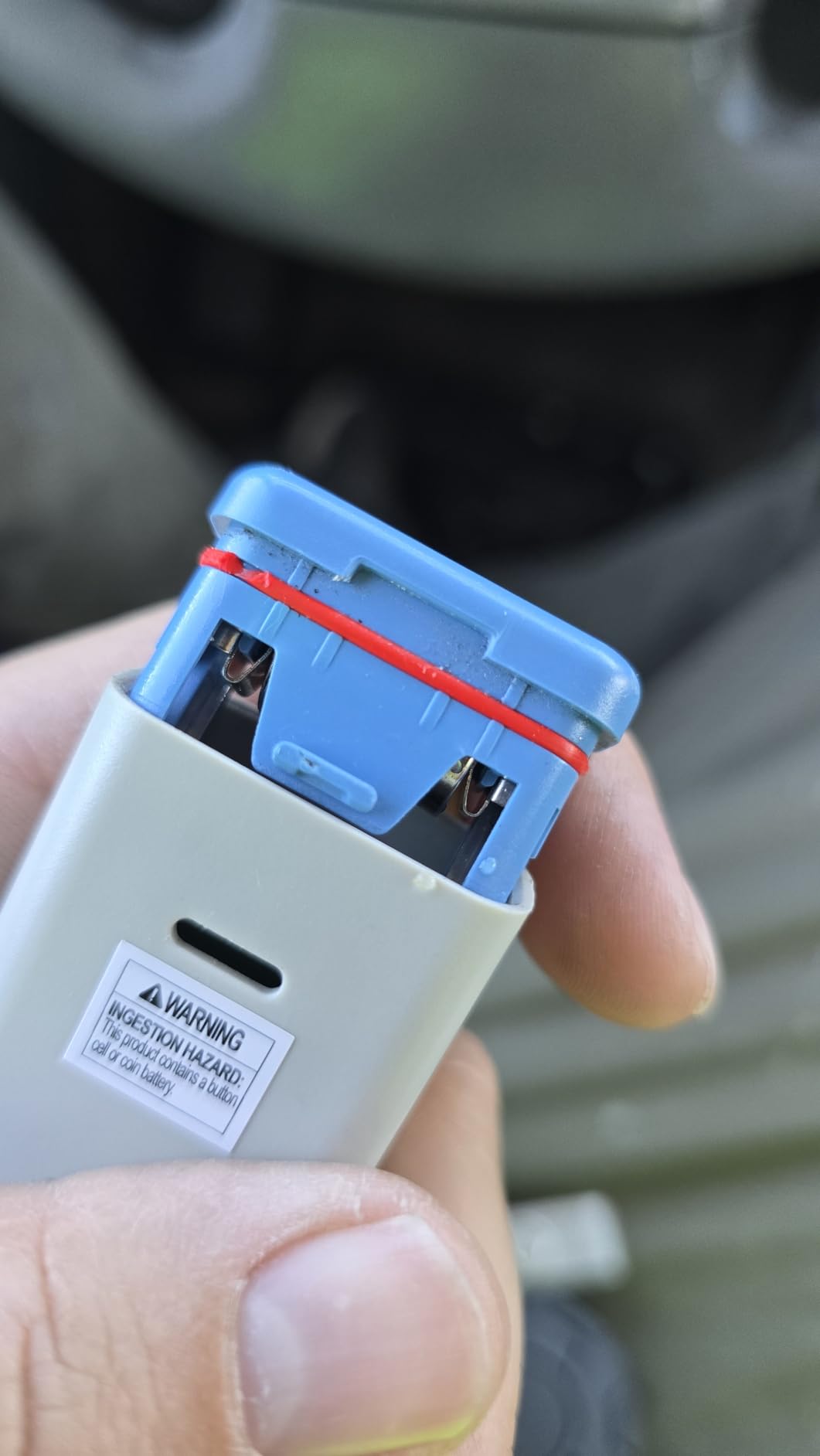
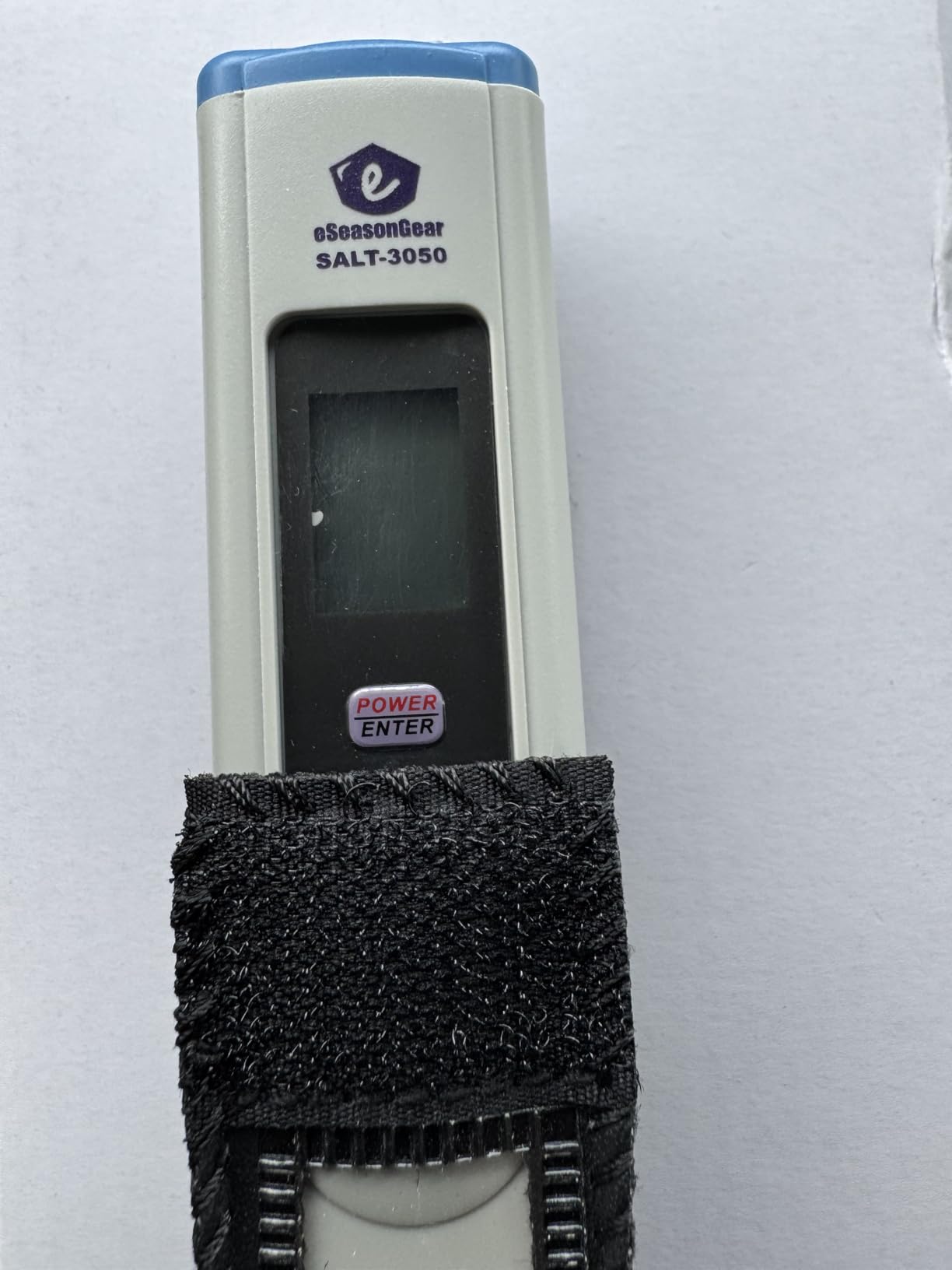
The SALT-3050 is not a refractometer in the optical sense, and the distinction matters. It is a conductivity-based salt meter aimed squarely at saltwater swimming pools and koi ponds, measuring 0-9999 ppm or 0.0 to 1.0% salt alongside water temperature across a 0-55 degree Celsius range.
It arrives precalibrated at 3000 ppm sodium chloride at 25 degrees Celsius, so you can use it without buying fluid first, though a separate calibration solution is needed for accurate setup later. The IP65 housing is built for poolside work, and the digital display stays readable in direct sunlight where test strips and small LCDs fail.
By a wide margin this is the most proven instrument here, with 2475 reviews averaging 4.3 stars and a lot of them from pool service businesses that use it daily. Many customers switch to it specifically to stop using test strips.
Understand what it measures before you trust it. It reads total dissolved solids, so anything dissolved in the water beyond salt pushes the reading high. Two verified buyers documented results between 2400 and 3600 ppm against an actual 3200 ppm, and the listing is explicit that it is not for marine aquariums or food salt testing.
Where it does the job well
Pool service technicians, koi pond owners and anyone dosing salt by hand will find a bright, rugged, quick meter with a proven track record. At this review volume, reliability is the least uncertain thing about it.
Where it should stay away
Reef and marine aquarium keepers should not use it, and neither should anyone doing food salt testing. If your concern is true NaCl salinity rather than total dissolved solids, the Milwaukee MA887 measures the right thing. Expect small positive bias on any water with other dissolved material.
How to Choose a Digital Refractometer
Range first, everything else second. A meter that cannot reach your sample’s concentration produces a number that looks authoritative and means nothing, and this is the single most common regret we found among buyers. Before comparing accuracy or battery life, work out the highest concentration you will ever put on the prism.
Which scale do you need?
Brix measures sugar as a percentage by weight, and it is the standard scale for brewing, winemaking, juice, honey and maple. Specific gravity is a density ratio brewers use to calculate alcohol by volume, and most digital Brix meters convert between the two internally. Salinity in parts per thousand or PSU is the reef aquarium scale, and it needs a dedicated salt instrument. Baume and Babo scales appear on winemaking and syrup equipment and are worth checking for if that is your application.
If your liquid is salt water, any Brix-only meter in this list is the wrong purchase, however good its rating. That mistake shows up repeatedly in aquarium forums, where owners buy a general Brix meter and then find it cannot read their range. It is a good companion to our guide to digital church organs in terms of picking one instrument and mastering its scale properly.
How accurate does your accuracy need to be?
Accuracy and resolution are different numbers. Accuracy is the tolerance around a reading, stated as plus or minus a figure; resolution is the smallest step the display shows. A meter claiming plus or minus 0.2% accuracy at 0.1% resolution is telling you the honest thing: the last digit is display, not measurement.
For most home work, plus or minus 0.2% is plenty. For propagation work, cutting tests and any comparison between two close samples, plus or minus 0.1% is worth paying for. If you are simply asking whether juice is at 12 or 25 Brix, do not spend more for a tenth of a point.
What automatic temperature compensation really buys you
Sugar solutions change refractive index as temperature rises, so a raw reading at 5 degrees Celsius and a raw reading at 30 degrees will differ even though the liquid is identical. Automatic temperature compensation applies a correction so the displayed value matches the liquid’s composition rather than its temperature. It is the single most useful feature in this category.
Check the compensation window rather than assuming. Ranges here run from 5-40 degrees Celsius on some units to 10-40 on others and up to 5-45 on the COFFMETER. A window of 10-40 is fine for a warm kitchen but narrow if you pull cold wort straight from a fermenter.
Refractometer vs hydrometer, and the fermentation accuracy problem
This is the question that comes up in nearly every brewing forum, and the honest answer is that both instruments have a failure mode. A refractometer is faster, uses a fraction of the sample and reads in seconds. A hydrometer is slower, needs more liquid, but its calibration is physical and it is not fooled by alcohol in the sample.
Here is the problem. A refractometer infers specific gravity from refractive index using a relationship calibrated for sugar in water. Once fermentation produces alcohol, that relationship breaks down, and the displayed reading drifts low. The common forum reaction is a reading of 1.000 or a number that is physically impossible for the beer you brewed, followed by a loss of trust in the instrument.
Reef and aquarium owners hit a similar trap with temperature: a cold sample straight from the tank gives a wrong reading unless the meter compensates or the sample is warmed first. Long-term owners across the brewing forums use both instruments for exactly this reason, taking the refractometer for quick checks and the hydrometer for the authoritative number at bottling.
Our take: buy the refractometer for daily work, and keep a hydrometer for the final reading if fermentation accuracy matters to your recipe. If you want alcohol by volume directly, look for a meter that pairs with a density analyser rather than relying on a corrected refractometer figure.
Calibration, sample handling and the mistakes that skew readings
Most digital refractometers calibrate with distilled or deionized water, and salinity instruments may need a 1.000 reference solution. Calibrate on first use, after any drop or impact, and whenever readings start to look odd. In practice, most drift complaints turn out to be a dirty prism rather than a bad instrument.
Rinse the prism and wipe it with a soft cloth after every sample, especially when moving between liquids. Residual film is the number one cause of readings that run high, and it is also what damages the accuracy of the LAFMATE BM-310 in the third section above.
Then warm the sample. Let wort or tank water reach about 20 degrees Celsius before you read, close the cover, and wait several seconds for the reading to settle. Community advice repeated across brewing forums is consistent on this point: give the sample time to reach room temperature and give it time on the prism.
Bubbles are the other silent error. A covered sample with trapped air reads inconsistently, so add liquid until the well is properly filled and the cover sits flat. Avoid pulpy or particulate samples unless you strain them first.
Reading a good measurement in five steps
Rinse and wipe the prism so no residue remains from the last sample.
Bring the sample to roughly 20 degrees Celsius rather than reading it straight from a cold fermenter.
Add enough liquid to cover the prism completely and close the cover flat with no bubbles trapped underneath.
Wait several seconds for the reading to stabilise, then read the display.
Rinse the prism immediately under water and wipe dry before putting the meter away.
If you want more hands-on buying guides from our team, we have covered digital synthesizers, digital pianos for adults, keyboard stands for digital pianos and large digital photo frames in detail.
Frequently Asked Questions
Are digital refractometers accurate?
A good digital refractometer is accurate to about plus or minus 0.2% Brix, and the best units in this roundup state plus or minus 0.1%. Accuracy depends far more on technique than on the instrument: a dirty prism, a cold sample or trapped bubbles will ruin the reading. Let the sample reach room temperature, cover the prism completely, wait for the number to settle and rinse between samples.
What is more accurate, a refractometer or a hydrometer?
For original gravity, a well-calibrated refractometer is faster and easier to read. After fermentation, the hydrometer wins, because alcohol distorts the refractive index relationship the refractometer relies on. Experienced brewers keep both: the refractometer for quick checks during the day, the hydrometer for the authoritative reading at bottling.
Why does my refractometer read 1.000 after fermentation?
Alcohol breaks the relationship between refractive index and specific gravity, so post-fermentation readings drift low or appear impossible. The instrument is not broken. Either accept the small inaccuracy, apply a published refractive index correction, or confirm final gravity with a hydrometer, which measures density directly and is unaffected by alcohol.
Why does my digital refractometer not calibrate?
Calibration usually uses distilled or deionized water, and anything else will shift the baseline. Check that you are using genuine distilled water, that the prism is clean and dry before the water goes on, and that the sample sits long enough to settle. Salinity instruments may need a 1.000 reference solution instead of plain water.
What are the most common Brix refractometer errors?
The most frequent errors are reading a cold sample straight from the fermenter, leaving residue on the prism between liquids, trapping bubbles under the cover, and testing a sample above the instrument’s range. Each one shifts the number without any warning on the display. Warming the sample, rinsing between readings and checking your range ceiling prevents all four.
Do I need a digital refractometer if I brew beer?
If you brew regularly, yes. A digital Brix meter turns original gravity into a number in about two seconds using a third of a millilitre, which makes recipe adjustments far easier. Keep a hydrometer if fermentation accuracy matters, because refractometers lose precision once alcohol is present in the sample.
Our Final Pick for 2026
After working through all twelve, the Milwaukee MA871 remains our pick as the best digital refractometer for 2026. Its 0-85% Brix range covers brewing, winemaking, juice and produce work in one instrument, the sealed flint prism and stainless steel well survive the messiest samples, and the two-button layout means you get a number without navigating a menu.
The other picks depend on what you measure. Aquarium keepers should take the Milwaukee MA887, the only dedicated saltwater instrument here with PSU, ppt and specific gravity output. Winemakers and anyone working in the field want the pocket-sized Atago PAL-1. Beekeepers and maple producers need the wide 0-95% range, and tight-tolerance work belongs to the Flagfront meter at plus or minus 0.1%.
Budget buyers get the most usable instrument with the LAFMATE BM-169-55, and small-sample work belongs to the COFFMETER at 0.2 ml. Whatever you choose, get the range right for your highest expected concentration and keep distilled water on hand for calibration.
Last updated in 2026. Specifications and review counts change over time, so check the current listing before buying.