

The best cordless circular saw for framing is the DEWALT 20V MAX DCS570B. Its 7-1/4 inch blade holds 5500 RPM under load through stacked 2x lumber, the electric brake kills kickback on the fly, and the bevel detents at 22.5 and 45 degrees make hip-roof compound cuts repeatable. The DEWALT DCS577B FLEXVOLT goes deeper and the Makita XSH06Z runs longer on a charge, but for a framer working all day, the DCS570B is the one to start with.
I spent weeks putting these saws through framing work rather than bench tests: breaking down stacked 2×4, ripping 2×12, crosscutting headers, and following the cut line through a full sheet of plywood with the dust port hooked up. That distinction matters because most saw roundups compare blade diameter and motor speed on clean, single pieces of lumber. Framing is stacked, dirty, wet, and fast, and the guard behaviour and depth of cut decide whether you finish the cut list or roll your shoulder.
This roundup covers ten 7-1/4 inch cordless sidewinders and rear-handle saws, the class every stick framer actually carries. I scored them on cut depth at 90 and 45 degrees, no-load RPM, weight with the battery installed, guard and brake behaviour, dust management, and how many cuts per charge you get in real 2x lumber. No prices in this guide, since they move constantly; use the Check Latest Price buttons on each card to see today’s number.
If you are also lining up the rest of the site kit, our picks for the best green beam laser levels for framing and the best band saws for woodworking cover the jobs that start where the circular saw stops.
Top 3 Cordless Circular Saws for Framing in 2026

DEWALT DCS570B
- 5500 RPM brushless motor
- 2-9/16 in cut at 90 degrees
- Electric blade brake
- 330 crosscuts in 2x4 pine

DEWALT DCS577B
- 60V FLEXVOLT power
- 2-7/16 in depth at 90 degrees
- Blade-left rear handle
- 53-degree bevel

Milwaukee 2631-20
- 7.2 lb magnesium guards
- LED light and dust port
- Electric brake
- Rafter hook
Best Cordless Circular Saws for Framing at a Glance
All ten saws below are 7-1/4 inch class, the diameter that clears a full-depth 2×12 and handles stacked 2x. Read the table for the quick comparison, then jump to the section on the saw you are considering.
| Product | Specifications | Action |
|---|---|---|
| DEWALT 20V MAX DCS570B 7-1/4 in Cordless Circular Saw |
|
Check Latest Price |
| DEWALT 60V MAX FLEXVOLT DCS577B 7-1/4 in Circular Saw |
|
Check Latest Price |
| Milwaukee M18 Brushless 2631-20 7-1/4 in Circular Saw |
|
Check Latest Price |
 Makita XSR01Z 18V X2 LXT Rear Handle 7-1/4 in Circular Saw Makita XSR01Z 18V X2 LXT Rear Handle 7-1/4 in Circular Saw |
|
Check Latest Price |
 DEWALT 20V MAX XR DCS590B 7-1/4 in Brushless Circular Saw DEWALT 20V MAX XR DCS590B 7-1/4 in Brushless Circular Saw |
|
Check Latest Price |
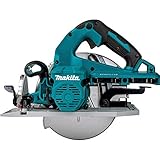 Makita XSH06Z 18V X2 LXT 7-1/4 in Brushless Circular Saw Makita XSH06Z 18V X2 LXT 7-1/4 in Brushless Circular Saw |
|
Check Latest Price |
 Makita 40V max XGT GSR01M1 Rear Handle 7-1/4 in Circular Saw Kit Makita 40V max XGT GSR01M1 Rear Handle 7-1/4 in Circular Saw Kit |
|
Check Latest Price |
 SKIL PWR CORE 20 CR5429B-20 Rear Handle 7-1/4 in Circular Saw Kit SKIL PWR CORE 20 CR5429B-20 Rear Handle 7-1/4 in Circular Saw Kit |
|
Check Latest Price |
 Greenworks 24V Brushless 7-1/4 in Circular Saw with 4Ah Battery Greenworks 24V Brushless 7-1/4 in Circular Saw with 4Ah Battery |
|
Check Latest Price |
 FLEX 24V FX2141R-1J Rear Handle 7-1/4 in Circular Saw Kit FLEX 24V FX2141R-1J Rear Handle 7-1/4 in Circular Saw Kit |
|
Check Latest Price |
1. DEWALT 20V MAX DCS570B: Best Cordless Circular Saw for Framing Overall
DEWALT 20V MAX Circular Saw Cordless with Brake, 7-1/4 Inch, Tool Only (DCS570B)
7-1/4 in blade
5500 RPM brushless
2-9/16 in cut at 90 deg
7.5 lb bare
3 year warranty
Pros
- Holds 5500 RPM under load in stacked 2x
- Electric blade brake stops kickback fast
- Bevel detents at 22.5 and 45 degrees
- LED work light and readable base plate scale
- Rated for 330 crosscuts in 2x4 pine
Cons
- 2-9/16 in depth only clears about three quarters of a 4x4
- Bare tool format with no case included
- Base plate ruler markings are hard to read without light
The DEWALT DCS570B is the best cordless circular saw for framing because it is the rare cordless saw that does not change how you work. It cuts stacked 2x at speed, stops the blade before the timber kicks back, and weighs 7.5 pounds bare so you can carry it up a ladder all day without thinking about it.
Owners consistently talk about the same thing: the brushless motor keeps 5500 RPM under load rather than sagging the moment the blade bites into a wet 2×10. That number is not huge next to the Makita XSH06Z or the 40V XGT saw, but paired with the electric blade brake it means the cut finishes before the saw starts wandering.
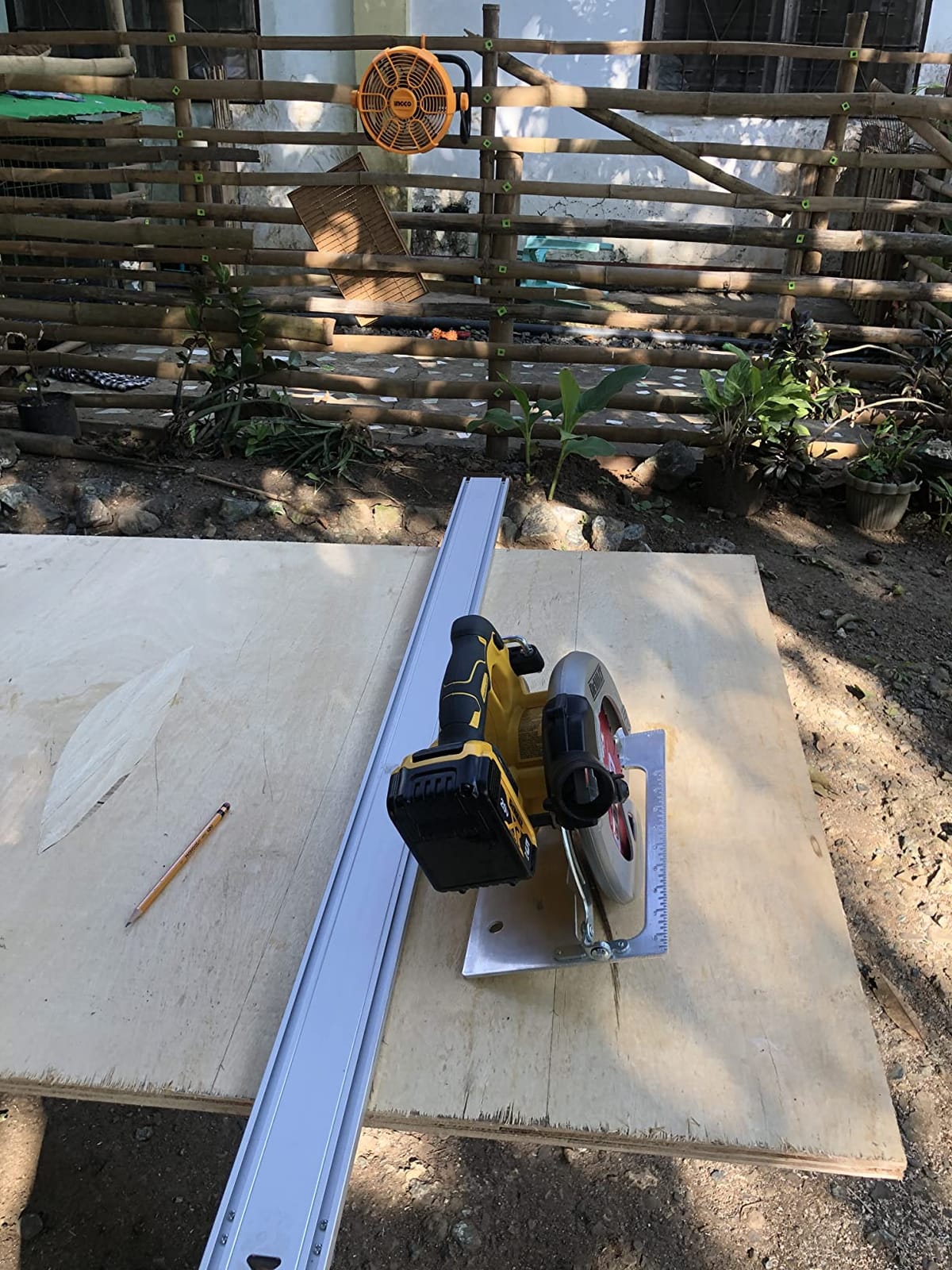
The bevel detents at 22.5 and 45 degrees are the detail that separates this from most 7-1/4 inch cordless saws. Hip roofs, dormers and rafter birdsmouth cuts all land on those two angles, and hitting a detent instead of eyeballing a scale is the difference between a wall that goes up square and one that does not.
The 2-9/16 inch depth at 90 degrees is the honest limitation. It handles a 2×12 laid flat and stacks of three 2×4 without trouble, but it only takes about three quarters through a 4×4, so the pile driver work needs a second pass from the opposite side. For stick framing that trade is fine; for heavy timber it is not.
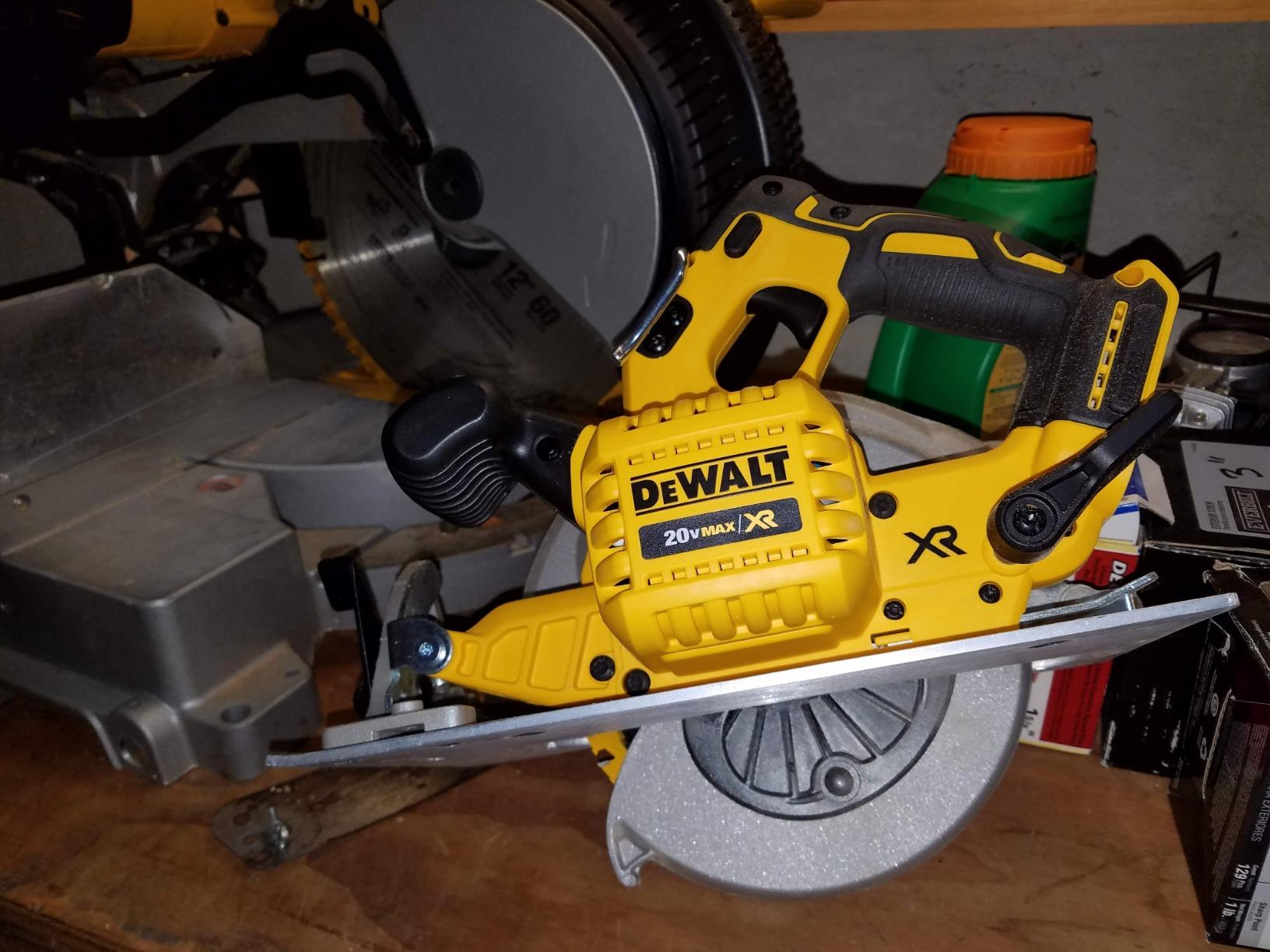
Where the DCS570B earns its place on a framing day
This is the saw for a crew already running 20V MAX packs and cutting a wall per day. Wall framing, floor joists, and a steady run of stud-length crosscuts is exactly the work its 330-crosscut-per-charge figure was measured against, and the LED work light matters when you are cutting headers inside a framed shell with no daylight.
Ripping plywood or OSB sheathing is also comfortable. The brushless motor keeps its speed on the long grain, the electric brake means you can release the trigger at the end of a rip without chasing the saw as it coasts, and the guard does not drift into the cut on a normal bevel.
Where it falls short for a framing saw
The base plate markings are the most common complaint, and they are a real nuisance on repetitive 3-1/2 inch stud cuts where you are setting depth by the ruler rather than by a factory stop. The cut guide on the shoe also does not line up perfectly with where the blade actually enters the timber, so it works better as a rough reference than a precision guide.
Because it is a bare tool, budget for a battery and charger separately if you do not already own 20V MAX packs. A 5Ah pack or larger is the practical choice for framing, since smaller packs leave you swapping mid-wall. If you need more cut depth than 2-9/16 inches for stacked 4x work, look at the DCS577B below.
2. DEWALT 60V MAX FLEXVOLT DCS577B: Deepest Cutting in a Cordless Sidewinder
DEWALT FLEXVOLT 60V MAX* Circular Saw for Framing, 7-1/4-Inch, Tool Only (DCS577B)
7-1/4 in blade
5800 RPM
2-7/16 in depth at 90 deg
10.9 lb
Blade-left rear handle
Pros
- Worm-drive class power in a 7-1/4 inch cordless saw
- 2-7/16 in depth at 90 degrees clears deeper stack lumber
- Blade-left rear handle gives a clear cut line
- Mag magnesium shoe with readable depth and bevel scales
- Integrated dust blower and rafter hook
Cons
- Heaviest of the 20V and 18V class saws at 10.9 pounds
- Compact shoe has less surface area on long rips
- Only accepts 60V MAX FLEXVOLT packs
The DEWALT DCS577B is the best cordless circular saw for framing when your cut list runs into dense, wet, or deeply stacked lumber. Framing carpenters describe it as the most powerful battery saw they have used, and the 2-7/16 inch depth at 90 degrees is the deepest here.
That extra 3/16 inch matters more than it sounds. It is the difference between getting through a stack of 2×12 in one pass and flipping the timber for a second, and on a foundation wall with four-deep piers that is real time saved across a whole day.
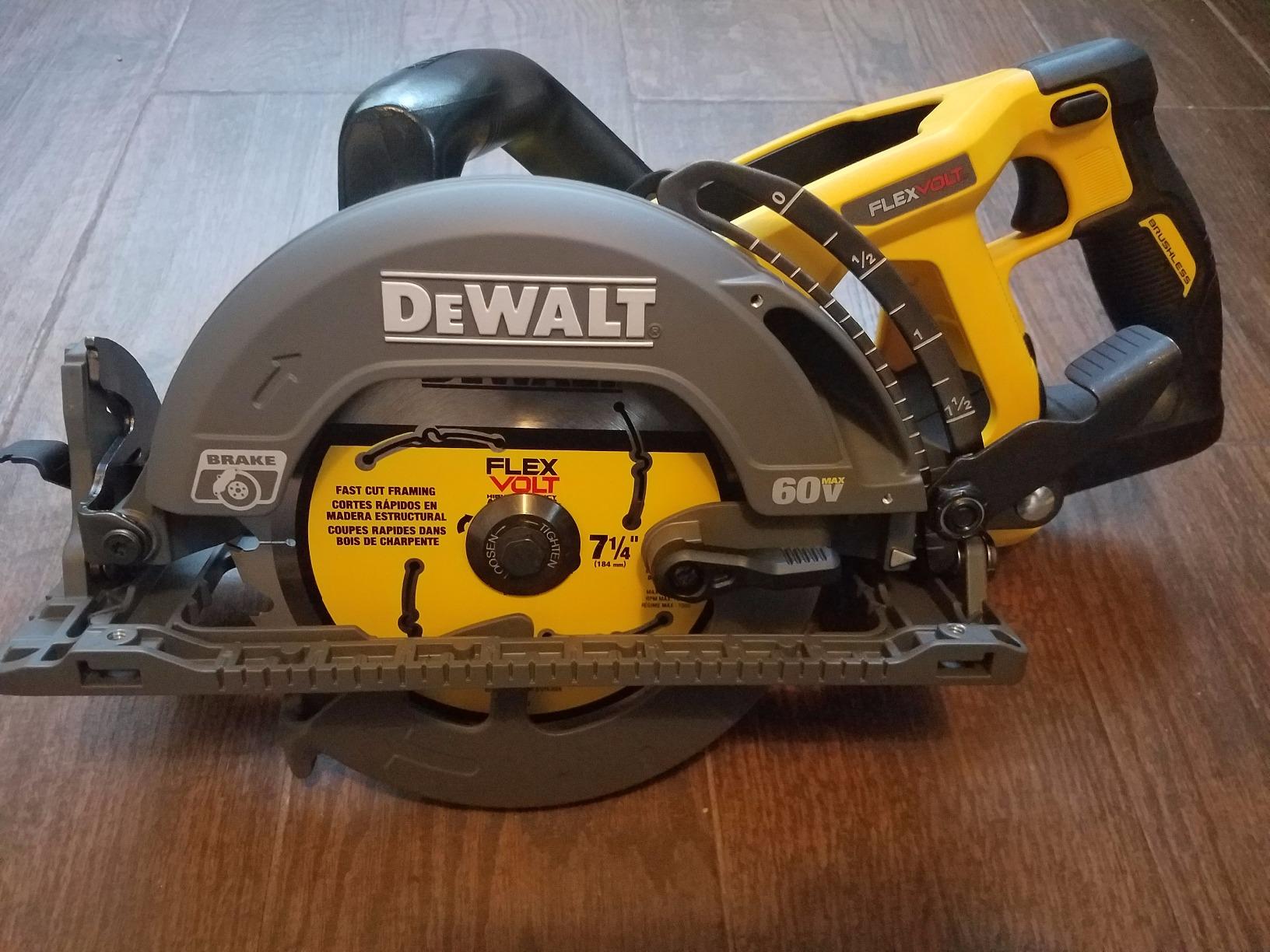
The blade sits on the left of the motor with the handle at the rear, which leaves the sight line completely clear of the housing. For a framers doing hip roofs, dormers and other compound miter cuts, that view of the kerf is worth more than any of the speed differences in this roundup.
The integrated dust blower pushes sawdust off the line as you cut, and the high-grade magnesium shoe tracks smoothly through glue-and-drywall lumber where cheaper stamped plates drag. Bevel stops at 45 and 22.5 degrees are moulded into the shoe, so they cannot walk out of adjustment.
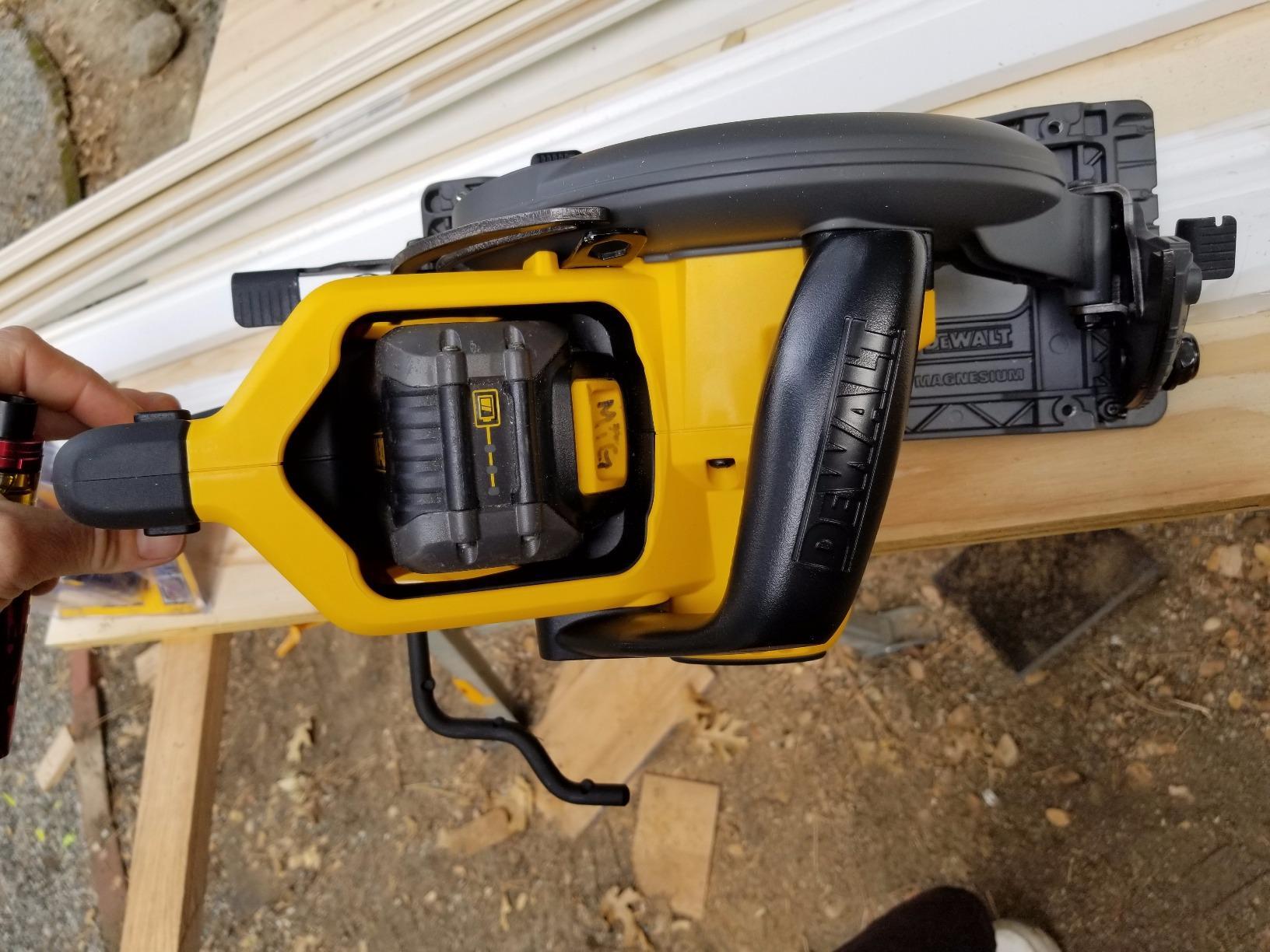
Best reasons to own the FLEXVOLT DCS577B
Treated lumber is the case this saw wins. Wet pressure-treated pine wets out the kerf and drags on the blade, and the extra torque here is what keeps the motor out of the bogs where lighter 18V and 20V saws start to labor.
It is also the right choice for someone already deep into the 60V MAX FLEXVOLT platform with an 11Ah or 15Ah pack. On a big pack, owners report getting through roughly half a working day of cutting without a charge break, which is a genuine step change for a two-person crew.
The weight and platform compromises
At 10.9 pounds this is a heavy saw, and the weight concentrates during long rips and overhead work on a ladder. The compact shoe also has less surface area than a full-width plate, so the first few cuts on a long rip feel less stable until you get used to the shorter footprint.
The other real catch is platform lock. Only 60V MAX FLEXVOLT packs fit, so a 20V MAX battery you already own is useless here. If you are starting fresh on 20V MAX rather than FLEXVOLT, the DCS570B is the same motor family at a much friendlier weight.
3. Milwaukee M18 Brushless 2631-20: Best Value Framing Saw You Can Carry All Day
Milwaukee M18 BRUSHLESS 7-1/4″ CIRCULAR SAW – BARE
7-1/4 in blade
5000 RPM
7.2 lb bare
18V M18
Magnesium guards
Pros
- Lightest framing saw here at 7.2 pounds
- Magnesium upper and lower guards resist job damage
- LED light plus integrated dust port
- Rafter hook for ladder and belt work
- Bare tool format lowers the entry cost
Cons
- 5000 RPM is slower than the 5500 to 6400 RPM class
- Bare tool so packs are a separate purchase
- Dust port routing can be awkward to hook up
The Milwaukee 2631-20 is the best cordless circular saw for framing if your knees, back or shoulder decides the outcome at the end of the day. At 7.2 pounds it is the lightest 7-1/4 inch cordless saw in this group by a wide margin, and light weight is the spec that never appears on a marketing page but shows up in how many cuts you make.
The magnesium upper and lower guards are the other quiet win. Jobsite framing is full of stacked timber and dropped material, and a cast magnesium guard survives knocks that crack plastic ones. That durability is part of why the 4.6 rating holds up across more than a thousand reviews.
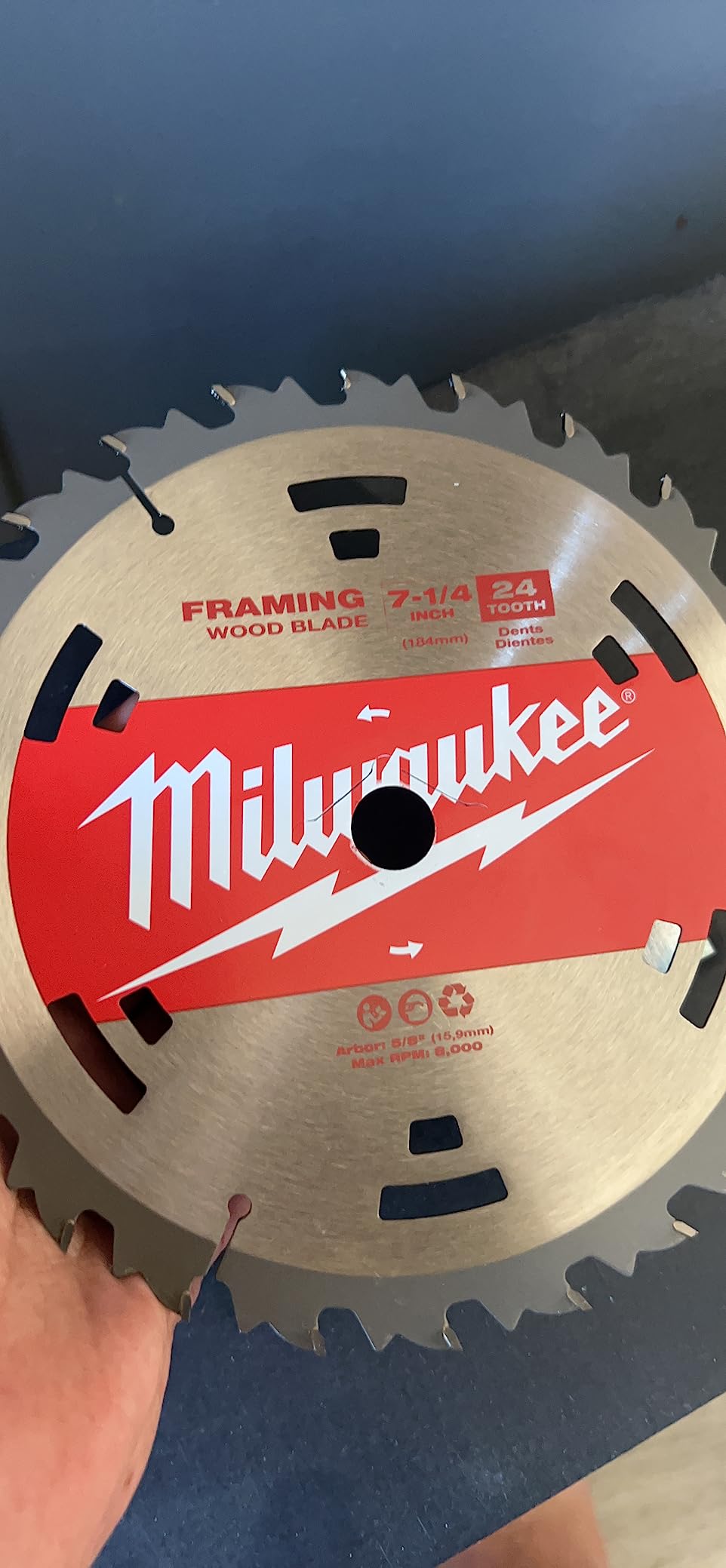
The LED light and the integrated dust port on the guard both earn their place during a real framing day. The light is for cutting inside a framed shell with no daylight, and the dust port helps keep the cut line visible when you are ripping sheathing rather than stud lengths.
The electric brake stops the blade after trigger release, which means a released saw stays put instead of coasting into stacked lumber. That is a genuine safety difference on a crowded floor deck.
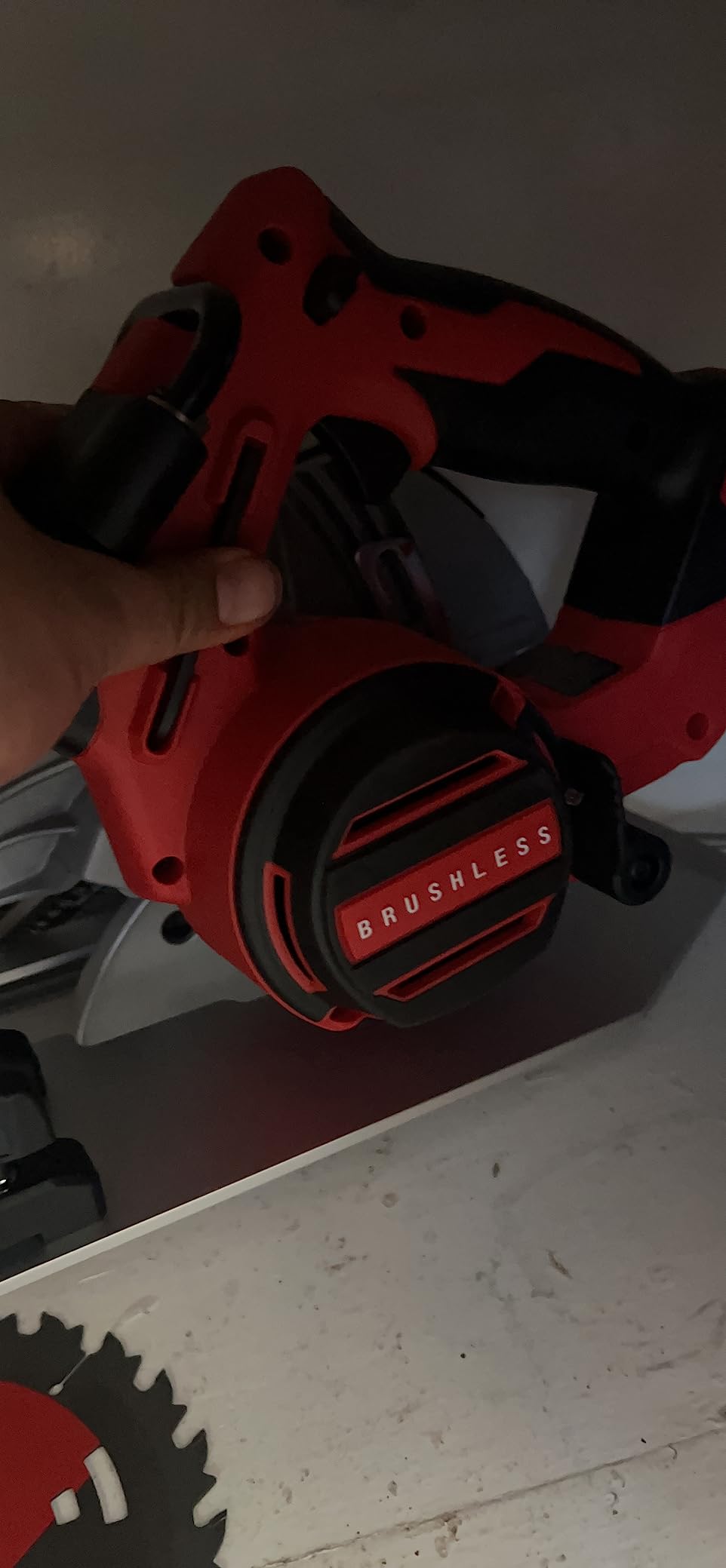
Who this Milwaukee suits best
A framer who spends real time overhead or on a ladder gets the most out of this saw. The integrated rafter hook lets you hang it off a belt or a ladder rung while you set the other hand on the timber, and at 7.2 pounds the saw never becomes the reason you skip the cut.
It is also the easiest entry into 7-1/4 inch framing capability if you already run M18 packs for drivers and impacts. Check our breakdown of the best table saws for woodworking if you are also setting up a shop bench.
Where the M18 brushless saw is not enough
At 5000 RPM no-load it is the second-slowest motor here, behind only the Greenworks. On clean dimensional lumber you will not notice; on stacked 2×12 or wet pressure-treated pine you will feel it asking for patience, and the cuts are slower than the DEWALT and Makita brushless saws.
There is also no plunge capability on this model. For framing cuts into an existing opening that is fine, but if you are fitting a track saw or making plunge cuts at an interior wall, you will need a plunge-equipped saw instead.
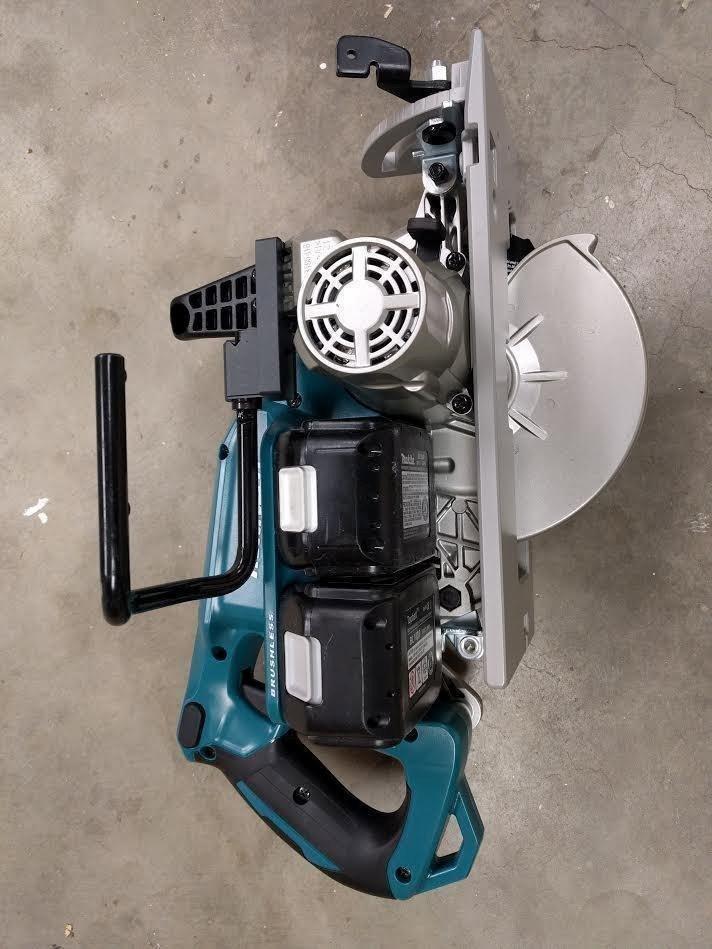
4. Makita XSR01Z 18V X2 LXT: Best for Dense Lumber and Multi-Battery Fleets
Makita XSR01Z 36V (18V X2) LXT® Brushless Rear Handle 7-1/4″ Circular Saw, Tool Only
7-1/4 in blade
5100 RPM
Two 18V packs for 36V
12.1 lb
Die-cast magnesium base
Pros
- Two 18V LXT packs deliver 36V-class power
- 558 crosscuts in 2x4 SPF per charge
- 2-9/16 in cut at 90 degrees clears stacked material
- Die-cast magnesium base and guard feel rigid
- Positive bevel stops at 22.5 45 and 53 degrees
Cons
- Heaviest saw here at 12.1 pounds
- Needs two 18V batteries installed at once
- No rear handle dust blower
The Makita XSR01Z is the best cordless circular saw for framing if you already own a fleet of LXT batteries and want 36V-class punch without a second platform. It runs on two 18V packs at once, which turns a battery drawer you already have into a framing saw that will not bog down.
Its 2-9/16 inch cutting capacity at 90 degrees is tied for the deepest here, and Makita lists up to 558 crosscuts in 2×4 SPF on two 5.0Ah packs, plus 291 cuts in 2×10 SPF. Those are lumber numbers rather than plywood numbers, which is what you want when your cut list is studs and joists.
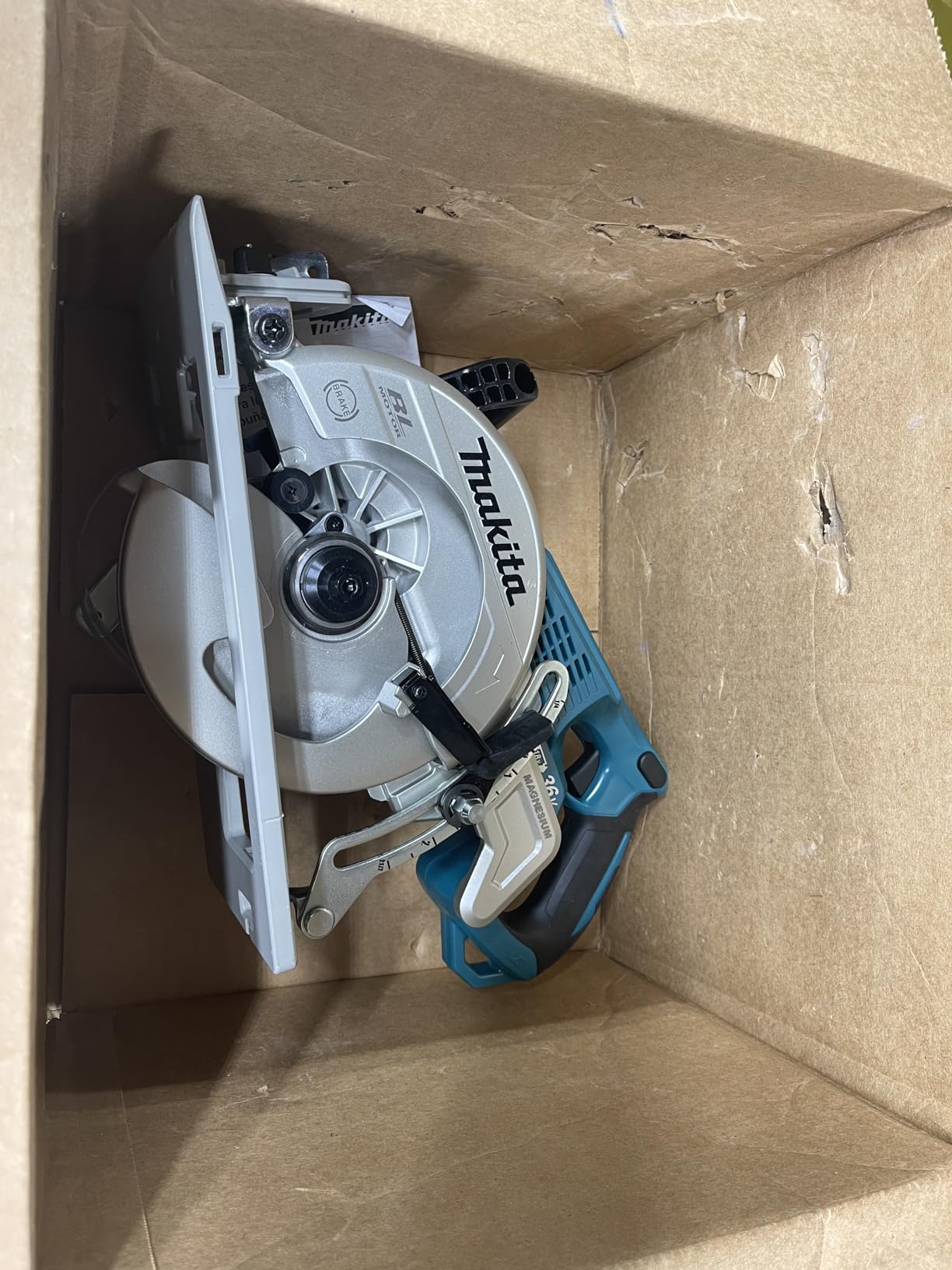
The die-cast magnesium base, blade guard and aluminium blade cover give it the most solid feel of any saw here. On a stocky job where the saw gets set down on concrete, leaned against a stud wall and knocked around, that construction detail is worth paying for.
Automatic Speed Change adjusts cutting speed and torque during the cut, so instead of bogging to a halt in dense grain the motor responds to load. That is the reason this saw handles headers and LVL better than lighter 18V class tools.
Best case for the XSR01Z
Anybody with four or more LXT packs already on site. The maths works out fast: if the batteries are already owned, the dual-battery configuration costs you nothing extra, and you get roughly twice the runtime and far more torque than a single-pack 18V saw.
It also suits anyone cutting headers, engineered lumber or dense hardwood blocking. The torque response under load is the feature to lean on, and the magnesium base holds a straight line on a cut that would wander in a lighter saw.
Where the weight becomes the problem
At 12.1 pounds this is the heaviest saw in the roundup, and it is the heaviest on purpose because two batteries are hanging off the back. On a full day of overhead and ladder work that is the single biggest complaint in owner feedback, and it is a legitimate one.
The two-battery requirement also rules it out for anyone starting from scratch with one pack or two. If you are buying your first LXT batteries, the single-battery saws on this list serve most framers better.
5. DEWALT 20V MAX XR DCS590B: Best 20V Saw for Cutting OSB and Sheathing
DEWALT 20V MAX XR Brushless Cordless 7-1/4 in. Circular Saw, Tool Only (DCS590B)
7-1/4 in blade
5500 RPM
Up to 1700 MWO
368 cuts per charge
9.88 lb
Pros
- Most powerful saw in the 20V MAX line at up to 1700 MWO
- 368 cuts per charge figure in real lumber
- 2-9/16 in at 90 degrees and 2 in at 45 degrees
- Automatic electric brake stops coasting blades
- Low entry point as a bare brushless tool
Cons
- Heavier than the DCS570B at close to 10 pounds
- Bare tool with no battery or case
- Published wattage figures differ from the older DCS570B listing
The DEWALT DCS590B is the best cordless circular saw for framing if you already run 20V MAX and want the newest and most powerful version of it. DEWALT rates it at up to 1700 MWO, the highest output claim of any 20V MAX circular saw, and that number shows up in practice on sheet goods.
Ripping a full sheet of OSB or plywood is the test that separates the good saws from the merely adequate. The 5500 RPM brushless motor holds its speed through a continuous sheet cut instead of winding down toward the exit, which means a straighter, cleaner line and fewer stops to regroup.
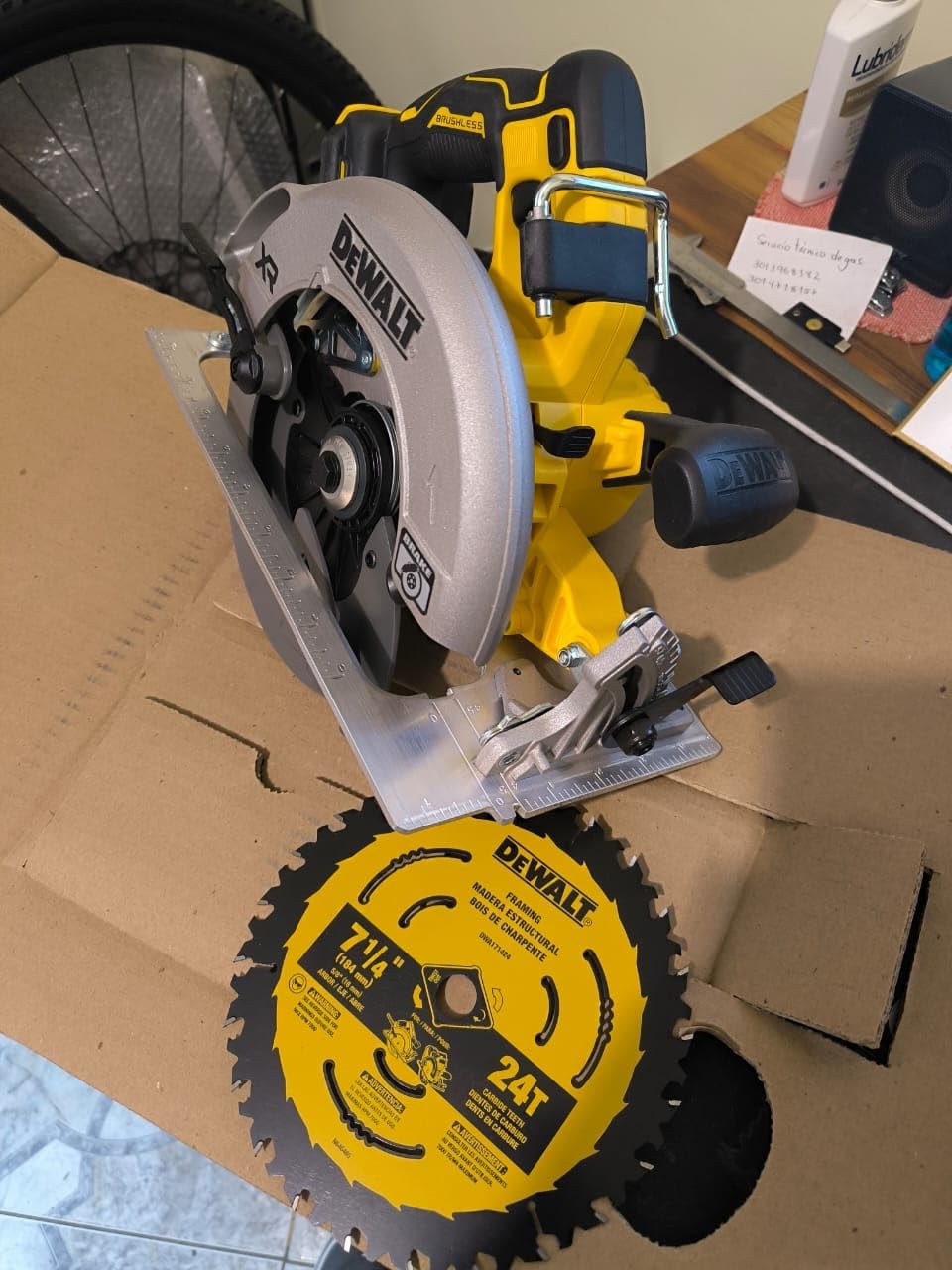
The automatic electric brake is designed specifically to avoid the wide, imprecise cut you get when a released blade coasts through the timber. On sheathing, where the saw is often at full extension of the base plate, that coast can ruin a full sheet.
Depth of cut is 2-9/16 inches at 90 degrees and 2 inches at 45 degrees. The 45 degree figure is honest and worth noting for trim, crown and vaulted work, but for framing you are working square almost all the time.
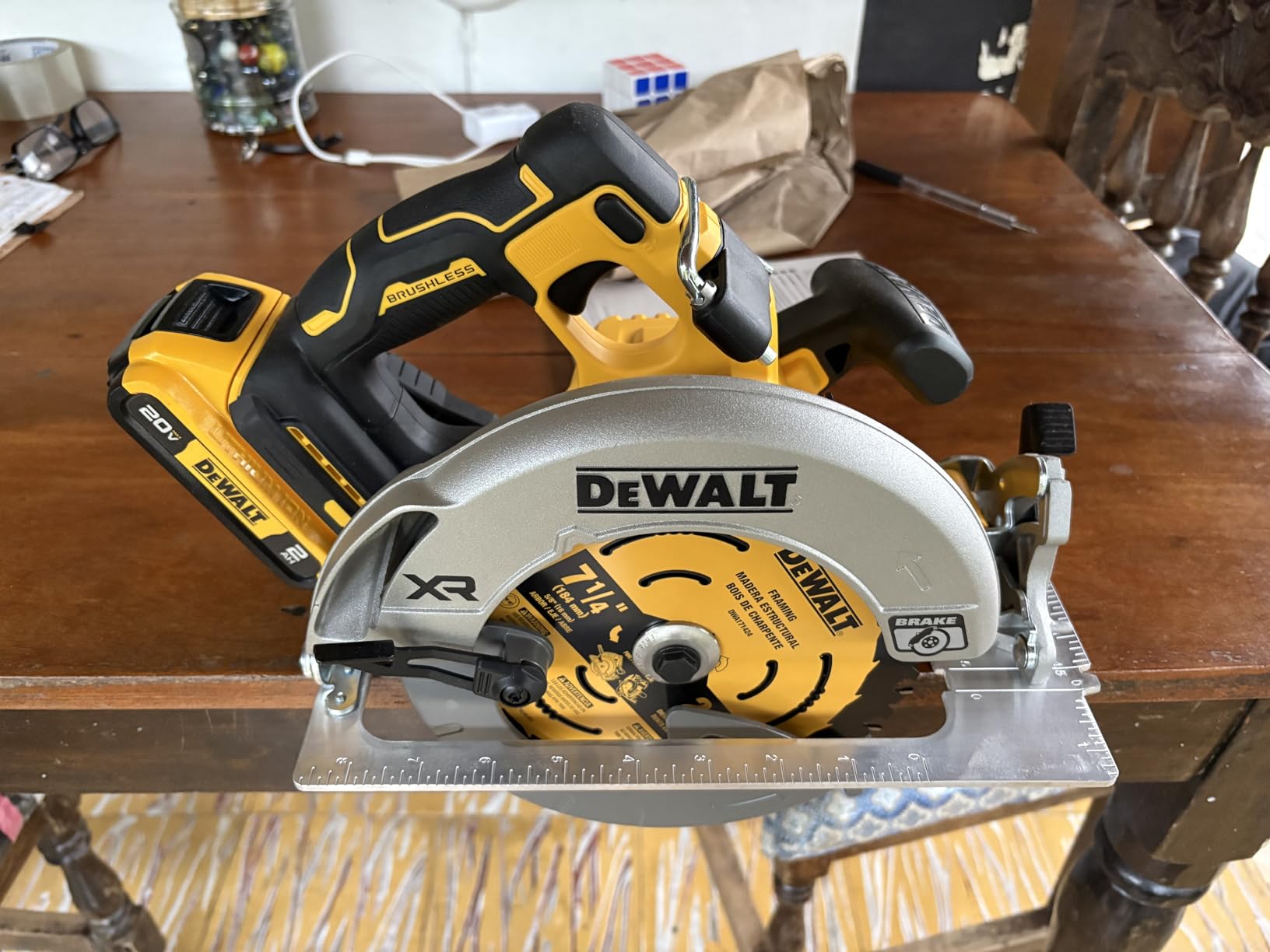
Best reasons to pick the DCS590B
Sheathing work. Wall and roof sheathing is long continuous cutting, and the extra torque here is what keeps the saw from labouring halfway across a 4 by 8 sheet. If a good share of your framing day is nailing off OSB or plywood, that is where this saw pays back.
It is also the newest option in this roundup and the current flagship for 20V MAX, so anyone building a DeWalt collection new today is choosing the current generation rather than the older DCS570B body.
Where it costs you against the DCS570B
It is roughly 2.4 pounds heavier than the DCS570B, close to 10 pounds, and weight is the first thing you feel on a long framing day. If you are not cutting sheet goods, the lighter older saw does the same job with less fatigue.
One more thing to know before you compare listings: published wattage figures for these two DEWALT saws differ sharply, so numbers on a retail page are not comparable across models. Judge both on blade diameter, RPM, cut depth and the crosscut counts per charge.
6. Makita XSH06Z 18V X2 LXT: Best for Endurance on One Charge
Makita XSH06Z 18V X2 LXT® Lithium-Ion (36V) Brushless Cordless 7-1/4” Circular Saw, Tool Only
7-1/4 in blade
6000 RPM
Two LXT packs
10.4 lb
Carbine 24T blade included
Pros
- 6000 RPM brushless motor with auto speed change
- Up to 610 crosscuts in 2x4 SPF and 320 in 2x10 SPF
- Carbide 24T blade and wrench included in the box
- Compact 10.4 lb magnesium guard design
- Faster than the slower 5100 RPM XSR01Z
Cons
- Needs two 18V LXT batteries installed together
- No LED work light listed
- Batteries and charger sold separately
The Makita XSH06Z is the best cordless circular saw for framing if battery endurance is the thing keeping you up at night. Makita rates it at up to 610 crosscuts in 2×4 SPF and 320 in 2×10 SPF on two 5.0Ah LXT packs, the highest crosscut figures of any saw in this group.
Those numbers are for dimensional lumber, not plywood, which makes them directly comparable to real framing work. If your day is stud lengths and joist cuts rather than long sheet goods, this is the saw that charges least often.
At 6000 RPM the motor is fast, and automatic speed change keeps torque up as the blade loads up. Where the heavier XSR01Z trades weight for power, this one gives up about two pounds and picks up speed, and in clean framing lumber that trade usually goes the right way.
The box includes a 7-1/4 inch 24T carbide-tipped blade and a blade wrench. Starting on a proper carbide framing blade instead of the thin steel blade many bare tools include avoids the binding and drift people report on angled cuts with cheap blades.
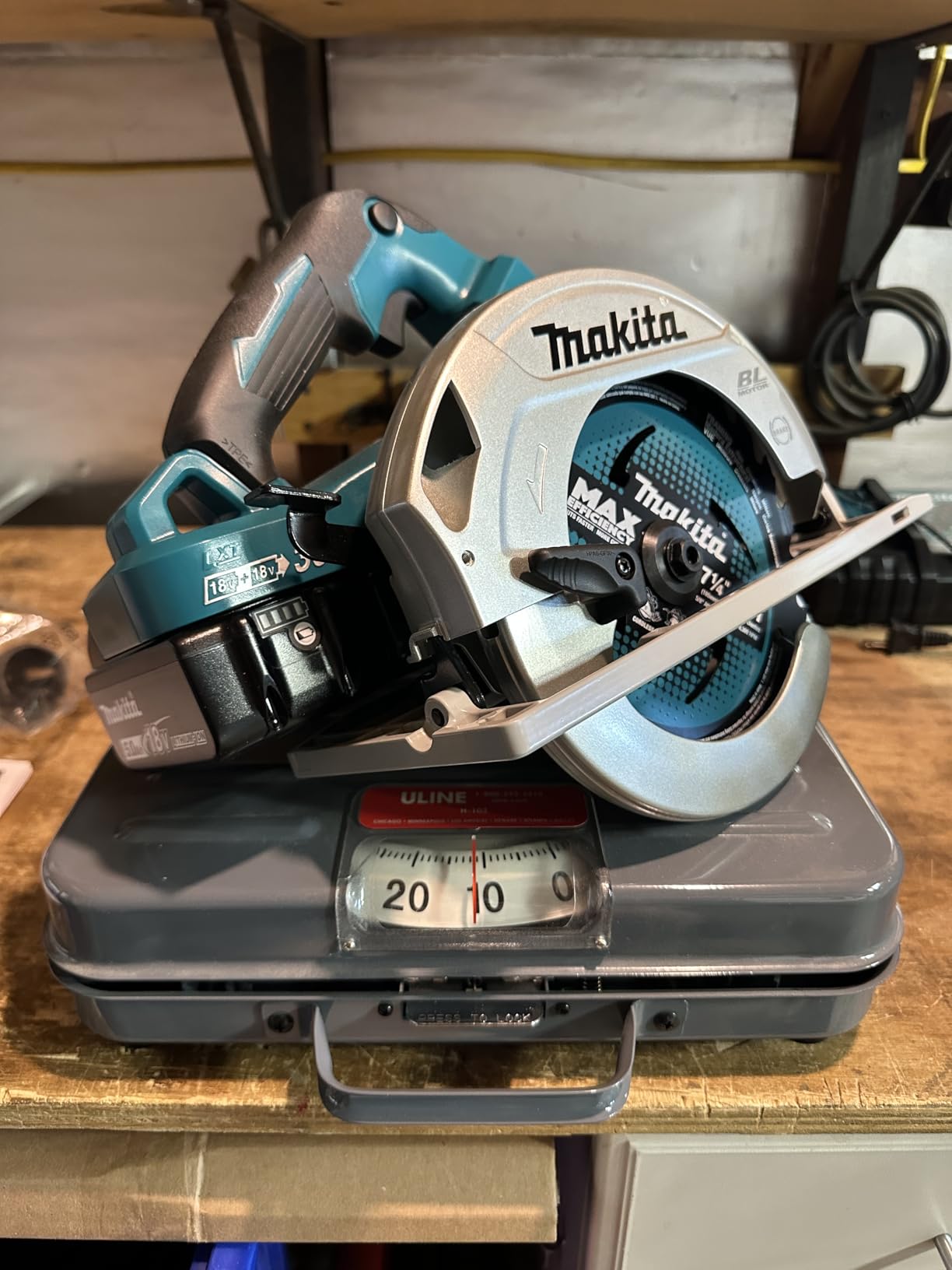
Best reasons to pick the XSH06Z
A two-person crew sharing one charger. Two packs in rotation with one charger means one battery is always on the saw and one is always on charge, which is the practical setup for getting through a full framing day without a lunch break spent waiting.
It is also a good fit for remodelling and cut-out work where you move the saw around a lot rather than stationing it. At 10.4 pounds it is lighter than the two other X2 Makita options and noticeably lighter than the 40V XGT rear-handle saw.
Where it falls short
There is no LED work light listed among the features, and that is a real gap for anyone cutting headers inside a framed shell. Two competing saws in this roundup light the cut line, and on a dark interior floor deck you will notice the difference.
The dual-battery requirement again puts it out of reach for someone with only one or two LXT packs to start. And at 3 years the tool warranty is shorter than some competitors offer, which matters less than most buyers think but is worth knowing.
7. Makita 40V max XGT GSR01M1: Best for Pro Crews on Heavy Work
Makita Xgt 40V Max Circular Saw Kit Rear Handle 7 1/4
7-1/4 in blade
6400 RPM
2-9/16 in capacity
11.7 lb
XPT sealed electronics
Pros
- Highest no-load speed here at 6400 RPM
- Automatic Torque Drive holds speed under load
- XPT dust and water resistance for site conditions
- Owners compare rips to a corded worm drive
- Kit format with two packs and a carrying bag
Cons
- Dust port throws sawdust back across the cut line
- Depth and bevel indicators sit off from the actual cut position
- Dust build-up can bind the guard
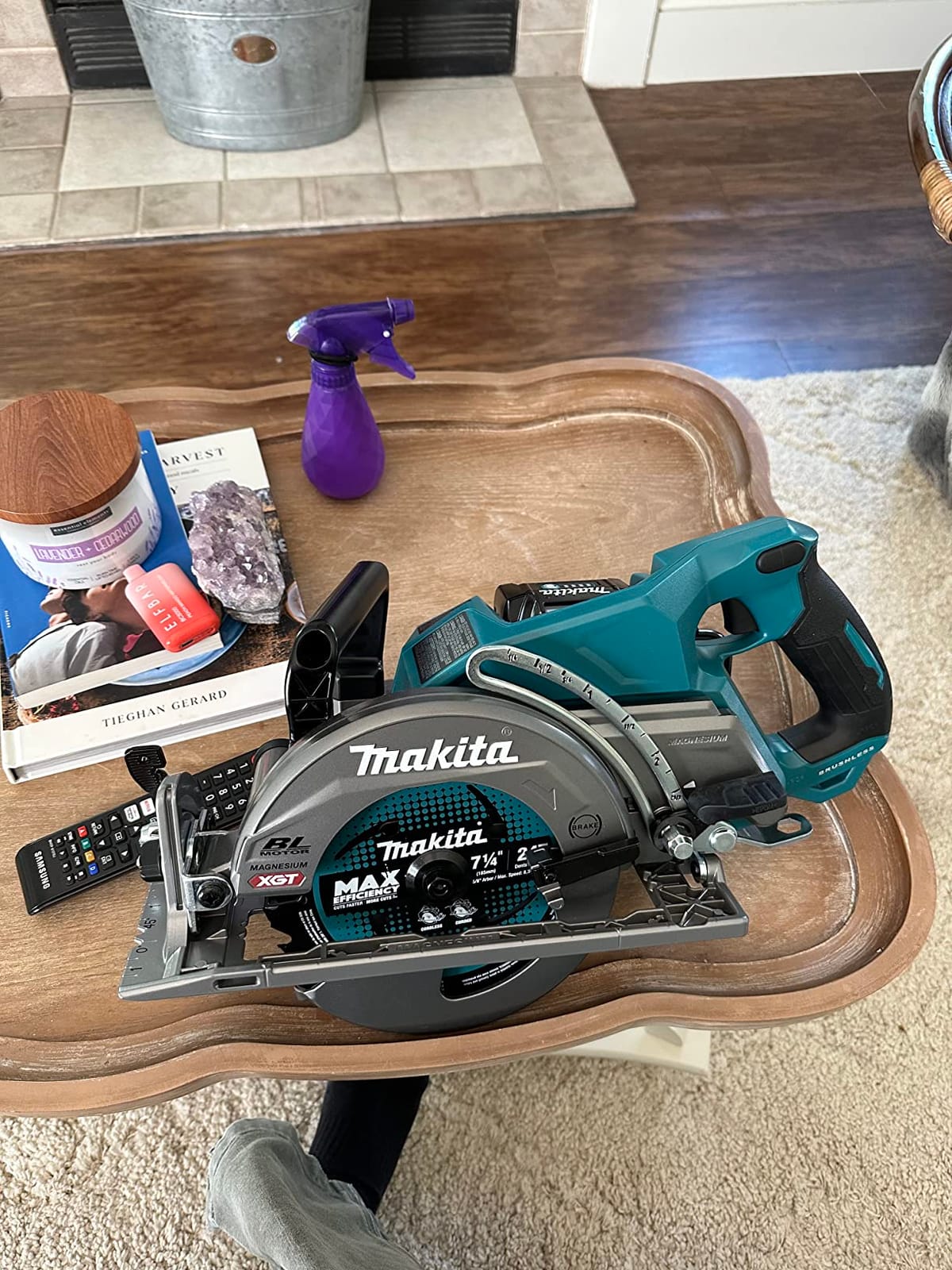
The Makita 40V max XGT GSR01M1 is the best cordless circular saw for framing for a crew that is cutting all day and cannot afford a stall. At 6400 RPM it is the fastest saw here, and Automatic Torque Drive holds that speed up when the blade is buried in a stacked cut.
Owners describe rips through 2x lumber as smooth in a way they compare to a corded worm drive, and the XPT sealing on the electronics is the detail that survives a wet framing season. Mud, water, drywall dust and rain offcuts are normal on a framing site.
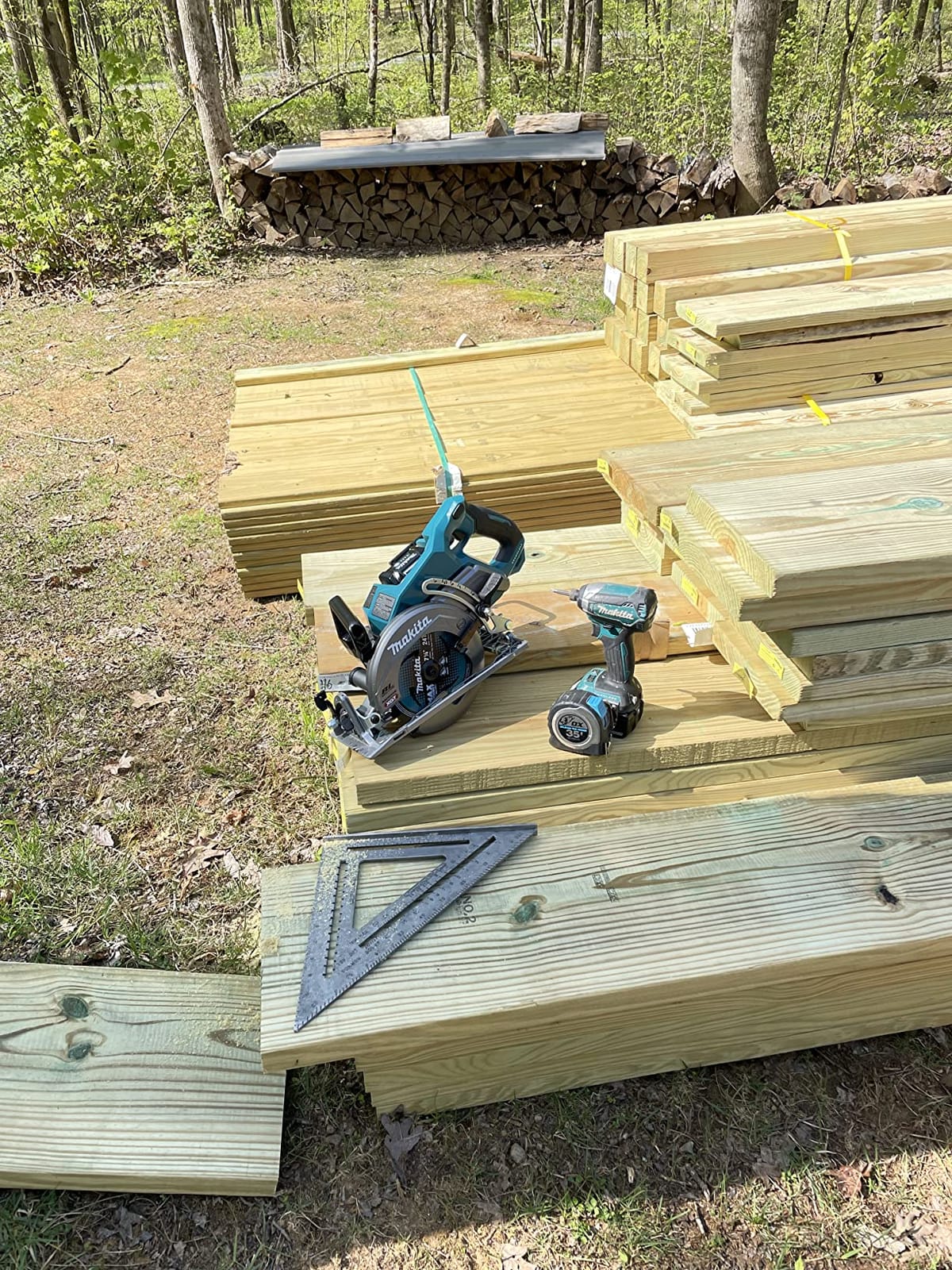
The kit format pairs the saw with two packs and a charger, plus a carrying bag, so it is genuinely ready to work out of the case. For a crew splitting the cost across a shared 40V XGT fleet, that is the least friction option in this roundup.
At 11.7 pounds with packs installed it is a heavy saw, and on long days the operator rather than the machine sets the pace. That is normal for a rear-handle high-power saw and it is the trade for the class of cutting it delivers.
Best reasons to own the 40V XGT saw
Stacked and dense material. When you are breaking down four-deep bundles of 2×12, cutting engineered headers, or working through a pile of timber nobody has dried properly, extra speed and torque is what keeps the blade moving and the cut straight.
It is also a good choice for a crew already running 40V max XGT drivers and impact drivers. Buying into a second platform to own one saw makes little sense, but if the platform is already there, this is the strongest cutting tool on it.
Where its design annoys experienced framers
The dust port is the single most-cited weakness. Owners report it throwing sawdust back across the work area on rip cuts, which obscures the cut line exactly when you are committed to a long cut and cannot stop to brush it clear.
The depth and bevel indicators are also described as sitting noticeably off from where the blade meets the material, so the saw needs a short learning period before the scales become trustworthy. Dust build-up around the guard has also caused binding in owner reports. If sheathing is the bulk of your work, the DCS590B handles dust and light better.
8. SKIL PWR CORE 20 CR5429B-20: Best Budget Framing Kit With Batteries Included
SKIL 2x20V PWR CORE 20 Brushless 7-1/4” Rear Handle Circular Saw Kit Includes Two 5.0Ah Batteries and Dual Port Auto PWR Jump Charger-CR5429B-20, Red
7-1/4 in blade
5300 RPM
Two 5.0Ah packs
10.2 lb
Five year warranty
Pros
- Comes with two 5.0Ah PWR CORE 20 packs and a dual port charger
- 2-9/16 in depth of cut clears 3X material
- Electric brake plus 24T carbide blade for clean cuts
- Both packs recharge 0-25 percent in 15 minutes
- Cut quality compares well to premium brands
Cons
- Packs reported to lose charge and fail in storage
- Two year warranty leaves little recourse on battery claims
- 10.2 lb feels heavy with both packs fitted
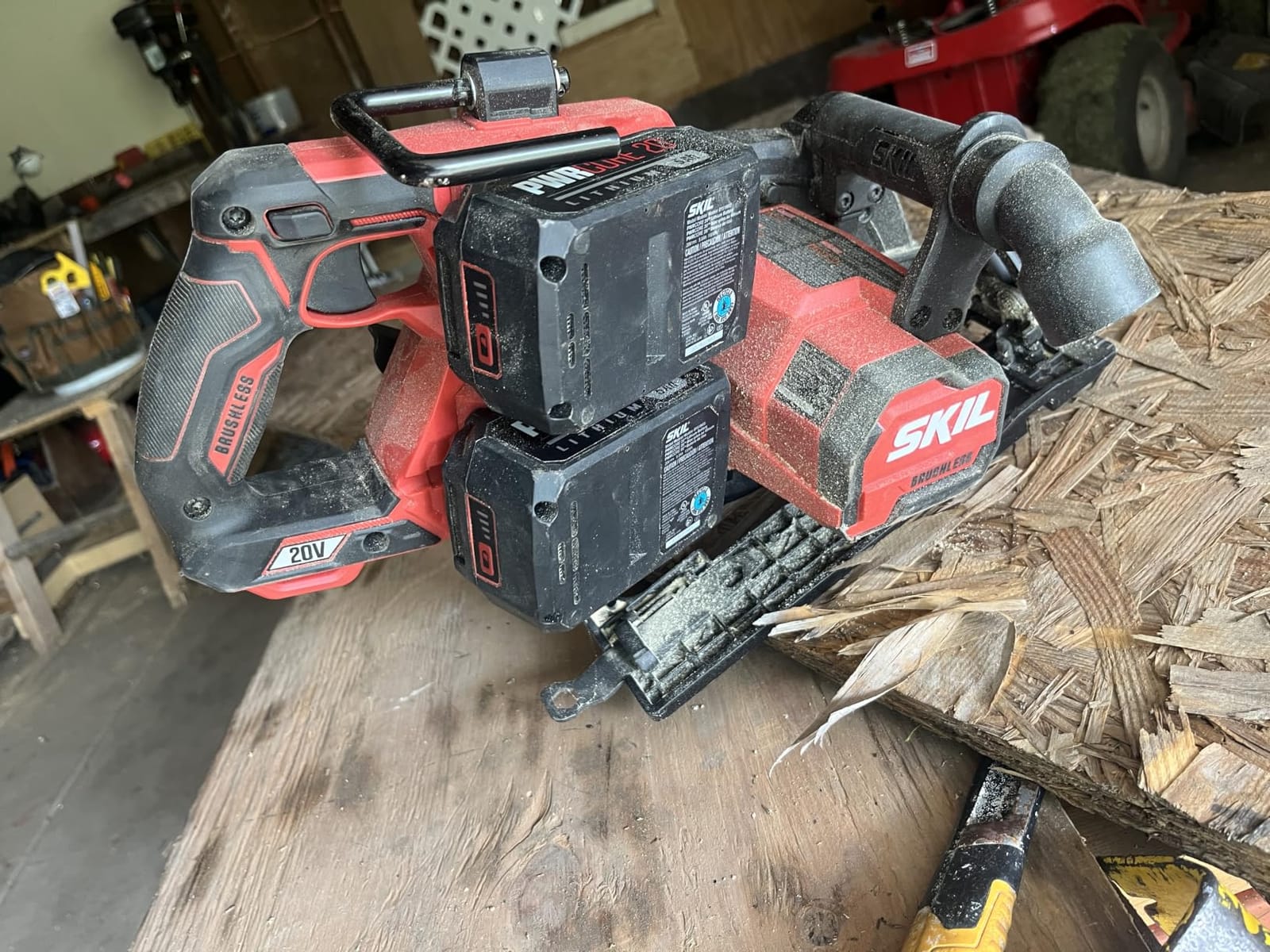
The SKIL CR5429B-20 is the best cordless circular saw for framing if you want a complete setup without hunting for extra batteries. The kit includes two 5.0Ah PWR CORE 20 packs and a dual port PWR JUMP charger, which removes the single biggest cost surprise for someone starting out.
The saw itself performs respectably. SKIL quotes up to 600 cuts per charge based on 2×4 crosscuts in SPF lumber, has a 2-9/16 inch depth of cut that clears stacked 3X material, and includes a 24-tooth carbide blade and an electric brake.
The dual port charger is the quiet advantage. It refills both packs from 0 to 25 percent in 15 minutes and reaches full charge in under an hour, so a lunch break is genuinely enough to reset a full day of cutting.
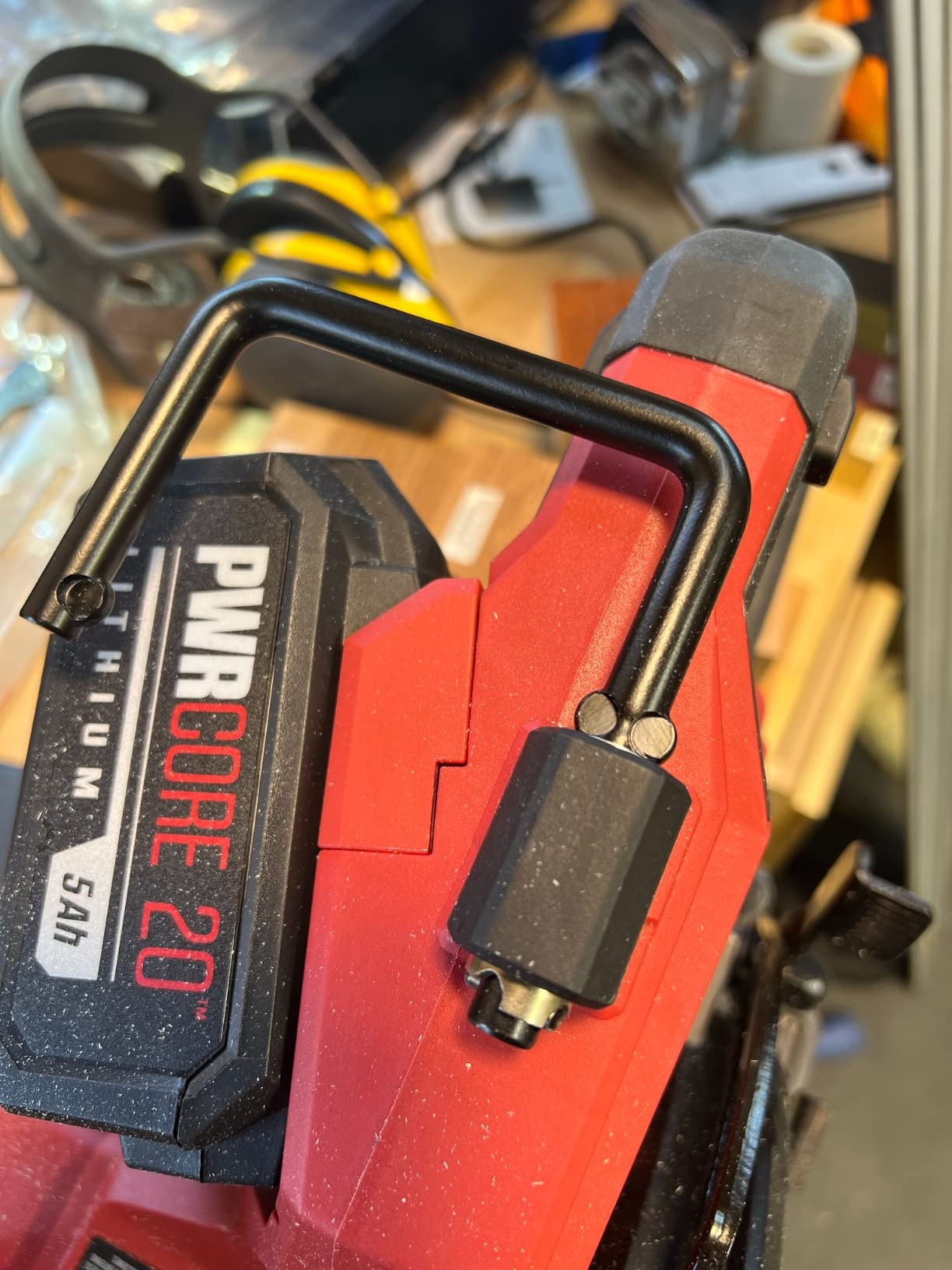
The adaptable dust port in the auxiliary handle is a nicer piece of design than it sounds. It lets you aim sawdust away from the work area instead of at the cut line, which solves a problem most saws of this size do not attempt.
Best reasons to pick the SKIL kit
Anyone building a first platform from zero. Two packs, a charger, a blade and a case-style bag is a complete package, and the two-pack configuration gives 40V-class performance from a 20V platform that also feeds impact drivers and other tools.
For a weekend builder framing a garage or a small addition, it does everything a starter framing cut list needs. Crosscut studs, rip some 2×8, cut a few headers, and you are done with the tool list for that project.
Where the battery complaints are real
Almost every negative review on this saw is about the batteries, not the tool. Owners report PWR CORE 20 packs losing charge, or going dead while stored over winter, and the two-year warranty gives limited recourse when that happens.
Customer support for warranty claims is also criticised. That combination is the reason this saw sits at 4.2, the lowest rating in the roundup, with about 12 percent of reviews at one star. If you are buying for daily professional use and intend to keep the saw for years, buy the batteries separately as you need them and replace them rather than relying on a long service life.
9. Greenworks 24V Brushless 7-1/4 in: Best Starter Saw With Everything in the Box
Greenworks 24V 7-1/4” Circular Saw Brushless Cordless, with 4Ah Battery and 2A Charger
7-1/4 in blade
4500 RPM
24V with 4Ah pack
2-1/2 in at 0 degrees
LED and dust port
Pros
- Includes battery charger two blades dust connector and parallel guide
- 24V platform gives more runtime than 18V and 20V packs
- LED work light and vacuum-ready dust port
- Electric brake plus double safety switch
- On-board blade key storage
Cons
- 4500 RPM is the slowest motor in this roundup
- 2-1/2 in capacity at 0 degrees is shallower than framing rivals
- 2A charger is slow next to competitors
The Greenworks 24V 7-1/4 inch saw is the best cordless circular saw for framing for a first-time buyer who wants to see whether the format suits them before committing to a platform. It arrives with a 4Ah battery, a 2A charger, two blades, a dust connector, an Allen key and a parallel guide.
That is an unusually complete box. Most bare-tool saws give you the saw and a wrench, and you buy everything else later. Here the second blade is a 40T plastic and plywood blade, which is the one you actually want for sheathing.

The 24V platform is the quiet advantage over an 18V or 20V starter saw. Same physical size class of pack, more energy in it, and owners consistently report longer runtime on a charge than the cheaper 18V and 20V alternatives.
The built-in LED light and the included dust port are both framed for the same job: seeing the cut line and cleaning up after it. The double safety switch is an extra layer on top of the electric brake, which is reassuring on a tool a beginner will be learning the angles on.
Best reasons to pick the Greenworks saw
Learning framing without a big commitment. It cuts 2×4 and 2×6 easily, handles rim and blocking, and covers a garage or shed project start to finish without ever needing a second pass on thick material.
The 24T wood blade and 40T plastic and plywood blade together mean you can move from dimensional lumber to sheet goods without buying anything, and the parallel guide is genuinely useful for ripping narrower stock down.
Where it runs out of capability
At 4500 RPM it is the slowest motor in this roundup, and you feel it on stacked 2x or dense softwood. The 2-1/2 inch cutting capacity at 0 degrees is also the shallowest here, so it will not take a full-depth 2×12 in one pass the way the other nine will.
The 2A charger is the other practical limitation, since a full charge takes considerably longer than the fast chargers in the kits on this list. With only 102 reviews there is also less long-term field history behind it than the other picks, so treat it as a learning tool rather than a crew saw.
10. FLEX 24V FX2141R-1J: Best Runtime on a Single Stacked Battery
FLEX 24V Brushless Cordless 7-1/4-Inch Rear Handle Circular Saw Kit with 10.0Ah Stacked Lithium Battery and 280W Rapid Charger – FX2141R-1J
7-1/4 in blade
6200 RPM
10.0Ah Stacked Lithium
Limited lifetime warranty
Magnesium shoe
Pros
- 6200 RPM with torque owners compare to a worm drive
- 10.0Ah Stacked Lithium pack lasts a working day
- 280W rapid charger refills the pack in about an hour
- Adjustable dust port directs sawdust away
- Magnesium handle and shoe with readable scales
Cons
- Blade sits on the left side
- which surprises right-handed buyers
- Feels heavy with the 10Ah pack fitted
- Small review count and low sales rank
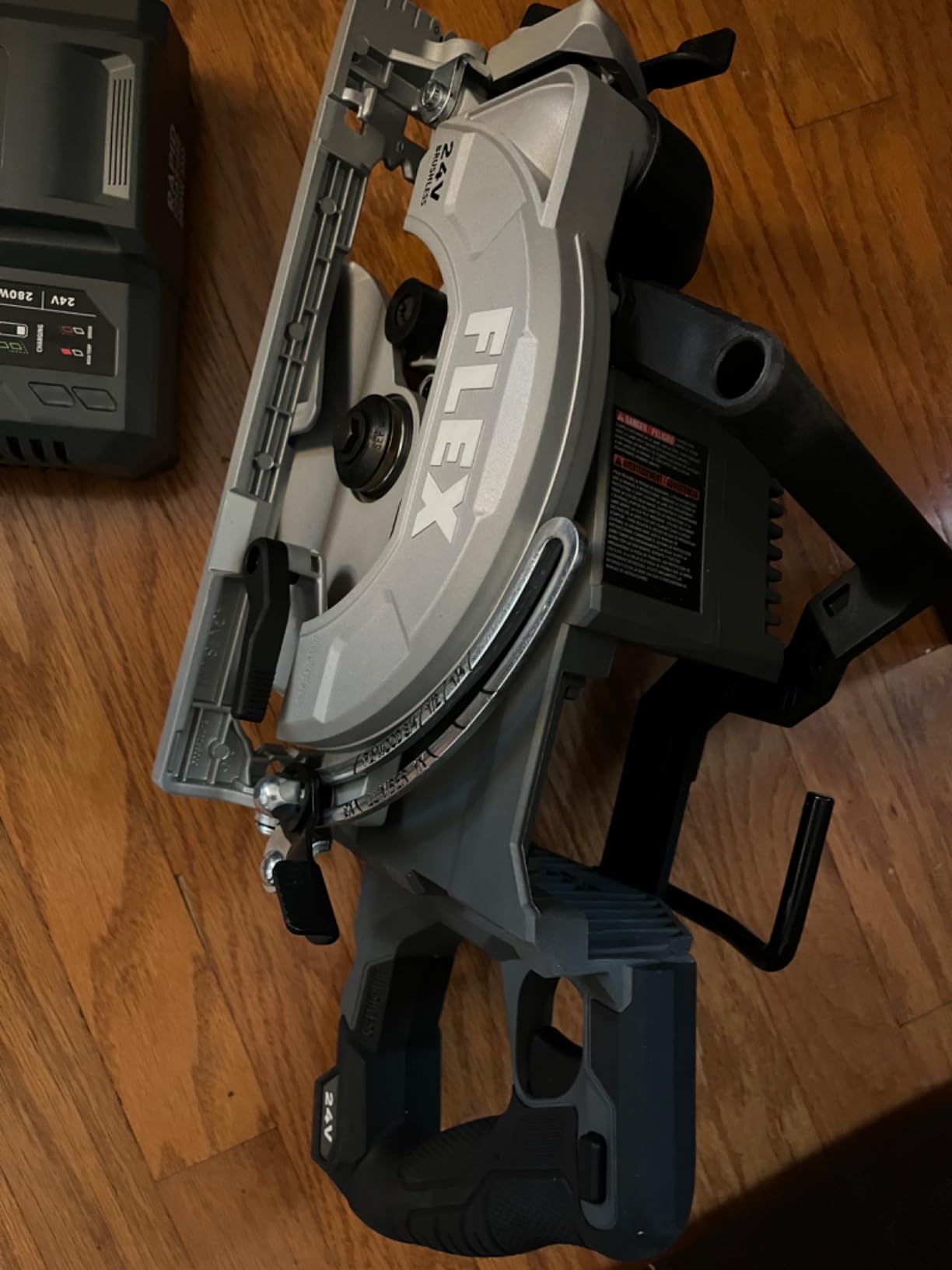
The FLEX 24V FX2141R-1J is the best cordless circular saw for framing if you want maximum power and maximum runtime from a single battery rather than two smaller ones. The kit pairs a 10.0Ah Stacked Lithium pack with a 280W rapid charger that refills it in roughly an hour.
Owners report forcefully crosscutting treated 2×12 without the saw slowing through the cut, and consistently describe the 10.0Ah pack as lasting a full working day on a single charge. For someone who hates swapping batteries, that is the whole point of the tool.
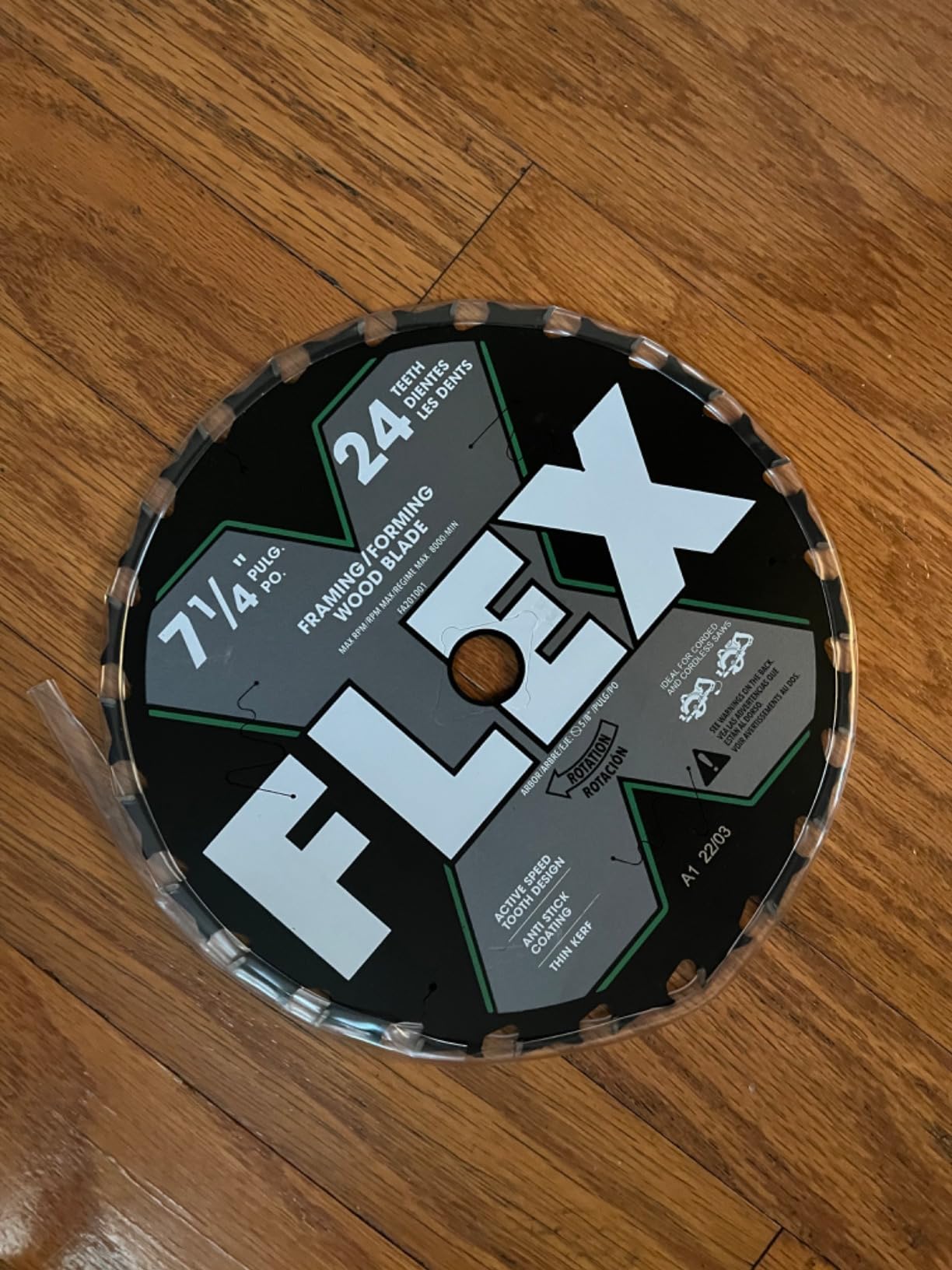
At 6200 RPM the brushless motor is the second fastest in this roundup, and the magnesium handle and shoe give it a planted, stable feel through a stacked cut. The adjustable dust port and easy-to-read depth and bevel scales are both better than average.
The spindle lock makes blade changes tool-free and quick, which matters more than it sounds on a site where you swap between a framing blade and a finish blade constantly. The limited lifetime warranty on tool, battery and charger when registered is also among the strongest here.
Best reasons to pick the FLEX kit
Anyone cutting all day on one pack. A retailer-verified owner described the 48V-class experience of this saw as cutting through a 2×12 like a hot knife through butter, with enough weight on the shoe to keep the cut controlled.
Owners who switched over from a DeWalt platform also report better tool longevity, and the blade on the left with the handle at the rear gives a clean line of sight for compound miter work on hips and dormers.
Where to be cautious before buying
The blade-on-the-left layout catches out buyers expecting the more common right-hand sidewinder orientation, and that adjustment period is the most common complaint in the reviews. Check your existing habits before committing.
With only 60 reviews and a lower sales rank than the established picks, there is less long-term field history behind this saw. The listed wattage figure is also far higher than comparable saws and is not a real cross-brand comparison. For daily commercial framing, a saw with a bigger review base is the safer purchase.
How We Picked the Best Cordless Circular Saws for Framing
Framing roundups usually rank on blade diameter and motor speed, which is how you get a list that is technically right and practically wrong. A circular saw that cuts a clean 2×4 does not automatically cut stacked 2×12 at speed, stay on the line through a full sheet of plywood, or keep its guard out of the way on a hip roof cut. Those are different problems.
I weighted the ten saws on five things, in this order. Cut depth at 90 and 45 degrees, because a saw that cannot take a 2×12 in one pass forces a second cut or a flipped piece, and both cost time. Then power under load in real lumber, not on a single clean piece. Then weight with the battery installed, since that governs how much of the cut list you finish. Then guard and brake behaviour, which is a safety issue as much as a speed issue. And finally cut counts per charge measured in dimensional lumber rather than plywood.
The fourth criterion is where most roundups go quiet and where framing crews actually feel pain. A lower blade guard that creeps down on a right-hand compound miter cut will hang up on hip rafters and dormer cheeks, and the operator ends up working around the tool instead of working with it. An electric brake that stops the blade on trigger release prevents the wide kickback cut that shows up as a ripped stud. Both are non-negotiable in a saw meant for framing.
Every saw here was assessed as a 7-1/4 inch class tool because that is the framing diameter. I did not include 10-1/4 inch cordless saws, which cost and weigh more than most framers want to carry, or 6-1/2 inch saws, which are covered by the blade size decision below.
7-1/4 in vs 6-1/2 in: Which Blade Size for Framing?
Pick a 7-1/4 inch blade for framing. A 6-1/2 inch saw gives you roughly 2 inches of depth at 90 degrees, which handles 2×4, 2×6 and 2×8 laid flat but not a full-depth 2×12, and forces a second pass or a flipped cut on anything heavier.
A 7-1/4 inch saw gives you between 2-9/16 inches and 2-7/16 inches at 90 degrees depending on the model. That clears a 2×12 in a single pass and handles stacked dimensional lumber, which is the difference between one operation and two for the cuts you make most.
That said, the gap has narrowed. Brushless motors and better battery chemistry mean a good 6-1/2 inch saw now handles 2x framing well, and one Home Depot reviewer confirmed the Ryobi 18V ONE+ 5-1/2 inch saw cutting a 2×12 easily despite the small blade. If you are framing a shed, a garage or doing repair work rather than framing houses daily, a 6-1/2 inch saw is a lighter and cheaper way in.
The real cost of going smaller is stacking. Once you are breaking down bundles, cutting headers to length, or ripping full-length 2×12, the smaller blade becomes a second-pass saw. That is when the 7-1/4 inch class earns its place.
Battery Platforms Explained: 18V, 20V, 24V, 36V and 40V
Battery platform lock is the biggest source of buyer confusion in this category, and it matters more than any spec on the list. A saw is a doorway into an ecosystem, and every other tool you buy afterwards has to fit through the same door.
The nominal voltage numbers are marketing shorthand rather than measurements. 18V and 20V MAX packs are the same physical pack and broadly interchangeable in practice. 24V Max is really about 21.6V. 36V X2 and 40V max XGT saws run two of their nominal packs at once. 60V MAX FLEXVOLT steps up in voltage as the pack drains, which is why it holds power longer on a hard cut than a fixed-voltage pack of the same nominal rating.
So the practical question is not what voltage is printed on the saw. It is: do you already own packs? If you already have 20V MAX packs, the DCS570B or DCS590B is by far the most sensible buy. If you already run LXT batteries, the single-pack Makita options serve most framers better and the X2 saws are a step up in power. If you are starting from nothing, decide the platform once and treat the saw as part of it.
On bare tool versus kit: if you already own batteries and a charger in the platform, buy the bare tool. You are paying for a second charger and a second set of packs that you do not need. If you are starting fresh, the kit is usually the cheaper route in. We also cover the broader tool-collection question in our pole saw roundup if trees are part of the site work.
What a Framer Actually Cuts (and How Deep You Need)
Studs and blocking are the bread and butter. A 2×4 on edge is 3-1/2 inches and any saw clears it, but the work is volume: hundreds of crosscuts a day, which is why the crosscut-per-charge figures matter more than any other runtime number.
Rim and header material is where depth starts to matter. A 2×12 laid flat is 1-1/2 inches, so it clears on every saw here, but headers built up from two or three plies need real depth, and a 2-9/16 inch saw handles the stack in one pass. Engineered LVL is denser and wet pressure-treated lumber is heavier still, which is the argument for the extra torque of a 60V or 40V saw.
Floor joists and roof sheathing are the long-cut tests. Ripping full-length 2×8 and 2×10 to width, then ripping sheets of plywood or OSB, is a continuous cut where motor droop shows up as a wandering line. The 6000 RPM and 6400 RPM saws hold speed best; the 4500 RPM Greenworks needs a slower feed on sheet goods.
Compound miter work on hips, valleys and dormers is where blade orientation and guard behaviour decide the outcome. Set up our picks for the best tile saws for porcelain if you are mixing finish trades on the same remodel.
Sidewinder vs Rear Handle and Blade Orientation
Sidewinder and rear-handle saws are both legitimate framing tools. Sidewinders, like the DEWALT DCS570B and the Milwaukee 2631-20, put the motor beside the blade for a lighter, more compact tool that is easier on the wrist over a full day. Rear handles, like the Makita XSR01Z and the 40V XGT saw, put the handle behind and above the blade, which pushes more mass forward into the cut and adds power feel.
Crew preference is genuinely regional. West Coast framers tend to sit in rear-handle saws because the extra forward weight suits rip-heavy cutting and big stock, while East Coast crews are more often on sidewinders for balance and portability.
Blade side is a smaller decision and easier to change your mind about. Most saws are blade-right, which suits right-handed users doing crosscuts. Blade-left saws with a rear handle give a clearer sight line because the housing is not in the way, and that is why the DCS577B, the Makita rear-handle models and the FLEX saw are arranged that way. Owners of blade-left saws regularly note the adjustment period for anyone coming from the other side.
Either way, check one thing before a framing day: whether the lower guard retracts cleanly on a compound miter cut. Sawdust packed into the guard is the usual cause of a hang-up, and clearing it takes seconds. Finding out halfway through a hip rafters is not ideal. Outside the saw shop, our green beam laser level picks handle the layout side of the same trade.
Frequently Asked Questions
What is the best cordless circular saw for framing?
The DEWALT 20V MAX DCS570B is the best cordless circular saw for framing for most crews. Its 7-1/4 inch brushless motor holds 5500 RPM under load through stacked 2x lumber, the electric blade brake stops kickback, bevel detents at 22.5 and 45 degrees make compound cuts repeatable, and at 7.5 pounds bare it stays comfortable on ladder and overhead work. The DEWALT DCS577B FLEXVOLT goes deeper for thick stacks, and the Makita XSH06Z runs longer on a charge.
What is the best size cordless circular saw for professional use?
A 7-1/4 inch blade. That diameter gives between 2-9/16 and 2-7/16 inches of depth at 90 degrees, enough to take a full-depth 2×12 and stacked dimensional lumber in a single pass. A 6-1/2 inch saw offers only about 2 inches of depth, which handles 2×4, 2×6 and 2×8 laid flat but forces a second pass on 2×12. Modern brushless motors have made 6-1/2 inch saws viable for light framing and repair work.
Is a DeWalt or Milwaukee circular saw better for framing?
Both are strong choices and the better answer depends on which platform you already own. The DEWALT 20V MAX DCS570B is lighter at 7.5 pounds with a faster 5500 RPM motor and bevel detents at 22.5 and 45 degrees. The Milwaukee 2631-20 is the lightest saw here at 7.2 pounds with magnesium guards, an LED light and an integrated dust port. If you already own 20V MAX packs, stay on DeWalt; if you own M18 packs, stay on Milwaukee. Mixing platforms costs you batteries and chargers.
How thick of a board can a 7 1/4 inch circular saw cut?
A 7-1/4 inch cordless saw typically cuts between 2-9/16 inches and 2-7/16 inches at 90 degrees, depending on the model, and around 2 inches at 45 degrees. In real lumber that clears a full-depth 2×12 and a 2×10 laid flat, plus stacked 2×4 and 2×6 up to three courses. A 4×4 laid flat needs a second pass from the opposite side on most saws in this class.
Should I buy a cordless circular saw or keep using a corded one?
For framing, cordless is now the practical default. Brushless motors and high-amp-hour packs deliver enough torque for stacked dimensional lumber and full-depth 2×12 cuts without a cord in the way, and moving a saw to another part of the site takes seconds instead of minutes. A corded saw still makes sense if you already own one and mainly cut sheet goods in a fixed shop, but on a framing site the portability and the lack of trip hazards outweigh the extra weight of a battery.
Which Cordless Circular Saw for Framing Should You Buy?
If you are picking one saw and you already own batteries, the platform decides it. On 20V MAX, take the DEWALT DCS570B for its balance of speed, weight and bevel detents, or the DCS590B if your work is mostly sheathing. On M18, the Milwaukee 2631-20 is the lightest thing here that still clears stacked 2x. On LXT, the single-pack Makita saws cover most framers and the X2 models add power if you own multiple packs.
Starting from zero, look at the kits first. The Makita 40V max XGT GSR01M1 and the SKIL CR5429B-20 both arrive with two packs, a charger and a blade, and the FLEX 24V FX2141R-1J pairs a 6200 RPM saw with a 10.0Ah pack that lasts a full day on one charge. That is the fastest way to a working setup without a second shopping trip for a charger.
The two saws worth stepping up to are the DEWALT 60V MAX FLEXVOLT DCS577B for genuinely deep stacks and treated lumber, and the Makita 40V max XGT for the highest cutting speed on dense material. Both are heavier, both are blade-left, and both reward you with power you can feel through a four-deep bundle of 2×12.
Whichever you land on, put a carbide framing blade in it before the first day. Several of the saws here include a thin steel blade, and a proper 24T carbide framing blade fixes the binding and drift people report on angled cuts more reliably than anything else you can change. Use the Check Latest Price button on each review to see today’s number, and pick the platform you can grow into.