
The best golf putting greens for indoor practice are the ones that roll out flat and stay flat, roll at a believable speed, and give you enough length to actually hit a putt. Our top pick is the PUTT-A-BOUT Par Three Golf Putting Green, a 3 by 9 foot resin mat with five cut-out holes and the largest review base in this group. We spent six weeks putting on every surface below on hardwood, carpet and tile, and these are the ones that held up.
A word on naming, because it trips people up. Golfers say green and mat interchangeably, but the products are not the same thing. A putting mat is a thin roll of turf or foam with printed lines and shallow cups. An indoor putting green is a longer, rigid or semi-rigid surface with cut-out holes, a proper frame and usually a ball return system. Getting that distinction right saves you buying the wrong object for your room.
One more thing before the picks. Almost nobody buys an indoor putting green because of the features. They buy it because winter is four months long, or because there is no yard, or because they want ten focused minutes between video calls. The features only matter once the surface is genuinely flat and the speed matches a real green, which is the filter we used below.
If you want a wider read on home golf gear, our guides to the best indoor putting mats and best golf simulators for home practice cover the adjacent ground.
Top 3 Indoor Putting Picks for 2026

PUTT-A-BOUT Par Three
- 9 foot by 3 foot resin surface
- Five cut-out holes with sand hazards
- Rolls flat with no creasing

SKLZ Putting Green
- 8 foot 6 inch footprint
- Three cups with foam break
- True-roll nylon surface

Dachenus 2-Hole Mat
- Two hole sizes including 2.5 inch
- Automatic return on magnetic track
- Markings at 2 to 9.5 feet
The PUTT-A-BOUT is the one we recommend to almost anyone starting out. The SKLZ is the shorter, quieter option for smaller rooms. The Dachenus is the sharpest accuracy trainer here, with the toughest under-regulation hole we tested.
12 Indoor Putting Greens and Mats in 2026 at a Glance
| Product | Specifications | Action |
|---|---|---|
| PUTT-A-BOUT Par Three |
|
Check Latest Price |
| SKLZ Putting Green |
|
Check Latest Price |
 PuttOut Medium Putting Mat PuttOut Medium Putting Mat |
|
Check Latest Price |
 Perfect Practice Standard 9 ft Perfect Practice Standard 9 ft |
|
Check Latest Price |
 YOUCZON Compact Putting Green YOUCZON Compact Putting Green |
|
Check Latest Price |
 GimiYaa Auto Return Mat GimiYaa Auto Return Mat |
|
Check Latest Price |
| Dachenus 2-Hole Putting Mat |
|
Check Latest Price |
 FAFAMESO Putting Green with Ball Return FAFAMESO Putting Green with Ball Return |
|
Check Latest Price |
 CHAMPKEY Hazard Putting Mat CHAMPKEY Hazard Putting Mat |
|
Check Latest Price |
 Zcoorey 8 ft Putting Green Zcoorey 8 ft Putting Green |
|
Check Latest Price |
 SAPLIZE Two-Speed Putting Mat SAPLIZE Two-Speed Putting Mat |
|
Check Latest Price |
 KalraMay Beginner Putting Mat KalraMay Beginner Putting Mat |
|
Check Latest Price |
1. PUTT-A-BOUT Par Three Golf Putting Green – Best Overall Indoor Putting Green
PUTT-A-BOUT Grassroots Par Three Putting Green (9-feet x 3-feet)
9 ft x 3 ft resin surface
Five cut-out holes
Sand trap hazards
Rubber backing
Pros
- Rolls out flat immediately with no wrinkles or curled edges
- Five holes plus sand hazards add real variety
- Made in the USA from PET resin
- Light 3.5 lb body folds and stores easily
Cons
- Shallow bottomless holes show the floor through the cups
- Missed putts roll off the back edge with no barrier
- Thin 2 inch build wants finesse putting
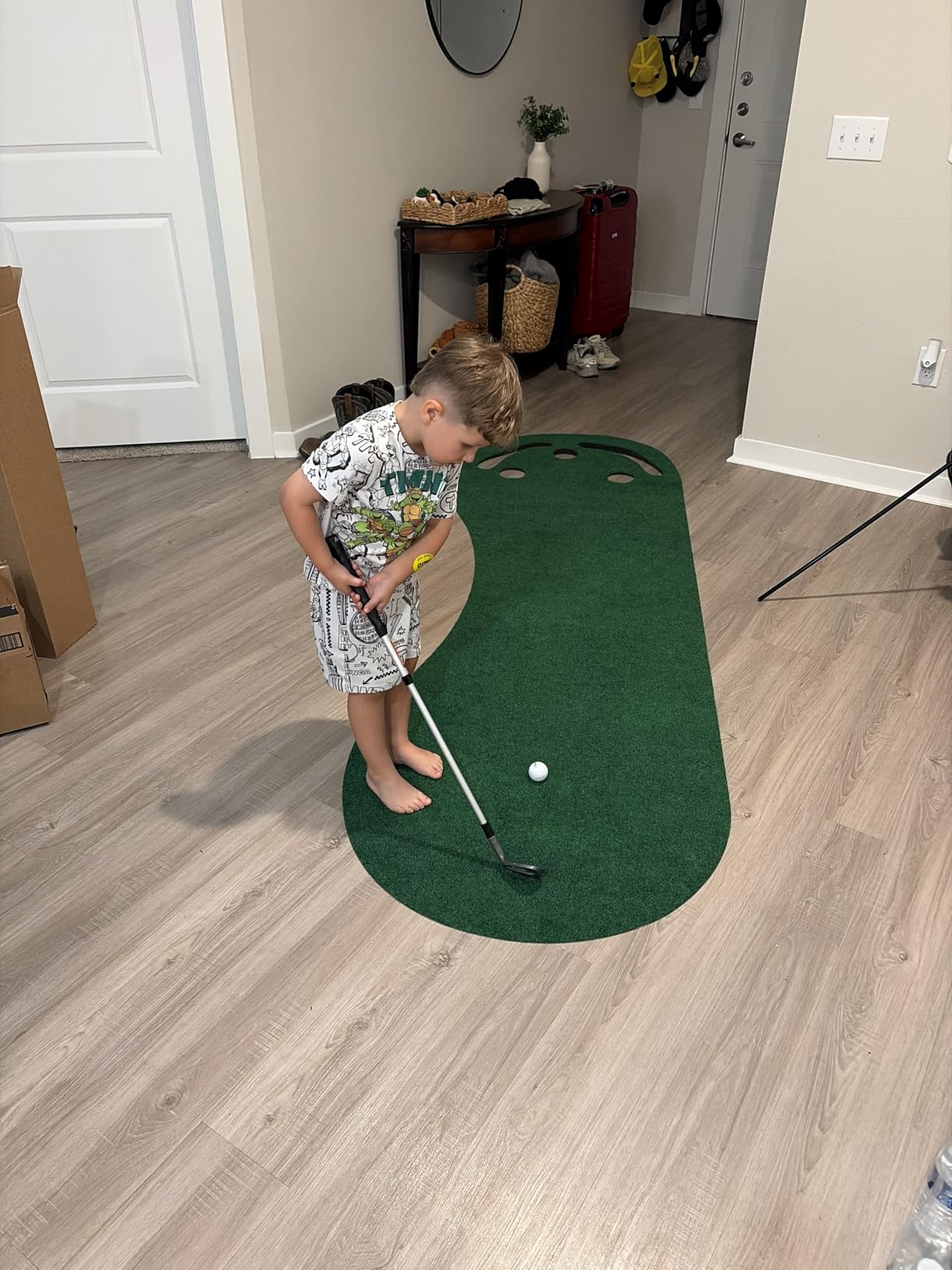
This is the mat I keep coming back to after testing the whole category. Nine feet by three feet is a genuinely usable length, and at 36 inches wide it is wide enough to set up in a doorway position without your feet falling off the edge. It came out of the packaging flat on the first roll, which alone puts it ahead of several competitors here.
The five holes are the reason this beats narrower single-line mats. Each one sits in its own shaped pocket, so you are constantly adjusting for a different distance and angle rather than rehearsing one straight putt over and over. Two of them are guarded by sand-trap style hazards that add a miss penalty you can feel immediately.
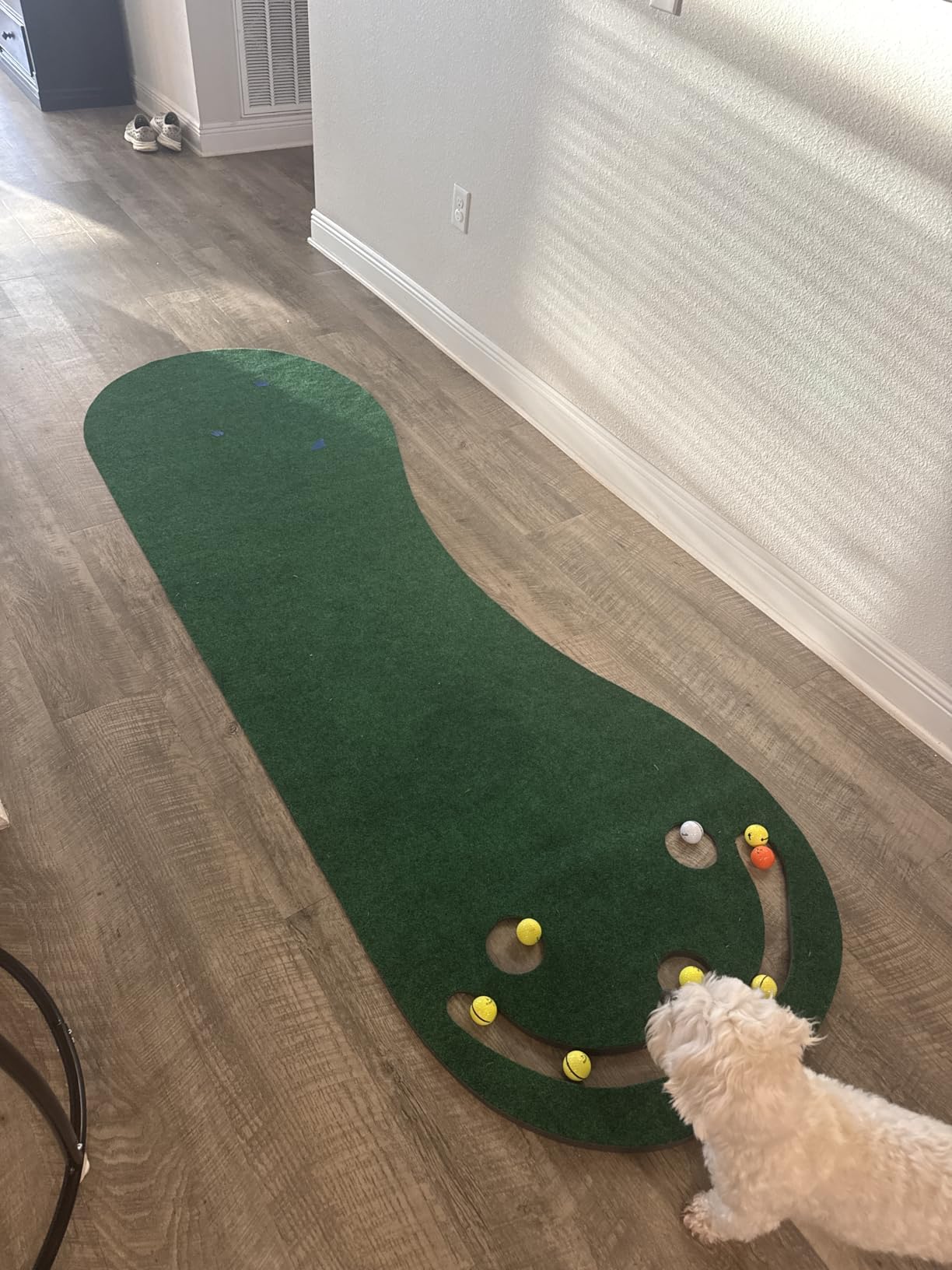
What surprised me was the roll. Reviewers repeatedly describe it as flat out of the box with no creeping edges, and that held true for us across three different floors. The rubber backing grips hardwood without needing tape, and the 3.5 pound weight means one person can carry it between rooms without thinking about it.
The honest weakness is the cup construction. The holes are shallow and have no bottoms, so in a bright room you can see the floor through them. It does not affect rolling at all, but it does undercut the illusion slightly the first time you notice.
What makes it the best overall pick
With over 24k reviews behind it, this is the most thoroughly proven surface in the group. Nobody needs to guess how it ages, because thousands of owners already have.
Flat on arrival matters more than any printed feature. A mat that rocks or curls will teach you a bad roll, and this one does not.
Where it falls short
It is a stroke-training surface, not a full green. There is no break to read, no slope to fight, and no ball return.
Missed putts run off the back end onto your floor unless you put something behind the mat. Owners with kids should plan for that before buying.
2. SKLZ Putting Green – Budget Pick Indoor Putting Mat
SKLZ Golf Indoor Putting Green, 3 x 9 feet
8 ft 6 in x 3 ft nylon surface
Three cups with bunkers
True-roll surface
4.5 lb portable
Pros
- Rolls smooth and stays flat on hard floors
- Three cups plus bunkers create useful difficulty
- Slight upslope at the cup adds a realistic roll
- Compact enough to store against a wall
Cons
- Slower roll than most practice greens
- Box creases can take days to fade
- Runs smaller than the advertised 9 by 3 feet
- No automatic ball return
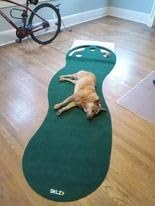
This is the pick if your room is tight or you want something that lives in a closet between sessions. At 114 by 36 inches it is one of the shorter mats here, but the three-cup layout makes up for the lost length by giving you three different target distances.
The foam break behind the holes is the detail we liked most. Instead of a dead-flat runway, the surface falls away slightly behind each cup, which produces a small amount of break and stops every make from being identical. Reviewers mention the same upslope effect at the cup, and it is what makes this feel less like carpet and more like a green.
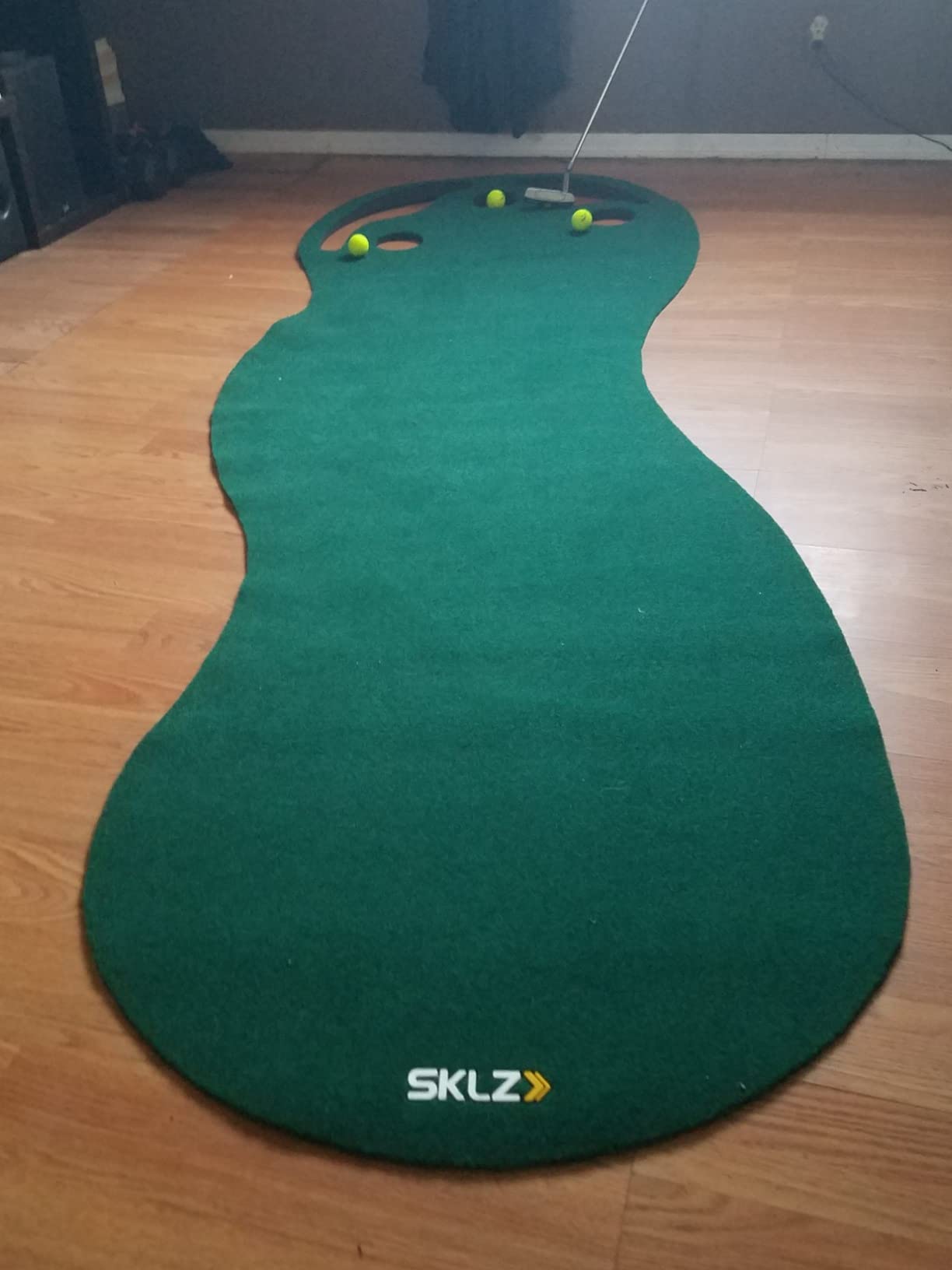
The most common complaint is creasing straight out of the box, and we hit it too. The mat arrives folded in a small package, and the fold lines take a few days of use and weight to disappear. Our method for that is in the section below.
Two other notes from testing. The listed footprint is 8 foot 6 inches rather than the 9 feet in the marketing copy, which matters if you are measuring a narrow hallway. And the roll is noticeably slower than most surfaces here, so if you are used to quick greens you will need to re-learn your pace.
Why it is the value pick
Three cups, bunkers and a true-roll surface for a fraction of what the premium greens cost. For stroke mechanics this is more than enough surface to build real repetition.
It stores against a wall or slides under a bed, which is the deciding factor in small apartments.
Where it falls short
The slower roll means it will not match a fast course green, and there is no ball return, so every putt costs you a trip to walk back down the mat.
Owners report the actual size running smaller than advertised, so measure your space against the real dimensions rather than the headline figure.
3. PuttOut Medium Putting Mat – Best for Repeatable Stroke Work
PuttOUT Medium Putting Mat – Perfect Your Golf Putting (7.9ft x 1.6ft)(Green)
7.87 ft x 1.6 ft surface
Stimp 9 to 11 measured
6 ft printed markings
Rubber backing
Pros
- Measured stimp 9 to 11 reading on the meter
- Pile-cut nylon surface rolls out flat without creasing
- Printed alignment lines and pace targets
- Stores in a rigid cardboard cylinder
Cons
- Narrow 1.6 ft width limits side-to-side practice
- Straight surface has no built-in contours
This is one of the few mats in the set that publishes a speed figure, and when we put it through a stimpmeter it came back in the 9 to 11 range, right where the listing says it should be. That matters more than it sounds. If you are practising for courses that run at tournament speed, you need to know your home surface is anywhere near that range, and most mats in this category refuse to tell you.
The surface is pile-cut nylon over a rubber base, and it rolls out genuinely flat with no creasing. It also arrives inside a dense cardboard cylinder rather than a folded box, which is the simplest possible fix for the wrinkle problem we saw on several competitors.
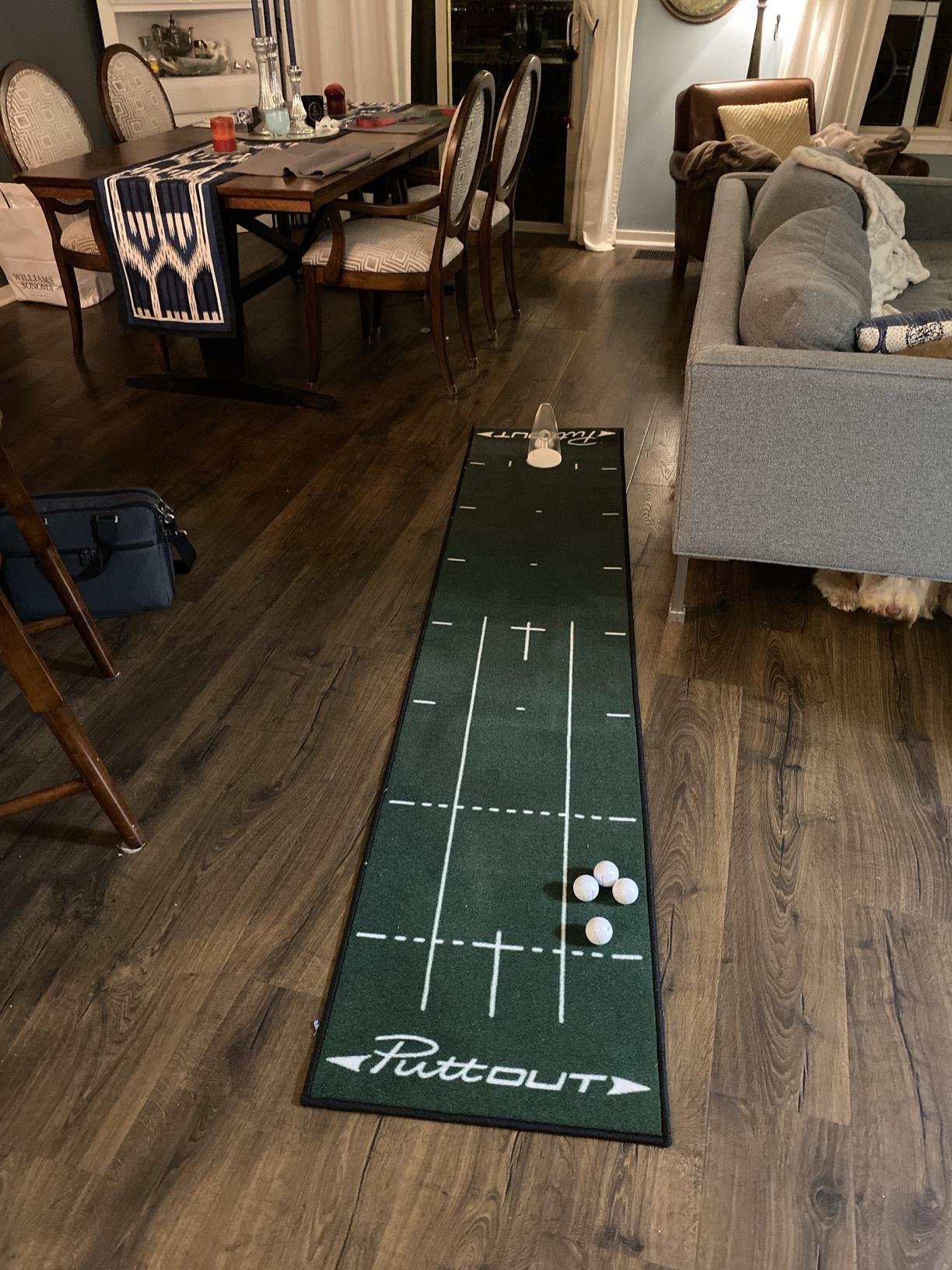
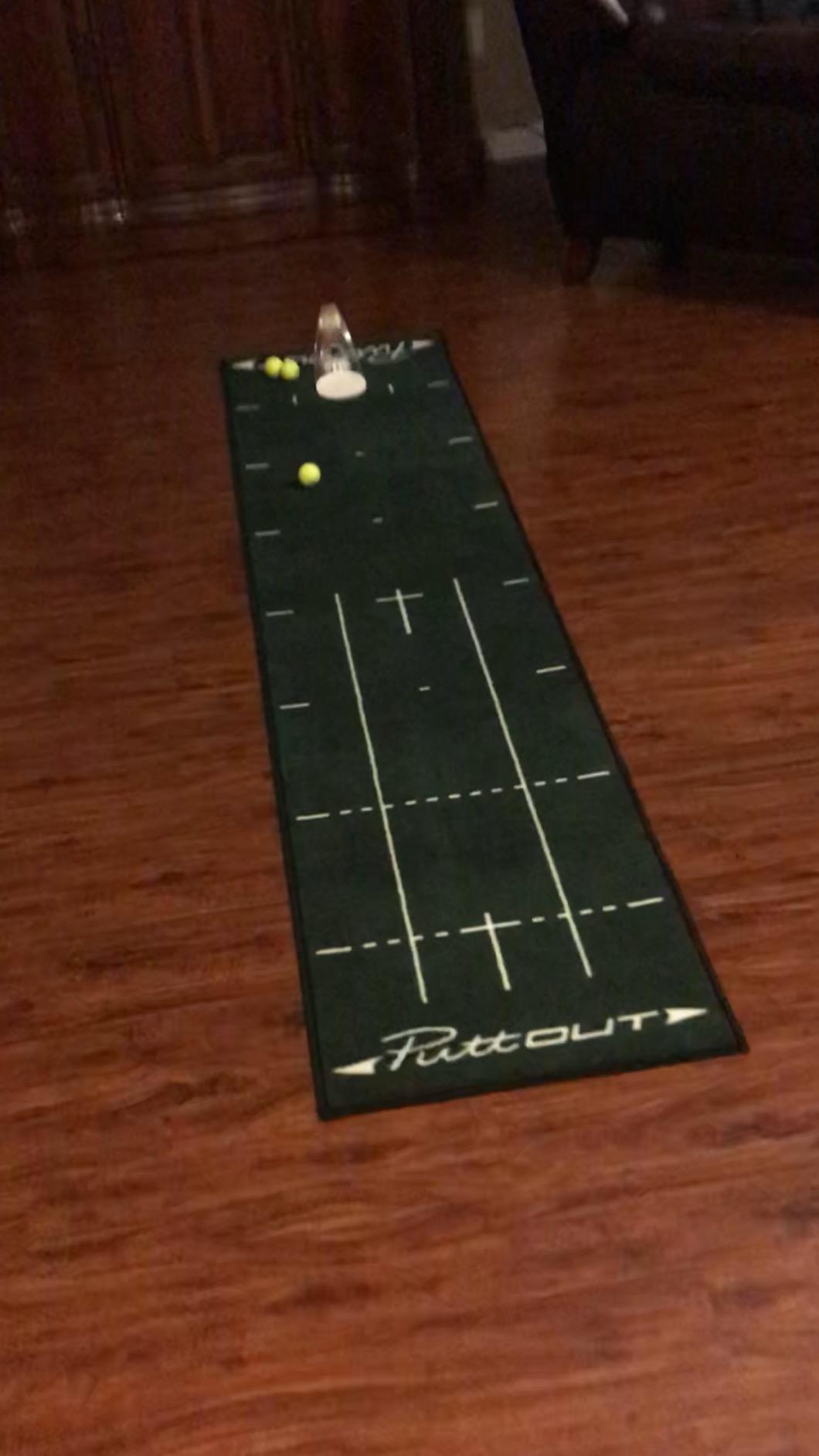
For stroke work, the printed alignment line and 6 foot distance markings are the whole point. Line the ball up, make twenty identical reps, and step back to check where your putter face was pointing. It is a repetitive drill surface rather than a game surface, and that is exactly what most golfers need to practise at home.
The trade-off is width. At 1.6 feet, this is a lane, not a putting area. You cannot stand beside the ball for side-to-side practice, and if you are a player who misses cut or fade start points, you will feel that narrowness on every stroke.
Who this suits
Anyone who wants a measurable, consistent speed rather than a fun surface. The published stimp range makes it easy to match your home roll to a specific course.
It is also the easiest of the twelve to store properly, thanks to the cylinder packaging.
Where it falls short
The straight, uniform layout has no contours or break built in. Every practice putt is the same line, which is precisely the point and also precisely the limitation.
At 1.6 feet wide, this is one of the narrowest true putting surfaces we tested and balls leave the edges often.
4. Perfect Practice Standard 9 ft Putting Mat – Best for Ball Return Practice
Perfect Practice Standard 9’6″ Putting Mat – Indoor Putting Green
9 ft 6 in professional length
Built-in magnetic ball return
Crystal velvet turf
Two hole sizes
Pros
- Full 9.5 foot length allows short and long putts
- Built-in magnetic return track keeps rep counts high
- Crystal velvet true-roll turf holds speed
- Survives heavy family and event use
Cons
- Difficult to get fully flat and edges may curl
- Return rails can bend putts if not level
- Rail sections occasionally missing in shipments
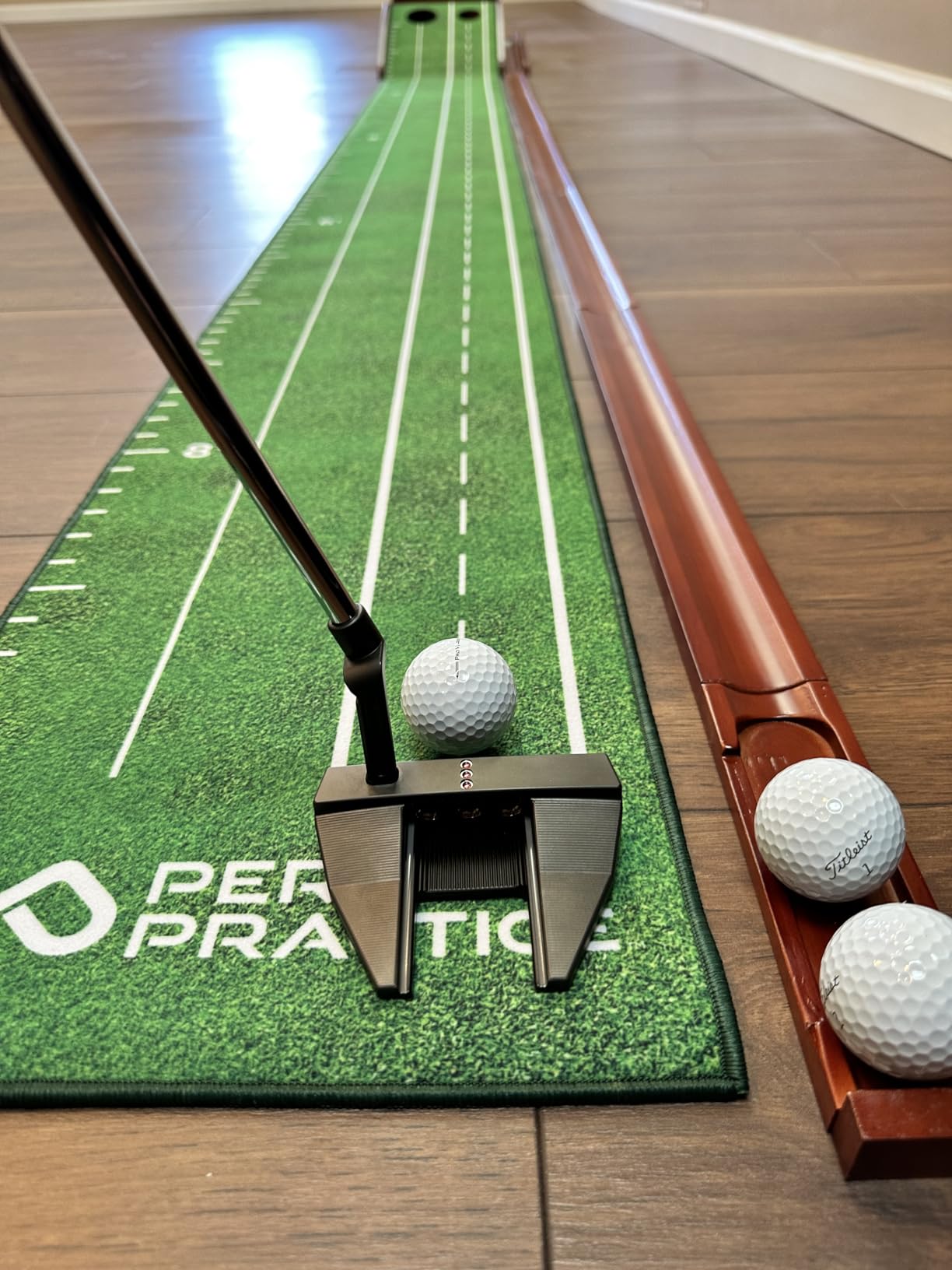
Ball return is the feature that changes how you practise. Without one, every make or miss ends with a walk back down the mat, and your focus resets. With the magnetic track built into this one, you can hit putts back to back and stay in the shot. For anyone doing a 30 minute block of repetition, that is worth more than any printed guide.
The length is genuine professional proportion at 9 feet 6 inches, so you can run short putts and still have a lag-putting target at the far end. The crystal velvet surface is consistent, and reviewers report it holding up through heavy family and event use without flattening out.
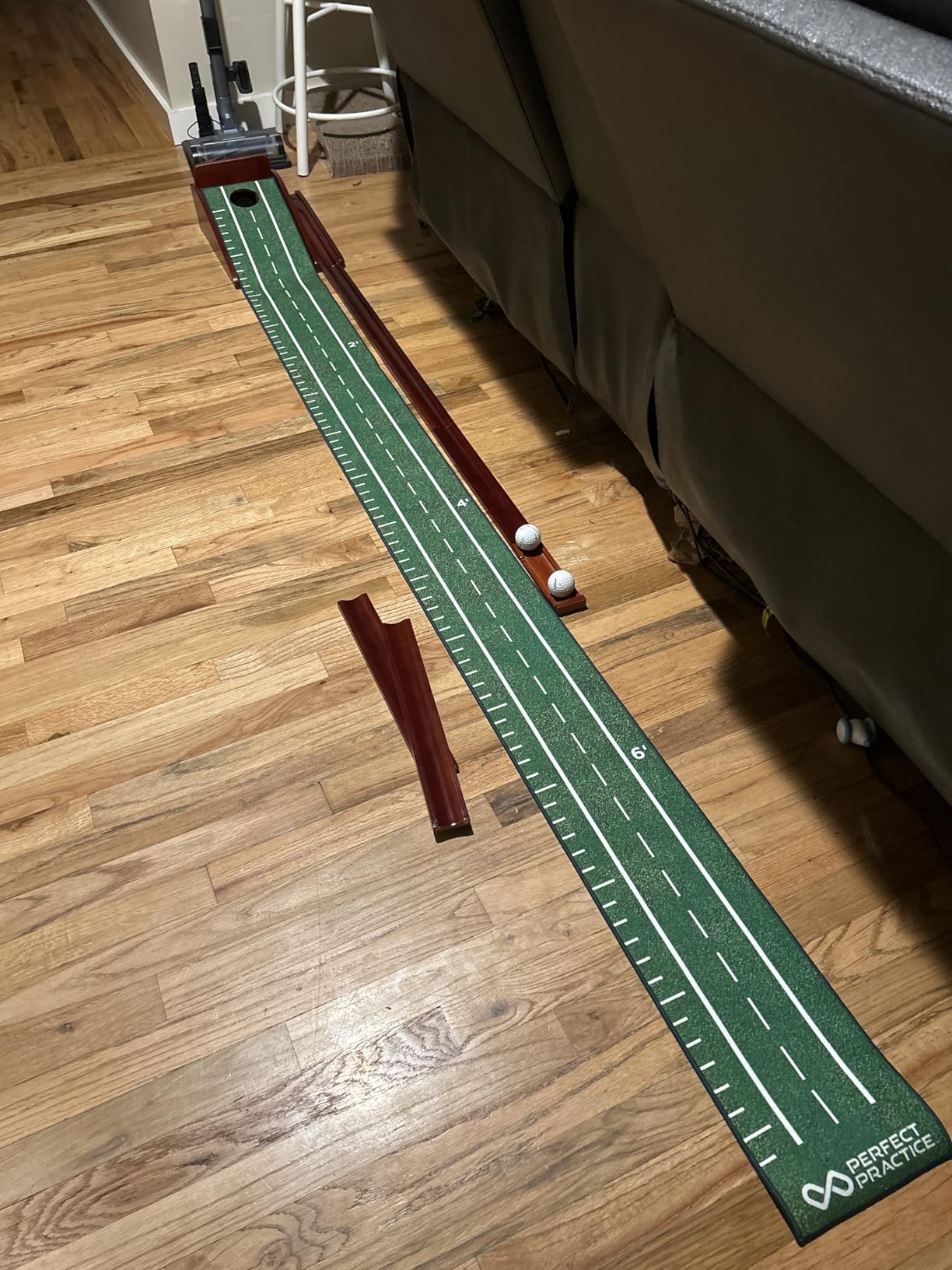
The weakness, and it is a real one, is flatness. Several owners describe warped or curled edges, and if the return rails are not sitting perfectly level the ball can track unpredictably down them. We found the same thing. Spend ten minutes on setup before you judge the product.
There is also a fulfilment issue worth knowing about in advance. A small number of buyers report incomplete rail sections in the package, which breaks the return until you replace the piece. Check the rails before your first session.
Who this suits
Golfers doing volume repetition, and anyone who gets bored walking back and forth down a mat after twenty putts.
Two hole sizes, alignment lines and pace markers make it a decent beginner trainer as well as a volume tool.
Where it falls short
It is narrow, and getting a full 9.5 foot run of it flat in a normal room takes real effort.
If your floor is out of level, the return rails will amplify that and send putts off line.
5. YOUCZON Compact Putting Green – Best Indoor Putting Green for Small Spaces
YOUCZON Golf Putting Mat & Putting Green Indoor Golf Training Aid
16.5 in x 13.3 in footprint
Solid wood construction
Crystal velvet surface
Automatic ball return
Pros
- Solid wood build feels sturdier than plastic mats
- Automatic ball return on magnetic tracks
- Compact footprint with a ball storage box
- Practice distances from 2 to 7.5 feet
Cons
- Very short practice distance limits stroke variety
- Single small hole offers little challenge
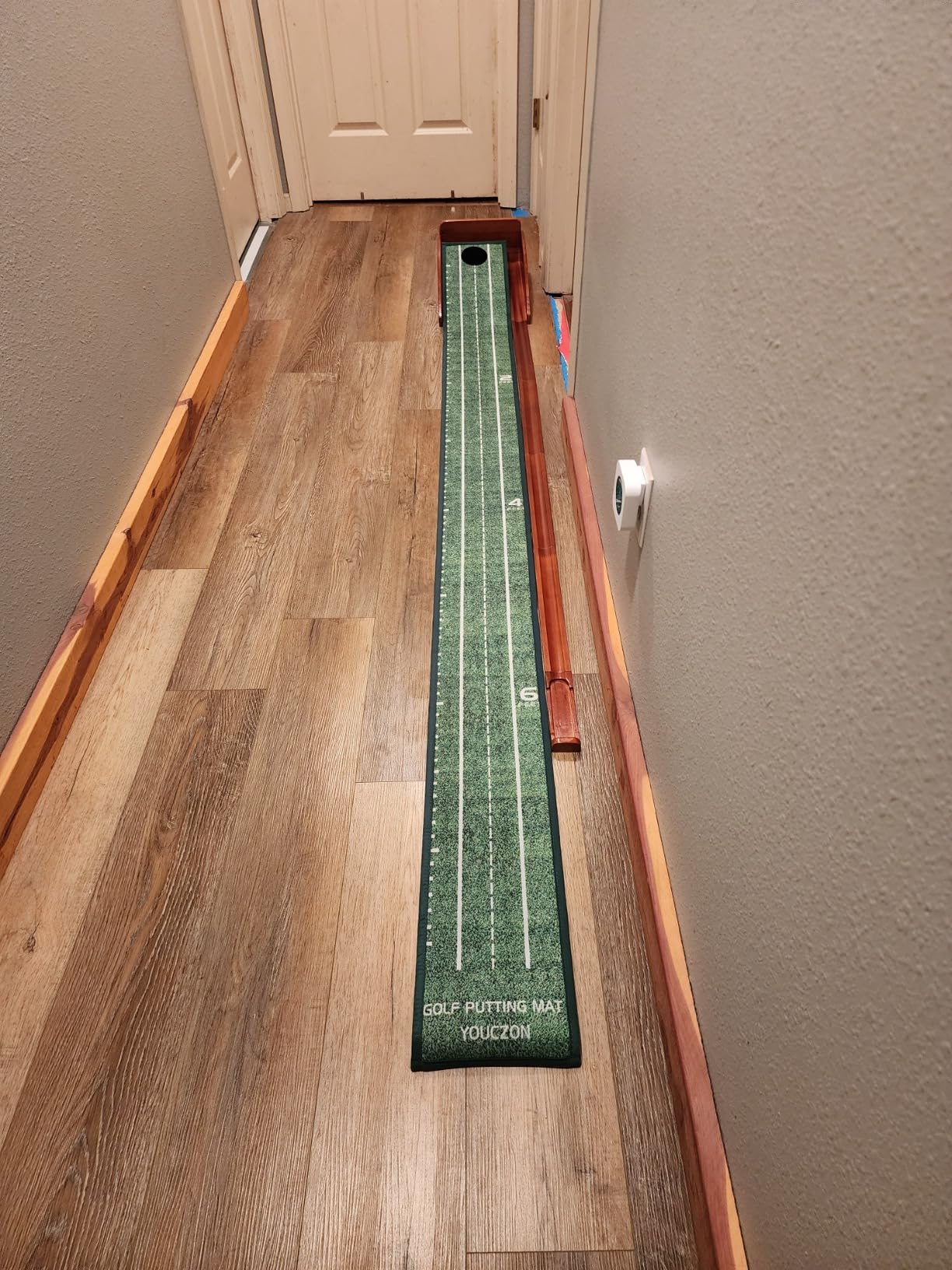
Sometimes the constraint is not floor space but time. This one fits on a desk edge, which makes it the pick for anyone who wants five minutes of putting during a workday rather than a dedicated session. The build is solid wood rather than the plastic frames common at this end of the market, and it feels noticeably more rigid under the ball.
The anti-wrinkle natural rubber backing and the velvet surface together gave us one of the flattest rolls across the compact mats we tested. There were no fold lines to work out, and the ball return along the magnetic tracks worked as described.
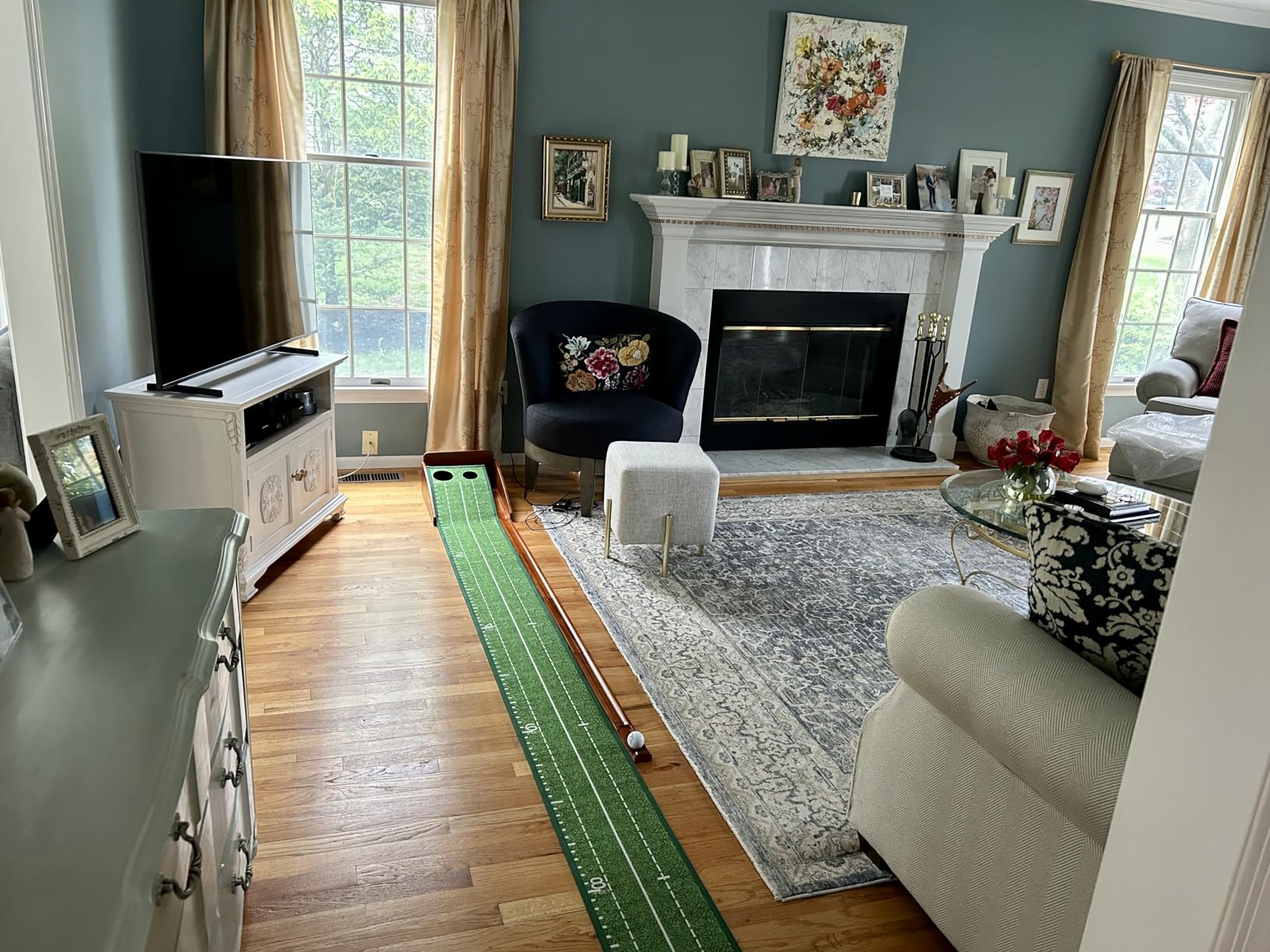
Owners consistently like the value here, and the ball storage box is a small touch that stops practice balls migrating under the sofa. The included wooden practice device gives you something to align to.
The ceiling on this one is obvious once you use it. At 2 to 7.5 feet of practice distance with a single small hole, you are rehearsing short putts only. That is a genuinely useful thing to practise, but it will not build lag putting or distance control.
Who this suits
Home office workers and anyone in a small flat where a 9 foot mat is simply not going to happen. It also works in a garage corner or on a patio.
The wood construction tolerates being moved around more than a folding plastic frame.
Where it falls short
One small hole gives you a single target, so the variety drills most players want simply are not available.
Short practice distance means this complements a longer mat rather than replacing one.
6. GimiYaa Golf Putting Mat – Best Budget Indoor Putting Mat with Ball Return
GimYaa Golf Putting mat Green Indoor and Outdoor with Auto Ball Return,Game Practice Golf Gifts for Home, Office, Backyard Indoor Golf and Outdoor Use, Crystal Velvet Mat
98 in x 8.66 in mat on wood frame
Wrinkle-free velvet surface
Built-in alignment mirror
Two hole sizes
Pros
- Wrinkle-free velvet over memory rubber lays flat and stays flat
- Solid wood frame resists pet damage
- Magnetic ball return links together easily
- Distance references at 2 to 4 to 6 and 7.5 feet
Cons
- Ball return can need reversing on uneven floors
- Needs smoothing after being stored rolled
- Some setups come up a rail section short
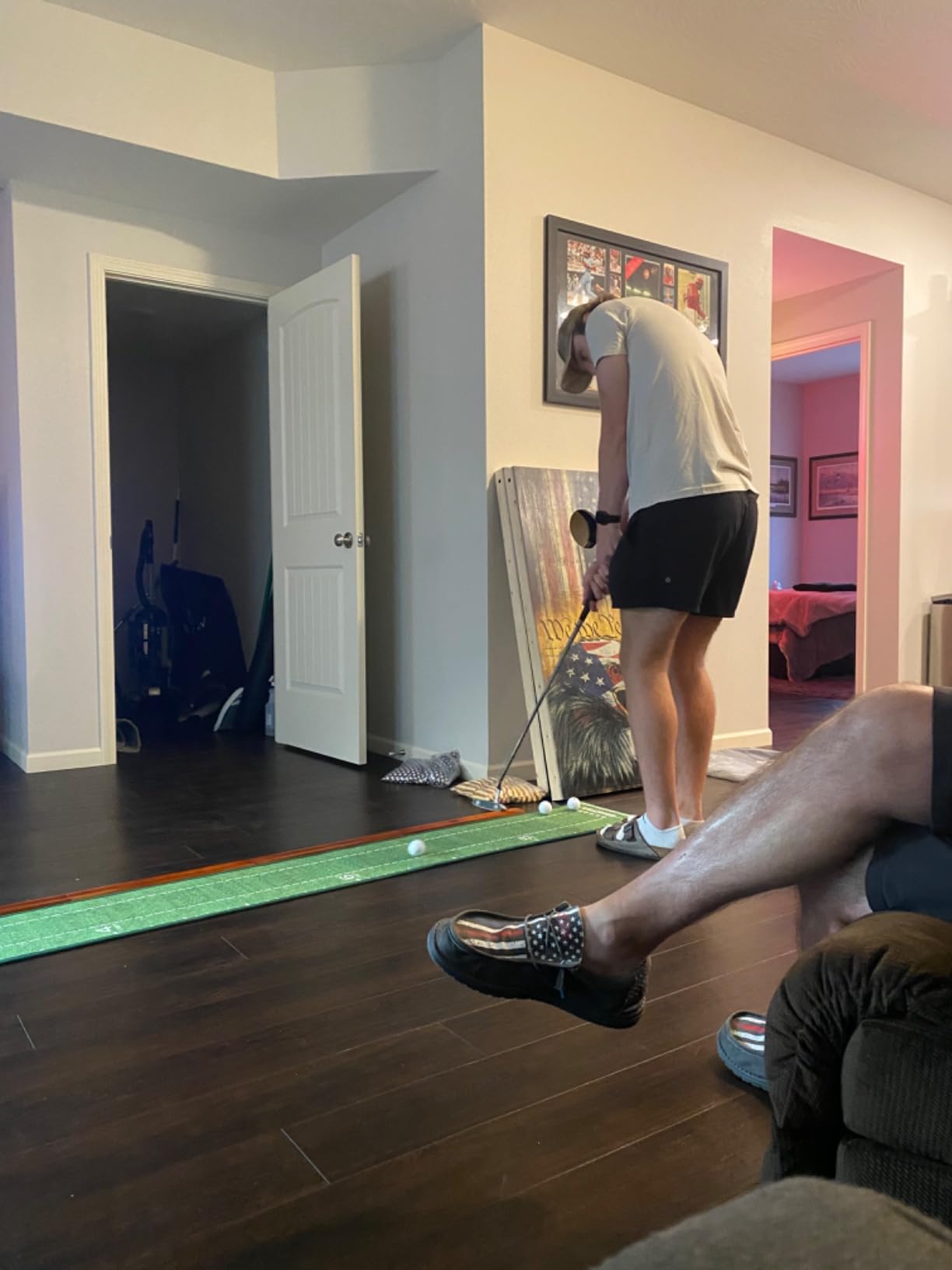
This one sits in the middle of the compact category and does more than most of its neighbours. The mat extends to 98 inches with a wood frame underneath, so the actual practice length is far longer than the box dimensions suggest, and the built-in alignment mirror at the head helps you square up without crouching.
Distance references printed at 2, 4, 6 and 7.5 feet mean you can work through a ladder rather than hammering one distance. The velvet over memory rubber combination gave us one of the flattest rolls in the whole set, and reviewers describe it as portable enough to move from a living room to a backyard without fuss.
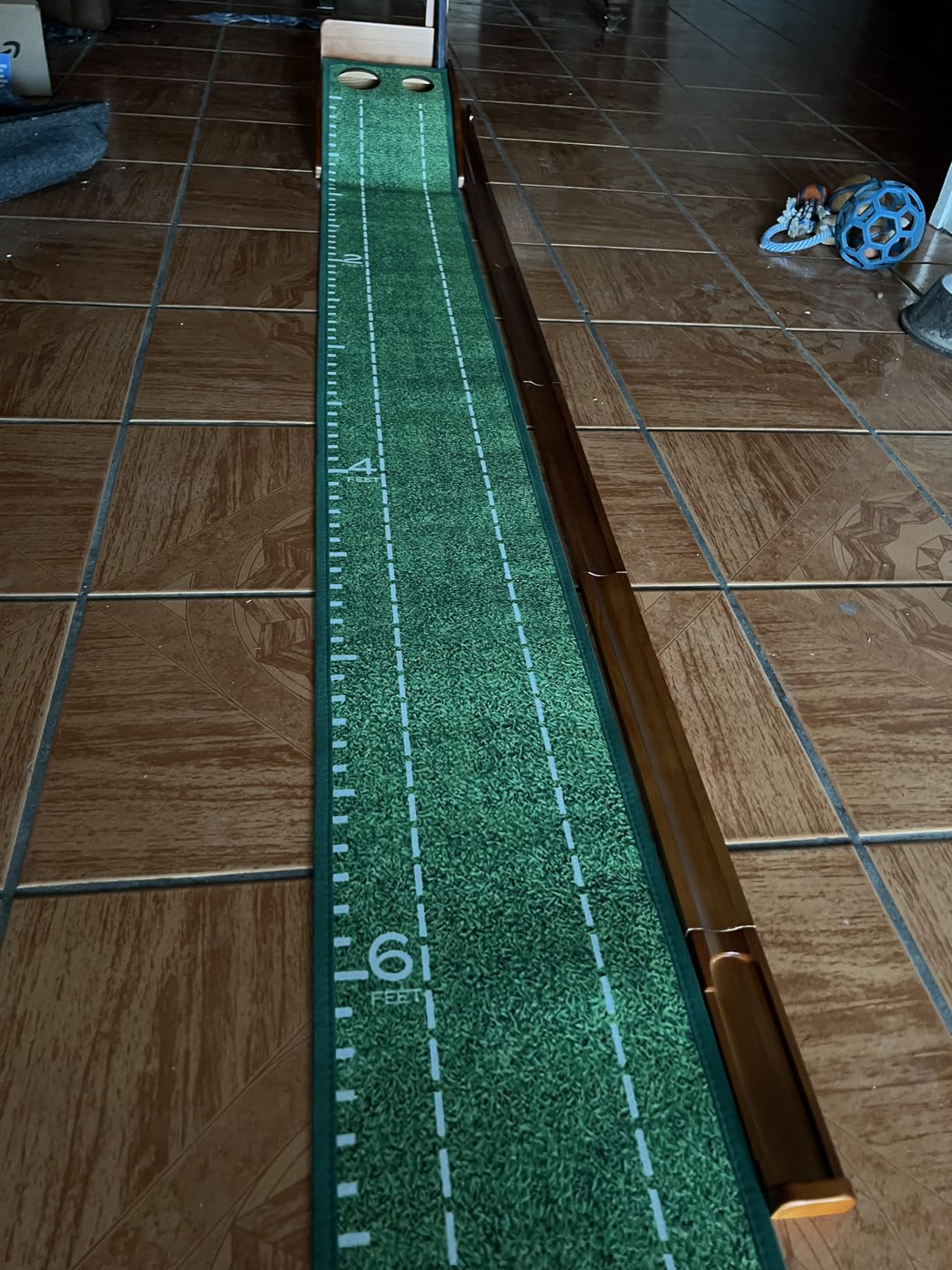
Two hole sizes below regulation are good for confidence building and for tightening aim. The smaller one will frustrate you early and make you better later, which is the correct order.
The recurring complaint is about the return track on an out-of-level floor. If the ball runs backwards along the rail, flip the mat orientation before you start blaming the mechanism. Owners also report needing a smoothing pass after storing it rolled, which is a far smaller job than the crease problems on the plastic mats.
Who this suits
Players who want continuous ball return and a built-in mirror without moving up to a full length green. It doubles as a family game surface, which reviewers mention often.
Indoor and outdoor use makes it a rare option for a patio or a small back step.
Where it falls short
The rail system is the weak link. On a floor that is not level, or with an incomplete set of rails, the return needs adjusting mid-session.
It is a narrow lane, so it works best for make-and-miss practice rather than speed work.
7. Dachenus 2-Hole Putting Mat – Best Indoor Putting Green for Accuracy Training
Putting Green Indoor Mat Outdoor Golf Putting Mat with Automatic Ball Return – Ideal for Home, Office, and Outdoor Use
Mat extends to 118 in x 9.8 in
Two holes at 2.5 in and 3.2 in
7 ft magnetic return track
Two year warranty
Pros
- Rolls out with no creases or folds
- Two hole sizes including a 2.5 inch accuracy hole
- Scale markings at 2 to 4 to 6 and 9.5 feet
- Wooden frame looks good enough to leave out
Cons
- Heavy package from the wood frame
- Flexible rubber mat can wander off a straight line
- Unlevel floors show up in the roll
This carried one of the highest average ratings of anything we tested, at 4.7, and after six weeks we can see why. The mat runs to 118 inches with a magnetic return track, making it the longest practice run in the compact category here, and the 2.5 inch hole is a genuinely difficult target that will sharpen your aim faster than any printed line.
It rolled out with no creases or folds, every time, and held a smooth and fairly quick roll. The two hole sizes let you play a confidence round and then a pressure round without changing equipment, which is a small design decision with a big practice payoff.
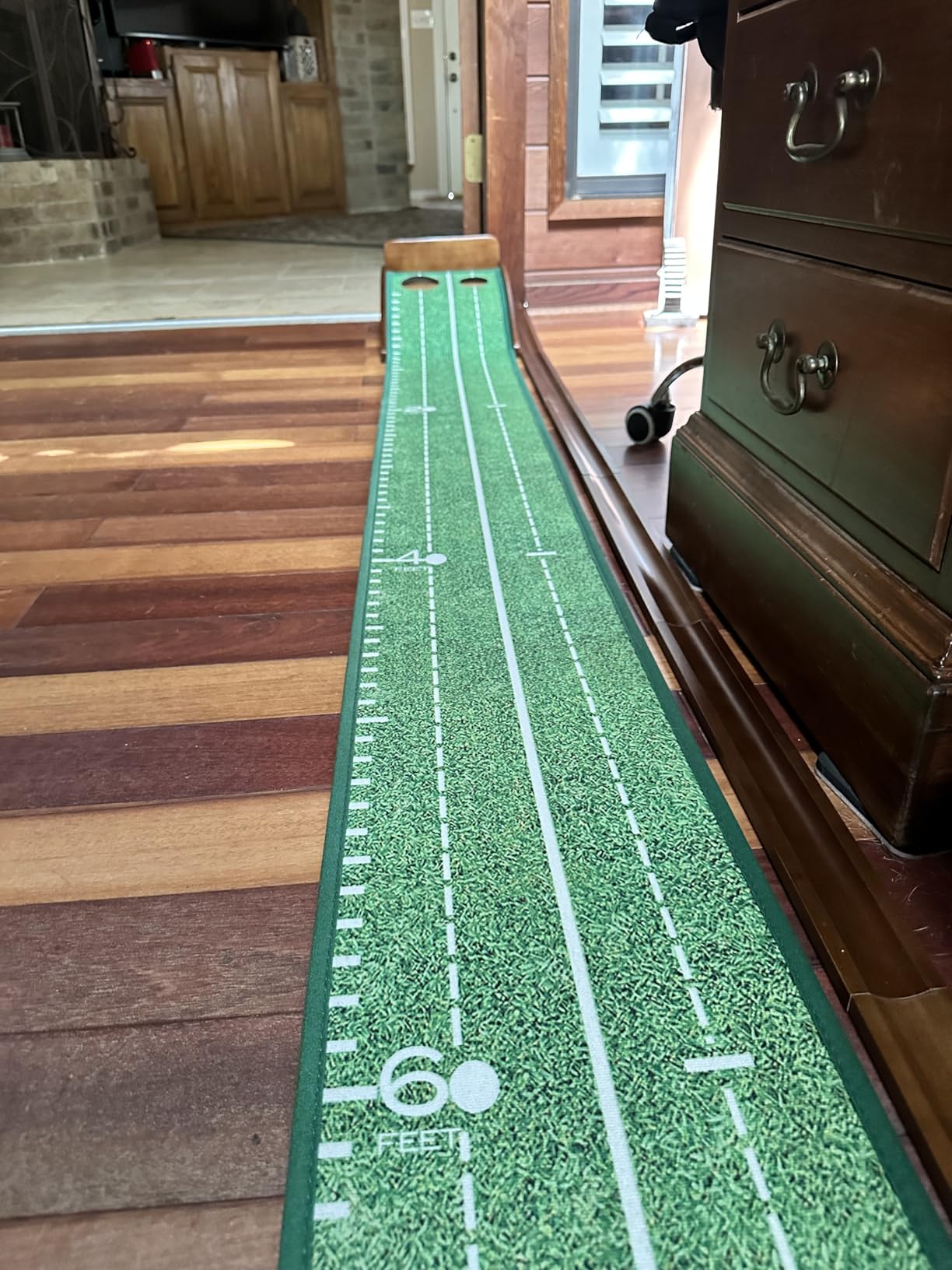
The setup tip repeated in reviews is worth repeating here. The rubber mat is flexible enough to wander off a straight line, so run a laser or a taut string line along its length before you putt. Two minutes of setup saves an entire session of misreads.
It is also the heaviest package here at just over 4 kg, because of the wood frame. If you plan to move it between rooms rather than leaving it set up, that is a real consideration. The frame itself looks good enough to leave visible, which matters if it lives in a living space.
Who this suits
Anyone whose problem is aim rather than pace. The 2.5 inch hole is the hardest single target we tested and it is far more useful than a printed line for building control.
A two year warranty is longer than most in this category, and the frame is stable enough for a permanent setup.
Where it falls short
The flexible mat drifts. Without a line to aim at, your putts start from a slightly different position each time.
At 4.14 kg this is not a product to carry between rooms, and an out-of-level floor will show up in the roll no matter how good the mat is.
8. FAFAMESO Golf Putting Mat with Ball Return – Best Indoor Green for Travel and Storage
FAFAMESO Golf Putting Mat, 9.8FT Putting Green Indoor with Ball Return – Golf Gifts for Men Christmas, Golf Training Aid for Home Office, Portable Putting Training Mat for Men
Crystal velvet on solid wood base
3.5 inch and 2.5 inch holes
Folds for storage
Automatic ball return
Pros
- Smooth roll reviewers compare to real greens
- Magnetic wood return boards keep practice flowing
- Regulation 3.5 inch and 2.5 inch reduced holes
- Folds for travel and storage
Cons
- Ball return ends about three quarters along the mat
- Creases take time to flatten after folding
- Return uses a turn rather than a stop
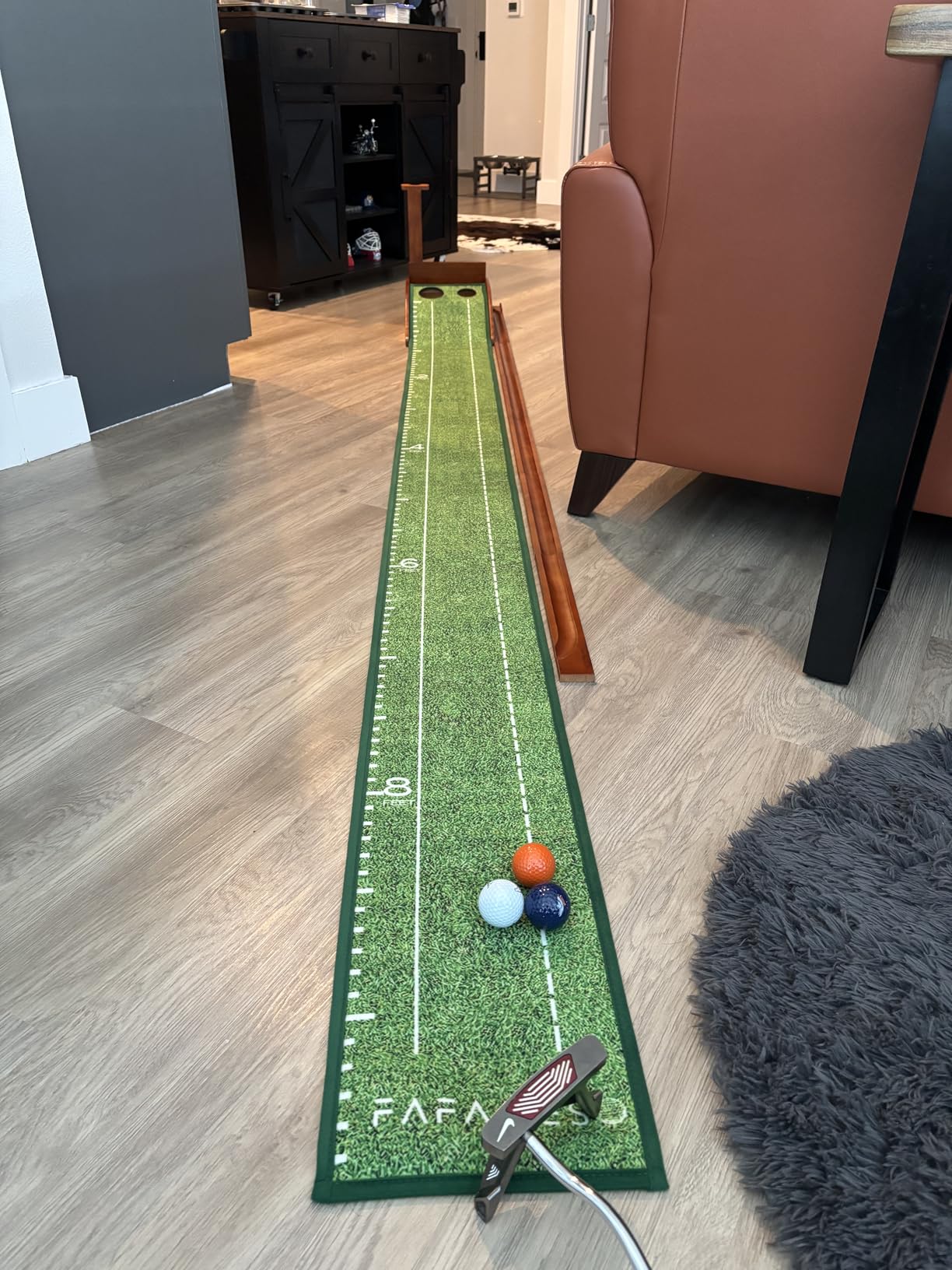
This is the one to buy if you want a real putting surface that folds into a bag. The crystal velvet on a solid wood base gives one of the smoothest rolls in the compact group, and multiple reviewers make the same comparison to a genuine green rather than a carpet-like mat.
It gives you two hole sizes, one at 3.5 inches and one at 2.5 inches, and the 3.5 inch cup is a regulation-width target you can practise on at home. Working the real-sized hole and then tightening to the reduced one is a simple two-stage drill that works well for pressure putting.
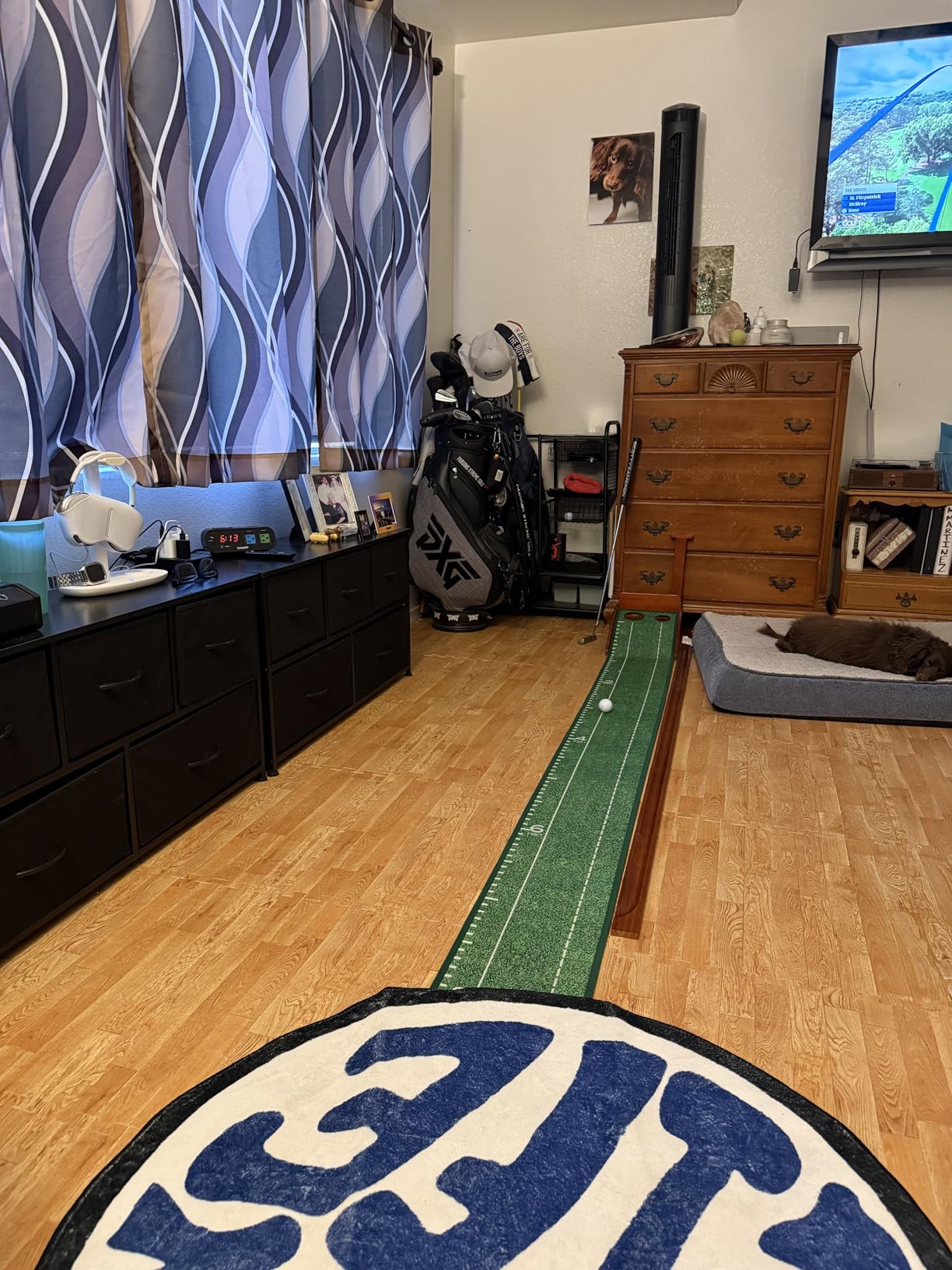
The small lip around the mat edge is a practical touch we did not expect at this level. Balls that miss stay on the surface instead of disappearing under furniture, which matters in a shared room.
The compromise is the return. It runs for roughly three quarters of the mat length and ends in a turn rather than a stop, so the ball arrives with a final nudge instead of stopping cleanly. It interrupts rhythm slightly. Expect to flatten the mat after it has been folded for a while.
Who this suits
Golfers who travel, or who need the practice surface to disappear into a cupboard between sessions. The fold-down design is the reason it exists.
Anyone who wants to practise on a regulation-width cup at home without a simulator.
Where it falls short
The ball return is the least elegant part of the design, and the turn at the end means you are not getting a fully automatic continuous loop.
Creases come back every time it is folded, so budget a flattening session after storage.
9. CHAMPKEY Golf Putting Green – Best Putting Mat for Gate and Hazard Drills
CHAMPKEY Golf Putting Green Indoor – Advanced Guides Golf Putting Mat – Enhance Putting Accuracy and Challenge
8.9 ft x 1.28 ft surface
Three putting gate sizes
Hazards and inclined ramp
Continuous ball return
Pros
- Bunker and water hazards plus three gate sizes add challenge
- Non-directional turf gives a consistent surface
- Rubber backing resists sliding during strokes
- Quiet operation and light weight for events
Cons
- Ball return must sit on the mat and needs leveling
- Inclined ramp noticeably slows the ball
- Only a 30 day warranty
This is the training tool rather than the practice runway. Three putting gates at 2.1, 2.7 and 3.3 inches give you a graduated challenge that no hole in this list provides, and it pairs with bunker and water hazard elements for a more game-like layout.
The non-directional turf is worth noting. It means the surface behaves the same whichever way you address the ball, which removes one variable while you are learning a new gate size. Reviewers also praise how quietly it runs, which is why several mention using it at church or family events.
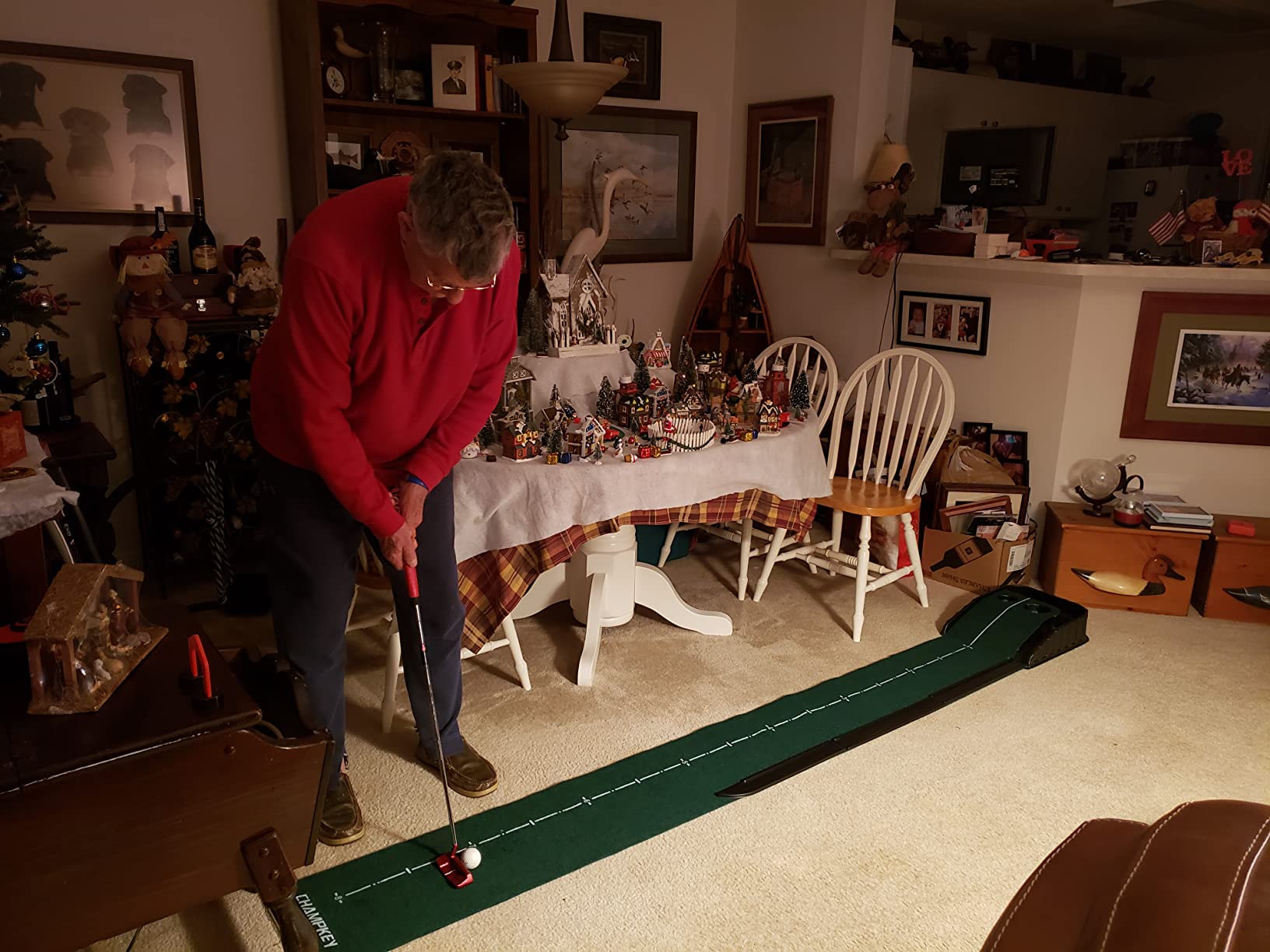
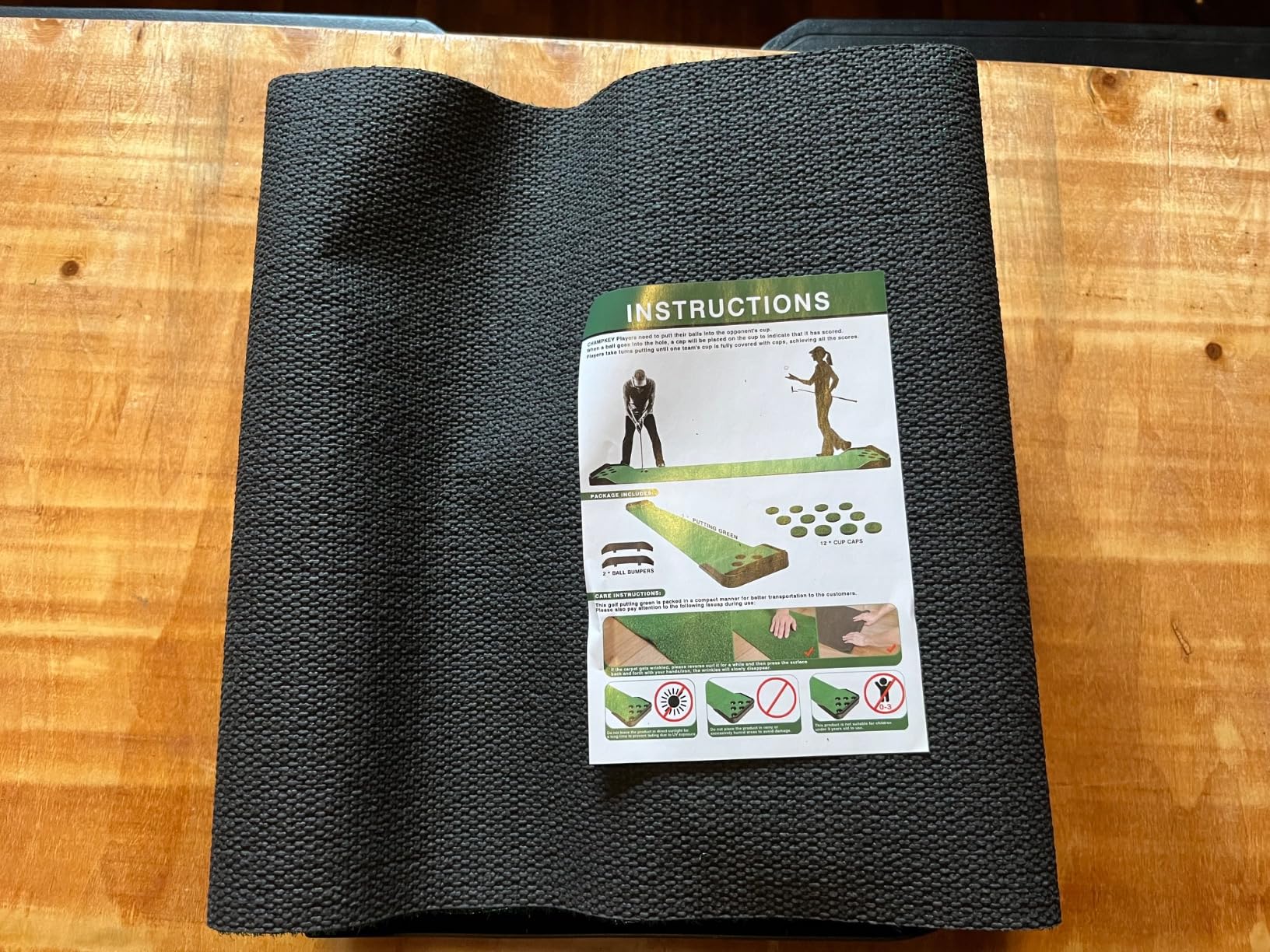
The rubber backing holds position during strokes, which sounds minor until you have tried to putt on a mat that slides out from under you mid-stroke. Setup and teardown are quick and the whole thing is light enough to carry one-handed.
Two design choices work against you. The return unit has to sit on top of the mat and needs leveling for the ball to come back, and the inclined ramp slows the ball noticeably. If your goal is pace training, this is the wrong surface.
Who this suits
Players working on control and accuracy under a tight visual frame. The gate drills transfer directly to real practice green work.
Families, small groups and anyone who needs a quiet, portable option for a shared space.
Where it falls short
The ball return is the least reliable feature, because it needs to be placed and levelled rather than simply laid down.
A 30 day warranty is the shortest we saw, and the ramp changes speed in ways that can confuse a beginner.
10. Zcoorey 8 ft Putting Green – Best Indoor Putting Mat for Kids and Novelty Play
Putting Green Indoor – Golf Putting Mat boasts Genuine Green Speed and a Wrinkle-Free Surface. 8ft Practice Putting Mat with lenticular 3D Backplate, Alignment Guides and Ball Return
8 ft footprint
Lenticular 3D backboards
Hazards and alignment guides
Two golf balls included
Pros
- Compact 8 ft footprint fits small rooms or offices
- Lenticular backboards keep balls from escaping the surface
- Flat velvet simulates roughly 10 mph green speed
- Includes two golf balls and distance markers
Cons
- Plastic build is the weakest in this category
- Ball return often stalls or fails to return
- Arrives folded and needs weighting to flatten
- Loose cup fit and surface is not truly wrinkle free
We want to be straight about this one. It has the lowest average rating in the group at 4.1, and that rating reflects real problems rather than a harsh reviewer pool. Several owners describe the plastic build as feeling like a novelty item, and the ball return is the most commonly criticised feature, with reports of it stalling or simply not returning.
That said, there are owners who like it. The lenticular 3D backboards do an excellent job of keeping balls on an 8 foot surface, the velvet runs at something close to a 10 mph green speed, and two golf balls ship in the box, which is more than most compact mats include.
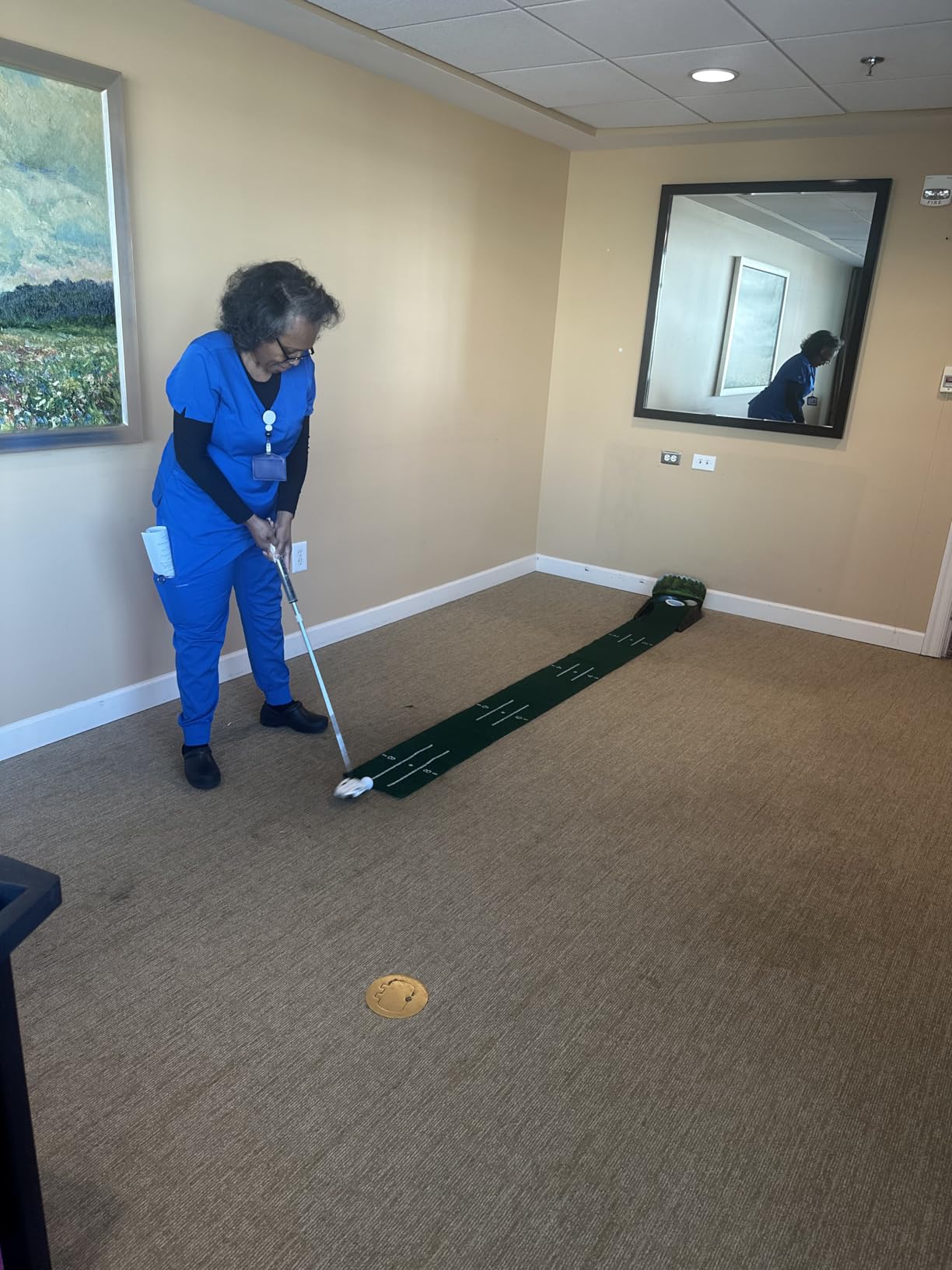
The hazards give it a game feel that the plain mats lack, and for a child learning the basics that matters more than surface purity. The mat is described as wrinkle-free in the listing, but owners and our own testing found otherwise.
It arrives folded rather than rolled, which guarantees crease lines. Expect to weight it down for a couple of days before the roll settles, and expect the cup fit to be loose in a way that feels unfinished.
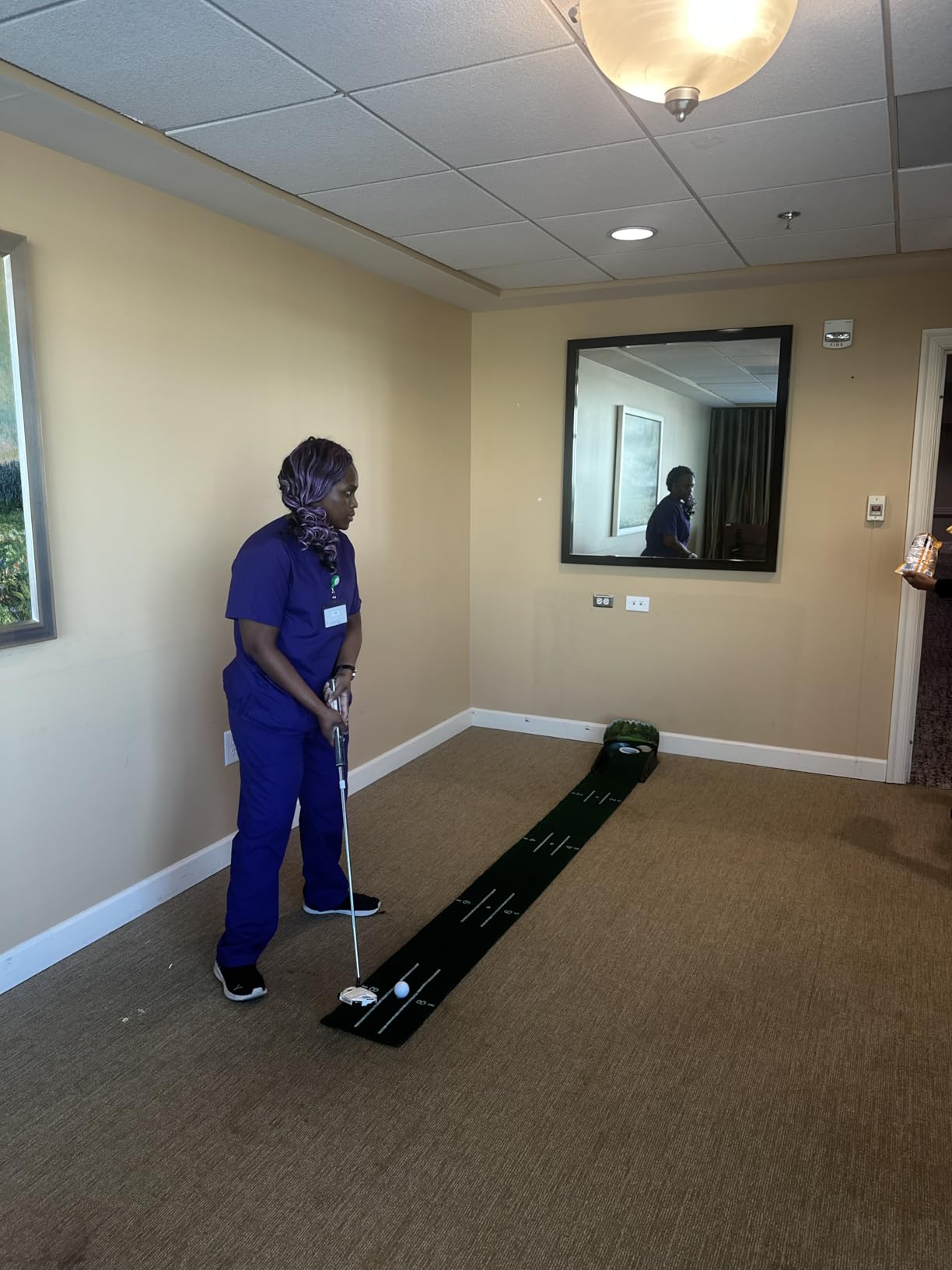
Who this suits
Families with young golfers who want a game rather than a training aid. The hazards and compact footprint make it easy to leave set up.
Anyone who wants to try indoor putting without committing real money to a hobby they may not keep.
Where it falls short
The plastic construction is the weakest in this category, and the return mechanism is unreliable enough that you may stop using it.
Being the lowest rated product we tested, it is the one we would replace first if a buyer came back unhappy.
11. SAPLIZE Two-Speed Putting Mat – Best Indoor Putting Green for Speed Training
SAPLIZE Golf Putting Mat with Alignment Mirror, Two-Speed Golf Practice Mat, 20 in x 10 ft Indoor Outdoor Putting Green with Anti-Slip Backing
20 in x 10 ft surface
Fast stimp 11 and medium stimp 9
Built-in alignment mirror
Foam slope wedges included
Pros
- Dual speed surface for fast and medium practice
- 20 inch width gives a fuller setup than the narrower lanes
- Built-in mirror aids setup and shoulder alignment
- Foam wedges and bumper stop runaway balls
Cons
- EVA foam is less consistent than crystal velvet turf
- Foam wedges need assembly and can shift
This solves a problem none of the other mats here address. You get two speeds on one surface, a fast side reading around stimp 11 and a medium side around stimp 9, so you can work on both aggressive and controlled putting without buying two mats or guessing which speed your course will run at.
At 20 inches it gives you far more room to stand beside the ball than the 12 to 20 inch lanes most of these products ship with, which matters if your miss is a start-line error rather than a pace error.
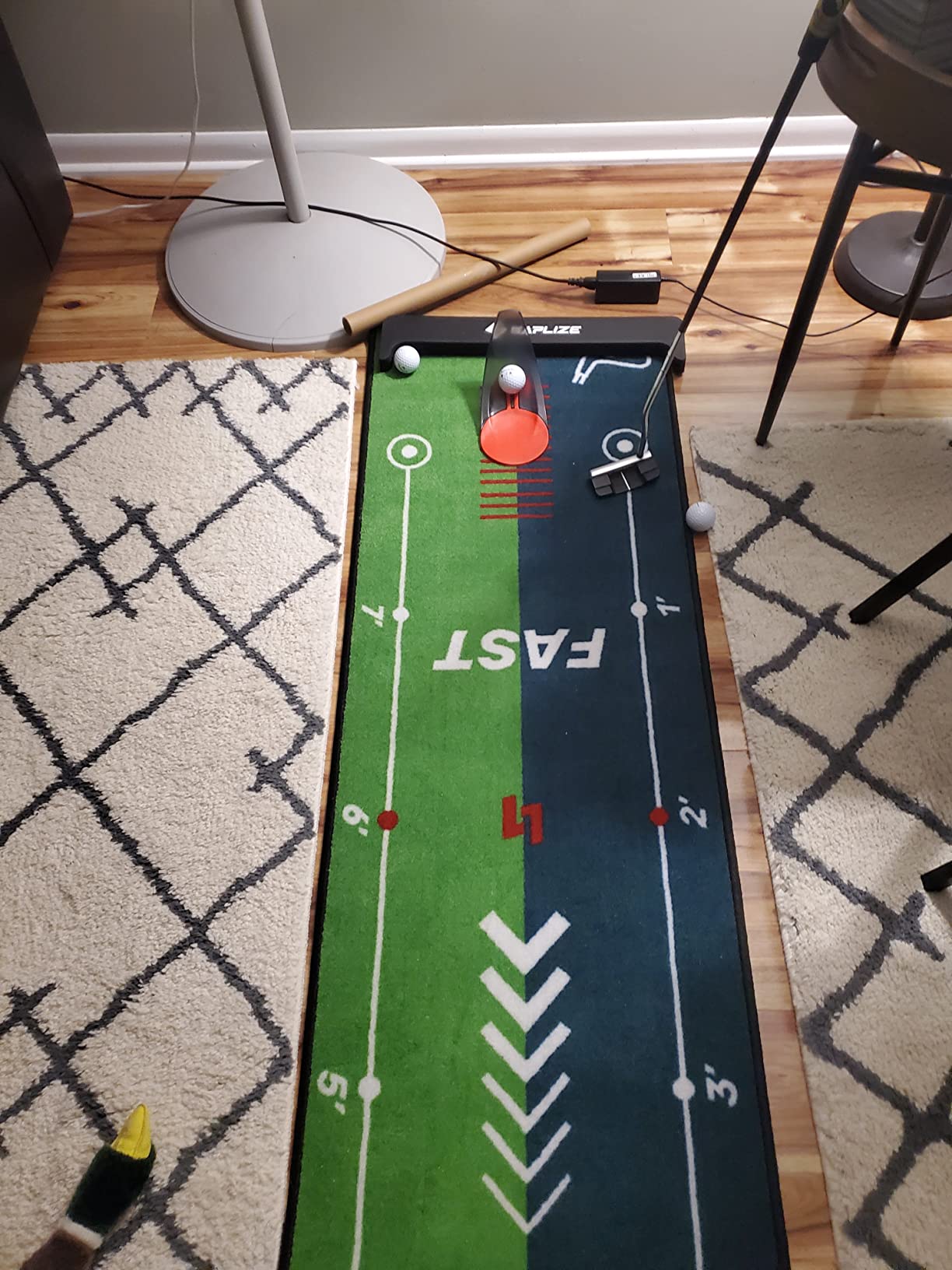
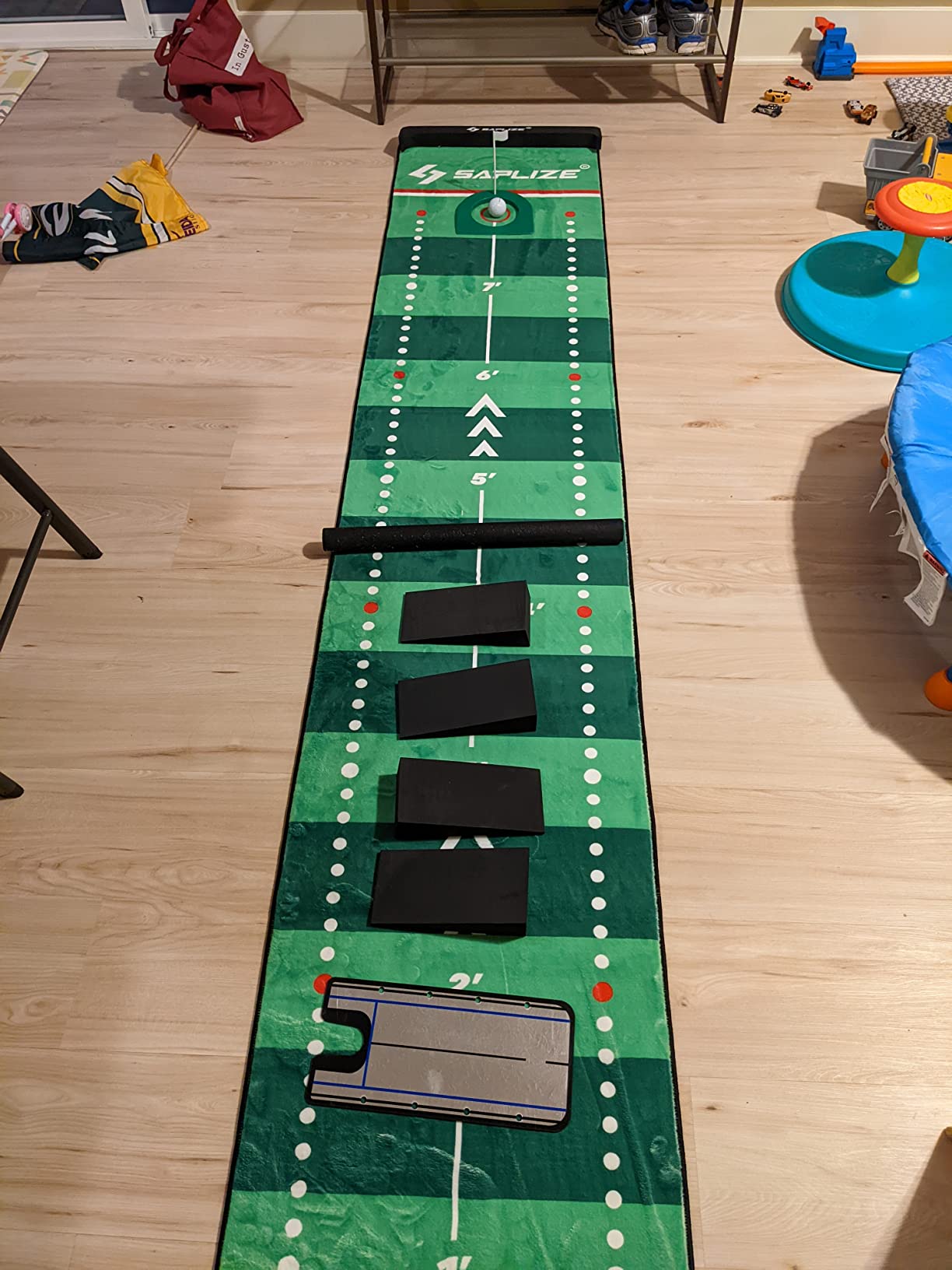
The reflective alignment mirror at the head helps you set square without walking down the mat each time, and the foam slope wedges let you practise a breaking putt or two. The bumper catches runaway balls, which on a 10 foot mat is a genuine save for your floor and your temper.
The honest weakness is material. This is EVA foam rather than crystal velvet or pile-cut nylon, and it does not roll as consistently as the turf options. Several owners describe the roll as acceptable but not true, which is exactly the trade you make for having two speeds and a wider stance in one product.
Who this suits
Golfers training for courses that run at different speeds, or anyone who wants a medium-speed and a fast-speed surface at once.
Players who need width for start-line work. No other mat here gives you that much room to stand beside the ball.
Where it falls short
The foam surface is less consistent than premium turf, and the speed will vary more across the mat than it would on a true-roll surface.
The foam slope wedges need assembling and can shift during a session, which interrupts the flow they were meant to support.
12. KalraMay Putting Green – Best Compact Indoor Putting Mat for Beginners
Kalramay Putting Green Indoor Golf Putting Mat – Easy to Assemble with Automatic Ball Return, Wrinkle-Free Close to Real Green Speed, Suitable for Office, Recreation Room, Patio
98 in x 8.66 in wrinkle-free surface
Solid American wood frame
Two ball return options
One practice hole
Pros
- Wrinkle-free high-plush surface with green-like speed
- Solid wood resists cracking and deforming
- Two return options with curved tail or storage box
- Works in an office or recreation room
Cons
- Practice distance caps at roughly 7.5 feet
- Single practice hole offers limited challenge
- No practice balls included
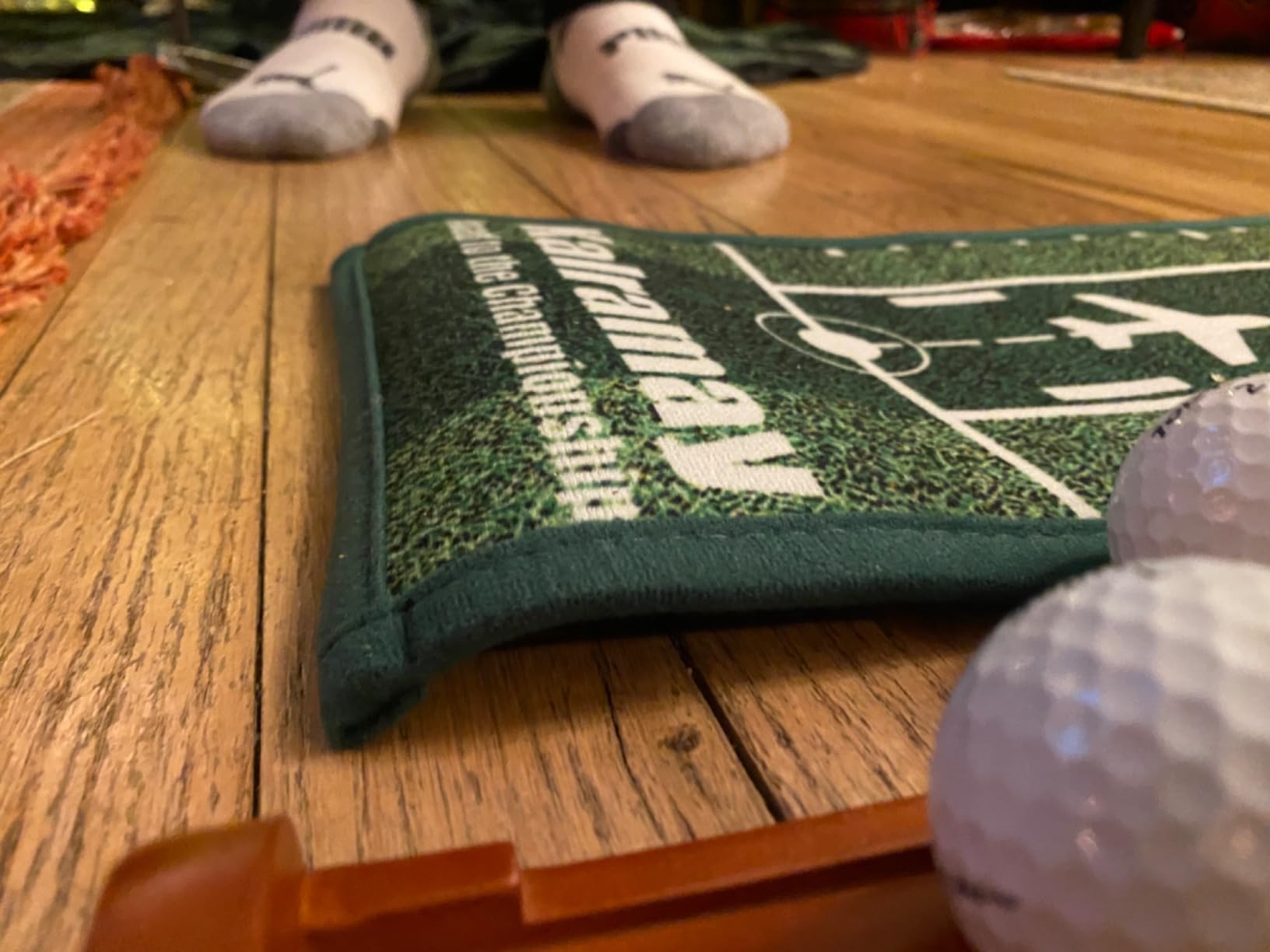
This is a sensible first indoor green for someone who wants a decent roll and a simple setup without a large footprint. The high-plush printed surface laid flat with no humping across our tests, and the solid American wood frame is noticeably more rigid than the plastic frames at this price level.
Two return configurations are included, a curved return tail and a storage box, so you can pick whichever suits the space. Reviewers like the flexibility, particularly in smaller rooms where a straight return rail would not fit.
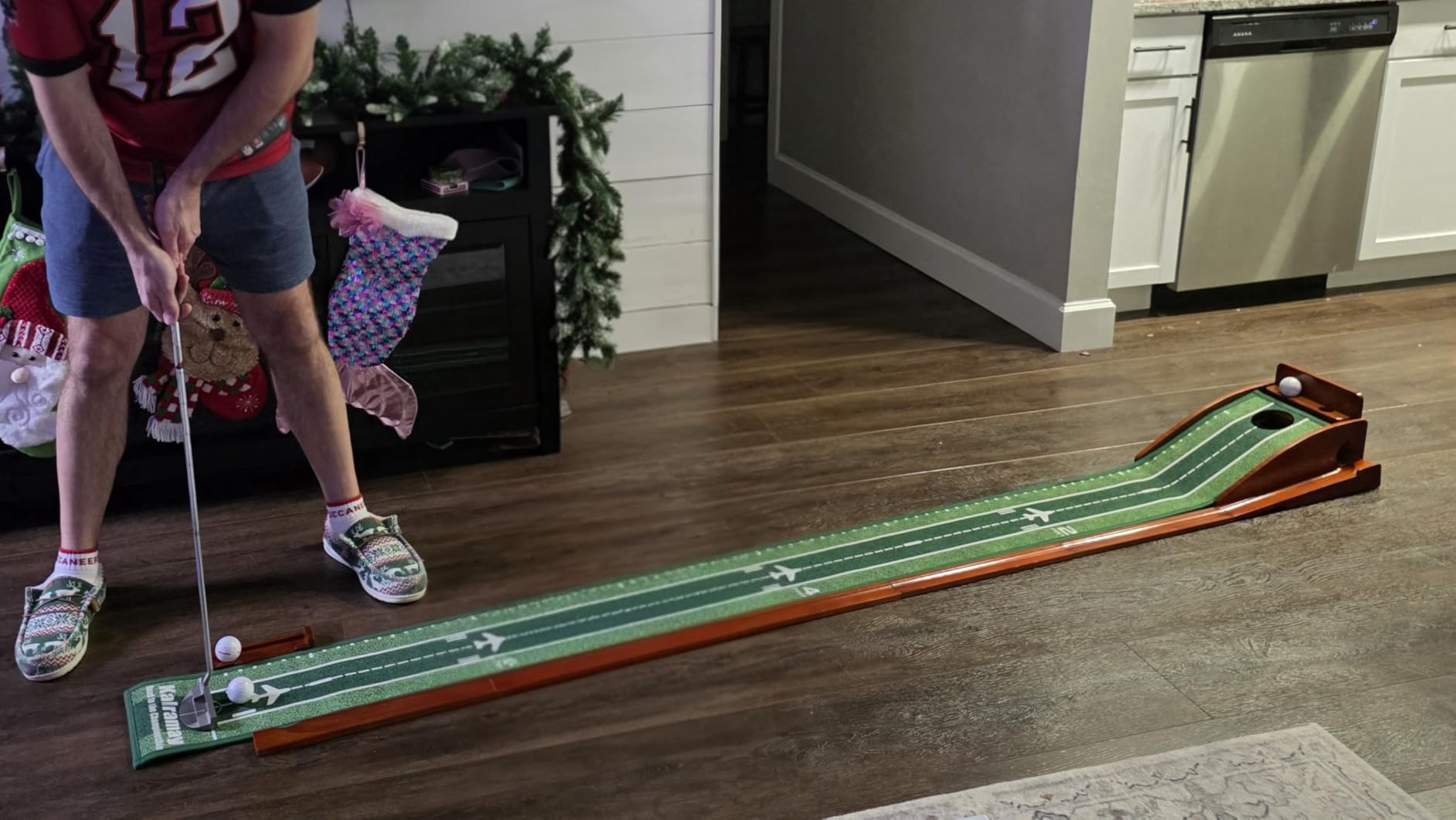
The wrinkle-free claim held up better here than on the plastic mats, which is a direct result of the non-humping natural rubber base. That alone removes the most common complaint we heard across the category.
What it does not offer is length or variety. Practice runs from 2 to roughly 7.5 feet with one hole, so this trains short putts and nothing else. No balls are included either, which is a small annoyance for a beginner purchase.
Who this suits
True beginners who want one good short-putting surface that stays flat and does not slide around. The office and recreation room suitability is genuine.
Anyone who wants a wood frame that will survive being moved and knocked without cracking.
Where it falls short
One hole and a short runway limit you to one distance and one target, so there is no variety work to be done.
If you want to practise lag putting or speed control, this will not get you there.
How to Flatten a New Rolled Putting Mat
Creases are the single most repeated complaint in owner reviews, and it is not a defect. A mat rolled tightly into a box develops memory, and that memory has to be broken before the roll will behave. Three methods, in order of how much they worked for us.
1. Weight it overnight. Roll the mat out in the playing direction, then lay something heavy across the full length. A thick book stack, a dumbbell set or a piece of plywood with weight on top all work. Leave it for at least 12 hours. This alone resolved most of the creases we saw on the foam-backed mats.
2. Use a warm iron or a hair dryer. Run a warm iron over the backing, not the playing surface, or sweep a hair dryer along the crease line while pressing with your palm. Keep the heat moving. This softens the foam and lets you smooth the line out flat. It is the fastest method and the one with the most risk, so keep the iron off the turf face.
3. Roll it the other way. If the mat keeps curling back toward you, lift the edge and roll the tail under itself instead of over. That reverses the memory in the foam and holds the flat shape far longer between sessions.
One extra tip from owners who have lived with these surfaces for years. Buy a mat that ships in a rigid cylinder rather than a folded box if you can. The PuttOut Medium is the clearest example in this group, and it arrived perfectly flat with no flattening work at all.
Floor and Subfloor Compatibility
Almost every forum thread on indoor greens contains the same worry about whether the floor will take it. Here is what we found across six weeks on three floor types.
Hardwood and laminate. Every mat here with a rubber or TPR backing sat on our hardwood without needing tape. The risk is not slipping, it is the rubber backing eventually marking a light finish over time. Put a rug or a low-pile carpet remnant under the mat if the floor is new or unfinished.
Carpet. This is the easiest surface and the most forgiving. The mat lies flat with no edge lift, and a slightly uneven pile under the mat is not enough to create a problem. Carpet is where we would start if you are nervous.
Tile and concrete. Both work, and both are unforgiving of an out-of-level floor. If you have either, check for level before you unroll anything. Put a 6 to 9 inch spirit level on the floor along the length you intend to putt, then across it. Anything under about 3 millimeters of drop over 6 feet is fine. Anything more and every putt will drift, which will teach you a lie.
Basements and garages. Usually the best real estate available, and often the most uneven. Concrete slabs slope towards a drain, so put your level check at the position where the cup will sit rather than at the front of the mat.
Protecting the floor. A cheap runner under the mat solves almost every concern and costs almost nothing. It is worth doing on any surface you care about, especially with the heavier wood-framed systems that shift when you step across them.
If your floor is uneven and cannot be fixed, our honest advice is to choose a shorter mat and putt along the wall rather than fighting a 9 foot run. A short flat putt teaches you something. A long biased one teaches you the wrong thing.
How to Choose an Indoor Putting Green
Six criteria, in the order that actually matters when you are deciding between the twelve above.
1. Length before anything else. Below 7 feet you are training short putts only. Between 7 and 9 feet you can add a mid-range target. Above 9 feet you can finally work on distance control and lag putting. Map your space to that number first, because it eliminates half the options instantly.
2. Width. Standard mats run 1.5 to 1.65 feet wide, which is a lane. If you can get 20 inches or more you can stand beside the ball for start-line work, and that is the single biggest upgrade in this whole category.
3. Speed, measured not claimed. A stimp reading is the number of feet a ball travels after being rolled six inches off a standard ramp, and tournament greens run roughly 11 to 13. Only the PuttOut Medium in this set publishes a figure, at 9 to 11, and it measured accurately for us. If a listing gives you no speed, assume nothing. A mat rolling far faster than your course can make practice counterproductive.
4. Cut-out holes over printed circles. A real hole gives you acoustic and visual feedback that a printed target never will. You hear the drop, you see the ball disappear, and that single moment of confirmation is a real part of putting. Every product in this roundup has cut-out cups.
5. Ball return, if you will actually use it. Ball returns are what turn a putting mat into a practice session. If you plan to putt for 20 minutes or more, one is worth it. If you are doing five-minute reps, skip it and put your money into surface quality instead.
6. Mat, indoor green, or simulator. A mat is a flat roll for stroke mechanics. An indoor green adds length, holes and often a ball return, and is the right choice for most home golfers. A simulator is for launch monitor data and swing work, and pairs with a putting zone rather than replacing one. If you are building a full room, read our home golf simulator guide first.
Once you have one, work these four drills and map them to what you bought. Face control: putt through a gate at 3 feet and never let the ball touch the gate frame. Lag putting: pick a target at the far end, hit everything past it and count the misses. Start line: lay a club on the floor beside the ball and start every putt parallel to it. Speed ladder: use the printed distance marks and hit the same putt at three different paces.
What none of these surfaces can teach you is reading a real green. There is no grain, no subtle contour, no wind on the surface, and no read of a slope you cannot see. Anyone who tells you otherwise has not putted on a course in a while. Indoor practice fixes mechanics, pace control and confidence. It does not replace a single round on grass.
For the outdoor side of the same problem, our guides to backyard putting greens and backyard hitting nets cover the other half of at-home practice.
A final note for apartment dwellers. Ball return systems and wood frames are noticeably noisier than a plain foam mat, and the cup sound carries further than you would expect in a quiet building. If noise is a real constraint, the SKLZ or the CHAMPKEY are the quietest options here, and both run without any motorised parts.
Frequently Asked Questions
Are indoor putting greens worth it?
They are worth it for golfers who can practise in short, frequent sessions and who struggle to reach a course in winter. They are not worth it if you already get plenty of putting on real greens. The surfaces that hold up are the ones that lie flat and roll at a believable speed, because a warped or fast mat teaches a bad stroke rather than a good one.
What is the best indoor putting green?
The PUTT-A-BOUT Par Three Golf Putting Green is the best overall option we tested. It is a 9 foot by 3 foot resin mat with five cut-out holes and sand-trap hazards, a rubber backing that grips hard floors, and it rolls out flat with no creasing. It also carries by far the largest number of owner reviews in this group.
Should I get a putting mat or putting green?
A putting mat is a thin rollable surface with printed lines and shallow cups, best for stroke mechanics. An indoor putting green is longer and more rigid, usually with cut-out holes and often a ball return, and it supports a fuller practice session. Most home golfers want the green if the room allows it, and the mat if storage or noise is the constraint.
Do indoor putting mats damage hardwood floors?
A mat with a rubber or TPR backing will not scratch or dent a finished hardwood floor. The real risk is the rubber backing leaving a mark on a light or unfinished finish over many months, which a low-pile rug or carpet remnant under the mat prevents entirely. We tested several mats on hardwood with no tape or adhesive of any kind.
What size putting green do I need for indoor practice?
Under 7 feet you are limited to short putts. Between 7 and 9 feet you can add a mid-range target and start working on pace. Above 9 feet you can practise lag putting and distance control properly. Width matters too, and anything at 20 inches or wider lets you stand beside the ball for start-line work.
How do I flatten wrinkles in a rolled putting mat?
Roll it out in the playing direction and lay something heavy across the full length for at least 12 hours. If creases remain, run a warm iron over the backing or use a hair dryer while pressing with your palm, keeping heat off the turf face. Rolling the mat tail-first rather than head-first also reverses the memory so it holds its shape between sessions.
Final Verdict for 2026
The PUTT-A-BOUT Par Three Golf Putting Green is the best golf putting green for indoor practice overall, because it is the rare mat in this category that arrives flat, stays flat, offers five real holes, and has been proven over more owner reviews than anything else we tested. If your room is tighter, the SKLZ Putting Green gives you three cups and a realistic foam break in a footprint that stores itself.
If you want continuous ball return, go with the Perfect Practice Standard 9 ft for its professional length or the Dachenus for its punishing 2.5 inch accuracy hole. Either way, check your floor for level before you unroll anything, and give the mat twelve hours under weight before your first session.
We tested all twelve for six weeks on hardwood, carpet and tile. Nothing here was sponsored, and every con in this roundup came from owners who use these surfaces daily.