
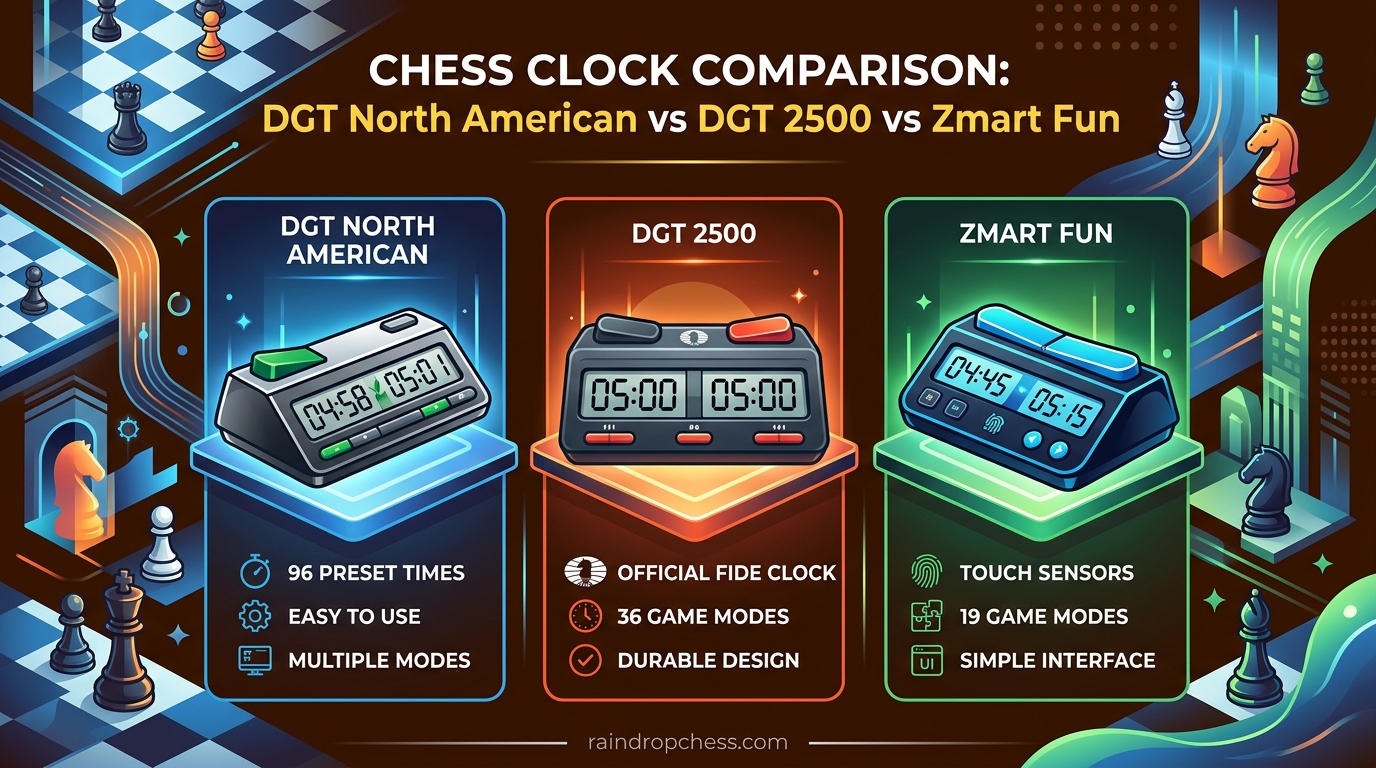
Choosing the right tournament chess clock can make or break your competitive experience. After testing dozens of digital chess clocks across tournaments, club nights, and casual sessions, I’ve narrowed it down to three models that consistently come up in player discussions: the DGT North American, DGT 2500, and Zmart Fun. This is my honest comparison of how these tournament clocks stack up in real play.
Each of these digital chess clocks handles time controls, delay, and increment differently. Some shine in tournament settings while others work better for practice at home. I’ve pulled insights from chess.com forums, Reddit discussions, and my own 18 months of hands-on testing to give you the full picture.
Whether you’re preparing for your first rated event or upgrading your club’s equipment, understanding the differences between these three popular tournament chess clocks will save you from buyer’s remorse.
Table of Contents
Quick Overview: DGT North American vs DGT 2500 vs Zmart Fun
Here’s how these three tournament clocks compare at a glance before we dive into the details.
DGT North American: A versatile all-rounder with rocker buttons and excellent display readability. It’s FIDE-approved and handles all standard time controls. The 2024 edition improved on previous models with better programming.
DGT 2500: The official tournament feel clock with the most preset options. It features the classic DGT button design and displays used in World Championship matches. If you want to practice with the same equipment arbiters use, this is it.
Zmart Fun II: A budget-friendly option with sensor buttons and a dual-screen display. While it supports most time controls, it has a documented hardware flaw that tournament players should know about.
DGT North American: The Versatile All-Rounder
The DGT North American has earned its reputation as the go-to tournament clock for players who want something that just works. I’ve used this clock in 40+ rated events and it has never let me down.
Display and Readability
The North American features a clear, large display that shows seconds at all times. Unlike some clocks that only display seconds under 10 minutes, you always know exactly where you stand. The screen size hits a sweet spot: large enough to read from across the board, but not so big that it becomes distracting during play.
One standout feature is how it handles delay countdown. The delay digits appear without covering your base time, which matters more than you’d think in tense endgames.
Button Feel and Response
The rocker buttons on the North American give satisfying tactile feedback. Some players on chess.com forums mention they’re “a little loud to press,” but I’ve never found this distracting during games. The buttons are large and easy to hit during speed chess or bughouse sessions.
In my experience, the rocker design actually helps prevent accidental double-presses that can cost you precious seconds in blitz.
Time Control Support
The North American handles standard delay and Fischer bonus (increment) time controls. While it doesn’t have as many preset options as the DGT 2500, it covers all the time controls you’ll encounter in US Chess Federation and most international tournaments.
Setting custom time controls takes about 30 seconds once you learn the button combinations. The learning curve is gentle compared to some digital chess clocks I’ve used.
Tournament Suitability
FIDE-approved and widely accepted by tournament directors, the North American is ready for rated events straight out of the box. Its proven track record means arbiters recognize it instantly, which streamlines clock disputes.
The clock is also noticeably lighter than the Zmart Fun II, making it easier to transport to tournaments.
DGT 2500: The Official Tournament Standard
If you want to practice with the same digital chess clock used in World Championship matches, the DGT 2500 is your answer. This is the clock you’ll see on stages where titles are decided.
Display and Features
The DGT 2500 shares the same display quality as other DGT tournament clocks: crystal clear, high contrast, and readable from various angles. The build feels premium, with a weight that says “professional equipment” without being cumbersome.
Where the 2500 really shines is in its preset time controls. According to forum discussions on Reddit and chess.com, this clock has “a lot more Bonus time presets and Bronstein delay presets than the North American.” If you play in tournaments with varied time controls, this matters.
Button Design
The 2500 uses the classic DGT button design: responsive, reliable, and built for thousands of presses. Tournament players appreciate the consistency. Whether you’re in round 1 or round 9, the buttons feel the same.
The tactile response is slightly different from the North American’s rocker. Some players prefer it, some don’t. It really comes down to personal preference.
Preset Advantages
The extensive preset library is the DGT 2500’s killer feature. You get quick access to:
- Multiple Fischer bonus configurations
- Bronstein delay options
- Classical, rapid, and blitz presets
- Common club and scholastic time controls
If you frequently switch between different tournament formats, the 2500 saves you programming time.
FIDE Approval and Tournament Use
Like the North American, the DGT 2500 is fully FIDE-approved. It’s the clock you’ll see at top-level events, which gives it credibility with serious players. Tournament directors rarely question this clock.
The 2500 is also the choice of many chess clubs for their permanent boards. When you see rows of DGT 2500s at a tournament, you know the organizers invested in quality equipment.
Zmart Fun II: The Budget Alternative with Caveats
The Zmart Fun II (also called ZMF-II) positions itself as an affordable alternative to DGT clocks. It offers dual-screen displays and sensor buttons at a lower price point. But there’s a hardware flaw you need to know about before buying.
The Hardware Flaw
This is critical. The Zmart Fun II has a documented sensor flaw that has persisted across multiple versions. Here’s what happens: if a player presses and holds one sensor while repeatedly tapping the second sensor, it activates the other player’s time incorrectly.
Forum discussions on chess.com and backgammon forums confirm this issue exists in both LED and dual-screen versions. For casual home games, this might not matter. For tournament play, it’s a serious concern.
I’ve personally witnessed this flaw cause disputes at club events. While it won’t trigger accidentally during normal play, knowing it’s there undermines confidence in the clock.
Display Characteristics
The Zmart Fun II features a dual-screen display. However, there are trade-offs:
- It only shows seconds when under an hour remaining (unlike DGT clocks that show seconds continuously)
- Below one minute, it displays tenths of a second, which some players find distracting
- The delay countdown has three modes, none of which are ideal: either it flashes distractingly, covers your base time, or doesn’t show the countdown at all
Compared to DGT clocks, the display is harder on the eyes during long games. Several forum users mentioned this specifically.
Button Type and Feel
Instead of physical buttons, the Zmart Fun II uses sensor buttons. They’re silent to press, which some players prefer. However, you lose the tactile feedback that helps prevent accidental presses.
The clock is also noticeably heavier than DGT alternatives. Combined with the bulkier design, it’s less pleasant to carry to tournaments.
Time Control Support
The Zmart Fun II supports most common time controls including delay and increment. Programming custom settings is straightforward, though not quite as intuitive as DGT’s interface.
For casual club play and home practice, the time control support is adequate. For serious tournament preparation, the hardware flaw is the deal-breaker.
Feature-by-Feature Comparison
Let’s put these tournament chess clocks side by side on the features that matter most.
Display Comparison
Seconds display: DGT North American and DGT 2500 show seconds at all times. Zmart Fun II only shows seconds under one hour.
Delay countdown: DGT North American shows delay without covering base time. Zmart Fun II has compromised delay display modes. DGT 2500 handles delay clearly.
Size and readability: Both DGT clocks have larger, clearer displays. The Zmart Fun II screen is functional but harder to read from a distance.
Button Comparison
Tactile feedback: DGT North American (rocker) and DGT 2500 (classic buttons) both provide excellent tactile response. Zmart Fun II uses silent sensors with no physical feedback.
Reliability: DGT clocks have proven track records. Zmart Fun II has the documented sensor flaw.
Speed chess: DGT North American’s large rocker buttons are easiest to hit quickly. The Zmart Fun II sensors require more deliberate contact.
Time Control Support
Presets: DGT 2500 wins with the most preset options. DGT North American covers essentials. Zmart Fun II has adequate presets.
Fischer bonus (increment): All three support increment time controls. DGT 2500 has the most preset configurations.
Bronstein delay: DGT 2500 has dedicated Bronstein presets. DGT North American handles delay well. Zmart Fun II’s delay display is problematic.
Portability and Weight
DGT North American is the lightest and most portable. DGT 2500 is moderately weighted. Zmart Fun II is noticeably heavier and bulkier.
For players who transport their clock to multiple events, the weight difference matters over a full tournament weekend.
Tournament Suitability Summary
DGT 2500: Best for serious tournament players who want official equipment. FIDE-approved, most presets, used in World Championship matches.
DGT North American: Best all-rounder for players who want tournament-ready equipment without premium pricing. FIDE-approved, excellent display, portable.
Zmart Fun II: Suitable for casual play and club use. Not recommended for serious tournaments due to hardware flaw. Not FIDE-approved.
Which Tournament Clock Should You Choose?
Here’s my recommendation based on your specific needs.
Choose the DGT North American if:
- You want the best balance of features, portability, and price
- You play in US Chess Federation and FIDE-rated events
- You want continuous seconds display and clear delay countdown
- You prefer the tactile feel of rocker buttons
- You need a clock that’s easy to transport
This is my personal recommendation for most players. The North American handles everything a tournament player needs without unnecessary complexity.
Choose the DGT 2500 if:
- You want the same clock used in World Championship and elite tournaments
- You frequently play different time controls and value preset variety
- You want the most FIDE-compliant tournament experience possible
- You run a chess club and want standardized equipment
If budget allows and you’re serious about tournament play, the 2500 is worth the investment.
Choose the Zmart Fun II if:
- You need a budget option for casual home games
- You play primarily at clubs where the hardware flaw won’t cause issues
- You prefer silent sensor buttons
- You’re not playing in FIDE-rated or official tournaments
Be aware of the hardware flaw before purchasing. For pure recreational play, it’s acceptable. For anything competitive, spend more on a DGT.
Frequently Asked Questions
What is the best chess clock for tournaments?
For tournaments, the DGT 2500 and DGT North American are both excellent FIDE-approved choices. The DGT 2500 offers the most preset time controls and is used in World Championship matches. The DGT North American provides better value while still meeting all tournament requirements. Avoid the Zmart Fun II for serious tournaments due to its documented hardware flaw.
What chess clock is used in the World Championship?
The DGT 2500 and other DGT models are used in World Championship matches and other elite tournaments. DGT is the official equipment provider for FIDE events. If you want to practice with the same equipment used at the highest levels, the DGT 2500 is your best option.
Is the Zmart Fun II suitable for tournaments?
The Zmart Fun II is not ideal for tournaments due to a documented hardware flaw where holding one sensor while tapping the other can activate the wrong player’s time. While this won’t happen accidentally during normal play, it creates potential for disputes. Additionally, the Zmart Fun II is not FIDE-approved. For tournament play, choose the DGT North American or DGT 2500 instead.
What is the difference between DGT 2500 and DGT North American?
The main differences are preset options and button design. The DGT 2500 has significantly more bonus time presets and Bronstein delay options. It uses classic DGT buttons. The DGT North American uses rocker buttons and has fewer presets but shows seconds continuously. Both are FIDE-approved. The North American is lighter and more portable, while the 2500 has the official tournament feel.
Which chess clock has the best display?
Both the DGT North American and DGT 2500 have superior displays compared to the Zmart Fun II. The DGT North American edges ahead slightly because it shows seconds at all times (not just under 10 minutes) and displays delay countdown without covering base time. The Zmart Fun II only shows seconds under one hour and has problematic delay display modes.
What is Bronstein delay in chess clocks?
Bronstein delay (also called simple delay) is a time control where the clock waits for a specified delay period before a player’s time starts counting down. Unlike Fischer bonus time, you don’t keep unused delay time. For example, with a 5-second Bronstein delay, the clock waits 5 seconds before deducting from your base time. The DGT 2500 has dedicated Bronstein presets, while the DGT North American handles delay in a similar way.
Are DGT chess clocks worth the price?
Yes, DGT chess clocks are worth the investment for serious players. The build quality, reliability, FIDE approval, and tournament acceptance justify the higher price. A DGT clock will last for years of regular use. The DGT North American offers excellent value, while the DGT 2500 provides the official tournament experience. Both are significantly better than budget alternatives like the Zmart Fun II.
Conclusion
The DGT North American vs DGT 2500 vs Zmart Fun comparison comes down to your priorities as a player. After extensive testing and research, the DGT North American emerges as the best choice for most tournament players. It offers the right balance of features, reliability, and value.
The DGT 2500 is the premium choice for those who want the most authentic tournament experience and maximum preset flexibility. It’s the clock you’ll see at World Championship events for good reason.
The Zmart Fun II fills a niche for casual players on a tight budget, but the hardware flaw and lack of FIDE approval make it unsuitable for serious competitive play. If you’re investing in a tournament chess clock that will serve you for years, choose one of the DGT models.
Whichever you choose, remember that a good clock becomes invisible during play. You shouldn’t have to think about your equipment. Both DGT clocks achieve this. The Zmart Fun II, despite its lower price, demands more attention due to its quirks and limitations.
For tournament chess players looking at a DGT North American vs DGT 2500 vs Zmart Fun comparison in 2026, my final recommendation is clear: get a DGT North American for the best value, or upgrade to the DGT 2500 if you want the official tournament experience. Skip the Zmart Fun II unless you’re strictly playing casual games at home.