
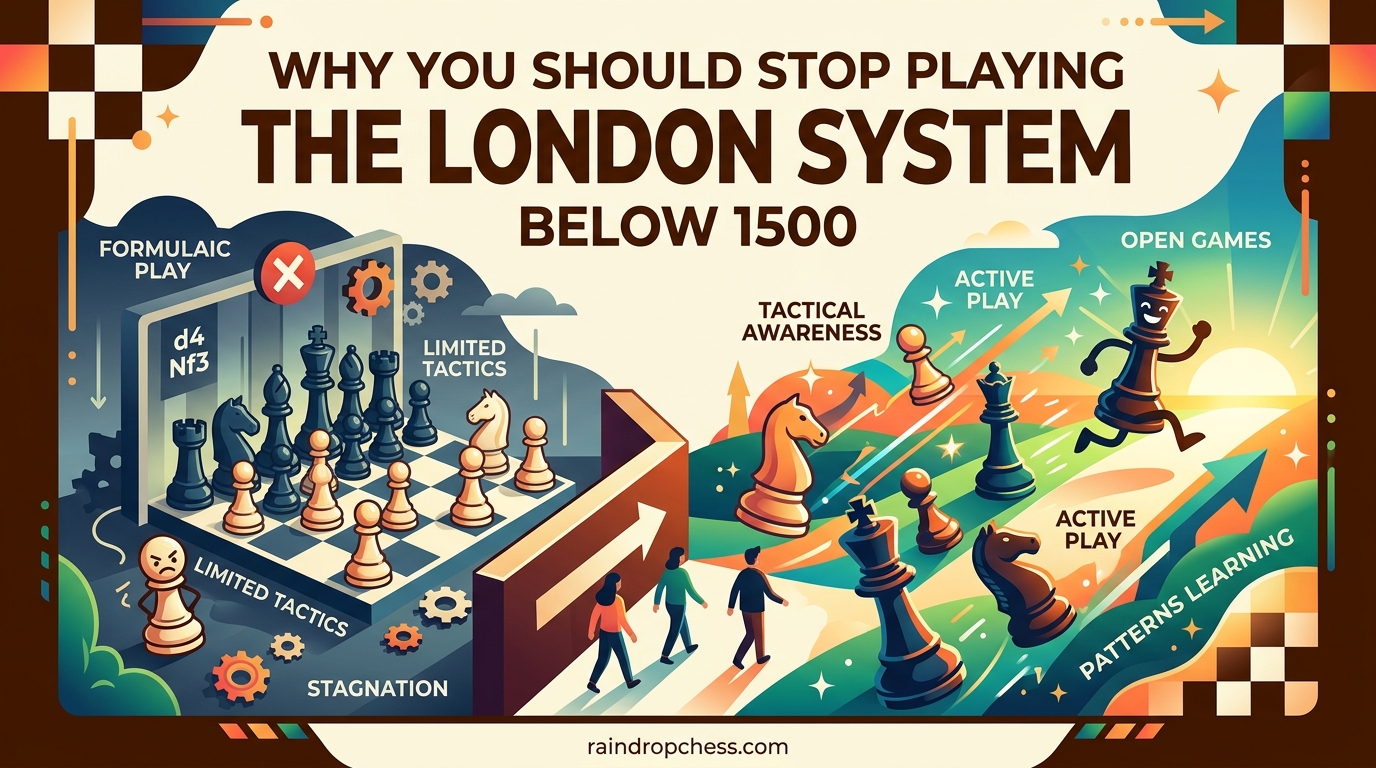
If you are stuck around 1000-1400 rating and play the London System as your main weapon, I have some hard truths for you. I spent 8 months grinding the London exclusively, watching my rating plateau while my friends who played sharper openings shot past me. The London System feels safe. It feels easy. But that comfort comes at a massive cost to your chess development.
Why you should stop playing the London System below 1500 is simple: it creates a false sense of progress while limiting your exposure to the diverse positions you need to become a well-rounded player. Below 1500, you need breadth. You need to lose games in complicated positions. You need to figure out what to do when the center opens up. The London gives you none of that.
In this guide, I will break down exactly why the London stunts your growth, what specific problems you will face, and what you should play instead to break through that rating ceiling.
Table of Contents
What Is the London System
The London System is a chess opening for White that starts with 1.d4 followed by an early Bf4. The typical setup involves moves like 2.Bf4, 3.e3, 4.Nf3, 5.Nbd2, and 6.Bd3. You develop your pieces to safe squares, control the center with pawns, and aim for a solid, positional game.
It is attractive to beginners for good reason. You can play the same setup almost regardless of what Black does. There is minimal theory to memorize. You avoid sharp tactical lines. Your king is safe, your position is solid, and you rarely lose quickly.
That safety is exactly the problem.
Why the London System Harms Beginners Below 1500
Chess improvement below 1500 is about pattern recognition and exposure. You need to see hundreds of different pawn structures. You need to solve tactical problems in the opening. You need to understand when to attack and when to defend. The London System actively prevents all of this.
When you play the London, you get the same type of position almost every game. Closed centers. Solid but passive setups. Games that drift into slow maneuvering battles where one tiny inaccuracy decides everything. You are not learning chess. You are learning one very narrow subset of chess.
Forum discussions on Reddit and Chess.com consistently show the same pattern. Players report hitting walls around 1100-1300 after months of London play. Many who switch to more dynamic openings see immediate rating jumps of 100-200 points.
The Five Main Problems With the London System
Problem 1: Repetitive and Boring Positions
After 50 games with the London, you have seen essentially the same position 50 times. The pawn structure barely changes. Your pieces go to the same squares. The middlegame plans are identical.
This repetition kills engagement. Chess becomes mechanical rather than creative. You stop thinking critically from move one because the setup is autopilot. That autopilot mindset spreads to other parts of your game.
Problem 2: Limited Pawn Structure Exposure
Strong chess players understand pawn structures deeply. Isolated queen’s pawns, hanging pawns, fixed centers, mobile centers, doubled pawns, backward pawns. Each structure teaches different strategic lessons.
The London System gives you one structure: the closed d4-e3 setup. You never face hanging pawns. You never play against an isolated queen’s pawn. You never learn the attacking patterns that come from fluid center pawns. This gap in your education becomes glaring as you approach 1500.
Problem 3: Opponents Equalize Too Easily
Black has several straightforward ways to equalize against the London. The early c5 break challenges your center immediately. The Qb6 line puts pressure on b2 and forces awkward defense. Simple development with d5, Nf6, e6, and Be7 reaches a comfortable position.
A prepared opponent knows these lines cold. They play 1…d5, 2…c5, develop pieces, and achieve a completely playable game with minimal effort. You spend the entire game trying to prove something in an equal position, which is not easy at any level.
Problem 4: Lack of Tactical Training
Sharp openings force you to calculate. You must see tactics or you lose. The London avoids sharp lines by design. That means fewer forcing moves, fewer combinations, and less tactical practice during your games.
When you do reach a tactical position in the London, it is often by accident. You have not trained your calculation muscle the way 1.e4 players have. The result is a tactical blind spot that stronger opponents exploit mercilessly.
Problem 5: The Autopilot Trap
The London encourages autopilot play. You know the setup. You play the same moves. You stop critically examining the position because the system handles it for you. This habit bleeds into the middlegame and endgame.
Chess improvement requires constant evaluation. Every position is different. The London trains you to ignore that truth. When you finally face a dynamic position, you are mentally unprepared because you have spent months on autopilot.
Addressing the Grandmaster Argument
Yes, Magnus Carlsen plays the London System. Yes, GMs use it at the highest levels. That fact gets thrown around constantly in defense of the opening.
Here is why that argument fails for players below 1500. Grandmasters use the London as part of a complete toolkit. They have mastered every pawn structure. They can switch to tactical mode instantly. They play the London when they want a specific type of position against a specific opponent.
You do not have that toolkit yet. Playing the London exclusively before building your foundation is like using a power tool before learning basic carpentry. It works for the master who knows every technique. It cripples the beginner who needs to learn.
What to Play Instead of the London System
Switching away from the London does not mean abandoning 1.d4. Several excellent alternatives will teach you more while keeping you in familiar territory.
Alternative 1: The Catalan
The Catalan keeps your d4 pawn and develops the bishop to g2. You get open diagonals, fluid pawn structures, and diverse middlegame positions. The Catalan teaches you about space advantage, piece coordination, and when to launch pawn breaks.
It is still solid but far more dynamic. You will face isolated queen’s pawn positions, hanging pawn structures, and various center configurations. Each game teaches something different.
Alternative 2: Main Line d4 Openings
Instead of Bf4, try 2.c4 or 2.Nf3 with natural development. Play against the Queen’s Gambit Declined, the Nimzo-Indian, or the King’s Indian Defense. These openings force you to learn real chess.
You will face sharp tactical lines in the King’s Indian. You will learn positional maneuvering in the QGD. You will understand pawn breaks in the Nimzo. Each defense teaches different lessons, and you will face them all.
Alternative 3: The King’s Indian Attack
If you want a system-like opening without the London’s drawbacks, the King’s Indian Attack delivers. You play 1.Nf3, 2.g3, 3.Bg2, 4.0-0, 5.d3, 6.e4. The positions are rich and varied. You get attacks on the kingside. You learn about pawn storms.
The KIA gives you structure without repetition. Games go in different directions depending on Black’s setup. You stay comfortable while learning more chess.
Conclusion
Why you should stop playing the London System below 1500 comes down to one principle: you cannot become a complete player by studying one narrow position type. Chess improvement requires exposure to diverse pawn structures, tactical patterns, and strategic ideas. The London System, for all its safety, denies you that exposure.
Does this mean the London is useless? Not at all. It has value as a surprise weapon or for specific situations. But as your primary opening below 1500, it actively limits your growth.
If you are serious about improving your chess and breaking through your rating plateau, switch to a more dynamic opening. Learn the Catalan. Study main line 1.d4. Play the King’s Indian Attack. Give yourself the chess education you deserve. Your future self, sitting at 1600 or 1800, will thank you.
FAQ
Is the London System for beginners?
The London System is often recommended for beginners because it is easy to learn and requires minimal memorization. However, this article argues that while it is easy to start with, it ultimately harms beginner development below 1500 rating by limiting exposure to diverse positions and pawn structures.
Do grandmasters use the London System?
Yes, grandmasters including Magnus Carlsen have used the London System. However, GMs employ it as part of a complete opening repertoire after mastering diverse pawn structures. For beginners below 1500, playing the London exclusively stunts growth because they lack the foundational knowledge that makes the opening effective at higher levels.
Why is the London System hated?
The London System faces criticism for producing repetitive, closed positions that many players find boring. Critics argue it allows Black to equalize easily with minimal preparation and that over-reliance on the system prevents players from developing a well-rounded understanding of different pawn structures and tactical patterns.
What rating should you stop playing London?
This article recommends moving away from the London System as your primary opening once you reach approximately 1500 rating, or ideally before. Below 1500, you need maximum exposure to diverse positions to build pattern recognition. After 1500-1600, you may reintroduce the London as one weapon in a broader repertoire.
What is better than London System for beginners?
Better alternatives for beginners include the Catalan (for fluid, dynamic positions), main line 1.d4 openings like the Queen’s Gambit (for diverse pawn structures), or the King’s Indian Attack (for system-like comfort with more variety). These openings teach more chess while remaining manageable for improving players.