
If you have ever replaced a capacitor by guessing at its value, or wondered whether an audio crossover inductor was actually the right inductance, you already know the limits of a multimeter. A multimeter applies DC and reports resistance. Real components do not behave that way. They change value with frequency, they carry losses that grow as they age, and a part can read perfectly healthy on a bench while quietly failing in your circuit. An LCR meter drives a component with a small AC signal at a frequency you choose, measures the resulting complex impedance, and reports not just a number but the health of that number: equivalent series resistance, dissipation factor, quality factor, phase angle.
That is why the best LCR meters in 2026 are not a replacement for a multimeter. They answer a different question. A multimeter tells you whether a resistor is 10 ohms. An LCR meter tells you whether that 10 ohm part is still a 10 ohm part at the frequency your switching converter actually runs at, and whether its inductance and phase behaviour will behave there too. If you build speaker crossovers, test power supplies, wind coils, service vintage gear, or salvage surface-mount components off circuit boards, this is the instrument that saves the guessing.
We put ten of the most widely used LCR meters through their paces in 2026, covering everything from a dial-entry meter for a first bench to a benchtop bridge with SCPI automation for production work. Several have been community favourites for years, and a few are newer designs that quietly outclass them. The short version: the DER EE DE-5000 remains the meter that most repair technicians name first, but the FNIRSI LC1020E gives you four-wire Kelvin measurement and a colour screen at a fraction of the older instrument’s cost. Details, caveats and the honest weaknesses of each are below.
Top 3 Picks for the Best LCR Meters in 2026

Proster BM4070
- 1999 count rotatable LCD
- 8 capacitance ranges to 2000uF
- Sampling 3 times per second
- Complete kit with leads clips battery and case
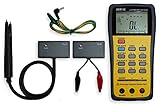
DER EE DE-5000
- 100Hz to 100kHz test frequency
- D Q phase angle and ESR
- Auto-LCR smart mode
- TL-21 leads and TL-22 tweezers included

FNIRSI LC1020E
- Four-wire Kelvin to 100kHz
- 19999 count 2.8 inch colour TFT
- Sorting mode with tolerance presets
- 3000mAh USB-C rechargeable
Our editor’s choice is the Proster BM4070, a single-dial meter with 2680 owner reviews behind it. That is not a spec-sheet decision. It is a support-life decision, and in a category where manuals are thin and firmware is uneven, a large installed base is worth real money. If you want more measurement capability rather than more owners, the DE-5000 and the LC1020E are the two to look at first.
All 10 LCR Meters Side by Side in 2026
Every meter below measures inductance, capacitance and resistance. What separates them is the range you can reach, the frequencies you can select, the secondary parameters on screen, and whether the unit uses four-wire Kelvin connections. The table gives you the headline of each; the individual reviews below give you the trade-offs.
| Product | Specifications | Action |
|---|---|---|
| Proster BM4070 LCR Meter |
|
Check Latest Price |
| DER EE DE-5000 |
|
Check Latest Price |
 FNIRSI LCR-ST1 LCR Tweezers FNIRSI LCR-ST1 LCR Tweezers |
|
Check Latest Price |
| FNIRSI LC1020E |
|
Check Latest Price |
 PEAK Atlas LCR45 PEAK Atlas LCR45 |
|
Check Latest Price |
 Smart Tweezers ST5S Smart Tweezers ST5S |
|
Check Latest Price |
 LCR Research Pro1 Plus LCR Research Pro1 Plus |
|
Check Latest Price |
 Extech LCR200 Extech LCR200 |
|
Check Latest Price |
 MATRIX MCR5200 Benchtop MATRIX MCR5200 Benchtop |
|
Check Latest Price |
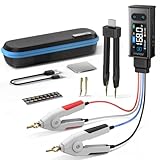 FNIRSI LCR-ST2 LCR Tweezers FNIRSI LCR-ST2 LCR Tweezers |
|
Check Latest Price |
1. Proster BM4070 – The Best LCR Meter for a First Bench
Proster LCR Meter Multimeter Capacitance Inductance Resistance Tester
0.1pF-2000uF C
200uH-20H L
1999 count rotatable LCD
3 readings per second
Pros
- Widest span in the group at 200pF to 2000uF and 200uH to 20H
- Single dial with no menu navigation needed
- Rotatable LCD plus data hold for bench or field
- Comes with leads clips battery screwdriver and case
- Resistor readings match a Fluke 87V in owner testing
Cons
- No Kelvin four-terminal connections
- Alligator clips only crimp on rather than snapping to the probes
- Zero adjust is limited so picofarad readings need manual lead compensation
- Does not state the measurement frequency used
The BM4070 is the meter we recommend to someone building a first serious bench, and the reason is not the spec sheet. With 2680 owner reviews averaging 4.5 stars, this is the most thoroughly exercised instrument in the group by a wide margin. When a manual is thin and a firmware release is late, having thousands of people who already solved your problem is worth more than an extra feature.
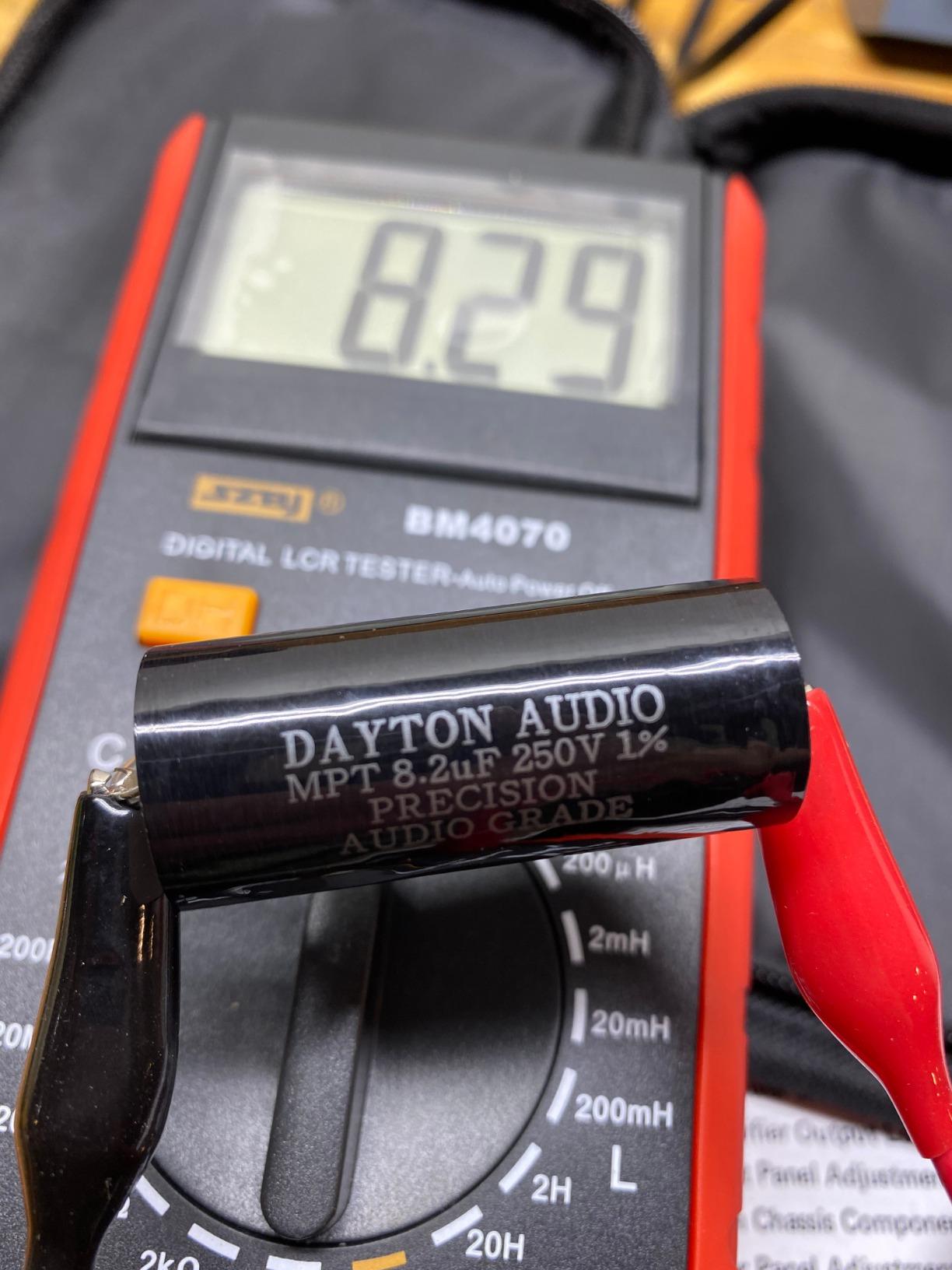
It is also genuinely capable. Eight capacitance ranges run from 200pF with 0.1pF resolution up to 2000uF, six inductance ranges cover 200uH to 20H, and five resistance ranges reach 20M ohms. The display is a rotatable 1999 count LCD with data hold, and readings update three times per second. That is enough for speaker and crossover work, ham radio coil checks, and general repair, which is exactly what owners report using it for.
The honest limitation is the fixture, not the meter. There is no Kelvin connection, so the leads contribute their own stray capacitance to every reading, and the zero adjust only partly compensates. Below roughly 50pF you are subtracting lead capacitance by hand. The supplied insulated alligator clips also crimp onto the probe tips rather than snapping on, which is a small annoyance that every reviewer mentions and nobody loves.
How accurate it is on real components
Owners comparing resistor readings against a Fluke 87V report agreement, and forums describe it as strong value inside its accuracy limits. Capacitance tolerance is quoted at plus or minus 2.5 percent plus five digits on the 200pF range, widening to plus or minus 5 percent on the 2000uF range, so treat bulk electrolytics as approximate.
It is also one of the few things in this roundup the data names repeatedly as a value: the kit ships with test leads, crocodile clips, a mini screwdriver, a 9V battery and a zippered bag. Nothing else in the group at this tier gives you a full bench-ready box for the money.
When to step up instead
Step up when your work moves to small-value ceramics, where a 2-wire lead error stops being a rounding detail, or when you need a specific test frequency for datasheet comparison. Neither is available here. The meter also does not tell you which frequency it used, so readings are not comparable across units.
For a student, a hobbyist building one crossover, or a repair bench that needs a sanity checker for inductors and bulk caps, this is the right purchase. Users on electronics forums consistently call it the best value they have found for this kind of work. For precision, add a second instrument later rather than stretching this one.
2. DER EE DE-5000 – Best LCR Meter Overall for Repair Work
DE-5000 Handheld LCR Meter
100Hz-100kHz test frequency
D, Q, phase, ESR
AUTO-LCR smart mode
19999/9999 count display
Pros
- Reads small picofarad SMD ceramics that cheaper meters report as zero
- Five selectable frequencies up to 100kHz
- Secondary parameters D Q phase angle ESR and Rp
- AUTO-LCR smart mode measures without choosing a function
- Sorting mode bins batches quickly
- Rugged build that owners report surviving years of daily bench use
Cons
- Supplied TL-21 leads are very short so most owners replace them
- Large filter capacitors fall outside the readable range and return nothing
- Thin manual with limited detail
- Calibration sequence takes about a minute and resets after a power cycle
The DE-5000 has a decade-plus of community validation behind it, and it is still the first recommendation on repair forums when someone says they are building a bench before retiring. That reputation is deserved rather than inherited: it is the meter owners reach for when a power supply misbehaves and they need to know whether an electrolytic has gone high-ESR.
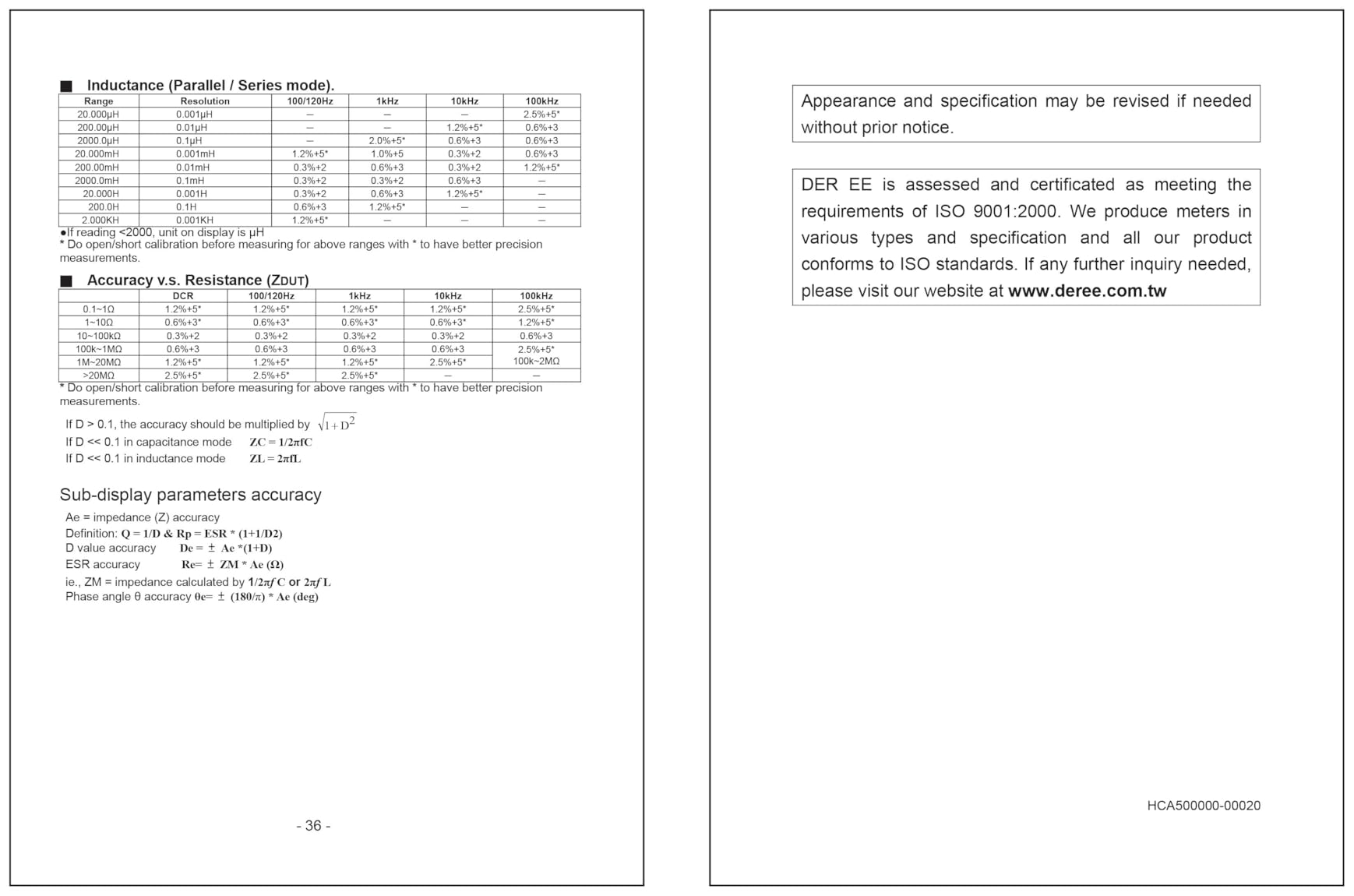
Five test frequencies from 100Hz to 100kHz give you the control that matters. diyAudio members in particular value the ability to force 1kHz so readings stay consistent across a batch of matched capacitors. Secondary parameters cover dissipation factor, quality factor, phase angle, ESR and Rp, and the 19999/9999 count dual display shows a primary value and a derived value at once, which saves a lot of menu time.
Open and short calibration plus the Kelvin lead system removes lead capacitance error on low-value parts, so those small SMD ceramics that cheaper meters call zero actually read. AUTO-LCR smart mode measures without selecting a function, series or parallel mode is chosen automatically from the impedance of the part, and a sorting mode bins batches quickly.
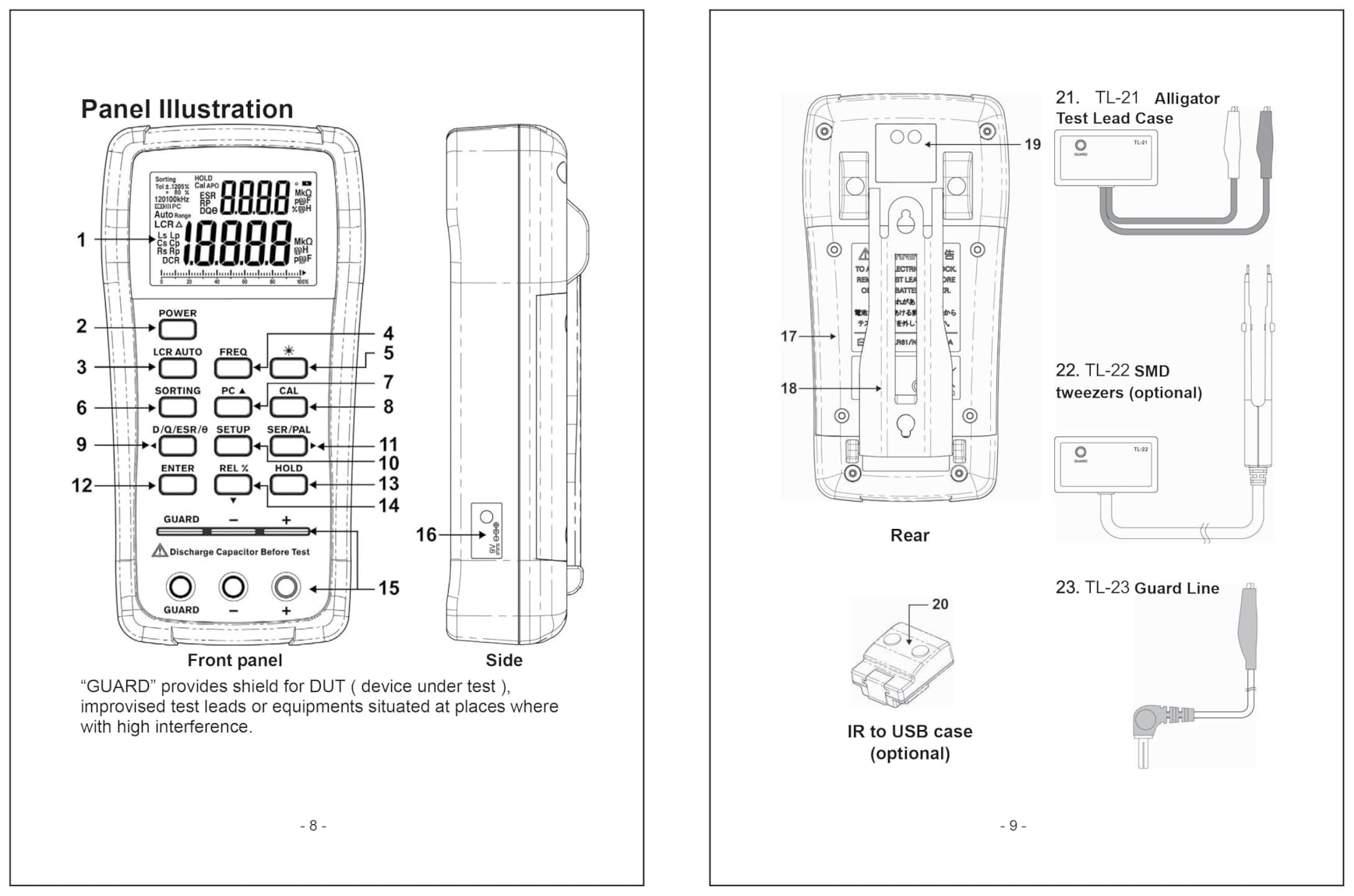
The most common modification in this community is not a firmware update. It is the leads. The supplied TL-21 alligator lead case is short, and most owners solder on longer 60 to 70cm Kelvin leads with BNC connectors, a shared modification with step-by-step videos online. Budget for that if you intend to measure anything smaller than a bulk capacitor.
What you give up compared with newer designs
Large filter capacitors exceed the readable range and simply return no reading, which is a real problem on switch-mode power supplies where the big smoothing can is often the suspect. The unit also cannot test a capacitor for leakage at its rated working voltage, because the test signal is AC and low amplitude by design.
The calibration routine takes about a minute and has to be repeated after a power cycle, which is tedious when you swap fixtures constantly. The manual is thin, and detailed instructions are largely in English headings only. Owners have learned the sequence from forums and video rather than from documentation.
Where it still wins
For ESR screening of electrolytics, forum consensus is that this remains the most-used function and the most trusted. Rugged, battery powered, and indifferent to a cluttered bench, it also holds roughly 0.3 percent in real-world use despite a 0.2 percent headline spec. That gap between spec and reality is smaller than it is on most other meters in this group.
3. FNIRSI LCR-ST1 – Best Budget LCR Tweezers for SMD Work
FNIRSI LCR-ST1 10kHz LCR Meter Tweezers, Smart SMD Component Tester
100Hz, 1kHz, 10kHz
0.3V and 0.6V levels
1pF-22mF C, 1uH-10H L
1.14 inch colour
Pros
- Tweezer format makes probing tiny SMD parts practical
- Pointed and hook heads cover different component shapes
- Logs readings and exports to a spreadsheet
- Automatic component recognition speeds up board fault finding
- Carrying case and USB-C charging included
Cons
- Maximum test frequency is only 10kHz
- Fixed 1.14 inch display that does not rotate
- About 10 percent of ratings are one star
- Very light at 2.86 g so it is easy to knock off a bench
The LCR-ST1 exists for one job: putting two probes on a small component while your other hand holds the iron or the board. In that role it is hard to beat, and the price sits at the entry end of the range. If your work is identifying unmarked SMD parts or tracking down a fault on a populated board, a tweezer meter changes how you work more than any spec upgrade.
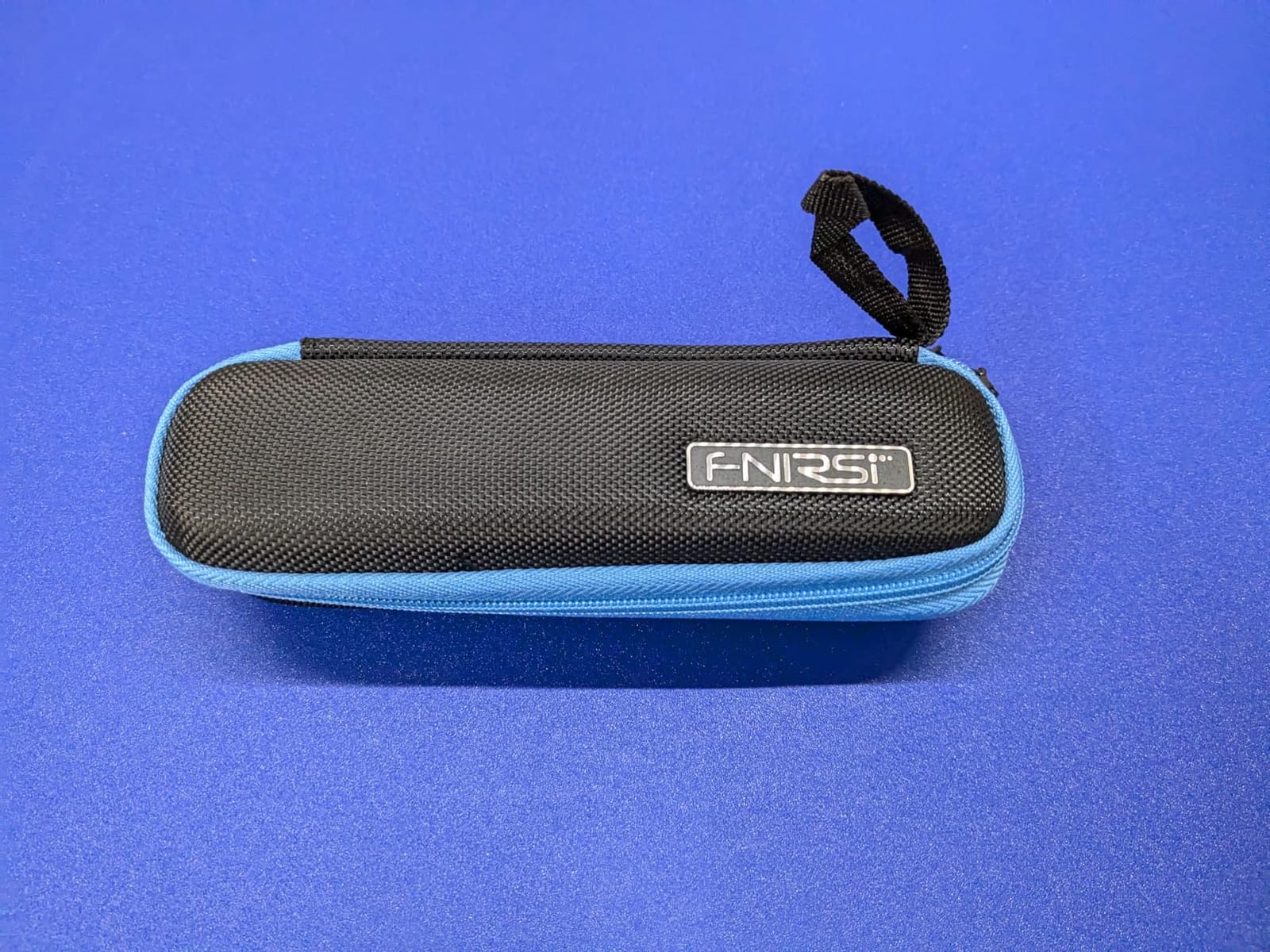
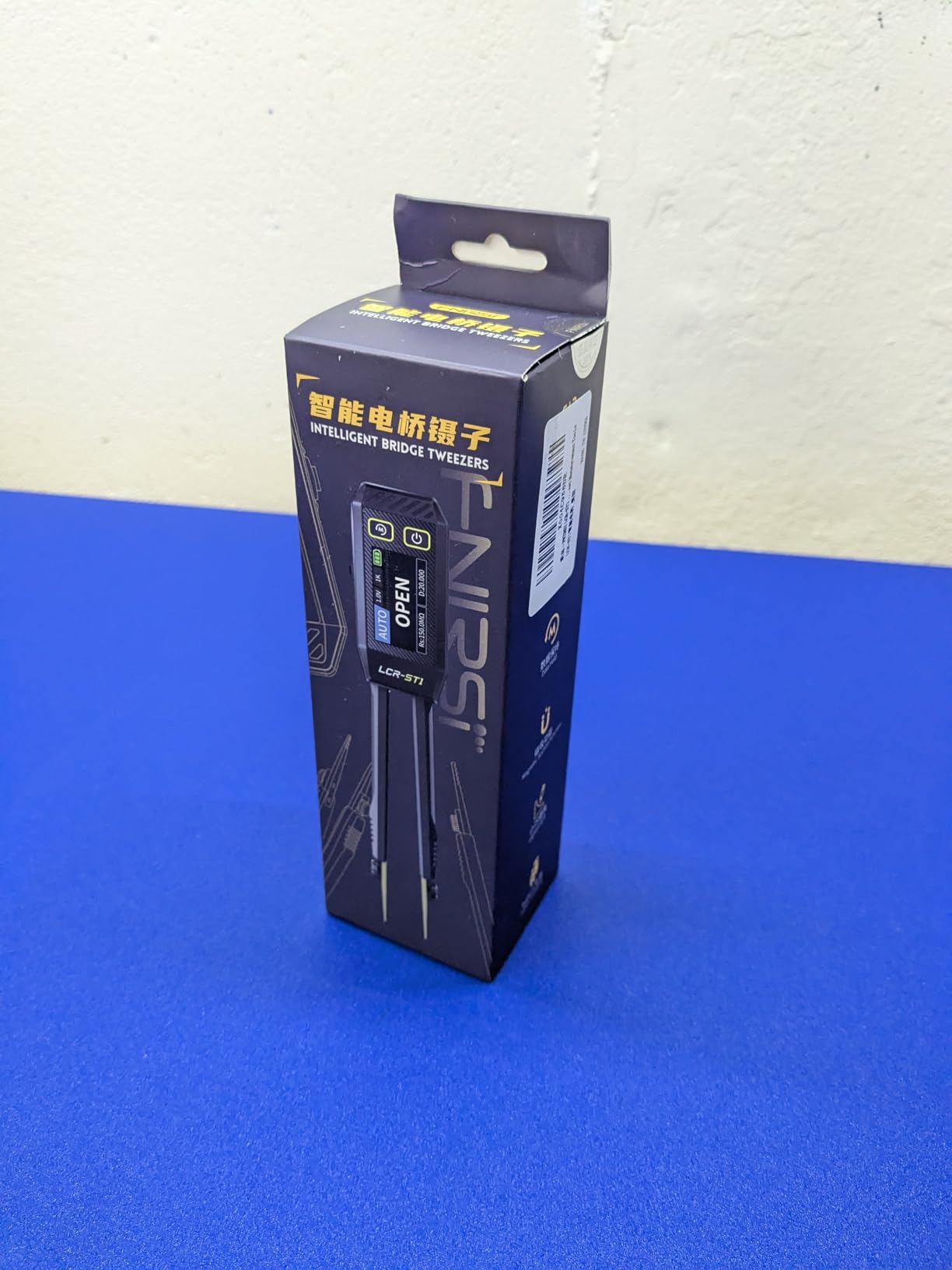
Ranges are broad for a tweezer: resistance from 10 milliohms to 10 megohms, capacitance from 1pF to 22mF, inductance from 1uH to 10H. You get three test frequencies at 100Hz, 1kHz and 10kHz, and two test voltage levels at 0.3 and 0.6Vrms. Secondary values including dissipation factor, impedance angle, quality factor, resistance and ESR appear alongside the primary reading, and automatic recognition identifies the part for you.
The data logging with spreadsheet export is the sleeper feature. When you are comparing forty capacitors from a salvaged board, having the readings written to a file beats writing them down. Two interchangeable heads, a pointed tip and a hook tip, cover different package shapes.
Where the 10kHz ceiling actually matters
Ten kilohertz is fine for identifying a part and for general board-level work. It is not fine for low-ESR film capacitors, power inductors, or anything where the behaviour above 10kHz is the whole point. If you build converters or audio crossovers with precision film, move up to the LCR-ST2 or a handheld that reaches 100kHz.
The polarised ratings tell their own story: about 10 percent of reviews are one star, a meaningfully high share. Most of that comes from buyers whose expectations outrun an entry-level tool, and a few from the fixed small display, which does not rotate or flip.
Handling and battery notes
At 2.86 g the tool is light enough to lose off the edge of a bench, which is a small thing that irritates owners. Charging is over the supplied USB-C data cable, and a carrying case is included. Treat it as a probe tool rather than a precision instrument and it serves its purpose very well.
4. FNIRSI LC1020E – Best Value LCR Meter with Four-Wire Kelvin
FNIRSI LC1020E 100kHz LCR Meter, 19,999 Counts Resistor Inductor Capacitor Tester, Auto Component Detect, Measures ESR/Q/D/θ/X, 2.8” Color TFT, Dual Parameter Display, Sorting & Open/Short Calibration
100Hz-100kHz
Four-wire Kelvin
19,999 count 2.8 inch TFT
0.1/0.3/0.6V test levels
Pros
- Genuine four-terminal Kelvin measurement up to 100kHz
- Largest and clearest colour display in this group
- Reads parts the cheaper dial meters miss
- Sorting mode with tolerance presets and pass-fail alerts
- 3000mAh USB-C rechargeable battery
- Adjustable test voltage down to 0.1V improves in-circuit trust
Cons
- Does not measure capacitance above 100uF
- Feels light in the hand
- No carry case included
- Secondary test modes revert to a default at power up
- Instructions read poorly
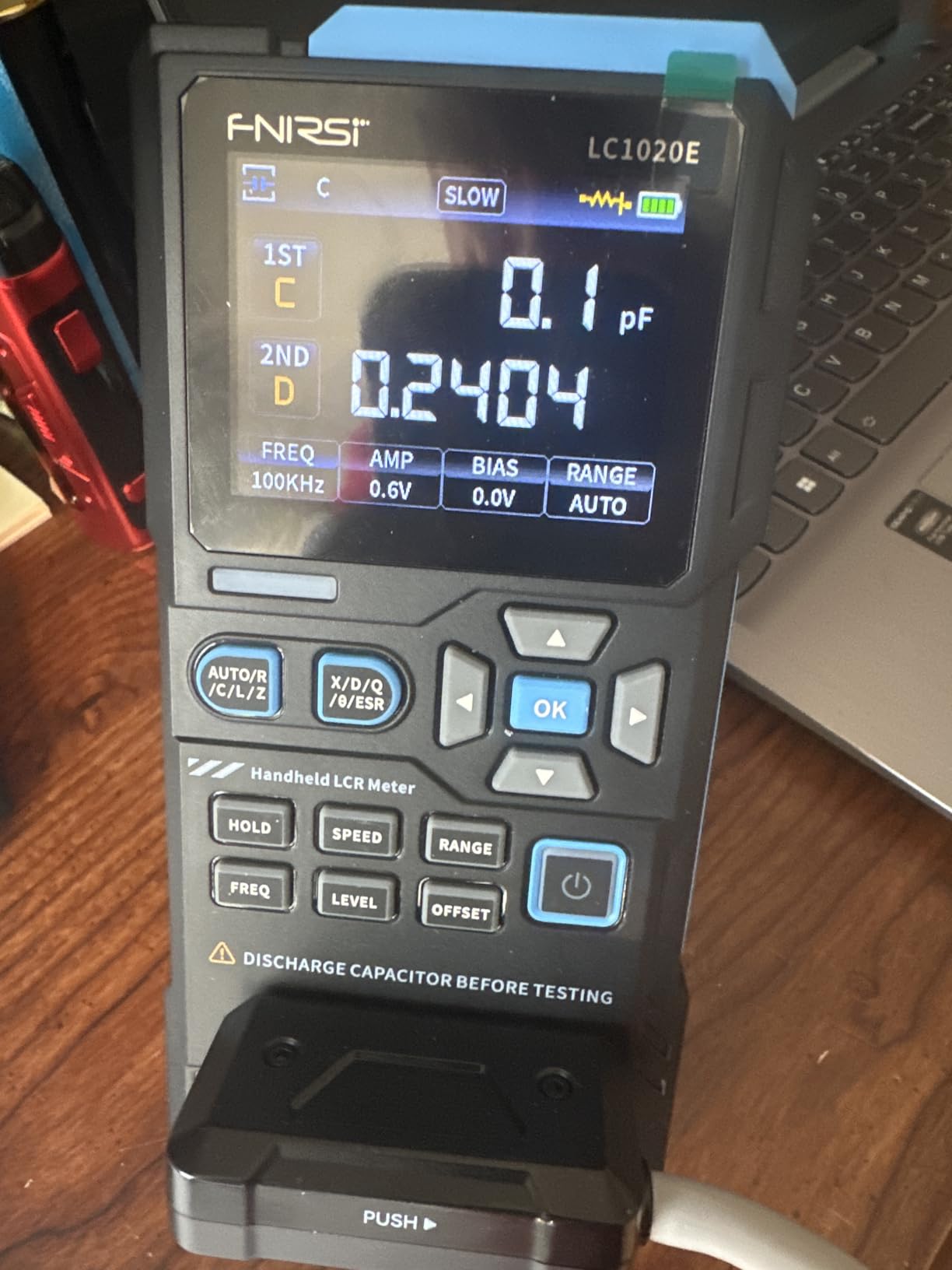
The LC1020E is the instrument that made us re-check our assumptions. One owner who tested it against both a DER DE-5000 and a Proster picked it on display clarity and completeness of measurement, and another notes that its four-wire Kelvin measurement at 100kHz features a two-decade-old B&K Precision bridge could not match. With 83 percent five-star feedback, the highest share in this group, the enthusiasm is consistent rather than a single outlier.
Five test frequencies from 100Hz to 100kHz, a 19,999 count five-digit display on a 2.8 inch colour TFT with ten brightness levels, and three test voltages at 0.1, 0.3 and 0.6V. The 0.1V setting is the one that matters most in practice: a lower test signal disturbs a live circuit less, so in-circuit readings become far more trustworthy than on a fixed-voltage meter.
Measurement runs from 1pF to 100mF in capacitance, 10 milliohms to 10 megohms in resistance, and 1uH to 100H in inductance. The sorting and comparison mode takes a preset nominal and tolerance from 0.1 to 99.9 percent, calculates relative error, and sounds a pass or fail alert. That turns a bench instrument into a screening tool for incoming inspection.
The four-wire question
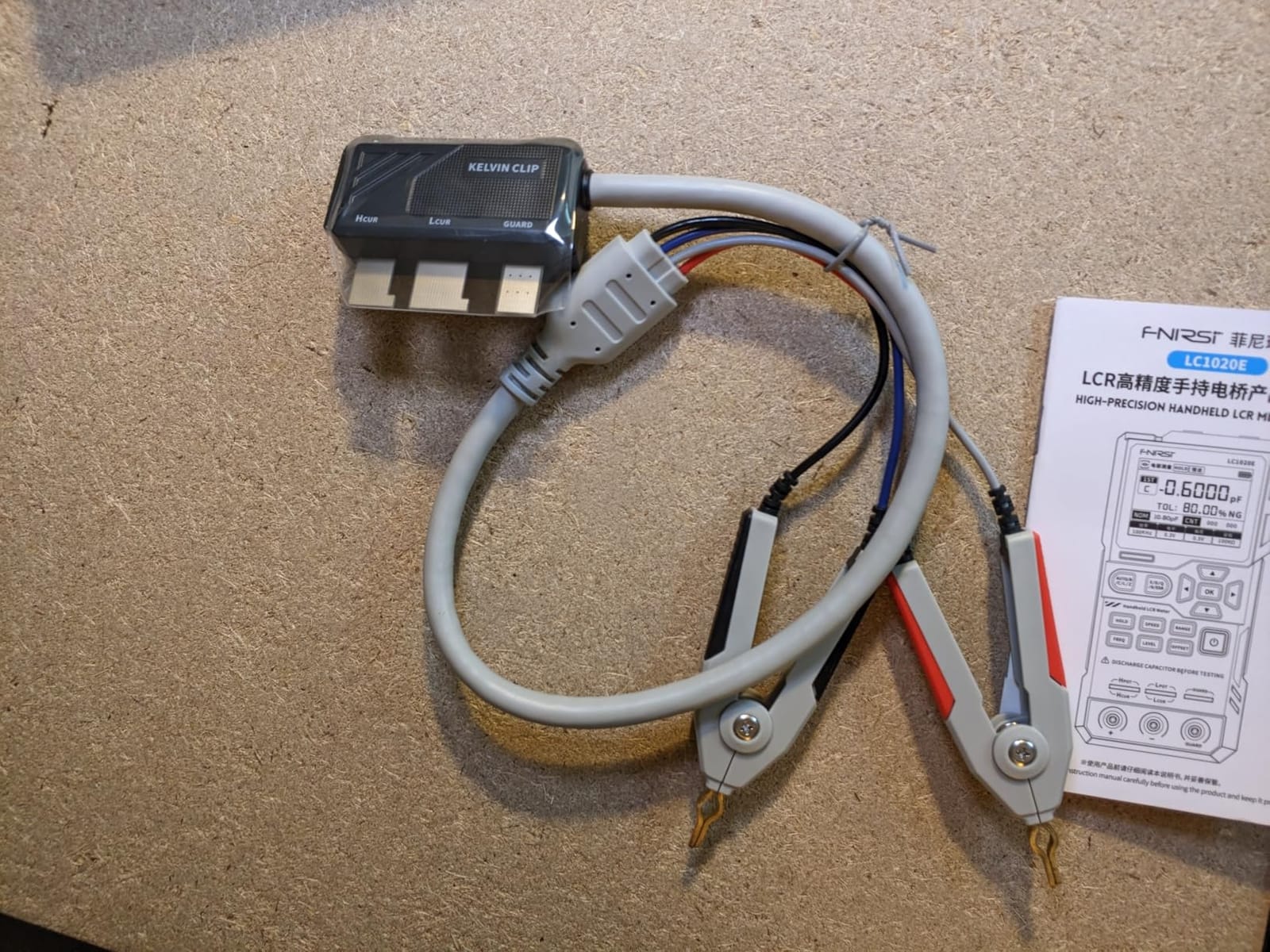
Two-wire meters push current and sense voltage through the same leads, so lead resistance and stray inductance land inside your reading. Four-wire Kelvin connections keep the current and voltage paths separate, which is why this meter holds accuracy on small ceramics where a dial meter drifts. If your parts are below roughly 1uF or you care about a 1 percent tolerance, this is the single most important feature on the list.
Open and short calibration, three-pin sockets and five-slot jacks for fixture connection, and selectable measurement speed of four, two or one readings per second round out a genuinely complete package. A 3000mAh rechargeable battery with Type-C charging and firmware updates handles long sessions away from a bench.
Where it falls short
The 100uF capacitance ceiling is the real limitation. It is not a problem for ceramics and film, and it is a problem the moment you want to check a bulk electrolytic, which is a common bench task. The chassis also feels light, which prompts some doubts about the battery, and no carry case is included.
One small annoyance recurs: the minor test modes for dissipation factor, quality factor, phase angle and ESR always revert to a preprogrammed default at power-up, powers them on, so you reselect them more often than you should have to. Power button and menu wording drew criticism too. Neither affects the measurements.
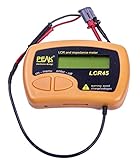
5. PEAK Atlas LCR45 – Best LCR Meter for RF and High-Frequency Work
Peak Atlas LCR45 LCR and Impedance Meter
DC, 1kHz, 15kHz or 200kHz
0.2uH / 0.2pF / 0.2 Ohm resolution
Complex impedance
1 year warranty
Pros
- Highest average rating in the group at 4.8 with 88 percent five-star feedback
- Auto-detect usually identifies the component correctly
- 200kHz capability is higher than any other handheld here
- Accurate against known reference parts without losing picofarad accuracy
- Small 145g body with a very clear display
- 2mm banana sockets accept custom test attachments
Cons
- A23 12V battery gives limited service between changes
- Occasionally misidentifies the component type
- Costs more than generic handheld meters
- 2mm banana connectors need adapters for many probe styles
The LCR45 is the odd one out in this list, and that is exactly why it is here. It reaches 200kHz, it outputs complex impedance data rather than only derived component values, and at 145g it is small enough to live in a jacket pocket. If you work on RF chokes, coil windings or anything where the behaviour above 100kHz is the whole question, no other handheld in this roundup answers it.
Owners repeatedly note that the unassuming enclosure belies the measurement quality. Auto-detect identifies the connected component and applies the correct measurement almost every time, and readings match known reference capacitors and inductors without losing accuracy in the picofarad range. Forum users trust it for peak-related readings and say its capacitance figures are the weaker side, which lines up with the resolution figures of 0.2uH, 0.2pF and 0.2 ohms.
What the 200kHz ceiling unlocks
Test frequency is selectable automatically or manually at DC, 1kHz, 15kHz or 200kHz. At 200kHz you start to see the self-resonance of an inductor and the real behaviour of a capacitor at RF, which is exactly the information an RF designer needs and a 10kHz meter cannot provide at any price.
Component type is also selectable manually, which is a genuine fallback when auto-detect guesses wrong. The hold function freezes a reading, which makes sorting a batch of capacitors for tolerance much faster than a manual unit, and a spare A23 battery is included in the box.
Where the compromises are
The A23 coin-cell style battery gives limited service between changes, and if you are doing long measurement sessions the meter will interrupt you. The 2mm banana sockets are unusual, so you will want adapters if your existing probe style does not fit, and some owners build custom attachments such as RCA cable adapters instead.
Occasional component-type misidentification is the most reported fault, and it is worth knowing about because auto-detect is otherwise the feature people praise most. Zero can be trimmed and calibrated with an added wire. With a full one year manufacturer warranty and UK manufacture, support is straightforward.
6. Smart Tweezers ST5S – Best Calibrated LCR Tweezers
Smart Tweezers ST5S Professional LCR Meter/ESR Meter with Spare Test Leads and Pocket Case
0.1% accuracy with certificate
Swiss 24K gold-plated leads
Auto plus manual C R L Z ESR
ClearValue OLED
Pros
- 0.1% basic accuracy and a calibration certificate in the box
- Swiss-made 24K gold-plated test leads give stable contact on tiny parts
- Automatic identification plus manual C R L Z and ESR modes
- Portable and clamshell cases plus spare leads included
- Two year warranty with lifetime technical support
Cons
- Test frequency tops out at 10kHz
- Lowest test voltage of 0.45V makes in-circuit readings less reliable
- Small joystick navigation is fiddly and the screen feels delayed
- Screen and font are small
- Standard tips included but optional precision tips cost extra
The ST5S is the tweezer answer for anyone who cares about the paperwork. It is supplied factory calibrated at 0.1 percent basic accuracy with a calibration certificate in the box, and it comes with Swiss-made 24K gold-plated test leads that hold contact on very small parts where a generic spring probe slips. For a lab, a supplier audit, or anyone who has to justify a number later, that certificate changes the conversation.
Measurement modes cover automatic identification plus manual capacitance, resistance, inductance, impedance and ESR on a ClearValue OLED. The two year warranty with lifetime technical support is the longest in this roundup, and both a portable clamshell case and spare test leads are included, so the consumable wear part is already covered.
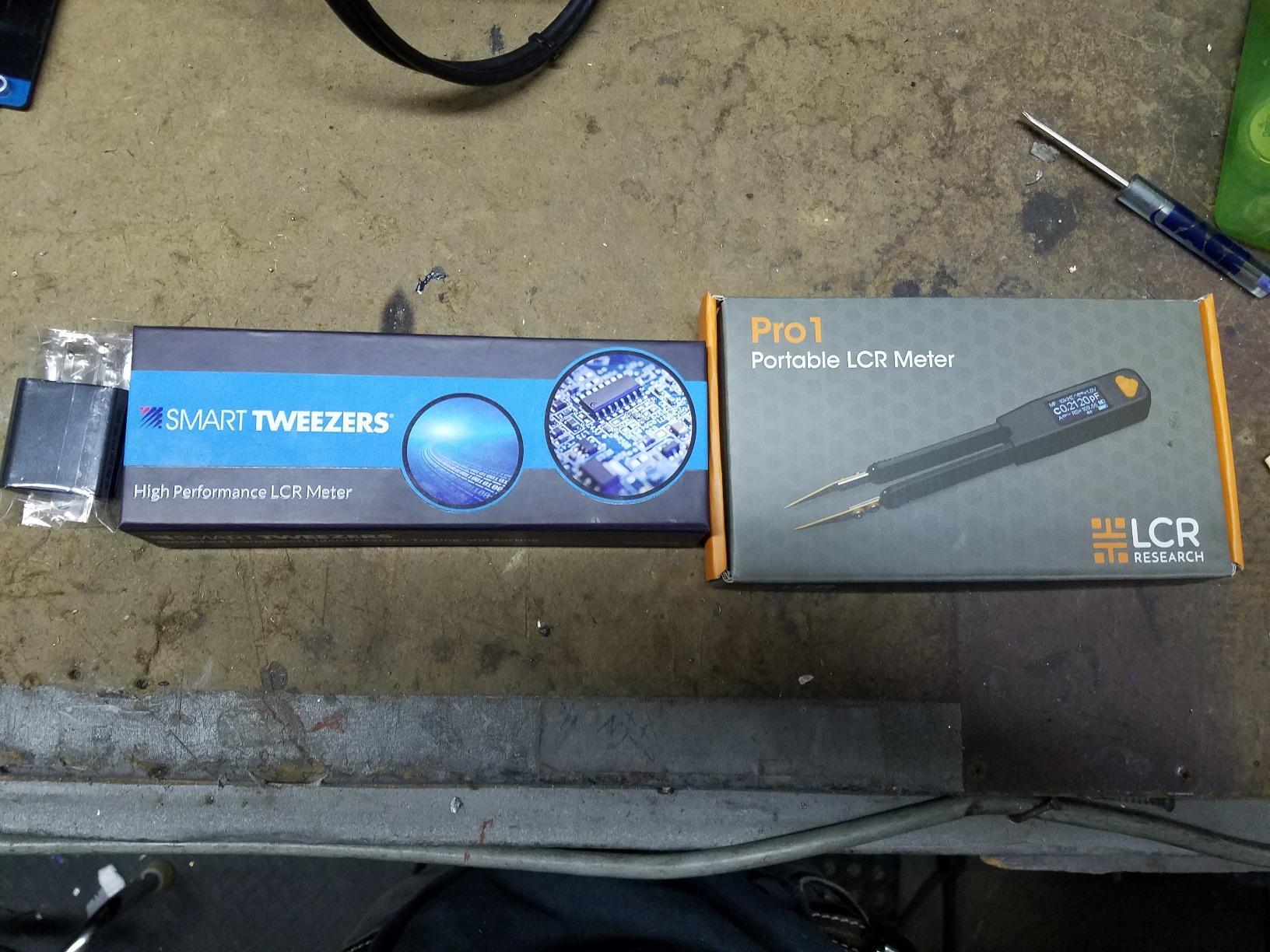
Owners describe the build quality in unusually positive terms for a handheld tool, and the gold-plated leads are the part that gets singled out most.
How it compares to the Pro1 Plus
Owners who bought both at similar cost point in one direction. The Pro1 Plus is judged better on display size and clarity, menu responsiveness, low-voltage in-circuit capability at 0.2Vrms against 0.45Vrms, a 100kHz frequency ceiling against 10kHz, and case design. The ST5S is credited for the included calibration certificate, spare leads and charging accessories.
So the decision is straightforward. Buy the ST5S if traceability and a documented accuracy figure matter to you. Buy the Pro1 Plus if you want to measure more kinds of part, in circuit, at higher frequency.
Ergonomics and the in-circuit caveat
The small joystick is the most cited ergonomic complaint, especially for anyone with larger fingers, and the delayed screen response adds to it. The display and menu font are small enough that you bring the unit close to read settings. One buyer reports the ST5S repeatedly reading resistors as capacitors when measuring in circuit, which is a direct consequence of the 0.45V minimum test signal disturbing the surrounding circuit.
Standard tips are in the box; the optional precision tips are a separate purchase, and if your work is very fine-pitch SMD you will want them. With 64 reviews the owner base is smaller than most here, and 88 percent five-star feedback is strong for that sample size.
7. LCR Research Pro1 Plus – Best Precision LCR Tweezers for Serious Bench Work
LCR Research Pro1 Plus – 100KHz LCR Meter with 0.1% Accuracy/LED Tester/ESR Meter/Smart SMD Tweezers
0.1% R, 0.2% L and C
100Hz-100kHz, 0.2V lowest level
High-contrast OLED
LED checker with Vf/If
Pros
- Measures the inductance of a one inch length of wire that university lab equipment could not
- 0.1% on resistance and 0.2% on inductance and capacitance with self-calibration
- 0.2Vrms test level makes in-circuit readings far more reliable
- Large high-contrast OLED with a bigger font than the ST5S
- Responsive button navigation instead of a joystick
- Built-in LED checker reports forward voltage and current
- Hard case with foam insert protects the tips
- Very small precision tips included at no extra cost
Cons
- Menu system has been reported as laggy and capable of locking up
- Low-refresh OLED flickers at the edge of vision when moved fast
- Displayed resolution overstates real precision on very high-precision resistors
- No printed manual
- Auto mode is unreliable in circuit so type must be set manually
- PC Link software needs Windows 7 or higher
- Inductance range tops out at 1H
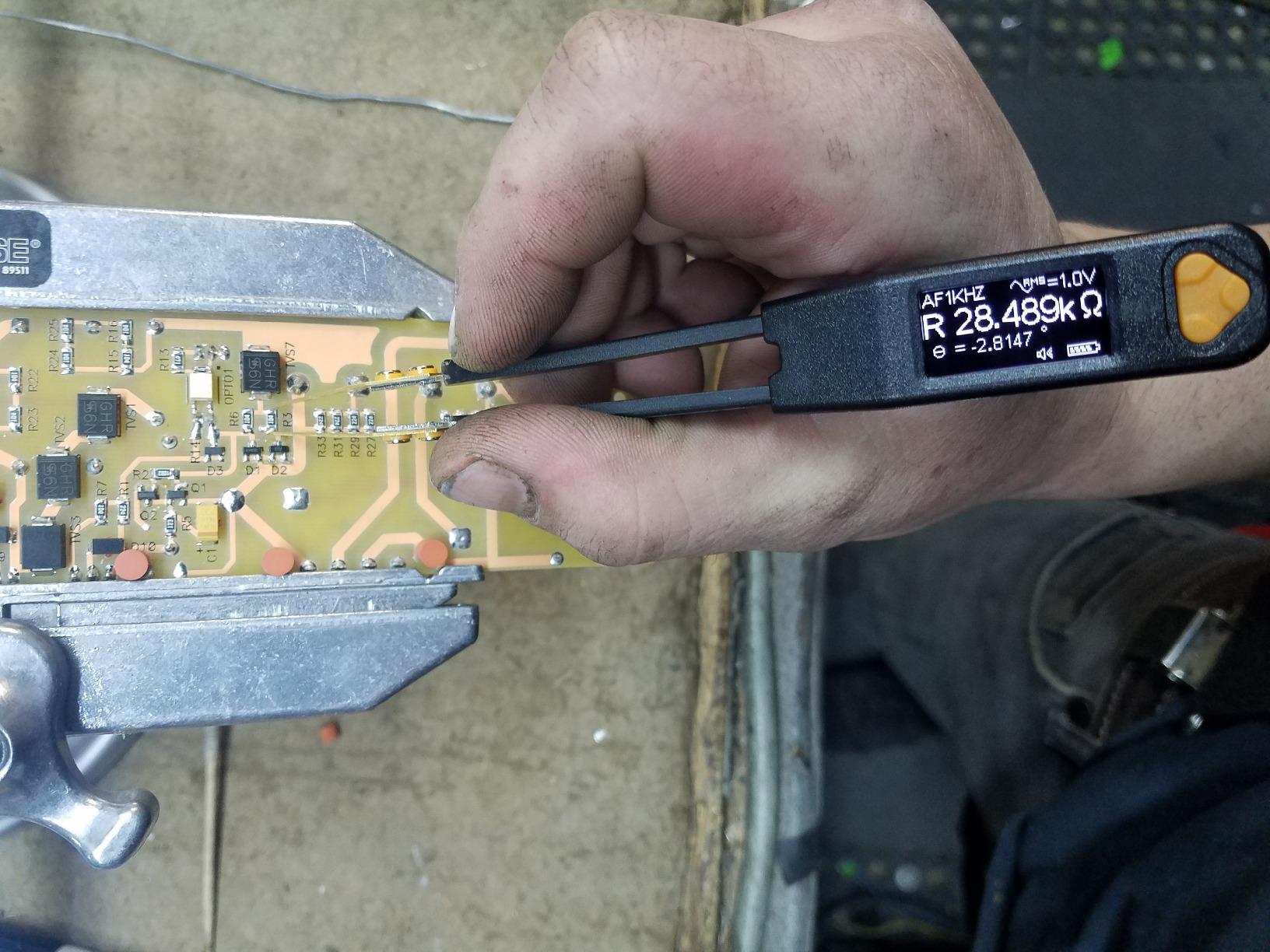
The Pro1 Plus is the most capable tweezer meter here, and one owner reports it correctly measuring the inductance of a one inch length of wire, something the university lab equipment used for comparison could not manage. That single anecdote says more about the range and resolution than any specification line.
Basic accuracy is quoted at 0.1 percent for resistance and 0.2 percent for inductance and capacitance, with a self-calibration routine built in. Five test frequencies run from 100Hz to 100kHz, and three test voltage levels at 0.2, 0.5 and 1.0Vrms. Ranges are 20 milliohms to 10 megohms, 0.1pF to 10mF, and 10nH to 1H. That 0.2Vrms level is the important one: a low test signal is what makes in-circuit measurement possible without the meter seeing everything around the part.
Why owners prefer it to the ST5S
The comparison is consistent in head-to-head reviews: bigger and clearer display, more responsive navigation, 100kHz rather than 10kHz, 0.2Vrms rather than 0.45Vrms, an LED checker with forward voltage and current readout, and a hard foam-lined case rather than a slide-in tube. One reviewer returned the ST5S. The display shows primary and secondary values together, so ESR sits next to capacitance without a menu change.
Very small precision probe tips are included at no extra cost, which matters more than it sounds when you are working on 0201 parts. There is a one year warranty with lifetime support.
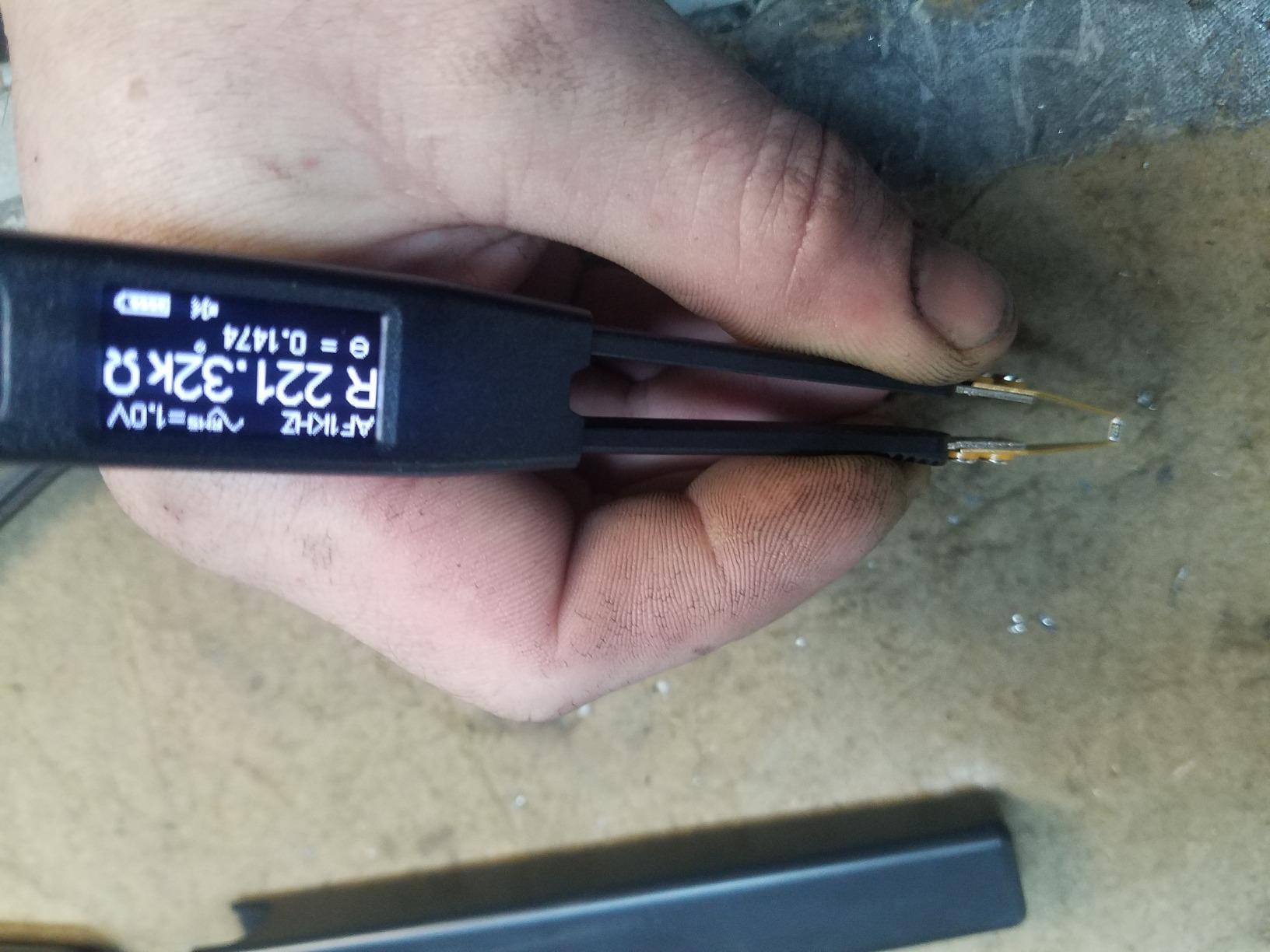
Physical build supports that: a hard case with a foam insert protects the probe tips, which matters more than it sounds given how easily fine tips bend.
Limits worth knowing before you buy
Interface polish is the weak point. The menu system has been reported as laggy and capable of locking up, with the sleep timer needed to recover, and the low-refresh OLED produces visible flicker at the edge of vision when the tweezers move. Displayed resolution overstates real precision on very high-precision resistors, so the last digit bounces.
Auto mode is unreliable in circuit, so plan on setting the component type manually. There is no printed manual, it must be downloaded, and the optional PC Link software requires Windows 7 or higher. The inductance ceiling of 1H excludes large power inductors. With 42 reviews and no one- or two-star ratings at all, the feedback is enthusiastic but the sample is small.
8. Extech LCR200 – Best LCR Meter for Batch Sorting and Limit Testing
Extech LCR200 – Passive Component LCR Meter
100Hz-100kHz, five frequencies
Q, D, phase and ESR
20,000 and 2,000 count dual display
Built-in fixture
Pros
- Shows primary and secondary parameters simultaneously on a dual backlit display
- Open and short calibration removes stray impedance for repeatable readings
- Built-in test fixture is faster than fiddling with loose leads
- Limit settings with Hi and Lo in absolute or percentage form
- Five selectable frequencies from 100Hz to 100kHz
- Two year warranty from an established instrumentation brand
- Complete with test leads and a 9V battery
Cons
- Smallest review base in the group at 33 reviews
- Lowest top-end rating share at 64 percent five-star
- No long-term reliability data because the review base is too small
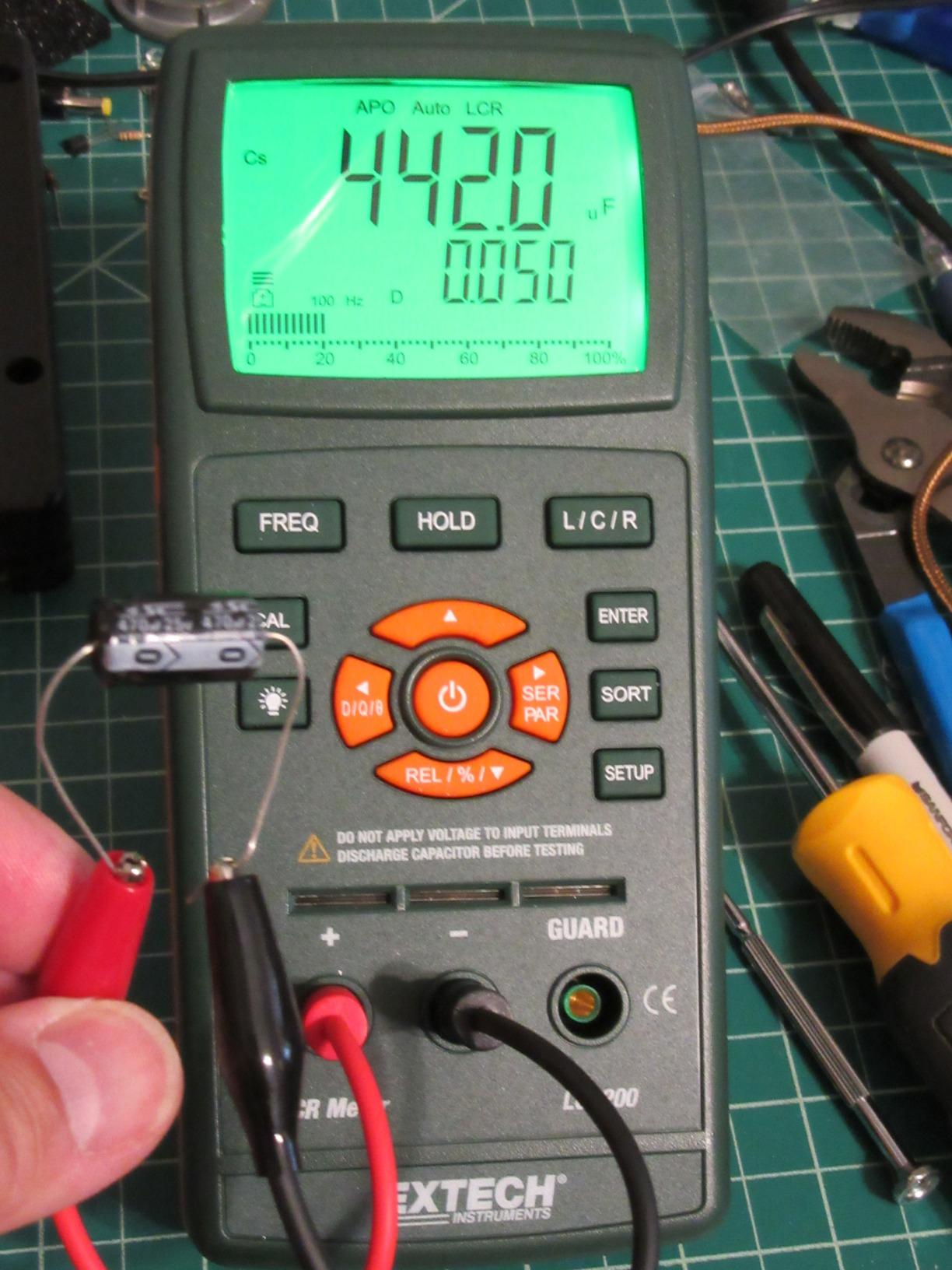
The LCR200 is the conventional bench instrument in this group: a green handheld with a built-in test fixture, a dual backlit display, and a full set of limit-testing features. Nothing about it is exotic, and that is the appeal for anyone doing incoming inspection or screening a batch of parts against a pass or fail band rather than measuring one component at a time.
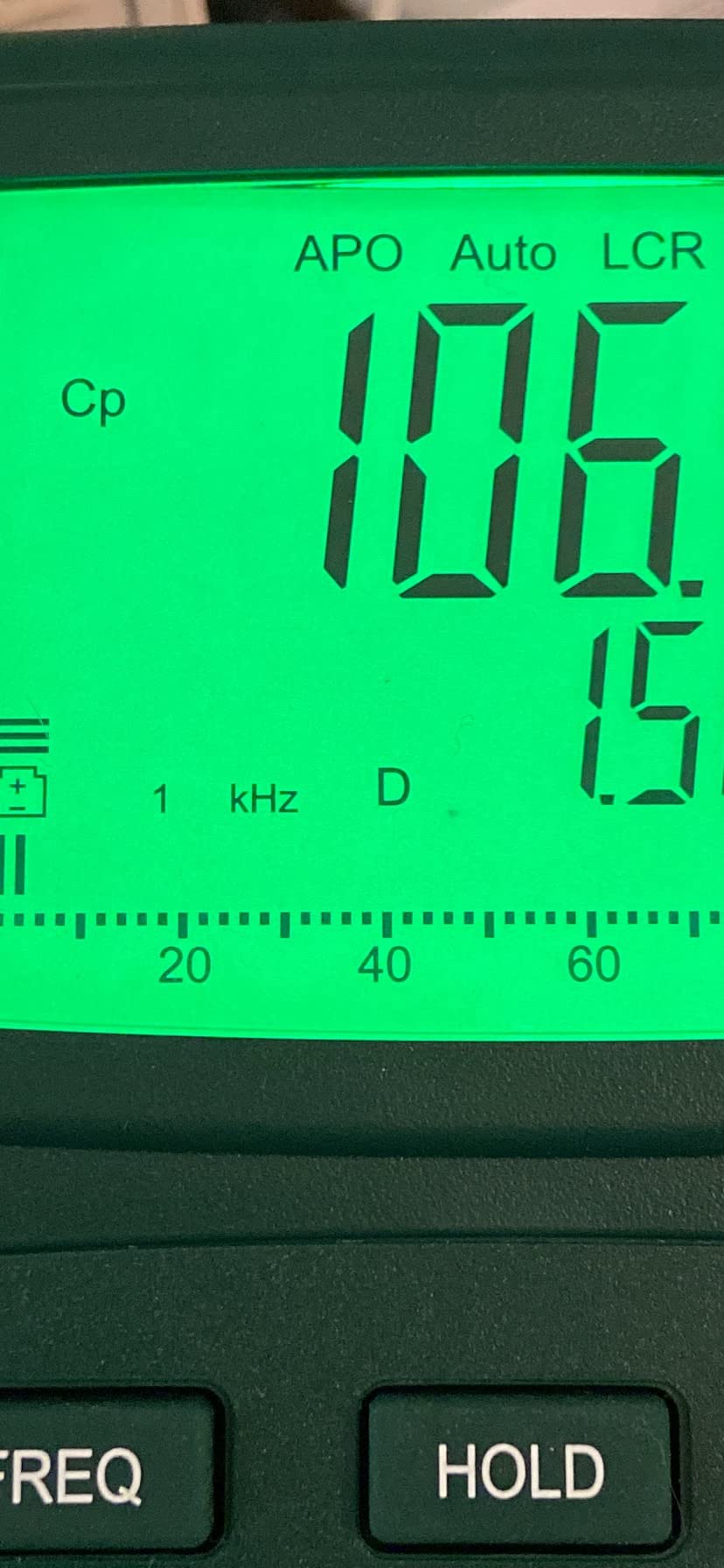
The dual display runs 20,000 and 2,000 counts and shows the primary and secondary parameter at the same time, so you read capacitance and quality factor, or capacitance and ESR, without waiting for a mode switch. Secondary parameters cover quality factor, dissipation, phase and equivalent series resistance. Both series and parallel measurement modes are available, which matters for high-impedance parts.
What open and short calibration buys you
Every measurement includes the fixture, leads and whatever is on the test bed. Open and short calibration measures with the leads open and then shorted, and subtracts that stray impedance from subsequent readings. Without it, small capacitance values drift as you move components around. With it, readings are repeatable enough to compare against a limit, which is exactly the point of a limit-based instrument.
The limit settings accept high and low thresholds in either absolute values or percentage deviation, and auto power off has an override so a long batch sorting run is not interrupted. A low battery indicator is also standard, and the box includes test leads and a 9V battery.
What the small review base means for you
Thirty-three reviews is the thinnest sample here, and the rating distribution is the broadest, with 6 percent one-star and 8 percent three-star feedback. That is not evidence of a fault, it is evidence of an absence of long-term ownership data. Nobody can tell you how this unit behaves after five years because almost nobody has reported on it that long.
Against that, the two year warranty and the Extech name mean support and spares are straightforward if you need them. If you want the established brand on a bench and the built-in fixture for repetitive work, this is a sound choice. If you want the newest capability, the LC1020E or the Pro1 Plus offers more.
9. MATRIX MCR5200 – Best Benchtop LCR Meter for Automated Work
MATRIX MCR5200 Benchtop LCR Meter, 40Hz-200kHz 0.1%, Digital LCR Bridge Measures Inductance/Capacitance/Resistance, USB/RS232C, Calib-Clear, Data Save
0.1% accuracy, 41 points 40Hz-200kHz
SCPI, GPIB, RS232C, USB Host
4.3 inch TFT
5-grade comparator
Pros
- Only benchtop bridge in the group with 0.1% accuracy and 41 frequency points
- Enormous ranges from 0.01uH inductances to 9.9999F capacitance
- SCPI and GPIB support with RS232C and USB Host for automation
- Bundled software saves data to a PC or USB stick
- Built-in comparator with 5-grade pass-fail alarming
- Open short and quick-clear calibration improves stability
- Mains powered so there is no battery to manage
Cons
- Weighs 7.7 pounds so it is fixed to a bench
- Only one product image gives little visual detail before purchase
- 11 percent one-star reviews
- Only 25 reviews so limited long-term data
- Variants cover different frequency spans so confirm the range before buying
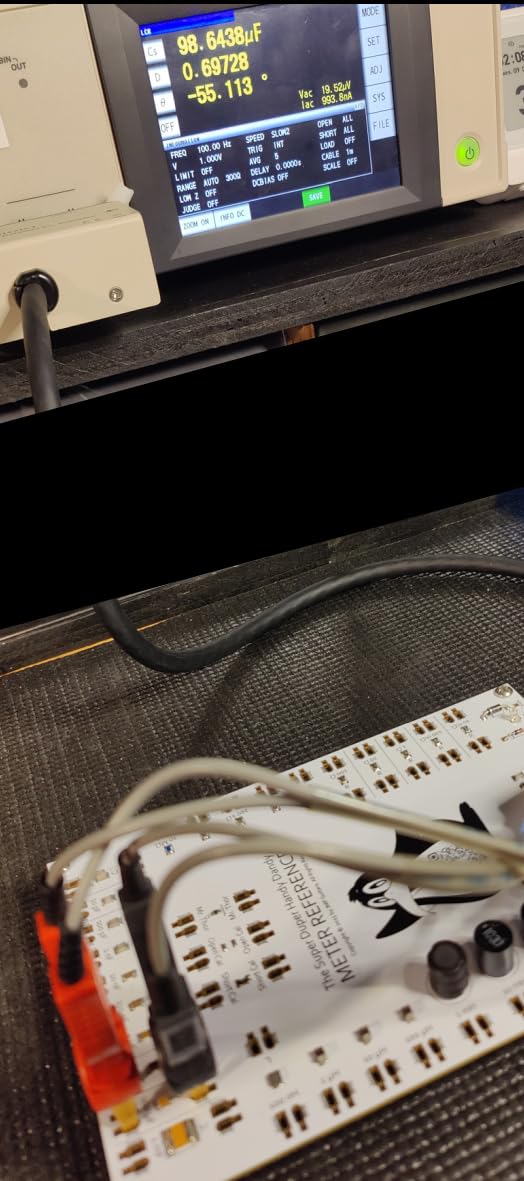
Everything else in this roundup is a handheld. The MCR5200 is a benchtop bridge, and that changes what it is for. With 0.1 percent basic accuracy across 41 selectable frequency points from 40Hz to 200kHz, it is the instrument you put on a bench when the measurement itself has to be defensible, rather than the tool you grab to check a part quickly.
The ranges are almost absurd in their breadth: inductance from 0.01uH to 99999H, capacitance from 0.01pF to 9.9999F, and resistance or impedance from 0.1 milliohms to 99.999 megohms, with dissipation factor, quality factor and phase angle in both degrees and radians. A 4.3 inch TFT LCD with a five-digit display runs on a 32-bit processor, and measurement speed is selectable at 30, 10 or 3 readings per second with an adjustable delay and 1 to 255 averaging.
Why automation support changes the use case
RS232C, USB Host and Handler ports with SCPI and GPIB support mean this meter can sit inside a production or QA workflow. The bundled software saves data to a PC or USB stick, including FAT16 and FAT32 drive copying, so a test result can be written directly to removable media at the end of a run.
Calibration supports manual, hold and automatic range modes with open, short and quick clear, which reduces measurement error and improves stability over a long session. The built-in comparator with 5-grade pass-fail alarming speeds up batch screening, and test conditions can be saved automatically. Signal source output resistance is optionally 30 or 100 ohms, which affects how the meter behaves on very low-impedance parts.
What to check before you commit
It weighs 7.7 pounds and is mains powered at 110 to 220V AC. That is a bench instrument, not a field tool, and the trade is worth it only if you have a bench. The variant list covers 40Hz to 100kHz, 40Hz to 200kHz, 100Hz to 30kHz and 100Hz to 10kHz, so confirm the frequency span matches the span you need.
With 25 reviews and 11 percent one-star feedback, the sample is the smallest here and the one-star share the highest, which is too small a group to diagnose a specific failure mode. A three year manufacturer warranty and bundled test report are meaningful mitigations. If your need is automated measurement and logging rather than a portable instrument, this is the only one in the group that does it.
10. FNIRSI LCR-ST2 – Best LCR Tweezers for In-Circuit ESR Screening
FNIRSI LCR-ST2 100kHz LCR Meter Tweezer SMD & Through-Hole Component Tester
100Hz-100kHz
0.1V to 1.0V RMS levels
1.47 inch HD display
Auto sort and compare
Pros
- Full 100kHz frequency scan in a tweezer
- ESR measurement works reliably in circuit
- Selectable 0.1V test level reduces interference from surrounding parts
- Rear magnet sticks to a metal bench and keeps the tool within reach
- Swappable gold-plated tips plus curved tip and Kelvin clips included
- Compact and light with a storage pouch
Cons
- Diode reading is inconsistent on some Schottky and Zener parts
- Auto-detect sometimes reads a standard diode as an inductor
- Transistor test does not show anode or cathode direction
- Large electrolytics read over 20 percent high against bench meters
- Battery drains quickly
- Display shows only two significant digits on large values
The LCR-ST2 is the tweezer that fixed the biggest weakness of the LCR-ST1: frequency. A full five-point scan from 100Hz to 100kHz in a 1.47 inch handheld format means you can now probe a surface-mount part and still have the option of a high-frequency reading, which matters for low-ESR film and for inductor work.
It also measures more than the LCR-ST1. Alongside resistance, capacitance, inductance and impedance it tests diodes to 0.7V, reads DC voltage to plus or minus 30V, and offers continuity. Four RMS test levels from 0.1V to 1.0V and both series and parallel modes give real control over how gently you probe a live board.
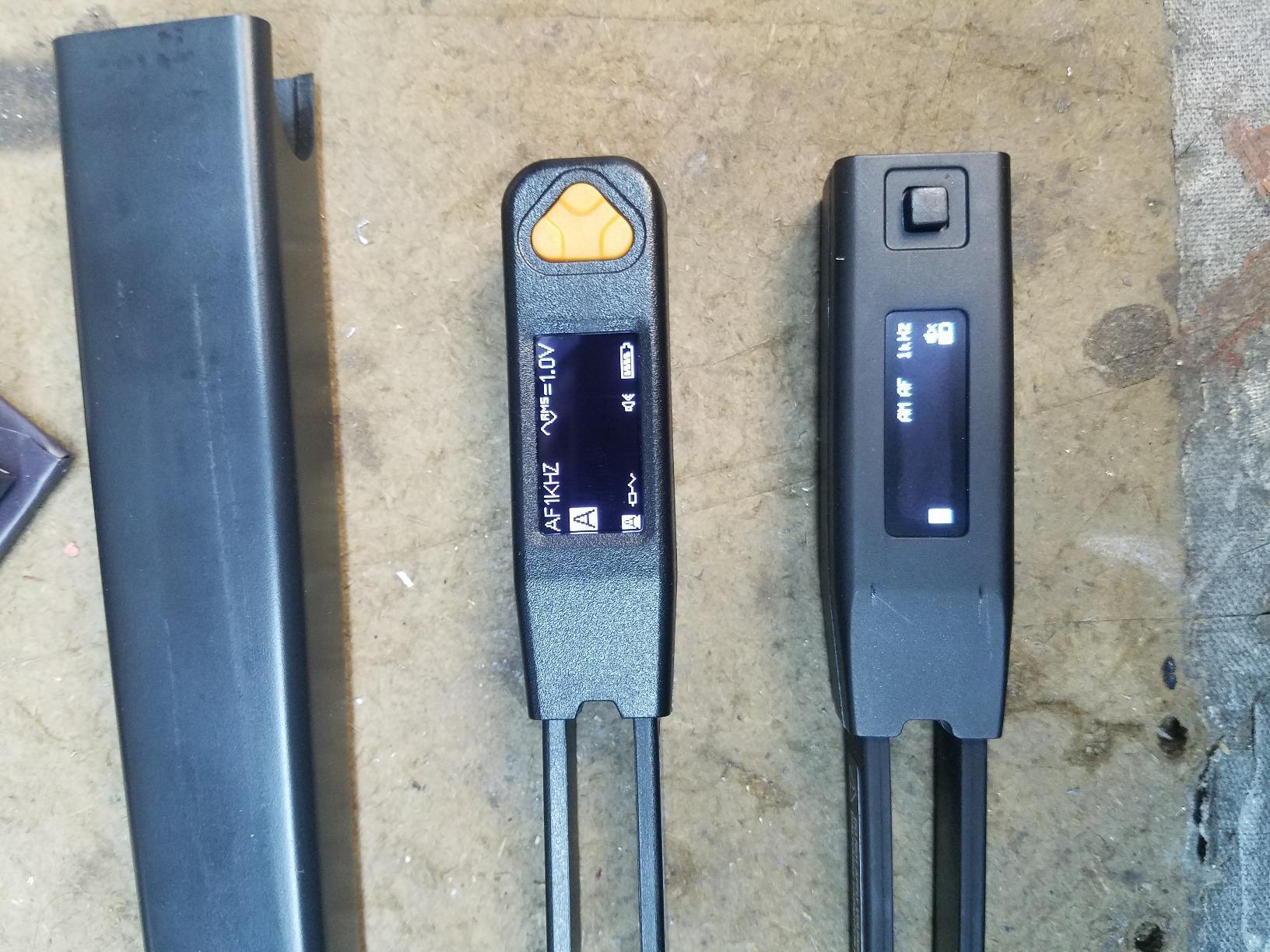
The standout application, confirmed by owners, is in-circuit capacitor ESR. One reviewer used it to diagnose a full recap on a Denon DP-45F amplifier without removing components one at a time. The 0.1V test level is why that works: a small signal is disturbed less by the surrounding circuit, so the ESR reading reflects the capacitor rather than its neighbours.
Physical design details are unusually thoughtful. A high-strength magnet on the back sticks to a metal bench so the tool stays within reach, there is a mode for either hand, the display brightness is adjustable, and the kit includes swappable gold-plated tweezer tips, a curved tip, Kelvin test clips, a storage pouch and a data cable.
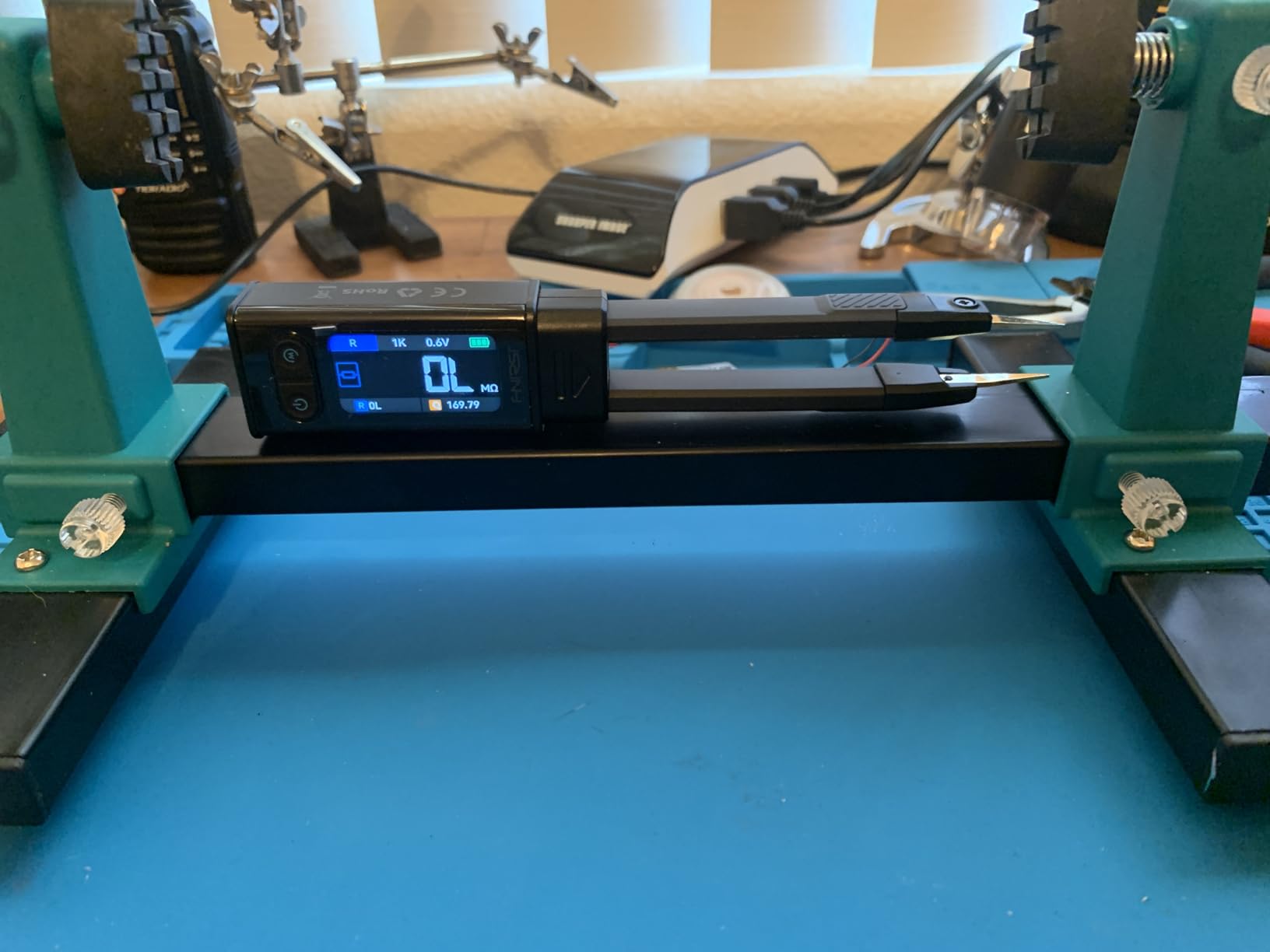
Read this before you rely on auto-detect
Auto sort and compare is a good feature when it works, but the negative feedback is specific. Some Schottky and Zener diodes fail to read even on the latest firmware, auto-detect has read a standard diode as an inductor, and transistor testing does not indicate anode or cathode direction, so PNP and NPN cannot be told apart. If diode and transistor work is central to your job, this is the wrong tool.
Accuracy is also uneven. ESR readings are agreed accurate, but large electrolytic capacitances have been measured over 20 percent high against bench LCR meters, and the display shows only two significant digits, so a 1500uF capacitor reads as 1.5mF. Battery life is short on the 300mAh cell, and owners recommend lowering brightness, volume and auto-off to stretch it.
Small handling issues
The tweezer tips are slightly offset when closed, which can flick small SMD parts off rather than gripping them. With 80 reviews the distribution is the widest of any tweezer here, at 69 percent five-star and 14 percent one-star. The capability set is the richest in the tweezer category, so the trade is about trusting specific functions rather than the meter as a whole.
How to Choose the Best LCR Meter for Your Work
What are the different types of LCR meters?
Four formats cover almost every use case, and the right question is which part of your work needs which one. Benchtop bridges win on accuracy and automation, tweezers win on access to surface-mount parts, and dial-entry handhelds win on simplicity and cost.
Entry handheld (dial or button): broad LCR ranges in a simple package, no Kelvin connection, no frequency selection you control. Good for learning, for coil and bulk capacitor checks, and as a second opinion on a repair bench. The Proster BM4070 is the example.
Handheld with selectable frequency and secondary parameters: the general-purpose category most buyers want, with ESR, dissipation factor, quality factor and phase angle, open and short calibration, and frequency choice from 100Hz to 100kHz. The DER EE DE-5000, FNIRSI LC1020E and Extech LCR200 sit here.
SMD smart tweezers: probe-style instruments that identify and measure a component in place, mostly on boards. The FNIRSI LCR-ST1 and LCR-ST2, Smart Tweezers ST5S and LCR Research Pro1 Plus all belong here.
Benchtop bridge: mains powered, higher accuracy, many frequency points, SCPI and GPIB automation, data logging to a PC or USB stick. The MATRIX MCR5200 is the only one in this roundup.
Which test frequency should you use for capacitors?
Pick the frequency that matches how the part will actually be used, because capacitance is frequency-dependent and electrolytics drift with DC bias. Match the test to the component chemistry and the part behaves predictably.
Electrolytic and tantalum capacitors: 100Hz or 120Hz, close to mains ripple frequency, is the standard choice for general health and ESR checks.
Film and ceramic capacitors: 1kHz is the conventional reference and makes readings comparable across instruments and datasheets.
Small ceramic capacitors and RF work: 10kHz to 200kHz, because dielectric absorption means a 100nF part can read noticeably lower at high frequency than its marked value.
Power inductors and low-ESR film: 10kHz to 100kHz, which is where the losses and self-resonance that affect a converter show up.
How accurate do you need to be?
Headline accuracy is a best-case figure, usually quoted at 1kHz in the middle of the range. Accuracy degrades at the extremes of the range and at unusual frequencies, so a 0.2 percent headline number does not mean 0.2 percent on the smallest capacitor you own.
Hobby and learning: plus or minus 2 to 3 percent is enough. Readings still have to be repeatable, which is a different requirement from being traceable.
Field repair and audio work: around 1 percent, and ESR readings matter more than absolute capacitance accuracy.
Quality control and incoming inspection: 0.1 to 0.5 percent, with a calibration certificate and repeatability across a temperature range.
Design validation and lab work: 0.05 to 0.1 percent with four-wire connections and documented calibration.
Series or parallel mode, and does 4-wire matter?
Use series mode for low-impedance parts such as large electrolytics and low-value resistors, and parallel mode for high-impedance parts such as small film and ceramic capacitors, because the equivalent model differs and a high-impedance part reads inaccurately in series. If your meter chooses automatically, check that it is choosing correctly for your part.
Four-wire Kelvin measurement keeps the current path separate from the voltage sense path, so lead resistance and stray inductance are excluded from the reading. Two-wire meters fold that error into the result, which is why budget meters can read a few percent off on small capacitors and low inductances. The real penalty shows on parts below about 1uF, where lead capacitance can exceed the value you are trying to measure.
Can you measure a capacitor while it is still on the board?
Rarely, and the exception is ESR. In-circuit capacitance readings are misleading because every part connected in parallel with your capacitor adds to the total, and every part in series adds impedance. A good capacitor on a populated board will read high.
ESR is the exception, because a high-frequency ESR measurement passes mainly through the capacitor under test while the surrounding parts, typically ceramic, present a very high impedance. That is why ESR-only meters work as in-circuit screening tools. If you want that capability without desoldering, a tweezer with a 0.1V test level such as the FNIRSI LCR-ST2 is the practical route. Desoldering still gives the only trustworthy capacitance value.
What about fixtures, calibration and PC connection?
Test leads are an accuracy multiplier, not an accessory. Short unshielded leads add stray capacitance and inductance, and open and short calibration subtracts it, so do that calibration with the fixture you actually use rather than the leads in the box. For small-value work, a proper fixture or a three-pin Kelvin connection is worth more than a specification upgrade.
For logging and automation, check what the meter actually offers. The FNIRSI LCR-ST1 exports readings to a spreadsheet, which is enough for component sorting. The MATRIX MCR5200 goes further with SCPI, GPIB, RS232C and USB Host plus bundled software, which is what you need for a production or QA workflow.
How much should you expect to spend?
Prices move, so we deliberately do not print figures here, but the tiers are stable. The entry tier covers dial handhelds and entry tweezers and gives you broad ranges with no frequency control. The mid tier covers colour-screen handhelds with four-wire Kelvin and five test frequencies, which is where most serious hobbyists should aim.
Above that, premium tweezers and bench-suitable handhelds add calibration certificates, lower test voltages for in-circuit work and higher frequency ceilings. The top tier is benchtop instrumentation with automation interfaces, traceable accuracy and ranges spanning several orders of magnitude. A used vintage bridge from a university or laboratory is also a real path if you want laboratory-grade measurement, though forum users caution that even broken examples are priced well above new handhelds.
Frequently Asked Questions
What is the best capacitance meter?
A dedicated capacitance meter measures capacitance and nothing else. An LCR meter measures capacitance plus ESR, dissipation factor and leakage at a known frequency, which is what actually tells you whether a capacitor is healthy rather than merely the right value. For electrolytics, ESR is the number that predicts failure, so a full LCR meter is the better purchase unless your work is purely ceramic identification.
How accurate are LCR meters?
It depends on the class of the meter and the range. Entry handhelds are typically good to 2-3 percent, serious handhelds around 0.1-0.5 percent, and benchtop bridges to 0.1 percent or better. Treat the headline figure as a best case at 1kHz in mid-range. Accuracy degrades at the extremes of the range and at unusual frequencies, so repeatability matters more than the printed number.
What are the different types of LCR meters?
There are four main types. Entry handhelds give broad LCR ranges with no Kelvin connection and no user frequency control. General-purpose handhelds add selectable test frequencies, open and short calibration and secondary parameters such as ESR, D and Q. SMD smart tweezers probe surface-mount parts in place. Benchtop bridges offer the highest accuracy, the most frequency points and SCPI or GPIB automation.
How much does an LCR meter cost?
Four tiers cover the market. Entry dial handhelds and basic tweezers sit at the bottom and give broad ranges without frequency control. Mid-tier handhelds add colour displays, four-wire Kelvin and five test frequencies. Premium tweezers and bench handhelds add calibration certificates, lower test voltages and higher frequency ceilings. Benchtop bridges with automation interfaces occupy the top tier.
Do I need an LCR meter if I already have a multimeter?
Yes, for anything involving frequency behaviour or component health. A multimeter applies DC and reports resistance, so it cannot tell you whether a capacitor still works at your circuit’s switching frequency or whether its ESR has climbed. An LCR meter drives a small AC signal at a chosen frequency and reports ESR, dissipation factor, quality factor and phase angle alongside the main value.
Which LCR meter is best for SMD work and component identification?
A smart tweezer meter is the right form factor because it puts two probes on a small part while your other hand stays free. The FNIRSI LCR-ST2 reaches 100kHz with a 0.1V test level and a Kelvin clip, which makes it the most capable in this roundup. The LCR Research Pro1 Plus is the more accurate option, with 0.1 percent on resistance and a documented calibration routine.
Can an LCR meter test a bad capacitor while it is still on the board?
Capacitance, rarely. Parts connected in parallel add to the total and parts in series add impedance, so a good capacitor on a populated board reads high. ESR is the exception, because at high frequency the signal passes mainly through the capacitor under test. An ESR-only meter or a tweezer with a low test voltage level can therefore screen electrolytics without desoldering.
Why does my LCR meter read a different value from the datasheet?
Four reasons account for most disagreements. Test frequency differs from the datasheet condition, so capacitance and inductance shift with frequency. The equivalent circuit model differs, since series and parallel values for the same part are not identical. Your fixture adds stray capacitance and inductance that calibration reduces but does not eliminate. And a two-wire connection folds lead resistance into the result, which matters below about 1uF.
Final Verdict: The Best LCR Meters for 2026
If you want one meter for a first serious bench, take the Proster BM4070. Its 2680 owner reviews, complete accessory kit and single-dial simplicity make it the least likely purchase to disappoint, and the limitations are ones you can work around. If you want the most used repair instrument in the community, the DER EE DE-5000 earns its reputation through ESR screening and a decade of forum validation, once you fit longer Kelvin leads.
Our best value pick is the FNIRSI LC1020E, which brings four-wire Kelvin measurement, a 19,999 count colour display and a sorting mode to a mid-tier price point. For RF and high-frequency work the PEAK Atlas LCR45 reaches 200kHz and outputs complex impedance, which nothing else in a handheld does. For SMD work the FNIRSI LCR-ST2 and LCR Research Pro1 Plus are the tweezers to own, with the Pro1 Plus preferred where accuracy and in-circuit capability matter most. The Extech LCR200 suits batch sorting with limit thresholds, and the MATRIX MCR5200 is the only option here for automated bench work with SCPI and GPIB.
Whatever you pick, run open and short calibration with your own fixture, and check one known reference component before you trust a single reading.