
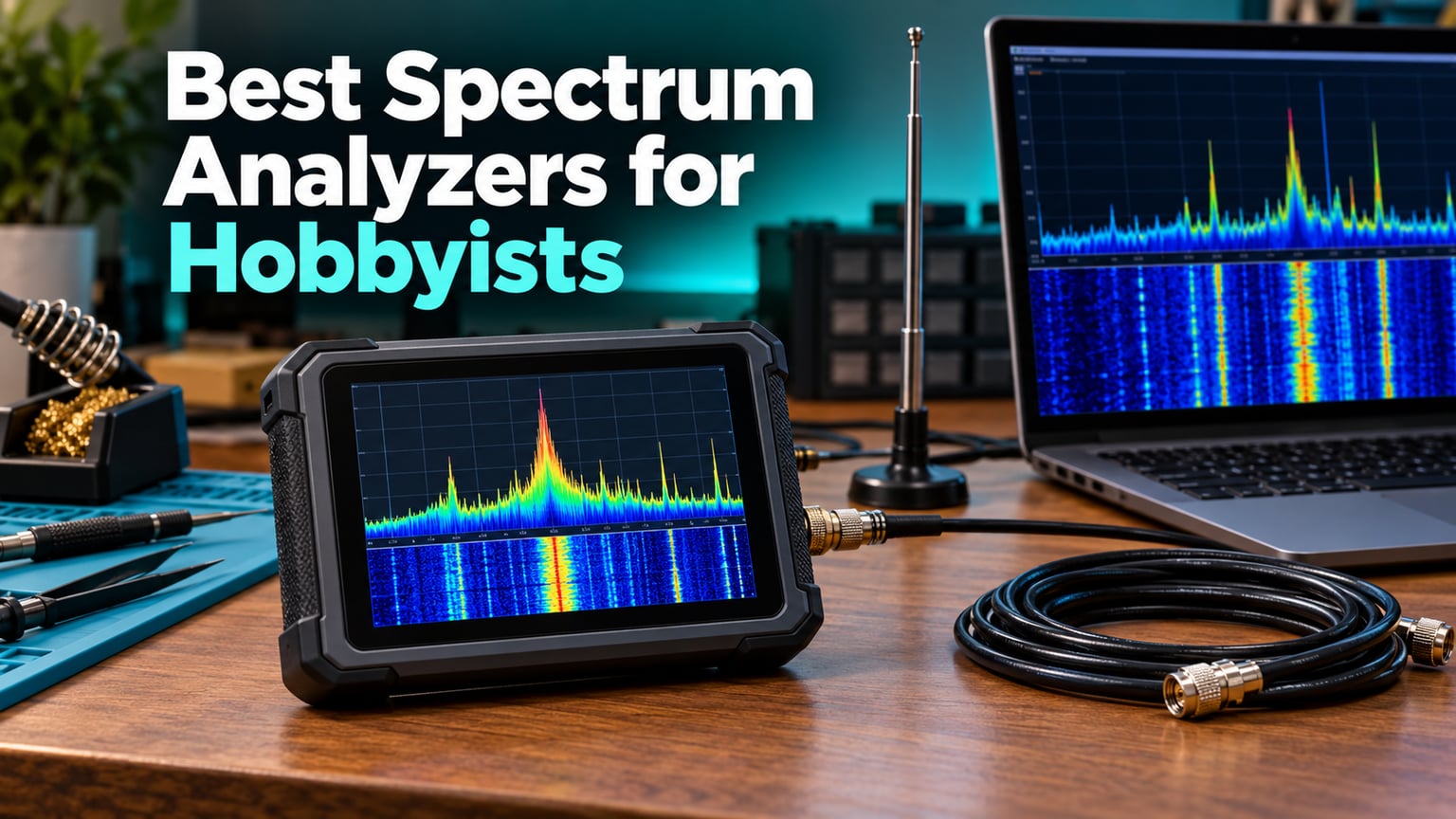
If you only read one thing: the SEESII TinySA is the best spectrum analyzer for hobbyists who are starting out, and the Siglent SSA3021X is the one to buy when you outgrow a pocket device and need real bench resolution bandwidth. We compared ten units across USB dongles, pocket handhelds, wideband handhelds and benchtop instruments to work out which tier actually suits which job.
A spectrum analyzer shows you the amplitude of an RF signal across a range of frequencies, so you can see what is transmitting, how strong it is, and how it changes. An oscilloscope shows amplitude against time, which means an RF problem is simply invisible on it. That is why the same forum threads keep asking whether an oscilloscope can replace one, and the honest answer is no.
What follows covers the whole hobbyist ladder in 2026, from a dongle that needs a laptop to a benchtop with a tracking generator. We also explain the specs that actually decide what you can see, because frequency range gets all the attention while the numbers that matter most are the displayed average noise level and the resolution bandwidth.
If you are also building out a bench, our soldering station roundup for electronics hobbyists covers the other tool you will reach for constantly. For anyone buying gifts, the hobbyist gift buying guide has the shortlist.
Top 3 Picks for Hobbyist Spectrum Analyzers in 2026

The TinySA wins because it does the one job a beginner needs most, seeing what is on the air, without a laptop, a licence or a learning curve. The ZS406 is the sensible upgrade when you need to look above 1GHz. The Siglent sits at the top of the ladder for anyone doing filter or duplexer work with a real tracking generator.
All 10 Spectrum Analyzers Compared in 2026
| Product | Specifications | Action |
|---|---|---|
| SEESII TinySA Handheld Spectrum Analyzer |
|
Check Latest Price |
 SEESII TinySA Ultra+ ZS406 SEESII TinySA Ultra+ ZS406 |
|
Check Latest Price |
 RF Explorer WSUB1G Handheld RF Explorer WSUB1G Handheld |
|
Check Latest Price |
 SEESII TinySA Ultra+ ZS407 SEESII TinySA Ultra+ ZS407 |
|
Check Latest Price |
 RF Explorer 6G WB Plus Slim RF Explorer 6G WB Plus Slim |
|
Check Latest Price |
 RF Explorer 6G Combo Plus RF Explorer 6G Combo Plus |
|
Check Latest Price |
 RTL-SDR Blog V3 USB Dongle RTL-SDR Blog V3 USB Dongle |
|
Check Latest Price |
 Nooelec RTL-SDR v5 Bundle Nooelec RTL-SDR v5 Bundle |
|
Check Latest Price |
 Rigol DSA815-TG Benchtop Rigol DSA815-TG Benchtop |
|
Check Latest Price |
| Siglent SSA3021X Benchtop |
|
Check Latest Price |
1. SEESII TinySA: the Best Starter Handheld Analyzer
Portable TinySA Spectrum Analyzer,SEESII Upgraded V0.3.1 Handheld Tiny Frequency Analyzer 100kHz to 960MHz MF/HF/VHF UHF Input,Signal Generator with 2.8 inch Touch Screen with ESD Protect Function
0.1MHz-960MHz
Pocket handheld
2.6kHz-640kHz RBW
Signal generator plus calibrator
Pros
- Pocket-sized full analyzer with no PC required
- Covers HF VHF and UHF in one box
- Doubles as a signal generator with a calibration source
- USB CDC PC control with auto-installing Windows driver
- Rechargeable battery for field work
Cons
- Finicky touch interface with imperfect screen calibration
- Modest resolution bandwidth and dynamic range
- Included telescopic antenna hinge is fragile
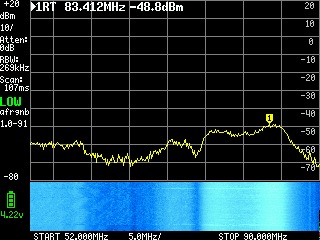
This is the unit we keep coming back to. It weighs 2.2 pounds, runs from 100kHz to 960MHz across two inputs, and it does one thing extremely well: telling you whether a signal is there and roughly how strong it is. On r/amateurradio, the TinySA and the NanoVNA are repeatedly named as the two canonical first purchases for anyone moving beyond a bare transceiver, and this is the analyzer half of that pair.
The two-input design is smarter than it looks. The HF/VHF path runs 0.1MHz to 350MHz at higher quality, while the UHF path handles 240MHz to 960MHz, which is exactly where wireless microphone bands and 70cm amateur activity sit. You get a built-in calibration signal generator too, so you can self-test before you trust a reading.
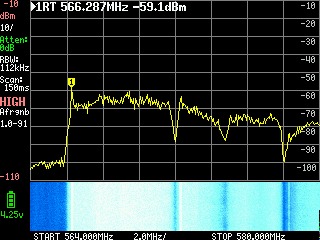
What you give up is real. The finest resolution bandwidth filter is 640kHz, so you cannot separate two carriers that are close together, and the dynamic range is weak enough that some measurements need a signal around -40dBm or better. One SDR group described it honestly as a great signal sniffer that is far less good at precise characterisation.
Over USB CDC it becomes a PC-controlled analyzer, and the Windows driver installs by itself while Linux users get it in the kernel. The rechargeable battery gives a minimum of two hours of portable use, and the included telescopic antenna, 20cm cables and SMA barrel adapter are enough to get started without buying anything else.
What you can actually measure with it
It is excellent for finding an interfering carrier on a wireless mic band, confirming a transmitter is on frequency, checking whether a repeater is up, and comparing noise floors between a good and a bad antenna feed. For narrowband work it will frustrate you, because 640kHz of resolution will not separate two adjacent signals.
You can also use the internal generator plus the analyzer to sanity check a cable run, which is a genuinely useful bench test that costs nothing extra.
Where it falls short
The touch interface is the most common complaint, and owners regularly report screen calibration that is off. Documentation is sparse, the included antenna hinge is fragile, and there is no headphone jack or audio output, so you cannot listen to what you find. Any of that stops mattering the moment you want to resolve two close carriers or chase a signal below the noise floor.
2. SEESII TinySA Ultra+ ZS406: Best Value Upgrade
SeeSii TinySA Ultra+ ZS406 Spectrum Analyzer, 4.0 Inch 100kHz to 5.4GHz Handheld Tiny Frequency Analyzer with 32Gb Card, 2-in-1 Signal Generator MF/HF/VHF UHF Input,V0.4.6.1,2025 Upgraded
0.1MHz-5.4GHz
4.0 inch touchscreen
200Hz-850kHz RBW
Switchable LNA below 3.5GHz
Pros
- Reaches 5.4GHz so 2.4GHz ISM and 5GHz WiFi are covered
- 450 scan points on a 4 inch display
- DANL of -166dBm/Hz with strong phase noise
- Switchable LNA adds 20dB below 3.5GHz
- 5000mAh battery plus 32GB recording card
Cons
- Resolution bandwidth still far behind benchtop units
- LNA gain stops above 3.5GHz
- Serious analysis still needs a PC and the TinySA app
This is the one we recommend to anyone whose interest extends past 70cm. It runs 100kHz to 5.4GHz, which puts 2.4GHz WiFi, Bluetooth and most of the 5GHz band within reach, and it adds a switchable LNA that gives 20dB of extra gain below 3.5GHz. That is the single biggest practical jump from the original TinySA for weak-signal work.
Phase noise is quoted at -108dB/Hz at 100kHz offset and -115dB/Hz at 1MHz offset on a 30MHz carrier, with a displayed average noise level of -166dBm/Hz. Those are genuinely good numbers for a pocket device, and they are why the 4 inch 480×320 touchscreen and 450 scan points feel usable rather than cramped.
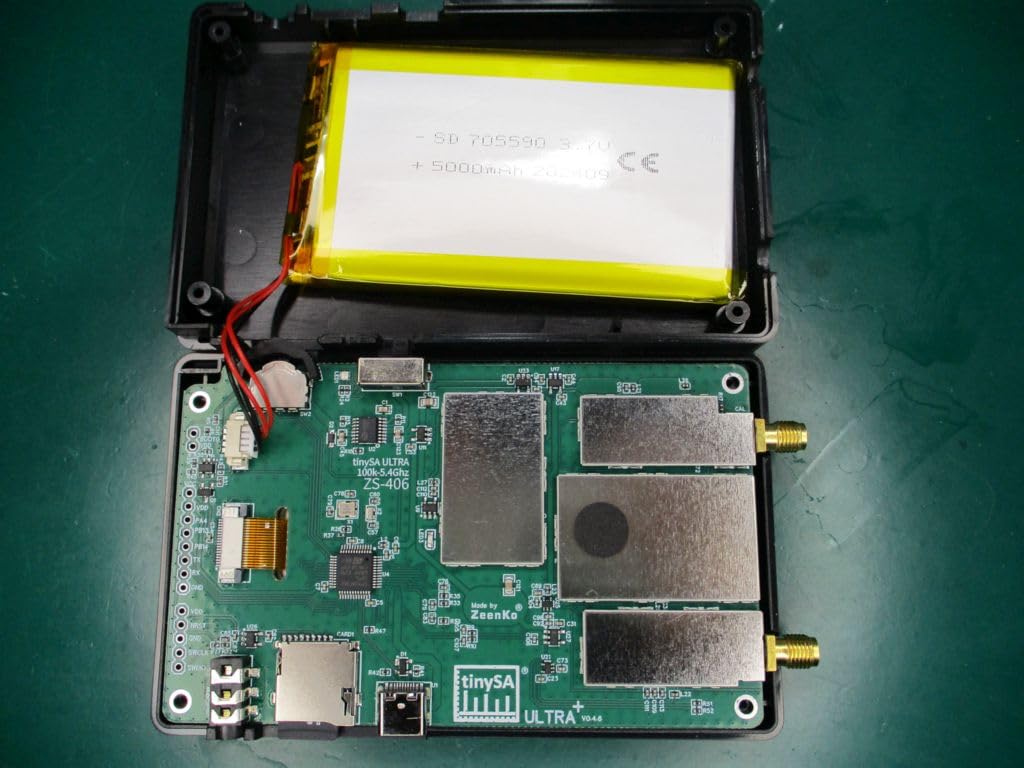
Battery life comes from a 5000mAh pack that takes roughly three hours to charge, and the included 32GB microSD card means you can record traces in the field without a laptop. It also handles a signal generator role with sine, square wave and dual tone output, plus a built-in calibration source.
Owners consistently treat it as the value upgrade rather than a different class of instrument. The reservations are about the limits of a pocket device: the resolution bandwidth of 200Hz to 850kHz is nothing like a benchtop, and the LNA stops helping above 3.5GHz.
What you can actually measure with it
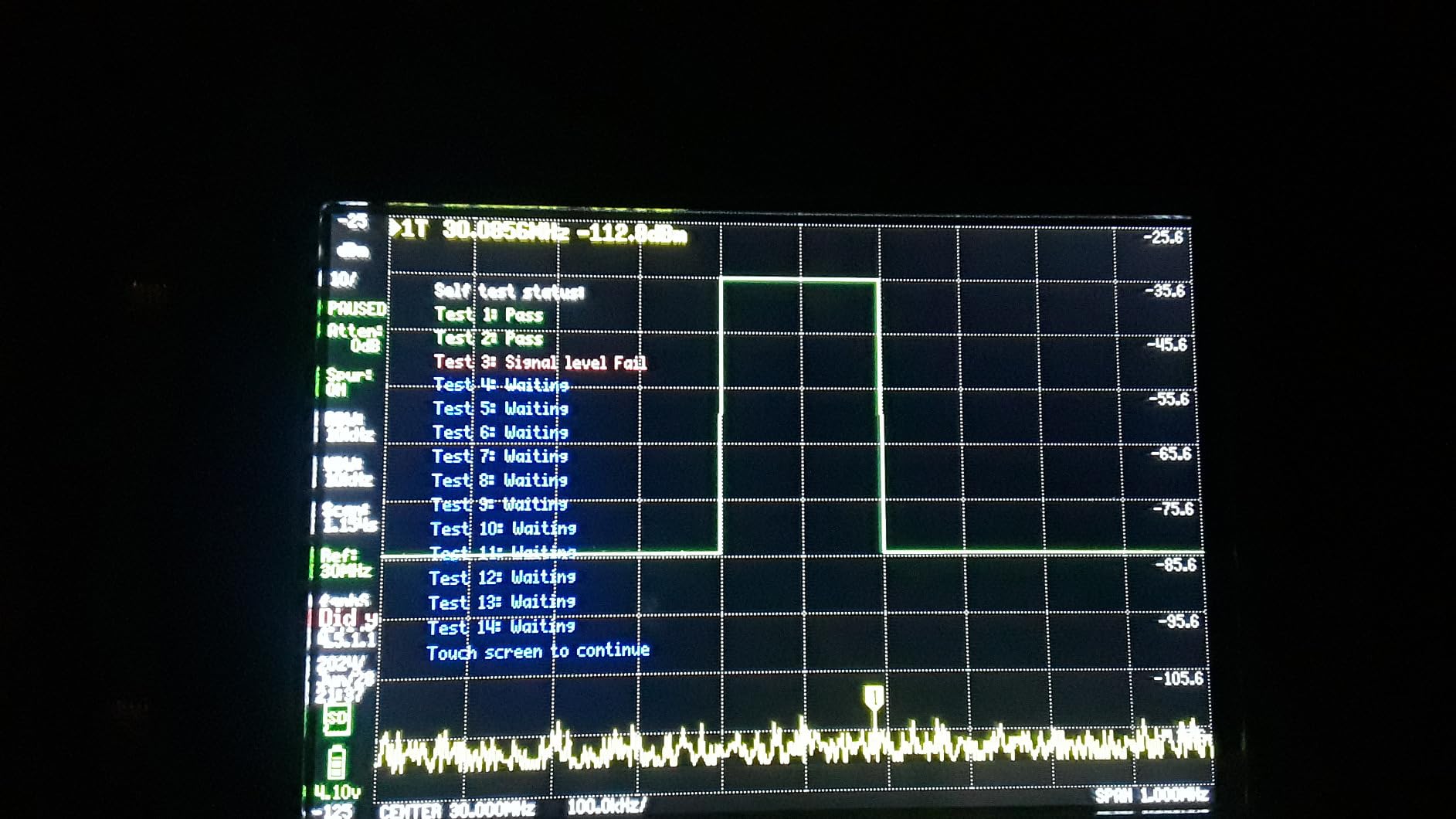
It handles the classic beginner projects properly. You can pick a clean 2.4GHz channel by looking at the band, confirm a 5GHz access point is transmitting, and see the noise floor difference between a good and a poor WiFi antenna.
Because it writes to microSD, it works well as a remote monitor: park it near a router or a repeater and review the recording later rather than watching the screen.
Where it falls short
The screen is still the bottleneck. When a band is busy and you want to inspect several traces at once, a 4 inch display is limiting, and the honest fix is to plug it into a PC and use the TinySA app. Anyone expecting a benchtop workflow with multiple split traces should step up rather than fight the interface.
3. RF Explorer WSUB1G: a Focused 240MHz to 960MHz Handheld
RF Explorer Digital Handheld Spectrum Analyzer model WSUB1G 240 – 960 MHz
240MHz-960MHz no gaps
9.76 ounce body
Peak max and hold plus averaging
mini-USB PC link
Pros
- Large installed base and mature RF Explorer software
- Covers 315MHz 433MHz 868MHz and 915MHz ISM
- Light enough for a pocket at 9.76 ounces
- Average and peak max and hold modes for intermittent carriers
Cons
- Stops at 960MHz so anything above 1GHz is out of reach
- Older Tegra hardware refreshes slowly
- Windows-centric software with no WiFi analyzer mode
There is a reason this design has stayed on the market for so long. It does one narrow job extremely well, and that job is the sub-1GHz ISM world. The 240MHz to 960MHz band has no gaps, which means 315MHz, 433MHz, 868MHz and 915MHz are all covered in one sweep.
At 9.76 ounces with dimensions of 4.45 by 2.76 by 0.98 inches, it is small enough to genuinely live in a pocket. Peak max and hold, normal, overwrite and averaging modes give you the tools to catch a burst transmission that flashes past once.
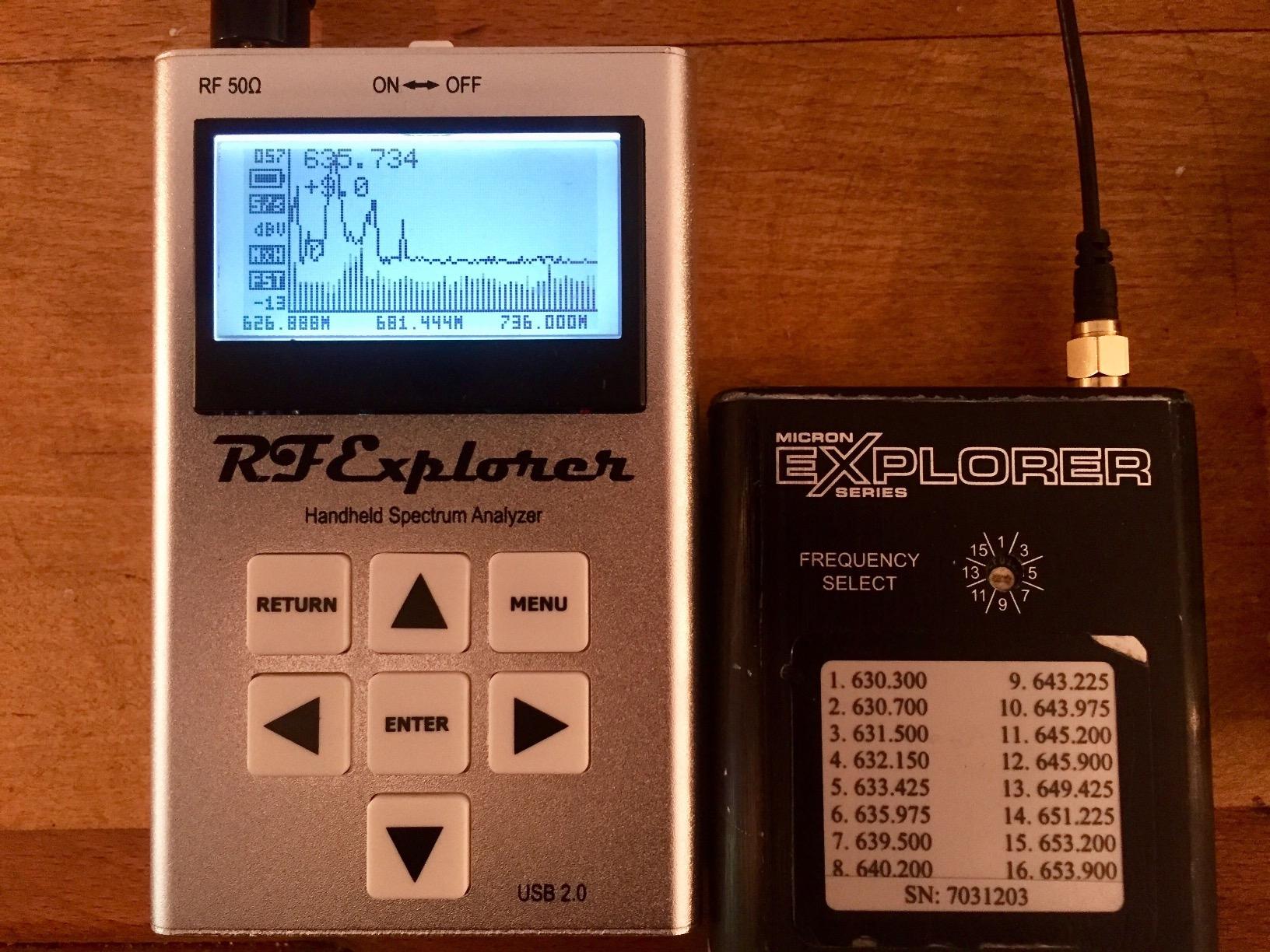
The mini-USB 2.0 connection to a PC extends its functionality through the RF Explorer software, and the Nagoya NA-773 wideband telescopic antenna in the box is a sensible default for the coverage it offers. It is designed for equal use indoors and outdoors, which suits antenna and interference work.
Owners treat it as dependable for 433MHz and 868MHz hunting, and the 4.6 rating reflects that. The catch is the ceiling. Anything above 960MHz simply is not there, and the underlying Tegra processor shows its age with a slower refresh than newer models.
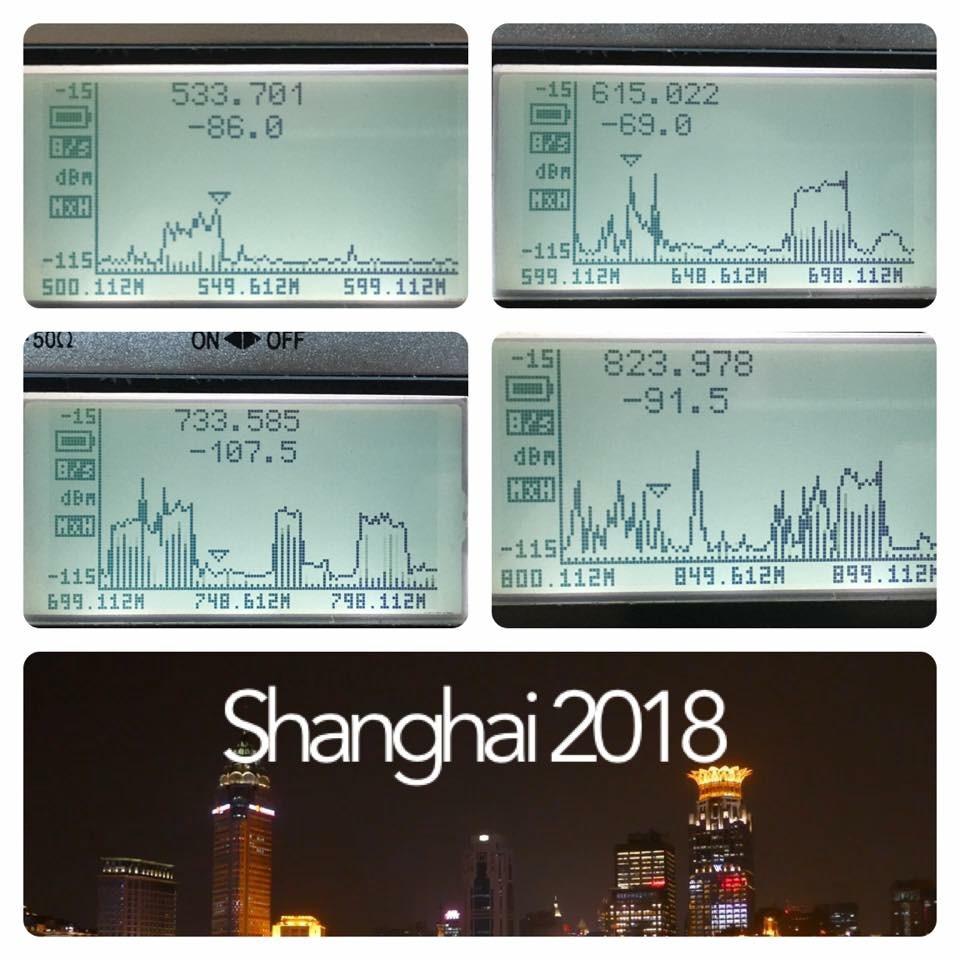
What you can actually measure with it
This is the interference-hunting tool for wireless microphones, garage door and alarm remotes, LoRa and ZigBee gear, and 70cm or 33cm amateur activity. A key fob that works in the car park but not at the gate is a classic case, and a held peak trace plus averaging will find it quickly.
It will also confirm a handheld transmitter is actually radiating, which is more useful than it sounds when a cheap transmitter turns out to be faulty.
Where it falls short
It is not a WiFi tool, and the software is Windows-centric. If your interest is 2.4GHz and 5GHz, this unit cannot help you at all, and the older hardware means trace refresh lags behind anything sold in the last few years. Treat it as a specialist sub-1GHz instrument rather than a general analyzer.
4. SEESII TinySA Ultra+ ZS407: Widest Reach in a Handheld
SEESII Tinysa Ultra+ ZS407 7.3GHz Spectrum Analyzer with Hard Case: HW V0.5.4 100kHz-7.3GHz Handheld Tiny Frequency Analyzer 2-in-1 RF Signal Generator with 4” EVA Shell, for Ham Radio, Field Testing
0.1MHz-7.3GHz
4 inch HD touchscreen
200Hz-850kHz RBW
Generator supports two-tone IM tests
Pros
- Widest frequency reach in the handheld class at 7.3GHz
- Handles 5GHz WiFi and 6GHz WiFi 6E bands
- Two-tone intermodulation testing from the built-in generator
- Bundled waterproof EVA hard case with foam dividers
Cons
- 4 inch screen is small for dense traces
- Ultra mode is specified to 6GHz not the headline 7.3GHz
- Newer hardware revision with a thin review base
The ZS407 exists for one reason: bandwidth. It covers 100kHz to 7.3GHz and is calibrated to 8GHz, which makes it the widest-reaching handheld here. It is one of only two units in this roundup that reach into the 6GHz WiFi 6E band, and it does so in a pocket device. If your work sits at 5GHz or above, that ceiling is the deciding factor and nothing else in the pocket class matches it.
The generator side is more capable than on the smaller ZS406, covering sine from 100kHz to 900MHz and square wave from 800MHz to 6.3GHz, with mixed signals from 4.4GHz to 6.3GHz. It also supports SSB two-tone intermodulation tests, which is a real measurement rather than a party trick.
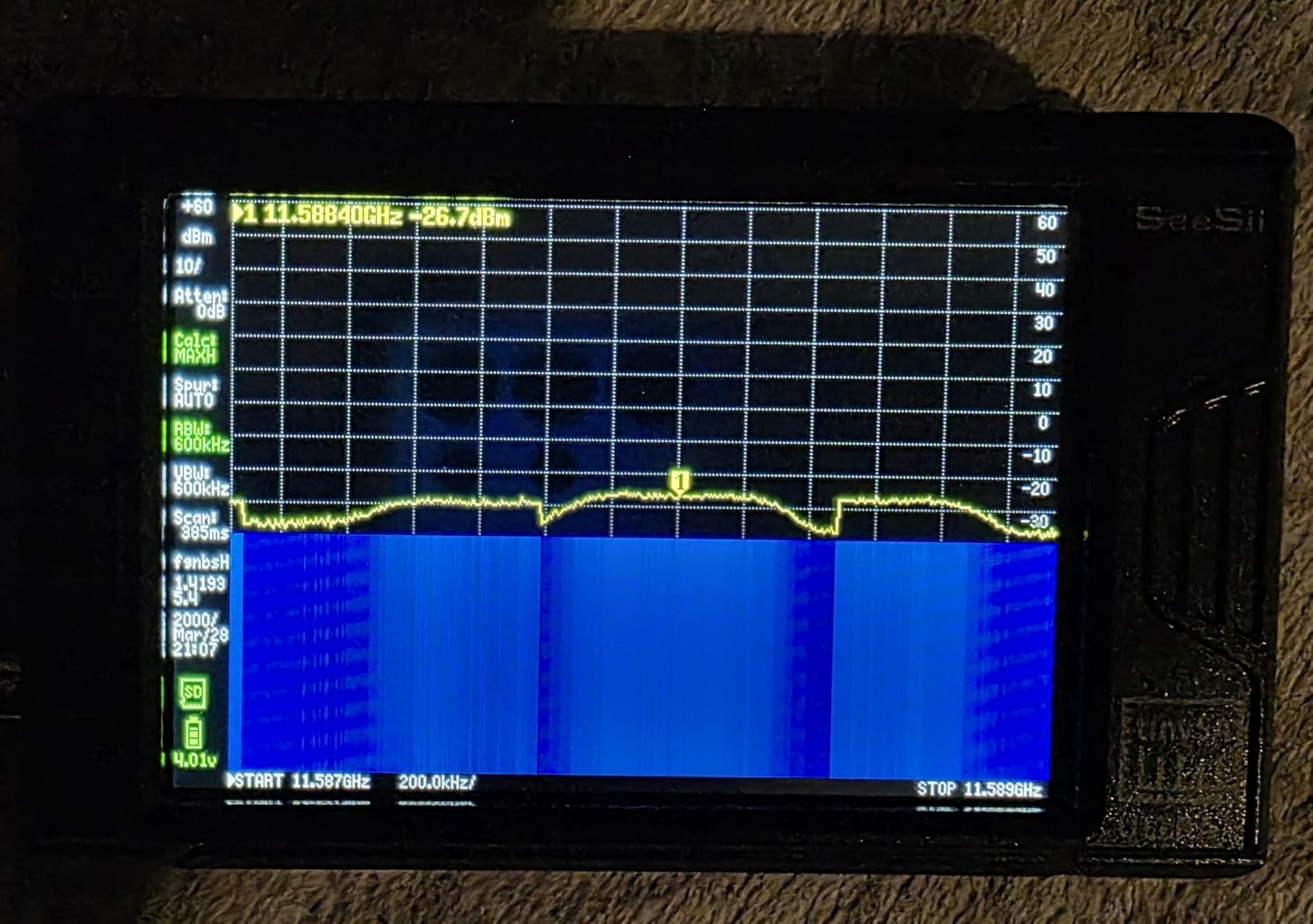
The bundled EVA hard case is a real inclusion rather than filler, with foam dividers and mesh pockets for cables. It weighs 15.8 ounces, which is heavier than the smaller handhelds but still field-usable, and USB plus the TinySA app give real-time display and data transfer.
Owners with an 83 percent five-star share pick it specifically for the 7.3GHz reach and the protective shell, and it suits satellite alignment and frequency verification work. Read the mode limits carefully though, because standard mode stops at 800MHz and Ultra mode is specified to 6GHz even though the headline number is 7.3GHz.
What you can actually measure with it
Channel planning across 5GHz and 6GHz is the headline use. You can see every access point in a room, judge congestion, and pick a channel before blaming your router. It is equally good for confirming frequency references and for tracking down a spurious emission near a transmitter.
The 32GB card means a day of recorded traces is possible, which turns it into a remote monitor for a site you cannot sit next to.
Where it falls short
A 4 inch screen is small for a device advertised with laboratory-grade measurement claims, and dense 5GHz environments produce traces you will want to inspect on a monitor. As a handheld it still has modest resolution bandwidth, and the case adds bulk for pocket use. It is also the newest hardware revision in the list, so the review base is thin compared with the established models.
5. RF Explorer 6G WB Plus: Waterfall First, Flaw Forgiving
RF Explorer 6G WB Plus – Slim Handheld Spectrum Analyzer
15MHz-6100MHz continuous
0.5dBm amplitude resolution
WiFi analyzer mode
2D and 3D waterfall software
Pros
- Gap-free 15MHz to 6.1GHz coverage in a slim body
- Free Mac and Windows software with 2D and 3D waterfall views
- WiFi analyzer mode added in the current firmware
- 0.5dBm amplitude resolution for level accuracy
Cons
- Gain drift on early hardware needs corrected firmware
- Lowest rating in this lineup at 3.9
- 15MHz lower limit misses the low-HF range a benchtop covers
We are including this one with a warning attached, because the 3.9 rating is real and explained. The original gain-drift flaw produces a noisy, unstable trace that makes readings hard to trust, and hobbyist firmware releases from the community largely correct it. Owners who install the corrected firmware rate the WiFi analyzer mode and waterfall software highly, and those two features are the reason to consider it.
With that understood, the fundamentals are good. Coverage is continuous from 15MHz to 6100MHz with no gaps, amplitude resolution is 0.5dBm, and the free Mac and Windows software gives you 2D and 3D waterfall views that make intermittent interference visible in a way a single trace cannot.
It weighs 6.5 ounces and a carrying case is included. The 15MHz lower limit is the practical drawback: it never reaches the low HF region a benchtop covers, so it is not a tool for amateur HF work.
What you can actually measure with it
WiFi troubleshooting is the strongest case. The waterfall view shows a channel that works for five minutes and then dies, which is exactly the fault a normal scan misses. It also handles 2.4GHz congestion surveys and locating a noisy device near a router or access point.
Because it runs on Mac as well as Windows, it is one of the few handhelds here that suits a laptop user without extra software.
Where it falls short
Out of the box the gain drift is the defining weakness, and fixing it depends on community firmware rather than a vendor update, which is not a comfortable position for a first purchase. The slim screen is small for detailed work, and 15MHz to 6.1GHz is a narrower total window than the wider handhelds.
6. RF Explorer 6G Combo Plus: Analyzer Plus Tracking SNA
RF Explorer Digital Handheld Spectrum Analyzer 6G Combo Plus – Slim
50kHz-6.1GHz no gaps
Plus revision adds 6.5-7.5GHz
Armored metal body
Tracking SNA mode
Pros
- Tracking SNA measures gain and SWR with a signal generator
- Gap-free 50kHz to 6.1GHz plus 6.5-7.5GHz
- Free Windows Linux and Mac software with CSV and MatLab export
- Open-source API and libraries for scripting
Cons
- Noise floor steps up between roughly 950MHz and 1650MHz
- Internal LNA may need enabling in that region
- Cannot charge while switched off
The Combo Plus is the only unit in this roundup that can double as a tracking network analyzer. Paired with the RF Explorer signal generator, its tracking SNA mode measures gain, attenuation and standing wave ratio of filters, amplifiers and antennas. That is a capability a plain spectrum analyzer does not have, and it is why antenna and filter people gravitate here.
Coverage is 50kHz to 6.1GHz with no gaps, and the Plus revision adds the 6.5GHz to 7.5GHz band over the earlier model. The fully armored metal enclosure with a baked varnish finish is genuinely field-durable, and the internal lithium battery runs for hours of continuous use.
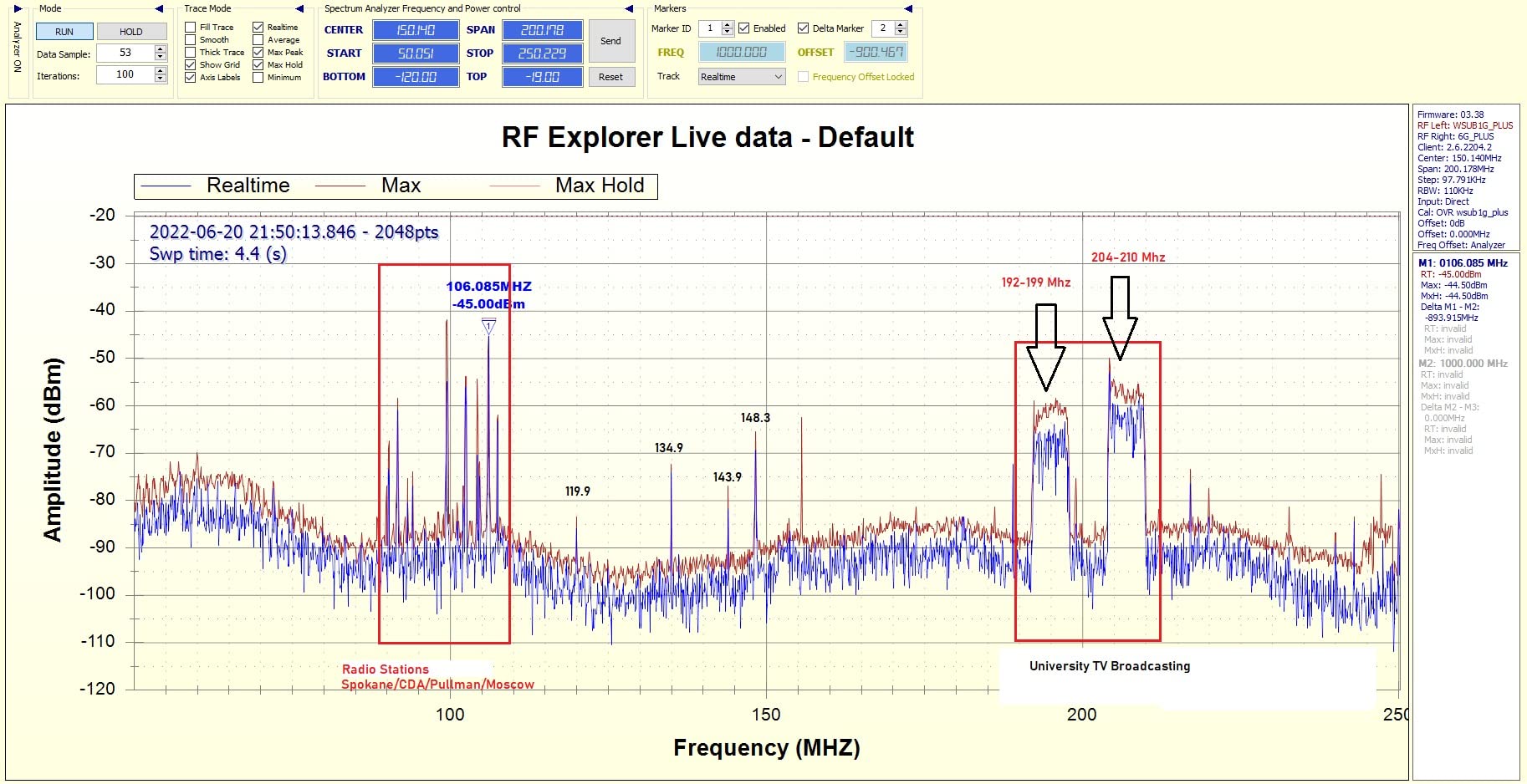
The software is a real strength. It is free on Windows, Linux and Mac, with real-time and historical charts, CSV export, export to WW6 or MatLab, markers and limit lines, plus a free open-source API and libraries. Hardware is continuously updated through firmware.
Antenna and filter work is the headline use. You can sweep a filter and read its passband and stopband response, and with a generator attached you can tune a duplexer or check antenna gain without a separate VNA. Wireless microphone troubleshooting and WiFi channel surveys are also strong, given the range. The open API means you can script measurements, which matters if you are logging environmental data over time.
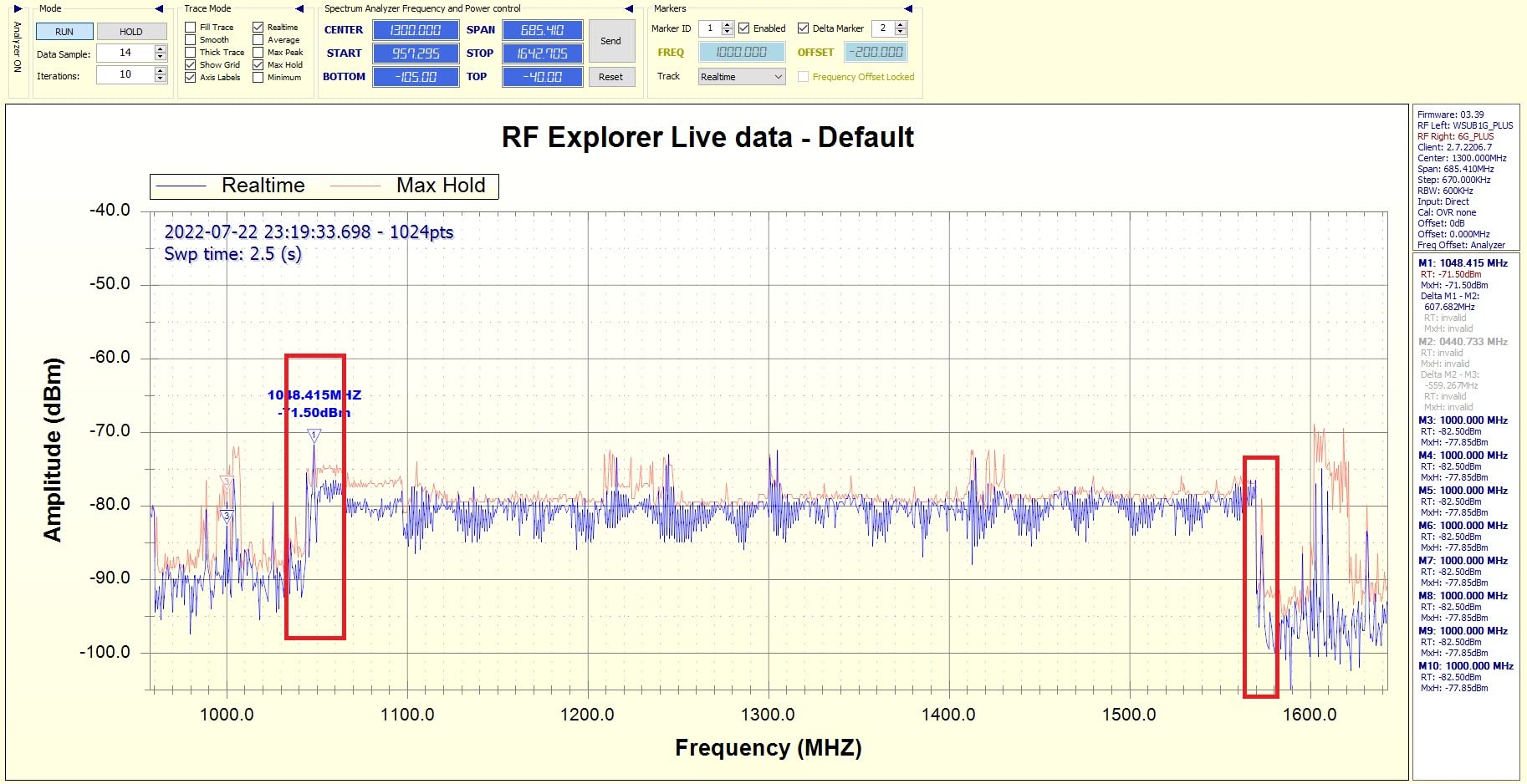
What you can actually measure with it
Filter response sweeps with a generator attached are the case that justifies the price. Tuning a duplexer or measuring antenna gain without buying a separate VNA is the practical payoff, and the armored body means it survives the trip to a site rather than living on a desk.
Its 50kHz lower limit also reaches further down into HF than the 6G WB Plus, which makes it the better wideband handheld when you work below 15MHz.
Where it falls short
There is a documented noise floor step between roughly 950MHz and 1650MHz caused by the internal frequency plan and mixer switch. The manufacturer treats it as a hardware limitation rather than a defect, and enabling the internal LNA is the workaround, but it confuses beginners who read it as a fault.
It also cannot charge while switched off, and the feature set does not stretch as far as the money suggests compared with the handhelds lower down this list. Owners have also reported a cheaper unit arriving in place of the ordered model, so check the box on arrival.
7. RTL-SDR Blog V3: the Free Software Entry Point
RTL-SDR Blog V3 R860 RTL2832U 1PPM TCXO SMA Software Defined Radio (Dongle Only) (Black)
0.5MHz-1.7GHz tuning
3.2MHz instantaneous bandwidth
1PPM TCXO
Bias tee for an external LNA
Pros
- Affordable genuine way into wideband spectrum analysis
- with 3000+ reviews backing it
- 3.2MHz instantaneous bandwidth for wide signals
- 1PPM TCXO holds frequency with no drift
- Switchable bias tee powers an external LNA
Cons
- Receive only with no transmit path
- No antenna included so results depend on your own
- HF below about 24MHz needs an upconverter and a good antenna
With over 3000 reviews behind it, this dongle is the most established wideband entry point in this roundup. It is a USB stick containing an R860 tuner RTL2832U chipset with a 1 PPM temperature compensated oscillator, and with free software such as SDR# or SDR++ it becomes a working wideband receiver on any laptop.
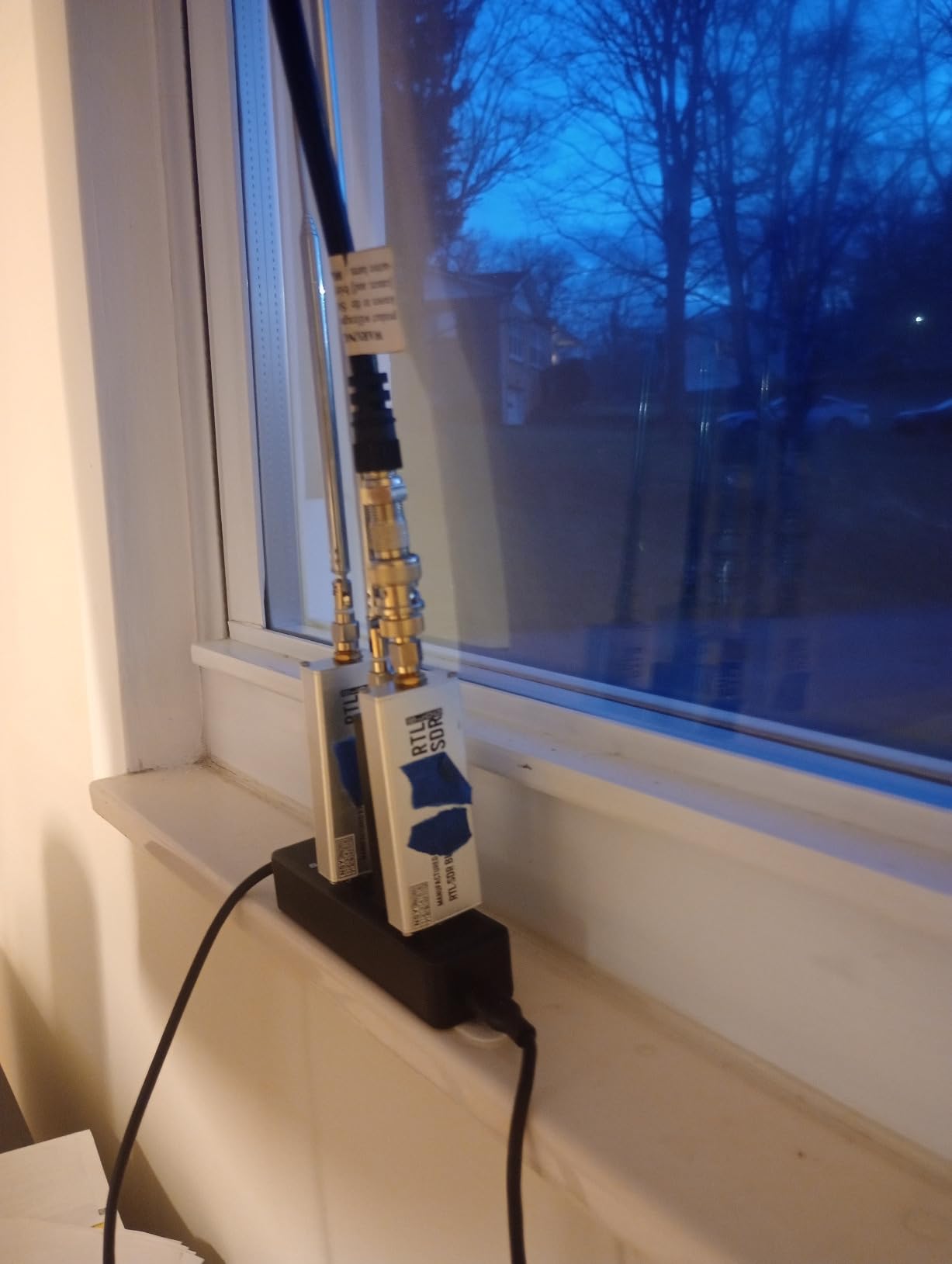
Up to 3.2MHz of instantaneous bandwidth, stable at 2.4MHz, is enough to see an entire WiFi channel at once. The activatable bias tee circuit can power an external low-noise amplifier, which is how you claw back sensitivity on weak signals, and the aluminum shielded case with a thermal pad handles the heat.
It runs on Windows, macOS, Linux, Raspberry Pi, tablets and phones, and the SMA female input means any antenna you already own will work. Long-time hobbyists describe it as one of the great breakthroughs in amateur radio gear, replacing rack-mounted receivers with a stick and free software.
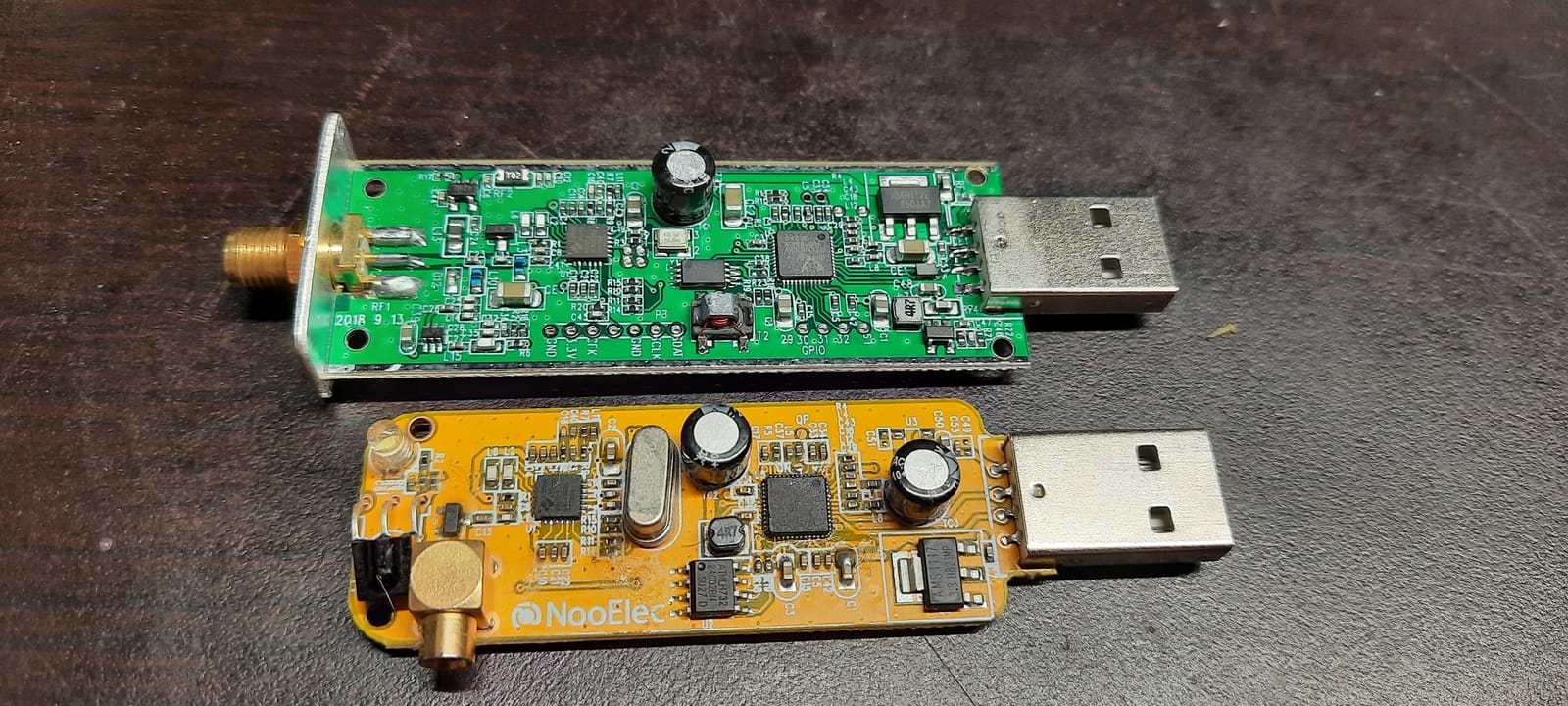
What you can actually measure with it
Because the bandwidth is wide, it is genuinely a spectrum analyzer and not just a radio. You can compare the noise floor between two antennas, see a whole WiFi band, watch a local oscillator or switching supply radiate, and record wideband captures for offline analysis in Python or GNU Radio.
For ham radio, a 0.5MHz to 1.7GHz dongle covers the 2m and 70cm bands and every ISM band worth watching.
Where it falls short
It is receive only, and no antenna is included, so reception quality depends entirely on what you attach. Below about 24MHz performance drops sharply and you need an upconverter such as a Ham It Up plus a decent antenna and preamp. It also runs hot, so continuous unattended use calls for a heatsink or fan, and the Windows driver step can fail on domain-managed PCs.
8. Nooelec RTL-SDR v5 Bundle: the All-in-One Starter Kit
Nooelec RTL-SDR v5 Bundle – NESDR Smart HF/VHF/UHF (100kHz-1.75GHz) Software Defined Radio. Premium RTLSDR w/ 0.5PPM TCXO, SMA Input, Aluminum Enclosure & 3 Antennas. RTL2832U & R820T2-Based Radio
100kHz-1.75GHz
0.5PPM TCXO
Bundle with 3 antennas and a base
RTL2832U and R820T2 based
Pros
- Radio plus three antennas and a magnetic base in one box
- 0.5PPM TCXO with no measurable drift
- HF SNR improved up to 15dB over the v3
- Brushed aluminum case with an integrated heatsink
Cons
- No bias tee so it cannot power an external LNA
- Runs warm during long unattended sessions
- Magnetic base and bundled masts reported as poorly made
With nearly 4000 reviews this is the most reviewed product here, and the reason is simple packaging. You get the radio, a magnetic antenna base with 2 metres of RG-58 feed cable, and three antenna masts: a variable-frequency telescopic, a 433MHz fixed and a UHF fixed. For a beginner that removes the single most common failure, which is buying a dongle and then realising you have no way to receive anything.
The receiver is RTL2832U and R820T2 based, covering 100kHz to 1.75GHz with up to 3.2MHz of instantaneous bandwidth. The 0.5 PPM TCXO is roughly four times more accurate than earlier versions, and signal-to-noise ratio improves by up to 15dB on HF and 6dB on VHF and UHF compared with the v3, with no measurable drift.
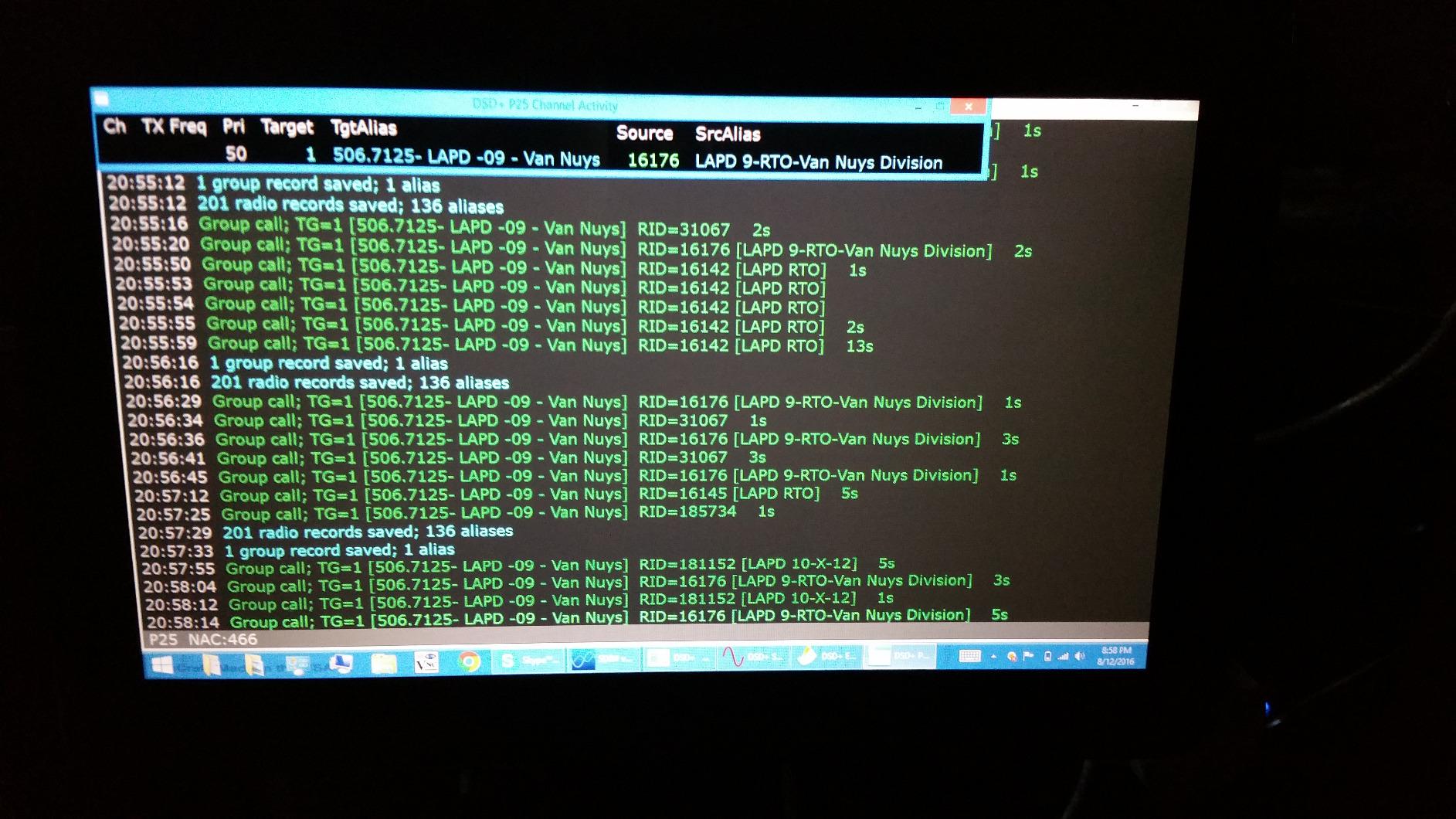
Below 25MHz it uses direct sampling, though Nooelec recommends a Balun One Nine or Ham It Up upconverter for a fuller HF experience. The brushed aluminum enclosure with an integrated heatsink feels solid, and it works on Windows, macOS, Linux and Android with a two-year warranty.
What you can actually measure with it
The same wideband spectrum work as the bare dongle, with a better starting antenna. It receives AM and FM broadcast, shortwave, CB, public safety, trunked, ADS-B, AIS, POCSAG, weather balloon and satellite signals, so a single device covers a huge amount of the hobby spectrum.
For signal work specifically, the stable oscillator makes it a good match for narrowband digital signals where a drifting reference would smear the trace.
Where it falls short
There is no bias tee, so unlike the v3 dongle it cannot power an active antenna or an external LNA, which is a real loss on weak signals. It runs warm during long sessions, and the bundled magnetic base is reported as poorly made and prone to falling apart, with the antenna masts hard to source connectors for outside that base. Documentation is thin.
9. Rigol DSA815-TG: a Benchtop With a Tracking Generator
Rigol DSA815-TG Spectrum Analyzer,Swept spectrum analyzer,Frequency Range 9kHz~1.5GHz,Description 10Hz~1MHz,With Tracking Source
9kHz-1.5GHz
10Hz minimum RBW
-161dBm typical DANL
Tracking generator in the base unit
Pros
- Tracking generator included so duplexer and filter tuneup is practical
- 10Hz RBW and -161dBm DANL read deep notches
- Level accuracy under 0.8dB on an 8 inch WVGA display
- 3-year warranty on the main unit
Cons
- Extended RBW advanced measurements and VSWR sit behind paid licenses
- No LAN or remote desktop control
- No split-screen multi-trace display
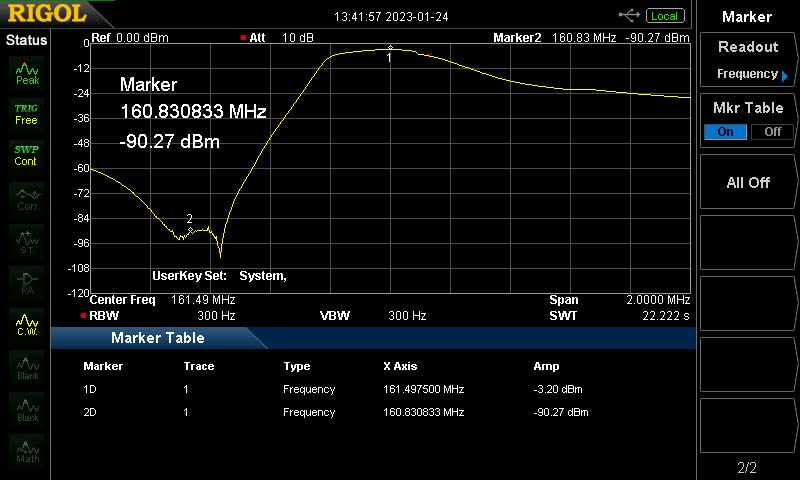
This is where the hobbyist ladder becomes a real instrument. The Rigol covers 9kHz to 1.5GHz with a 10Hz minimum resolution bandwidth, a typical displayed average noise level of -161dBm, phase noise better than -98dBc/Hz at 10kHz offset and level measurement uncertainty below 0.8dB. Those numbers let you read a notch and its skirts far more confidently than a handheld trace allows.
The tracking generator is included in the base unit, not sold as an upgrade, and that is the practical reason to buy this machine. Owners with professional RF backgrounds describe tuning duplexers and filters to around -98dB with it, which is guesswork removal rather than a convenience. The 8 inch WVGA display and panel controls also feel like lab equipment, which they are.
It weighs 9.35 pounds with a 14.24 by 5.04 by 7.04 inch footprint and a built-in handle, so it is light enough to move to another bench. A three-year warranty on the main unit is included.
What you can actually measure with it
Filter and duplexer work is the reason to buy it. Sweep a filter, use the tracking source to find its passband edges, and tune notch positions with a real reference rather than a broadcast signal. It is also excellent for noise floor work on HF and VHF, and for intermodulation products around a transmitter.
With the optional EMI and quasi-peak detector kit, it becomes an EMC pre-compliance tool for a bench near an electronics repair desk.
Where it falls short
The licensing model is the dominant complaint. Extended resolution bandwidth, advanced measurement functions and VSWR are all locked behind paid upgrades, and those licenses cost a lot relative to the base unit. There is no LAN control at all, including through Windows Remote Desktop, and no split-screen multi-trace display, so narrow and wide spans mean two passes. The learning curve is steep.
10. Siglent SSA3021X: Best Benchtop for 2.4GHz Work
Siglent Technologies SSA3021X Spectrum Analyzers,9 kHz to 2.1 GHz with Free Tracking Generator
9kHz-2.1GHz
1Hz minimum RBW
-161dBm/Hz typical DANL
Tracking generator permanently enabled
Pros
- 2.1GHz range covers 2.4GHz ISM work that 1.5GHz benchtops cannot
- 1Hz minimum RBW is finer than the Rigol DSA815
- Tracking generator permanently enabled with no license
- Ethernet and USB for PC control and logging
Cons
- Several extra features are time-limited trials without a software key
- Thin documentation and a real learning curve
- Trace display can lag next to faster consumer hardware
The Siglent is our benchtop recommendation because it solves the two problems that push people off a Rigol DSA815. It reaches 2.1GHz, so you can work in the 2.4GHz ISM region and the lower part of that band, and its minimum resolution bandwidth is 1Hz rather than 10Hz. Displayed average noise level is -161dBm/Hz typical with phase noise of -98dBc/Hz at 10kHz offset at 1GHz.
All-digital IF technology, Ethernet and USB connectivity, and a quick start guide, USB cable and calibration certificate in the box round out a well-judged package. Owners consider it the best overall benchtop hobbyist buy on features per dollar.
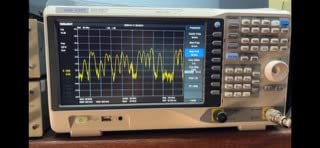
It weighs 11.6 pounds with a quiet fan and a footprint that fits an ordinary bench, and a three-year parts and labour warranty backs it up. Siglent support is regularly praised by owners.
What you can actually measure with it
Filter response measurement becomes genuinely precise at 1Hz resolution, so you can resolve a narrow notch or a skirt on a duplexer. It is strong for WiFi and ISM board bring-up, checking transmitter spurious emissions, and any measurement where two signals sit close together.
Because the tracking generator is permanently enabled, filter sweeps and gain measurements work straight out of the box with no software key.
Where it falls short
Siglent uses the same trial model elsewhere: several features are time-limited unless you buy a software key, which is worth knowing before you commit. Documentation is thin and most guidance sits in community videos, so budget time for the learning curve. The trace display can also lag noticeably next to high-performance consumer hardware, and there is no high-impedance input option for probing with an oscilloscope probe at low frequencies.
How to Choose a Spectrum Analyzer: 7 Steps
Frequency range is step one and everyone starts there, because a tool that cannot reach your band is useless. Everything after that is about what you can do once you get there.
Frequency range. Match the band you actually work on. For HF and low VHF you need the 9kHz to 1.5GHz class or an upconverter. For 2.4GHz and 5GHz you need a unit that genuinely reaches 6GHz or beyond, which rules out several handhelds.
Displayed average noise level (DANL). This is the noise floor below which you cannot trust what you see. It is the single most useful number for judging whether a cheap device will find the weak signal you are hunting.
Resolution bandwidth (RBW). RBW sets how close together two signals can be and still be seen as separate peaks. Wide RBW gives speed and a stable trace; narrow RBW resolves close carriers but slows the sweep.
Dynamic range and overload behaviour. Cheap analyzers compress or flatten when a strong local transmitter is nearby. An input attenuator or a switchable LNA that you can turn off is the difference between a readable trace and a flat one.
Form factor. Handheld for field sniffing, benchtop for precision and repeatability, USB dongle when a laptop is already part of the workflow.
Tracking generator. Only needed if you plan to measure filters, amplifiers or antenna response. Skip it otherwise and spend the budget on frequency range.
Software and post-purchase costs. Check the software is free, works on your operating system, and whether the functions you want need a paid licence key.
Two more terms will show up in manuals. Video bandwidth (VBW) is a display smoothing filter; leaving it too slow produces a trace that lags the real data. Phase noise describes how much a signal smears across nearby frequencies, which matters when you are looking at a weak signal sitting close to a strong one.
One honest warning: forum threads repeatedly flag post-purchase surprises, including firmware modification costs and paid unlock keys that extend a range or enable VSWR. Check what the base unit does before you buy, not after.
If your bench needs other fundamentals first, our 3D scanner guide for hobbyists covers a different kind of workshop tool, and the nitrox analyzer roundup is the other kind of analyzer people search for.
Spectrum Analyzer vs Oscilloscope vs VNA
An oscilloscope shows voltage against time. A spectrum analyzer shows power against frequency. For an RF problem, that difference is everything, because a carrier at 433MHz looks like a flat line on an oscilloscope unless you have a downconverter in front of it.
So can an oscilloscope replace a spectrum analyzer? Not for RF work. It can produce a Fourier transform and show you a frequency component, and one forum user described a Picoscope ADC-200 as making a decent spectrum analyzer “if you understand its limitations”. The limits are band-limited sampling, a noise floor well above a real analyzer’s, and no DANL specification. Fine for audio and power, poor for finding an interferer.
A signal analyzer is a different tool again. Where a spectrum analyzer answers what is present and how strong, a signal analyzer also demodulates and decodes, telling you what the signal is. Most hobbyist units in this roundup do not demodulate, so if you need to identify a modulation scheme you need a different category of instrument.
A vector network analyzer answers a narrower question. Rather than sweeping a whole band, a NanoVNA measures return loss, VSWR and impedance at one frequency at a time, which makes it the correct tool for tuning an antenna. It is not a spectrum analyzer, and it cannot find an interferer. If your work is antennas, buy a VNA; if your work is troubleshooting what is on the air, buy an analyzer.
Analog versus digital is the other confusion worth settling. Analog analyzers are still alive, and some enthusiasts rate their display as more intuitive, but they are large, band-limited by their sweep design, and hard to find new at hobbyist money. Every unit we list is digital, which is the right default today.
What Each Price Tier Can and Cannot Measure
These are the tiers, described by what they do rather than by a number that changes weekly.
Entry dongles. A USB SDR dongle with free software can sweep 0.5MHz to 1.7GHz across a 3.2MHz instantaneous bandwidth, which is enough for WiFi surveys, noise floor comparison and broadcast-band monitoring. You cannot reliably resolve very close carriers, you have no calibrated amplitude, and you must supply an antenna and a laptop.
Pocket handhelds. These add a battery, a screen and a calibration source, typically covering 0.1MHz to 960MHz with a resolution bandwidth of a few hundred kHz. They excel at finding which signal is present. They cannot measure accurately, cannot handle a strong transmitter without compressing, and their dynamic range is modest.
Wideband handhelds. These reach 6GHz and beyond, add waterfall displays and sometimes a tracking SNA mode, which widens the range of antenna and filter work you can do. You still lose to a benchtop on resolution bandwidth, phase noise and amplitude accuracy, and a small screen becomes the limiting factor in a busy band.
Benchtop instruments. Here you get 1Hz to 10Hz resolution bandwidth, a -161dBm noise floor, sub-decibel level accuracy, and a tracking generator in the base unit. This is where precision measurements become practical. The costs are a desk footprint, a learning curve, and licence fees on some models for functions you may want on day one.
One practical point that applies to every cheap tier: if a local transmitter is strong, the input compresses and the trace flattens. Switchable input attenuation or an external attenuator fixes it, and that knowledge alone saves hours of confusion.
First Five Measurements to Make With a New Analyzer
Set the reference level so the tallest signal sits near the top of the screen, then start with the noise floor. A wide span at a wide resolution bandwidth gives you a map of the band, and the floor tells you what is normal for your location.
Second, find a known transmitter. Find a local broadcast, a nearby amateur repeater or a WiFi access point, put a marker on it, and note the level. That becomes your reference for every later measurement.
Third, compare antennas. Swap the supplied antenna for a better one over the same frequency span and watch the noise floor move. This is the single most persuasive demonstration for anyone who doubts an antenna upgrade.
Fourth, use the signal generator. Every handheld here has one, and injecting a known signal at a known level is how you verify your cables, connectors and attenuators rather than trusting a reading.
Fifth, watch a band over time in a waterfall view. Interference that switches on at 6pm, or a device that drops out for a minute, is invisible in a single trace and obvious in a waterfall.
Frequently Asked Questions
Which spectrum analyzer is considered the best?
For hobbyists, the SEESII TinySA is the best general choice because it runs from 100kHz to 960MHz, needs no laptop, and includes a signal generator and calibration source. If your work sits at 2.4GHz or above, step up to the TinySA Ultra+ ZS406 for 5.4GHz coverage, or to the Siglent SSA3021X if you need 1Hz resolution bandwidth and a benchtop trace.
How do I choose a spectrum analyzer?
Choose in this order. First frequency range, so the unit reaches your band. Then the displayed average noise level, which sets the weakest signal you can trust. Then resolution bandwidth, which sets how close two signals can be and still be separate. After that consider dynamic range and overload behaviour, form factor, whether you need a tracking generator, and whether the software is free or licence-gated.
What is the best free spectrum analyser?
The best free option is a USB SDR dongle such as the RTL-SDR Blog V3 or the Nooelec RTL-SDR v5, paired with free software like SDR# or SDR++. You get a 0.5MHz to 1.7GHz receiver with up to 3.2MHz of instantaneous bandwidth for a small outlay, and every analysis tool you need is free software rather than a paid licence.
What is the best SDR dongle for ham radio?
The RTL-SDR Blog V3 is the best proven dongle for ham radio, with over 3000 reviews and a 1 PPM TCXO that holds frequency without drift. The Nooelec RTL-SDR v5 bundle is the better beginner option because it includes three antennas and a magnetic base. Both are receive only and both need an upconverter plus a good antenna for anything below about 24MHz.
What is the difference between a spectrum analyzer and an oscilloscope?
An oscilloscope shows voltage against time, while a spectrum analyzer shows power against frequency using a Fast Fourier Transform. An RF carrier appears as a flat line on a scope unless you add a downconverter, so a scope cannot find an interferer or read a noise floor. A scope can show audio frequency components, but its noise floor and bandwidth make it a poor substitute for RF work.
Is a NanoVNA a spectrum analyzer?
No. A NanoVNA is a vector network analyzer that measures return loss, VSWR and impedance at one frequency at a time, which makes it the right tool for tuning antennas and matching. A spectrum analyzer sweeps a whole band to show which signals are present and how strong. Most hobbyists end up owning both, and antenna work is where the VNA wins.
Do I need a tracking generator?
Only if you plan to measure filters, amplifiers or antenna response. The tracking generator injects a known swept signal so you can measure the device response directly instead of using a broadcast signal as a reference. The Rigol DSA815-TG and Siglent SSA3021X both include one in the base unit. If you only need to see what is on the air, skip this feature and spend the budget on frequency range instead.
Why does my spectrum analyzer overload with strong signals?
Overload happens when a strong local transmitter drives the input past its linear range, so the displayed level compresses and the trace flattens or distorts. Fix it by enabling input attenuation if your unit has it, or by using an external attenuator in front of the input. Switching off an internal LNA on units that have one also helps, since LNA gain is what pushes the front end into compression.
Final Verdict: Who Should Buy What
Buy the SEESII TinySA if this is your first analyzer and you want to see what is on the air without a laptop. Buy the TinySA Ultra+ ZS406 if you need to look at 2.4GHz and 5GHz, and the ZS407 if you also need 6GHz.
Buy a USB SDR dongle if you already own a laptop and a good antenna, because the free software ecosystem is the strongest in this list. Buy the RF Explorer WSUB1G for sub-1GHz ISM hunting, the 6G WB Plus for waterfall-based WiFi work, and the 6G Combo Plus if antenna and filter measurements are your goal.
Buy the Rigol DSA815-TG or the Siglent SSA3021X when you need precision. The Siglent reaches 2.1GHz with 1Hz resolution bandwidth, while the Rigol is the lower-tier entry into the same class of instrument. Whichever you pick, check the licence situation before you order, because that is where hobbyists get caught out.
Whichever tier you land on, that is the best spectrum analyzer for hobbyists for your actual work. Measure the noise floor first, keep a known transmitter as your reference, and the rest follows.