
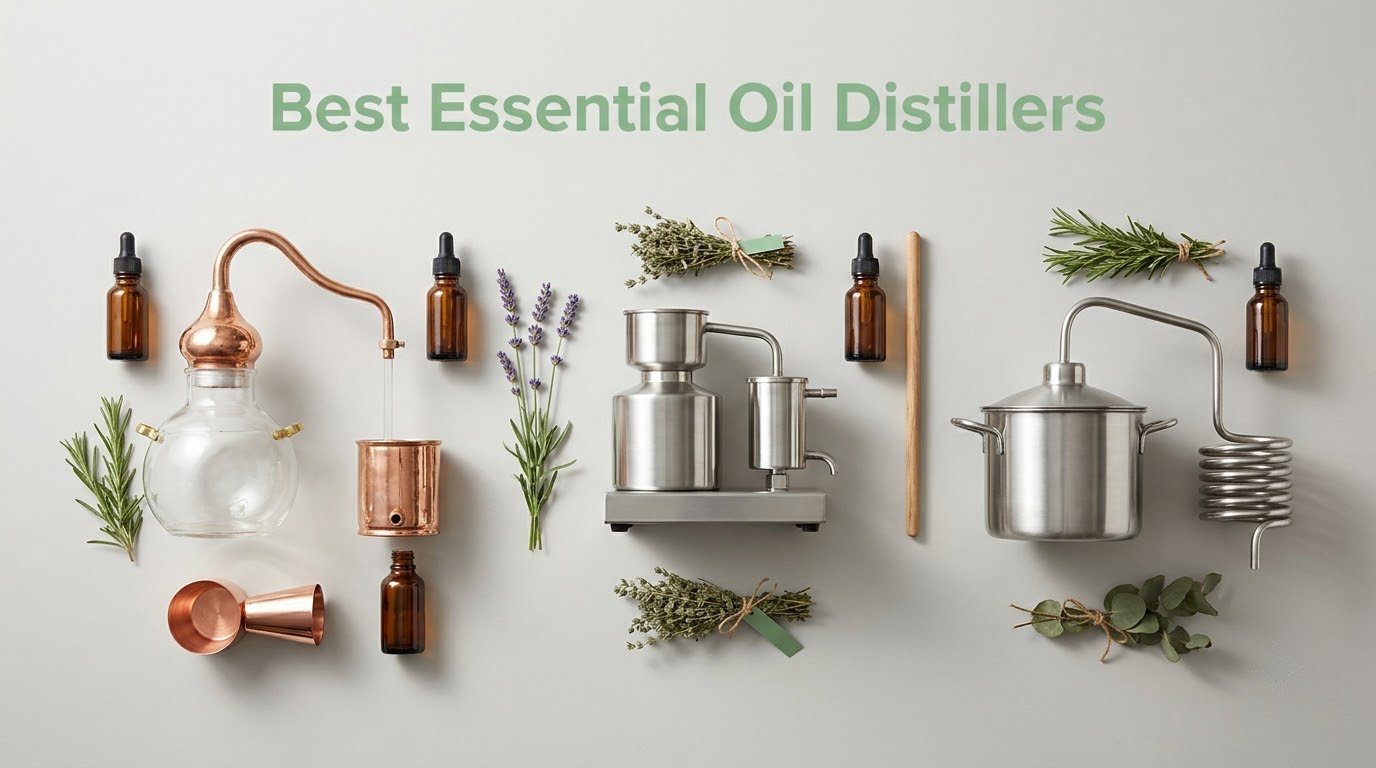
There is no single honest answer to “which essential oil distiller should I buy”, because the honest answer depends on what you plan to put in it. I have read through more than 1,100 owner reviews across ten of the most-distributed distillers on the market right now, and the pattern that jumped out is how badly the category is explained. Five of the ten units here are borosilicate lab glass kits sold to people who want to make lavender oil, and most of those buyers end up disappointed for exactly the same reason: the kit is a teaching aid, not a still.
That is why this roundup exists. Rather than repeating manufacturer claims, I sorted every unit by what it can actually produce, how much oil comes out of a realistic batch, what breaks, and what you cannot replace. I kept the low-cost glass sets in the list because the question comes up constantly in the forums, and the honest answer is that one of them is fine for learning and the rest are not. I also kept the small stainless units, because for lavender and rosemary hydrosol they are genuinely the right tool at a fraction of the cost of a copper alembic.
What I could not do is test distillation yields myself in a workshop, so every number I give you about output comes from owner reports, not from my own batch records. Where owners disagree I say so.
If your interest is in the finished product rather than the extraction, our essential oil diffuser roundup for large rooms covers the other half of the category. For extracting oil mechanically instead, our home oil press guide for seeds covers the pressing route, and the commercial oil press roundup goes deeper if you are scaling up.
Table of Contents
What Is the Best Essential Oil Distiller?
The best all-round essential oil distiller here is the Copperholic 20-litre pure copper alembic: it handles hydro distillation, steam distillation and alcohol work on one vessel, and it carries the largest owner review base of anything we looked at. If your goal is lavender or rose hydrosol rather than separated oil, the LETIME KD5 stainless kit is the better value and far easier to run.
Top 3 Picks for Best Essential Oil Distillers in 2026
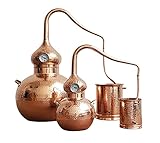
Copperholic 20L Pure Copper Alembic
- Pure copper at 1.1mm thickness
- Built-in thermometer
- Handles hydro steam and alcohol work
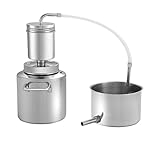
LETIME KD5 Stainless Hydrosol Kit
- 2L pot and 1.5L condenser
- Food grade 304 stainless
- No fragile glass
- Setup in about a minute

VEVOR 32-Piece Borosilicate Glass Kit
- 3.3 borosilicate glass
- Standard 24/40 ground joints
- Assorted flask sizes
- Good for learning
All 10 Essential Oil Distillers Compared in 2026
| Product | Specifications | Action |
|---|---|---|
| Copperholic 20L Pure Copper Alembic |
|
Check Latest Price |
| VEVOR 32-Piece Borosilicate Kit |
|
Check Latest Price |
 Cherish XT 500ml 15-Piece Glass Kit Cherish XT 500ml 15-Piece Glass Kit |
|
Check Latest Price |
| LETIME KD5 Stainless Hydrosol Kit |
|
Check Latest Price |
 Aimee_JL 500ml Labware Set Aimee_JL 500ml Labware Set |
|
Check Latest Price |
 LETIME LT3000 3L Stainless Distiller LETIME LT3000 3L Stainless Distiller |
|
Check Latest Price |
 Copper Pro 1.3 Gallon (5L) Kit Copper Pro 1.3 Gallon (5L) Kit |
|
Check Latest Price |
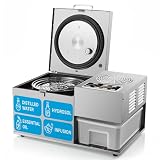 LETIME ADI04 Automatic 4L Extractor LETIME ADI04 Automatic 4L Extractor |
|
Check Latest Price |
 VEVOR 33-Piece Kit with Heating Plate VEVOR 33-Piece Kit with Heating Plate |
|
Check Latest Price |
 Xeoca 31-Piece 500ml Glass Kit Xeoca 31-Piece 500ml Glass Kit |
|
Check Latest Price |
1. Copperholic 5 Gallon Pure Copper Alembic, 20L – a multi-purpose vessel for hydro and steam work
5 Gallon Pure Copper Alembic Still for Whiskey, Moonshine, Essential Oils by Copperholic
20L pure copper capacity
1.1mm copper thickness
21.9 lb weight
Built-in thermometer in C and F
Pros
- Handles hydro distillation steam distillation and alcohol work in one vessel
- Heats fast because copper moves heat quickly
- Built-in thermometer reads Celsius and Fahrenheit
- Owners consistently rate the craftsmanship
Cons
- Condenser seal has failed for some owners
- Manufacturer instructions are thin
- Hose clamps and electrical tape sold separately
Our team put this one at the top of the list because it is a rare unit in this roundup that is not specialised. Every other machine here either does one thing (hydrosol) or is really a chemistry teaching kit. The Copperholic runs 20 litres of pure copper at 1.1mm wall thickness, weighs 21.9 pounds, and carries a thermometer that reads both Celsius and Fahrenheit in the pot itself.
Owners describe fast heat-up as its standout trait, which is what you would expect from all-copper construction. The same owners report using it for hydro distillation, steam distillation and alcohol work, and the review summary puts 76% of owners at five stars.
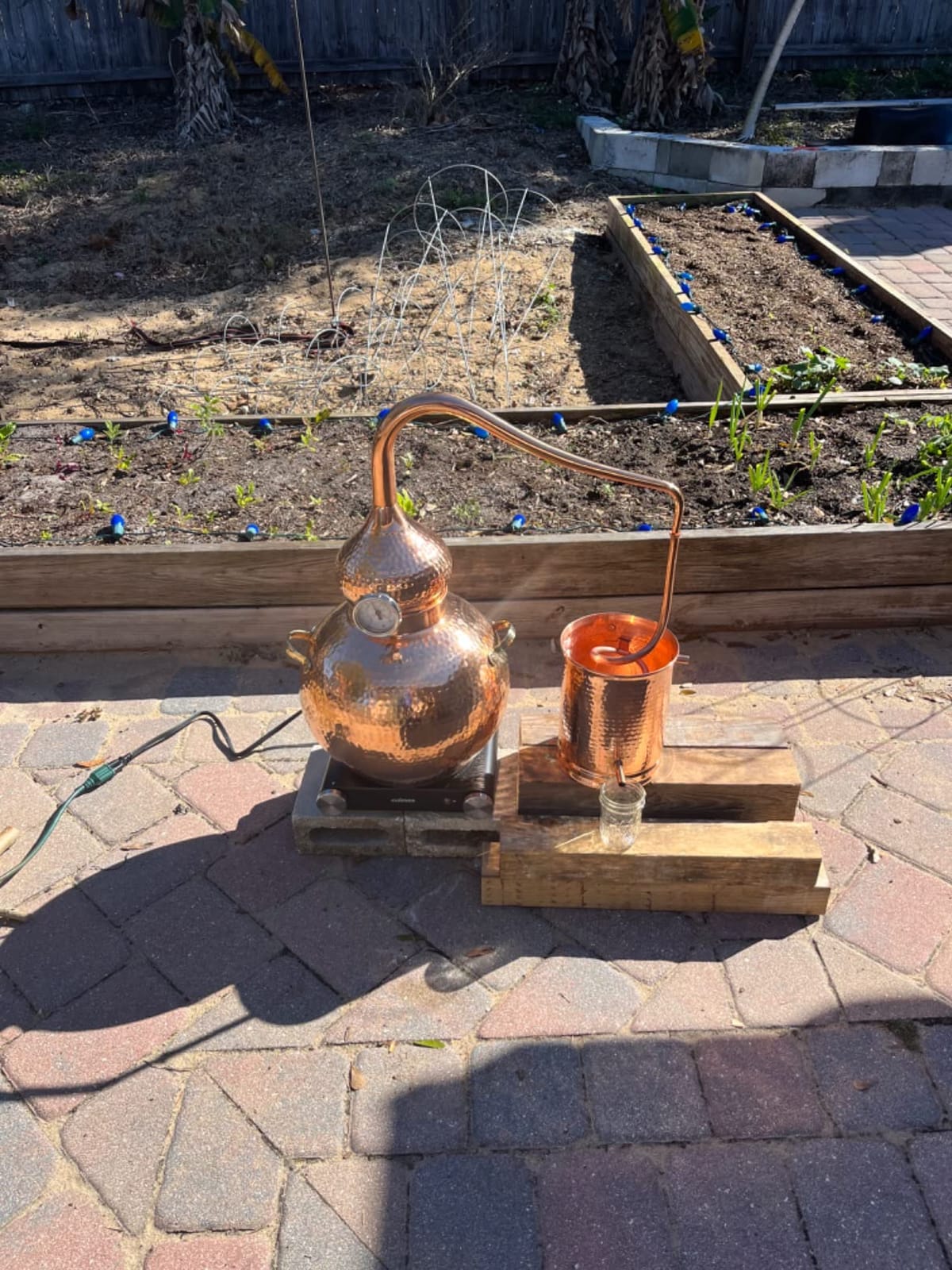
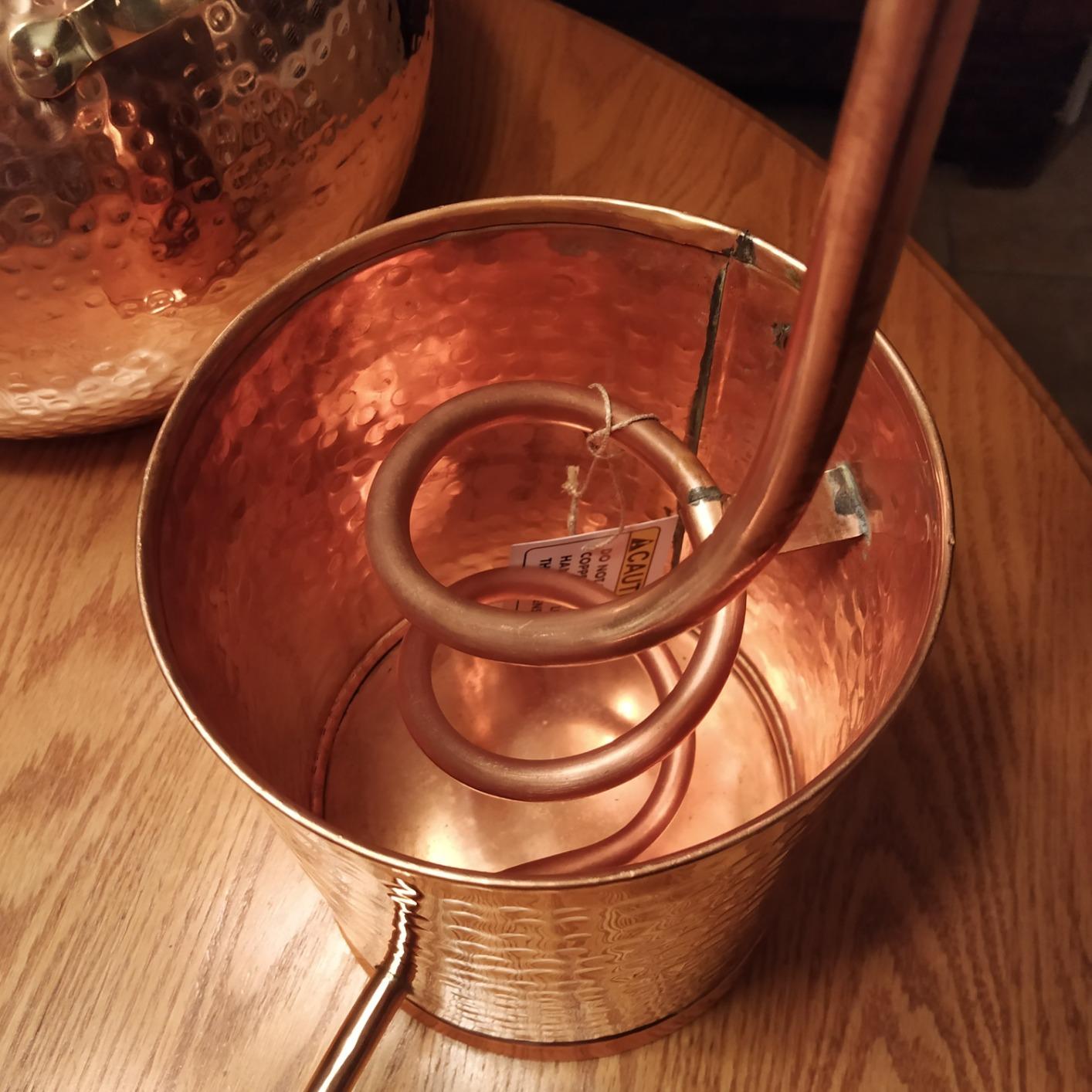
The build is 20-gauge copper on the pot, swan neck and condenser coil, and the specification sheet lists a condenser with an extra outlet for emptying or circulating the cooling water. That outlet matters more than it sounds. A still without a drain or circulation path is awkward to run twice in one day, and most home setups will be.
The honest caveat is quality control on assembly. One buyer reported a condenser that did not seal properly, with holes drilled in the wrong places, and the manufacturer instructions are widely described as weak or unclear. You will want a set of hose clamps and a short length of silicone tubing ready before your first run, because those are not included.
What a 20-litre copper vessel lets you do that smaller units cannot
Twenty litres is a genuinely different production scale from anything else on this list. A full charge of fresh lavender or a large load of rosemary can sit in a proper column rather than being crammed into a 500ml flask, and steam can pass through the botanical bed instead of boiling it. That is the difference between an extract that tastes cooked and one that does not.
It is also one of the few units here you can grow out of. Start with a small charge, learn how the thermometer behaves at first distillate, then scale up inside the same vessel instead of buying again. For anyone moving toward soapmaking batches or workshop-scale aromatherapy, that headroom is the deciding factor.
Where this alembic is the wrong choice
Skip it if you have never distilled before and want something plug-and-play. There is no electric element in this unit, so you supply your own heat source, and there is no separator funnel in the box. The first run means sourcing a burner, clamps, tubing and a separator before you can collect anything clean.
It is also the heaviest unit in the group, at 21.9 pounds, so a countertop setup needs real support rather than a kitchen cabinet. At 315 reviews it is also the best-documented machine here, which cuts both ways: you will find answers to almost any question, but you will also find plenty of people who hit sealing problems on their particular unit.
2. VEVOR Lab Distillation Kit, 32-Piece Borosilicate Glass – the best glass set for larger runs
VEVOR Lab Distillation Kit, 3.3 Boro Lab Glassware Distillation Kit with 24, 40 Joint, 1000ml Essential Oil Distillation Apparatus Kit, 32 pcs Set of Glassware Equipment
32-piece 3.3 borosilicate set
1000ml distillation flask
24/40 ground joints
6.24 lb weight
Pros
- Largest flask capacity among the glass kits here
- Standard 24/40 joints make parts easy to source
- Packed in protective foam and usually arrives intact
- Glass held up under heat and vacuum
Cons
- Occasional cracked or scratched pieces in delivery
- Vacuum adapter has the wrong angle
- Not heavy duty
- needs careful handling
The 1000ml distillation flask gives this kit more working room than the 500ml sets in this list, and that changes what you can do with it. All joints are ground to standard 24/40 and sandblasted for airtightness, and you get a spread of flasks in assorted capacities. At 6.24 pounds it is also easy to carry between a workbench and a shelf.
Owners rate the value highly and report that the glass has held up under vacuum and heat in an oil bath. The 70% five-star share reflects solid packaging, and the seller is described as responsive when a piece arrives damaged. For chemistry work beyond essential oils, that combination of standard joints and multiple flask sizes is the real draw.
Be clear-eyed about what you are buying. This is laboratory glassware, not a still designed for repeated steam cycles with plant material packed inside it. A 1000ml flask gives you a wider window than the 500ml kits, but you are still doing small-batch work and you are still assembling by hand from glass joints each time.
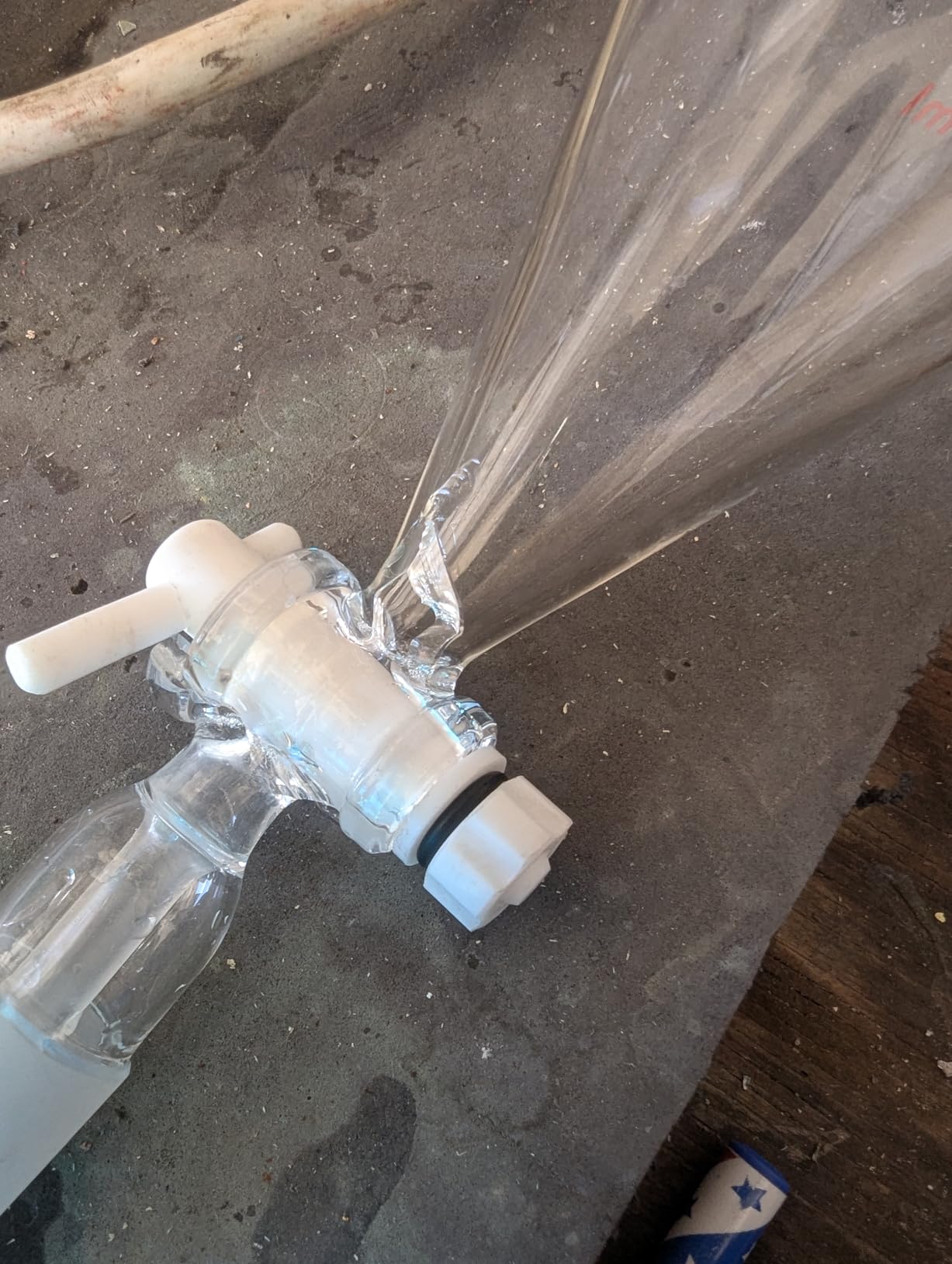
Two practical warnings from owner reviews. Pieces occasionally arrive cracked, or with residues and scratch marks, so inspect everything before you start. And the included vacuum adapter is angled wrong for a typical distillation train, which is a five-minute fix if you know what you are doing and a frustrating one if you do not.
When 24/40 standard joints actually matter
Standard ground joints are the underrated feature here. When a thermometer, adapter or condenser cracks, you can replace that single piece from any laboratory supplier instead of ordering a proprietary spare from an overseas seller and waiting weeks. The same 500ml kits with non-standard joints force a full replacement in a way that quietly ends the hobby.
It also means you can build up a bench over time. Buy a larger condenser, add a different head, swap the receiving flask, and the whole train stays compatible. If your interest extends past essential oils into aqueous extracts or general laboratory work, that flexibility is worth more than any single included accessory.
Who should pass on this kit
Pass if your goal is separated essential oil in any volume. Glass kits of this size produce a few millilitres at best from a large charge of plant material, and most of your output will be hydrosol rather than oil. They are also fragile, and glass does not forgive a rushed seal or a thermal shock from cold plant material hitting a hot flask.
Pass as well if you want something you can run weekly without rebuilding it. There is no fixed column, no basket and no heating element here, so every session involves the same assembly sequence. Nothing wrong with that if you enjoy the process, but it is a hobby, not an appliance.
3. Cherish XT 500ml 15-Piece Glass Distillation Kit – the Most Versatile, and the compromise is real
Cherish XT Home Distiller Distilling to Making Your Own Essential Oil, Moonshine, 3.3 Boro Alcohol Distiller Chemistry Lab Glassware Kit,Glass Distilling,Distillation Apparatus 15pcs Set, 500 ML
15-piece borosilicate set
500ml scale
Rated to high temperatures
6.69 lb weight
Pros
- Genuinely good glass for the money
- Hand-blown and polished flasks fit well
- Compact 500ml size suits learning
- Protected packaging
Cons
- Included alcohol lamp is too weak to boil
- Non-standard joints are hard to replace
- Clamps and rings do not always fit
- Unstable stand
This kit exists to teach you what distillation looks like, and for that purpose the glass is better than the price suggests. The flasks are hand-blown and polished, rated to high temperatures, and the low thermal expansion coefficient of 3.3 borosilicate is a genuine material advantage over thin glassware. At 6.69 pounds and 500ml scale, it fits on a small shelf.
The 64% five-star share tells you what buyers like: glass quality, compact size and protective packaging. One owner reported the seller replacing a bubbled flask, a broken thermometer and a missing cap without argument, which is decent service on a low-cost item.
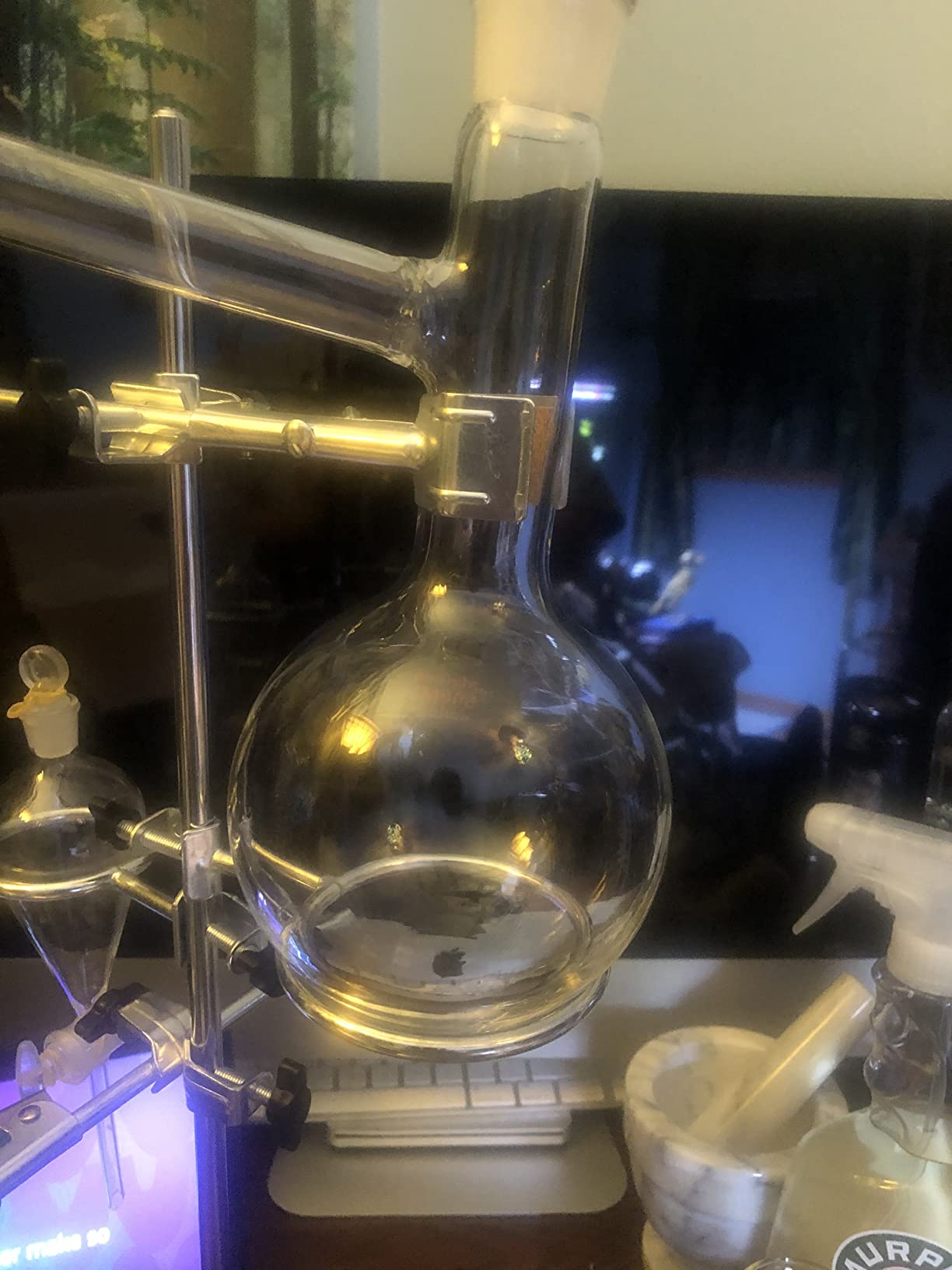
Now the problem, and it is a significant one. The alcohol lamp included in the set is not strong enough to boil water, so you will need a separate burner before you can run anything at all. Owners also report clamps and rings that do not fit the glass properly, and a loose stand that makes the whole assembly wobble while you work.
There is no circulating water supply in the box either, so cooling is whatever you arrange yourself. Combined with the non-standard connections, which make individual replacement pieces hard to source, you are buying a parts problem along with a glassware problem.
What a 500ml flask can realistically produce
A 500ml flask is a demonstration scale. Fill it with plant material and you will get a small amount of aromatic hydrosol and, with the right botanical, a thin film of oil that you will likely need to collect with a pipette rather than a separator. The realistic use here is learning how the process behaves: how long first distillate takes to appear, how the temperature moves, what the condensate smells like.
That knowledge is worth something. Almost every experienced distiller on the forums says their first batch should be a throwaway, and this kit is a low-stakes way to have that first batch. You learn the mechanics without risking a large basket of expensive botanicals.
Who should skip it
Skip it if your intention is to produce oil you can actually use. At 4.1 stars from 165 reviews, the rating reflects a wide spread of experiences, and the complaints cluster on hardware rather than glass, which means the weaknesses are structural to the design. You will end up buying a burner, better clamps and a stand anyway.
Also skip it if you might want to expand later. Because the joints are non-standard, nothing you buy alongside it will be interchangeable with a better kit later. Treat this as a standalone teaching purchase, not the first step in a growing setup.
4. LETIME KD5 Stainless Steel Hydrosol Distiller – the value pick for a first hydrosol batch
LETIME Hydrosol Maker, Steam Distillation Equipment for Making Hydrosol and Essential Oil, KD5 Stainless Steel Hydrosol Distiller, Plug and Play Distillation Kit, Portable Hydrosol Machine
2L pot with 0.45L steamer
1.5L condenser
304 stainless steel
4.99 lb weight
Pros
- 4.6 stars from 132 owner reviews
- Assembles in about a minute with no fragile glass
- Strongly aromatic lavender and rose hydrosol
- Small enough to store in a closet
Cons
- Suited to high-oil herbs
- not rose or low-oil flowers
- Needs a separate oil separator
- Plastic tubing is fiddly and feels fragile
The LETIME KD5 shares the highest average rating in this roundup at 4.6 stars across 132 reviews, with an 83% five-star share. It arrives pre-assembled and takes roughly a minute to set up, which removes the single biggest reason people abandon distillation.
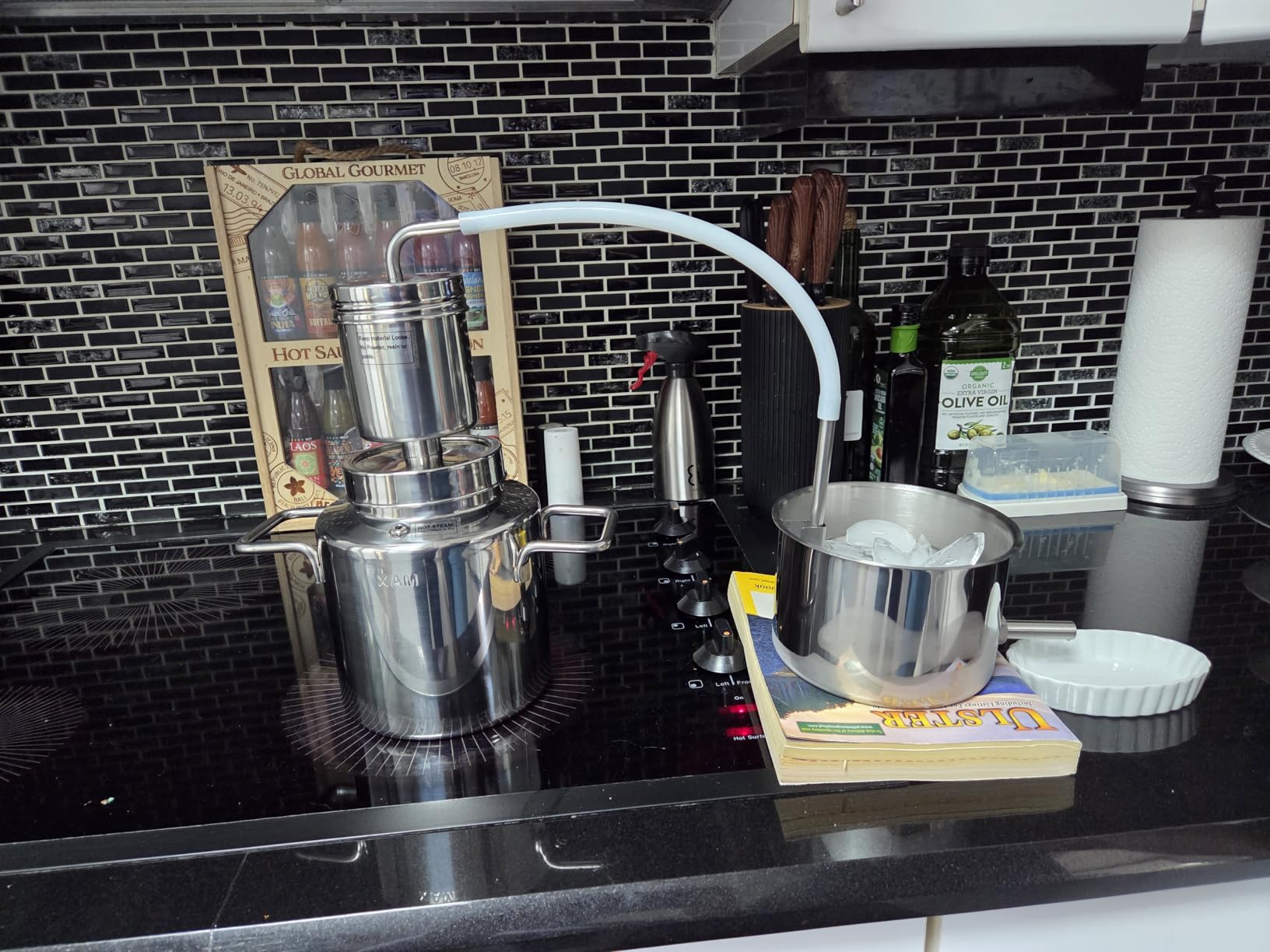
The specification is a 2-litre pot, a 0.45-litre steamer and a 1.5-litre condenser in food grade 304 stainless steel with food grade silicone tubing. Owners report no leaks and describe the output as strongly aromatic lavender and rose hydrosol. At 4.99 pounds and 17.5 by 10 by 8.5 inches, it stores out of sight between uses.
The design detail that matters most is how you cool it. Instead of running a pump and hoses, you add ice cubes to the condenser. That removes the most common failure point in small distillation setups, which is cooling water flow, and it is why owners report consistent output rather than variable results.
The limitation is botanical. This is built for high-oil-content material: lavender, rosemary and oregano. Owners are clear that it is not suited to rose or similar low-oil-content flowers, where you would process a great deal of plant material for very little distillate. The stated estimate is around 25 minutes for a personal weekly batch, though some owners report a single run taking considerably longer than that.
Why hydrosol output is the more realistic goal for beginners
Hydrosol is the floral water remaining after the oil separates out of the condensate, and for most home users it is the more useful and far more generous output. A batch of lavender that yields a few drops of oil can still produce a meaningful quantity of aromatic water, which is perfectly good for facial toner, linen spray and soapmaking.
Because of that, a machine built for hydrosol output makes more sense than one chasing a millilitre of separated oil. You will use what it produces. Note that an oil separator is a separate purchase, so budget for a small funnel if you want the oil layer rather than just the water.
Who this is not for
It is not for you if your target botanicals are rose, chamomile or any other flower with low oil content. Feeding a low-oil flower into a 0.45-litre steamer is a poor use of plant material, and the reviews report this disappointment directly rather than in the abstract.
It is also not for larger batches. Two litres of pot capacity is a small charge, and a recirculating bath is the usual next step for anyone who outgrows it. The plastic tubing is the other common gripe: it is difficult to attach and feels fragile, so handle connections gently and expect to replace one eventually.
5. Aimee_JL 500ml Essential Oil Extraction Labware Set – a low-cost way to see the whole process
Labware Set 500ml Essential Oil Extraction Distillation Apparatus Water Distiller Purifier Glassware Kits Hydrosol, Home Distillation kit
500ml borosilicate set
Hand-blown flasks
One year replacement warranty
6.59 lb weight
Pros
- Low cost entry to the process
- Hand-blown and polished glass
- One year free replacement warranty
- Compact 17 inch footprint
Cons
- Mixed reviews on durability and fit
- Non-standard components are hard to replace
- Only 57% five-star share
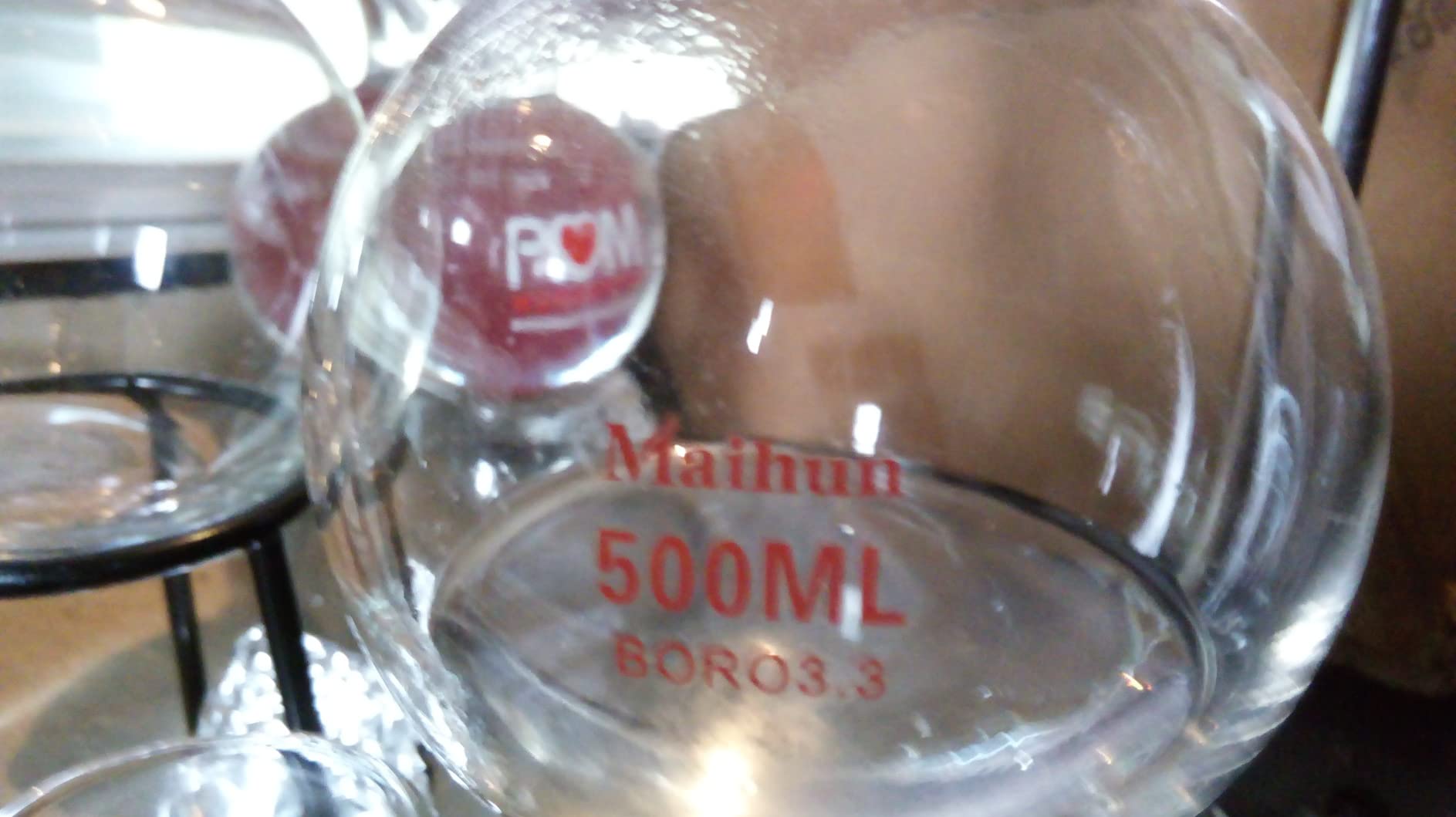
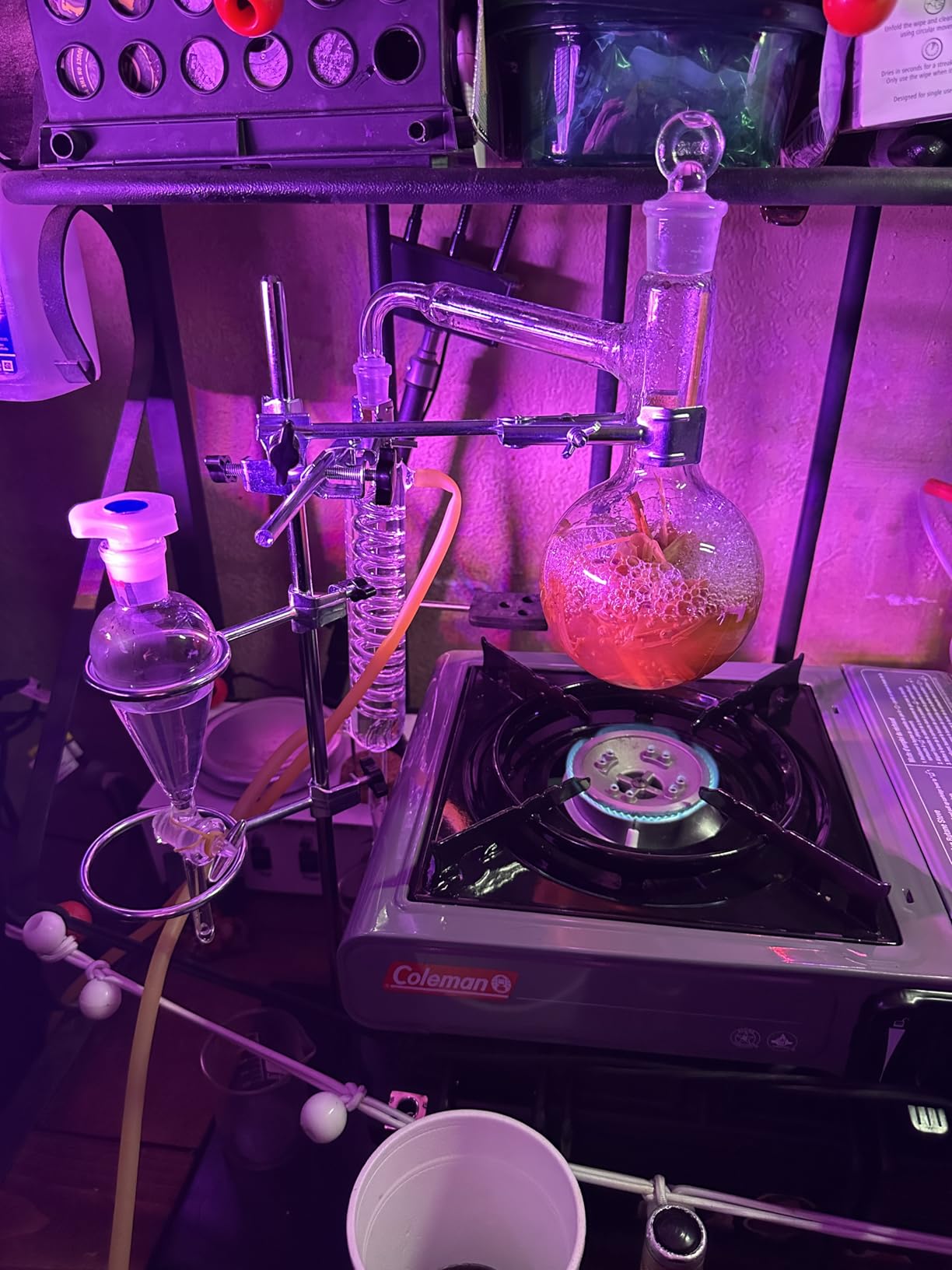
This is the most straightforward way to find out whether you actually enjoy distillation. The set is 3.3 borosilicate at 500ml scale, hand-blown and polished, rated to high temperatures with a very low thermal expansion coefficient. It is a small, complete kit for watching a condensate form and separating it, and it needs nothing more complicated than a heat source you supply.
The warranty is the standout for a kit at this level: one year of free replacement. That directly addresses the fear that a cracked flask ends your experiment. The build suits organic chemistry work including distillation, fractional distillation, separation, purification and synthesis.
At 4.0 stars, with a 57% five-star share and a visible tail of three- and two-star reviews, this is a divided product. Buyers who treat it as a low-cost starter set are happy. Buyers who expected a working distiller are not, and the reviews make that split explicit.
The durability feedback on individual pieces is mixed, and the components are non-standard, so a broken part cannot simply be swapped for the nearest laboratory equivalent. Plan on replacing the whole set rather than one piece if something fails, or use it carefully enough that nothing fails.
When a teaching kit is the right purchase
Buy this if your real question is whether you want to own a distiller at all. A few hours of glassware work teaches you what a thermometer reading means and why temperature control decides your output.
It is also a sensible companion purchase for a larger machine. Once you know what good condensate smells like, you can tell a working run from a burnt one on a machine like the 20-litre copper alembic rather than guessing.
When to spend more instead
Spend more if you have already decided you will distil regularly. At 4.0 stars and 128 reviews, this kit will not reward frequent use the way a stainless unit or a copper still will. Repeated handling, thermal cycling and washing erode cheap glass, and the non-standard parts problem gets more annoying every time it happens.
Skip it entirely if you need separated essential oil in usable volume. This scale produces a trace film of oil and a quantity of hydrosol, which is fine for learning and disappointing for production.
6. LETIME LT3000 3L Stainless Steel Distiller – a herb column built for lavender
LETIME 3L (2L Pot + 1L Column) Essential Oil Distiller, Stainless Steel Steam Distillation Kit Making Essential Oil and Hydrosol, Floral Water Machine, LT3000 Distiller Kit
2L pot with 1L herb column
304 stainless steel
Tool-free hand-twist assembly
6.98 lb weight
Pros
- No tools needed to assemble
- Owners report around 22ml of oil plus hydrosol from two lavender batches
- Condenser mounts on either side
- Ice or pumped cooling both supported
Cons
- Produces hydrosol more readily than separable oil
- One owner received a mis-machined condenser port
- Needs a recirculating bath for bigger batches
The LT3000 is the step up from the KD5 for anyone who has outgrown a 2-litre pot. It combines a 2-litre pot with a 1-litre herb column, which gives the plant material a proper vertical space and a sieve plate to sit on, so steam passes through a bed of botanicals rather than past a loose handful.
Owners report abundant, strongly aromatic lavender hydrosol, and one reviewer documented around 22ml of oil plus hydrosol from two batches of lavender buds. That is a real yield figure from an actual user, and it is the kind of number most listings hide. Assembly is by hand-twist with no tools, and the condenser can mount on either side of the column, which solves awkward bench layouts.
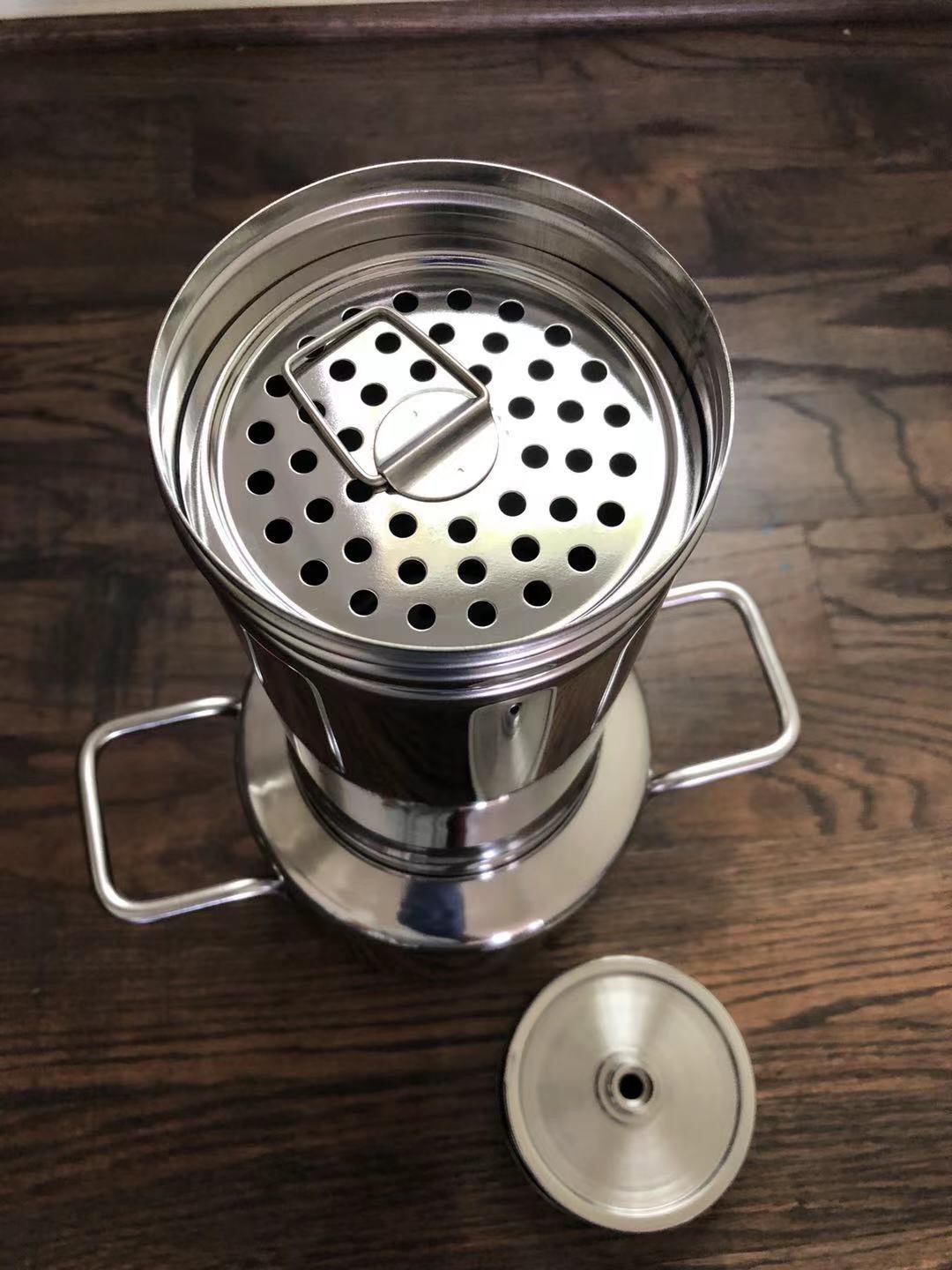
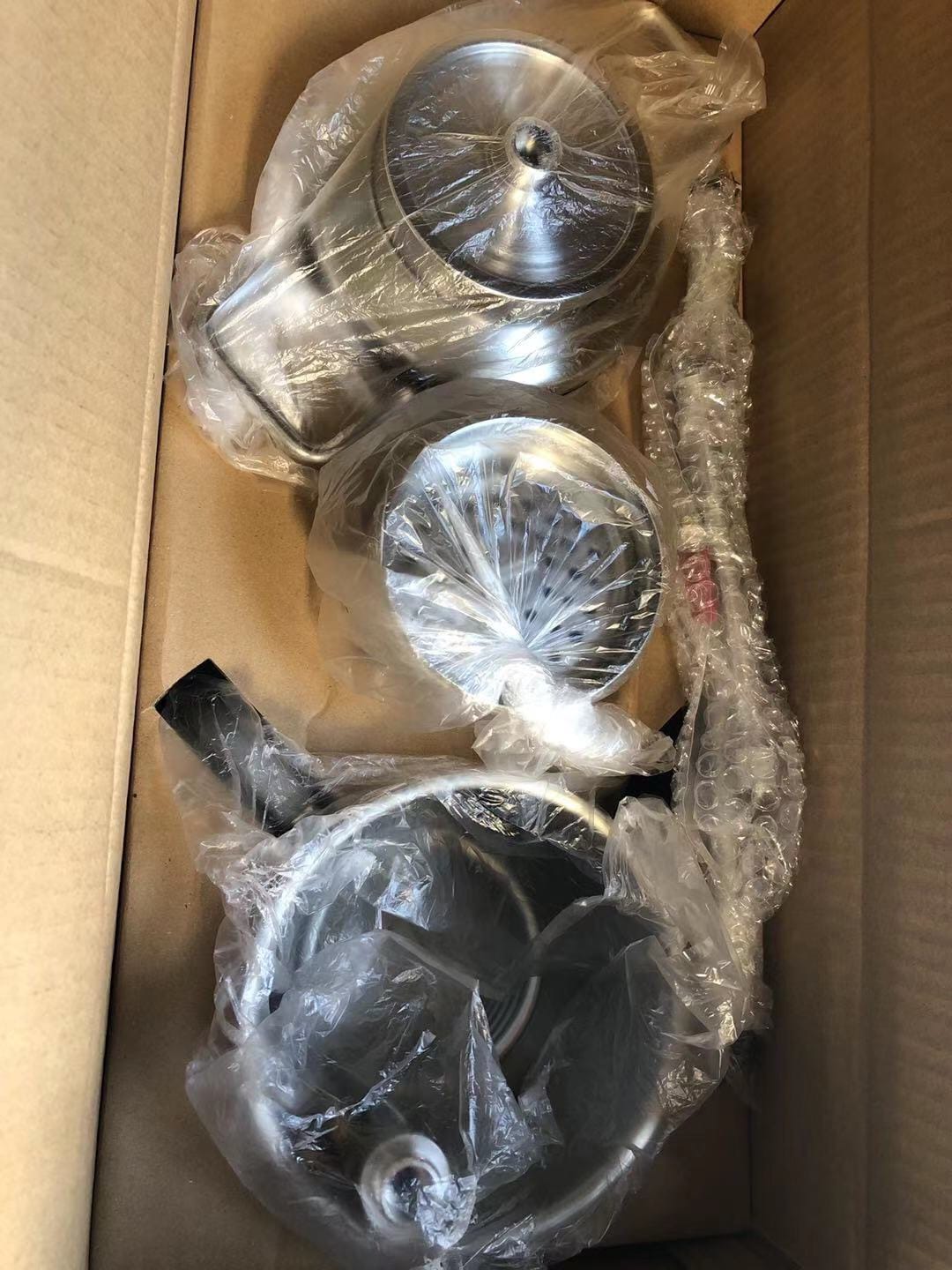
Cooling is your choice. Manual ice in the condenser works for small runs, and a water pump with silicone or PVC tubing handles larger batches. The manufacturer also ships instructional videos, a printed manual and a companion app with cleaning guides, which addresses the documentation complaint that plagues imported equipment in this category.
The 4.0 rating reflects a real split. A 63% five-star share sits alongside an 11% one-star rate, and the low reviews concentrate on two things: no readily separable oil layer, and one buyer whose condenser connection port was machined incorrectly, rendering the unit unusable with an unreachable seller.
How the herb column changes your results
A column is the difference between plant material being steamed and plant material being steeped. The sieve plate holds the charge above the water line and keeps it from falling into the pot, while the extra litre of vertical space lets you load enough material to justify the run. That is why owners report better hydrosol from this unit than from the smaller pot-only design.
It also changes how you load. You need a loose, even charge with space for steam to move through it. Pack the material tight and you will get channeling, where steam finds one path through the bed and takes the volatile oil with it, leaving most of the plant material untouched.
Where this one disappoints
The recurring message is that this is a hydrosol machine rather than an oil machine. You may get a thin oil layer, and a separator is a separate purchase if you want to collect it. If your plan depends on separated oil as the primary product, this is the wrong tool no matter how good the hydrosol is.
There is also a small-sample caution. Sixty-nine reviews is a thinner base than most of this list, and the one-unit failure described above shows what a manufacturing defect costs you. If you cannot replace a part locally, factor that into the decision.
7. Copper Pro 1.3 Gallon (5L) Essential Oil Distiller Kit – the compact copper workshop option
Essential Oil Distiller Kit – 1,3 Gall (5L) for Steam Distillation Oil Making and Extracting – Home Distiller Equipment DIY Essential Oil from Herbs, Plants and Flowers
1.3 gallon (5L) capacity
Step-by-step guide included
Size family from 2L to 25L
Pros
- 79% five-star share from owners
- Includes a step-by-step distillation guide
- Capacity supports workshop scale batches
- Part of a size family from 2L to 25L
Cons
- Only 55 reviews so durability feedback is thin
- One design across the family means no per-size tuning
At 4.6 stars this matches the KD5 for the strongest owner rating in the roundup, and the distribution is unusually clean: 79% five-star, 11% four-star and 2% one-star.
Copper earns its reputation for a chemical reason rather than tradition. Copper binds sulfur compounds as vapour passes through the wall, which removes the harsh sulphurous note that turns up in oils from stainless or glass equipment, particularly with green and allium-like botanicals.
Five litres is the meaningful number here. It is large enough to run a serious batch of lavender or a workshop session for a small aromatherapy class, and the kit comes with a step-by-step distillation guide, which addresses the documentation complaint that comes up constantly with imported copper equipment.
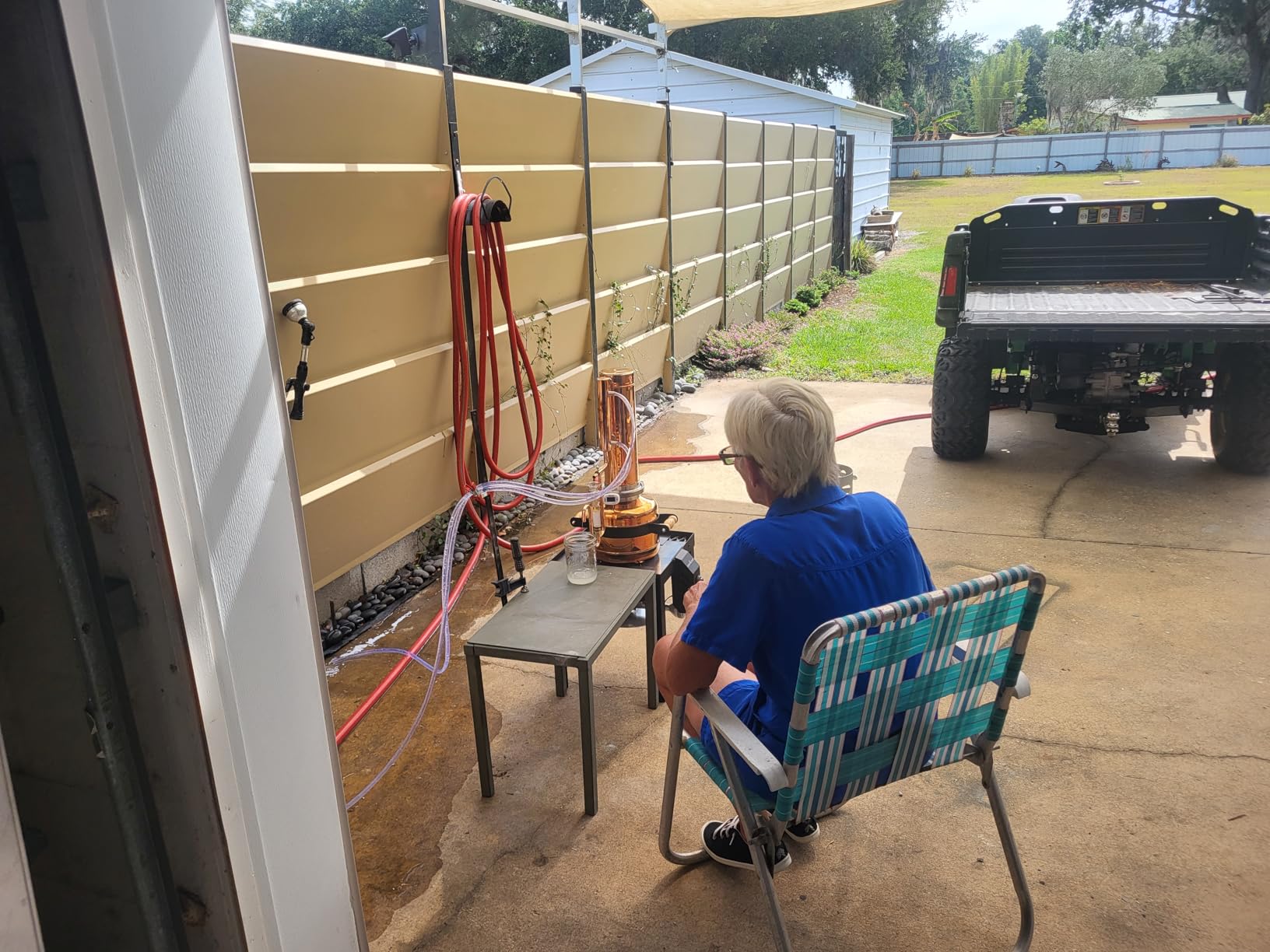
It is also part of a family, and that is the quiet advantage. The same design runs from 0.53 gallon (2L) up to 6.6 gallon (25L), so you can start small, learn the process on a manageable charge, then move up without changing your whole understanding of the equipment. The recommended uses listed are aromatherapy, handmade soaps and handmade lotions.
What you do not get yet is long-term evidence. Fifty-five reviews is a small base, and there is not enough history here to know how the copper ages, how the joints wear or how well the seals hold over a year of cycles. We would treat that as the main open question on this unit.
When copper earns its place over stainless
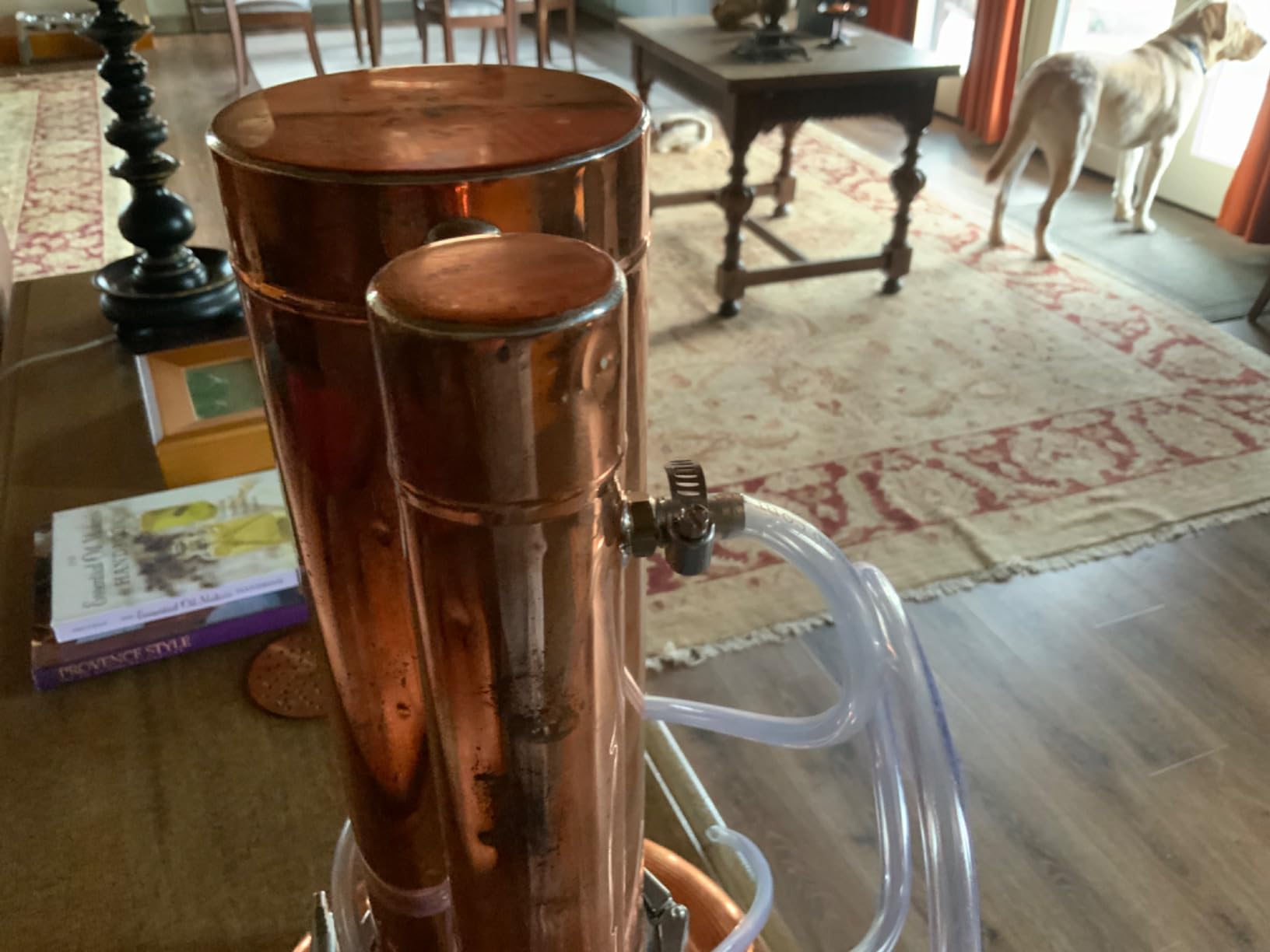
Choose copper when scent quality is the point and you are working with material where sulfur notes appear. Steam passing through copper picks up trace copper ions that react with sulfur compounds, which is why copper-b stilled lavender oil is widely regarded as cleaner smelling than the same oil from a stainless unit.
Choose copper for aroma work, fragrance and soapmaking where the finished scent is the product. You are not getting a different volume of oil, and you are not getting a faster run. You are buying a cleaner profile.
When stainless makes more sense
Members of the distilling community on r/herbalism argue the opposite case, and it deserves a hearing: stainless units reportedly give higher yield and have far easier-to-source replacement parts than full copper models. Copper-clad listings without a material disclosure are a specific trust problem, and modular stainless designs are easier to repair when a gasket ages.
So if your priority is repairability, part availability and maximum output rather than top-note quality, one of the stainless units in this roundup is the more practical machine. Both claims are real; they describe different priorities.
8. LETIME ADI04 Automatic Herbal Extractor and Distiller – the only one that runs itself
LETIME ADI Automatic Herbal Extractor. Infuser and Distiller in One. Herbal Oil Infusion Machine. Essential Oil Distiller. Hydrosol Maker. 4 L Water Distiller. Countertop Pure Distilling Water. 120V
4L water distiller
Infusion and distillation modes
120V at 780W
18.96 lb weight
Pros
- One machine handles infusion and distillation
- Digital temperature control cuts infusion time dramatically
- One-touch operation with built-in cleaning program
- 4 litre capacity in a single run
Cons
- Only 25 reviews so reliability is unproven
- Bulky at 19 pounds to move around
The ADI04 is the only appliance-style machine in this roundup. It is not a still you assemble and tend. It is a countertop unit with one-touch operation that handles temperature, timing and extraction for you, and a patented dual mode that switches between infusion and distillation in the same machine.
The pitch that matters is speed on the infusion side. Digitised temperature control cuts infusion time from weeks down to hours, which makes herbal infused oils, vinegars and glycerites practical in a way they are not with a conventional still. The same hardware produces essential oils and hydrosols from high-oil-content herbs, and distilled water for cooking or skincare.
The specification is 120V at 780W, a 4-litre pot, herb basket, sieve plate, receiver box and manual, with a built-in cleaning program and a one-year manufacturer warranty. Materials are described as FDA-compliant stainless steel, silicone and BPA-free plastic, and it makes from a few ounces up to 4 litres in one run.
At 18.96 pounds it is one of the two heaviest units here, and 120V means it works on standard North American household circuits.
That is a real convenience. The cycling complaints that show up with cheaper imported heating elements on a 110V circuit simply do not apply to a fixed 780W element on a designed circuit.
What automation actually fixes
It removes the two things beginners get wrong. First, temperature: a digital control holds the profile instead of relying on your reaction to a burner dial. Second, timing: the machine runs the cycle rather than requiring you to watch for when the distillate changes. Both mistakes scorch plant material and produce an off note that no condenser can fix later.
It also removes cleaning as a chore. A built-in cleaning program means the maintenance that normally takes an evening happens on a button. For anyone distilling weekly rather than occasionally, that time saving compounds quickly.
Where automation does not help
It does not create capacity you do not have. Four litres is a modest pot, and like the stainless units here it is built around high-oil-content herbs rather than low-yield flowers. Nor does it make a 25-review product a proven one. This is the thinnest review base in the roundup, and it is the newest design, so long-term reliability is genuinely unknown.
Skip it if you want the craft side of the process. Watching a still run, reading the thermometer and adjusting your heat is the part many distillers enjoy most, and a one-touch appliance removes all of it.
9. VEVOR 33-Piece Kit with 1000W Heating Plate – the glass set that includes its heat source
VEVOR Essential Oil Distillation Kit, 500ml Distillation Apparatus, 3.3 Boro Lab Glassware Distillation Kit with 1000W Heating Plate and 24, 40 Joint, 33 pcs Set
33-piece 500ml set
1000W electric heating plate
3.3 borosilicate glass
6.99 lb weight
Pros
- Heating plate removes open flame from the process
- Adjustable clamps support the plate
- Good borosilicate glass for the price
- Well packed
Cons
- Condenser seams leak on some units
- Heating plate needs raising but no stand is included
- Silicone tubing too short for a first run
- Some sets arrive with European joints
This set solves a problem the other glass kits here share: heat. A 1000W electric heating plate replaces the open alcohol lamp, which is both safer and far more controllable. That is a meaningful upgrade if you have been trying to boil with a lamp that was never powerful enough.
The distribution is good for its size, with 71% five-star and no four-star ratings at all, which tells you owners are either happy or frustrated rather than lukewarm. Buyers like the glass quality, the adjustable clamps and the fact that the whole thing is packed well for the money.
There are real completeness problems though. The heating plate needs to be raised to sit under the flask, and no stand is included to do it, so you will be improvising. The silicone tubing supplied is reported as too short for a first run. And one buyer received 19/26 European joints rather than the listed 24/40 American sizes, which is the sort of listing error that only shows up after the box is open.
Leaking condenser seams and a poorly joined glass assembly are the other recurring complaints. Leaks matter more here than in a heated flask: escaping steam is a burn risk, and a leaking joint lets you lose volatiles before the condenser does its job.
Why an electric plate is worth the extra parts
Controllable, flameless heat changes the character of a run. You can bring the flask up slowly, hold a temperature rather than chasing a boiling point, and stop before you push plant material past the point where it cooks rather than distils. That is the difference between a clean aromatic condensate and something that tastes green and grassy in a bad way.
It is also the reason this set ranks ahead of the other VEVOR kit in our order, despite the smaller review count.
Who should look elsewhere
Look elsewhere if you want repeatable production. Every run means rebuilding a glass train, and leaks on seams are hard to diagnose when a joint is weeping. The 22-review base also means the sample is too small to have surfaced every version of the manufacturing variation owners describe.
And if your plant material is valuable, be careful. A 500ml flask with hand-packed botanicals and a leaking seal is a real risk of losing the whole charge. Start with lavender and learn before working with rose or anything expensive.
10. Xeoca 31-Piece 500ml Borosilicate Kit – a compact glass option with a large flask
Essential Oil Distillation Kit – 500ml Distillation Apparatus Water Distiller 3.3 Boro Lab Glassware Distillation Kit with 24/40 Joint, 31pcs Set
31-piece 500ml set
Spacious extraction flask
Universal 24/40 joints
16.5 x 12 x 8 in
Pros
- Standard 24/40 joints keep parts interchangeable
- Spacious flask supports higher extraction yield
- Lab-grade borosilicate resists heat and chemicals
- Compact footprint suits a small shelf
Cons
- No heating element listed so a heat source is required
- Only 21 reviews with a 12% one-star share
The Xeoca set is compact at 16.5 by 12 by 8 inches, and the design point that separates it from the cheaper kits is flask volume. A spacious extraction flask at 500ml scale gives you more plant material per run than a slim flask, and the manufacturer lists improved extraction efficiency as the reason.
Standard 24/40 ground joints are the other meaningful feature. They keep connections airtight and make components interchangeable with other laboratory glassware, which is the fix for the parts problem that makes similar kits disposable in practice. Glass is 3.3 borosilicate, lab grade.
Two limitations are documented. There is no heating element in the list, so you supply a heat source, which adds a variable the other glass kits at least partly solve. And at 21 reviews the sample is the smallest here, with a 12% one-star share, so there is not enough history to know how the pieces wear over time.
The rating distribution is odd in a useful way: a 59% five-star and 21% four-star with no three-star ratings at all. Owners are positive or critical, and the criticism concentrates on the stand and fittings rather than the glass itself.
What a bigger flask buys you in practice
Yield from a small glass still is limited almost entirely by how much plant material fits. A 500ml flask packed properly is a thin layer of botanicals, and that thin layer gives a weak, short distillate that can be disappointing on its own. More headroom means a fuller charge, a longer run and a stronger result from the same equipment.
It is also the reason the flask shape matters. A conical flask holds a small amount of liquid but a surprising amount of plant material, which is the right trade for a first separation. Beakers and the rest of the 31 pieces cover the filtering and holding work afterwards.
Reasons to choose something else
Choose a different unit if you want any heat source included. Adding a plate or burner moves you to the VEVOR 33-piece set, which is the better buy for the same money if you have not already got a heat source.
Choose a different unit if you want oil rather than a demonstration. Twenty-one reviews at 4.0 stars is a thin foundation, and the compact fittings are not built for the repeated thermal cycling of regular use.
As a teaching kit or a chemistry bench companion it does its job. As a production machine it is the last place to start.
How to Choose an Essential Oil Distiller in 2026
Decide steam distillation versus hydro distillation first
This is the most consequential decision and it is not about price. In steam distillation, plant material sits in a column above the boiler and steam rises through it. In hydro-distillation, the material is submerged in water and boiled directly.
Steam is the better choice for essential oils because the plant never sits in water at temperature, so delicate top notes survive and there is no risk of the material cooking onto the pot.
Hydro-distillation is faster to set up and works fine for hydrosol and for hard woody material. Nearly every forum thread we read converged on the same view: steam distillation is the better method if you can build or buy it, which is why several of the units here are steam-capable.
Understand the copper versus stainless argument from both sides
Copper advocates point to chemistry. Copper binds sulfur compounds in the vapour stream, removing the harsh sulphurous note that shows up in oils from stainless and glass, especially with green or allium-like botanicals. It also conducts heat far better, so runs are faster and more even. The r/homechemistry crowd reports that inexpensive condenser components can be sourced separately, and that hybrid builds are common.
Stainless advocates point to serviceability. Members of r/herbalism report that stainless units give higher yield and have far easier-to-source replacement parts than full copper models. Stainless does not pit, costs less per litre, and a leaking gasket on a stainless machine is a ten-minute fix rather than a sourcing problem.
Both are true. Choose copper when the finished scent is the product and you are working with material where sulfur notes appear. Choose stainless when you care more about yield, repairability and low maintenance, or when you are working with lavender and high-oil herbs.
Also avoid the phrase that trips up most listings. Copper-clad over steel gives you the appearance without the chemistry, and a mill test report is the only reliable answer to that question.
Size the still to the botanical, not to the price
Match capacity to the material you will actually process. A 2-litre pot with a 0.45-litre steamer handles lavender, rosemary and oregano well and produces a personal weekly batch of hydrosol in roughly 25 minutes on the small units. A 5-litre vessel gives you a serious batch, and 20 litres is a different category of production again.
Botanical matters more than capacity. High-oil-content herbs yield generously. Low-oil-content flowers like rose and chamomile return very little distillate for a large charge, and owners of the small stainless units report disappointment specifically with rose.
Loading a column tightly is the other common error. Steam channels through a packed bed, takes the volatiles with it and leaves most of the material unprocessed. Load loose and even.
Check condenser cooling, voltage and parts before you buy
Condenser cooling is the most overlooked specification. Options run from manual ice in the condenser, through a pumped water circulation loop with silicone or PVC tubing, to an air-cooled coil. Ice cooling is the simplest and removes the most common failure point, which is restricted water flow. Pumped circulation is what you want for longer runs and bigger batches.
On electrical side, a fixed 120V element at a known wattage is easier to live with than a cheap element that cycles aggressively on a 110V circuit, a complaint that comes up repeatedly on imported units and can require an external thermostat to solve. For storing dried botanicals after a run, a vacuum-sealing pump is the natural companion purchase, and our oil-free pump freeze dryer roundup covers that side.
Finally, ask what happens when a part fails. Standard 24/40 ground joints mean you replace one piece from any laboratory supplier. Proprietary spares from an overseas seller mean weeks of waiting. Gaskets degrade within months on almost every unit in this category, so treat the spare-parts question as seriously as the capacity question.
Safety, Descaling and the Legal Picture
Steam burns are the primary hazard, and they come from three places: the boiler vent, the connections between components, and the condenser drain. Work on a stable surface, keep your face out of the line of the swan neck, and never loosen a clamp on a hot system. Glass under pressure is the second hazard, which is why borosilicate, a stand and a heat source you control matter more than capacity.
Electrical load is the third. A 780W element on a 120V circuit is unremarkable; several heating elements on one domestic circuit is not. Check your circuit rating, and if a cheap imported element cycles aggressively rather than holding temperature, an external thermostat is the fix owners recommend.
Descaling matters less for essential oil work than for water distilling, but mineral scale still builds on heating surfaces and reduces heat transfer. Owners use citric acid for the job, run it warm rather than boiling, and rinse thoroughly. A monthly cadence suits regular use; an annual clean suits occasional use. Replace gaskets and silicone tubing on any sign of hardening or weeping, because a weeping seal loses volatiles and leaks steam.
On legality, the confusion is real and it is worth clearing up. Distilling water or essential oils at home is legal in the United States and in most countries, with no permit required for personal use. It is entirely separate from alcohol distilling, which carries different and far stricter rules involving permits and registration. Distilling essential oils is not a loophole around alcohol law and is not treated as one.
Selling the output is a different question. Once you are producing to sell, standard business registration applies, and cosmetic products need proper labelling, safety data and in many markets a notification filed before you can sell. A handful of forum regulars have asked directly whether you can make money distilling essential oils, and the practical answer is that the money is in consistent volume and a product people keep buying, not in the distillation itself. Treat your first batch as a learning run rather than inventory.
Frequently Asked Questions
What is the best home distiller for essential oils?
For most home users the LETIME KD5 stainless kit is the best balance of price and usability, because it assembles in about a minute, has no fragile glass and produces strongly aromatic hydrosol in a personal weekly batch. If you want separated oil and better scent quality from sulfur-sensitive botanicals, a copper alembic such as the 20-litre Copperholic unit is the stronger long-term machine.
What size still do I need for home essential oil production?
A 2-litre pot with a 0.45-litre steamer suits lavender, rosemary and oregano and produces a personal weekly batch of hydrosol. A 5-litre vessel handles a serious batch or a workshop session, and 20 litres is a different production category. Low-oil-content flowers like rose and chamomile return very little distillate regardless of size, so match capacity to the botanical rather than the price.
How much essential oil can you make from lavender?
Realistic output is small. One owner of a 3-litre stainless distiller reported around 22ml of oil plus hydrosol from two batches of lavender buds, which is the kind of figure most listings omit. The widely used 20/30/50 rule is a rough starting expectation: about 20ml of oil per kilogram of flowers at the low end, 30ml per kilogram for a good average batch, and 50ml per kilogram when the material is exceptionally fresh, dry and high oil content.
What is the 20/30/50 rule for essential oils?
It is a community rule of thumb rather than a laboratory constant, and it describes yield from plant material by weight. Expect roughly 20ml of oil per kilogram of plant material at the conservative end, around 30ml per kilogram as a realistic average, and up to 50ml per kilogram from unusually dry, freshly handled, high oil content material. Woody material such as sandalwood and vetiver yields far less than any of these figures.
Is home distilling essential oils legal?
Yes. Distilling essential oils or distilled water at home is legal in the United States and most countries, with no permit required for personal use. It is entirely separate from alcohol distilling, which carries different and far stricter laws. Selling the output commercially triggers ordinary business registration plus cosmetic labelling and safety data requirements, and in some markets a product notification before sale.
The Best Essential Oil Distiller for Your Situation
Pick the Copperholic 20-litre pure copper alembic if you want one machine that handles hydro distillation, steam distillation and scent quality, and you are willing to source a heat source, clamps and a separator yourself. Pick the LETIME KD5 if you want the easiest first run and a hydrosol you will actually use, or the LT3000 if you want a proper herb column and a larger lavender batch. Pick the Copper Pro 5L for workshop-scale copper work, and the VEVOR 32-piece glass kit only if your interest in 2026 is chemistry as much as it is oil.
Skip a distiller altogether if you want an oil once a year. Buying finished oils or hydrosols is cheaper and faster, and it is the advice most experienced distillers give beginners. Buy a still when distilling has become the thing you want to do, not the thing you think you should do.