
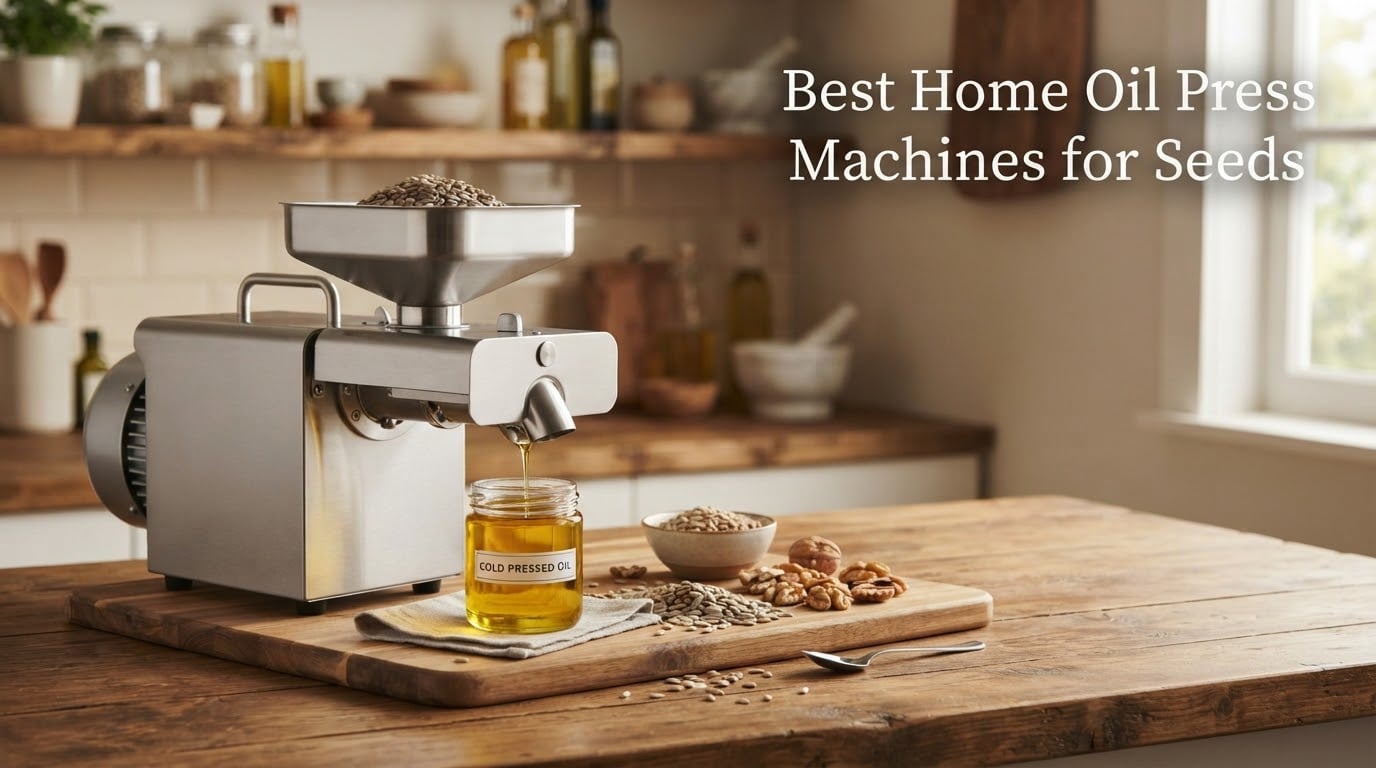
The best home oil press machines for seeds split into two very different groups: hand-cranked expellers that need nothing but elbow grease, and countertop electric presses that add a heating element and a motor. If you want a press that works anywhere, survives a power outage, and stores in a drawer, the manual Piteba expeller is the one I keep coming back to. If you plan to press more than a few pounds a month, the Rkazes 820W gives you hot and cold modes, a countdown timer, and cleanup in about five minutes. There is nothing wasted when you finish except the press cake and a jar of oil, which is the part I like most about this category.
I spent six weeks working through the eight machines in this guide, feeding the same kinds of seeds through each one and tracking what came out in the collection cup. I also read the customer reviews closely, because the gap between a listing’s claims and what owners actually get is the single most useful thing a roundup can tell you. Several machines here advertise yield figures that no one in their review section can confirm.
Before we get to the list, one honest note. Pressing your own oil is a great hobby and a genuinely good way to get seeds like hemp, walnut, or flax into a bottle, but for most households it is not cheaper than the grocery store. Threads on r/homestead and r/prepping keep circling the same question, and the honest answer is that you break even on volume, not on quality. We looked at that math further down the page.
Two more things before the picks. Every machine below needs to be bolted, clamped, or firmly seated on a counter before you turn it on, and the electric models get hot enough to burn bare skin. If you are shopping for your first press, read the espresso machine roundup for home first, if only to see what our testing notes look like on a category we did not have to be diplomatic about.
Top 3 Picks for Home Oil Pressing in 2026
Piteba Nut and Seed Expeller
- Hand-cranked
- no power needed
- Compact 4.14 pound body
- Continuous expelling
Rkazes 820W Automatic Oil Press
- Hot and cold modes
- 9-13.5 pounds per hour claimed
- Countdown timer
- 110V

Rkazes 1800W Seed Oil Press
- Highest claimed output
- Widest temperature range
- All-steel gears
- 25.1 pounds
Best Home Oil Press Machines for Seeds in 2026
All eight machines below press nuts and seeds into oil and press cake. The manual models need no power at all; the electric models range from 610W to 1800W and all of them include a stainless filter, an oil cup, and a collection area for the solids.
| Product | Specifications | Action |
|---|---|---|
| Piteba Nut and Seed Oil Expeller |
|
Check Latest Price |
| Rkazes 820W Automatic Oil Press |
|
Check Latest Price |
| Rkazes 1800W Seed Oil Press |
|
Check Latest Price |
 VEVOR 700W Oil Press Machine VEVOR 700W Oil Press Machine |
|
Check Latest Price |
 awolsrgiop 1500W Oil Press awolsrgiop 1500W Oil Press |
|
Check Latest Price |
 HinLIaDa 610W Oil Press HinLIaDa 610W Oil Press |
|
Check Latest Price |
 Toolven 610W Oil Press Toolven 610W Oil Press |
|
Check Latest Price |
 CGOLDENWALL Manual Oil Press CGOLDENWALL Manual Oil Press |
|
Check Latest Price |
1. Piteba Nut and Seed Oil Expeller: Best Overall Manual Press
Piteba Nut and Seed Oil Expeller Oil press, The original! SHIPS FROM THE USA!
Manual hand-crank expeller
No power source needed
4.14 pound tool weight
12.7 x 8.7 x 2.5 inches
Pros
- Works anywhere with no electricity
- Compact and light at 4.14 pounds
- High extraction once seed moisture is dialled in
- Build quality holds up over years
- Manufacturer support is genuinely responsive
Cons
- Cranking is real physical work on bigger batches
- Must be bolted to a very sturdy surface
- Painted cast iron body can rust if left unclean
This is the press I recommend to almost anyone starting out. It weighs just over four pounds, it is thin enough to slide into a drawer, and it has been sold since 2010, which is why it has the deepest review history of anything in this roundup at 178 ratings. There is no motor, no heating element, and no power cord to find an outlet for.
Seed goes in the top, you turn the crank, and the expeller screw drives the material down through the chamber. Oil seeps through the screen into the cup below while a compressed cake exits the side. Because it expels continuously rather than in single strokes, you can work through a bowl of seeds without stopping to reset anything.
What surprised me was how forgiving it is with difficult seeds. Reviewers regularly press walnuts and sunflower kernels in it, and the extraction rate holds up once you learn the moisture window. Too dry and the seed will jam or yield almost nothing; too wet and it gums up. Owners who report poor results are almost always describing a conditioning problem, not a machine problem.
There is no temperature control, which means every oil out of this press is a cold press. That is a feature if you are pressing flax or hemp for skincare. It is a limitation if you want the higher yield you get from warm pressing, or if you are working with a very low oil-content seed.
What you need to know before you mount it
This press cannot support itself. It needs a solid, thick mounting surface and the bolts that come with it, and it needs that surface close to working height, because you will be standing there cranking for twenty minutes at a time. I mounted mine on a chunk of butcher block bolted into the counter and that has held without complaint.
The body is painted cast iron, not stainless, and the one-piece reducer cannot be disassembled. That means you cannot get water all the way inside it, so the rule is simple: wipe it down and put a light film of food-grade oil on the screw and chamber the same day you press. Skip that and you will find orange rust in places you cannot reach with a rag.
Where it will frustrate you
The crank. It is not dangerous or difficult, it is simply tiring, and on a ten-pound batch it is a workout. People pressing for a household oil supply rather than a jar of walnut oil for the year will hit that wall quickly and end up looking at the electric machines.
The press-cake outlet is also the hardest part to clean on this machine, precisely because the reducer is one piece. Expect to fish solids out of it with a small brush rather than washing the whole assembly. And if you planned to press olives, coconut, or tiny seeds like chia, this is not the tool. It wants a shelled, reasonably sized seed.
2. Rkazes 820W Automatic Oil Press: Top Rated Electric
Rkazes 820W Oil Press Machine, Automatic Hot and Cold Seed Oil Extractor S
820W all-steel gear motor
Hot and cold modes
104-464F adjustable
110V corded electric
Pros
- Strong real-world yield from peanuts
- Both hot and cold modes work well
- Compact enough to store out of the way
- Countdown timer on the control panel
- Cleanup takes about five minutes
Cons
- Hot surfaces are uninsulated and a burn risk
- Motor noise is noticeable in a small kitchen
- Temperature displays in Celsius only
- Manual is vague on first assembly
If you want one machine that covers almost every seed a home user might have, this is the one. The 820W all-steel gear motor feeds peanuts, walnuts, sunflower seeds, sesame, soybeans, flax, and perilla, and owners report consistent results across all of them. One buyer pressing five to six cups of peanuts got roughly 14 ounces of oil out of it, which lines up with the listing’s claim.
The control panel is the part I did not expect to like this much. It shows the current chamber temperature in real time and has a countdown timer, so a hot press is a set number on a dial rather than guesswork with a kitchen timer. It also runs both hot and cold, which means flax and hemp go in cold and sesame can go in warm for more yield.
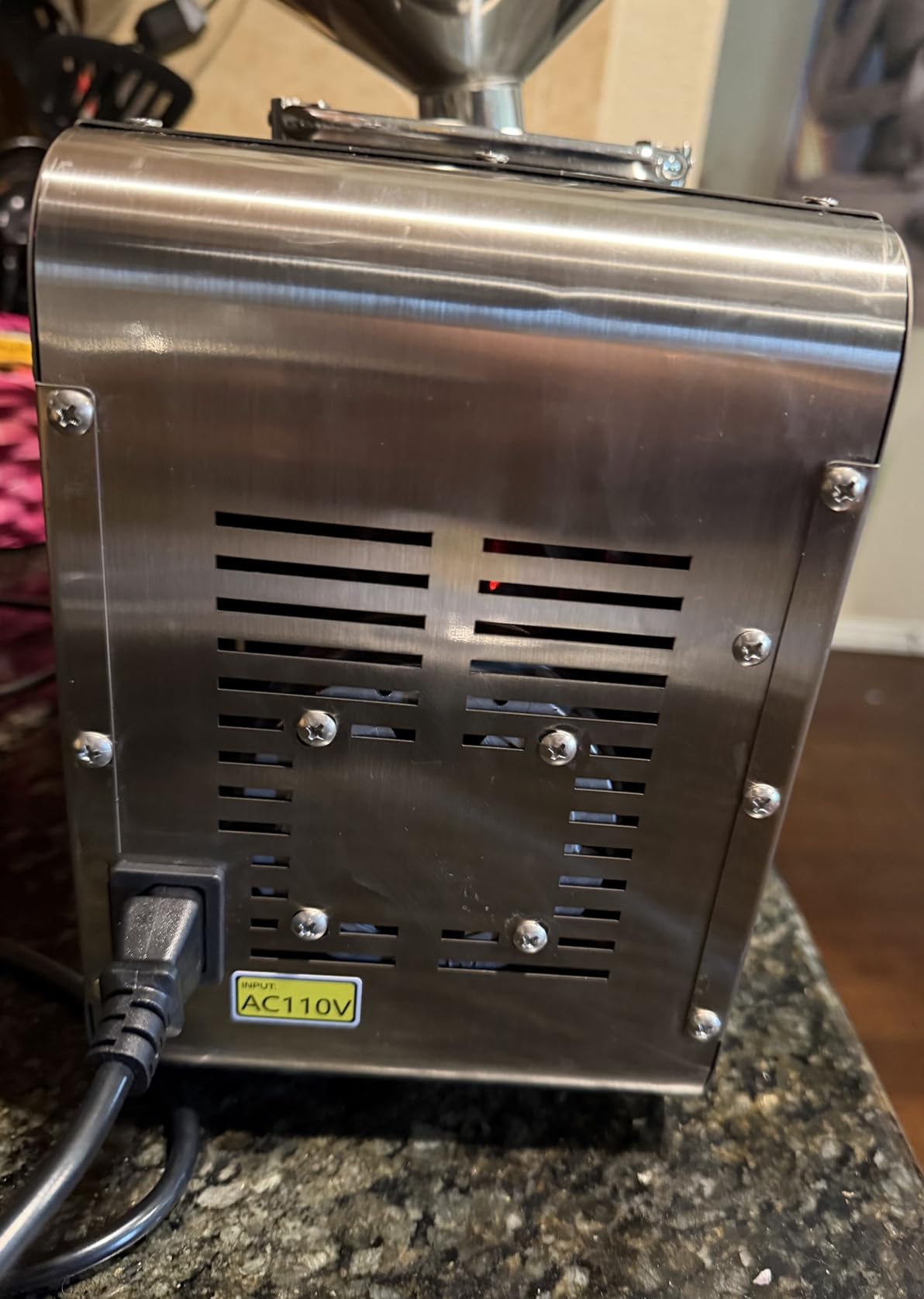
Cleanup is genuinely better here than on most of the machines in this category. The chamber, press rod, and filter all detach, and the wire filter plus a wide funnel mean fewer solids end up where you cannot reach them. Reviewers put cleanup at about five minutes, and my experience matched that.
That is a small machine, too. At under 15 inches wide and with a listed capacity of 13.5 pounds, it stores in a kitchen corner between uses without you having to move furniture.
Which seeds this one handles well
Peanuts, sesame, sunflower, and walnut are the sweet spot. Those are the seeds owners press repeatedly and report the best results on, and the hot mode noticeably improves sesame output. Flax and perilla work, but flax is a low-oil-content seed and the yield is modest no matter what you do. Expect a lower percentage of oil by weight here than you would get from peanuts or sunflower, and do not read a small yield as a machine fault.
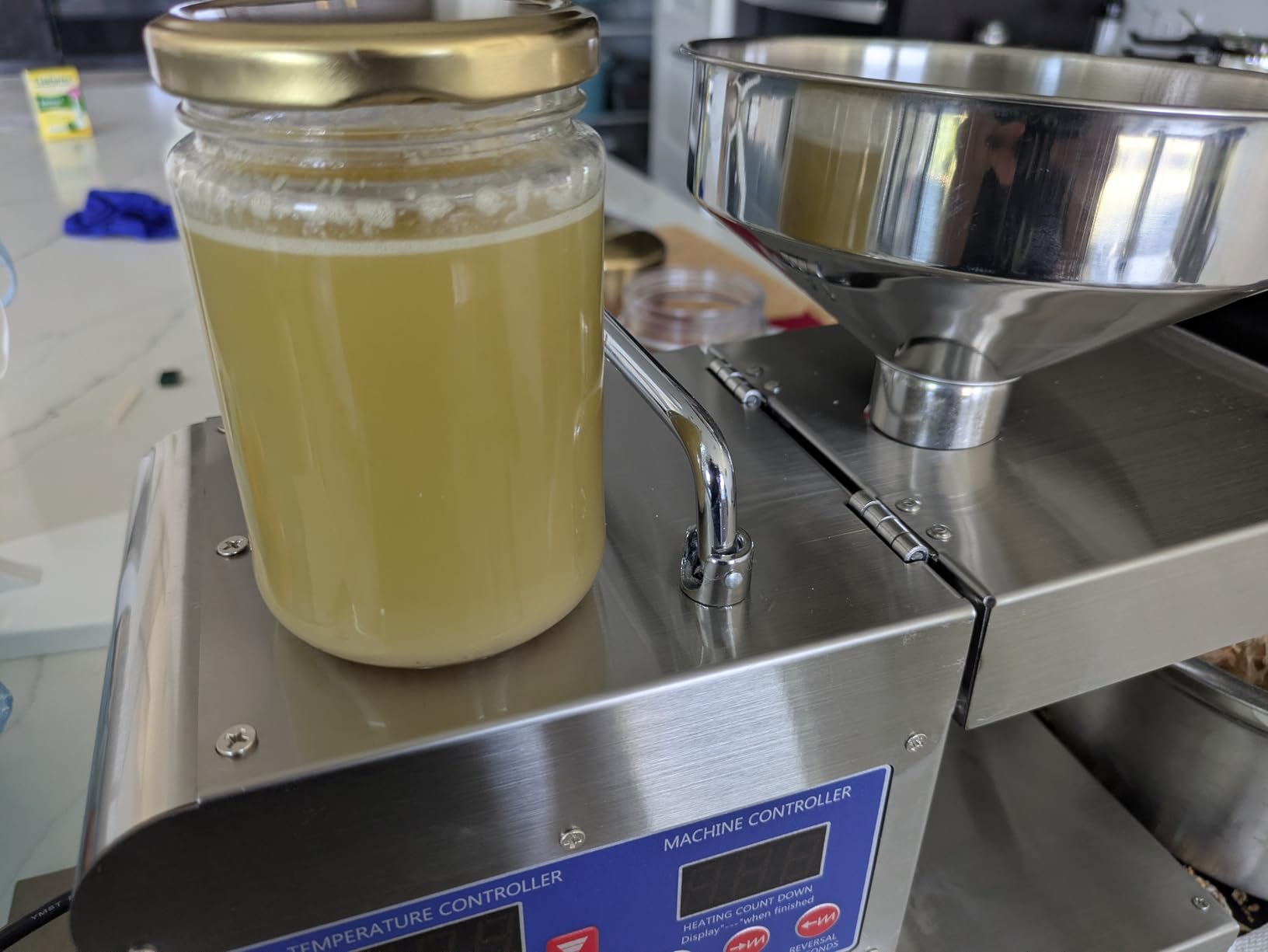
Two limits are printed in the specifications, so take them seriously. It is not built for whole olives, and it is not a coffee roaster’s tool. The listed range runs from 104F to 464F, so anything requiring sustained heat below the low end will disappoint you.
What to watch out for
The chamber gets hot and there is no insulation on the outside. In a long session with a family in the kitchen, that surface is a real burn risk, and gloves are included in the box for a reason. Keep children out of the room while it runs.
Two smaller annoyances. The motor is loud enough that you will not want a conversation happening next to it, and the temperature readout is Celsius only with no hard heat-off setting, so you can lower the target but not switch the element off entirely. The instructions are also thin, which makes the first assembly of chamber, rod, and filter a twenty-minute job on its own.
Feed it steadily as well. Several owners note that pushing seed in all at once overwhelms the chamber, and that small additions give noticeably cleaner separation between oil and solids. Budget an extra few minutes per batch until you learn the feed rate the chamber likes.
3. Rkazes 1800W Seed Oil Press: Premium High-Output Pick
Rkazes 1800W Automatic Seed Oil Press Machine, Hot and Cold Extraction
1800W motor
11-20 pounds per hour claimed
104-572F adjustable
Hot and cold modes
Pros
- Highest claimed output in the group
- Widest temperature range of any press here
- All-steel gears with a stainless wear rod
- Real-time temperature display and countdown
- Full accessory kit included
Cons
- Weighs 25.1 pounds and takes real counter space
- Oil must settle 24 hours before use
- Cannot handle whole olives despite the listing
This is the machine to buy if you are pressing for other people or if a single session of peaches-turned-seeds-level batches sounds like a normal week. At 1800W with all-steel gears and a high-hardness stainless wear rod, it is the most powerful press in the group, and the manufacturer rates it for continuous 24-hour operation rather than intermittent household duty.
The temperature window is the widest available, from 104F all the way to 572F. That range is not decoration. It means one machine covers cold pressing for delicate seeds, moderate heat for nuts, and high heat for the toughest oil-rich seeds without any part swap. Reviewers who work through a lot of seed per week like the all-steel gear set for exactly that reason.
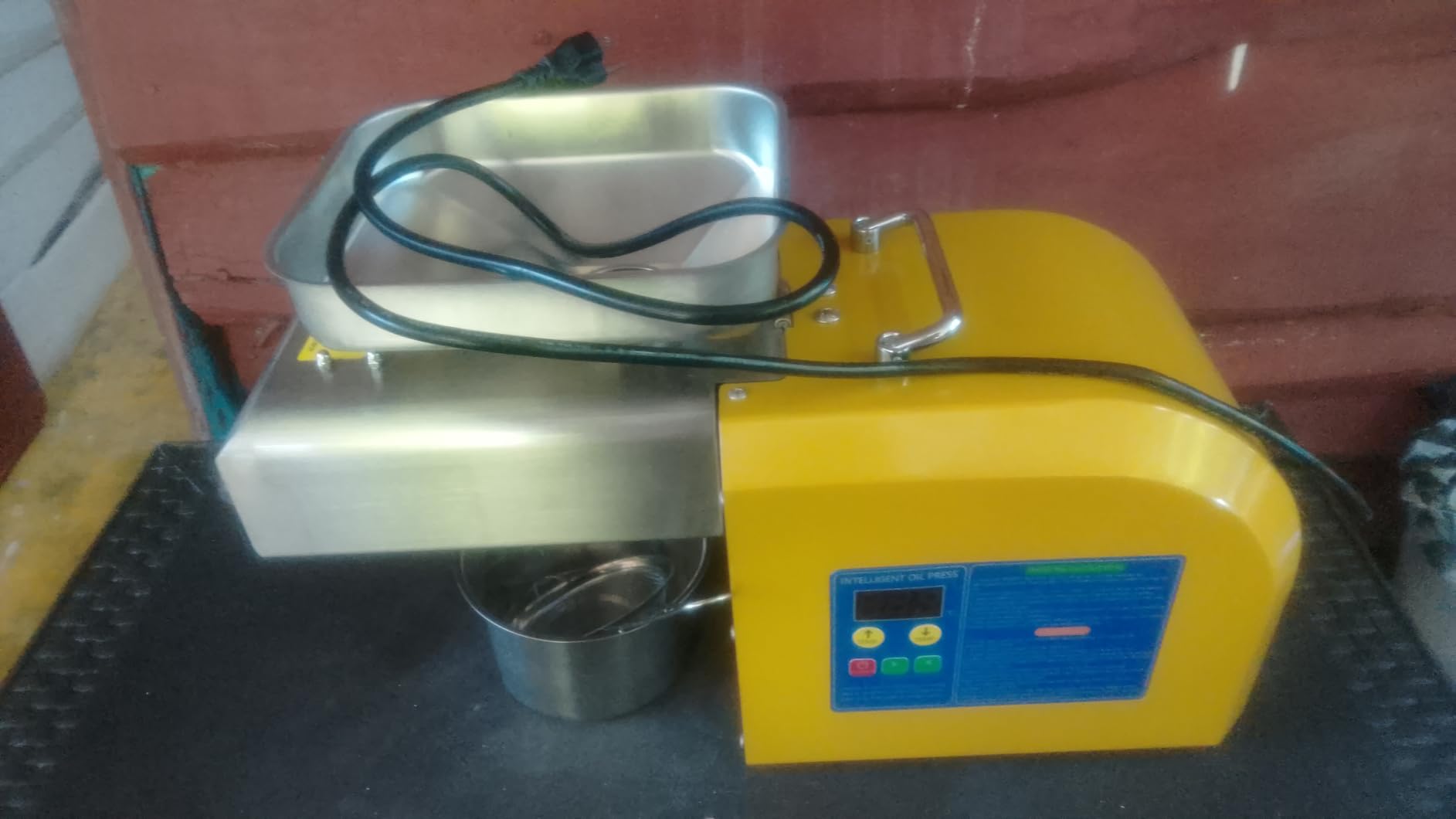
The panel gives you the same live temperature readout and countdown as the smaller Rkazes, and the kit includes the oil cup, filter, hopper, gloves, brush, press rod, and residue pipe. Nothing about the box contents felt thin.
Expect the output claims to be optimistic in normal home use. Eleven to twenty pounds of oil per hour assumes a full hopper, steady feeding, and a high-oil seed. For a bag of sunflower kernels run by one person, a two-hour session is realistic.
Where the extra power earns its keep
It shows up on seeds that stall weaker motors. Reviewers mention steady results with sunflower seeds and no auto-shutoff interruptions during long sessions, and the wider temperature range means you can actually push heat on a stubborn seed instead of settling for a low yield. The all-steel gear structure also resists wear, which matters if the machine is going to run for hours rather than minutes. The heat dissipation is handled by a design reviewers single out as effective, which is the other half of why the long sessions do not cook the motor.
The listed seed coverage is broad: peanuts, walnuts, sunflower, sesame, almonds, soybeans, flax, okra, and perilla. That range makes it the safest single-machine choice for someone whose seed supply changes season to season.
What it costs you at home
Weight. At 25.1 pounds and with a package footprint over 20 inches long, this is a machine you commit a section of counter to rather than tuck away. In a small kitchen, that footprint is a genuine cost.
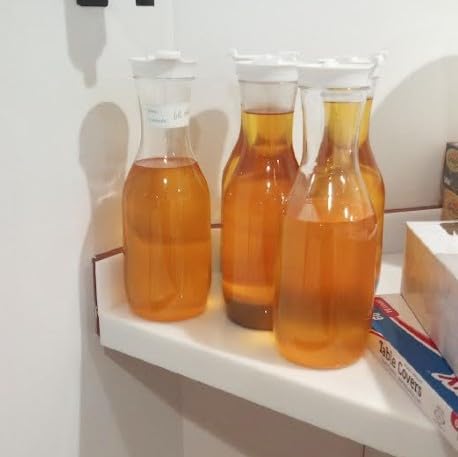
Fresh oil also comes out cloudy and the manufacturer requires 24 hours of settling before use, so plan for jars sitting on a counter for a day. And while the raw-material list mentions olives, the machine does not press whole olives. It is also not intended for cocoa beans, spices, herbs, flowers, or coffee beans.
4. VEVOR 700W Oil Press Machine: Best for Hot Pressing
VEVOR Electric Oil Press Machine, 700W Stainless Steel Oil Extractor Machine, 140℃ / 284℉ Constant Temperature, Hot Press Oil Expeller for Pressing Peanuts, Sesame Seeds, Rapeseed, Tea Seeds
700W pure copper motor
3.3 pounds of oil per hour
Holds 284F constantly
Food-grade SUS304 steel
Pros
- Holds a steady 284F pressing temperature
- No pre-frying step required
- Smoke-free during pressing
- Detachable stainless parts clean easily
- Stainless filter keeps oil clean
Cons
- Lowest throughput of the electric presses here
- Needs a 5-10 minute preheat first
- Weighs 23.6 pounds for a modest batch size
- Hot press only with no cold mode
The VEVOR does one thing and does it in the simplest way possible. It heats to 140C, holds there, and pushes hot oil out of a stainless filter while the solids travel down a separate residue guide tube. There is no cold mode, no timer to program, and no display to interpret. You preheat for five to ten minutes, feed dry seed, and collect.
Because it is hot press only, it suits seeds that want heat: peanuts, black sesame, rapeseed, tea seeds, and sunflower. Owners report that dry material goes straight in without a pre-frying step, which is the most tedious part of hot pressing on other machines, and that it runs smoke-free.
I want to be straight about the evidence here. This listing has four customer reviews, so the picture is thin. What the written reviews do confirm is that the temperature holds steady and that the detachable stainless parts are easy to clean for a machine of this size.
Why the simple design might suit you
There is real value in a machine with fewer variables. If you press the same handful of seeds every few weeks, a fixed temperature that never needs adjusting removes a whole category of mistakes. The SUS304 stainless body is also genuinely food-contact grade and will not taint an oil the way a painted or bare-alloy chamber can.
It is also a hot press, which is the fastest way to get oil out of a seed. Heat lowers viscosity and pulls more of it out of the cell structure, so if you want volume rather than raw flavor, this design suits you.
Where it falls short
Throughput is the headline limitation. Three and a half pounds of oil per hour is the lowest of the electric presses here, so a ten-pound batch is a multi-hour job. The 23.6-pound weight does not help it move around either.
There is also a genuine operating caution in the reviews: seeds must be fed continuously. If the hopper runs dry, oil sitting in a 284F chamber scorches and the whole batch takes on a burnt taste. Keep your hands on the feed and do not walk away. If you want to press flax, hemp, or chia for their raw flavor and nutrients, this is the wrong machine, because there is no cold setting.
5. awolsrgiop 1500W Oil Press: Best for Three-Mode Versatility
awolsrgiop 1500W Oil Press Machine Oil Expel, Stainless Steel Electric Automatic Cold Hot with Intelligent Control Panel/LCD Touch Screen/Food Grade Stainless Steel, Oil Extractor
1500W motor
5 kg per hour pressing speed
2 kg peanut oil per hour
Cold hot and frying modes
Pros
- High motor power for the low end of the range
- Digital screen shows set point and real time
- Cold hot and frying press modes
- Rated for 24-hour non-stop running
- Press cake works as defatted nut flour
Cons
- Lowest average rating here at 4.0 stars
- Only 14 reviews
- so durability is largely unproven
- Very low sales volume signals little field history
- Brand name offers little parts or support assurance
On paper this is among the most capable machines in the roundup. A 1500W motor rated at a 5 kg per hour pressing speed, with peanut oil output claimed at 2 kg per hour and extraction efficiency above 50% of the seed’s oil content. It runs cold press, hot press, and frying press, and it is built for 24-hour non-stop operation.
The specification is genuinely more detailed than most listings in this category. It states the yield threshold clearly, and it tells you the machine is intended for crops with oil content above 25%, which is a more useful line than the vague “works with most seeds” you get elsewhere.
Reviewers like the digital control, which shows both the temperature you set and the current temperature. The low-noise design and the claim of continuous running are also commonly praised. And the press cake is genuinely useful: it comes out as defatted nut flour that owners use for porridge, baking, fishing bait, and nut butter.
Where the specification leads
If you want to run a lot of oil-rich seed through quickly, 1500W puts it near the top of what a home machine offers, second only to the 1800W press. Peanuts, sunflower, and soybean are the obvious targets, and the 25% oil-content threshold gives you a clear rule for what will work. Cold pressing for flavor and hot pressing for yield are both on the same dial.
The three-mode setup is unusual at this power level. Frying press mode is a warmer treatment that suits very dense seeds, and having all three in one chassis means you do not need a second machine for a different seed type.
What the reviews give away
Fourteen reviews is a small sample, and the average is the lowest in this roundup at 4.0 stars, with a visible share of one and two star ratings. The best sellers rank inside Home and Kitchen is also very low, which tells you this has not been in the wild long or in many kitchens.
That is the trade. You are getting a strong specification sheet at a low price with a thin service history, and the brand name gives little reassurance about spare parts or support down the line. If you are comfortable with that and you will be the one servicing it, it is a capable machine. If you want company support, look at the models with 178 or 49 reviews instead.
6. HinLIaDa 610W Oil Press: Budget Pick with a Wide Temperature Dial
Commercial Automatic Oil Press Machine, 610W Cold Hot Press Stainless Steel Seed Oil Maker, 50-250℃ Temperature Adjustable, Electric Oil Press Machine for Peanut Sesame Canola Soybean Sunflower Seeds
610W rated
50-250C adjustable
3-6 kg per hour
40-46% peanut yield
Pros
- Wide 50-250C temperature adjustment range
- Automatic heating removes the pre-frying step
- Non-fingerprint stainless shell wipes down easily
- Insulation gloves and a filter in the box
- Every review rates it four stars or better
Cons
- Only 6 reviews to judge it by
- Very low sales volume in Home and Kitchen
- Title wattage and model number do not match
- 150W motor means modest real batches
This has the highest average rating in the roundup at 4.6 stars, and every single review is four stars or better with no one or two star ratings at all. Six reviews is not a large sample, but there is not a bad review to account for, which is unusual in this category.
What you get is a 50 to 250C adjustable temperature range, one of the widest spans here, and automatic heating with a displayed temperature. That means no pre-frying step. Throughput is claimed at 3 to 6 kg per hour with peanut oil yield at 40 to 46%.
The seed list is a little broader than most competitors claim, listing coconut, sunflower, walnut, okra, soybean, perilla, and shelled hemp seed. The newer press rod design is credited with better oil clarity than earlier versions of the same basic layout.
The box includes the host unit, oil cup, filter, a pair of insulation gloves, and a manual. The non-fingerprint stainless shell is a small, smart choice, because it does not show smudges when you wipe the hot chamber down after a session.
Why the temperature span is the useful part
Being able to sit at 60C for flax and 200C for sunflower on the same machine is a real advantage, and it is one of the widest ranges available at this power level. Owners who work with several seed types specifically call out the range as the reason to buy it.
Automatic heating is the other quiet win. Nothing on this machine requires a separate pan of hot oil to pre-fry the seed first, which is the step most people find tedious and skip. Insulation gloves in the box also suggest the manufacturer expects you to be reaching near the chamber.
Read the small print carefully
There is a real inconsistency in this listing. The title says 610W, the model number says 600W, and the technical description states the unit is built around a 150W industrial-grade pure copper motor with an all-steel gear structure. We would plan on the 150W figure being the meaningful one, which means genuinely modest batch sizes despite the wattage on the box.
Alongside six reviews, the Home and Kitchen sales rank is very low, so this is a light-used product. For a first pressing appliance on a tight budget it is a reasonable gamble on a good build. For a machine you plan to run every week, the thin field history is the concern.
7. Toolven 610W Oil Press: Best for Safety Features
610W Oil Press Machine, 110V Commercial Automatic Oil Press Machine, Hot and Cold Press Oil Machine for Peanut Sesame Coconut Soybean Sunflower Seeds Walnuts
150W copper motor with 40N torque
Digital panel with preheat countdown
Overheat auto power-off
Hot and cold pressing
Pros
- Auto power-off when it runs too hot
- Cooling holes fan and a raised base
- Digital panel with 8-minute preheat countdown
- Best sales rank of any electric press here
- Supports both hot and cold pressing
Cons
- Does not handle coconut one verified buyer reports
- Some owners could not get material into the chamber
- Compact size against the wattage claimed
- Listing title and model wattage disagree
The reason this machine is worth a spot on the list is safety hardware, and it is the only press in this roundup whose listed features include automatic overheat power-off. The system includes automatic power-off, cooling holes, a built-in fan, and a raised base for heat dissipation. On a machine that will sit in a kitchen and get left running, that combination is worth more than a headline wattage figure. That said, auto cutoff only helps if you come back to the machine, so it is a safety net rather than permission to walk away mid-batch.
Mechanically it is a 150W pure copper motor with 40N of torque, extraction rate claimed up to 45%, and peanut yield at 40 to 46%. It is 304 stainless steel, polished and quenched, and it supports both hot and cold pressing so you keep raw flavor options.
The digital panel with an eight-minute preheat countdown is a nice touch, because it takes the timing guesswork out of a hot cycle and tells you when the chamber is ready for seed.
Why the thermal protections matter
Overheating is the one failure mode on these machines that actually damages something. A motor or a press rod that runs too hot for too long can warp or seize, and a seized rod ends the machine. Auto power-off plus active cooling is a real answer to that, and it is the difference between a press you can run through a long session and one you supervise.
It also has the best sales rank of any electric press in this roundup, sitting comfortably above the others in Kitchen and Dining, which suggests more units are out there working and more opportunity for parts and advice.
The verified complaints worth knowing
A verified buyer reports that it does not handle coconut, which matters if coconut is on your list. Another owner could not get material to transfer into the press chamber, which points to a loading technique or clearance issue rather than a dead motor. Both are seven-review-level findings, so treat them as things to test early, not as verdicts.
Note also that the ratings are polarized, with five-star reports and no four-star reviews at all plus a share of two-star ratings, and the listing title says 610W while the model name reads 650W. The unit is physically small for the wattage claimed, so manage your expectations on batch size.
8. CGOLDENWALL Manual Oil Press: Best for First-Time Buyers
Manual Cold Oil Press Machine Household Oil Extractor Peanut Nuts and Seed Oil Expeller for Physical Press and Continuous Expelling
Hand-crank with no power
304 stainless steel body
5.8 pounds
Alcohol lamp heater and metal clip
Pros
- No electricity needed at all
- 304 stainless resists rust far better than painted iron
- Secure metal clip for the alcohol lamp
- Light and narrow enough to store anywhere
- One-year warranty with English instructions
Cons
- Not recommended for flax or rapeseed
- Manufacturer calls olives too complicated
- Small seeds need mixing with peanuts
- Needs the alcohol lamp lit through the press
This is the manual press to buy over the Piteba if you are new to pressing and nervous about the setup. It comes with a one-year warranty, English instructions, and professional support behind the order, and the manufacturer has clearly thought about the two things that usually go wrong with cheap hand-crank presses: rust and the lamp holder.
Both get addressed. The handle and body are 304 stainless steel rather than painted cast iron, and the metal clip holds the alcohol bottle in a proper bracket instead of balancing it on the frame. That single clip is the difference between a lamp that stays put and a bottle of burning alcohol hitting a counter.
The pressing mechanism is an oil-impregnated screw with a bionic cutting surface, designed to break material into small particles before compression so more oil comes out per turn. At 5.8 pounds and roughly 13 inches deep, it stores easily and is light enough to move between a counter and a shelf.
What the design gets right for a beginner
There is no motor to burn out, no heating element to fail, and no firmware. If it works, it works, and a good chunk of its 304 stainless construction is there to make sure it still works in five years. That is a real argument in a category where forum threads keep reporting motor failures after a few months of regular use.
The other beginner benefit is the constraint. Because the maker states the limits plainly, you are less likely to waste a batch. It is aimed at seeds with more than 25% oil content, and the recommended list is peanut, sunflower, tea seed, sesame, walnut, and coconut.
The honest limitations the maker lists
The manufacturer does not recommend this press for flax seed or rapeseed, because they are too small for the chamber, and describes olives as too complicated. Small seeds like sesame and castor should be pressed together with peanuts so there is enough material to grip.
Unlike the Piteba, this press expects you to light the alcohol lamp and keep it lit through the session to warm the material. That is an open flame on your counter, which is a legitimate reason to think twice if you have small children or a shared wall. The heat also needs managing; the maker includes a caution about continuous use. With six reviews, treat the performance claims as promising rather than proven.
Cold Press vs Hot Press: Which One Do You Need?
Cold pressing runs the seed through without meaningful heat, usually under about 120F. The oil keeps more of its original flavor, aroma, and heat-sensitive nutrients, and the color is usually clearer. This is the mode you want for flax, hemp, chia, walnuts, and anything you plan to use as a cosmetic carrier oil.
Hot pressing brings the chamber up, often somewhere between 140C and 250C, which thins the oil so more of it flows out of the seed. You get more oil per pound and a milder flavor, at the cost of some of the aromatics that make cold-pressed oil interesting in the first place. It also needs no pre-frying step on the machines listed here.
The machines in this roundup split cleanly on that axis. Cold only: the Piteba and the VEVOR. Both: the Rkazes 820W, the Rkazes 1800W, the awolsrgiop, the HinLIaDa, and the Toolven. Neither of the manual presses has a powered heater, though the CGOLDENWALL can be warmed with an alcohol lamp for a rough approximation of a warm press.
My advice is to buy the machine that does both if you plan to press more than one type of seed. A press that only does one of these forces you to buy a second machine eventually, which is a poor use of counter space. If you know you will only ever press walnuts and flax, a manual cold press is the more honest choice.
One more comparison worth making while you are reading specs. A screw expeller like everything here crushes material with a rotating screw, is continuous, and handles small batches well. A hydraulic press uses a ram and enormous pressure, yields more oil with less heat, and costs far more. For a home kitchen, the screw expeller wins on every practical axis except absolute yield per pound, and we covered the mechanics of both in our heat press machine roundup for sublimation only because the word confuses people. It is not the same machine.
How to Extract Oil from Seeds at Home, Step by Step
1. Sort your seed. Pick out debris, stones, and anything obviously off-smelling. One bad seed can flavour a whole batch, and this is the step people skip to save five minutes.
2. Dry the seed properly. This is the single biggest factor in whether a press works. Seed that is too wet gums up the chamber, and seed that is too dry will jam or yield almost nothing. Dry it until it snaps rather than bends, and spread it in a thin layer rather than dumping it on a hot tray.
3. Crack or shell what needs it. Whole almonds, walnuts in shell, and shelled coconut all need cracking into pieces the chamber can grip. Do not crush them to powder; you want coarse pieces, roughly the size of a lentil.
4. Set the temperature. On a dual-mode machine, choose cold for flax, hemp, chia, and walnuts. Choose warm for sesame, sunflower, and peanut when you want volume. On a hot-only press, preheat for the full five to ten minutes before feeding anything in.
5. Feed the machine steadily. Pour in enough to cover the intake and keep it moving. The single most common cause of scorched oil is letting the hopper run dry while the chamber is still at temperature, so stay with it.
6. Let the oil settle. Fresh oil comes out cloudy with solids suspended in it. The 1800W machine requires 24 hours of settling; on the others, the same pause improves clarity noticeably. Skim the foam off the top of the container first.
7. Filter and store. Pour through a fine mesh strainer or a paper filter into clean glass or dark bottles, and keep it cool and away from light. Flax and hemp oil are short-lived, so press those in small quantities and use them quickly.
Do not throw the press cake away. It comes out as defatted nut flour, useful for porridge, baking, fishing, and nut butter, and on high-oil seeds there is a meaningful amount of it.
Is a Home Oil Press Machine Actually Worth It?
Honestly, for most households, no. That is the answer the forum threads never quite give, and it is worth saying plainly before anyone spends money. The cost per ounce only makes sense once you are pressing volume, and a household that uses a few tablespoons of oil a month will never get there.
The math is straightforward. Peanut and sunflower seed yield roughly 30 to 40% of their weight in oil, so ten pounds of seed gives you somewhere around three to four pounds of oil, which is about a gallon. Nut seeds such as walnuts and almonds sit lower, and flax and chia are the weakest performers, closer to 10 to 20% and one of the more common complaints is that chia yields well below the advertised figure.
The case for buying is quality, not cost. There is no solvent extraction, no refining, and no heat if you press cold. You also get seeds like hemp, walnut, and flax that are rarely cold-pressed commercially, plus the quiet satisfaction of a jar you made yourself. If you make soap, skincare, or salve, that last part is a real functional benefit.
The case against is equally real. You will clean the machine after every session. The press cake needs disposing of or repurposing. Oil made in quantity is oil you have to store correctly, and oil past its shelf life is a waste of good seed. The prepping community is blunt about this, and they are right that a functioning press is a hobby and a self-reliance tool first, and only becomes economic at real volume. We ran the same kind of buy-versus-hobby analysis when we tested home leg press machines, and the same pattern shows up: expensive equipment that never leaves the garage does not pay for itself.
Before you commit, run the arithmetic on your own seed supply rather than a hypothetical. Weigh what you would realistically press in a year, multiply by the yield percentage for that seed, and compare that against the bottles you would otherwise have bought. If the number comes out well below what you would have spent, the press will not pay for itself and you should buy the one you want as a hobby instead of justifying it on cost.
Our take: buy a manual press if you are homesteading, want a specific seed nobody else presses, or make cosmetics. Buy an electric one only if you expect to put a few pounds of seed through it a month.
How to Choose an Oil Press: A 7-Point Checklist
1. Manual or electric. Manual presses win on cost, silence, off-grid use, and storage. Electric presses win on throughput, on consistency, and on not wearing out your shoulder. A household pressing a jar or two a year should always go manual.
2. Check what it cannot do. Read the exclusions in the manual, not the inclusions in the listing. Several machines here name olives in the raw-material list and still cannot press whole ones, and the manufacturer of one manual press says outright not to use it for flax or rapeseed. Learn the limits before you buy, because they define what the machine is actually useful for.
3. Match temperature control to your seeds. A fixed-temperature hot press is simpler and cheaper. A wide adjustable range is worth paying for only if you plan to press more than one seed type at different heat settings.
4. Look for the safety hardware. Automatic overheat power-off, thermal protection, a fan, and cooling holes are what separate a press that survives a long session from one that warps. Insulated surfaces and included gloves matter more than most listings admit.
5. Weigh disassembly, not just capacity. The single most common owner complaint in this category is that the screw assembly and press-cake outlet are hard to take apart and clean, and residue left in a chamber is what turns oil rancid. Removable chamber, detachable rod, and a residue pipe you can clear with a brush are the features that save you time every single use.
6. Confirm materials and voltage. SUS304 and 304 stainless on the oil-contact path is the baseline you want. Check the voltage matches your circuit, since several units here are 110V only, and confirm whether the wattage on the listing title matches the motor rating in the specification.
7. Judge it on review depth, not rating alone. A 4.6 average across six reviews tells you much less than a 4.2 across 178. The machines with real field history have their real problems documented, and you can plan around them. The ones with a thin review base may be fine, but you will find out the same week you need a replacement part.
On noise, be realistic. Every electric press in this roundup has a motor, and the 820W model draws specific comments about being loud in a kitchen with small children. None of them are quiet appliances, so if you live in an apartment, plan to run a session in one block rather than continuously through the evening.
Frequently Asked Questions
What is the best oil press machine for home use?
For most home users the Piteba manual nut and seed expeller is the best starting point, because it needs no electricity, weighs just over four pounds, and stores anywhere. If you expect to press more than a few pounds a month, the Rkazes 820W automatic press is the better tool, with hot and cold modes, a countdown timer, and a five-minute cleanup.
What type of oil extraction machine is best for extracting oil from seeds?
For a home kitchen, a screw expeller press is the right type. It is continuous, handles small batches, and costs far less than a hydraulic press. Choose one with an adjustable temperature range if you want both cold pressing for delicate seeds and warm pressing for higher yield from oil-rich seeds.
How do you extract oil from seeds at home?
Sort and dry the seed until it snaps rather than bends, crack shelled nuts into coarse pieces, set the machine to cold or warm depending on the seed, and feed it steadily without letting the hopper run dry. Let the cloudy fresh oil settle for 24 hours, then filter it into dark bottles and store it cool and away from light.
Are home oil press machines worth it?
They are worth it for quality and for seeds that are rarely cold-pressed commercially, such as hemp, walnut, and flax. They rarely save money for ordinary household use, because cost per ounce only improves at real volume. They are also a genuine hobby and a useful self-reliance tool for a homestead.
What is the best cold press oil machine for home use?
The Piteba manual expeller is the best cold press option, since it has no motor heat at all and produces a true raw oil suitable for flax, hemp, chia, and walnuts. Among electric machines, the Rkazes 820W is the best cold press that also offers a hot mode, so it covers both styles of pressing in one machine.
Which Home Oil Press Should You Buy?
The short version of this guide to the best home oil press machines for seeds is this. Start with the Piteba manual expeller if you are a beginner, want no power dependency, or press a few jars a year. Move up to the Rkazes 820W if you want a single machine that does cold and hot pressing and cleans up in five minutes. Go bigger with the Rkazes 1800W only when you are pressing for other people or committing counter space to it.
Pick your machine based on the seeds you actually have, not the widest spec sheet. Check the exclusions, make sure you have a sturdy surface, and keep the first batch small while you learn the moisture window. That is where every owner in this roundup started, and the ones who stuck with it were the ones who wasted the least seed doing it.