
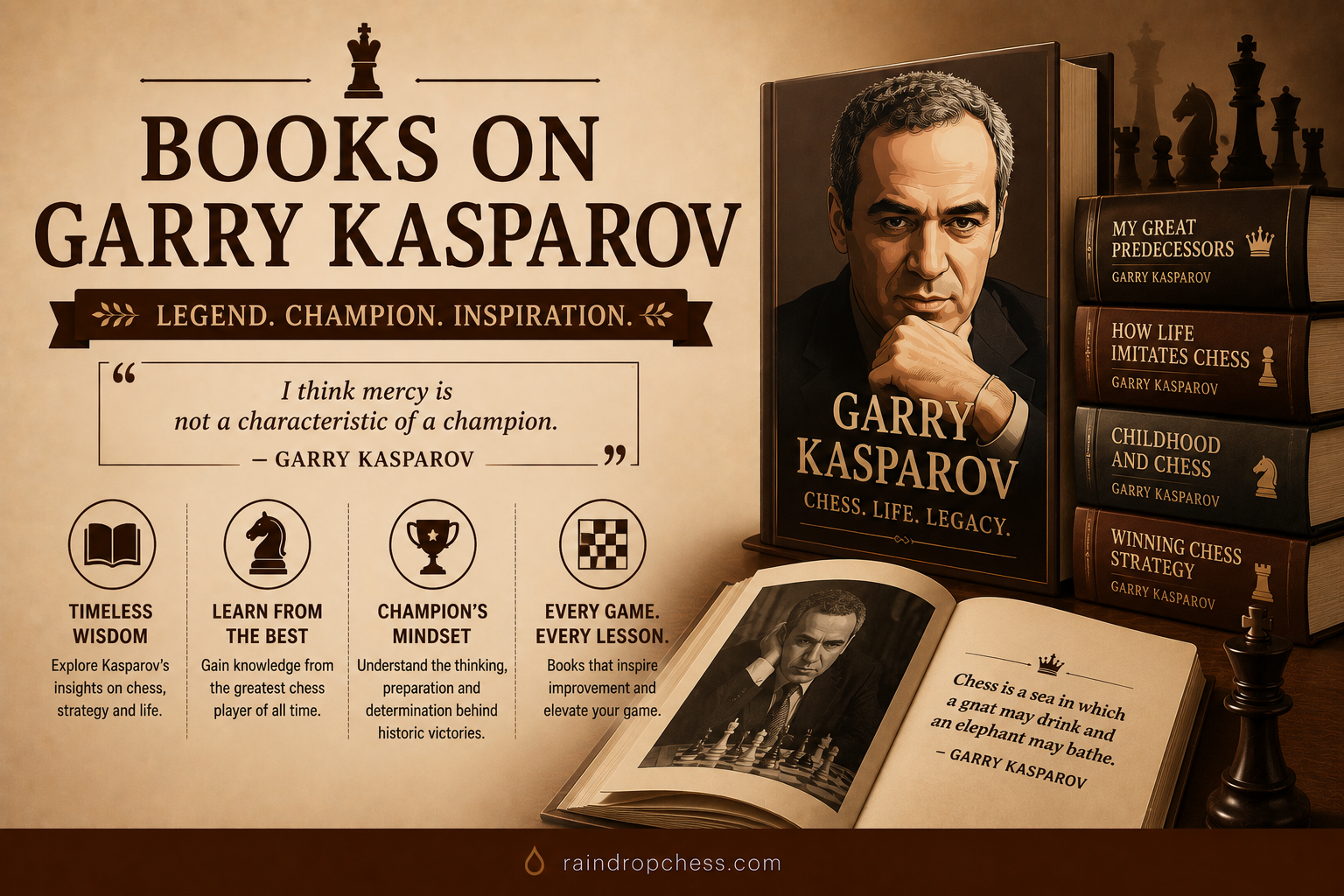
Garry Kasparov dominated chess for over two decades. He held the world number-one ranking for 255 months straight, a record that may never be broken. What most people do not realize is that his written work is just as formidable as his play over the board. His books cover everything from deeply annotated championship games to philosophical takes on strategy, artificial intelligence, and even global politics.
Our team spent weeks reading through the entire Kasparov library to figure out which titles actually deserve a spot on your shelf. We compared community ratings on Goodreads, Amazon reviews, and Reddit discussions from chess players ranging from beginners to titled competitors. The result is this guide to the best books on Garry Kasparov, organized so you can quickly find the right book for your skill level and interests.
Whether you want to study classical World Championship games, understand the story behind his famous Deep Blue match, or introduce a child to chess, there is a Kasparov book built for that purpose. Let us walk through each one.
Table of Contents
Top 3 Picks for Best Books on Garry Kasparov
My Great Predecessors Part 1
- Covers Steinitz to Alekhine
- Deep annotated games
- Historical context
- 4.8 rating

My Great Predecessors Part 2
- Euwe to Tal coverage
- 150 annotated games
- Excellent diagrams
- 4.8 rating

Garry Kasparov on Garry Kasparov Part I
- 100 annotated games
- Autobiographical insight
- Soviet chess culture
- 4.7 rating
Best Books on Garry Kasparov in 2026
| Product | Specifications | Action |
|---|---|---|
| My Great Predecessors Part 1 |
|
Check Latest Price |
| My Great Predecessors Part 2 |
|
Check Latest Price |
| Garry Kasparov on Garry Kasparov Part I |
|
Check Latest Price |
 Deep Thinking Deep Thinking |
|
Check Latest Price |
 How Life Imitates Chess How Life Imitates Chess |
|
Check Latest Price |
 Winter Is Coming Winter Is Coming |
|
Check Latest Price |
 Checkmate! Everyman Chess Checkmate! Everyman Chess |
|
Check Latest Price |
1. Garry Kasparov on My Great Predecessors, Part 1 – The Definitive History of Chess Champions
Garry Kasparov on My Great Predecessors, Part 1
Covers Steinitz to Alekhine
Deep annotated games
Historical context
4.8 rating
Pros
- Covers first four World Champions
- Deeply annotated games with alternative lines
- Rich historical storytelling
- Suitable for intermediate to advanced players
Cons
- Not suitable for beginners
- Dense material requires focused study time
I first picked up My Great Predecessors Part 1 expecting a standard game collection. What I got was something far more ambitious. Kasparov traces the lineage of World Chess Champions from Wilhelm Steinitz through Alexander Alekhine, and he does it with the kind of detail that only someone who lived in that tradition could provide. The book opens with earlier masters like Paul Morphy and Harry Nelson Pillsbury before settling into the four official champions.
Each chapter combines biographical narrative with deeply annotated games. I found myself stopping mid-game to work through Kasparov’s alternative lines, and those side variations alone taught me more about positional play than most dedicated strategy books. He does not just tell you what happened; he explains why, and what the players could have done differently.
The historical context sets this apart from any other chess book I have read. You learn about the personal rivalries, the political pressures on players during the World Wars, and how chess theory evolved across generations. Kasparov’s personal admiration for certain champions, particularly Alekhine, comes through clearly and adds genuine warmth to the writing.
At 250 reviews and a 4.8 rating, the community consensus backs up my experience. Players on Reddit consistently recommend this as the starting point for anyone serious about studying chess history. The annotations are accessible enough for intermediate players but deep enough to reward repeated reading at higher levels. This book earned its Editor’s Choice badge through sheer quality of content and presentation.
Who Should Read This Book
If you are rated above 1200 USCF and want to understand how chess theory evolved from the first official World Championship onward, this is your starting point. It works equally well for players who enjoy chess history as a subject on its own, not just as a tool for improvement. Tournament players looking to broaden their understanding of classical openings and positional themes will find hundreds of instructive moments.
It is not the right choice if you are just learning the rules. Wait until you can comfortably follow annotated games without needing every tactical detail explained. Pair this with a good tactics workbook and you have a solid daily study routine.
Reading Difficulty and Skill Level
I would place this at an intermediate-to-advanced level. You need to be comfortable reading chess notation and following multi-move variations. The annotations assume basic tactical awareness, so players rated 1200-2000 USCF will get the most direct benefit. That said, even Grandmasters have praised Kasparov’s historical research and narrative skill, so higher-rated players will still find plenty of value.
Plan on spending at least 30-40 hours with this book if you want to work through every game properly. I recommend setting up a physical board and playing through each game at least once before reading the annotations.
2. Garry Kasparov on My Great Predecessors, Part 2 – From Euwe to Tal
Garry Kasparov on My Great Predecessors, part 2
Covers Euwe to Tal
150 annotated games
482 pages
4.8 rating
Pros
- Excellent diagrams for boardless study
- Strong historical context for mid-1930s to 1960s
- Covers four World Champions with depth
- Praised for accessible annotations
Cons
- Requires solid chess foundation
- Series investment if you continue
Part 2 picks up exactly where the first volume leaves off, covering Max Euwe, Mikhail Botvinnik, Vasily Smyslov, and Mikhail Tal. I actually started with this volume because I was specifically interested in Botvinnik’s methodical approach and Tal’s attacking wizardry. Neither disappointed. Kasparov treats each champion with genuine respect, even Euwe, who often gets overlooked in chess histories.
The approximately 150 annotated games in this volume represent a goldmine of instructional material. What struck me most was how Kasparov contrasts Botvinnik’s scientific preparation with Tal’s intuitive sacrifices. Seeing these different philosophies analyzed side by side by someone who studied under Botvinnik himself gives the commentary an authenticity you cannot find anywhere else.
The diagrams deserve special mention. I tested reading this book during a long flight without a chess set, and the diagrams were frequent and clear enough that I could follow the critical positions without a board. For a 482-page book at this level of depth, that is impressive production quality from Everyman Chess.
With 127 reviews and a 4.8 rating, this volume matches the quality of Part 1. Reviewers frequently highlight the Tal sections as some of the most entertaining chess writing in any language. The combination of beauty and depth in Tal’s games, filtered through Kasparov’s analytical lens, creates something genuinely special on every page.
Who Should Read This Book
This volume is perfect for players who want to understand the transition from classical to modern chess. The Botvinnik era represents a turning point where opening preparation and physical fitness became central to competitive play. If you are building an opening repertoire and want to understand the historical foundations of modern systems, the games here are essential reference material.
Tal fans will find some of the most beautiful attacking games ever played, annotated by someone who actually faced Tal over the board. The combination of historical narrative and technical analysis makes this equally appealing to chess historians and competitive players.
Reading Difficulty and Skill Level
Slightly more accessible than Part 1 in my experience, mainly because the games from this era involve more familiar opening systems. Players rated 1100-1900 USCF will find the annotations rewarding. The 482-page length means you can spend months working through this material, and it holds up well to repeated study sessions.
I suggest reading this after Part 1 for the full historical arc, but each volume does stand on its own if you have a specific interest in one era.
3. Garry Kasparov on Garry Kasparov: Part I (1973-1985) – The Young Prodigy’s Rise
Garry Kasparov on Garry Kasparov
1973-1985 era
100 annotated games
522 pages
Autobiographical trilogy
Pros
- Personal stories from Kasparov's youth
- 100 deeply annotated games
- Insight into Soviet chess culture
- Fascinating account of surname change decision
Cons
- Part I of three volumes
- Requires chess notation fluency
This is the book that made me understand Kasparov as a person, not just a chess machine. Part I of his autobiographical trilogy covers his life from age 10 through 21, the years when a boy from Baku rose to challenge Anatoly Karpov for the World Championship. The 100 annotated games tell the chess story, but the personal anecdotes between games tell the human story.
I was genuinely surprised by how candid Kasparov is about his early struggles. He writes openly about the pressure of growing up in the Soviet chess system, the influence of Mikhail Botvinnik’s famous school, and the deeply personal decision to change his surname from Weinstein to Kasparov. These moments give the book an emotional depth that pure game collections lack.
The games themselves are instructive because they show a future World Champion making mistakes, learning from them, and gradually refining his style. You see the raw attacking talent of a teenager slowly gaining the positional understanding that would make him dominant. I found this far more relatable than studying his peak games, where everything looks inevitable in hindsight.
At 522 pages with 108 reviews and a 4.7 rating, this volume has earned its reputation as essential reading. Reviewers consistently describe it as a page-turner, and I agree. The combination of personal memoir and chess analysis creates a narrative momentum that keeps you reading well past your planned stopping point.
Who Should Read This Book
Anyone who wants to understand Kasparov’s development will find this compelling. It works for chess players who enjoy biographical context alongside their game analysis, and for chess history enthusiasts who want a first-person account of Soviet chess culture in the 1970s and 1980s. Players building their own game will relate to a young Kasparov working through the same learning curve they face.
It is also a great entry point into Kasparov’s writing if the My Great Predecessors series feels too academic. The personal narrative makes the chess analysis feel more approachable.
Reading Difficulty and Skill Level
I would rate this as intermediate level, appropriate for players rated 1000-1800 USCF. The annotations are clear and less dense than in My Great Predecessors, which makes the games easier to follow. The personal stories provide natural breaks between heavy analysis sections, so you can enjoy the book even when you are too tired for deep calculation.
At 522 pages, this is a substantial read. I recommend tackling one or two games per session rather than trying to rush through it.
4. Deep Thinking – Where Machine Intelligence Ends and Human Creativity Begins
Deep Thinking: Where Machine Intelligence Ends and Human Creativity Begins
AI and chess history
Deep Blue match account
304 pages
PublicAffairs 2018
Pros
- Fascinating first-person account of Deep Blue matches
- Thoughtful perspective on AI and human creativity
- Well-written and accessible to non-chess players
- Updated 2018 edition with modern AI context
Cons
- Some sections feel repetitive
- Chess content is lighter than his other books
Deep Thinking is the Kasparov book I recommend most to people who do not even play chess. It tells the story of his two matches against IBM’s Deep Blue supercomputer in 1996 and 1997, but it is really about something much bigger: the relationship between human intelligence and artificial intelligence. Kasparov writes from a unique position because he is arguably the most prominent human to have been directly affected by AI development.
I read this shortly after the current wave of AI tools started dominating headlines, and the timing made Kasparov’s reflections feel remarkably relevant. He does not treat the Deep Blue loss as a tragedy. Instead, he frames it as a necessary step in understanding how machines and humans can work together. His honesty about his own mistakes, both during the matches and in his reaction afterward, gives the book a vulnerability I was not expecting.
The historical sections covering the evolution of computer chess, from early experiments in the 1950s through to modern engines, are genuinely gripping. Kasparov does his research and presents it with the same analytical rigor he brings to chess positions. At 304 pages, the book moves quickly and never gets bogged down in technical jargon.
With 1,081 reviews and a 4.4 rating, this is one of Kasparov’s most widely read books. Some reviewers note that his message about human-machine collaboration can feel repetitive in later chapters, and I understand that criticism. But the core narrative is strong enough to carry the book through its slower passages.
Who Should Read This Book
Anyone interested in artificial intelligence, technology history, or the philosophical questions around human creativity will enjoy this, whether they play chess or not. It is also a must-read for chess players who want the full story behind the most famous human-versus-machine contest in history. Business leaders and technology professionals have praised this book for its forward-thinking perspective on AI integration.
If you are looking for a book that will improve your chess tactics, this is not it. Come back to this one after you have studied the more technical books on this list.
Reading Difficulty and Skill Level
This is the most accessible book on this list. You do not need to know chess notation or have any chess background to follow the narrative. Kasparov writes for a general audience here, and the prose is clean and engaging. I finished it in about four sittings, and the pacing kept me turning pages throughout.
For chess players, the few game positions included are clearly explained in text, so you will not need a board set up nearby. This makes it a perfect travel read or bedtime book.
5. How Life Imitates Chess – Strategy Lessons Beyond the Board
How Life Imitates Chess: Making the Right Moves – From the Board to the Boardroom
Chess and life strategy
Decision making principles
Self-improvement focus
Audiobook available
Pros
- Applies chess thinking to business and life
- Emphasizes self-awareness and questioning assumptions
- Engaging personal stories from Kasparov's career
- Available in audiobook format
Cons
- Can feel light on specifics for expert readers
- Some examples feel generic
How Life Imitates Chess is Kasparov’s attempt to distill what he learned from decades of competing at the highest level into principles anyone can apply. The central argument is that the way we think about chess positions, evaluating patterns, calculating consequences, and managing our emotions under pressure, mirrors how we should approach decisions in business, relationships, and personal growth.
I found the chapter on self-awareness particularly valuable. Kasparov argues that most people, including strong chess players, do not honestly assess their own strengths and weaknesses. He describes how he forced himself to change his opening repertoire mid-career when he realized his style was becoming predictable. That kind of brutal self-honesty is rare, and he presents it as a learnable skill.
The book draws on chess stories from Kasparov’s career to illustrate each principle, which keeps the material grounded. I appreciated that he includes examples of his own failures alongside his famous victories. The message that questioning the status quo matters even when you are winning is one I have thought about often since reading it.
At 661 reviews and a 4.6 rating, the book has found a wide audience beyond chess players. Some advanced chess players have noted that the chess content is relatively light, and that criticism is fair. This is a strategy and philosophy book that uses chess as a framework, not a chess improvement book.
Who Should Read This Book
Business professionals, entrepreneurs, and anyone interested in strategic thinking will benefit from this book regardless of their chess background. The principles are universal enough that non-chess players can apply them immediately. It is also a good choice for chess players who want to understand the mental framework behind Kasparov’s dominance, even if the specific chess analysis is less detailed than his other works.
If you want a book that bridges chess and life philosophy, this fills that niche better than anything else on the market.
Reading Difficulty and Skill Level
This is another highly accessible entry. No chess notation is required, and the book reads like a business or self-improvement title. The audiobook version, narrated with energy, makes it easy to absorb during commutes. I would recommend it for readers of all chess levels, though advanced players seeking deep game analysis should look to My Great Predecessors instead.
6. Winter Is Coming – A Political Warning From a Chess Champion
Winter Is Coming: Why Vladimir Putin and the Enemies of the Free World Must Be Stopped
Political memoir
Putin threat analysis
Written 2015
Prescient predictions
Pros
- Accurately predicted Russia's invasion of Ukraine
- Powerful insider perspective on Russian politics
- Compares Putin to historical authoritarians
- Critiques Western diplomatic failures
Cons
- Political focus may not appeal to chess-only readers
- Editing could be tighter in later chapters
Winter Is Coming is not a chess book at all. It is Kasparov’s political manifesto, published in 2015, warning the world about Vladimir Putin’s ambitions. What makes it extraordinary in hindsight is how accurately Kasparov predicted events that would unfold years later, including Russia’s full-scale invasion of Ukraine. Reading this book now feels like watching someone solve a chess puzzle before anyone else sees the solution.
Kasparov brings the same analytical intensity to geopolitics that he brought to the chessboard. He dissects Western diplomatic failures with surgical precision, arguing that concessions to Putin only emboldened him. His personal experience as a Russian political activist who was arrested and beaten for protesting gives the writing an urgency that armchair commentators simply cannot match.
The book draws direct parallels between Putin’s methods and those of historical authoritarians. I found the comparisons to be well-researched and convincingly argued, though some readers may find the tone polemical. Kasparov is not trying to be neutral. He is trying to sound an alarm, and he writes like someone who believes time is running out.
With 1,283 reviews and a 4.5 rating, this is one of Kasparov’s most widely reviewed and discussed books. Many reviewers specifically mention how prescient his warnings proved to be. The audiobook version, narrated with conviction, is particularly effective.
Who Should Read This Book
Anyone interested in geopolitics, Russian history, or current events will find this compelling. It is also worth reading if you want to see how a chess champion applies strategic thinking to real-world problems. The book does not require any chess knowledge whatsoever, so it works for a completely general audience.
Chess players who only want chess content should skip this one. But I would argue that understanding Kasparov’s political convictions adds depth to your appreciation of his chess writing, since his fighting spirit over the board clearly extends to his worldview.
Reading Difficulty and Skill Level
This reads like a standard political nonfiction book. No special knowledge is required, though a basic familiarity with post-Cold War European history helps. The prose is direct and punchy, typical of Kasparov’s writing style across all his books. I finished it in a few days of casual reading, and the pacing is consistent throughout.
7. Checkmate! – The Perfect First Chess Book for Kids
Checkmate! (Everyman Chess)
Beginner chess instruction
Ages 4 and up
98 pages
Colorful hardcover format
Pros
- Excellent visual presentation with colorful diagrams
- Covers rules through basic strategy
- Hardcover format is durable for young readers
- Suitable for ages 4 and up
Cons
- Too basic for anyone beyond beginner level
- Only 98 pages
Checkmate! is the outlier on this list because it is not written for serious chess students. It is a children’s book, aimed at kids as young as four years old, and it does its job remarkably well. I bought this for my nephew when he turned six, and within a week he was playing full games and asking to learn more. That kind of result speaks louder than any review score.
The book covers the rules of chess, basic openings, tactics, combinations, and simple endgames. Each concept is presented with colorful graphics and clear diagrams that make the abstract rules of chess feel tangible and fun. The hardcover format with a dust jacket holds up well to enthusiastic handling by small hands.
At 98 pages, it is brief by design. But Kasparov packs a surprising amount of foundational knowledge into those pages. The reading age recommendation of 4 to 8 years is accurate, though I would say the sweet spot is 5 to 7 for independent reading. Parents can read it with younger children as a shared activity.
The 4.7 rating with 288 reviews confirms that other parents have had the same positive experience. Reviewers consistently praise the visual quality and the way complex concepts are simplified without being dumbed down. For a book published in 2004, it has aged very well.
Who Should Read This Book
Parents, grandparents, and teachers looking to introduce children to chess will find this an ideal starting point. It also works for adult beginners who want the simplest possible introduction before moving on to more serious study materials. If you have tried teaching chess to a child and struggled to explain the rules clearly, this book solves that problem.
Anyone rated above 600 USCF will find the content too basic. The value here is in the presentation and accessibility, not in the depth of chess knowledge.
Reading Difficulty and Skill Level
This is rated for ages 4 and up, so the reading difficulty is minimal. The colorful diagrams do most of the teaching, with short text explanations alongside each visual. A child who can read at a first-grade level can use this independently, and younger children will enjoy it with a parent reading alongside them.
Adult beginners can work through the entire book in under an hour. Think of it as a foundation layer before you move on to something like Deep Thinking or the Garry Kasparov on Garry Kasparov series.
How to Choose the Right Kasparov Book for You
Picking the right Kasparov book depends on three things: your chess skill level, what you want to get out of the book, and how much time you are willing to invest. Here is how I would approach the decision.
Match the Book to Your Skill Level
Beginners rated under 1000 USCF should start with Checkmate! if they are young or complete newcomers, or How Life Imitates Chess if they want a non-technical introduction to Kasparov’s thinking. Both books require minimal chess knowledge and work as gateway texts into his more demanding works.
Intermediate players rated 1000-1800 USCF have the most options. The Garry Kasparov on Garry Kasparov autobiographical trilogy is my top recommendation for this group. The games are annotated clearly, the personal narrative keeps you engaged, and the difficulty ramps up naturally as young Kasparov gets stronger. Deep Thinking also works well for this level since the chess content is secondary to the AI narrative.
Advanced players rated above 1800 USCF should jump straight into My Great Predecessors. Start with Part 1 and work through the series sequentially. The depth of analysis and the historical detail reward strong players who can appreciate the subtleties in Kasparov’s annotations. These are the books I return to most often during my own training.
Consider Your Purpose
If you want to improve your chess, the My Great Predecessors series and the Garry Kasparov on Garry Kasparov trilogy are your best bets. Both contain hundreds of deeply annotated games that teach patterns, calculation, and strategic understanding through real examples.
If you are more interested in Kasparov as a thinker and public figure, start with Deep Thinking or How Life Imitates Chess. These books showcase his analytical mind applied to subjects beyond chess. Winter Is Coming is for readers specifically interested in geopolitics and Russian affairs.
If you are buying a gift, match the book to the recipient’s interests. A chess-obsessed teenager would love the autobiographical trilogy. A business executive would appreciate How Life Imitates Chess. A child just learning chess needs Checkmate! and nothing else until they have the basics down.
Budget and Reading Order
The full My Great Predecessors series represents a significant investment since there are multiple volumes. I recommend buying Part 1 first and seeing if the style works for you before committing to the rest. The same applies to the Garry Kasparov on Garry Kasparov trilogy. Start with Part I and continue only if you are hooked.
For budget-conscious readers, Deep Thinking and How Life Imitates Chess are standalone books that deliver full value in a single volume. Checkmate! is the least expensive option on this list and makes a great stocking stuffer for a young chess enthusiast.
A common question on chess forums is whether you need to read the My Great Predecessors volumes in order. I would say yes for the full historical experience, but each volume does cover a distinct set of champions, so you can jump to the era that interests you most without getting lost.
Frequently Asked Questions About Garry Kasparov Books
What is the best chess book of all time?
While opinions vary, Kasparov’s My Great Predecessors series is consistently ranked among the greatest chess books ever written. Part 1 alone holds a 4.8 rating across hundreds of reviews. Other frequently mentioned contenders include Bobby Fischer’s My 60 Memorable Games and Aron Nimzowitsch’s My System. For pure chess instruction, My Great Predecessors offers unmatched depth and historical breadth.
Which Kasparov book should I read first?
It depends on your goals. For chess improvement, start with Garry Kasparov on Garry Kasparov Part I because the autobiographical format is engaging and the games increase in difficulty naturally. For a non-chess audience, Deep Thinking is the most accessible entry point. For pure chess history, begin with My Great Predecessors Part 1. Beginners should start with Checkmate! if they are new to the game entirely.
Are Kasparov’s My Great Predecessors books good for beginners?
My Great Predecessors is not ideal for beginners rated below 1200 USCF. The annotations assume familiarity with chess notation and basic positional concepts. Beginners would be better served starting with Checkmate! or a basic tactics workbook before tackling this series. Intermediate players rated 1200-1800 will find the annotations accessible and instructive, while advanced players will benefit most from the deep analysis.
Has anyone ever beaten Kasparov?
Yes, many players beat Kasparov during his career, including Anatoly Karpov, Viswanathan Anand, Vladimir Kramnik, and the Deep Blue computer. His overall competitive record still places him among the most dominant players in history. Kramnik defeated him in the 2000 World Championship match, ending his 15-year reign as World Champion. The Deep Blue loss in 1997 remains the most famous defeat in chess history.
Was Garry Kasparov better than Magnus Carlsen?
This is one of the most debated questions in chess. Kasparov held the number-one ranking for 255 months and dominated his era with an attacking, aggressive style. Carlsen holds the highest rating ever achieved (2882) and has shown remarkable longevity at the top. Most experts consider both players among the top three in history alongside Bobby Fischer, with no definitive consensus on who was greater.
Final words
After reading through the entire Kasparov library, my top recommendation has not changed. My Great Predecessors Part 1 remains the single best starting point for anyone who wants to experience Kasparov’s chess writing at its finest. The Garry Kasparov on Garry Kasparov trilogy is the best value for players who want autobiography alongside their game analysis. And Deep Thinking stands alone as his most accessible and broadly appealing book.
The best books on Garry Kasparov each serve a different purpose, and that is what makes his catalog so rewarding. Whether you are a tournament player chasing rating points, a parent introducing your child to the game, or a curious reader fascinated by the intersection of human and machine intelligence, Kasparov has written something for you. Pick the book that matches your goals, set up a board, and start reading. You will not be disappointed.