
Finding the best premium chess memberships can feel overwhelming when every platform promises to transform your game. I have spent the last three years testing Chess.com subscriptions at every tier, comparing them against free alternatives like Lichess, and pairing them with training tools that actually move the needle on your rating.
Whether you are a complete beginner wondering if Chess.com Gold is worth the upgrade, or an intermediate player deciding between Platinum and Diamond, this guide breaks down every option with honest, experience-based recommendations. We will also look at supplementary training products that pair perfectly with your premium chess membership.
After analyzing every major chess subscription available in 2026, our team found that most players get the best value from Chess.com Platinum. It unlocks unlimited game analysis, which is the single feature that accelerates improvement the fastest. But depending on your goals and budget, the right choice varies. Let us walk through every option so you can pick with confidence.
Table of Contents
Top 3 Picks for Best Premium Chess Memberships

Millennium ChessGenius Pro Wood Edition
- 2200 ELO AI Coach
- Real Wood Board
- Screen-Free Training

How to Win at Chess by Levy Rozman
- Beginner to Intermediate
- 272 Pages
- Video Links Included
Best Premium Chess Memberships in 2026
| Product | Specifications | Action |
|---|---|---|
| ChessBase 26 PREMIUM Package |
|
Check Latest Price |
| Millennium ChessGenius Pro Wood Edition |
|
Check Latest Price |
| How to Win at Chess by Levy Rozman |
|
Check Latest Price |
 Beginner to Winner Chess Opening Formula Beginner to Winner Chess Opening Formula |
|
Check Latest Price |
Chess.com Membership Tiers: Free, Gold, Platinum, and Diamond Explained
Chess.com is the world’s largest chess platform with over 150 million members, and its membership structure directly impacts how fast you improve. Understanding what each tier offers helps you avoid overpaying for features you will not use, or worse, missing out on tools that could transform your game.
The platform offers four tiers: Free, Gold, Platinum, and Diamond. Each one unlocks progressively more features across puzzles, lessons, game analysis, and training tools. The jump from Free to any paid tier is substantial, while the differences between paid tiers are more nuanced.
Free Plan: What You Get Without Paying
The free Chess.com plan is surprisingly generous for casual players. You get access to unlimited live chess games across all time controls, basic puzzle sets (limited to 5 per day), and a handful of introductory lessons. You can also play against bots rated from 250 to 2800.
Where the free plan falls short is game analysis. You receive a basic game report after each match, but without the detailed move-by-move breakdown that helps you understand why specific moves were mistakes. For players rated below 800 who just want to learn the rules and play casually, free is honestly fine.
The biggest annoyance on the free plan is the ads. They interrupt your flow between games and during puzzle sessions. Many players on Reddit cite this as the single reason they upgraded, even more than the feature restrictions.
Gold Membership: The Entry Point to Premium
Chess.com Gold unlocks unlimited puzzles and Puzzle Rush, which alone makes it worthwhile for tactics training. You also get access to all lessons across every skill level, ad-free gameplay, and the ability to create custom themes for your profile. The lesson library covers openings, middlegame strategy, and endgames with interactive exercises.
What Gold does not give you is unlimited game analysis. You are limited in how many full game reviews you can run per day, and you miss out on the Insights tool and the advanced opening explorer. For players focused primarily on tactics improvement through puzzles and lessons, Gold hits the sweet spot between cost and capability.
I used Gold for six months when I first started taking chess seriously, and the unlimited puzzles alone probably added 200 points to my rating. Pattern recognition builds fastest when you can solve puzzles without hitting a daily cap.
Platinum Membership: The Sweet Spot for Most Players
Platinum is where Chess.com premium becomes a complete training system. You get everything from Gold plus unlimited game analysis, the advanced game review with coach explanations, the opening explorer with master-level game references, and the endgame trainer. This is the tier that forum users on r/chess recommend most often.
The game analysis feature alone justifies Platinum. After every game, you receive a detailed report showing your accuracy score, key moments where you gained or lost advantage, and alternative moves the engine recommends. The coach explanations translate engine lines into human-readable advice like “you missed a fork here” or “this blunder allowed a back-rank mate.”
I switched to Platinum after hitting a plateau around 1200, and the game review tool was the single biggest factor in breaking through. Seeing exactly where I went wrong in positions I thought I played well was eye-opening.
Diamond Membership: The Complete Package
Diamond is the top tier and includes everything Chess.com offers. Beyond Platinum features, you get the Insights tool (which analyzes your entire game history to find patterns in your play), the full video lesson library with content from grandmasters, and priority access to new features. You also get unlimited Puzzle Rush and Puzzle Battle.
The Insights feature is genuinely powerful for competitive players. It breaks down your performance by opening, time control, and phase of the game, showing you exactly where your weaknesses live. I discovered through Insights that I was losing 60% of my games in time trouble, which completely changed how I approach the last five minutes of a match.
Diamond is the best premium chess membership for tournament players and anyone training seriously for competitive chess. The depth of analysis tools and the video library from titled players give you resources that rival working with a personal coach.
1. ChessBase 26 PREMIUM Package – Professional Chess Database Software
ChessBase’26 PREMIUM Package-Chess Database Management Software Program for Download *Special Holiday Offer* Included is ChessCentral’s Exclusive Chess Success II – Jam Packed Chess Training Software
11.7M Game Mega Database
AI Analysis Tools
1-Year Premium Membership
Multi-Language
Pros
- Industry-standard database used by grandmasters
- 11.7 million games in Mega Database 2026
- AI-powered Monte Carlo Analysis and plan descriptions
- Includes 1 year Playchess and ChessBase Account premium
Cons
- Windows only with no Mac support
- Very high price point for casual players
ChessBase is not a subscription membership in the traditional sense, but it is the tool that serious tournament players use alongside or even instead of online memberships. The 2026 Premium Package includes the full ChessBase program, the Mega Database with 11.7 million games, and a full year of premium access to Playchess and ChessBase cloud services.
I have used ChessBase for opening preparation before tournaments, and the depth of the database is unmatched by any online platform. Type in any position and instantly see how grandmasters handled it across decades of competitive play. The new AI features, including Monte Carlo Analysis and AI-generated plan descriptions, make it accessible even if you are not a master-level player.
The Opening Report feature is designed specifically for club-level players. It generates a summary of how your preferred openings perform statistically, showing the most common responses and which lines lead to the best results. This alone saves hours of manual research.
Where ChessBase falls short is accessibility. It runs only on Windows, requires 8 GB of RAM minimum, and the interface has a learning curve. This is not a casual training tool. It is professional-grade software built for players who treat chess improvement like a discipline.
Best for Tournament Players and Coaches
If you compete in rated OTB tournaments, coach other players, or spend more than 10 hours a week on chess training, ChessBase 26 is the most powerful tool you can own. The database depth, analysis engines, and cloud integration create a training environment that no web-based membership can match. Coaches especially benefit from the ability to prepare customized material for students using the reference database.
The 1-year premium membership included with the package gives you access to the Playchess server for live games and the ChessBase web app for cloud analysis. This means your database travels with you, accessible from any browser when you are away from your main computer.
Not Ideal for Casual or Mobile-Only Users
Players who primarily train on their phone or tablet will not get full value from ChessBase. There is no native mobile app for the full database experience, and the Windows-only requirement means you need a dedicated PC. If your chess training happens mostly during commutes or on lunch breaks, a Chess.com membership is the better fit for your lifestyle.
The price point also places this firmly in the professional category. Casual players who just want to improve their online rating can achieve similar results with a Chess.com Platinum membership at a fraction of the cost.
2. Millennium ChessGenius Pro Wood Edition M818 – Electronic Chess Board
Millennium ChessGenius Pro Wood Edition M818 – Electronic Chess Board with Handcrafted Wooden Pieces & 2200 ELO Adaptive AI Coach, Magnetic Travel Design & HighSensity Pressure Sensors
2200 ELO Adaptive AI
Real Wood Pieces
Magnetic Travel Design
Battery Powered
Pros
- Handcrafted wooden pieces with premium feel
- 2200 ELO adaptive AI grows with your skill
- Screen-free play complements online training
- Compact and travel-ready magnetic design
Cons
- Piece registration requires pressing start and end squares
- Batteries not included
- Light piece weight may feel insubstantial
The Millennium ChessGenius Pro is an electronic chess board that pairs beautifully with any premium chess membership. While your Chess.com subscription handles the online training, this board gives you screen-free practice against a 2200 ELO AI opponent using real wooden pieces. I tested it during a two-week break from screens and was surprised at how much sharper my board vision became.
The adaptive AI is the standout feature. It adjusts to your playing strength, providing a competitive game whether you are rated 800 or 1800. Unlike playing against a computer screen, moving physical pieces on a wooden board engages spatial memory the same way OTB tournament play does.
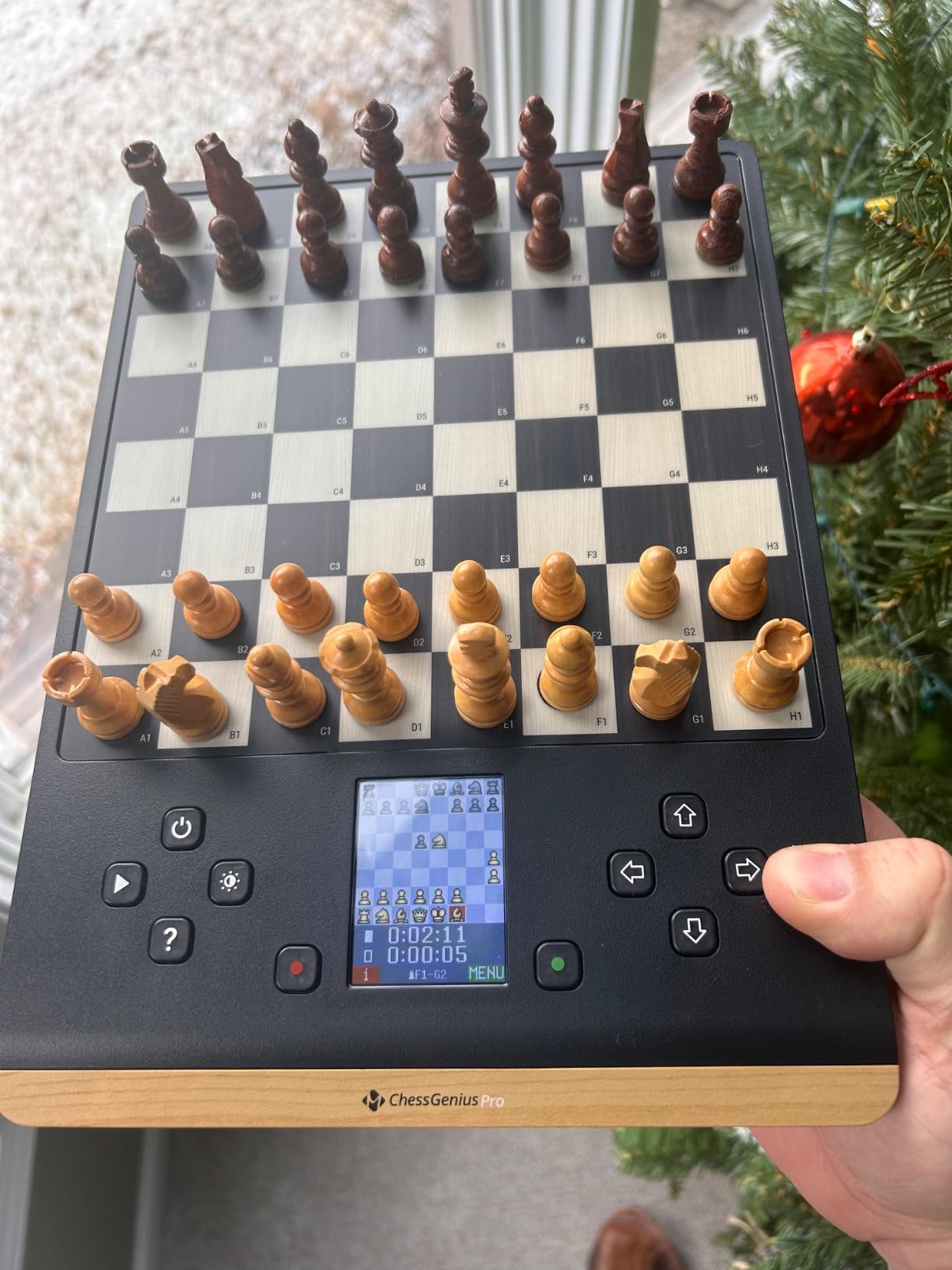
The handcrafted wooden pieces have a satisfying tactile feel, and the magnetic design keeps everything secure during travel. I took this board on a weekend trip and played about 30 games against the AI, which felt far more productive than the same number of online bullet games.
The main limitation is the piece registration system. Instead of RFID technology that automatically detects piece movement, you press the starting square and then the destination square for each move. It takes about 10 games to get used to, and after that it becomes second nature, but it is an extra step compared to premium electronic boards that cost twice as much.
Screen-Free Training That Complements Digital Memberships
This board fills a gap that no premium chess membership can address: physical board vision. Online players often struggle when they transition to over-the-board tournaments because calculating moves on a physical board feels different from clicking on a screen. The ChessGenius Pro bridges that gap at a price that makes sense for intermediate players.
I recommend pairing this with a Chess.com Platinum membership. Use the online membership for game analysis, puzzles, and lessons, then use the physical board for practice games that build your OTB skills. The combination gives you both analytical depth and practical board feel.
Limitations to Consider Before Buying
The board runs on 4 AA batteries that are not included, and there is no USB charging option. At 1.3 pounds it is portable, but the slim profile (0.04 inches thick) means it feels more like a roll-up mat than a traditional chess board. Players looking for a substantial, furniture-quality board should look at Millennium’s higher-end models instead.
Also, this is strictly a play device. It does not connect to Chess.com or any online platform, so you cannot use it for online games or import your game history for analysis. Think of it as a dedicated practice partner rather than a training ecosystem.
3. How to Win at Chess by Levy Rozman – The Ultimate Beginner Guide
How to Win at Chess: The Ultimate Guide for Beginners and Beyond
272 Pages
Hardcover/Kindle/Spiral
Video Links Included
4.8 Stars from 3,468 Reviews
Pros
- Clear and friendly writing style covers all fundamentals
- Video links supplement written explanations
- Exceptional 4.8-star rating from over 3400 reviews
- Available in hardcover/ Kindle/ and spiral-bound formats
Cons
- Dark squares make pieces hard to see in physical edition
- Kindle version recommended for color clarity
- Some advanced players may find it too basic
Levy Rozman, better known as GothamChess, wrote the chess book that I wish existed when I started playing. “How to Win at Chess” covers everything from basic piece movement through intermediate tactics and strategy, all in Levy’s signature friendly and approachable style that made his YouTube channel the most popular chess channel on the platform.
The book is 272 pages of genuinely useful instruction organized into progressive lessons. Each chapter builds on the previous one, and Levy includes links to supplementary video content that demonstrates the concepts in real games. I found myself reading a chapter, then immediately applying it in my Chess.com games with noticeable results.
With a 4.8-star rating from over 3,400 reviews, this is one of the highest-rated chess books ever published. The 87% five-star rate tells you that this is not a mediocre guide with inflated ratings. Real readers, from complete beginners to players around 1200 ELO, report meaningful rating improvements after working through the material.
The spiral-bound edition is worth seeking out if you plan to use it as a working reference. It lays completely flat on a table, which matters when you are setting up positions on a board while reading. The hardcover is beautiful for a gift, but the spiral version is the one you want for actual study sessions.
Perfect Companion to Any Chess Membership
This book pairs naturally with every chess membership tier. If you are on the Chess.com free plan, the book gives you structured learning that replaces the locked lessons. If you have Gold or Platinum, the book reinforces concepts you learn in the video lessons with additional examples and exercises. I kept it next to my computer during my first three months of serious study.
The endgame section alone is worth the purchase. Levy covers practical endgames that actually appear in online play, not the theoretical positions you find in advanced endgame manuals. Learning to convert winning endgames and hold drawn ones is the fastest way to gain rating points below 1500.
What Could Be Better
The main complaint across reviews is about the physical printing. The dark squares on the board diagrams make it difficult to distinguish dark pieces, especially black bishops and knights. This is not an issue with the Kindle version, which displays colors clearly on any screen. If you buy the physical edition, expect to squint at some diagrams.
Players rated above 1500 will likely find most of the content too basic. This is fundamentally a beginner-to-intermediate book, and while the advanced sections have useful material, they do not match the depth you get from dedicated training resources or a premium Chess.com Diamond membership.
4. The Beginner to Winner Chess Opening Formula – Free Kindle Ebook
The Beginner to Winner Chess Opening Formula: Play Better Chess and Win More Games With Proven Opening Principles, Tips and Tactics
82 Pages
Free Kindle Ebook
Opening Principles
Screen Reader Supported
Pros
- Completely free Kindle ebook with zero cost
- Good introduction to fundamental opening principles
- Easy to understand format for absolute beginners
- Screen reader supported for accessibility
Cons
- Only 82 pages of relatively basic content
- First half covers piece movement nomenclature
- Limited examples may leave advanced beginners wanting more
The Beginner to Winner Chess Opening Formula is a free Kindle ebook that focuses on opening principles rather than memorizing specific lines. At 82 pages, it is a quick read that covers why certain opening moves are strong and others are weak, without drowning you in theory. I downloaded it during a lunch break and finished it the same evening.
The book emphasizes proven principles like controlling the center, developing pieces early, and king safety. These are the same fundamentals that Chess.com lessons teach, but presented in a self-contained format that does not require a subscription. For someone who is not ready to commit to a paid chess membership, this is a reasonable starting point.
However, the content is genuinely basic. The first half of the book explains piece movement notation, which most players who have played even a few games already know. The second half covers opening principles, which is useful but limited in depth. Think of this as a preview of what proper chess training looks like rather than a complete resource.
Zero-Risk Way to Start Learning Openings
The best thing about this ebook is the price: free. If you are on the fence about whether chess training materials help you improve, this removes all risk. Download it, spend an hour reading, and see if the opening principles click for you. If they do, you know investing in a premium chess membership or a more comprehensive book like Levy Rozman’s is worth it.
I recommend this specifically for players in their first month of chess who want something structured to read alongside their first Chess.com games. It bridges the gap between knowing how the pieces move and understanding the first few moves of a real game.
When You Will Outgrow This Book
Most players will outgrow this material within a few weeks of regular play. Once you understand basic opening principles and have played 50-100 games, the 82 pages here will feel elementary. That is not a flaw in the book, it is just the reality of a short introductory resource. The natural next step is either Levy Rozman’s comprehensive book or a Chess.com Gold membership for unlimited access to structured lessons.
Players who already have a rating above 900 on Chess.com should skip this ebook entirely and go straight to a paid membership. The opening principles covered here are things you have likely already internalized through gameplay.
Free Alternatives: Lichess Patron and Other Platforms
No guide to premium chess memberships is complete without addressing the elephant in the room: Lichess is completely free and offers many features that Chess.com reserves for paid tiers. Lichess provides unlimited puzzles, game analysis with Stockfish, opening explorer, and unlimited games across all time controls at zero cost.
Lichess also offers a voluntary Patron subscription that funds the platform. Patron does not unlock additional features since everything is already free. Instead, it supports the open-source project and gives you a cool icon next to your username. The Patron model is appealing if you believe chess tools should be accessible to everyone regardless of financial situation.
Where Lichess falls behind Chess.com is in structured learning content. Chess.com’s lesson library, video courses, and adaptive bots provide a guided improvement path that Lichess lacks. Lichess is like a fully equipped gym with no personal trainer, while Chess.com premium is a gym that includes coaching sessions in your membership.
ChessKid, designed for players under 13, offers its own membership structure. The Gold tier unlocks unlimited puzzles, lessons, and bots for children, while the family plan covers up to five accounts. If you are choosing a platform for a young player, ChessKid provides age-appropriate content and parental controls that Chess.com and Lichess do not offer.
Chessable rounds out the premium chess ecosystem as a course-based platform. Rather than a flat membership, you purchase individual courses created by grandmasters and international masters. The spaced repetition system ensures you retain what you study. Chessable works best as a supplement to Chess.com or Lichess, not a replacement.
How to Choose the Right Premium Chess Membership
Picking the right membership comes down to your current rating, your improvement goals, and how much time you spend on chess each week. Here is how I break it down after testing every option.
For Beginners (Under 1000 Rating)
Start with Chess.com Gold or even the free plan paired with Levy Rozman’s book. The unlimited puzzles from Gold will build your pattern recognition faster than anything else at this stage. You do not need advanced game analysis yet because most of your games are decided by one-move blunders that are easy to spot in a basic review.
If budget is tight, use the free Chess.com plan plus Lichess for unlimited puzzles and game analysis. Add the free opening ebook to cover fundamentals. This combination costs nothing and gets you through the beginner phase effectively.
For Intermediate Players (1000-1500 Rating)
Chess.com Platinum is the best premium chess membership for this range. The unlimited game analysis shows you exactly where you are losing games, and the opening explorer helps you build a repertoire based on what actually works at your rating level. This is where detailed feedback matters most, because your mistakes become positional rather than tactical.
I spent about 18 months in this range, and Platinum’s game review was the tool that helped me understand concepts like piece activity, pawn structure weaknesses, and king safety in practical game situations rather than abstract lessons.
For Advanced and Tournament Players (1500+ Rating)
Chess.com Diamond or ChessBase 26 Premium are the right tools at this level. Diamond’s Insights feature reveals long-term patterns in your play that individual game reviews miss. You discover which openings you perform best with, where your endgame technique breaks down, and how your accuracy varies across time controls.
For players competing in rated over-the-board tournaments, ChessBase adds the database preparation layer that online memberships cannot match. Being able to study your opponent’s games and prepare specific lines gives you a competitive edge that no amount of online training replaces.
Budget Considerations
Annual subscriptions offer significant savings over monthly billing on every platform. Chess.com’s annual pricing works out to roughly 40% less per month compared to paying monthly. If you are confident you will use the membership for at least 6 months, always choose the annual option.
Chess.com also offers a 30-day money-back guarantee on all memberships, which removes the risk entirely. Try any tier for a month, and if you are not seeing improvement or not using the features enough to justify the cost, cancel for a full refund.
Reddit users consistently recommend Platinum as the best value tier. It costs roughly two-thirds of what Diamond costs annually while delivering the features that matter most for improvement: unlimited puzzles, game analysis, and the opening explorer. Diamond is worth the premium only if you will actively use the Insights tool and the video lesson library.
FAQ
What is the best premium Chess.com membership?
Chess.com Platinum is the best premium membership for most players. It provides unlimited game analysis with coach explanations, unlimited puzzles, the opening explorer, and the endgame trainer. Diamond adds the Insights analytics tool and video library, which are valuable for advanced players but not essential for most. Gold is a good entry point focused on puzzles and lessons.
Is chess premium membership worth it?
Yes, a premium chess membership is worth it if you play chess regularly and want to improve. The unlimited puzzles alone (available from Gold upward) build pattern recognition that directly translates to better game results. Game analysis (Platinum and Diamond) shows you exactly where your play breaks down, which is the fastest path to fixing weaknesses. Most players see measurable rating improvement within the first month.
What is the 20 40 40 rule in chess?
The 20/40/40 rule is a training guideline suggesting that players under 2000 rating should spend roughly 20% of study time on openings, 40% on middlegame tactics and strategy, and 40% on endgames. This prevents the common mistake of memorizing opening lines while neglecting the tactical vision and endgame technique that actually win games at club level.
Is Chess.com better than Lichess for learning?
Chess.com is better for structured learning because it offers guided lessons, video courses, and adaptive bots that create a clear improvement path. Lichess offers unlimited puzzles and free game analysis that rival Chess.com’s paid features, but it lacks the curated educational content. For self-directed learners who already know what to study, Lichess is excellent. For players who want guided instruction, Chess.com premium is the better choice.
Can I get Chess.com premium for free?
Chess.com occasionally runs promotions and challenges that award free premium time, such as the annual PogChamps events. You can also receive premium memberships as gifts from other users. Some users on Reddit have reported getting free trial offers after extended periods of free play. However, there is no standard free trial, and most users need to purchase a subscription to access premium features.
Final Verdict on Premium Chess Memberships
After testing every major chess subscription and training tool available in 2026, our team recommends Chess.com Platinum as the best premium chess membership for most players. It delivers the features that directly improve your rating: unlimited game analysis, unlimited puzzles, the opening explorer, and structured lessons. The step up from Gold to Platinum matters more than the step from Platinum to Diamond for 90% of players.
For tournament competitors and coaches, ChessBase 26 Premium adds the professional database tools that no online membership can match. Pair it with the Millennium ChessGenius Pro for screen-free board vision practice, and you have a training setup that covers every dimension of chess improvement.
Start with the tier that matches your current commitment level. Chess.com offers a 30-day money-back guarantee, so there is no risk in trying a higher tier and downgrading if you do not use the extra features. The most important thing is to pick a membership and actually use it consistently. A Gold membership used daily beats a Diamond membership used once a week.