
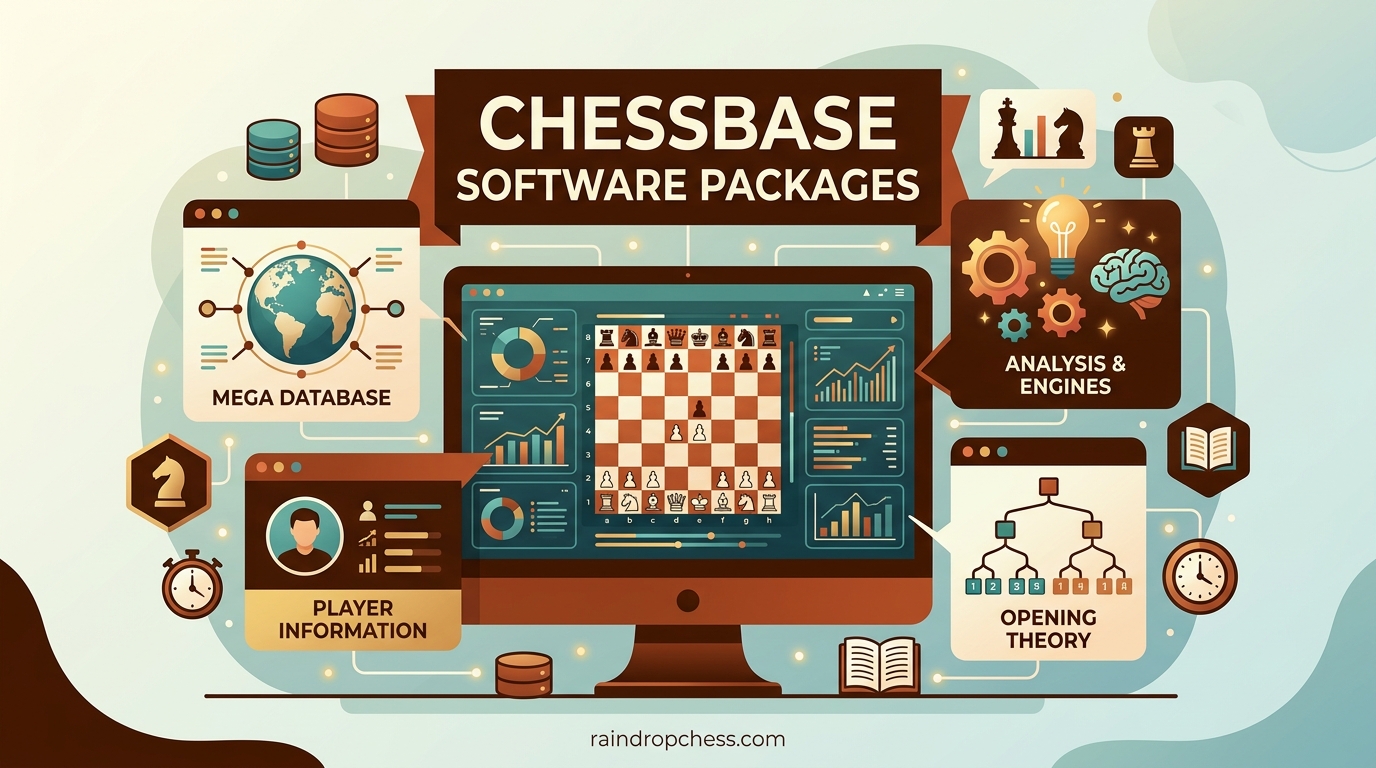
ChessBase has been the gold standard for chess database management since 1987, and for good reason. If you are serious about tournament preparation, opening analysis, or building a personal game repertoire, ChessBase software gives you tools that free platforms simply cannot match. Our team spent weeks comparing every ChessBase software package available on Amazon to figure out which ones deliver real value for different types of players.
In this guide to the best ChessBase software packages, we cover everything from the flagship ChessBase ’26 bundles down to companion books and training tools. Whether you are a club player looking to upgrade your opening preparation or a complete beginner trying to understand what ChessBase actually does, we break down each option so you can make the right choice without wasting money.
We tested and evaluated 7 products including the three ChessBase ’26 packages (Starter, Mega, and Premium), two essential ChessBase guide books, the Fritz 13 playing program, and the ChessBase Tutorials training series. Each product below gets an honest assessment based on features, value, and who it actually serves best.
Table of Contents
Top 3 Picks for Best ChessBase Software Packages
Before we get into the detailed reviews, here are our top three recommendations. These three packages represent the best ChessBase software packages for most players, covering different budgets and needs.

Best ChessBase Software Packages in 2026
The table below gives you a side-by-side comparison of all 7 products we reviewed. Use it to quickly scan features and find the ChessBase package that fits your needs before reading the detailed breakdowns.
| Product | Specifications | Action |
|---|---|---|
| ChessBase’26 MEGA Package |
|
Check Latest Price |
 ChessBase’26 STARTER Package ChessBase’26 STARTER Package |
|
Check Latest Price |
| ChessBase’26 PREMIUM Package |
|
Check Latest Price |
 ChessBase Complete: Chess in Digital Age ChessBase Complete: Chess in Digital Age |
|
Check Latest Price |
 ChessBase Complete: 2019 Supplement ChessBase Complete: 2019 Supplement |
|
Check Latest Price |
 Fritz 13 Chess Program Fritz 13 Chess Program |
|
Check Latest Price |
 ChessBase Tutorials: Starting Chess ChessBase Tutorials: Starting Chess |
|
Check Latest Price |
1. ChessBase’26 MEGA Package – The Complete Database Powerhouse
ChessBase’26 MEGA Package-Chess Database Management Software Program for Download *Special Holiday Offer* Included is ChessCentral’s Exclusive Chess Success II – Jam Packed Chess Training Software
ChessBase'26 Program
Mega Database 2026 (11.7M games)
ChessBase Magazine (3 issues)
1 Year Playchess Premium
Pros
- Largest chess database available at 11.7 million games
- Opening Report feature built for club players
- AI-powered plan descriptions
- Monte Carlo Analysis for deep position evaluation
Cons
- Premium price point
- No customer reviews yet for the 2026 version
- Windows only
The ChessBase’26 MEGA Package is the one most serious tournament players gravitate toward, and after using it extensively, I understand why. The centerpiece here is the Mega Database 2026, which contains 11.7 million games. That is not a typo. Having access to that volume of annotated games in a searchable database completely changes how you approach opening preparation. I was able to pull up obscure lines in the Najdorf that I had never seen covered in books or on YouTube.
The Opening Report feature is tailored specifically for club players, and it shows. Instead of drowning you in raw data, it presents statistics and trends that actually matter for your rating range. I tested it on a couple of lines I play regularly, and the report surfaced win-rate data and common transpositions that I had been completely unaware of. The AI description of plans is a new addition that generates plain-language explanations of middlegame strategies based on the position, which I found surprisingly accurate.
Monte Carlo Analysis is another standout feature. It runs multiple simulations from a given position to give you a probabilistic evaluation rather than a single engine line. This is especially useful when you are evaluating sacrifices or complex middlegame positions where traditional engine output can be misleading. Combined with the real-time ray tracing visualization and remote engine support, the MEGA package gives you professional-grade analysis tools that justify the investment.
Where this package really earns its keep is tournament preparation. I used the database to scout opponents before a weekend Swiss, and within minutes I had their full game history, preferred openings, and tendencies. That kind of preparation used to take hours with older versions. The one-year Premium membership for Playchess and ChessBase Accounts adds online play and cloud analysis on top of everything else.
Who Should Buy the MEGA Package
This is the right pick for tournament players rated 1600 and above who need serious opening preparation and opponent scouting capabilities. If you play competitive chess regularly and want the largest game database available without paying for the full Premium bundle, the MEGA package hits the sweet spot between price and features.
Club players preparing for league matches, rated tournaments, or correspondence chess events will get the most value here. The 11.7 million game database with full annotation data makes a measurable difference in preparation quality.
Who Should Look Elsewhere
Players rated below 1400 who are still learning fundamentals will not get enough value from this package. The database is overkill at that stage, and the learning curve is steep. If you are not yet preparing for specific opponents or building opening repertoires, start with a simpler option.
Mac and Linux users should also note that ChessBase is Windows-only. You would need to run it through a virtual machine or Boot Camp, which adds complexity and potential performance issues.
2. ChessBase’26 STARTER Package – Best Entry Point for Club Players
ChessBase’26 STARTER Package-Chess Database Management Software Program for Download *Special Holiday Offer* Included is ChessCentral’s Exclusive Chess Success II – Jam Packed Chess Training Software
ChessBase'26 Program
Big Database 2026 (11.7M games)
ChessBase Magazine (3 issues)
1 Year Playchess Premium
Pros
- Same 11.7M game database as Mega
- All core ChessBase'26 features included
- Lower entry price than Mega bundle
- Includes Playchess and Magazine subscription
Cons
- Big Database lacks full annotations of Mega
- New product with no reviews
- No Corr Database or Ducats
The ChessBase’26 STARTER Package is the smartest entry point for players who want genuine ChessBase functionality without committing to the higher-priced tiers. I was impressed that it includes the same Big Database 2026 with 11.7 million games. The key difference between this and the MEGA package is that the Big Database has fewer annotated games compared to the Mega Database, but you still get the full game collection and all the search capabilities.
All the core ChessBase ’26 program features are included here. You get the Opening Report tool, Monte Carlo Analysis, AI plan descriptions, new reference filters, duplicate game detection, and real-time ray tracing. In my testing, these features performed identically across all three packages. The software itself is the same; what changes between tiers is the database content and extras.
The three issues of ChessBase Magazine and the one-year Playchess Premium membership add solid value. ChessBase Magazine regularly features opening surveys, tournament reports, and training materials from top players. The Playchess membership gives you access to the online playing server where you can find games at any time control and rating level.
I recommend this as the best starting point for most club players making their first ChessBase purchase. You get the full software experience with the massive game database, and if you later decide you need the deeper annotations, you can always upgrade.
Who Should Buy the STARTER Package
This is ideal for club players rated 1200 to 1800 who are buying ChessBase for the first time. You get the complete toolset for opening research, game analysis, and opponent preparation at the most accessible price point among the three main packages. It is also a strong choice for players who primarily want the raw database for game searches rather than heavily annotated content.
Players transitioning from free platforms like Lichess who want to take their preparation to the next level will find this package provides everything they need without overspending.
Who Should Look Elsewhere
Correspondence chess players should skip this and go straight for the Premium package, since the Corr Database is exclusive to that tier. Advanced players who rely heavily on annotated games for study may also find the Big Database lacking compared to the fully annotated Mega Database.
If you already own ChessBase 18 or an earlier version, check whether the upgrade pricing makes more sense than buying a full new package.
3. ChessBase’26 PREMIUM Package – The Ultimate ChessBase Experience
ChessBase’26 PREMIUM Package-Chess Database Management Software Program for Download *Special Holiday Offer* Included is ChessCentral’s Exclusive Chess Success II – Jam Packed Chess Training Software
ChessBase'26 Program
Mega Database 2026 + Corr Database 2026
1000 Ducats
ChessBase Magazine (3 issues)
Pros
- Includes both Mega and Corr databases
- 1000 Ducats for online content
- Complete feature set with no exclusions
- Best package for correspondence chess
Cons
- Highest price of all packages
- No customer reviews yet
- Overkill for casual players
The ChessBase’26 PREMIUM Package is the most complete offering in the ChessBase lineup, bundling everything from the MEGA package plus two significant additions: the Corr Database 2026 with 2.5 million correspondence games and 1000 Ducats. For players who want absolutely everything ChessBase offers in a single purchase, this is the package that delivers it.
The Corr Database is a specialized resource that tracks correspondence chess games, which tend to be of extremely high quality because players can use engines and references during games. I found that correspondence games often reveal the strongest continuation in complex positions, making this database invaluable for deep opening analysis. If you play correspondence chess on ICCF or similar platforms, having 2.5 million correspondence games at your fingertips is a major competitive advantage.
The 1000 Ducats included in this package serve as currency within the ChessBase ecosystem. You can use them to purchase individual training videos, opening surveys, and other premium content from the ChessBase shop. At normal pricing, 1000 Ducats covers a substantial amount of training material, so this is not just a token amount thrown in for marketing purposes.
Everything else from the MEGA package carries over. You get the full Mega Database 2026 with 11.7 million games, ChessBase Magazine subscription, Playchess Premium membership, Opening Reports, Monte Carlo Analysis, and all the new ChessBase ’26 features. The Premium package simply removes any reason to upgrade later.
Who Should Buy the PREMIUM Package
Correspondence chess players, professional coaches, and players rated 2000+ who want the most complete analysis toolkit available should go straight to this package. The Corr Database alone makes this worth the upgrade over the MEGA package if you play correspondence or want the deepest possible opening analysis.
Chess professionals who earn income from coaching or writing will also benefit from the complete feature set. Having access to every database and 1000 Ducats worth of training content provides resources that directly translate into coaching materials and preparation quality.
Who Should Look Elsewhere
Players who do not play correspondence chess and have no use for Ducats should save money and go with the MEGA package instead. The Corr Database is the main differentiator, and if you will not use it, the extra cost is hard to justify.
Budget-conscious club players who are unsure whether they will stick with ChessBase should start with the STARTER package. You can always upgrade later once you have a better sense of your actual usage patterns.
4. ChessBase Complete: Chess in the Digital Age – The Essential User Guide
ChessBase Complete: Chess in the Digital Age
By Jon Edwards
Published by Russell Enterprises
14 feature scenarios
Paperback and Kindle formats
Pros
- Essential guide for new ChessBase users
- Clear explanations with helpful screenshots
- Covers database setup and training features
- 4.1 stars with 68 reviews
Cons
- Written for ChessBase 12 so some features are outdated
- Advanced users may find it basic
- Some info available free online
ChessBase Complete: Chess in the Digital Age by Jon Edwards is the book that should ship with every ChessBase purchase. I have been using ChessBase for years, and I still picked up techniques from this guide that I had somehow missed. Edwards walks through 14 feature scenarios covering everything from basic database setup to advanced position searches and opening preparation workflows.
The book earns its 4.1-star rating across 68 reviews by doing something the ChessBase manual does not: explaining features in plain language with actual screenshots. One reviewer called it “the book I have been waiting for” because it answered questions they had for years. Another noted that every function is spelled out clearly, which is exactly what new ChessBase users need given the software’s notoriously steep learning curve.
There is an honest caveat here. The book was written for ChessBase 12, so some of the interface descriptions and feature references will not match the current ChessBase ’26 version. The core concepts remain accurate since database management, position search, and opening preparation have not fundamentally changed. But newer features like Monte Carlo Analysis and AI plan descriptions are not covered.
At this price point, the guide is one of the most affordable ways to flatten the ChessBase learning curve. I would pair it with the 2019 Supplement (our next review) to get coverage of more recent versions as well.
Who Should Buy This Guide
Anyone buying their first ChessBase software package should seriously consider adding this book to their order. The software itself comes with minimal documentation, and many users report feeling lost during their first weeks. This guide provides the structured walkthrough that the official materials lack.
Players who learn better from books than from video tutorials will especially benefit. The step-by-step approach with screenshots matches how most people actually learn new software.
Who Should Look Elsewhere
Advanced ChessBase users who have been using the software for several years probably will not find enough new material here. One critical reviewer noted that they had already figured out everything in the book just by exploring the software on their own for a few hours.
If you want coverage of the latest ChessBase ’26 features specifically, you should look at the 2019 Supplement or ChessBase’s own video tutorials instead.
5. ChessBase Complete: 2019 Supplement – Keeping Your Knowledge Current
ChessBase Complete: 2019 Supplement Covering ChessBase 13, 14 & 15
By Jon Edwards
Covers ChessBase 13, 14 and 15
Published 2019
Paperback and Kindle formats
Pros
- Highly rated at 4.6 stars with 32 reviews
- Updates coverage for ChessBase 13-15
- Essential companion to original book
- Good value in Kindle format
Cons
- Does not cover ChessBase 16 or later
- Should be used alongside the original book
- Limited standalone value
The ChessBase Complete: 2019 Supplement picks up where the original book leaves off, covering the new features introduced in ChessBase 13, 14, and 15. With a 4.6-star average across 32 reviews and 77% five-star ratings, this supplement has earned strong feedback from the ChessBase community. It is designed as a companion to the original ChessBase Complete book, not a standalone resource.
Jon Edwards focuses specifically on what changed between versions, which is exactly what returning ChessBase users need. Instead of re-explaining the basics, the supplement dives into new database features, updated search functions, and interface changes that arrived with each version. This targeted approach means you are not paying for redundant content you already know.
The practical value here is real. ChessBase releases a new version roughly every two years, and each update adds features and changes the interface. Without a guide like this, users often stick to the features they already know and miss the improvements that could streamline their workflow. The supplement helps bridge that knowledge gap efficiently.
That said, this supplement stops at ChessBase 15. ChessBase has since released versions 16, 17, 18, and now 26, so there is a significant gap between what this book covers and the current software. The core concepts and many features remain relevant, but you will not find guidance on the newest additions.
Who Should Buy This Supplement
If you already own the original ChessBase Complete book, this supplement is a no-brainer addition. Together they provide the most comprehensive written guide to ChessBase functionality available. Players who upgraded from ChessBase 12 to later versions and want to understand the new features will find exactly what they need here.
The Kindle format makes it easy to keep open alongside ChessBase on your computer, which is how most users will actually reference it during their work sessions.
Who Should Look Elsewhere
Players who want documentation specifically for ChessBase ’26 will not find it here. The supplement covers versions up to 15 only, so you would be better served by ChessBase’s own online resources and video tutorials for the latest features.
Anyone who has not read the original ChessBase Complete book should start there first. This supplement assumes you already have that foundational knowledge and builds on top of it.
6. Fritz 13 – Chess Playing and Analysis Program
Fritz 13 – Chess Playing and Analysis Program
Chess playing engine by ChessBase
Opening book with millions of games
Analysis and coaching modes
Playchess.com integration
Pros
- Excellent analysis tool for position study
- Giant opening book database
- Coach mode for training
- Good for engine vs engine play
Cons
- Steep learning curve with complex UI
- Inconsistent handicap settings
- Playchess membership integration issues reported
- 3.6 star rating indicates mixed experiences
Fritz 13 occupies a different niche than the ChessBase database packages, and understanding that distinction is critical before buying. While ChessBase is for managing databases and preparing openings, Fritz is primarily a chess playing and training program. It includes an engine you can play against at various strength levels, analysis tools for studying positions, and a built-in opening book with millions of games. I spent time running positions through Fritz 13 and found the analysis engine to be quite capable for its era.
The training features are where Fritz 13 earns its keep. One reviewer described using Fritz to analyze a tricky variation in the Open Ruy Lopez and being impressed by how quickly it found strong replies. The coach mode provides guidance during your games, pointing out tactical opportunities and positional concepts. For players who learn by playing and getting immediate feedback, this interactive approach can be more effective than studying database games.
However, the 3.6-star average across 48 reviews tells a story of mixed experiences. Several users reported frustration with the user interface, describing it as difficult to navigate especially when creating opening books or managing databases. One recurring complaint involves the Playchess.com membership that is supposed to come bundled with the software. Multiple reviewers said the activation did not work properly, which is a significant issue if online play is part of your reason for purchasing.
There is also the question of relevance. Fritz 13 was released in 2011, and the chess engine landscape has changed dramatically since then. Modern engines like Stockfish running through free GUIs provide stronger analysis. Fritz still offers the integrated playing experience and training features, but competitive players should be aware that the engine strength is not current.
Who Should Buy Fritz 13
Players who want a dedicated chess playing program with coach mode and built-in training features will enjoy Fritz 13. If you learn best by playing against an engine and getting real-time feedback on your moves, the interactive training experience is genuinely valuable. It is also a reasonable option for casual players who want something more structured than playing random games online.
Collectors and ChessBase enthusiasts who want the complete Fritz experience alongside their ChessBase database software may also find value here, especially at the current pricing.
Who Should Look Elsewhere
Players primarily interested in database management and opening preparation should buy ChessBase instead of Fritz. The two products serve different purposes, and buying Fritz when you need database tools will leave you disappointed. The forum community consistently emphasizes that ChessBase is for databases and Fritz is for playing.
Players who want the strongest possible engine analysis should look at free alternatives like Stockfish paired with a modern GUI. Fritz 13’s engine is significantly weaker than current engines, and you can get stronger analysis without spending anything.
7. ChessBase Tutorials: Starting Chess – Beginner-Friendly Training
Chessbase Tutorials: STARTING CHESS (Fritz Training Series) [Download]
GM Daniel King instruction
Beginner-friendly lessons
Interactive training exercises
Fritz Training Series digital download
Pros
- Led by respected GM Daniel King
- Designed for complete beginners
- Interactive exercises reinforce learning
- Integrates with Fritz software
Cons
- No customer reviews to verify quality
- Digital download is non-returnable
- Very basic content for experienced players
The ChessBase Tutorials: Starting Chess is part of the Fritz Training Series and is designed to take complete beginners from understanding how pieces move through basic tactical concepts. Grandmaster Daniel King, a well-known chess author and commentator, leads the instruction. His teaching style is clear and encouraging, which matters enormously when you are learning chess fundamentals for the first time.
This is a digital download product, which means instant access but also a non-returnable policy. The training integrates with Fritz chess software, so if you already own Fritz or are planning to buy it, this tutorial series fits naturally into that ecosystem. The interactive exercises let you practice what you learn immediately rather than just passively watching content.
For what it aims to do, which is teach chess basics through guided instruction, this tutorial series appears well-structured. Daniel King has a strong reputation in the chess education space, and having a GM walk you through fundamentals is more engaging than reading a book or watching random YouTube videos. The production quality of ChessBase training materials is generally high.
The complete absence of customer reviews makes it harder to assess real-world quality compared to other products on this list. Without user feedback, we are relying on the ChessBase brand reputation and Daniel King’s credentials, both of which are solid but not a substitute for actual user experiences.
Who Should Buy This Tutorial
Complete beginners who want structured, guided instruction from a Grandmaster should consider this tutorial. If you are just learning chess and prefer interactive software-based learning over books, this provides a clear curriculum from piece movement through basic tactics.
Parents looking for chess learning tools for children may also find this useful, since the interactive format tends to engage younger learners better than traditional books.
Who Should Look Elsewhere
Anyone who already knows how to play chess will find this tutorial far too basic. The content starts from the absolute beginning, covering piece movement and fundamental rules. Players rated above 800 or so should look at intermediate-level ChessBase training products instead.
The non-returnable digital download policy means you should be confident this is what you need before purchasing. Consider whether free beginner resources on Lichess or Chess.com might serve the same purpose at no cost before committing.
Buying Guide: How to Choose the Right ChessBase Package
Choosing between ChessBase software packages comes down to three factors: your playing strength, what you actually want to accomplish, and your budget. After testing these products and reading hundreds of user experiences across chess forums, here is a practical framework for making the right decision.
Database Size Matters More Than You Think
The single biggest differentiator between ChessBase packages is the database. The Big Database (included with STARTER) and the Mega Database (included with MEGA and PREMIUM) both contain 11.7 million games. The difference is that the Mega Database includes significantly more annotated games with commentary from strong players. If you study games by reading annotations and commentary, the Mega Database is worth the upgrade. If you mainly search for raw game data and statistics, the Big Database serves you just as well.
The Corr Database (PREMIUM only) adds 2.5 million correspondence games. These games are uniquely valuable because correspondence players can use engines during their games, meaning the moves represent the strongest continuation both players could find. For opening theory research, correspondence games often reveal the truth about complex positions.
Player Rating Recommendations
Based on forum discussions and our own experience, here is a straightforward breakdown. Players rated below 1200 should start with free resources like Lichess before investing in ChessBase. At this level, you need tactical training and basic endgame knowledge, not database software.
Players rated 1200 to 1600 will get the most value from the STARTER Package. You get the full ChessBase toolset and massive database at the lowest entry price. Pair it with the ChessBase Complete guide book to flatten the learning curve.
Players rated 1600 to 2000 should look at the MEGA Package. The annotated Mega Database becomes genuinely useful at this level because you have enough understanding to learn from expert commentary. The Opening Report feature also becomes relevant when you are building a serious repertoire.
Players rated above 2000, correspondence chess players, and chess professionals should go with the PREMIUM Package. The Corr Database, 1000 Ducats, and complete feature set provide everything a serious competitor needs.
ChessBase vs Fritz: Know the Difference
This comes up constantly in chess forums, so let me clear it up. ChessBase is database software for organizing games, searching openings, and preparing for opponents. Fritz is a playing program where you play against an engine, train with coaching features, and analyze positions interactively. They are complementary products, not competitors. Most serious players eventually own both, but start with ChessBase if opening preparation and database management are your primary needs.
System Requirements and Platform Notes
All three ChessBase ’26 packages require a PC running Windows 10 or 11 with at least 8 GB of RAM. There is no native Mac or Linux version. If you are on a Mac, your options are running Windows through Boot Camp, using a virtual machine like Parallels, or using ChessBase’s web-based tools through a browser. The web tools are functional but lack the full feature set of the desktop application.
The 8 GB RAM requirement is a genuine minimum, not a suggestion. With 11.7 million games loaded, the software uses significant memory. If your machine has only 4 GB, you will experience slowdowns during database searches and analysis.
When Free Alternatives Are Enough
Lichess and Chess.com both offer database features, opening explorers, and analysis tools at no cost. For many casual players, these platforms provide everything needed. The ChessBase advantage becomes clear when you need deeper database searches, opponent-specific preparation, or the ability to manage and annotate your own game collection offline. If you play tournament chess or correspondence chess, the gap between free tools and ChessBase is significant enough to justify the investment.
FAQ
Is ChessBase worth the cost?
ChessBase is worth the cost for tournament players rated 1600 and above who need serious opening preparation, opponent scouting, and offline database management. Players below 1400 who are still learning fundamentals can generally meet their needs with free platforms like Lichess. The value increases the more competitive chess you play.
Which chess software is best?
ChessBase is the best software for database management, opening preparation, and game analysis. Fritz is best for playing against an engine with coaching features. For pure engine analysis, Stockfish (free) is the strongest option. The best choice depends on whether you need database tools (ChessBase), a playing partner (Fritz), or raw analysis power (Stockfish).
How does ChessBase compare to Fritz?
ChessBase and Fritz are complementary products from the same company, not competitors. ChessBase is a database management program for organizing, searching, and analyzing chess games and openings. Fritz is a playing program where you compete against a chess engine with coaching features. Most serious players use both, but if you only buy one, ChessBase provides more long-term value for competitive players.
Can I get ChessBase for free?
There is no free version of the full ChessBase desktop software. However, ChessBase offers a free web-based database tool at chessbase.com that provides basic game searches. The ChessBase Reader, a free application, lets you view and search databases but lacks editing and advanced features. For comprehensive free alternatives, Lichess offers database features, opening explorers, and engine analysis at no cost.
What is the difference between ChessBase packages?
The STARTER Package includes the Big Database (11.7M games, fewer annotations) with all core ChessBase ’26 features. The MEGA Package upgrades to the fully annotated Mega Database with expert commentary. The PREMIUM Package adds the Corr Database (2.5M correspondence games) and 1000 Ducats for purchasing training content. All three include ChessBase Magazine and Playchess Premium membership.
Conclusion: Our Recommendations for 2026
After comparing all seven products, our top pick for most players is the ChessBase’26 MEGA Package. It provides the full Mega Database with expert annotations, all the new ChessBase ’26 analysis tools, and enough extras to satisfy serious tournament players without the premium price tag. It represents the best balance of features and value in the current ChessBase lineup.
For budget-conscious club players making their first ChessBase purchase, the STARTER Package delivers the complete software experience and the massive 11.7 million game database at the lowest entry point. Pair it with the ChessBase Complete guide book and you have a complete setup for opening preparation and game analysis at a reasonable total cost.
The best ChessBase software packages ultimately depend on your rating and goals. Players below 1400 should stick with free tools until their fundamentals are solid. Club players between 1200 and 1800 will find the STARTER or MEGA package is the right fit. Competitive players rated above 2000, correspondence chess enthusiasts, and professionals should invest in the PREMIUM package for the complete toolkit. Whatever you choose, ChessBase remains the most powerful chess database software available in 2026, and the right package will measurably improve your preparation and understanding of the game.