
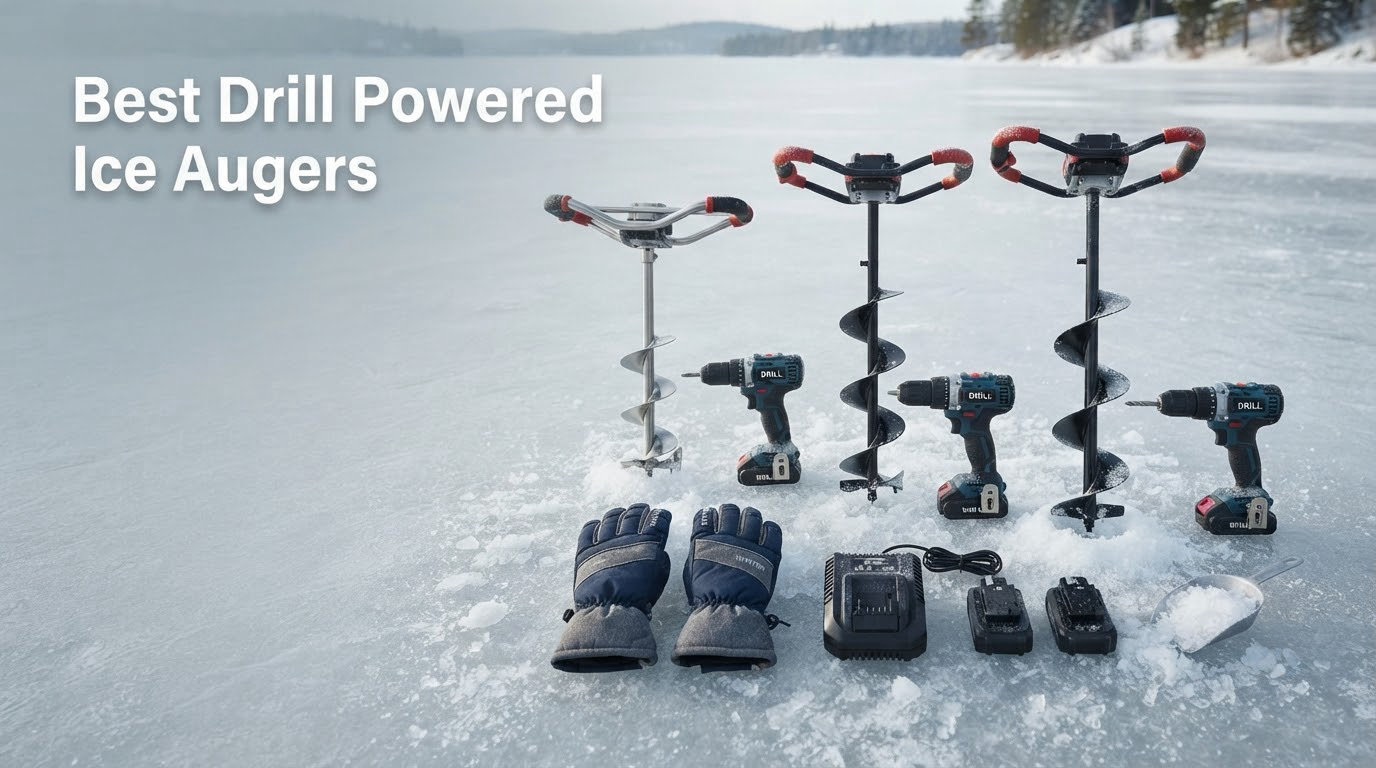
A drill powered ice auger is an ice fishing auger whose spiral flight and blades spin off a cordless drill instead of a hand crank or a gas engine. You clamp the auger into a half inch chuck, pull the trigger, and the spinning blades shave ice away while the flight pulls the shaft down, so a hole that takes twenty minutes of cranking takes under a minute. That speed, the silence, and a carry weight roughly a third of a gas auger is why most serious weekend hard water anglers made the switch.
Our team pulled specs, weights and owner feedback on ten drill powered ice augers, then sorted them by the things that actually end a good season early: torque starvation, a dulling blade in silty ice, and a battery that dies at 15 below. Every pick below works with a cordless hammer drill you either own or can buy once and reuse for everything else on the sled.
Worth saying plainly before the picks: yes, drill ice augers are worth it. A hand auger is the lightest option and it never fails, but twenty holes a day will wear out your shoulders long before it wears out the auger. Propane and electric augers are faster still and demand a dedicated machine, a dedicated battery, and a gas can or a heavy battery sled. A drill auger borrows the tool you already carry for every other winter task, runs without fumes inside a permanent shelter, and breaks down small enough to fit in a fish sled.
One caveat carries through this whole roundup. The auger is the consumable half of the system; the drill is the engine. Pair a mid-size auger with an underpowered drill and you will stall, overheat, and eventually cook the motor, which is the single most common complaint we found from owners. We note the drill requirement for every product below so you can match them before you buy, and we cover platform pairing in detail in the buying guide.
If you have not settled on a drill yet, our cordless drill set roundup covers the platforms that show up most often in ice auger setups, and our drum auger guide is the right reference if you also handle digging work where ice is not the medium.
Top 3 Drill Powered Ice Augers in 2026
These three cover the range most anglers need. The K-Drill is the balanced all-rounder with the best owner feedback score in the group, the Nordic Legend E-Drill Combo has the deepest review base of any auger here, and the Hardware Lite is the fastest high-volume option we found.

K-Drill Auger 7.5 in
- Cuts ice up to 36 inches
- Fits half inch chuck drills
- Floating design
- Tool-steel blades

Nordic Legend E-Drill Combo
- 8 inch nylon flighting
- 14 inch extension included
- Center point blade
- Works with most 18V-20V drills

Nordic Legend Hardware Lite
- 39 inch nylon shaft
- Dual replaceable steel blades
- Top plate included
- Center point blade
All 10 Drill Powered Ice Augers at a Glance in 2026
Diameter, drive style, and what each one is actually built for. All ten take a standard half inch chuck, and the listed weights are the manufacturer figures, so treat them as comparable rather than identical measurement methods.
| Product | Specifications | Action |
|---|---|---|
| K-Drill Auger 7.5 in IDRL75 |
|
Check Latest Price |
| Nordic Legend E-Drill Nylon Combo 8-in |
|
Check Latest Price |
| Nordic Legend Hardware Lite E-Drill 8-in |
|
Check Latest Price |
 Eyoyo 6-8 inch Nylon Auger Bit Eyoyo 6-8 inch Nylon Auger Bit |
|
Check Latest Price |
 Eskimo Pistol Bit 2.0 Eskimo Pistol Bit 2.0 |
|
Check Latest Price |
 Eskimo Redneck Bit 8-inch Eskimo Redneck Bit 8-inch |
|
Check Latest Price |
 VEVOR 8 inch 41 inch Nylon Auger VEVOR 8 inch 41 inch Nylon Auger |
|
Check Latest Price |
 Longrun Nylon 8 Inch Extended Auger Longrun Nylon 8 Inch Extended Auger |
|
Check Latest Price |
 NILS Convertible 8 inch Hand Auger NILS Convertible 8 inch Hand Auger |
|
Check Latest Price |
 Zunate 6 Inch Floating Auger Bit Zunate 6 Inch Floating Auger Bit |
|
Check Latest Price |
1. K-Drill Auger 7.5 in – the one we would pack
K-Drill Auger 7.5 in, IDRL75
7.5 inch cut
Aluminum shaft and composite flighting
Fits half inch chuck
Listed at 7.4 lb
Pros
- Cuts quickly when paired with a quality hammer drill
- Light for its cutting class
- Blades stay sharp over many seasons
- Floats if dropped in water
Cons
- An adapter is needed for some drill plate setups
- Drill capability drives the result more than the auger does
This is the auger we kept coming back to across dozens of owner accounts. The K-Drill 7.5 sits in a sweet spot that most roundups miss: big enough that you are not fighting a six inch hole for a lake trout, small enough that a mainstream eighteen to twenty volt hammer drill can turn it without strain. Owners running DeWalt and Milwaukee platforms describe cutting so fast that the slush clears almost before the hole is finished.
The build is where it earns its keep. A tool steel blade pair rides an aluminum shaft wrapped in composite flighting, and the listed weight of 7.4 pounds is a fraction of what a comparable gas auger puts on your sled. There is no battery pack to warm up in the truck and no pull cord to freeze. If the drill battery dies mid hole, you simply pull the shaft, clear the ice, and swap packs.
Blades are the consumable, and this is where the K-Drill earns repeat business for us. Owners report tool steel blades that arrive sharp and stay that way across many seasons of use, which matters most in early season ice where a dull blade is what stalls a drill and kills a motor. The floating design also means a dropped auger surfaces instead of sinking into slush you cannot see.
Two things to know before you commit. The 7.5 inch bore is a compromise: panfish anglers will find it oversized and pike anglers may want the wider hole. And owners who mounted it to certain drill plate conversions needed an extra adapter, so check what your setup requires before ordering.
How it performs on early season ice
The manufacturer rates it for ice up to 36 inches thick, and that number matters in February and March when lake ice gets thick and a hand auger becomes a workout. The 7.5 inch cut and tool steel blades are sized for that load, and reports of clean, fast holes in thick ice line up with the spec.
Owners consistently pair it with an eighteen volt or twenty volt hammer drill and get consistent results. One forum pattern worth copying is running the drill on its low speed, high torque setting rather than max RPM, which reduces the chance of a chuck walking loose mid hole.
Who should skip it
Skip it if your hole count is two or three a day. At that rate a hand auger is lighter, quieter, and does not require you to buy a capable hammer drill first. It is also the wrong pick for someone who wants a ten inch bore for muskie work without changing heads later.
Skip it if your only drill is a small brushless driver with a keyless plastic chuck. The spec sheet asks for a standard half inch chuck, and a light duty chuck on a heavy auger is exactly the combination that produces slipped shafts and burnt gearboxes. Our drill press and driver notes cover chuck quality differences if you are unsure what you own.
2. Nordic Legend E-Drill Nylon Combo 8-in – most holes per season of feedback
Nordic Legend E-Drill Nylon Ice Auger Combo and Universal Adapter with 14” Extension (8-in)
8 inch cut
33 inch shaft plus 14 inch extension
Center point blade
High visibility color
Pros
- Cuts deep ice in seconds on a 20V drill
- About a third lighter than a steel hand auger
- Extension rod reduces bending while drilling
- Blades hold up across seasons
Cons
- Height adjustment bolt threads can strip
- Needs a properly powerful cordless drill
With 158 owner reviews behind it, this Nordic Legend has the deepest feedback record of anything in our set, and that data is unusually consistent. Buyers report cutting 18 inches of ice and more in seconds on a DeWalt 20V or Milwaukee 18V, and several describe full seasons in the 60 hole range without a major failure. For a piece of gear that mostly lives in a sled, that consistency matters more than any single spec.
The construction is a synthetic nylon flighting over an aluminum stem with alloy steel blades and a separate center point blade. Nylon keeps the weight down and stays flexible in cold, and the high visibility finish is a small detail that saves you time when you are walking a hundred yards of flat light ice trying to find your last hole.
The combo package is the part that makes it stand out. You get a universal adapter, a 14 inch extension, three adjustable height settings, a safety cover, and a carry strap. The extension is a real ergonomic win: owners say it reduces the bending at the waist that comes with a short shaft, and on heavy ice that back fatigue is what ends a drilling day early.
The weak point is hardware, not cutting. Multiple reviews flag the height adjustment bolt threads stripping, and there is a report of a unit breaking early. The other recurring note is honest and important: this auger needs a genuinely high torque cordless drill to hit its rated speed, and pairing it with a weak drill is the fastest way to be disappointed.
Why the extension rod matters more than it looks
An eight inch bore in 20 inch ice generates a lot of resistance at the point where the blade meets the surface. Owners who added the extension report steadier posture and fewer stalls because the auger hangs further out in front of you, letting the drill pull straight down instead of you leaning over the hole.
It also changes hole placement in slush. With a longer shaft you can step back and let the auger find the center on its own rather than repositioning your hands over a wet hole. That matters most for anglers fishing structure where a crooked hole is a missed fish.
Where it falls short
The height adjustment system is the flaw. If the bolt strips, you lose one of the three height settings and the fix is hardware you may have to source separately. If you break it, the whole auger is still usable, so this is an annoyance rather than a deal breaker.
It is also not the answer for shallow ice. On a lake that rarely sees 12 inches, the 14 inch extension is dead weight in the sled and the nylon shaft is more than you need. Match the shaft length to your thickest expected ice instead of to the deepest ice you have ever seen.
3. Nordic Legend Hardware Lite E-Drill – the high-volume workhorse
Nordic Legend Hardware Lite E-Drill – Cordless Nylon Ice Drill Auger with Centering Point Blade, 8″ Ice Auger Bit with Adapter & Top Plate for Ice Fishing
8 inch cut
39 inch nylon shaft
Dual replaceable steel blades
Drill adapter and top plate
Pros
- 10-12 inches of ice in under 5 seconds on a Fuel hammer drill
- 15-20 holes on a single charge
- Blades are cheap and easy to replace
- Light enough to retire a gas auger
Cons
- Rubber guard strap broke on first adjustment
- Needs an 18V+ hammer drill or it stalls
- Very aggressive cutting needs wrist control
This is the pick for the angler who walks a long way, drills a lot of holes, and does not think about it. The 39 inch shaft is long enough to clear most early season ice without an extension, and owners running a Milwaukee Fuel hammer drill report 10 to 12 inches of ice in under five seconds. For a 30 hole day that adds up to time you get back fishing.
Battery efficiency is the quiet strength. Reviewers report 15 to 20 holes on a single charge, which is more than many standalone electric augers deliver. On a two battery setup you can drill a full day of holes on one pack while the second sits in your jacket against your body, which is the single most effective cold weather trick we know.
Blades are dual flat steel and replaceable, and the cheap widely available replacements are a genuine advantage. When a blade dulls in silty river ice, you are not filing it for an hour at a roadside table. You swap it, and you carry spares.
Three caveats from the review data. The rubber strap that holds the blade guard in place broke during first adjustments on multiple units, which is a two minute fix with a zip tie or a length of cord. The cutting is aggressive enough that a high torque drill can walk the bit off center if you do not keep your wrists behind it. And lower end brushless drills can stall or overheat on this auger, which is not the fault of the auger but does end the outing.
Does it handle overlapping holes
Overlapping holes, where a second hole is drilled into the side of the first, are the reason many anglers want an eight inch auger instead of a six inch one. The wide bore means the head has room to spin inside a partly collapsed hole without binding against the wall, and the center point blade keeps it tracking when the ice inside is already broken.
The hard part is not the auger, it is your feet. Start the first hole as vertical as you can, and expect the second hole to wander if the first one leaned. We see this same complaint in forum threads across every auger brand, and the center point helps but does not rescue a hole drilled at an angle.
Who this is not for
It is not the right tool if your trip is two holes and a thermos. The 39 inch shaft and the drill together are a lot of cargo for a short walk to a spot you could reach with a six inch bit. Serious hole-count anglers are the obvious audience.
It is also not for anyone unwilling to check the blade screws and guard strap before the first hole. That is ninety seconds of work, and skipping it is exactly how the complaints in this product’s reviews happen.
4. Eyoyo 6-8 inch Nylon Auger Bit – the overlapping-hole specialist
Eyoyo 8 Inch Diameter Ice Auger Bit, Nylon Cordless Drill Attachment
6-8 inch cut options
Centering point blade
Nylon body with hardened steel edges
Spare blades included
Pros
- Cuts a foot of ice in well under a minute
- Light and easy to transport on a sled
- Blades stay sharp for a full season
- Includes a spare set of blades
Cons
- Needs a half inch 80-120Nm drill to perform
- A few buyers question long-term build durability
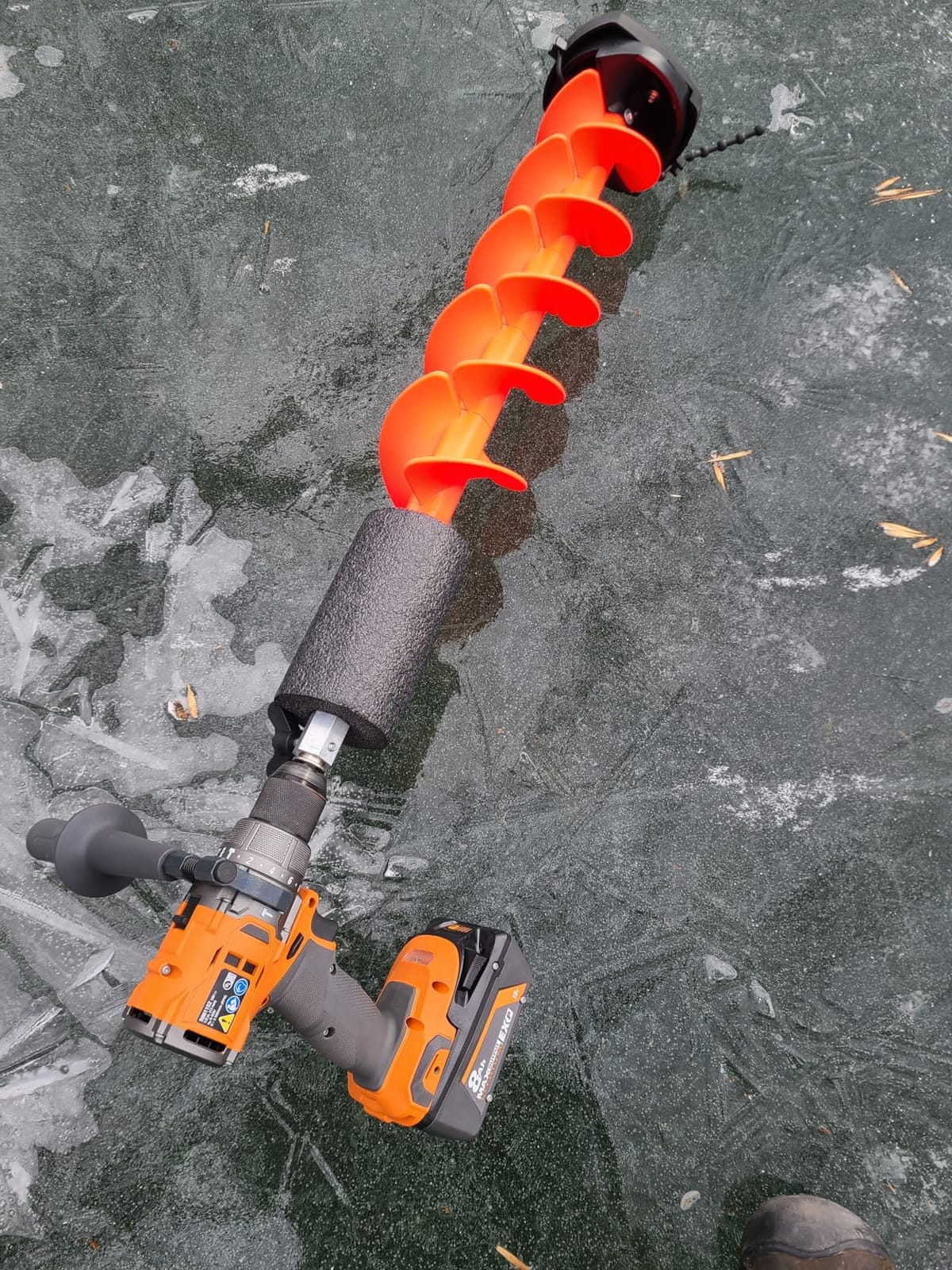
The Eyoyo stands out because it comes in 6 and 8 inch diameters, which makes it the easiest way to match your auger to your target species without buying a different machine. Walleye and perch anglers working a 6 inch hole and lake trout anglers who want a wider 8 inch opening can both run the same adapter and the same drill.
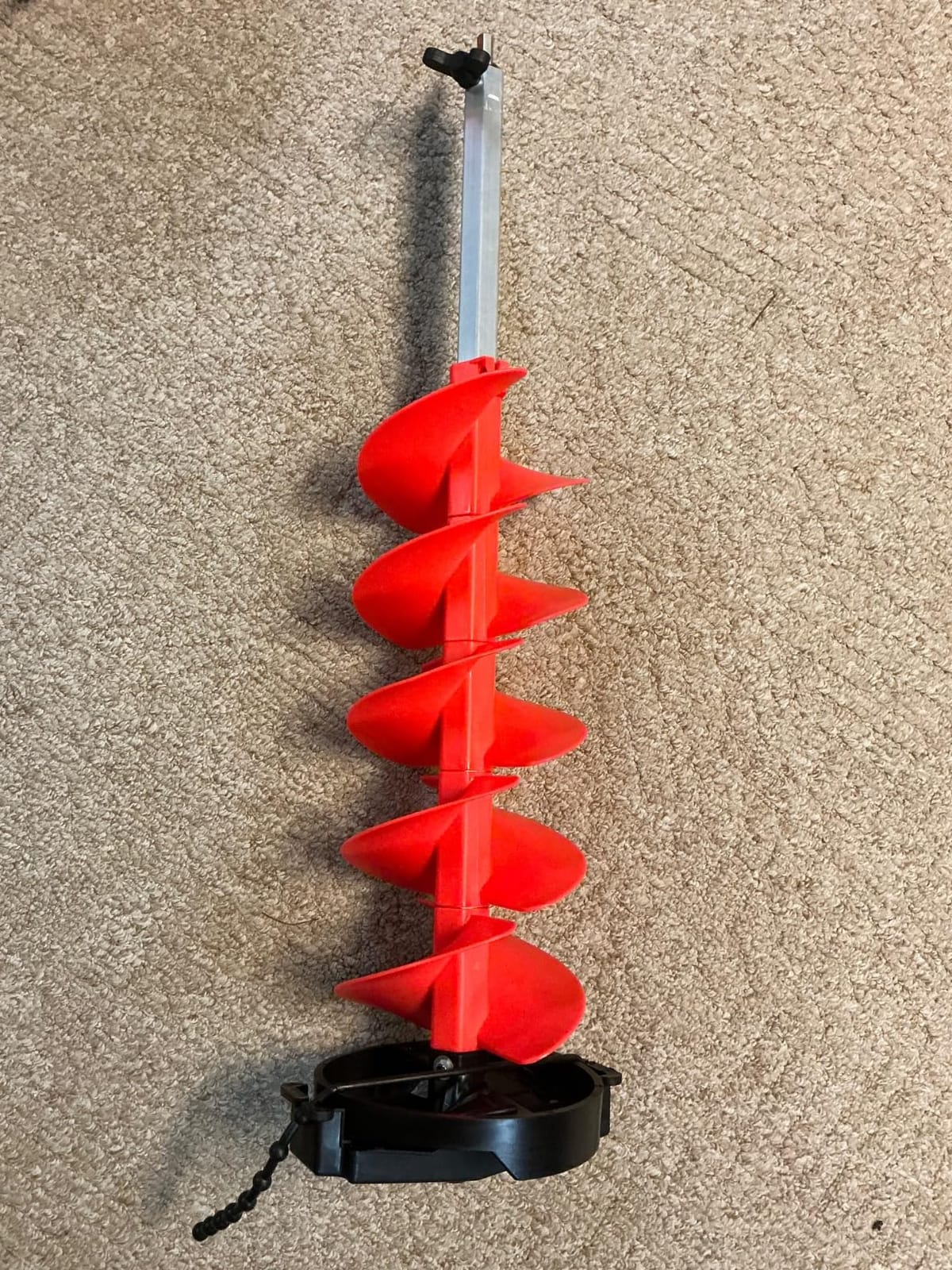
It ranks near the top in the ice auger category on speed alone. Buyers report cutting a full foot of ice in well under a minute, and the nylon body is significantly lighter than a stainless steel auger, which is the whole argument for a drill powered setup in the first place. It also fits standard DeWalt and Milwaukee cordless drills without anything unusual.
The centering point is the feature that earns this badge. It stabilizes the bit on uneven ice, and it is the part that makes overlapping holes workable because the head has something to bite into when the surface inside the old hole is broken and ragged. Spare blades come in the box, and owners report the edges still cutting well after a full season.
The requirement is a genuine half inch drill rated around 80 to 120 Nm. That is a real constraint and the most common caveat in the reviews. A few buyers also raise questions about long term build durability, which is normal for a lighter duty component in a category where the steel options cost substantially more.
Sizing the diameter to your target fish
Diameter is the easiest decision in this roundup and anglers overthink it. Six inches is standard for panfish, walleye, and most walleye structure work. Eight inches gives you clearance for larger fish and room to work a jig head. Ten inches is for muskie, pike, and lake trout where you want to reach under a ledge without pinching your line.
A broader hole is easier to fish and easier to clear slush from, but it also means more work per hole, more battery, and more ice to re-freeze around the rim. If you fish both panfish and trout, start at eight and adapt rather than buying two machines.
What to watch in silty water
Rivers and sloughs punish blades. Sand and silt embedded in ice will take an edge off a steel blade in a single day of hole moving, and a dull blade is the beginning of motor strain. Bring a file or a spare blade set, and expect to touch up between holes rather than once at the end of the day.
Keep the nylon body in your favor here. It does not ice up and jam the way some steel flights do, and it will not rust in slush water. That is a real advantage over the steel designs in this list when you are working moving water.
5. Eskimo Pistol Bit 2.0 – the one to carry between holes
Eskimo Pistol Bit™ 2.0, Drill-Adaptive Auger, 10-Inch, Centering Point, Turbo Cutting System, Bit-Saving Top Plate, 45650
10 inch cut, 8 inch available
Composite and aluminum body
4.8 lb
725 in/lbs torque minimum
Pros
- Weighs under 5 pounds for hopping between holes
- Composite stays flexible in cold
- Top plate stops the bit vanishing
- 3-year limited warranty
Cons
- Needs 18V/6Ah or higher and 725 in/lbs torque
- Small review base limits long-term evidence
The Pistol Bit 2.0 is the pick if you move. At a listed 4.8 pounds it is one of the few ten inch cutting tools here you can carry in one hand between holes without setting the drill down, which is the difference between drilling twenty holes comfortably and drilling four. The 10 inch bore is the wide end of the range, and an 8 inch version exists for anglers who want the same feel on a narrower cut.
The build explains the weight. High strength composite and aluminum replace the solid steel used in traditional augers, and the material stays flexible and impact resistant in deep cold rather than becoming brittle. It is a hex shank, so it clamps cleanly into a keyed chuck, and it works with Eskimo extension systems if you need to reach past thick ice.
Two design details show real field thinking. The centering ice point keeps the bit from skating when you start a cut, and the polymer top plate is wider than the bit diameter, which means a dropped auger lands on the plate instead of vanishing into slush. Both features exist because people have lost augers down holes.
The drill requirement is strict: a half inch brushless drill, eighteen volt with a six amp hour pack or better, and at least 725 in/lbs of torque. That is a real drill purchase if you do not own one. With only 16 reviews on record, the feedback is uniformly positive but thin, so treat the long term durability picture as less proven than the specs suggest.
When a ten inch hole is the right call
Wide holes win when you are fishing under structure. Muskie and pike anglers working a ledge in 24 inches of ice need room to get a big bait below the lip, and a six inch hole simply will not let the line and lure through at the right angle. Lake trout anglers with a heavy line and a big flasher get the same benefit.
The cost is honest and worth stating. A ten inch bore removes more ice per foot, so each hole takes longer and drains a battery faster. On a trip where you only need four deep holes, the lighter Eyoyo or Nordic Legend options serve you better. On a day of moving, the Pistol Bit earns its place.
What the warranty covers
It carries a 3-year limited warranty, the longest in this roundup, which matters for a composite bit that will flex in cold temperatures season after season. Arctic and cold weather anglers care about this because brittleness is the failure mode for composite components in general.
Read the terms before you rely on it, because limited warranties typically exclude blade wear and normal consumable parts. Blades are a routine expense regardless of brand. The warranty is protection against a structural failure in the body, not against a dull edge.
6. Eskimo Redneck Bit 8-inch – the all-steel workhorse
Eskimo® Redneck™ Bit, Drill-Adaptive Ice Fishing Auger, 8-inch, Centering Point, Red, 45601
8 inch alloy steel cut
Turbo multi-edge blades
Centering ice point
Listed at 8.2 lb
Pros
- Fast smooth cutting owners compare to gas augers
- Steel construction built for hard use
- Fits ION auger setups with the adapter removed
- 1-year limited warranty
Cons
- Needs a brushless 18V+ drill with 725 in/lbs torque
- Heavier than the composite builds
Every auger on this list is built around the idea that your drill is the engine. The Redneck Bit inverts that thinking by putting the durability in the auger. At a listed 8.2 pounds it is a heavy carry, but the alloy steel body and spiral flutes are the kind of construction that shrugs off the abuse that breaks nylon designs, and owners rate cutting speed and durability without reservation across its 18 reviews.
The turbo cutting system uses multi-edge blades designed for both new holes and re-drilled ones, which matters in late season when you are working ice that has already been opened and refrozen. A centering ice point keeps the bit aligned on the start, and the safety recovery plate is wider than the cutting diameter so a dropped drill or auger stops at the plate rather than vanishing into the slush.
One compatibility note is genuinely useful. Owners report it fits ION auger setups when the adapter is removed, so if you or a partner already own that platform you may be able to consolidate gear rather than carry two systems. That is a small saving that matters on a long sled run.
The 1-year limited warranty is the shortest we see, and the drill requirement is firm: a half inch chuck, brushless motor, eighteen volt with a 4 amp hour pack or better, and a minimum of 725 in/lbs of torque. A side stabilizer arm is recommended and we agree with that recommendation for an eight inch steel bit in thick ice.
Steel or composite for your lake
Steel wins where the ice is gritty and the trip is long term. It tolerates contact with bottom, rocks, and slush better than nylon, and a steel auger that survives five seasons is cheaper per season than a nylon one replaced every two. It is the sensible pick for rivers, sloughs, and permanent shelters where the same hole gets used all winter.
Composite and nylon win where weight decides the trip. If you walk a mile across a lake with a full sled, shaving several pounds off the auger changes the whole day. Most of the nylon options here run between 7 and 8 pounds, so the difference is modest unless you are choosing the Eskimo Pistol Bit at under 5 pounds.
Protecting your drill on steel
Steel demands torque. If your drill bogged down and the bit stopped advancing, the answer is to lift and clear rather than hold the trigger. Chasing a stalled auger is what strips gearboxes and burns motors, and burned drill motors are the most common long term failure reported by owners across this whole category.
Set the drill to a low speed, high torque setting, keep the trigger feathered, and add a stabilizer arm if your setup allows. Slow, steady, and vertical beats fast and aggressive every time the ice gets thick.
7. VEVOR 8 inch 41 inch Nylon Auger – the full kit out of the box
VEVOR Nylon Ice Auger Drill Bit, 8″ Diameter 41″ Length, Cordless Ice Augers for Ice Fishing with Extra 13.4in Extension Rod, Drill Adapter, Top Plate and Blade Guard
8 inch cut
41 inch shaft plus 13.4 inch extension
Nylon flighting with steel blades
Listed at 7.7 lb
Pros
- Lightweight and easy to carry
- Sharp self-centering bit drills quickly
- Owners report cutting like pricier gas augers
- Box includes replacement blades and a spare drill head
Cons
- Extension rod reported breaking on second use
- Centering point screw can strip
- One arrived scratched and missing spare blades
The VEVOR is the most complete package we found, and for a first time drill auger buyer that matters more than any other factor. The box includes a 13.4 inch extension rod, a drill adapter, a top plate, a blade guard, replacement blades, and a protective cover. Nothing else in this roundup arrives with that much in the box, which means one order instead of three.
Weight and cutting speed are the two things owners mention most. At a listed 7.7 pounds with a nylon flight and hollow aluminum main tube, it carries well on a sled, and reviewers report the sharp self-centering bit drilling quickly with several owners describing it as cutting as well as more expensive gas augers. It is also new enough on the market that you are not buying a design nobody has stress tested.
The included top plate deserves a mention because it is wider than the auger flights, which stops a splash of slush from launching toward you when the bit breaks through. On an 8 inch hole drilled in 20 inch ice, that breakthrough is the single most unpleasant moment of the trip, and the plate largely fixes it.
Now the honest list. There is a report of the extension rod breaking on second use, and a separate report of a unit arriving scratched and missing spare blades. The screw on the centering point can strip, which owners say is fixable by checking tension before the first hole. Inspect the whole assembly before you leave the truck.
Inspecting the kit before the first hole
Two minutes of checking saves a wasted day. Confirm the centering point screw is tight, confirm the blade bolts are torqued, and confirm the extension rod threads fully into the shaft. The blade tension screw in particular is the one that shows up in reviews as something to re-tighten before every trip.
If spare blades are missing, order them before your first outing rather than after your blade dulls. A nylon auger with steel blades needs a compatible blade set, and the manufacturer part number is worth saving in your phone.
When the extra length is worth hauling
A 41 inch shaft that extends to 54.4 inches covers essentially any ice you will encounter on a lake, including the late season ice on shallow bays that never gets mindedly deep. You can drill through in one pass without stopping to add a section, which on 30 hole days is a meaningful time saving.
The tradeoff is sled length. A 54 inch reach plus the extension is not a compact package, and on a long walk you are carrying length you may never use. Anglers who fish one lake and know its ice well may prefer the shorter Nordic Legend shaft that packs tighter.

Owner photos on this listing show the assembled auger with the extension rod in place and the top plate fitted, which is useful for checking your own setup against the intended configuration. The scale of the tool in those photos also sets expectations better than the dimension listing does.
Pairing it with a drill
The spec sheet calls for a half inch adapter and cordless drills with torque of 120 Nm or less, which is a generous ceiling and a fair floor for most eighteen and twenty volt hammer drills. In practice, owners pair it successfully with mainstream eighteen to twenty volt platforms and report good results.
Because the drilling demand is high, run it on a low gear, high torque setting rather than maximum speed. That reduces the odds of the extension rod or the adapter hex taking a shock load when the bit breaks through the bottom of a hole.
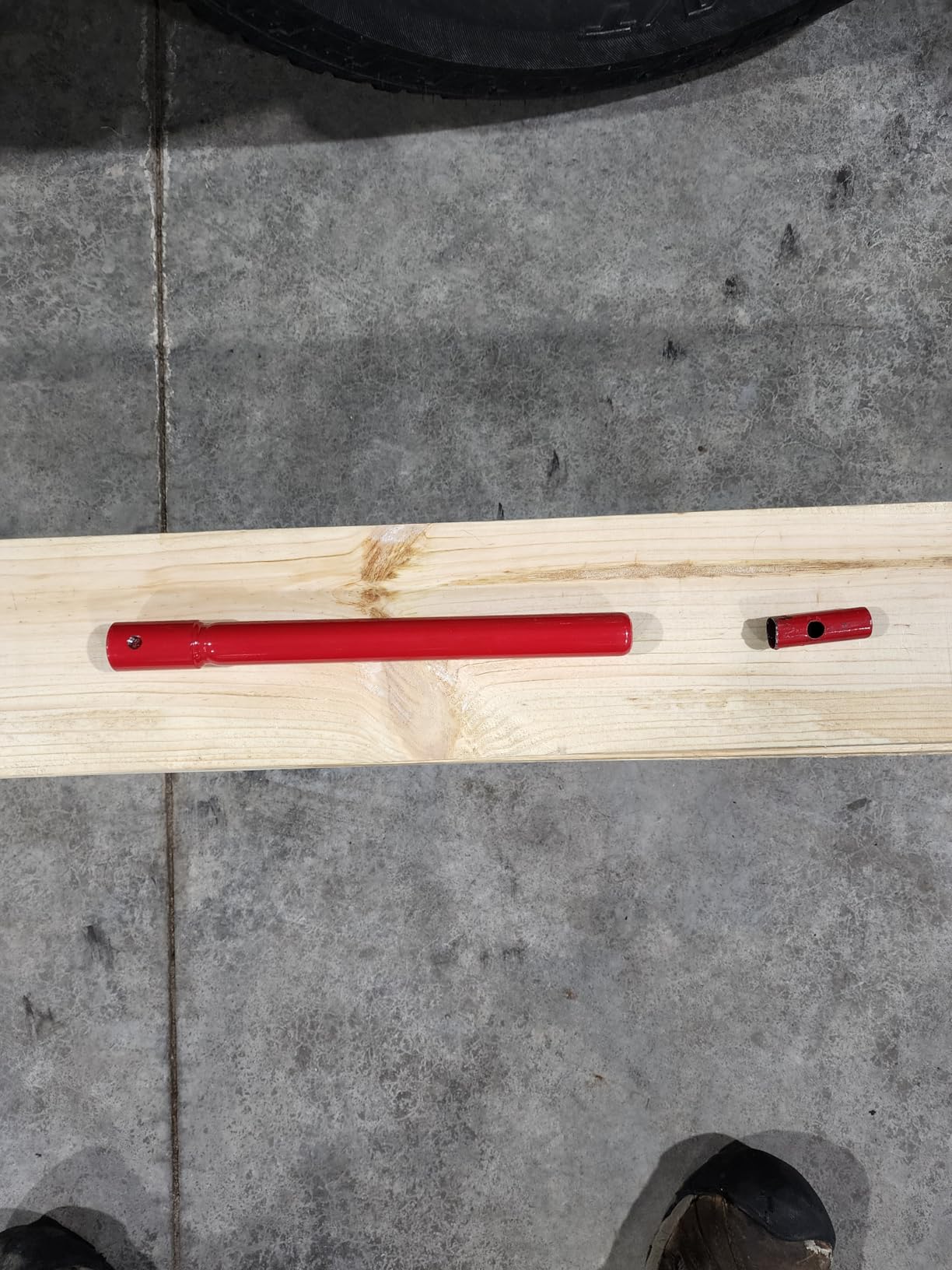
8. Longrun Nylon 8 Inch Extended Auger – the long-reach option
Nylon 8 Inch Ice Auger, 35.95 Inch Extended for Drilling Deep Ice Fishing Holes, Durable Polymer Auger Drill Bit for Ice Post Hole Digger w/Sharp Blade & Cover, Ice Auger Adapter with Handle-Yellow
8 inch cut
35.95 inch shaft
Carbide-tipped centering spike
Adapter with handle
Pros
- Carbide tip stops the bit skating on the ice
- Handle adds leverage and keeps hands clear
- About a third the weight of other augers
- Cuts 20-36 inches without twisting
Cons
- Adapter retaining screw loosens within a few holes
- No manual or documentation included
- Missing hex key and handle misalignment in some boxes
The Longrun is built around one idea better than most: do not let the bit skate. Its carbide-tipped centering spike bites into ice that other augers slide across, and owners credit that with the straightest, deepest holes in the reviews. If you have drilled on rough ice and watched a nylon auger wander off your mark, that spike is the feature that solves it.
The handle adapter is the second idea worth talking about. It adds leverage and keeps your hands away from the hole, which sounds minor until you are clearing slush at the end of a 30 hole day with cold wet gloves on. It is the kind of feature that looks unnecessary in a listing photo and turns out to matter in week three of the season.
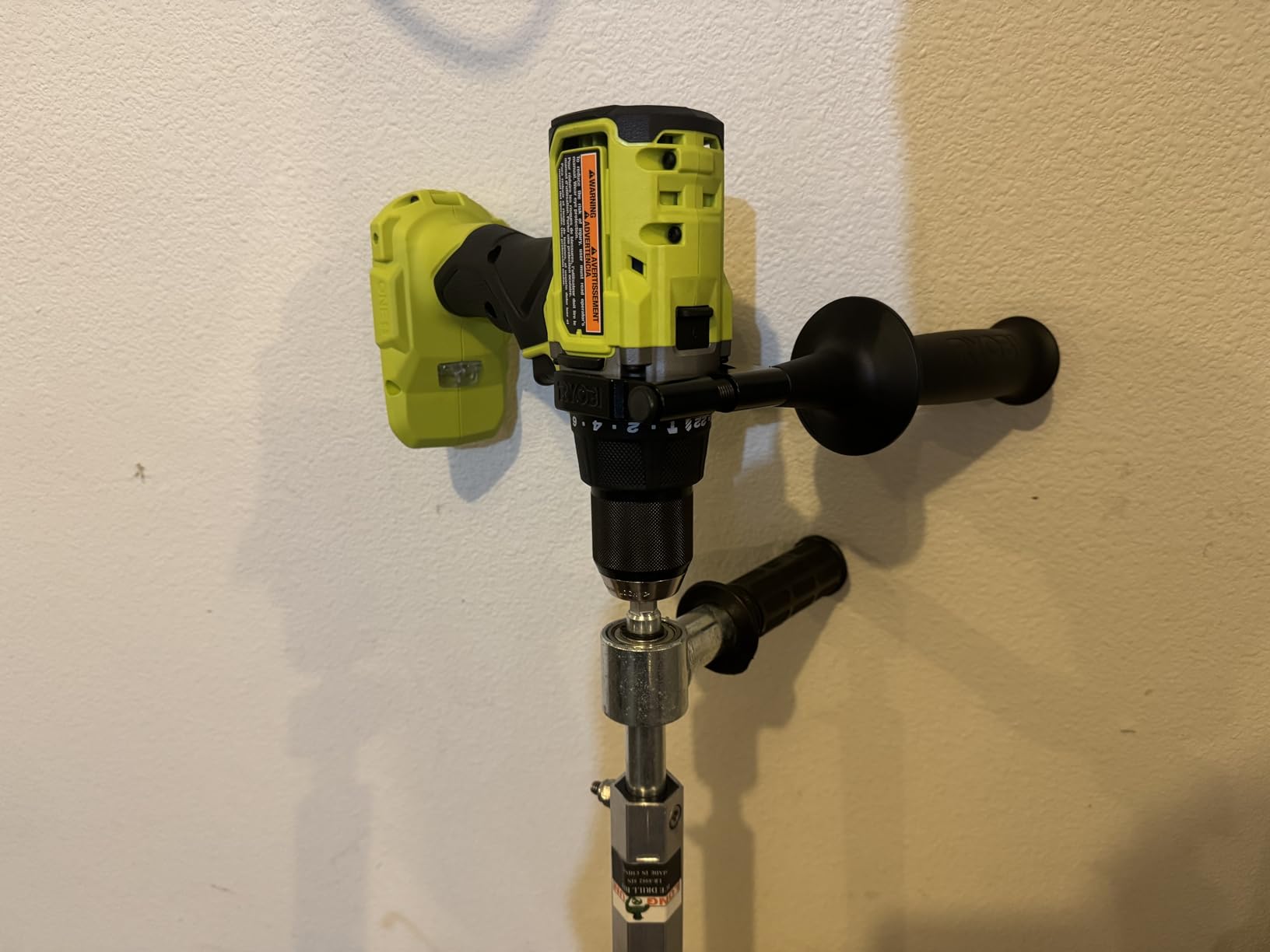
Owners report cutting 20 to 36 inches of ice without torque twisting at break through, and they consistently praise the nylon body for not freezing or clogging and for weighing roughly a third of a comparable auger. The spiral flute pattern in the nylon body is what handles the slush, and the package also includes interchangeable blades and a pair of protective gloves.
Quality control is the weak spot and it keeps the rating below the leaders. The adapter retaining screw started coming apart within the first few holes for some owners, one report describes a handle mounting hole that did not line up, and the hex key was missing from some boxes. There is no manual, so you are relying on the listing for assembly.
The carbide spike in practice
On a lake with wind scoured ice, snow ridges, or a freeze thaw cycle that leaves the surface crusty and uneven, a plain auger point tends to skate before the blades engage. The carbide tip gives the bit something to catch on, which is why this design handles rough ice better than its weight class suggests.
It also makes overlapping holes more forgiving. When the second hole starts into a wall of already drilled ice, the spike finds purchase where a plain point would deflect. That is the practical reason this auger earns its spot for anglers fishing tight clusters of spots.
Fixing the hardware complaints yourself
Every complaint in this product’s reviews traces back to small hardware, and all of it is fixable in a driveway with one hex key. Check the adapter retaining screw before every outing, thread the handle only as far as it goes, and confirm the mounting hole is aligned before you tighten anything.
Request a hex key with your order if one did not arrive. It is a two minute fix, but discovering the missing tool at the ramp at 6 in the morning is how a good day turns into a wasted one.
9. NILS Convertible 8 inch Hand Auger – drill and crank in one
NILS Convertible 8″ Hand Auger for Cordless Drills
8 inch cut
Runs by hand or with a cordless drill
Alloy steel and plastic
48 inch listed length
Pros
- Convertible between hand and drill power
- Curved point starts a hole cleanly
- No dependency on a battery platform
Cons
- Hand cranking 8 inch ice is still heavy work
- One diameter in this listing
- Limited published spec detail
The NILS is the only true convertible in this roundup, and that is a genuinely different proposition. The same 8 inch auger runs on a cordless drill when the holes are coming fast and cranks by hand when they are not, when the battery dies, or when you walk into a spot you did not plan to drill. No other tool here gives you that fallback.
That matters for solo anglers and for anyone fishing a lake they do not know well. If you are scouting a new spot, one auger covers exploration and production instead of two. It also means an angler who already owns a good hand crank effectively has a backup drive system for a week of bad weather.
The 4.9 average across its reviews comes with no one or two star feedback, which is the strongest consistency profile of any drill powered design we analyzed. The curved point is the traditional ice-fishing shape, and it is good at starting a clean hole and staying on line as it descends.
The tradeoffs are equally real. Cranking an 8 inch hole by hand through 20 inches of ice is serious work, so the hand mode is a fallback and a scouting tool, not a plan for a full day. Only one diameter is offered in this listing, and the published spec detail is thin compared with the Nordic Legend and Eskimo entries, so verify the shank and adapter before you commit.
When a hand crank is the right backup
There are three situations where it earns its keep. First, early morning arrival before your batteries have warmed, when a hand crank will not suffer from a cold pack. Second, remote lake access where carrying a battery you may drain is a risk you would rather not take.
Third, and most common, fishing a single spot. If you are drilling two or three holes in a day, the convertible eliminates the need for a second tool entirely, and the drill sits in the truck with the rest of your gear.
Braking and control on the crank
The reason hand augers catch is a blade that hits a slush shelf at the bottom of the hole and stops while the crank keeps turning. With a drill you simply release the trigger. With the crank, the handle can slip and the auger can twist, which is the moment the blade work takes the abuse.
Go slowly at depth, and keep the auger turning as you break through so the blades shear the slush instead of catching it. That habit transfers directly to the drill side of the tool, where a steady trigger is easier to modulate than a fast one.
10. Zunate 6 Inch Floating Auger Bit – the budget entry
Ice Fishing Auger Nylon Floating Bit 6 Inch Cordless Power Drill
6 inch cut
Floating buoyant nylon body
Universal drill adapter
Two hardened steel blades
Pros
- Low cost entry into drill powered augers
- Drilled 20 holes through 12 inches of ice on a DeWalt
- Floats if dropped in water
- Simple to set up
Cons
- Shorter than ideal over 18 inches of ice
- Blades mount on plastic and stripped on some builds
- Listing photos show blades reversed
Every other auger here assumes you already own a capable hammer drill or you are willing to buy one. The Zunate exists for the angler testing whether drill powered ice fishing works for them at all, and at that job it performs. Owners report drilling 20 holes through 12 inches of ice with a DeWalt cordless drill, which is real output for an entry level tool.
The floating design is the feature we like most. The buoyant nylon housing surfaces if you drop it in open water, and on a lake with current or a slough with submerged structure that difference is the difference between losing your auger and fishing the rest of the day.
It is also the simplest to set up. A universal adapter connects to a cordless drill, a locator helps you start the cut, and screws and a wrench are included, so there is no adapter hunting on a cold ramp.
Be clear-eyed about the compromises. The shaft is short, which means kneeling on ice over 18 inches thick, and the blades mount directly to the plastic body, which owners report stripped or failed on some builds. The listing installation photos are also misleading, with blades shown mounted in reverse. A meaningful share of one and two star reviews cite blades that would not cut at all, so this is a mixed results tool at this level.
What you give up versus spending more
The jump from this to a mid priced nylon auger buys you replaceable blades on a metal carrier, a center point blade for stability, and a shaft long enough for thick ice. Those three things are what separate a tool you use all season from one you use a few times and replace.
If you fish a lake that stays under 12 inches and target panfish, this is a defensible buy. If you expect to drill 20 inches or fish for trout, spend the difference. The cost of a second auger in two seasons is more than the money saved up front.
When it makes sense anyway
Two situations justify it. If you are pairing augers, a spot on a shallow lake where the trip is a half mile walk, a cheap second bit you can leave in the sled is defensible.
Second, if you already own a six inch manual auger you love, this is a way to add drill power without changing what you carry on a good day. Some anglers keep the hand crank permanently and use the drill bit only on high hole count mornings.
How to Choose a Drill Powered Ice Auger in 2026
Five decisions do most of the work. Take them in this order and the rest of the specification sheet mostly takes care of itself.
Pick the diameter from your target fish, not your ambition. Six inches covers panfish, perch, and most walleye work. Eight inches is the all-round choice and the only diameter that makes overlapping holes comfortable. Ten inches is for muskie, pike, and lake trout where you need clearance under structure. A wider hole is also slower and drains a battery faster, so do not oversize for a fish you do not fish for.
Match shaft length to your thickest expected ice. Add roughly a foot of shaft for every ten inches of ice you might realistically encounter, then add an extension if you fish late season ice. An undersized shaft means kneeling on the ice with your upper body over the hole, which is how backs get hurt. An oversized shaft is only dead weight in the sled.
Understand blade types before you shop. Shaver blades have fine serrations and take a light scrape, which is fast in clear ice and drinks battery. Chipper and multi-edge blades have larger cutting teeth that shear chips away, use less battery per foot, and tolerate sand and silt far better. On a clear lake, a shaver style blade is efficient. On a river, a chipper style blade is the one that stays sharp.
Decide between shaft augers and pistol bits. Every auger in this roundup except the two Eskimo bits is a shaft style auger that clamps into a chuck, which is the format most drill owners use. A pistol auger bit is a short, wide cutting head that you hold like a drill handle in a single hand. Pistol bits are faster to pick up and move between holes and easier to control on uneven ice, but they cut less depth per stroke and you trade away the ability to reach deep ice in one pass. If you only ever drill shallow ice and move constantly, a pistol bit is the better tool.
Budget for a second battery and a blade set. Every reliable setup runs two packs. One in the drill, one in your jacket pocket against your body, and you swap when the first pack slows on thick ice. Cold weather cuts usable battery life and a pack that sits in a cold truck is the reason anglers think drill augers do not work. Blades are a consumable, and the nylon designs here use cheap replaceable ones.
Which Cordless Drill Do You Need for an Ice Auger?
This is the question anglers ask most and the one most roundups skip, so here is the direct answer. You need a half inch chuck, a brushless motor, a hammer or high torque setting, and roughly 725 in/lbs of torque for an 8 inch auger. More torque and a bigger battery mean faster holes and a drill that survives a season. Less torque means stalls, heat, and eventually a damaged gearbox.
The simplest rule of thumb: match the drill class to the auger diameter. A 6 inch nylon auger runs happily on an 18 volt compact drill. An 8 inch auger wants a full size 18 or 20 volt hammer drill. A 10 inch steel or composite bit wants 18 volt with a 6 amp hour pack or larger, and a stabilizer arm is worth adding if your platform has one.
Brands matter far less than class. Forum experience is consistent that a DeWalt, Milwaukee, Makita, Ridgid, Ryobi or Husky platform in the correct voltage class all work, and the Nordic Legend models in this roundup are explicitly designed to fit almost all 18V to 20V chucks including those brands. The advice from experienced anglers is to buy one reliable name brand drill and stick to its battery ecosystem rather than mixing platforms to save a few dollars.
Two technique points that protect the drill. Run the auger on a low speed, high torque setting rather than maximum RPM, which reduces the shock load when the blade breaks through the bottom of a hole. And never hold the trigger through a stall. Lift, clear the slush, restart, and if the drill is bogging down consistently, you have mismatched the drill to the auger. Burned drill motors are the most common long term complaint in the category, and almost all of them trace back to chasing a stall.
If you do not own a drill yet, the decision is easy. A high torque hammer driver drill in your existing platform is a fine first auger drill for 6 and 8 inch augers, and it will also run every other job on your winter project list. If you are starting from nothing and plan to stay on one platform for a decade, buy the highest torque 18 or 20 volt brushless model with a large battery, and treat it as a ten year purchase.
Frequently Asked Questions
Are drill ice augers worth it?
Yes, if you drill more than a handful of holes a day. A drill powered auger cuts a hole in under a minute, runs silently with no fumes so it is safe inside a permanent shelter, and weighs roughly a third of a gas auger. If you drill two or three holes per trip, a hand auger is lighter and never fails.
What is the best auger for a drill?
For most anglers the K-Drill 7.5 inch is the best balance of weight, blade durability, and drill compatibility, with a 4.8 average across 134 reviews. For pure hole count and the deepest feedback base, the Nordic Legend E-Drill 8 inch combo has 158 reviews and a well documented record. For moving between holes, the Eskimo Pistol Bit 2.0 at 4.8 pounds is hard to beat.
What is the best cordless drill to use on an ice auger?
A half inch chuck brushless hammer drill rated at roughly 725 in/lbs of torque, running an 18 or 20 volt battery. A 6 inch nylon auger works on a compact 18 volt, an 8 inch auger wants a full size 18 or 20 volt hammer drill, and a 10 inch steel or composite bit wants 18 volt with a 6 amp hour pack or larger.
Can you use an impact driver for an ice auger?
You can drill with one, but a high torque hammer drill is the better choice. Impact drivers deliver higher peak torque but they freewheel between hammer blows, which gives an auger shaft less steady rotational control and makes it more likely to slip in the chuck. If you use an impact driver, clamp the auger firmly and use a low gear.
How many holes can I drill on one battery?
Owners of the 8 inch nylon augers in this roundup report 15 to 20 holes on a single charge, and a 6 inch nylon bit has cleared 20 holes through 12 inches of ice. Ice thickness moves that number more than anything else. Carrying a second battery in your jacket against your body is the standard fix for cold weather battery drain.
What thickness of ice can a drill powered auger handle?
It depends on the auger rather than the drill. The K-Drill 7.5 inch is rated for ice up to 36 inches thick, and owners report the 8 inch nylon models cutting 20 to 36 inches without twisting. Check that your shaft is long enough to clear the ice you expect plus several inches of slush before you head out.
Can drill powered augers drill overlapping holes?
An 8 inch auger is the practical choice because the head has room to spin inside a partly collapsed hole. The center point blades on the Eyoyo and Nordic Legend models help the bit track when the surface is already broken. The auger is not the hard part though, keeping the first hole vertical is what makes overlapping holes work.
Final Verdict
The K-Drill 7.5 inch is our pick for the best drill powered ice augers in 2026 because it balances weight, blade life, and drill compatibility better than anything else we compared, and its 4.8 average holds up across 134 owner reviews. The Nordic Legend E-Drill Combo is the value pick with the deepest feedback record in the group, and the Eskimo Pistol Bit 2.0 is the one to buy if you carry weight and move constantly.
Buy the auger that matches the drill you already own, keep a spare blade set in the sled, and run two batteries. If you are still deciding, start with the guide above and pick your diameter from your target fish.