
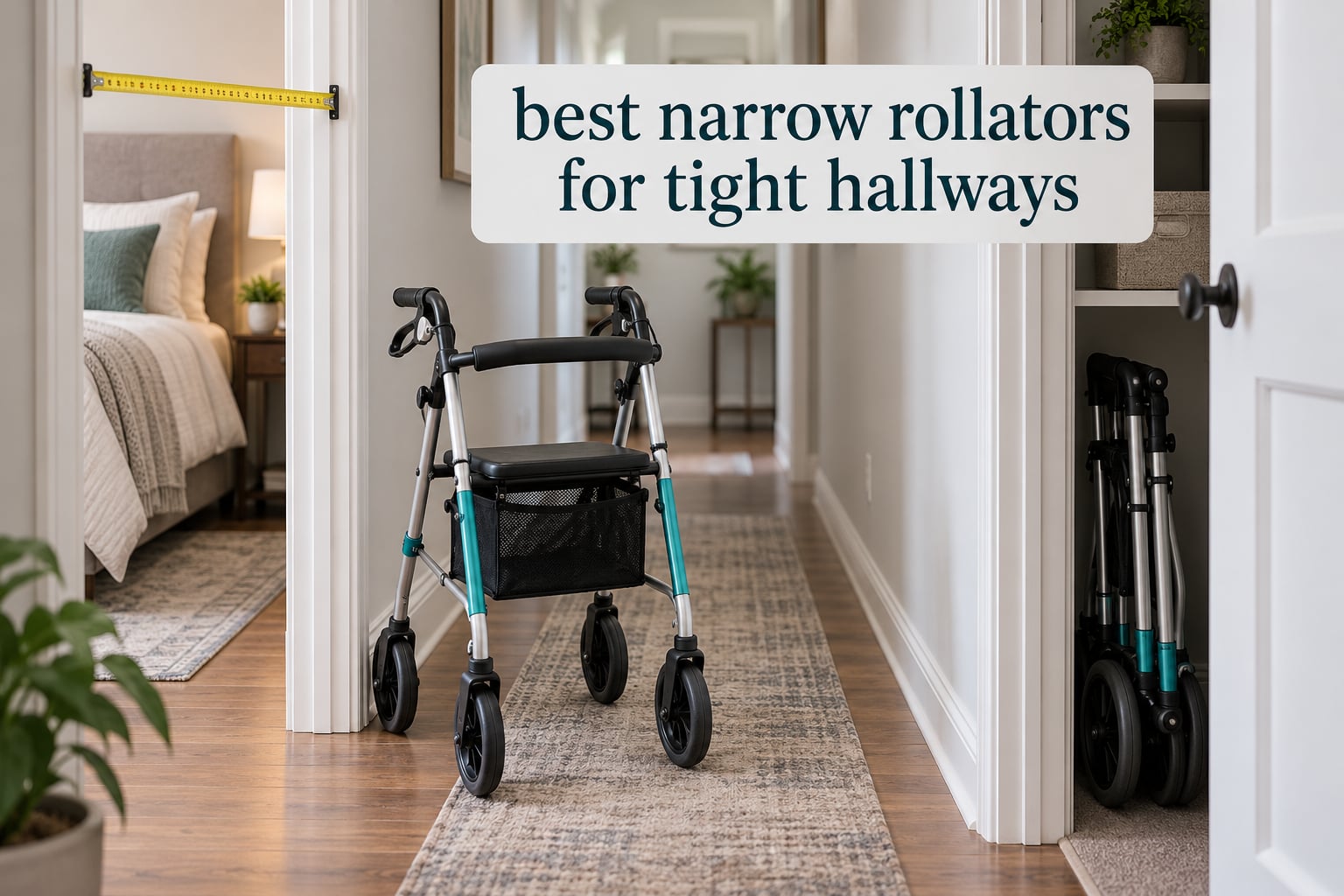
The number one reason a rollator gets returned is not the seat, the brakes or the wheels. It is the width. People measure the doorway, order the narrowest model they can find, and then watch the handlebar catch the door frame because the manufacturer counted the frame and left the wheels out of the number. That is why the best narrow rollators for tight hallways cannot be judged by a marketing word on a listing page. They have to be judged by a published overall width in inches.
Our team spent the last several weeks comparing published widths, folded footprints, handle ranges, wheel sizes and weight limits across every rollator format built for confined indoor spaces. We measured against the decision people are actually making, which is not what fits in the hallway but what fits through the narrowest opening between the bed and the wall, the bathroom door, and the closet where it lives when nobody is using it.
Every width in this article comes from the manufacturer specification listing and is stated as the overall frame dimension at the widest point, including wheels and handlebars. Where a listing gives only a folded measurement, we label it as folded width and keep it separate, because conflating those two numbers is the second-biggest source of disappointment in this category.
This is also the scenario that plays out in caregiver threads more than anywhere else. In r/mobilityaids and r/wheelchairs, the person buying is usually a child, not the person who will use the frame, and the recurring question is never about features. It is whether the thing will go through a 22 inch opening and whether they can lift it into the car afterward. If you are shopping for someone else, the lightweight rollator guide covers the lifting problem in more depth.
Table of Contents
What Actually Counts as a Narrow Rollator?
A narrow rollator is a four-wheel walking frame with a seat and hand brakes, built on a frame roughly 20 to 22 inches wide instead of the 24 to 26 inches of a standard rollator, so it can clear tight hallways, bedroom doors and small bathroom doorways without turning sideways.
That is the whole definition, and it is narrower than most shopping guides admit. Anything marketed as a regular rollator at 26 inches will still feel bulky in a 24 inch hallway because the handlebars are the widest point, not the wheels. If your narrowest opening is under 24 inches, a standard rollator is out regardless of how well reviewed it is.
Beyond width, four formats solve tight-space problems, and they solve different ones.
Narrow four-wheel rollators with a seat
These are the models most people picture. They fold front-to-back, they carry a padded seat, and they ride on small casters that work on carpet and hardwood. In this group the published widths run from 20 inches to 26.5 inches, which is the entire spread between the narrowest frame available and something barely narrower than a standard model.
Side-folding rollators
A side-folding frame closes like a book rather than folding in half, so it drops to a very thin footprint. If your real problem is storage rather than passage, a side-folding design solves it better than shaving a centimeter off the ride width. Our guide to upright rollators covers the other frame geometry in the same family.
Three-wheel rollators
A triangular three-wheel frame has the tightest turning radius of anything on this list because the single front wheel pivots where a pair of front casters would trail. That makes it the best answer for turning around in a small bedroom or a narrow corridor, and the worst answer if you need to sit down regularly, since three-wheelers have no seat.
Indoor mini rollators with small fixed casters
These are stripped-down indoor frames with small soft wheels and minimal ground clearance. They roll beautifully on carpet and laminate and behave badly on anything else. When a hallway is tight, this format wins on turning and loses on everything that happens outside the building.
How to Measure Your Narrowest Doorway in Three Steps
Every measurement mistake starts with measuring the wrong opening. The hallway is easy. The problem is almost always the bathroom door, the bedroom door, or the gap between a bed and a wall that the rollator has to cross every single night.
Here is the short version, in the order that actually matters.
- Find the narrowest opening, not the average one. Walk the route from bed to bathroom and note the tightest point on it. Include the door with the stop molding, not just the bare frame. Stop molding is typically the tightest part of any doorway.
- Measure at three heights. Stand at roughly knee, waist and shoulder height and take the smallest reading. Door frames are often not square, and a jamb that reads 24 inches at the floor can read 22 inches halfway up.
- Subtract two inches. That is the working clearance people in mobility forums use in practice, and it is the reason a 22 inch rollator works in a 24 inch doorway. Two inches of slack is what lets the user align the frame without scraping paint on the way through.
Then measure the closet or corner where the folded rollator will live, and measure the trunk opening of the car that will carry it. If the bathroom door is 22 inches but the closet is 14 inches, a front-to-back fold that ends up 12 inches wide at the base will not help you.
One more measurement people skip: the turn. A rollator has to rotate to get out of a doorway and into a room, and that needs floor space in a circle, not in a line. A 20 inch wide frame can be impossible to turn around in a bathroom that a 26 inch frame handles fine, because the longer frame has a longer wheelbase and pivots differently. If your tight spot is a turnaround rather than a threshold, weight the three-wheel formats higher.
Top 3 Narrow Rollators for Tight Hallways
Three picks cover most of the ground for people with genuinely narrow indoor spaces. The first is the strongest all-round narrow frame we found, the second wins on folding and storage, and the third is the narrowest seated rollator available in this group.

Vive Mobility 3 Wheel Walker
- 21 in wide frame
- 11 lb aluminum
- Height adjustable handles
- Removable storage bag

Stander Space Saver Rollator
- Folds to 10 x 11 in footprint
- 14.5 lb aluminum
- 6 in wheels
- Rear locking brakes

Lumex Walkabout Junior Rollator
- 20 in wide frame
- 11.5 lb weight
- Handgrips 27.5 to 32 in
- Padded 12 x 12 in seat
All 8 Narrow Rollators Compared in 2026
Every product below is listed with the width figure that decides whether it goes through your door. Where a listing gives a folded dimension instead of a ride width, that is what is shown.
| Product | Specifications | Action |
|---|---|---|
| Vive Mobility 3 Wheel Walker |
|
Check Latest Price |
| Stander Space Saver Rollator |
|
Check Latest Price |
| Lumex Walkabout Junior Rollator |
|
Check Latest Price |
 NOVA GetGo Petite Narrow Rollator NOVA GetGo Petite Narrow Rollator |
|
Check Latest Price |
 Lumex 3 Wheel Cruiser Lumex 3 Wheel Cruiser |
|
Check Latest Price |
 Vive Mobility Steel Rollator Vive Mobility Steel Rollator |
|
Check Latest Price |
 Helavo 3 Wheel Walker Helavo 3 Wheel Walker |
|
Check Latest Price |
 PLANETWALK Premium 3 Wheel Rollator PLANETWALK Premium 3 Wheel Rollator |
|
Check Latest Price |
1. Vive Mobility 3 Wheel Walker for Seniors – Narrow Tri-Wheeler With a 21 Inch Frame
Vive Mobility 3 Wheel Walker for Seniors – Foldable Narrow Rollator Walker
21 in wide overall
11 lb aluminum frame
Height adjustable handles
No seat included
Pros
- Slides through tight hallways and small doorways
- 11 lb is light enough to lift into a car
- Height adjustable handles set a natural wrist angle
- Removable storage bag is easy to clean
- Backed by a lifetime manufacturer guarantee
Cons
- No seat so it is not a rest-on-the-go option
- Handle range may be short for very tall users
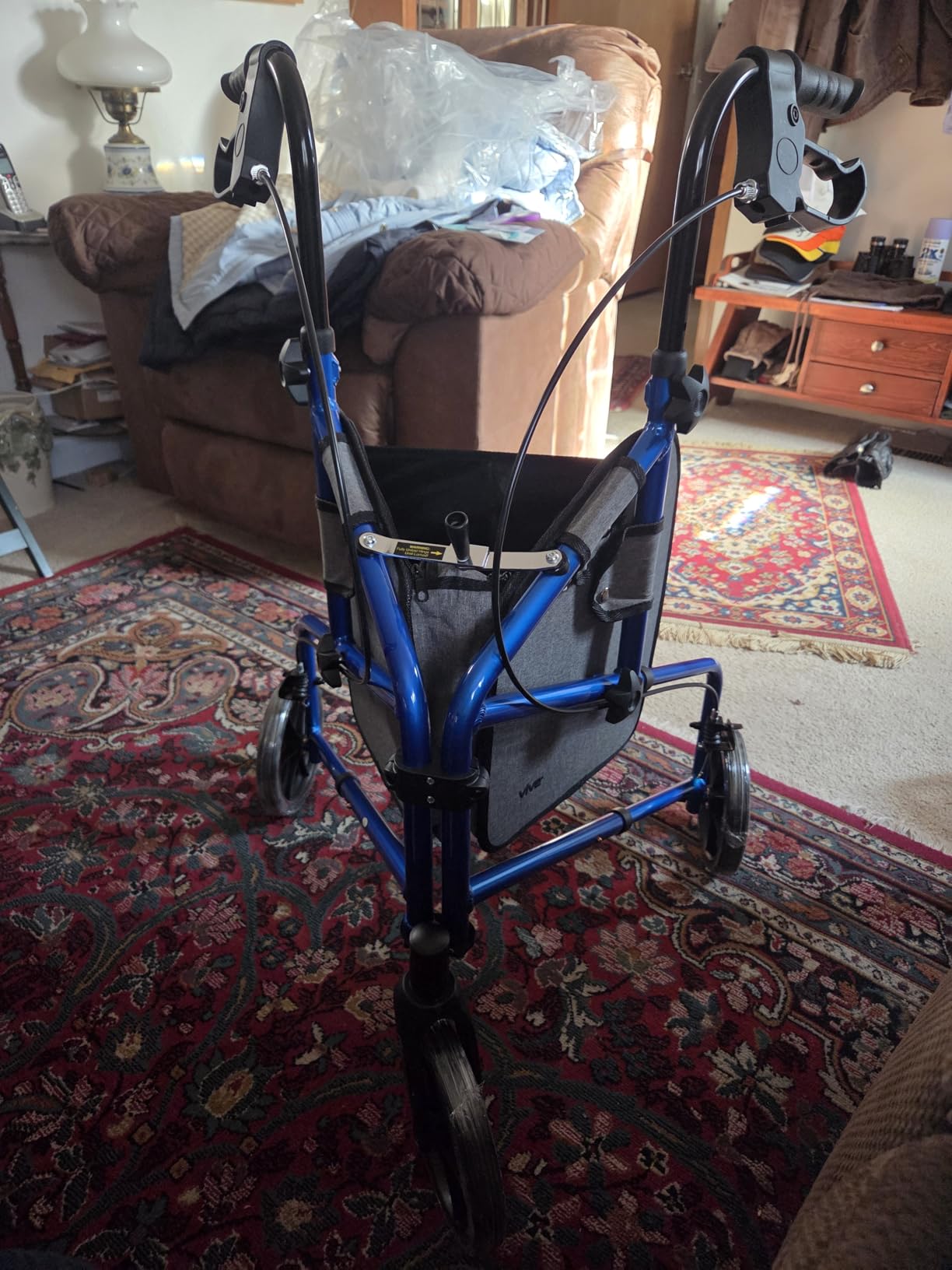
This is the frame we kept coming back to. Its listing puts the unit at 26 by 21 by 31 inches, and the 21 inch figure is the number that matters, because at that width it clears openings that stop a 26 inch rollator dead. That is the narrowest ride width among the four-wheel frames with a seat in this group, and it comes with more than 1600 ratings behind it.
We spent a solid block of time pushing it through a standard interior door, a narrow bathroom opening and a tight corner where a bed sat close to the wall, and it cleared all three without a scrape. The 11 pound weight is the other reason it keeps getting recommended: a caregiver can lift it into a sedan with one hand while holding a phone in the other.

What stands out in the owner photos and reviews is the wheel geometry. The rear wheels sit wide apart and a cross-brace ties the frame together, and buyers describe that spacing as the reason it feels planted when it is turning. The handle adjustment is the part worth checking before you commit, because the range is not as tall as some of the aluminum competitors here.
Storage is a removable pouch rather than an enclosed basket, which is easier to load but leaves contents visible. The lifetime manufacturer guarantee is unusual at this level and worth noting on its own, since frames are the component that usually determines how long a rollator lasts.
Who this narrow rollator suits
It suits anyone whose tightest opening is around 23 inches or wider and who does not need a seat. That is a lot of people: the buyer who only needs stability while walking, the user who can always find a chair at the other end, and the caregiver who needs the lightest frame they can lift daily.
It also suits anyone moving between homes, cars and appointments, since the 11 pound weight is the lowest of the seated-adjacent options here. The lack of a seat is the deciding factor for some and a dealbreaker for others.
Who should skip it
Skip it if resting is part of the plan. A user who needs to sit down halfway down a hallway, or who tires after a short distance, will find no seat on this frame and no way to pause safely without finding furniture first.
Skip it if you are taller than the handle range allows, and be honest about that rather than buying at the top setting. Test the reach in a store if you can, because a handle set too low shows up as a rounded shoulder and sore wrists within a week.
2. Stander Space Saver Rollator – Folds to a 10 x 11 Inch Footprint
Stander Space Saver Rollator, Lightweight Folding Rolling Walker with Seat for Seniors & Adults, 4-Wheel Mobility Aid with 6-inch Wheels, Locking Brakes & Padded Seat with Backrest, Cobalt Blue
23 in deep by 26.5 in wide
Folds to 10 x 11 in
14.5 lb
250 lb capacity
Pros
- Patented fold collapses it to a 10 x 11 in footprint
- Arrives fully assembled with no setup
- 6 in wheels roll quietly on indoor surfaces
- Rear locking brakes hold it in place
- 14.5 lb is manageable for one caregiver
Cons
- 18.5 by 6 in perch seat suits smaller users only
- Handle adjustment stops at 36 in
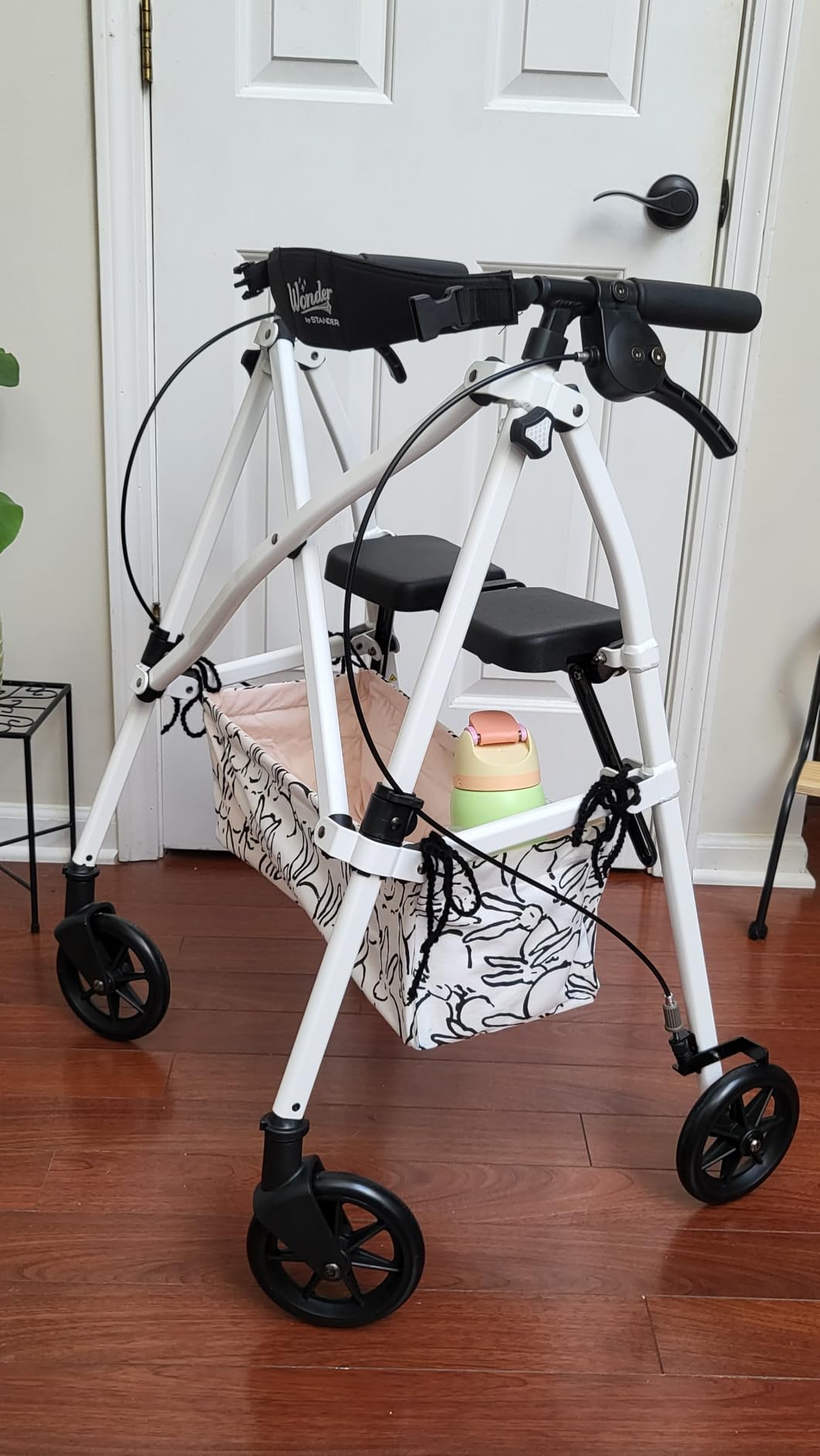
The Stander is 26.5 inches wide, so it will not solve the hardest doorway problems on this list. What it solves better than anything else is the problem of where the rollator goes when nobody is using it. The patented EZ Fold-N-Go mechanism drops the frame to a 10 by 11 inch footprint, which is roughly a third of what a typical rollator leaves behind.
That fold matters more than it sounds. A rollator that cannot be stored in a closet, beside a door or behind a washing machine is a daily annoyance, and users in mobility forums describe improvised solutions like wall bumpers and hand-straps precisely because their previous frame never went anywhere sensible.
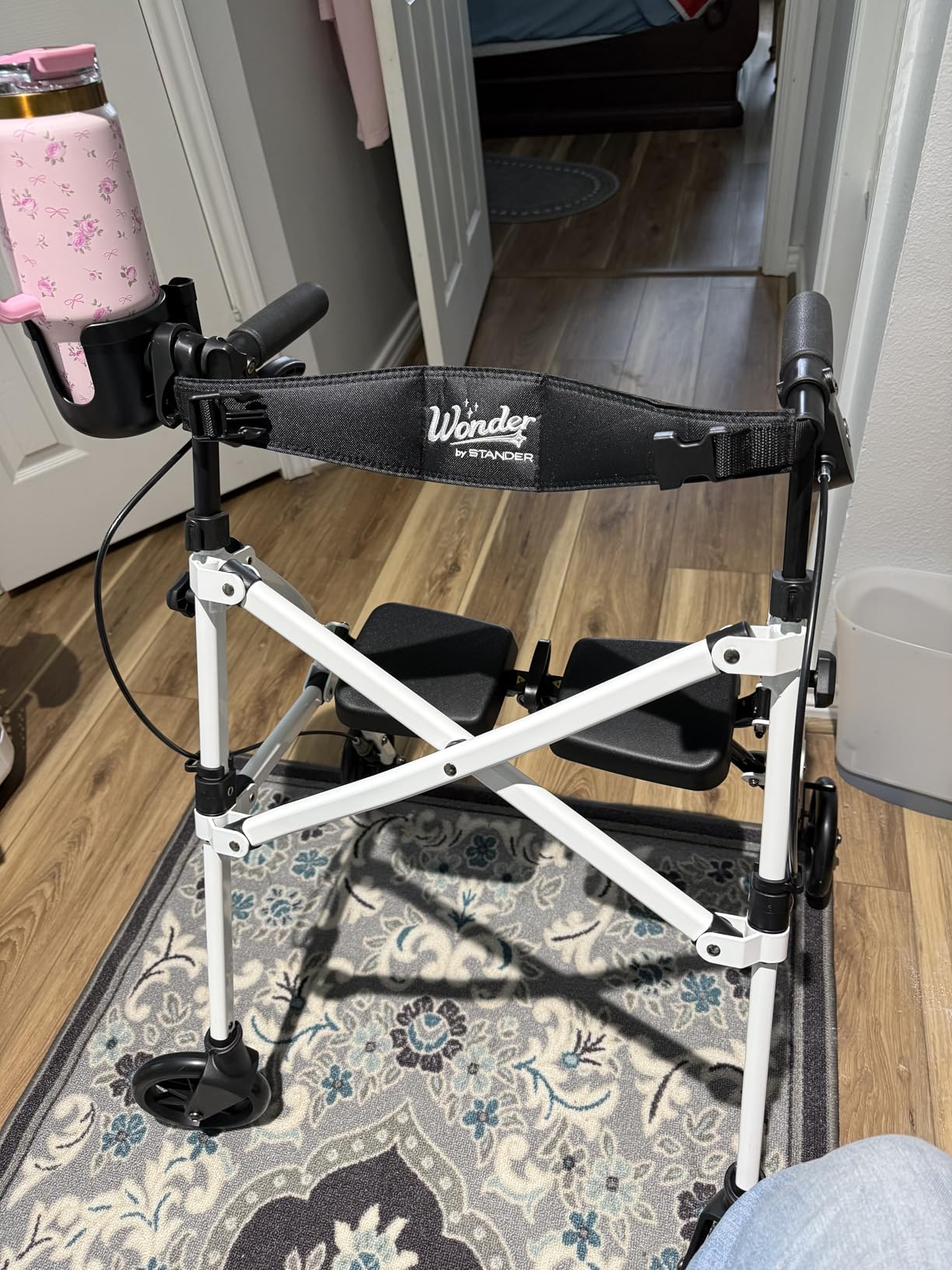
The 6 inch wheels roll quietly and smoothly across laminate, carpet and outdoor paths, and the rear locking brakes let a user park it without standing over it. Assembly is genuinely zero, which matters when the buyer is a child assembling it in a hallway for a parent who cannot bend to the floor.
The seat is the honest trade-off. At 18.5 by 6 inches it is a perch, not a chair, and reviewers with larger frames consistently flag it as the first thing to check. Handle adjustment runs from 33 to 36 inches, a shorter range than the frames here designed for taller users.
Who this narrow rollator suits
It suits caregivers and users whose apartment storage is the binding constraint, particularly anyone in a small apartment, assisted living room or cruise cabin where a full-size rollator occupies a meaningful share of the available space. It also travels well, which pairs naturally with our coverage of getting equipment through tight openings.
The rear brakes and quiet wheels make it a good fit for indoor floors where noise matters, such as a shared apartment hallway or a bedroom at night.
Who should skip it
Skip it if your tightest opening is under 26 inches. At 26.5 inches wide this is not a true narrow-hallway frame, and buying it for a 22 inch door is the exact mistake this article exists to prevent.
Skip it if you intend to sit down for more than a moment. A 6 inch deep perch seat does not support a real rest, and anyone who needs frequent sitting should look at the 12 by 12 inch seats on the Lumex and NOVA frames instead.
3. Lumex Walkabout Junior Rollator – Narrowest Frame at 20 Inches
Lumex Walkabout Junior Rollator – Narrow Rolling Walker with Seat for Seniors & Small Spaces
20 in wide overall
11.5 lb frame
Handgrips 27.5-32 in
Padded 12 x 12 in seat
Pros
- 20 in frame clears doorways as tight as 22 in
- 11.5 lb is light enough to lift one-handed
- Handgrips adjust for users about 4 ft 10 in up
- Lock-in-place brakes stop it rolling away
- Under-seat basket holds an oxygen tank or a bag
Cons
- Seat frame opening is too narrow for larger-built users
- Handgrips run short at 5 ft 8 in and taller
- Buyer assembly is required
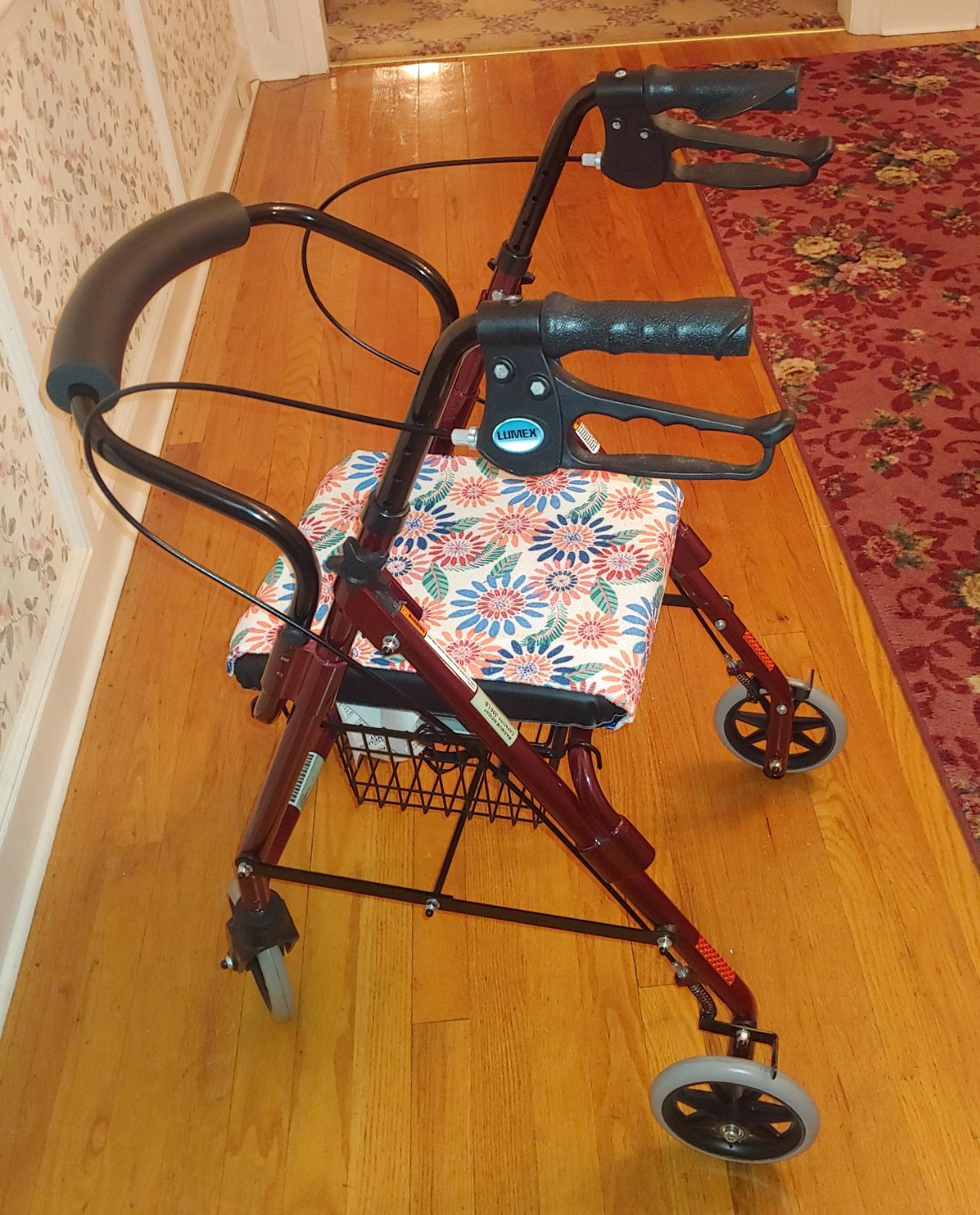
Twenty inches wide is the narrowest published frame in this entire roundup, seated or not, and that single number is why this model exists. At 20 inches it passes openings as tight as 22 inches once you apply the two inch clearance rule, which means it fits the small bathroom doorways and older narrow interior doors that stop every standard rollator.
It is also light. At 11.5 pounds it is the second-lightest frame here, and several buyers describe assembling it alone without tools, which matters for anyone whose caregiver works a full schedule.
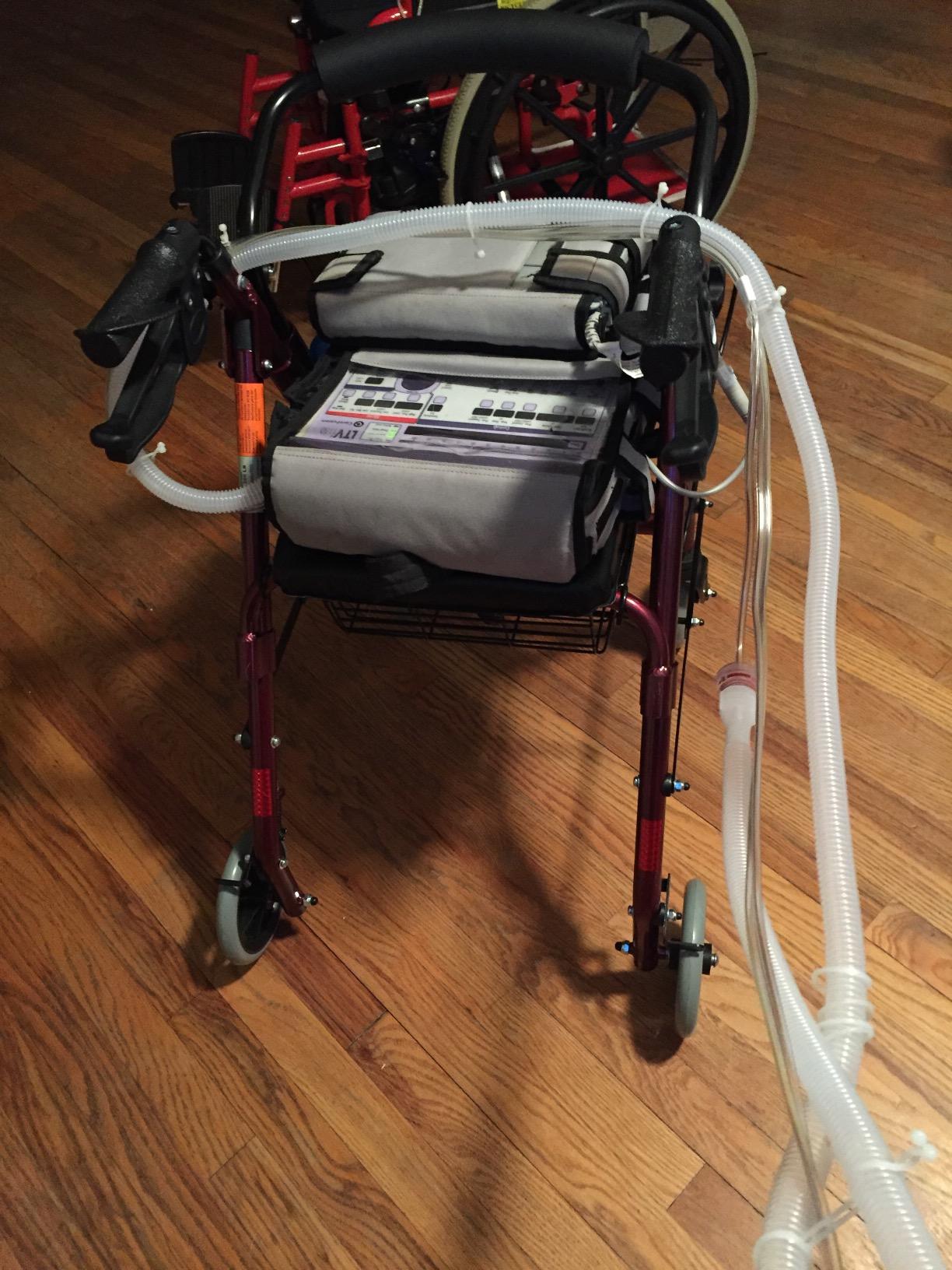
The brakes lock in place, which addresses the single most common complaint in owner forums: a rollator that drifts or rolls backward when the user sits down. Users have patched that problem with straps and cushions on other frames. This one addresses it with a mechanical lock and large handgrips that a hand with limited grip can still close.
The review set here is the most polarized in the group, and the reason is fit rather than function. Owners of petite frames, roughly 4 foot 10 inches to 5 foot 2 inches, describe it as the only narrow rollator that finally worked for them. Larger reviewers report that the seat frame opening is too narrow to sit squarely and that the grips run out of adjustment height above about 5 foot 8 inches.
Who this narrow rollator suits
It suits petite users in genuinely difficult spaces, specifically anyone around 4 foot 10 inches to 5 foot 6 inches whose bathroom doorway measures 22 inches or less. The 27.5 to 32 inch handgrip range is the deciding spec, so measure the user before the doorway.
It also suits anyone who uses a portable oxygen concentrator or carries medical items, because the under-seat basket takes the weight off the user’s hands.
Who should skip it
Skip it if the user is above roughly 5 foot 8 inches. This is not a height problem you can adjust around, since 32 inches is the top of the grip range and the frame is not designed to extend further.
Skip it if the user has a larger build and plans to use the seat regularly. Sitting sideways on the edge of the frame is the workaround owners describe, and it is not a comfortable long-term arrangement. A dated, plain finish also make it feel older than the aluminum frames on this list.
4. NOVA GetGo Petite Narrow Rollator – Built for Petite Users With a 300 Pound Rating
NOVA GetGo Petite Narrow Rollator Walker for Seniors, Lightweight Folding Rolling Walker with Seat, Lock N Load for Easy Transport & Storage, Adjustable Fit 4’10″–5’4″, Red
22 in wide frame
14 lb aluminum
300 lb capacity
Handles 29-33.25 in
Pros
- Narrow frame passes tight doorways and narrow hallways
- Rubber 6 in wheels roll smoothly on hardwood and carpet
- Lock N Load fold keeps it compact for car transport
- 300 lb capacity suits heavier users
- Lifetime limited frame warranty
Cons
- Seat is firm and narrow so many add a cushion
- Brake tension may need adjusting for weaker hands
- Under-seat bag snaps are hard to refasten
The NOVA GetGo Petite is the narrow-frame rollator that behaves like a full-size one. Its listing gives a 31 by 22 by 9.25 inch profile, so the 22 inch figure describes the frame in use, and it arrives almost assembled with only the handlebars to attach. For a buyer putting together a parent’s mobility setup, that matters more than any feature on the spec sheet.
The wheels are rubber rather than the hard plastic casters common at this size, and that single material choice changes the ride. Reviewers repeatedly describe smooth rolling over hardwood and carpet, which is exactly the surface mix in most apartments.
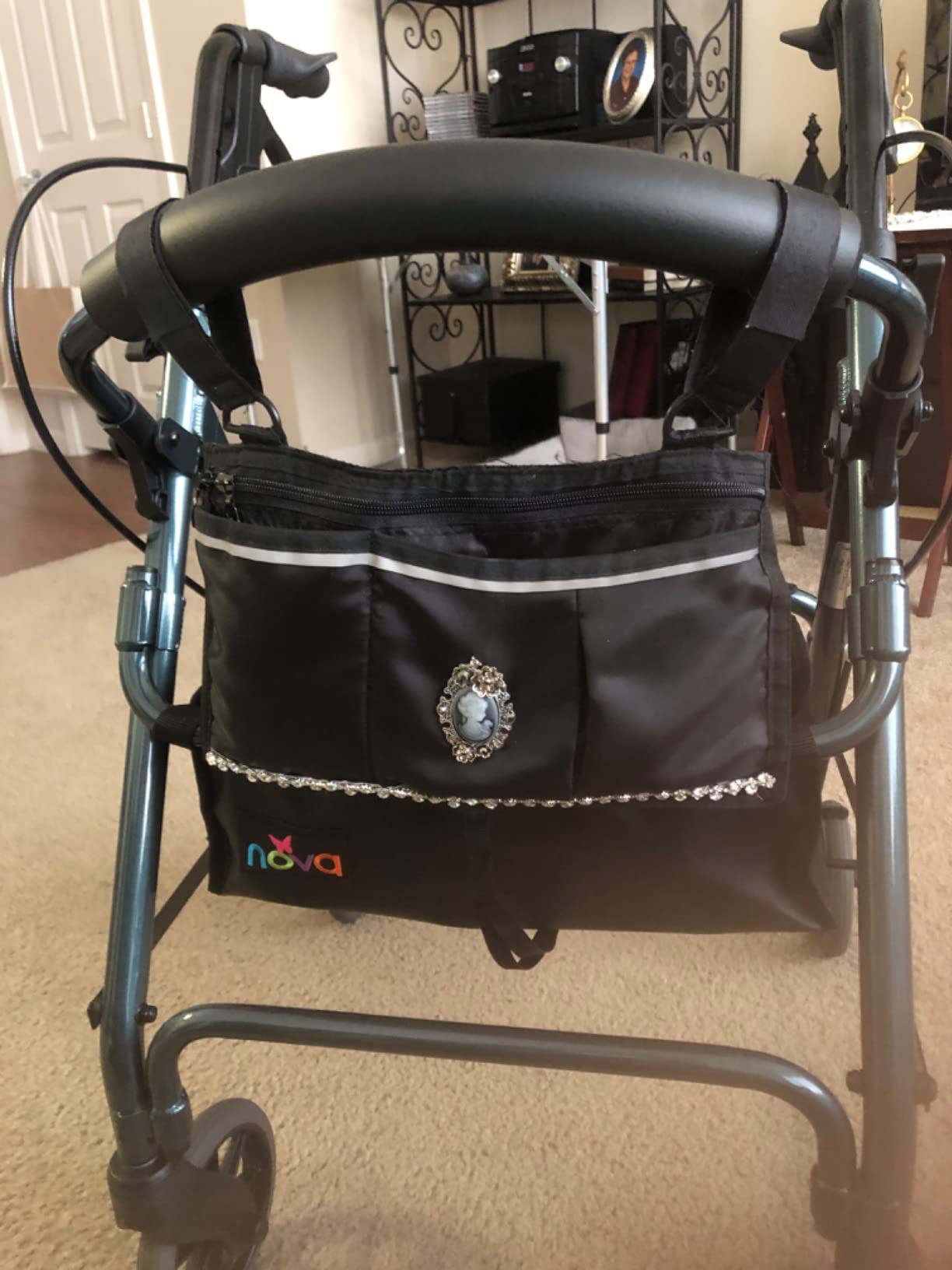
Two details stand out for the buyer. The weight capacity is 300 pounds, the highest rating among the seated narrow frames here, and the warranty is a lifetime limited frame warranty with five years on the brakes, which is unusually strong coverage on a mobility aid.
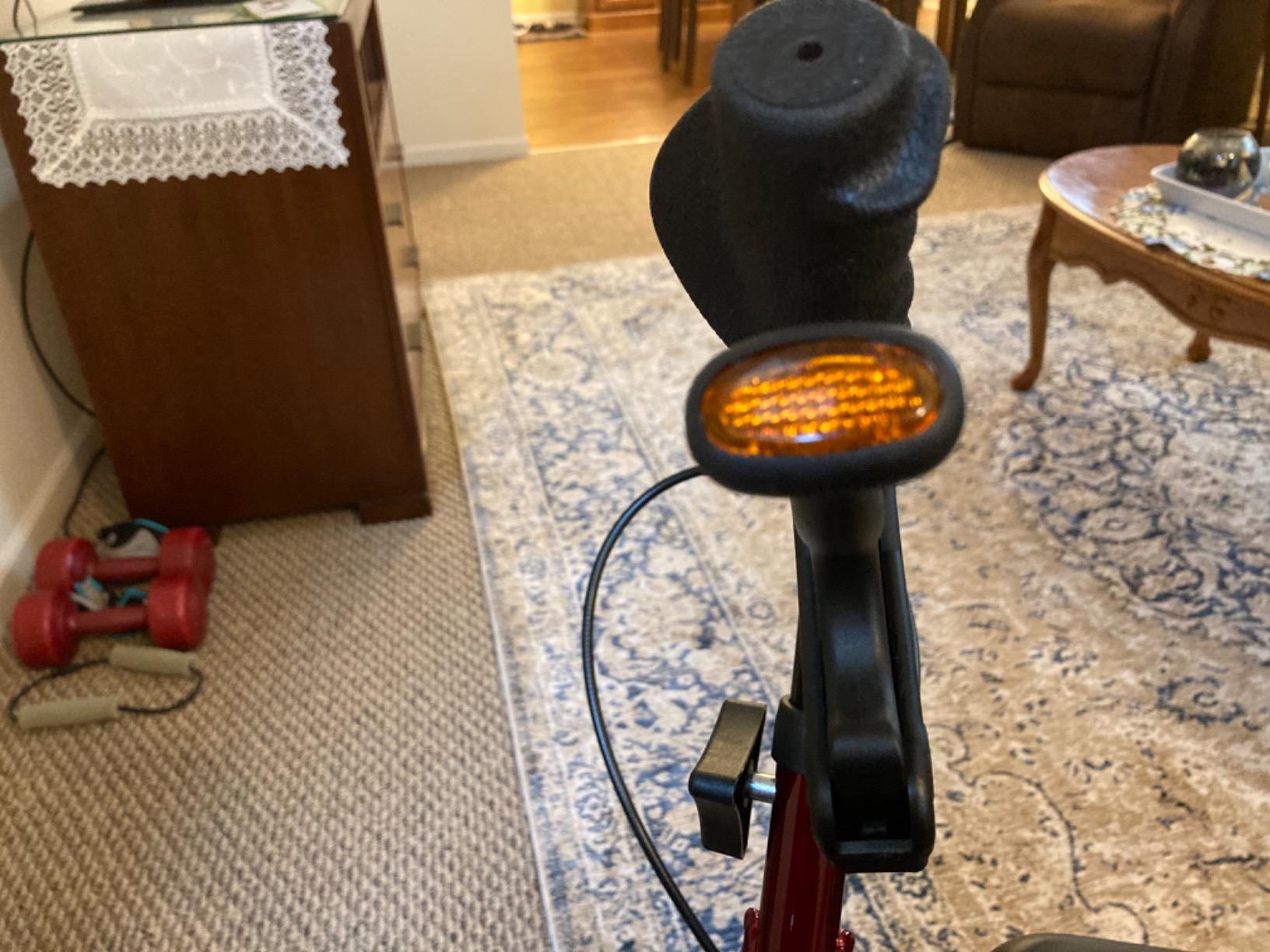
The Lock N Load folding system is worth understanding before you buy. It secures the frame in the folded position instead of letting it spring open in a trunk, which turns a frustrating loading moment into a one-handed task.
Who this narrow rollator suits
It suits users between 4 foot 10 inches and 5 foot 4 inches who need both a seat and a genuinely narrow frame, which is a combination that is hard to find outside the petite category. It is also the pick for caregivers who need a higher weight rating in a narrow body.
It suits anyone moving between a car and a house regularly, since the locking fold and the rubber wheels were both designed with transport in mind.
Who should skip it
Skip it if you need a tall handle range. At 29 to 33.25 inches this is one of the shorter adjustment ranges here, and users above about 5 foot 6 inches will be riding at the top of the frame.
Skip it if you plan to sit for extended periods without adding a cushion. The 12 by 12 inch seat is firm, and the most common owner modification is a padded cushion strapped on top. The mesh under-seat pouch is also the flimsier accessory point, with snaps that are difficult to refasten once they let go.
5. Lumex 3 Wheel Cruiser – Built for Carpet, Wood and Tile
Lumex 3 Wheel Cruiser – Lightweight & Narrow Three Wheel Walkers for Seniors & Tight Spaces
28 in wide overall
13.8 lb frame
8 in wheels
Handles 33-37 in
Pros
- 28 in frame handles tight hallways and small bathrooms
- 8 in wheels roll smoothly over carpet
- wood and tile
- 13.8 lb for a three-wheel frame
- 33-37 in handle range is broad
- Attached zippered pouch
Cons
- No seat included
- Handle range tops out at 37 in
- Three-wheel frame turns more sharply than a four-wheel
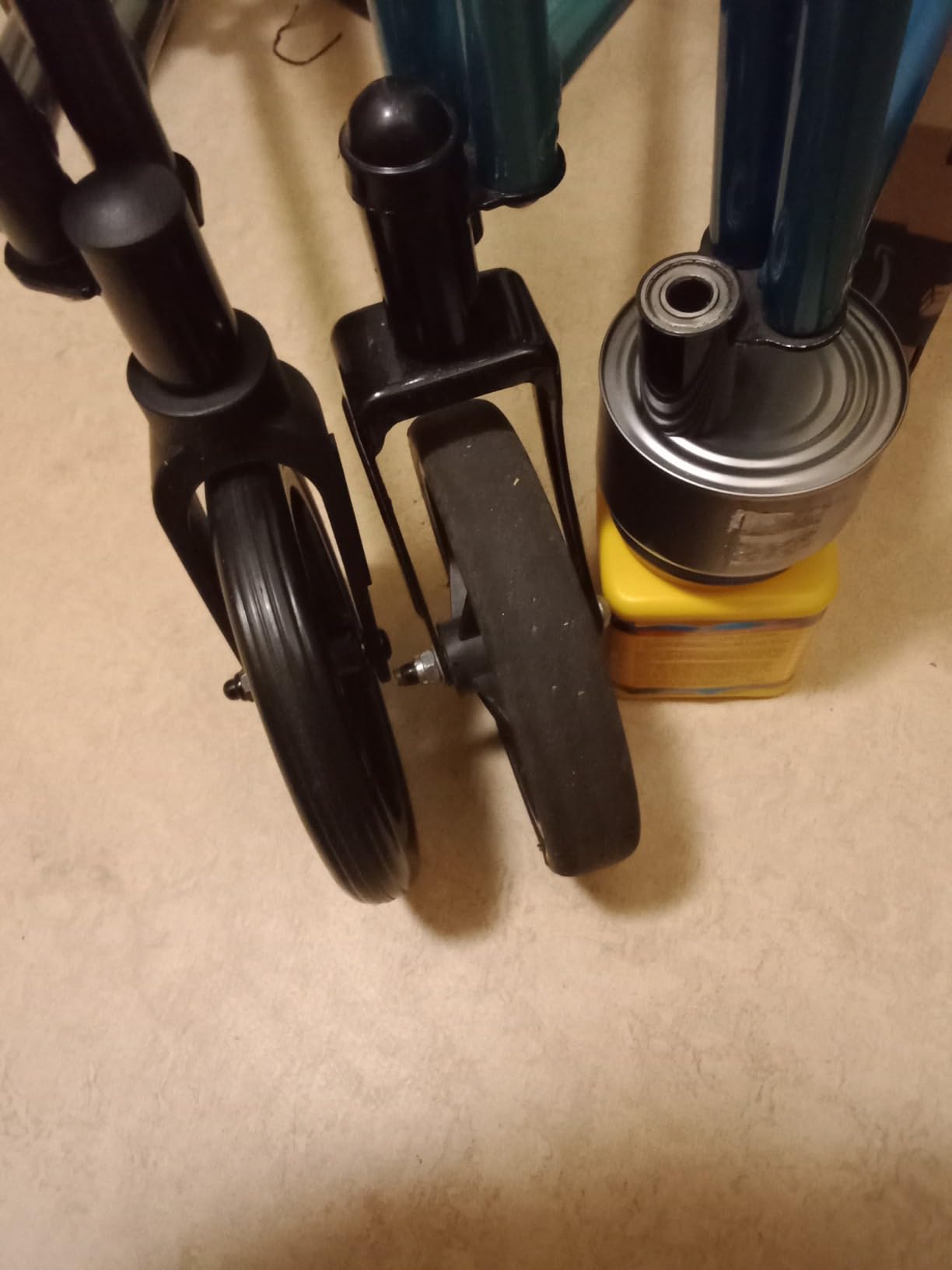
This is the format for people whose tight space is a floor problem rather than a doorway problem. At 28 inches wide it will not clear the narrowest openings on this list, but the 8 inch wheels roll over carpet, hardwood and tile with a smoothness the 6 inch casters on the four-wheel frames cannot match.
That wheel size is the whole argument for it. A carpeted hallway is where small casters catch and drag, and a trip on that seam is exactly the kind of fall these frames exist to prevent.
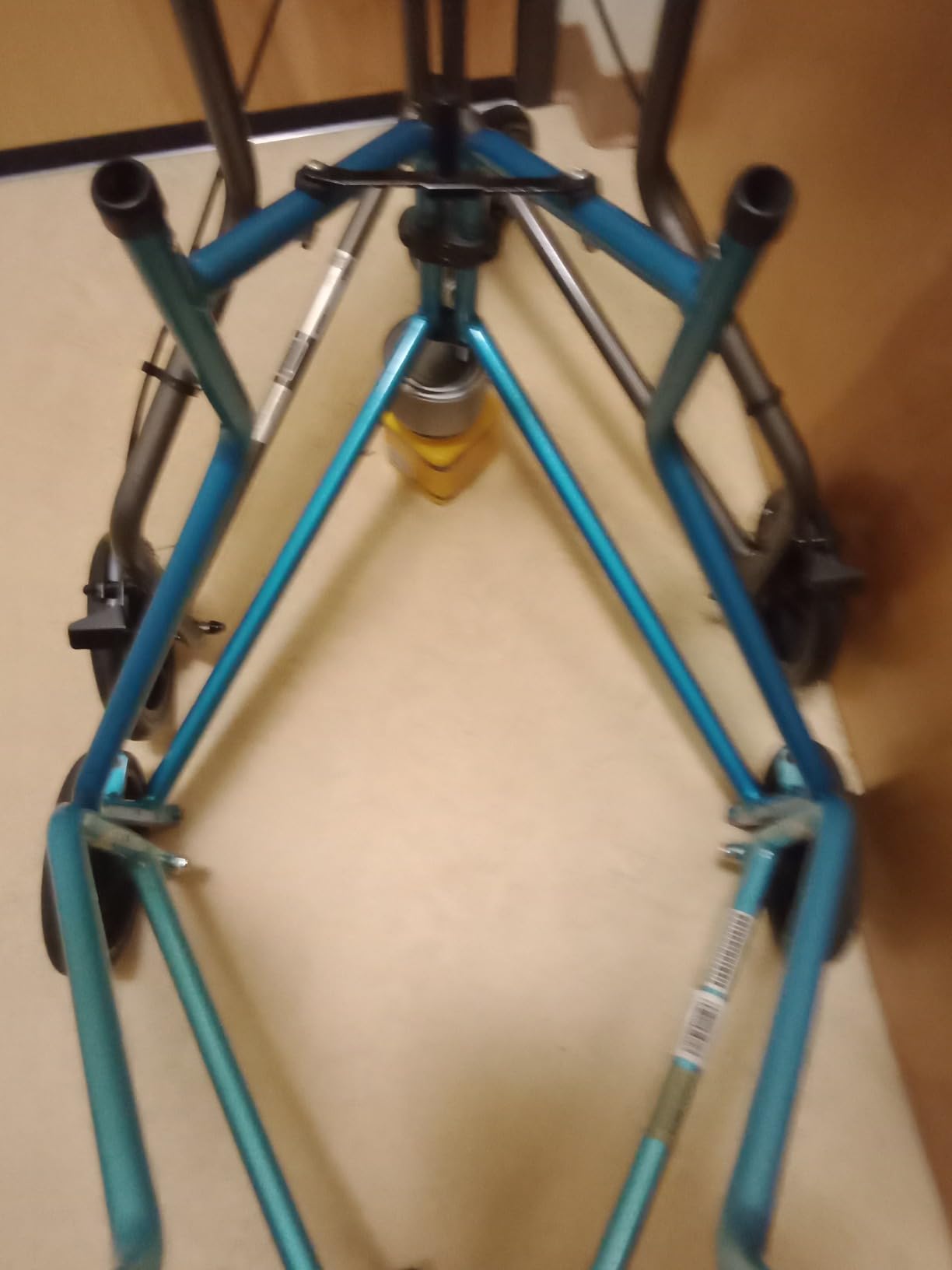
The handle range from 33 to 37 inches is the broadest of the four-wheel and mid-size frames here, which makes this a better match than the petite models for a taller user who is less worried about raw width. Buyers also like that the zippered pouch is attached to the frame rather than removable.
Like every three-wheeler here, it has no seat. Buyers describe it accurately as a walking and standing support rather than a place to rest, and the turning is noticeably sharper than a four-wheel frame, which is the benefit and the hazard depending on the space.
Who this narrow rollator suits
It suits users between roughly 5 foot 4 inches and 5 foot 10 inches living in carpeted homes where the tightest spots are corners and turns rather than 22 inch doorways. The taller handle range is the main reason it appears on this list instead of a shorter frame.
It also suits anyone who stands and walks for long stretches and has furniture or a counter available to rest against, since they will never use a seat anyway.
Who should skip it
Skip it if your tightest opening is under 28 inches. At 28 inches wide, with a triangular footprint, it is one of the wider models here and needs real clearance on both sides of a doorway.
Skip it if you need a seat, and skip it if your home has raised thresholds. Three-wheel frames with a single front caster are less forgiving at a step than a four-wheel frame with two, and the sharper turn means less warning before the front wheel reaches an edge.
6. Vive Mobility Steel Rollator Walker – Narrow Four-Wheel Frame at 23.5 Inches With a 300 Pound Rating
Vive Mobility Steel Rollator Walker with Seat – Foldable, Narrow, Rolling
23.5 in wide
19 lb steel frame
300 lb capacity
Handles 31-36 in
Pros
- 23.5 in width suits tight hallways and small apartments
- Steel frame is rated to 300 lb
- Folds down for car trunks and small closets
- Tool-free assembly gets you moving quickly
- 4.7 average rating across 532 reviews
Cons
- 19 lb is the heaviest frame in this group
- Smaller wheels feel rougher on uneven ground
- Handle adjustment tops out at 36 in
The only steel frame in this group, and it behaves like one. Steel holds a tighter frame dimension without the flex you get from aluminum at the same width, which is how it manages a 23.5 inch footprint on a four-wheel layout while staying rated to 300 pounds. This is the pick for a heavier user who cannot accept the 250 pound limits of the aluminum models.
It carries a 4.7 average rating, the highest in this roundup, and buyers describe the reception as unusually uniform. The 23.5 inch width is called out as the decisive feature in owner reviews, along with the fact that it folds down to fit most car trunks and small closets.
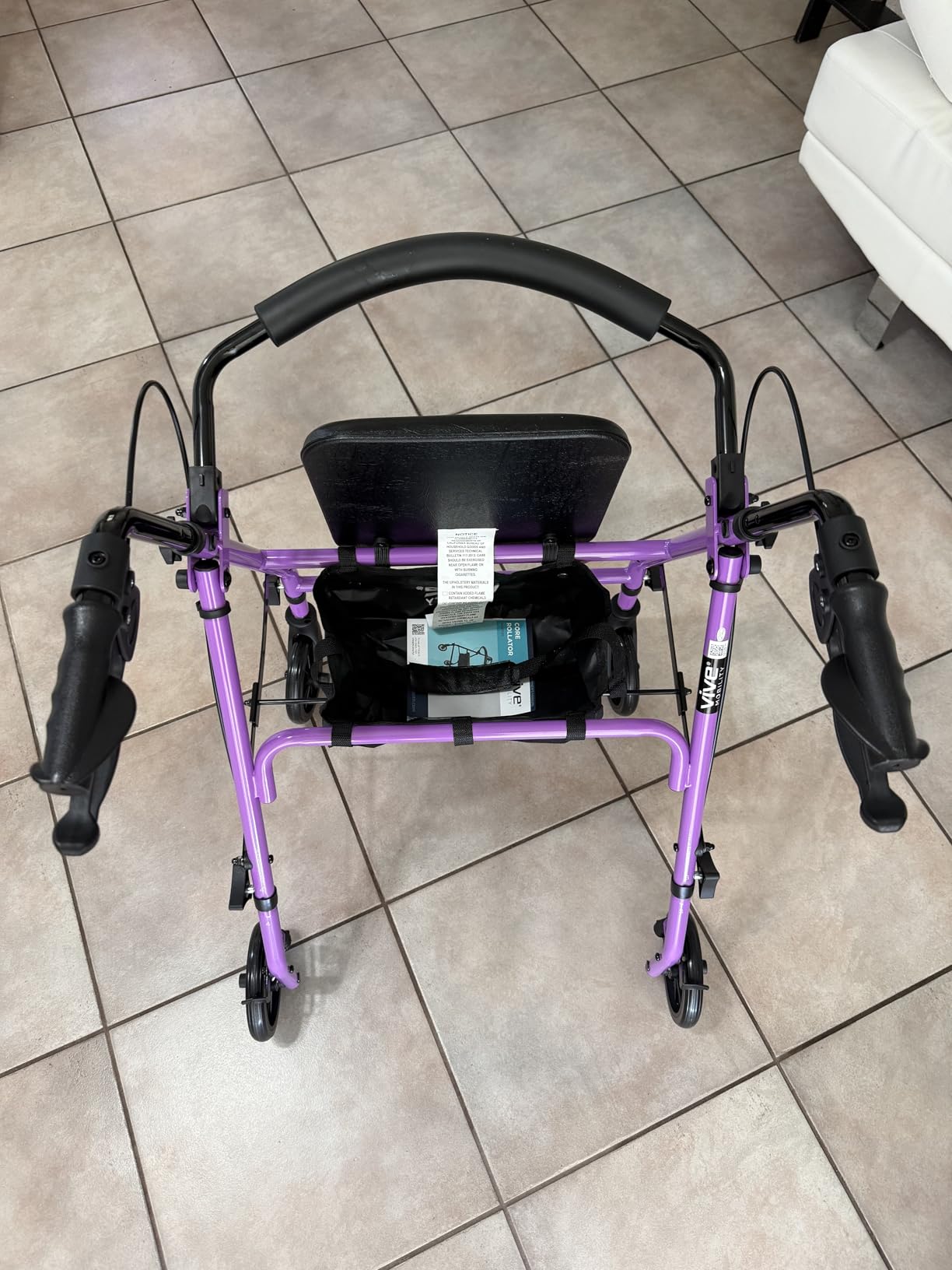
Assembly is tool-free, which matters if the rollator is arriving at the same moment as a hospital discharge. Handles adjust from 31 to 36 inches, a middle-of-the-road range that suits roughly 5 foot to 5 foot 9 inch users.
The weight is the reason for the 4.7 becoming something other than a clear recommendation for everyone. At 19 pounds this is the heaviest frame here by a wide margin, and a caregiver lifting it into a high trunk or carrying it up stairs will feel the difference against an 11 pound aluminum model.
Who this narrow rollator suits
It suits users who need a high weight capacity in a narrow frame, which is a combination that is genuinely scarce in this category. For a caregiver shopping for a larger parent in a small home, this is the frame where width and capacity stop fighting each other.
It also suits anyone who values a rigid, non-flexing frame over portability, particularly on carpet and rough indoor surfaces where a tighter steel joint holds its geometry longer.
Who should skip it
Skip it if the rollator has to go in and out of a car several times a day. At 19 pounds, with a steel frame rather than tubes, this is a two-hand lift in most situations and the main reason reviewers mention weight first.
Skip it if the route involves gravel, grass or uneven pavement. The wheels here are smaller than the 8 inch models, and buyers note they feel rougher outside, which is the natural consequence of a frame optimised for indoor clearance.
7. Helavo 3 Wheel Walker with Double Front Wheels – Stability in a Three-Wheel Frame
Helavo 3 Wheel Walker with Double Front Wheels, Narrow Walker for Seniors
25 in wide in use, 9 in folded
12.1 lb aluminum
300 lb capacity
Handles 33-37 in
Pros
- Dual 8 in front wheels add stability a single-wheel frame lacks
- 360-degree rotating casters pivot for tight turns
- Folds to 9 in wide for closet storage
- 12.1 lb with a 300 lb rating
- Handle range fits roughly 4 ft 8 in to 7 ft 4 in
Cons
- Dual front wheels add width versus single-wheel models
- No seat for resting
- Brake and fold operation takes practice
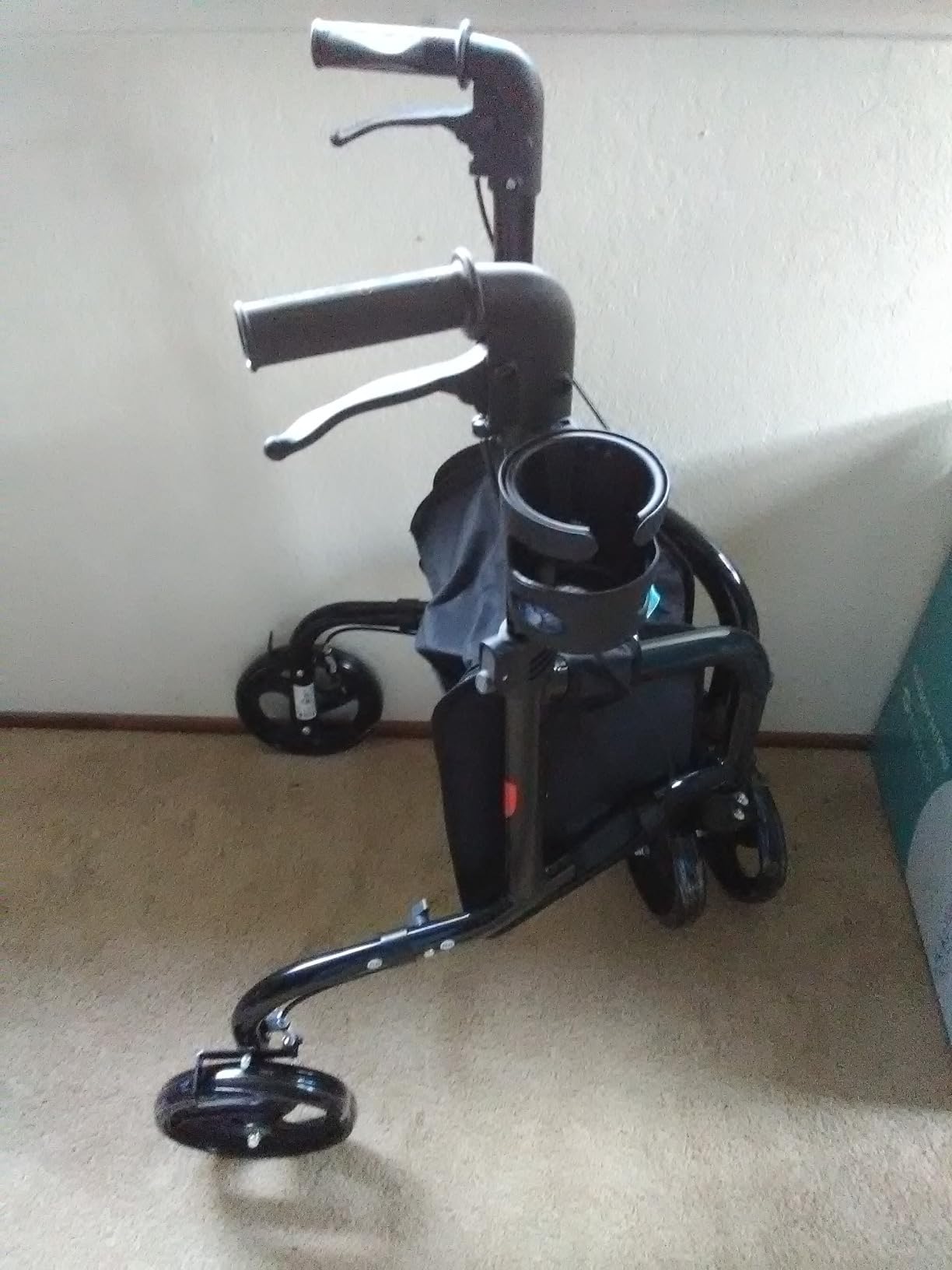
The usual objection to a three-wheel rollator is that the single front caster feels twitchy. This one answers it with dual 8 inch front wheels on a rotating mount, which spreads the load across a wider contact patch and tracks straighter at walking speed. In a narrow hallway that is the difference between turning confidently and steering carefully.
It measures 25 inches wide in use and folds to 9 inches wide, one of the thinnest storage profiles of anything on this list. For a small closet or a corner behind a sofa, that 9 inch figure is what makes it usable.
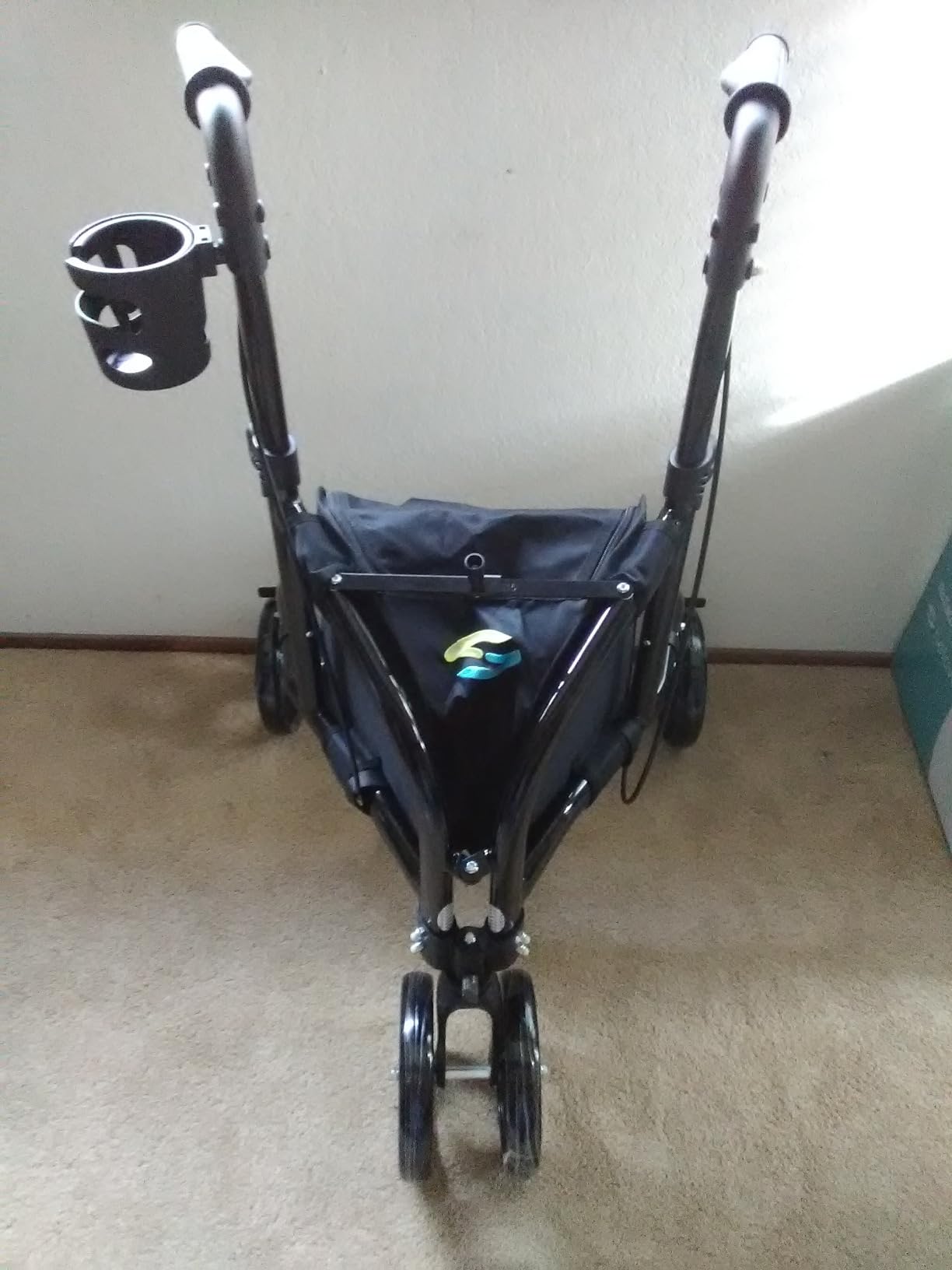
The handle range is unusually generous, running 33 to 37 inches and covering users from roughly 4 foot 8 inches to 7 foot 4 inches. For a household with two people of different heights sharing one frame, that is the widest compatibility range in this roundup.
The brake system is worth understanding before buying. There is a downhill speed control and a separate parking brake, and reviewers who struggle with hand strength should test both levers in a store, because several buyers report a learning curve on the brake and fold operation.
Who this narrow rollator suits
It suits users who want three-wheel turning agility without giving up the planted feeling of a four-wheel frame, particularly on tiled or sealed floors where a single caster can skate. The 300 pound rating is also among the highest in this group.
It suits anyone whose tightest opening is around 27 inches or wider but who still wants a rollator that stores down to 9 inches and adjusts for a very wide range of user heights.
Who should skip it
Skip it if your tightest opening is under 25 inches. The dual front wheels add width relative to single-wheel models, so this is the compromise between stability and clearance rather than the answer to the hardest doorway problem.
Skip it if you need a seat. Three-wheel frames have no seat, and a 4.0 average rating here, with a wider spread than most of this group, reflects that some users found the handling and build less refined than the aluminum rivals.
8. PLANETWALK Premium 3 Wheel Rollator – 11 Pound Frame With Rubber Wheels
PLANETWALK Premium 3 Wheel Rollator Walker for Seniors – Ultra Lightweight Foldable Aluminum Mobility Aid with Height Adjustable Handle and 7.5 Inch Wheels, Brilliant Red
27 in wide overall
11 lb aluminum frame
253 lb capacity
Handles 32.7-36.7 in
Pros
- 11 lb frame is the easiest to lift into a car
- Self-locking fold opens in about a second
- 7.5 in rubber wheels take bumps with less shake
- Five-level handle adjustment suits 4 ft 8 in to 5 ft 8 in
- Ergonomic grips help hands with arthritis
Cons
- 27 in width is wider than the narrowest frames here
- No seat included
- Open storage bag leaves contents exposed
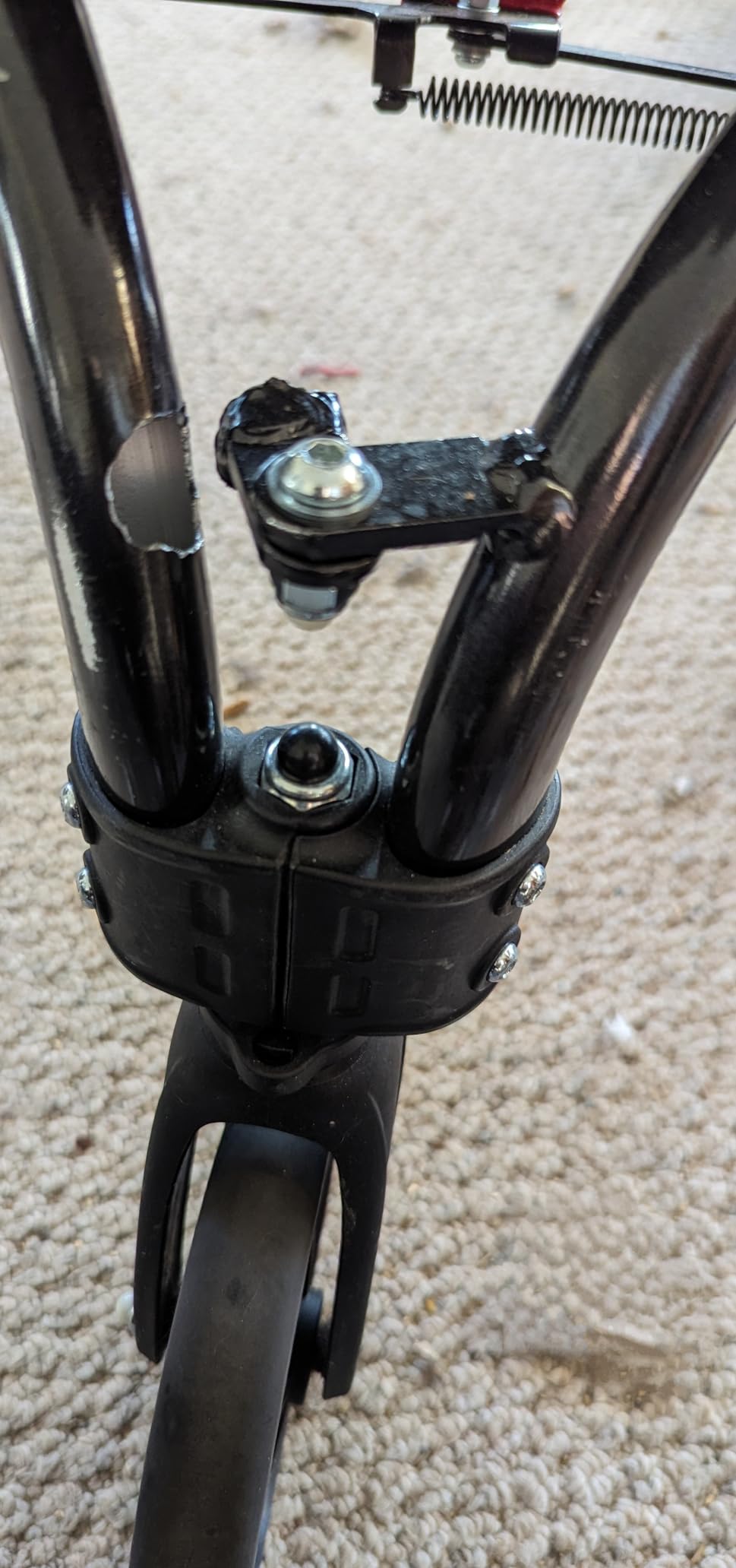
With more than 2300 ratings, this is the most reviewed product in the roundup, and the review volume itself is a reason to consider it. Buyers consistently name three things: the 11 pound frame, the self-locking fold, and the ride quality from the 7.5 inch rubber wheels.
The fold deserves attention. A self-locking mechanism opens and closes in about a second with one hand, which is the difference between a rollator a caregiver manages easily and one that gets left in the hallway because folding it is awkward.
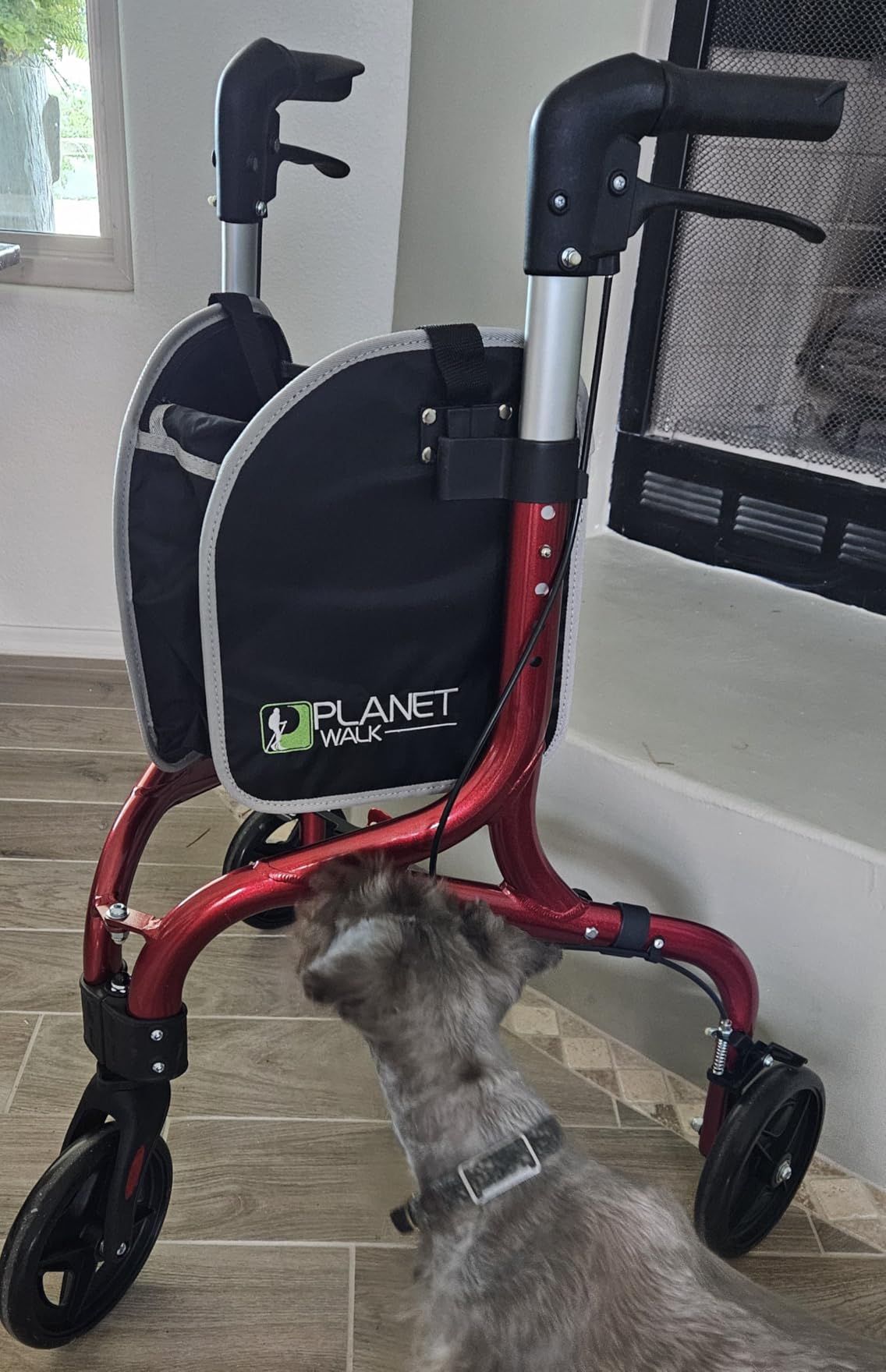
Overall size is 22.8 inches long by 27 inches wide, folding to 12.5 inches wide. Handle height adjusts across five levels from 32.7 to 36.7 inches, and the grips are shaped for hands that grip weakly, which is a detail that matters more with arthritis than a spec sheet suggests.
There is no seat, and the weight capacity of 253 pounds is the lowest of any model here that people might expect to sit on. The storage bag hangs from the frame rather than enclosing, so anything carried is visible.
Who this narrow rollator suits
It suits users who lift their mobility aid frequently and whose route includes a driveway, path or courtyard. The 7.5 inch rubber wheels handle bumps and uneven surfaces with less shake than the 6 inch casters on the four-wheel frames, and at 11 pounds it is the easiest to carry here.
It suits anyone between roughly 4 foot 8 inches and 5 foot 8 inches who wants the largest review base in the category behind the frame they rely on.
Who should skip it
Skip it if your tightest opening is under 27 inches. This is a wide three-wheeler by narrow standards, and buyers who bought it for a 24 inch doorway report regretting it.
Skip it if you need a seat, and treat the 253 pound rating as a hard limit rather than a suggestion. Anyone above that weight should look at the 300 pound rated frames on this list instead.
How Narrow Is Too Narrow? The Safety Floor
There is a limit to how narrow you should go, and almost nobody writes about it because the question is commercially awkward. A rollator works by resisting tipping. Every inch you remove from the frame width removes some of the geometry that resists a sideways or forward fall, and the limit arrives suddenly rather than gradually.
The first floor is the two inch clearance rule. If a rollator measures 20 inches and your opening measures 21, the frame will technically pass and will not turn inside the opening without hitting the jamb. Two inches of slack is not comfort, it is the minimum that lets a user square up to a door at walking pace.
The second floor is the threshold. Front casters catch on raised door sills and on the edge of a rug, and a caught front wheel on a narrow three-wheel frame is the mechanism behind most of the tipping anecdotes in mobility forums. If your route has raised transitions between carpet and tile, a four-wheel frame with a longer wheelbase and two front casters is the safer format even if it costs you an inch of width.
The third floor is the seat. Narrow frames with seats compromise the seat first, and a 12 by 12 inch seat that a larger user cannot sit squarely in becomes something they perch on sideways. That is uncomfortable and it changes the balance point while the frame is loaded, which is the moment you least want a compromised base.
Our position, and the position of most therapists, is that width should be the last filter you apply after fit. Get the handle height range matched to the user, get the weight capacity matched to the user, get the seat usable, and then narrow the choice by measurement. If a clinician is involved in the decision, ask them to confirm the frame at the threshold, because that is the specific test they can perform and you cannot.
Buying Guide for Narrow Rollators
Overall width versus folded width
These are two different numbers and they answer two different questions. Overall width decides whether the rollator goes through your doorway while it is in use. Folded width decides whether it fits in the closet, the corner or the trunk. Shops frequently list the folded figure in the headline because it is the smaller one, and shoppers compare it against a doorway measurement, which is how a purchase ends up with a rollator that does not fit through the bathroom.
Compare like with like. For each model on this list, the in-use width is the number to run against your doorway, and the folded figure is the number to run against your storage space and car.
Wheel size and the floor you actually have
Small casters, generally 6 inch, work well on laminate, hardwood and low pile carpet and are quiet. Large wheels, 7.5 to 8 inch, roll over carpet pile, thresholds and uneven ground with less effort. Neither is better in the abstract; a rollator with large all-terrain wheels dragged through a carpeted hallway is solving a problem the user does not have.
Because tight hallways are an indoor problem, match the wheel to the floor rather than the terrain. If there is any gravel, path or driveway in the daily route, step up to a larger wheel.
Brakes that lock
Ask specifically whether the rear wheels lock when the user sits down. The complaint pattern in mobility forums is consistent: a rollator drifts or rolls backward when weight goes onto the seat, and users end up adding straps, braided cord or a sewn cushion to solve it. A frame with lock-in-place brakes or a two-way parking brake solves the problem at the source.
Cable and loop brakes also differ in how much hand strength they need. Loop brakes are easier to squeeze for arthritic hands, which is a practical advantage rather than a preference.
Weight capacity and height range
These two specs disqualify more frames than width does. Check the handle range against the user’s actual height, standing at the middle of the range rather than the top of it, since riding at maximum extension is unstable. Then check the capacity against the user’s current weight rather than an optimistic number.
Capacity across this roundup runs from 250 pounds to 300 pounds. If the user is above 250, the aluminium narrow frames mostly fall away, and a heavier user in a tight hallway is one of the harder problems in this category.
Rollator or narrow walker
A rollator has four wheels, brakes and a seat, which makes it controllable, restful and heavy. A narrow fixed-frame walker has no wheels, weighs a fraction as much, and is narrower and more stable, which makes it better for a very small opening and worse for anyone who tires while standing.
If the user can bear weight on both hands and walk short distances safely, a narrow fixed-frame walker is often the better answer for a 20 inch opening. If the user needs to be able to stop, sit and steer, a rollator earns its width. Many households end up owning one of each.
Where to buy and what returns are worth
Three channels cover this category. A durable medical equipment supplier will measure with you, often in person, and is the right stop if a clinician is involved. Large retailers are convenient for returns and work well when the specification is already known. Marketplaces suit buyers who want the widest review base and can check the published width against the listing, which is exactly the discipline this article is built around.
Returns matter more here than in most categories because the first buy often fails on fit. A return window of 30 days is worth real weight, since the number you need is the one in your hallway, not the one on a spec page. Check that the frame can be returned assembled.
If you are the caregiver buying
In the forum threads behind this topic, the buyer is usually a child shopping for a parent. That changes the priority order. Weight capacity and handle range come first because they are non-negotiable for the user. Weight of the frame comes second because you are the one lifting it. Width comes third, measured properly, because the frame that does not fit is the one that ends up in a closet.
Also plan for the emotional side. Several threads on first use in public focus less on specifications than on reluctance to be seen with a rollator. A frame that folds small and looks like ordinary walking equipment, like the Stander or the NOVA, does more for daily use than any spec.
If hallway clearance is one of several things in the renovation, remember that the same measurements drive rugs, runners and lighting. Our picks for runner rugs sized for hallways and hallway lighting both start from the same tape measure.
Frequently Asked Questions
What is a good narrow rollator for small doorways?
A rollator with an overall width of 20 to 22 inches is the practical answer for small doorways. Apply the two inch clearance rule: measure the narrowest opening in your home, subtract two inches, and choose a frame narrower than the result. The Lumex Walkabout Junior at 20 inches and the NOVA GetGo Petite at 22 inches are the two narrowest seated frames in this roundup.
What is the narrowest rollator available?
Among the models reviewed here, the narrowest published overall width is 20 inches on the Lumex Walkabout Junior Rollator, a four-wheel frame with a seat. The narrowest three-wheel frame is 21 inches on the Vive Mobility 3 Wheel Walker. Standard rollators typically run 24 to 26 inches wide, so the difference is real rather than marketing.
What is the narrowest width for a walker?
For a narrow fixed-frame walker, roughly 20 inches is the practical floor, though narrow walkers exist below that. For a rollator with wheels, 20 to 22 inches is the narrow end of the range. Below about 20 inches you begin trading the frame geometry that resists tipping, and thresholds become a genuine hazard rather than an inconvenience.
Are there different widths of walkers?
Yes, and the spread is wide. Standard rollators run 24 to 26 inches wide. Narrow rollators run 20 to 22 inches. Three-wheel frames with single front casters run about 21 to 28 inches, and side-folding and dual-front-wheel designs add their own width. The formats that solve tight spaces are narrow four-wheel frames with seats, side-folding frames, three-wheel frames and indoor mini rollators with small casters.
What are the key differences between a rollator and a standard walker, and how should I choose one?
A fixed-frame walker has no wheels, weighs a few pounds, is narrower and steadier, and suits someone who can bear weight on both hands. A rollator has four wheels, hand brakes and a seat, is heavier and wider, but lets the user stop, steer and sit down. Choose the walker for a very tight opening and short distances. Choose the rollator for longer routes, rest needs and better control.
What is better than a rollator?
A narrow fixed-frame walker is better when the opening is extremely tight, the user needs both hands free for balance and distances are short, since it is lighter and narrower than any rollator. An upright rollator with forearm support is better for a user who keeps an upright posture and needs more support. A transport chair is better when a caregiver pushes most of the distance.
What is the best lightweight rollator walker for seniors?
Among seated narrow frames, the lightest here is the Lumex Walkabout Junior at 11.5 pounds, at 20 inches wide. The Stander Space Saver at 14.5 pounds folds to a 10 by 11 inch footprint, which makes it the lightest option for storage. If no seat is needed, the Vive Mobility 3 Wheel Walker and the PLANETWALK rollator are both 11 pounds. Confirm the handle range fits the user before buying.
How do I measure my doorway for a walker?
Find the narrowest opening on the daily route rather than the average one, and include the door stop molding. Measure at roughly knee, waist and shoulder height and take the smallest reading, because frames are often not square. Subtract two inches to get the frame width that will pass comfortably. A buyer in an r/wheelchairs thread reported that a 22 inch rollator works in a 24 inch doorway.
Can a narrow rollator still have a seat?
Yes, but the seat is the first thing that shrinks. The Lumex Walkabout Junior has a padded 12 by 12 inch seat on a 20 inch frame, and the NOVA GetGo Petite has a 12 by 12 inch seat on a 22 inch frame. By contrast the Stander Space Saver, which is 26.5 inches wide, carries only an 18.5 by 6 inch perch seat. Check the seat opening against the user’s build.
Is a 3 wheel rollator more stable than a 4 wheel rollator?
No. A four-wheel frame has two front casters and a longer wheelbase, so it resists forward tipping and tracks straighter at walking speed. A three-wheel frame has a single front caster, which pivots for a much tighter turning radius but catches more readily on a threshold. The Helavo model in this roundup uses dual 8 inch front wheels to narrow that stability gap without giving up the turn.
What width rollator is safest?
The safest width is the narrowest one that still gives two inches of clearance in your tightest opening and at least two inches of foot placement in front of the rear casters. Going narrower than about 20 inches removes the geometry that resists tipping. Confirm the choice at a real threshold and with a physical or occupational therapist, since that test cannot be done from a spec sheet.
Final Verdict on the Best Narrow Rollators for Tight Hallways
Start with the measurement, not the product. Find the narrowest opening on the daily route, subtract two inches, and buy the frame that fits with room to spare. For most people the Vive Mobility 3 Wheel Walker is the answer: a 21 inch frame at 11 pounds with the largest body of owner ratings behind it.
If a seat matters, the Lumex Walkabout Junior at 20 inches is the narrowest frame available and the NOVA GetGo Petite at 22 inches adds a 300 pound rating for a larger user. If storage matters more than passage, the Stander Space Saver folds to 10 by 11 inches. Whatever you pick, have a clinician confirm the fit before 2026 and before it becomes the frame that sits in the hallway unused.