
A griddle insert for a gas grill is a flat steel or cast iron plate that drops onto your grill’s grate ledges in place of the cooking grates, turning one appliance into a flat-top griddle for smash burgers, pancakes, hibachi stir-fry and seafood. You pull the grates, set the plate on the ledges so it sits flush, and the same burners now heat one continuous surface instead of a set of bars.
That matters because most of us already own the grill, the propane tank and the deck space. An insert converts space we already have into a second cooking appliance without adding another appliance to store, fuel to buy or a stand to find. The closed lid also turns into a melting dome for cheese, and the surrounding cook box walls contain splatter that a standalone flat top would throw across the patio.
We spent several weeks comparing ten plates across three material families and five sizes, from an 18 x 12.6 inch ceramic-coated compact to a full-size 25.9 x 17.6 inch plate cut for one specific grill brand. Our criteria were fit confidence, even heat, grease routing, how much grill you give up, and how much punishment the surface takes at high heat. If you are still choosing a grill rather than a plate, our built-in gas grill picks cover that side of the decision.
One warning before we start. Fit is the single biggest source of disappointment in this category, and it is almost always a generation problem, not a size problem. Weber alone sells plates that fit 2016 through 2024 builds and separate plates for 2025-and-newer builds, and the Genesis II plate here does not fit 2022 Genesis grills at all. Measure before you order, every time.
Top 3 Griddle Inserts for Gas Grills in 2026
Our short list covers the three situations we see most often: a Genesis owner who wants the part that fits like a glove, a large-format buyer who wants the most cooking surface, and a universal buyer who refuses to commit to one grill brand. Full reasoning for all ten plates runs below.
Weber Genesis II Griddle Insert
- Porcelain-enameled cast iron
- Angled surface drains to a reservoir
- Replaces one Genesis II grate

Utheer 25 x 16 Pre-Seasoned Cast Iron
- Over 400 sq in of flat top
- Three reinforced base ridges
- Grease trough and detachable handles

Onlyfire 23 x 16 Stainless Steel
- Food-grade stainless
- Only 5 lb
- Wavy underside for airflow
All 10 Griddle Inserts at a Glance in 2026
Every plate below sits in the same category, so the useful comparison is material, footprint and how much clearance your grill has to give up. Sizes are the manufacturers’ stated cooking-surface dimensions, and some of the plates need more room than the headline number suggests because their handles add width.
| Product | Specifications | Action |
|---|---|---|
| Weber Genesis II Griddle Insert |
|
Check Latest Price |
| Onlyfire 23 x 16 Stainless Steel Universal Insert |
|
Check Latest Price |
| Utheer 25 x 16 Pre-Seasoned Cast Iron Griddle |
|
Check Latest Price |
 Uniflasy 25 x 16 Cast Iron Griddle Plate Uniflasy 25 x 16 Cast Iron Griddle Plate |
|
Check Latest Price |
 Uniflasy 17 x 13 Nano-Ceramic Cast Iron Griddle Uniflasy 17 x 13 Nano-Ceramic Cast Iron Griddle |
|
Check Latest Price |
 Hisencn 17 x 13 Carbon Steel Griddle Hisencn 17 x 13 Carbon Steel Griddle |
|
Check Latest Price |
 Onlyfire Chef 23 x 16 Pre-Seasoned Cast Iron Onlyfire Chef 23 x 16 Pre-Seasoned Cast Iron |
|
Check Latest Price |
 Weber Rust-Resistant Full-Size Griddle Insert Weber Rust-Resistant Full-Size Griddle Insert |
|
Check Latest Price |
 EasiBBQ Full-Size Griddle for Napoleon P500 and Rogue 525 EasiBBQ Full-Size Griddle for Napoleon P500 and Rogue 525 |
|
Check Latest Price |
 Onlyfire 18 x 12.6 Ceramic Coated Cast Iron Onlyfire 18 x 12.6 Ceramic Coated Cast Iron |
|
Check Latest Price |
How to Measure Your Grill Before You Buy an Insert
Forum threads repeat the same question in every cooking group we read: what size plate fits my grill. The answer is almost never in the listing, because grill generations share a marketing name while swapping the cooking surface underneath. Three steps, five minutes, and you can skip the return shipping.
Step 1: Read the model plate. The sticker is usually on the inside of a cabinet door, on the frame under a front shelf, or on a tag at the back leg. You are after the full model number, the series generation and the burner count. Weber Spirit and Spirit II grills look nearly identical but the plate ledges differ, and 2016 through 2024 builds do not share a plate with 2025-and-newer ones.
Step 2: Measure the cooking area in two directions. Measure the usable width across the grate ledges, front to back at the deepest point, and write both down in inches. Then add the handle allowance. A plate with fixed handles needs roughly one inch of extra clearance per side, so a 25 inch cooking surface can demand closer to 27 inches of grate-level width.
Step 3: Check the shape and the ledges. Curved grates, round burner camp stoves and unsupported glass or electric cooktops will not take a rectangular plate, no matter what the width says. Also confirm the plate’s resting depth matches your ledge height. A plate that sits too low starves the burners of air, and a plate that sits too high never reaches temperature.
Once you have all three numbers, the fitment notes under each product below tell you which of the ten plates is worth a closer look. If you are still undecided on the grill itself, our gas appliance insert guide covers the sizing logic shared across this family of products.
1. Weber Genesis II Griddle Insert – Best Enameled Half-Griddle for Genesis Owners
Weber® Genesis II Griddle Insert, Porcelain-Enameled Cast Iron
Porcelain-enameled cast iron
22 x 16 x 3 in
15 lb
Replaces one Genesis II grate
Pros
- Even heat retention from thick enameled cast iron
- Angled surface drains grease into a filter reservoir
- Two-year Weber accessory warranty
- Stays hot long after the burners shut off
Cons
- Covers only one grate
- roughly a third of the cook box
- Heavy at 15 lb
- Will not fit 2022 Genesis grills
This is the plate we keep coming back to for anyone who wants the confidence of an exact-fit part and does not mind giving up grill space. It replaces one grate on Genesis II and II LX 3, 4 and 6 burner grills, and owners describe the fit in the terms buyers care about most: it drops in and sits where the grate sat. With 1493 reviews averaging 4.5, this is one of the most thoroughly documented products in our group, which means the long-term behavior is well established rather than anecdotal.
The enameled cast iron does the heavy lifting. Its thermal mass holds temperature through a long cook, so when you drop smash burgers at a hard sear the surface barely dips, and it stays hot enough to finish eggs off the heat two minutes later. The angled cooking surface is the detail that separates it from a flat slab: grease runs down into a reservoir that filters it toward the cook box instead of pooling under your food.
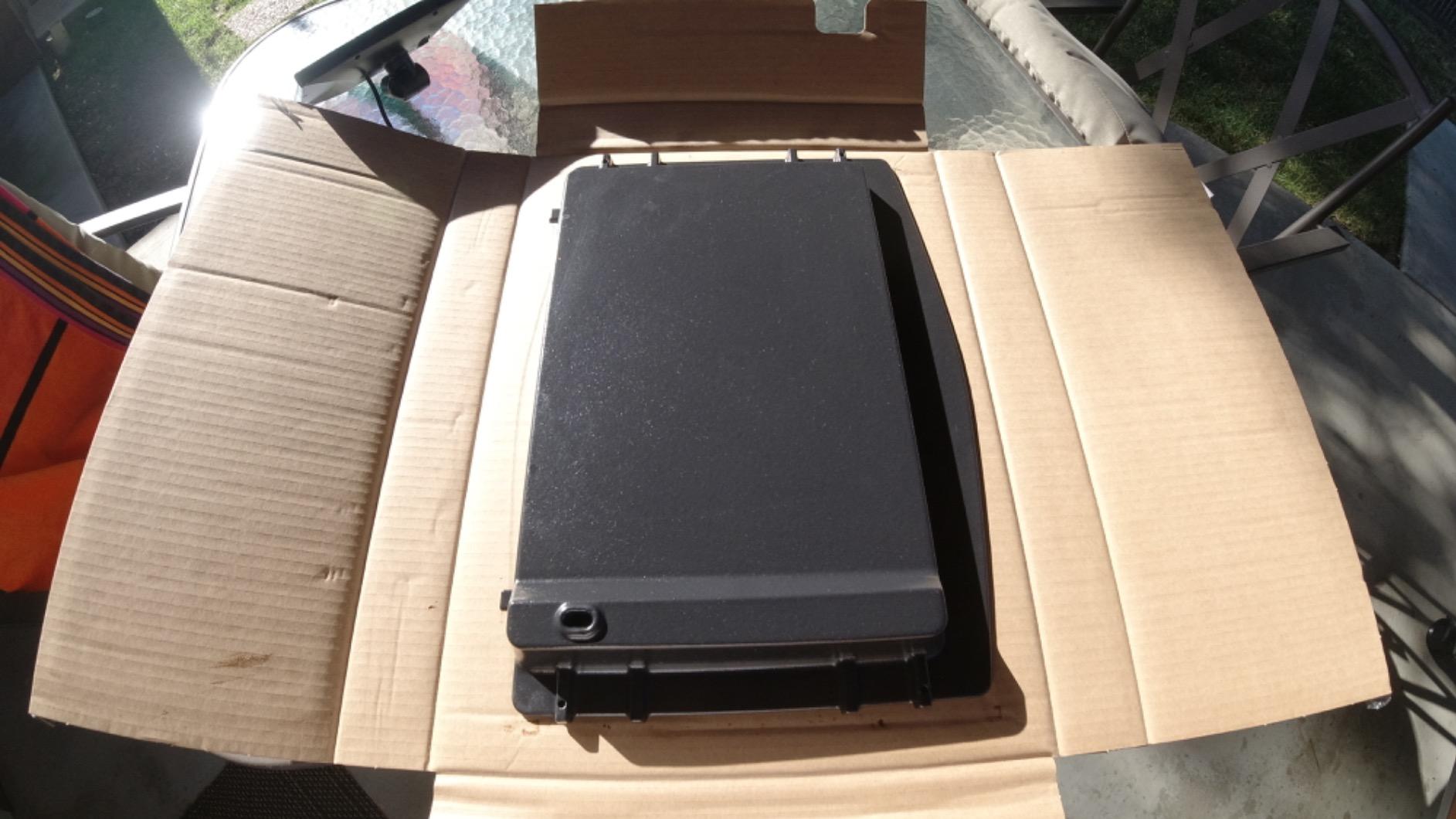
Two things to plan around. First, this is a half-griddle. You lose one grate, which on a 3-burner Genesis is close to a third of the available cooking area, so a cook who wants a full griddle surface and a usable grill zone at the same time needs to think about the Weber full-size plate further down. Second, the fit is generation-specific and the listing is explicit that it does not fit 2022 Genesis gas grills. Check the model plate before you order.
At 15 pounds it is heavy but manageable, and the weight is the price of the stability that stops this plate from shifting when you scrape a spatula across it. Hand washing only, and cover it or a shelf when it is not in use. If you own a 2022 Genesis or a 2025-and-newer Spirit, skip this one and read section 8 instead.
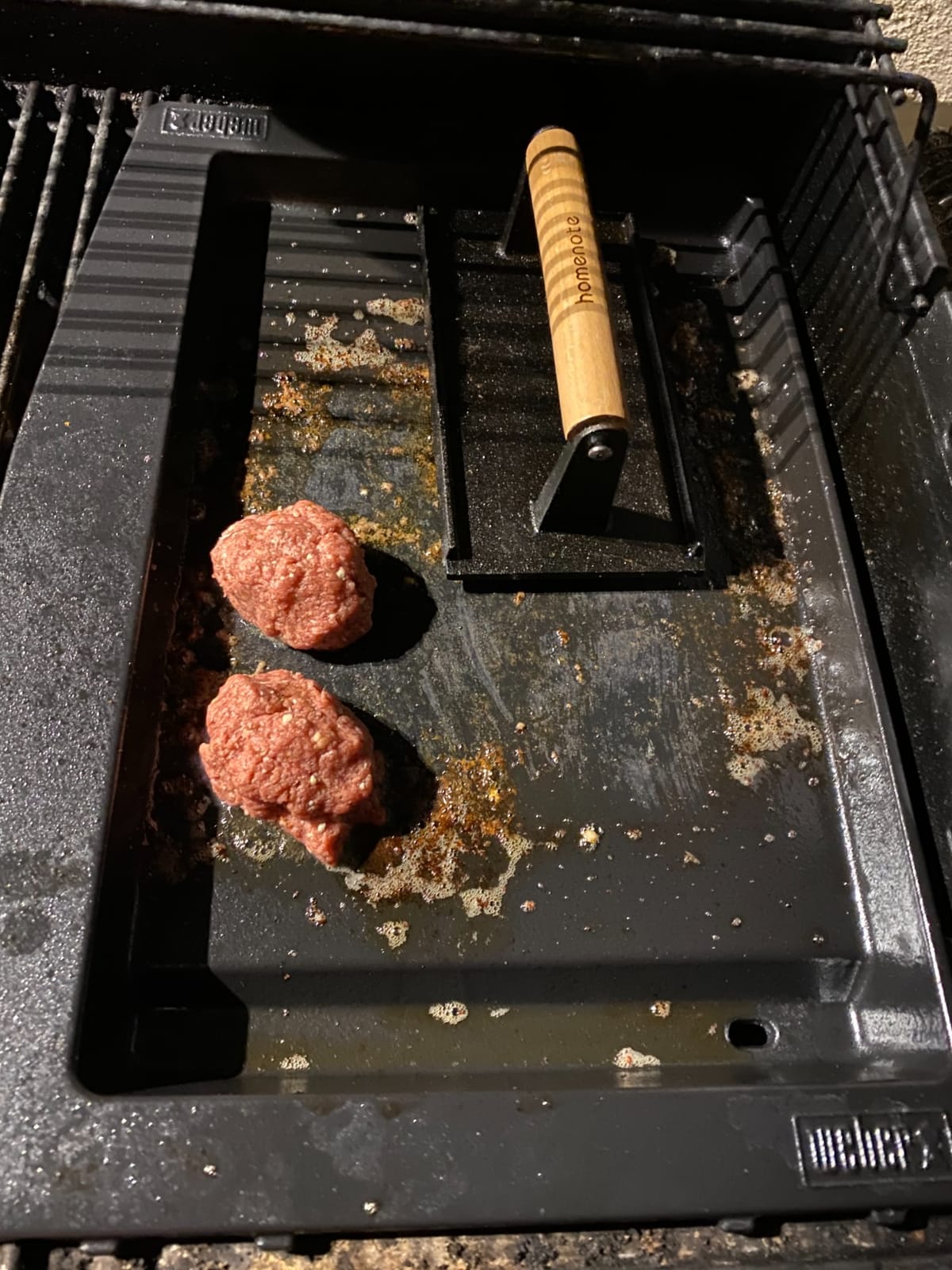
Who the Weber Genesis II plate suits
Buy it if you own a Genesis II or II LX from the pre-2022 generations and you mainly cook burgers, eggs, vegetables and shrimp. The easy-clean enamel means you are not managing a seasoning film, which matters if your griddle time is scattered across a dozen short breakfast cooks rather than one long weekend session.
It also suits anyone who wants to keep most of the grill intact for direct grilling. A half-griddle lets you griddle on one side and grill on the other, which is the easiest possible version of the twofer setup. If you only need two burners of flat surface for pancakes and bacon, this is a lot of unused plate for the job.
Where the Genesis II plate disappoints
The coating is the long-term risk. Enamel is essentially a glassy layer over iron, and once it chips you are seasoning bare iron underneath a cracked surface, which is a worse situation than starting with bare carbon steel. Owners also point out the easy-clean benefit only holds if you are gentle with tools, since a hard steel scraper can scratch enamel.
The fit is the other limitation, and it is the one that ends purchases. If your model number is from 2022 or later, this plate will not go on your grill no matter how close the dimensions look. Measure first, and if your grill falls outside the listed generations, the full-size Weber plate or a universal 23 inch stainless option will save you the return.
2. Onlyfire 23 x 16 Universal Stainless Steel Insert – Best Lightweight Universal Plate
23″ x 16″ Universal Stainless Steel Cooking Griddle Flat Top Griddle Insert
Food-grade stainless steel
23 x 16 x 2.75 in
5 lb
Detachable side handles
Pros
- Only 5 lb in a 23 x 16 format
- Wavy hollow underside channels air for even heating
- Detachable handles make stacking and storage simple
- Grease trough and raised walls contain drips
- A review base of 3341 ratings
Cons
- Stainless gives up heat retention versus cast iron
- Universal sizing needs a clearance check
- Some owners report more sticking than seasoned iron
This is the one we recommend to anyone who swaps between grill and griddle on a whim, and to anyone whose garage or apartment storage cannot swallow a heavy slab of cast iron. At 5 pounds, you can lift it with one hand, slide it into a corner between cooks, and put grates back without waiting for the plate to cool. Nothing else in this list makes switching that painless.
It also carries an unusually large review base at 3341 ratings averaging 4.3, so the reported behavior is consistent rather than anecdotal. Buyers single out the wavy hollow underside, which routes air under the plate to even out the heat and limit hot spots, and the detachable side handles, which let the plate nest flat for storage. The grease trough collects drippings and raised walls keep diced peppers and onions on the surface where you put them.
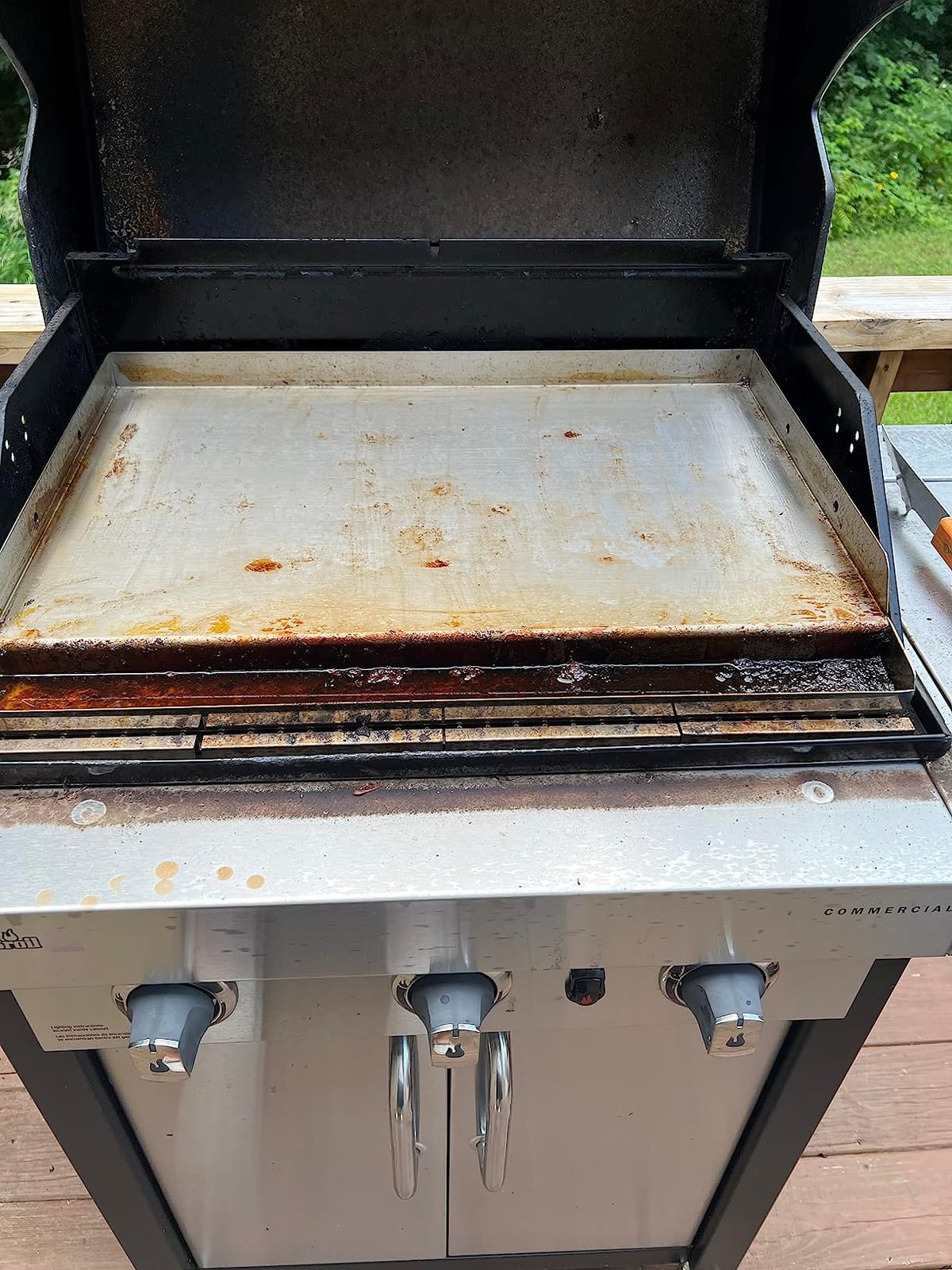
The compromise is heat behavior. Stainless steel is a fantastic conductor but a poor retainer compared with cast iron, so this plate responds faster to burner changes and cools faster once you turn them down. That is genuinely useful for temperature control, and it is also why the surface gives up less of a stored sear between batches. Plan on oiling before every session rather than once a week, because stainless has no seasoning layer to fall back on.
Fitment is the other thing to check. It is a universal 23 x 16 plate, so your grill needs a cooking area at least that size with flat ledges. As with every universal plate here, measure first.
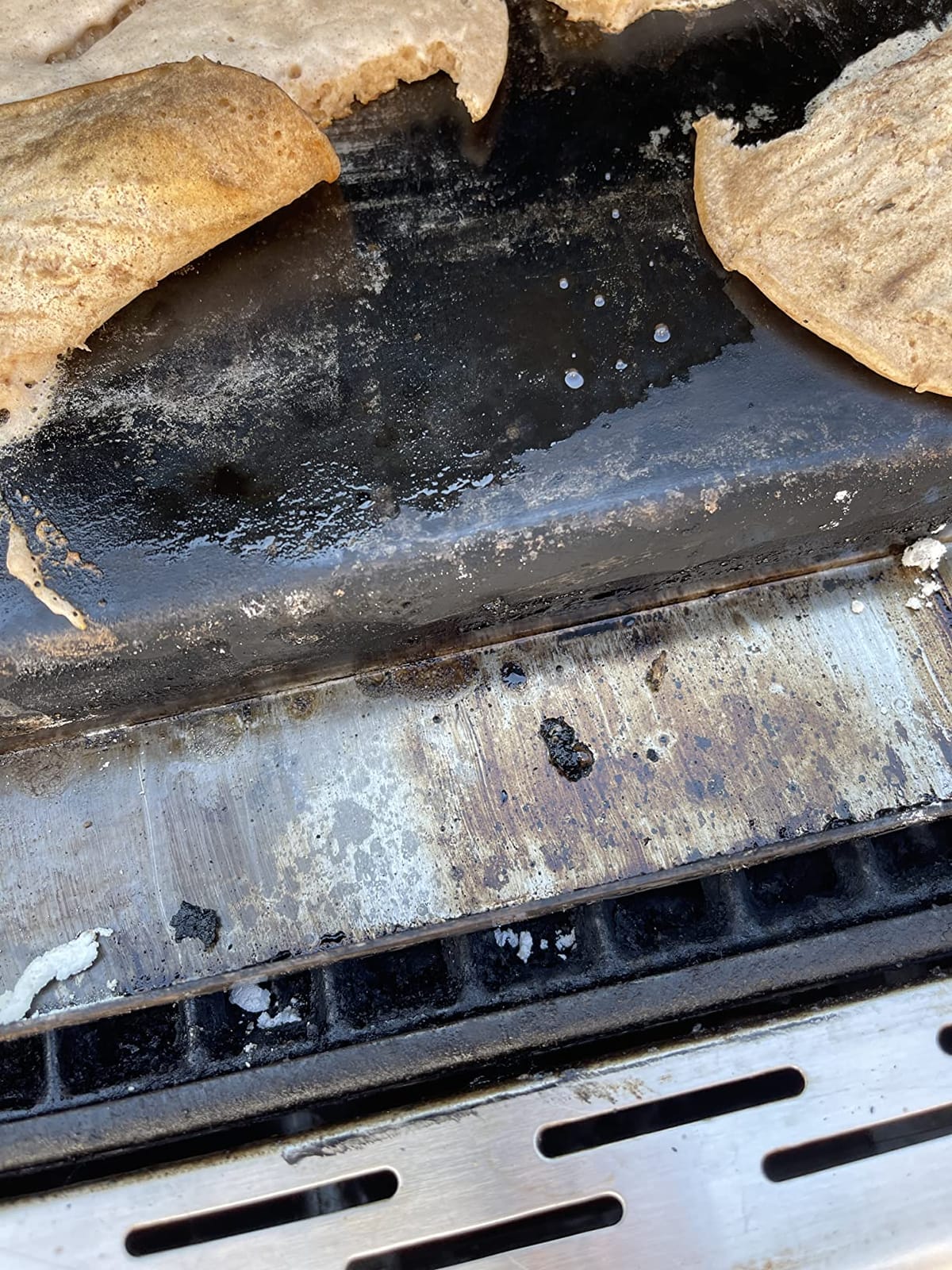
Who the stainless universal plate suits
It is the right pick for small decks, RV trips and tailgating, where the plate travels in the car and the same surface needs to work on a grill and a camp burner. Because it never rusts and needs no seasoning, it also suits people who know they will not keep up an oiling routine. Stainless forgives neglect in a way bare carbon steel does not.
Choose it when weight is the deciding factor. If a 15 or 20 pound insert would end up permanently in a corner of the garage because lifting it feels like a chore, the lighter plate is the one that stays in rotation. The fast heat response also makes it a good match for cooks who like working a hard sear and then dialing back.
Where the stainless plate disappoints
Cast iron simply holds a flat-top temperature longer, and anyone cooking a full spread of smash burgers at once will feel the difference when the burner has to recover between batches. The tradeoff is real but manageable, and it is the reason seasoned iron remains the reference standard for griddle work.
Sticking is the second common theme in reviews. The surface has no seasoning to build, so it lives entirely on the oil you put down, and reviewers who report sticking are almost always describing a session that started with a dry plate. Oiling, preheating and wiping are not optional with stainless, and the plate will not reward the days you skip them the way a well-seasoned iron plate does.
3. Utheer 25 x 16 Pre-Seasoned Cast Iron Griddle – Best Value for Maximum Surface
Utheer 25″ x 16″ Pre-Seasoned Nonstick Cast Iron Griddle for Gas & Charcoal
Pre-seasoned cast iron
25 x 16 x 2.6 in
Three reinforced base ridges
Detachable side handles
Pros
- Over 400 sq in of flat-top space
- Three base ridges spread heat and cut hot spots
- Grease trough and polished edges
- Pancakes through seafood on one surface
Cons
- Very heavy
- needs two hands
- Preheat and oil before first use
- Universal fit still needs measuring
When people ask for the best griddle insert for gas grill performance per square inch of cooking surface, this is the plate we hand them. At 25 x 16 inches it delivers more than 400 square inches of flat top, which is enough to cook a full batch of smash burgers, a pan of fried rice and a sheet of vegetables without rotating anything. At 2910 reviews averaging 4.4, it is among the most reviewed products here.
The three reinforced support ridges on the base are the feature owners mention most, and they matter more than they sound. A flat cast iron slab on a grill burner is prone to hot spots over the burner tubes, and the ridges break up contact so heat moves across the whole plate. The result is a surface you can trust at one end and the other, which is the difference between evenly browned pancakes and a batch that is overdone in the middle.
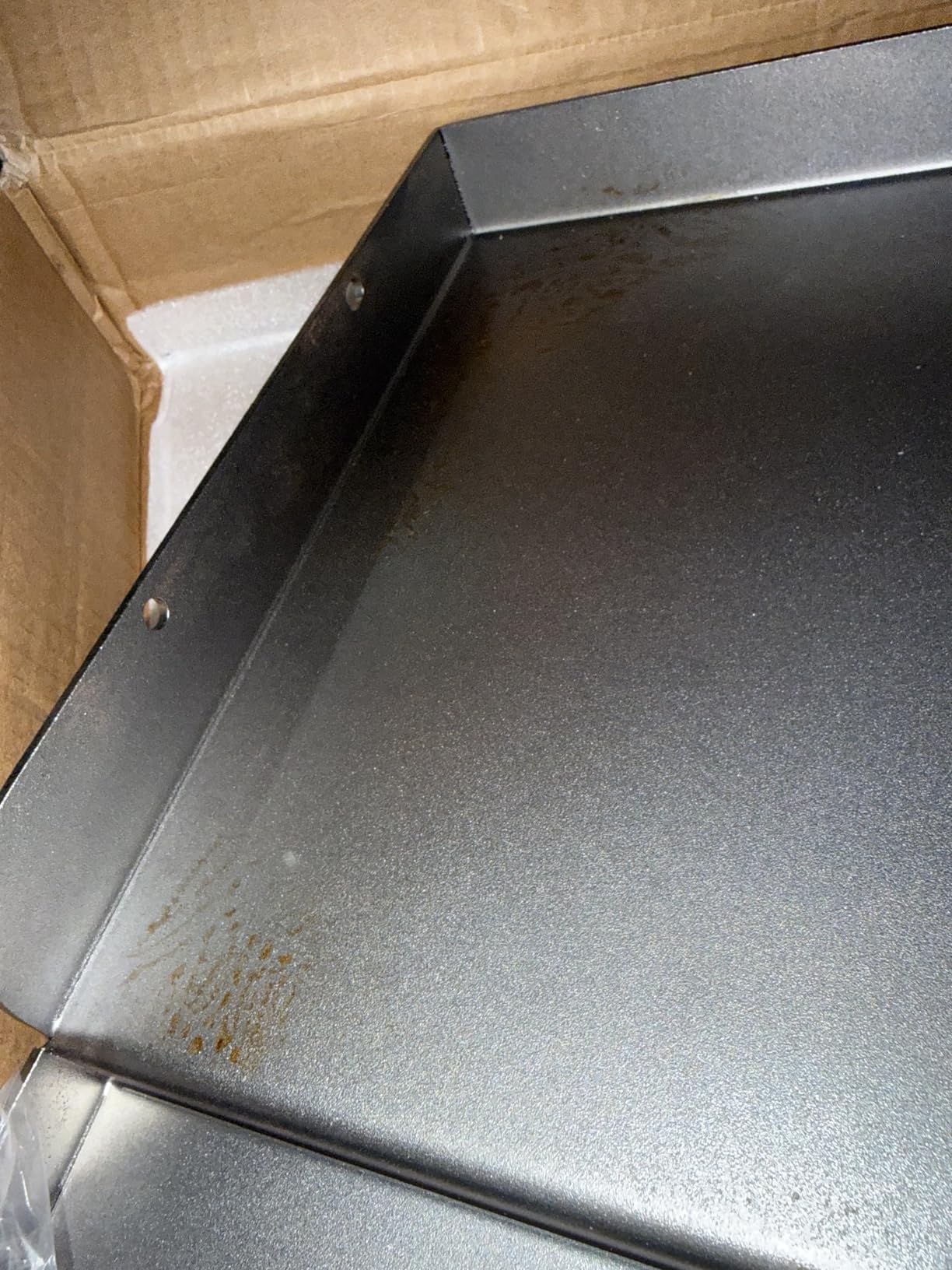
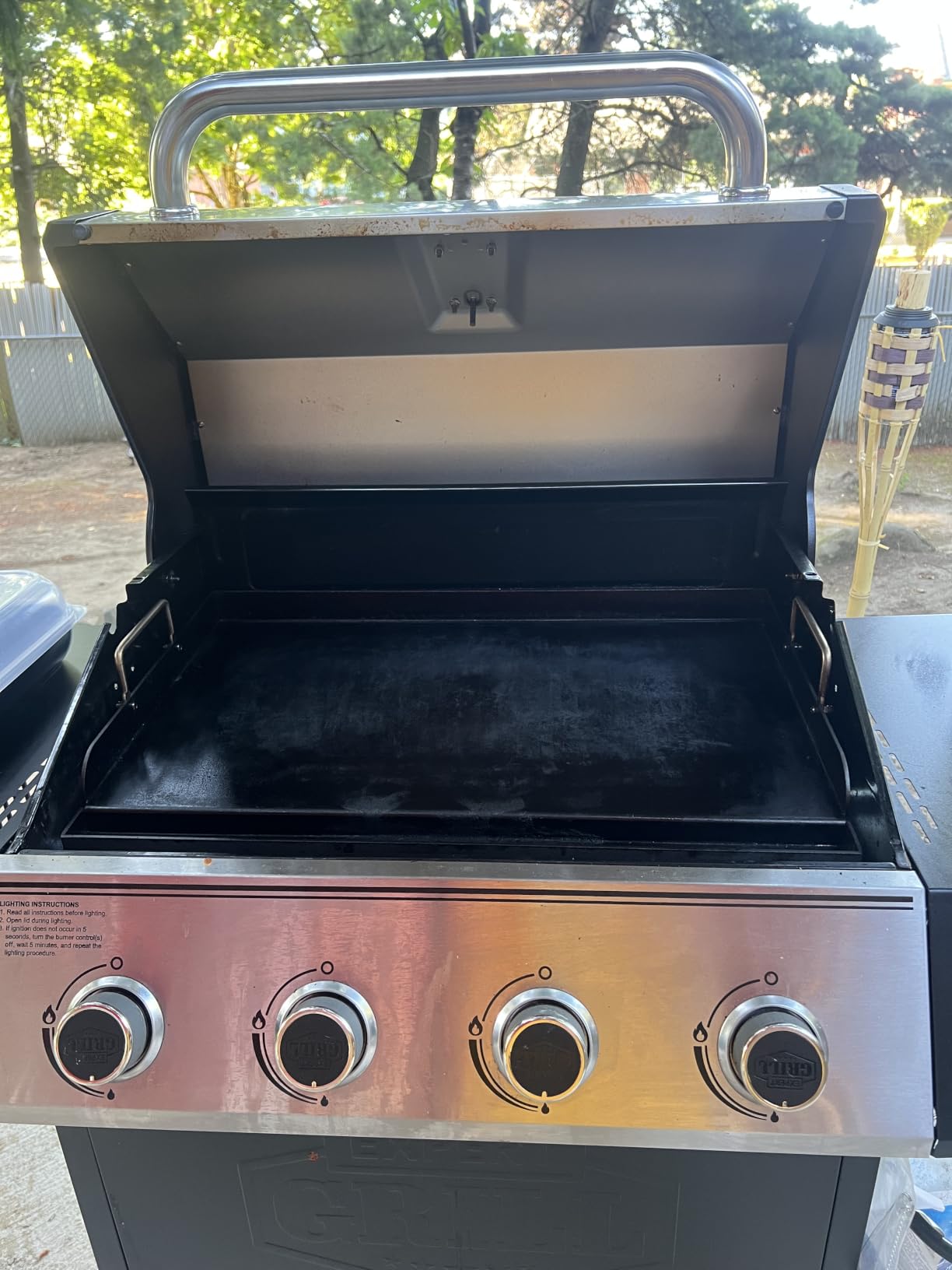
Grease handling is handled by a built-in trough with polished edges, which keeps rendered fat moving toward the runoff instead of sitting under the food. Detachable side handles make it manageable despite the weight, and they also mean you can lift the plate by the edges rather than swinging a hot slab of iron. Users cook the full range on it, from eggs and bacon through burgers, steaks, vegetables and seafood.
The one instruction that matters is the one the brand repeats: preheat, then add oil, then cook. Skipping the first oil pass is the most common reason new owners think a nonstick pre-seasoned surface is not working. Give it one proper oiled session before the real breakfast.
Who the Utheer 25 x 16 plate suits
This is our pick for a three-burner or larger grill where you genuinely want the whole surface, and for cooks who move between sweet and savory. A 400 square inch plate will hold pancakes and bacon on one half and stir-fried vegetables on the other at the same time, which no plate in the compact end of this list will do.
It also suits anyone who wants a large surface without paying for a brand-specific part. Because it is universal at 25 x 16, it will land on a lot of grills from different manufacturers, and the detachable handles mean it stores out of the way when you go back to grilling. Enthusiasts cooking for a group will use the width more than anyone else.
Where the Utheer plate disappoints
Weight is the honest drawback. Owners consistently describe swapping it in and out as a two-handed job, and if your grill sits high or at an awkward angle into a patio, that matters every single time you want a griddle rather than grates. The detachable handles help but they do not make a heavy plate light.
Because it is a universal part, the fit is only as good as your measurement. A 25 inch plate needs a 25 inch cooking area, and plenty of three-burner grills fall short of that. The upside of buying the manufacturer plate is exactly this: a part designed for a specific cook box tends to land on the ledges properly, while a universal plate needs the numbers to work in your favor.
4. Uniflasy 25 x 16 Cast Iron Griddle Plate – Best for a 400 Square Inch Nonstick Surface
Griddle for Gas Grill Flat Top Grill Griddles Plate 25 x 16 Inch Cast Iron
Nonstick-coated cast iron
25 x 16 x 3 in
Handles add about 1.05 in per side
Pros
- FDA-tested nonstick
- no seasoning needed
- 400 sq in of flat-top surface
- Raised edges and grease drain channel
- Built-in handles for placement
Cons
- Handles push needed clearance to about 27.1 in
- Not for curved grates or unsupported cooktops
- About 22 lb makes the swap awkward
- Hand wash and store covered
This is the plate for people who want a large nonstick surface and refuse to run a seasoning routine. The coating is FDA-tested and the listing is clear that no seasoning is required before first use, so you can be searing on it during the first cook after unboxing. At 400 square inches of surface it competes with the largest plates here while skipping the iron seasoning learning curve entirely.
Heat retention still comes from the cast iron body, so you get the thermal mass that makes a griddle a griddle, and owners report good browning across the surface. The raised edges keep food on the plate and a grease drain channel moves oil away from the cooking zone, which cuts flare-ups and makes the post-cook wipe-down faster. Built-in handles mean you do not need a separate tool to set it down.
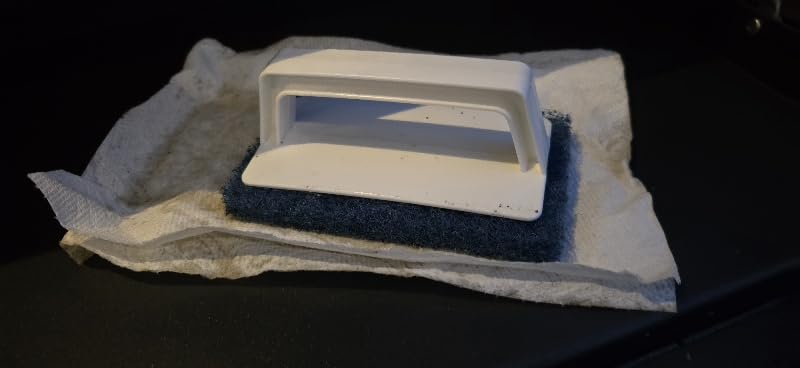
Fitment is the theme that dominates the reviews, and it is worth reading twice. The stated cooking surface is 25 x 16 inches, but the handles extend about 1.05 inches on each side, so you need roughly 27.1 inches of clear width at grate level. On a grill with 25 inches of clear width, the plate will not sit fully inside the cook box. The brand recommends it for 5-burner grills and larger for exactly this reason, and many buyers report the size was the deciding factor on whether it worked for them.
It is also not a universal shape in the way smaller plates are. Curved grates, round burner camp stoves and unsupported glass or electric cooktops are all excluded, so this one is a grill-specific rectangle. At roughly 22 pounds it is a genuinely heavy lift, and the reviews that mention difficulty are almost all about getting it in and out rather than about how it cooks.
Who the Uniflasy 25 x 16 plate suits
It suits owners of a large gas grill, five burners or more, who want maximum surface with a coating that works from day one. If you cook a lot of eggs, pancakes and delicate seafood, a coated surface saves you from the egg-onto-raw-iron learning curve that takes most beginners a season to get through.
It also suits anyone whose storage plan depends on the plate not rusting. A coated surface does not need an oiling routine to survive a humid garage, which makes it a practical choice for seasonal grills stored outside or on a covered patio. Just hand wash it, dry it thoroughly, and store it covered.
Where the Uniflasy plate disappoints
The handle allowance is the biggest trap. Buyers who read 25 inches and stop measuring end up with a plate that overhangs the ledges or sits on top of the grate frame rather than in the cook box. Measure the outside width you have, not just the cooking area, and confirm the handle clearance before ordering.
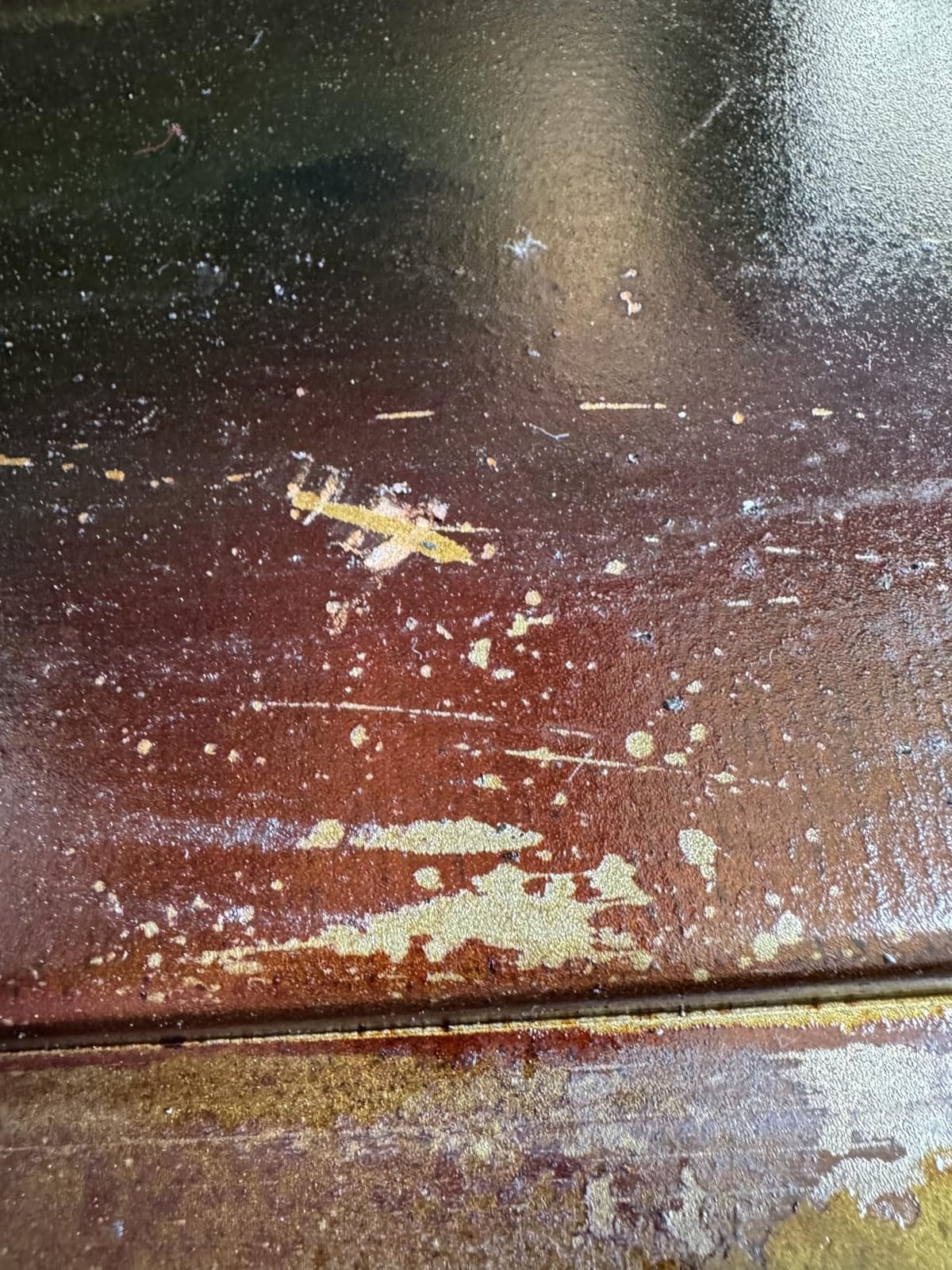
Coatings have a service life, and a nonstick layer that has been used hard on a grill can eventually lose its release. This is the tradeoff you accept by skipping seasoning: no polymer to build, but also nothing to re-season when it wears down. Use silicone or wooden utensils, and expect to replace the plate eventually rather than restoring it.
5. Uniflasy 17 x 13 Nano-Ceramic Cast Iron Griddle – Best for Smaller Grills and Tight Cooking Areas
Pre-seasoned Cast Iron Griddle for Gas Grill, Nanoceramic Nonstick Flat Top Griddle Insert for Outdoor Gas Grill, 17″ x 13″ Flat Top Plate for Weber, Nexgrill, Charbroil Grills, Plancha Para Cocinar
Nano-ceramic coated cast iron
17 x 13 x 2.6 in
High-bar sides and vent holes
Pros
- Nano-ceramic coating resists scratching at high heat
- Fits Weber
- Nexgrill
- Charbroil
- Kenmore and Camp Chef grills
- Vent holes and triangular ridges resist warping
- Grease trough and high-bar sides contain splashes
Cons
- Handle bolts sit inside the cooking surface
- No drain hole
- so the trough must be lifted to empty
- Some owners report warping
- 17 x 13 is smaller than the 23 and 25 in plates
Compact griddles are underrated. A 17 x 13 plate is not going to feed a crowd, but it will sit on a smaller grill without overhang, it heats faster because there is less iron to bring to temperature, and it takes up a fraction of the storage space. Owners use it for pancakes, eggs and single smash burgers, where a small surface is easier to manage than a large cold one.
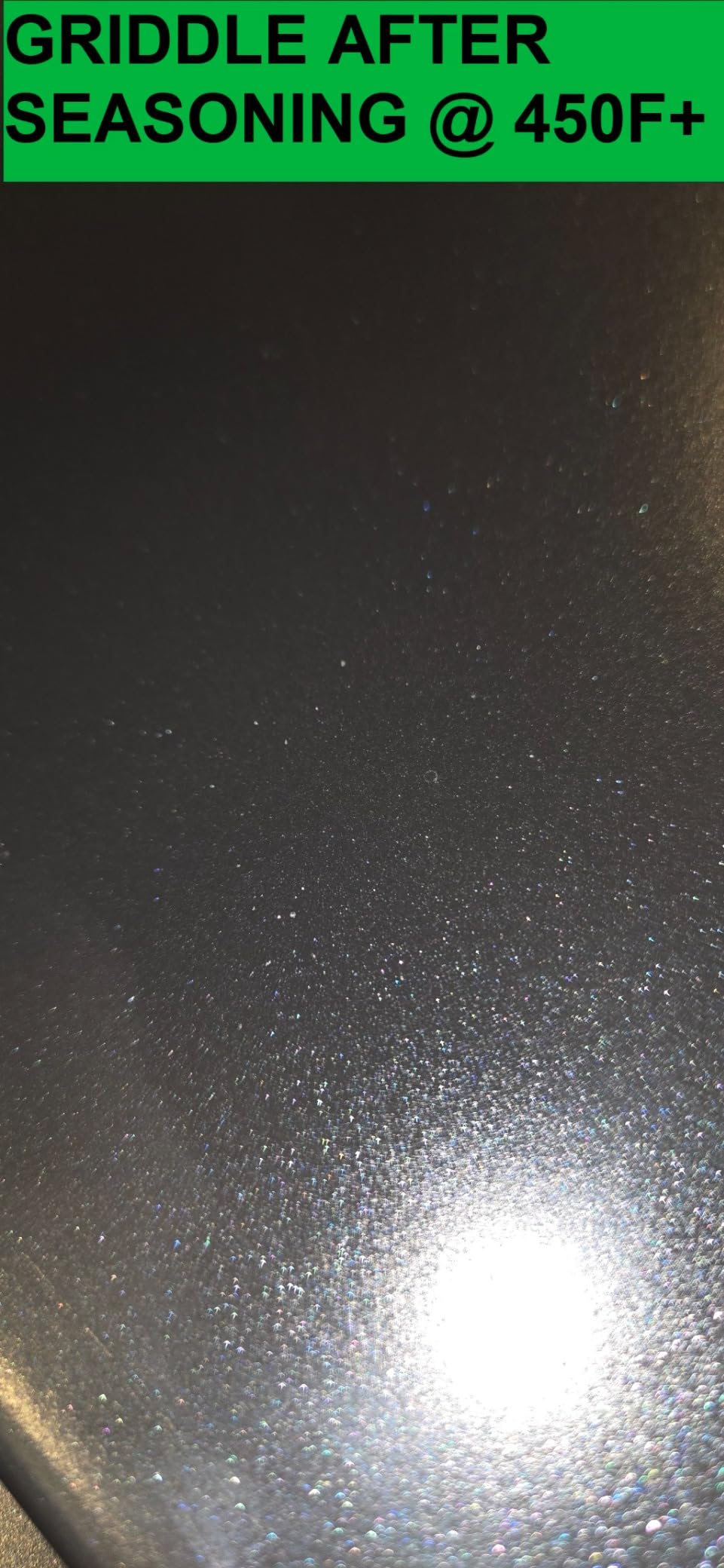
The nano-ceramic coating is the headline feature and the reviews support the durability claim more than we expected at 2411 ratings averaging 4.4. Owners report that the coating resists scratching and peeling even under high heat, and cleaning is a soft sponge and mild detergent. There is no seasoning to build and no film to strip, so the maintenance story is simple compared with bare cast iron.
Ventilation holes and reinforced triangular base ridges are the two design details that separate a decent small plate from a bad one. The holes keep air moving under the surface, which prevents the heat build-up that makes small griddles smoke, and the ridges spread load and resist warping. The fit list is broad for a plate this size, naming Weber Spirit, Nexgrill, Charbroil, Kenmore and Camp Chef grills among others.
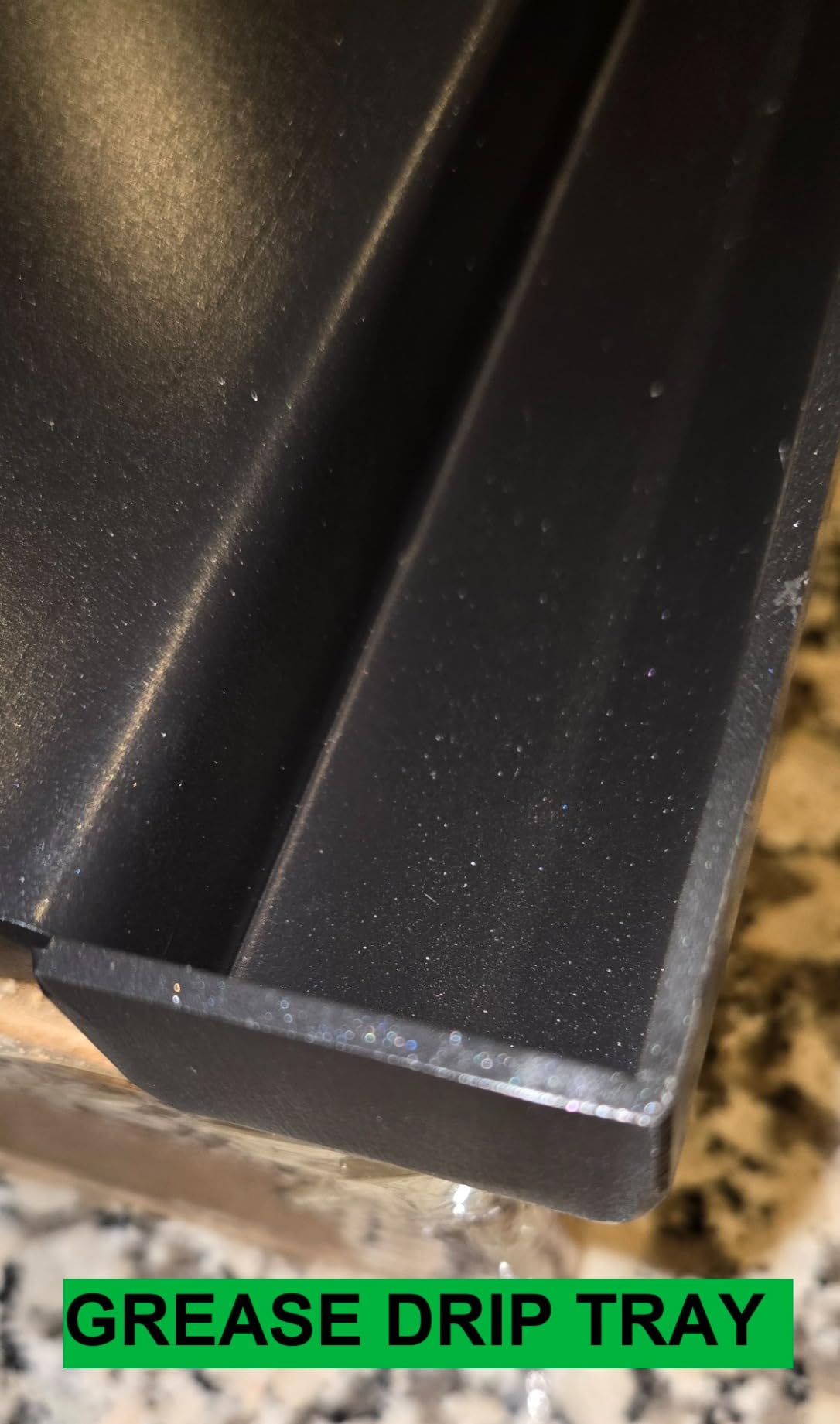
Two complaints recur and neither is fatal. The handle bolts are positioned inside the cooking surface, so there is a small obstruction in the middle of the plate when you flip food. And the grease trough has no drain hole, which means you lift the whole plate to empty it over a container rather than tipping a channel into the grill’s drip pan.
Who the 17 x 13 plate suits
This is our pick for two-burner grills, compact three-burner models and anyone whose cooking area is genuinely too small for a 23 inch plate. If a large insert would overhang your ledges, a smaller plate that sits fully inside the cook box is a better product, not a compromise. It is also easier to lift, store and carry than any of the large plates in this list.
It suits casual griddlers who cook breakfast for two or three rather than a group. The fast heat-up from a smaller mass means you can go from cold to cooking temperature without a long wait, which is exactly what you want for eggs. Anyone who will not maintain a seasoning routine will also like the coating, since there is nothing to season and nothing to strip.
Where the 17 x 13 plate disappoints
The size caps what you can do. One 400 square inch plate feeds a party; this one does not, and trying to cook a batch of smash burgers plus a full breakfast on 17 x 13 means serial cooking rather than parallel cooking. Know your serving size before you commit to the compact end.
A minority of owners report warping even when they followed the seasoning instructions, and warping is the failure mode that ruins a griddle because it creates a low spot where oil pools and food sticks. The handle placement in the cooking surface is a more common everyday irritation, since it catches your spatula if you are not used to working around it.
6. Hisencn 17 x 13 Carbon Steel Griddle – Best for Coating-Free Cooking on a Small Surface
Hisencn 17″x13″ Griddle for Gas Grill & Stove Top
Thick carbon steel
17 x 13 x 2.6 in
Also works on a gas stove top
Pros
- Pre-seasoned with no PFOA or PTFE coating
- Works as a grill insert and a stove top flat top
- Raised sides and grease channel reduce flare-ups
- Fits many 3 to 5 burner grills
Cons
- Listing says carbon steel while spec fields say cast iron
- 17 x 13 is compact next to larger inserts
- Measuring before ordering is required
The most interesting thing about this plate is that it does two jobs. Owners use it as a grill insert and as a flat top on a gas stove, which turns one purchase into a two-surface setup and gives small kitchens a griddle zone that does not need a grill at all. At 4.5 across 908 reviews, it holds one of the stronger satisfaction scores in this group despite having a smaller review base.
Unlike the coated plates, this is a bare seasoned surface with no PFOA, no PTFE and no synthetic coating of any kind. For cooks who want a griddle that improves with use rather than one whose coating eventually gives out, that is the whole point. Thick carbon steel moves heat fast and holds it well enough to keep a steady temperature across a compact surface.
One caveat worth flagging plainly: the listing describes carbon steel construction in its product copy while the specification fields list cast iron. The review consensus treats it as a seasoned bare-metal plate, and owners report good performance either way, but if the exact material matters to you, confirm it before buying. Raised side walls and a built-in grease channel keep oil where you want it and reduce flare-ups over the burners.
Who the Hisencn plate suits
It suits cooks who want a coating-free surface and who will put the work into a light oil routine. A bare seasoned plate gets better the more you use it, which is the opposite of how a coated plate ages, and that is the reason many griddlers end up here permanently. The dual grill and stove use also makes it a strong pick for renters and small patios where a second appliance is not an option.
Anyone with a 3 to 5 burner grill listed in the compatibility range will find it more than wide enough, because 17 x 13 is a modest footprint. The small size also means a fast preheat, which is what you want for a quick weeknight breakfast plate of bacon and eggs.
Where the Hisencn plate disappoints
The material description inconsistency is the first thing to resolve. If you are buying because you specifically want carbon steel behavior and the box contains something else, that is a bad surprise. Second, a 17 x 13 surface is small next to the 23 and 25 inch plates here, and it will not handle a large batch of anything.
Bare metal also means rust is possible, and the compact size does not change that. A thin oil film after each cook and a cover when the plate is not in use will keep it in good shape indefinitely. Skip that and you will be stripping and re-seasoning, which is a Saturday project rather than a five-minute one.
7. Onlyfire Chef 23 x 16 Pre-Seasoned Cast Iron Griddle – Best for High Sidewalls and Grease Control
Onlyfire Pre-Seasoned Universal Cast Iron Cooking Griddle, 23″ x 16″
Pre-seasoned cast iron
23 x 16 x 2.6 in
Extra-high sidewalls
Two side handles
Pros
- Extra-high walls contain grease and reduce flare-ups
- 23 x 16 suits 4-burner grills and large groups
- Handles move it between grill and stove
- Works indoors for breakfast
- A 4.6 average across 642 ratings
Cons
- Roughly 23 lb of cast iron
- Fit must be verified against the cooking area
- Coating needs gentle cleaning
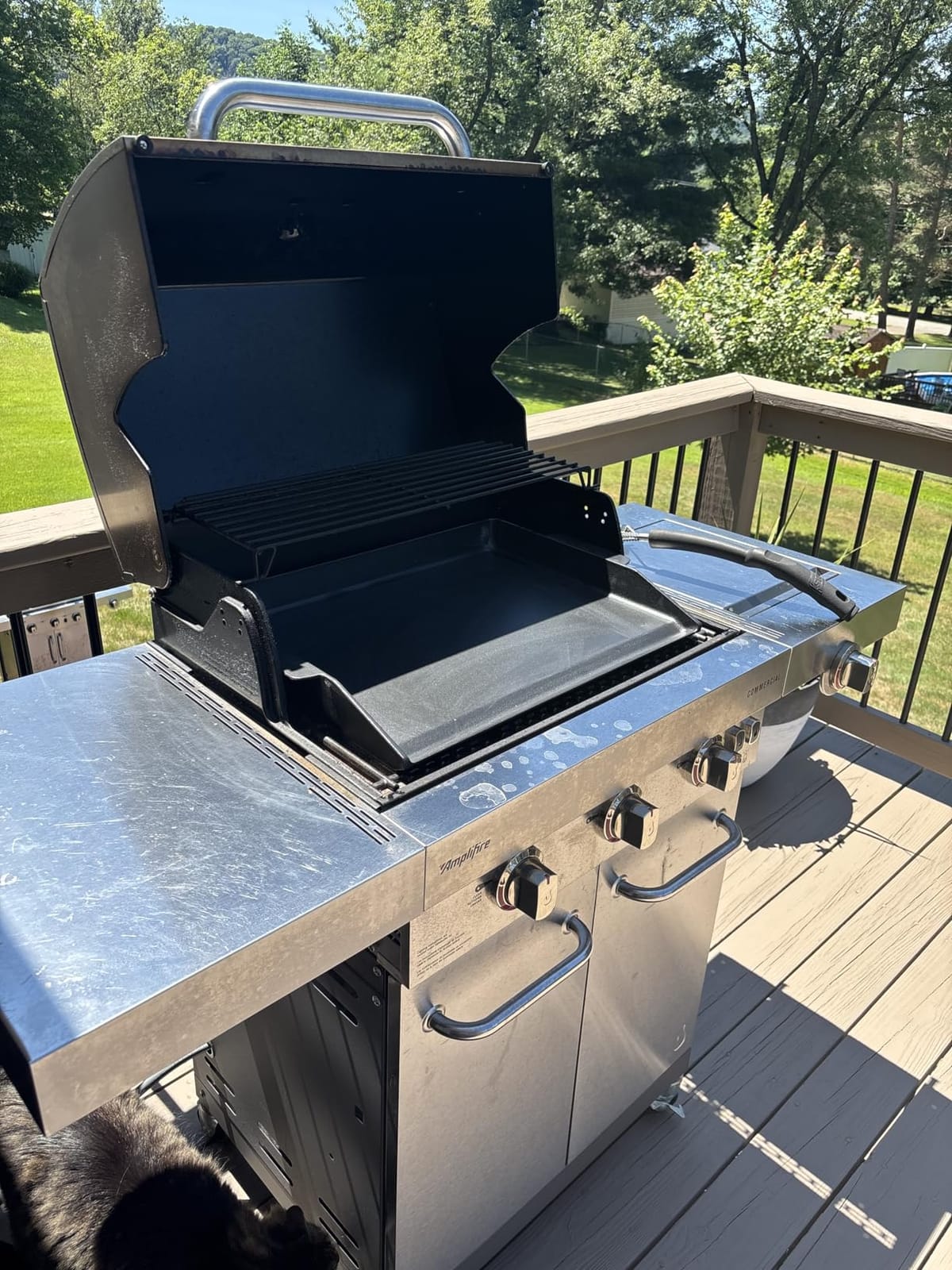
With 642 ratings averaging 4.6, owners point to the same feature every time: the sidewalls. They are described as extra high, and in practice that height is what stops diced onion, chopped peppers and smashed burger edges from ending up on the patio floor when you work fast with a spatula. It is a small design decision that changes how confident you feel at high heat.
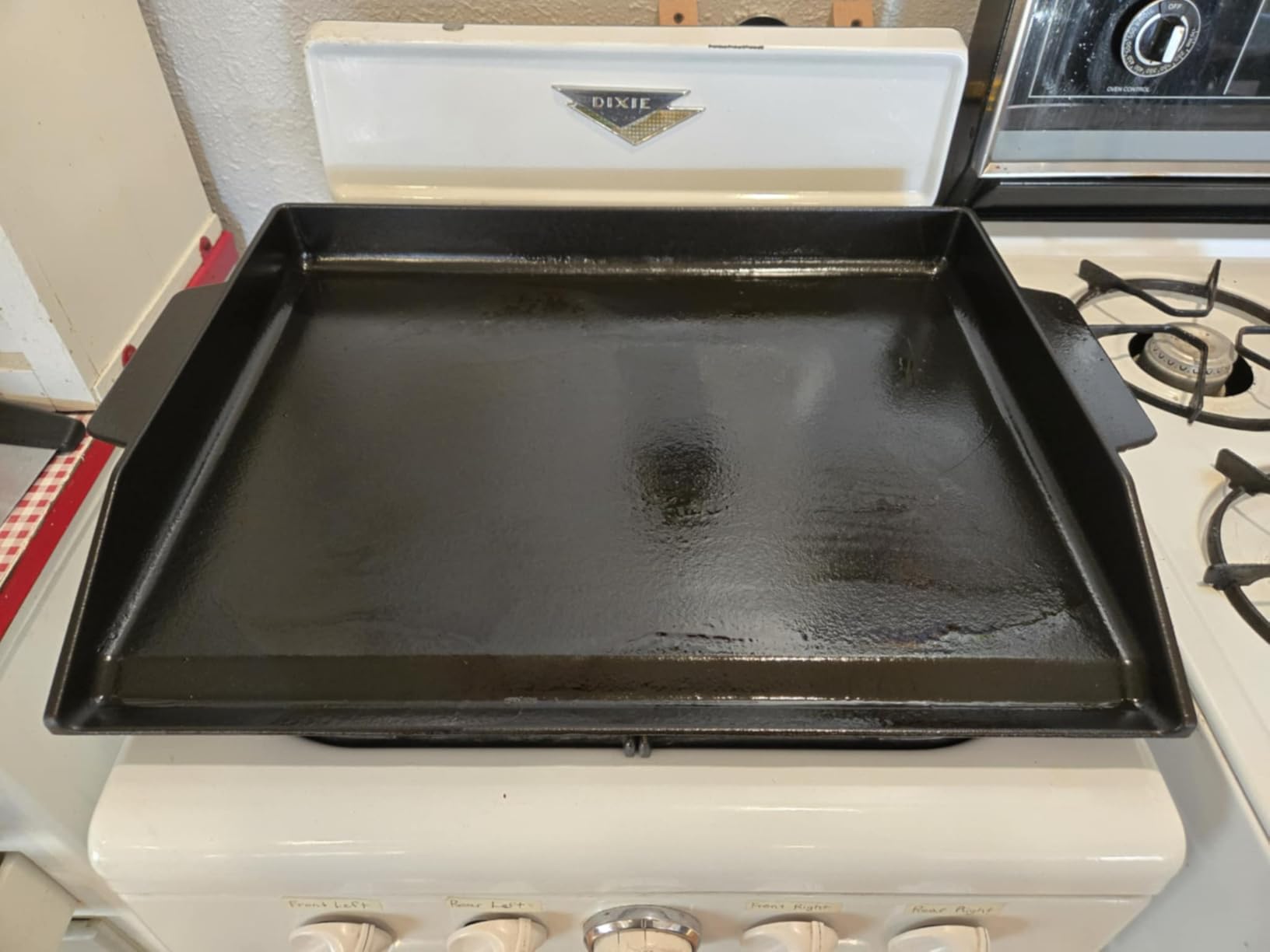
The 23 x 16 surface is the sweet spot in this list. It is large enough for a proper smash burger session or a pan of fried rice, and small enough to fit a 4-burner grill without overhang. Owners use it at the grill, on a stove for indoor breakfast, and on camping trips, which makes it a genuinely versatile plate that works across three environments.
Grease control is handled by containment rather than drainage. High walls slow the runoff so fat stays on the plate long enough to cool rather than dripping straight onto a lit burner, which is where most griddle flare-ups start. That means less smoke, fewer flare-ups and a noticeably easier cleanup after a greasy cook.
Who the Onlyfire Chef 23 x 16 plate suits
It suits cooks who work fast and messy, which is to say anyone doing hibachi-style stir-fry, fried rice, or a Saturday smash burger session where a dozen patties are going down at once. The high walls let you chop, scrape and flip aggressively without worrying about losing food over the edge. It is equally at home on a stove for pancakes when the weather is not cooperating.
Buyers who want a single plate for the grill, the stove and the campground will appreciate the versatility. At 23 x 16 it also fits more grills than the 25 inch plates, so it is the safer large-format choice if you are unsure how much room you have.
Where the Onlyfire Chef plate disappoints
It is roughly 23 pounds, which makes it one of the heavier plates here and a real consideration for handling. If your grill sits high, is built into a counter and at an angle, weight becomes the deciding factor against this plate.
As a universal part it still needs a fit check, and the coating needs gentle cleaning. Metal utensils and hard scraping will shorten the life of the nonstick surface, and there is no seasoning layer to rebuild once the coating is done. Treat the tools as carefully as you would a coated skillet.
8. Weber Rust-Resistant Full-Size Griddle Insert – Best for Large Spirit and Searwood Grills
Weber® Rust‑Resistant Griddle Insert
Pre-seasoned carbon steel
22.67 x 17.29 in
21.8 lb
Two-year warranty
Pros
- Turns the whole grilling surface into one flat top
- Thick steel that resists warping
- Rimmed edges and integrated grease collection
- Ready to cook out of the box
- Two-year Weber warranty
Cons
- 21.8 lb is a genuine two-handed lift
- Fit limited to certain Spirit
- Searwood and Genesis II builds
- Seasoning instructions run longer than the pre-seasoned label suggests
- Storage bag sold separately
At 4.7 this is the highest average rating in our group, and the reasoning is not hard to understand. It is engineered to convert the grill’s entire grilling surface into one flat top, so instead of splitting your cook box between griddle and grates you get a single unbroken surface sized for a group. Owners with 662 reviews describe it as the thing that turned them from grates to griddle, which is the strongest endorsement a plate in this category can earn.
Thick carbon steel is the reason for the consistency. Heavier gauge resists warping under repeated high heat, so the surface stays flat across months of use instead of developing the low spot that makes everything stick. Rimmed edges keep food and oil in place, and the grease management is designed to integrate with the grill’s own collection system rather than relying on you to catch runoff.
Fit is precise and generation-specific. It is listed for Spirit 4-burner grills made since 2025, for Spirit and Spirit II 3-burner grills from 2016 through 2024, and for Searwood pellet grills. Check your model plate, because a Spirit from the wrong years will not accept it.
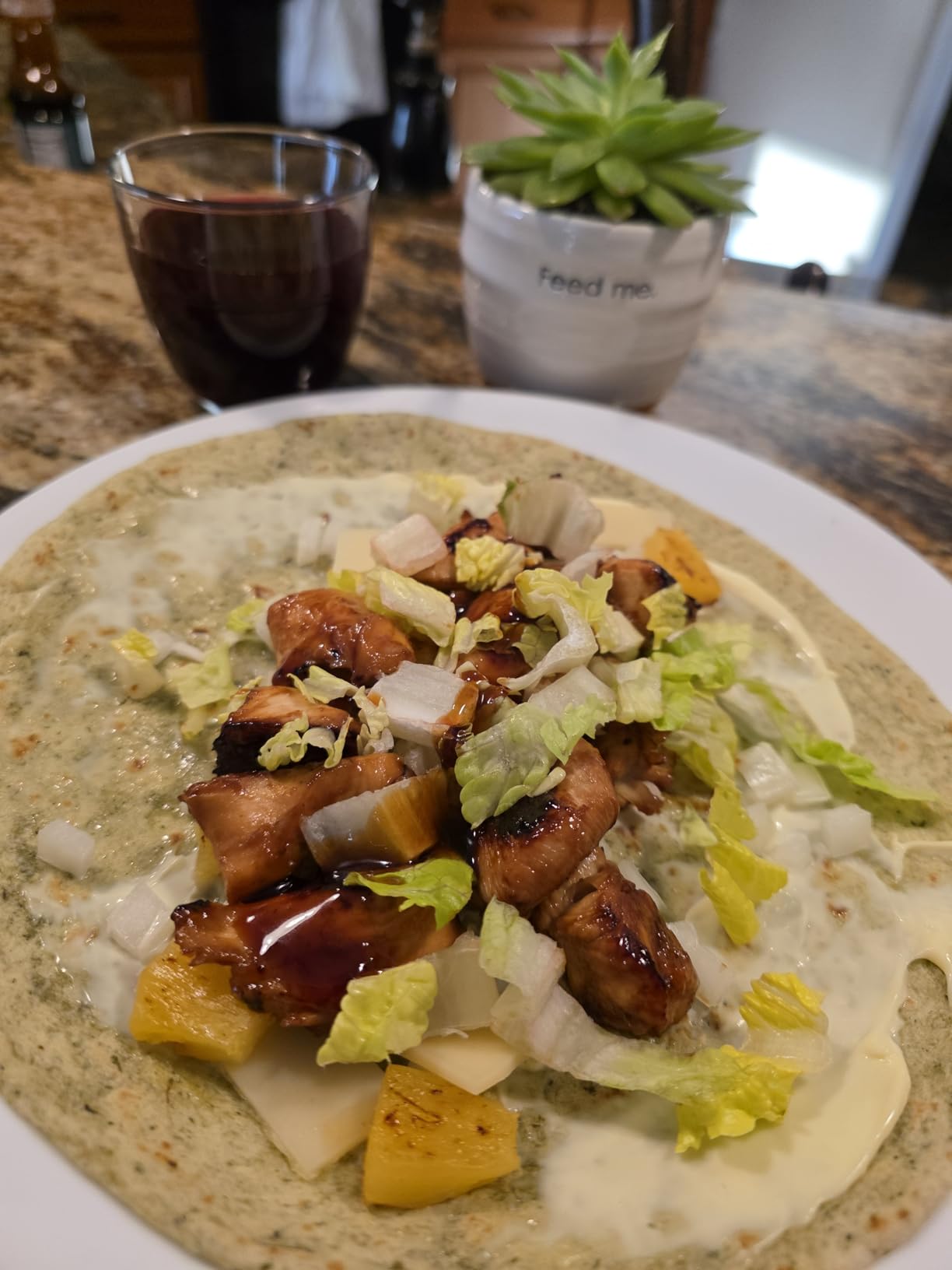
Two practical notes. The plate is 21.8 pounds, which is the heaviest in this list and is a genuine two-handed lift, especially once the steel is hot. And while it is described as pre-seasoned and ready to use, the included instructions outline a longer seasoning process, so plan for a first oiled session before you put a serious cook on it. The storage bag is sold separately if you are storing it indoors.
None of that changes the recommendation for a buyer whose grill is on that list. The combination of a full-surface conversion, gauge steel that holds flat, and integrated grease handling is the most complete package here, and the two-year accessory warranty is a real offset to the price premium over universal plates.
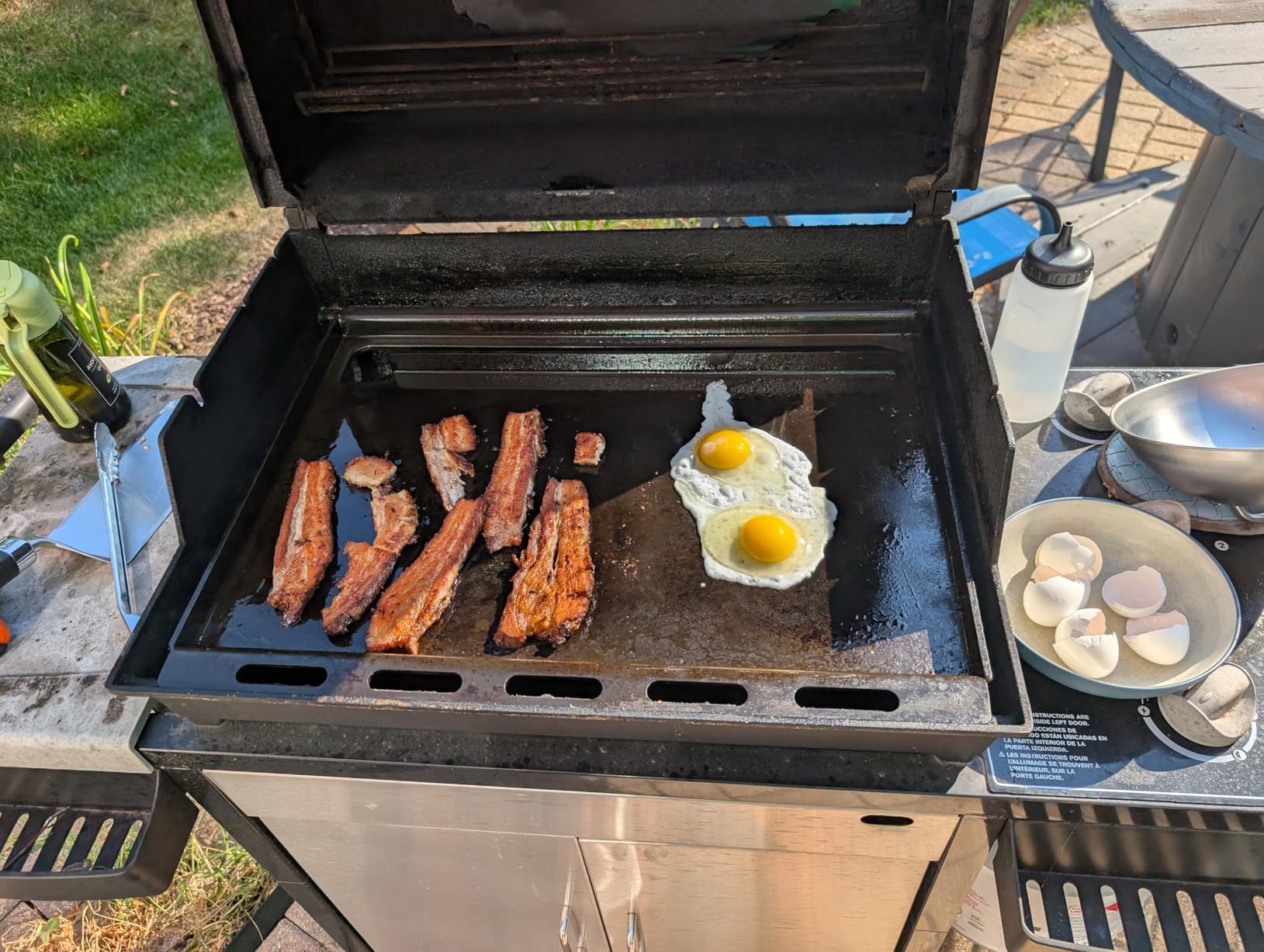
Who the Weber full-size plate suits
It suits owners of a large Spirit or Searwood who want to stop trading griddle space for grill space. Full-size conversion means a group of people can eat smash burgers, fried rice and vegetables off one surface in a single session, which no half-griddle in this roundup can deliver. If you cook for people rather than for yourself, this is the plate the list is built around.
It also suits anyone who values exact fit over price. A manufacturer-specific plate lands on the ledges the way the grate did, which removes the wobble and the overhang that universal plates risk. The two-year warranty and Weber’s service network add a layer of support that marketplace plates generally do not offer.
Where the Weber full-size plate disappoints
At 21.8 pounds this is a slab you will be moving in and out of the cook box, and it takes two hands once the steel is hot. The separate storage bag is another thing to buy if you are stowing it indoors.
Fit is the hard limit rather than a disadvantage. If your Spirit is from outside the listed years, or your grill is a Genesis, a Charbroil or a Nexgrill, this plate is not an option regardless of how good it is. Confirm the model before you commit, and if the years do not line up, the universal 23 inch stainless or the 25 inch pre-seasoned cast iron plates cover most grills with a proper measurement.
9. EasiBBQ Full-Size Griddle for Napoleon P500 and Rogue 525 – Best for Napoleon Owners
Full-Size Griddle Insert for Napoleon P500 and Rogue 525 Grills
Carbon steel
25.9 x 17.6 x 3 in
Silicone mitts rated to 446F
Pros
- Cut for Napoleon Prestige and PRO 500 and Rogue 525
- Large 25.9 x 17.6 cooking area
- Sits closer to the flame than a grate-mounted plate
- Silicone mitts included for swaps without a cool-down
- Handles allow a fuel or mode change mid-cook
Cons
- Sizing is narrow and limited to matching grills
- Heat plates must be removed before use
- Coating needs one or two heat-and-oil passes first
This plate exists because Napoleon grills put the heat a little closer to the food than many competitors, and a plate designed for that cook box takes advantage of it. It is cut for the Prestige and PRO 500 and the Rogue 525, and owners report that sitting closer to the fire source means it heats faster than a grate-mounted plate of similar size. The 25.9 x 17.6 cooking area is the largest stated surface among the plates here.
The detail we liked most is the bundled silicone mitts, rated to 446 degrees. They are what make the twofer work in practice: you can swap between griddle and grill modes without waiting for a 25.9 inch slab of steel to cool first. Owners also like that the handles let them add fuel or change grill mode partway through a cook rather than committing to one burner setup for the whole session.
Fit is the whole trade. This is not a universal plate, it is a plate for specific grills and for others with matching dimensions. The brand is direct about measuring before you order, and heat plates need to come out for the closest positioning to the flame.
Two cautions. The coated surface should be heated and oiled once or twice before you cook on it properly, which is a small commitment but a real one for a large plate. And the review distribution here is the widest of the group, with a 10 percent one-star share, which usually means the fit complaints are concentrated in people whose grill dimensions were close but not close enough. If you own one of the listed grills, that risk largely disappears.
The cooking area is generous enough for steaks, pasta, vegetables, potatoes and stir-fry in the same session, which makes it a strong plate for a mixed menu rather than a burger-only setup.
Who the EasiBBQ Napoleon plate suits
It suits owners of a Napoleon Prestige, PRO 500 or Rogue 525 who want the full cook box as a flat top and who value fast heat-up over a low price. The closer-to-flame positioning is a genuine advantage if you like cooking at temperature immediately, and the included mitts make swapping modes during a gathering painless.
It also suits anyone willing to remove the heat plates before cooking, since the brand notes that this gets you as close to the fire as the design allows. For a cook who runs a tight menu of steaks and vegetables and wants a large surface, that combination of size and heat proximity is hard to match.
Where the EasiBBQ plate disappoints
It only fits the grills it was cut for, or others with matching dimensions. If your grill is a Weber, Charbroil or Nexgrill, this plate is irrelevant no matter how good it looks, and a universal stainless or cast iron plate will serve you better. The wider review spread is a direct consequence of that specificity.
The coating needs an initial treatment, and coated surfaces have a service life. The heat plate removal step is a habit you have to build, and skipping it means leaving performance on the table. And the size means you need the floor space to set it down somewhere hot, which is exactly what the bundled mitts are for.
10. Onlyfire 18 x 12.6 Ceramic Coated Cast Iron Griddle – Best for Compact Cooking and Small Groups
onlyfire Universal BBQ Griddle with Handles for Most Grills, 18″ x 12.5″
Ceramic coated cast iron
18 x 12.6 x 2.8 in
7cm raised sidewalls
Two handles
Pros
- Ceramic coating releases well with no seasoning
- Coating adds corrosion resistance
- 7cm raised walls help with flipping
- Handles on both sides for removal mid-cook
- Grease trough simplifies cleanup
Cons
- 18 x 12.6 is one of the smaller surfaces here
- Metal utensils can scratch the coating
- Universal sizing needs a clearance check
At 4.6 across 381 reviews this plate shares the second-highest average rating in the group, and the reason is a surface that works immediately. The ceramic coating releases food well with no seasoning required, and it also adds corrosion resistance, which means the plate tolerates a humid garage or a covered patio without the rust worries that come with bare steel. It is the simplest possible ownership story.
The 7cm raised sidewalls do more than they sound like. That height helps you flip and rotate food without pushing it off the edge, which matters most on a small surface where everything is close to the rim. A grease trough collects drippings to limit flare-ups and shortens cleanup, and the two side handles let you lift the plate out mid-cook without waiting for it to cool.
The 18 x 12.6 surface is the constraint. That is enough for pancakes, bacon, sandwiches, burgers, eggs, fried rice and vegetables for two to four people, and not enough for a group service. Owners use it for breakfasts, quick lunches and small gatherings where the plate needs to fit on a smaller grill.
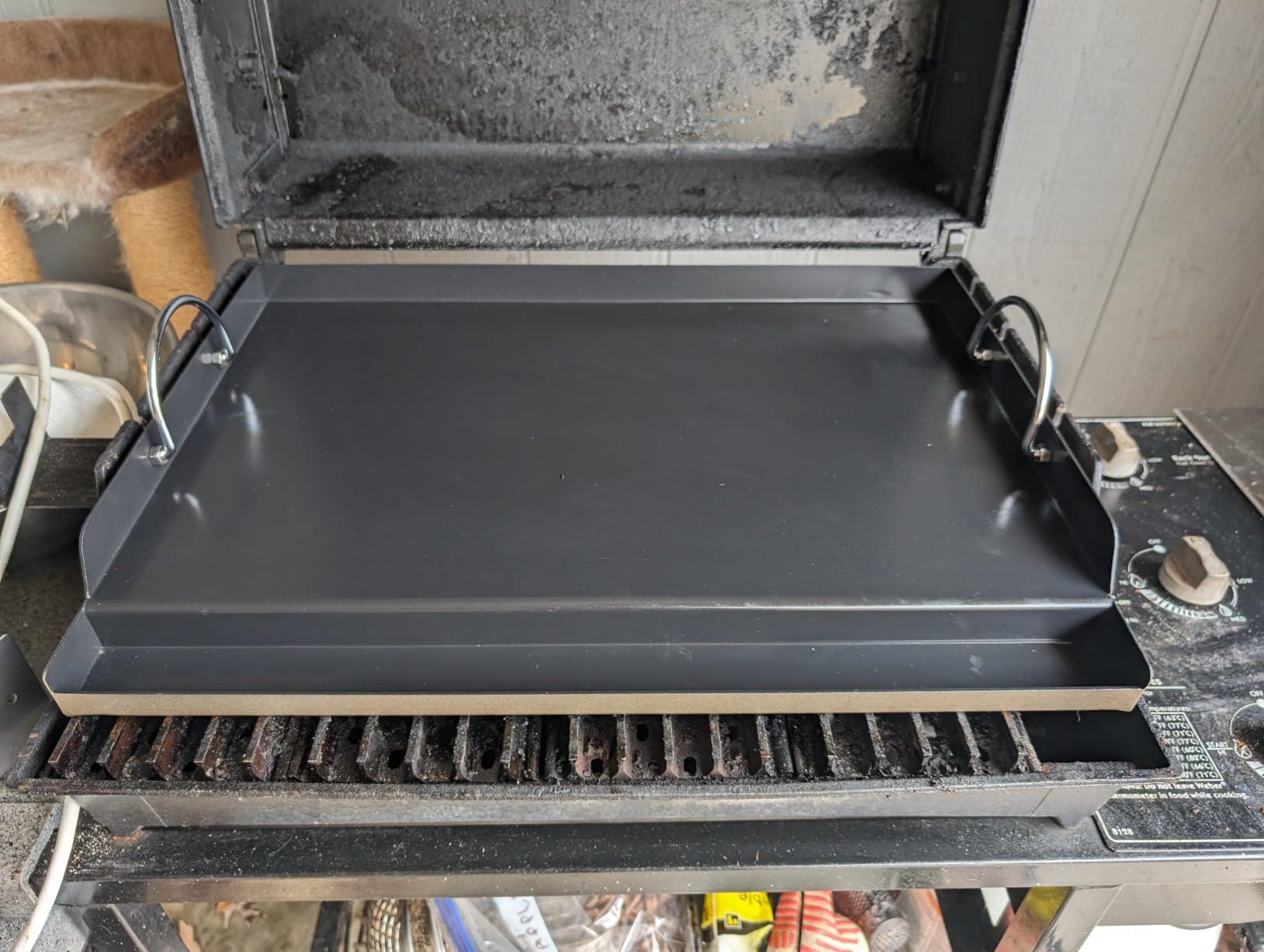
Care is the one thing to be deliberate about. A ceramic coating will scratch if you use metal utensils or drag a hard steel scraper across it, and unlike a seasoned bare-metal plate there is nothing to re-season afterward. A soft sponge and mild detergent is all the cleaning it asks for, and following that habit is what keeps the release consistent.
One last fit note. This is a universal plate at 18 x 12.6, a modest footprint that fits more grills than the large plates, but confirm the clearance before ordering.
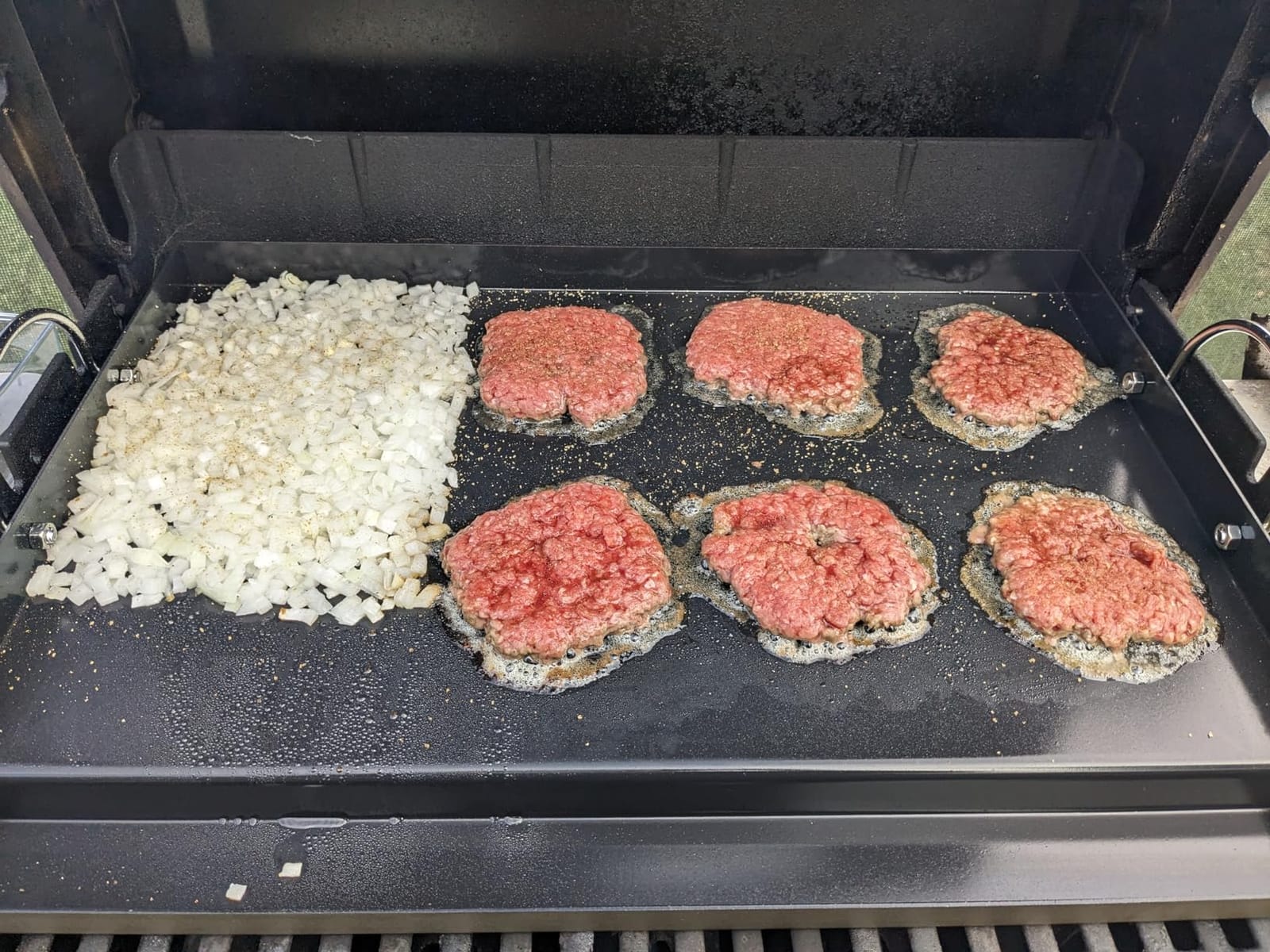
Who the 18 x 12.6 ceramic plate suits
It suits households of two to four who want griddle capability without a large slab of iron to store. It is the easiest plate in this roundup to live with: no seasoning, no rust risk, no oiling routine, and a surface that is ready the first time you heat it. For weeknight breakfast cooks, that removes every step between taking the plate out and cooking on it.
It also suits anyone with a smaller gas grill where a 23 or 25 inch plate would overhang, and anyone who wants griddle and grill capability without a large-format part. Raised walls and a grease trough keep the cooking area tidy, which makes it pleasant to use in a tight space or on a patio table setup.
Where the compact ceramic plate disappoints
The size is the limit. At 18 x 12.6 you are cooking in batches for anything beyond a small group, and there is no way to run a main and a side at the same time. Know your serving size before buying, because this is the plate that gets outgrown fastest.
The coating is a consumable. Once a ceramic layer scratches through, you are cooking on exposed cast iron with no seasoning to fall back on, and the honest expectation is replacement rather than repair. Use wood or silicone tools, and treat a coated griddle the way you would treat a coated pan.
Material Matters: Carbon Steel vs Cast Iron vs Stainless Steel
Material drives almost everything else about how a griddle behaves, and most buyer mistakes come from treating the three families as interchangeable. They are not. Here is how they compare on the four things that actually change your cooking.
Carbon steel heats fast, holds temperature well for its weight and seasons into a genuinely nonstick surface with use. It is the material the two Weber plates in this roundup use. The tradeoff is maintenance: it rusts if stored damp, and the seasoning is something you build and maintain rather than something you buy.
Cast iron is the heaviest and the best at holding a flat-top temperature steady through a long cook. It is what five of the ten plates here are made from, and it is the reference standard for smash burger and hibachi work because it takes high heat without warping. Its penalties are weight and a seasoning film that can flake if the plate is stored damp.
Stainless steel is the light, rust-proof, low-maintenance option. It responds to burner changes faster than iron, which some cooks prefer, and it never needs seasoning, so it suits anyone who will not keep up an oiling routine. The cost is heat retention and sticking, since there is no seasoning layer to fall back on.
Porcelain-enameled cast iron is the one material here that is maintenance-free by design. The enamel is a glassy surface that does not rust and does not need seasoning, which is why the Genesis II plate is our editor’s choice for a half-griddle. The risk is that enamel is a coating, and once it chips, the iron underneath is unseasoned.
One quick rule that answers most questions: if you will cook on it weekly and enjoy the ritual, bare carbon steel or cast iron is the better long-term material. If you will cook occasionally and want zero upkeep, a coated surface is the right call.
Full-Size vs Half-Size Inserts: How Much Grill You Give Up
This is the decision that catches people, because sizing is not only about how much room the plate needs, it is about how much grill you lose when it is in. A full-size plate converts the whole cook box to flat top, which is the twofer setup most people are after. A half-size plate replaces one or two grates and leaves the rest of your grill available for direct grilling.
Half-size is not a compromise if you mostly cook for two. The Weber Genesis II plate is 22 x 16 inches and leaves most of the cook box intact. Full-size is worth the trade if you cook for a group, because it is the only way to get a 400 square inch surface out of a grill that was never designed to be one.
Also remember that a full-size plate funnels more grease to fewer points. Check your grill’s grease cup or drip pan more often when a large plate is in, because a cook that produces a lot of fat with no one watching the tray is how a grease cup gets missed. Sidewalls that channel runoff to one corner make this more manageable, which is a genuine advantage of factory-designed plates over universal slabs.
Seasoning, Rust Prevention and Storage
Seasoning is a polymerized oil film built on bare steel through heat and repetition. It is not a coating you apply once, and the most common complaint about a new insert is that food sticks on the first few cooks, which is a seasoning problem rather than a quality problem. That is also why experienced griddlers run fatty foods, burgers and bacon, on a new plate before anything delicate.
Seasoning a new carbon steel or cast iron plate: scrub the surface with coarse salt and a little oil to remove any factory residue, rinse, dry completely, then heat the plate and wipe a very thin film of high smoke point oil over the whole surface. Let it smoke off, cool, wipe the surface with a dry towel to remove what did not polymerize, and repeat once more. Avocado or grapeseed oil is the usual choice because it tolerates the temperature. Aerosolized canola is what produces the fishy smell people report in the first weeks.
During every cook: scrape the surface, wipe it down, and while it is still warm put on a fresh thin oil film. That two-minute habit is the entire maintenance routine for bare steel.
Recovering a rusted plate: strip the surface with coarse salt and oil or a wire brush until you are back to bright metal, wash, dry, and run the seasoning steps above again. Surface rust is recoverable; a plate that has sat damp long enough to pit may not be.
Stainless and coated plates: stainless is not seasoned, so oil lightly before and after cooking to reduce sticking. Ceramic and nonstick coatings are cleaned with a soft sponge and mild detergent and never seasoned.
Storage: store bare steel plates dry and covered, and never stack them bare against each other. A thin oil film, a paper towel between plates and a cover in a humid garage will keep them in shape for years. This is also why the lighter stainless plate suits small-space storage, since a 20 pound slab is awkward to put away properly.
Switching Between Griddle Mode and Grill Mode
The most repeated practical complaint in owner threads is not about cooking at all, it is about the swap. Griddle inserts take extra effort to clean and switch from grill to griddle and back again, and the effort is the reason many plates end up unused.
Four things reduce it. Buy a plate with detachable side handles or bundled silicone mitts so you are not waiting for steel to cool. Wipe the plate down while warm rather than soaking it later. Keep the grates in one place so the swap is not a search. And do not buy the largest plate available unless you will genuinely cook for a group, because the bigger the plate the more there is to move.
The upside is worth the friction. The closed lid doubles as a melting dome, the cook box walls contain splatter that a standalone flat top throws everywhere, and one appliance now covers grilling, griddling, and finishing under a lid.
Frequently Asked Questions
Can I add a griddle to my gas grill?
Yes. A griddle insert is a flat plate that sits on your grill’s grate ledges in place of the cooking grates. Remove the grates, set the plate on the ledges so it sits flush, and the same burners now heat a continuous flat surface. This works on most gas grills with flat ledges and a cooking area large enough for the plate. Curved grates, round burner camp stoves and unsupported glass or electric cooktops will not take a rectangular insert. Measure your cooking area before you buy.
How to measure griddle size?
Three steps. First, find and read the model plate on your grill, usually inside a cabinet door or on a frame under a front shelf, and record the model number, series generation and burner count. Second, measure the usable width across the grate ledges and the front-to-back depth in inches. Third, check the shape and ledge height, and add about one inch of clearance per side if the plate has fixed handles.
What are the dimensions of a Weber Spirit grill?
It depends on the generation. Weber Spirit and Spirit II grills look nearly identical but their grate ledges differ, and inserts are not interchangeable between them. The full-size carbon steel insert listed here is 22.67 by 17.29 inches and is specified for Spirit 4-burner grills made since 2025 and for Spirit and Spirit II 3-burner grills from 2016 through 2024. The Genesis II griddle is 22 by 16 inches and does not fit 2022 Genesis grills. Always read your model plate rather than guessing from the marketing name.
Is carbon steel good for a griddle?
Yes, and it is the material most experienced griddlers choose. Carbon steel heats quickly, holds temperature well for its weight, and seasons into a genuinely nonstick surface that improves with use rather than degrading. The two Weber inserts in this roundup use it for exactly that reason. The tradeoff is maintenance: the plate needs a light oil film after each cook and must be stored dry and covered, or it will rust.
Do you season a stainless steel griddle?
No. Seasoning is a process for bare carbon steel and cast iron, and stainless steel does not form that polymerized oil film in the same way, so the term does not really apply. What stainless needs instead is routine oiling: a light film before cooking to reduce sticking and a wipe-down and thin coat afterward. The benefit is that stainless never rusts and needs no burn-in, which makes it the low-maintenance choice.
Does a griddle insert void my grill warranty?
Check with your grill manufacturer before adding an accessory, since policies differ and a part that does not fit the model generation can cause problems. In practice, using a griddle insert is a normal accessory use and does not damage the grill, but a poorly fitting plate that blocks burner vents or sits on the wrong ledges is a different situation. Buying the manufacturer-designed insert for your exact model is the safest route, and it is why exact-fit plates carry a longer accessory warranty.
Conclusion: Which Griddle Insert for Gas Grill Is Right for You
The right griddle insert for gas grill shopping comes down to your grill model first and your maintenance tolerance second. Our top pick is the Weber enameled griddle in section one: if you own a Genesis II from the pre-2022 generations it drops in with confidence and cleans without a seasoning routine. If you want the whole cook box as one surface on a large Spirit or Searwood, the full-size carbon steel Weber plate in section eight is the most complete option, and it is the one to choose when you regularly cook for a group.
Outside those, the 25 x 16 pre-seasoned cast iron plate gives you the most cooking area for a universal part, the 23 x 16 stainless plate is the one to pick if weight and storage decide the outcome, and the compact coated plates suit smaller grills and households of two to four.
Whichever you choose, measure before you order, oil bare steel after every cook, and check your grease cup more often when a large plate is in. Those three habits account for most of the difference between a griddle that gets used and a griddle that ends up in a corner of the garage.