
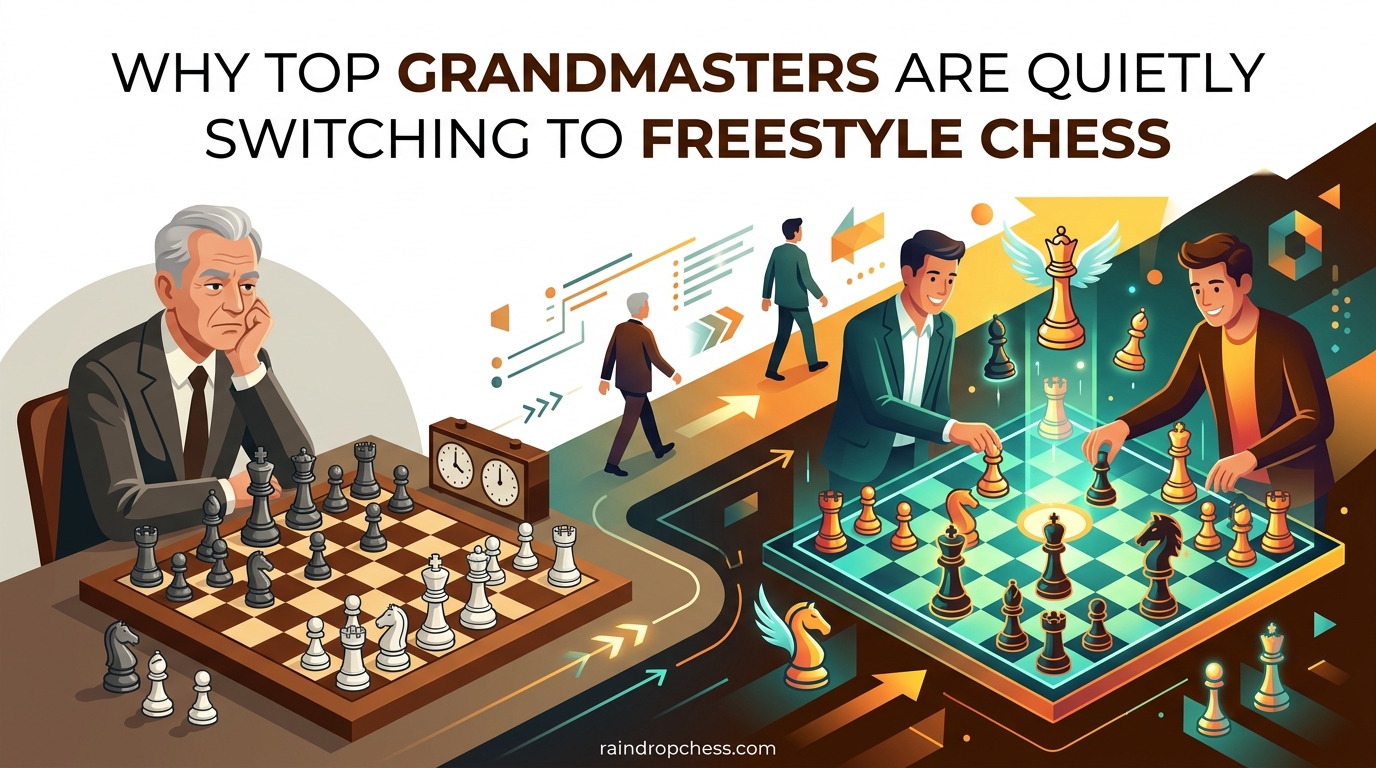
For decades, the upper echelons of chess have been defined by a single, uncomfortable truth: the best players in the world rarely lose to each other anymore. Games between grandmasters at the highest level increasingly end in draws, decided not by brilliance but by exhaustion of opening theory. Preparation has become so deep, so engine-driven, that the creative spark that made chess compelling feels like it has been outsourced to silicon. Now, something is shifting. A growing number of the world’s top grandmasters are quietly stepping away from classical chess’s most prestigious events, not in protest, but in pursuit of something they feel the traditional game has lost. That something is Freestyle Chess.
The movement is still in its early stages, but its momentum is undeniable. Magnus Carlsen, widely considered the greatest classical chess player of all time, has not only embraced the format but helped build it. Tournament organizers are reporting record viewership for Freestyle Chess events. And among younger grandmasters especially, the appeal of a format where creativity matters more than memorization is proving irresistible. So what exactly is Freestyle Chess, and why are some of the sharpest minds in the game abandoning centuries of tradition to play it?
What Is Freestyle Chess?
Freestyle Chess, also known as Chess960 or Fischer Random Chess, is a chess variant invented by former world champion Bobby Fischer in 1996. The fundamental difference from classical chess lies in the starting position. Rather than the fixed, symmetrical setup that has been standard since the 15th century, Freestyle Chess randomizes the placement of the back-rank pieces: the bishops, queen, knights, rooks, and king.
There are exactly 960 possible starting positions in Freestyle Chess, which is where the name Chess960 originates. However, there is one critical rule that governs all of them: the king must be somewhere between the two rooks, ensuring that castling remains a legal option in most positions. This single constraint preserves many of the strategic principles of traditional chess while making opening preparation essentially impossible.
Every game of Freestyle Chess begins in unfamiliar territory for both players. There are no memorized opening lines to fall back on, no database of novelties from previous games, and no engine preparation that can give a player an unfair edge before move one. The position is genuinely new, and both players must rely entirely on their understanding of chess fundamentals: pawn structure, piece activity, king safety, and the timeless art of calculation.
The time controls used in Freestyle Chess tournaments are typically shorter than classical events, often 10 minutes per player with an increment, but the reduced preparation time is not the point. The point is intellectual authenticity. Freestyle Chess returns the game to something purer, where the outcome of a game is determined by the players at the board, not by the hours spent grinding database lines beforehand.
Why Grandmasters Are Switching to Freestyle
The reasons top grandmasters are gravitating toward Freestyle Chess are multiple and deeply personal, but several core grievances with classical chess recur across interviews, forum posts, and tournament commentary. Here are the most significant factors driving the shift.
1. Opening Memorization Has Replaced Real Chess
In modern classical chess at the top level, it is not unusual for players to spend 15 to 20 moves in known theoretical positions before a game truly begins. Grandmasters spend thousands of hours memorizing opening lines, often working with computer engines to find improvements that their opponents have never seen. The result is that many high-level games feel scripted, with the real battle beginning only after the opening phase is exhausted. Freestyle Chess eliminates this entirely. There is no theory to memorize because there are 960 possible starting positions. Players who switch to Freestyle often describe a feeling of liberation, as if a weight has been lifted from their shoulders.
2. Engine Dependency Has Stunted Creativity
Computer chess engines like Stockfish have become indispensable tools for top grandmasters. But their influence has fundamentally altered how classical chess is played. Rather than independently evaluating positions, many players defer to engine recommendations, building their preparation around lines the computer approves of. This has led to a homogenization of style at the top level, where games between different players can look remarkably similar. Freestyle Chess resists this dynamic because no engine has been trained on these specific positions. Players must think for themselves, and the variety of positions that arise is vastly greater than in classical chess.
3. Draw Rates in Classical Chess Are Alarmingly High
The rate of draws in elite classical chess has been a growing concern for years. At some tournaments, more than 70 percent of games end in draws. While draws are a legitimate part of chess, their prevalence at the highest level has raised questions about whether classical chess is still delivering entertaining competition. Freestyle Chess games, by contrast, tend to feature more decisive results. Because neither player has deep preparation, both are more likely to land in unbalanced positions where mistakes are more likely and the game remains in genuine doubt for longer.
4. The Creative Joy of Chess Is Restored
Several grandmasters who have spoken publicly about switching to Freestyle describe a rediscovery of why they fell in love with chess in the first place. Having to think from move one, rather than executing memorized sequences, engages the brain in a fundamentally different way. Levon Aronian, a longtime top-10 player, has been among the most vocal about this aspect, describing Freestyle as a return to “real chess” where intuition and calculation matter more than database coverage.
5. Financial Incentives Are Growing
The Freestyle Chess Tour has injected significant prize money into the format, with events offering competitive purses that rival smaller classical tournaments. As the tour has grown, the financial case for participating has improved. For grandmasters who are not consistently winning the biggest classical events, Freestyle Chess offers a legitimate and potentially lucrative alternative.
6. Format Fatigue Is Real
After a lifetime of classical chess, many top players experience what psychologists might call format fatigue. The rituals of classical play, the multi-hour time controls, the deep preparation cycles, the constant travel to the same tournament venues, all of it compounds into exhaustion. Freestyle Chess offers something new, a change of pace that re-energizes players who might otherwise drift away from competitive chess entirely.
7. A Level Playing Field for Everyone
Because opening preparation is impossible in Freestyle Chess, the format arguably rewards raw talent and overall chess understanding more fairly than classical chess. Players from countries or teams with fewer resources, who cannot afford large analytical teams or expensive preparation tools, may find Freestyle Chess a more meritocratic arena. This is an angle that has resonated strongly in online chess communities, where debates about the equity of modern chess preparation are common.
Magnus Carlsen’s Role and Vision
No single person has done more to legitimize Freestyle Chess than Magnus Carlsen. The Norwegian grandmaster, who held the world classical chess crown from 2013 to 2023, has for years been the most famous face of the game. His decision to step away from classical chess at the highest level and throw his weight behind Freestyle Chess sent shockwaves through the chess world.
In a guest essay published by The Economist in January 2025, Carlsen made his case directly. “Freestyle Chess radically reimagines the game by randomising the placement of back-rank pieces like the king, queen and bishops,” he wrote. But his motivations went beyond the format’s mechanics. Carlsen argued that traditional chess had become stale, that the dominance of engine preparation had drained the game of the spontaneity that drew players to it in the first place. His vision for the future of chess was one where creativity, not memorization, determines the champion.
Carlsen co-founded Freestyle Chess alongside Henric Buettner, and together they have built the Freestyle Chess Tour, a circuit of professional events dedicated to the Chess960 format. The tour has attracted top players from around the world, with events across Europe and plans for further expansion. Carlsen has been a regular participant, and his presence has lent the format both credibility and visibility.
Carlsen is not alone in his enthusiasm. Other well-known grandmasters have joined the movement, some reluctantly and some with enthusiasm. Hikaru Nakamura, the American grandmaster and popular chess streamer, has expressed more mixed opinions publicly, acknowledging the appeal of Freestyle while also defending the enduring value of classical chess. But even skepticism from high-profile players has helped keep Freestyle Chess in the public conversation.
The question of whether Carlsen’s involvement constitutes a genuine threat to FIDE’s authority over chess is one that the governing body has had to confront. Carlsen is not just a participant; he is a business partner in a competing format, and the Freestyle Chess Tour operates independently of FIDE’s own events and rankings. This tension lies at the heart of the dispute between the two organizations.
The FIDE and Freestyle Chess Dispute
The relationship between Freestyle Chess and FIDE, the International Chess Federation, has been marked by growing tension since the format began attracting serious professional attention. FIDE is the official governing body for chess worldwide, and any challenge to its authority over the game’s formats and tournaments represents a fundamental threat to its structure.
The core of the dispute is economic and organizational. FIDE earns significant revenue from classical chess events, including the World Chess Championship, which is its flagship product. The Freestyle Chess Tour operates as a private commercial venture, not under FIDE’s jurisdiction, and its success raises uncomfortable questions about whether FIDE’s model is sustainable in a world where alternative formats can attract top players and large audiences.
FIDE has attempted to address the appeal of Chess960 by incorporating it into certain events, including some Grand Slam tournaments, but these efforts have been seen by many as reactive rather than proactive. Critics within the Freestyle Chess community argue that FIDE’s governance structure is too slow and too politically entangled to drive genuine innovation in the game. The dispute has occasionally spilled into public rhetoric, with accusations of a “power grab” on one side and concerns about the fragmentation of competitive chess on the other.
For individual grandmasters, the dispute creates a genuine dilemma. FIDE-rated classical events remain the primary path to prestige and ranking points in the traditional game. But Freestyle Chess offers freedom, creativity, and financial opportunity that many players find increasingly attractive. Some players, like Vincent Keymer, have spoken openly about the difficulty of choosing between the two worlds, particularly when commitments to one format can affect standing in the other.
The tension between FIDE and Freestyle Chess is not merely a corporate dispute. It represents a broader question about the future of chess: Should the game be organized around a single governing body and a single format, or should it evolve into a more fragmented ecosystem where different formats serve different purposes and audiences? The outcome of this dispute may well determine what competitive chess looks like a generation from now.
The Future of Chess: Freestyle vs. Classical
It would be premature to declare the death of classical chess. The World Chess Championship remains one of the most-watched events in the chess calendar, and thousands of players at the club and amateur level continue to play and study classical chess with passion. The format is not going away. But the trajectory is clear: Freestyle Chess is growing, and classical chess is feeling the pressure to evolve.
The implications for the classical format are significant. If top grandmasters continue to spend more time and energy on Freestyle Chess, the depth of preparation in classical events may eventually decrease, which could paradoxically make classical games more competitive and entertaining. Alternatively, FIDE may be forced to introduce structural changes to its own events, perhaps incorporating time controls or formats that reduce the advantage of deep preparation.
What seems most likely is a coexistence of the two formats, with Freestyle Chess appealing to players and audiences who want fast-paced, creative chess, and classical chess retaining its role as the ultimate test of deep strategic thinking. This dual ecosystem could ultimately benefit chess as a whole, broadening its appeal and ensuring that the game remains vibrant in an era when entertainment options are more diverse than ever.
The grass-roots response to Freestyle Chess has been notably positive. Online communities on Reddit and Chess.com forums report high engagement with Freestyle tournaments, and many amateur players have begun studying the format with the same intensity they once applied to classical opening theory. The randomized starting positions make the format accessible in a way that classical chess is not: you do not need years of study to appreciate a Freestyle Chess game, because both players are thinking in real time, without scripts.
For the grandmasters who have made the switch, the verdict is largely positive. They describe feeling more alive at the board, more engaged with the positions, and more proud of their games. Whether this movement continues to grow, and whether it ultimately reshapes the landscape of competitive chess, will depend on the decisions of players, organizers, and governing bodies in the years ahead. But one thing is certain: the quiet revolution in chess has already begun.
Frequently Asked Questions
Why is Freestyle Chess becoming popular?
Freestyle Chess is gaining popularity because it eliminates opening memorization and computer engine preparation, forcing players to rely on pure creativity and adaptability. Grandmasters are drawn to its unpredictability and the renewed challenge it offers after decades of classical chess dominance. Additionally, the Freestyle Chess Tour has brought financial legitimacy to the format, making it an attractive professional option.
Does Magnus Carlsen own Freestyle Chess?
Magnus Carlsen is a co-founder of Freestyle Chess, alongside Henric Buettner. Together they launched the Freestyle Chess Tour, a series of professional tournaments dedicated to the Chess960 format. Carlsen has been one of the most visible advocates for the format and a regular participant in Freestyle Chess events.
Is Freestyle Chess more difficult?
Many grandmasters report that Freestyle Chess is more difficult because no opening preparation is possible. Every game starts from an unfamiliar position, requiring pure calculation, intuition, and adaptability rather than memorized lines. However, the absence of engine prep also levels the playing field, making talent and fundamental understanding more decisive factors.
Why is freestyle chess different?
Freestyle Chess randomizes the back-rank pieces at the start of each game, creating 960 possible starting positions. This eliminates opening theory and engine prep, placing the emphasis entirely on creativity, calculation, and positional understanding. Unlike classical chess, where hours of preparation can provide a decisive edge before the game begins, Freestyle Chess requires players to think independently from move one.
Is classical chess declining in popularity?
Classical chess at the elite level has faced declining viewership and rising draw rates, but it remains the gold standard for chess prestige. The format retains a large and passionate following at the amateur and club level. The rise of Freestyle Chess represents a diversification of competitive chess rather than an outright replacement of classical play.
Who are some grandmasters who have switched to Freestyle Chess?
While many top grandmasters have participated in Freestyle Chess events, Magnus Carlsen has been the most prominent advocate. Levon Aronian has also been vocal about his preference for the format. The movement spans multiple nationalities, though some analyses have suggested that Indian grandmasters, in particular, have struggled more initially with the transition compared to their European counterparts.