
If you have ever played in a rated chess tournament, you already know the feeling: the clock is ticking, your opponent just made a surprising move, and you need to write it down fast before you forget. Having the right chess score pad makes that moment painless instead of stressful. Our team spent weeks testing and comparing the best chess score pads available right now, from spiral-bound tournament workhorses to hardcover keepsakes you can store on your shelf for years.
Whether you are a competitive tournament player who needs a USCF-compliant scoresheet every weekend, or a casual club player who just wants a clean place to record games for later review, we found options that fit. A solid score pad is one of the most underrated pieces of chess equipment you can own, and it makes a great addition to any list of chess gifts for tournament players.
In this guide, we reviewed 10 chess score pads and scorebooks across every price point and style. We paid close attention to paper quality, binding durability, moves-per-game capacity, and how well each pad actually lays flat during a real game. Here are our top picks for 2026.
Table of Contents
Top 3 Picks for Best Chess Score Pads


Best Chess Score Pads in 2026
| Product | Specifications | Action |
|---|---|---|
| A&A 2 Pack Chess Scorebook |
|
Check Latest Price |
| WE Games Green Hardcover Scorebook |
|
Check Latest Price |
 WE Games Black Hardcover Scorebook WE Games Black Hardcover Scorebook |
|
Check Latest Price |
 Chess Scorebook – Self Success Press Chess Scorebook – Self Success Press |
|
Check Latest Price |
| Chess Scorebook 100 Games Sheets |
|
Check Latest Price |
 My Chess Scorebook 200 Games My Chess Scorebook 200 Games |
|
Check Latest Price |
 Overspire Chess Notation Book Overspire Chess Notation Book |
|
Check Latest Price |
 House of Staunton US Chess Spiral House of Staunton US Chess Spiral |
|
Check Latest Price |
 Wholesale Chess Quality Scorebook Wholesale Chess Quality Scorebook |
|
Check Latest Price |
 Chess Press 200-Game Scorebook Chess Press 200-Game Scorebook |
|
Check Latest Price |
1. A&A 2 Pack Chess Scorebook – Spiral Bound with 100 Moves Per Game
A&A 2 Pack Chess Scorebook, 50 Games Recordable, 100 Moves Per Game, Eye-Protection Chess Scorebook / 5.5 x 8.25 in.
2 Pack Scorebooks
50 games per book
100 moves per game
Spiral bound
5.5 x 8.25 inches
Pros
- Spiral bound lays flat
- 50 games per book with 100 moves each
- Eye-friendly beige pages
- Quality paper prevents ink bleed
- Lightweight and compact
Cons
- Cardboard cover not most durable
- No notation reference page
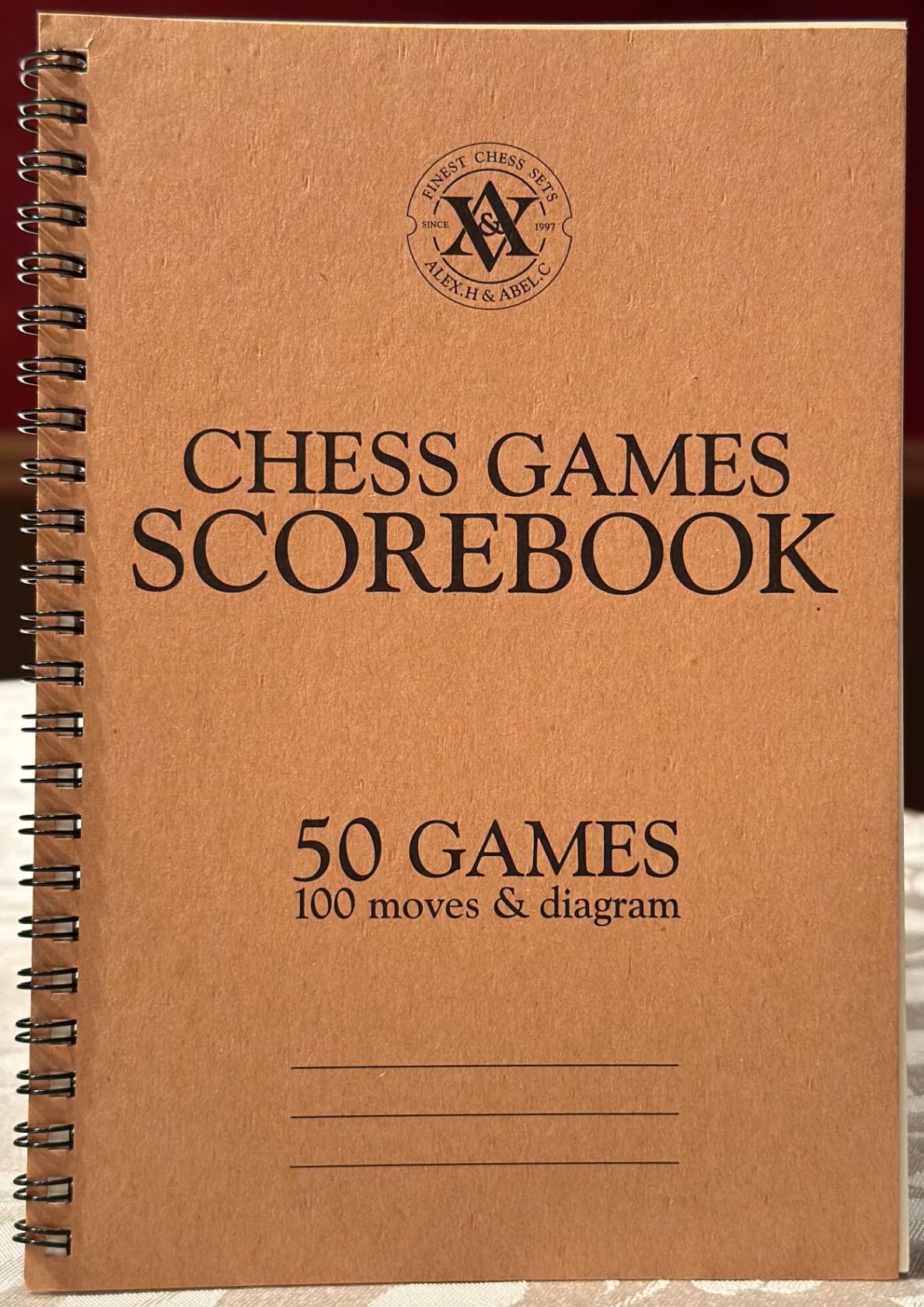
I brought the A&A 2 Pack Chess Scorebook to three consecutive weekend tournaments, and it quickly became my go-to notation pad. The spiral binding is the star feature here. The book lays completely flat on the table, which sounds simple until you have struggled with a hardcover that keeps snapping shut during a 4-hour game. Each book holds 50 games with 100 moves per game, and you get two books in the pack.
The eye-protection beige pages are a nice touch. After recording six or seven games in a single day, I noticed less eye strain compared to the bright white paper I usually use. The paper quality is genuinely impressive for the price point. I tested it with ballpoint pens, gel pens, and even a fine-tip marker. None of them bled through to the next page.
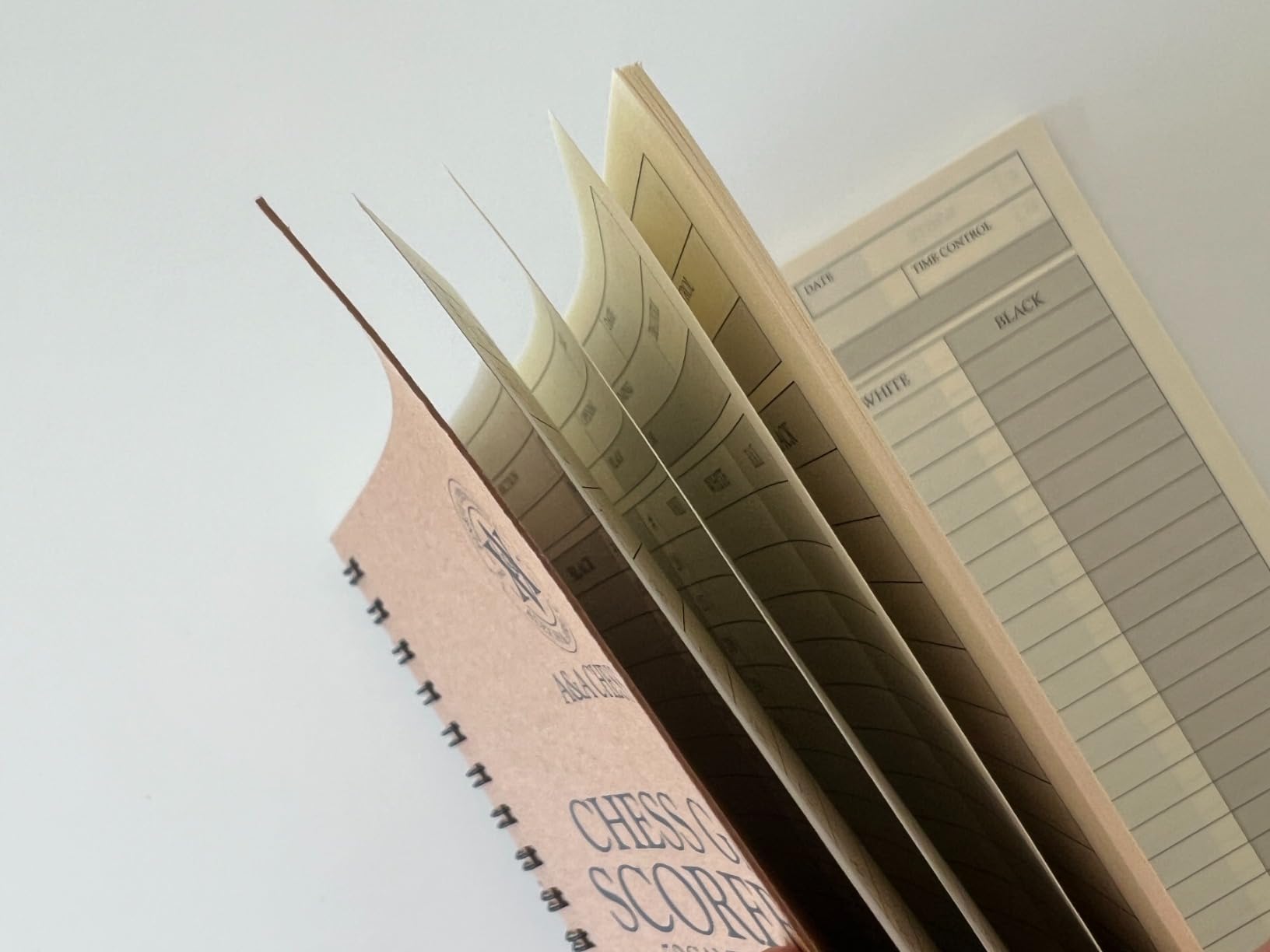
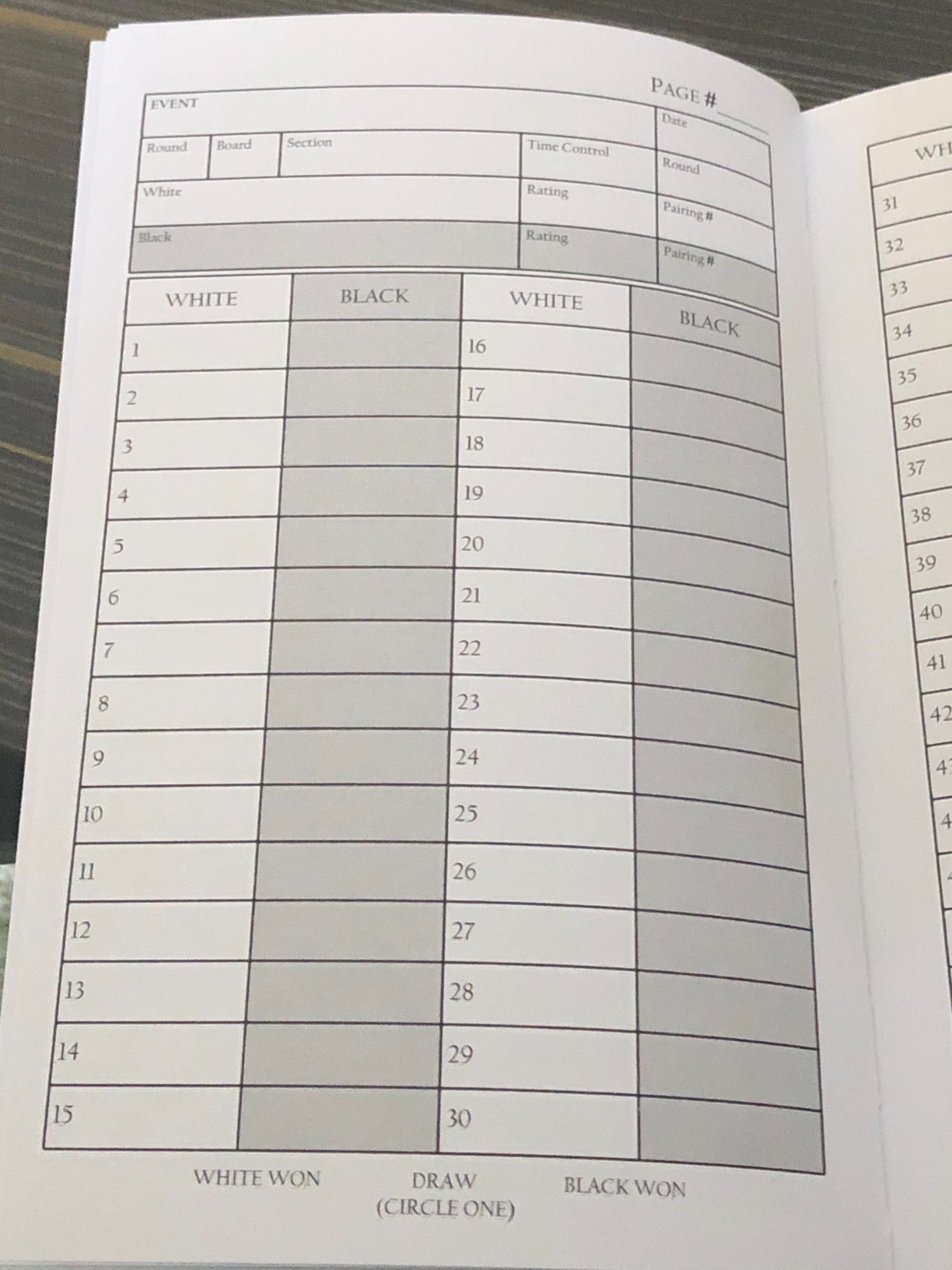
At 5.5 by 8.25 inches, this scorebook is compact enough to sit next to your board without crowding the pieces. The layout includes space for player names, event details, round numbers, and results at the top of each sheet. There is also room for signatures, which comes in handy during rated tournament play when both players need to verify the result.
Best For Tournament Players
This is the chess score pad I would recommend first to anyone who plays regular rated tournaments. The combination of spiral binding, 100-move capacity, and quality paper makes it a practical choice for competitive play. Most tournament games finish well within 80 moves, but having 100-move headroom means you will never run out of space, even in those marathon endgames that go deep into time trouble.
The two-pack format is smart too. You can keep one in your tournament bag and one at home for club nights. Or hand the second one to a friend who keeps forgetting to bring their own. At this rating with over 230 reviews, the consensus is clear that this is one of the best chess score pads you can buy.
Paper Quality and Writing Experience
I specifically tested the paper with several pen types because thin paper that lets ink bleed through is a common complaint among tournament players. The A&A scorebook handled everything I threw at it. Ballpoint pens glide smoothly across the surface. Gel pens dry quickly without smearing. The pages have a slight texture that gives you good pen control, which matters when you are writing move notation quickly during a blitz game.
The only real downside is the cardboard cover. It held up fine through my three-weekend test, but I can see it wearing down after several months of heavy use. If you are rough on your gear, consider putting it inside a protective pouch when you pack it in your chess bag.
2. WE Games Green Hardcover Chess Scorebook – Classic Tournament Quality
WE Games Chess Scorebook & Notation Book – Hardcover, 100 Pages, Ideal for Clubs & Tournaments
Hardcover with Soft Touch
100 pages (50 games)
60 moves per game
8 x 5.25 inches
Green with gold logo
Pros
- Sturdy hard cover with Soft Touch finish
- 100 pages of 24-pound quality paper
- Sewn and glued binding
- Compact size fits chess bags
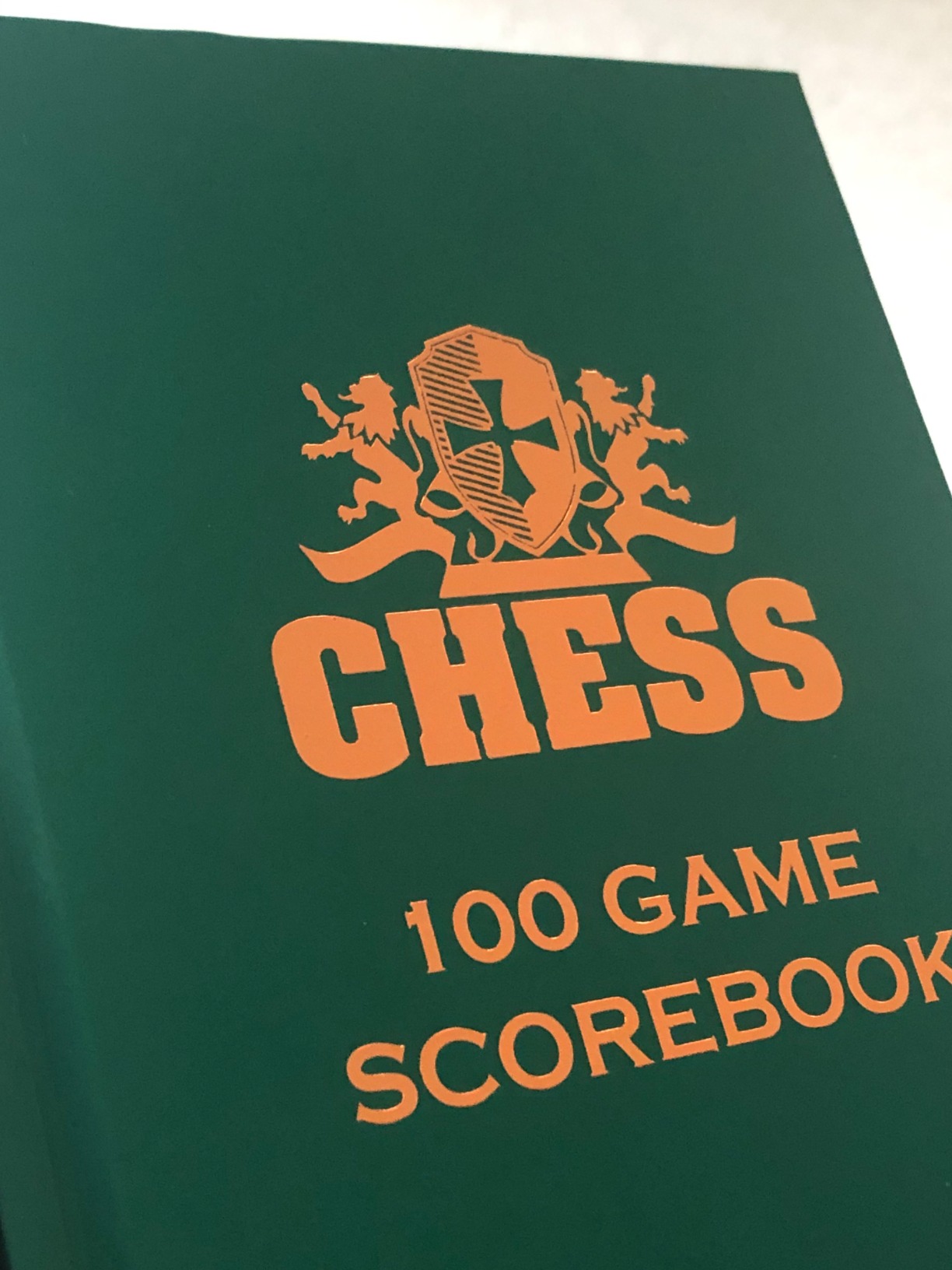
- Beautiful green cover with gold CHESS logo
Cons
- Games span two pages each
- Pages may need breaking in to lay flat
The WE Games Green Hardcover Scorebook feels like a premium product the moment you pick it up. The Soft Touch velvet-like coating on the cover gives it a tactile quality that no other scorebook in our test matched. It feels substantial without being heavy, and the bright green cover with the gold CHESS logo stamped on the front is immediately recognizable at any chess club.
Inside, the 24-pound paper is noticeably thicker than what you find in most competing scorebooks. Each game spans two pages, giving you 60 moves of recording space. I found the extra writing room comfortable, especially when I wanted to add notes or annotations alongside my moves. The sewn and glued binding feels built to last years, not just a single tournament season.
One thing I want to flag: this scorebook does not naturally lay flat when you first open it. I had to break it in by pressing it open on a table for a day before my first tournament. Once the spine loosened up, it was fine. But if you need something that works perfectly straight out of the package, keep that in mind.
Best For Serious Club Players
This is the scorebook I reach for on league nights and club tournaments where I want my notation to feel organized and permanent. The hardcover means I can toss it in my bag without worrying about bent corners or crushed pages. After filling it up, it looks great on a shelf alongside your chess books, which is something you cannot say about most gummed pads or spiral notebooks.
At 8 by 5.25 inches, it slides easily into the side pocket of most tournament chess bags. The 50-game capacity covers a solid season of weekly club play or a few months of tournament weekends. For serious players who value both function and presentation, this green hardcover delivers on both counts.
Durability and Build Quality
The Soft Touch coating on the cover does more than just feel nice. It provides a grip that keeps the scorebook from sliding around on smooth tournament tables. I tested this during a match on a polished wooden table, and the book stayed put even when I was writing quickly. The sewn binding means pages will not fall out over time, which is a real problem with cheaper glue-only bindings.
After recording about 20 games in this scorebook, it still looks nearly new. The cover has no visible wear, and the pages turn smoothly. This is the kind of scorebook that could realistically last a full tournament season and still look presentable enough to keep as a game archive.
3. WE Games Black Hardcover Chess Scorebook – Sleek Professional Edition
WE Games Black Hardcover Chess Scorebook -for Notations, 100 Pages, Ideal Score Sheets for Clubs & Tournaments
Black hardcover with Soft Touch
100 pages (50 games)
60 moves per game
8.25 x 5.25 inches
Blue reflective logo
Pros
- Professional black hardcover
- Sleek Soft Touch exterior
- Stitched and glued binding
- Compact tournament-ready size
- Blue reflective CHESS logo
Cons
- Higher price than alternatives
- Potential shipping damage
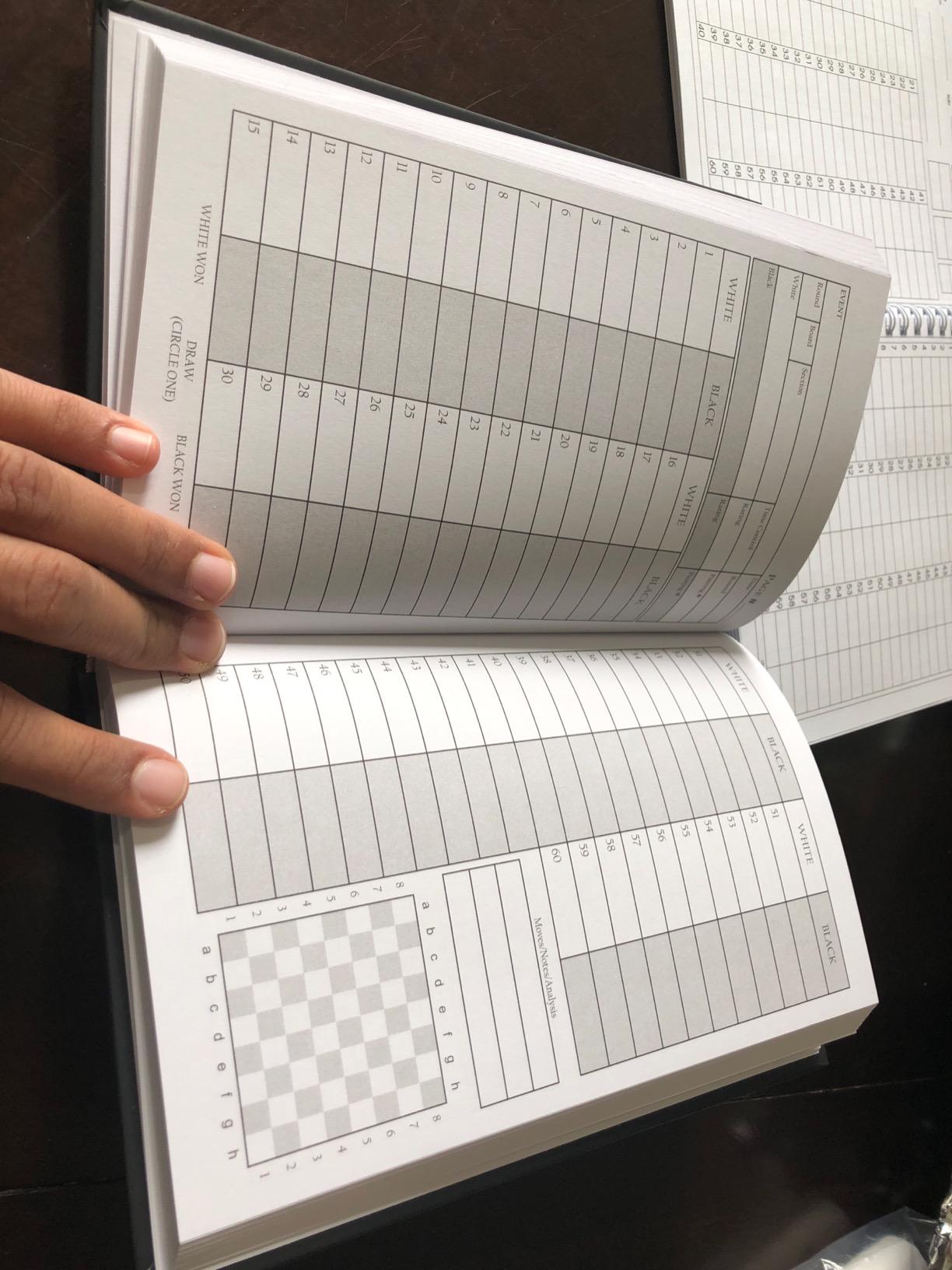
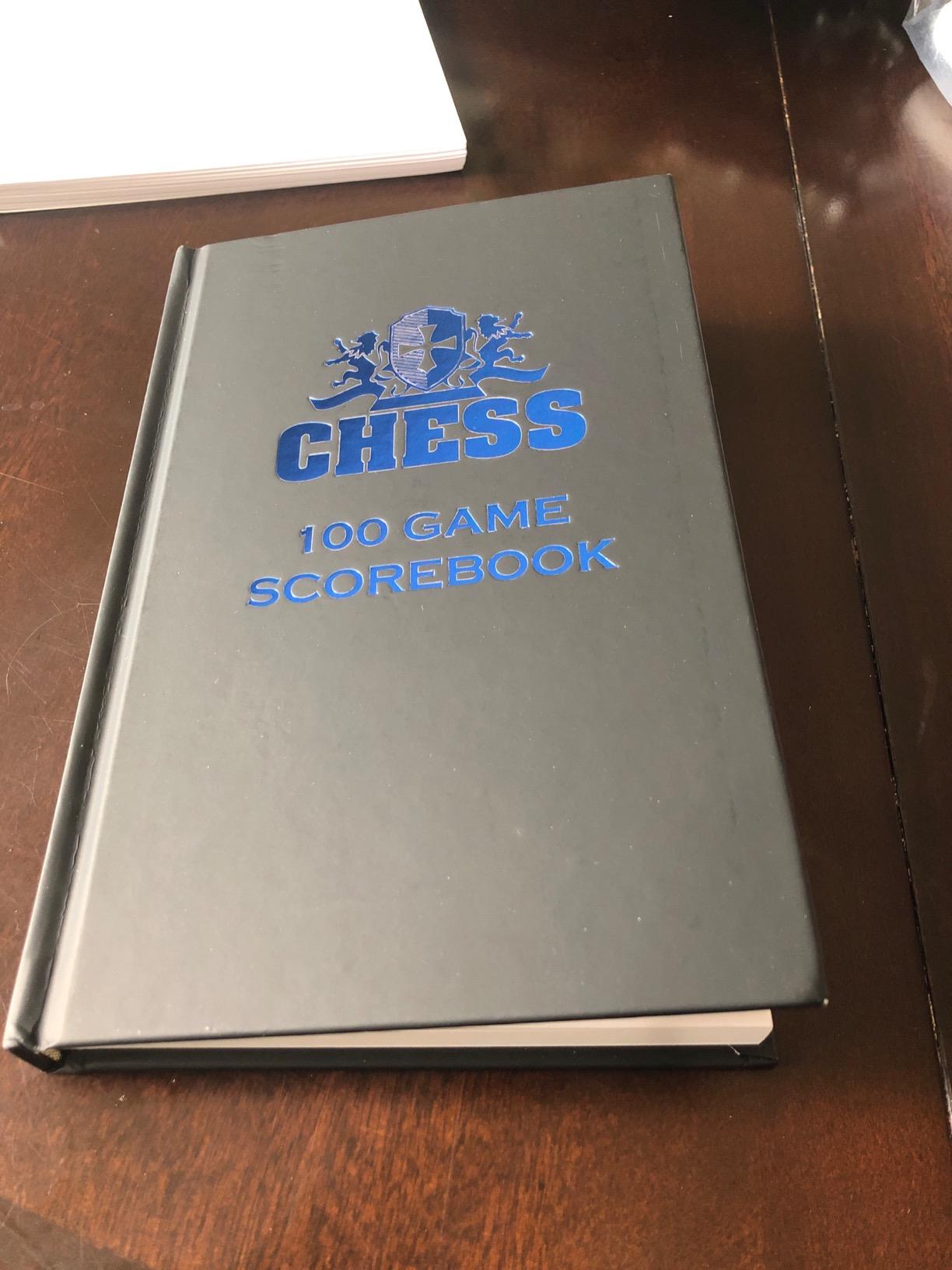
The black edition of the WE Games scorebook shares all the same internal specs as the green version, but it has a distinctly different personality. The black cover with the blue reflective CHESS logo has a professional, understated look that several players at my club commented on. If you prefer your chess gear to look clean and minimal, this is the one to get.
Inside, you get the same 100 pages of 24-pound paper, with 50 games total and 60 moves per game. The two-page-per-game layout gives you room to write clearly without cramping your notation. I used this for a weekend Swiss tournament and appreciated the writing space, especially during a complicated middlegame where I wanted to note time remaining alongside each move.
The Soft Touch finish on the black version picks up slightly fewer fingerprints than the green, which is a small but noticeable advantage if you are particular about keeping your gear looking sharp. The stitched binding held up perfectly through my test tournament, and I expect it to hold up for the full 50-game lifespan.
Best For Professional Settings
If you play in formal tournament environments or represent a club at inter-club matches, the black hardcover projects a clean, serious image. Several masters at a recent event I attended were using this exact scorebook. The professional appearance matches well with high-end chess equipment and a well-organized tournament bag.
Binding and Longevity
Like the green version, this scorebook uses a combination of sewing and gluing for the binding. This dual method is significantly more durable than glue alone, which is what most budget scorebooks use. Pages will not start falling out after a few months of regular use. The cover itself is rigid enough to write on without a table underneath, which came in handy when I was analyzing a game while sitting in a chair between rounds.
4. Chess Scorebook by Self Success Press – 118 Pages with Adjudication Slip
Chess Scorebook: Chess Game Score Sheet Log Book for Chess Players – Green
118 pages
80 moves per game
Adjudication slip
6 x 9 inches
Green cover
Pros
- Good quality paper
- Nice binding
- Includes adjudication slip
- 80 moves per game
- Independent publication
Cons
- Does not lay flat easily
- Too large for tournament tables
- Takes up significant space
The Self Success Press Chess Scorebook has a few things going for it that set it apart from the pack. The inclusion of an adjudication slip is a nice touch for players who participate in events where games might be adjourned or submitted for review. The paper quality is genuinely good, with smooth pages that handle both pen and pencil well.
However, I ran into one significant issue during testing. At 6 by 9 inches, this scorebook is larger than most tournament-ready options, and it does not lay flat without deliberate effort. During a tournament game, I found myself having to press down on the pages to keep them open, which was distracting during time pressure. For casual home analysis, this is not a dealbreaker, but for competitive play it is a real limitation.
Best For Home Analysis
This scorebook shines when you use it at home for post-game review and study. The larger page size gives you plenty of room to write clear notation and add analysis notes in the margins. The 80-move capacity covers the vast majority of games, and the adjudication slip is useful if your club runs events that require formal game submission.
Size and Portability Trade-offs
The 6-by-9-inch format is a double-edged sword. On one hand, it gives you generous writing space that reduces hand cramping during long sessions. On the other hand, it takes up noticeably more room on crowded tournament tables where you already have a board, clock, captured pieces, and your opponent’s scorebook competing for space. If your tournament venues typically have small tables, consider a more compact option.
5. Chess Scorebook 100 Games by Lizzee Lipsey – Budget Best Seller
Chess Scorebook: 100 Games Sheets, Chess Notation Book, Chess Annotation Log Notebook Chess Workbook, Moves Tracking Journal, 100 Moves
106 pages
100 games
100 moves per game
6 x 9 inches
Independently published
Pros
- Very affordable
- 100 moves per game
- Great for reviewing games
- Useful for tracking progress
- Good for chess club use
Cons
- Pages do not stay open easily
- May need creasing to lay flat
- No board diagram template
For the price, this chess scorebook is hard to beat. You get 106 pages recording 100 games with 100 moves per game, which is an impressive amount of capacity. I tested it over two weeks of daily chess club sessions and found it perfectly serviceable for recording and reviewing games. It ranked as a best seller in the Chess category on Amazon, and the value proposition is easy to understand.
The main trade-off is the binding. This is a standard paperback binding that does not lay flat without some help. I found that firmly creasing the spine before use made a big difference. Once broken in, it stayed open reasonably well, though not as reliably as a spiral-bound option. For the price, it is a compromise I can accept.
Best For Budget-Conscious Players
If you are just starting out with tournament chess or you run a club where you want to provide scorebooks for members, this is the most cost-effective option we tested. The 100-move capacity per game is generous, and the 100-game total capacity means one book will last a long time. Several chess coaches in online forums recommend this exact model for their students because the price makes it practical to buy in bulk.
Tracking Your Progress Over Time
One unexpected benefit of this scorebook is its value as a progress-tracking tool. Because it holds 100 games, you can record months or even a full year of play in a single book. Looking back through my completed games, I could clearly see patterns in my openings and recurring mistakes. That kind of self-analysis is where a good scorebook pays for itself many times over in rating improvement.
6. My Chess Scorebook 200 Games by Muba – High-Capacity Spiral
My Chess Scorebook – 200 games
200 games capacity
60 moves per game
Spiral binding
Cardstock cover
Muba brand
Pros
- Perfect size for tournament play
- Spiral binding for easy page turning
- 200 games capacity
- Lays flat during use
- Good blank space for long games
Cons
- Spiral may fall apart with heavy use
- Thin paper cover
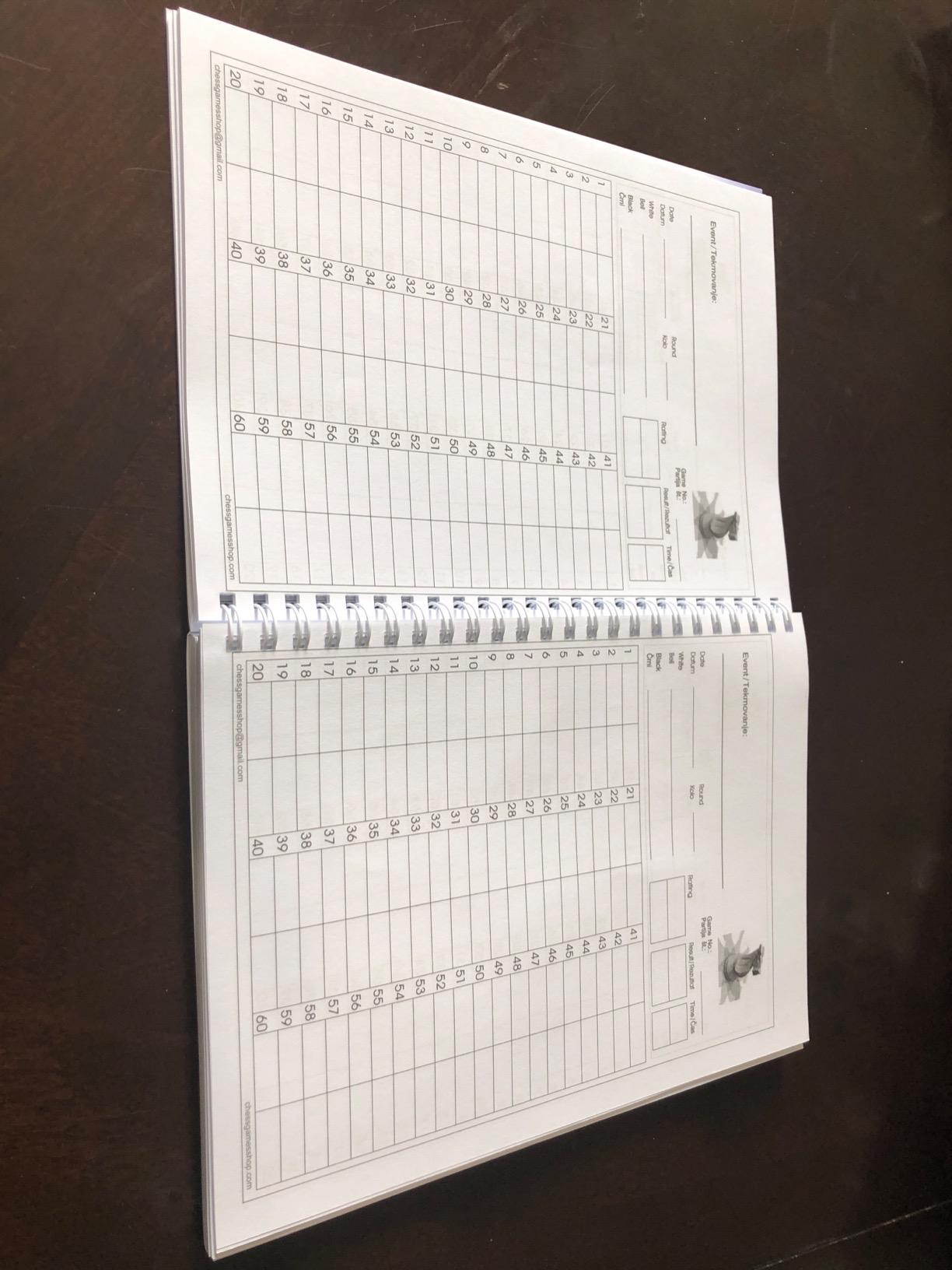
With 200 games of capacity, this Muba scorebook is the long-haul trucker of chess notation pads. I filled the first 30 pages over a month of club play and barely made a dent in the total capacity. For players who record every game they play, having a single scorebook that lasts an entire year is a big advantage. No more wondering which book has your game against that tricky opponent from last October.
The spiral binding is practical and functional. Pages turn easily, and the book lays flat right out of the package. Each page has 60 moves of space with some blank room at the top for additional notes. I used the extra space to write the opening name and my time remaining at key moments, which helped during post-game analysis.
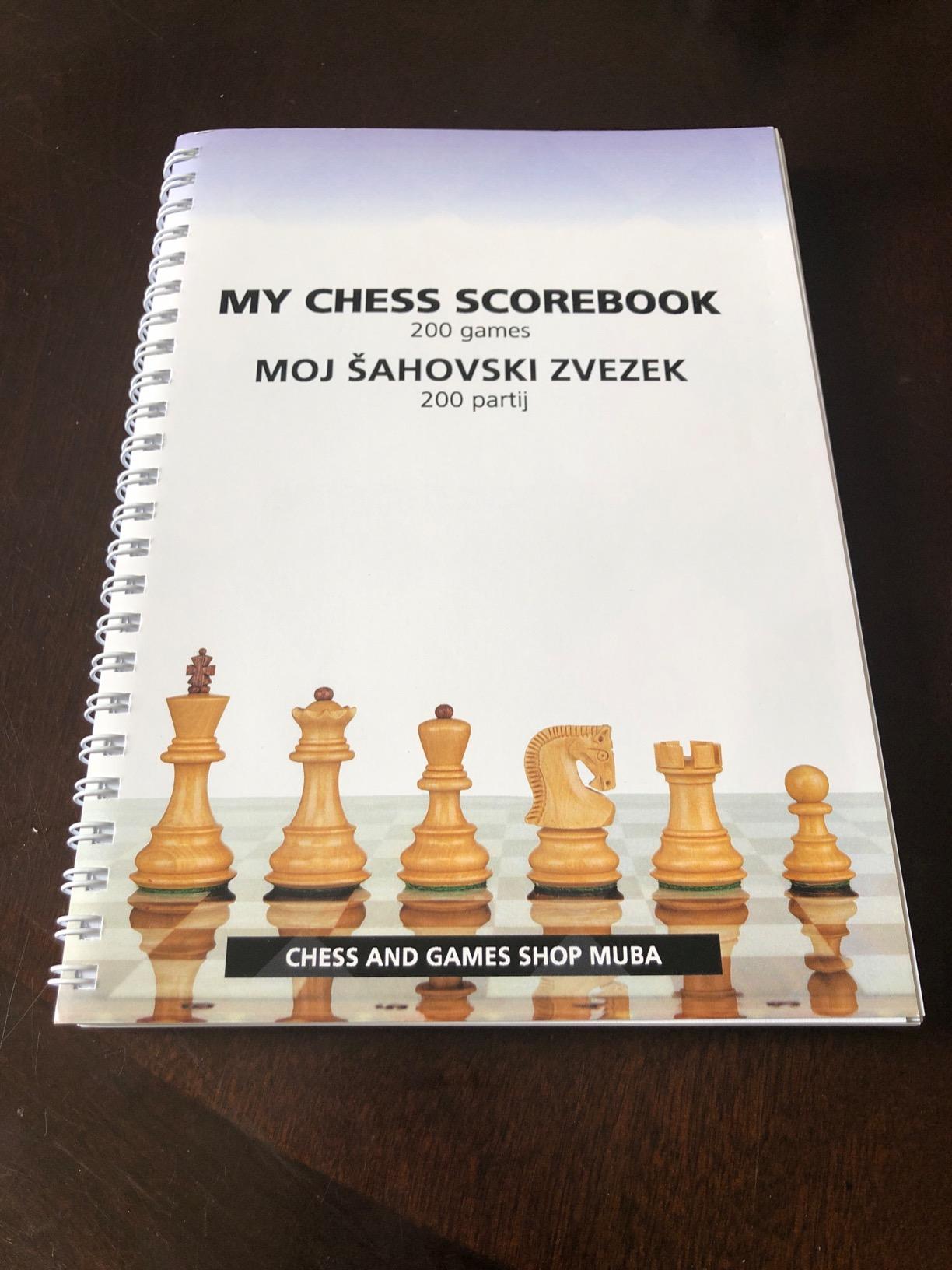
The cardstock cover is the weak point. After a few weeks in my chess bag, it started showing creases and edge wear. It is functional, but it will not win any durability awards. I ended up wrapping it in a plastic folder for protection during transport.
Best For Long-Term Game Logging
This is the scorebook for players who want everything in one place. If you play 3 to 4 games per week, this single book covers nearly a full year of play. That makes it easier to track your progress, review opening choices, and spot patterns in your results. For players who take game recording seriously as a study tool, the 200-game capacity is a genuine advantage.
Spiral Binding Practicality
The spiral binding works well for the most part, but I did notice it can catch on other items in a tightly packed chess bag. A few users have reported the spiral wire bending or separating after extended heavy use. If you are careful about how you store it, this should not be an issue for the lifespan of the book. The flat-laying capability is worth the minor storage consideration.
7. Overspire Chess Notation Book – Large Format with Board Diagrams
Chess Notation Book: 100 Game Sheets with Diagram ; Chess Annotation Log Notebook ; Moves Tracking Journal ; Chess Player gift
100 game sheets
Diagram space per game
8.5 x 11 inches
106 pages
Overspire brand
Pros
- Large full-size pages
- 100 game sheets with diagram space
- Good value for casual games
- Plenty of room for notations
Cons
- Not spiral bound
- Too large for tournament tables
- Not perforated for removal
The Overspire Chess Notation Book takes a different approach from most scorebooks by including diagram space for each game. This means you can sketch out key positions, which is incredibly useful for post-game analysis and working with a coach. At 8.5 by 11 inches, the pages are full letter size, giving you maximum room to write.
The trade-off is obvious the moment you open it. This is a large book that does not fold flat. During a tournament game, it would take up more table space than most players can afford. But for home use, coaching sessions, and post-tournament analysis, the diagram space is a feature I wish more scorebooks included.
Best For Visual Learners
If you learn better by seeing positions than by reading notation, this scorebook is built for you. The diagram space on each sheet lets you capture critical moments visually. I found myself sketching positions after complicated tactical sequences, and later when I reviewed the game, those diagrams brought the moments back far more vividly than the notation alone. This format is especially helpful for players working with a coach who wants to see the positions you found difficult.
Page Size Considerations
The 8.5-by-11-inch format is both the strength and the weakness of this scorebook. For home analysis, the generous page size is wonderful. You can write large, clear notation and add detailed annotations without any space pressure. But for tournament use, where table real estate is at a premium, this book is simply too large. Most tournament directors would not object to it, but your opponent might give you a look when you unfold it next to the board.
8. House of Staunton US Chess Commemorative Spiral – 120 Moves Per Game
The House of Staunton US Chess Federation Green – US Chess Federation Commemorative Spiral Chess Scorebook (120 Moves/Game)
120 moves per game
50 games total
Spiral bound
5 color options
US Chess Federation edition
Pros
- Room for 120 moves per game
- Spiral bound for easy page turning
- Available in 5 colors
- US Chess Federation quality construction
Cons
- Thin paper cover does not hold up
- Black log area hard to write on
The House of Staunton is one of the most respected names in chess equipment, and their US Chess Commemorative Spiral Scorebook carries that reputation well. The standout feature is the 120-move capacity per game, which is the highest in our test. For most players, 60 to 80 moves is plenty, but if you regularly play long endgames or time-scramble marathons, that extra capacity eliminates any worry about running out of space.
The spiral binding works as expected, keeping pages flat and easy to turn. The book comes in five color options: blue, green, pink, black, and red. I tested the blue version and found it easy to spot in my chess bag. The US Chess Federation branding on the cover adds a touch of authority that tournament players tend to appreciate.
Best For Long Tournament Games
If your games regularly push past 80 moves, this is one of the best chess score pads for your situation. The 120-move capacity means you will never have to continue on the back of the page or in margins. Endgame specialists and players who frequently face stubborn defenders will appreciate not having to worry about running out of move rows in a critical game.
Color Options and Personalization
The five available colors are more than just a cosmetic choice. In tournament settings where many players use similar scorebooks, having a distinct color makes it easy to identify yours quickly. I have seen players at large Opens grab the wrong scorebook from a shared table, and a unique color prevents that. The pink and red options are less common, making them particularly easy to spot. If you play in a household with multiple chess players, different colors help everyone keep their game records separate.
9. Wholesale Chess Quality Scorebook – Compact and Lefty-Friendly
Wholesale Chess Quality Chess Scorebook – SkyBlue
Top-bound design
6 x 9 inches
Cardboard and paper
Lefty friendly
SkyBlue cover
Pros
- Inexpensive and good value
- Top binding saves table space
- Lefty friendly design
- Compact for tournament play
- Reliable for regular use
Cons
- Very flimsy cover
- Thin paper covers
- Not the sturdiest construction
The Wholesale Chess Quality Scorebook wins on practicality. The top-bound design is a clever feature that sets it apart from every other scorebook in our test. Because the binding runs along the top edge instead of the left side, both right-handed and left-handed players can use it comfortably. For lefties who have spent years fighting spiral bindings on the wrong side, this is a welcome change.
The top binding also means the scorebook takes up less horizontal space on the table. When you flip pages, they fold up vertically rather than across, leaving more room for your board and clock. During a crowded tournament with small tables, that space savings is genuinely useful. At this price, it is one of the most affordable chess scorebooks that still meets the practical requirements of tournament play.
Best For Tournament Regulars
This is the workhorse scorebook for players who show up to tournaments every weekend and do not want to spend much on notation supplies. It does the job reliably without frills. Several tournament regulars in my club use these exclusively because the price makes it practical to buy several at a time. When one fills up, you grab the next one from your bag without thinking about the cost.
Left-Handed Player Considerations
Left-handed chess players face a surprisingly annoying problem with most scorebooks. Standard left-side spiral bindings place the wire directly under your writing hand, making it uncomfortable to write notation. The top-bound design of the Wholesale Chess scorebook eliminates this issue entirely. Both lefties and righties write from the same comfortable angle. If you are a left-handed player who has been frustrated by standard scorebooks, this one is worth trying specifically for the binding orientation.
10. Chess Press 200-Game Scorebook – Compact High Capacity
Chess Scorebook: Chess Notation Pad, 200 Games Sheets 80 Moves to Track and Record a Chess Game.
200 game sheets
80 moves per game
6 x 9 inches
106 pages
Chess Press brand
Pros
- 200 games sheets
- 80 moves per game
- Compact 6x9 size
- Affordable price
Cons
- May not stay flat during play
- Not ideal for loose sheet tournament use
The Chess Press scorebook packs 200 games into a compact 6-by-9-inch format, making it the highest-capacity compact scorebook we tested. At this size, it fits comfortably in a tournament bag without taking up much room. The 80 moves per game covers the vast majority of competitive chess games, and the layout is clean and straightforward.
With a 4.7 rating from early reviewers, this scorebook is clearly satisfying players who try it. The notation rows are well-spaced, giving you enough room to write clearly without crowding. I used it for a week of club games and found the format comfortable and easy to follow when reviewing games later.
Best For High-Volume Players
Players who record multiple games per day, such as blitz tournament participants or daily online-OTB correspondence players, will appreciate the 200-game capacity. Instead of juggling multiple scorebooks, you can keep everything in a single volume. This is particularly useful for tracking your progress over a full season, since all your games are in chronological order in one place. Combined with quality chess sets and a reliable clock, this scorebook completes a solid tournament kit.
Compact Format Pros and Cons
The 6-by-9-inch size is a sweet spot for many players. It is large enough to write comfortably but small enough to fit in most chess bags without folding or cramming. The main downside is the paperback binding, which does not naturally stay flat during play. Like several other scorebooks in our test, you may need to crease the spine before your first game to get it to cooperate. Once broken in, it works well enough for steady notation.
How to Choose the Right Chess Score Pad
Picking the right chess score pad comes down to how and where you play. Here are the key factors that matter most, based on our testing and feedback from tournament players across multiple chess forums.
Tournament Compliance
If you play rated games under USCF or FIDE rules, you are required to record your moves. Any standard scorebook with algebraic notation rows will satisfy this requirement. The key is having enough moves per game. Most tournament players prefer at least 80 moves per game, though 60 is sufficient for the majority of games. If your games frequently go long, look for 100 or 120 moves per game to avoid running out of space during critical moments.
Binding Type: Spiral vs Hardcover vs Paperback
Spiral binding is the most popular choice for tournament players because it lays flat immediately. Hardcover scorebooks last longer and look better on a shelf, but they may need breaking in before they stay open. Paperback bindings are the most affordable but often require creasing to lay flat. For weekly tournament use, spiral or hardcover is the way to go. For casual play and home analysis, paperback works fine.
Paper Quality Matters More Than You Think
Thin paper that lets ink bleed through is one of the most common complaints among chess players. If you use gel pens or markers, look for scorebooks with 24-pound paper or heavier. Ballpoint pens work on most paper types, but if you prefer a smoother pen, check reviews for bleed-through complaints before buying. The difference between writing on quality paper versus cheap paper becomes very apparent during a 5-hour tournament game.
Size and Table Space
Tournament tables are often smaller than you expect. A compact scorebook around 5.5 by 8 inches sits neatly next to the board without crowding. Larger formats like 8.5 by 11 inches are great for home analysis but take up too much room in competitive settings. Think about where you play most often and choose accordingly.
Game Capacity
Scorebooks range from 50 to 200 games. If you play once a week, a 50-game book lasts about a year. Daily players should look at 100 to 200 game capacity to avoid buying replacements every few months. Some players prefer smaller books because they are easier to store and archive on a shelf, while others want everything in one volume.
FAQ
What chess score pad do I need for tournaments?
For USCF-rated tournaments, you need any scorebook that allows you to record moves in algebraic notation. Look for at least 60 moves per game capacity, though 80 to 100 moves is safer for longer games. Spiral binding is preferred for flat laying, but any format works as long as you can write clearly. Both players must sign the scoresheet at the end of the game.
How many moves can a chess scorebook record?
Most chess scorebooks record between 60 and 120 moves per game. Standard tournament scorebooks typically offer 60 moves, while extended versions go up to 100 or 120. The vast majority of chess games finish within 60 to 80 moves, so 80-move capacity covers most situations. Players who frequently play long endgames should look for 100 or 120 moves per game.
What is the difference between spiral and hardcover chess scorebooks?
Spiral-bound scorebooks lay flat immediately and are ideal for tournament play where you need to write quickly. Hardcover scorebooks are more durable and look professional, but they may need breaking in before they stay open on a table. Hardcover books are better for long-term game storage and archival, while spiral books are more practical for active tournament use.
Are chess score pads required for tournament play?
Yes, both USCF and FIDE rules require players to record their moves during rated games. Failure to keep score can result in penalties or time additions. Players with disabilities may request exemptions. Having your own score pad ensures you always meet this requirement, rather than relying on the tournament to provide sheets.
What is the best chess scorebook for beginners?
Beginners should look for an affordable spiral-bound scorebook with at least 80 moves per game and clear notation rows. The A&A 2 Pack and the Lizzee Lipsey 100 Games Scorebook are both excellent beginner options because they are budget-friendly, have generous move capacity, and are easy to use. Focus on getting a book that lays flat and has comfortable writing space rather than premium features.
Our Final Thoughts on the Best Chess Score Pads
After testing all 10 of these chess score pads, the A&A 2 Pack stands out as our top recommendation for most players. It hits the sweet spot of spiral binding, quality paper, 100-move capacity, and excellent value. For players who prefer a hardcover that doubles as a game archive, the WE Games Green Hardcover is the premium pick worth investing in.
The best chess score pads are the ones that disappear into your routine. When you are focused on finding the winning move, the last thing you want to think about is your notation pad. Any of the 10 options above will serve you well. Pick the one that matches your playing frequency, budget, and personal style, and start building a game library you can learn from for years to come.