
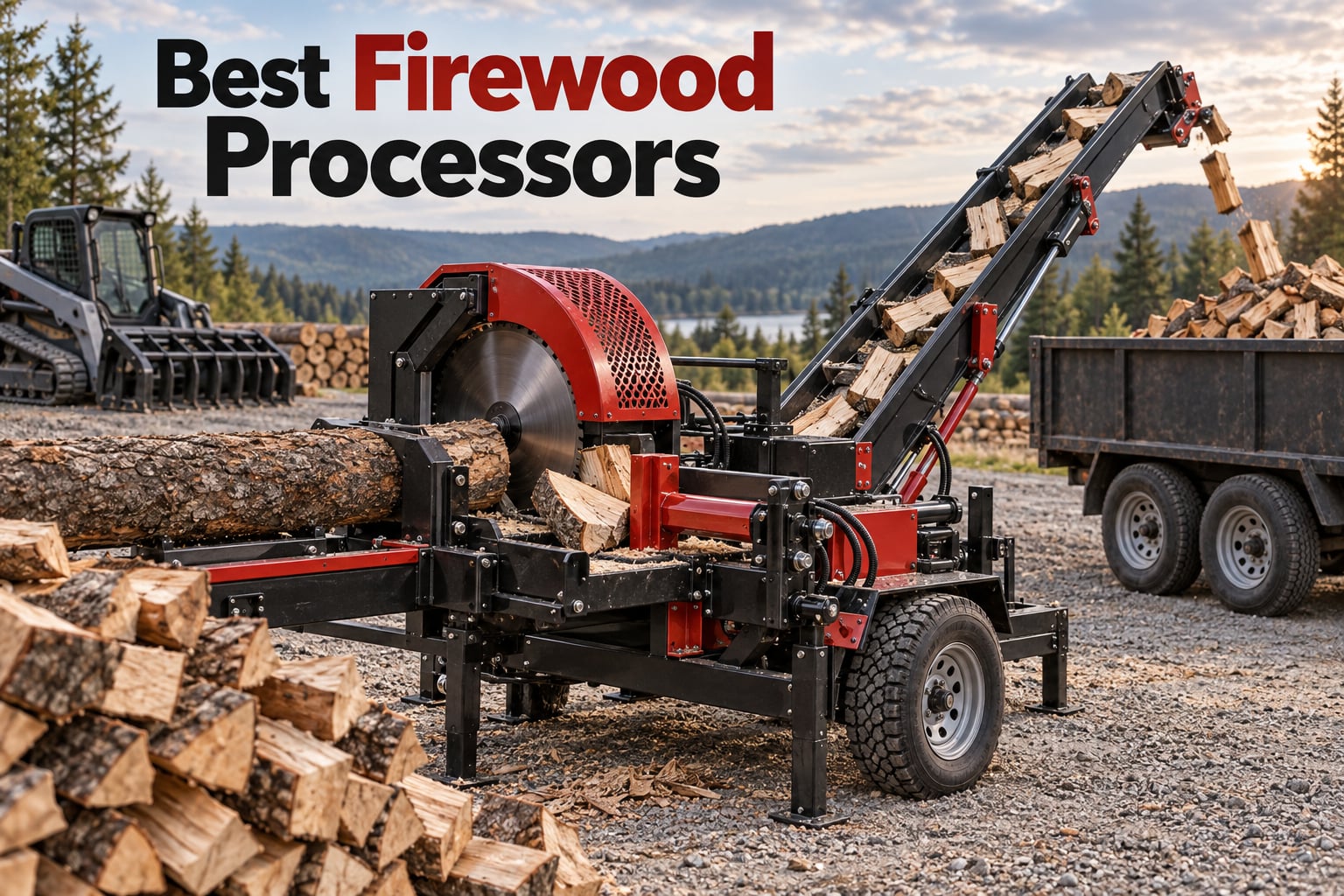
The best firewood processors are the machines that cut a round to length, split it, and throw the finished wood into a pile without you touching it again. That single continuous cycle is the whole reason to spend real money here: it turns a job that normally needs a chainsaw, a splitter, and hours of swinging into one-person operation.
We spent several weeks going through every currently listed firewood processor we could find, reading the published specifications line by line and cross-checking them against the customer feedback that actually exists. We also tracked down the owner consensus that circulates on firewood forums, because marketplace review data in this category is thinner than most spec sheets would like you to believe. Only a handful of machines in this roundup have any customer feedback at all, and we tell you exactly which ones rather than filling the gaps with marketing copy.
What follows covers the four things a processor does, then a review of every machine we evaluated, then the buying decisions that actually move the needle. We are not affiliated with any manufacturer or dealer, and nothing here is sponsored. If a machine has thin documentation, thin reviews, or a vague listing, we say so plainly.
Before the machines, it helps to know the shape of the job. If you are still comparing splitters on their own, our guide to the best log splitters for firewood is the right starting point, because a processor is a splitter with a saw and a conveyor bolted on.
Top 3 Firewood Processor Picks in 2026

YHT 45T Firewood Processor
- 20HP GX630 gas engine
- 45 ton split force
- 4/6 way wedge
- 19.6 in max cut diameter

YHT 27T Firewood Processor
- 739cc RATO gas engine
- 27 ton split force
- 6 way wedge
- 17.32 in max cut

QEEKA 45T Firewood Processor
- 20HP GX630 gas engine
- 45 ton split force
- interchangeable 4 and 6 way wedge
- 25 in chain
The YHT 45T takes the top slot because it is the only machine in this roundup with enough customer feedback to actually judge, and that feedback is mostly positive on welds, packing, and seller support. The YHT 27T is the value pick for operators running a few dozen cords a season who want a six-way wedge without a 45-ton frame. The QEEKA 45T is the one to look at if your timber runs wide, because both of its owners report it chewing through oversized hardwood that beat their previous splitter.
Best Firewood Processors in 2026: Quick Spec Overview
| Product | Specifications | Action |
|---|---|---|
| YHT 45T Firewood Processor |
|
Check Latest Price |
| YHT 27T Firewood Processor |
|
Check Latest Price |
| QEEKA 45T Firewood Processor |
|
Check Latest Price |
 QEEKA 35T Skid Steer Attachment QEEKA 35T Skid Steer Attachment |
|
Check Latest Price |
 Boruite 45T Firewood Processor Boruite 45T Firewood Processor |
|
Check Latest Price |
 MechMaxx HLS20 MechMaxx HLS20 |
|
Check Latest Price |
 Dvsripa 30T Attachment Dvsripa 30T Attachment |
|
Check Latest Price |
 Generic RDY-PMJ-26 Generic RDY-PMJ-26 |
|
Check Latest Price |
 Generic RDY-PMJ-37 Generic RDY-PMJ-37 |
|
Check Latest Price |
 Generic RDY-PMJ-28 Generic RDY-PMJ-28 |
|
Check Latest Price |
 Generic WDY-PMJ-24 Generic WDY-PMJ-24 |
|
Check Latest Price |
 Generic JXH-75PCJ-9 Generic JXH-75PCJ-9 |
|
Check Latest Price |
Read that table as a map of the market rather than a verdict. Four machines here are trailer-mounted gas units in the 27-ton to 45-ton class, two are attachments that borrow hydraulics from a skid steer or tractor, one is a light portable unit, and five are generic-branded frames whose listings are thin enough that you have to ask the seller direct questions before you commit.
What a Firewood Processor Actually Does
A processor bundles four jobs into one cycle, and once you see the four parts, most spec sheets make sense on their own.
1. Cut to length. A circular saw, bar saw, or chainsaw bar brings the round down to a consistent firewood length. Every machine in this roundup uses a chainsaw bar and chain, which is the cheapest and most repairable option and the one that gets replaced most often.
2. Split. A hydraulic wedge drives through the cut round. The tonnage figure (20-ton, 35-ton, 45-ton) is the wedge force, and it is the number that determines whether you can handle the roundwood you actually have rather than the roundwood the brochure imagined.
3. Convey. Feed rollers or a live deck move the next log in while the wedge works, and an integrated belt stacker throws the finished firewood out. This is where the labor saving actually happens, because the operator never touches the wood twice.
4. Handle. A log lifter, winch feed, or hydraulic table puts the round in position. On the two attachment models in this roundup, handling is done by the carrier machine instead.
One caution before you go further. Stated cords per hour figures are manufacturer claims measured on straight, uniform, well-seasoned material. The same machine on twisted oak from a storm cleanup will produce far less, and no listing in this roundup publishes a realistic figure for messy timber.
1. YHT 45T Firewood Processor – Best Overall With The Most Owner Feedback
YHT 45T Firewood Processor 20HP GX630 19.6″ Cut 25″ Saw Hydraulic Conveyor
Engine: 20HP GX630
Split force: 45 tons
Wedge: 4/6-way
Max cut: 19.6 in
Pros
- Strong welds and durable paint
- All nylock fasteners supplied and well packed
- Seller support answers within a day
- Emergency stop plus chainsaw guard
- Handles a couple of cords per session
Cons
- Assembly instructions thin
- expect 12 to 14 hours
- Splitting force reported below 45 tons on larger logs
- Conveyor can be overloaded by very large rounds
This is the machine we kept coming back to, and the reason is simple: it is the only one here with a real review history. Seven customer reviews is not a large sample, but it is enough to see a pattern. Owners consistently talk about the welds, the paint, the fact that the crate arrived with every nylock fastener bagged and labelled, and a seller who answers questions within a day.
On paper it is a full-size gas machine. A 20HP GX630 engine drives a 45-ton hydraulic wedge with interchangeable four-way and six-way splitting, a 25 inch steel chain handles the cut, and a three-meter conveyor with a 2.55 meter discharge height moves the finished wood out. Maximum cutting diameter is listed at 19.6 inches, with a maximum split wood length of 22.83 inches. Manual hydraulic control with an emergency stop button, and a chainsaw safety guard net as standard.
Its weight is 3000 pounds and its footprint is 250 by 105 by 80 inches, which is a forklift job on delivery day rather than a weekend project. Plan the unloading before you order.
What owners actually report about it
Several reviewers note that the real splitting force on larger logs falls short of the advertised 45 tons, particularly above 10 inches of diameter. That gap between a headline tonnage number and what the wedge delivers is common across this whole class of machine, and it is the single most useful thing we learned from the reviews.
One owner reported a coupler breaking within 15 hours of use, and another flagged that the conveyor belt can be overloaded by very large rounds. The 3.4 average rating comes from a spread that includes a meaningful share of one-star reviews, so treat it as a mixed-but-honest machine rather than a flawless one.
Where it falls short
The assembly manual is the most common complaint, with owners budgeting 12 to 14 hours and relying on the video tutorials the seller provides. That is a real weekend-and-a-half investment before you cut a single round, and you should factor it into your decision rather than discovering it in the crate.
At 3000 pounds it also needs a properly rated trailer to move at all. This is a machine for someone with equipment already, not someone trying to get into the game cheaply.
2. YHT 27T Firewood Processor – Best Value For Small-Business Volume
YHT 27T Firewood Processor 739cc RATO 17.32″ Cut 20″ Saw 6-Wedge w/Conveyor
Engine: 739cc RATO
Split force: 27 tons
Wedge: 6-way steel
Cut: 17.32 in
Pros
- Assembles in a few hours with hand tools
- Reliable over several months of small business use
- Hydraulic log lifter cuts manual handling
- 6 way wedge raises output per cycle
- Responsive company support for setup
Cons
- Maximum cut diameter is 17.32 in
- Only two customer reviews on record
This is the machine we would point a small firewood business at. Its two verified five-star reviews describe someone who assembled it with basic hand tools in a few hours, then ran it for several months of paid firewood work without a single reported fault. When you are selling wood by the cord, that reliability story matters more than raw tonnage.
The specification sheet is a smaller, tidier version of the 45T. A 739cc RATO gasoline engine, 27-ton splitting force, a 6-way steel wedge, a 20 inch chainsaw, a three-meter conveyor, and a hydraulic log lifter included in the package. Maximum log cutting capacity is 17.32 inches, which is the real trade-off you are making against the bigger machine.
Weight is 2150 pounds, so it is still a two-person or forklift move, but it is built from alloy steel and the smaller engine is cheaper to run and service than a 20HP GX630.
What makes it the value pick
The 6-way wedge is the reason. A six-way wedge turns one stroke into six pieces, which matters far more to your hourly output than the difference between 27 and 45 tons of ram force on logs under 16 inches. Most homestead and small-contractor timber never gets that thick.
The included hydraulic log lifter is the other quiet win. It means you are not lifting rounds into position by hand every cycle, which is where the back injury risk lives in a non-processed workflow. If you want to see the cheaper alternative doing that work, our battery chainsaw roundup covers the cutting side of a manual setup.
Where it falls short
Seventeen inches of cutting capacity is a real ceiling. If your wood comes off storm-thrown hardwood, you will be splitting oversize rounds on the ground rather than feeding the machine, and you lose most of the automation benefit.
The other honest caveat is the review count. Two five-star reviews is a good start, not a reliability record. Budget for the possibility that a hydraulic component needs sourcing outside the normal parts chain.
3. QEEKA 45T Firewood Processor – Best For Oversized Hardwood
QEEKA 45 Ton Firewood Processor with GX630 20HP Gas Engine, 19.6″ Max Cutting Diameter, Chain Table, 3M Conveyor, Full Hydraulic Control, Commercial Log Splitter Machine
Engine: 20HP GX630
Split force: 45 tons
Wedge: 4/6-way
Max cut: 19.6 in
Pros
- Handles oversized knotted hardwood that beat a previous splitter
- Smooth fast consistent hydraulic cycles
- Clean welds and solid components
- Starts easily after weeks of sitting
- Controls simple enough to teach quickly
Cons
- Only two customer reviews and both are very recent
- Model listing names Honda as manufacturer
Both of the owners who reviewed this machine describe the same thing: it handled knotted, oversized hardwood that had defeated their previous splitter. That is the specific problem this machine solves, and if your wood comes from cleanup work rather than a managed tree lot, it is the most relevant review in the entire roundup.
The specification matches the other 45-ton gas machines in this group. A 20HP GX630 gasoline engine, 45-ton hydraulic splitting force, interchangeable four-way and six-way splitting wedges, a 25 inch high-strength steel chain, and a three-meter conveyor belt with a 2.55 meter discharge height. Full hydraulic control with an emergency stop and a protective chainsaw guard. Maximum log diameter is 19.6 inches, or 50 centimeters.
Dimensions are 249 by 105 by 80 inches and weight is 3100 pounds, which makes it the heaviest trailer machine here alongside the Boruite. One detail worth flagging: the product data lists the manufacturer as American Honda Motor Co. because the GX630 engine is a Honda unit, but the machine itself is assembled by QEEKA, so the warranty runs through the seller, not Honda.
Why the owner reports matter here
The reviews mention smooth, fast, consistent hydraulic cycles with no leaks or mechanical problems after heavy use, and an engine that starts first try even after sitting for weeks. Those are the two failure points that end firewood seasons early, and neither has shown up.
Both owners also comment on the controls being simple enough that a second operator could learn them quickly. That is a bigger deal than it sounds if you ever plan to run two people on the same machine.
Where it falls short
Two reviews, both recent, is not a service life. The hydraulic smoothness in those reviews could reflect a well-tuned machine or simply a new one, and there is no way to tell the difference from outside.
At 3100 pounds with a 249 inch frame, this is a permanent installation on a dedicated trailer. It is not a machine you move around a property on a whim.
4. QEEKA 35T Skid Steer Attachment – Best For Skid Steer Owners
QEEKA 35T Firewood Processor with Log Lifter Skid Steer Attachment Wood Processor Splitting,4&6-Way Wedge Remote Control,25″ Chainsaw Force Max 17.72 in Cutting Diameter
Split force: 35 tons
Attachment: skid steer or tractor
Remote control
Output: approx 3 cords per hour
Pros
- No separate engine to buy or maintain
- Wireless remote allows safe working distance
- Factory pre-assembled and tested
- Automatic hydraulic cycle
- Low 1500 lb weight
Cons
- Needs a compatible 35 HP plus skid steer or tractor
- Only one customer review on record
This is the most interesting machine in the roundup from a design standpoint. It has no engine at all. It runs off the hydraulics of the machine it bolts to, which means no fuel line, no starting, no engine service schedule, and a total weight of just 1500 pounds.
It is a 35-ton wedge with a wireless remote for all functions, a four-way and six-way wedge, and a claimed output of up to 12 cubic meters, roughly 3 cords, per hour under optimal conditions. Maximum cutting diameter is 17.72 inches with a 22.83 inch cutting length and a 4.5 meter feed length. The manufacturer recommends skid steers of 35 horsepower or more.
The one customer review supports the concept rather than proving the hardware. The owner highlighted that it comes pre-assembled and factory tested, so setup is connecting hydraulic tubes and a lifting arm, and that the remote lets a single operator load, cut, split, and discharge from a safe distance.
Why the attachment approach wins for some buyers
For a tree service or landscaping company that already owns a 35 HP skid steer, this is genuinely economical. The machine disappears onto the carrier, the carrier becomes the hauler for branches and brush, and you have one power unit instead of two. It also travels between job sites without a dedicated trailer.
The wireless remote is the safety story. Working from the cab with line of sight to the cut is a meaningfully different risk profile from standing beside a swinging splitter handle for a full day.
Where it falls short
You are locked to the carrier’s hydraulic flow. If your skid steer is under 35 horsepower, cycle times stretch badly and the throughput claim disappears. Check your machine’s flow rating before anything else.
There is one review on record, so long-term reliability of the wedge and the chainsaw motor is undocumented. Treat the three-cords-per-hour figure as a marketing number until you see it on your own material.
5. Boruite 45T Firewood Processor – Best Spec Sheet In The 45-Ton Class
Boruite 45T Firewood Processor – 0% APR Financing Available, GX630 Engine, 19.68″ Cut Capacity, 4-Way and 6-Way Wedge, 3M Conveyor, Auto Cycle, Ships Free
Engine: 20HP GX630
Split force: 45 tons
Wedge: 4/6-way
Cut: 19.6 in
Pros
- Most complete published spec sheet in the group
- Automatic cycle operation
- 3m conveyor at 2.55m discharge height
- Interchangeable 4 way and 6 way wedges
- Financing option advertised
Cons
- No customer reviews or ratings yet
- Assembly required by the buyer
This machine is essentially the YHT 45T platform sold under a different brand name, and its published specification is the most complete of any 45-ton machine in this roundup. It states engine, splitting force, wedge configuration, chain size, conveyor length and height, cutting diameter, and split length in the same place, which is more than most listings bother with.
The numbers: a 20HP GX630 gasoline engine, 45 tons of splitting force, interchangeable four-way and six-way wedges, a 25 inch high-quality steel chain, a three-meter conveyor belt at 2.55 meters height, a maximum cutting diameter of 19.6 inches, and a maximum split wood length of 22.83 inches. Hydraulic manual control with an emergency stop button. Dimensions are 250 by 105 by 80.3 inches and the weight is 3000 pounds.
One listed feature is worth calling out: auto cycle operation, which lets the machine run its own cutting and splitting sequence rather than waiting on the operator at each stage. On paper that is the single biggest labor saving feature in the whole group.
What the documentation gap means
There are zero customer reviews and zero ratings for this listing. Everything you know about it comes from the seller’s description, and the manufacturer part number (BRT45T500) differs from the model name, which sometimes means the listing is shared across several storefronts.
That does not make it a bad machine, it makes it an unproven one. If the auto cycle feature is what you are buying, ask the seller to demonstrate it on a video call with a log in the chamber.
Where it falls short
Assembly is on you, and at 3000 pounds you will need equipment to unload it. The combination of no reviews, buyer assembly, and forklift weight is a lot of first-week risk for a machine most owners expect to run for a decade.
Because it shares a platform with a machine that does have reviews, we would choose the reviewed version at a similar price point. Ask the seller directly whether the two are identical builds.
6. MechMaxx HLS20 – Best Portable Pick You Can Move By Hand
MechMaxx ZONSEN 459cc 15hp Electric & Recoil Start Engine Firewood Log Splitter Processor with Conveyor, 20ton Splitting Force 24″ x 15″ Log Capacity, 18″ Chainsaw, HLS20
Engine: 459cc ZONSEN 15hp
Split force: 20 tons
Cut: 15 in diameter
Weight: 545 lb
Pros
- Only 545 pounds so two people can reposition it
- Compact 110 by 51 by 47 in footprint
- Electric and recoil start options
- Conveyor feed reduces manual lifting
- Operator friendly safety guards
Cons
- 20 ton force and 15 in limit are well below commercial units
- No customer reviews or ratings yet
Every other trailer machine in this roundup weighs between 1500 and 3100 pounds. This one weighs 545 pounds and measures 110 by 51 by 47 inches. That single fact changes who can own it, because you can move it to the wood pile, reposition it at a work site, or store it in a shed rather than parking it permanently on a trailer.
It runs a 459cc ZONSEN 15hp engine with both electric and recoil start, delivers 20 tons of splitting force, and uses an 18 inch chainsaw with a conveyor feed system. Maximum log diameter is 15 inches with a maximum split length of 24 inches, on a steel frame with a hydraulic system, operator-friendly controls, and safety guards.
The electric start is a genuinely useful detail on a portable machine. Recoil-starting a 15hp engine in cold weather with wet hands is exactly the small misery that makes people stop using equipment.
Where a 20-ton machine makes sense
This is the honest niche for this category. If you burn five to fifteen cords a year, deal with softwood and moderate hardwood, and want processed firewood without a dedicated trailer, a 20-ton portable unit does the job at a fraction of the weight and cost of the 45-ton machines.
The 24 inch split length is actually a sensible stove-friendly cut length, longer than the 22.83 inch figure on the bigger machines. Conveyor feed keeps the operator in a normal working position rather than bent over a table.
Where it falls short
Fifteen inches of diameter is the hard limit. Anything larger gets split on the ground, and at that point the machine is no longer saving you the labor that justified it.
There are no customer reviews for this listing, so every performance figure comes from the manufacturer description. Combined with a 20-ton wedge, expect it to be slow on dense hardwood rather than to struggle with it.
7. Dvsripa 30T Attachment – Best For Tractor Owners Without A Skid Steer
Dvsripa 30T Firewood Processor Log Splitter Skid Steer Attachment Wood Processor Splitting Force Max 17.72 in Cutting Diameter Max 22.83 in Cutting Length
Split force: 30 tons
Attachment: tractor or skid steer
Remote control
Output: approx 3 cords per hour
Pros
- No separate engine to buy or maintain
- Works on tractors with lifting arms not just skid steers
- Wireless remote for all functions
- Pre-assembled and factory tested components
- 60 by 30 by 50 in listed size
Cons
- No customer reviews or ratings yet
- Needs a carrier with adequate hydraulic flow
This is the more flexible of the two attachment models. The manufacturer lists compatibility with skid steers, front bucket tractors, forklifts, and tractors with lifting arms, so you are not locked into owning a specific carrier type the way you would be with some attachments.
It delivers 30 tons of splitting force with a wireless remote covering all functions and runs entirely off the host machine’s hydraulics. Published capacity is up to 12 cubic meters, roughly 3 cords, per hour under ideal conditions, with a maximum cutting diameter of 17.72 inches, a 22.83 inch cutting length, and a six-meter feed length.
The listed dimensions of 60 by 30 by 50 inches are far smaller than the other machines here, which is consistent with an attachment that nests against the carrier rather than sitting on its own trailer frame. The main components are pre-assembled and tested before shipping, so installation is tubes and a lifting arm.
When this beats the 35-ton skid steer attachment
If you own a loader tractor rather than a skid steer, this is the only machine in the roundup that will work for you without an adapter. The 30-ton force is a notch below the QEEKA 35T, but the compatibility list is meaningfully wider and the remote coverage is described as covering all functions.
For a small farm that already has a tractor and wants processed firewood plus a way to move large roundwood around the property, the combination is efficient. One machine, two jobs, no second engine to maintain.
Where it falls short
There are no customer reviews at all, so the throughput claim and the build quality are both unverified. The six-meter feed length also tells you this is designed to be loaded by a machine or winch, not walked up to by a person with a log in each arm.
Before buying, confirm your tractor’s hydraulic flow rate and lifting arm capacity with the seller. A mismatch here is the most common reason attachment processors disappoint.
8. Generic RDY-PMJ-26 – Best Fit For Timber Yards And Farms
Hydraulic Log Splitter Firewood Processor for Firewood and Timber Process
Class: 20T portable hydraulic
Feeds cuts and splits
Listed weight: 2000 lb
Model: RDY-PMJ-26
Pros
- Single machine handles feeding cutting and splitting
- Layout built for repeated daily preparation work
- Listed for timber yards and commercial sites
- 2000 lb frame with 102 by 59 by 67 in size
Cons
- No customer reviews or ratings
- Listing states listed price is not final and specs vary
- No engine or tonnage figures disclosed in the listing
We are including this machine because it represents a large and genuinely confusing part of the market: unbranded frames sold with a model number and a photograph rather than a specification sheet. Model RDY-PMJ-26 is listed at 2000 pounds with dimensions of 102 by 59 by 67 inches, described as a hydraulic machine that feeds, cuts, and splits in one workflow.
What it tells you is real: it is intended for timber yards, commercial workshops, farms, and dedicated wood processing sites, and the log feeding arrangement is designed to organize material before processing rather than being an afterthought. The selling point is continuous flow for repeated daily preparation.
What it does not tell you is the engine type, the splitting tonnage, or the maximum cutting diameter. Those three numbers are the ones that determine whether the machine fits your wood, and none of them appear in the listing.
How to handle a listing like this
Treat it as a starting conversation, not a product. Before you commit to anything, ask the seller for the engine make and horsepower, the rated splitting tonnage, the maximum log diameter in inches, the saw type and size, and whether the conveyor is included or optional.
The listing itself flags that multiple models and customization are supported and that the listed price is not final, so the machine you receive may not match the description you read. Get the answers in writing before arranging a delivery.
Where it falls short
Zero reviews, zero ratings, and a brand field that simply says Generic. There is no track record to check and no obvious party to contact if a hydraulic component fails six months in.
For a first-time buyer this machine carries the highest documentation risk in the roundup. The configuration flexibility that makes it attractive is the same thing that makes it impossible to evaluate from a product page.
9. Generic RDY-PMJ-37 – Best 45-Ton Class Frame For Seasonal Runs
Hydraulic Wood Splitter Log Processor 45T for Outdoor Firewood Preparation
Class: 45T hydraulic
Feeds cuts and splits
Listed weight: 2000 lb
Model: RDY-PMJ-37
Pros
- 45 ton class frame suits heavy seasonal work
- Feeds cuts and splits in one workflow
- Hydraulics support repeated operating cycles
- Feeding structure organizes material flow
- Suited to farms shops and commercial sites
Cons
- No customer reviews or ratings
- Listing states listed price is not final and specs vary
- Limited disclosed technical detail for a 45 ton class
Model RDY-PMJ-37 is described as a 45-ton class hydraulic wood splitting and log processing unit, and it is the heaviest-rated claim among the unbranded machines in this roundup. The listing gives dimensions of 92 by 24 by 66 inches and a listed weight of 2000 pounds.
The described workflow is a combined feed, cut, and split arrangement with a log feeding structure that positions material before processing and a hydraulic mechanism built to deliver controlled force through repeated cycles. The stated use cases are farms, timber yards, workshops, and commercial processing facilities, and the bullet list specifically references seasonal work.
That framing matters. A 45-ton class is a seasonal-work machine. It suits someone who processes heavily for a few months and then needs the capacity to be there, rather than someone running steady low volume all year.
Where the 45-ton class earns its cost
The advantage over a 27 or 30-ton wedge shows up on the rounds that would otherwise stop your day. Large hardwood rounds, storm-downed timber, and root balls need ram force, and a 45-ton machine keeps cycling instead of forcing you to bring an axe into the workflow.
The feeding structure is the part worth asking about. On any processor, material flow is what determines whether the wedge is fed steadily or whether the operator is constantly repositioning logs by hand. A dedicated feed arrangement is a good sign.
Where it falls short
For a machine claiming 45 tons, the listing discloses no engine, no tonnage measurement, no cutting diameter, and no conveyor specification. That is a considerable amount of missing information for a heavy seasonal machine.
As with the other unbranded frames, there are no customer reviews, and the seller states that specifications vary by model. Confirm the actual configuration in writing before you pay.
10. Generic RDY-PMJ-28 – Most Versatile For Cabin And Garden Use
Portable 20T Firewood Processor Log Splitter for Home Garden and Cabin Use
Class: 20T hydraulic
Feeds cuts and splits
Listed weight: 2000 lb
Model: RDY-PMJ-28
Pros
- Lowest cost entry in the 20T class
- Feeds cuts and splits in one machine
- Hydraulic components give controlled force
- Targeted at home garden and cabin use
Cons
- No customer reviews or ratings
- 20T class is the lowest capacity in this group
- Listing states listed price is not final and specs vary
This is the entry point in the group. Model RDY-PMJ-28 is a 20-ton class portable hydraulic firewood processor listed for home garden, cabin, and small commercial firewood preparation, with a listed weight of 2000 pounds and dimensions of 102 by 59 by 67 inches.
The described configuration coordinates log feeding, cutting, and splitting in one machine, with hydraulic working components providing controlled cutting and splitting force and a feeding structure that positions material consistently before processing.
At this end of the market the deciding factor is rarely tonnage. It is whether the machine will fit your wood, your budget, and your patience for setup. This one is honest about being a 20-ton class machine aimed at light material.
Where it makes sense
A cabin, a garden-level wood stove, or a smallholding that burns a modest number of cords is the stated target, and the 20-ton class is the right size for softwood and moderate hardwood in that range. The integrated workflow means you do not need a separate splitter, a separate conveyor, and a separate saw.
Because the listing positions it for light residential work, the lower force figure is not a hidden weakness. It is a reasonable match for the job described.
Where it falls short
No customer reviews, no ratings, and a brand field reading Generic. The seller also notes that multiple models are available and the listed price is not final, so the exact machine you receive needs to be confirmed.
For anyone processing serious timber, the 20-ton ceiling will be reached quickly, and you will end up splitting oversize rounds by hand. Consider the portable MechMaxx instead, which has a published engine and capacity even though it also lacks reviews.
11. Generic WDY-PMJ-24 – Best For Long Rounds And Big Diameter Logs
Industrial Log Splitter for High Volume Firewood Processing Operations
Listed weight: 1966 lb
Dimensions: 203 by 71 by 69 in
Wheel kit included
Large log capacity
Pros
- Longest published frame in the group at 203 inches
- Large wood capacity for bigger diameter and longer logs
- Steady hydraulic power for smooth splitting
- Portable wheel kit for moving between sites
Cons
- No customer ratings or reviews to validate durability
- Multiple models mean listed price is not final
Model WDY-PMJ-24 is the odd one out in this roundup in a useful way: it is the only machine whose physical size tells you something concrete about its intended job. At 203 by 71 by 69 inches and 1966 pounds, it is the longest frame in the group, and the listing describes it as an industrial log splitter for high-volume firewood processing operations with large wood capacity suited to bigger diameter and longer logs.
Frame length is not a marketing number. On a processor, longer means the feed table can accept longer rounds, which means fewer cuts per cord and less handling on the way in. If your timber comes in long rather than in short trimmed sections, that is the single most relevant physical specification on any product page.
The wheel kit for moving across work sites is another practical touch on a machine this size. It does not make a 1966 pound frame portable in the way a trailer-mounted unit is, but it does save you from needing a second tractor for repositioning.
Why frame length matters more than people expect
Most firewood processors are fed by a person or a winch placing a cut section onto the table. The longer the feed, the more of the round is supported while the saw and wedge do their work, and the fewer times you have to reposition mid-cycle.
On rough, long, storm-downed material this is where a big machine separates itself from a small one. A short table on a 20-ton frame means you are constantly catching the round as it goes in.
Where it falls short
This listing has almost no disclosed information. It gives a model number, weight, and dimensions, and the bullet points are descriptive rather than technical. There is no engine, no tonnage, no cutting diameter, and no conveyor specification.
With no customer ratings or reviews, the durability claim is unverified, and the seller states that multiple models and customization options mean the listed price is not final. Ask for the full specification sheet in writing.
12. Generic JXH-75PCJ-9 – Best Four-Way Pick For Hardwood
Hydraulic Wood Splitter, 4 Way Blade Log Splitter, Efficient Firewood Prep
Wedge: 4 way steel blade
Listed weight: 1956 lb
Dimensions: 203 by 70 by 71 in
Pros
- Steel edge described as splitting hardwoods with ease
- Simple one hand control
- Cutting edge holds performance after repeated use
- Handles log cutting and firewood making
Cons
- No customer ratings or reviews
- Pricing varies by configuration and options
Model JXH-75PCJ-9 is the only machine in this roundup built around a four-way blade, and that single design choice shapes everything about it. Four-way means one stroke produces four pieces, which is less per cycle than a six-way but a simpler, stronger blade that handles dense hardwood without the higher ram force a six-way typically needs.
The listing describes a strong steel edge engineered to split hardwoods with ease, a high-efficiency cutting edge that retains its splitting performance after multiple uses, and simple one-hand control intended to make splitting fast with minimal effort. It is described as multipurpose, handling log cutting, firewood making, and small outdoor projects.
Dimensions are 203 by 70 by 71 inches at 1956 pounds, placing it in the same physical class as the other long-frame machine here.
When four-way is the right call
If your wood is dense hardwood rather than softwood, the arithmetic changes. Six-way machines need more tonnage to push through the larger block, and on a lower-force frame they stall. A four-way blade on a solid frame often out-produces a six-way on a weak frame with the same horsepower.
One-hand control is also worth noting for ergonomics. You are not operating a lever through a full stroke, which reduces the fatigue that ends a processing session early.
Where it falls short
There are no customer ratings or reviews, so nothing here is validated by owners. The listing also notes that pricing varies by configuration and optional features, which means the specification you end up with depends on what you select.
As with the other unbranded frames, ask for the engine, tonnage, and cutting diameter before committing. A four-way blade is a sensible design, but only if the hydraulics behind it match the wood you process.
How To Choose A Firewood Processor: 7 Decisions That Matter
1. Start with your annual volume, not the machine. Under roughly 10 cords a year, a processor is hard to justify and a good splitter plus a battery chainsaw will serve you better for far less money and storage. Above that, the labor saving compounds quickly. Between 50 and 150 cords a year is where the mid-range gas machines make sense, and thousands of cords a year is where the heavy commercial class earns its price.
2. Measure your average log diameter. This is the most consequential single number. A 17.32 inch cutting limit sounds generous until you meet a 22 inch oak round, and then you are splitting on the ground with an axe and the processor is decoration. Match the machine’s published maximum diameter to your largest typical round, not your average one.
3. Understand what the tonnage number means. Rated ram force is measured at peak on ideal material. Owners consistently report real output below the headline figure on larger logs. Treat 45 tons as a ceiling rather than a promise, and buy one class above what you think you need if your wood is dense hardwood.
4. Choose the wedge configuration by wood type. A 4-way blade is stronger and better on dense hardwood with a modest frame. A 6-way wedge produces more pieces per stroke and is the better choice for softwood and mixed wood, which is most firewood. More ways is not automatically better, and a 6-way on an under-powered frame will stall.
5. Pick a saw type you can service. Every machine in this roundup uses a chainsaw bar and chain. That is the cheapest and most readily replaceable cutting system, but it does mean you should confirm chain availability before you buy, because a machine you cannot cut with is out of service.
6. Decide between a powered machine and an attachment. If you already own a 35 HP or larger skid steer or a tractor with lifting arms, an attachment removes an entire engine from your maintenance list and travels between sites without a trailer. If you do not own a carrier, the engine and frame of a standalone gas machine is the simpler path.
7. Confirm the documentation before you pay. Eight of the twelve machines here have no customer feedback, and five of those are unbranded listings that do not disclose engine, tonnage, or cutting diameter. For any of those, get the full specification sheet in writing, and ask whether the machine you receive matches the listing exactly.
One more practical note. Firewood is only half the system, and where it goes matters as much as how it is cut. We have a guide to the best firewood racks for storage and airflow, which matters more than most buyers expect during the first season of seasoning.
Are Firewood Processors Worth It?
They are worth it above roughly 10 cords a year, and worth it at any volume if back injury risk is the binding constraint in your firewood work. A processor removes the single most injury-prone task in the job, which is swinging a heavy splitter handle for hours.
Below that threshold, the economics do not work. The machines in this roundup are heavy, they need assembly, they need a trailer or a skid steer, and they need maintenance. A good splitter and a reliable chainsaw will process a few cords a year for a fraction of the outlay.
For a firewood business, the case is different. Labor is the dominant cost, and a processor lets one person do the work of two, which changes what you can charge and how much wood you can move in a season.
Who Should Not Buy A Firewood Processor
You should not buy one if you burn fewer than about 10 cords a year and your back is fine. You should not buy one if you have nowhere to keep a 2000 to 3100 pound machine, because trailer and storage costs can approach the machine’s own cost over its life.
Skip it entirely if your timber never exceeds 12 inches in diameter and you already own a good splitter. The automation benefit is real but small at that scale, and a mid-range machine would be underused.
And be honest about the setup. If you cannot give a machine from 12 to 40 hours of assembly and commissioning, the unassembled import-class options in this roundup will disappoint you. The brands with dealers and documented support are worth their premium partly because somebody else does that work.
Buying A Used Firewood Processor: A Dealer Inspection Checklist
Used machines represent most of the value in this category, and the single most repeated piece of practical advice in firewood forums is the same: go to the machine and photograph the pump and motor tags. Those two components dominate both the purchase value and the failure risk, and you cannot judge either from a photograph of a sales listing.
1. Photograph the hydraulic pump tag and the electric motor tag. Record the model numbers, the pressure ratings, and any service date stickers before you agree on anything.
2. Run the machine through a full cycle on a log and watch the wedge for hesitation. A slow or uneven stroke usually points to pump flow or a worn cylinder, and it is far cheaper to know in the driveway.
3. Check the chainsaw bar, chain, and sprocket wear together, and ask what the last chain cost. A replacement bar and chain is a meaningful part of a used machine’s real value.
4. Look at the conveyor belt, the rollers, and the belt tension. Belts are a consumable item and a sagging conveyor is a straightforward reason to walk away.
5. Count the hydraulic fittings and inspect the hoses for weeping. Repeated leaks at fittings are cheap fixes; a weeping manifold or a scored cylinder rod is not.
6. Confirm that the wedge and the cylinder were ever disassembled, and ask who did the work. Prior welding on the wedge frame is a useful thing to know about.
7. Verify that the machine starts and runs on its own fuel and that the engine hours, if any, are documented.
If a seller will not let you run the machine or photograph the tags, that tells you everything you need to know about how they will treat a warranty claim.
Frequently Asked Questions
Are firewood processors worth it?
Yes, above roughly 10 cords a year, and at any volume if back injury risk is your main concern. A processor collapses cutting, splitting, and conveying into one cycle, removing the most injury-prone task in firewood work. Below 10 cords a year, a quality log splitter plus a reliable chainsaw costs far less and stores far more easily.
What is the best firewood processor for the money?
Among the machines in this roundup, the YHT 27T offers the strongest balance of capability and cost. A 739cc RATO engine, 27-ton splitting force, a 6-way steel wedge, a hydraulic log lifter, and a three-meter conveyor cover most homestead and small-contractor timber. Its 17.32 inch cutting limit is the main compromise.
Are circular saw firewood processors faster than chainsaw processors?
Circular saws generally cut faster and hold a straighter edge, but they need blade sharpening and are far less tolerant of dirt and knots. Chainsaw bars and chains are slower on ideal wood but shrug off mud and damage and cost a fraction as much to replace. Every processor in this roundup uses a chainsaw bar.
Do I need a live deck on a firewood processor?
A live deck keeps feeding material while the wedge works, which is where most of the labor saving comes from. It matters most once you pass roughly 100 cords a year or start feeding from a grapple or conveyor. Below that volume, a manual feed table with a log lifter is adequate.
What size firewood processor do I need?
Size it by annual volume and largest log diameter together. Under 10 cords a year, a splitter is enough. Between 10 and 150 cords, a 20 to 30-ton machine with a 6-way wedge fits most timber. Above that, move to a 45-ton class with a triple-function feed system. Always check the machine’s maximum diameter against your largest typical round.
Final Verdict: Which Firewood Processor To Buy
The YHT 45T is the best firewood processor in this roundup, and it wins on evidence rather than specification. It is the only machine here with enough customer feedback to see a pattern, and that pattern is favorable on the things that matter: welds, paint, fasteners, and responsive seller support. Its weaknesses are the 12 to 14 hour assembly and the gap between claimed and real splitting force on thick logs, both of which are manageable if you plan for them.
If your budget is tighter or your timber is under about 17 inches, the YHT 27T is the smarter buy. The 6-way wedge and included log lifter do more for your output per hour than extra ram force you will never use.
If you already own a skid steer, skip the engine entirely and look at the QEEKA 35T attachment. And if you are considering one of the unbranded frames, get the full specification in writing before you pay, because none of them disclose enough to evaluate from the listing alone.
Check current specifications and seller details before you commit. Machine configurations change, and the honest caveat on this whole roundup is that customer feedback here is thinner than the spec sheets suggest, so verify the hydraulics with your own eyes.