
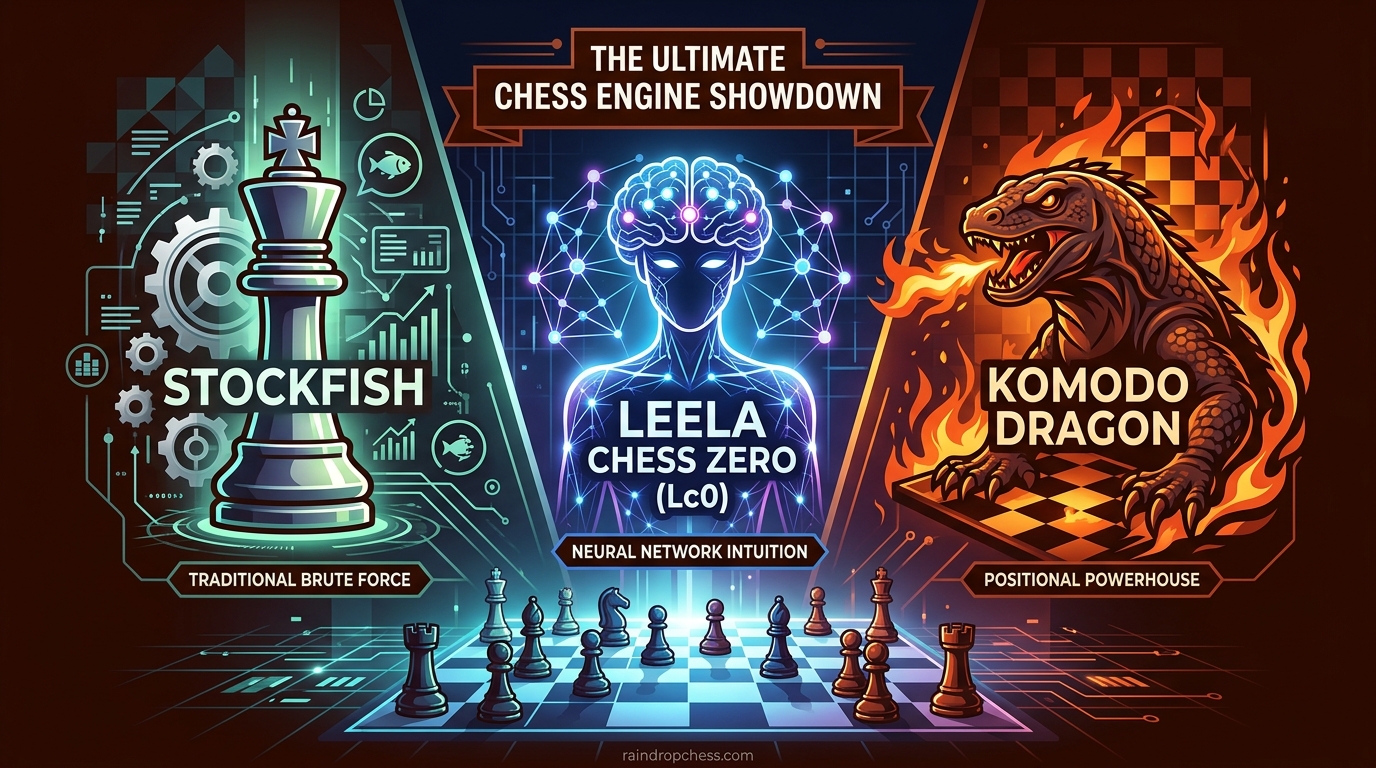
If you have ever wondered why Stockfish, Leela Chess Zero, and Komodo Dragon sometimes disagree on the same position, you are not alone. These three engines consistently rank at the very top of every major chess engine rating list, yet they reach their conclusions in completely different ways. Understanding the Stockfish vs Leela Chess Zero vs Komodo Dragon debate is not just academic trivia. It changes how you analyze your games, prepare openings, and improve as a player.
All three engines play at roughly 3500 Elo on rating lists like CCRL. For context, Magnus Carlsen peaked around 2882. That means the gap between the world champion and these engines is larger than the gap between a beginner and a strong club player. But raw strength is only part of the story. The way each engine finds its moves matters just as much as the moves themselves.
I have spent hundreds of hours running all three engines on my own games and correspondence positions. Each one has surprised me in different ways. In this guide, our team breaks down exactly how Stockfish, Leela Chess Zero, and Komodo Dragon differ under the hood, what each one does best, and when you should reach for one over the others.
Table of Contents
How Chess Engines Think: Search and Evaluation
Every chess engine, no matter how advanced, relies on two core mechanisms: search and evaluation. The search component looks ahead through possible move sequences, building a tree of variations. The evaluation component judges how good each resulting position is. The interplay between these two mechanisms is what separates one engine from another.
Think of search as breadth and depth. How wide does the engine cast its net, and how deep does it look? Traditional engines use an approach called alpha-beta pruning, which systematically explores the move tree while cutting off branches that are clearly worse than what it has already found. This is efficient but follows a rigid structure. The engine evaluates positions using handcrafted heuristics or, more recently, neural networks.
Monte Carlo Tree Search, or MCTS, takes a fundamentally different approach. Instead of pruning branches, it runs thousands of simulated games (called playouts) from promising positions and uses the results to guide further exploration. MCTS is probabilistic. It does not guarantee finding the absolute best move in every case, but it tends to find moves that are strong in a broader strategic sense.
Then there is the neural network evaluation approach. Rather than relying on human-written rules about pawn structure, king safety, and piece activity, a neural network learns to evaluate positions from massive amounts of training data. Leela Chess Zero trained entirely through self-play, starting from random moves and gradually improving. Stockfish adopted a different flavor of neural networks called NNUE (Efficiently Updatable Neural Network), which runs on CPU and evaluates positions incrementally as moves are made.
A few terms you will see throughout this guide: ply refers to one half-move (one move by one side), depth is how many plies deep the engine has searched, and nodes per second (nps) measures how fast the engine processes positions. A transposition table is a memory cache that stores previously evaluated positions to avoid recalculating them. These concepts matter because they directly affect how each engine performs in practice.
Stockfish: The King of Tactical Depth
Stockfish is the engine most chess players know best, and for good reason. It has dominated computer chess for years and is the default analysis engine on platforms like Lichess and Chess.com. Stockfish is fully open source, developed by a large community of contributors, and completely free to use.
At its core, Stockfish uses alpha-beta search. It explores the move tree systematically, using pruning techniques to eliminate weak variations quickly. For years, Stockfish relied on a handcrafted evaluation function. Human programmers wrote thousands of rules about pawn structure, piece coordination, king safety, and passed pawns. This worked extremely well, but in 2020, everything changed with the introduction of NNUE.
NNUE stands for Efficiently Updatable Neural Network. The key insight is that when a move is played on the board, most pieces stay in the same place. So instead of recalculating the entire position evaluation from scratch, NNUE updates only the parts that changed. This makes neural network evaluation fast enough to run on a regular CPU without needing a GPU at all.
The impact was immediate and massive. Starting around mid-2020, Stockfish with NNUE began dominating the TCEC (Top Chess Engine Championship), the premier computer chess competition. Before NNUE, Leela Chess Zero had been winning tournaments. After NNUE, Stockfish reclaimed the top spot and has held it ever since.
What makes Stockfish special is its tactical depth. The engine calculates variations with extraordinary precision, finding deep tactical shots and defensive resources that other engines miss. On the forums, experienced users note that Stockfish has a “heavier” evaluation with more continuation histories, which leads to lower nodes per second compared to some rivals, but better practical accuracy in complex positions.
Stockfish runs entirely on CPU, which is a huge practical advantage. You do not need an expensive GPU to get world-class analysis. A modern multi-core processor with sufficient RAM (16GB or more recommended) and a large hash table will give you excellent results. The engine scales well with more threads, so if you have a 16-core machine, Stockfish will use all of them efficiently.
One feature I rely on constantly is MultiPV (Multiple Principal Variations). This lets you see not just the engine’s top choice, but its second, third, or even tenth choice for any position. If you are analyzing your own games, MultiPV helps you understand alternative plans and why the engine prefers one move over another. Setting MultiPV to 3 or 5 gives you a much richer analysis experience.
Leela Chess Zero: The Neural Network Visionary
Leela Chess Zero, usually abbreviated as Lc0, took a radically different path to the top of computer chess. Inspired by DeepMind’s AlphaZero project, Lc0 was built from scratch to learn chess entirely through self-play. No human knowledge was programmed into it. No opening books, no endgame tablebases, no handcrafted evaluation rules. It started from random moves and taught itself to play master-level chess through millions of training games.
The self-play training process is remarkable to follow. Lc0 played game after game against itself, initially making random moves. Over time, a neural network learned from the results, gradually understanding piece values, tactical patterns, and positional concepts. After sufficient training, the network developed a deep understanding of chess that, in some ways, goes beyond what human programmers could encode in handcrafted rules.
The most important practical difference between Lc0 and Stockfish is hardware. Lc0 requires a capable GPU (Graphics Processing Unit) to run effectively. The neural network that evaluates positions is designed to run on GPU architecture, which excels at the parallel math operations needed for neural network inference. Without a decent NVIDIA or AMD GPU, Lc0 runs painfully slowly and cannot compete with Stockfish on equal footing.
This GPU requirement is a real barrier. Many chess players who want to try Lc0 discover they need to invest in hardware they may not already own. Forum discussions frequently mention this as a frustration. If you have a gaming PC with a modern GPU, you are in great shape. If you are working with a laptop or a basic desktop, Stockfish is the more practical choice.
Where Lc0 truly shines is positional understanding, particularly in closed or strategically complex positions. Lc0 occasionally finds deep strategic ideas that Stockfish misses, especially in positions with locked pawn chains or long-term pawn majorities. The neural network seems to “see” patterns that traditional search does not explore deeply enough.
Lc0’s playing style is often described as more human-like than Stockfish. It tends to prefer moves that make intuitive sense to strong human players, rather than finding bizarre computer moves that only work because of precise calculation over 20-ply deep lines. This makes Lc0 an excellent training partner if you want to study positions that have practical value for human play.
Lc0 won the TCEC Season 19 championship in April 2020, which was a watershed moment for neural network chess engines. It proved that a self-play trained engine could compete at the highest level. However, since Stockfish adopted NNUE shortly afterward, Lc0 has generally played second fiddle in direct competition. At fast time controls, Stockfish dominates most matches. At longer time controls with powerful GPUs, Lc0 remains competitive and occasionally wins individual games through superior positional play.
Komodo Dragon: The Human-Like Hybrid
Komodo Dragon occupies a unique space in the chess engine landscape. Unlike Stockfish (fully open source and free) or Lc0 (open source and self-play trained), Komodo has commercial origins. Originally developed by Don Dailey and later maintained by Larry Kaufman and Mark Lefler, Komodo has evolved significantly over the years, and the “Dragon” version represents its most ambitious change.
What makes Komodo Dragon different is its integration of Monte Carlo Tree Search into a traditional alpha-beta framework. Rather than choosing one search philosophy, Komodo Dragon uses both. The engine can blend MCTS probabilistic exploration with alpha-beta’s systematic pruning, creating a hybrid approach that draws on the strengths of each method.
This hybrid approach gives Komodo Dragon a distinctive playing style. It tends to play more human-like chess than pure alpha-beta engines, often choosing plans that strong human players would consider natural. Komodo has historically been tuned to evaluate positions in a way that reflects human understanding of chess concepts like piece activity, pawn structure, and king safety.
One of Komodo’s most interesting features is its contempt setting. Contempt is a parameter that tells the engine how much to avoid draws. A high contempt setting makes Komodo play more aggressively, taking risks to win rather than accepting drawish positions. This is particularly valuable for correspondence players who need to play for wins with both colors.
In terms of raw strength, Komodo Dragon consistently ranks near the top of major rating lists like CCRL, though typically a small margin behind Stockfish. The gap is usually in the range of 20-40 Elo points, which is significant at the top level but not enormous. In practical terms, Komodo Dragon is more than strong enough to find moves that would stump any human player.
Komodo Dragon runs well on CPU, similar to Stockfish. You do not need a GPU to get strong performance, though the MCTS component does benefit from more processing power. If you have a multi-core CPU and sufficient RAM, Komodo Dragon will perform admirably. The engine is available through various commercial packages, and there is also a free version with some feature limitations.
Where I find Komodo Dragon most useful is as a second opinion. When Stockfish and Leela disagree on a position, running Komodo Dragon can break the tie with its different evaluation philosophy. The MCTS component means it explores positions in a way neither pure alpha-beta nor pure neural network engines do, which sometimes leads to unique insights.
Stockfish vs Leela Chess Zero vs Komodo Dragon: Direct Comparison
Now for the side-by-side breakdown. This is the comparison most chess players are looking for when they search for Stockfish vs Leela Chess Zero vs Komodo Dragon. Each engine has clear strengths and trade-offs, and the right choice depends on your hardware, goals, and personal preferences.
Search Algorithm
Stockfish uses alpha-beta pruning with NNUE evaluation. Leela Chess Zero uses neural network-guided MCTS. Komodo Dragon uses a hybrid alpha-beta + MCTS approach. These are not minor variations. They represent fundamentally different philosophies about how to find the best move.
Hardware Requirements
Stockfish runs on CPU alone. A modern multi-core processor with 16GB RAM and a generous hash allocation is all you need. Leela Chess Zero requires a capable GPU for useful analysis, ideally an NVIDIA card with at least 6GB of VRAM. Komodo Dragon runs on CPU like Stockfish, though it benefits from extra cores for the MCTS component.
Playing Style
Stockfish excels at tactical accuracy and deep calculation. It finds shots, combinations, and defensive resources through sheer computational depth. Leela Chess Zero excels at positional understanding and strategic evaluation, often finding quiet moves that improve positions gradually. Komodo Dragon plays the most human-like chess, favoring plans that align with traditional chess principles.
Strength and Ratings
On the CCRL rating list, all three engines cluster near 3500 Elo, with Stockfish typically at the top. Stockfish usually leads by 20-50 Elo over Leela (when Leela has comparable GPU hardware) and 30-60 Elo over Komodo Dragon. These gaps sound small but are meaningful at the elite computer chess level.
When to Use Each Engine
Use Stockfish when: you want the strongest overall analysis, you only have a CPU, you need fast analysis at blitz speeds, you are checking tactics, or you want MultiPV to explore alternative lines. Stockfish is the right choice for probably 80% of chess players’ everyday analysis needs.
Use Leela Chess Zero when: you have a capable GPU, you are analyzing strategically complex or closed positions, you want a second opinion on quiet positional moves, or you prefer studying ideas that make human sense. Leela is especially valuable for opening preparation in positions where the engine evaluations seem counterintuitive.
Use Komodo Dragon when: you want a human-like perspective on a position, you need a third engine to break a tie between Stockfish and Leela, you are playing correspondence chess and want to explore creative winning chances, or you want to study plans rather than just finding the objectively strongest move.
The best setup for serious analysis, in my experience, is running Stockfish as your primary engine and cross-checking critical positions with either Leela or Komodo Dragon. When all three agree, you can be confident. When they disagree, the disagreement itself reveals something interesting about the position.
Common Misconceptions About Chess Engines
Myth: Higher Depth Always Means Better Analysis
Depth is a useful metric, but it is not the whole story. Stockfish at depth 30 on your laptop is not the same as Stockfish at depth 30 on a 64-core server, because depth measures how far the engine has searched in terms of plies, not how thoroughly it has explored each ply. A higher depth on a more powerful machine with a larger hash table will always produce better analysis than the same depth on weaker hardware.
Additionally, depth means different things across engines. Stockfish depth 30 is not directly comparable to Leela’s iteration count or Komodo Dragon’s depth, because each engine measures and reports search progress differently. Do not compare depth numbers across different engines.
Myth: Leela Is Just a Weaker Stockfish
This oversimplification misses the entire point of why Leela matters. Leela uses a fundamentally different approach to finding moves. It does not search the same way Stockfish does. In positions where strategic understanding matters more than raw calculation, Leela sometimes finds moves that Stockfish never considers, even at extreme depths. The two engines disagree on about 10-15% of positions at the top level, and in those disagreements, neither engine is always right.
Myth: You Need Expensive Hardware for Engine Analysis
Stockfish runs remarkably well on modest hardware. A mid-range laptop from the last few years can run Stockfish at depth 25-30 within minutes, which is more than sufficient for analyzing club-level games. You only need serious hardware if you are doing correspondence chess, professional opening preparation, or running engine tournaments. The NNUE evaluation that Stockfish uses was specifically designed to work well on standard CPUs.
Myth: All Engines Agree on the Best Move
In tactical positions with a clear winning shot, most engines will agree. But in strategically complex positions, engine disagreement is common and valuable. When Stockfish recommends one plan and Leela recommends another, both moves are likely strong, but they lead to different types of positions. Studying these disagreements is one of the most effective ways to deepen your chess understanding.
Frequently Asked Questions
Is Leela Chess Zero stronger than Stockfish?
In most direct competition, Stockfish is the stronger engine, especially at fast time controls and on CPU-only hardware. Stockfish has dominated TCEC since adopting NNUE in mid-2020. However, Leela Chess Zero remains competitive at longer time controls with strong GPU hardware, and it occasionally wins individual games through superior positional understanding. On the CCRL rating list, Stockfish typically leads by 20-50 Elo points when both engines have adequate hardware. For practical analysis purposes, Stockfish is the stronger all-around tool, but Leela provides valuable second opinions in strategic positions.
Which is better, Stockfish or Komodo?
Stockfish is generally stronger than Komodo Dragon on rating lists, typically by 30-60 Elo points. Stockfish also has the advantage of being free and open source, while Komodo Dragon has commercial licensing. However, Komodo Dragon plays a more human-like style and its MCTS hybrid approach can provide insights that Stockfish misses. For most players, Stockfish is the better primary engine, but Komodo Dragon serves as an excellent secondary engine for getting a different perspective on complex positions.
Has Stockfish 17 ever lost?
Yes. No chess engine is unbeatable. Stockfish has lost individual games in TCEC and other computer chess competitions. In TCEC, Stockfish occasionally drops games to Leela Chess Zero and other top engines, particularly at longer time controls. However, Stockfish very rarely loses match situations. Over a full TCEC season with dozens of games, Stockfish consistently finishes at or near the top. Individual losses typically come in strategically complex positions where a neural network engine finds a deep plan that alpha-beta search does not fully explore.
Can AlphaZero still beat Stockfish?
AlphaZero has not played a public match against recent versions of Stockfish. When AlphaZero first defeated Stockfish 8 in 2017, it was a landmark moment, but that version of Stockfish was significantly weaker than current versions with NNUE. Since then, Stockfish has improved dramatically. Most computer chess experts believe that the latest Stockfish versions would be competitive with or potentially stronger than AlphaZero. However, without a new match, this remains speculation. The techniques AlphaZero pioneered, particularly neural network evaluation and self-play training, have been adopted and refined by both Stockfish (via NNUE) and Leela Chess Zero.
Conclusion: Choosing the Right Engine for Your Game
The Stockfish vs Leela Chess Zero vs Komodo Dragon comparison comes down to three things: your hardware, your goals, and how much depth you want in your analysis. Stockfish is the best starting point for almost everyone. It is free, runs on any modern CPU, and provides the strongest overall analysis available in 2026. If you only install one engine, make it Stockfish.
Leela Chess Zero is the engine to add when you have a capable GPU and want a different perspective, especially in strategically rich positions. Its self-play trained neural network finds ideas that traditional search methods overlook. The hardware requirement is a real consideration, but if your machine can handle it, Leela is an invaluable second opinion.
Komodo Dragon rounds out the picture with its hybrid MCTS approach and human-friendly playing style. It is the engine I reach for when I want to understand why a move is good, not just that it is the strongest. For correspondence players and anyone serious about understanding chess at a deeper level, running all three engines on critical positions is the gold standard.
The beauty of having three distinct approaches to computer chess is that their disagreements teach us as much as their agreements. When Stockfish, Leela, and Komodo Dragon all point to the same move, you can play it with confidence. When they disagree, the position is worth studying carefully, because that is where the most interesting chess lives.