
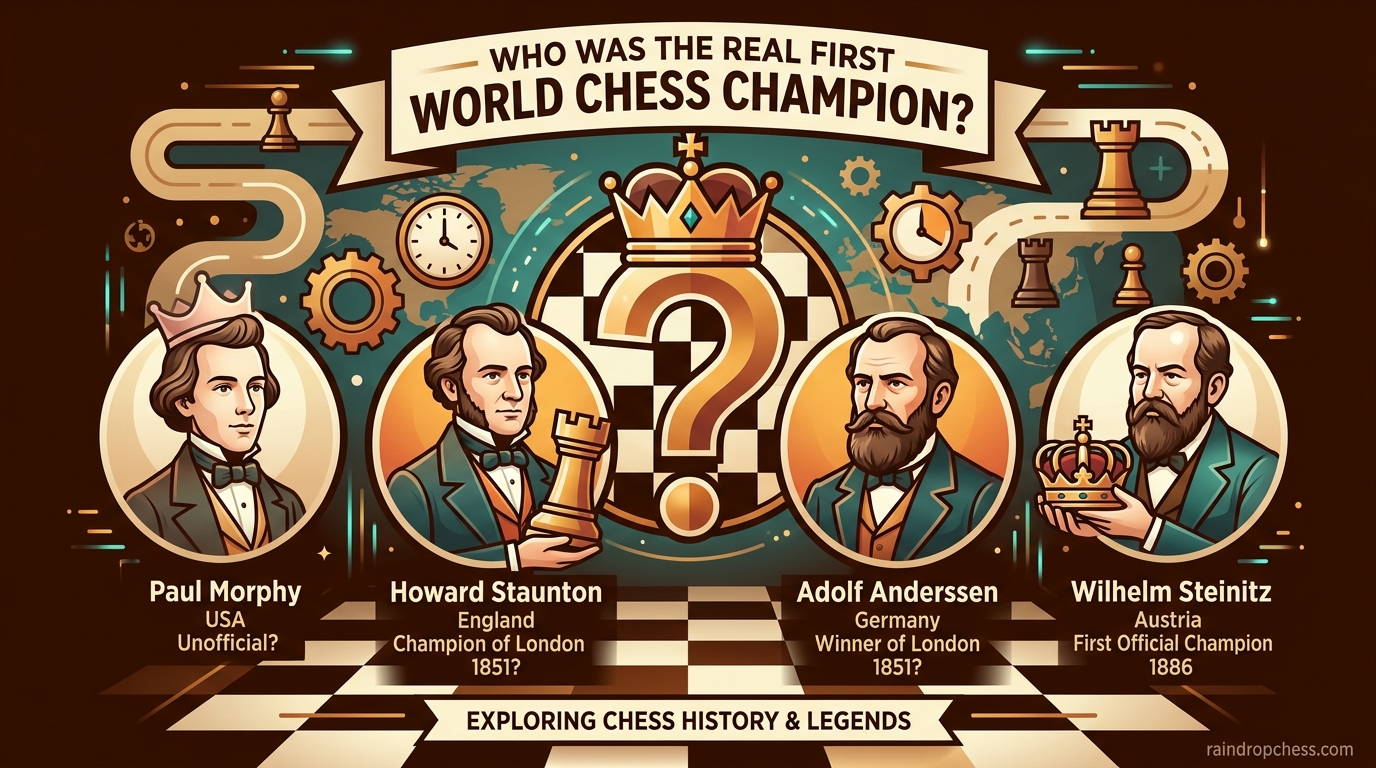
If you have ever looked up “who was the first world chess champion,” you probably got a straightforward answer: Wilhelm Steinitz, who won the title in 1886. But here is where history gets interesting. The real story is far more complicated than a single date and name. Before Steinitz, chess had dominant players who were widely considered the world’s best. Yet none of them held an official title. This gap between reputation and formal recognition creates one of chess history’s most fascinating debates.
I spent weeks digging through historical records, correspondence between players, and modern chess historians’ analyses. What I found was a tale of missed matches, controversial refusals, and a sport that took centuries to formalize its championship system. The question of who was “really” first depends entirely on how you define a world champion.
Table of Contents
Who Was the First Official World Chess Champion
Wilhelm Steinitz is universally recognized as the first official World Chess Champion. He earned this title by defeating Johannes Zukertort in a formal match held in New Orleans in 1886. The final score was 10 wins to 5, with 5 draws. This match established the precedent that world championships required organized, public contests with agreed-upon conditions.
Steinitz held the title from 1886 until 1894, defending it successfully against several challengers. His reign lasted nearly a decade. During that time, he helped transform chess from a game of romantic attacking play into a more scientific, positional discipline. But the question remains: why did it take until 1886 for chess to have an official champion?
The Era Before Formal Championships
Chess existed for over a thousand years before anyone thought to organize a world championship. Throughout most of that history, the game was played recreationally among nobility and intellectuals. There was no formal competitive structure, no governing bodies, and certainly no official titles.
By the mid-19th century, chess had evolved into something resembling modern competitive play. Strong players emerged in coffee houses and chess clubs across Europe. Strength was determined through informal matches, simultaneous exhibitions, and tournament results. If you consistently beat the best players in your region and abroad, you were considered the strongest. But this recognition carried no official weight.
The “romantic era” of chess emphasized brilliant attacking combinations and sacrificial play. Positional understanding was minimal compared to modern standards. Champions of this era built reputations through memorable victories rather than systematic dominance. This made determining the “best” player more subjective than it would later become.
Paul Morphy: The Unofficial Champion Who Never Was
Paul Morphy dominated chess in the 1850s like no American before or since. In 1857, he won the First American Chess Congress in New York, defeating Louis Paulsen in the final. The following year, he traveled to Europe and systematically defeated the continent’s strongest players. His victims included Adolf Anderssen, who was widely considered Europe’s best after winning the 1851 London tournament.
Morphy’s playing style was decades ahead of his time. He combined tactical brilliance with positional understanding that anticipated the ideas Steinitz would later formalize. Bobby Fischer, himself a world champion and notorious critic of historical players, called Morphy “the greatest chess genius in history.” That is high praise from a man who rarely complimented anyone.
Historical chess rating estimates place Morphy’s peak strength comparable to top modern grandmasters. Some calculations suggest he was over 200 rating points stronger than his nearest rivals. If true, that gap is unprecedented in chess history.
Yet Morphy never held an official world championship title. He retired from serious chess in 1859 at age 22, while still at the peak of his powers. Some historians speculate about mental health struggles. Others point to the lack of financial support for professional chess in that era. Whatever the reason, Morphy walked away before formal championship structures existed.
Howard Staunton and the Champion Who Refused to Play
Before Morphy’s European triumph, Howard Staunton was widely considered the world’s strongest player. The English master had won the 1843 match against Pierre Saint-Amant, which was sometimes called a championship contest. He edited influential chess publications and helped organize the 1851 London tournament. His name became synonymous with quality chess equipment after the design of the Staunton chess set, still the standard today.
Staunton remained active in chess organization even as his playing strength declined in the 1850s. When Morphy arrived in Europe seeking matches against the strongest players, Staunton was the obvious target. A match between them would have settled the question of world supremacy. It never happened.
The reasons why Staunton avoided playing Morphy have been debated for over 160 years. Some contemporaries accused him of cowardice. Others suggested scheduling conflicts and professional obligations prevented the match. Modern historians generally agree that Staunton, past his competitive prime, had little incentive to risk his reputation against a rising phenomenon half his age.
The Staunton-Morphy Controversy: What Really Happened
The negotiations between Staunton and Morphy began in 1858 through an exchange of letters. Morphy proposed a match with fair conditions. Staunton initially expressed interest but demanded increasingly specific terms. The correspondence dragged on for months with no resolution.
Staunton eventually claimed his professional duties as a Shakespearean scholar prevented him from committing to a chess match. He also objected to Morphy’s proposed stakes and playing schedule. By the time Morphy returned to America, no match had been arranged. The chess world was left to wonder what might have been.
Contemporary accounts suggest Staunton’s reluctance was genuine rather than cowardly. He was genuinely busy with literary work and increasingly aware that his competitive days were behind him. But his failure to play Morphy left a permanent stain on his legacy. Chess history remembers Morphy as the uncrowned champion and Staunton as the player who refused to face him.
Modern analysis using historical rating systems suggests Morphy would likely have defeated Staunton decisively. The English master’s competitive prime had passed by 1858, while Morphy was entering his. We will never know for certain, but the statistical evidence supports the conventional narrative.
Why Chess Needed Formal Championships
The period between Morphy’s retirement and Steinitz’s 1886 victory saw chess develop the organizational infrastructure necessary for formal championships. Several factors drove this evolution.
First, international chess was growing in popularity. Strong players emerged in multiple countries, making informal “strongest player” claims harder to sustain. Second, chess clubs and national federations began coordinating efforts. The need for standardized rules and recognized titles became apparent. Third, financial backing for major matches became available as chess attracted wealthy patrons and spectators.
Steinitz himself played a role in this transformation. After moving to America in 1883, he advocated for organized challenge systems and agreed-upon championship conditions. His match against Zukertort was arranged with proper contracts, prize funds, and neutral officiating. These elements had been largely absent from previous high-level encounters.
The establishment of an official world championship also reflected changing attitudes toward competitive sports in general. The late 19th century saw the formalization of championships in boxing, tennis, and other pursuits. Chess was following a broader cultural trend toward institutionalized competition.
The 1886 Match That Changed Everything
The 1886 match between Wilhelm Steinitz and Johannes Zukertort was played in New Orleans from January to March. It was agreed to be for the world championship before the first move. This pre-match agreement distinguished it from earlier high-stakes encounters.
Zukertort won the first game and led 4-1 after five games. Steinitz then mounted a remarkable comeback, winning nine of the next eleven games. The final score of 10-5 with 5 draws established Steinitz as the undisputed champion. More importantly, it established the principle that world championships required formal matches with recognized stakes.
Steinitz defended his title successfully against Gunberg, Chigorin, and Blackburne before losing to Emanuel Lasker in 1894. His reign lasted over eight years. During that time, the concept of a world chess champion became firmly established in the chess world’s consciousness.
The 1886 match also demonstrated that world championships could be financially viable. Prize funds and spectator interest made future matches possible. This economic reality ensured that the world championship would continue as an institution.
The Modern Debate: Should Pre-1886 Players Count
Chess historians continue to debate whether pre-1886 players should be considered unofficial world champions. The arguments for inclusion are compelling. Morphy clearly dominated his era like a champion. Staunton held a position of supremacy in the 1840s. Anderssen was widely considered the world’s best player after winning the 1851 London tournament.
However, there are strong arguments for maintaining the 1886 standard. Before that date, there was no formal challenge system. No agreed-upon rules for determining supremacy. No institutional recognition of championship status. The title “world champion” implies more than temporary dominance. It requires a formal structure that did not exist before Steinitz.
Historical rating systems offer another perspective. Computer analysis of old games suggests Morphy would have been competitive with later champions. But ratings alone cannot establish championship status. They merely quantify playing strength, not official recognition.
Most modern chess historians accept the 1886 date as the beginning of the official world championship lineage. This does not diminish the achievements of earlier greats. It simply acknowledges that the concept of a world champion required formal institutional backing that did not exist until Steinitz’s time.
Frequently Asked Questions
Who was the first official chess champion?
Wilhelm Steinitz is recognized as the first official World Chess Champion. He won the inaugural world championship match in 1886, defeating Johannes Zukertort 10-5 with 5 draws in New Orleans.
Who was the first chess world champion before Steinitz?
Before Steinitz, there were no official world champions. Paul Morphy was widely considered the world’s strongest player in the 1850s, but he retired before formal championship structures existed. Howard Staunton held a similar status in the 1840s.
Why did we start counting world champions at Steinitz?
Steinitz’s 1886 match against Zukertort was the first contest formally designated as a world championship before play began. It established the organizational framework for future championships, including formal challenges, agreed conditions, and institutional recognition.
Was Howard Staunton a world chess champion?
Howard Staunton was never an official world chess champion, as the title did not exist during his prime in the 1840s. He was widely considered the world’s strongest player after defeating Saint-Amant in 1843, but no formal championship system recognized his status.
Who was the first unofficial world chess champion?
Most chess historians consider Paul Morphy the first unofficial world champion. He dominated international chess in 1858, defeating Europe’s strongest players including Adolf Anderssen. Bobby Fischer called Morphy the greatest chess genius in history.
Conclusion
So who was the real first world chess champion? The official answer is Wilhelm Steinitz, and that is the answer you will find in every record book and chess database. But the murky history behind that simple fact reveals a more complex story. Morphy dominated like a champion. Staunton reigned supreme in his era. Anderssen was considered the world’s best after London 1851.
The genius of Steinitz was not just winning the 1886 match. It was creating the institutional framework that made “world champion” a meaningful, defensible title. Before Steinitz, chess had great players. After Steinitz, it had a lineage of champions that continues to this day. That transformation is why history remembers him as the first.