
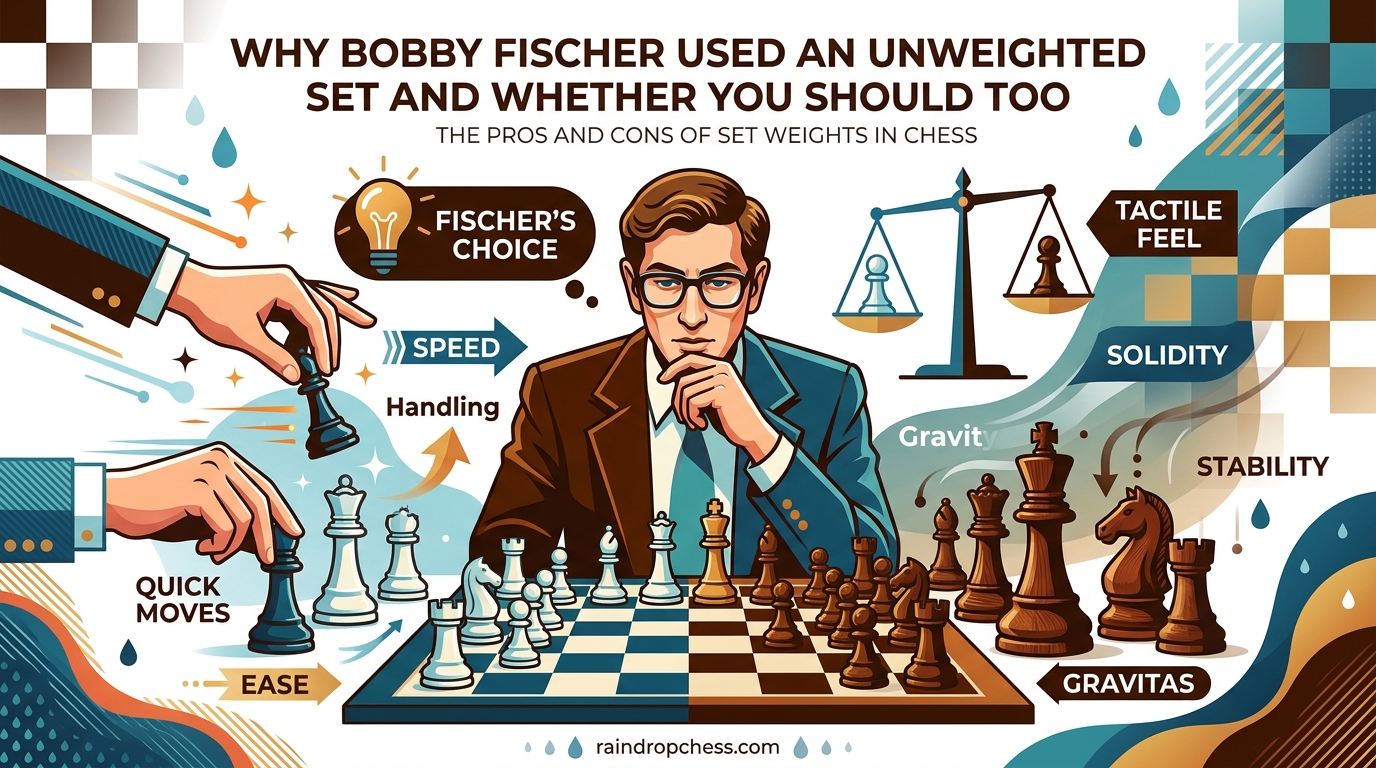
Bobby Fischer called the Dubrovnik chess set “the best set for playing with that I’ve ever seen.” His specific praise went to its light weight, smooth carving, and functional design. But here’s what most players miss: Fischer specifically used the unweighted version of this set throughout his career.
In this guide, we’ll explore why Fischer preferred unweighted chess pieces and whether they make sense for your own games. Our team has analyzed tournament footage, historical interviews, and forum discussions from serious players to give you the complete picture.
By the end, you’ll understand exactly why Fischer chose unweighted pieces and whether you should follow his lead or stick with weighted alternatives.
Table of Contents
Why Bobby Fischer Used an Unweighted Set
Fischer’s preference for unweighted pieces wasn’t arbitrary. It came from a combination of historical circumstance, practical benefits, and his unique playing style. Understanding these factors helps explain why the greatest American chess player in history chose equipment that many modern players would consider inferior.
The Historical Context: Yugoslavian Sets Were Never Weighted
The original Dubrovnik chess set was created for the 9th Chess Olympiad in 1950. According to historical research from Eastern European chess historians, no chess set manufactured in Yugoslavia at that time was ever weighted. This wasn’t a design choice specific to the Dubrovnik set—it was simply how chess sets were made in that region.
When Fischer first encountered these pieces, he was experiencing authentic Yugoslavian craftsmanship. The unweighted nature was inherent to the design, not an afterthought or cost-cutting measure. The set was designed with functionality and visual clarity in mind, eschewing decorative elements that could distract from the game.
The 1950 Dubrovnik set represented a departure from the ornate, heavily decorated sets common in that era. Its clean lines and practical design made it ideal for tournament play, where visibility and ease of handling matter more than decorative flourishes. The pieces were crafted from quality wood and designed to last, with the understanding that weight wasn’t necessary for stability.
The set was designed by master craftsmen who understood that wide bases and proper proportions could provide stability without added metal weights. This approach to chess piece design prioritized the player’s experience over arbitrary standards of heaviness.
Fischer’s Radio Interview Revelation
In a radio interview, Fischer specifically praised the Dubrovnik set’s characteristics that directly relate to its unweighted nature. He mentioned the “lightness” as a positive feature, not a drawback. This is significant because most players today assume heavier pieces are automatically better.
Fischer noted the set had “no ornaments” and “easy to handle pieces.” These qualities made it ideal for his needs as a player who analyzed positions extensively and played thousands of blitz games. The absence of hard edges and the smooth carving allowed for rapid piece manipulation during intense calculation sessions.
The interview revealed something deeper about Fischer’s philosophy toward chess equipment. He valued function over form, practicality over decoration. This mindset extended beyond just the pieces to his entire approach to the game.
The Real Reasons Unweighted Pieces Worked for Fischer
Understanding why Fischer preferred unweighted pieces requires looking at how he actually played. Tournament footage and game analysis reveal several practical advantages that aligned perfectly with his style.
Blitz Speed and Analysis Benefits
Fischer was known for his marathon analysis sessions and lightning-fast blitz play. Unweighted pieces move effortlessly across the board, allowing for rapid position changes during analysis. When you’re running through dozens of variations, every millisecond of piece movement adds up.
Forum users who’ve adopted unweighted sets for analysis report the same experience: “They move effortlessly when quickly running through games.” The lightweight nature becomes an asset when you’re repositioning pieces constantly. One user noted that weighted pieces “slow me down” during analysis sessions, a sentiment echoed by many serious players.
The speed advantage becomes particularly apparent in blitz chess, where quick piece movement can mean the difference between flagging your opponent and losing on time. Fischer’s aggressive, fast-paced style benefited from pieces that responded instantly to his touch.
Wide Bases and Design Stability
Here’s the counterintuitive truth: unweighted pieces can be remarkably stable when properly designed. The Dubrovnik set features wide, fat bases that provide excellent stability despite the light weight.
Multiple forum users confirm this: “The Dubrovnik design is quite stable without weights due to the design.” The column-like structure and broad base create a lower center of gravity naturally, without needing metal inserts. The pieces are designed to stand firmly on their own through intelligent geometry rather than added mass.
Manufacturer Noj Chess, which produces reproductions of the Dubrovnik set, has reported zero cracking issues in over 736 sets produced since 2008. This includes both weighted and unweighted versions, demonstrating that modern unweighted pieces are built to last. The concern about unweighted pieces being more fragile appears unfounded based on this manufacturing data.
The wide base design is key to this stability. By spreading the weight across a broader surface area, the pieces resist tipping even during aggressive play. This engineering principle explains why Fischer could “bang” pieces down without them falling over.
Portability for Tournament Travel
Fischer traveled extensively for tournaments throughout the 1960s and early 1970s. Unweighted pieces are significantly lighter, making them ideal for players who need to transport their equipment regularly. The Candidates Tournament in 1959, where Fischer first made his mark on the world stage, required extensive travel between venues.
Modern tournament players report the same benefit: “I prefer unweighted for travel and analysis between rounds.” When you’re carrying your equipment to multiple games over several days, every ounce matters. A full set of unweighted pieces can weigh half as much as a weighted equivalent, making a real difference in your luggage.
The portability factor extends beyond air travel. Players who commute to chess clubs or bring sets to coffee shop sessions appreciate the reduced bulk and weight. Unweighted sets fit more easily into backpacks and travel cases, making spontaneous games more practical.
For players who compete regularly, the weight savings compound over time. Carrying a lighter set reduces fatigue during tournaments and makes it easier to keep your equipment with you rather than checking it.
Tactile Feel and Playing Style
Tournament footage shows Fischer had a distinctive way of handling pieces. Observers noted he would “bang them down hard onto a board.” This aggressive handling style actually works better with unweighted pieces because they respond to quick, decisive movements without the momentum that weighted pieces carry.
The pieces feel different in your hand. Some players describe the experience as “wobbling is part of the charm.” It’s a tactile feedback that connects you to the historical tradition of chess. The lightweight nature creates a different relationship between player and pieces, one that emphasizes precision and control.
Experienced players note that the adjustment period for unweighted pieces typically lasts only 3-5 games. After that initial learning curve, many report preferring the feel of unweighted pieces for certain types of play.
Should You Use an Unweighted Chess Set?
Here’s where we get practical. Fischer’s choice made sense for him, but does it make sense for you? The answer depends on several factors including your playing style, experience level, and intended use.
When Unweighted Pieces Make Sense
Unweighted pieces are ideal for several specific scenarios:
- Analysis sessions: When you’re running through dozens of positions quickly, lightweight pieces move faster
- Blitz chess: Speed chess benefits from pieces that glide across the board
- Travel play: Lighter sets are easier to transport to tournaments or chess clubs
- Historical authenticity: If you want to experience chess as Fischer did, unweighted is the way
- Home analysis: Many players keep an unweighted set specifically for study
Players who own both weighted and unweighted sets often report using the unweighted ones for specific purposes: “I prefer unweighted for analysis and travel, weighted for tournament games.” This dual-set approach is common among serious players who recognize that different contexts call for different equipment.
One forum user summarized it well: “Unweighted pieces are fun to play with after getting used to their lightness.” The key phrase is “after getting used to”—there is an adjustment period, but many players find the experience rewarding.
When Weighted Pieces Are Better
Weighted pieces have their place. Choose them when:
- You’re playing outdoors: Wind can affect lightweight pieces significantly
- You have a shaky playing surface: Weighted pieces resist tipping better on unstable tables
- You prefer deliberate play: The extra weight can encourage more thoughtful piece placement
- You’re a beginner: Weighted pieces are more forgiving of clumsy handling
The outdoor play consideration is significant. Several forum users mentioned that unweighted pieces can be problematic in breezy conditions or on uneven surfaces like park tables. Weighted pieces provide that extra stability when environmental factors are working against you.
Player Skill Level Considerations
Our analysis of forum discussions reveals interesting patterns by skill level:
Beginners often prefer weighted pieces for stability. The fear of pieces falling over is real, and weighted bases provide confidence while learning proper handling. One beginner noted feeling “afraid of knocking pieces over” when first trying unweighted sets.
Intermediate players start appreciating unweighted pieces for analysis. As your study sessions lengthen and you analyze more positions, the benefits become apparent. This group often reports being the most curious about Fischer’s equipment choices.
Advanced players often develop preferences based on playing style. Those who play lots of blitz or analyze deeply tend to prefer unweighted pieces. Collectors in this group also value historical accuracy, making unweighted reproductions particularly appealing.
Proper Handling Techniques for Unweighted Pieces
If you decide to try unweighted pieces, proper technique makes a significant difference:
- Place pieces vertically: Set them down straight rather than sliding them into position
- Be precise: Accurate placement prevents the wobbling that frustrates new users
- Use the whole hand: Grip pieces firmly but gently—don’t pinch them between two fingers
- Accept the learning curve: Most players report adjustment periods of 3-5 games before feeling comfortable
Experienced users emphasize: “Put them down vertically and accurately, and they’ll stay put.” The technique is different from weighted pieces, but it’s learnable. Think of it as developing a more precise, deliberate approach to piece handling.
Modern Grandmaster Perspectives
Modern grandmasters have adapted to unweighted pieces in the form of DGT electronic tournament sets. These pieces are essentially unweighted by design, and top players use them without issue in professional competition.
The transition from weighted to unweighted is less dramatic than many beginners fear. If grandmasters can play world championship games on unweighted electronic pieces, recreational players can certainly adapt for home use.
Many modern grandmasters actually prefer lightweight pieces for analysis sessions, just as Fischer did. The ability to quickly reset positions and run through variations is valuable at every level of play.
Cost Considerations and Availability
Quality unweighted sets are available from several manufacturers, with prices ranging from budget-friendly to premium collectibles. The Dubrovnik reproductions tend to command higher prices due to their historical significance and association with Fischer.
One challenge noted by forum users is limited availability in some regions, particularly North America. However, online retailers have made these sets more accessible than ever before.
When considering cost, remember that unweighted pieces may actually last longer in some circumstances. Without the metal weights that can shift or cause cracking over time, well-made unweighted pieces can remain stable for decades.
Some players find that the durability of unweighted pieces surprises them. The solid wood construction, without internal cavities for weights, can actually create a stronger piece that resists damage from drops or impacts.
Comparing Weighted and Unweighted Performance
When evaluating whether to choose weighted or unweighted pieces, consider these performance factors:
Speed of play: Unweighted pieces allow faster movement, which benefits blitz and bullet chess. Weighted pieces slow down rapid repositioning but provide more deliberate control.
Stability on different surfaces: On solid tournament tables, both types perform well. On uneven or outdoor surfaces, weighted pieces have a clear advantage.
Durability over time: Both types can last decades with proper care. Unweighted pieces avoid the risk of weight loosening or causing cracks.
Comfort during long sessions: Some players report less hand fatigue with lighter pieces during marathon analysis sessions.
Common Myths About Unweighted Pieces
Several misconceptions persist about unweighted chess pieces that deserve clarification:
Myth: Unweighted pieces are always unstable. Reality: Properly designed unweighted pieces with wide bases can be remarkably stable. The Dubrovnik design proves this.
Myth: Unweighted pieces are cheaper quality. Reality: Historical unweighted sets were premium products. Modern reproductions maintain high craftsmanship standards.
Myth: Serious players only use weighted pieces. Reality: Many serious players, including Fischer, preferred unweighted pieces for specific purposes.
Myth: Unweighted pieces are only for children. Reality: Unweighted pieces serve specific functional purposes for players of all levels.
Frequently Asked Questions
What was Bobby Fischer’s favorite chess set?
Bobby Fischer’s favorite chess set was the Dubrovnik chess set, specifically the unweighted version from the 1950s. He praised its light weight, smooth carving, and functional design, calling it the best set for playing with that he had ever seen.
Are unweighted chess pieces stable?
Yes, unweighted chess pieces can be stable when properly designed. The Dubrovnik set Fischer used featured wide, fat bases that provided excellent stability despite the light weight. Proper handling technique, such as placing pieces vertically and accurately, also ensures stability during play.
Should I buy weighted or unweighted chess pieces?
Choose weighted pieces if you’re a beginner, play outdoors, or prefer deliberate play. Choose unweighted pieces if you analyze extensively, play blitz chess, travel frequently, or want historical authenticity. Many serious players own both types for different purposes.
Do modern grandmasters use unweighted pieces?
Modern grandmasters often use unweighted pieces in specific contexts. Many prefer them for analysis and blitz play. Additionally, electronic tournament pieces used with DGT boards are essentially unweighted, and grandmasters have adapted to these lightweight pieces without issue.
Are unweighted pieces good for beginners?
Most beginners find weighted pieces easier to handle initially because they’re more forgiving of clumsy placement. However, if a beginner is committed to learning proper technique from the start, unweighted pieces can work. The adjustment period typically takes 3-5 games.
Conclusion
Bobby Fischer used an unweighted chess set because it matched his playing style, historical context, and practical needs. The Dubrovnik design provided stability through wide bases rather than metal weights, allowing for faster piece movement during his legendary analysis sessions. His preference wasn’t just nostalgia—it was based on real functional advantages.
Should you use an unweighted set? If you’re an intermediate or advanced player who analyzes positions, plays blitz, travels to tournaments, or simply wants to experience chess as Fischer did, the answer is yes. The learning curve is short—most players adapt within a few games—and the benefits are real. The combination of portability, speed, and historical connection makes unweighted sets worth considering.
If you’re a beginner or primarily play outdoors, start with weighted pieces. But don’t dismiss unweighted sets entirely. Understanding why Bobby Fischer used an unweighted set helps you appreciate the historical and practical dimensions of chess equipment, even if you ultimately choose a different path for your own games. The beauty of chess lies partly in these choices—each player finds the tools that best suit their journey.