
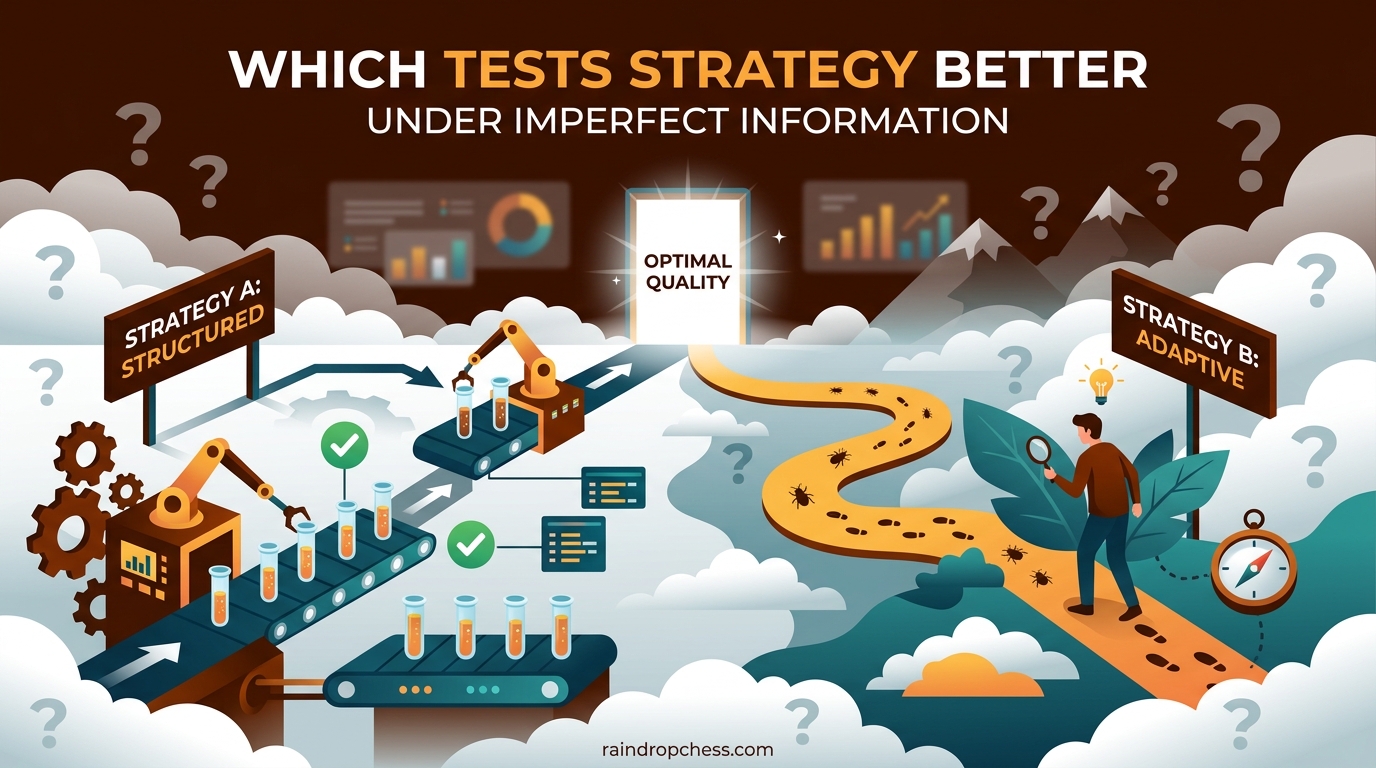
Chess and Stratego both claim to test strategic thinking, but they approach the challenge from opposite directions. One gives you perfect information about every piece on the board. The other hides critical information until combat forces revelation.
I’ve spent years playing both games, and the question keeps coming up in forums and among fellow players: which one actually tests strategy better? In 2026, with DeepMind’s DeepNash AI now mastering Stratego after already conquering Chess and Go, we have fresh perspective on this age-old debate.
This article compares how each game tests strategy under its unique information conditions. By the end, you’ll understand which game develops which skills, and which one might better prepare you for real-world strategic challenges.
Table of Contents
Understanding Perfect and Imperfect Information Games
Every strategy game falls into one of two categories based on what players know.
What Are Perfect Information Games?
In perfect information games, both players see everything. Every piece position, every possible move, every strategic calculation happens in full view. Chess represents the classic example. When you sit down at a Chess board, nothing is hidden.
The complexity comes from the sheer number of possibilities, not from uncertainty about the current state. You can calculate sequences of moves because you know exactly what your opponent can do in response.
What Are Imperfect Information Games?
Imperfect information games hide critical details. Poker hides cards. Battleship hides ship positions. And Stratego hides piece identities.
In Stratego, your opponent sees your pieces moving, but cannot see whether that moving piece is a lowly Scout or the powerful Marshal. You might be marching a Flag toward their territory, disguised as an aggressive piece. They must deduce, guess, or force revelation through combat.
This creates what military strategists call “fog of war” – the uncertainty that real commanders face when they cannot see enemy dispositions or intentions.
Games with imperfect information include Poker, Battleship, Bridge, and Stratego. Games with perfect information include Chess, Go, Checkers, and Connect Four.
How Chess Tests Strategy Under Perfect Information
Chess offers the purest test of calculation under complete information.
The Shannon Number: Chess Complexity by the Numbers
Computer scientist Claude Shannon calculated Chess’s game-tree complexity at approximately 10^120 possible games. For context, that’s more than the number of atoms in the observable universe.
This massive number means perfect play is theoretically possible but practically impossible. Even the strongest computers cannot solve Chess completely. They rely on evaluation functions and search algorithms rather than true understanding.
Strategic Elements Chess Tests
Chess rewards several specific cognitive abilities:
Calculation depth: The ability to visualize positions five, ten, or twenty moves ahead. Grandmasters calculate variations with remarkable accuracy.
Pattern recognition: Identifying tactical motifs like pins, forks, skewers, and discovered attacks. Experienced players recognize these patterns instantly.
Positional understanding: Evaluating piece placement, pawn structure, king safety, and long-term strategic goals without calculating specific variations.
Forcing moves: Chess contains forcing sequences where one player has no good reply. Checks, captures, and threats create lines where calculation determines the outcome.
The absence of hidden information means Chess strategy focuses entirely on what is visible and calculable. There are no bluffs in Chess, only miscalculations.
How Stratego Tests Strategy Under Imperfect Information
Stratego inverts the strategic challenge. You know your own position perfectly but face significant uncertainty about your opponent’s.
Stratego Rules: Hidden Piece Identities
Each player arranges 40 pieces in secret formation at game start. Pieces range from the Marshal (rank 10, strongest) down to the Scout (rank 2, weakest but mobile), plus six Bombs and one Flag.
When pieces meet in combat, the lower rank loses (with exceptions – Spy defeats Marshal, Miner defeats Bomb). Until combat occurs, you cannot know whether the piece approaching your territory is dangerous or vulnerable.
The objective is simple: capture the opponent’s Flag while protecting your own.
Game Tree Complexity: Why Stratego Exceeds Chess
Here is where Stratego surprises many Chess players. DeepMind researchers calculated Stratego’s game-tree complexity at approximately 10^535. That dwarfs Chess’s 10^120 by a factor so large the comparison becomes almost meaningless.
The hidden information multiplies possibilities exponentially. At each decision point, you face uncertainty not just about what your opponent might do, but about what they even can do given their hidden piece distribution.
Strategic Elements Stratego Tests
Stratego develops different cognitive abilities than Chess:
Deductive reasoning: Using combat results to narrow down what pieces remain. If their piece defeated your 7, you know they have an 8, 9, or 10 still in play.
Bluff and deception: Making aggressive moves with weak pieces to scare opponents, or feigning weakness with strong pieces to lure attacks.
Information gathering: Deciding when to sacrifice pieces to learn opponent formations versus preserving strength.
Risk management: Calculating whether potential rewards justify the risk of unknown enemy pieces.
Most importantly, Stratego has no forcing moves. You cannot calculate sequences because you cannot know how enemy pieces will respond. Every combat is a revelation that changes your understanding of the position.
Core Comparison: Chess vs Stratego Strategy
The strategic differences run deeper than hidden pieces versus visible ones.
| Characteristic | Chess | Stratego |
|---|---|---|
| Information Type | Perfect information | Imperfect information |
| Game Tree Complexity | ~10^120 | ~10^535 |
| Branching Factor | Average 35 moves | Higher due to hidden state |
| Primary Skill | Calculation and pattern recognition | Deduction and bluff reading |
| Memory Demand | Positions and patterns | Inferred piece distributions |
| Reasoning Type | Verbal/analytical | Spatial/probabilistic |
| Forcing Moves | Yes – tactical combinations | No – uncertainty prevents forcing |
| Bluff Mechanics | None – all information visible | Central strategic element |
| Best Opening | Studied theory exists | Setup variation endless |
| AI Mastery Date | 1997 (Deep Blue) | 2022 (DeepNash) |
Branching Factor Differences
In Chess, the average position offers about 35 legal moves. In Stratego, the branching factor varies dramatically based on how much information you’ve gathered. Early game positions have enormous branching factors because so much remains unknown.
This makes Stratego harder for both humans and computers to play optimally. The uncertainty multiplies the calculation problem beyond Chess’s already formidable challenge.
Tactical vs Strategic Emphasis
Chess players often describe their game as 99% tactics at lower levels, gradually becoming more strategic as rating increases. Strong players calculate accurately first, then apply strategic understanding.
Stratego inverts this. The tactical elements (individual combats) are simple and resolved by rank. The strategy lies entirely in information management – when to reveal pieces, how to structure formations, when to attack versus probe.
Cognitive Skills Each Game Develops
After analyzing how both games work, we can identify which cognitive skills each develops.
Chess Develops Verbal and Analytical Reasoning
Chess engages what psychologists call verbal reasoning systems, even though the game has no words. Players analyze positions using symbolic representation and logical deduction chains.
The skills transfer to domains requiring systematic analysis:
Mathematical problem solving follows similar patterns of step-by-step logical deduction.
Programming requires holding multiple variable states in mind while tracing execution paths.
Legal analysis proceeds through precedent and logical argumentation much like Chess calculation.
Chess grandmasters show enhanced activation in brain regions associated with object recognition and pattern matching. Years of practice builds massive mental libraries of positions and their characteristics.
Stratego Develops Spatial and Probabilistic Reasoning
Stratego engages spatial reasoning systems more heavily. Players must track piece distributions across the board, updating mental models as information arrives.
The skills transfer to domains requiring decision-making under uncertainty:
Business strategy often proceeds without complete competitor information. Bluff and information gathering matter as much as resource calculation.
Military command deals with literal fog of war. Commanders must decide based on incomplete intelligence about enemy positions and intentions.
Poker and negotiation require reading opponents and managing uncertainty about hidden information.
Stratego players develop what game theorists call “belief updating” – the ability to revise probability assessments as new information arrives without overreacting to single data points.
Which Prepares You Better for Real Life?
Here is where forum debates heat up. A Reddit user in r/changemyview argued that “practicing Stratego will make one a better irl problem solver than practicing chess” because real life rarely offers perfect information.
They have a point. Most real decisions happen under uncertainty. You rarely know competitor plans, market conditions, or future events with Chess-like clarity.
However, Chess players counter that systematic calculation training transfers broadly. Learning to analyze positions carefully, avoid blunders, and think ahead benefits any complex endeavor.
The honest answer: both develop useful but different skills. Chess teaches rigorous analysis of known situations. Stratego teaches adaptation to uncertainty. Real-world success requires both.
AI Perspective: DeepNash vs AlphaGo
Artificial intelligence research offers fascinating perspective on which game poses the harder strategic challenge.
AlphaGo Conquered Perfect Information
DeepMind’s AlphaGo defeated world champion Lee Sedol at Go in 2016, following earlier Chess computer supremacy dating to Deep Blue’s 1997 victory over Garry Kasparov.
Perfect information games, despite their complexity, yielded to search algorithms combined with neural network evaluation. The complete game state is knowable, making Monte Carlo tree search effective.
DeepNash Took Years Longer for Stratego
Stratego resisted AI mastery far longer. DeepMind published their DeepNash research in Science journal in December 2022, announcing an AI that achieved expert-level play at Stratego.
The challenge was not computational power but algorithmic approach. Traditional search methods fail in imperfect information games because the game state includes hidden information that cannot be enumerated.
The R-NaD Method
DeepMind developed Regularised Nash Dynamics (R-NaD), a model-free deep reinforcement learning approach. Rather than trying to calculate all possibilities, DeepNash learned approximate Nash equilibrium strategies through self-play.
A Nash equilibrium means no player can improve their outcome by changing strategy unilaterally. DeepNash finds strategies that are effectively unexploitable – they may not win every game, but opponents cannot systematically beat them.
What This Tells Us About Strategic Difficulty
The fact that Stratego required fundamentally new AI techniques while Chess yielded to brute force search suggests something important. Imperfect information adds a layer of strategic complexity that perfect information lacks.
Chess complexity is wide – enormous numbers of positions to evaluate. Stratego complexity is deep – uncertainty that cannot be calculated away, only managed through probabilistic reasoning.
FAQ Section
Which is harder, Stratego or Chess?
Neither is objectively harder; they test different skills. Chess demands deeper calculation and pattern recognition. Stratego requires better deduction and bluff reading. DeepMind’s AI research suggests Stratego’s imperfect information creates computational challenges that exceeded Chess, taking until 2022 to solve versus 1997 for Chess.
What’s the best strategy for Stratego?
Focus on information gathering early through controlled piece exchanges. Protect your Flag with layered defenses using Bombs. Bluff by making bold moves with weak pieces to scare opponents. Update your mental model of enemy piece distribution as combats reveal information. Late game, use your knowledge advantage to target their Flag.
Does Stratego improve real-life problem solving?
Stratego develops skills highly transferable to real-world situations: decision-making under uncertainty, reading opponents without complete information, and adapting strategies as new data arrives. These skills apply to business, negotiation, and any domain where you must act without knowing everything. Chess develops complementary systematic analysis skills.
What is the 40-40-20 rule in chess?
The 40-40-20 rule suggests spending roughly 40% of study time on tactics, 40% on endgames, and 20% on openings. This distribution emphasizes that tactical sharpness and endgame technique matter more than memorizing opening theory for most players. Some coaches modify this based on student strengths and weaknesses.
What’s more strategic than chess?
Go has higher state-space complexity than Chess and rewards deeper strategic planning over tactical calculation. Stratego presents different strategic challenges through imperfect information. The question of ‘more strategic’ depends on which strategic skills you want to develop. No game universally exceeds all others across every strategic dimension.
Conclusion: Stratego vs Chess Strategy Testing
So which game tests strategy better under imperfect information? The question contains a trick – Chess does not operate under imperfect information at all.
Between the two, Stratego uniquely tests how players handle uncertainty, hidden information, and the fog of war. Its game-tree complexity exceeds Chess by orders of magnitude, and AI researchers needed fundamentally new techniques to master it.
However, calling Stratego “better” would miss the point. Chess offers the purest test of calculation and pattern recognition under perfect information. The world’s top tactical players develop abilities that Stratego cannot replicate.
The real answer: play both. Chess develops systematic thinking and analytical rigor. Stratego develops adaptability and decision-making under uncertainty. Together, they build a more complete strategic skillset than either alone.
For 2026 and beyond, the resurgence of interest in classic strategy games – fueled partly by AI achievements like DeepNash – reminds us that strategic thinking remains essential. Whether you prefer the clarity of Chess or the mystery of Stratego, both will sharpen your mind in complementary ways.