
The TOPDON BT100 is the best overall battery load tester for most drivers because it reads cranking amps, cranking voltage and charging system voltage in one handheld unit that fits in a glove box. The real answer, though, depends on your vehicle and on what kind of test you actually need: a digital conductance tester, a true carbon-pile load tester, or a 24V unit for trucks.
That distinction matters more than any spec sheet. The phrase battery load tester gets used for two very different devices, and most buyers only discover it after they have spent their money. A carbon-pile tester draws a real, heavy current out of the battery and watches the voltage sag. A digital tester applies a small signal, measures the response, and calculates a number. Both are legitimate. They are not interchangeable, and the second one is the better tool for almost every car on the road today.
We compared ten of them across every segment that matters: pocket digital units, multi-chemistry analyzers, 24V fleet tools, and three genuine analog carbon-pile load testers that no other roundup bothers to cover. The lineup below spans 6V, 12V and 24V systems, from a 100-CCA motorcycle battery to a heavy-duty diesel pack rated well past 2000 CCA.
One thing worth saying up front, because it is the single most common question we see: a resting voltage reading is not a health verdict. A healthy 700-CCA battery and a badly sulfated 200-CCA battery can both sit at 12.7V after a charge. If that is the only test you have done, you have not tested the battery yet.
Table of Contents
Top Battery Load Testers by Category

Best overall: the TOPDON BT100 for everyday cars, motorcycles, boats and SUVs, covering battery health, cranking and charging system in a 9-ounce body.
Best value: the KONNWEI KW208, which carries the largest review pool in the category and reports internal resistance and Ah capacity alongside cranking amps.
Best true carbon-pile load tester: the Schumacher BT-100, an analog 100-amp load tester that also measures starter motor draw, the one diagnostic most digital units cannot do.
Best for 24V trucks and fleet work: the FOXWELL BT705, the only unit here that tests both 12V and 24V systems with a cable long enough to run a cranking test from the driver seat.
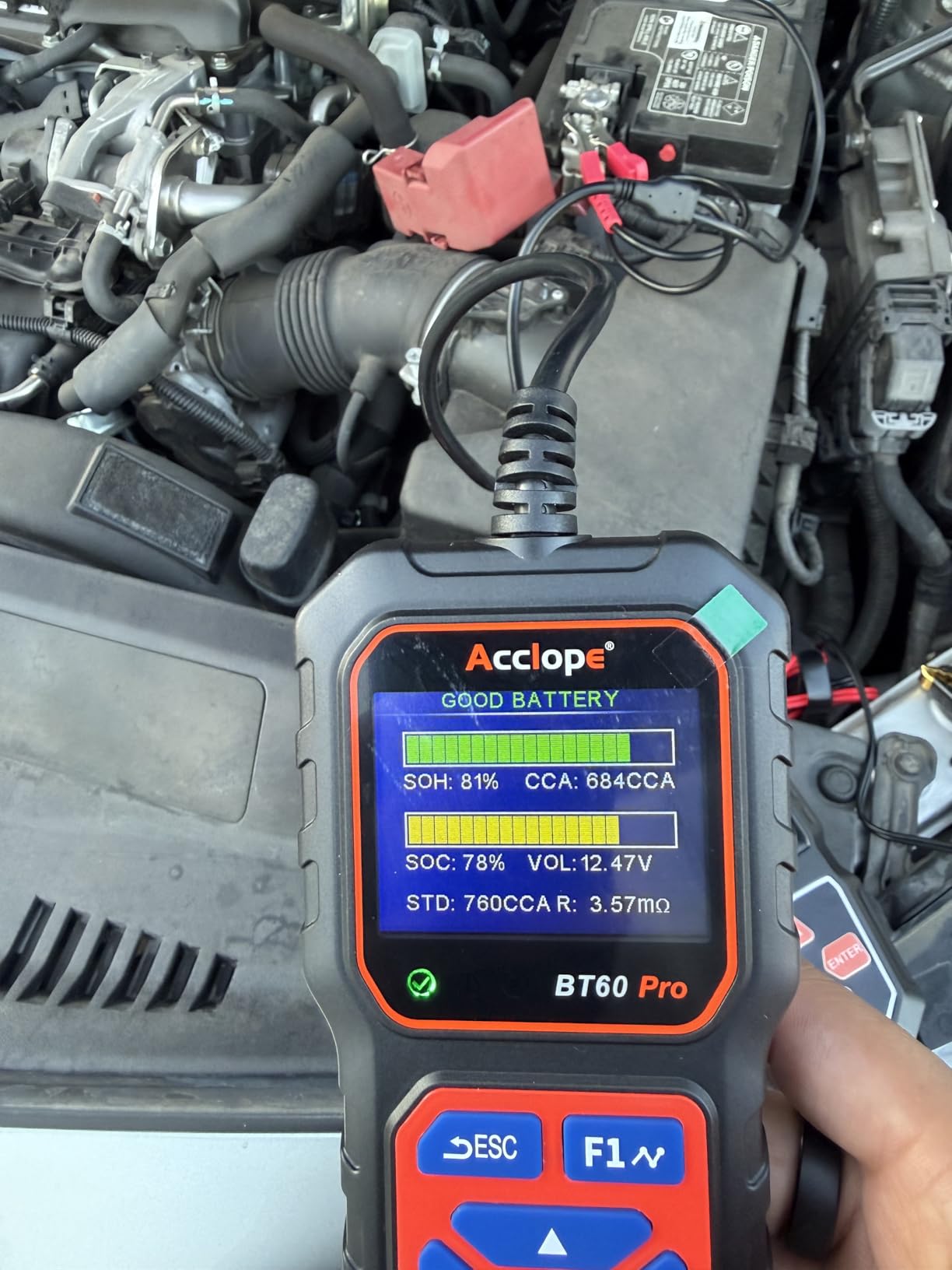
Best for mixed chemistries and shared vehicles: the Acclope BT60 PRO, covering 6V, 12V and 24V from 100 to 3000 CCA with a QR report you can open in a phone browser.
Best durable analog for a mobile workshop: the OEMTOOLS 24338, a 100-amp carbon-pile unit in a steel case with copper-plated clamps.
All six of those are covered in depth below, alongside the remaining four picks, a primer on how load testing actually works, and a step-by-step procedure that will not cook a marginal battery.
The Ten Picks at a Glance in 2026
| Product | Specifications | Action |
|---|---|---|
| TOPDON BT100 |
|
Check Latest Price |
 KONNWEI KW208 KONNWEI KW208 |
|
Check Latest Price |
 ANCEL BA101 ANCEL BA101 |
|
Check Latest Price |
 MOTOPOWER MP0515A MOTOPOWER MP0515A |
|
Check Latest Price |
 Schumacher BT-100 Schumacher BT-100 |
|
Check Latest Price |
 FOXWELL BT705 FOXWELL BT705 |
|
Check Latest Price |
 TOPDON BT200 TOPDON BT200 |
|
Check Latest Price |
 Acclope BT60 PRO Acclope BT60 PRO |
|
Check Latest Price |
 OEMTOOLS 24338 OEMTOOLS 24338 |
|
Check Latest Price |
 OTC 3181 OTC 3181 |
|
Check Latest Price |
Every product in this table is covered individually further down, with the same questions answered for each one: who it suits, who it does not suit, and what the spec sheet leaves out.
Carbon Pile vs Conductance: What a Battery Load Tester Actually Does
These two technologies answer the same question in completely different ways, and confusing them is the most common mistake in this category.
A carbon pile load tester is the traditional instrument. Inside is a resistive element made from compressed carbon, and when you engage it, current really flows out of the battery at a controlled rate. The tester watches the voltage across the terminals while that happens. The classic protocol draws half the battery’s rated cold cranking amps for about fifteen seconds and passes the battery if voltage stays above roughly 9.6V. Some smaller units, like the ones in this roundup, run a shorter 10-second interval at a lower current.
It works because a healthy battery has plenty of stored energy, so pulling hard current barely dents the voltage. A sulfated or aged battery has high internal resistance, so the same draw drags the voltage down hard and fast. You are watching the battery struggle in real time.
A conductance tester does not apply a meaningful load. It sends a small alternating signal into the battery, measures the impedance response, and uses that to calculate measured cold cranking amps. It then compares that against the rated CCA you type in from the case label, and gives you a state of health percentage. Nothing gets hot, no stress is applied, and you can run it on a battery that is nearly dead without consequence.
That sounds like a weakness, and in the lab it is one. In the real world it is a benefit, because a carbon-pile test applied to a nearly discharged battery will push it over the edge. Most shops stopped running true load tests on customer vehicles for exactly that reason.
There is one thing only the analog units give you: starter motor current draw. A healthy starter on a typical car pulls somewhere in the region of 150 to 250 amps. If the draw is far above that, the starter or its wiring is dragging the battery down, and every battery you install in that vehicle will get a shortened life. The Schumacher BT-100 and the OEMTOOLS 24338 both cover that test.
The practical takeaway: for a car in your driveway, buy a conductance tester. For a warranty program, an insurance claim, a fleet inspection, or a classic vehicle registration where a physical load test is demanded, you need the carbon pile unit.
How to Load Test a Battery Without Ruining It
These steps apply to any tester in this roundup, and they are the same steps a technician follows. Skip the first one and you will condemn a healthy battery.
1. Let the battery rest for 20 to 30 minutes. A battery that has just been driven or charged is on surface charge, and every reading you take will be inflated. This is the most common reason healthy batteries get replaced needlessly.
2. Check resting voltage before you connect anything. At 12.6 to 12.8V a 12V lead-acid battery is charged. Around 12.4V is roughly three-quarters, and near 12.2V is about half. Below 11.8V the battery is depleted.
3. Do not run a carbon-pile load test below about 12.4V at rest. A real load on a depleted battery generates heat and can permanently damage plates that might still have recovered with a proper charge. Charge it first, then test.
4. Clean the terminals and seat the clamps properly. Corrosion adds resistance that has nothing to do with the battery. Clamps have to grip bare metal on the post, not the plastic casing. Users on repair forums make this point constantly: testing technology means nothing if the clamps cannot get a firm hold.
5. Choose the right chemistry and rating standard. Select flooded, AGM, EFB or GEL to match the label. Then enter the rated CCA from the case. Get either wrong and the pass/fail verdict is wrong, and a conductance tester has no way to tell you that.
6. Decide whether you are testing in the vehicle or out of it. Battery health can be tested either way. Cranking and charging system tests need the engine running, so stay connected.
7. Run the test and read the result against the threshold. For a carbon pile test, above about 9.6V at the end of the load interval is a pass. For a conductance test, read the state of health percentage and the measured-versus-rated CCA comparison.
8. Wear eye protection, and keep flames away. A charging lead-acid battery vents hydrogen, and a carbon pile test makes it vent more. Reverse-polarity protection is worth having, but it is not a substitute for checking which clamp is which.
1. TOPDON BT100 Review
TOPDON BT100 12V Car Battery Tester, Automotive Battery Load Tester
100-2000 CCA
12V only
Battery, cranking and charging tests
Flooded, AGM, EFB, GEL
Pros
- Covers battery cranking and charging tests in one unit
- Works on cars motorcycles trucks RVs boats and golf carts
- Copper clamps with reverse-polarity and spark protection
- 9 ounces and 5.3 by 3 by 1 inches
Cons
- Menu-driven interface takes some practice Conductance readings can be approximate against a bench load test
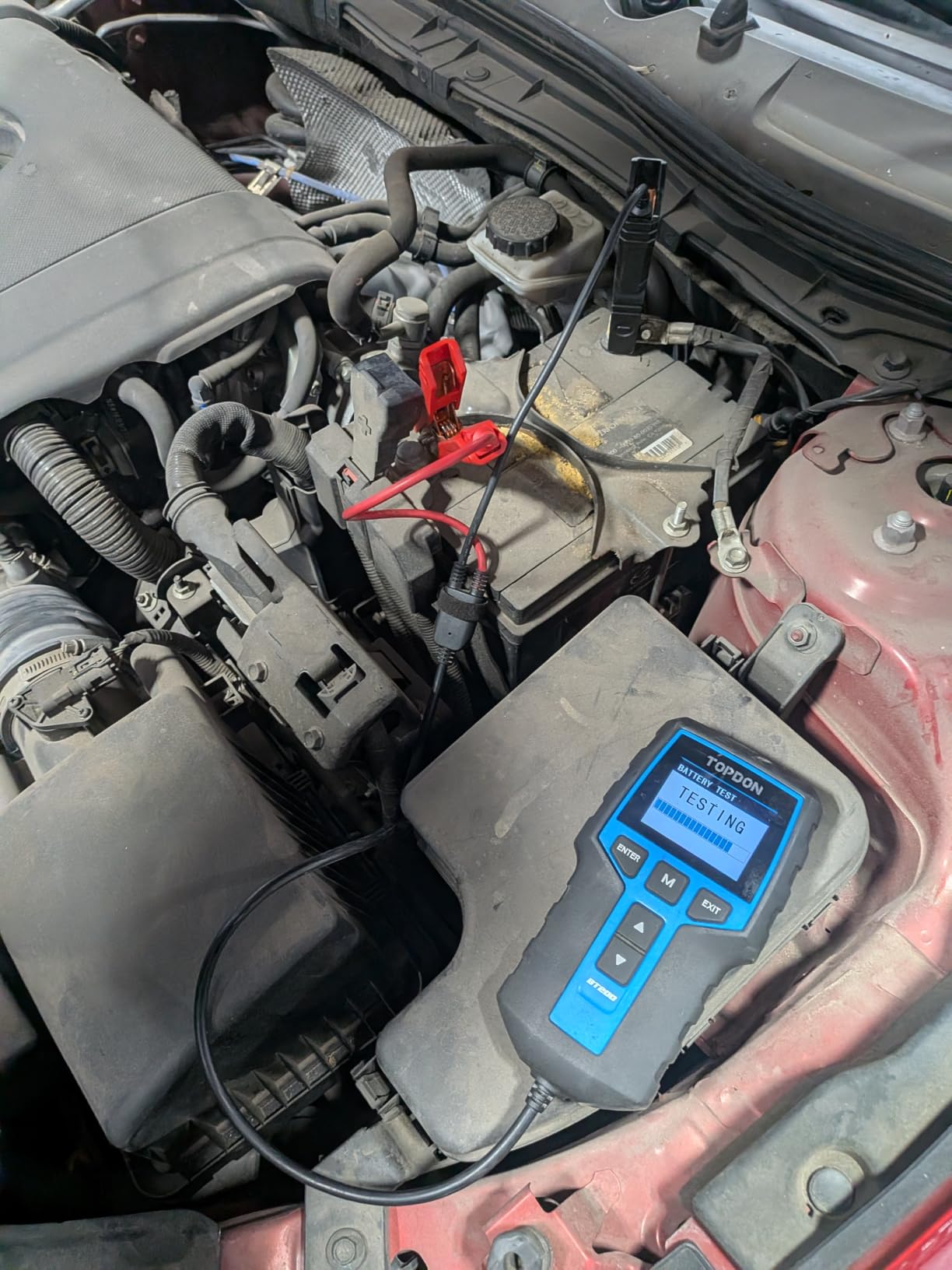
This is the unit we keep coming back to. Three test modes in one body, a 100 to 2000 CCA range that covers everything from a small scooter pack to a big truck battery, and a form factor that genuinely disappears into a glove box at 9 ounces and a little over five inches long.
It draws its operating power from the battery under test, which sounds odd until you realise what it means in practice: there is no internal rechargeable cell to maintain, nothing to go flat in storage over winter, and you can clamp it onto a nearly dead battery and it will still power up.
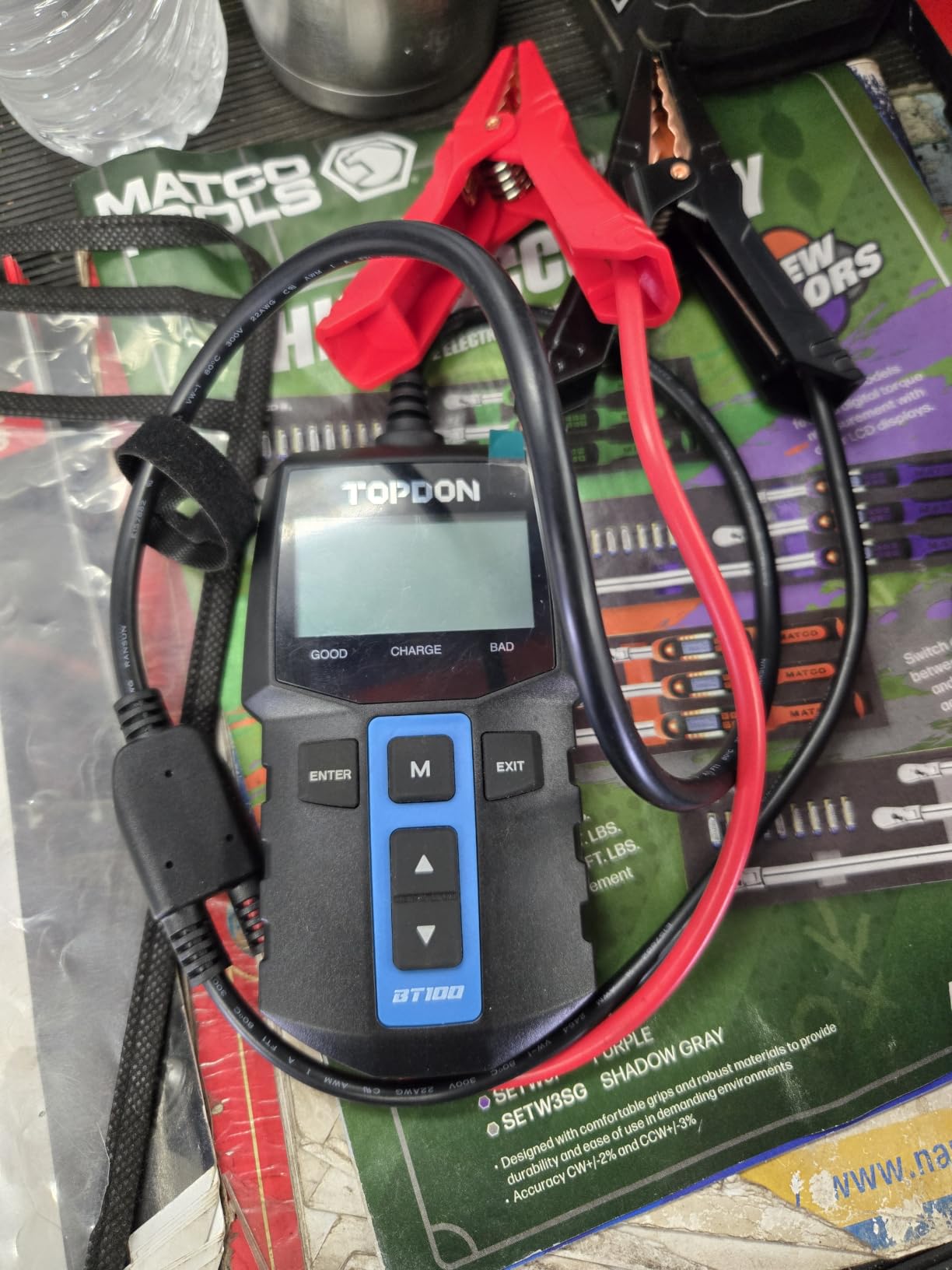
Reviewers consistently mention how fast the workflow is once you know it. Clamp on, pick battery health or cranking or charging, read the three-colour LED status, done. The copper clamps are a genuine step above the plastic jaws on cheaper units, and the polarity reverse prevention and spark-proof design are not just marketing copy.
One honest limitation: this is a menu-driven interface, and the first session takes longer than it should. Owners also note that conductance readings sit slightly apart from a bench load test, which is expected. If you need a signed physical load result for a warranty claim, this is the wrong tool.
Who this tester suits
Any driver with a 12V car, SUV, motorcycle, boat, RV, golf cart or lawn mower who wants a quick answer to one question: is the battery still good, and is the charging system keeping up. The range of vehicle types listed for it is not marketing padding; the same three tests work across all of them.
It also suits anyone who plans to keep a tester in the car permanently. The 30-day return window and 12-month customer service give some comfort, and the three-colour LEDs mean you can get a verdict without learning the whole menu in advance.
Who should skip it
If you work on 24V trucks or buses, move up to the FOXWELL BT705. If a club, fleet operator or insurer requires a documented physical load test, you need an analog carbon-pile unit instead.
It is also 12V only, which rules out 6V classic cars and 24V systems outright. And owners consistently flag the manual as thin, so budget a few minutes of setup learning before your first real diagnosis.
2. KONNWEI KW208 Review
KONNWEI KW208 12V Car Battery Tester, Battery Load Tester Automotive 12V Alternator Starter Tester Digital Auto Battery Analyzer Charging Cranking System Tester for Car Truck Marine Motorcycle Boat
100-2000 CCA
12V only
Reports resistance, CCA and Ah
8 menu languages
Pros
- Largest review pool in the category at more than 8100 reviews
- Reports internal resistance
- Ah capacity and cold cranking amps Plug-and-play
- powers on when the clamps attach
- Switchable between 8 languages
Cons
- Instruction manual is thin and printed small Results depend on entering the correct CCA and battery type
- Some owners report the clip hinge cracking after about a year
This is the value pick, and the review numbers back that up: more than 8,100 ratings at 4.5 stars is the widest sample in the category. That matters in a field where a tool lives in a garage for years and gets used in bad light with dirty hands.
What sets it apart from the bare-bones analyzers is reporting depth. Alongside state of health and state of charge, it gives you internal resistance, measured cold cranking amps, and Ah capacity. Internal resistance in particular is the number that moves early on a battery that is dying slowly, well before the cranking amps fall off a cliff.
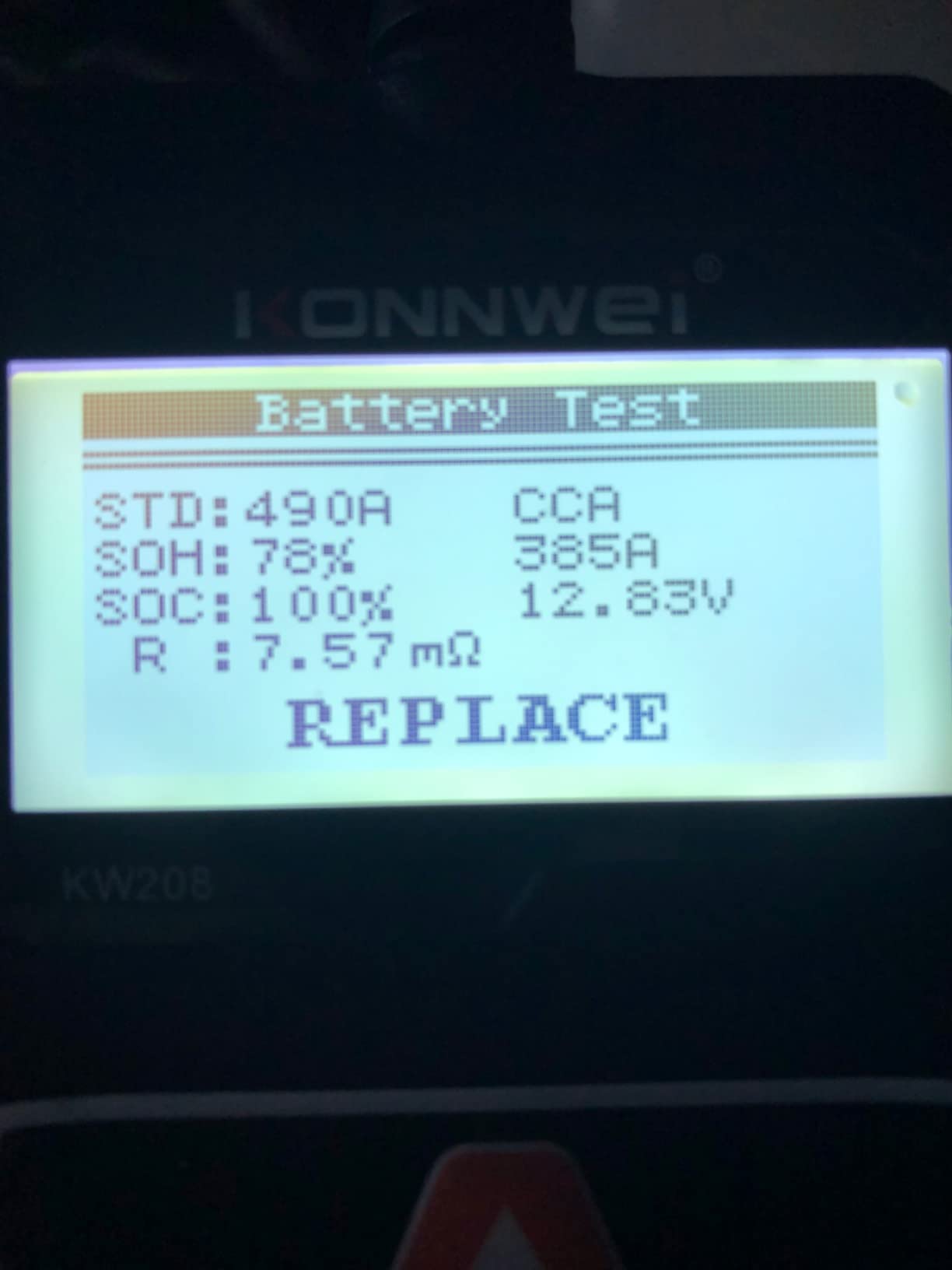
It also runs cranking and charging system tests with a starter and alternator check, and it can be switched between up to eight menu languages. The battery clips were updated to galvanized alloy in a recent revision specifically for durability and contact quality, which is the fix for the most common complaint about cheap testers.
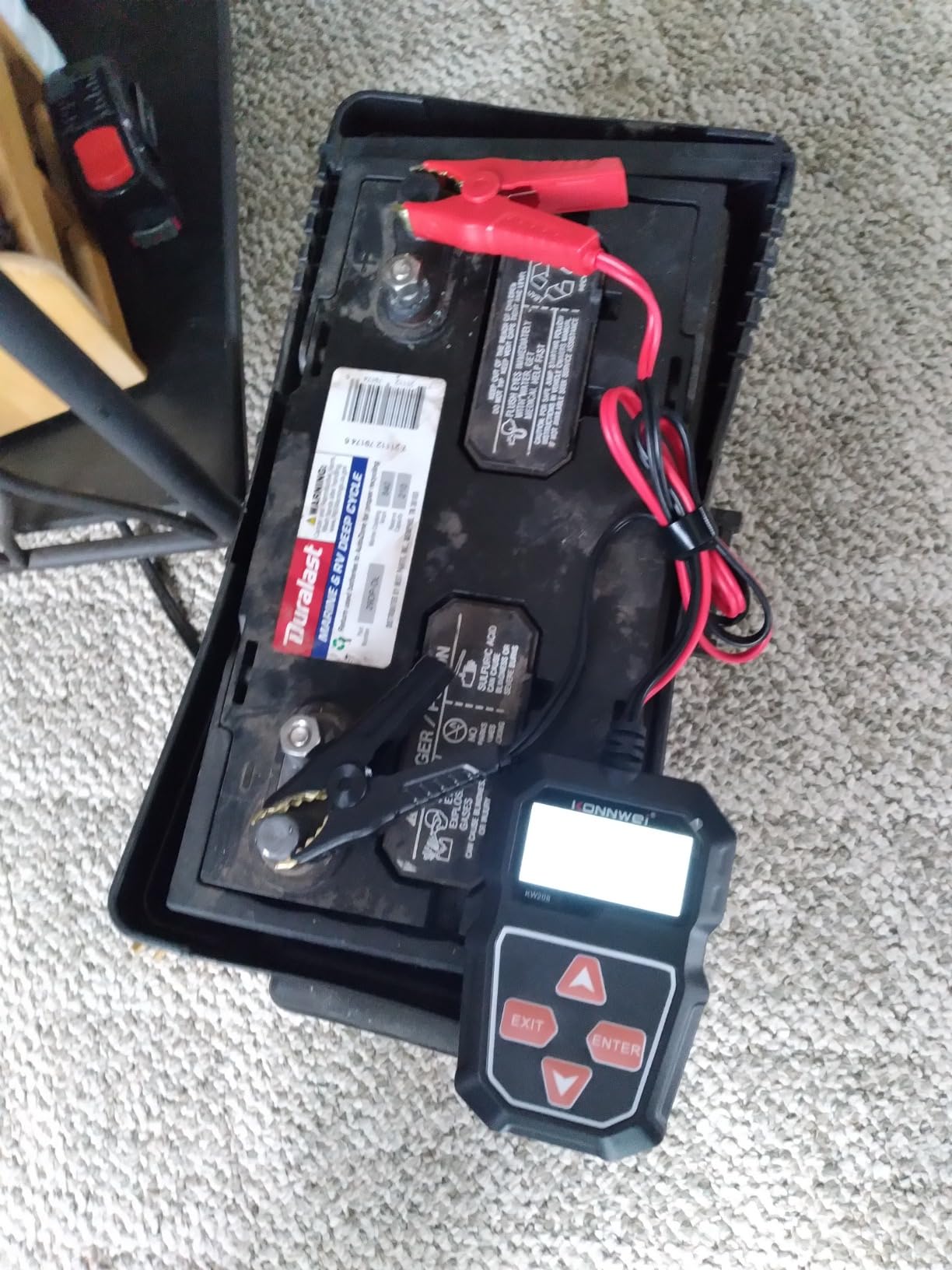
No internal battery, no charging, no storage anxiety. It powers on the moment the clamps make contact, whether the battery is in the vehicle or sitting on the bench, and it works on a dead one.
Who this tester suits
Home mechanics and everyday drivers who want more than a pass or fail verdict without paying for a shop-grade unit. The claimed accuracy above 99.7% comes from a smart chip, and in practice owners report it reliably identifies clearly bad batteries, which is the failure mode that actually strands people.
It suits anyone working across several vehicles of different chemistries, since it covers regular flooded, AGM flat plate, AGM spiral and gel. The multilingual menu is a real convenience in mixed shops.
Who should skip it
Testing a hybrid battery through remote underhood jump-start posts can produce a false BAD verdict, a complaint that shows up repeatedly. Test the battery directly at its terminals instead.
Results also depend entirely on entering the right CCA and battery type, and the thin, small-print manual makes that learning curve steeper than it should be. There is no 24V support, and if you need starter draw measurement, this is not the tool.
3. ANCEL BA101 Review
ANCEL BA101 Car Battery Tester, 12V Digital Automotive Alternator Meter Diagnostic Tool,100-2000 CCA Load Capacity, Charging & Cranking Analyzer for Truck, Boat, RV, Marine Vehicle, and More
12V batteries over 30Ah
8 rating standards
SOH, SOC, CCA and resistance
4-in-1 protection
Pros
- Ranks first in the Battery Testers category Supports JIS EN DIN SAE BCI GB CA MCA and IEC
- Reports internal resistance alongside voltage Backlit display with adjustable contrast
- 4-in-1 protection including reverse polarity
Cons
- Instructions are poorly written Settings menus are confusing with many capacity options Not compatible with lithium or 6V
- 8V and 24V systems
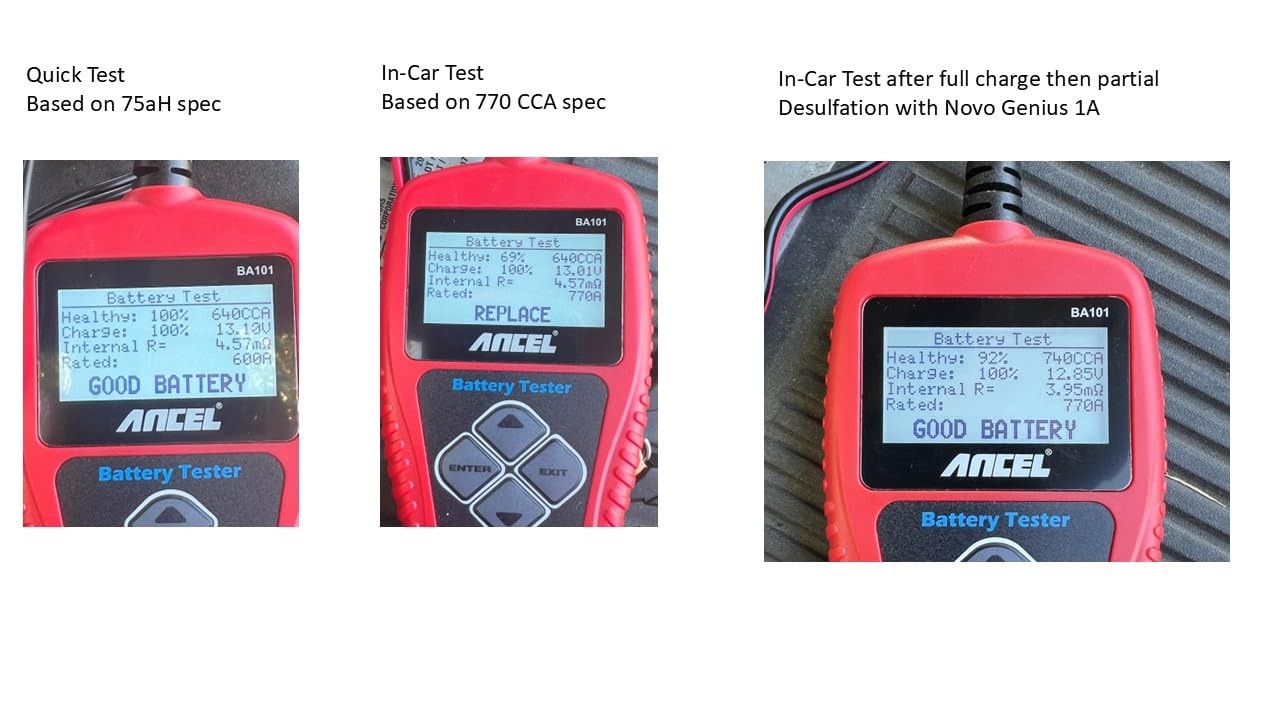
The BA101 is the broadest in terms of rating standards, covering JIS, EN, DIN, SAE, BCI, GB, CA, MCA and IEC. That list is the reason to buy this one if your vehicles carry European or Japanese labels, because the thresholds behind each standard differ and a tester set to the wrong one will return a wrong verdict.
It tests flooded, AGM, GEL and EFB batteries over 30Ah and reports state of health, state of charge, voltage, current, cold cranking amps and internal resistance. Battery, cranking and charging system tests all work with the battery in the vehicle or out of it.
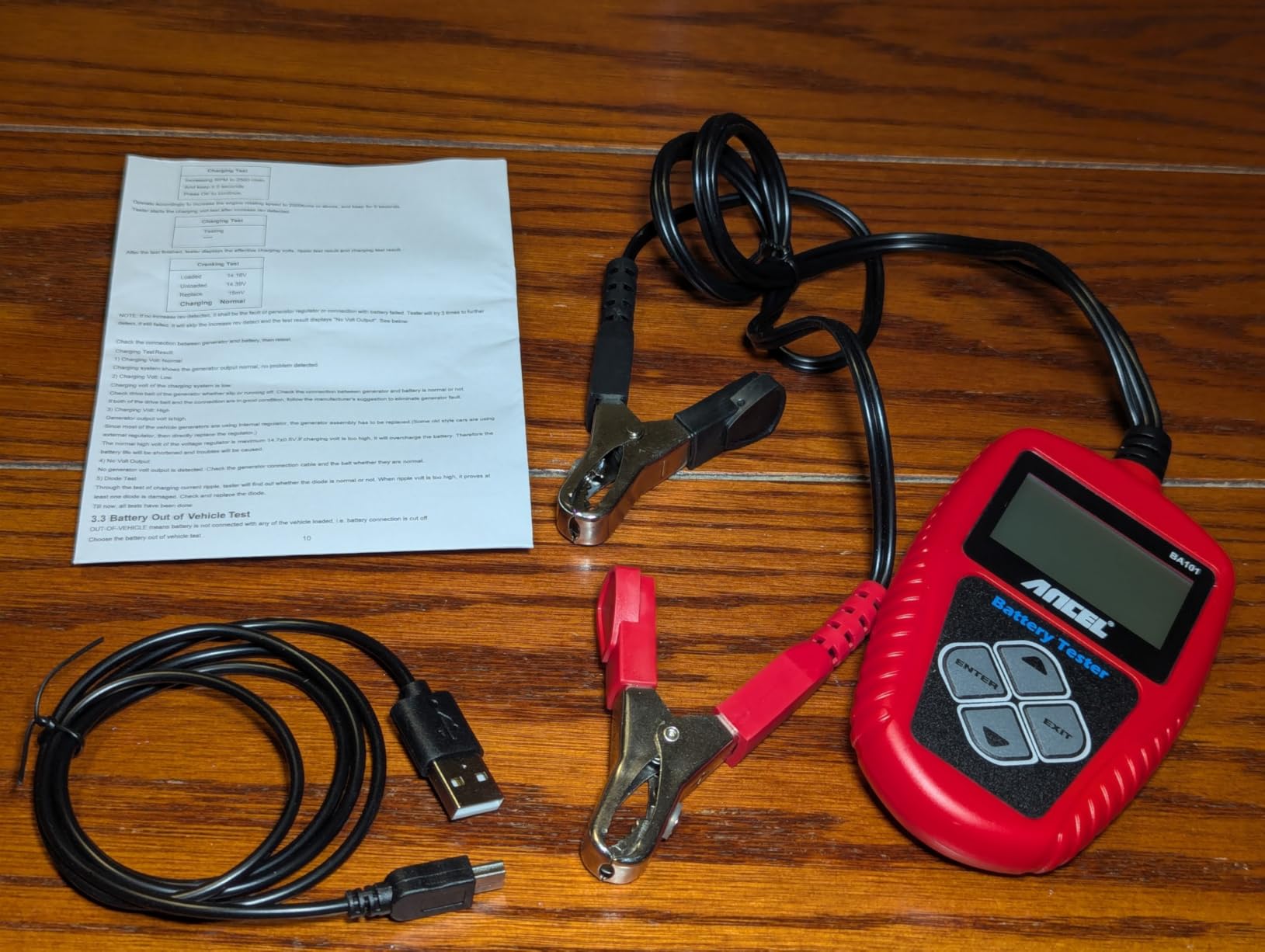
Build quality is a notch above the entry digital units. The housing is 3x reinforced ABS, the crocodile clips are copper, and there is 4-in-1 protection against reverse polarity, short circuit, overcurrent and overvoltage. Owners also like the backlit black-and-white screen with adjustable contrast, which is genuinely readable in a dark engine bay.
The 12-month warranty is standard rather than generous, but the review volume, at more than 4,700 ratings, is the third largest here, and 75% of owners gave it five stars.
Who this tester suits
Technicians who service mixed fleets where battery labelling is not uniform. If you have a shop with a European car one bay over a Japanese one, the rating standard coverage is the differentiator rather than any single extra feature.
It also suits anyone who wants a quick test with a cable, a screen and one hand, and who values clamp and housing quality over menu features. The backlight and one-handed operation make roadside and parking-lot testing practical.
Who should skip it
Do not buy it for a 12V lithium starter pack, a 6V classic car, or any 24V system. The listing is explicit that it is not compatible with lithium batteries or 6V, 8V and 24V systems.
The most common complaint is documentation. The manual is thin, and the number of battery capacity and rating options makes the settings menus confusing enough that owners recommend looking up the right values separately. The quick test on its own will not settle a marginal battery either.
4. MOTOPOWER MP0515A Review
MOTOPOWER MP0515A 12V Car Battery Tester Automotive 100-2000 CCA Battery Load Tester Auto Cranking and Charging System Tester
100-2000 CCA
12V only
Digital analyzer format
Cranking and charging tests
Pros
- 4.6 stars across more than 4300 reviews
- Ranks third in the Battery Testers category
- Covers battery cranking and charging checks
- 5.91 by 3.35 by 0.91 inches suits glove-box storage
Cons
- Handheld analyzer cannot apply a true carbon-pile load
- Menu-driven interface with limited on-screen detail
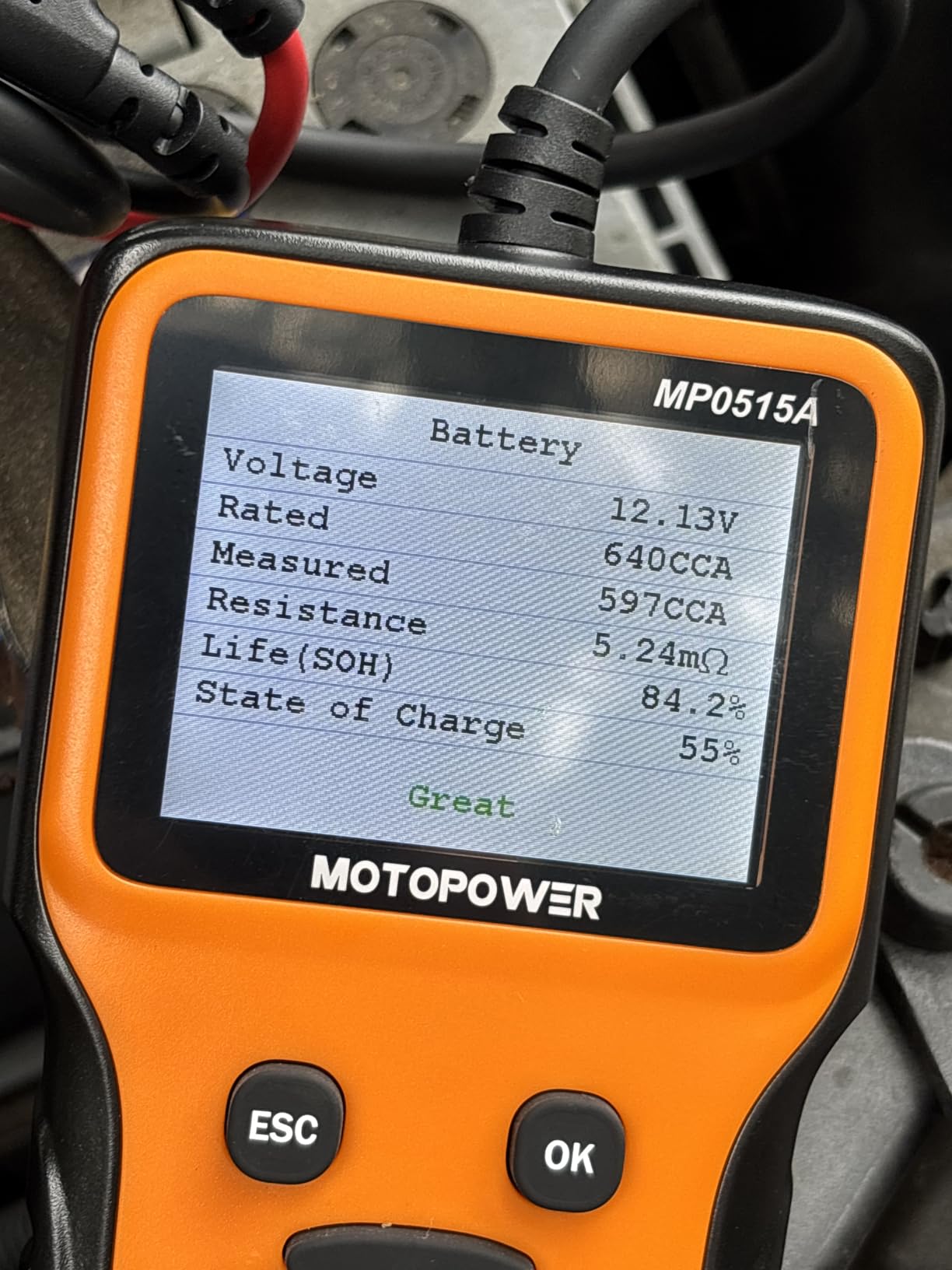
This is the no-fuss option: a 12V digital analyzer covering 100 to 2000 CCA with cranking and charging system tests, and not much else. That restraint is the point. There is no printer, no cloud reporting, no multi-language menu, and no screen you need to study.
At 4.6 stars from more than 4,300 reviews, with 80% five-star, it is one of the best-rated units in the lineup. People like it because it does the three standard tests and gets out of the way.
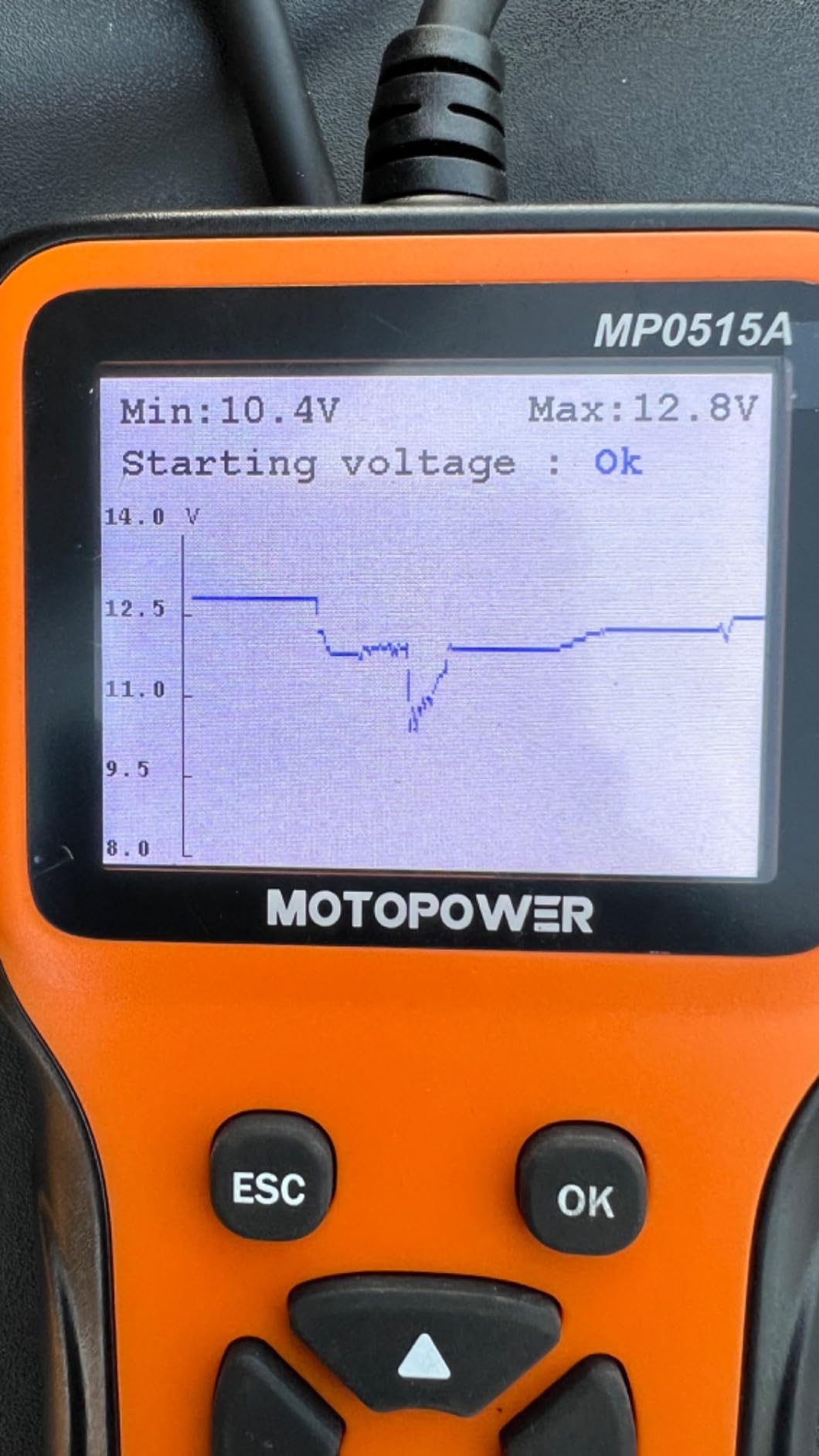
The form factor is genuinely pocketable. At 5.91 by 0.91 by 3.35 inches and 11.99 ounces, it slides into a toolbox drawer or a centre console without becoming one more thing that does not fit.
What you give up by keeping it simple is diagnostic resolution. There is no internal resistance readout, no Ah capacity, and no chemistry or rating standard selection in the published spec. The display gives you limited detail, and the menu is the only way to navigate.
Who this tester suits
Drivers who want one reliable answer: is the battery holding charge, will the starter crank, and is the alternator keeping up. That is a complete triage of a no-start complaint, and for most people it is enough.
It also suits anyone who does not want to configure anything before each test, or who is working on motorcycles, cars and small powersports where a lightweight handheld is easier to manage than a bench unit.
Who should skip it
It cannot apply a true carbon-pile load, so it will never satisfy a warranty programme or an insurer that asks for a physical load test result. Anyone needing 24V, 6V or lithium support should look elsewhere in this list.
And if your workflow depends on internal resistance or capacity figures, or on documented reports for a battery sales counter, the limited spec set is a real limitation. A shop doing serious triage will find it too thin.
5. Schumacher BT-100 Review
Schumacher Electric Battery Load Tester, 6V/12V – BT-100
Analog carbon pile
6V and 12V
1000 CA
Three tests including starter draw
Pros
- Applies a genuine load instead of inferring one
- Handles 6V and 12V up to 1000 CA
- Measures starter motor draw
- Top-mounted rocker switch and visible analog meter
- Schumacher has built automotive power products since 1947
Cons
- Requires manually timing the load interval
- Analog meter is less precise than a digital readout
- Heavier and larger than handheld digital testers
This is the one most roundups leave out, so it deserves an explanation. The head keyword is battery load tester, and this is the thing that phrase originally meant. When you engage the rocker switch, current really flows out of the battery through a carbon-pile resistor, and the needle on the top-mounted meter shows the voltage sagging in real time.
It runs three tests from one device: battery health, charging system performance, and starter motor draw. That third test is the reason professional technicians have kept analog units for decades. Nothing digital in this roundup measures how much current the starter is actually pulling, and a starter drawing too much is a genuine failure mode that shortens every battery you fit afterwards.
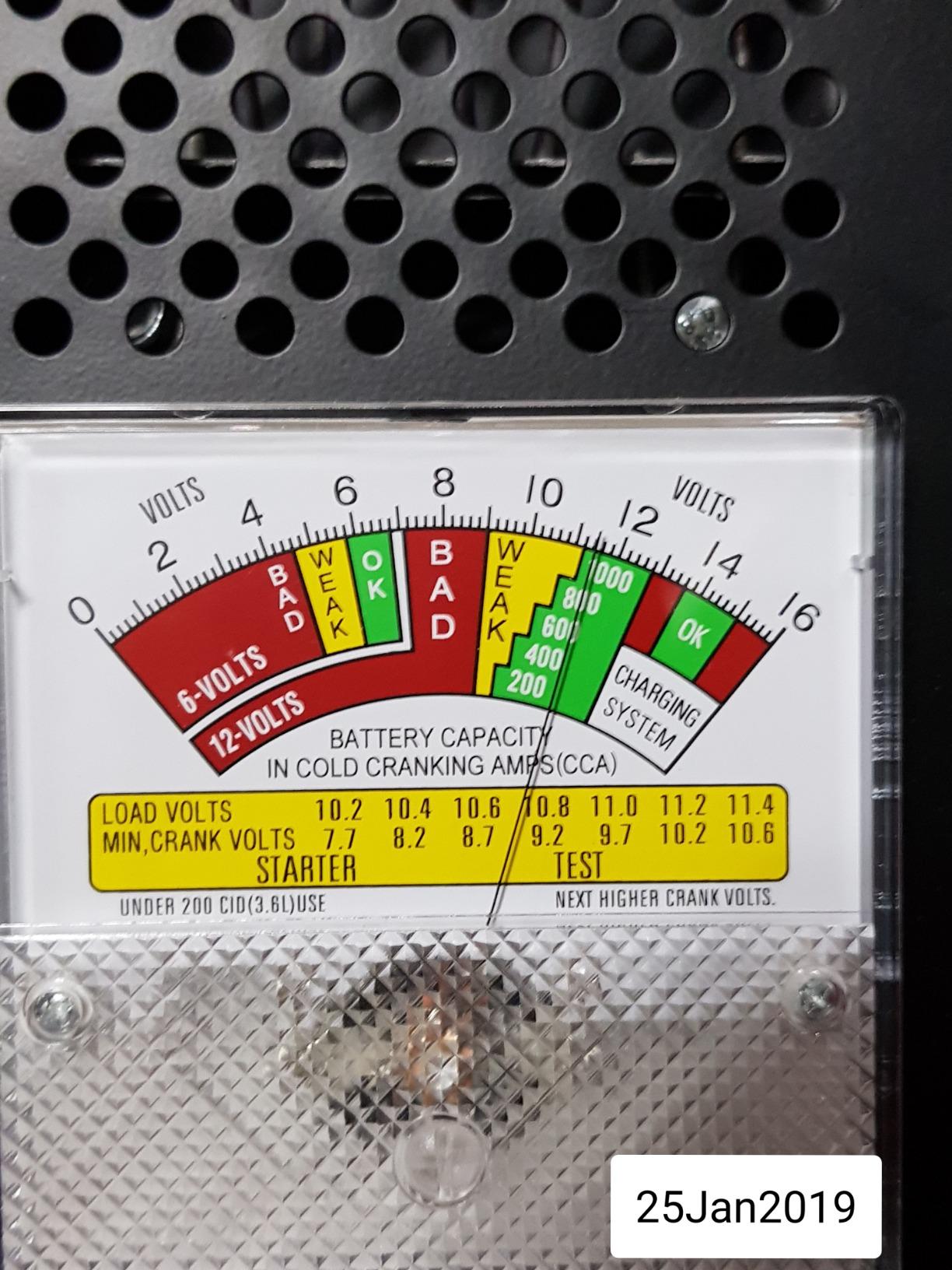
It handles 6V and 12V batteries up to 1,000 CA, with a 50-amp load test at 6V and 100 amps at 12V. That 6V capability matters more than it sounds, because 6V cells still live in golf carts, lawn tractors and classic cars.
Compatibility runs from motorcycles and ATVs through lawn tractors, cars, boats, light trucks and RVs, on both gas and diesel. At 2 pounds it is heavier than a digital handheld, but the top-mounted switch and highly visible analog meter are easy to read while the unit is in your other hand.

Who this tester suits
Owners of classic and vintage vehicles, who are exactly the group most likely to still need a physical load test for registration, club or insurance purposes. They also tend to want a tool with no software and no settings to misconfigure.
It suits mobile mechanics and anyone diagnosing a starting complaint, because battery, charging system and starter draw in a single ten-second-plus check is a fast triage. Reading a needle while your hands are on the tool is also a genuinely simple workflow once you have done it twice.
Who should skip it
You need to time the load interval yourself, and there is no digital record of what happened afterwards. If you need a printed report for a customer, a CCA number you can look up later, or a chemistry profile, look at the digital units.
And if you work on 24V trucks, the 1,000 CA ceiling and 6V/12V-only design rule it out. The 2-pound weight is real if you are working in a tight boat or RV battery compartment.
6. FOXWELL BT705 Review
FOXWELL BT705 Car Battery Tester 24V 12V, Alternator and Load Tester
12V and 24V
100-2000 CCA
5.9 ft cable
2.8 inch guided screen
Pros
- Only unit here covering both 12V and 24V systems
- 5.9 ft cable lets you crank test from the driver seat
- Step-by-step guided prompts on a 2.8 inch screen
- GOOD RECHARGE and REPLACE verdicts are easy to read
- Hard carrying case and durable clamps included
Cons
- Costs more than entry-level digital testers
- Conductance readings are inferred rather than a true full load test
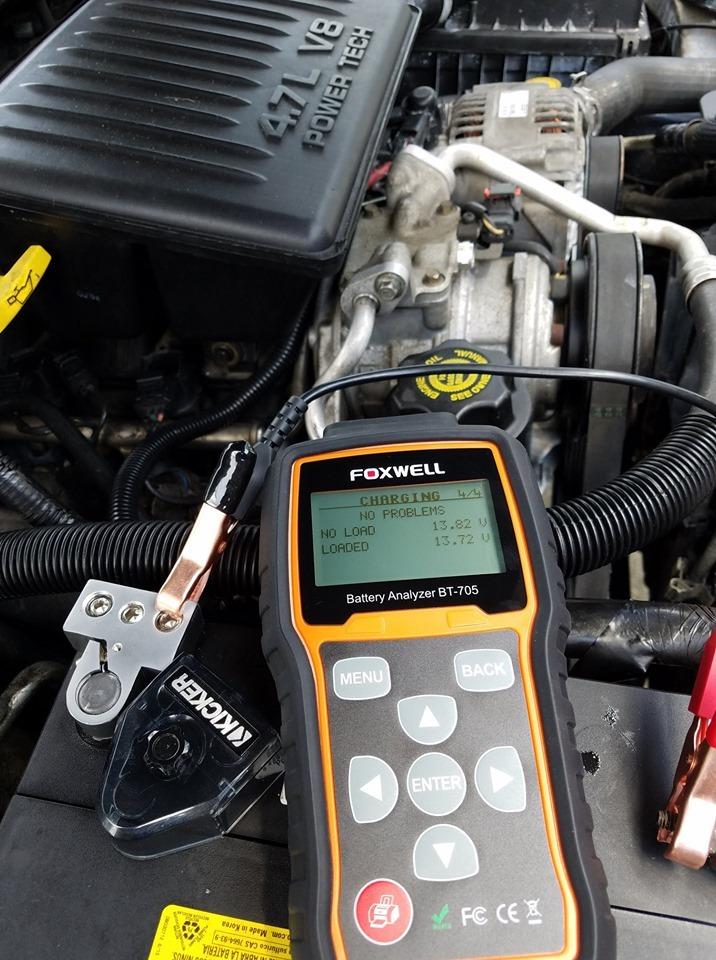
Every truck, bus and RV owner should look here first. The BT705 is the only unit in this roundup that covers both 12V and 24V systems across a 100 to 2000 CCA range, which means one tool covers a mixed fleet instead of two.
The 5.9 ft cable is the sleeper feature. It is long enough to reach from a battery under a truck bed or in a bus bay all the way to the driver seat, so you can run a cranking test alone: clamp on, start the engine, and read the cranking voltage and cranking time from the cab. That turns a two-person job into a one-person job.
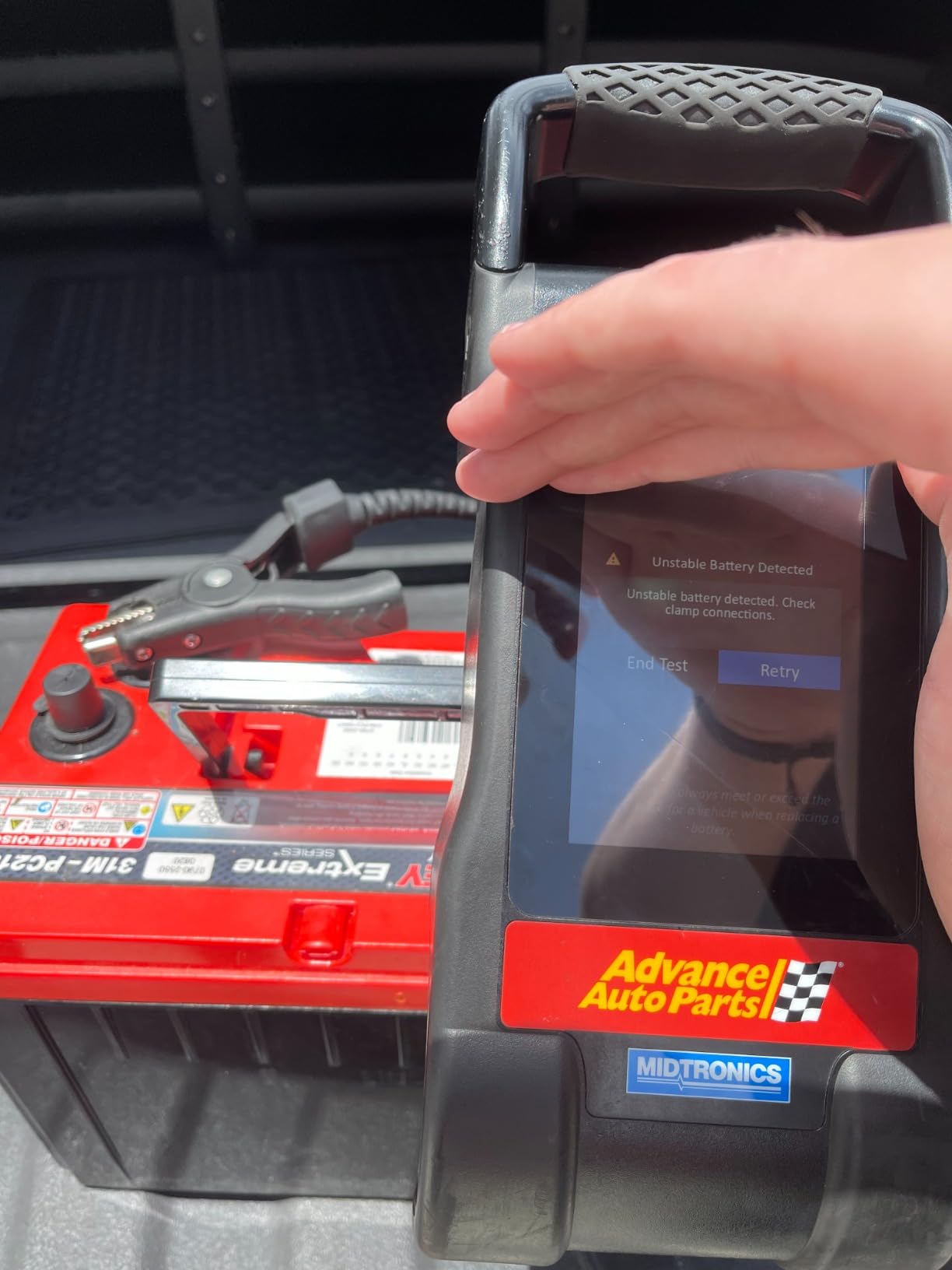
It checks CCA, voltage, internal resistance and state of health, including at 32F. Getting a usable reading at cold temperatures matters in northern climates, where a marginal battery passes in July and fails in January.
The 2.8-inch screen walks you through each step and then summarises the verdict as GOOD, RECHARGE or REPLACE. That matters for first-time users, because a raw number without context is not a diagnosis. It covers flooded, AGM, GEL and EFB lead-acid types including start-stop applications, and the hard carrying case is a nice touch for a shop.
Who this tester suits
Diesel shops, mobile mechanics and anyone running a fleet with a mix of 12V cars and 24V trucks. It is the practical choice here because the 24V coverage is real rather than a menu option that exists on paper.
It also suits one-person cranking diagnostics and cold-climate work. The 24-month warranty is the longest in this lineup, which is a fair signal of manufacturer confidence.
Who should skip it
It is conductance-based, so a verdict is inferred from an impedance measurement rather than from a real applied load. If a warranty programme or an insurer requires a physical carbon-pile result, this does not satisfy it.
It also carries a 325 g weight and a larger footprint than the pocket units, so it is not the glove-box choice. And 6V classic car batteries and 12V lithium packs are outside its stated range.
7. TOPDON BT200 Review
TOPDON BT200 Car Battery Tester, 12V/24V, 100-2000 CCA Load Tester
12V and 24V
100-2000 CCA
-4F to 140F
2.4 inch color LCD
Pros
- Color LCD readable in direct sunlight
- Works from -4F to 140F for winter and cold-morning checks
- Last-test memory recalls your previous test
- Covers 12V and 24V plus deep-cycle batteries
- 12-month guarantee with 30-day returns
Cons
- Does not test LiFePO4 lithium batteries
- Health percentage is inferred and shifts with charge state
- Cannot test converter output on a camper or trailer
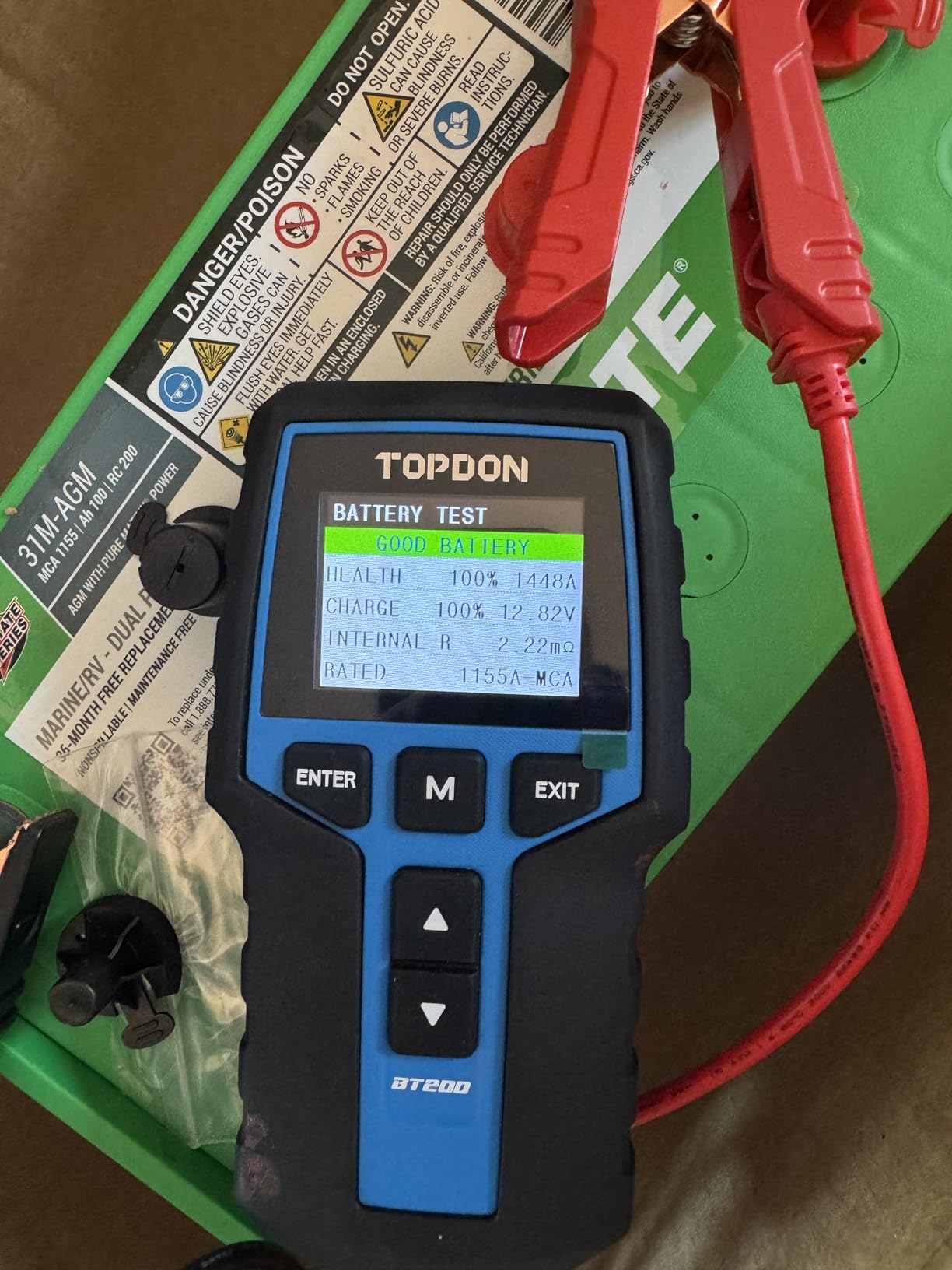
The BT200 is the BT100 with more reach: 24V support, a colour screen, cold-weather operating range and memory. If you liked the BT100 idea and wanted more headroom, this is the same idea with fewer compromises.
The temperature rating is the headline. It operates from -4F to 140F, which covers the whole range from a frozen morning battery check to a summer roadside test. Combined with a 2.4-inch colour LCD that stays readable in direct sunlight, it is a good choice for anyone diagnosing vehicles outdoors.
The last-test memory is small but genuinely useful. Re-entering rated CCA and temperature for every battery on a job gets old fast, so recalling the previous test saves real time on repeat work.
Conductance accuracy is claimed at 99.9% across 100 to 2000 CCA for both 12V and 24V batteries, and it covers regular flooded, AGM, GEL and deep-cycle types. Copper clamps and a rugged housing are upgrades over the BT100, and owners report units running three years without trouble.
Who this tester suits
Anyone in a cold climate doing early-morning or pre-winter checks, and anyone whose work spans 12V and 24V vehicles. The deep-cycle coverage also makes it more useful for RV and marine dual-battery work than a starter-focused tester.
It suits technicians who test the same vehicles repeatedly, because the memory function turns a five-step setup into a one-step one on the second visit.
Who should skip it
It will not test 12V LiFePO4 lithium starter packs, and that segment is growing fast. Owners also note that testing a camper or trailer converter output is out of scope, since there is no engine to crank.
The health percentage is an inference, so it can shift after charging or sitting. Treat it as a directional figure and confirm anything borderline with a real load test rather than quoting the number to a customer.
8. Acclope BT60 PRO Review
Acclope BT60 PRO 2–120Ah Battery Tester 6V/12V/24V 100–3000 CCA QR Report
6V, 12V and 24V
100-3000 CCA
2-120Ah
QR cloud report
Pros
- Widest voltage coverage here at 6V 12V and 24V
- Handles 100-3000 CCA and 2-120Ah
- QR cloud report opens in a phone browser with no app
- Built-in LED on the clamps for dark spaces
- Dedicated 6V motorcycle mode and 12 languages
Cons
- Repeat tests on the same battery can vary
- LiFePO4 CCA figures are not guaranteed
- Not a carbon-pile load tester
- Cannot read or clear OBD2 codes
This is the most chemically flexible unit in the roundup. It runs 6V, 12V and 24V, covers 100 to 3000 CCA and 2 to 120Ah, and works across lead-acid, AGM, GEL, EFB, deep-cycle and lithium. If your garage holds a motorcycle, a car, a boat and a truck, one tool covers all of it.
The 6V motorcycle mode is its own menu entry rather than a manual voltage override, which sounds trivial until you have had to convince a general-purpose tester to read a golf cart pack.
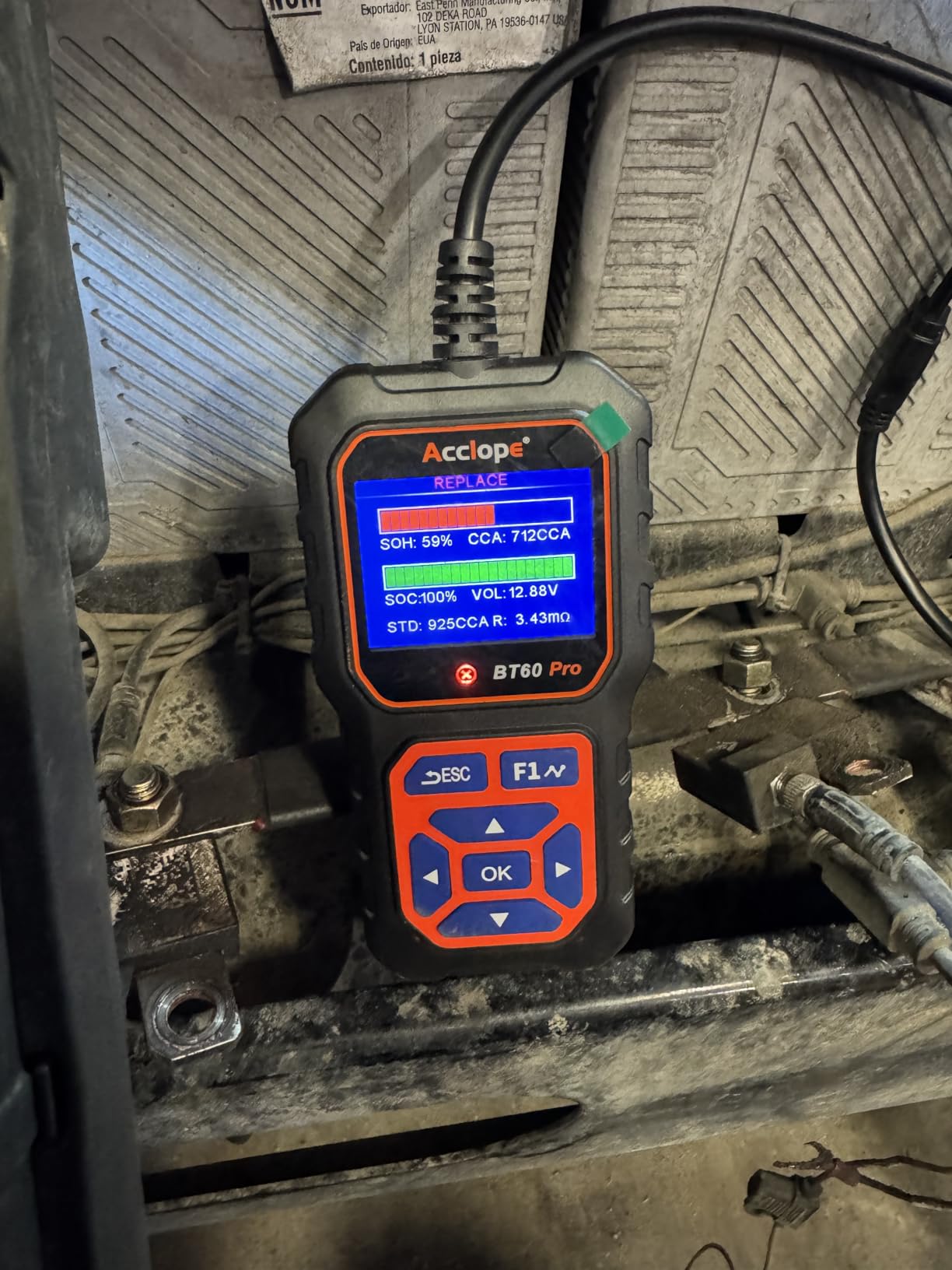
The QR cloud report is the standout feature. You scan a code and the results open in a smartphone browser, no app required, and they can be printed or shared. For a mobile mechanic sending evidence to a customer or a warranty provider, that is worth more than another screen mode.
Other details that show real use: wide-mouth clamps with a built-in LED for tight or low-light engine bays, a 3.2-inch HD screen with 12 languages, and reverse-connection and short-circuit protection. The listing is unusually candid, stating plainly that it is not a carbon pile load tester and that the USB port is for firmware updates only, not charging.
Who this tester suits
Multi-vehicle households, mobile mechanics and small shops that test more than one kind of machine. The 24-month customer service window and a documented history of replacing a dead-on-arrival unit at seller expense are reasonable signals of support.
It also suits anyone who wants a shareable record of each test without a thermal printer, and anyone working on 12V lithium packs, with the caveat below.
Who should skip it
Lithium support is partial. For LiFePO4 you get voltage and health checks, but the CCA figure is explicitly not guaranteed, so do not quote it as a capacity measurement.
Repeat readings on the same battery can vary somewhat, which matters if you are judging a borderline case. It is also conductance-based only, it will not read or clear OBD2 fault codes despite the multi-function marketing, and 48V systems are out of scope.
9. OEMTOOLS 24338 Review
OEMTOOLS 24338 Battery Load Tester, Battery Tester 12V Automotive, Easy-to-Read Car Battery Tester, Heavy Duty Clamps, Shock Resistant Meter, Housed in Sturdy Steel Case
Analog carbon pile
6V and 12V
1000 CCA
Steel case with handle
Pros
- True analog carbon pile test in about 10 seconds
- Sturdy steel case with a carry handle for mobile work
- Copper-plated heavy duty clamps
- Reports state of charge cranking volts and charging performance
Cons
- Reads low on small low-CCA batteries such as lawn mower packs
- Less accurate at 6V and on deep-cycle than on 12V automotive
- Load coil runs hot and needs to cool between tests
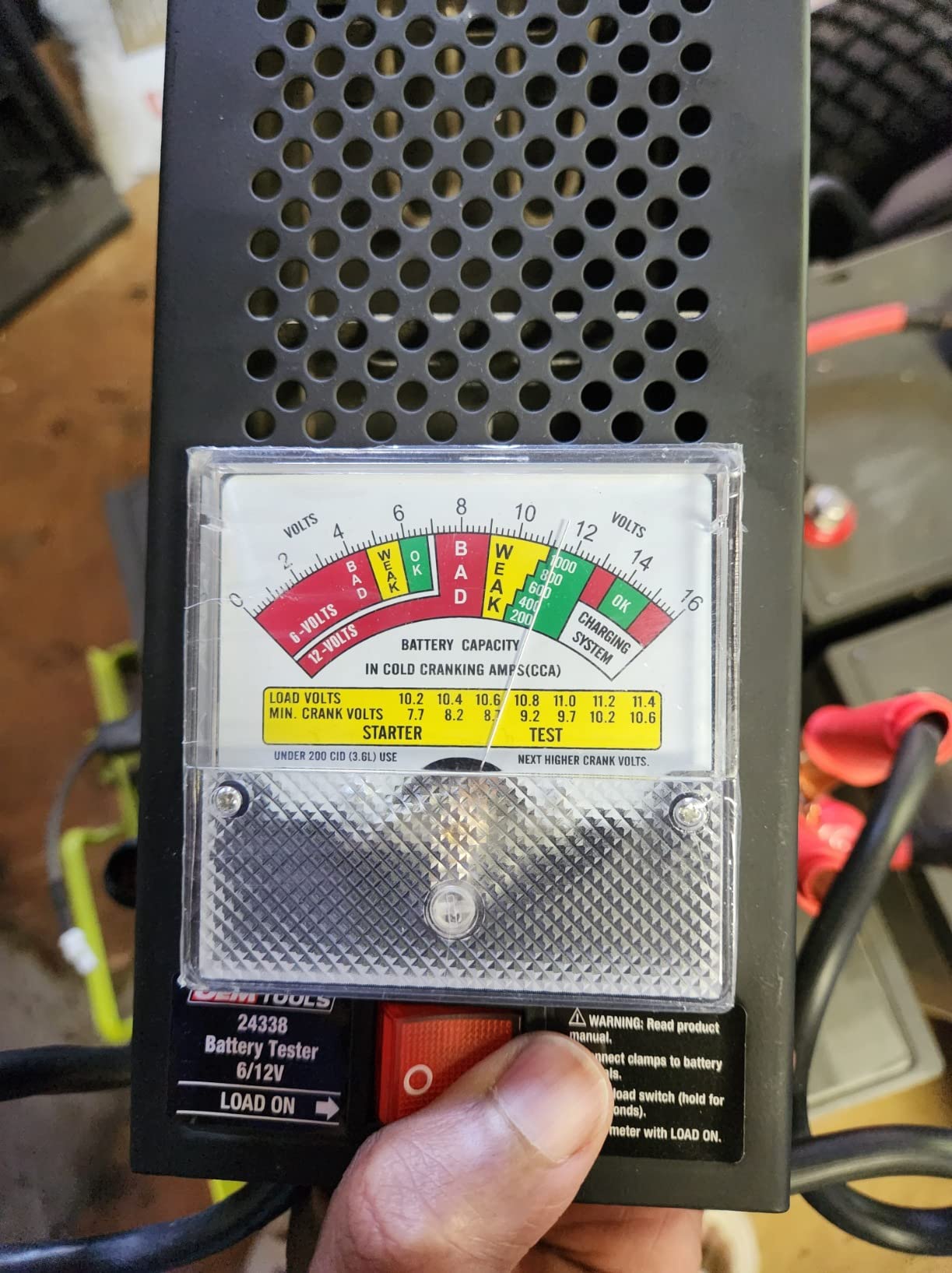
The second carbon-pile option here, and the one built for a mobile workshop. It is a true analog load tester that gives results in about ten seconds, works on 6V and 12V batteries up to 1,000 CCA including deep-cycle and automotive types, and can test with the battery on or off the vehicle.
The housing is the story. A sturdy steel case with a carry handle and shock-resistant construction means it survives being thrown in a van, which is not true of the plastic cases on most budget testers. The copper-plated heavy duty clamps are designed to hold a secure connection in all climates.
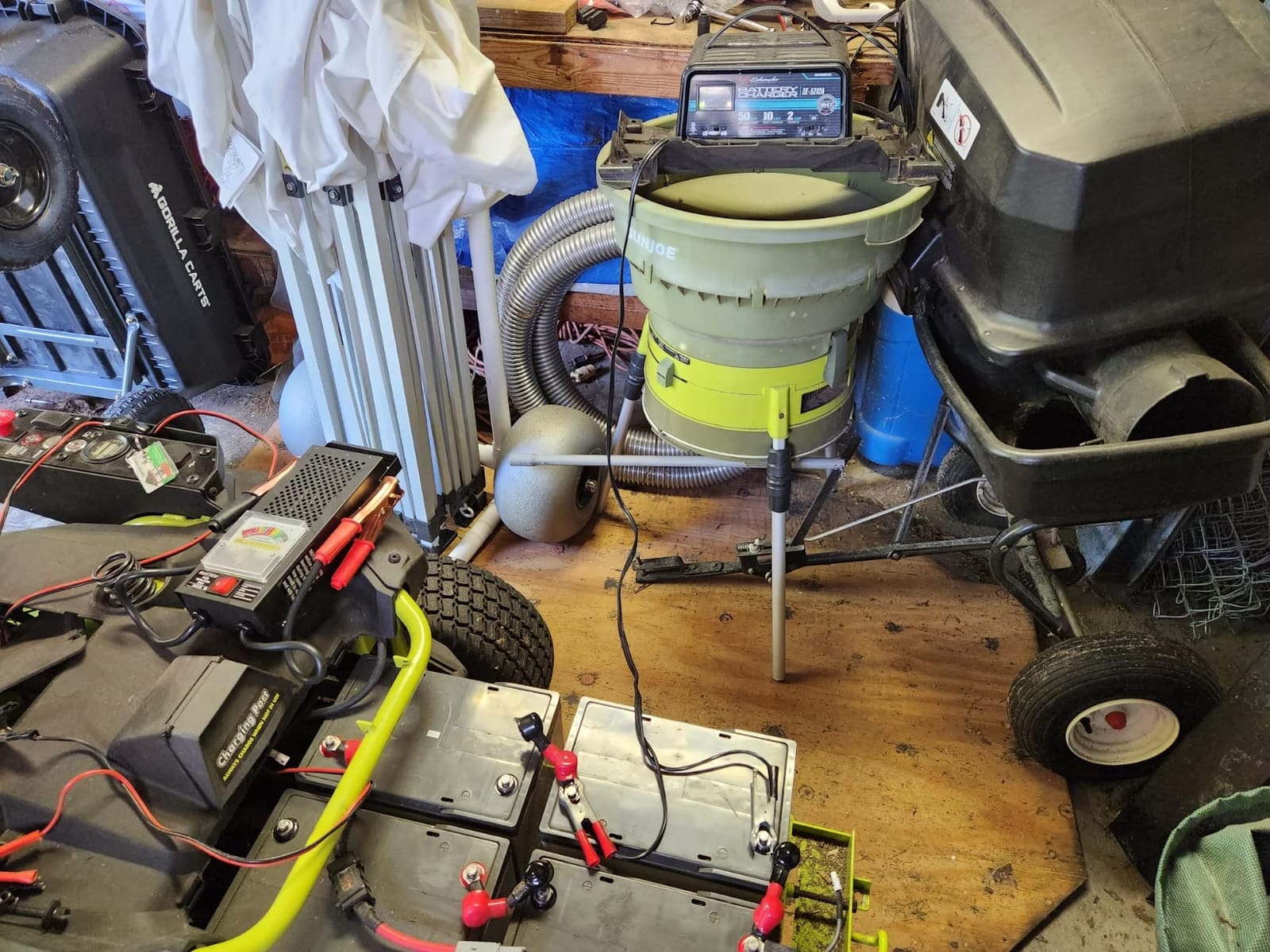
It reports state of charge, cranking volts and charging system performance, so it covers the same three-part diagnosis as the digital units while doing it with a needle. One owner reported using it on a real diagnostic and correctly flagging both a failing battery and a healthy alternator, which is the kind of feedback that matters more than feature lists.
It is 1.7 pounds and 12.3 by 7.1 by 3.6 inches. That is bulkier than a digital handheld, and getting it down into a boat or RV battery compartment is a genuine inconvenience, a complaint forum users raise about analog testers in general.
Who this tester suits
Mobile mechanics, roadside operators and small independent shops that need a tool that survives being carried around. Owners of 6V and 12V vehicles, including classic cars, deep-cycle marine batteries and golf carts, are within its stated range.
It suits anyone who prefers a physical applied load and a clear needle over a menu and a percentage, and anyone who wants the same three-diagnosis workflow the digital units offer without any charging or firmware.
Who should skip it
It reads low on small low-CCA batteries such as lawn mower packs and some golf cart batteries, and it is less accurate at 6V and on deep-cycle types than on 12V automotive batteries. Do not use it to condemn a small pack.
The load coil also runs hot and needs to cool between consecutive tests, which slows down back-to-back diagnostics. You must time the ten-second interval yourself, and there is no digital record of the result.
10. OTC 3181 Review
OTC 3181 130 Amp Heavy-Duty Battery Load Tester – 6V and 12V Compatible
130-amp analog carbon pile
6V and 12V
0-16V display
Top and side post clamps
Pros
- 130-amp capacity for heavy-duty and large-displacement batteries
- Clamps grip both top-post and side-post batteries
- Extra large 0-16V display with zero adjust
- Side tabs for clamp storage and back brackets for a wall or toolbox
- 82% five-star share from 745 reviews
Cons
- Analog gauge requires manual timing of the 10-second interval
- No digital readout
- data logging or cranking analysis
The OTC 3181 closes out the roundup as the highest-capacity carbon-pile unit here. At 130 amps, it is the pick for heavy-duty and large-displacement engines, where a 100-amp tester is working at the edge of what the battery can deliver.
The clamp design is the detail worth knowing about. They are shaped to get a robust grip on both top-post and side-post batteries, which is not a small detail on commercial vehicles and marine applications, where side posts are common and cheap clamps slip.
The extra large display runs a 0-16 volt range with zero adjust, so you can zero the needle before a test. In a workshop that is a legibility advantage over a small gauge. Results come in about ten seconds on 6V and 12V batteries.
It is also the tidiest tool here to own. Side tabs hold the clamps on the tool itself, and the back brackets let it hang on a wall or sit in a toolbox, which stops the usual mess of coiled cables.
Who this tester suits
Truck, bus and heavy-equipment shops testing large-displacement engines, and anyone working on marine or commercial vehicles with side-post batteries. The 130-amp capacity means the load is closer to a genuine cranking demand than a 100-amp unit delivers.
It also suits technicians who want a physical load result and simple workshop ergonomics, backed by a 1-year manufacturer warranty and CE, RoHS and UL compliance markings.
Who should skip it
There is no digital readout, no data logging, and no cranking or charging system analysis. If you need a test record for a customer file, you will be writing the number down by hand.
You must also time the ten-second interval yourself, and 6V and 12V only means no 24V fleet work and no 6V-and-12V-in-one convenience for motorcycles and 6V packs.
Battery Tester vs Multimeter: When a Voltage Reading Is Enough
A multimeter answers one question: how much voltage is the battery producing right now. That is useful, and for most people it is the test they already do. It is not a health test, because a charged battery sits near 12.6 to 12.8V whether it has full cranking amps left or none.
Here is the resting voltage reference for a 12V lead-acid battery at rest after a charge, which tells you state of charge rather than state of health:
12.6 to 12.8V: charged
Around 12.4V: roughly 75% charged, the safe floor for a carbon-pile load test
Around 12.2V: roughly 50% charged, test it as unreliable and recharge first
Below 11.8V: depleted, do not load test this battery at all
Why the two numbers diverge is worth understanding. A healthy 700-CCA battery and a sulfated 200-CCA battery can both read 12.7V on a multimeter after an overnight charge. What separates them is what happens when current is demanded, and that is exactly what a load or conductance test measures.
So: use a multimeter to check alternator output, to hunt a parasitic drain, and to sanity-check a battery before and after charging. Use a battery load tester when the question is whether the battery will actually start the car.
Is It the Battery or the Alternator
Most repeat no-start calls turn out to be one or the other, and the same tool settles both questions. Every digital unit in this roundup runs a cranking test and a charging system test, and reading all three numbers in order tells you which part failed.
Check cranking first. A healthy starter pulls the voltage down to roughly 9.5V or below briefly while cranking and hold above 9.6V overall. If cranking voltage drops to 7V or lower, the battery is weak. If cranking voltage is fine but the engine cranks slowly, suspect a starter drawing too much current, which is what the analog carbon-pile units measure directly.
Then check charging. With the engine running, a healthy alternator puts 13.5 to 14.5V at the battery terminals. Below 13V means the system is undercharging, and above 15V means it is overcharging. Both destroy batteries, and both are faults in the charging system, not the battery.
One more test worth knowing: ripple voltage. AC noise riding on the DC output points at a failing rectifier diode, and catching it before it kills the replacement battery is the whole point of checking the charging system rather than just the battery.
For storage batteries, uninterruptible power supplies and backup systems, our guides to whole home battery backup and UPS battery backups cover the testing needs of that kind of equipment, which is a different job from starting a car.
How We Chose and What to Look For
We ranked these on accuracy against the published specification, clamp quality, build quality, chemistry and voltage coverage, warranty length and the volume of verified owner feedback. We excluded listings with implausible review patterns, unbranded units that clone a CCA figure without any published test method, and products sold only through third-party resellers with no manufacturer warranty.
Chemistry selection is the factor people most often get wrong, and it causes errors in both directions. Setting AGM thresholds on a flooded battery, or vice versa, produces false passes on healthy packs and false failures on marginal ones. The same applies to rating standards: SAE, EN, DIN, IEC, JIS, BCI, CA, MCA and GB each use different thresholds.
Clamps deserve more attention than they get. A clear sign of a poor tester is a solid body with poor-quality jaws, because contact resistance at the terminal corrupts every reading downstream. Stamped, copper-plated clamps are the marker to look for, along with reverse-polarity protection.
Voltage coverage should match your vehicles. A 12V-only tester cannot test two series batteries in a 24V truck as a pair, and it cannot test a 6V golf cart or classic car. If you own lithium starter packs, check that the unit supports LiFePO4 before buying, and understand that CCA may not be reported.
Two ownership facts that get overlooked: most of these testers draw their operating power from the battery under test, so there is no internal cell to charge and nothing to go flat in a glovebox over winter. And warranty length is a reasonable proxy for how confident a manufacturer is in the accuracy claims.
Finally, consider who demands documentation. Battery sales counters, fleet maintenance files and warranty claims need a record. A thermal printer or a QR report solves that, and no plain handheld will.
Frequently Asked Questions
What is a good load tester for a car battery?
For most drivers, a digital conductance tester covering 100 to 2000 CCA with battery, cranking and charging system tests is the right choice, and the TOPDON BT100 is the one we would buy first. What counts as good depends on your vehicle voltage, whether you work on 24V trucks, whether you need 6V support, and whether a warranty programme or insurer requires a physical carbon-pile load test rather than an inferred one.
Do battery load testers work?
Yes, and a real load test is still the definitive answer on whether a battery can deliver cranking current. Two conditions matter. The battery must be properly charged first, so a 20 to 30 minute rest and a resting voltage above 12.4V. And you should not run a heavy carbon-pile load on an already depleted battery, because the heat can finish off plates that might still have recovered.
What is a good quality battery tester?
Look for four things. Accuracy documented against a reference unit rather than claimed without method. Stamped, copper-plated clamps that grip bare terminal metal. Verified review volume in the thousands rather than a handful. And a warranty length that reflects manufacturer confidence, ideally two years or more. Honest chemistry specifications, including what the unit cannot do, is the fifth marker of a well-built tester.
What is the best way to load test a battery?
Let the battery rest 20 to 30 minutes after driving or charging, then confirm resting voltage is above 12.4V. Clean the terminals and seat the clamps on bare metal. Select the correct chemistry and rating standard, and enter the rated CCA from the case label. Apply the load, either a real carbon-pile draw or a conductance measurement, and read the result against the pass threshold of about 9.6V for a load test.
Which battery load tester is the best?
The TOPDON BT100 is the best overall battery load tester for typical car, motorcycle, boat and SUV use, because it combines battery health, cranking and charging system tests in a 9-ounce handheld covering 100 to 2000 CCA. For 24V trucks and fleets the FOXWELL BT705 is the answer, and for a genuine applied load with starter draw measurement the Schumacher BT-100 is the one to buy.
Which battery tester is better, Topdon or Ancel?
They win different use cases. TOPDON units cover a wider voltage range, with the BT200 adding 24V support, a colour screen and operation from -4F to 140F, while the BT100 is the most compact. The ANCEL BA101 covers more battery rating standards, including JIS, EN, DIN, IEC, BCI, GB, CA, MCA and SAE, which matters for mixed European and Japanese fleets, but it is 12V only and does not support lithium.
What is the best 12 volt battery load tester?
For 12V only, the TOPDON BT100 and the KONNWEI KW208 are the strongest everyday choices, and the Schumacher BT-100 is the best true carbon-pile option if you need a real applied load. If you also want 12V lithium support, only a few units in this roundup cover LiFePO4, and the Acclope BT60 PRO checks voltage and health on lithium while not guaranteeing a CCA figure.
What’s the difference between a battery tester and a battery load tester?
A battery load tester applies a real heavy current, usually half the rated cold cranking amps for fifteen seconds, and passes the battery if voltage holds above about 9.6V. A battery tester of the digital kind measures conductance with a small signal and calculates cold cranking amps without applying a real load. Both are valid, but a load test is more definitive and can stress an already weak battery.
The Shortlist by Vehicle Type
If you drive a normal 12V car, SUV or motorcycle and want one tool that stays out of the way, the TOPDON BT100 is the pick. It covers the three tests that matter and disappears into a glove box.
If value and review volume are your priorities, the KONNWEI KW208 gives you internal resistance and Ah capacity at the same time as cranking amps, backed by the widest review pool in the category. For a technician working on mixed international fleets, the ANCEL BA101 is the one with the rating standard coverage.
For 24V trucks, buses and RV work, the FOXWELL BT705 is the only unit here that does the job, and its 5.9 ft cable lets one person run a cranking test. In genuinely cold climates, the TOPDON BT200 is rated to -4F and has a sunlight-readable colour screen. If lithium, 6V motorcycles or a shareable test report matter, the Acclope BT60 PRO covers all three.
And if you need a real applied load, a starter draw figure, or a document for a warranty programme or insurer, the analog carbon-pile units are the answer: the Schumacher BT-100 for 6V and 12V work, the OEMTOOLS 24338 for a mobile workshop in its steel case, and the OTC 3181 when 130 amps and large-displacement engines are the job.
Whatever you choose, give the battery 20 to 30 minutes of rest before you judge it, confirm it is above 12.4V, and remember that 12.7V on a multimeter tells you how full the battery is, not how many cranking amps it has left.