
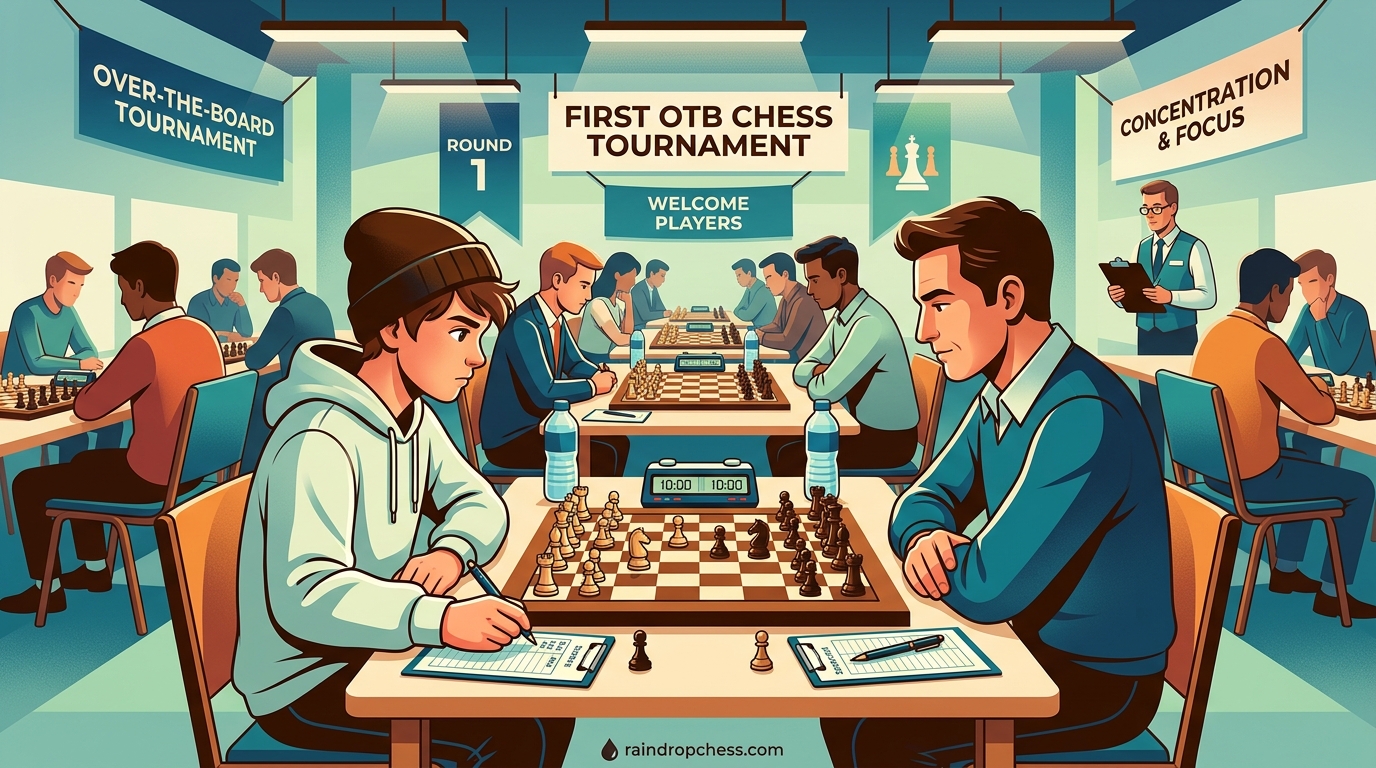
I remember the night before my first over-the-board chess tournament. I lay awake worrying about everything that could go wrong. Would I forget the touch-move rule? Would I embarrass myself in front of rated players? Would I even enjoy it?
That was 12 years ago. Since then, I have played in hundreds of OTB tournaments across five states. I have also watched hundreds of first-timers walk into the playing hall with that same nervous energy I felt. Here is what I want you to know: your first tournament will be challenging, occasionally awkward, and absolutely worth it.
This guide will walk you through exactly what to expect at your first over-the-board chess tournament. We will cover finding tournaments, essential rules, what to bring, and how to handle the emotional journey. By the end, you will feel prepared rather than petrified.
Table of Contents
Why Play Over-the-Board Chess?
Online chess is convenient. You can play a quick game during your lunch break or analyze positions at 2 AM. But something fundamentally different happens when you sit across from a living opponent with a physical board between you.
OTB chess demands focus. There are no notifications popping up. You cannot tab away to check email. The only thing that exists is the position in front of you and the clock ticking beside it. That intensity forces you to play your best chess.
Then there is the community. Online, your opponents are usernames and ratings. In person, they are people you might share coffee with between rounds. I have made lifelong friends at tournaments. The chess community is remarkably welcoming to newcomers who show respect for the game.
Perhaps most importantly, OTB tournaments give you an official rating. Your USCF or FIDE rating becomes a real measure of your strength. Unlike online ratings that fluctuate wildly, these ratings carry weight in the chess world. They open doors to invitational events, club memberships, and a sense of belonging to something bigger than your phone screen.
How to Find Your First Chess Tournament
Before you can play, you need to find an event. The best place to start is the US Chess Federation website at uschess.org. Their tournament directory lets you search by state, date, and rating section. Most tournaments are listed 2-4 weeks in advance.
State chess associations also maintain event calendars. These often include smaller club tournaments that do not appear on the national site. Search for “[Your State] Chess Association” and look for their events page.
Chess clubs in your area are another excellent resource. Many clubs host monthly tournaments open to the public. These tend to be friendlier environments for first-timers than large regional events. A quick Google search for “chess club near me” should turn up local options.
When choosing your first tournament, look for these keywords in the description: “beginner-friendly,” “U1200 section,” or “novice.” Avoid events labeled “Grand Prix,” “National,” or “Championship” for your debut. Those attract serious competitors and can be overwhelming.
Registration usually happens online through the tournament website or a service like Chess.com events. You will need a USCF ID. If you do not have one, you can usually purchase a membership during registration or at the venue. Adult memberships cost around $45 per year as of 2026. Some tournaments also accept single-event memberships for a few dollars.
What to Expect on Tournament Day
Arrive at least 30 minutes before the posted start time. Tournament directors appreciate punctuality, and you will want time to find parking, locate the playing hall, and settle your nerves.
The registration desk is your first stop. Present your USCF card or ID number. You will receive a pairing card or be directed to a posted list showing board assignments. Keep this information handy. It tells you which board to sit at and what color you are playing.
Walk into the playing hall and take it in. Rows of tables stretch across the room. Chess boards sit ready. Some players are already seated, quietly reviewing openings or staring at the ceiling. Others mill about, greeting friends they see at every tournament. The atmosphere is focused but not hostile. This is a room full of people who love the same thing you do.
Find your board number and sit down. Your opponent will arrive shortly. Shake hands. This is traditional and expected. Then place your score sheet and pen where you can reach them easily. Set your clock if required. Some tournaments provide clocks. Others expect you to bring your own.
The tournament director will make announcements. Listen carefully. They will explain the time control, any special rules, and when the round begins. When the director says “Start your clocks,” your first tournament game officially begins.
Understanding Swiss Pairings
Most tournaments use the Swiss system. Here is how it works in simple terms. You play a set number of rounds, usually 4 or 5 for a one-day event. In each round, you are paired against someone with approximately the same score as you.
Win your first game, and you will face another winner in round two. Lose, and you play someone else who lost. This means you are always playing opponents at your current performance level. By the final round, the top boards feature the players who have won consistently.
You never get eliminated. Even if you lose every game, you keep playing. This is one reason Swiss tournaments are perfect for beginners. You get multiple games regardless of results.
Color alternates as much as possible. If you played White in round one, you will likely play Black in round two. The system tries to balance this over the tournament. Sometimes you will play the same color twice in a row. That is normal.
Essential Rules You Must Know
Tournament chess has rules that online play does not enforce. Knowing these beforehand prevents awkward moments and potential penalties.
The Touch-Move Rule
If you touch a piece, you must move it. This is the touch-move rule, and it is absolute. If you touch your own piece, you must move it if any legal move exists. If you touch your opponent’s piece, you must capture it if legally possible.
The only exception is when you say “adjust” or “j’adoube” before touching the piece. This lets you center a piece on its square without being forced to move it. Say it clearly before your hand makes contact.
Online chess lets you pick up and hover pieces while deciding. OTB does not. Once you touch, you commit. I recommend hovering your hand above pieces until you are certain of your move. Only then do you make contact.
Notation Requirements
You must write down your moves. This is called keeping notation or filling out a score sheet. Standard algebraic notation is required. You write e4, not pawn to king four. You write Nf3, not knight to king’s knight three.
Record your move before pressing the clock. The correct order is: make your move on the board, write it down, then press the clock. This is the move-clock-write routine, though technically you write after moving but before clock-pressing.
If you have fewer than five minutes remaining, you can stop writing. The clock becomes your priority. Some tournaments require notation until the time control regardless. Check the specific rules for your event.
Your score sheet serves multiple purposes. It proves how the game reached its current position if a dispute arises. It lets you reconstruct the game afterward for analysis. It also creates a physical record of your chess journey. I still have score sheets from my earliest tournaments.
Clock Usage
The clock sits to your right side of the board. Your time is on the side matching your color. When you complete your move, you press the button on your side with the same hand that moved the piece. This is the one-hand rule.
Time controls vary. G/30 means game in 30 minutes. Each player gets 30 minutes for the entire game. G/60 gives an hour each. G/90+30 means 90 minutes plus a 30-second increment added after each move. The increment helps prevent time scrambles.
Beginners often benefit from longer time controls. You have more time to think and less chance of losing on time. However, shorter controls mean less physical endurance required. For your first tournament, G/30 or G/45 is reasonable.
If your flag falls, meaning your time reaches zero, you lose if your opponent has mating material. The game ends immediately when time expires. Do not keep playing.
Illegal Moves
If you make an illegal move, your opponent should stop the clocks and call the arbiter. In most time controls, you receive a time penalty for the first two illegal moves. The third illegal move results in forfeit loss.
Do not panic if you make an illegal move. It happens to everyone. Acknowledge it, accept any penalty, and continue playing. The key is recognizing it quickly rather than playing several more moves.
What to Bring to Your First OTB Tournament
Preparation prevents panic. Here is your complete packing checklist.
Chess Equipment
Bring a regulation chess set if the tournament does not provide boards. Regulation means a king height between 3.75 and 4.25 inches. The squares should fit the pieces comfortably. A tournament-style board with algebraic coordinates is ideal.
A chess clock is essential if not provided. Digital clocks are standard now. Make sure you know how to set your time control before arriving. Practice at home. Nothing is more stressful than fumbling with clock buttons while your opponent waits.
Bring a pen for notation. Black or blue ink is standard. Do not use pencil, as it can smudge and become illegible. Some tournaments provide score sheets. Others expect you to bring your own notepad.
Personal Items
Your USCF membership card or ID number is mandatory. Photo ID may be required for adult sections. Bring cash or a card for entry fees, food, or merchandise.
Water and snacks are crucial. Tournament days are long. Most venues have limited food options nearby. I recommend granola bars, fruit, or nuts. Avoid heavy meals that make you sleepy. Stay hydrated but not so much that you need bathroom breaks every game.
Wear comfortable clothing. Layers are smart because playing halls vary in temperature. Bring a light jacket even in summer. Some rooms are air-conditioned aggressively.
A small notebook is useful for recording opening ideas or post-game thoughts. Your phone should stay in your bag, turned off or on silent. Using a phone during a game results in forfeit loss in most tournaments.
Optional Extras
Opening book or notes for review between rounds. However, do not obsess over preparation. Your first tournament is about experiencing the format, not perfecting your repertoire.
A small towel or handkerchief is useful. Tournament nerves make hands sweaty. Dry palms grip pieces better.
Earplugs help if you are sensitive to noise. Tournaments are quieter than coffee shops but not silent. Players walk around. Clocks click. Doors open and close.
Game Day Tips and Routines
Success in tournament chess comes from good habits. Here are routines that have served me well over hundreds of games.
The Move-Clock-Write Flow
Develop a consistent routine for every move. After your opponent moves, take a breath. Survey the board. Decide your response. Make the move firmly. Say “adjust” first if centering pieces. Write the move on your score sheet. Then press the clock.
This flow prevents common errors. Rushing to press the clock leads to illegal moves. Forgetting to write moves brings penalties. Practice this sequence until it becomes automatic.
Managing Tournament Nerves
Nerves are normal. Everyone feels them. The key is not eliminating anxiety but channeling it productively.
Arrive early so you are not rushed. Use the restroom before each round. A full bladder distracts from calculation. Take a short walk between rounds rather than sitting and brooding over your last game.
Breathe deeply before starting each game. Four counts in, hold, out, hold. This activates your parasympathetic nervous system and reduces panic.
Remember that your opponent is also nervous. They might look calm, but they are feeling pressure too. You are both human beings trying your best.
If you feel overwhelmed during a game, it is okay to stand up briefly after making your move and pressing the clock. Walk a few steps, breathe, and return. Just do not hover over other games or discuss anything.
When to Call the Arbiter
The arbiter is the tournament official who enforces rules. Do not be afraid to call them. That is their job.
Call the arbiter if your opponent makes an illegal move and does not correct it. Call them if there is a dispute about time or claims of threefold repetition. Call them if your opponent is distracting you or violating rules.
Raise your hand and say “Arbiter” or “Director” clearly. Wait for them to come to your board. Explain the situation calmly. They will make a ruling.
Never argue with the arbiter. Their decision is final during the game. You can appeal after the round if you believe an error occurred, but accept their authority in the moment.
Tournament Etiquette
Silence is golden during games. Do not talk to your opponent except to offer a draw, resign, or report checkmate. Offer draws only after making your move and before pressing the clock. Simply say “I offer a draw” and extend your hand.
Do not hover over other boards. If you finish your game early, leave the playing hall. Spectating distracts players still competing.
Turn off your phone completely. Vibrate mode is not sufficient. A buzzing phone can result in forfeit.
Shake hands before and after each game. Win gracefully. Lose gracefully. Thank your opponent for the game regardless of result.
Common First-Timer Mistakes (And How to Avoid Them)
After talking with dozens of first-timers and remembering my own blunders, these are the most common mistakes beginners make at their first over-the-board chess tournament.
Physical Board Blindness
Online chess trains your eyes to see from above. OTB requires reading the board from your side. Pieces look different from angles. Knights especially can hide behind pawns in ways they do not on a screen.
I once missed a knight fork because the knight appeared safely behind a pawn from my seated perspective. Standing up slightly to verify key lines is acceptable. Developing the habit of scanning diagonals and knight squares before committing to moves will save you points.
Time Trouble Panic
Beginners often spend 80 percent of their time on the first 20 moves, then rush the endgame. This is backwards. The endgame deserves careful calculation. Practice managing your time so you have at least 5 minutes remaining when queens come off.
When you get low on time, simplify. Trade pieces. Reduce complications. A slightly worse endgame with time is better than a complex middlegame where you blunder.
Forgetting the Basics
In the stress of tournament play, players forget things they know cold in casual games. They miss simple tactics. They hang pieces. They forget to castle.
Before every move, ask yourself: what is my opponent threatening? What did their last move change? Never make a move without checking for immediate threats. This simple discipline prevents countless blunders.
Notation Neglect
Many first-timers stop writing moves when they get behind or enter time trouble. This is when notation matters most. A disputed position without a score sheet is impossible to resolve fairly. Keep writing until you have under five minutes.
Also, write legibly. You may need to reconstruct the game later for analysis or dispute resolution. Your future self will thank you for clear notation.
Emotional Collapse After Losses
Losing your first tournament game can feel devastating. You came with hope and left the board feeling foolish. Do not let one loss ruin your entire tournament.
Step outside for fresh air. Remind yourself that every player in the room has lost countless games. Grandmasters lose. Beginners lose. Losses are tuition for improvement.
Analyze briefly if your opponent is willing, then let it go. The next round is a new game. Your tournament is not over because of one result.
Handling Losses and Setbacks
Let us talk about losing. You will probably lose games at your first tournament. Most first-timers do. This is not failure. It is data.
Your performance rating is calculated based on your results and your opponents’ ratings. Even if you lose every game, you get a provisional rating that becomes the foundation for future improvement. The only way to get a rating is to play rated games.
Between rounds, find the analysis room or skittles area. Many tournaments provide space where players review games together. Stronger players often offer free advice to newcomers. Ask questions. Learn from every game regardless of color or result.
Focus on process over outcome. Did you manage your time well? Did you avoid simple blunders? Did you try your best in every position? These are victories even when the score says zero.
I lost my first four tournament games. I was crushed. But I kept showing up. Within a year, I was winning my section. Within three years, I had gained 500 rating points. Progress in chess is not linear. Plateaus precede breakthroughs.
Your first over-the-board chess tournament is the beginning of something, not the definition of your ability. Treat it as a baseline. Every tournament after will build on this foundation.
FAQ: Your First Chess Tournament Questions Answered
How to prepare for an OTB chess tournament?
Prepare physically and mentally by practicing with a real board and clock at home. Review basic rules like touch-move and notation requirements. Plan to arrive 30 minutes early. Pack your chess set, clock, pens, water, snacks, and USCF membership confirmation. Get good sleep the night before and eat a solid breakfast.
What to know before joining your first chess tournament?
Key essentials include the touch-move rule, notation requirements, and proper clock usage. You must write down all moves before pressing the clock. Understand that tournaments use the Swiss system where you play all rounds regardless of results. Know that calling the arbiter is encouraged when you have questions or disputes.
What should you do before a chess tournament?
Confirm your registration and find the venue location beforehand. Pack a regulation chess set, digital clock, multiple pens, water bottle, snacks, photo ID, and your USCF membership card. Charge your clock batteries. Review opening lines lightly but focus more on being well-rested and mentally prepared than last-minute preparation.
How does Swiss pairing work in chess tournaments?
Swiss pairings match you with opponents who have similar scores. Win and you face other winners. Lose and you play other players with losses. You never get eliminated. Colors alternate as much as possible. Board numbers are assigned based on ranking, with top boards featuring the highest-scoring players.
Do I need a USCF rating to play in my first tournament?
No. You can purchase a USCF membership at the tournament or register as a non-member if the event allows. Many tournaments offer single-event memberships for a small fee. After your first rated games, you will receive a provisional rating that becomes official after enough games are played.
What happens if I make an illegal move in a tournament?
Your opponent should stop the clocks and call the arbiter. For the first two illegal moves, you typically receive a time penalty of adding two minutes to your opponent’s clock. The third illegal move results in an immediate forfeit loss. Acknowledge the error calmly and continue playing.
How is OTB chess different from online chess?
OTB chess requires physical piece handling, notation writing, and clock management. The touch-move rule is enforced strictly. There are no take-backs. The social environment means you meet opponents in person. Tournaments are rated officially. The pace is typically slower, and the focus is more intense without digital distractions.
What time control should beginners choose?
Beginners often benefit from G/30 or G/45 time controls. These provide enough time to think without requiring extreme physical endurance. Avoid ultra-fast controls like G/10 until you gain experience. Longer controls like G/90 give more thinking time but require stamina for multiple rounds.
Final Thoughts: Your First Tournament Awaits
Walking into your first over-the-board chess tournament takes courage. You are stepping from the familiar world of online play into something more demanding and more rewarding. The pieces feel different in your hand. The silence of the playing hall carries weight. Your opponent sits across from you, a real person with their own hopes and fears.
What to expect at your first over-the-board chess tournament? Expect to learn. Expect to feel nervous and excited in equal measure. Expect to make mistakes and discover strengths you did not know you had. Expect to meet people who share your passion for this ancient game.
You do not need to win every game. You do not need to play perfect chess. You need only to show up, try your best, and treat your opponents with respect. Everything else is bonus.
The chess community needs more players willing to take this step. Online growth has been tremendous, but the soul of chess lives in the playing hall. Your first tournament is your invitation to join that tradition.
Find a tournament. Register. Pack your bag. Show up early. Shake hands. Play your moves. Win or lose, you will walk out with stories, lessons, and a rating that marks the beginning of your OTB journey.
I will see you at the board.