
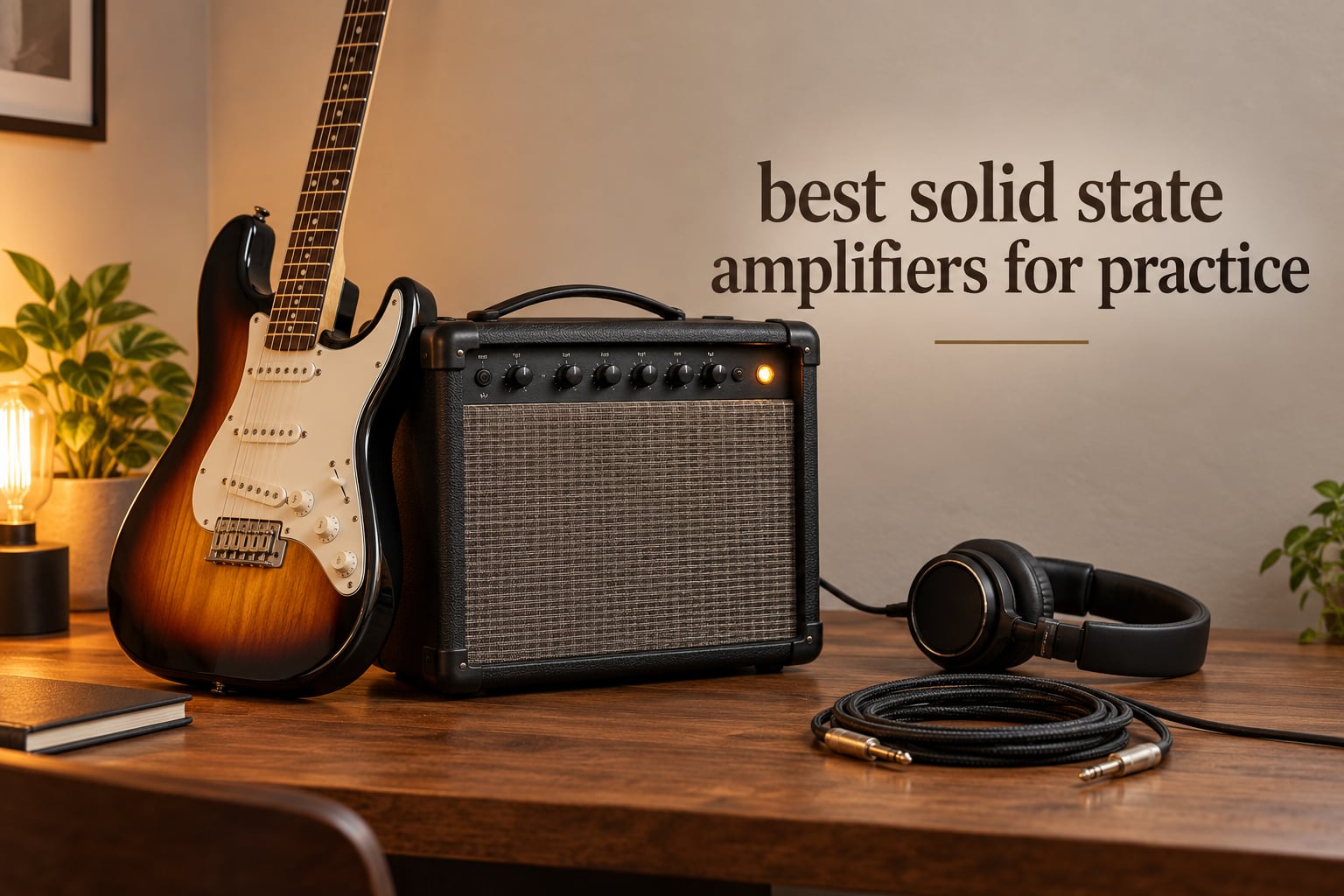
A solid state practice amp is a guitar amplifier that uses transistors instead of vacuum tubes, giving you a consistent tone at low volume with no warm-up time, no bias tubes, and no risk of the noise complaint that a tube amp earns you in a shared-wall apartment. That is why the search for the best solid state amplifiers for practice keeps circling back to the same short list of models, and why it is worth separating the two very different things people lump together under that name.
There are two families of gear sold as practice amps, and they are not interchangeable. Analog solid state amps run a continuous transistor signal path from input jack to speaker, with nothing digital in the chain. Modeling amps add a DSP processor that recreates the shape of famous circuits, usually with a cab simulation on the headphone output. Owners who want a real analog path and dislike DSP fizz keep asking forums for the analog-only list, so this roundup gives every product a clear type label.
I spent several weeks moving through all 12 of these amps in a small, badly treated room with thin walls, at volumes low enough to practise with a neighbour in the next room, and at volumes loud enough to cover a drummer. Everything here is judged on the only question that matters for practice: does the tone still sound like something when the master is at 3, not 10. If you want the wider view of practice amps including tube options, our practice guitar amplifier guide covers that side of the market.
Headline answer first: the Fender Frontman 10G takes the top slot for most people, the Fender Mustang LT25 has the highest average rating in the set, and the Fender Mustang Micro is the pick if practice happens entirely in headphones at midnight.
Top 3 Solid State Practice Amps in 2026

Fender Frontman 10G
- 10-watt solid state
- 6-inch Fender Special Design speaker
- Headphone jack and aux input
- Two-year limited warranty

Fender Mustang LT25
- 25-watt digital modeling combo
- 8-inch Fender Special Design speaker
- 30 preloaded presets
- USB and headphone output

Fender Mustang Micro
- 5-watt personal headphone amp with DSP
- 13 amp models and 12 effect combinations
- Bluetooth streaming with audio and video sync
- USB-C recording
Those three cover the three genuinely different ways people practise. The Frontman 10G is a straightforward analog combo for a room. The LT25 is a modeling combo with a speaker for louder rooms and for players who want presets. The Mustang Micro has no speaker at all, because it feeds headphones.
How We Picked These 12 Amps
The selection leaned on three things: consensus on the largest guitar forums, long review histories that suggest the amp still works after a few years, and specification checks on the details that decide whether a practice amp suits a small room. Repeated recommendations on r/GuitarAmps, thegearpage and gretsch-talk carried the most weight, particularly the recurring request for analog solid state with no modeling.
We also applied one filter that most roundups skip. Anything whose main selling point is a speaker it cannot project into a room was judged on headphone quality instead of volume. The result is a list with no tube amps, no modeling-only gimmicks, and a clear reason for every inclusion.
Forum complaints shaped the writing as much as the picks. Players repeatedly report that analog solid state amps get thin and harsh at low volume, that budget overdrive channels sound flat, and that effect ordering into a modeling amp turns to mud. Each of those shows up below as a specific limitation rather than a general disclaimer.
All 12 Solid State Practice Amps at a Glance in 2026
| Product | Specifications | Action |
|---|---|---|
| Fender Frontman 10G |
|
Check Latest Price |
| Fender Mustang LT25 |
|
Check Latest Price |
| Fender Mustang Micro |
|
Check Latest Price |
 Vox Pathfinder 10 Vox Pathfinder 10 |
|
Check Latest Price |
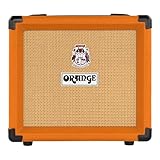 Orange Crush 12 Orange Crush 12 |
|
Check Latest Price |
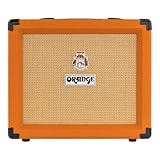 Orange Crush 20 Orange Crush 20 |
|
Check Latest Price |
 Positive Grid Spark NEO Positive Grid Spark NEO |
|
Check Latest Price |
 Marshall MG10G Marshall MG10G |
|
Check Latest Price |
 Marshall MG30GFX Marshall MG30GFX |
|
Check Latest Price |
 Monoprice Stage Right 40W Monoprice Stage Right 40W |
|
Check Latest Price |
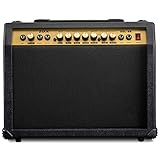 LyxPro 40W LyxPro 40W |
|
Check Latest Price |
 NUX Mighty Plug MP-2 NUX Mighty Plug MP-2 |
|
Check Latest Price |
Read the type column first, because it decides whether the rest of the row matters. If you want no digital processing anywhere in the chain, the analog entries are the ones to shortlist.
1. Fender Frontman 10G – Best All-Round First Amp
Fender Frontman 10G Electric Guitar Amplifier, 10-Watt Amp, Black/Silver
10-watt solid state combo
6-inch Fender Special Design speaker
Gain, volume, treble, bass
Headphone jack and aux input
Pros
- Clean Fender tone is genuinely usable for practice and recording
- Very small and portable with a tiny footprint
- Headphone output gives a noticeably fuller sound than the speaker
- Simple controls that never get in the way of playing
- Two-year limited warranty from Fender
Cons
- Onboard overdrive is overly compressed with no overtones
- Distortion is only tolerable at low gain settings
- Bass thins out at low volume on the 6-inch woofer
- No guitar cable included in the box
The Frontman 10G is the amp I recommend to anyone who has not owned a guitar amp before. It does one job and does it without drama: a clean, familiar voice at bedroom volume, controls you can understand in ten seconds, and a footprint small enough to move between rooms without planning a trip.
Out of the box it sits around 10 watts into a 6-inch Fender Special Design speaker, in a closed-back cabinet that helps the low end more than a small open-back would. I set volume near 4, gain at 3, and the amp filled the room comfortably for scale practice and stayed polite through the wall.
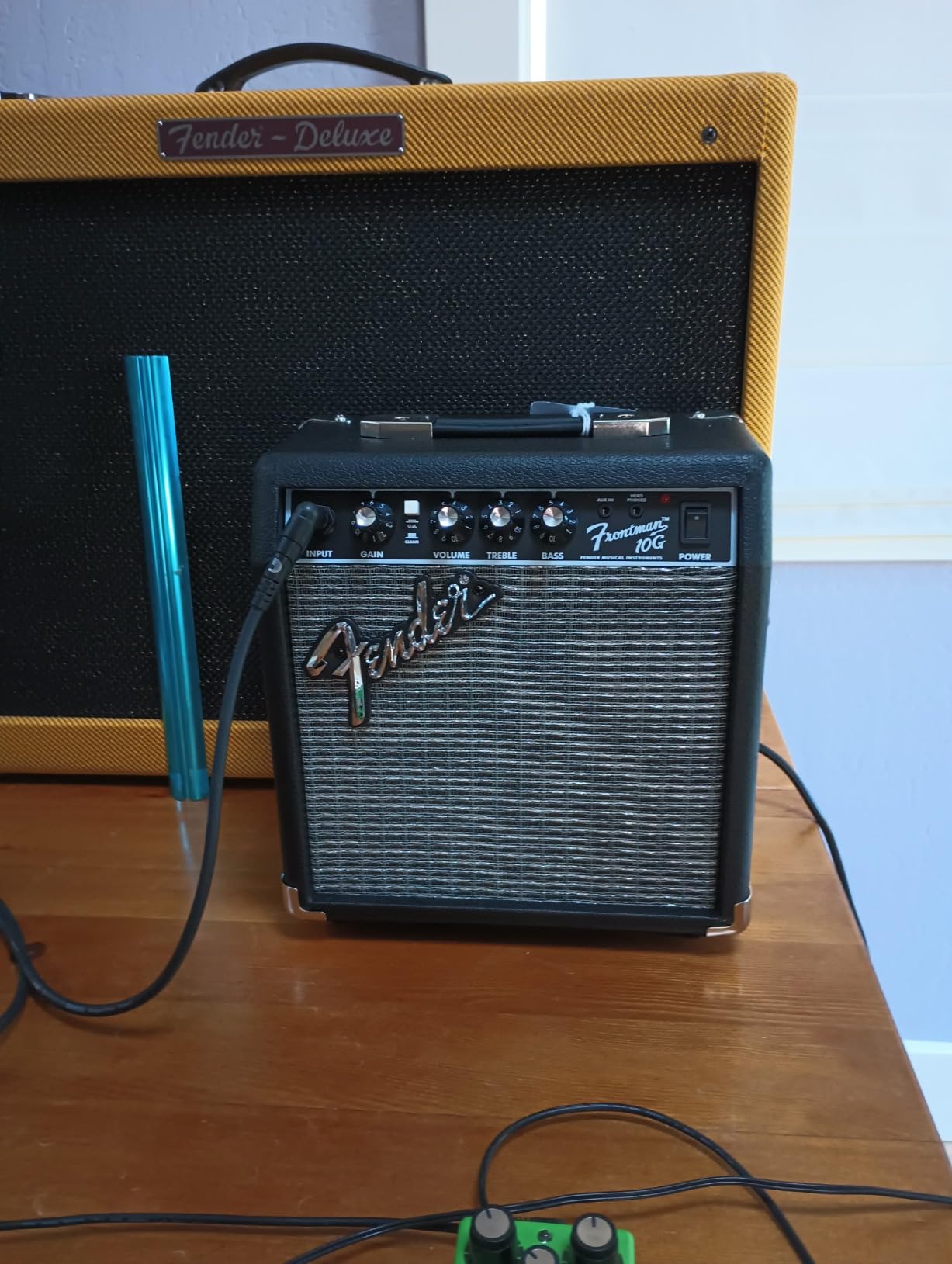
The owner reviews describe the same behaviour almost word for word: a clean channel that sounds like a small Fender, and an overdrive channel most people simply never use. Several owners report that swapping the 6-inch speaker for a Jensen unit improves the tone noticeably, which tells you the cabinet is not the weak link.
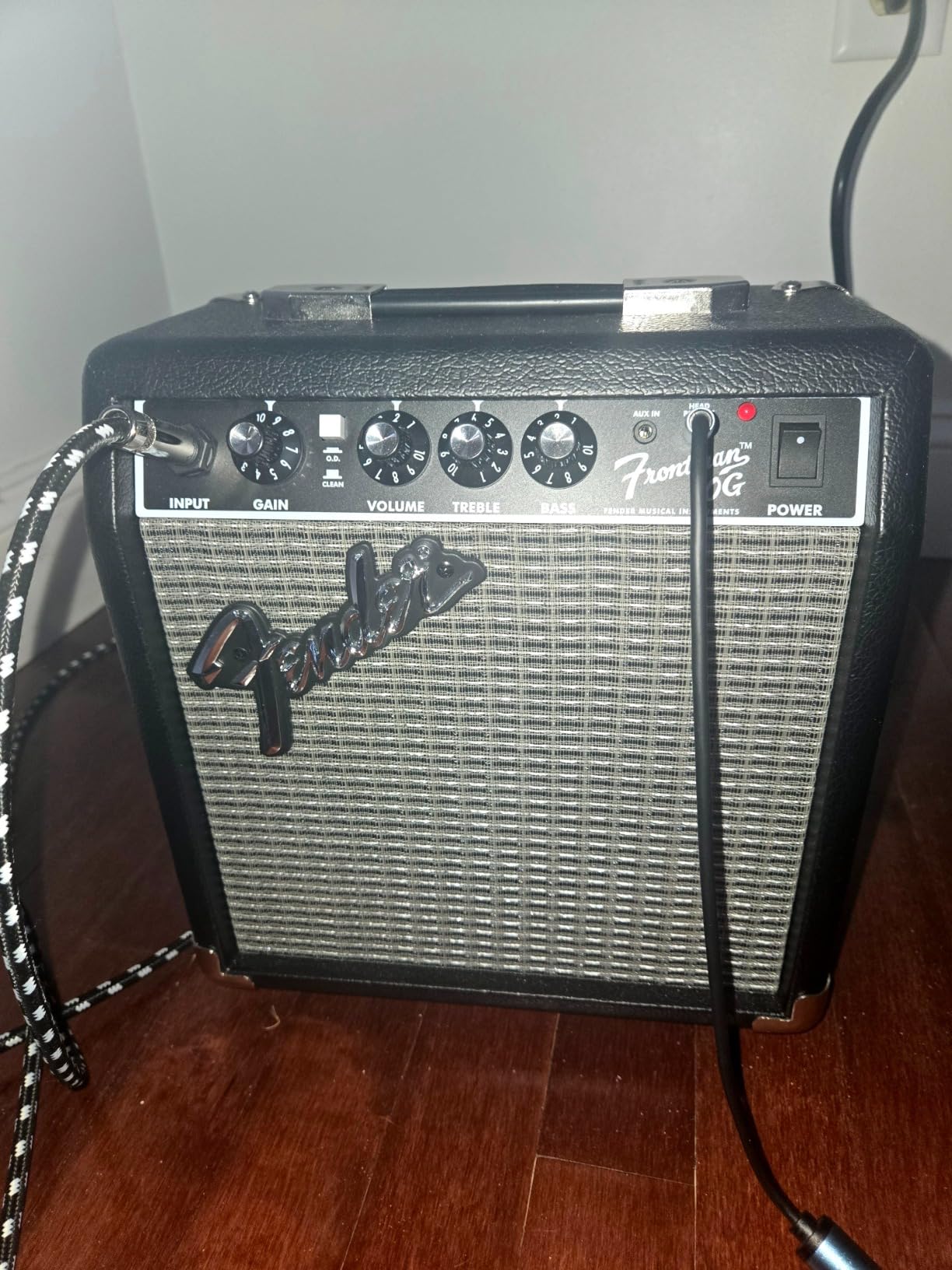
Headphone output is the sleeper feature here. Owners consistently say the headphone sound is fuller and more convincing than the speaker at low volume, which is a common pattern with small solid state combos and one of the reasons this amp keeps its value years later.
What you should know before buying
Dimensions matter more than wattage here. The cabinet measures 7.5H by 11.5W by 13.7D inches and weighs just under 4 kg, so it is a genuine one-hand carry. If your practice spot is a desk in a small bedroom office, that is the deciding spec.
Reviewers also flag the missing cable, so budget for a 1/4 inch instrument lead. It is a small thing, but it is the one complaint on the list that stops someone playing on the day the box arrives.
Who it suits and who it does not
It suits a beginner on a budget, anyone practising in a bedroom, and any guitarist who wants a recording-ready clean channel without a pedalboard. Our wider picks on the best practice amps page cover the cases this one cannot.
It does not suit a player who needs to be heard over a drummer, or anyone who wants their overdrive channel to sound like a driven tube stage. Owners are clear that the distortion is only tolerable at low settings. If your band practice happens in a loud room, look at the 30-watt and 40-watt entries further down.
2. Fender Mustang LT25 – Best Rated Amp in the List
Fender Mustang LT25 Guitar Amplifier, 25-Watt Combo Amp with 8″ Speaker
25-watt digital modeling combo
8-inch Fender Special Design speaker
30 preloaded presets
1.8-inch color display
USB and headphone
Pros
- Highest average rating among the amps reviewed here
- Beginner-friendly interface with a clear color display
- 30 presets covering a wide range of styles
- 8-inch speaker delivers a classic Fender voicing
- USB and headphone output for quiet practice and recording
Cons
- Presets are fixed so tone edits start from someone else's settings
- Modeling character sits apart from a fully analog signal path
- 25 watts is short of what a loud band rehearsal needs
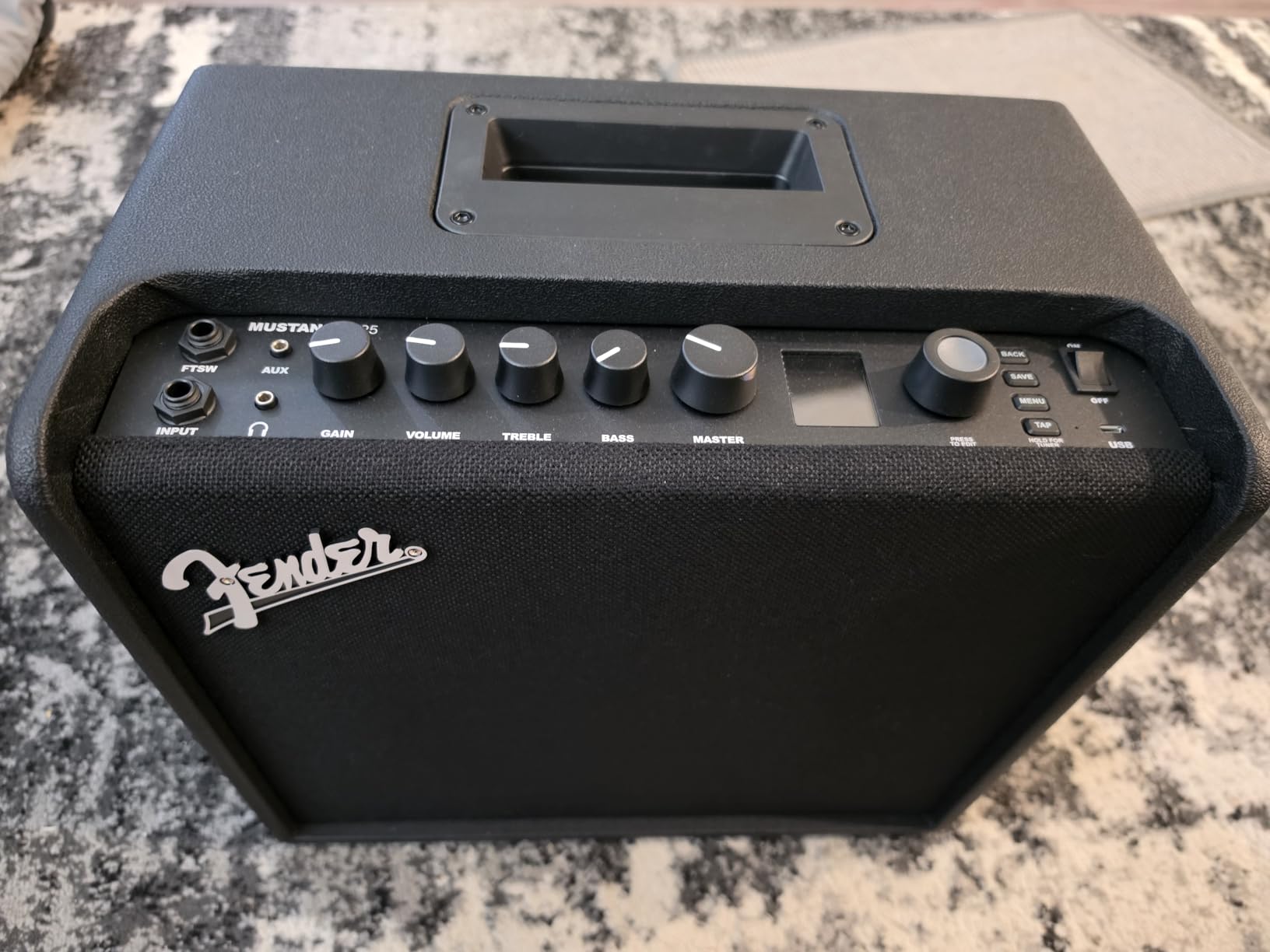
The Mustang LT25 holds the highest average rating of any amp in this roundup, and the reason is the interface rather than the circuit. A 1.8-inch color screen and a simple knob set mean a beginner can get a usable sound in about a minute, which is exactly the job a first amp has to do.
Behind the display is a 25-watt digital modeling section with 30 preloaded amp and effect presets and an 8-inch Fender Special Design speaker. At 25 watts it moves from bedroom quiet to small-room loud without switching anything, which no 10-watt entry on this list manages.
The 8-inch speaker is the step up that matters from the smaller combos. Owners highlight the classic Fender voicing and the headroom it gives the clean channel, and the headphone and USB outputs mean you can record or practise silently without buying anything extra.
What you give up for the preset convenience is signal path purity. A modeling amp reprocesses your signal digitally, so the response under your fingers differs from an analog amp even at the same volume. Players who want a straight transistor path do not enjoy that, which is the single most common objection in the forums.
What you should know before buying
Warranty length is the detail that separates it from the cheaper Fender. The Mustang LT25 lists a one-year manufacturer limited warranty, while the Frontman 10G in the previous entry carries two years. That difference is worth remembering if you keep your amp for years.
Presets are the other thing to understand before you buy. Thirty sounds like variety, but each one is a fixed starting point, and editing from there is a different workflow from setting gain and EQ on an analog panel. Decide which workflow you actually enjoy.
Who it suits and who it does not
It suits a beginner who wants to cover a lot of ground quickly, a player who records demos at home through the USB connection, and anyone practising in a room where 10 watts is not enough.
It does not suit someone chasing the analog response described in the forums, or a guitarist who only wants one clean channel and a pedal. Both of those are served better by the analog entries on this list.
3. Fender Mustang Micro – Best for Silent Headphone Practice
Fender Mustang Micro Headphone Amplifier, with 2-Year Warranty
5-watt personal headphone amplifier
13 amp models and 12 effect combinations
Bluetooth streaming with audio and video sync
USB-C doubles as a recording interface
Pros
- Pocket sized at under 3 ounces ideal for late-night silent practice
- 13 amp models and 12 effect combinations give wide tonal range
- Bluetooth streaming lets you play along with backing tracks
- USB-C recording to phone tablet or computer
- Battery powered with several hours per charge
- Works for bass as well as electric
Cons
- Controls are push buttons and LEDs rather than physical knobs
- Effects come as fixed combinations you cannot isolate
- No control from the Fender Tone app
- Sound quality depends heavily on the headphones you use
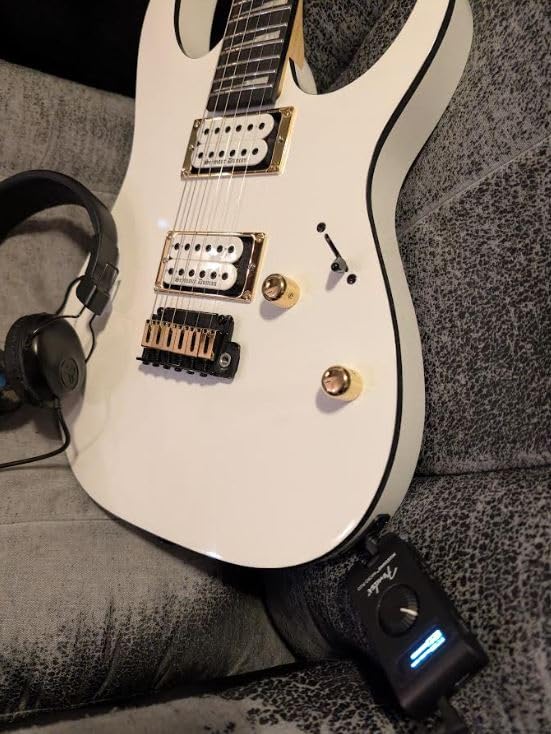
If your practice happens between 11pm and 1am behind a closed door, speaker wattage stops being the relevant spec. The Mustang Micro is a 5-watt personal headphone amplifier with onboard DSP and no speaker at all, and it solves the volume problem completely rather than approximately.
Inside are 13 amp models and 12 effect combinations, plus Bluetooth streaming with audio and video sync so you can play along with a song without the timing drifting. It weighs 2.4 ounces and runs on a rechargeable battery, which makes it the only amp here that genuinely fits in a coat pocket.
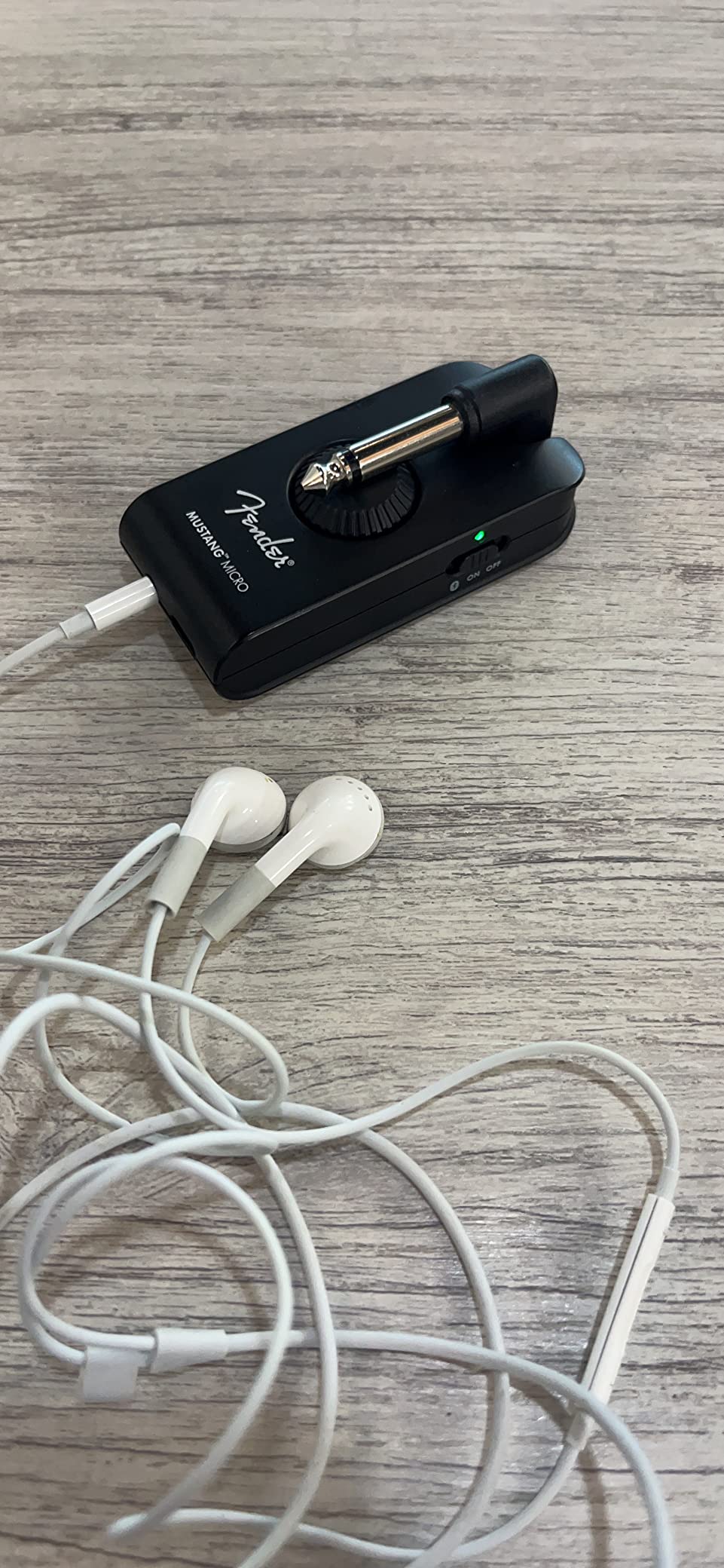
Owners treat it as a second tool rather than a primary rig. Recording is the surprise: the USB-C port doubles as an audio interface, so demos can go straight to a phone, tablet or computer without an interface box on the desk.
You will want decent over-ear headphones. That is the most repeated caveat across the reviews, and it is a real one: the tone you judge is a mix of the modeling engine and the headphone response, so cheap cans will misrepresent the amp.
What you should know before buying
The control scheme is the thing to try before committing. Everything runs through push buttons and LED indicators rather than knobs, and effects are selected as preconfigured combinations with no way to isolate a single effect. Owners who like hands-on tone shaping find that workflow slow.
There is no app control, which cuts both ways. It means no phone in the loop, but it also means no updates to your sound between practice sessions. Your settings stay where you put them, which some people love.
Who it suits and who it does not
It suits players in shared accommodation, flatmates, anyone with a sleeping child in the next room, and travelling players who want an amp for hotel rooms. It also works for bass, which several owners point out.
It does not suit anyone who wants a speaker, a footswitch, or an effects loop. There is no speaker output, so this is a silent-practice tool and nothing else. Consider improving room isolation first, since it helps every other option on this list too.
4. Vox Pathfinder 10 – Chimey Analog Clean With No DSP
Vox Pathfinder 10 1×6.5 inch 10-watt Combo Amplifier w/ 1 Channel
10-watt all-analog solid state combo
6.5-inch VOX Bulldog speaker
Clean and overdrive switch
Gain, volume, treble, bass
Pros
- Exceptionally clean chimey Vox tone from a very small combo
- Treble and bass controls have an unusually wide range
- Fully analog signal path with no digital processing
- Headphone and line output for silent practice or feeding a PA
- Light enough to move between rooms or carry to a small gig
Cons
- No built-in reverb
- no tuner and no aux input
- Large volume jump when you switch to overdrive
- EQ limited to treble and bass only
- One-year warranty is the shortest on this list
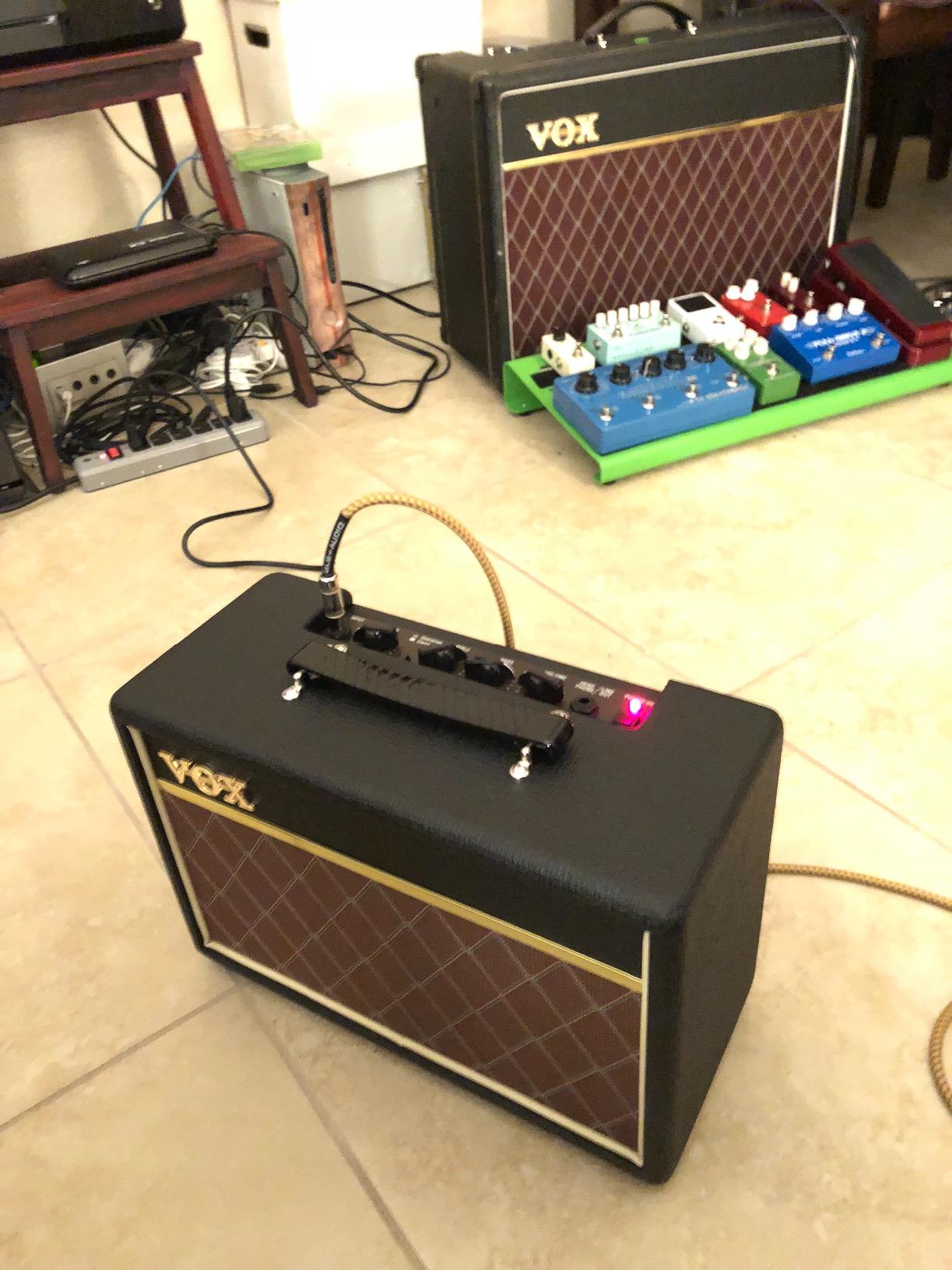
The Pathfinder 10 is the amp the analog-only forum threads keep circling. It is a fully analog solid state combo, which means nothing in the signal path is digital, and the clean channel is widely described as sounding like a scaled-down AC-series amp.
At 10 watts with a 6.5-inch VOX Bulldog speaker, it is built for rooms rather than stages. The wide-ranging treble and bass controls do more work here than the two-band layout suggests, and that is where you spend your time if you want a chimey top end.
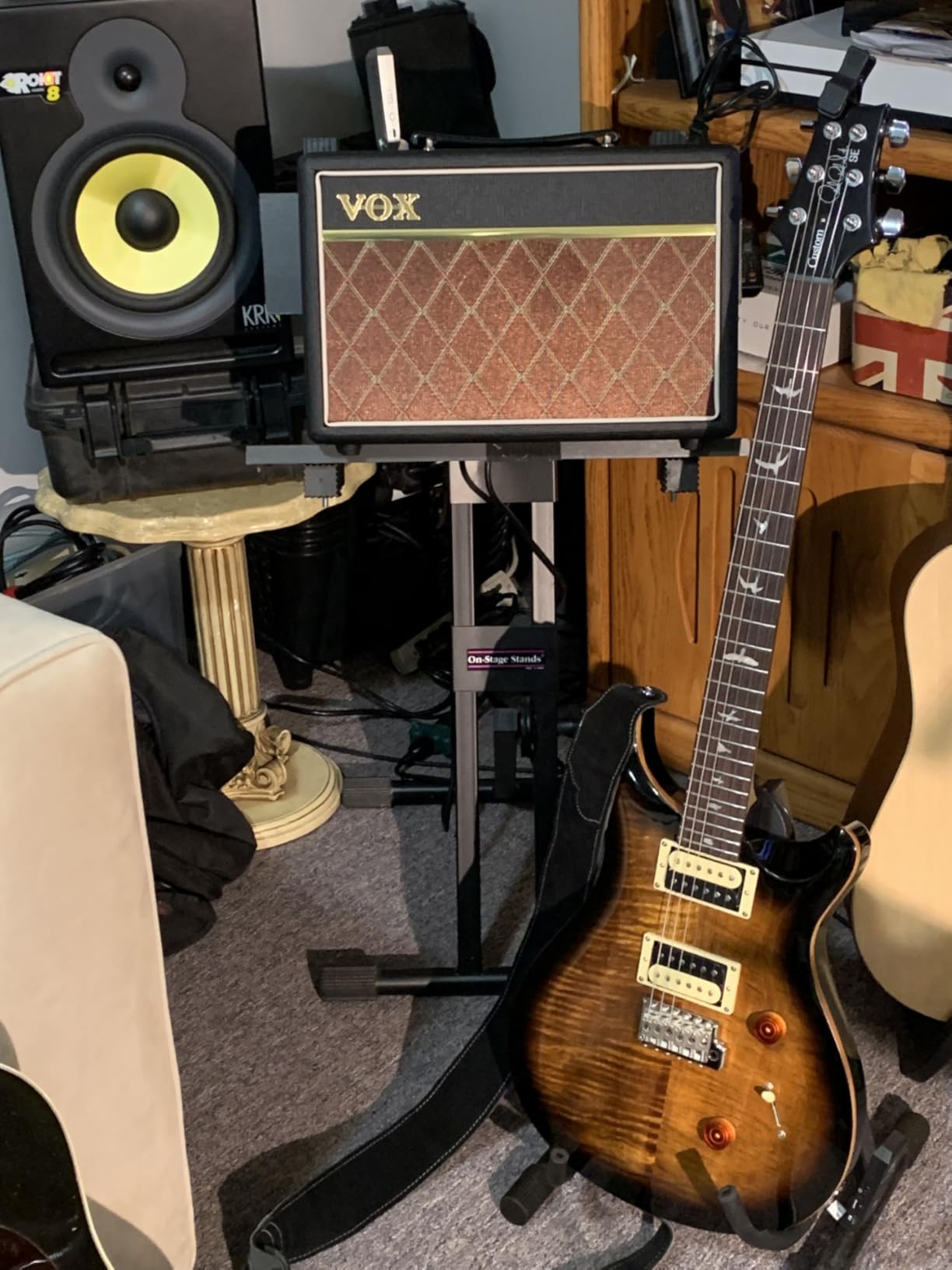
Line output is a genuinely useful inclusion at this size. Owners use the headphone or line output to feed a PA or a larger cabinet for a small room, which is how a lot of players get an amp designed for practice into a rehearsal space.
The classic VOX presentation matters to owners too. Diamond grille cloth and chicken head knobs get mentioned constantly in reviews, which tells you this is one of the amps people keep visible in a living room rather than hiding in a corner.
What you should know before buying
The omissions are the real spec. There is no reverb, no tuner, and no aux input, so no backing-track jamming out of the box. Owners work around this with an external multi-effects pedal, which adds a floor pedal to an otherwise pedal-free practice chain.
The channel switch is the other thing to try. Reviewers report a big discrepancy in both volume and dirtiness between clean and overdrive, and the overdrive gets loud very quickly. It is a jump, not a blend.
Who it suits and who it does not
It suits a player who wants an honest analog signal path, plays a Strat or Jazzmaster, and wants the classic Vox top end without a tube amp’s volume and maintenance. It is also a strong first amp for a student.
It does not suit someone who needs built-in effects, a tuner, or quiet volume-controlled overdrive. If you want a digital path with the same chime, the LT25 in position two is the closer comparison.
5. Orange Crush 12 – Best Step Up for a Beginner
Orange Crush 12 12W 6″ Guitar Amplifier and Speaker Combo,
12-watt solid state combo
6-inch speaker
Dual gain controls
3-band EQ
CabSim headphone output
Pros
- Warm rich British-style tone from an analog solid state circuit
- Dual gain controls and a 3-band EQ give real tone shaping
- CabSim headphone output for quiet practice and monitoring
- Durable cabinet that works reliably as a long-term amp
- Portable enough for home use and small booths
Cons
- 12 watts is short of a full band rehearsal
- No built-in reverb or tuner
- 6-inch speaker gives less low end than larger cabinets
- One-year warranty only
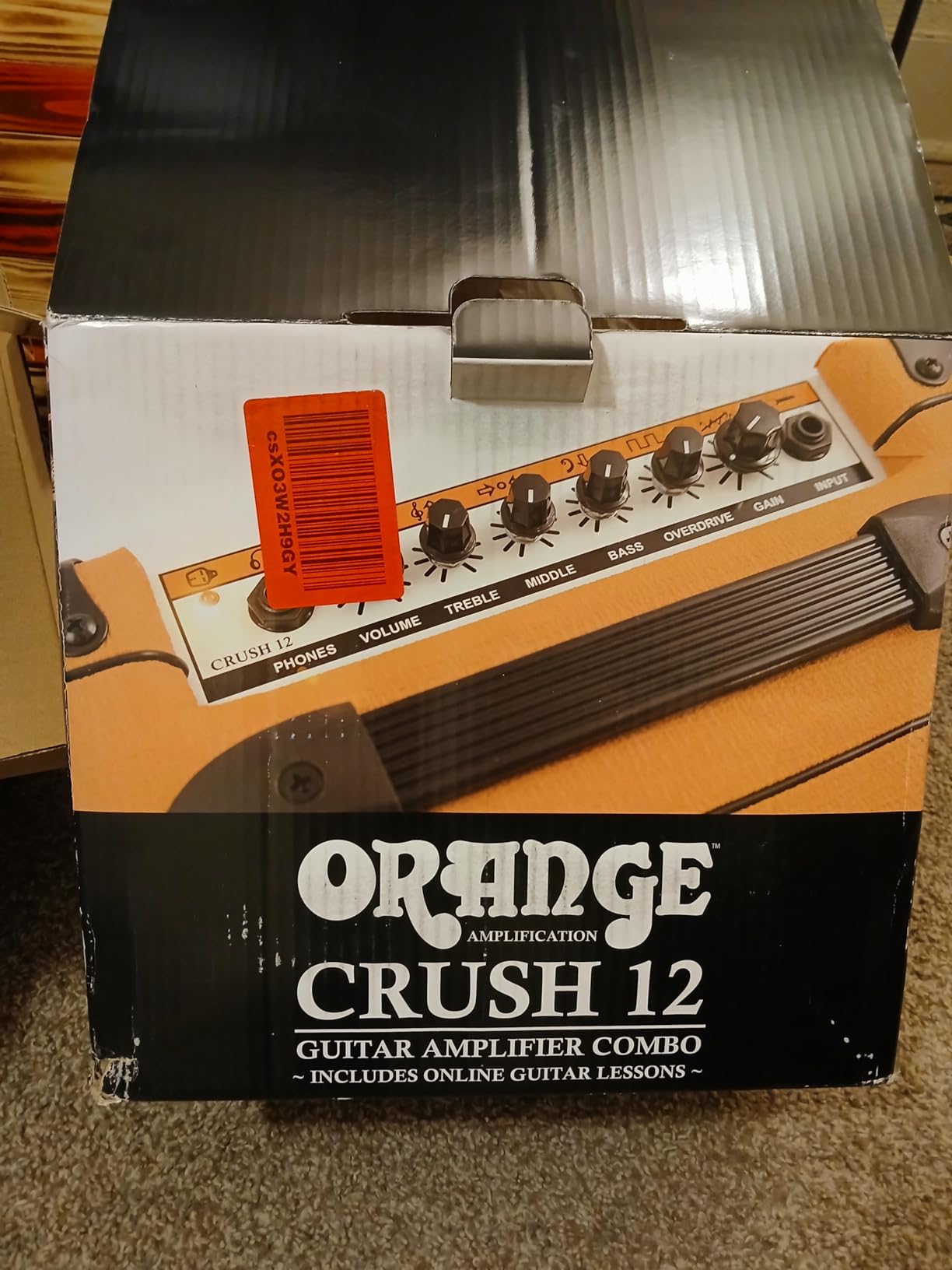
The Crush 12 is the step up from a 5 or 10 watt starter combo, and it is the first amp on this list where the tone control panel starts to feel like a real instrument. Three-band EQ plus dual gain controls means two distinct voicings without hunting for a switch.
It is an analog solid state design rated at 12 watts with a 6-inch speaker and a master volume. Owners describe the clean channel as warm and the punch as more than the wattage suggests, which is the classic small-combo behaviour where the cabinet does more work than the headline number implies.
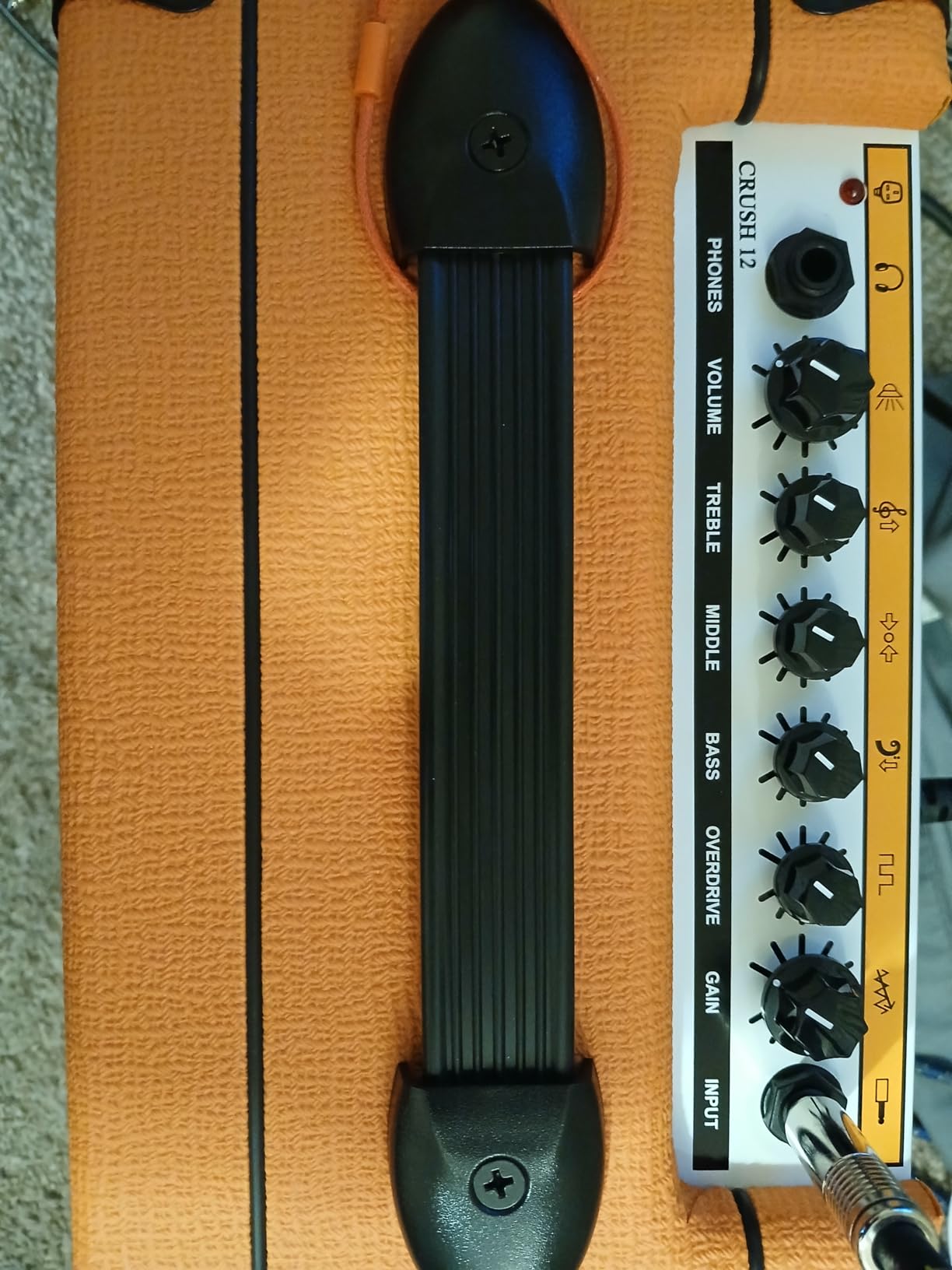
The CabSim headphone output is the practical reason this amp recurs so often on apartment forums. It gives you a speaker-cabinet voicing in headphones, so a late practice session does not turn into a thin 6-inch-speaker version of the sound.
Owners also report that it takes pedals well. That is not surprising from a clean, low-gain platform, and it means you can add distortion, fuzz or modulation later without replacing the amp.
What you should know before buying
Wattage and room size are linked here. At 12 watts it comfortably fills a living room and a practice room, and reviewers describe it as durable enough to keep for years as a workhorse. It is not a band-rehearsal volume.
There is no reverb and no tuner. For players who want ambience out of the box, the Monoprice Stage Right later in this list is the opposite trade, with a real spring reverb and an effects loop instead.
Who it suits and who it does not
It suits a beginner moving up from a tiny combo, a bedroom player who wants genuine tone-shaping control, and anyone who wants a pedal platform that stays clean at low volume.
It does not suit a player who wants a gigging amp, or someone who needs effects included. The dual gain controls are a strength for tone shaping but a distraction if you only ever want one sound.
6. Orange Crush 20 – Best Solid State Combo for a Pedalboard
Orange Crush 20 20W 8″ 2-Channel Guitar Amplifier and Speaker Combo, Orange
20-watt solid state combo
8-inch speaker
Two channels with separate gain
3-band EQ
Aux in and CabSim phones output
Pros
- Rich deep British tone with a standout midrange many amps lack
- Two channels including a dirty channel with its own gain control
- Loud and projecting for a small combo
- aux input and CabSim headphone output for backing tracks
- Accepts a standard footswitch for channel switching
Cons
- No built-in reverb and no direct out for recording
- Power switch is on the rear panel
- Noisy with single-coil pickups past roughly volume 5
- One-year warranty
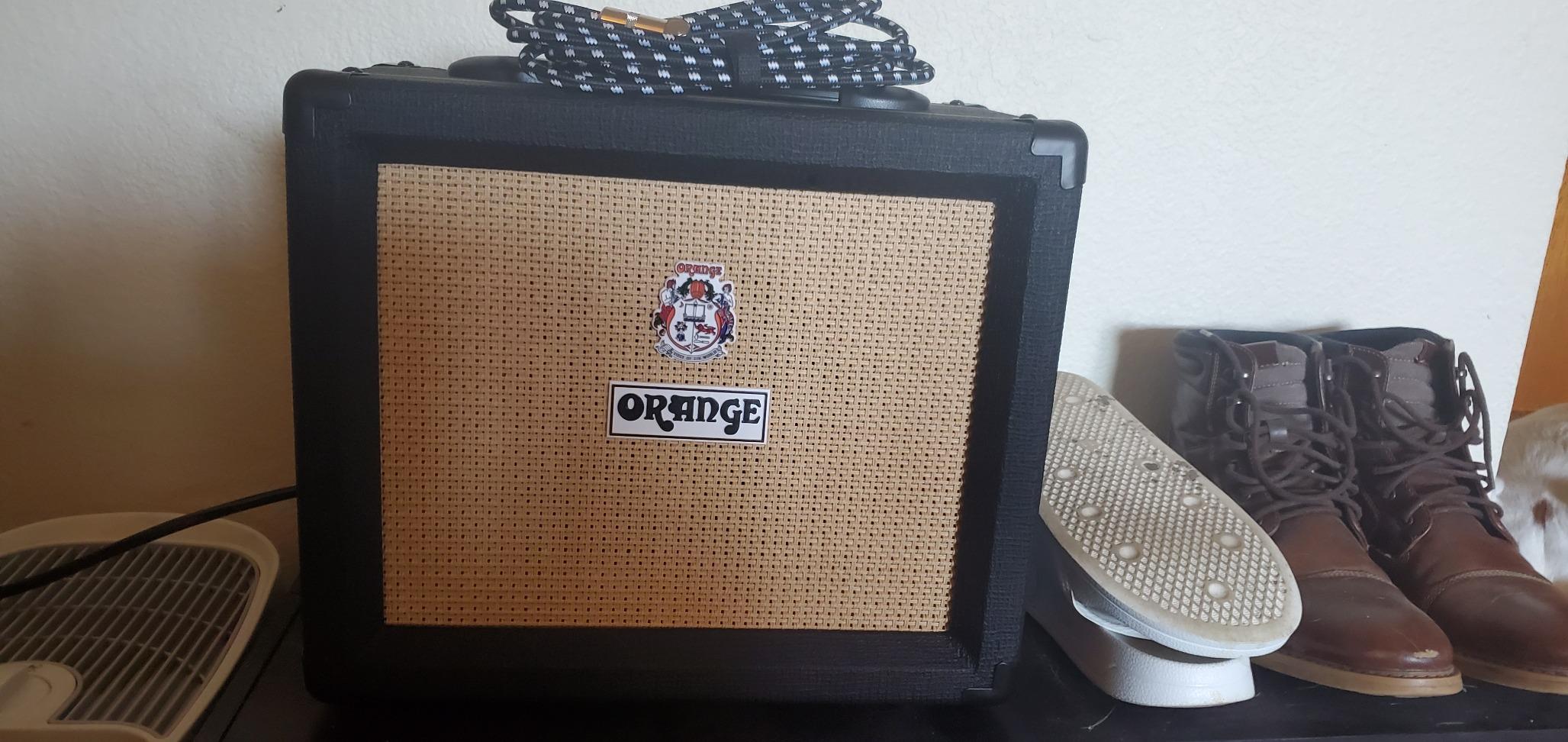
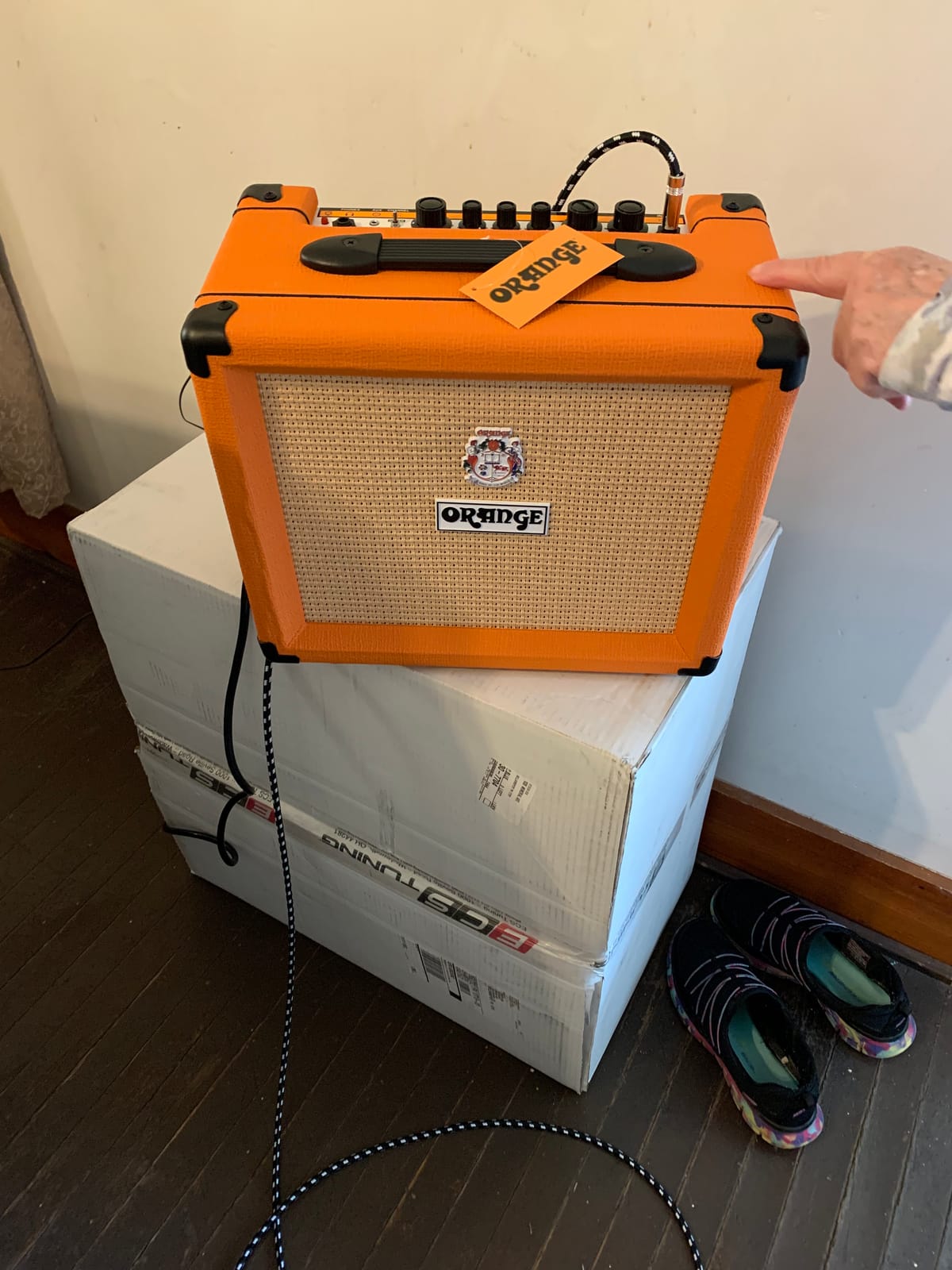
The Crush 20 takes the ideas of the 12-watt model and gives you the two things that matter as soon as a pedalboard enters the picture: a genuinely clean channel at higher volume, and a second channel for when the pedals run out.
It rates at 20 watts into an 8-inch speaker with a high-gain preamp, 3-band EQ, aux input, a CabSim-loaded headphone output, and a footswitch input for channel switching. Reviewers single out the midrange as the standout, and it is what makes distortion pedals sit properly in front of it.
The aux input is genuinely used. Plenty of owners plug in a phone or a practice track, which is one of the cheapest ways to make a small practice amp feel less like a solo exercise. Headphone output gives the same late-night option the smaller Orange offers.
Forum consensus treats the Crush range as a reference point for analog solid state, and the 20-watt version is the one that gets recommended when a pedalboard is in the picture. Clean headroom at low master settings is the deciding factor, not raw volume.
What you should know before buying
Single-coil noise is the practical warning. Owners report hiss becoming audible past about volume 5 with a Strat or Jazzmaster. If your guitar is a single-coil and your room is quiet, check this before you commit.
Two small irritations recur: there is no direct out for recording, and the power switch sits on the rear panel. If the amp lives tucked into a corner, that switch position matters more than it sounds like it should.
Who it suits and who it does not
It suits a pedalboard owner practising at bedroom volume, a band guitarist who wants one amp for both rehearsal and a small room, and anyone who wants a footswitchable second channel.
It does not suit someone who needs built-in reverb or a recording output, and it is a step up in size and weight from the 12-watt model. If you only play clean at low volume, the smaller Crush covers it.
7. Positive Grid Spark NEO – Best for Fully Wireless Practice
Positive Grid Spark NEO Wireless Smart Guitar Headphone Amp & Rig
Wireless guitar headphone amp and over-ear headset
Wireless transmitter with 3.8 ms latency
Built-in 1/4 inch input
Bluetooth 5 streaming
Spark app tone tools
Pros
- Wireless latency low enough to be indistinguishable from a wired connection
- Doubles as ordinary Bluetooth headphones with balanced sound
- Comfortable over-ear fit for long sessions
- Spark app with AI tone tools and a community tone library
- Up to 6 hours of battery for guitar and music
Cons
- App menus and tone navigation are confusing to learn
- Headset and transmitter feel cheaply built
- Volume buttons are hard to locate while wearing the headset
- Transmitter can lose connection and be hard to re-pair
The Spark NEO is a different proposition from everything else here. It is not a combo amp at all, but an over-ear headset with a wireless transmitter, custom drivers, and the Spark app’s tone tools driving the guitar signal. Nothing about it belongs in a living room next to a guitar stand.
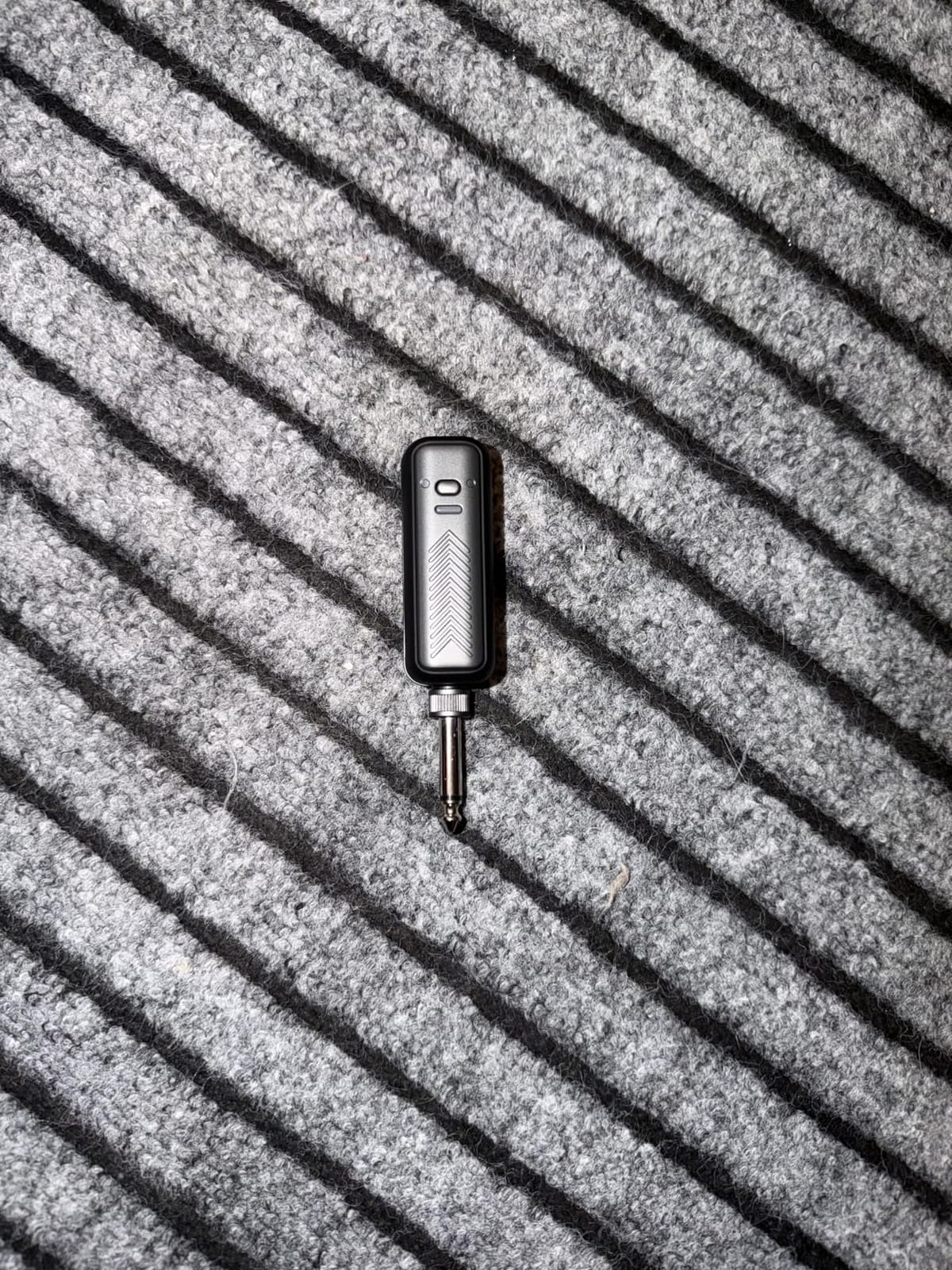
The transmitter specification is the reason it works. Listed audio latency is 3.8 milliseconds, which is low enough that most players stop noticing it, and there is a built-in 1/4 inch input plus a wired option when you want certainty. The headset also streams over Bluetooth 5 for jam-along.
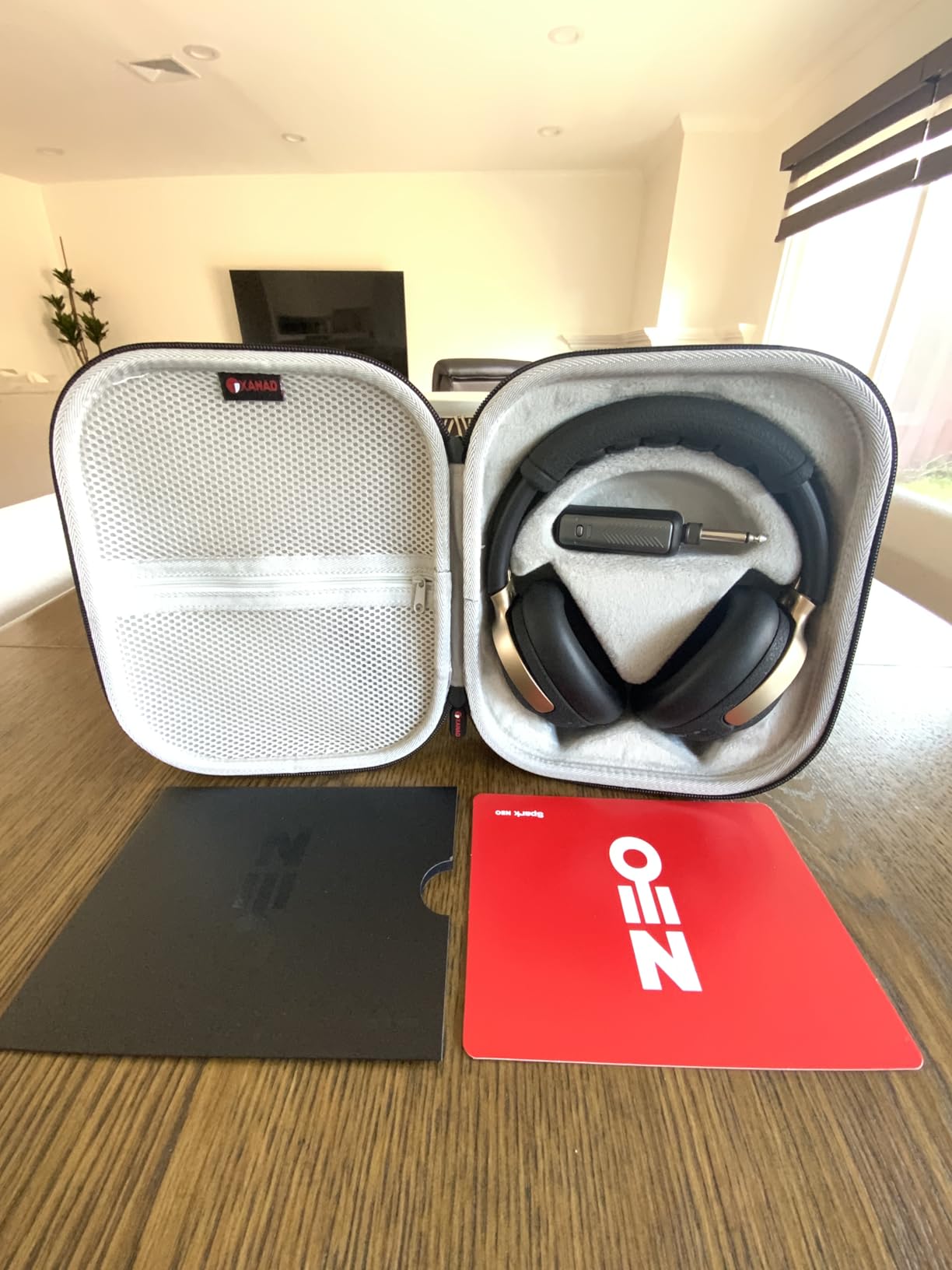
Owners are enthusiastic about latency and about comfort across long sessions, and they like that it works as plain headphones when the guitar is put down. Battery life of up to 6 hours covers a full practice block on one charge.
The critical reviews concentrate on software and hardware feel rather than tone. The app is described as cumbersome to navigate, the headset and transmitter as cheap in the hand, and the volume buttons as hard to locate while wearing the headset. Setup trouble is the main reason the rating sits below the rest of this list.
What you should know before buying
This is an app-dependent product. Tone profiles are created and selected through the Spark app, and some owners needed a factory reset before distinct profiles were clearly audible. If you dislike managing software, buy something else.
Weight is 410 g for the headset and the whole package is built around the headphones rather than a speaker cabinet. That is a genuine trade: you give up any sound in the room, and you get complete freedom in it.
Who it suits and who it does not
It suits players who practise entirely on headphones, travel regularly, or share a space with people who need quiet. It also suits anyone who wants AI tone generation and a community tone library rather than a fixed panel.
It does not suit someone who wants to play a room, uses a pedalboard, or wants controls that work without an app. Expect to spend an evening with the setup process. For a simpler silent option, the Mustang Micro needs no app at all.
8. Marshall MG10G – Compact Marshall With Real Pedal Headroom
Marshall MG10G Combo Electric Guitar Amplifier – Black
10-watt solid state combo
6.5-inch speaker
Clean and overdrive channels
Contour tone control
3.5mm headphone jack and aux
Pros
- Recognisable Marshall voice from a very small lightweight combo
- Clear punchy balanced sound that holds up at low volume
- Clean and overdrive channels plus a contour control
- Headphone jack and aux input included
- Handles distortion fuzz and modulation pedals well
- Runs quieter than comparable higher-wattage models
Cons
- Channel switch can stay stuck in the overdrive position
- Limited onboard tonal shaping for the size
- No built-in effects
- Not loud enough for gigging
The MG10G does the thing fans want from a small Marshall, which is put a recognisable voice in a box you can carry with one hand. At 10 watts into a 6.5-inch speaker it is small enough to be a bedroom amp, but the reviews describe the tone as clear and well balanced rather than thin.
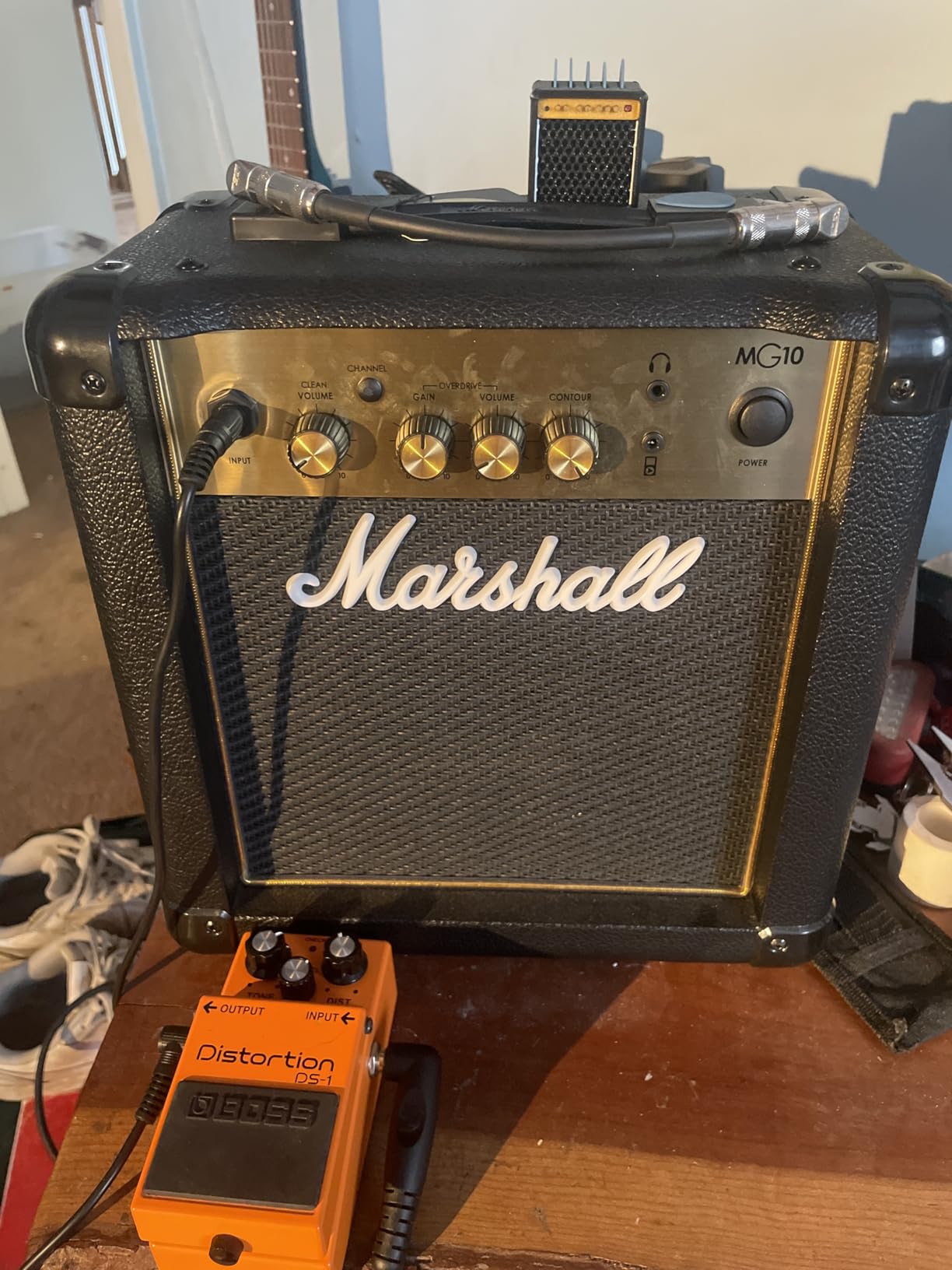
Two channels with a contour control give you a clean and a dirty side, and the contour knob is the fast way to scoop or lift mids without a three-band EQ. The 3.5mm headphone jack and aux input cover silent practice and backing tracks.
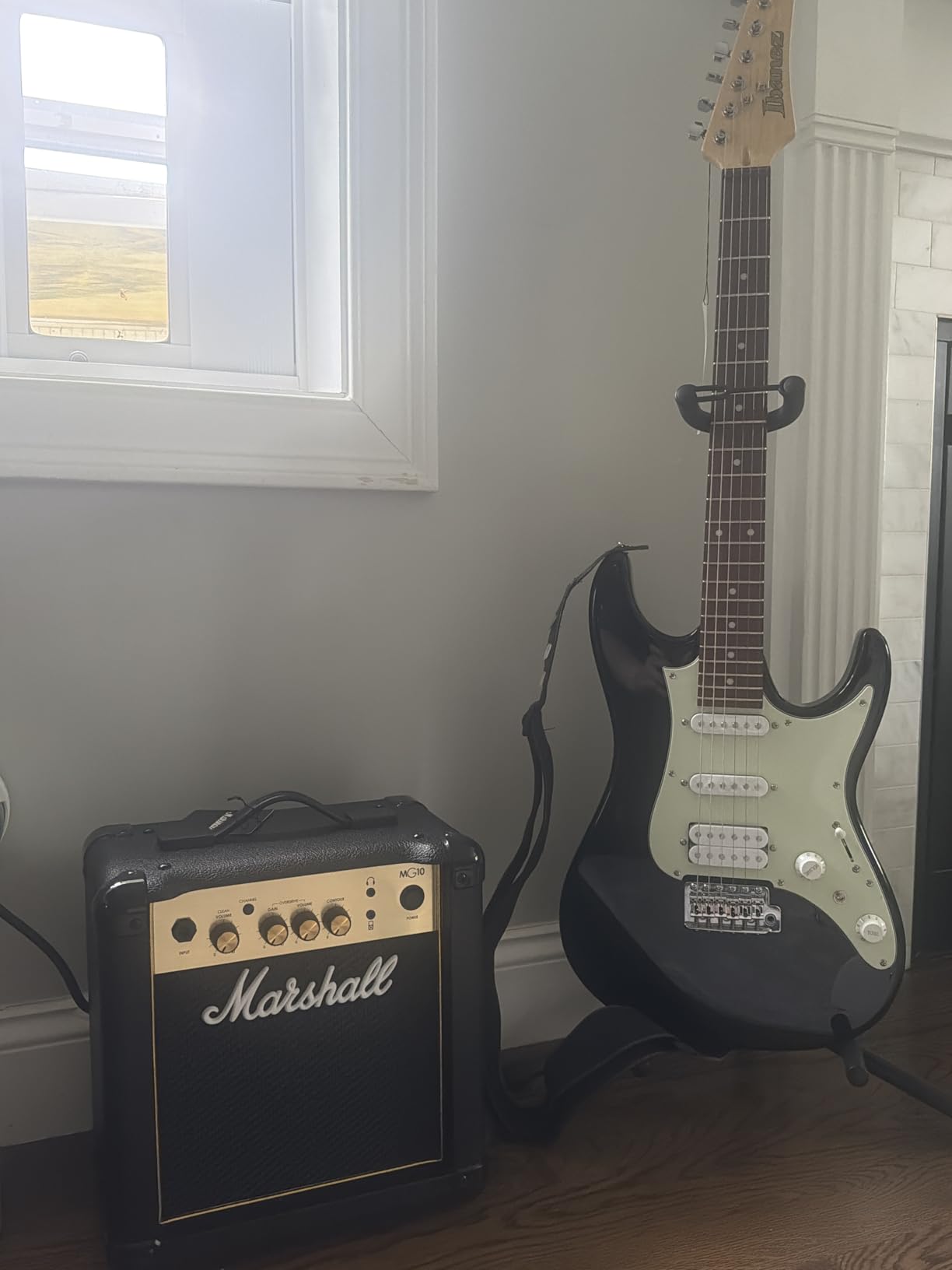
Pedal acceptance is the underrated part. Owners report that distortion, fuzz and modulation pedals all work through it despite the small cabinet, which makes this a reasonable low-volume pedal platform if you are not chasing high-gain tones.
It also runs noticeably quieter than comparable 15-watt models, according to owners. In a small apartment that is a feature rather than a limitation, and it is one of the reasons this amp suits thin-wall living better than its wattage suggests.
What you should know before buying
There is a real mechanical complaint here and you should know it going in: the channel switch can remain stuck in the overdrive position. Owners describe having to work the switch to return to clean, so test it the moment the amp arrives.
Onboard tonal shaping is limited for the size, and there are no built-in effects. If you want chorus, delay or reverb without pedals, the MG30GFX is the same brand a step up.
Who it suits and who it does not
It suits a beginner who wants a recognisable brand voice in a compact, quiet amp, and a pedal owner practising distortion and fuzz at low volume.
It does not suit a gigging player or someone who wants effects built in. High-gain tones are also out of reach, since the dirty channel is a Marshall crunch rather than a modern saturated stage sound.
9. Marshall MG30GFX – Four Channels and Built-In Effects
Marshall MG30GFX Combo Electric Guitar Amplifier – Black
30-watt solid state combo
Custom 10-inch speaker
Clean, crunch, OD1, OD2 channels
3-band EQ
Built-in digital effects
Pros
- Four channels covering clean crunch and two overdrive levels
- Built-in chorus phaser flanger delay and octave effects
- Full-bodied shimmery clean tone from a custom 10-inch speaker
- Headphone output and 3.5mm line input for practice and recording
- Designed to work with external effects pedals
Cons
- High-gain distortion character is not especially strong
- Onboard effects are limited even if usable
- Some external pedals do not interact well with it
- 30 watts is marginal for loud full-band practice
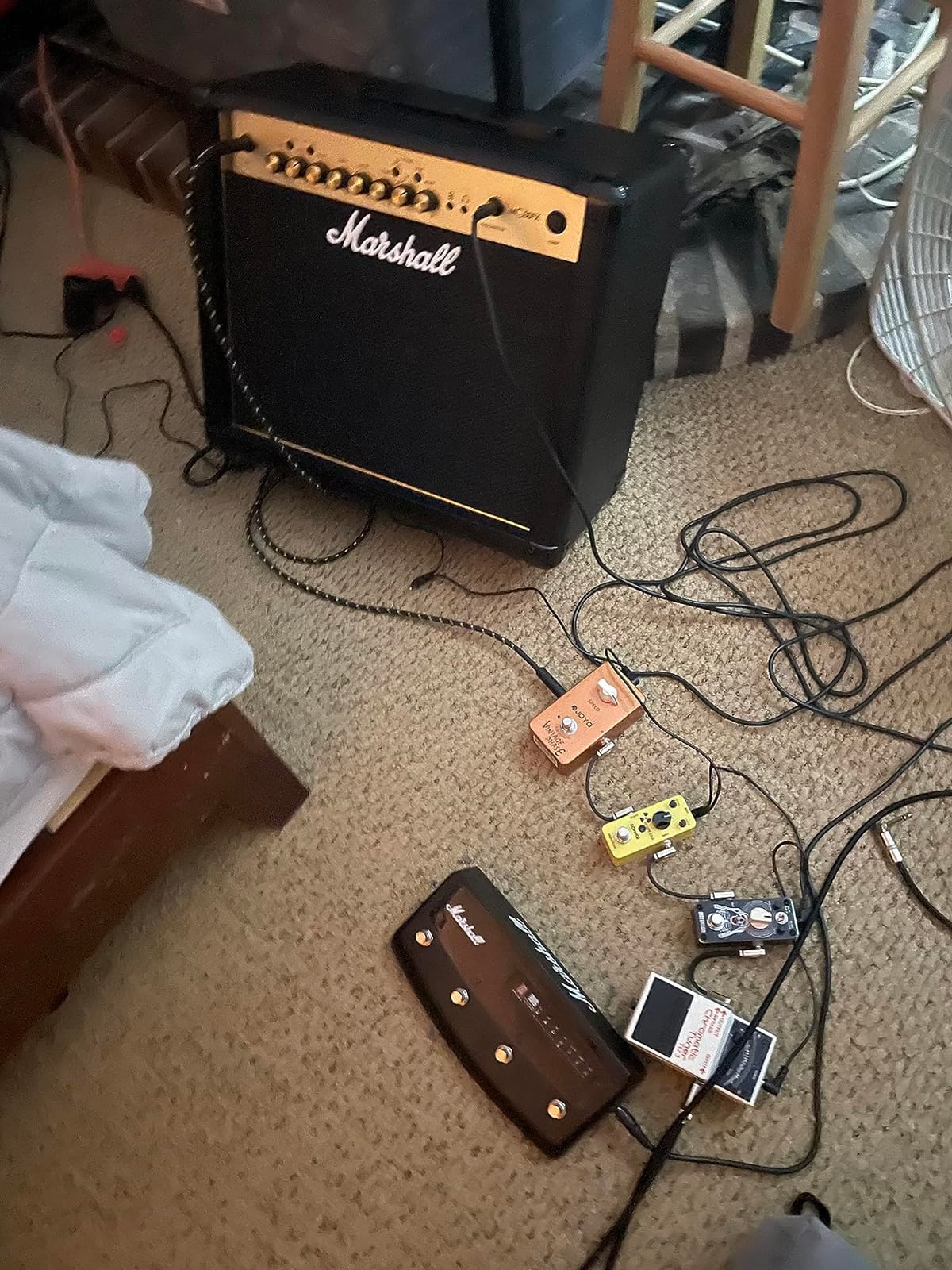
The MG30GFX is the one amp here that gives you four channels and a full set of digital effects on board, and that combination is why it appears on so many first-amp shortlists. Clean, crunch, OD1 and OD2 cover most of what a practice session needs before a single pedal goes in.
At 30 watts with a custom 10-inch speaker, it is the smallest amplifier in this roundup with genuine low-end weight. The frequency response is not specified, but owners describe the clean channel as full-bodied and shimmery, and the larger cone is the reason.
Headphone output and a 3.5mm line input handle the two most common practice needs: playing quietly, and playing along with a track. Reverb and delay are also present, which several owners put ahead of pedals when starting out because there is nothing to set up.
The honest limitation is the high-gain side. Reviewers consistently describe the distortion as weaker than the channel names imply, and the effects set as usable in quality but limited in scope.
What you should know before buying
Wattage is where this one runs out. At 30 watts it is comfortable for practice, basements and small rooms, but owners frequently suggest 50 watts or more for full-band practice with a loud drummer. Match it to your rehearsal room, not your bedroom.
It is also the heaviest practice amp here, at 23.8 pounds, and the cabinet is 18.9 inches wide. That matters if you plan to move between rooms or carry it to band practice on public transport.
Who it suits and who it does not
It suits a beginner who wants the most sounds from one box, someone practising in a larger room or basement, and a player who wants built-in reverb and delay before buying pedals.
It does not suit a high-gain player, and it is too heavy for players who need a genuinely portable amp. A modelling amp with a headphone path may suit you better if your practice is mostly silent.
10. Monoprice Stage Right 40W – Only Amp Here With a Spring Reverb and Effects Loop
Monoprice 1×10 Guitar Combo Amplifier – Black 40-Watt, Spring Reverb, 10-Inch 4-Ohm Speaker, High & Low Inputs, Headphone Output – Stage Right Series
40-watt solid state combo
10-inch 4-ohm speaker
Spring reverb and effects loop
3-band EQ at 100 Hz 1 kHz, 3 kHz
High and low inputs, headphone out
Pros
- Clean channel described as tube-like with a responsive 3-band EQ
- Real spring reverb that works and is controllable
- Quiet useful effects loop for pedalboard builds
- Headphone output is clean and an external speaker out adds flexibility
- Best value combo in its bracket on owner reviews
Cons
- Onboard overdrive channel is underwhelming and fizzy
- Line output is unbalanced and noisy
- Some listeners report a brittle upper-midrange no EQ setting fixes
- Factory speaker may need roughly 25 hours of break-in
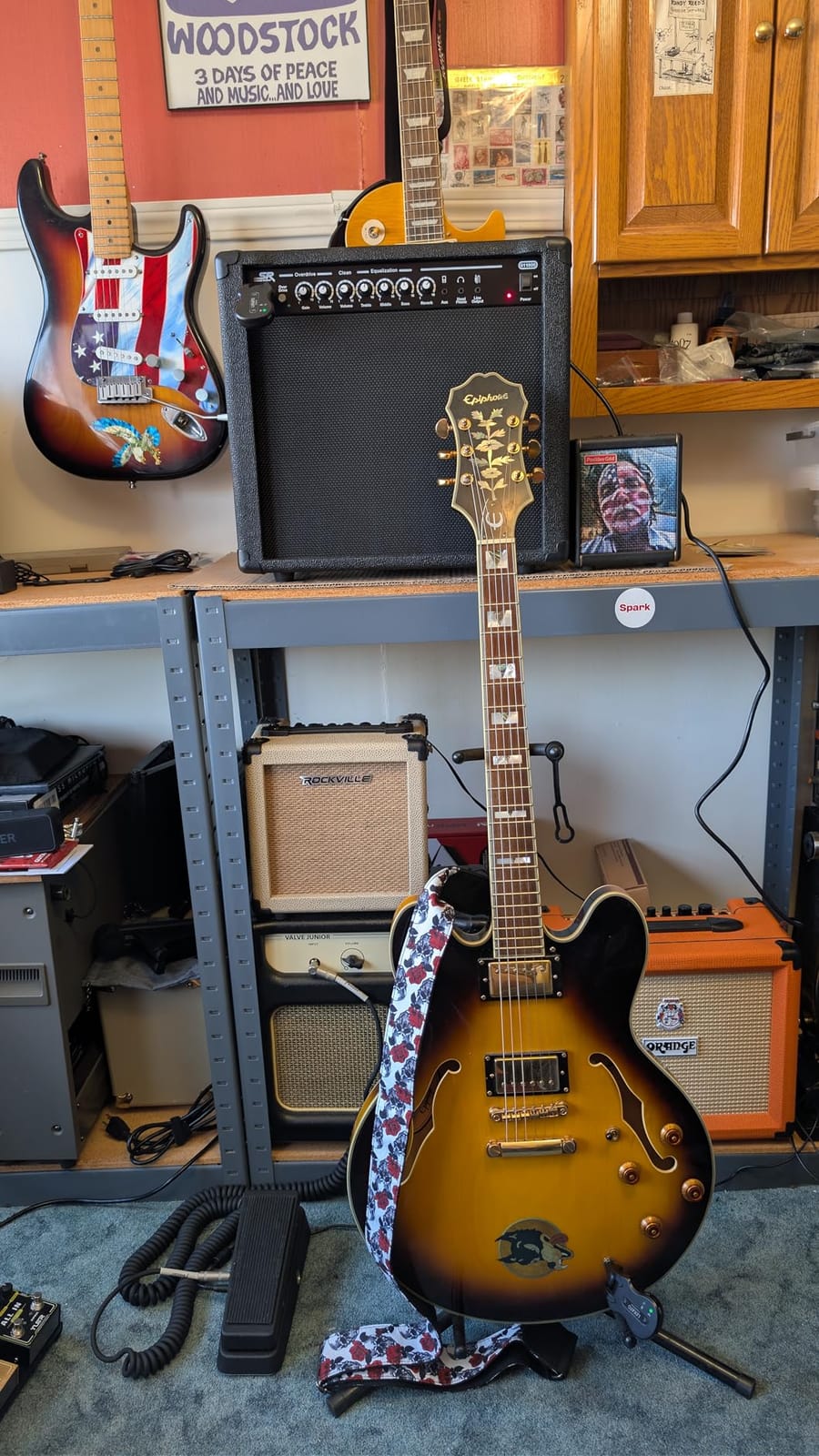
The Stage Right 40W is the specification outlier in this list. A real spring reverb and a functioning effects loop are the two features most practice amps leave out, and both of them show up here in a 40-watt solid state combo driving a 10-inch speaker.
Technical detail is unusual at this size. The frequency response runs 60 Hz to 12 kHz, the 3-band EQ is centred at 100 Hz, 1 kHz and 3 kHz, and total harmonic distortion is listed at 0.5 percent. High and low input jacks let you run two instruments if you need to.
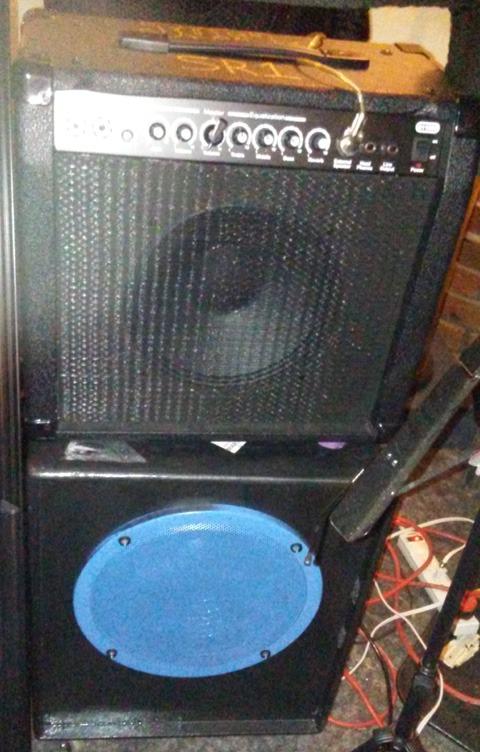
Owners consistently praise the clean channel as tube-like and responsive under the EQ, and the effects loop is repeatedly described as quiet enough to be useful rather than merely present. The external speaker out and headphone output add recording and monitoring options.
The clean channel is where the value sits. The factory overdrive is the weak point, described as underwhelming and fizzy, and the line output is unbalanced and noisy enough that reviewers do not recommend it for recording or chaining.
What you should know before buying
Two honest warnings. The factory 10-inch speaker may need roughly 25 hours of break-in before it sounds its best, and some listeners hear a brittle upper-midrange character that no EQ position removes. The 3.3 percent one-star share reflects exactly that kind of reaction.
Owner reviews also note audible hiss and reverb bleed at low volumes even with the controls down. If your room is genuinely quiet, that is a real consideration for late-night practice.
Who it suits and who it does not
It suits a pedalboard builder who wants a proper effects loop, anyone who wants real spring reverb in a practice amp, and a player in a basement or small venue who wants 40 watts of headroom.
It does not suit someone who needs the onboard overdrive, a quiet line output for recording, or the polished build quality of a major brand. The rating here is the lowest on the list, and the tone opinions are genuinely divided.
11. LyxPro 40W – Most Connection Options in the List
LyxPro 40 Watt Electric Guitar Amplifier | Combo Solid State Studio & Stage Amp with 8” 4-Ohm Speaker, Custom EQ Controls, Drive, Delay, ¼” Passive/Active/Microphone Inputs, Aux in & Headphone Jack
40-watt solid state combo
8-inch 4-ohm speaker
Passive and active inputs plus mic input
Headphone jack and line out
Adjustable drive and digital delay
Pros
- Passive active microphone line out headphone and aux connections in one budget combo
- Loud and clean for 40 watts
- Works well with distortion overdrive and modeling pedals
- Handles electric and acoustic-electric instruments
- Many colour and wattage variants available
Cons
- Onboard delay and reverb cannot be fully switched off and stay faintly audible
- Onboard distortion stays quiet even at maximum gain
- Light construction with plastic knobs and a cabinet that is not sturdy
- Not built for stage use and the mic input is not XLR
The LyxPro 40W is the connectivity amp. Between passive and active inputs, an integrated microphone input, a line out for external speakers and PA systems, a headphone jack and an aux in, there is no other amplifier on this list with this many ways to connect something to it.
Underneath it is a 40-watt solid state combo with an 8-inch 4-ohm speaker, adjustable drive, digital delay, and treble, middle and bass controls running from 0 to 10. Owners are most often surprised by how loud and clean it is for the money.
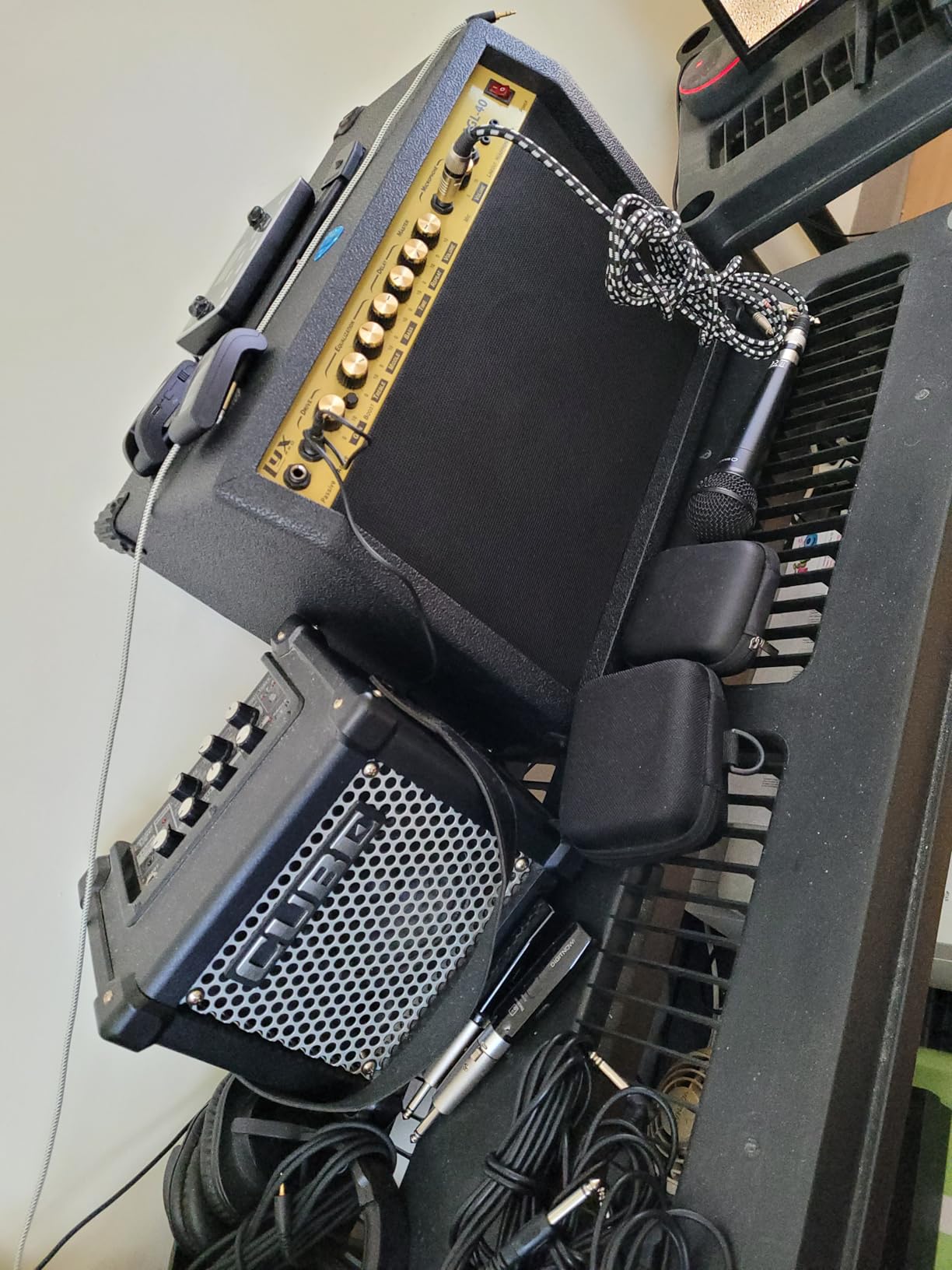
It works with distortion, overdrive and modeling pedals, and it handles acoustic-electric instruments as readily as electric. For someone setting up a home recording corner, the line out and mic input combination is the reason to look at it at all.
Build quality is the trade. The cabinet is wood but light, reviewers describe plastic knobs that can arrive crooked, and some owners report damage or peeling covering on arrival. Treat it as a practice and jam tool rather than stage equipment.
What you should know before buying
The onboard effects will not fully go away. Owners report that the delay and reverb remain faintly audible even at zero, which matters in a quiet room late at night because it sits under everything you play.
The onboard distortion is also modest. It does not reach a genuinely loud or saturated sound at maximum gain, so treat the drive control as a light boost and plan to use a pedal for real overdrive.
Who it suits and who it does not
It suits a beginner who wants a loud amp with every connection type available, a home recording user who needs a line out and a mic input, and a player practising acoustic-electric as well as electric.
It does not suit someone who values sturdy construction, who needs a quiet signal chain at very low volume, or who plays bass. Bass response is limited, and bass guitar through it sounds like a guitar through a practice amp.
12. NUX Mighty Plug MP-2 – Most Features in a Pocket Amp, Guitar and Bass
NUX Mighty Plug MP-2 Guitar and Bass Modeling Headphone Amplug with Bluetooth,13 Amplifier Models,20 IR,19 Variety of Effects
Pocket modeling headphone amplifier
13 amp models, 20 IR cabinets, 19 effects
Adjustable by mobile app
Rechargeable battery, 3 hours playing time
USB audio to computer
Pros
- Feature-rich silent playing for both guitar and bass
- 13 amp models 20 IR cabinets and 19 effects with adjustable parameters
- Rechargeable battery with USB power bank support
- Low-latency USB audio and ASIO recording to a computer
- Live backing-track mode and dual Bluetooth channels
- Compact enough to carry to gigs for silent warm-ups
Cons
- Requires the mobile app to configure and the manual is limited
- App can hang and needs its cache cleared periodically
- Output volume is modest so low-impedance headphones may need a boost
- Custom IR files cannot be loaded from the internet
The NUX Mighty Plug MP-2 is a guitar and bass modeling headphone plug, and it is the only product in this roundup that takes bass as seriously as electric. Thirteen amplifier models, 20 IR cabinets and 19 effects, all adjustable from a mobile app, in an enclosure that weighs 0.15 kg.
The recharge is about three hours of playing time, and it can run from a USB power bank, which makes it genuinely usable away from mains power. Bluetooth works as a receiver with dual channels, so you can play along to a track, and a backing-track mode is included.
For recording, the built-in USB streaming function connects directly to a computer over Micro B USB with low latency and ASIO support. Owners rate that recording path as clean, which is unusual at this size.
What you should know before buying
Configuration runs through the app, and that dependency is the amp’s defining limitation. Owners report the app hanging and needing its cache cleared periodically, and the included documentation is thin. There is no physical tone control beyond what the app provides.
Maximum output volume is modest, so low-impedance headphones may need a boost. Custom IR files cannot be downloaded from the internet, and Bluetooth is not the low-latency aptX LL variant, so video playback can drift out of sync.
Who it suits and who it does not
It suits bass players practising on headphones, anyone who records direct to a computer, and travelling players who want something smaller than the Mustang Micro with far more tone shaping available.
It does not suit someone who wants to avoid apps, or who needs to hear sound in a room. There is no speaker output. If you want simple one-touch operation rather than tone menus, the Mustang Micro is the cleaner choice.
Bass practice deserves its own note
Two amps on this list handle bass without special pleading. The Mustang Micro is praised by owners for working for bass as well as electric, and the NUX Mighty Plug was designed for both instruments from the start.
Everything else on the list is a guitar amp. The LyxPro owners say so plainly: its bass response is limited, so a bass guitar through it sounds like a guitar through a practice amp. If you play bass, start from the two pocket options rather than the combos.
How to Choose a Solid State Practice Amp
Decide analog or modeling first. It is the only decision that changes what you are buying. An analog solid state amp sends your signal straight through a transistor circuit to the speaker, so what you play is what you hear, and the response under your fingers is consistent. A modeling amp reprocesses that signal digitally to imitate a known circuit, which gives you preset variety and a speaker simulation in headphones but changes the feel. Players who dislike DSP fizz keep asking the forums for analog-only recommendations, and the reason is the response, not the sound quality. Our practice amplifier roundup covers both circuit types in more depth.
Match wattage to the room, not the spec sheet. The 10-watt entries comfortably fill a bedroom or living room. The 20- and 30-watt amps handle basements and practice rooms. The 40-watt amps reach small venues but stop short of competing with a loud drummer, and several owners on this list say so directly. If your practice is silent through headphones, wattage becomes almost irrelevant and you should judge tone and features instead.
Understand what a power attenuator actually does. Most of the amps here simply scale down, which is why a solid state amp holds its voice at low volume in a way a tube amp cannot. The most useful feature in that family is the power selector or master volume working in combination with the gain structure: turn the gain up and the master down, and you get the same voicing at a lower level. None of the amplifiers in this roundup offers a dedicated attenuator switch, so if you want that behaviour, keep the gain structure in mind when you set up.
Check the connection list before the tone. Headphone output is the single most requested feature in the forum threads and the one buyers regret missing. After that, look for an aux or line input for backing tracks, a built-in tuner, a footswitch input, an effects loop, and USB recording. The Monoprice Stage Right is the only amp here with a proper effects loop, and the LyxPro is the only one with a microphone input and a line out.
Size and weight decide portability more than wattage does. The Fender Frontman 10G is the most easily moved of the larger-sounding options, while the MG30GFX at nearly 24 pounds is genuinely awkward outside a house. Measure your practice spot and your route to it before you commit.
Fix the room before you fix the amp. If sound travels through the wall, no amplifier wattage will solve it. Practical first steps are a thicker or heavier door on the practice room, moving practice to daytime hours, and pointing the cab away from shared walls. Our guide to solid core interior doors for soundproofing covers the door side of that problem, and it changes the result for every amp on this list.
Consider the used market honestly. Solid state amps hold value well, and owners treat used pricing as real information rather than a fallback. The most useful rule is that a used modeling amp is only worth buying if the seller can show the app, the preset workflow and the included accessories, because that software support is part of the product. Analog amps are simpler to assess on condition alone.
One thing solid state genuinely cannot deliver is power-stage compression. A tube amp loaded by a speaker reacts to how hard you pick in a way a transistor circuit does not fully replicate, and players who want that feel will always prefer a tube. For practice at low volume, the trade is overwhelmingly in favour of solid state, which is why these amps are the right answer to the noise complaint problem.
Frequently Asked Questions
What is the best solid state amp for practice?
The Fender Frontman 10G is the best solid state amp for practice for most players, because its analog 10-watt circuit stays clean and predictable at low volume, it has a headphone jack, and it is small enough to move between rooms. The Fender Mustang LT25 is the alternative if you want presets and more volume, and the Mustang Micro is the right answer when practice happens entirely in headphones.
What is the best budget solid state amp?
On a tight budget the Fender Frontman 10G is the strongest first amp, with the clean channel carrying almost all of the praise its owners give it. The VOX Pathfinder 10 is the better pick if you want a fully analog path and a chimey clean tone, and the Orange Crush 12 is the better pick if you want three-band EQ and dual gain controls instead of a two-band layout. The onboard overdrive channels on all three are the weakest part.
Which solid state amp sounds most like a tube amp?
Nothing solid state fully replicates power-stage compression, but the analog Fender, VOX and Orange designs come closest in feel because they run a continuous transistor signal path with no digital processing. The VOX Pathfinder 10 in particular is regularly described as sounding like a scaled-down AC-series amp, and the Monoprice Stage Right clean channel is described as tube-like. Modeling amps go further in imitating specific circuits but change the response under your fingers.
How many watts do I need for home practice?
For a bedroom or living room, 10 watts is genuinely enough, and two of the amps here sit at that figure while filling a small room comfortably. Move to 20 to 30 watts for a basement or a shared practice room. Reserve 40 watts for small venues, and remember that owners of the 40-watt models still say they fall short of competing with a loud drummer. If you practise in headphones, wattage barely matters.
Can I gig with a solid state amp?
Some of these amps are giggable and some are not, and the forum consensus is that a solid state amp works fine on stage at moderate volume. The Orange Crush 20 is described as loud and projecting for a small combo and accepts a footswitch, which makes it the most practical stage option here. The Marshall MG30GFX at 30 watts is fine for small rooms but owners suggest 50 watts or more for full-band use. The 10-watt combos are practice-only.
Are solid state amps quieter than tube amps?
Yes, in practice. A tube amp at a musically useful volume is loud, which is why apartment players move to a transistor circuit that holds its character at low volume instead. One caveat from owner reviews: some models still show audible hiss with single-coil pickups past about volume 5, and the Monoprice Stage Right has a note about hiss and reverb bleed at low settings. Solid state removes the volume problem, not every noise problem.
Which Solid State Amp Should You Buy?
Start with the Fender Frontman 10G if you want one amp that works in a bedroom, records through headphones, and costs you no decisions. Its clean channel is what 13,563 owners are actually praising, and the cabinet is light enough that moving it is never the reason you stop practising.
Choose the Fender Mustang LT25 if you want a color screen, 30 presets and 25 watts that reach a small room. Choose the Fender Mustang Micro if practice is silent, shared-wall or midnight, and accept that its controls are buttons rather than knobs.
For a fully analog signal path, the VOX Pathfinder 10 gives the chimeiest clean channel and the Orange Crush 12 and Crush 20 give you the most tone shaping and the better pedal platform. If you run pedals at low volume, the Crush 20 is the one with the clean headroom and a footswitch to match.
The Marshall MG30GFX is the buy when you want four channels and built-in effects in one box, and the Monoprice Stage Right 40W is the one with a real effects loop and spring reverb. Bass players should skip the combos and go straight to the NUX Mighty Plug MP-2 or the Mustang Micro.
Whichever you pick, the tone that matters is the tone at low volume. Set the gain higher than feels natural, bring the master down, and listen at the volume you will actually be playing. That is the whole test, and it is why the best solid state amplifiers for practice are still the same handful of models the forums recommend year after year.