
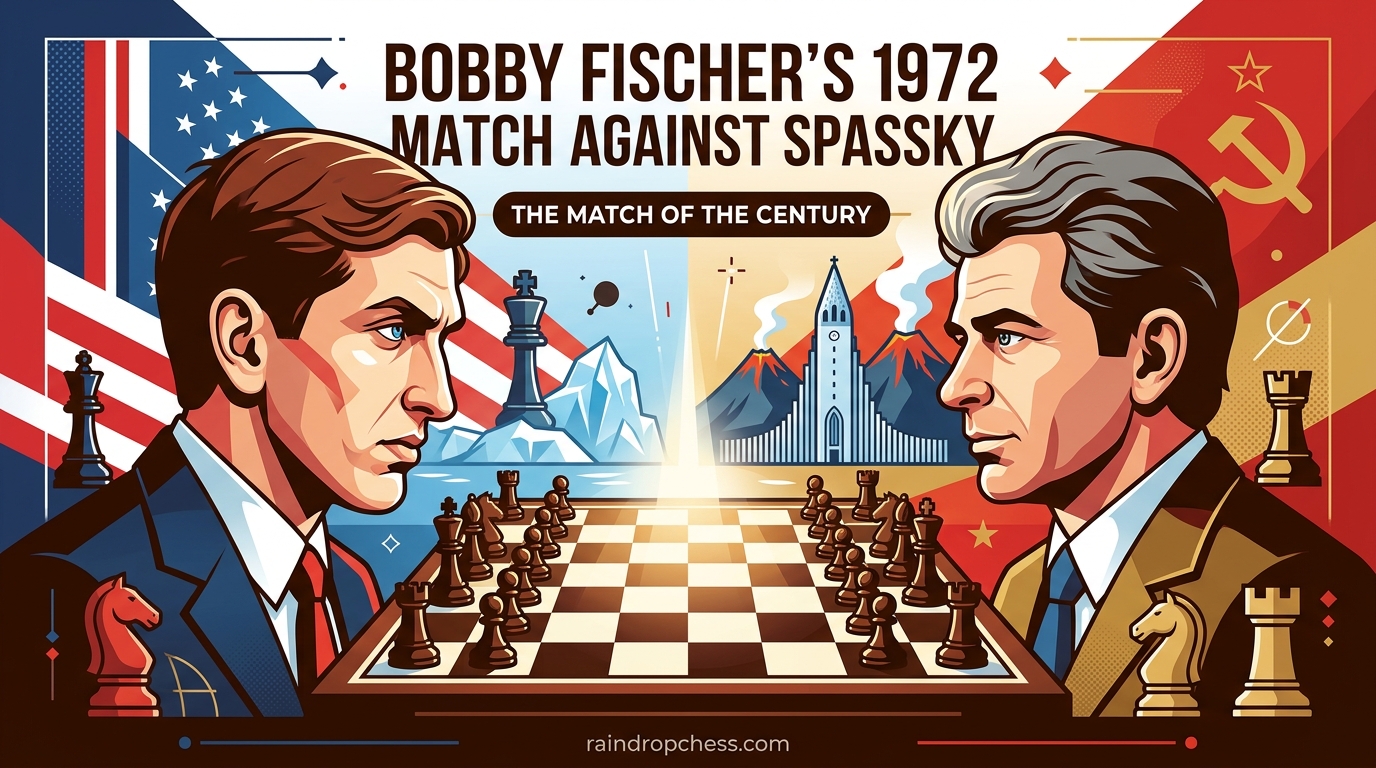
The 1972 World Chess Championship in Reykjavik, Iceland was won by American Bobby Fischer, who defeated Soviet champion Boris Spassky 12.5-8.5 to become the first American World Chess Champion. The match lasted from July 11 to September 1, 1972, and is widely regarded as the Match of the Century.
I have studied this match for years, pouring over game annotations and historical accounts. What strikes me most is not just the chess brilliance on display, but how this single event transcended the 64 squares to become a symbol of Cold War rivalry and American determination.
Fischer was 29 years old. Spassky was 35 and had held the title since 1969. The Soviet Union had dominated world chess for 24 years. This was not merely a sporting contest. It was a geopolitical showdown played out with kings and pawns.
Table of Contents
Historical Context: Cold War on the Chessboard
The Soviet Union treated chess as a matter of national prestige. Since 1948, every world champion had been Soviet. The government poured resources into chess schools, coaches, and professional players. Chess was proof of communist superiority.
America had no such system. Bobby Fischer was essentially a self-taught prodigy from Brooklyn who had learned the game from a set purchased at a candy store. He represented everything the Soviets feared: individual genius thriving without state support.
The match carried enormous symbolic weight. When Fischer arrived in Iceland, he was not just playing for himself. He was playing for American pride against a Soviet chess machine that had crushed every challenger for a generation.
The Path to Reykjavik: Fischer’s Candidates Campaign
Fischer earned his place in Reykjavik through one of the most dominant performances in chess history. In the 1971 Candidates Tournament, he faced three of the world’s strongest players and demolished them.
First came Mark Taimanov of the Soviet Union. Fischer beat him 6-0. Nobody had ever blanked a grandmaster in Candidates history. Then came Bent Larsen of Denmark, the strongest Western player. Another 6-0. The chess world was stunned.
In the final, Fischer faced Tigran Petrosian, a former world champion and defensive genius. The score was 6.5-2.5. Fischer had won 20 games and lost only one in the entire cycle. Yet he remained the underdog against Spassky.
Spassky was the defending champion, calm and technically brilliant. He had beaten Petrosian for the title in 1969 and defended it successfully. The Soviet chess establishment believed he would handle the erratic American.
The Match of the Century Begins
The match was scheduled to begin on July 2, 1972. Fischer did not show up. He was still in New York, making demands about prize money and playing conditions. The opening ceremony proceeded without him.
FIDE, the international chess federation, had secured a prize fund of $125,000, with $78,125 going to the winner. Fischer wanted more. He also wanted specific conditions: no television cameras near the board, specific lighting, and a certain brand of chess clock.
Henry Kissinger, President Nixon’s national security advisor, personally called Fischer to urge him to play. The match had become a diplomatic concern. Finally, on July 11, Fischer arrived in Reykjavik. The world watched to see if he would actually sit down at the board.
Game-by-Game Highlights
The match format was best of 24 games. The first player to reach 12.5 points would be champion. Draws counted as half a point each. What followed was two months of the most dramatic chess ever played.
Game 1: The Disputed Clock
Fischer arrived on time for the first game, surprising everyone. He played the Nimzo-Indian Defense as Black and reached a drawn position. Then something strange happened.
Fischer complained that the cameras were too loud and distracting. Tournament officials agreed to remove them. But Fischer also objected to the placement of the electronic game clock, claiming he could hear its faint humming noise. He demanded it be moved.
Spassky agreed to the change. But in the complicated position that followed, Fischer blundered on move 29, losing his bishop. He resigned on move 56. Spassky took a 1-0 lead. Fischer was furious.
Game 2: The Forfeit
Fischer demanded the cameras be removed completely or he would not play. Organizers refused. The second game began with Fischer’s clock running and his chair empty. After an hour, Spassky was declared the winner by forfeit.
The score was now 2-0 in Spassky’s favor. The match seemed over before it had truly begun. American officials pleaded with Fischer. The Icelandic organizers threatened to cancel everything. Chess fans worldwide held their breath.
Finally, a compromise was reached. The cameras would be placed in booths with one-way glass. Fischer would play. But he had dug himself a deep hole.
Game 3: The Comeback Begins
Game 3 was moved to a private room to accommodate Fischer’s demands. Spassky, showing remarkable sportsmanship, agreed to play there rather than the main stage.
Fischer played the Sicilian Defense and produced a stunning victory. He sacrificed a pawn for initiative, then outplayed Spassky in a complex middlegame. The win brought the score to 2-1. The match was alive.
Something shifted in this game. Fischer proved he could beat Spassky. More importantly, he proved he could handle the pressure and the complications. The psychological balance began to tilt.
Game 6: The Masterpiece
Game 6 is considered one of the greatest games in World Championship history. Fischer played the Queen’s Gambit Declined, an opening he had rarely used. Spassky responded with a solid defense.
What followed was chess perfection. Fischer gradually outplayed the champion, restricting Black’s pieces until they had no good moves. By move 41, Spassky’s position was hopeless. He resigned.
Then something extraordinary happened. Spassky stood up and applauded Fischer’s performance. The champion was acknowledging that he had been outplayed by sheer brilliance. This gesture of sportsmanship became one of the most famous moments in chess history.
The score was now 3.5-2.5 in Fischer’s favor. Fischer had seized the lead, and the world knew it was witnessing something special.
The Middle Games: Fischer Dominates
Games 7 through 11 were all draws, but they told a story. Spassky could not break through Fischer’s defenses. The American was playing with confidence and precision, neutralizing the champion’s attacking attempts.
In Game 8, Spassky tried an aggressive Sicilian and reached a winning position. Fischer defended brilliantly and escaped with a draw. In Game 11, Spassky missed a winning continuation in time trouble. The draws felt like victories for Fischer.
The psychological pressure was mounting. Spassky began to doubt himself. Fischer grew stronger with every game. The match had become a test of wills as much as chess skill.
Game 13: Spassky’s Last Stand
Game 13 produced one of the most complex positions ever seen in a World Championship. Spassky sacrificed material for an attack, and Fischer faced a dangerous assault on his king.
The game was adjourned with Fischer in time trouble and Spassky pressing hard. Analysts gave Fischer little chance to survive. But when play resumed, Fischer found defensive resources that nobody had seen. The game ended in a draw after 70 moves.
Spassky had thrown everything at Fischer and failed to break him. The champion’s spirit was beginning to crack. The score remained 7.5-6.5, but the momentum was all with Fischer.
Games 14-20: The Slow Strangulation
Fischer won Game 14 with precise endgame technique, extending his lead to 8.5-6.5. The draws continued, but each one brought Fischer closer to his goal.
Game 17 was another brilliant Fischer victory. He trapped Spassky’s queen in a subtle tactical sequence. The score became 10.5-7.5. Fischer needed just two more points.
Game 19 was critical. Spassky had chances to win but again failed to convert. The game was drawn. The champion was running out of time.
Game 21: Fischer Takes the Title
Game 21 began on August 31, 1972. Spassky needed to win to keep the match alive. He played the Sicilian Defense, his favorite weapon. Fischer chose a positional approach.
Gradually, Fischer outplayed the champion. His pieces took better squares. His king was safer. Spassky’s position deteriorated move by move. After 40 moves, the game was adjourned.
The next day, September 1, 1972, Boris Spassky telephoned his resignation to the organizers. He did not even resume the game. The final score was 12.5-8.5. Bobby Fischer was the new World Chess Champion.
The Controversies and Drama
The 1972 match was filled with incidents that would define Fischer’s legacy as much as his chess brilliance. His demands seemed endless, his behavior erratic, his focus absolute.
The film camera incident almost derailed everything before it started. Fischer claimed the cameras distracted him, though other players had never complained. He refused to play unless they were removed, forcing organizers into a last-minute scramble.
The clock placement became another issue. Fischer insisted the clock be placed in a specific position. When Spassky agreed to move it in Game 1, some speculated it threw off Fischer’s concentration and contributed to his loss.
Noise was another obsession. Fischer complained about the audience, the air conditioning, the lighting. He retreated to his hotel room for days, refusing to meet with officials. His team, including lawyer Paul Marshall and priest Bill Lombardy, spent hours negotiating on his behalf.
Behind the scenes, the US government monitored the match. Kissinger’s phone call to Fischer was real. The State Department wanted an American victory for Cold War propaganda. Soviet officials pressured Spassky to win at any cost.
Through it all, Spassky maintained remarkable composure. He never publicly criticized Fischer’s behavior. He accommodated demands that other champions would have rejected. His sportsmanship elevated the match beyond mere gamesmanship.
Spassky’s Perspective: The Defeated Champion
Boris Spassky was not just a great player but a true sportsman. His applause after Game 6 was spontaneous and genuine. He recognized genius when he saw it, even at his own expense.
Spassky later described Fischer as “a phenomenon, a genius, a man who brought chess to a higher level.” He never made excuses for his defeat. He acknowledged that Fischer was simply the better player during those two months.
The Soviet chess establishment was less gracious. Spassky faced criticism at home for losing to an American. Some officials accused him of being too soft, too accommodating. But history has vindicated his approach.
Spassky and Fischer developed an unusual relationship. They would meet again 20 years later for a rematch in Yugoslavia, by which time both men were past their primes. Fischer had become a recluse. Spassky had settled in France. The 1992 match drew attention, but it was a shadow of the 1972 original.
Aftermath and Legacy
Bobby Fischer became the first American World Chess Champion in history. He returned to the United States as a hero. Television networks aired his games. Chess clubs across the country saw membership surge. The Fischer Boom had begun.
But Fischer did not defend his title. In 1975, he refused to play challenger Anatoly Karpov under FIDE’s match conditions. He demanded a different format. FIDE refused. Fischer forfeited his title.
He disappeared from competitive chess for nearly 20 years. When he reemerged in 1992 to play Spassky again, he was wanted by American authorities for violating sanctions against Yugoslavia. He spent his final years in Iceland, the country that had hosted his greatest triumph, eventually dying there in 2008.
Spassky continued playing at a high level for many years. He never regained the world championship, but he remained one of the most respected figures in chess. His graceful handling of the 1972 defeat earned him admirers worldwide.
The match transformed chess into a global spectacle. Millions watched on television who had never played a game. The ABC Wide World of Sports broadcast brought chess to American living rooms. Chess books sold out. Children took up the game inspired by Fischer.
Today, the 1972 match remains the standard by which all chess events are measured. The Match of the Century transcended its era to become a permanent part of sports history. It proved that chess could be drama, theater, and cultural phenomenon.
Frequently Asked Questions
What happened to Bobby Fischer and Boris Spassky after the 1972 match?
After winning the 1972 World Chess Championship, Fischer became a national hero in America but never defended his title. He forfeited to Karpov in 1975 and disappeared from competitive chess for 20 years. He died in Iceland in 2008. Spassky continued playing at a high level but never regained the championship. He eventually settled in France and remained respected throughout the chess world.
Why did Fischer refuse to defend his world championship title?
Fischer refused to defend his title in 1975 because he disagreed with FIDE’s match format. He wanted different rules including a first-to-10-wins format rather than the traditional 24-game match. When FIDE would not accommodate his demands, Fischer forfeited rather than compromise. This decision shocked the chess world and cost Fischer his title without losing a game.
Did Spassky applaud Bobby Fischer during the match?
Yes, after losing Game 6 of the 1972 match, Boris Spassky stood up and applauded Fischer’s brilliant performance. This spontaneous gesture of sportsmanship acknowledged that Fischer had played a masterpiece. It remains one of the most famous moments in chess history and demonstrated Spassky’s character as both a player and a person.
What was the final score of the Fischer-Spassky 1972 match?
Bobby Fischer defeated Boris Spassky 12.5-8.5 in the 1972 World Chess Championship. The match consisted of 21 games, with Fischer winning 7 games, Spassky winning 3 games, and 11 games drawn. Fischer clinched the title when Spassky resigned the adjourned Game 21 on September 1, 1972.
Why is the 1972 Fischer-Spassky match called the ‘Match of the Century’?
The 1972 match earned the title ‘Match of the Century’ because it combined exceptional chess quality with Cold War symbolism. It featured the first American challenger in decades against the Soviet champion, breaking 24 years of Soviet dominance. The match was watched by millions globally, created unprecedented media coverage for chess, and produced some of the most brilliant games ever played at the World Championship level.
Conclusion
The 1972 match between Bobby Fischer and Boris Spassky remains the most famous chess event in history. Fischer won 12.5-8.5, ending Soviet dominance and becoming the first American World Chess Champion. The match lasted from July 11 to September 1, 1972, in Reykjavik, Iceland.
What actually happened was more than just a chess match. It was a drama of human psychology, Cold War tension, and sporting greatness. Fischer’s brilliance and eccentricity. Spassky’s dignity and sportsmanship. The games that will be studied for centuries.
Every chess player should know this story. Every student of sports history should understand its significance. The Bobby Fischer 1972 Spassky match proved that chess could capture the world’s attention and that individual genius could triumph over institutional power.
If you have never studied the games from this match, I urge you to do so. Start with Game 6, the masterpiece that earned Spassky’s applause. Then explore the others. You will understand why this remains the Match of the Century.