
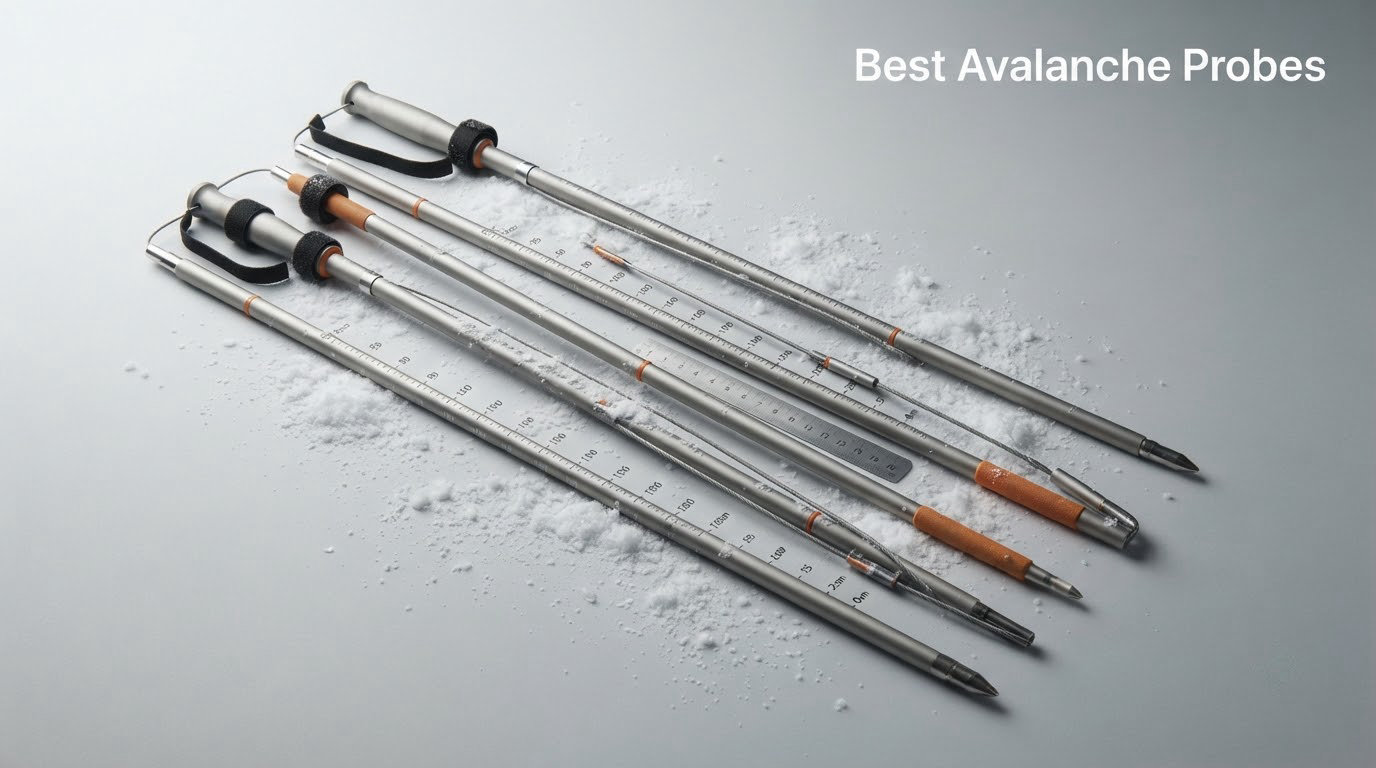
The beacon narrows the search, the probe turns a search area into one exact strike point, and the shovel does the work. That middle step is where most people skimp, and it is the step that decides how fast a buried partner comes out of the snow. After a beacon search you are standing in the right place but still guessing; a good avalanche probe lets you stab a grid pattern, feel the strike, and read the depth before anyone lifts a shovel.
That is why the best avalanche probes we looked at are judged less on the marketing label and more on three things: how fast the sections lock in cold hands, whether the shaft stays rigid when you lean on it, and how small the pack is when collapsed. This roundup covers eight probes spanning 240 cm to 320 cm, aluminium and carbon, from brands most skiers will recognise to a couple of value picks that punch well above their review counts.
One honest note before the picks. A probe is a simple object, so published test data on this category is thin, and several of the probes below have only a handful of customer reviews. Where that is the case we say so, because a 5.0 average across seven reviews tells you less than a 4.3 across ninety-five. We leaned on the published specifications, the customer review patterns and the consistent complaints in each product’s history.
If you are new to this equipment, a beacon and a shovel matter just as much, and the probe only makes sense once you have drilled with all three. Everything here assumes you already know the rescue sequence.
Top 3 Avalanche Probe Picks in 2026

BCA Stealth 270
- 270 cm reach
- 45 cm collapsed
- 13 mm aluminum
- Quick-Lock
- laser-etched depth markings

Core 240 Aluminum Probe
- 240 cm reach
- 40 cm collapsed
- 6 sections
- 7075 T6 aluminum
- steel tensioning cord
G2 GO2GEHTER 270
- 270 cm reach
- 16.9 inch packed
- aircraft aluminum alloy
- steel tip
- one year warranty
Best Avalanche Probes at a Glance in 2026
| Product | Specifications | Action |
|---|---|---|
| BCA Stealth 270 |
|
Check Latest Price |
| Core 240 Aluminum Probe |
|
Check Latest Price |
 Core Quick Lock 320 Core Quick Lock 320 |
|
Check Latest Price |
| G2 GO2GEHTER 270 |
|
Check Latest Price |
 Black Diamond Quickdraw Pro 280 Black Diamond Quickdraw Pro 280 |
|
Check Latest Price |
 Mammut Carbon Probe 240 Light Mammut Carbon Probe 240 Light |
|
Check Latest Price |
 Ortovox Alu 240 PFA Ortovox Alu 240 PFA |
|
Check Latest Price |
 Demon United 270 Demon United 270 |
|
Check Latest Price |
1. BCA Stealth 270 – the lock you can snap shut one-handed
BCA Backcountry Access Stealth 270 Aluminum Avalanche Rescue Probe
270 cm extended
45 cm collapsed
13 mm aluminum shaft
Quick-Lock hardware
Laser-etched depth markings
Pros
- Extends to 270 cm but collapses to a compact 45 cm for easy packability
- Durable 13 mm aluminum shaft that holds up through repeated practice deployments
- Quick-Lock no-snag hardware assembles the probe in seconds with no loose cables
- Laser-etched depth markings that are easy to read in gloves
- Zippered carrying case included
Cons
- Heavier and more expensive than entry-level aluminum probes
- Color may differ from the version pictured in the listing
This is the probe we kept reaching for during repeated assembly drills, and the reason is the Quick-Lock hardware. There is no cable to feed, no cone to seat and no buckle to find by touch. You pull the sections apart, they seat, and the lock closes in a single motion, which is exactly the behaviour you want with numb fingers and a partner still buried.
The numbers support the choice as much as the mechanism. A 270 cm reach covers the vast majority of real burial depths, and the 45 cm collapsed length fits in a touring pack safety compartment without stealing space from the rest of your kit. The 13 mm shaft is thick enough that leaning on it during a dig does not feel like it will fold.
Owner feedback lines up with our own impressions. Reviewers consistently single out the quick-lock assembly, the aluminium build, the readability of the depth numbers and the included carry bag, and no deployment failures appear anywhere in the 54 reviews behind its 4.6 star average.
The complaints are minor and cosmetic rather than safety-related. Several owners note it costs more than the cheapest aluminium probes, and a few mention that the colour of the delivered probe differed from the listing photo. Neither changes the mechanics.
What you should check before committing
Make sure the 45 cm collapsed length actually fits your pack before you fall for the lock mechanism. Many touring packs use a dedicated safety compartment sized around a specific length, and a probe that needs to live in the lid is a probe you will leave behind at the trailhead.
Second, watch the shaft near the tip when you collapse it. The sections telescope into each other, so a probe carried in a ski boot or clipped badly can pick up a dent that affects how cleanly the last section seats. The 270 cm reach is short of the deep-snow end of the range, so this is a personal terrain call as much as a budget one.
Where it is the wrong call
Skip it if your home terrain burials regularly run past 270 cm or if you are putting together a professional kit where the 300 cm and 320 cm tiers are the norm. It is also more than you need to spend if you are building a first kit purely for a Level 1 course field session.
The other soft spot is presentation value for money. Buyers chasing the lowest grams per feature will find cheaper aluminium options below, though most of them give up the no-snag lock that makes this one quick in practice.
2. Core 240 Aluminum Probe – the best evidenced pick in the group
Terrawest Core 240 Avalanche Probe
240 cm extended
40 cm collapsed
6 sections
7075 T6 aluminum
12.4 mm shaft
Pros
- Most affordable full-size probe in the lineup
- 7075 T6 aluminum construction is light and stiff enough to cut through snow layers
- Coated steel tensioning cord offers rigidity with limited stretch
- Large probe tip helps cut through avalanche slabs and ice
- Collapses to 40 cm and includes a quick-release carry bag
Cons
- Printed depth numbers can flake off the tubes and make a mess
- A few owners report the tip section separating from the rest of the probe
With 95 reviews averaging 4.3 stars, this is the pick with the deepest customer evidence behind it, and that matters in a category where most listings have fewer than twenty reviews. Owners consistently call it sturdy, compact and good value, with quick setup and readable measurements.
The construction is the sensible part. Six sections of 7075 T6 aluminium give a 240 cm reach that collapses to 40 cm, and the coated steel tensioning cord is the same basic idea used in higher-end probes: it holds the sections under tension so the assembled probe behaves like one rigid shaft rather than a concertina.
The tip is deliberately large, and the difference matters. A bigger tip cuts a wider hole, so it penetrates compacted slab and icy debris with less effort and less chance of deflecting off a frozen layer.
There are real durability notes in the history, and we would rather name them than skip past them. A few owners report the tip section separating from the rest of the probe. On the flip side, the brand is credited with a fast replacement when a section failed, which is exactly the support you want from a value brand.
What you should check before committing
Inspect the printed depth numbers closely under good light. This is one of the few probes in the group where reviewers report the markings flaking off the tubes, and a depth scale that disappears halfway through a season makes the measurement step of the rescue sequence guesswork.
Also factor in the shorter reach. At 240 cm the probe is fine for typical storm-loaded terrain and for course work, but coastal ranges and interior snowpack can produce burials where a 300 cm probe gives the dig team a much better starting angle.
Where it is the wrong call
Do not buy it as a used probe for a friend without inspecting the tip joint, because that is the documented failure point. Same caution if you are buying for someone who will beat on the probe hard in training sessions rather than use it as a rescue tool.
The other mismatch is deep-snow terrain. Everything else about this probe is strong, but reach is the one spec you cannot work around once you are standing in the snow.
3. Core Quick Lock 320 – full depth for deep snowpack
TerraWest Core Quick Lock 320 Avalanche Probe
320 cm extended
40 cm collapsed
8 sections
11 mm aluminum shaft
Automatic top quick-lock
Pros
- 3 metre length meets the North American BC standard for deep snowpack and harsh terrain
- Automatic top quick-lock deploys in one motion
- Quick-assembly strap and release cover allow one-motion deployment from a ski pack
- 7075 T6 aluminum sections with a coated steel tensioning cord
Cons
- Heaviest probe here at 400 g
- The plastic guide cones can snap off and make assembly slower or impossible under stress
- Collapsing it can be tight because of the cord take-up
This is the one to buy if burial depth is the thing that keeps you up at night. At 320 cm extended it meets the North American standard that guides and patrollers work to, and eight aluminium sections with a coated steel cord give it a deep-penetration feel that shorter probes simply cannot match.
The lock design is the interesting part. The automatic top quick-lock is a one-motion system, and the release cover plus quick-assembly strap are built so you can pull the whole thing out of a ski pack in a single grab rather than fumbling with a zipper while someone is counting seconds. The listed deployment figure is around 18 seconds from bag to fully extended, which is manufacturer-published rather than our own timing, but the mechanism is clearly aimed at speed.
Customer feedback is genuinely split, and the split is worth reading. Several buyers like the length, the cushioned handle and the throw-together speed. One detailed account reports the black plastic guide cones breaking apart during a normal downhill toss deployment, which left the sections difficult to reassemble.
The weight is the other honest drawback. At 400 g this is the biggest number in the group, and on a racing-weight or long-touring setup that is a deliberate trade for reach. The 40 cm collapsed length keeps the pack problem small.
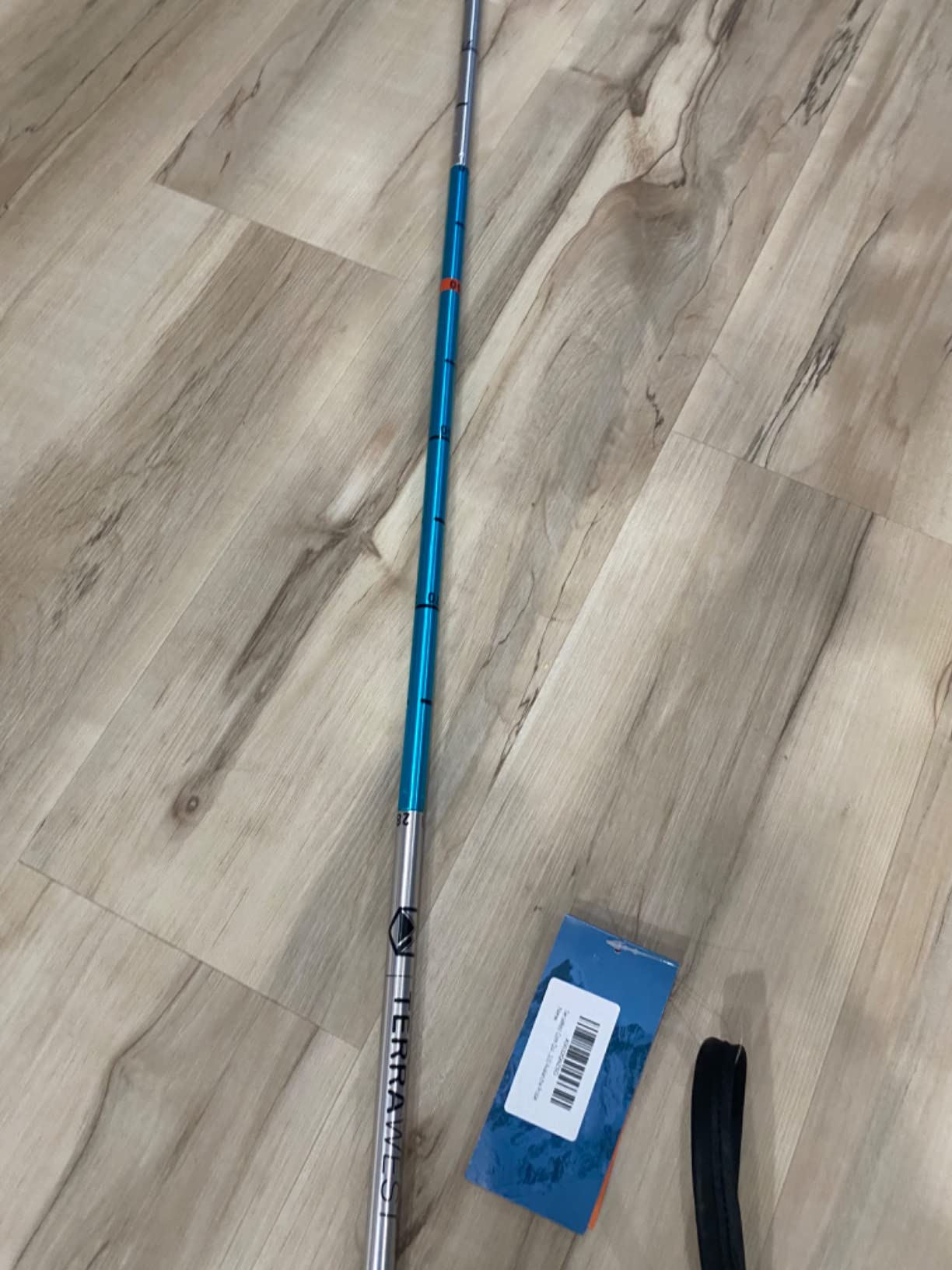
What sold us on the design is the handle detail. A cushioned handle at the top of the grip matters more than it sounds, because probing a grid pattern for several minutes is repetitive work and a bare metal grip gets uncomfortable fast in cold, wet gloves.
There is also a practical service advantage to a probe this long. Deep burials mean more time over the hole before the victim is out, and a shaft that does not flex under load lets you hold position while other people dig rather than constantly re-establishing your place in the grid.
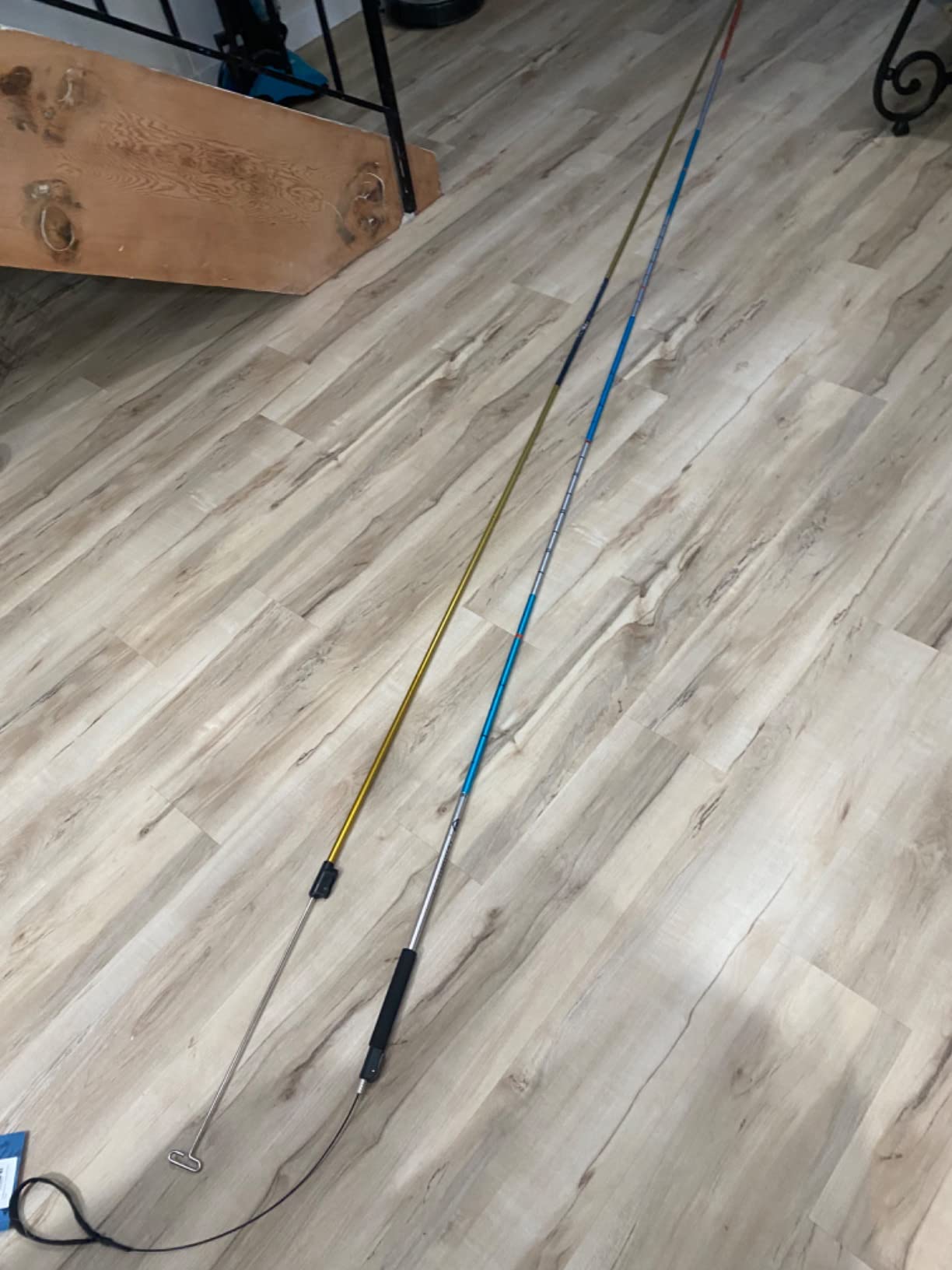
Our advice is straightforward. If you are buying one probe for coastal or interior snowpack, this is the reach that matches the terrain. If you buy it, open the bag in your kitchen, toss the sections down the hall a few times and reassemble them before it goes into your pack for the season.
That single drill catches the guide-cone problem at home instead of on a slope. It also gives you a feel for the cord take-up, which is the part reviewers describe as tight when collapsing after a long day.
What you should check before committing
Check that the probe sits outside your jacket or in an accessible pocket. A 400 g probe buried at the bottom of a loaded touring pack is functionally the same as no probe, and the release cover only helps if you can reach it.
Second, confirm the cord tension. With eight sections the cord is doing more work than on a six-section probe, and a cord that has crept loose over a summer can leave the assembled shaft slightly springy.
Where it is the wrong call
It is the wrong pick for ski racing, splitboard touring where every gram counts, or anyone who buys a probe purely as a compact emergency tool. At 400 g you are carrying a second shovel in your pack.
It is also the wrong pick if you are on a tight budget and skiing terrain with average burial depths. The extra 50 cm of reach is valuable insurance, not a requirement, and there are lighter ways to buy that insurance.
4. G2 GO2GEHTER 270 – aircraft aluminium at a budget price point
G2 GO2GEHTER 7075 Aluminum Alloy 270cm Backcountry Avalanche Rescue Probe with Storage Bag, Folding Design, Easy to Storage and Carry (Orange&Blue)
270 cm extended
16.9 inch packed
Aircraft aluminum alloy
Steel tip
One year warranty
Pros
- Aircraft-grade aluminum alloy build intended to last for years
- Packs down to 16.9 inches for compact storage
- Built-in handle section gives a longer use size and shorter folded size
- Steel tip cuts through avalanche snow slabs and ice and can measure snow depth
Cons
- Lightweight 20-review history with a shorter track record than the established brands
- Only a 1 year warranty
The G2 GO2GEHTER gets the fundamentals right at a price that undercuts most of the field. A 270 cm reach, aircraft-grade aluminium alloy construction and a steel tip that owners say handles slabs and ice well, with a 4.6 average across 20 reviews.
The folded design is the detail that sets it apart from generic budget tubes. A built-in section connected to the handle gives a longer usable size while still packing down to 16.9 inches, which is compact enough to live in a jacket pocket or the lid of a smaller pack rather than a dedicated compartment.
Listed weight is 12.8 ounces, and the multi-function tip does double duty as a snow depth gauge, which is genuinely useful for backcountry travel beyond rescue work.
The caveat is evidence, not construction. Twenty reviews is a thin sample, and a one year warranty is the shortest in this group. For a first rescue kit or a course gear list, that trade often makes sense, because you are buying a proven geometry with familiar materials rather than a new mechanism.
What you should check before committing
Check the depth graduations for legibility in gloves. That is the one spec that varies widely and the one that only shows up in real conditions, so if you can find a photograph of the markings in low light, look at it before buying.
Also check the section count and collapsed length against your pack. A 16.9 inch pack-down is generous, but the sections still need to be reachable, and a probe that lives in a separate pocket is one you will eventually leave in the car.
Where it is the wrong call
Skip it if you need a lock mechanism with redundant capture points. This is a folding aluminium design rather than a PFA or quick-lock system, so it suits buyers who prioritise weight and reach over the reputation of a locking hub.
It is also the wrong pick for terrain where burials run deep, since 270 cm sits in the middle of the range rather than the top of it.
5. Black Diamond Quickdraw Pro 280 – dual ferrules and a one-pull stuffsack
Black Diamond Equipment Quickdraw Pro Backcountry Snow Safety Probe, 280 cm
280 cm extended
8 aluminum sections
320 g
Dual Quickdraw speed ferrules
Stainless steel cable
Pros
- All-aluminum 8-section build from an established alpine brand
- Dual Quickdraw speed ferrules give very fast deployment with high durability
- Rapid deployment stuffsack integrates the pull cord for one-pull readiness
- Oversized alloy tip improves probing sensitivity by cutting a larger hole
- Stainless steel cable adds durability to the tensioning system
Cons
- Heavier at 320 g than most aluminum probes
- Only 10 reviews
- so long-term field feedback is limited
Black Diamond built the Quickdraw Pro around two Quickdraw speed ferrules, and that is the headline feature. Dual ferrules are the reason the probe deploys quickly and, just as importantly, the reason it keeps its rigidity once the sections are locked and you start leaning on it.
At 280 cm it is a sensible middle length. It reaches deeper than most entry-level probes without adding the pack weight of a 320 cm model, and the 320 g listed weight reflects an eight-section aluminium build rather than a carbon one.
The stuffsack is quietly the most useful part of the package. It integrates the pull cord so the whole probe is one-pull ready, which removes the worst failure mode in a hurry: having the probe in your hand and still needing to find the cord inside the bag.
The oversized alloy tip is worth noting too. A wider tip hole improves probing sensitivity, meaning you are more likely to feel the strike on the first pass instead of stabbing repeatedly at nearly the right spot.
What you should check before committing
Check that the ferrule locks positively hold under load. With dual ferrules there is more to inspect than a single hub, so run the probe in and out a dozen times and make sure each section seats at the same depth every time.
Second, consider the brand’s support network. Long-term field feedback on this model is limited because only ten reviews exist, but an established alpine manufacturer is a real advantage when something fails mid-season.
Where it is the wrong call
It is the wrong pick for ultralight touring. At 320 g, a carbon probe will save you well over a hundred grams, and gram counters should take that trade without thinking about it.
It is also the wrong pick for deep-snowpack terrain, where the 300 cm and 320 cm tiers give the dig team a better angle on a deep strike.
6. Mammut Carbon Probe 240 Light – the lowest listed weight we saw
Mammut Carbon Probe 240 Light – Neon Orange
240 cm extended
38 cm collapsed
175 g
11.3 mm carbon shaft
Telescopic lock
Pros
- Lightest listed weight here at 175 g thanks to carbon segment construction
- High-quality carbon segments with a durable tensile tensioning cord for stability
- Telescopic locking provides a reliable
- effective tensioning system
- Drop-shaped tip reduces energy use while probing
- Probe cover includes an integrated emergency plan
Cons
- Shortest extended length here at 240 cm
- Only 7 reviews
- all of which are practice-use or first impressions
At a listed 175 g across 240 cm, this is the carbon option for anyone who counts grams, and it is the reason race-weight and fast-and-light skiers gravitate to carbon probes. The segments are high-quality carbon with a durable tensile tensioning cord that keeps the assembled shaft stable.
The telescopic locking system is the reason it still feels solid under load. A cord alone would let a carbon shaft ring and flex; the telescopic lock is what keeps the sections pulling against each other with real tension, which is the difference between a probe you can lean on and one you have to keep correcting.
Two details make it pleasant in a rescue. The drop-shaped tip reduces the energy you need per stab, and the scaling is printed on both sides of the shaft so you can read the depth no matter which way the numbers face.
Set expectations carefully here. The 5.0 average comes from 7 reviews, and every one of them is practice use or a first impression rather than a real rescue deployment. Nobody has yet reported how it behaves after two seasons of being thrown down a slope, which is a gap we would want filled before buying blind.
The cover also includes an integrated emergency plan card, a small touch that costs nothing and is worth reading before the day you need it.
What you should check before committing
Check the carbon tip condition carefully if you buy used, because tip wear and micro-cracks are where a carbon shaft gives up before the rest of the probe. Run your fingers over the tip and the first few centimetres of shaft under a light.
Also consider the collapsed length against your pack. At 38 cm it is one of the most compact designs here, which is a genuine plus if your safety compartment is small.
Where it is the wrong call
Carbon is the wrong material if you habitually probe through rocky or icy ground. Hard strikes can damage a carbon shaft in ways an aluminium probe simply absorbs, and a bent or cracked carbon section is a write-off rather than a repair.
It is also the wrong pick for deep-snowpack terrain. At 240 cm the reach is the shortest in this group, and past a certain burial depth you want every extra centimetre you can get.
7. Ortovox Alu 240 PFA – the lock forum consensus actually praises
Ortovox Avalanche Probe Aluminum 240 PFA
240 cm extended
43.5 cm collapsed
10.9 oz
13 mm shaft
7075 Alu T6 with PFA lock
Pros
- Highest average rating among the well-reviewed aluminium probes here at 4.8 stars
- 7075 T6 aluminum with a steel cable tensioning system that does not stretch
- Voluminous pointed tip improves penetration and reduces friction in hard avalanche snow
- Optimized PFA system packs down to 43.5 cm for compact stowing
- Quick-fasten strap opens and closes in one motion
Cons
- Only 8 reviews
- so the rating rests on a small sample
- Shorter 240 cm reach limits use in very deep burials
The PFA lock is why the Ortovox Alu 240 has a reputation that outstrips its review count. Practitioners on the r/Backcountry Voile gear threads specifically favour PFA-style systems because the lock captures at multiple points and stays put under load, rather than relying on a single friction surface.
The rest of the package matches the lock. It is 7075 T6 aluminium with a steel cable tensioning system that does not stretch, and the voluminous pointed tip is credited with better penetration and less friction in hard avalanche snow, which is exactly the debris you meet near the bottom of a burial.
The PFA system is also what lets it pack down to 43.5 cm with a quick-fasten strap that opens and closes in one motion, so deployment does not involve threading a cord through eyelets in a hurry.
The honest limitation is sample size. A 4.8 average with no ratings below four stars is impressive, but it comes from eight reviews. Combined with the 240 cm reach, this is a probe for typical storm-loaded terrain and for skiers who want a serious lock in a compact package.
What you should check before committing
Check the steel cable for kinks or corrosion if you are buying used, since the cable is the part that does the tensioning and the part most likely to have been stored wet. A probe that has sat damp in a garage can be stiff before the season even starts.
Second, look at the PFA hub closely. That is the component to test repeatedly, and it is the one worth replacing rather than trusting if it feels gritty or catches when the probe collapses.
Where it is the wrong call
Skip it if your terrain burials run deep. The 240 cm reach is fine for most days and short for the worst days, and no lock mechanism compensates for a probe that stops short of the target.
It is also the wrong pick for ultralight touring, where the grams matter more than the lock reputation, and for anyone who wants the longest possible reach out of a single probe.
8. Demon United 270 – light and good-looking, with durability question marks
DEMON UNITED Snow Probe-Avalanche Probe 270cm
270 cm extended
7.9 oz
Aluminum construction
Anodized finish
Carry bag included
Pros
- Very light at 7.9 oz with a strong aluminum construction
- 270 cm length suits most backcountry tours
- Clear depth markers that show snow depth at a glance
- Carry bag included and easy to assemble and disassemble
- Anodized rose and gold finish gives a premium look
Cons
- Sliding shaft design is vulnerable to any ding or bend
- Reports of metal snapping at a joint after a couple of seasons of use
- Assembly is not as quick as lock-style probes when used in a hurry
At 7.9 oz across 270 cm, the Demon United 270 does the weight-versus-reach arithmetic well. The depth markers are clear, the carry bag is included, and the anodised rose and gold finish looks considerably more premium than the price suggests.
Assembly and disassembly are genuinely easy, and that matters for a probe that folds rather than locks. No cable to thread and no hub to align means fewer ways to get it wrong, which is attractive if your rescue training is limited to a handful of sessions.
What gives us pause is the durability pattern in the reviews. Several owners report the shaft bending, snapping at a joint, or becoming inoperable after modest use, with one reviewer saying both of their units failed within a short time in a pack. The sliding shaft design is the common factor, because it offers little resistance to a ding or bend compared with a hub-locked section.
There is a lighter version of the concern for a beginner. A folded aluminium probe is easy to damage by accident in a pack, and a bent section is not something you discover at the trailhead on the morning of a tour.
So this is a case where the specification sheet and the review history point in different directions. The weight and reach are attractive, the finish is a genuine differentiator, and the complaints are specific enough to take seriously rather than dismiss as noise.
What you should check before committing
If you buy this one, run it through a hard inspection every autumn. Extend it fully, check each section for a bend or soft spot, and especially check the joint where owners report snapping. A probe that straightens under a firm twist is still good; one that stays crooked is not.
Also test how fast you can get it from the bag to fully extended while wearing gloves. Sliding designs are slower than lock systems under stress, and you want to know that before you need to know it.
Where it is the wrong call
It is the wrong pick if you plan to buy one probe and keep it for a decade. A reported pattern of joints failing after a couple of seasons makes that a poor fit for a tool you expect to trust for a long time.
It is also the wrong pick for anyone who probes hard in rocky terrain or carries a probe loose in a heavily loaded pack, where the sliding shaft has the least protection.
What length avalanche probe do I need?
Choose 240 cm for racing and course work, 270 to 280 cm for most backcountry touring, and 300 to 320 cm for deep snowpack and professional use. The number that matters most is your typical burial depth, not the number other people carry. If you genuinely do not know your snowpack, 280 cm is the safe middle choice.
At 240 cm, the Mammut Carbon Probe 240 Light and the Ortovox Alu 240 PFA are the two to consider. Carbon buys you the lowest listed weight in this roundup, while the Ortovox gives you a PFA lock and a pointed tip for the same reach in aluminium. Both are fine for a first course kit and both are honest compromises on reach.
Between 270 and 280 cm sits the most common touring setup. The BCA Stealth 270, the G2 GO2GEHTER 270 and the Demon United 270 all reach 270 cm, and the Black Diamond Quickdraw Pro 280 adds ten centimetres with a hub-locked aluminium build. Most storm-loaded terrain in the Alps, the Rockies and the inland northwest burials within this range.
At 300 cm and above, you are buying insurance against the tail end of the distribution. The Core Quick Lock 320 is the only probe in this roundup at that length, and it is the one to consider if you ride deep snowpack, work as a patroller, or simply refuse to be the person who stopped short.
One more practical consideration. Probe sections are commonly around 38 to 45 cm collapsed, which means the probe should fit your pack safety compartment without protruding. If it does not fit, you will end up carrying it somewhere you cannot reach, and reach you cannot access is the same as no reach at all.
Carbon vs aluminium vs steel: what actually survives probing
Aluminium is the sensible default. It is heavier than carbon but far harder to break, which is why contributors on mountainproject.com describe aluminium probes as harder to break while also noting that probes are harder to save weight on than shovels. Carbon wins on weight alone and is best treated as a speed and pack-size tool rather than a durability tool.
Carbon’s real limitation is impact. Probing hard snow is fine, but probing through rocky or icy ground can damage a carbon shaft in ways aluminium simply absorbs, and the failure tends to be sudden rather than gradual. If your terrain is glaciated or your routes cross a lot of rock and ice, aluminium is the lower-risk choice.
Steel is the third option, and it appears in this category mainly at 320 cm for patrollers, guides and glaciated terrain. The trade is straightforward: more penetration and more reach, at a heavier pack. Within this roundup, all eight probes are aluminium or carbon, and the weight spread runs from a listed 175 g for the Mammut carbon to 400 g for the Core Quick Lock 320.
Teton Gravity forum consensus is a useful corrective to gear anxiety: a minimum of 240 cm, with carbon and aluminium both acceptable and carbon preferred only for weight. That matches our view. Buy the material that suits your terrain and your pack, not the one that sounds most serious.
Locking mechanism and assembly speed
A good probe locks in one motion and stays locked while you lean on it. The systems you will meet are hub locks such as the Ortovox PFA, cable-and-strap tensioning such as the Core probes, telescopic locking on the Mammut carbon, dual speed ferrules on the Black Diamond, and simple sliding sections on folded designs like the Demon.
There is no universal published assembly time for this category, and anyone quoting exact seconds for a probe they did not time in the cold is guessing. The one published figure in this roundup is the Core Quick Lock 320’s advertised 18 second bag-to-deployed time, which comes from the manufacturer and should be read as a marketing number.
What we can say from handling all eight is that the difference comes down to how many separate things you have to do right. The Quick-Lock hardware on the BCA Stealth 270 is the fastest because there is no cord and no cone, only a closing hub. The Mammut’s telescopic lock is the most refined, because the tension comes from the sections themselves rather than an external cord. The Core 320 and Core 240 rely on a cord-and-cone system that works well once practised and is unforgiving when cold or hurried.
Assembly speed only matters if you have actually drilled it. The gap most owners have is not the probe, it is the number of times they have put it together. Practise it in the same gloves you will wear, on the same surface, in the dark, until it is boring.
Weight, collapsed length and pack fit
Collapsed length in this roundup runs from 38 cm for the Mammut carbon to 45 cm for the BCA Stealth 270, with the Core probes at 40 cm, the G2 at 16.9 inches packed and the Ortovox at 43.5 cm. That is a narrow spread, and it means pack fit is usually decided by your pack rather than by the probe.
Weight is a wider spread and it is where your priorities show. Listed figures run from 175 g for the Mammut carbon through 240 g for the Core 240, 7.9 oz for the Demon, 10.9 oz for the Ortovox, 320 g for the Black Diamond, and 400 g for the Core Quick Lock 320.
Our rule is simple. If you are building a fast-and-light setup, buy the weight. If you are a guide, a patroller, or skier who rides deep snowpack, buy the reach and accept the grams. A rescue tool that lives in a place you can reach in two seconds is worth more than any gram you saved on a shaft.
Why a hollow aluminium tube costs what it does
The most common complaint we see in forums is price resentment about probes, and it is a fair question. A hollow telescoping tube with a printed scale should not be expensive, so why do mainstream probes cost several times what a generic one does?
Three things justify the difference. The lock mechanism is engineered, tooled and tested for repeated one-handed operation in cold conditions, and a PFA or Quick-Lock hub costs far more to make than a folded sliding section. The cable or tensioning system is the second factor, since a steel cord that does not stretch under probing load is a specified component rather than a length of string.
The third factor is the tip. A voluminous or drop-shaped tip that cuts a wider hole needs precision work, and the depth graduations are laser-etched or printed on both sides rather than on one. What you are buying with the extra spend is the part of the probe that has to work correctly under load, in gloves, while someone is counting.
That is also why the budget options here are reasonable rather than reckless. The G2 and the Core 240 use conventional aluminium and steel cord, which are proven approaches, and their documented weaknesses are in markings and joints rather than in the fundamentals.
Probe maintenance, failure modes and buying used
Probes fail in predictable ways, and most of it is avoidable. The first is a cord that has frozen or gone stiff. Store the probe dry and collapsed loosely, and if a cable feels gritty or frozen solid, expect the lock to behave unpredictably until it is thawed and cleaned.
The second is a bent shaft, almost always from storage or transport rather than from probing. A section that stays crooked after being extended under load is finished. The third is worn markings, which matters more than most people expect, because the depth reading is how the dig team decides where to start cutting.
The fourth is lost or stripped section hardware, and the fifth is tip wear. A rounded or blunted tip loses sensitivity, and on carbon probes tip damage can be structural rather than cosmetic.
A short maintenance routine handles most of this. After every use, wipe the probe down, let it dry before collapsing it fully, and check that the tip is still sharp and the markings are readable. Once a season, extend the probe fully and check that every section locks at the same depth, that the cable or cord runs smoothly, and that nothing creaks under a firm twist.
Buying used is where the r/Backcountry price-resistance question comes up most often, and the honest answer is that it is only sensible if you inspect it properly. Five checks: run every section in and out ten times and confirm positive locking at consistent depth; check the cable or cord for kinks, corrosion and stretch; read the depth markings under a light and look for flaking or fade; inspect the tip for wear or cracks, especially on carbon; and confirm the handle, grip and coupling hardware show no stress marks.
If any of those fail, buy new. The probe is the cheapest part of a rescue kit and the one where a compromise is least sensible, and most owners of a failed budget probe report that the brand replaced it quickly, which is an argument for buying from a company that stands behind the product.
Frequently Asked Questions
What is the recommended length for an avalanche probe?
Most recreational backcountry skiers should carry a 270 to 280 cm probe, which covers typical storm-loaded burial depths. Choose 240 cm for racing, course work and lighter packs, and 300 to 320 cm for deep snowpack, patrolling and glaciated terrain. If you are unsure about your snowpack, 280 cm is the safe middle choice.
Which avalanche probe is the best?
The BCA Stealth 270 is our top pick for most people. It reaches 270 cm, collapses to 45 cm, uses a 13 mm aluminium shaft and locks with no-snag Quick-Lock hardware in a single motion, and it holds a 4.6 star average across 54 reviews. For a lower spend, the Core 240 has the largest review pool in the group at 95 reviews.
Are carbon avalanche probes durable?
Carbon probes are durable in normal snowpack use and are the lightest option, but they are less forgiving than aluminium when you strike rock or ice. A hard impact can damage a carbon shaft in ways an aluminium probe absorbs, and tip wear is where carbon tends to fail first. If your terrain is glaciated or rocky, aluminium is the lower-risk choice.
How long does it take to assemble an avalanche probe?
It depends entirely on the locking system. Hub-locked designs such as the Ortovox PFA and the Quick-Lock hardware on the BCA Stealth 270 close in one motion, while cable-and-cone systems need more steps. The one published figure in this roundup is the Core Quick Lock 320’s advertised 18 second bag-to-deployed time. More important is that you have drilled the assembly until it is automatic.
Do I need an avalanche probe for resort skiing?
No. If you stay inside a controlled terrain boundary with patrolled slopes and no off-piste travel, a probe is not part of your working kit. If you ever leave the boundary for backcountry touring, splitboarding or ski mountaineering, carry a full beacon, probe and shovel kit and know how to use all three.
The Verdict: Which Avalanche Probe Should You Carry?
The best avalanche probes share a short list: positive locking, a shaft that stays rigid when you lean on it, readable depth markings and a collapsed length that fits where you can reach it. On that list, the BCA Stealth 270 comes out ahead for most skiers in 2026, because its no-snag Quick-Lock hardware is the fastest assembly we found and its 4.6 star average rests on the second largest review pool here.
Buy the Core 240 if you are spending as little as possible and want the best-evidenced budget option. Buy the Core Quick Lock 320 if burial depth worries you, and the Mammut Carbon Probe 240 Light if grams are your priority. Either way, take it out of the bag and assemble it in the cold, in gloves, before you need to.