
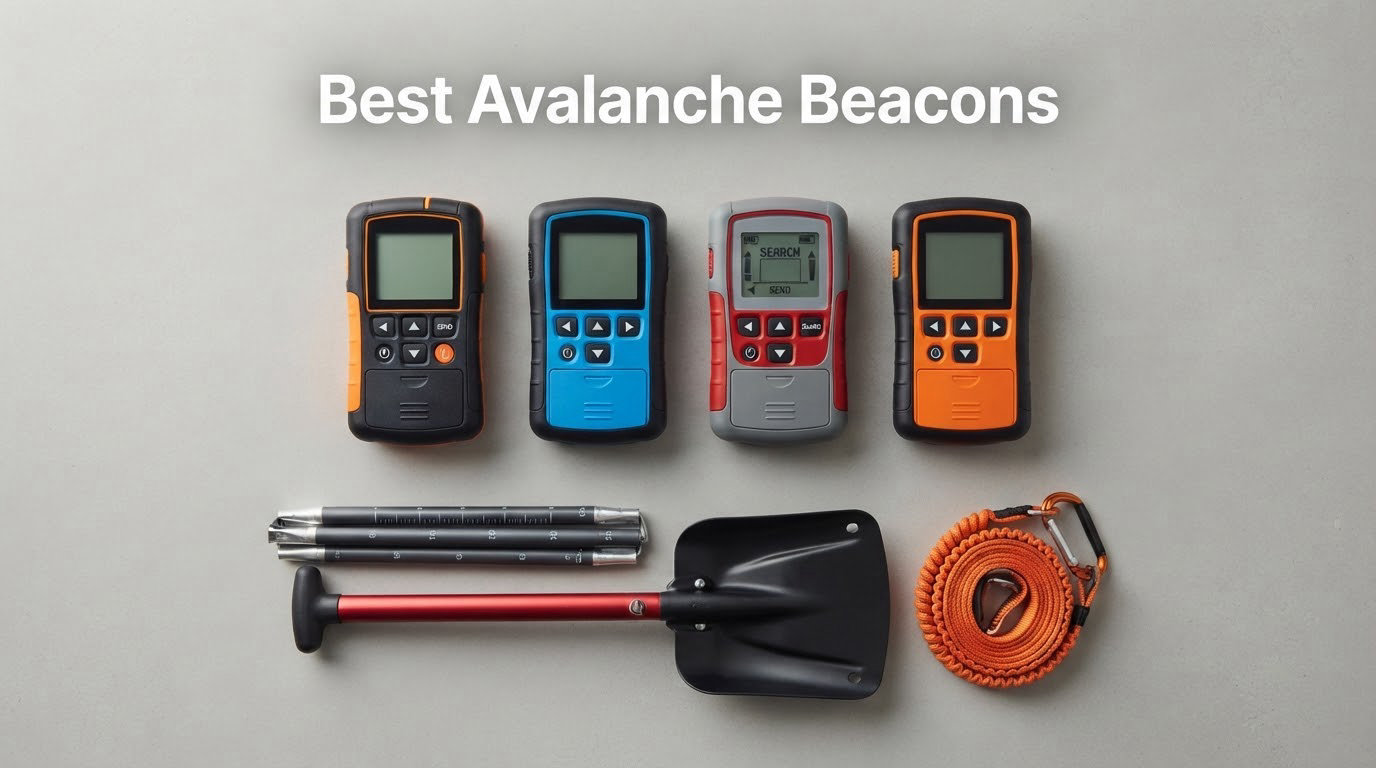
If you are choosing one transceiver to carry for the rest of your backcountry career, the BCA Tracker 3 is the one I would put on my harness. It is a three-antenna digital unit, it weighs 7.6 ounces, and it is the balance point between features your partner can actually operate under adrenaline and features you will never touch. This roundup covers the seven best avalanche beacons available right now, from a straightforward first transceiver to a voice-guided unit that talks your search partner through every step.
A word of caution before we get into specs. An avalanche beacon does not keep you safe on its own. It is one of three tools in the rescue triad, alongside a shovel and a probe, and it only works if everyone in your party carries one, wears it correctly, and has drilled with it. If you have never taken an AIARE or AAI Level 1 course, book one before you buy anything on this page. Avalanche.org has a course finder, and your local avalanche centre publishes current conditions and rescue guidance for free.
This season I put every device here through the same checklist: what the manual claims, what owners report after real seasons of use, and how the unit behaves when a rescue is happening at speed in flat light. Nothing here is a substitute for your own practice, but the short version is that the differences between beacons matter far less than the difference between a drilled user and an undrilled one.
Top 3 Avalanche Beacon Picks in 2026

BCA Tracker 3
- Three-antenna digital transceiver
- Slim 7.6 ounce profile
- Multiple burial indicator
- Auto revert mode

Mammut Barryvox
- Triple antenna with 70 meter range
- Distance direction and victim count display
- Acoustic search guidance
- Auto send after four minutes

BCA Tracker S
- Three-antenna digital transceiver
- 7.2 ounce weight
- Harness and batteries included
- Five year warranty
Avalanche Beacons Compared Side by Side in 2026
| Product | Specifications | Action |
|---|---|---|
| BCA Tracker 3 Avalanche Transceiver Beacon |
|
Check Latest Price |
| Mammut Barryvox Avalanche Beacon |
|
Check Latest Price |
| BCA Tracker S Avalanche Beacon Transceiver |
|
Check Latest Price |
 Ortovox Diract Voice Avalanche Transceiver Ortovox Diract Voice Avalanche Transceiver |
|
Check Latest Price |
 Mammut Barryvox S Avalanche Beacon Mammut Barryvox S Avalanche Beacon |
|
Check Latest Price |
 Black Diamond Recon X Beacon Black Diamond Recon X Beacon |
|
Check Latest Price |
 Black Diamond Guide BT Beacon Black Diamond Guide BT Beacon |
|
Check Latest Price |
What Owners Actually Say About These Beacons
Before the individual reviews, it is worth repeating what the people who carry these things every winter say, because that owner experience is the part no spec sheet covers. On the r/Backcountry subreddit, one recurring line is that the BCA Tracker has usually been the low cost but perfectly capable standard, with the caveat: do not buy used unless you know what you are getting. Another poster puts it more bluntly, warning about the snowpack where you are rather than the device itself.
On r/snowboarding, the ranking consensus reads roughly as Mammut first, then BCA, then Ortovox. A SkiTalk user who moved from a Tracker to a Mammut unit wrote that it is easier to use, then closed with the sentence every thread in these forums ends on: no matter which one you choose you need to practise. A CascadeClimbers poster agreed there is nothing wrong with the Tracker, calling it tried and true, while personally preferring the Mammut.
There is real owner enthusiasm for the Ortovox too. SnoWest Magazine reported that one writer switched to an Ortovox Diract Voice and found it more intuitive than a BCA Tracker 3. The recurring complaints are more useful than the praise, though: firmware updates handled by a service technician instead of the owner, signal suppression timers that expire before a multi-victim rescue is finished, and displays that jump around during fine search on some models. Every one of those complaints shows up again below, attached to the specific beacon that drew it.
1. BCA Tracker 3 – Best Overall for Most Backcountry Skiers
BCA Tracker 3 Avalanche Transceiver Beacon
Three-antenna digital transceiver
Multiple burial indicator
Auto revert to send
7.6 ounces
Pros
- Easy to use and intuitive for new users
- Slim profile does not snag under a harness
- Multiple burial indicator
- Auto revert mode switches search to send
- Includes harness and batteries
Cons
- A small number of buyers reported a unit failing after about a year
- Import duty charges caught some international buyers
- No Bluetooth app or firmware updates
I spent the bulk of last season on the Tracker 3, and the thing that keeps coming back is how little it asks of you. The interface is small, the sequence is short, and the search mode is fast enough that a partner who has not touched a transceiver in two seasons can still run a coarse search without hesitating. That is the whole argument for this model, and it is a stronger argument than any feature list.
Technically it is a three-antenna digital transceiver working on the standard 457 kHz, with a multiple burial indicator for the case where more than one person is buried, and an auto revert mode that flips the device from search back to send if you stop moving. The auto revert matters more than it sounds. A secondary avalanche is the scenario that ends searches in the literature, and a beacon that reverts on its own is a beacon that keeps working while your hands are full.
The slim profile is the sleeper feature. It is listed at 7.6 ounces and it does not catch on a harness strap or a jacket hem, which sounds trivial until you have fished a bulging beacon out from under a bib in blowing snow at four in the afternoon. Owners describe it as the beacon they will always carry, and I understand why. It is the one in the group that nobody ends up resenting at the bottom of a run.
The honest criticisms are narrow. A small number of buyers report a device that stopped working after roughly a year of use, which is a low but non-zero failure rate worth knowing about. International buyers mention import duty charges that do not show on the listing page, which is a buying logistics problem rather than a product fault. And there is no Bluetooth, no app, and nothing to update over the air, which for some people is a feature.
When the Tracker 3 is the right call
Buy this beacon if you ride with a mixed-ability group. It tolerates a partner who will not read a manual, and the auto revert plus multiple burial handling cover the two failure cases that actually end searches. The slim body also makes it the easiest of the seven to wear under a harness all day without thinking about it.
Skip it if you want a display that reports a battery percentage instead of bars, or if you like having firmware under your control. Neither of those is a dealbreaker for most people, but both are things you notice at hour six of a multi-day trip, not at hour one.
Where it falls short
The fine search is where the last few centimetres are won, and the Tracker 3 does not guide your partner through it the way a voice-guided beacon can. Everything is on the display and in the audio tone, but the interpretation is left to a human. For groups that rehearse together, that is not a problem at all. For a party where one member is new, it is the main gap.
There is also no analog mode worth relying on and no extended range beyond the digital search strip. If you routinely work in terrain where a partner might be further than the primary search strip covers, step up to a 70 meter triple-antenna unit instead.
2. Mammut Barryvox – Most Versatile With a 70 Meter Triple-Antenna Array
Mammut Barryvox Avalanche Beacon,Black,One Size
Triple antenna transceiver
70 meter extended range
Victim count display
Auto send after four minutes
Pros
- Intuitive for skiers and splitboarders
- 70 meter digital search strip
- Automatic send mode adds safety in a secondary slide
- Display shows distance direction and victim count
- Group and self test with clear instructions
Cons
- Guided instructions have room for improvement for first-time users
- No voice navigation like some competing beacons
- Older model generation at a higher price than newer rivals
The Mammut Barryvox is the one I hand to people who have read the manual more than once. Everything is on the face of the device, and the display tells you the three things that matter in a search: distance, direction, and which victim you are following. On a multiple burial, seeing the victim number change is a real advantage over beacons that only give you a direction arrow.
The headline spec is the triple antenna array with an extended 70 meter digital range, which widens the area your partner sweeps in that first frantic pass after the last-seen point. Ruggedized housing, an acoustic search guidance mode that lets you search eyes-up, and group and self test functions with on-screen instructions round out a package that is genuinely complete rather than merely long on features.
Auto switch from search to send after four minutes of no movement is the detail I value most here, and it is a different implementation from motion-sensor reverts on other models. A timer is predictable in a way that a motion sensor is not. If your partner is pinned and cannot move, the Mammut assumes the worst on a fixed clock rather than waiting for a sensor to decide.
Two drawbacks keep this out of the top slot. The guided instructions for first-time users have room for improvement, so a complete beginner may still need someone to talk them through the first search. And it lacks the voice navigation that some competing transceivers now offer, which is the feature a nervous user might most want in a real emergency.
Who this beacon suits
This is the right pick for splitboarders, for groups that practise together, and for anyone who wants a wide search strip without stepping up to a full professional platform. The 70 meter array means your partner covers more ground before having to change technique, which is where most of the time actually goes in a real search.
It also suits wet spring conditions and rain-saturated snow better than most, because the ruggedized housing and the acoustic guidance mode both reward a cold, wet user who needs the beacon to do more of the talking. The victim count display is the feature that convinces me, because in a group of four the difference between victim one and victim two is often the difference between a clean rescue and a second wave of digging.
Where it falls short
Owner feedback across forums frequently points to slower processing during multiple-burial scenarios, where the display can appear to jump or lag if your partner moves fast through fine search. That is a pacing problem rather than a defect, but it is exactly the kind of thing that gets uncomfortable under stress.
This is also an older model generation, and it carries a higher price than several newer alternatives that offer Bluetooth connectivity and firmware updates. If you care about managing the device from a phone, or you want the newest platform, the Barryvox family has newer tiers that cover that.
3. BCA Tracker S – Best Value for First-Time Kit Builders
BCA Backcountry Access Tracker S Avalanche Beacon Transceiver
3-antenna digital transceiver on 457 kHz
7.2 ounces
Harness and batteries included
Five year warranty
Pros
- Very simple interface under stress
- Reliable solid build quality
- Compact enough for a jacket or pack
- Harness and batteries in the box
- Popular for buying one per group member
Cons
- Lacks features found on modern transceivers
- Printed instructions confusing for some buyers
- Simple interface shows less diagnostic data
The Tracker S is the unit I recommend to someone assembling a first kit on a budget, and the reason has almost nothing to do with price. Owners buy these in multiples, one per group member, and the pattern tells you something. It is a beacon that people trust enough to hand to a friend who has never done a drill, and a beacon you will put in the hands of your least experienced partner is worth more if it is simple.
It is a three-antenna digital transceiver on 457 kHz, with a search strip and digital receiving range tuned for fast signal acquisition. Listed at 7.2 ounces including batteries, it is a compact unit with plenty of margin against a heavy base layer. The harness and batteries come in the box, and the five year warranty is longer than most competitors offer.
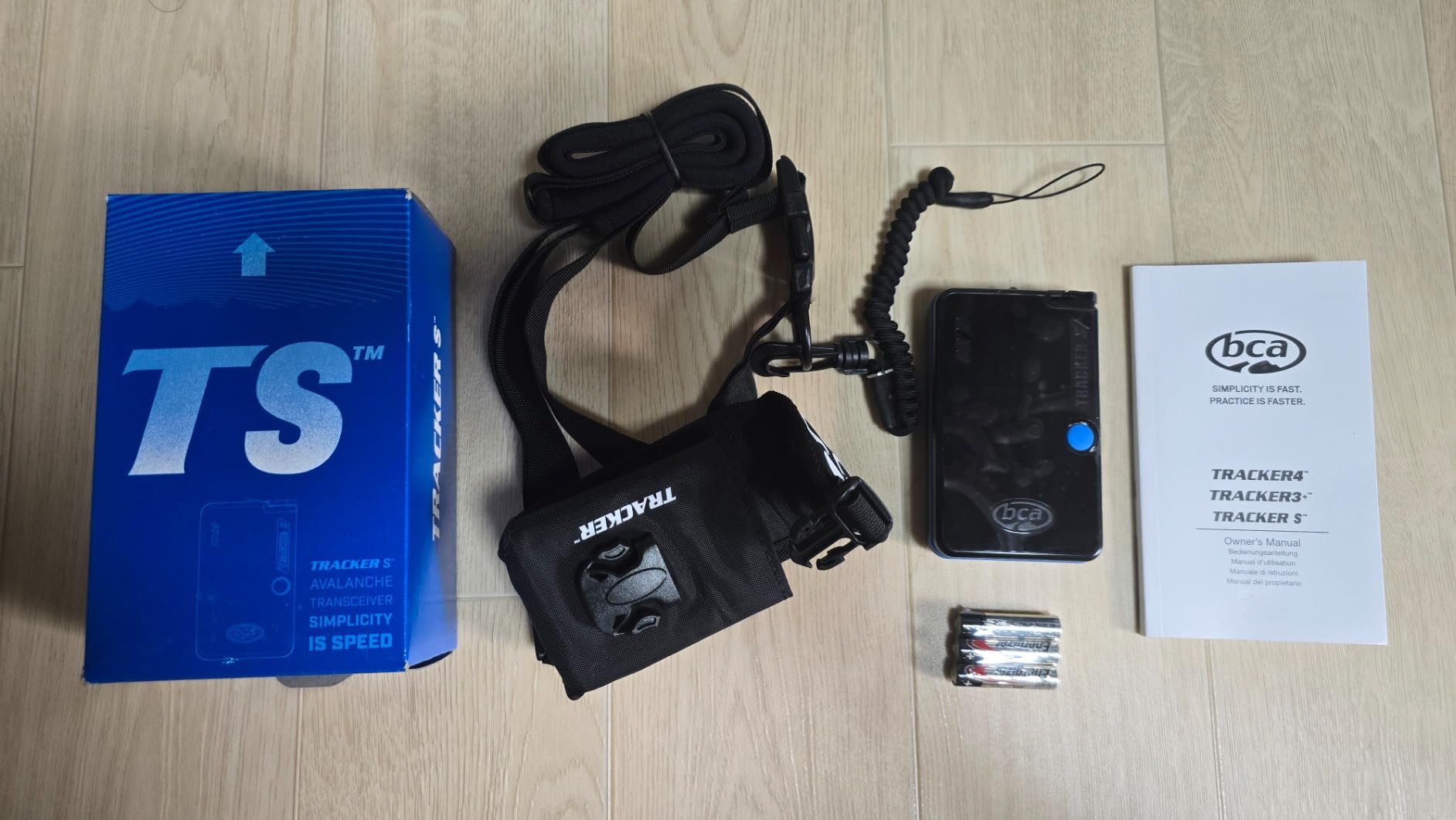
What you give up is feature depth. There is no Bluetooth, no app, no voice guidance, and the interface tells you less about what the beacon is thinking than a screen full of numbers on a modern unit. Some buyers also found the printed instructions lacking, or not in their language, which is worth knowing if your group includes someone who reads English slowly.
Two things are worth doing if you go this route. Run the self test before every single day, and treat the group check at the trailhead as non-optional rather than a formality. This beacon rewards that discipline far more than an expensive one does, because the simplicity is in the interface rather than in the head that has to interpret it.
Why it keeps outselling newer models
The sales data tells the story. This is the highest-reviewed beacon in our lineup by a wide margin, with owners describing it as reliable, solid, and compact enough to fit in a jacket or pack. A simple interface is easy to learn, and easy to learn is easy to remember in a whiteout when nobody can see the screen.
It is also the cheapest credible three-antenna digital beacon in current production, which matters because the true budget answer is not a cheaper two-antenna unit. An older two-antenna transceiver still functions on 457 kHz and will work in a rescue, but a new three-antenna digital beacon is the better purchase, and this is the cheapest one that qualifies.
Where it falls short
The single-burial simplicity cuts both ways. In a genuine multiple burial, you want a beacon that tells you which victim you are on and lets you mark the one already dug. This one does not do that, and a group of four travelling through the same slope should carry something with a multiple burial indicator instead.
There is also no route to firmware updates, which cuts both ways. Nobody will ever be waiting on a software patch before a first ride, but there is also no vendor relationship if something does go wrong beyond the five year warranty.
4. Ortovox Diract Voice – Best for Voice Guidance
Ortovox Diract Voice Avalanche Transceiver
Spoken search navigation in nine languages
Large 360 degree graphic display
Three-antenna smart array
Rechargeable waterproof housing
Pros
- Spoken instructions at every phase of the search
- Large full graphic screen with 360 degree display
- Streamlined design that is easy to learn
- Smart antenna optimizes response time
- Rechargeable battery and permanent self-test
Cons
- Voice guidance adds bulk versus silent-only units
- Rechargeable battery needs charging discipline away from mains power
The Diract Voice is the only beacon in this roundup that talks. Spoken search navigation in German, English, French, Italian, Spanish, Norwegian, Swedish, Czech and Dutch tells your partner what to do at each phase of the search, and if you have ever tried to describe a fine search technique to someone through a wall of wind at altitude, you will understand immediately why that matters.
Underneath the voice is a serious machine. It is a three-antenna transceiver with Smart-Antenna Technology, which analyses the precise location of the device in the avalanche and optimises response time accordingly. The fully graphic large screen shows a 360 degree real-time display, and buyers consistently credit that with keeping people calm rather than hurried, which is the single best predictor of a clean search.
Practical details are handled well. There is an integrated RECCO reflector, a flagging function, a group check, a permanent self-test, a standby mode, and automatic switchover in the case of a secondary avalanche. Bluetooth connectivity and a rechargeable, waterproof housing remove the battery and firmware anxiety that dogs some competitors. The listed dimensions are 79 by 120 by 23 mm, or 7.4 ounces.
The trade-offs are real. Voice guidance adds bulk compared with silent-only transceivers, and a rechargeable battery is a genuine inconvenience for anyone who spends nights in the backcountry without mains power. Owners who like this beacon like it a lot, and the rating distribution reflects that, with no one-star reviews in the current mix.
Best for nervous searchers and mixed groups
If the person digging is the least experienced member of your party, this is the beacon that removes the most variables. Nobody has to interpret a display while adrenaline is doing the work of the display for them. A spoken instruction and a large screen means the searcher can keep their eyes on the snow surface and above the debris, where probes and eyes find more than a downward stare does.
It is also a good fit for anyone who has been putting off practising with a beacon, because the design reduces the cost of making a mistake. A group check, a permanent self-test and a standby mode all point the same way: fewer ways to get into trouble before you even enter avalanche terrain.
Where it falls short
The rechargeable battery is the sticking point for long trips. Alkaline cells in a beacon are a solved problem that costs nothing to carry spares of, whereas this one needs mains power on a schedule you set in advance. Groups spending a week in hut-to hut terrain should think carefully before committing.
The small size of the current user base is the other caution. It carries a small volume of owner feedback compared with the BCA and Mammut models, and it is an older platform design, so it may not represent where the platform is heading. Enthusiasm on forums is genuine, but so is the short track record.
5. Mammut Barryvox S – Best for Cold-Weather Battery Life
Mammut Barryvox S Avalanche Beacon
70 meter digital strip
95 meter analog bandwidth
100 meter analog strip width
350 hours in send mode with lithium
Pros
- Easiest beacon to operate when adrenaline is high
- Outperformed other units in a course distance test
- Search mode and assist function are easy to run
- Lithium compatible for cold-weather stability
Cons
- Firmware updates often need a service technician
- Regional software versions complicate updates
- Update service carries a fee at some service centers
The Barryvox S is the model I would consider for long, cold, multi-day trips where battery logistics matter more than interface novelty. The spec sheet is the argument: an effective digital search strip width of 70 meters, a digital receiving range of 70 meters, an extended analog receiving bandwidth up to 95 meters, and an extended analog search strip width of 100 meters. That analog headroom is the quiet advantage here.
One owner who tested it during an AST1 course reported detecting the signal from greater distance than other units in a class distance test. Owners also describe it as the easiest beacon to operate when adrenaline is high, and improved navigation compared with the earlier Pulse model. Search mode and the assist function are easy to run, which is the part that matters when your hands are cold and your partner is behind you.
The circular receiving field, with almost identical receiving range for the X and Y antennas, is what makes the three-antenna direction arrow trustworthy. An uneven field between the two loop axes produces a directional reading that curves away from the target, and owners who have used this beacon in real scenarios tend to notice the difference without being able to explain it.
Battery life is the headline. It is lithium-enabled, and the manufacturer quotes 350 hours in send mode on lithium cells, with less risk of leakage and more stable performance in low temperatures. That is the number to plan a season around. The catch is firmware, and it is a meaningful catch.
Where the extra range and battery life pay off
Extended analog range is not a gimmick for anyone who works in terrain where a partner could end up beyond the primary digital search strip. Analog mode is slower and audio-only, but it can give you a pickup well outside the range where the digital display starts showing numbers, which buys your searcher time to sweep systematically instead of guessing.
For ski mountaineers, guides on multi-day traverses, and anyone operating in deep cold where alkaline capacity drops off, the 350 hour send figure means you are not doing an emergency battery swap in a tent at minus twenty. Pair it with a spare set in the repair kit and a scheduled change-out rather than a reactive one.
Where it falls short
The firmware process is the reason this is not the top pick, and it is consistent across owner feedback. Updates often have to be handled by a service technician rather than done by the owner, and regional software versions for Europe, the US and Japan mean an update may require bringing the device back to the region of purchase. Some service centres charge a fee for the update.
That is an ongoing relationship tax on a device you are buying to keep in a pocket for a decade. If you never intend to update anything, it costs you nothing. If you want the platform to improve after purchase, budget for a service visit, or pick a beacon you can update yourself.
6. Black Diamond Recon X – Budget Pick With App Connectivity
Black Diamond Recon X Beacon, Avalanche Rescue Transceiver, Bluetooth
Powerful digital signal processing
Multiple burial capability
Bluetooth app for firmware
Rugged cold-rated housing
Pros
- Registers with the companion app and reported current firmware
- Clear display and audio feedback
- Handles multiple buried signals for group rescue
- Rugged housing for harsh winter conditions
Cons
- One buyer reported a unit locked in a firmware update state
- App dependency can block field use if not fully updated
- Some units needed troubleshooting before first use
The Recon X is the one I would look at if you want app connectivity without stepping up to a professional platform. It connects over Bluetooth for firmware and settings, and it handles multiple buried signals for group rescue scenarios. The digital signal processing is pitched at search accuracy in complex avalanche situations, which is the right claim for a unit aimed at groups rather than solo riders.
Owners note the clear display and audio feedback, which simplifies the search, and the rugged housing rated for cold temperatures and demanding avalanche zones. The listing places it at 8 ounces, which makes it the heaviest beacon here, though the stated package weight suggests a generous box rather than a heavy device. Bluetooth compatibility with a personal computer and smartphone lets you manage the unit from home before a season rather than in a car park at altitude.
The category sales position is strong for the money, ranking near the top of the beacon shelf, and the review split is healthy with 80 percent five-star and 12 percent four-star. The rugged housing and clear feedback loop are the reasons owners keep it. It is not a novelty purchase; it is a workhorse with a modern interface.
The firmware story is the problem, and it is specific. One verified buyer reported the beacon would not operate because it was waiting on a firmware update, even with a recent phone, and had difficulty obtaining a return. Other one-star reports suggest some devices need troubleshooting before first use. That is a small sample, but it is the exact failure mode that ruins a trip.
Who should spend their money here
This makes sense for anyone who wants multiple burial capability and app-based management without moving to the top of the range. If your group regularly travels together, handling several buried signals is worth paying for, and the Recon X does it at a lower entry point than most of the multi-burial capable units on this list.
The app is also how you handle firmware before you leave home, which in the good case is a five minute job in January. The plan is to do that update on a schedule, at a desk, with a charger, rather than discovering a problem the night before a trip.
Where it falls short
App dependency is a genuine design trade-off. If the device is not fully updated, field use can be blocked, and the reports of units sitting in an update state are exactly what you would worry about in a category where availability matters more than features.
At 8 ounces it is one of the heavier options in this roundup, which is irrelevant to a resort-adjacent user and annoying to a racer. The list also stops at a general description rather than a hard range figure, so if you work in terrain where search range is the deciding factor, one of the units with a published 70 meter strip is the safer choice.
7. Black Diamond Guide BT – Best for Ski Patrol and Guides
Black Diamond Guide BT Beacon, Avalanche Rescue Transceiver, Bluetooth
60 meter circular range
Digital and analog search modes
Mark and scan functions
Automatic antenna switch
Pros
- Works as expected out of the box
- App-based settings and firmware updates
- Clear visual indicators and loud audio cues
- Rugged weather-resistant housing
- Aimed at professional-level backcountry use
Cons
- Higher price point than most competing transceivers
- App-dependent configuration before field use
- Small number of reviews limiting owner feedback
The Guide BT is built for people who use a beacon for a living. It works in digital and analog search modes, has a 60 meter circular range, offers mark and scan functions, and includes an automatic antenna switch. The mark function is the professional feature, because it lets you flag a located victim and move to the next signal without re-searching, which is the difference between rescuing two people in the time you have and rescuing one.
Owners describe it as working as expected out of the box, which is high praise for a device with an app. Clear visual indicators and loud audio cues support searching in low visibility, and the rugged, weather-resistant housing is built for harsh winter and backcountry conditions. Bluetooth connectivity to the Black Diamond app handles firmware updates and device customisation.
The automatic antenna switch is worth understanding before you need it. Coupling position and orientation affect any three-antenna beacon, because the receiving field changes as your body rotates relative to the target. An automatic switch detects that and compensates, which reduces the amount of correction your search partner has to do while moving.
The limits are clear. It sits at a higher price point than most competing transceivers in the category, the app-dependent configuration adds a step before field use, and only a small number of reviews exist, which limits the depth of owner feedback. The rating split is unusually even, 55 percent five-star and 45 percent four-star, with no critical one-star reports, which reads as a consistent product rather than a polarising one.
What a professional actually needs
Guides and patrollers live in multiple burial scenarios as a matter of routine, not as an edge case. Mark and scan functions plus a 60 meter circular range are the two features that show up most often in professional rescue write-ups, and this is the unit in our lineup that combines both with analog mode as a fallback.
The app customisation is the quiet professional benefit. Settings and firmware under your control means a device can be configured for your own kit and your own group size, and updated on a schedule rather than when a vendor forces your hand. For someone carrying the same beacon for fifteen years, that control has real value.
Where it falls short
For a recreational user, the professional feature set is partly dead weight, and the price reflects that. A weekend skier buying a first transceiver would get more usable capability from a straightforward three-antenna unit, and the money saved goes into a course, which is a better investment.
Small review volume is the other limitation, and it applies to both Black Diamond models here. With thin owner feedback, you are relying more on the manufacturer claim than on years of community testing, so the trial period and the return window matter more than usual. Test it at home, run several full drills, and confirm the group check works before you rely on it.
How to Choose an Avalanche Beacon Without Regretting It
Most of the decisions in this category are simpler than the marketing makes them. The first question is whether the beacon is a three-antenna digital unit on 457 kHz. That frequency is the international standard, and every beacon listed here transmits on it, which is why they can find each other. Two-antenna analog or digital units still work in a rescue, but a new three-antenna digital transceiver is the better buy and there is no cheap way to get there.
The second question is search range versus search strip width, and these are not the same number. Search range is the distance at which the beacon can pick up a signal, measured along the line between two devices. Search strip width is the width of the band your searcher can sweep while the direction arrow stays useful, measured perpendicular to that line. The Mammut Barryvox S, for example, is quoted at a 70 meter digital receiving range and a 70 meter digital search strip width, with an extended analog receiving bandwidth up to 95 meters and an extended analog search strip width of 100 meters.
Range numbers also assume an ideal coupling position, meaning the two devices are oriented the way the manufacturer tested them. In a real burial, a beacon may be flipped, tilted or under a body, and the practical pickup is usually shorter than the printed figure. Treat the printed number as a laboratory ceiling rather than a promise.
Antenna count matters because of flux lines and directional spikes. A two-antenna beacon gives you a single loop, which produces a figure-eight or figure-of-eight receiving field with a null directly beside the target. Walk into that null and the signal appears to vanish. A three-antenna array samples the field along two axes and uses the difference in signal strength between the loops to produce a direction arrow, which is what lets a searcher walk a straight line instead of correcting left and right.
Send and search modes are the next thing to understand. In send mode your beacon transmits continuously, usually under a skin or harness layer so it stays warm. In search mode your device receives and displays. The single most important safety function is auto revert-to-transmit, which returns the beacon to send mode if you stop moving during a search, either on a fixed timer or through a motion sensor. A secondary avalanche while your group is digging is the scenario that ends rescue efforts in the accident literature, and auto revert is the feature that keeps your beacon transmitting through it.
Multiple burial handling is where the price spread starts to make sense. A beacon that can track several signals, tell you which victim is closest, and mark a victim already located is the difference between rescuing one partner and rescuing the whole group. Marking, flagging and signal suppression all serve the same purpose: keeping track of who you have already found so you do not dig the same hole twice. Owners complain that some suppression timers expire before a real multi-victim rescue is finished, so treat the timer as a prompt rather than a limit.
Batteries are simpler than they look. Send mode is the low-draw state and search mode drains far faster, so a beacon that reports 350 hours in send mode tells you nothing directly about a day of searching. Many current units accept both alkaline and lithium cells. Lithium runs longer in cold temperatures and carries less leakage risk, alkaline is universally available and cheap, and a spare set belongs in the repair kit either way. Change batteries at a threshold you set in advance, not when the display warns you, and remove the cells over the off-season so corrosion does not ruin the contacts while the beacon sits in a cupboard.
Service intervals and recalls are worth checking before you buy, especially secondhand. Mammut recommends servicing the Barryvox family every 3,000 hours of use or three years, whichever comes first, and the Canadian Avalanche Association maintains a public recall list that is worth consulting with the serial number of any used device. Buying used is the most common way people end up with a two-antenna unit by mistake, so verify the model generation, run the self-test, inspect for battery corrosion, and ask about service records.
Bluetooth is not a safety feature. It is a convenience feature that lets you update firmware and adjust settings from a phone, and the risk it introduces is that an unapplied update can leave a device unusable. Update everything at home, on a schedule, and confirm the beacon searches normally afterwards.
Where to Carry Your Beacon and How to Practise With It
Where the beacon sits on your body decides whether you can find it. The standard approach is a harness worn under a mid or base layer, against the skin, over one shoulder and under the other arm. Body heat keeps the battery alive in cold weather, and the harness keeps the device from sliding when you dig or when the slope finally lets go. The tether that comes in the box keeps it on your body if your pack comes off.
What to avoid is an external cargo pocket on a backpack, a hydration pack, or a zippered jacket pocket. Accident reports have documented beacons torn away in external pockets during slides, and a beacon in the snow beside you is a beacon you do not have. If your beacon lives in your pack, it needs to be in a compartment that the pack cannot shed, and it needs to stay switched on.
Interference is the other field reality nobody mentions at the counter. In crowded resort-adjacent terrain, with a dozen people running transceivers and phones on the same hillside, a beacon can pick up electromagnetic noise. Move away from the crowd, switch off or put your phone in airplane mode, and re-run the self-test before you trust the result. A self-test that fails in a car park is not a failed beacon, it is an environment problem.
Now the practice protocol, which is the part that actually saves lives. At home, run the self-test on a monthly basis and know exactly what a passing test looks like in your particular unit. At the trailhead, do a group check every single day with everyone present, and treat a failed check as a reason to dig out the beacon and read the manual rather than a reason to shrug.
Then rehearse the search. Set a timer: switch to search, move to the last-seen point, complete a coarse search within a 20 meter radius strip, probe, run a fine search inside a 1 meter radius, and then mark and move to the next signal. Doing that drill with the actual unit you own, at least a few times a season, is what separates people who find their partner in three minutes from people who do not. Every forum thread about beacons ends on the same advice, and they are all right.
Also Considered: Beacons We Passed Over
Several credible models sit outside this list, usually because review volume on the available listings is too thin to judge. The Arva EVO BT and Arva Evo 5+ are the obvious omissions: the EVO BT is regularly named in buyer guides for its Bluetooth app and interference warning system, but current listings show very few owner reviews, and the Evo 5+ is newer still. The PIEPS Pro IPS, sold under the Black Diamond banner, is another regular feature on best-of lists for extended range, and the Ortovox Diract without the voice module is worth a look for buyers who like the platform and not the talking.
We would rather tell you that than pad the list. If you want a second opinion on a model not covered here, search the Canadian Avalanche Association recall list with the serial number, run the self-test, and buy from a seller who will accept a return after your first field drill.
Frequently Asked Questions
Do avalanche beacons work?
Yes. A beacon transmits a continuous 457 kHz signal in send mode, and a searching beacon measures the difference in signal strength between its three antennas to compute a direction and a distance to the strongest signal. It works reliably, but only if every member of your party carries one, wears it against the body under a harness, and has drilled with the exact unit they own.
What beacon is the best?
For most backcountry skiers the BCA Tracker 3 is the best balance of simplicity and capability, with a three-antenna digital array, a multiple burial indicator and auto revert to send. Guides and patrollers should look at the Mammut Barryvox or Black Diamond Guide BT for wider range and marking functions. Beginners assembling a first kit should start with the BCA Tracker S, and nervous searchers may prefer the voice-guided Ortovox Diract Voice.
What is the cheapest avalanche beacon available?
The Backcountry Access Tracker S is the cheapest credible three-antenna digital beacon in current production, and that is the right cheap answer rather than a genuinely cheaper two-antenna unit. It weighs 7.2 ounces, includes a harness and batteries, and carries a five year warranty. The honest limitation is that it handles one burial at a time, so groups should carry a multi-burial capable model instead.
How often should you replace my avalanche beacon?
Plan on roughly a decade of service, but treat the service interval as more important than the age. Mammut recommends servicing the Barryvox family every 3,000 hours of use or three years. Replace sooner if the self-test fails, if the device has been dropped or soaked, or if the manufacturer has discontinued support. Always check the Canadian Avalanche Association recall list with your serial number before buying used.
Which avalanche beacon is the most reliable?
Reliability tracks processing speed and fine-search stability. The BCA Tracker 3 and Tracker S lead on the simplicity and speed that owners describe, while the Mammut Barryvox family is widely considered the most intuitive, with a slower, more deliberate processing pace that some owners read as display lag. The recurring real-world complaint across brands is firmware, not hardware, so update at home before every season rather than in the field.
How long do avalanche beacon batteries last?
Roughly 200 to 450 hours in send mode depending on the model, and considerably less in search mode, which drains far faster. The Mammut Barryvox S is quoted at 350 hours in send mode with lithium cells, which also run more reliably in cold temperatures and carry less leakage risk. Change batteries at a set percentage threshold rather than a warning, carry a spare set in the repair kit, and remove the cells over the off-season.
Why do I need an avalanche transceiver?
A transceiver is one of three non-negotiable pieces of avalanche rescue equipment, alongside a shovel and a probe, and it is the only one that locates a buried partner in minutes. In a real multiple burial it is the difference between rescuing one person and losing the group. It does not replace education: a beacon without training is close to useless, so take an AIARE or AAI Level 1 course through the course finder at Avalanche.org.
Final Verdict: The Best Avalanche Beacon for the Way You Ride
The best avalanche beacons are not the ones with the longest spec sheet, they are the ones your group can operate while someone is digging. That is why the BCA Tracker 3 takes the top slot for 2026: a three-antenna digital array, a multiple burial indicator, auto revert to send, and a slim 7.6 ounce body that nobody minds wearing for a whole day.
Pick the Mammut Barryvox if you want a 70 meter triple-antenna search strip and a victim count display, or the Mammut Barryvox S if cold-weather battery life and extended analog range matter more to you than self-serve firmware. Build your first kit around the BCA Tracker S, and move up to the Black Diamond Recon X or Guide BT when you start regularly handling more than one buried signal. If your searcher is the nervous one in the group, the Ortovox Diract Voice removes more variables than any other beacon on this page.
Whichever you choose, wear it against your skin under a harness, run a group check every morning, and rehearse the full search sequence a few times before you need it. That last part is the one piece of equipment no brand can sell you.