
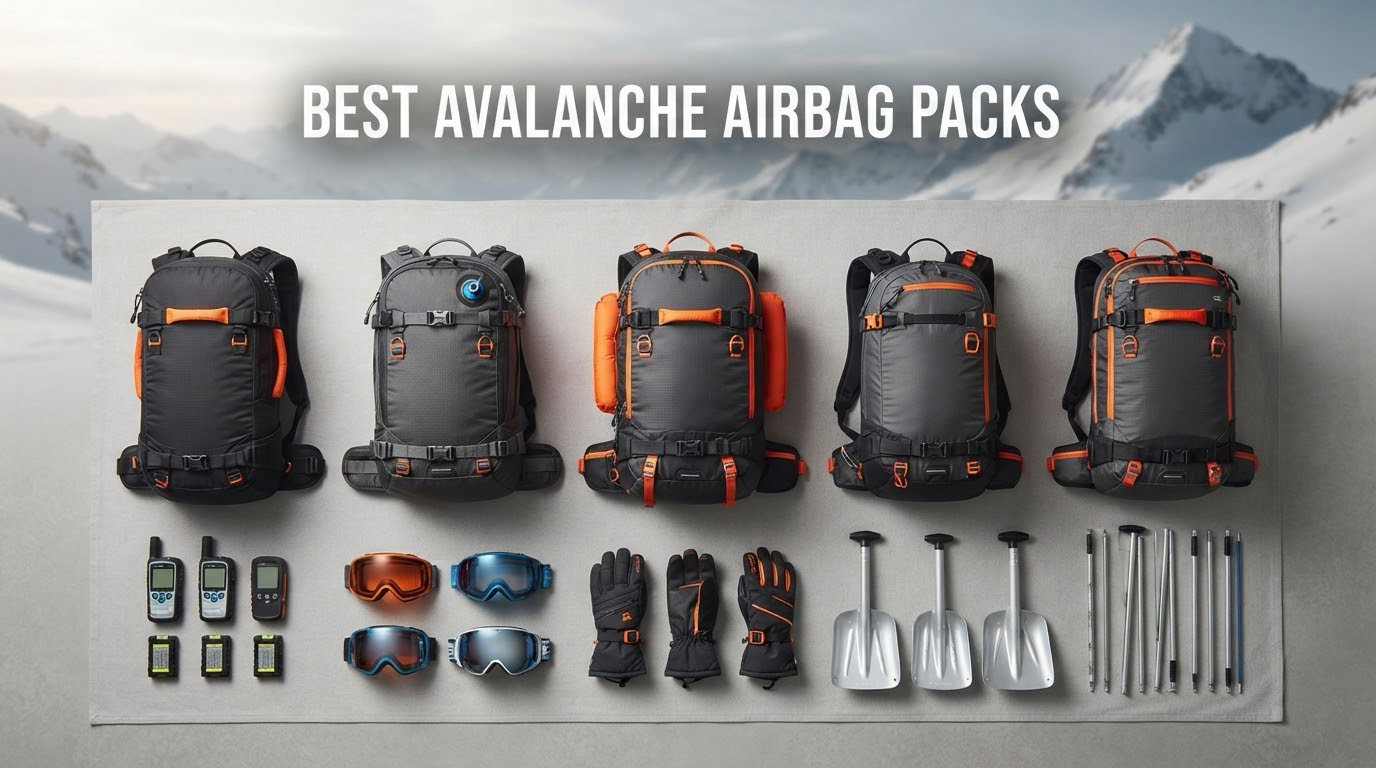
An avalanche airbag pack is one of the few purchases in winter sports where the decision is not really about the gear itself. You are choosing an inflation system, a volume that matches how far you travel from a road, and a harness that has to sit on your hip bones for ten hours. Get the volume wrong and the pack rides badly all season. Get the system wrong and you are stuck sourcing compressed gas cartridges at the airport.
That is why the best avalanche airbag packs lists online tend to be shallow. They rank on star ratings without telling you whether the airbag unit is included, whether the pack fits a short torso, or what a canister costs you to keep flying with. We pulled the full specification set for ten current packs, from a 15 litre sledding pack to a 35 litre professional touring pack, and read them line by line.
Our method was simple: full published specifications, weight including the airbag where the maker states it, the review history on each listing, and a hard look at what is missing. Where owners have left enough feedback to make a judgement we used it. Where a listing has almost no owner history, we say so rather than borrowing reputation from a sibling model. If you want the same volume-versus-weight discipline applied to other kinds of packs, we did it for fishing chest packs too.
Everything below is updated for 2026, and the shortlist covers compressed gas, fan-powered and supercapacitor systems so you can compare them on equal terms rather than by brand reputation.
Table of Contents
Top 3 Picks for the Best Avalanche Airbag Packs

Osprey Soelden Pro 32L E2
- Alpride E2 supercapacitor
- 32L snow-specific volume
- Built-in shovel and probe sleeves

BCA Float 15 Turbo 2.0
- 15L low-volume pack
- External shovel storage
- Highest average rating here

Mammut Pro 35 Removable Airbag 3.0
- 35L professional volume
- CONTACT U Frame back panel
- Adjustable trigger
All Ten Avalanche Airbag Packs at a Glance in 2026
| Product | Specifications | Action |
|---|---|---|
| Osprey Soelden Pro 32L E2 |
|
Check Latest Price |
| BCA Float 15 Turbo 2.0 |
|
Check Latest Price |
 Black Diamond JetForce Tour 26 Black Diamond JetForce Tour 26 |
|
Check Latest Price |
 BCA Float 32 BCA Float 32 |
|
Check Latest Price |
 BCA Float E2 35L BCA Float E2 35L |
|
Check Latest Price |
 Mammut Tour 30 Removable Airbag 3.0 Mammut Tour 30 Removable Airbag 3.0 |
|
Check Latest Price |
 Deuter Alproof Ride 18L Deuter Alproof Ride 18L |
|
Check Latest Price |
 Mammut Free 22L Mammut Free 22L |
|
Check Latest Price |
| Mammut Pro 35 Removable Airbag 3.0 |
|
Check Latest Price |
 Ortovox Ascent 30 Avabag Kit Ortovox Ascent 30 Avabag Kit |
|
Check Latest Price |
What an Avalanche Airbag Pack Is and What It Cannot Save You From
An avalanche airbag pack is a backpack with an integrated airbag around the head, shoulders and torso that inflates in roughly three seconds when you pull the trigger, keeping you nearer the surface of a slide and easier for rescuers to see.
The mechanism is called inverse segregation, sometimes described as the Brazil Nut effect. In a flowing mix of snow and rock, larger and lighter bodies tend to rise toward the surface while denser debris sinks past them. Inflating makes you bigger, so you rise. It is a physical accident of granular flow, not a guarantee, which is the part most marketing copy leaves out.
The airbag holds roughly 150 litres of volume around the upper body. That trapped air buys you breathing time while your body settles into the snow around you, and it raises your odds of staying visible enough for a beacon search to work. On the ground, guides and avalanche educators treat a pack as the fourth piece of kit alongside a beacon, a shovel and a probe, never as a replacement for training.
Here is the honest limit list. An airbag does not protect against blunt trauma from rocks, trees, ice or the force of being held under a turbulent flow. It does not save you from being swept into a terrain trap such as a gully, a creek bed or a runout funnel. It does not help if you are frozen, if you are buried far deeper than the debris allows the bag to inflate into, or if the slide carries you into a crevasse, a cornice collapse or a watercourse. And it does nothing at all in a slab avalanche that never really moves past you. Every pack on this list raises your margin. None of them replaces the judgement that keeps you on terrain you can handle.
1. Osprey Soelden Pro 32L E2 – Best Overall
Osprey Soelden Pro 32L Men’s Ski and Snowboard Backpack with E2 Airbag System, Red Mountain
Alpride E2 electronic system
32L snow-specific volume
6.4 lb
6 compartments
Pros
- Dependable Alpride E2 supercapacitor engine
- Built-in shovel and probe sleeves
- A-frame or diagonal ski plus snowboard carry
- Dual-position stow-away helmet carry
- GPS and radio pocket with mic harness webbing
Cons
- Heaviest pack in this group at 6.4 lb
- Water resistant rather than waterproof
- Only 18 reviews for a premium technical pack
Among the best avalanche airbag packs we reviewed, this is the one with the most owner history attached to a current-generation system. Eighteen reviews averaging 4.3, with roughly two thirds of those at five stars, is a real sample rather than a single enthusiastic buyer. That matters for a safety product where the questions are fit and long-term reliability, not excitement.
The pack runs the Alpride E2 supercapacitor engine, the same inflation platform used across a lot of premium alpine packs. Supercapacitors charge fast, hold their charge in cold, and give you multiple deployments from one charge, which is the single biggest practical difference from a compressed gas canister. The owner summary describes a dependable airbag, well organised safety gear storage and a snow-specific fit that holds up.
Two things temper it. At 6.4 pounds it is the heaviest pack we listed, so it is a pack for carrying a real load on long tours rather than for racing up a skin track. The shell is water resistant rather than waterproof, which in coastal or spring conditions means a dry bag inside for your insulation layer.
How the fit and sizing work on this pack
This is a gender-specific snow fit, not a unisex shell, and the 32L sits in the range that works for a day of touring plus a night in a hut. The dedicated avalanche safety kit pocket has a large front panel J-zip access with dedicated shovel handle and probe sleeves, so your beacon, shovel and probe are reachable without unpacking the main compartment.
The main compartment opens with a large U-zip and carries an internal zippered organisation pocket plus a dedicated GPS and radio pocket with mic harness webbing attachment points. If you run a tracker and a radio in a hut-to-hut trip, that pocket is the deciding feature rather than a nice-to-have.
Who should skip this pack
Skip it if your priority is minimum weight, because 6.4 pounds is real load on the ascent. This is the pack for a skier who carries skins, a spare layer and a full safety kit, and who wants the gear architecture to stay organised rather than to shave grams.
Skip it if you ride in heavy wet snow and treat waterproofing as non-negotiable. The listed care is hand wash only, and the shell will wet through in prolonged rain on a ridge.
2. BCA Float 15 Turbo 2.0 – Best Value
BCA Float 15 Turbo Avalanche Airbag 2.0 – Warning red/Black
Float 2.0 system
15L pack volume
2 lb shell / 6 lb with cylinder
External shovel storage
Pros
- Highest average rating in the group at 4.9
- Compact 15L volume built for sledders
- External shovel storage keeps the kit reachable
- Zipper closure with adjustable straps
Cons
- Airbag cylinder sold separately
- 15L leaves little room for a full day
- Nylon build is lighter on structure than alpine packs
This is the highest-rated pack on the shortlist, at 4.9 out of 5 across 13 reviews with about 89 percent of those at five stars. Reviewers consistently point to the low-volume, lightweight design and the external shovel storage. It is designed for mountain sledding, and it is the smallest genuine airbag pack here.
Split the weight figure into its two parts. The pack shell alone is 2 pounds. With the Float 2.0 cylinder fitted it is 6.0 pounds, which tells you how much of the mass is the compressed gas system rather than the bag. The cylinder is a separate purchase on this listing, so budget for it as a distinct item rather than assuming the pack ships complete.
External shovel storage is the detail that stands out for sledders, because a shovel is the tool you need most and it is awkward to strap to a small bag. For ski touring, a 15 litre volume is genuinely limiting: a day of layers, skins, water and a safety kit will not sit comfortably in it.
What 15 litres actually carries
At 915 cubic inches this is a pack for a helmet, a shell, a mid layer, a lunch, skins and the safety kit, with nothing spare. It works when you are moving fast and light, or when you are on a machine-served day and the pack is essentially a safety platform rather than a luggage system.
If you are boot-packing to a ridge and need a shovel, probe, extra layers and a repair kit, step up a volume class. The Float 15 is honest about what it is, but it is not a touring pack in the modern sense.
Who should skip this pack
Skip it if you need an all-in-one airbag unit, because the cylinder is a separate purchase and the whole ownership cost depends on sourcing that component. The published weight only makes sense once the cylinder is in the bag.
Skip it if you tour with a partner carrying the group gear, or if you like a spare jacket and a full thermos. You will be repacking every morning.
3. Black Diamond JetForce Tour 26 – Best for Simple Electrics
Black Diamond Jetforce Tour Pack 26 Avalanche Airbag (MD-LG)
JetForce electronic system
26L volume
3 AA batteries
Medium/large harness
Pros
- Perfect 5.0 average from the buyers who own it
- Single-handle electronic trigger is simple in gloves
- 26L splits the difference between touring and day use
- Medium/large harness sizing
Cons
- Only two reviews on record
- Limited published specification detail
- AA-powered rather than supercapacitor
The JetForce Tour 26 is the simplest electric system in this roundup: three AA batteries, one trigger, one button. Both recorded buyers rated it five stars with no negative signals at all, and a community owner noted in a backcountry forum thread that the PIEPS Jetforce gave them the same experience as the Black Diamond pack for noticeably less money, which is a useful signal that the platform is well understood.
Twenty-six litres is a genuinely useful middle. It carries a full day of touring kit with room for an emergency bivy and a shovel, and it is not so large that it gets in the way on a lift-served day. The medium and large harness sizing is worth checking against your torso, because that is where this generation of pack is most likely to fit you well or badly.
Be honest about the evidence. Two reviews is not a reliability record, and the listing carries sparse technical detail compared with the other packs here. The system is mature and well known, but I would not base a purchase on owner feedback this thin without trying it on.
Battery logistics on a three-AA system
Three AA batteries are the easiest supply chain in the category. You can buy them in any town on earth, they tolerate cold far better than a lithium-ion pack that has been sitting in a car, and the trigger has no separate charging state to forget about.
The trade-off is deployment count. A supercapacitor system gives you multiple pulls from one charge, which is what makes practice deployments and second chances realistic. A small battery system generally does not, so budget one battery change per season rather than treating it as a free practice tool.
Who should skip this pack
Skip it if you fly internationally and want to practise multiple deployments, because AA cells are not a substitute for a system that supports repeated inflation on one charge. Owners who switched to supercapacitor systems in forum discussions usually named travel logistics, not performance, as the reason.
Skip it if you fall outside the medium/large harness range, or if you want a published specification list dense enough to compare against alpine competitors.
4. BCA Float 32 – Best Mid-Volume Compressed Air Pack
BCA Backcountry Access Float 32 Avalanche Airbag Backpack (Orange)
Compressed air deployment
32L capacity
5.5 lb
Ice axe and helmet carry
Pros
- Full carry system for skis and snowboard
- Ice axe and helmet carry included
- 32L without excessive weight
- Newer listing from an established airbag maker
Cons
- Only a single review on this listing
- Compressed gas means a cartridge to source
The Float 32 is the straightforward answer if you want a full-featured touring pack without the supercapacitor price tier. It uses compressed air to deploy the airbag, sits at 5.5 pounds, and carries 32 litres, which is the volume that works for day touring and a hut night in most conditions.
The carry system is the reason to like it. It handles skis or a snowboard for boot-packing approaches, ice axe and helmet carry, and hydration compatibility, so it is a genuine alpine pack rather than a bag with an airbag sewn into it. One reviewer at four stars confirms it works as intended for avalanche terrain, but a single review tells you nothing about fit or longevity.
Compressed air is the quiet cost. Each deployment consumes a cartridge, and if you fly you are dealing with a compressed gas cylinder that airlines and security screening treat as a special item. The airbag itself is the reason people buy these packs, so make sure you factor in where the gas comes from when you are two valleys from a shop.
Volume and weight trade-off
Thirty-two litres at 5.5 pounds is a balanced figure. It holds a layer, a spare, skins, a repair kit and the safety kit without turning into a motorpack, and the weight stays reasonable on a long climb.
The comparison point matters here. The 35 litre compressed-gas option in this list is a full professional build, and the 18 litre alpine pack in this list is much smaller. Thirty-two litres sits between them and is the size most touring skiers settle on after one season.
Who should skip this pack
Skip it if you fly to the mountains more than once a season, because compressed gas plus airport screening is the friction that pushes long-term canister owners toward electric systems. One forum owner with 15 years on canisters named travel, not performance, as the reason he changed.
Skip it if you want a body of owner feedback on this specific listing. One review is a signal that it works, not a basis for a purchase of this size.
5. BCA Float E2 35L – Best for Big Hauls
BCA Float E2 Avalanche Airbag Pack (35L) – Black (SM/MD)
Alpride E2 supercapacitor
35L / 1891 cu in
6.1 lb
3-year warranty
Pros
- Alpride E2 supercapacitor engine
- 7 compartments and 8 pockets
- Side stash pocket for gloves or a bottle
- Machine washable with a 3-year warranty
Cons
- AA batteries bought separately
- SM/MD harness limits larger torsos
- Only one review on record
This is the pack for people who genuinely carry a lot. Thirty-five litres, 1891 cubic inches, seven compartments and eight pockets, and the weight difference between the 25 and 35 litre versions is small enough that most people should just take the 35. The single recorded owner gave five stars, which confirms satisfaction with build and storage but nothing more.
Running the Alpride E2 supercapacitor engine puts this pack in the same class as the Osprey at number one. Supercapacitor systems charge quickly, tolerate cold, and support repeated deployments from a single charge, which means you can run practice pulls without planning a cartridge budget or a battery budget first.
Two practical details. AA batteries are sold separately, so the engine is not ready to use straight out of the box. And this listing is the small/medium harness, which is the limiting factor for larger torsos rather than the volume.
Organising a pack this size
Seven compartments and eight pockets on a 35 litre pack is unusual, and it exists to stop a big load from turning into a gear bag you re-pack every morning. The side stash pocket is the one you will use most, because gloves, goggles and a bottle are the three things that need to be reachable while moving.
It is also machine washable and carries a three-year manufacturer warranty, which matters more than it sounds in a category where owners ask forum questions about how long a pack should last before the fabric and harness give up.
Who should skip this pack
Skip it if you have a large torso and the harness sizing does not cover you, because a 35 litre pack on a mismatched harness rides badly no matter how good the feature list is. Try it on with a full load before you commit.
Skip it if you are a fast-and-light skier. At 6.1 pounds with this much storage, you are carrying capacity you may never fill.
6. Mammut Tour 30 Removable Airbag 3.0 – Best for Modular Swaps
Mammut Tour 30 Removable Airbag 3.0, Sapphire/Black, 30 L, 2610-01980-50430-1030
Removable Airbag System 3.0
30L / 1830 cu in
1.5 kg
Recycled PFC-free textile
Pros
- Airbag system transfers between Mammut packs
- Versatile 30L all-mountain volume
- Recycled PFC-free textile shell
- Framed backpack construction
Cons
- Cartridge not included
- Only one compartment and one pocket
- No owner reviews on this listing
The modular argument is the reason to look at Mammut. The Removable Airbag System 3.0 pulls out of the pack, which means one airbag system can move between a 22 litre tour pack and a 35 litre alpine pack, or live in a pack you already own that uses the same system. Over a decade of gear rotation, that is a real saving on the part you can never reuse.
Thirty litres and 1830 cubic inches is the most versatile size Mammut makes, and at 1.5 kilograms this is a light pack for a compressed air system. The shell uses recycled PFC-free textile, which matters if you care about what happens to a pack at end of life.
There is no owner review history on this listing, so we are working from the specification sheet. The compression is that it lists one compartment and one pocket, which is thin internal organisation for a 30 litre volume, and the cartridge is not included.
How a removable airbag system changes ownership
With a fixed system, replacing the pack means replacing the airbag. With a removable one, you can keep the airbag, rotate shells by trip length, and send a tired pack for repairs or replacement while the safety system keeps working.
It also concentrates the consumable cost in one component. The system is compressed air, so you are still sourcing cartridges, but you are sourcing them for one unit rather than buying a new unit each time your pack wears out.
Who should skip this pack
Skip it if you want the simplest possible ownership story. A removable system means thinking about which Mammut pack the unit lives in, and anyone who wants a single fixed unit should start with the Ortovox at number ten instead.
Skip it if you organise gear obsessively. One compartment and one pocket is a deliberate simplification, and if you carry a full avy kit with separate layers you will feel the difference.
7. Deuter Alproof Ride 18L – Best for Light Freeride
Deuter Unisex Alproof Ride 18L, Freerider Alpine Backpack with Avalanche Airbag System, 18 Liter – Black
Alpride E2 system included
18L alpine volume
6 lb with system
21 x 11 x 7 in
Pros
- Alpride E2 airbag built into a real alpine pack
- Softstripe pads keep the load close
- Leg safety straps and sternum strap with whistle
- Fleece-lined goggle pocket and hip fin pockets
Cons
- Smallest capacity in this list at 18L
- Bladder sold separately
- No owner reviews on this listing
This is a genuine alpine freerider pack with an airbag built in, not an airbag strapped onto a hiking bag. The Alpride E2 system is included, the back system uses two flexible Softstripe pads for close-to-body load control, and the 6 pounds quoted already includes the airbag system, which is the number most brands bury.
The safety and carry detail is thorough. There is a front pocket for avalanche equipment, a stowable mesh helmet holder, an internal valuables compartment, diagonal ski and front snowboard attachment, zippered hip fin pockets and a fleece-lined goggles pocket. Leg safety straps and a two-way adjustable sternum strap with a whistle are the small things that matter when you are loaded on a steep pitch.
At 18 litres it is the smallest pack in this roundup, and there is no owner review history on the listing, so this is a spec-sheet recommendation. Hydration compatibility requires a two litre bladder, which is not included.
Why a real alpine back system matters
Softstripe pads flex with your movement rather than resisting it, which is what keeps a loaded pack from fighting you on a descent. The hip fin pockets keep small items off the shoulder straps and out of the main compartment, where they get crushed by a rope coil or a spare jacket.
The stowable helmet holder is a genuine freeride feature rather than a touring one, because on descents you want the helmet off your head and secured while you are moving through technical terrain.
Who should skip this pack
Skip it if you need to carry a hut kit, a sleeping bag or a multi-day load, because 18 litres is a day-pack number and this one is already 6 pounds. The Float E2 at number five exists for that trip.
Skip it if you want the benefit of proven owner feedback. This listing has none, so treat the spec sheet as a starting point for a hands-on fit instead.
8. Mammut Free 22L – Best for Fast Ski-Touring Days
Mammut Free 22L Removable Airbag 3.0 Black, One Size
Removable Airbag System 3.0
22L / 1342 cu in
4.6 lb
Anatomic vest harness
Pros
- Lightest listed weight here at 4.6 lb
- Vest-style anatomic harness sits close
- Compact 22L suits fast ski-touring
- Airbag system transfers between Mammut packs
Cons
- Listed as not water resistant
- Cartridge not included
- Only one pocket listed
At 4.6 pounds this is the lightest pack in the roundup, and the vest-style anatomic harness is the reason. A vest harness wraps the shoulders and torso rather than hanging from two straps, which keeps the load close and the pack quiet on a descent.
Twenty-two litres and 1342 cubic inches is a fast ski-touring number. It holds a shell, a mid layer, skins, food, water and the safety kit with a little room to spare, and it uses the same removable Removable Airbag System 3.0 as the larger Mammut packs, so the system can move between them.
The clear warning is the water resistance rating. This pack is listed as not water resistant, which in a coastal range or on a wet spring tour means wet snow soaks into the shell and the main compartment. Keep your insulation in a dry bag. The cartridge is not included, and only one pocket is listed.
Comparing a 22 litre vest to a 30 litre daypack
The eight-litre difference is roughly one extra layer plus a first aid kit and a spare. If your typical day is a long skin up and a descent with nothing left behind, 22 litres is a cleaner pack and this is where the low weight actually pays you back.
Against the BCA Float 15 Turbo, though, the 22 litre packs as a full day pack rather than a sledding pack, and its 4.6 pound weight includes the vest harness that the 15 litre model does not have.
Who should skip this pack
Skip it if you ski in wet or maritime snow, because the stated lack of water resistance is not a detail to work around on a whiteout descent. Every other pack in this list except the Ortovox carries at least a water resistant rating.
Skip it if you need more than one pocket to keep the safety kit separate from your clothing, and skip it if you want a pack that comes with the compressed air cartridge already in it.
9. Mammut Pro 35 Removable Airbag 3.0 – Best for Alpine Projects
Mammut Pro 35 Removable Airbag 3.0, Black, 35 L, 2610-02130-0001-1035
Removable Airbag 3.0 with adjustable trigger
35L
1.5 kg
420D recycled nylon oxford
Pros
- CONTACT U Frame with thermoformed back panel
- High-visibility orange avalanche safety pocket
- Rear and top access to the main compartment
- Machine washable 420D recycled nylon
Cons
- Cartridge not included
- 35L is more than some riders want to carry
- No owner reviews on this listing
The Pro 35 is built for people who work in the mountains, and the spec sheet reads like it. It carries the removable Airbag System 3.0 with an adjustable trigger, sits on a CONTACT U Frame with a thermoformed back panel, and uses 420D recycled nylon oxford with a PFC-free DWR treatment, which is a serious fabric for a pack that gets loaded, dropped and washed.
Thirty-five litres is a professional volume rather than a recreational one, and the storage design backs that up. The dedicated avalanche safety pocket has high-visibility orange lining so you can confirm your beacon, shovel and probe are in place at a glance, and the main compartment opens from both the rear and the top for fast transitions when you are changing from climbing to skiing stance.
At 1.5 kilograms it is not heavy for what it does, and it is machine washable with a limited warranty. There is no owner review history on this listing, and the compressed air cartridge is not included, so the total cost of ownership includes sourcing gas.
What an adjustable trigger changes
An adjustable trigger lets you set the handle position and pull geometry to match how you wear the pack and which hand you pull with. That matters more than it sounds, because a handle you cannot grab reliably with a glove on in a turbulent slide is a handle that does not get pulled.
Snowmobilers in particular care about handle side, and the community preference is a left-side pull that keeps the dominant hand free for the throttle. If that is your use case, confirm the handle position before you buy.
Who should skip this pack
Skip it if 35 litres is more than you need to carry, because a professional pack on a recreational tour is extra weight and extra bulk for storage you fill with kit you never needed. The 30 litre Mammut Tour covers the same trip in less space.
Skip it if you fly often, since the compressed air system is the one that generates the most friction at airport security and the most hassle refilling at the destination.
10. Ortovox Ascent 30 Avabag Kit – Best With the Airbag Included
Ortovox Men’s Ascent 30 Avabag Kit Black Anthracite 30 Liter
Integrated avabag system
30L volume
1.86 kg
3 pockets with bright lining
Pros
- Airbag system included as standard
- Three pockets plus a bright interior
- D-Skifix and snowboard mounts
- Hydration system compatible
Cons
- Listed as not water resistant
- Long-standing Evergreen collection design
- No owner reviews on this listing
This is the only pack in the roundup where the airbag system is included in the kit as standard, and that single fact changes the ownership maths. Every compressed air pack on this list except this one asks you to source a cartridge separately, and a cartridge you cannot find at the destination is an airbag that cannot be used.
The Ascent 30 is 30 litres and 1.86 kilograms, with three pockets and a bright interior lining so you can find gear in a snowstorm or in a dark hut. It carries a snowboard mount and a D-Skifix attachment point, and it is hydration compatible.
The honest caveats are that it is listed as not water resistant, and that it belongs to the long-standing Evergreen collection rather than the newest generation. There is no owner review history on this listing, so the reputation comes from the wider market rather than this page.
Why a complete kit changes the decision
Buying a pack without the gas is cheaper up front and frustrating later. If you are new to airbag packs, this kit removes the single most common first-season mistake, which is turning up at a hut with a pack and no cartridge.
It also suits anyone who wants one system to maintain rather than one to research. The trade is that the collection is older, and Ortovox users who want the newest electronic system should read the spec of the current generation before settling.
Who should skip this pack
Skip it if wet snow is part of your normal season, because the water resistance rating is the main structural weakness here. That is a bigger deal on a long tour than a missing pocket.
Skip it if you plan to keep the same pack for a decade and want the newest airbag electronics, since the Evergreen design is not the current flagship system in the Ortovox range.
Canister vs. Electric Avalanche Airbags: Which Should You Buy?
The first question is not which brand is better, it is which inflation system matches how you actually get to the mountains. Compressed gas, a fan, and a supercapacitor all inflate the same roughly 150 litre bag in about three seconds, and the differences show up in logistics, practice and cold-weather behaviour rather than in the rescue itself.
Compressed gas means a canister or cartridge, one deployment per unit, and a consumable you must source. Some brands let you refill a steel cylinder yourself at a scuba or paintball shop with an adapter, while others require a dealer. Electric fan systems use a battery to spin a fan, and supercapacitor systems use a capacitor bank that charges fast and holds its charge in cold. Both of those give you multiple deployments from one charge, which is the practical reason to pay more for them.
Forum consensus is fairly consistent here. Canisters inflate faster in a slide, and electric systems are far more convenient to practise with. One long-time canister owner described the fan advantage as ease of travel and the fact that you can have multiple pulls, and another noted canister systems are more appealing from a longevity standpoint, estimating roughly ten years as a practical maximum from the dirtbag standpoint.
For air travel, compressed gas cylinders attract the most friction at security screening, and users report having to show the pack with the cylinder removed and disconnected, then hunting for a refill station at the destination. Lithium-ion batteries in electronic systems raise their own questions, but the general rule is that you carry the electronic unit with the airbag removed, and the canister has to be dealt with as a separate compressed gas item. Check the current rule with your airline rather than trusting a forum post from two seasons ago.
For practice, this is the widest gap. A canister deployment ends the season’s gas budget, and because of that most people never practise. If you want to run a deployment rehearsal in a safe field a couple of times a year, an electric or supercapacitor system pays for itself in training value alone.
How to Choose an Avalanche Airbag Pack
Start with volume, because it is the decision you will live with every day. A 15 to 20 litre pack works for resort sidecountry, sledding and fast machine-served days where the bag is mostly a safety platform. A 25 to 32 litre pack is the day touring default, carrying a layer, skins, water and a full safety kit. A 35 to 45 litre pack is for hut trips, splitboarders carrying extra gear, guides and anyone hauling a rope or snow science kit.
Then measure your torso. This is where short-torso and women’s fit problems show up, and owners in forum threads describe exactly the symptoms: hip bones pressing against the lumbar area, straps too short, and lower back pain after a long day. A women’s-specific fit is not just a narrower pack, it is a shorter torso length and a shaped hip belt. If the manufacturer publishes a torso range in inches, measure from the top of your iliac crest to the base of your neck and check it before anything else.
Weight matters more than most buyers expect. The spread in this roundup runs from 4.6 pounds for the Mammut Free to 6.4 pounds for the Osprey Soelden Pro, and roughly 1.8 pounds of that difference is a percentage of the total load when you add a layer, food and a rope. Ask for the weight including the airbag system, not the empty pack weight, because that is how several brands mislead. We apply the same capacity-versus-carry-weight discipline across other specialist bags too, including our fishing sling packs roundup.
Check the safety kit architecture next. You want a dedicated avalanche pocket with a shovel handle loop and probe sleeves, not a general-purpose compartment where the beacon can slide to the bottom under a rope coil. Side access to that pocket saves real time. The Osprey at number one has a front panel J-zip, and the Mammut Pro 35 has a high-visibility orange lined safety pocket for a quick visual check.
For ski and snowboard carry, decide how you actually travel. A-frame or diagonal ski carry suits touring, vertical front panel carry suits one-board riders and splitboarders, and a stowable helmet holder is only useful if you descend. If you boot-pack a lot, a front compartment that opens without unpacking the bag is worth more to you than a hydration port.
Think about modularity if you plan to keep the pack for years. A removable system like the Mammut Removable Airbag System 3.0 means one airbag unit can move between pack sizes, and a pack with the airbag included as standard, like the Ortovox Ascent 30, means there is nothing extra to buy before the first trip. A system that is sold without its cartridge means there is one more thing to get right.
Maintenance is unglamorous and it decides whether the pack still works in year five. Recharge electronic systems fully between seasons rather than leaving them flat. Run a practice deployment where it is legal and safe to do so. Check the trigger, the handle and the harness stitching annually. Wash the shell according to the care label, which ranges from hand wash only to machine washable depending on the pack. And check the airbag itself for abrasion, because it is the component you cannot replace casually.
Finally, set a budget honestly. Canister packs sit at the entry point of this category, supercapacitor systems occupy the premium tier, and the price spread in this roundup reflects the inflation technology more than the fabric. If you are buying for one trip per season and can source gas locally, a canister pack is a defensible choice. If you fly, practise, or expect to keep the pack for a decade, the electronic premium buys convenience you will feel every season.
Frequently Asked Questions
Is an avalanche airbag worth it?
An airbag raises your chance of staying on the surface of a slide and being found by a beacon search, because inflating makes you a larger object in a flowing mass of snow. It is widely treated as the fourth piece of safety kit alongside a beacon, shovel and probe. It cannot protect you from blunt trauma, terrain traps or a very deep burial, and it does not replace avalanche training.
Which avalanche airbag pack is the best?
It depends on trip type and inflation system. For a general all-round touring pack, the Osprey Soelden Pro 32L E2 pairs a current supercapacitor system with a dedicated shovel and probe pocket. For minimal volume, the BCA Float 15 Turbo 2.0 is the smallest option. For a professional alpine build, the Mammut Pro 35 offers a thermoformed back panel and adjustable trigger.
Is it possible to fly with an avalanche airbag system?
Yes, but the two systems behave differently. Compressed gas canisters attract the most friction, and you may be asked to show the pack with the cylinder removed and disconnected before screening, then refill at your destination. Electronic systems are simpler, though you typically remove the airbag unit from the pack and carry it separately with the battery. Always confirm the current rule with your airline before departure.
How much does an avalanche airbag cost?
Prices vary widely because the inflation technology drives cost more than the fabric. Canister packs occupy the entry tier, supercapacitor and electronic systems sit at the premium tier, and specialist alpine packs sit above that. Budget separately if the listing does not include the airbag unit or the compressed air cartridge, which is the most common hidden cost in this category.
Who makes the highest quality avalanche backpacks?
Quality tracks the back system and the carry architecture more than the label. In this roundup the Osprey Soelden Pro, the Mammut Pro 35 and the Deuter Alproof Ride stand out for dedicated avalanche tool pockets, alpine back systems and full carry options. Whichever brand you pick, verify the torso length range and buy a kit where the airbag unit is included, since that is the part you cannot reuse.
Final Verdict on the Best Avalanche Airbag Packs in 2026
After working through ten current packs for 2026, the Osprey Soelden Pro 32L E2 comes out on top. It combines a current supercapacitor system, a real snow-specific fit, dedicated shovel and probe sleeves, and enough owner feedback to judge it on, which almost nothing else in this roundup can offer. The Mammut Pro 35 is the pick if you want a professional alpine build with an adjustable trigger, and the BCA Float 15 Turbo 2.0 is the pick if you want the smallest usable pack on the market.
Whatever you choose, the two decisions that matter most are the inflation system and the fit. Pick the system that matches your travel and your practice habits, then make sure the harness actually matches your torso. And take the airbag seriously for what it is: one layer of protection in a layered system, never the layer that replaces training.
We keep comparing carry systems, volume and comfort across other kinds of packs too, including fly fishing packs, using the same fit-first method.