
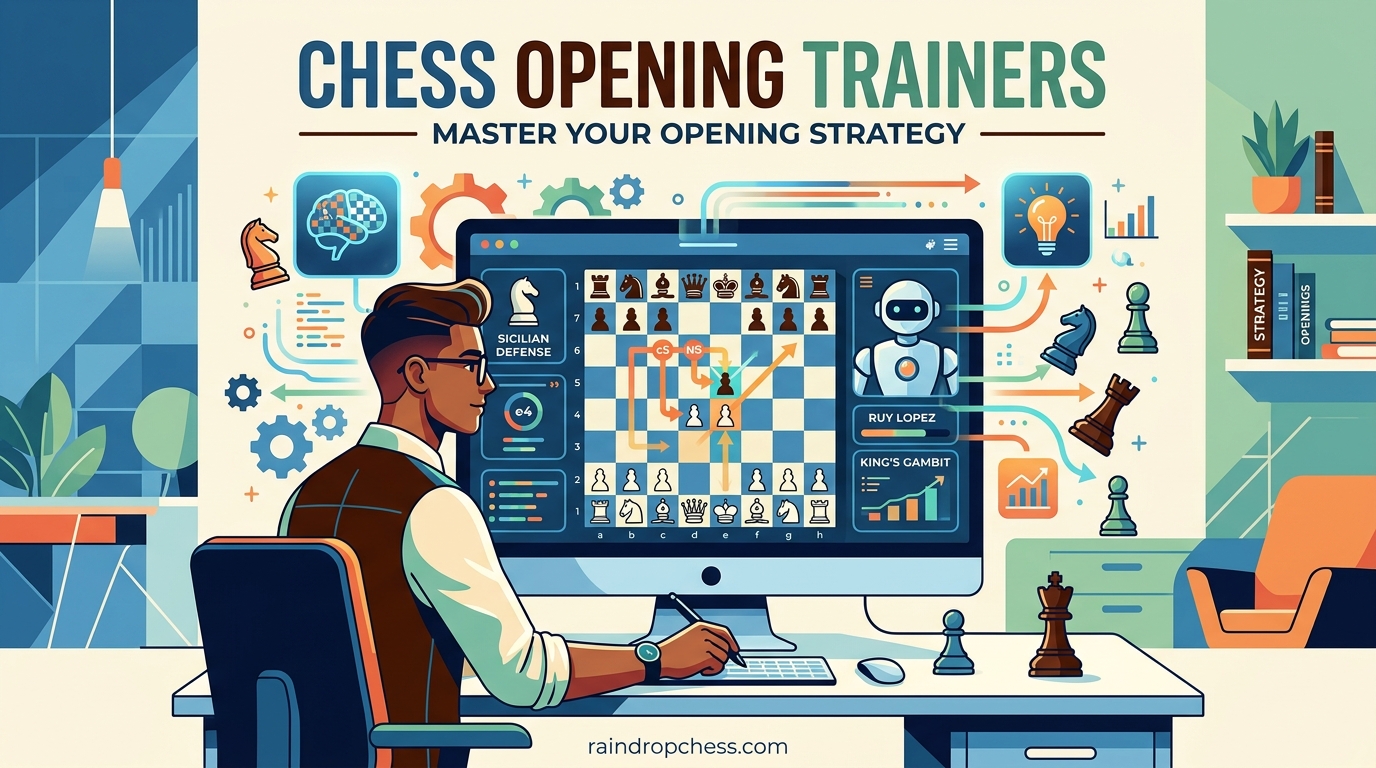
I have spent the better part of three years building and rebuilding my chess opening repertoire, and if there is one thing I have learned, it is this: the right training resource makes all the difference. Whether you are tired of getting caught in traps you have never seen or you simply want to stop burning clock time in the first ten moves, having a solid chess opening trainer on your desk (or screen) is non-negotiable.
In this guide, our team breaks down the best chess opening trainers available right now. We looked at 15 of the most popular and highly rated books and digital guides, from comprehensive reference tomes like Modern Chess Openings to focused repertoire builders and trap-heavy training manuals. Every product on this list was evaluated for its clarity, depth, audience fit, and long-term value. If you are also working on a broader improvement plan, this pairs well with a structured 90-day chess training plan.
We organized these picks by skill level and training style so you can find exactly what matches how you study. Let’s get into it.
Table of Contents
Top 3 Picks for Best Chess Opening Trainers

Best Chess Opening Trainers in 2026
1. Modern Chess Openings, 15th Edition – The Definitive Reference Guide
Modern Chess Openings, 15th Edition
768 pages
15th Edition
Algebraic Notation
Random House
Pros
- Most complete opening reference in book form
- Comprehensive listing of all major openings
- Excellent value for a 768-page reference
Cons
- Theory outdated since 2008 publication
- No coverage of London System
- Paperback binding may wear over time
When I first picked up Modern Chess Openings, I was honestly overwhelmed. At 768 pages, this is not a book you sit down and read cover to cover. It is a reference work, and a staggeringly complete one at that. Every major opening system is laid out in algebraic notation with variations branching out in exhaustive detail. I have used it to look up specific lines before tournament rounds, and the depth of coverage is unmatched in any single volume.
That said, the publication date is worth noting. This 15th edition came out in 2008, which means some modern theoretical developments are absent. You will not find much on the London System or recent innovations in the Sicilian Najdorf. But for building a foundational understanding of opening structures and standard plans, it remains the gold standard reference.
I found the organization particularly useful when I was trying to compare different responses to 1.e4. The book groups openings logically, so you can flip from the Ruy Lopez to the Italian Game and see how the pawn structures and plans differ side by side. For players who like having a physical reference they can annotate and bookmark, nothing else comes close.
The paperback binding is my only real complaint. After two years of regular use, my copy shows wear along the spine. If you plan to use this heavily, consider reinforcing the binding or being gentle with the pages.
Who Should Buy This Book
This is ideal for intermediate to advanced players who want a comprehensive opening reference on their shelf. If you are rated 1200+ and play tournament chess, Modern Chess Openings belongs in your collection. It is also excellent for coaches who need a reliable reference during lessons.
Beginners may find the dense notation intimidating. If you are just starting out, consider pairing this with a principles-based book like Discovering Chess Openings before diving into the encyclopedic content here.
How to Use It Effectively
Do not try to memorize entire chapters. I recommend using MCO to look up specific lines you encounter in your games. After each tournament, review the openings that gave you trouble and study the relevant variations. This approach keeps the book functional rather than overwhelming.
Use it alongside a chess engine or online database to cross-reference lines with recent games. This compensates for the 2008 publication date and keeps your preparation current.
2. FCO: Fundamental Chess Openings – Best for Beginners to Intermediates
FCO: Fundamental Chess Openings
448 pages
31 Openings Covered
Gambit Publications
Illustrated Edition
Pros
- Best opening book for beginners to intermediates
- Excellent structure and prose with dry humor
- Great explanations of themes and historical development
Cons
- Does not mention common traps often
- Not detailed enough for advanced players
- Some areas need more theoretical grounding
FCO is the book I wish I had when I was rated 900. Paul Van der Sterren does something most opening books fail at: he makes the material genuinely enjoyable to read. The prose has a dry wit that keeps you engaged, and the explanations focus on why certain pawn structures and piece placements matter rather than just listing moves.
The book covers 31 openings with main lines taken to about move 6 or 7. That depth hits a sweet spot for developing players. You get enough theory to understand the key ideas without drowning in variations. I found myself actually reading this like a regular book, which is rare for opening literature.
Each opening section includes historical context about how the line developed, which I found surprisingly helpful for remembering the plans. When you understand that the Nimzo-Indian emerged as a response to hypermodern principles, the moves make more intuitive sense.
The main limitation is that FCO stops short of the depth advanced players need. If you are rated above 1800 or preparing for a specific tournament opponent, this will not give you the detailed analysis you require. It also skips common traps, which is a missed opportunity for players who lose games to tactical tricks in the opening.
Who Should Buy This Book
This is the single best opening book for players rated 600 to 1600. If you understand the rules of chess and can play a full game but feel lost in the first few moves, FCO will give you a framework for understanding every major opening. It is also an excellent first opening book for self-taught players who want to fill gaps in their knowledge.
Advanced players can use it as a quick reference for refreshing on opening themes, but you will outgrow the depth fairly quickly.
How It Compares to MCO
While Modern Chess Openings is an encyclopedic reference, FCO is a teaching book. MCO lists variations; FCO explains why those variations exist. I recommend starting with FCO to build understanding, then moving to MCO for detailed reference work. Together they cover both the why and the what of chess opening theory.
3. Understanding Chess Move by Move – Move-by-Move GM Game Analysis

Understanding Chess Move by Move
240 pages
30 Annotated GM Games
Gambit Publications
Understanding Chess Series
Pros
- Superior to Chernev's Logical Chess
- Excellent explanations of why each move is played
- Modern games from the 1990s
- Complex positions simplified
Cons
- Many tactical positions require a board to follow
- Not ideal for early beginners
- Some alternative lines may distract
John Nunn’s Understanding Chess Move by Move holds the highest rating on this list at 4.8 stars, and it earns every bit of that score. This is not a traditional opening manual. Instead, Nunn presents 30 deeply annotated grandmaster games where every single move is explained. The result is a book that teaches opening principles through practical play.
I found this approach far more effective than memorizing variations in a vacuum. When you see how a subtle opening choice cascades into a middlegame advantage, the opening moves stop being abstract and start making real sense. The games are mostly from the 1990s, which means the opening theory is modern enough to be relevant.
Nunn’s annotations are clear without being condescending. He explains why alternatives were rejected, which I found invaluable for understanding the decision-making process. This is the kind of book that makes you a stronger player overall, not just someone who knows more opening lines.
Who Should Buy This Book
Players rated 1400 and above will get the most from this book. You need a solid grasp of basic tactics and opening principles to follow the analysis. If you have read Irving Chernev’s Logical Chess Move by Move and want a more advanced treatment, Nunn’s book is the natural next step.
Beginners under 1200 may find the positions too complex without a physical board to follow along.
Using It for Opening Study
I recommend going through the games that feature openings you play. If you play the Sicilian Defense, find the Sicilian games and study how both sides handle the resulting positions. This targeted approach connects opening knowledge directly to your own repertoire, making the study time far more productive.
4. Discovering Chess Openings – Opening Principles Over Memorization

Discovering Chess Openings
192 pages
6 Chapters
Everyman Chess
Principles-Based Approach
Pros
- Best book for understanding opening principles
- Explains basics better than any beginner book
- Clear and helpful explanations
- Good compromise between basic and deep
Cons
- Not an openings reference or manual
- Does not cover all openings comprehensively
John Emms wrote the book I recommend to every player who asks me where to start with openings. Discovering Chess Openings is not about memorizing Sicilian Najdorf variations. It is about understanding why controlling the center matters, when to develop pieces, and how pawn structure shapes the entire game.
I spent two weeks working through this book early in my chess journey, and it completely changed how I approached the first ten moves. Instead of guessing, I had concrete principles to guide every decision. The book covers pawn play, move timing, and king safety through practical examples that stick with you.
At 192 pages, it is concise enough to finish in a reasonable time. The six chapters are well-organized, building from fundamental concepts to more nuanced ideas. I particularly appreciated the section on when to break opening rules, which most beginner books avoid entirely.
Who Should Buy This Book
Absolute beginners and players rated under 1000 will benefit most. If you have never studied openings formally, this is your starting point. It teaches you how to think about openings rather than what to play.
Players rated 1200+ who still feel shaky on opening fundamentals may also find value here as a refresher.
What Comes Next
After finishing Discovering Chess Openings, I suggest moving to FCO: Fundamental Chess Openings for specific opening knowledge. The principles you learn here will make the specific openings in FCO much easier to understand and remember.
5. Chess Openings for Beginners: Essential Strategies – Visual Guide with 25 Openings

Chess Openings for Beginners: Essential Strategies Every Player Should Know
140 pages
25 Openings
Callisto Publishing
Large Board Diagrams
Pros
- Covers about 25 openings in concise terms
- Brightly covered with large diagrams
- Includes common traps and defense
- Easy to understand explanations
Cons
- Truly for absolute beginners only
- Spends time on basic moves like Scholar's Mate
- Not suitable for players rated 1000+
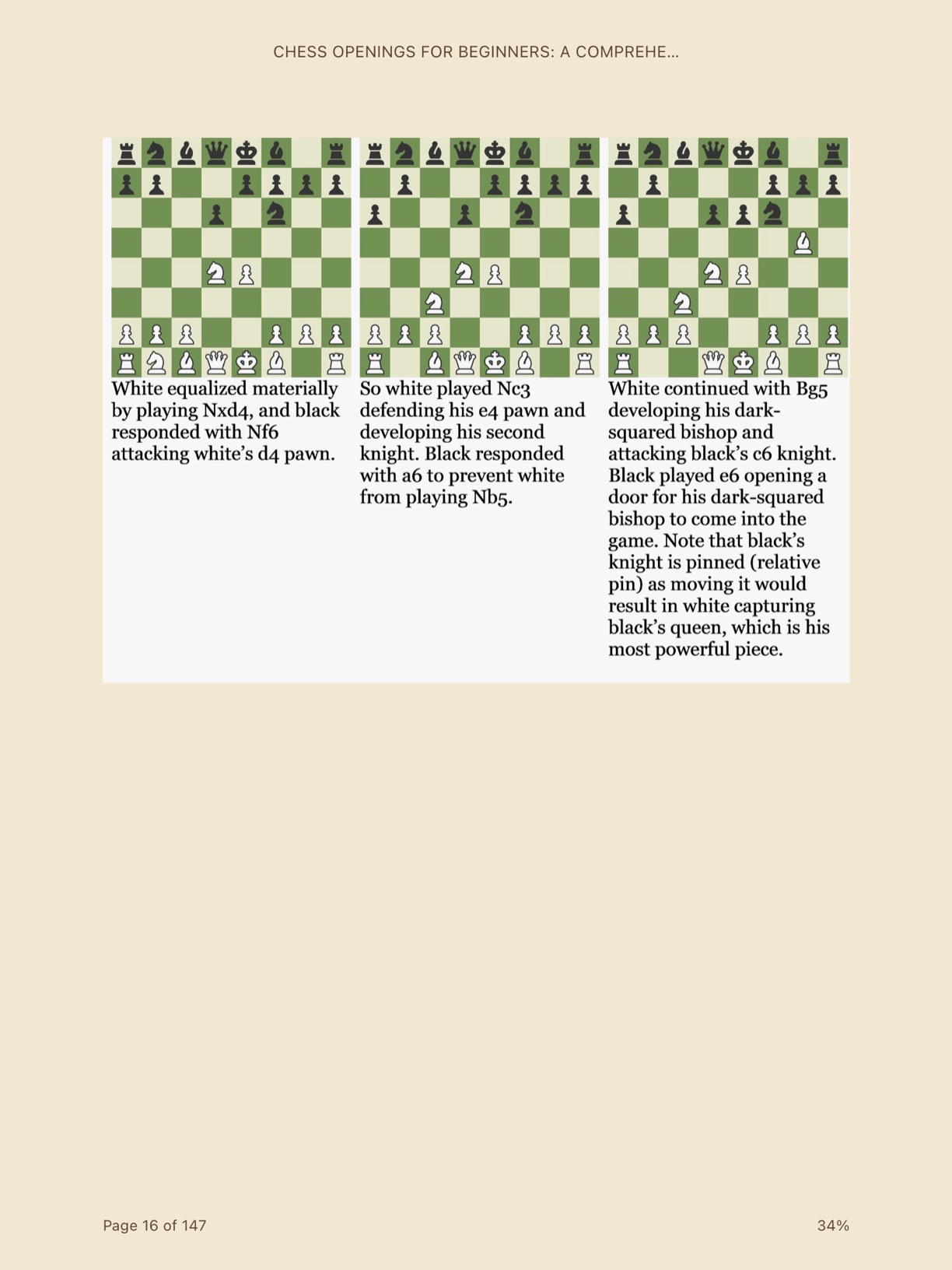
Jessica Era Martin’s Chess Openings for Beginners is the most visually accessible book on this list. The large board diagrams and colorful layout make it immediately approachable for players who have just learned how the pieces move. I handed this to my niece when she started playing, and she was able to follow along without any help.
The book covers roughly 25 openings, showing the first 6 to 7 moves of each with corresponding defensive ideas. It includes common traps like Scholar’s Mate and the Fried Liver Attack, which are exactly the kind of practical knowledge new players need to avoid embarrassing losses.
At 140 pages, it does not pretend to be comprehensive. What it does instead is give you enough to play competent openings without feeling overwhelmed. The problems and solutions sections at the end of each chapter reinforce the material well.
Who Should Buy This Book
This is for players who learned chess recently and want to stop blundering in the first five moves. If you are rated under 800 or teaching someone who is, the visual format and simple explanations are perfect. Parents and coaches will also find it useful as a teaching tool.
How Long Before You Outgrow It
Most players will outgrow this book within 3 to 6 months of regular play. Once you can consistently reach playable middlegame positions, you will want something with more depth. Plan to graduate to FCO or Discovering Chess Openings once the basics feel solid.
6. Chess Openings: Traps And Zaps – Learn Through Opening Traps

Chess Openings: Traps And Zaps: Traps And Zaps (Fireside Chess Library)
256 pages
Fireside Chess Library
Algebraic Notation
Touchstone Publishing
Pros
- Teaches opening principles through punishing blunders
- Explains the why behind opening moves
- Covers basic e4-e5 openings thoroughly
- Useful for beginners through expert players
Cons
- Focuses only on king pawn openings
- Contains some diagram and notation errors
- Limited to double king pawn openings
Bruce Pandolfini’s approach in Traps And Zaps is clever: instead of teaching openings through theory, he teaches them through traps. Each position shows what happens when your opponent makes a critical error, and in the process, you learn why the correct moves matter. I found this format surprisingly effective for internalizing opening principles.
The book focuses exclusively on 1.e4 e5 openings, which means you will not find coverage of the Sicilian, French, or any queen pawn games. That limitation is real, but the depth within the double king pawn territory is solid. If you play 1.e4 e5 as either color, the practical trap knowledge here will win you games.
Pandolfini writes in clear algebraic notation and keeps the explanations concise. Some readers have noted diagram errors and notation mistakes in certain editions, so I recommend having a board set up to verify positions as you go.
Who Should Buy This Book
Casual players and beginners who play king pawn openings will get the most value. If you regularly face opponents who play dubious moves in the opening, this book teaches you how to punish those mistakes immediately.
Advanced players may find the material too basic, but the trap patterns are still useful for club-level competition.
Pairing with Other Resources
I recommend using this alongside a principles-based book like Discovering Chess Openings. The principles book teaches you what to play, and Traps And Zaps teaches you what happens when your opponent plays badly. Together they give you both sides of the opening equation.
7. Chess Openings for Kids – 50 Openings for Young Players

Chess Openings for Kids
128 pages
50 Major Openings
Gambit Publications
Memory Marker Positions
Pros
- Covers 50 major openings with strategic plans
- Excellent reference material
- Good discussion without talking down
- Suitable for children starting serious chess
Cons
- Not truly a kids book despite the title
- Complex language may overwhelm young children
- Hard to track move flow in text format
Despite the title, Chess Openings for Kids by John Watson and Graham Burgess is better described as a solid opening guide for advanced beginners and club players of any age. The coverage of 50 major openings is impressive for a 128-page book, and the strategic plans attached to each opening are genuinely useful.
I tested this with a 12-year-old student who was transitioning from casual play to tournament chess. He handled the material well, but younger or less experienced children would likely struggle. The moves are written within the text rather than on separate diagrams, which makes them harder to follow without setting up a board.
The memory marker positions at the end of each chapter are a standout feature. These key positions help you remember the critical moments in each opening without having to memorize the full variation tree. I wish more opening books used this approach.
Who Should Buy This Book
Advanced beginners aged 10 and up who are ready for serious chess study. The material works equally well for adults at the same level. Do not be fooled by the “for Kids” label into thinking this is simplified content.
Younger children under 10 should start with Chess Openings for Beginners by Jessica Era Martin instead.
Tournament Preparation Value
The 50-opening scope makes this useful as a quick reference during tournament preparation. I use it to review the plans for openings my opponents are likely to play, and the concise format means I can cover several openings in a single study session.
8. Chess Openings for Black, Explained – Complete Black Repertoire

Chess Openings for Black, Explained: A Complete Repertoire
552 pages
Complete Black Repertoire
Accelerated Dragon and Nimzo-Indian
Diagrams Throughout
Pros
- Best format for reading without a board
- Covers accelerated dragon and nimzo-indian defenses
- Unbalanced and fun openings to play
- Great for club players rated 1500+
Cons
- Diagrams show white at the bottom
- Some inconsistencies in analysis
- Black and white printing only
Finding a reliable repertoire for Black is one of the hardest challenges for improving players. Chess Openings for Black, Explained solves this by providing a complete, thematically linked repertoire covering defenses against both 1.e4 and 1.d4. The accelerated dragon against e4 and the Nimzo-Indian against d4 give you aggressive, unbalanced positions that are fun to play.
I spent about six weeks working through this repertoire, and the diagram density is a major plus. You can genuinely study this book without a chess board, which makes it practical for commutes and travel. The memory markers at the end of each chapter help reinforce the key positions.
The main frustration is that all diagrams show the board from White’s perspective. When you are studying Black’s repertoire, seeing the board flipped would be far more intuitive. It is a small thing, but it adds friction to every study session.
Who Should Buy This Book
Club players rated 1500 and above who want a complete, ready-to-play Black repertoire. The openings are aggressive enough for tournament play and the analysis is thorough enough for serious competition.
Players under 1400 may find the variations too dense. Start with a principles-based book first.
Commitment Required
At 552 pages, this is a serious time investment. Plan on 2 to 3 months of regular study to absorb the full repertoire. I recommend focusing on one system at a time rather than trying to learn everything at once. Start with either the accelerated dragon or the Nimzo-Indian and add the second system once the first feels comfortable.
9. Mastering the Chess Openings Volume 2 – Queen Pawn Openings Deep Dive

Mastering the Chess Openings Volume 2
1.d4 Focus
QGD and Slav Coverage
Nimzo-Indian and KID
Gambit Publications
Pros
- Explains concepts behind openings rather than memorization
- Covers all major 1.d4 systems
- Walks through purpose behind each move
- Clear and approachable writing style
Cons
- Not exhaustive on every variation
- Digital format may lack some features
John Watson is one of the best chess authors working today, and Mastering the Chess Openings Volume 2 shows why. This volume covers 1.d4 openings including the Queen’s Gambit Declined, Slav, Semi-Slav, Nimzo-Indian, King’s Indian, Grunfeld, and Modern Benoni. The emphasis throughout is on understanding why moves are played, not just what to play.
I found Watson’s treatment of pawn structures particularly valuable. He explains how each pawn formation dictates the plans for both sides, which means you can figure out what to do even when your opponent deviates from the main line. That kind of conceptual understanding is worth more than memorizing a hundred variations.
This is volume 2 of a 4-volume series, and it stands on its own if you play 1.d4. The digital version includes links to Lichess studies, which I found helpful for practicing the positions interactively.
Who Should Buy This Book
Intermediate to advanced players who play 1.d4 as White or face it regularly as Black. Watson’s conceptual approach works for anyone rated 1300 and above who wants to understand queen pawn openings rather than just memorize them.
Volume Selection Guide
Volume 1 covers 1.e4 openings and general opening principles. Volume 2 covers 1.d4 systems. Volumes 3 and 4 continue with more specialized systems. If you play 1.d4, start here. If you play 1.e4, start with Volume 1. The full set gives you complete coverage of all major opening systems.
10. Chess Opening Essentials: The Complete 1.e4 – Ideas Behind All e4 Openings
Chess Opening Essentials: The Ideas & Plans Behind ALL Chess Openings, The Complete 1. e4
e4 Openings Coverage
New in Chess
Sample Games
Colors and Arrows in Diagrams
Pros
- Comprehensive and well laid out
- Easily accessible for intermediate players
- Breaks variations into small understandable pieces
- Explains philosophy behind each opening
Cons
- No index included
- Confusing notation system in some versions
- Black and white printing issues in some copies
If you play 1.e4 as White, Chess Opening Essentials is designed specifically for you. The book covers every major response to 1.e4, subdivided by variation, with clear introductions to each opening’s philosophy. I appreciated the way it breaks complex variation trees into digestible pieces.
The sample games included with each opening help anchor the theoretical material in practical play. Seeing how a grandmaster handles the positions you are studying makes the opening plans feel concrete rather than abstract. The use of colors and arrows to show possible lines is a nice touch, though some print editions lose this in black and white reproduction.
At its best, this book serves as an accessible bridge between beginner-friendly overviews and advanced theoretical tomes. It gives you enough depth to play the openings competently without requiring hundreds of hours of study.
Who Should Buy This Book
Intermediate players rated 1000 to 1800 who play 1.e4 or want to understand what to expect when facing it. The accessible format makes it a good choice for self-study without a coach.
Notation Considerations
Some reviewers have noted confusing notation in certain editions. I recommend getting the Kindle version if possible, as the digital format handles diagrams and notation more consistently. The screen reader support and X-Ray features are also helpful for navigating the content.
11. My First Chess Opening Repertoire for White – Turn-Key White Repertoire

My First Chess Opening Repertoire for White: A Turn-key Package for Ambitious Beginners
208 pages
1.e4 Systems
Grand Prix Attack
New in Chess
Pros
- Excellent Grand Prix Attack chapter
- Explains why moves are made not just what to play
- Teaches principles over memorization
- Good for beginner to intermediate players
Cons
- Slight coverage of Pirc and Modern defense
- Not for absolute beginners
- Some structuring issues noted
Building your first opening repertoire is daunting. My First Chess Opening Repertoire for White removes the guesswork by giving you a complete, ready-to-play set of lines for White. The book focuses on 1.e4 systems, with particularly strong coverage of the Italian Game and the Grand Prix Attack against the Sicilian.
What I liked most is the emphasis on understanding over memorization. The author explains why each move is played, so when your opponent inevitably deviates from the book line, you have the knowledge to find a good response. The Grand Prix Attack chapter alone is worth the book if you struggle against Sicilian players.
The 208-page length is manageable. I was able to work through the full repertoire in about three weeks of daily study, which is faster than most repertoire books allow.
Who Should Buy This Book
Beginner to intermediate players who want a structured White repertoire without spending months on theory. If you have been playing 1.e4 but feel unsure about which lines to commit to, this book makes the decisions for you.
Absolute beginners should start with Discovering Chess Openings first, then move to this once the principles feel natural.
Repertoire Longevity
The lines recommended in this book are solid and unlikely to be refuted. I have been playing the Grand Prix Attack for over a year now, and it continues to serve me well at the club level. The repertoire is practical rather than theoretically optimal, which is exactly what most players need.
12. A Killer Chess Opening Repertoire – Colle-Zukertort and More

A Killer Chess Opening Repertoire (Sverre’s Chess Openings)
Colle-Zukertort System
150 Attack
Barry Attack
Complete Games Approach
Pros
- Colle-Zukertort has excellent bite
- 150 Attack highly flexible against Pirc
- Presents ideas through complete games
- Good for club players
Cons
- Update lacks strategic explanations in places
- Too many variations without guidance
- Not ideal for those with limited study time
The Colle-Zukertort system is one of the most practical opening choices for club players, and A Killer Chess Opening Repertoire makes a convincing case for it. The system-based approach means you face fewer transpositions and can focus on understanding the resulting middlegame positions deeply.
I tested the Colle-Zukertort lines from this book in about a dozen online games. The system is easy to learn, hard for opponents to disrupt, and leads to positions where you know the plans while your opponent is guessing. The 150 Attack against the Pirc and the Barry Attack against the King’s Indian give you weapons against the most common offbeat defenses.
The book presents ideas through complete games, which I found more useful than dry variation lists. Seeing how the opening transitions into the middlegame and endgame gives context that pure theory books lack.
Who Should Buy This Book
Club players who want a low-maintenance White repertoire. The Colle-Zukertort system requires less memorization than main-line openings, making it ideal for players with limited study time who still want competitive positions.
Study Time Required
The Colle-Zukertort is one of the fastest systems to learn. I was playing it competently after about two weeks of study. The supplementary systems (150 Attack, Barry Attack) add another week or two. Total commitment is roughly one month for a complete White repertoire.
13. The Silicon Road to Chess Improvement – Engine-Based Opening Training

The Silicon Road to Chess Improvement: Chess Engine Training Methods, Opening Strategies & Middlegame Techniques
496 pages
Engine Training Methods
Opening Strategies
Endorsed by GM Nakamura
Pros
- Excellent ideas for using chess engines to improve
- Packed with material and themes
- Helps understand modern engine-style play
- Organizes complex engine games into themes
Cons
- No info on installing or configuring engines
- Tips mainly useful for strong players
- Some copies missing pages
The Silicon Road to Chess Improvement takes a completely different approach to opening training. Instead of teaching specific lines, it teaches you how to use chess engines like Stockfish and Leela to analyze openings and develop your own repertoire. At 496 pages, it is dense with material.
I found the opening strategy sections particularly useful for understanding how modern engine-style play differs from classical principles. The book organizes complex engine evaluations into human-understandable themes, which is no small feat. If you have ever looked at an engine line and wondered why the computer prefers a move that looks weird, this book explains the thinking behind it.
The main limitation is that this book assumes you already know how to use chess engines. There is no guidance on installing Stockfish, configuring analysis settings, or interpreting evaluation scores. Strong players will adapt quickly, but beginners to engine use will need supplementary resources.
Who Should Buy This Book
Advanced players rated 1800+ who want to incorporate engine analysis into their opening preparation. If you already use chess engines but feel like you are not getting the most out of them, this book will upgrade your analysis methodology.
Beginners and intermediate players should build fundamentals with traditional books first.
Engine Pairing Recommendations
I recommend using this book alongside a free analysis tool like Lichess’s built-in engine. Load the positions from the book into the analysis board and follow along. The combination of the book’s thematic explanations and live engine evaluation creates a powerful study environment.
14. A Strategic Chess Opening Repertoire for White – 1.d4 Strategic Systems

A Strategic Chess Opening Repertoire for White
1.d4 and 2.c4 Systems
Grunfeld and Nimzo-Indian Coverage
Strategic Focus
Gambit Publications
Pros
- Solid strategic repertoire for 1.d4 and 2.c4
- Thorough analysis without being overwhelming
- Clear explanations of move orders
- Good for non-GM players
Cons
- Somewhat dry presentation
- Limited strategic guidance in some chapters
- Not for those seeking tactical fireworks
This book is built around a simple idea: most players cannot devote hundreds of hours to memorizing opening theory, so they need a repertoire based on understanding. A Strategic Chess Opening Repertoire for White delivers exactly that, focusing on 1.d4 and 2.c4 systems with an emphasis on strategic comprehension.
I found the coverage of the Queen’s Gambit Declined Exchange variation and the Nimzo-Indian particularly strong. The move order explanations are clear and practical, showing how to reach your preferred positions while avoiding tricky transpositions. This is the kind of book that makes you feel prepared without feeling overwhelmed.
The presentation is on the dry side. If you need engaging prose to stay motivated during study sessions, Watson’s Mastering the Chess Openings covers similar territory with more personality. But for pure strategic content, this book is solid.
Who Should Buy This Book
Players rated 1400 to 2000 who play 1.d4 and want a strategic foundation rather than a theoretical one. If you prefer understanding positions to memorizing lines, this book matches your learning style.
Comparing with Watson’s Volume 2
Both this book and Watson’s Mastering the Chess Openings Volume 2 cover 1.d4 territory. Watson’s book is more engaging and concept-focused, while this one is more structured as a traditional repertoire guide. I recommend Watson if you want to understand the openings deeply, and this book if you want a practical repertoire you can start playing immediately.
15. Chess Openings for Beginners: Comprehensive Guide – Budget-Friendly Digital Guide

Chess Openings for Beginners: A Comprehensive and Simplified Guide to Chess Openings
Kindle eBook
109 MB
Historical Game Examples
Multiple Opening Styles
Pros
- Simple and concise explanations
- Good for beginners wanting common openings
- Includes examples from historical games
- Multiple opening styles covered
Cons
- Errors in move notation in some places
- Some editing issues with typos
- Binding quality concerns on physical copies
Cory Klein’s Chess Openings for Beginners is a budget-friendly Kindle eBook that covers the basics without pretension. At its core, this is a simple overview of common chess openings with annotated diagrams and examples drawn from famous games between top players. I found the historical game examples to be the strongest feature, as they give context to why each opening was played.
The Kindle format makes this instantly accessible and portable. You can pull it up on your phone during a commute or between rounds at a tournament. The X-Ray feature helps you navigate to specific openings quickly.
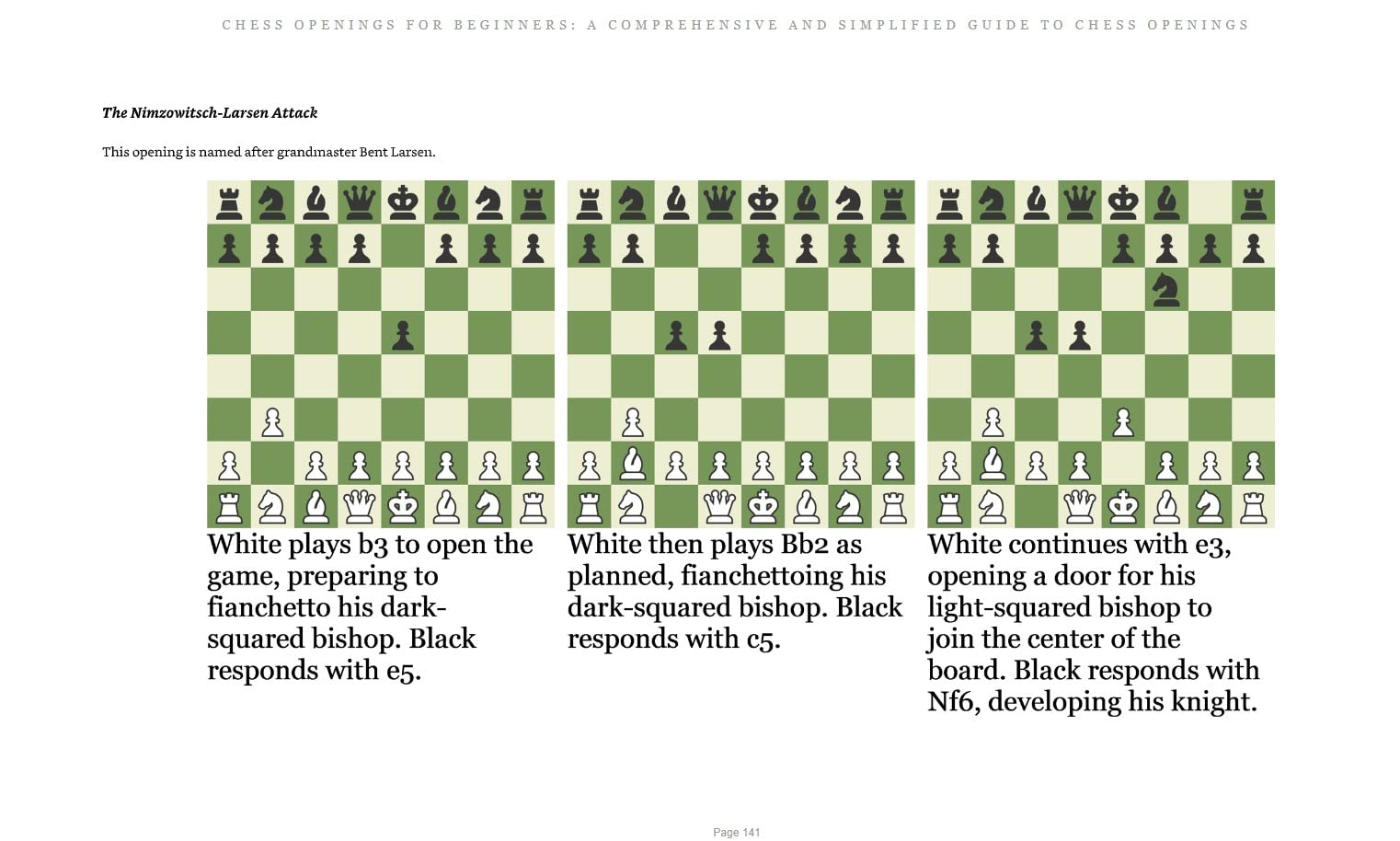
However, the editing issues are real. I found several notation errors that could confuse beginners who do not have the knowledge to spot the mistakes. If you use this book, I recommend verifying the moves on a board as you go.
Who Should Buy This Book
Beginners on a tight budget who want a quick overview of chess openings. The digital format and low entry cost make it accessible. It is also useful as a supplementary resource if you want a different perspective on openings you are already studying.
What to Watch Out For
Double-check the notation against a reliable source. The errors are not frequent enough to make the book useless, but they are frequent enough to potentially mislead a beginner who takes every move at face value. Use this as a starting point rather than your sole opening reference.
How to Choose the Right Chess Opening Trainer
Picking the best chess opening trainer comes down to three things: your current skill level, what side of the board you want to study, and how you prefer to learn. Let me walk you through the key factors that should drive your decision.
Match the Book to Your Rating
Your rating is the single most important factor in choosing an opening trainer. A book that is perfect for a 1500-rated player will overwhelm an 800-rated beginner and bore a 2000-rated tournament player.
Under 1000 rating: Start with Discovering Chess Openings or Chess Openings for Beginners by Jessica Era Martin. These focus on principles and visual learning. If you are also working on overall improvement, pair your opening study with a structured 90-day chess training plan.
1000 to 1600 rating: FCO: Fundamental Chess Openings is your sweet spot. Add Understanding Chess Move by Move for practical game analysis. Consider My First Chess Opening Repertoire for White if you want a ready-to-play repertoire.
1600 and above: Modern Chess Openings for reference, Mastering the Chess Openings Volume 2 for conceptual depth, and Chess Openings for Black, Explained for a Black repertoire. The Silicon Road to Chess Improvement is worth adding once you are comfortable with engine analysis.
Choose Your Format
Physical books work best for reference-heavy material like Modern Chess Openings. You can annotate pages, use sticky notes, and flip between sections quickly. Digital formats shine for repertoire books you want to study on the go, especially those with Lichess study links like Watson’s series.
If you study during commutes or travel, books with heavy diagram density like Chess Openings for Black, Explained are usable without a physical board. Books that describe moves purely in text notation require either a board or strong visualization skills.
White vs Black vs Both
Some books on this list are specifically for White (My First Chess Opening Repertoire for White, A Strategic Chess Opening Repertoire for White) or Black (Chess Openings for Black, Explained). Others cover both sides. If you are building a complete repertoire, you may need separate books for each color. If you just want general opening knowledge, FCO or MCO cover both sides in a single volume.
Study Method Matters
If you learn best through principles and concepts, prioritize Discovering Chess Openings, FCO, and Watson’s Mastering the Chess Openings series. If you learn better through practical examples and game analysis, Understanding Chess Move by Move and A Killer Chess Opening Repertoire present openings through complete games. If you want a structured repertoire with minimal decisions, the turn-key books like My First Chess Opening Repertoire for White do the choosing for you.
FAQ
What is the best chess opening book for beginners?
For absolute beginners, Discovering Chess Openings by John Emms is the best choice because it teaches opening principles rather than specific variations. For beginners who want to learn specific openings with visual diagrams, Chess Openings for Beginners by Jessica Era Martin covers 25 openings with large board diagrams. Both books are rated 4.6 stars and cost under $18.
What is the 20-40-40 rule in chess?
The 20-40-40 rule suggests spending roughly 20% of your study time on openings, 40% on middlegame strategy and tactics, and 40% on endgames. This guideline helps beginners avoid the common trap of over-studying openings at the expense of more impactful areas. At higher ratings, players may adjust this to spend more time on openings for specific tournament preparation.
Is it worth learning chess openings?
Yes, learning chess openings is worth it because a solid opening repertoire saves clock time, reduces early blunders, and helps you reach middlegame positions you understand. However, beginners should focus on opening principles (center control, piece development, king safety) rather than memorizing specific variations. Opening memorization becomes more valuable as you advance past the 1200 rating level.
How do I build a chess opening repertoire?
Start by choosing one opening system for White and one defense for Black against both 1.e4 and 1.d4. Use a book like My First Chess Opening Repertoire for White or Chess Openings for Black, Explained to get a structured repertoire. Practice the lines regularly using a chess board or training app, review your tournament games to identify weak spots, and expand your repertoire gradually rather than trying to learn everything at once.
What is the best chess opening book for tournament players?
For tournament players rated 1500 and above, Modern Chess Openings 15th Edition is the best reference guide for looking up specific variations. Understanding Chess Move by Move by John Nunn (rated 4.8 stars) is the highest-rated book for learning through annotated grandmaster games. For repertoire building, Chess Openings for Black, Explained and Mastering the Chess Openings Volume 2 by John Watson provide deep, structured coverage of specific opening systems.
Final Thoughts on the Best Chess Opening Trainers
After reviewing all 15 of these chess opening trainers, three stand out. Modern Chess Openings, 15th Edition remains the definitive reference for serious players. Understanding Chess Move by Move by John Nunn earned the highest rating on this list at 4.8 stars and teaches openings through practical game analysis. FCO: Fundamental Chess Openings offers the best balance of depth, readability, and value for developing players.
The best chess opening trainers are the ones you actually use consistently. Pick the book that matches your rating and learning style, set up a regular study schedule, and work through the material at your own pace. Your opening play will improve faster than you think.
If you are building a broader improvement plan beyond just openings, combine your opening study with tactics training and endgame work. A well-rounded approach to chess improvement will always outperform hyper-focusing on any single phase of the game.