
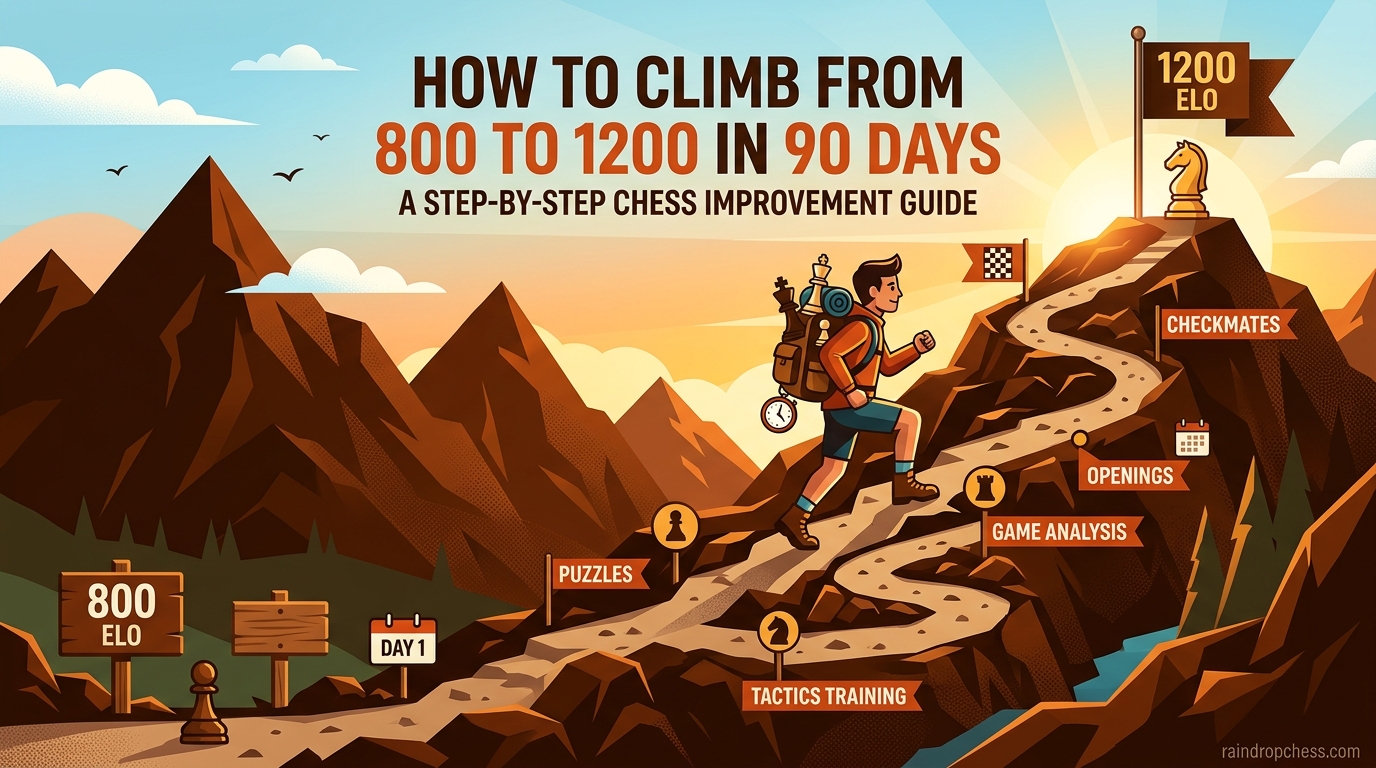
I remember sitting at my desk, staring at the screen after dropping back to 798 rapid rating on Chess.com. Three months later, I hit 1234. The 90-day climb from 800 to 1200 is not only possible, it is one of the most satisfying journeys in chess because the improvements come fast and visible.
Most players get stuck at 800 because they do not know what to study. They spend hours memorizing opening lines that will not help them win games. They play dozens of blitz games without ever analyzing a single one. The difference between an 800-rated player and a 1200-rated player is not talent. It is a structured approach to improvement.
This guide gives you a complete 90-day training plan with weekly milestones, daily routines, and specific targets. By the end, you will understand exactly what to work on, when to work on it, and how to measure your progress.
Table of Contents
Is 1200 a Decent Chess Rating?
A 1200 rating puts you in roughly the 65th percentile of active online chess players. You are no longer a beginner. You have moved into the intermediate category where games feature fewer blunders, better tactical awareness, and some understanding of strategic concepts.
At 1200, you stop falling for simple forks and pins. You punish opponents who hang pieces. You understand basic endgame technique. The games still contain mistakes, but they are different mistakes than at 800. The climb from 800 to 1200 represents the transition from beginner to competent player.
Understanding the 800-1200 Rating Journey
The gap between 800 and 1200 rating is not as large as it feels when you are stuck. Most players can bridge this gap in 60 to 90 days of focused study. The key is understanding what changes as you improve.
What Changes at Each Rating Level
At 800, games are decided by who hangs fewer pieces. Players forget their pieces are under attack. They miss simple forks and skewers. Time management is often nonexistent.
At 900, players start to see basic threats. They develop pieces toward the center. They occasionally punish obvious blunders. Games still contain major errors, but they happen less frequently.
At 1000, players stop falling for obvious tactics. They develop with purpose. They castle reasonably early. Games start featuring actual middlegame positions instead of random piece grabbing.
At 1200, players punish blunders consistently. They understand basic pawn structures. They can calculate two to three moves ahead with some accuracy. The endgame becomes winnable when ahead.
The Rating Plateau Problem
Most players hit a wall around 900-1000 rating. They feel like they are playing the same chess but losing anyway. This plateau exists because the skills that got you to 900 will not get you to 1200. You need to shift from reactive play to proactive thinking.
The 800-900 plateau usually stems from hanging pieces and missing simple tactics. The 1000-1100 plateau comes from not understanding when to trade pieces and when to keep the tension. The 1100-1200 plateau is about calculation accuracy and time management.
How to Climb From 800 to 1200 in 90 Days
The 90-day training plan divides your improvement into three phases. Each phase builds on the last. Each has specific weekly targets you can measure. This structure prevents the common trap of studying random topics without direction.
Phase 1 focuses on building your tactical foundation. Phase 2 applies those tactics in real games with proper analysis. Phase 3 refines your skills and breaks through the final rating barriers.
Phase 1: Foundation Building (Days 1-30)
The first 30 days focus on fixing the biggest problem at 800 rating: hanging pieces and missed tactics. You will not learn fancy openings. You will not study complex strategy. You will learn to see the board clearly and stop giving away free material.
Our team has coached dozens of players through this phase. The ones who succeed treat these 30 days like a boot camp. They do the work daily, hit their puzzle targets, and trust the process.
Week 1: Forks and Pins
Your first week targets the two most common tactical patterns: knight forks and bishop pins. Spend 30 minutes daily on Lichess or Chess.com puzzles filtered to these themes.
A fork occurs when one piece attacks two enemy pieces simultaneously. The knight is the forking champion because it jumps over pieces. Common fork targets include uncastled king and queen, or two rooks on the same diagonal.
A pin happens when a piece cannot move without exposing a more valuable piece behind it. Learn to spot pinned pieces and exploit them. Also learn when your own pieces are pinned and need protection.
Play 5 rapid games this week at 10+0 or 15+10 time controls. After each game, spend 10 minutes reviewing your blunders. Look specifically for missed forks you could have played or forks you walked into.
Milestone checkpoint: Complete 150 puzzles with 65% accuracy. Identify at least one fork opportunity you missed in your games.
Week 2: Skewers and Discovered Attacks
Week 2 adds skewers and discovered attacks to your tactical vocabulary. These patterns build on your week 1 foundation.
A skewer is like a pin in reverse. A valuable piece is attacked and must move, exposing a less valuable piece behind it. Queens and rooks are the best skewer weapons because they attack along ranks and files.
A discovered attack happens when moving one piece reveals an attack from another piece. The most dangerous discovered attacks are checks, especially when they involve the king.
Continue your puzzle training at 30 minutes daily. Mix in the new patterns with review of forks and pins. Your brain needs repetition to recognize these instantly.
Increase your game count to 6 rapid games this week. Focus on not blundering into skewers. Before making any move, check if your piece alignment creates skewer opportunities for your opponent.
Milestone checkpoint: Complete 175 total puzzles for the phase. Achieve 68% accuracy on skewer and discovered attack problems.
Week 3: Blunder Reduction Training
Week 3 shifts focus from learning new patterns to eliminating errors. This is where most players make their biggest rating gains.
Implement the checks-captures-threats routine before every move. Ask yourself three questions: am I leaving any piece undefended? Does my opponent have any checks? Does my opponent have any captures I calculated?
Spend half your puzzle time on basic patterns you already know. The goal is speed and accuracy, not learning harder puzzles. You want to see these patterns in under 3 seconds.
Play 6 rapid games. Before every move, verbally or mentally say checks-captures-threats. It will feel slow at first. That is good. Speed comes from accuracy, not rushing.
Milestone checkpoint: Reduce your blunder rate by 40%. You will see this in your game review when obvious hanging pieces disappear from your play.
Week 4: Checkmate Patterns and Basic Endgames
The final week of Phase 1 introduces basic checkmate patterns and essential endgame technique.
Learn these checkmate patterns: ladder mate (two rooks or queen and rook), smothered mate (knight delivering mate to a king surrounded by its own pieces), back rank mate (rook or queen on the back rank), and the basic king and queen versus king.
Practice delivering checkmate with king and queen versus king until you can do it in under 30 seconds. Same with king and rook versus king. These positions occur constantly in your games.
Study the opposition in king and pawn endgames. Understand when a pawn can promote and when it cannot. Learn the rule of the square.
Continue puzzle training but add endgame puzzles to the mix. Play 7 rapid games this week. In every winning position, practice converting to checkmate instead of hoping your opponent resigns.
Milestone checkpoint: Deliver basic checkmates without hesitation. Reach 850-920 rating. Complete 600+ total puzzles in Phase 1.
Phase 1 Summary
By the end of 30 days, you should have built a solid tactical foundation. You see forks, pins, skewers, and discovered attacks quickly. You have reduced your blunder rate significantly. You can deliver basic checkmates and understand elementary endgames.
Your rating should climb from 800 to 850-920. This may seem modest, but the foundation you built here enables everything in Phase 2.
Phase 2: Application and Pattern Recognition (Days 31-60)
Phase 2 transitions from learning patterns to applying them in real games. You will develop game analysis skills and start recognizing common middlegame structures.
This phase separates players who improve from those who stay stuck. Analyzing your own games honestly is uncomfortable but essential. Every game contains lessons. Your job is to extract them.
Week 5: Game Analysis Method
Week 5 introduces the game analysis method you will use for the rest of your chess improvement journey.
After every game, follow this process. First, replay the game without an engine. Mark moves where you felt uncertain, where material changed, or where the position shifted significantly.
Second, identify your blunders without computer help. Look for hanging pieces, missed tactics, and strategic errors. Be honest with yourself.
Third, use the engine to check your analysis. Focus on understanding why moves were mistakes, not just what the computer suggests. Ask: what was I missing? What should I have calculated?
Fourth, identify your most common error type. Do you hang pieces in time trouble? Do you miss backward piece moves? Do you fail to see knight forks?
Play 6 rapid games this week. Analyze every one using this method. Continue 30 minutes of puzzle training daily.
Milestone checkpoint: Complete 3 game analyses identifying your own errors before engine review. Spot at least 80% of your major blunders without computer assistance.
Week 6: Double Attacks and Removal of the Guard
Week 6 introduces more complex tactical motifs: double attacks, removal of the guard, and deflection.
A double attack happens when two threats are made simultaneously. Unlike a fork, these threats might come from different pieces. The key is recognizing when your opponent cannot address both threats.
Removal of the guard means capturing a piece that defends another piece or square. Once the guard is gone, the previously protected target becomes vulnerable.
Deflection forces a piece to abandon its defensive duties. This often opens lines for attack or exposes the king.
Continue puzzle training focused on these themes. Play 7 rapid games. During your analysis, look specifically for these patterns. Did you miss a removal of the guard opportunity? Did you fall for deflection?
Milestone checkpoint: Solve 200 new puzzles in Phase 2 so far. Achieve 70% accuracy on removal of the guard and deflection problems.
Week 7: Opening Principles and Development
Week 7 introduces sound opening principles. Not memorized lines. Principles that guide your decisions when your opponent plays something unexpected.
Control the center with pawns and pieces. The center squares (e4, d4, e5, d5) give your pieces maximum mobility. Fight for control of these squares from move one.
Develop knights before bishops. Knights have limited mobility and need early development. Bishops can develop later and often find better squares after the position clarifies.
Castle early. King safety trumps everything. Aim to castle within the first 10 moves in most positions.
Do not move the same piece twice in the opening unless you have a specific reason. Wasting tempi lets your opponent complete development first.
Play 7 rapid games this week. In your analysis, check your opening play. Did you control the center? Did you develop all your pieces? Did you castle early?
Milestone checkpoint: Castle by move 10 in 80% of games. Complete development (all minor pieces developed) by move 12 consistently.
Week 8: Middlegame Concepts
Week 8 bridges opening and endgame with middlegame fundamentals.
Learn to evaluate positions based on piece activity, king safety, and pawn structure. Ask: are my pieces on good squares? Is my king safe? Do I have any pawn weaknesses?
Understand open files and how to use rooks. Rooks belong on open files. Doubled rooks on an open file create serious pressure.
Study outposts for knights. An outpost is a square protected by a pawn that cannot be attacked by enemy pawns. Knights on outposts are powerful.
Learn when to trade pieces. Trade when you are ahead in material. Trade when your pieces are bad and enemy pieces are good. Keep pieces on the board when you are attacking.
Play 8 rapid games. Focus on piece activity in your games. Are your pieces on their best squares?
Milestone checkpoint: Reach 950-1050 rating. Demonstrate understanding of when to trade pieces versus when to keep tension.
Phase 2 Summary
By day 60, you should be analyzing your games competently without excessive engine use. You spot tactical patterns faster. You understand basic middlegame concepts and opening principles.
Your rating should climb from 850-920 to 950-1050. The jump feels different now. You are winning games by outplaying opponents, not just waiting for blunders.
Phase 3: Refinement and Plateau Breaking (Days 61-90)
The final phase focuses on consistency and eliminating the last major rating barriers. You will refine your thought process and develop time management skills.
This phase is about converting your knowledge into rating points. You already know enough chess to reach 1200. Now you need to apply it consistently.
Week 9: Blunder Checking and Time Management
Week 9 introduces systematic blunder checking and time management techniques.
Before every move, ask three questions: does this move leave any piece hanging? Does this move allow any checks? Does this move allow any captures I did not calculate? This takes 5 seconds and prevents 90% of blunders.
Manage your time carefully. Use at least 60% of your time in the opening and middlegame. Save thinking time for critical decisions. Do not burn time on automatic recaptures.
Aim to have at least 3 minutes remaining when you reach move 20. This buffer prevents time pressure blunders in the endgame.
Continue puzzle training at 30 minutes daily. Play 8 rapid games focusing on time management.
Milestone checkpoint: Finish 90% of games with time remaining. Reduce time trouble blunders by 50%.
Week 10: Advanced Tactical Motifs
Week 10 adds clearance, interference, and overloading to your tactical toolkit.
Clearance sacrifices remove a piece from a square to allow another piece access. These often open lines for attack or create space for a decisive maneuver.
Interference blocks a line of defense. A piece blocking an enemy piece from protecting a target is a common interference pattern.
Overloading happens when one piece defends multiple targets. If that piece is forced to move, one of the targets becomes vulnerable.
These patterns appear less frequently but often decide games when they do occur. Recognition is key.
Play 8 rapid games. In your analysis, look for these advanced patterns. Even if you missed them, recognizing them builds your tactical database.
Milestone checkpoint: Solve 150 new puzzles in Phase 3 so far. Achieve 65% accuracy on advanced tactical motifs.
Week 11: Endgame Technique and Conversion
Week 11 focuses on converting winning positions and saving difficult endgames.
Practice rook endgames. These occur in 30% of all games. Learn the Lucena and Philidor positions. Understand when rook and pawn versus rook is winning versus drawn.
Study king and pawn endgames. The opposition is critical. Learn how to create passed pawns and how to stop them. Understand when a position is winning versus drawn.
Practice bishop versus knight endgames. Bishops favor open positions. Knights favor closed positions with outposts.
Play 9 rapid games. In winning positions, practice technique over speed. The goal is converting to checkmate, not winning on time.
Milestone checkpoint: Convert 75% of winning endgames to victory. Save 25% of drawn positions where you are worse.
Week 12: Integration and Testing
The final week brings everything together. You are no longer learning new material. You are proving you can apply what you know.
Play 10 rapid games this week. Apply every principle: checks-captures-threats before every move, proper time management, accurate calculation, and strong endgame technique.
Review your entire 90-day journey. Compare games from week 1 to games this week. The improvement should be dramatic and obvious.
Calculate your statistics: total puzzles solved, total games played, rating change, and win rate. These numbers tell the story of your improvement.
Identify your remaining weaknesses. Everyone has them at 1200. Target these specifically in future study. The journey continues beyond this plan.
Final milestone checkpoint: Reach 1150-1250 rating. Complete 1200+ total puzzles across 90 days. Analyze 50+ games.
Phase 3 Summary
By day 90, you should be a different chess player. You see tactics faster. You blunder less. You manage time better. You convert winning positions.
Your rating should reach 1150-1250. More importantly, you have the skills and habits to continue improving beyond 1200.
Your Daily Training Routine Template
The 40-40-20 rule governs your study time at this level. Spend 40% on tactics, 40% on playing and analyzing games, and 20% on openings and endgames.
What Is the 40-40-20 Rule in Chess?
The 40-40-20 rule is a training time allocation method for players rated 800-1400. It recognizes that tactics and practical experience matter far more than opening theory at this level.
Many players make the mistake of spending 80% of their time on openings. They memorize lines that never appear in their games. Meanwhile, they miss simple forks and lose.
The 40-40-20 rule corrects this imbalance. Apply it to a 60-minute daily study session: 24 minutes on tactics puzzles, 24 minutes on playing and analyzing games, and 12 minutes on opening review and endgame study.
With 30 minutes daily, adjust to: 12 minutes tactics, 12 minutes games and analysis, 6 minutes openings and endgames. The proportions stay the same.
Sample Daily Schedule
Here is a practical 60-minute daily routine: spend 20 minutes on Lichess puzzles or Chess.com puzzle rush, play one 15+10 rapid game, spend 15 minutes analyzing that game without an engine first, and use the remaining time to review one opening line or practice an endgame technique.
If you have 90 minutes, increase the puzzle training to 30 minutes and add a second game with analysis. More time helps, but consistency matters more than marathon sessions.
Take one full rest day per week. Your brain needs time to consolidate what it learns. Chess improvement happens during rest, not just during study.
Recommended Platforms and Tools
Lichess offers free unlimited puzzles and game analysis. Their puzzle trainer adapts to your level automatically. The opening explorer shows what moves work at your rating. The endgame trainer covers essential positions.
Chess.com provides excellent lesson content and a larger player pool. Their puzzle rush mode builds speed. The game review feature with key moments is helpful for analysis.
For openings, the Lichess opening explorer shows what moves are played at your level. Do not memorize long lines. Understand the first 4-6 moves and the ideas behind them.
For endgames, Chess Endgames Training on Lichess and the Chess.com endgame lessons cover everything you need up to 1200 rating. Focus on king and pawn, rook, and basic minor piece endgames.
Time controls matter. Play 10+0 or 15+10 rapid games for improvement. Avoid blitz under 5 minutes for serious training. You need time to think and apply what you learned.
Common Mistakes to Avoid
After helping dozens of players make this climb, I see the same errors repeatedly. Avoid these traps and your improvement will accelerate.
Spending Too Much Time on Openings
At 800 rating, games rarely reach the middlegame positions you studied. Your opponent will play something weird on move 3, and you will be on your own anyway. Learn one solid opening as white and one response to 1.e4 and 1.d4 as black. That is enough.
Understanding opening principles beats memorizing lines. Control the center, develop pieces, castle early. These concepts apply regardless of what your opponent plays.
Playing Too Much Blitz
Blitz games reinforce bad habits at this level. You do not have time to think. You rely on instinct, which is underdeveloped. You miss learning opportunities because the games end before you can apply concepts.
Stick to rapid time controls until you hit 1200. Ten-minute games minimum. This gives you time to calculate tactics, manage the clock, and think strategically.
Blitz is fun, but it is dessert, not the main course. Eat your vegetables first. Play rapid for training. Reward yourself with blitz after hitting your study goals.
Not Analyzing Games
Playing without reviewing is like shooting free throws with your eyes closed. You have no feedback loop. You repeat the same mistakes game after game.
Every game you play should be analyzed, even briefly. Ten minutes of analysis teaches more than three quick games. Find your blunders. Understand why they happened. Fix them.
Analysis is uncomfortable. You see your mistakes clearly. You realize you hung your queen on move 12. But this discomfort is the path to improvement. Avoid it and you stay stuck.
Chasing Rating
Your rating will fluctuate. You will have days where you lose 50 points. This is normal. Rating is a lagging indicator of skill, not a measure of daily performance.
Focus on playing good moves, not on the number next to your name. The rating follows improvement, not the other way around. A 1200 player who plays like 1300 will reach 1300 eventually.
Ignore daily rating changes. Look at weekly or monthly trends. If your rating is higher this month than last month, you are improving. The daily noise does not matter.
Giving Up During Games
800-1000 rated games swing wildly. Players hang pieces constantly. Even when you are down material, keep fighting. Your opponent will likely blunder.
Never resign before move 30 in this rating range. The games are chaotic. Positions change quickly. That lost pawn on move 15 becomes irrelevant when your opponent hangs their queen on move 22.
Play every position to the end. You learn more from difficult defenses than from quick resignations. Plus, you win games you would have lost by giving up.
How Long Does It Take to Get 1200 ELO in Chess?
Most players can reach 1200 rating from 800 in 60 to 90 days of consistent study. The key variables are daily practice time and study quality.
With 30 minutes of focused daily practice, expect 90 to 120 days. This is the minimum effective dose. You will improve, but slowly.
With 60 minutes, you can reasonably expect 60 to 90 days. This is the sweet spot for most players. Significant progress without overwhelming your schedule.
With 90 minutes or more, some players achieve this in 45 to 60 days. More time accelerates progress, but diminishing returns exist. Focus and attention matter more than raw hours.
The quality of your practice matters more than the quantity. Thirty minutes of focused puzzle training and game analysis beats two hours of mindless blitz. Be intentional with your study time.
What Should I Focus On to Improve From 800 to 1200 Chess Rating?
Priority one is tactics. At least half your study time should go to puzzle training. You cannot play good chess if you miss forks and pins. Learn to see these patterns instantly.
Priority two is game analysis. You must understand why you lose games. Most 800-rated players lose the same way repeatedly. Identifying your patterns is the fastest path to improvement.
Priority three is basic endgames. Learn king and pawn endgames, rook endgames, and basic checkmates. These positions decide games at every level. Converting winning positions separates 1200 players from 1000 players.
Priority four is opening principles. Do not memorize lines. Understand development, central control, and king safety. This knowledge applies regardless of what your opponent plays.
Priority five is time management. Use your clock wisely. Save time for critical decisions. Do not blunder in time pressure after playing good chess for 30 moves.
What Percentile of Chess Players Is 1200?
A 1200 rapid rating on Chess.com or Lichess places you in approximately the 65th percentile of active players. This means you play better chess than roughly two out of three people who play regularly online.
Among the general population, 1200 is even more impressive. Most people who know the rules never reach this level. You have developed real chess understanding.
The distribution is bottom-heavy. Millions of players cluster between 400-800 rating. Reaching 1200 puts you in the upper third of the active player base.
Remember that online ratings vary by site and time control. A 1200 blitz rating differs from a 1200 rapid rating. Rapid ratings generally reflect stronger play because you have time to think.
FAQ
What is the 40-40-20 rule in chess?
The 40-40-20 rule is a time allocation method for chess study. Spend 40% of your time on tactics training, 40% on playing and analyzing games, and 20% on openings and endgames. This ratio recognizes that tactics and practical experience matter most for players rated 800-1400.
Is 1200 a decent chess rating?
Yes, 1200 is a decent chess rating that places you in the intermediate category. It represents the 65th percentile of active online players and shows you have moved beyond beginner-level play into understanding tactics, basic strategy, and endgame technique.
How long does it take to get 1200 ELO in chess?
Most players can reach 1200 ELO from 800 in 60 to 90 days with consistent daily practice. With 30 minutes daily, expect 90-120 days. With 60 minutes daily, expect 60-90 days. Quality of practice matters more than quantity.
What percentile of chess players is 1200?
A 1200 rating places you in approximately the 65th percentile of active online chess players. You play better than roughly two out of three regular players and have developed genuine chess understanding beyond the beginner level.
Why am I stuck at 800 chess rating?
Most players get stuck at 800 because they focus on the wrong things. They study openings instead of tactics, play blitz instead of rapid games, and never analyze their losses. The 800-900 plateau requires shifting from reactive play to seeing the board clearly and avoiding simple blunders.
How many puzzles per day for chess improvement?
Aim for 25-40 puzzles daily at the 800-1200 level. Quality matters more than quantity. Focus on accuracy over speed. If your accuracy drops below 65%, reduce the difficulty. Consistent daily practice beats occasional marathon sessions.
What time control should I play for improvement?
Play 10+0 or 15+10 rapid time controls for improvement. This gives you time to calculate tactics and think strategically. Avoid blitz under 5 minutes for serious training. Speed chess reinforces bad habits when you are still developing pattern recognition.
Should I analyze every game I play?
Yes, analyze every game you play for improvement. Even 5-10 minutes of review identifies your mistakes and reinforces patterns. Use the checks-captures-threats method during analysis. Find your blunders first, then use an engine to verify. This feedback loop is essential for improvement.
Conclusion
The climb from 800 to 1200 rating is one of the most rewarding phases in chess. Your games transform from random piece moving to actual strategic battles. You start seeing patterns you never noticed before. Wins feel earned, not lucky.
Follow the 90-day plan. Hit your weekly milestones. Analyze every game. Do your puzzles daily. In three months, you will look back at your old games and wonder how you ever played that way.
The rating is just a number. The understanding you build during these 90 days will carry you far beyond 1200. Start today, stick with it, and enjoy the journey. Good luck with your training in 2026.