
There is something about a well-made chess book sitting on a coffee table that draws people in. Maybe it is the glossy cover, the bold diagrams, or just the quiet confidence of a game that has survived centuries. I have spent months flipping through dozens of chess books looking for ones that look just as good on display as they feel in your hands. The best chess coffee table books do double duty: they catch the eye of anyone walking into the room and they teach you something real when you open them up.
Our team put together this guide after comparing 15 titles side by side. We looked at the obvious things like photo quality, page thickness, and binding. But we also dug into whether each book actually helps you play better chess. Too many coffee table books are just pretty pictures with no substance. We made sure every pick on this list earns its spot on both counts.
Whether you are shopping for a gift, building a chess collection, or just want something striking to stack on your living room table, this roundup has you covered. From Levy Rozman’s modern beginner guide to rare collector editions of Fischer’s annotated games, here are the 15 best chess coffee table books worth owning in 2026.
Table of Contents
Top 3 Picks for Best Chess Coffee Table Books

How to Win at Chess
- Beginner-friendly
- Friendly writing style
- 272 pages
- Video links included

Best Chess Coffee Table Books in 2026
1. How to Win at Chess by Levy Rozman – Best Overall Pick
How to Win at Chess: The Ultimate Guide for Beginners and Beyond
272 pages
7.27 x 8.27 inches
By Levy Rozman
Ten Speed Press
Pros
- Friendly accessible writing style
- Covers basics through advanced
- Includes video links
- Great for all skill levels
Cons
- Dark squares hard to see in print
- Digital version has better color
I picked up this book after watching Levy Rozman’s YouTube channel for months, and the experience of reading it felt exactly like having him explain chess over your shoulder. The writing is warm, conversational, and never condescending. He walks you through openings, middle game strategy, and endgame principles in a way that actually sticks.
What surprised me was how well it works as a display piece. The cover design is clean and modern, and the 8-by-7-inch format sits nicely on a table without looking like a textbook. Guests always pick it up when they see it. The spiral binding is a nice touch too because the pages lay flat while you follow along with a board.
The diagrams inside are clear and well-spaced, though I will say the darker board squares can make it tricky to distinguish pieces in the print version. If you read on a tablet or Kindle, the color version solves that problem completely. Still, the print quality is solid, and the weight of the book gives it a premium feel that justifies keeping it out on display.
With nearly 3,500 reviews and a 4.8-star rating, this is the book I hand to anyone who asks where to start with chess. It teaches real strategy without making you feel like you are studying for an exam. The linked videos are a bonus that no other book on this list offers.
Who should buy this book
If you are a beginner or returning player who wants one book that covers everything from how the pieces move to endgame technique, this is your best bet. It also makes a fantastic gift for anyone who has shown interest in chess but does not know where to begin.
Intermediate players will find value in the middle game and endgame sections too, though very advanced players might want something more specialized. For 90 percent of chess fans, though, this book hits the sweet spot between learning tool and attractive coffee table piece.
Who might want to skip it
Advanced tournament players looking for deep opening theory or dense annotated games will not find what they need here. This book prioritizes clarity over depth, which is exactly why beginners love it but seasoned competitors might find it too light.
If you specifically want a large-format photography book with minimal text, this is more of a teaching guide with nice design than a pure art book. Consider The Art of Chess or Master Pieces instead for that purpose.
2. Chess: 5334 Problems, Combinations and Games by Laszlo Polgar – Best Puzzle Collection
Chess: 5334 Problems, Combinations and Games
1104 pages
6.05 x 9.05 inches
By Laszlo Polgar
Black Dog and Leventhal
Pros
- Massive 5300+ problem collection
- All skill levels covered
- Legendary chess teacher author
- Excellent tactical training
Cons
- Some puzzles show only first move
- Print is small in places
- Games not annotated
This is the kind of book that makes a statement on a coffee table. At over 1,100 pages and nearly three pounds, it is a thick, serious-looking volume that tells anyone who sees it that you mean business about chess. Laszlo Polgar trained his three daughters to become chess masters using these exact methods, and the pedigree shows on every page.
I have been working through this book for about six months now, doing maybe 10 to 15 puzzles a day. The progression from mate-in-one to mate-in-three to full combinations is addictive. You start seeing patterns on the board that you never noticed before. It is the single best way I have found to build tactical vision without staring at a screen.
The layout is straightforward: diagram on one side, solution on the other. There are no long explanations, which some people might miss, but I actually prefer it. You learn by doing, not by reading about doing. The binding holds up well despite the thickness, and the pages are thick enough that your pen does not bleed through if you like to circle positions.
My one real complaint is that some of the endgame studies only show the first move of the solution, leaving you to figure out the rest. For a book this comprehensive, I wish every answer was complete. The print could also be bigger in some sections, especially the mini-game diagrams scattered throughout.
Who should buy this book
Anyone who wants to get better at chess through practice rather than theory will love this book. It is perfect for players rated 800 to 1800 who want to sharpen their tactical awareness. Parents teaching kids will find the mate-in-one section especially useful because the problems start simple and build gradually.
It is also one of the best value chess books you can buy. Over 5,000 problems for this price is hard to beat. As a coffee table piece, it looks impressive and invites conversation.
Who might want to skip it
If you need detailed explanations for every puzzle, this book will frustrate you. The solutions are minimal by design. Also, complete beginners who have not yet learned basic checkmate patterns should start with something like How to Win at Chess before tackling this mountain of puzzles.
The sheer size can be overwhelming. If you want a lighter, more casual book to flip through, the 1,100-page heft might feel more like homework than a coffee table book.
3. Chess Fundamentals by Jose Capablanca – Best Budget Pick

Chess Fundamentals
138 pages
6 x 9 inches
By Jose Capablanca
SDE Publishing
Pros
- Written by world champion
- Simple clear language
- Covers all game stages
- Compact and portable
Cons
- Not for complete beginners
- Too basic for advanced players
- Some print quality issues
There is something special about learning chess from one of the greatest players who ever lived. Jose Capablanca wrote this book to teach the principles he used to become world champion, and the advice holds up almost a century later. I read it over a weekend and immediately started applying his endgame principles to my online games with noticeably better results.
The book is thin and lightweight, which makes it easy to carry around or stack on a side table. It is not the flashiest coffee table book visually, but it has a quiet elegance that chess purists appreciate. The annotated edition from SDE Publishing uses algebraic notation, which is a welcome update from older versions.
Capablanca’s writing style is direct and free of fluff. He explains why certain moves are good rather than just showing you what to play. You learn the reasoning behind pawn structures, piece coordination, and endgame technique in a way that builds real understanding.
At just 138 pages, you can finish it quickly and return to specific sections for reference. I keep my copy next to my bed and revisit the endgame chapter regularly. For the price, it is hard to find a chess book with this much wisdom packed into so few pages.
Who should buy this book
Players who already know how the pieces move but want to understand chess strategy at a deeper level will get the most from this book. It bridges the gap between knowing the rules and actually knowing how to play. If you are rated between 600 and 1400, this is a fantastic companion.
Budget-conscious buyers will appreciate that this classic text is very affordable. It also makes a thoughtful, low-cost gift for any chess enthusiast who appreciates the history of the game.
Who might want to skip it
Complete beginners who are still learning piece movement should start with a more visual, beginner-oriented book first. Capablanca assumes you know the basics and jumps into strategy fairly quickly. Advanced players rated above 1800 will likely find the content too elementary.
Some readers have reported quality issues with pages being misprinted or upside down in certain copies. Check your copy when it arrives and exchange it if needed.
4. Modern Chess Openings 15th Edition by Nick de Firmian – Best Opening Reference

Modern Chess Openings, 15th Edition
768 pages
6.15 x 9.2 inches
15th Edition
Random House Puzzles
Pros
- Most comprehensive opening reference
- 20+ variations per opening
- Uses algebraic notation
- Great value for content
Cons
- Theory from 2008 somewhat dated
- Paperback binding wears thin
- Missing modern lines
Every serious chess player I know has a copy of MCO on their shelf. It is the reference book you reach for when you want to look up a specific line or prepare for an opponent. I have used this book to prepare for club tournament games, and the depth of opening variations is unmatched in a single volume.
At 768 pages, this is a thick paperback that looks authoritative on any table. The cover design is clean and professional, though the paperback binding does show wear after heavy use. I recommend handling it carefully if you want it to stay looking sharp as a display piece.
The organization is excellent. Each major opening gets its own chapter with main lines, variations, and brief evaluations. You will not find lengthy prose explaining the ideas behind each opening, but as a quick reference during study sessions, it works perfectly. The algebraic notation makes it accessible to modern players.
The main drawback is that the theory is from 2008, which means some recent developments like the London System surge are not covered. For most club players this is not a dealbreaker, but if you are preparing for competitive play at a high level, you will need to supplement with online databases.
Who should buy this book
Club players and tournament competitors who want a single volume to reference during opening preparation will find this indispensable. It is also useful for intermediate players who want to explore different openings without buying a separate book for each one.
If you are building a chess library, MCO is one of those foundation books that every collection needs. It serves as a reference you return to for years.
Who might want to skip it
Beginners who are still learning opening principles should not start here. Without a foundation in basic opening strategy, the dense variations will be confusing and overwhelming. Start with a beginner guide first, then graduate to MCO when you are ready.
If you want a visually stunning coffee table book with photographs and illustrations, this is purely a reference text. It has diagrams but no color photography or art.
5. The Most Instructive Games of Chess Ever Played by Irving Chernev – Best Game Collection
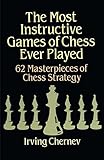
The Most Instructive Games of Chess Ever Played: 62 Masterpieces of Chess Strategy
279 pages
5.59 x 8.46 inches
62 Masterpieces
Dover Publications
Pros
- 62 carefully selected games
- Entertaining commentary
- Great for learning strategy
- Witty engaging prose
Cons
- Uses old descriptive notation
- Reprint quality could be better
- Diagrams hard to read
Irving Chernev had a gift for making chess games feel like stories. Each of the 62 games in this collection is annotated with warmth and humor that makes you want to keep turning pages. I read this book cover to cover in about three weeks, playing through each game on a physical board, and my positional understanding improved noticeably.
The games span from the Pillsbury era through Fischer, giving you a tour of chess history through its most instructive moments. Chernev does not just tell you what happened; he explains why each move matters and what the player was thinking. It is like having a patient teacher sitting next to you.
Physically, this is a modest paperback from Dover Publications. It will not win any beauty contests on your coffee table, but the content is so good that chess enthusiasts will forgive the plain presentation. The 5.5-by-8.5-inch size is comfortable to hold and read.
The biggest drawback is the use of descriptive notation instead of modern algebraic notation. If you grew up with algebraic, you will need to adjust. Some readers report that the reprint quality is uneven, with diagrams that can be hard to read in certain printings.
Who should buy this book
Players rated 800 to 1600 who want to learn positional chess through annotated games will benefit most from this collection. The games are selected specifically for their teaching value, not just their fame. If you learn better from studying complete games than from solving puzzles, this book is made for you.
Chess history buffs will enjoy the span of eras covered, from Romantic-era attacking games to modern positional masterpieces.
Who might want to skip it
If you cannot stand descriptive notation, look for a modern algebraic edition or choose a different annotated game collection. The notation barrier is real and can slow down your study sessions if you are not used to converting between systems.
Advanced players who have already studied the classic games might find the annotations too light. Chernev writes for the learning player, not the master.
6. How To Beat Anyone At Chess by Ethan Moore – Best for Casual Players

How To Beat Anyone At Chess: The Best Chess Tips, Moves, and Tactics to Checkmate
256 pages
5.5 x 7.5 inches
By Ethan Moore
Adams Media
Pros
- Easy to understand diagrams
- Great for semi-beginners
- Good for casual players
- Informative about game nuances
Cons
- Some illustrations hard to follow
- Can be hard to understand for some
- Limited advanced content
I grabbed this book on a whim before a weekend chess retreat with friends, and it turned out to be a fun, accessible read. Ethan Moore writes with a casual tone that does not take itself too seriously. The tips are practical and the tactics sections are well-organized for quick reference.
The compact 5.5-by-7.5-inch size makes it easy to toss in a bag or keep on a small table. It does not have the large-format visual impact of some other books on this list, but it works well as a secondary reference you can grab during a game night.
The diagrams are helpful for visualizing positions, though some of the illustrations could be clearer. I found the sections on tactical patterns and common traps particularly useful for casual play. It covers the kind of tricks that catch intermediate players off guard.
At 256 pages, it is substantial enough to be worth your time but short enough to actually finish. For casual players who want to get a bit better without committing to serious study, this fills that niche well.
Who should buy this book
Casual players and semi-beginners who want practical tips without a heavy time commitment will enjoy this book. It is also a good gift for a friend or family member who plays chess occasionally and wants to step up their game without becoming a serious student.
If you play chess socially and want to win more games at your local club or against friends, the tactical tips here are directly applicable.
Who might want to skip it
Serious players looking for deep strategic content or opening theory will find this too basic. The title promises a lot, but the content is geared toward casual improvement rather than competitive preparation.
If you want a visually stunning coffee table book, the small format and standard paperback design will not make a strong visual statement in your living space.
7. How to Play Chess by DK – Best Illustrated Beginner Guide

Pros
- Perfect for kids and beginners
- Bold entertaining pictures
- Easy to follow diagrams
- Sturdy construction
Cons
- Not suitable for advanced players
- Limited technical content
DK publishes some of the best visual reference books in the world, and their chess guide for kids is no exception. I bought this for my nephew and ended up reading through the whole thing myself. The bold, colorful illustrations make every concept immediately clear, from how each piece moves to basic checkmate patterns.
The large 9-by-11-inch format gives it genuine coffee table presence. The pages are thick and glossy, and the hardcover binding feels built to survive enthusiastic young readers. This is one of those books that looks great displayed on a shelf or table.
At 72 pages, it is not going to make anyone a tournament player. But that is not the point. It teaches the absolute basics with clarity and style. Each piece gets its own spread, and the diagrams are large enough that even young children can follow along without frustration.
Teachers have told me this is their go-to book for introducing chess in classrooms. The visual approach works for kids who might lose interest in text-heavy books. It is also surprisingly useful for adults who are visual learners and want a quick, friendly introduction.
Who should buy this book
Parents looking to introduce chess to children aged 8 to 12 will find this ideal. The visual format keeps young readers engaged, and the sturdy construction handles frequent use. Teachers and coaches working with beginners should also consider adding this to their classroom resources.
Adults who are complete beginners and learn best through visual aids will appreciate the clear, colorful approach even though the reading level targets kids.
Who might want to skip it
Anyone past the beginner stage will find the content too basic. If you already know how all the pieces move and understand basic checkmate patterns, this book has nothing new for you. The 72-page length means it covers breadth without depth.
Adults who prefer a more sophisticated presentation might feel the design is too childish for their coffee table, even though the content is solid.
8. Checkmate! by Everyman Chess – Best Visual Learner Guide

Checkmate! (Everyman Chess)
98 pages
8 x 8 inches
By Everyman Chess
First Edition
Pros
- Great graphics and illustrations
- Easy for visual learners
- Colorful diagrams
- Sturdy hardcover format
Cons
- Geared toward children format
- Somewhat basic for advanced
This square-format hardcover caught my eye because of its unique 8-by-8-inch dimensions, which mirror a chess board. The design is playful and colorful, with bright diagrams that make checkmate patterns easy to recognize and remember. I found myself flipping through it for longer than I expected.
The book covers openings, tactics, and endgames with a focus on visual learning. Instead of long text explanations, you get large diagrams with clear arrows showing piece movement and attack patterns. This approach works really well for players who struggle with text-heavy strategy books.
The hardcover binding is sturdy and the glossy pages feel premium. It looks great on a coffee table, especially next to a chess set. The square shape is distinctive and always gets comments from guests who pick it up.
While the format feels geared toward younger players, the actual content covers enough ground that teens and adults can benefit from it too. The checkmate pattern sections are genuinely useful for building the pattern recognition that separates intermediate players from beginners.
Who should buy this book
Visual learners of any age who want to understand chess patterns through diagrams rather than text will love this book. It is also great for parents teaching children, as the colorful format keeps young students engaged. The sturdy hardcover makes it a lasting gift.
If you want a chess book that doubles as an attractive display piece, the square format and bold design make this one of the most visually interesting picks on the list.
Who might want to skip it
Advanced players will find the content too basic for serious improvement. The book prioritizes accessibility over depth, which is great for beginners but limiting for experienced competitors.
The child-friendly design might not appeal to adults who want a more serious, refined look on their coffee table. If aesthetics matter to you, the colorful layout could clash with a minimalist decor style.
9. The Life-Changing Magic of Chess by Maurice Ashley – Best Inspirational Guide

The Life-Changing Magic of Chess: A Beginner’s Guide with Grandmaster Maurice Ashley
40 pages
7.55 x 9.65 inches
By Maurice Ashley
Harry N. Abrams
Pros
- Inspirational for young learners
- Clear concise explanations
- Great introduction for all ages
- Beautiful presentation
Cons
- Too basic for experienced players
- Not enough chess detail
Grandmaster Maurice Ashley brings something rare to chess literature: genuine inspiration. This book is less about teaching every tactical pattern and more about showing young readers why chess matters. I read it in one sitting and found myself smiling throughout. Ashley’s passion for the game is infectious.
The presentation is beautiful. Published by Harry N. Abrams, it has the production quality you expect from a premium picture book. The pages are thick and vibrant, and the 7.5-by-9.6-inch format gives it a substantial feel. It looks fantastic on display.
At just 40 pages, it is a quick read. But that brevity is intentional. This book aims to spark interest, not to be a comprehensive guide. Ashley shares his personal journey from Jamaica to becoming the first African American chess grandmaster, and the storytelling approach makes chess feel exciting and approachable.
I have seen this book recommended in schools and community programs, and it is easy to see why. It shows kids that chess is cool and that mastery is possible regardless of your background. That message alone makes it worth the shelf space.
Who should buy this book
Parents and educators looking to inspire young learners, especially children aged 6 to 10, will find this invaluable. The combination of biography, motivation, and basic chess instruction works perfectly for kids who need encouragement to try the game.
It also makes a thoughtful gift for any chess fan who appreciates the human side of the game. Ashley’s story is genuinely moving regardless of your age.
Who might want to skip it
Players seeking detailed chess instruction or strategy content should look elsewhere. The 40-page length means chess concepts are introduced briefly without deep exploration. This is an inspiration-first book, not a study guide.
If you want a book you will reference repeatedly for chess improvement, this is more of a one-time read. Its value is in the emotional impact, not the technical depth.
10. Master Pieces: The Architecture of Chess by Gareth Williams – Best for Collectors

Master Pieces: The Architecture of Chess
160 pages
6 x 8 inches
By Gareth Williams
Studio Publishing
Pros
- Beautiful color photos
- Excellent piece design history
- Comprehensive chess piece guide
- Fascinating historical facts
Cons
- Out of print and hard to find
- Minor factual error noted
If you collect chess sets, this book is essential. Gareth Williams traces the design and craftsmanship of chess pieces from 600 AD to the modern era, with stunning color photography throughout. I spent an entire evening just looking at the photos before I read a single word of text.
The book covers how chess pieces evolved across cultures: Indian, Persian, Islamic, European, and beyond. You see the progression from abstract shapes to the recognizable Staunton pattern we use today. Each chapter focuses on a different era and region, with close-up photos that show the artistry in detail.
As a coffee table book, this is one of the best-looking picks on the entire list. The photography is museum-quality, and the layout gives each image room to breathe. Guests who see it almost always stop to flip through the pages.
The main challenge is availability. The book is out of print, so you will likely be buying a used copy. Prices vary, and condition can be unpredictable. If you find a good copy at a fair price, grab it immediately because it does not stay available for long.
Who should buy this book
Chess set collectors and anyone fascinated by the artistry of chess pieces will treasure this book. It is also ideal for interior design enthusiasts who want a genuinely beautiful book to display. The photography alone justifies the shelf space.
History buffs who enjoy the cultural evolution of games and objects will find the narrative compelling even if they are not serious chess players.
Who might want to skip it
Players looking for chess strategy or game improvement content will not find it here. This is purely about the physical design and history of chess pieces. There are no annotated games, no puzzles, and no strategic advice.
The out-of-print status means availability is limited and prices can be high. If you want something easy to find at a consistent price, consider The Art of Chess instead for a similar visual experience.
11. Bobby Fischer: My 60 Memorable Games Collectors Edition – Best Classic Collection

Bobby Fischer: My 60 Memorable Games Collectors Edition
392 pages
6.14 x 9.21 inches
By Bobby Fischer
Batsford
Pros
- Fischer's original annotations
- High quality hardback edition
- Collector gold lettering
- Classic chess literature
Cons
- Some faulty analysis noted
- Binding quality varies
- Not all famous games included
Bobby Fischer’s My 60 Memorable Games is one of the most important chess books ever written, and this collector edition from Batsford does it justice. The gold lettering on the cover gives it a premium look that stands out on any shelf or table. I have wanted a nice edition of this book for years, and this one delivers on presentation.
Fischer annotated each of the 60 games himself, and his commentary is famously honest. He admits his mistakes, explains his thinking during critical moments, and shares insights that you cannot find anywhere else. Reading Fischer explain his own games is an experience every chess player should have.
The algebraic notation in this edition makes it accessible to modern readers who might struggle with the descriptive notation of older printings. At 392 pages, there is enough depth here to study for months. Each game rewards careful, repeated review.
Some readers have noted that this edition has binding issues, with pages potentially loosening over time. My copy has held up fine so far, but I handle it carefully given its collector status. The print quality is generally good, though a few reviewers mention inconsistencies.
Who should buy this book
Serious chess players who want to study the mind of a genius will find this endlessly rewarding. Fischer’s annotations teach you how a world champion thinks during actual competition. The collector edition makes a great gift for chess history enthusiasts and Fischer fans in particular.
Anyone building a serious chess library needs this book. It is considered required reading by coaches and teachers at every level.
Who might want to skip it
Complete beginners will find the annotated games too dense and the analysis hard to follow. Without a solid understanding of chess principles, Fischer’s explanations can feel like reading a foreign language. Build your foundation first with a beginner book.
If you want a visually oriented coffee table book with photography and art, this is a text-heavy game collection. The collector edition looks handsome, but the content is pure chess analysis.
12. The History of Chess in Fifty Moves by Bill Price – Best Chess History

The History of Chess in Fifty Moves
224 pages
6.75 x 9 inches
By Bill Price
Firefly Books
Pros
- Excellent overall chess history
- Simple yet thorough
- Informative and engaging
- Great illustrations
Cons
- Diagrams could be improved
- Pieces hard to distinguish
With a near-perfect 4.9-star rating, this book clearly resonates with readers. Bill Price organizes the entire history of chess into 50 key moments, and the structure makes it easy to dip in and out. I read a few chapters each night and found myself looking forward to the next session every time.
The writing is accessible and engaging without sacrificing depth. Price covers the origins of chess in India, its spread through Persia and the Islamic world, its evolution in Europe, and its modern global dominance. The hardcover format with quality print makes it a legitimate coffee table piece.
At 224 pages, it strikes a good balance between substance and readability. The illustrations and historical images add visual interest, though the chess diagrams themselves could be clearer. Some readers have noted that pieces in the diagrams are hard to tell apart.
This is one of those rare books that appeals to both chess enthusiasts and general history readers. Even my friends who do not play chess have enjoyed flipping through the historical anecdotes and vintage images.
Who should buy this book
Chess history enthusiasts and anyone curious about how the game evolved over 1,500 years will find this captivating. It is also a great gift for the intellectually curious person in your life who appreciates well-written nonfiction.
The 4.9 rating speaks for itself. Readers consistently praise the writing quality, the organization, and the breadth of historical coverage.
Who might want to skip it
If you want to improve your chess playing, this is not a strategy or tactics book. It focuses on the cultural and historical story of chess, not on how to play better. Pair it with a tactics book for a well-rounded chess library.
Availability can be spotty since stock is often low. If you see it available, do not hesitate because it sells out quickly.
13. The Story of Chess by Abbeville Kids – Best for Children

The Story of Chess
45 pages
10.25 x 10.25 inches
By Horacio Cardo
Abbeville Kids
Pros
- Beautiful illustrations
- Storytelling teaching method
- Teacher approved
- Great for children and adults
Cons
- Limited to 45 pages
- Only covers basics
This is the most visually stunning children’s chess book I have ever seen. The large 10-by-10-inch square format gives every illustration room to shine, and the artwork by Horacio Cardo is genuinely beautiful. My friend’s daughter was mesmerized by the pictures before she even understood what chess was.
The storytelling approach is what sets this book apart. Instead of dry instruction, the rules of chess are woven into a narrative that explains why each piece moves the way it does. Kids remember the stories, and through the stories, they remember the moves. Teachers consistently recommend it as the best introduction for young learners.
At 45 pages, it is concise by design. But every page is packed with full-color illustrations that make chess feel magical rather than academic. The book also teaches coordinates and map grids, which is a clever way to introduce algebraic notation without calling it that.
With a 4.9-star rating and zero negative reviews from verified buyers, the consensus is clear. This book does exactly what it sets out to do, and it does it beautifully.
Who should buy this book
Parents of children aged 9 to 12 who want to introduce chess through storytelling rather than direct instruction will find this perfect. The picturebook format is non-intimidating and inviting for kids who might resist a traditional textbook.
Teachers and chess coaches working with young beginners should consider this as a classroom resource. The large illustrations work well for group reading.
Who might want to skip it
Older teenagers and adults will find the picturebook format too young for their tastes, even though the chess instruction is sound. If you are buying for a teenager, consider How to Win at Chess instead.
The 45-page length means it only covers the absolute basics. You will need a follow-up book once the reader understands the rules and wants to improve.
14. The Art of Chess by Colleen Schafroth – Best Coffee Table Display Book

The Art of Chess
176 pages
9.38 x 9.5 inches
By Colleen Schafroth
Harry N. Abrams
Pros
- Excellent as a table book
- Beautiful color photos
- Period chess piece coverage
- Highly recommended
Cons
- Limited availability
- Niche audience
If there is one book on this list that is unapologetically a coffee table book, it is this one. The large 9.5-inch square format, the high-quality color photography, and the luxurious page stock make The Art of Chess feel like a museum catalog. I have seen this book in design stores for twice the price, and it looks the part.
Schafroth traces chess sets through different periods and cultures, with gorgeous full-color photos of ornate, historical, and artistic sets. Each chapter focuses on a different era or region, and the photography captures the craftsmanship of each piece in stunning detail. This is the book you buy when you want guests to say “wow” when they pick it up.
The text provides historical context for each set, but the photos are the real star. You do not need to read a word to enjoy this book. Just flipping through the pages is a visual experience. That said, the writing is informative and well-researched for those who want to dig deeper.
At 176 pages, there is enough substance to justify the price, and the hardcover binding feels built to last. This is a book you will keep for decades.
Who should buy this book
Anyone who wants the most visually impressive chess book possible for their coffee table should start here. Interior designers, chess collectors, and art enthusiasts will all find something to love. The photography is truly exceptional.
It also makes a stunning gift for anyone who appreciates beautiful books, even if they are not a serious chess player. The artistry transcends the subject matter.
Who might want to skip it
Chess players looking for strategic content or game improvement will not find it here. This is a visual celebration of chess as art and artifact, not a learning tool. If you want a book that teaches strategy, pair this with something like Chess: 5334 Problems.
Availability is limited since stock is often low. When you find a copy, act quickly because it does not stay in stock for long.
15. A World of Chess by Jean-Louis Cazaux and Rick Knowlton – Best for Chess Variant Enthusiasts

A World of Chess: Its Development and Variations through Centuries and Civilizations
408 pages
7 x 10 inches
By Cazaux and Knowlton
McFarland and Company
Pros
- Comprehensive chess variants coverage
- Complete rules for all variants
- Detailed diagrams
- Extensive bibliography
Cons
- Not for complete beginners
- Could include more cultural context
Most people think chess is just one game, but it is actually a family of hundreds of related games played across civilizations for over a thousand years. This book opened my eyes to that world. From Chaturanga in ancient India to Shogi in Japan to Xiangqi in China to Fischer Random Chess, Cazaux and Knowlton cover it all with impressive depth.
The 408-page length allows for thorough treatment of each variant. You get complete rules, historical context, and strategic tips for games like Shatranj, Makruk, and even some you have probably never heard of. The diagrams are detailed and the writing is clear despite the academic subject matter.
This is a serious reference book, not a quick browse. But for the right reader, it is endlessly fascinating. I found myself reading about Burmese chess and Korean chess variants for hours, completely absorbed. The illustrated edition adds visual appeal that the text alone would lack.
Published by McFarland, a respected academic press, the quality is solid. The 7-by-10-inch format is large enough to be comfortable but not so big that it dominates your table.
Who should buy this book
Chess enthusiasts who want to explore the global family of chess games will find this encyclopedic treatment invaluable. It is the most comprehensive single-volume guide to chess variants available in English. Serious collectors and chess historians should consider it essential.
If you enjoy learning about different cultures through their games, this book offers a unique lens. Each variant reflects the values and aesthetics of the civilization that created it.
Who might want to skip it
Players who only care about standard Western chess and want to improve their rating should look elsewhere. This book is about the broader chess world, not about getting better at the standard game. You will not find opening theory or tactical puzzles here.
Complete beginners should build a foundation in standard chess first before branching out into variants. Without understanding basic chess, the variants will be confusing rather than enriching.
How to Choose the Best Chess Coffee Table Book
Picking the right chess coffee table book depends on what you want it to do. Some people want a book that teaches, others want one that decorates, and many want both. Here is how I think about the decision.
Visual Appeal vs. Strategic Depth
The first question to answer is whether you want a book primarily for display or for learning. Books like The Art of Chess and Master Pieces prioritize stunning photography of chess sets and pieces. They look incredible on a table but will not help you win your next game. Books like How to Win at Chess and Chess: 5334 Problems prioritize content and teaching, with decent but not spectacular visual design.
The sweet spot for a true coffee table chess book is one that balances both. From our list, How to Win at Chess and Checkmate! come closest to hitting that balance, with attractive designs and real chess content between the covers.
Format and Binding Quality
Coffee table books need to look good and hold up to frequent browsing. Hardcover editions like The Art of Chess, Checkmate!, and Bobby Fischer’s collector edition are the most display-worthy. Paperback editions like Modern Chess Openings and Most Instructive Games are more affordable but less visually impressive on a table.
Pay attention to page count and physical dimensions. Larger format books around 9 to 10 inches make a stronger visual statement. Thicker books like Chess: 5334 Problems at 1,100 pages have undeniable presence on a shelf or table.
Matching the Book to the Reader’s Skill Level
For complete beginners: How to Win at Chess, How to Play Chess (DK), or The Story of Chess for kids. These books teach fundamentals without overwhelming new players.
For intermediate players: Chess: 5334 Problems, Chess Fundamentals, or Modern Chess Openings. These books build on existing knowledge and push players to improve through practice and reference.
For advanced players: Bobby Fischer: My 60 Memorable Games, Most Instructive Games, or A World of Chess. These books reward experienced players with deep content and expert-level analysis.
Gift-Giving Considerations
If you are buying a gift, consider the recipient’s relationship with chess. A casual player will love How to Beat Anyone At Chess. A chess history buff will be thrilled with The History of Chess in Fifty Moves. A parent introducing their child to chess should look at The Story of Chess or The Life-Changing Magic of Chess. A collector will appreciate Master Pieces or The Art of Chess.
The safest all-around gift is How to Win at Chess by Levy Rozman. It has broad appeal, high ratings, and a modern design that works for readers of almost any age and skill level.
FAQ
What are the classic chess books everyone should read?
The must-read classic chess books include Chess Fundamentals by Jose Capablanca for strategy principles, My 60 Memorable Games by Bobby Fischer for annotated master games, Chess: 5334 Problems by Laszlo Polgar for tactical training, and Modern Chess Openings for reference. For beginners, How to Win at Chess by Levy Rozman has become a modern classic since its release.
Can chess books really improve your game?
Yes, chess books can significantly improve your game when used correctly. Puzzle books like Chess: 5334 Problems build pattern recognition through repetition. Annotated game collections teach strategic thinking by showing how masters evaluate positions. Opening references like Modern Chess Openings help with preparation. The key is active reading: set up a board and play through the moves rather than passively scanning pages.
What makes a chess book a coffee table book?
A chess coffee table book combines large format dimensions, high-quality photography or illustrations, and premium binding with enough chess content to engage readers. Unlike standard strategy books, coffee table books prioritize visual appeal with glossy pages, color photographs, and attractive cover designs. The best ones balance stunning visuals with genuine chess knowledge, making them both decorative and educational.
What should I look for in a chess coffee table book?
Look for three things: visual quality (photography, illustration style, page thickness, binding), content depth (annotated games, historical context, strategic instruction), and format (hardcover vs paperback, dimensions, weight). The best chess coffee table books work on two levels: they catch the eye when displayed and reward the reader when opened. Match the content type to the recipient’s skill level for the best experience.
Are chess coffee table books worth it?
Chess coffee table books are worth the investment if you value both aesthetics and chess content. They serve as conversation starters, decorative pieces, and learning tools simultaneously. Books like The Art of Chess and Master Pieces are genuine art books that happen to be about chess. Strategy-focused options like How to Win at Chess teach effectively while looking great on display. For most chess enthusiasts, having at least one high-quality coffee table book is a worthwhile addition to their collection.
Final Thoughts on the Best Chess Coffee Table Books
Finding the best chess coffee table books means balancing what looks good on your table with what actually helps you understand and enjoy chess more deeply. After comparing all 15 titles, a few clear winners emerged. How to Win at Chess by Levy Rozman is the best all-around pick for its modern design and comprehensive teaching. Chess: 5334 Problems offers unmatched value with over 5,000 puzzles in a book that commands attention. And Chess Fundamentals delivers classic wisdom at a budget-friendly price.
For pure visual impact, The Art of Chess and Master Pieces are the standout display books in 2026. For gifts, you cannot go wrong with Levy Rozman’s guide for adults or The Story of Chess for children. Whatever you choose, a great chess book on your coffee table says something about you: that you appreciate a game worth studying and a craft worth displaying.