
If you have ever blown a winning position because your endgame technique fell apart, you are far from alone. I have done it more times than I care to admit, and so have players at every rating level. The good news is that endgame skill is one of the most trainable areas in chess. With the right resources, you can stop leaking rating points in positions you should be converting. Our team spent weeks comparing the best chess endgame trainers on the market, and this guide shares what we found.
Whether you are a beginner still learning basic checkmates or an advanced player trying to sharpen rook endings, there is a trainer here that fits your level. We looked at everything from comprehensive textbooks to puzzle workbooks to visualization trainers. We evaluated each one based on how well it teaches, how practical the exercises are, and whether real players actually see improvement from using it. If you want a structured path for your overall chess improvement, check out our 90-day training plan that pairs endgame work with tactics and strategy study.
This roundup covers 12 endgame training resources for 2026. We tested books from legendary authors like Jeremy Silman, John Nunn, Karsten Muller, and Mark Dvoretsky. We also included workbooks, exercise collections, and even a blindfold visualization trainer. Each product below gets a full breakdown of what it covers, who it is for, and where it falls short. Let’s get into it.
Table of Contents
Top 3 Picks for Best Chess Endgame Trainers

Silman’s Complete Endgame Course
- Progressive by rating level
- 530 pages
- Best seller #14 in Chess

100 Endgames You Must Know Workbook
- 240 practical exercises
- Real game positions
- Companion workbook

Best Chess Endgame Trainers in 2026
1. Silman’s Complete Endgame Course – Progressive Learning by Rating Level
Silman’s Complete Endgame Course: From Beginner to Master
530 pages
Progressive by rating
Publisher: Siles Press
Best Seller #14 in Chess
Pros
- Progressive introduction of material by rating level
- Clear explanations that make complex endgames understandable
- Covers essential theoretical positions for tournament play
- Excellent for class players up to master strength
Cons
- Missing some complex endgame coverage
- Lucena position presentation could be more thorough
I have used Silman’s Complete Endgame Course more than any other endgame resource, and the reason is simple: it meets you exactly where you are. The book is organized by rating bracket. If you are rated 1000, you study the 1000-level material and skip everything above it. Rated 1600? Start at that chapter. This means you never waste time on positions you are not ready for, and that focused approach is something I wish more chess books adopted.
The writing style is where Jeremy Silman truly shines. He avoids the dry, encyclopedic tone that ruins so many endgame books. Instead, he explains why moves work, not just what the right move is. I found myself actually remembering the patterns weeks after studying them, which is rare for me with endgame material. The 530 pages pack in a massive amount of knowledge without ever feeling overwhelming because you only tackle one rating bracket at a time.
With over 1,300 reviews and a 4.8-star rating, this is the most widely endorsed endgame book for club players. I have recommended it to half a dozen people in my chess club, and every single one came back positive. It sits at number 14 on the Chess best sellers list for a reason. The coverage of essential theoretical positions is strong enough for tournament play, and the progression from beginner to master gives it a shelf life of years rather than weeks.
The drawbacks are minor but worth noting. Some complex endgame types do not get as much coverage as specialists might want. The presentation of the Lucena position, one of the most critical rook endgame techniques, could be more thorough. A few readers have spotted typos and diagram errors across editions, though none that fundamentally change the lessons.
Who should buy this book
This is the single best starting point for anyone rated between 800 and 2000 USCF. If you only want to buy one endgame trainer, make it this one. The progressive structure means you can grow with it over years. It also works well as a reference book that you return to when you encounter a specific type of ending in your games.
Chess coaches will find it especially useful for structuring lessons around their students’ rating levels. Instead of guessing what endgame knowledge a student needs, you can assign the chapter that matches their playing strength. It is also a strong pick for self-motivated learners who want a clear roadmap without needing a teacher to guide them.
Who should look elsewhere
Players above 2000 USCF or FIDE may find the upper sections lack the depth they need. If you are already a strong expert or master, Dvoretsky’s Endgame Manual or Mikhail Shereshevsky’s Endgame Strategy will push you harder. Absolute beginners who are still learning piece movement should start with something simpler like Pandolfini’s Endgame Course first.
If you prefer interactive, screen-based learning over reading a physical book, you might find the format slow. There are no digital exercises or online companion materials. You will need a chess board (or strong visualization skills) to follow along with the positions.
2. The 100 Endgames You Must Know Workbook – Practical Exercises from Real Games
The 100 Endgames You Must Know Workbook: Practical Endgame Exercises for Every Chess Player
240 pages
Workbook format
Publisher: New in Chess
Real game positions
Pros
- Excellent exercises that cement endgame concepts
- Practical positions from actual games
- Well-organized by endgame type
- Helpful for players rated 1800-2000+
Cons
- Not suitable for beginners
- Can be difficult to read
- Dense material requires patience
This workbook by Jesus de la Villa and Ramon Jessurun takes a completely different approach from the textbook format. Instead of reading explanations and memorizing positions, you work through exercises pulled from actual tournament games. About 90 percent of the positions come from games played after 2000, which means you are practicing modern endgame technique rather than dusty theoretical constructions. I spent about three weeks working through the rook ending chapter alone, and the improvement in my over-the-board conversion rate was noticeable.
The exercises are genuinely challenging. These are not the kind of puzzles where the solution jumps out at you in five seconds. Many require deep calculation, sometimes ten moves or more, and you need to evaluate multiple candidate moves before finding the right path. That difficulty is exactly what makes this workbook valuable for players rated 1800 and above. It forces you to think critically about endgame positions rather than just memorizing patterns.
The organization is one of its strongest features. Positions are grouped by endgame type, so if you want to focus on rook endings or pawn endings, you can go straight to that section. Each exercise includes succinct but thorough notes that explain not just the winning method but the reasoning behind it. This is the companion workbook to de la Villa’s main textbook, and using them together creates a powerful learning system.
Who should buy this workbook
Serious players rated 1800-2000+ USCF who already have some endgame foundation and want to sharpen their calculation ability in practical positions. If you have already studied a theoretical endgame book and want to test yourself against real game scenarios, this workbook bridges that gap. It is also excellent for tournament preparation, especially if you tend to reach endgames frequently in your games.
Who should look elsewhere
Beginners and players below 1600 will find this workbook frustrating rather than helpful. The exercises assume you already know fundamental endgame principles. If you need to learn the basics of opposition, pawn promotion technique, or elementary checkmates, start with Silman’s or Pandolfini’s course first. Players who prefer guided explanations over self-testing will also find the format challenging.
3. Pandolfini’s Endgame Course – Bite-Sized Lessons for Beginners
Pandolfini’s Endgame Course: Basic Endgame Concepts Explained by America’s Leading Chess Teacher (Fireside Chess Library)
320 pages
One lesson per page
Publisher: Touchstone
Fireside Chess Library
Pros
- Bite-sized lessons perfect for beginners
- Covers all essential endgame basics
- Easy to use format without a chess board
- Clear diagram explanations
Cons
- Significant typos and errors in some editions
- Poor print quality in some printings
- Missing some advanced concepts
Bruce Pandolfini has been teaching chess for decades, and that teaching experience is evident on every page of this book. Each lesson fits on a single page with a clear diagram, so you can study without even needing a physical board. I tested this approach during my commute, working through a lesson or two per train ride, and the format genuinely works for busy schedules. At 320 pages, it covers all the essential endgame basics without drowning you in variations.
The strength of this book is its accessibility. Pandolfini writes in plain English and avoids the algebraic notation-heavy style that intimidates newer players. If you are rated under 1200 or you are returning to chess after a long break, this is about the gentlest introduction to endgame study you will find. The lessons build on each other logically, starting from basic king and pawn positions and working toward more complex scenarios.
The print quality issue is real and worth mentioning. Some printings have faded diagrams, misaligned pages, or typos that change the meaning of positions. I have seen this complaint in multiple reviews and experienced it myself with a copy I ordered. Check your edition carefully when it arrives, and consider exchanging it if the print quality is poor.
That said, the content itself is solid for what it aims to be. It does not pretend to be a comprehensive reference. It is a starter course that teaches you enough endgame knowledge to avoid embarrassing blunders and start converting simpler positions. For the price, it delivers solid value.
Who should buy this book
Beginners rated under 1200 who want a gentle introduction to endgame study. This is also a great pick for chess parents who want to study alongside their kids, since the format does not require deep chess knowledge to follow. Players who prefer short, focused study sessions over long reading blocks will appreciate the one-lesson-per-page design.
Who should look elsewhere
Players rated above 1500 will outgrow this book quickly. The coverage is intentionally basic, and intermediate players will find most of the material already familiar. If you want in-depth theoretical coverage or challenging exercises, look at Silman’s or Nunn’s books instead.
4. Understanding Chess Endgames – 100 Key Themes by John Nunn

Understanding Chess Endgames
232 pages
100 endgame themes
Publisher: Gambit Publications
Two-column format
Pros
- Clear well-written explanations by John Nunn
- Excellent for 1300-2000 USCF rating range
- Covers 100 key endgame themes
- Practical examples from real games
Cons
- Omits some basic mating methods
- No exercises to test understanding
- Less depth than some competing titles
John Nunn is one of the most respected chess authors alive, and Understanding Chess Endgames shows why. The book presents 100 essential endgame ideas, each illustrated with four carefully chosen examples from real games. I found this structure incredibly effective because seeing the same concept applied in multiple contexts helped me internalize the patterns rather than just memorizing them. The 1300-2000 USCF target range feels accurate; the material is challenging enough to stretch club players without being impenetrable.
The two-column format with frequent diagrams makes this one of the easiest endgame books to read without a board. Nunn’s explanations are precise without being dry, and he has a talent for identifying the exact moment in a position where the winning method becomes clear. At 232 pages, it is not the longest book on this list, but the density of useful ideas per page is very high. This is one of those books I keep within arm’s reach during study sessions.
The lack of exercises is the main drawback. Nunn presents the ideas and expects you to absorb them through reading and replaying the examples. If you learn best by testing yourself, you will want to pair this with a workbook like The Chess Endgame Exercise Book or de la Villa’s workbook. Some basic mating methods are also skipped, so true beginners should not start here.
Who should buy this book
Club players rated 1300-2000 USCF who want a well-written, idea-focused approach to endgame study. If you learn better from understanding concepts than from grinding through puzzles, Nunn’s teaching style will resonate with you. It is also a great companion piece to a more exercise-heavy trainer.
Who should look elsewhere
Beginners under 1300 might find the examples too complex and the assumed knowledge too high. Players above 2000 who want exhaustive theoretical coverage should look at Dvoretsky’s Endgame Manual instead. Anyone who needs practice exercises to solidify their learning will want to supplement this book with a dedicated workbook.
5. Chess Endgames for Kids – 50 Lessons That Work for All Ages

Chess Endgames for Kids
128 pages
50 lessons
Publisher: Gambit Publications
Ages 8-11 target
Pros
- Not just for kids - valuable for all ages
- Clear easy to understand explanations
- Excellent introduction to endgame basics
- Well-structured 50 lessons plus final test
Cons
- May need adult guidance for younger children
- Limited depth for advanced players
Do not let the title fool you. Karsten Muller, one of the world’s foremost endgame experts, packed genuine endgame knowledge into this 128-page book. The title says “for kids” but multiple reviewers and my own experience confirm that adults at the beginner-to-intermediate level get just as much out of it. The 50 double-page lessons each cover one key concept with clear diagrams and straightforward explanations. I handed this to a friend who just started playing competitively, and within two weeks he was converting king and pawn endings he used to draw.
The structure is one of the best parts. Each lesson is self-contained, so you can pick it up, study for 15 minutes, and walk away having learned something concrete. The final test section includes 36 exercises that reinforce everything covered in the lessons. This is also a favorite among chess coaches who use it as a teaching aid for younger students. The language is accessible enough for children but never talks down to the reader.
At 128 pages, it is understandably limited in depth. Advanced players will burn through the material quickly and want something more substantial. Very young children may need an adult to work through the lessons with them, as the reading level is geared toward ages 8-11. Still, as a first endgame book, this is hard to beat.
Ideal audience for this trainer
Beginners of any age who want a friendly introduction to endgame study. Chess coaches looking for structured lesson material for young students. Parents who want to study alongside their children. The format is perfect for short daily study sessions of 10-15 minutes.
Where it falls short
Anyone rated above 1400 will find the material too basic. The book covers fundamentals well but does not venture into complex theoretical territory. If you are an intermediate or advanced player, treat this as a gift for a chess-curious friend or family member rather than a purchase for yourself.
6. Mastering Endgame Strategy – Advanced Training for Serious Players

Mastering Endgame Strategy
544 pages
500 explanatory positions
Publisher: Everyman Chess
240 test positions
Pros
- For serious players aspiring to FIDE ELO 2000+
- 500 explanatory positions and 240 test positions
- Broad range of examples not found in other books
- Excellent strategy explanations
Cons
- Only for advanced players
- not beginners
This is the book I recommend when someone tells me they are stuck around 1800-1900 and cannot break through. Mastering Endgame Strategy focuses on the strategic side of endgame play, not just the theoretical positions you find in reference works. The 500 explanatory positions cover a wider range of practical scenarios than any other book I have seen. The 240 test positions then let you apply what you learned, with solutions that actually explain the reasoning rather than just listing moves.
At 544 pages, this is a serious commitment. I worked through it over about two months, doing a few positions each day, and by the end I was noticeably better at evaluating whether endgames were winning, drawn, or losing. The examples are drawn from games between strong players, so you are studying positions that actually arise in competitive play. This is not a book of composed studies or artificial constructions.
The one-sentence con is accurate: this is strictly for advanced players. If you are below 1600 USCF, the material will go over your head and you will get frustrated. This is also a strategy book, not a theoretical manual. You will not find exhaustive coverage of specific theoretical endgames here. It is about understanding endgame principles and applying them in practical play.
Who will benefit most
Players rated 1800+ USCF who are serious about reaching FIDE ELO 2000 or higher. Tournament players who frequently reach endgames and want to convert more of them. Anyone who has already studied a basic endgame book and wants the next step up in difficulty and depth.
Who should skip this
Beginners and intermediate players below 1600 will find this book overwhelming. If you have not yet studied the fundamentals of endgame play, start with Silman’s or Nunn’s book first. Players who only want to study specific theoretical positions should look at de la Villa’s 100 Endgames You Must Know instead.
7. Blindfold Endgame Visualization – Train Your Mental Chess Board

Blindfold Endgame Visualization: 50 Chess Positions (Blindfold Chess Visualization)
118 pages
50 positions
Progressive difficulty
Visualization training
Pros
- Improves visualization skills
- Progressively difficult problems
- Great for club players and beyond
- Provides insight into endgame play
Cons
- Requires sustained concentration
This book does something no other endgame trainer on this list attempts: it trains your ability to visualize positions without looking at a board. The 50 positions start simple and progressively get harder, forcing you to track piece movements in your head while also finding the correct endgame technique. I was skeptical at first, but after working through about 20 of these positions, I noticed I was calculating endgame variations more accurately in my online games. The skill transfer is real.
The format is straightforward. Each position is presented with a diagram and a series of moves to calculate. You work through the variation mentally, then check the solution. At 118 pages, it is a compact resource, but the mental effort required per position is substantial. I found myself spending 15-20 minutes on some of the harder exercises. The progressive difficulty curve is well-calibrated, though, so you build confidence before hitting the tough ones.

The obvious limitation is that this is a niche training tool, not a comprehensive endgame course. You will not learn theoretical endgames or systematic endgame technique here. What you will develop is a sharper mental board that helps you in every phase of the game, not just the endgame. Think of it as a supplement to your main endgame training rather than a replacement for it.
Who should try this
Club players and above who want to improve their calculation and visualization abilities. Anyone who struggles to calculate long variations accurately in endgames. Players preparing for over-the-board tournaments where mental board visualization gives a real edge. It is also valuable for players who want to study without a physical board available.
Who should pass
Beginners who are still building basic pattern recognition should focus on conventional endgame training first. If you find blindfold chess genuinely impossible rather than merely difficult, the early positions may still be accessible, but the later ones will be extremely frustrating. Players who want practical endgame knowledge over mental training should prioritize a different book from this list.
8. The Chess Endgame Exercise Book – Nunn’s Practice Collection

The Chess Endgame Exercise Book (Nunn’s Chess Endings)
192 pages
Endgame studies included
Publisher: Gambit Publications
Nunn's Chess Endings series
Pros
- Fun and entertaining exercises
- Covers basic to advanced endgames
- Includes pawn rook bishop knight queen endgames
- Endgame studies and strategy sections
Cons
- Small print in some editions
- No letters or numbers on chess diagrams
John Nunn returns with a dedicated exercise book that covers the full spectrum of endgame types. The 192 pages include sections on pawn, rook, bishop, knight, and queen endgames, plus a collection of endgame studies that are as entertaining as they are instructive. I found the studies section particularly refreshing because it teaches creative problem-solving rather than just dry technique. Working through these exercises felt more like solving puzzles than studying, which kept me engaged for longer sessions.
The difficulty range is broad. Early exercises cover fundamental positions that any club player should know, while later ones require deep calculation and creative thinking. This makes the book usable by a wide range of players, though the middle-to-advanced section is where it really shines. Nunn’s solutions are, as always, precise and well-explained. He does not just tell you the right move; he shows you why alternatives fail.
The print quality complaints are worth knowing about. Some editions have small print, and the diagrams lack coordinate letters and numbers. If your eyesight is less than perfect, consider using a magnifier or getting the digital version if available. These are presentation issues, not content problems, but they do affect the reading experience.
Best use cases
Players who learn best through active practice rather than passive reading. Anyone who wants a single exercise book covering all major endgame types. The endgame studies section makes this especially valuable for players preparing for composed problem competitions or who simply enjoy beautiful chess positions.
Limitations to consider
If you need detailed theoretical explanations alongside the exercises, this book alone will not be enough. It is designed for practice, not instruction. Pair it with Nunn’s Understanding Chess Endgames for the theory behind the exercises. Players who struggle with small print or unannotated diagrams should check the format carefully before ordering.
9. Endgame Strategy by Mikhail Shereshevsky – Classic Principles

Endgame Strategy
480 pages
Revised edition
Publisher: New in Chess
Classic strategy text
Pros
- Timeless principles of endgame play
- Excellent layout with plenty of diagrams
- Classic reference text
- Good for intermediate to advanced players
Cons
- Some chapters on psychological issues may not be endgame-specific
- New version seen as bloated by some original fans
Shereshevsky’s Endgame Strategy is one of those books that experienced players recommend in hushed tones. The original Russian edition became a classic, and this revised New in Chess version brings it to an English-speaking audience with updated annotations and additional examples. The 480 pages focus on the strategic principles behind endgame play rather than theoretical positions. I found the chapters on the principle of two weaknesses and do not hurry to be worth the entire book. These concepts changed how I approach endgames at the board.
The layout is clean with generous diagrams throughout, making it possible to follow many positions without a board. Shereshevsky draws examples from elite-level games, and his annotations explain not just what happened but what the players were thinking. This is strategy instruction at a high level, and intermediate-to-advanced players will get the most from it. The revised edition adds material that the original lacked, though some purists feel the new version is bloated compared to the concise original.
A few chapters veer into psychological territory that is not strictly endgame-related. If you are looking for pure endgame content, those sections might feel like filler. But if you appreciate the mental side of competitive chess, they add an interesting dimension. This is a reference book you will return to repeatedly, not something you read once and shelve.
Who should study this
Intermediate to advanced players rated 1500+ who want to understand the strategic principles that govern endgame play. Tournament players who need to improve their practical endgame decision-making. Anyone who has mastered basic theoretical endgames and wants to understand why strong players win positions that look drawn.
Who might want something different
Beginners will find this too advanced and should start with Silman’s or Muller’s books. Players who want a workbook with exercises should look elsewhere. If you prefer modern, computer-checked analysis over classic game-based instruction, Dvoretsky’s manual might be a better fit for your learning style.
10. Dvoretsky’s Endgame Manual: FastTrack Edition – Condensed Excellence

Dvoretsky’s Endgame Manual: FastTrack Edition
216 pages
Condensed edition
Publisher: Russell Enterprises
FIDE ELO 2000 and below
Pros
- Condensed version of the famous Dvoretsky manual
- Easier to absorb than the original
- Good for FIDE ELO 2000 and below
- Clear diagrams and examples
Cons
- Diagrams do not indicate who is to move
Mark Dvoretsky’s Endgame Manual is considered the gold standard of endgame literature, but the full version is dense, long, and intimidating for all but the strongest players. This FastTrack Edition condenses the essential material into 216 pages that players rated up to FIDE ELO 2000 can actually work through without feeling overwhelmed. I tried the full Dvoretsky manual years ago and gave up after 50 pages. This condensed version I finished in three weeks, and the difference in accessibility is dramatic.
The 4.9-star rating with 52 reviews tells you everything about the quality. This is fundamentally the same material that has trained generations of strong players, just presented in a more digestible format. The diagrams are clear, the examples are well-chosen, and the theoretical positions covered are the ones that actually matter in practical play. If you have been intimidated by Dvoretsky’s work, this edition removes that barrier.
The main frustration is that diagrams do not indicate which side is to move. In an endgame manual, this matters a lot because knowing who moves first often determines whether a position is winning or drawn. You will need to check the text carefully to avoid solving the wrong problem. Despite this, the content quality is so high that most readers consider it a minor annoyance rather than a dealbreaker.
Who this condensed edition serves best
Players rated 1400-2000 who want Dvoretsky-level instruction without the full manual’s demands. Anyone who has heard about Dvoretsky’s Endgame Manual but found the original too intimidating. Strong club players preparing for title norms who want to review essential endgame fundamentals efficiently.
When to choose the full manual instead
If you are rated above 2000 FIDE and want the complete, unabridged Dvoretsky experience, go for the original. Players who want exhaustive coverage of every theoretical variation will find this condensed version too brief. The FastTrack edition covers the essentials well but necessarily omits the deeper analysis that strong masters need.
11. 100 Endgames You Must Know – The Complete Reference by de la Villa

100 Endgames You Must Know: Vital Lessons for Every Chess Player
256 pages
6th edition
Publisher: New in Chess
Best Seller #28 in Chess
Pros
- Essential for chess improvement
- Great for deep dive learning
- Well-written and organized
- Highly recommended as a gift
Cons
- Price considered elevated
- Book may arrive with minor cosmetic issues
Jesus de la Villa’s 100 Endgames You Must Know is now in its sixth edition, which tells you everything about its enduring popularity. The premise is simple: there are 100 theoretical endgame positions that every serious player needs to know, and de la Villa teaches each one thoroughly. This is the textbook that the workbook (product number 2 on our list) is based on, and together they form the most complete endgame training system available. I used this book to prepare for a tournament last year and drew two endgames I would have lost six months earlier.
The 4.9-star rating from 43 reviews is the highest on this list, tied only with the Dvoretsky FastTrack Edition. The writing is clear and pedagogical without being condescending. Each of the 100 endgames is explained with variations, alternative lines, and practical tips. The 6th edition includes updates based on modern engine analysis, so you are getting the most current theoretical understanding available. It sits at number 28 on the Chess best sellers list, making it one of the most popular endgame books in print.
The price is higher than some competing titles, and a few reviewers noted minor cosmetic issues with their copies upon delivery. Neither of these affects the content quality, which is superb. This is the kind of book you buy once and use for the rest of your chess career.
Who should invest in this reference
Serious players rated 1400 and above who want a single comprehensive reference for theoretical endgame positions. Anyone studying for tournament play who needs to know the must-learn endings. Players who learn best from structured, progressive study of specific positions rather than general strategic advice.
Who might not need it
Beginners under 1200 will find the theoretical depth unnecessary at their level. If you already own an earlier edition, the updates in the 6th edition are helpful but not revolutionary enough to justify a second purchase. Players who prefer exercise-based learning over theoretical study should look at the workbook version instead.
12. 1001 Chess Endgame Exercises for Beginners – The Tactics Workbook
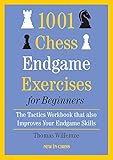
1001 Chess Endgame Exercises for Beginners: The Tactics Workbook that also Improves Your Endgame Skills
240 pages
1001 exercises
Publisher: New in Chess
Workbook format
Pros
- Excellent organization and logical approach
- Equips solver with thought process and key factors
- Bolded text and flashcards for easy review
- Great for beginners to intermediate players
Cons
- Can be confusing initially with layout
- First 500 puzzles are fairly easy
Thomas Willemze takes a different approach from most endgame trainers by focusing on tactical patterns that appear in endgames rather than theoretical positions. The 1001 exercises cover both offensive and defensive tactics, and the book teaches you a thought process for approaching each position, not just the right answer. I found the bolded key factors and flashcard-style review sections particularly helpful for reinforcing patterns. After working through about 600 of these exercises, my ability to spot endgame tactics in rapid games improved measurably.
The organization is methodical. Exercises are grouped by theme, and each group introduces new tactical ideas before testing them. The early exercises are intentionally accessible, making this one of the few endgame books that true beginners can use without a prerequisite. However, experienced players may find the first 500 puzzles too easy and want to skip ahead. The layout takes some getting used to, and I had to flip back and forth between pages a few times before I understood how the solutions were organized.
At 240 pages, the density of exercises is impressive. Willemze manages to pack in 1001 puzzles with explanations without making the book feel cramped. The flashcard concept is especially smart: after finishing the book, you can go back through the key positions quickly to reinforce what you learned. This is the kind of trainer you work through, then revisit periodically for maintenance.
Who will get the most value
Beginners to intermediate players rated 800-1600 who want to build endgame tactical pattern recognition. Players who learn best through high-volume practice. Anyone who has studied theoretical endgames but struggles to apply that knowledge in fast time controls. The flashcard format also makes this great for quick daily drilling.
Who might outgrow it quickly
Players rated above 1800 will likely find the first two-thirds of the book too easy. If you are already strong at endgame tactics, the time investment needed to reach the challenging exercises may not be worth it. Advanced players should consider the de la Villa workbook or Nunn’s exercise book instead for a more appropriate difficulty level.
How to Choose the Right Chess Endgame Trainer
Picking the right endgame trainer depends heavily on your current rating and how you like to study. I have made the mistake of buying advanced books too early, and it just led to frustration and wasted time. Here is a framework I wish I had when I started.
Match the book to your rating range
This is the single most important factor. If you are rated under 1200, start with Pandolfini’s Endgame Course or Chess Endgames for Kids. These books teach the bare essentials without overwhelming you. Between 1200 and 1800, Silman’s Complete Endgame Course is the gold standard because it lets you study exactly the material for your bracket. From 1800 to 2000, Understanding Chess Endgames, the de la Villa textbook, and Dvoretsky’s FastTrack Edition are all strong choices. Above 2000, go straight for Mastering Endgame Strategy, Shereshevsky’s Endgame Strategy, or the full Dvoretsky manual.
Decide between theory and practice
Some endgame trainers teach theoretical positions you need to memorize. Others give you exercises to solve. The best approach for most players is to combine both. Read a theoretical book like Silman’s or de la Villa’s to learn the positions, then use a workbook like the de la Villa Workbook or 1001 Chess Endgame Exercises to practice applying what you learned. The theory gives you the knowledge, and the exercises make it stick.
Consider your study format preferences
If you like studying without a chess board, books like Understanding Chess Endgames and Pandolfini’s Endgame Course have enough diagrams to follow along visually. If you prefer setting up positions on a real board, Silman’s and Dvoretsky’s work beautifully. For players who want screen-based interactive learning, endgame training apps and online platforms like Chess.com and Lichess offer digital alternatives. You can also supplement your book study with a structured training plan that balances endgame work with other areas of your game.
Common mistakes to avoid
The biggest mistake I see players make is trying to study endgame theory before they understand basic endgame principles. Learn opposition, the square of the pawn, basic mating patterns, and the concept of zugzwang before diving into theoretical variations. Another common error is studying endgames passively by just reading through solutions. You have to cover the answer and try to solve the position yourself, even if it takes 20 minutes per exercise. The effort is what creates the learning.
Finally, do not neglect endgame study entirely. Forum discussions on r/chess and chess StackExchange consistently show that players who skip endgame training lose more rating points from botched endgames than from any other phase of the game. Even 15 minutes of endgame practice per day makes a measurable difference over a few months.
Frequently Asked Questions
Who is the greatest endgame chess player of all time?
Most chess experts and historians consider Magnus Carlsen the greatest endgame player of all time. His ability to convert slightly better positions into wins, especially in long games, is unmatched in modern chess. Historically, Jose Capablanca and Akiba Rubinstein are also considered legendary endgame players, with Capablanca often called the chess machine for his near-flawless endgame technique.
How to be good at endgames in chess?
To improve at chess endgames, follow these steps: First, study basic theoretical positions like king and pawn versus king, the opposition, and key rook endgame patterns. Second, work through a structured book like Silman’s Complete Endgame Course at your rating level. Third, practice solving endgame puzzles daily for 15-20 minutes. Fourth, analyze your own endgame losses to identify recurring mistakes. Fifth, play out endgame positions against an engine to test your technique under pressure.
Who is the god of endgame in chess?
While there is no official title, Magnus Carlsen is widely regarded as the god of modern endgame play due to his extraordinary conversion rate in long games. Historically, Akiba Rubinstein earned a similar reputation in the early 20th century for his precise endgame technique. Among chess authors, Mark Dvoretsky is often called the king of endgame instruction for his legendary teaching materials.
What are common endgame mistakes?
The most common endgame mistakes include: forgetting about the opposition in king and pawn endings, pushing pawns too early instead of activating your king, trading into an endgame you do not understand, playing passively in rook endgames when active defense is available, and not knowing basic theoretical positions that are forced wins or draws. Many players also lose by calculating too shallowly, missing that an extra pawn is not enough to win in certain piece configurations.
Final Thoughts on Chess Endgame Trainers
Finding the right endgame trainer can genuinely change your chess results. We reviewed 12 of the best chess endgame trainers available in 2026, and the options span every rating level and learning style. If you want one recommendation, Silman’s Complete Endgame Course is the most versatile and widely praised pick on this list. For players who already have the basics down, pairing de la Villa’s 100 Endgames You Must Know with its companion workbook creates a powerful study system.
The most important thing is to actually study endgames regularly, not just read about them. Pick a trainer, commit to 15-20 minutes a day, and work through the material actively. Cover the solutions, calculate the positions yourself, and review your mistakes. Over a few months, you will start converting endgames that used to slip away. Your rating will thank you.