
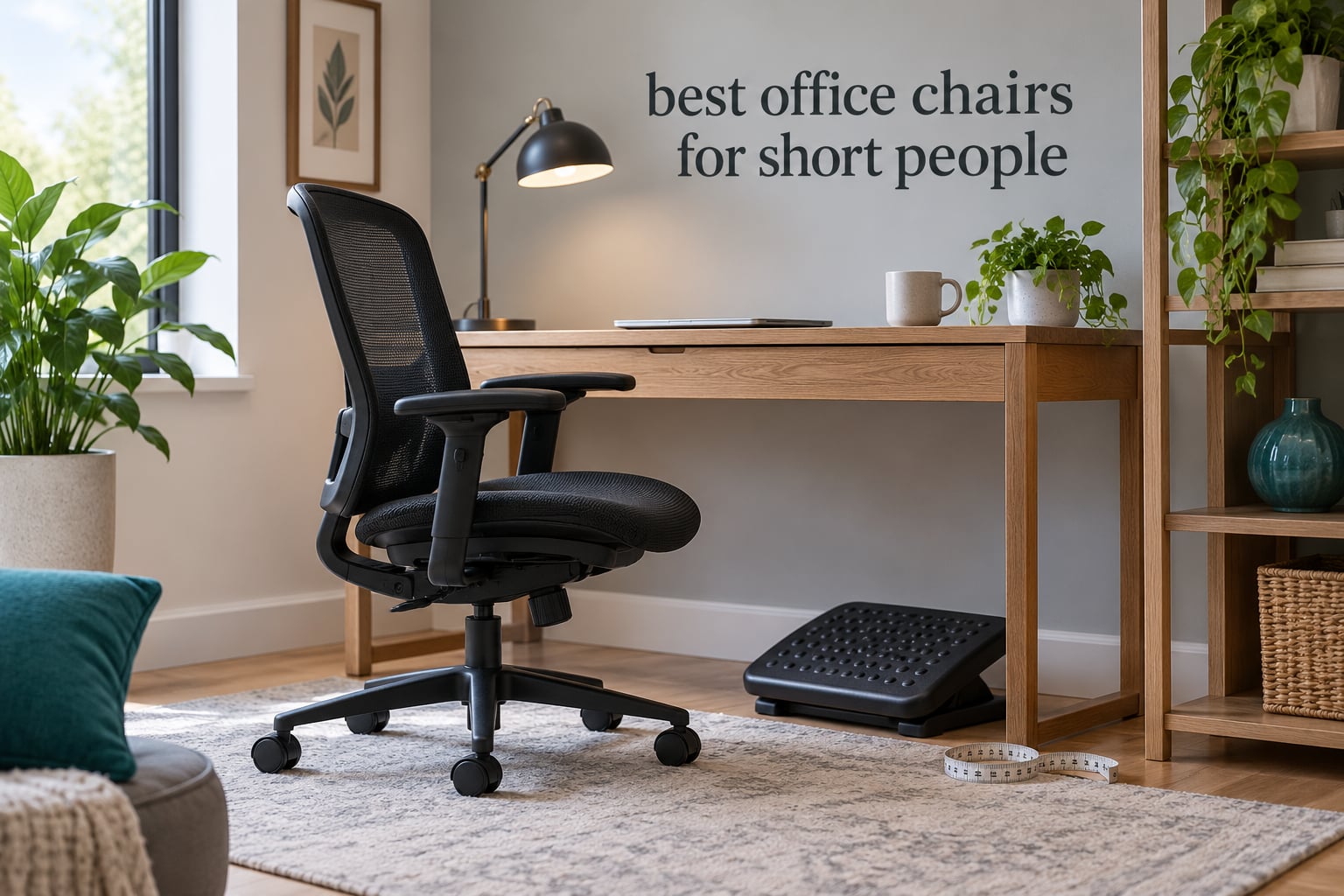
The best office chairs for short people are not the chairs with the longest adjustment lists. They are the ones whose lowest setting is genuinely low, whose seat pan is genuinely shallow, and whose armrests sit close enough together that your shoulders can relax. Standard task chairs are engineered around a 5’8″ to 5’10” reference frame, and the gap between that assumption and a 5’2″ body is where most of the frustration comes from.
Here is what short means for chair fitting. For our purposes, anyone 5’6″ and under is a short user, and anyone under 5’4″ is a hard fit. Most chairs sit inside a seat height range of roughly 16 to 21 inches, with a floor around 16 inches that leaves a 5’0″ to 5’4″ person perching on the front edge with their heels hovering. Push into the backrest in that position and the pressure moves to the backs of the thighs, the shoulders round forward, and the lumbar pad that felt supportive in the first ten minutes starts to dig into the middle of the back instead.
Across the twelve chairs below we sorted on the numbers short users actually shop on: minimum seat height, seat depth, armrest style, weight capacity, and warranty length. We gave the most weight to chairs whose lowest height lands at or below 17 inches, whose seat depth is under 19 inches, or whose armrests flip up or come off entirely. We also flagged where the data is honest about limits, because several of these chairs are marketed for short users and then fail at exactly the point that matters.
If you want the wider picture first, our guide to the best mesh office chairs covers backrest materials in more detail, and our picks for the opposite fit problem sit in 8 best infinite position lift chairs for tall people.
Top 3 Office Chairs for Short People (October 2026)

BestOffice Mid-Back Mesh Chair
- Seat height 17.1 to 20.3 inch
- 18 inch seat depth
- BIFMA certified 250 lb capacity

ProtoArc EC200
- Sliding seat depth 1.97 inch travel
- Adjustable lumbar 2.36 inch height
- Rated for 5 ft 4 in and up

Sweetcrispy Armless Mesh Chair
- Seat height 15.94 to 20.67 inch
- Armless 16.34 inch footprint
- Lightweight at 11.9 lb
These three lead the roundup for different reasons. The BestOffice chair wins on the balance of seat height, seat depth and volume of owner feedback. The ProtoArc EC200 is the only chair here with a sliding seat pan, which is the single most useful adjustment for a short user. The Sweetcrispy chair reaches the lowest seat height in the group at 15.94 inches, which makes it the practical answer for anyone near 5’0″.
Best Office Chairs for Short People in 2026: Specs at a Glance
Sorted roughly by how low each chair goes. Seat height ranges are the manufacturer figures, and minimum seat depth is where it is published. Full ordering below.
| Product | Specifications | Action |
|---|---|---|
| BestOffice Mid-Back Mesh Swivel Desk Chair |
|
Check Latest Price |
| ProtoArc EC200 Ergonomic Chair |
|
Check Latest Price |
| Sweetcrispy Small Armless Mesh Desk Chair |
|
Check Latest Price |
 Amazon Basics Low Back Mesh Office Chair Amazon Basics Low Back Mesh Office Chair |
|
Check Latest Price |
 DUMOS Small Desk Chair with Lumbar Support DUMOS Small Desk Chair with Lumbar Support |
|
Check Latest Price |
 OLIXIS Armless Home Office Chair OLIXIS Armless Home Office Chair |
|
Check Latest Price |
 Serta Armless Small Home Desk Chair Serta Armless Small Home Desk Chair |
|
Check Latest Price |
 NEO CHAIR Mesh Chair with Flip-Up Armrests NEO CHAIR Mesh Chair with Flip-Up Armrests |
|
Check Latest Price |
 Brick Attic PU Leather Desk Chair Brick Attic PU Leather Desk Chair |
|
Check Latest Price |
 COMHOMA Mid-Back PU Chair with Flip-Up Arms COMHOMA Mid-Back PU Chair with Flip-Up Arms |
|
Check Latest Price |
 Office Star ProGrid Mesh Manager Chair Office Star ProGrid Mesh Manager Chair |
|
Check Latest Price |
 Modway Articulate Ergonomic Mesh Chair Modway Articulate Ergonomic Mesh Chair |
|
Check Latest Price |
1. BestOffice Ergonomic Mid-Back Mesh Chair: Best Overall for Short People
BestOffice Ergonomic Office Chair | Mid-Back Swivel Desk Chair | Dark Black
Seat height 17.1 to 20.3 in
Seat depth 18 in
Weight capacity 250 lb
Item weight 19 lb
Pros
- Lowest minimum seat height among the full-size options
- 18 inch seat depth suits shorter thighs
- BIFMA certified alloy steel frame
- Assembles solo in 10-15 minutes
Cons
- Fixed lumbar with no height or depth adjustment
- Standard armrests cannot flip up
- Mid-back gives limited upper-back support
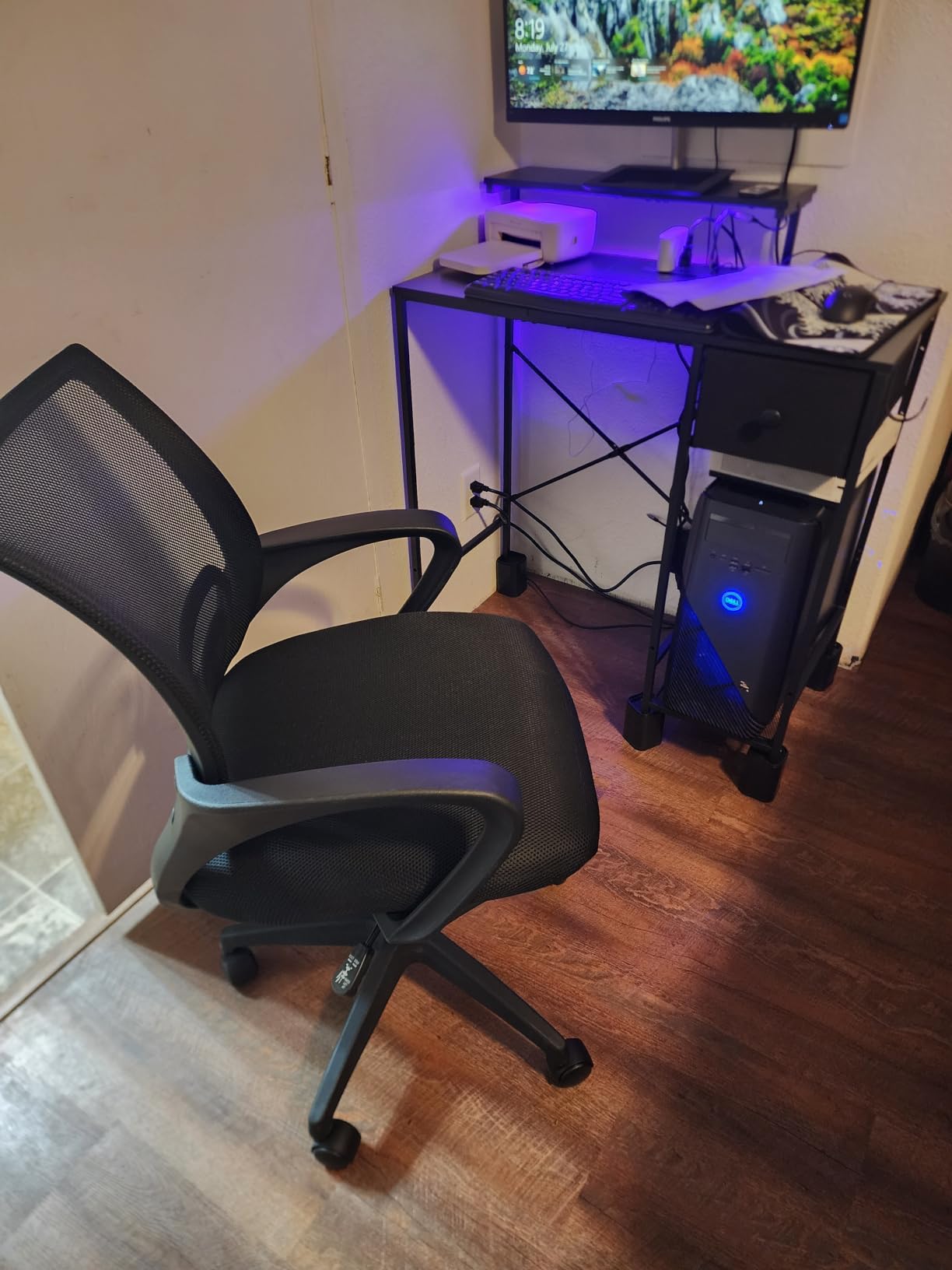
This is the chair we kept coming back to while assembling the roundup. The published seat height range runs from 17.1 to 20.3 inches, and 17.1 inches is the lowest floor of any full-size chair in this group. At that setting a 5’3″ person gets both feet flat with knees at roughly 90 degrees, which is the single most important thing a short user can ask of a chair.
The seat depth is 18 inches, compact enough that the front edge does not press into the backs of the knees, and the backrest is a ventilated mesh with a curved lumbar shape built into the frame. The frame itself is alloy steel meeting BIFMA standards with a 250 pound rating.
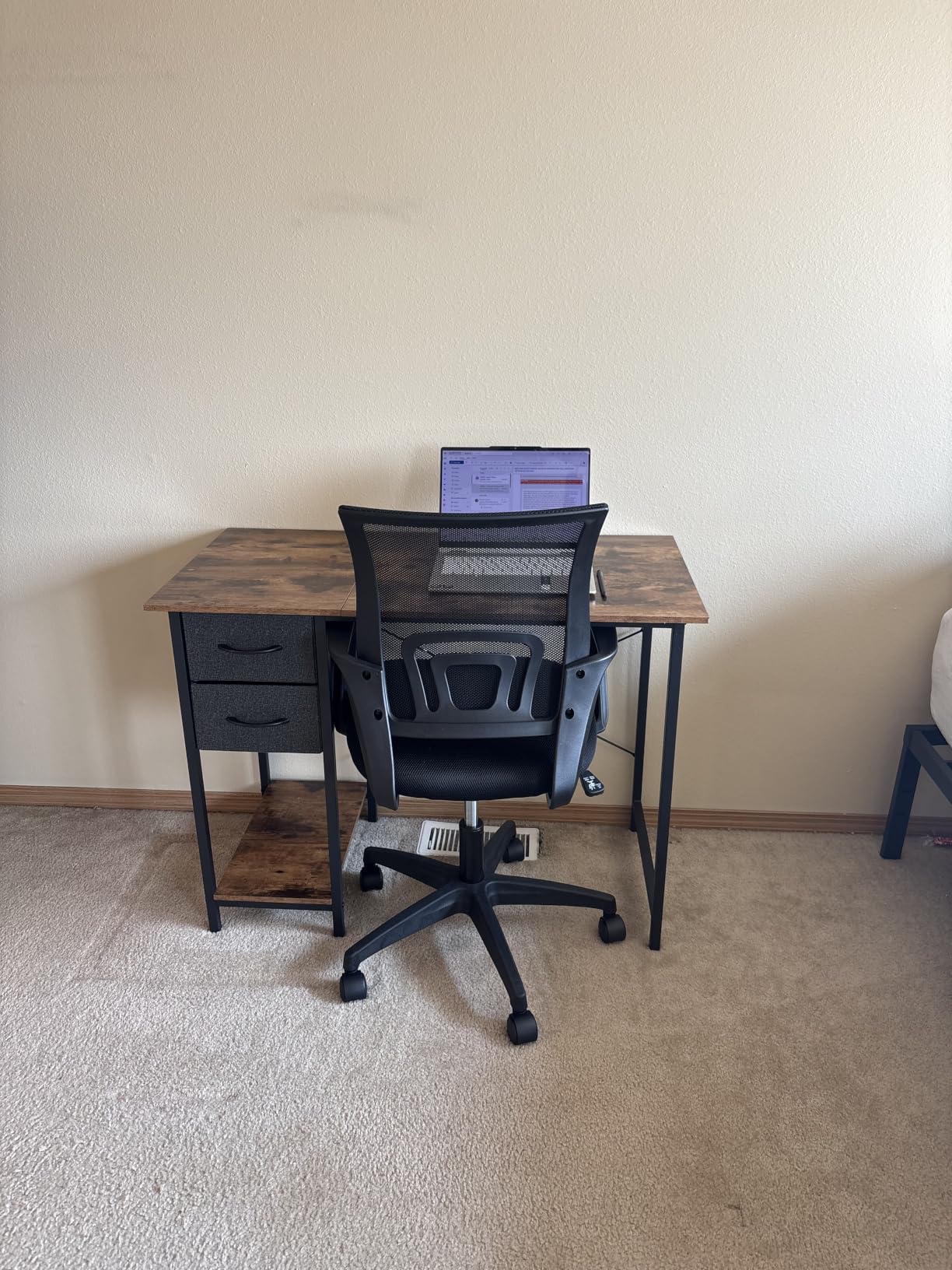
What you give up for that low seat is adjustment. The lumbar curve is fixed, so it sits where the manufacturer put it and does not travel up or down. For most short users that is acceptable because the seat height move shifts the lumbar relative to the spine as a whole, but if your lower back sits unusually high or low in the frame, this is not the chair for you.
The armrests are standard fixed pads rather than flip-up or removable arms, which means the chair will not slide fully under a shallow desk. Reviewers also mention that the mesh and plastic surfaces develop a plasticky feel after a couple of years of daily use. Assembly takes 10 to 15 minutes with the included hardware.
What the 17.1 inch floor actually solves
For a 5’3″ user, a 17.1 inch seat height plus a typical 26 inch inseam puts the feet on the floor without a footrest. That removes the perch, and with the perch gone the sitter can actually recline into the backrest without sliding forward.
Below about 5’0″, even 17.1 inches is too high. Those users should look at the armless chairs further down, or plan on adding a footrest to this one.
Who should skip it
Skip this chair if you need arms that tuck away, or if you want a lumbar pad that moves. It is also a mid-back, so anyone working eight hours a day with a tall frame will find the upper back unsupported.
For everyone shopping the best office chairs for short people on a reasonable budget, this is the safe first look.
2. ProtoArc EC200: Best Adjustable Fit for Short Bodies
ProtoArc EC200 Ergonomic Office Chair with Adjustable Seat Depth
Sliding seat depth 1.97 in
Lumbar 2.36 in height, 0.8 in depth
Rated 5 ft 4 in to 6 ft
45 lb
Pros
- Only chair here with a 5-position sliding seat pan
- Lumbar adjusts in both height and depth
- 3D headrest for long calls
- 3-year warranty
Cons
- Heavy at 45 lb and awkward in tight rooms
- Mesh surfaces attract lint and dust
- Lumbar can still sit high on some body types
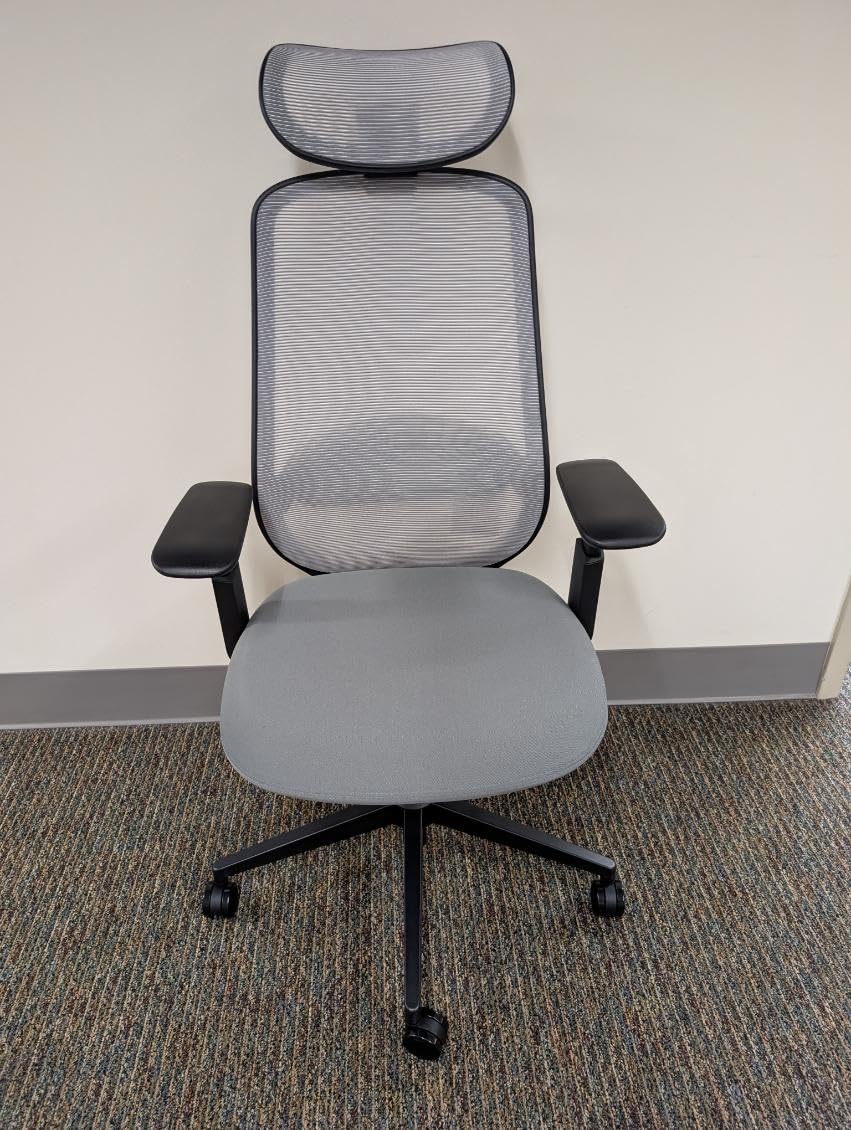
The manufacturer calibrates this chair for users between 5’4″ and 6’0″ weighing under 220 pounds, which puts it squarely in the short-user range rather than bolting a label onto a standard frame. The reason it matters is the seat pan. It slides through five positions with 1.97 inches of travel, and no other chair in this roundup does that.
Seat depth is the adjustment most people miss. A fixed 18 inch pan that suits one person presses the backs of the knees on someone 3 inches shorter, and the natural response is to slide forward and stop using the backrest. A slider removes that trade-off entirely.
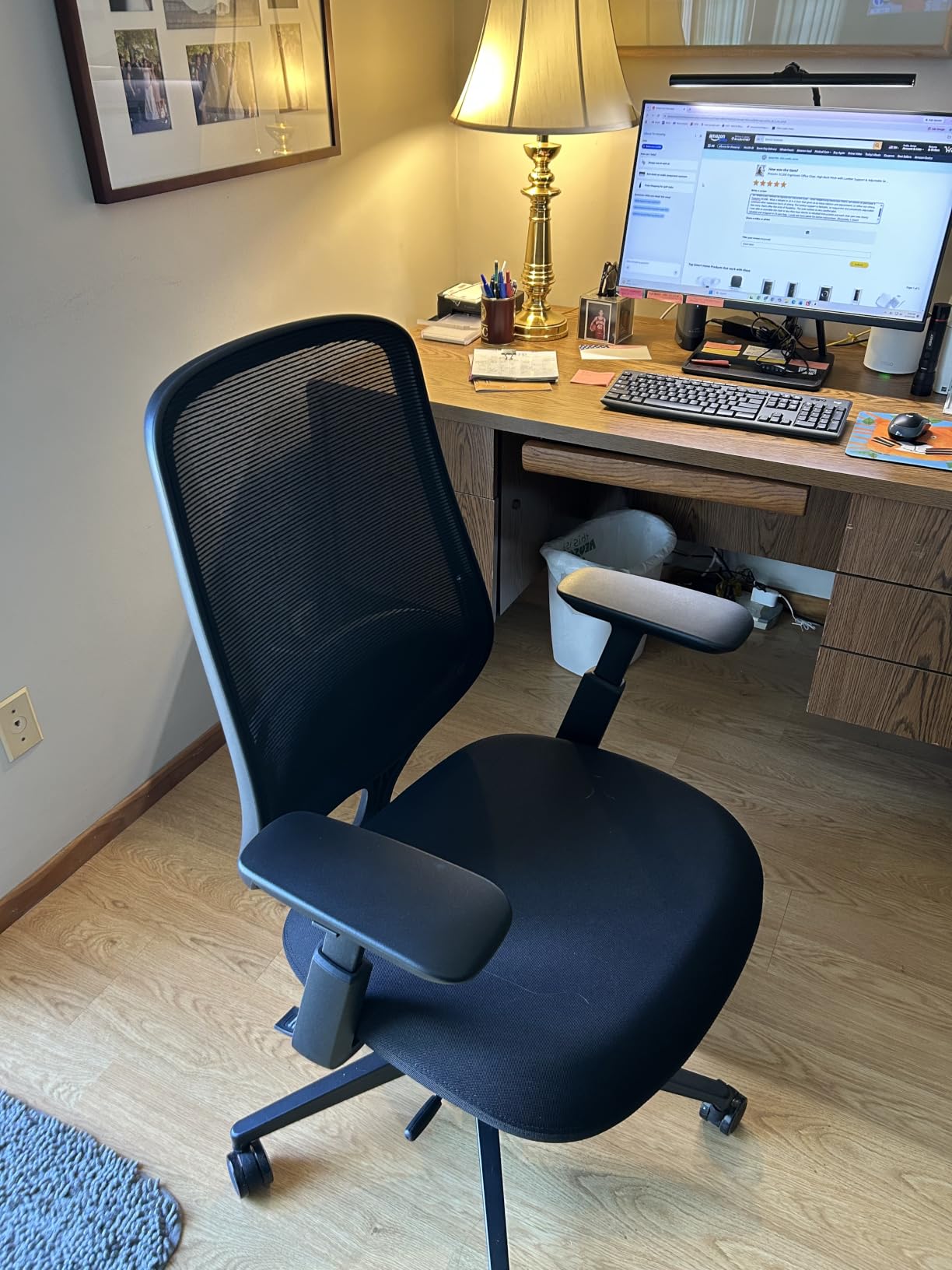
The lumbar support adjusts in both height, with 2.36 inches of travel, and depth, with 0.8 inches. That matters because a fixed lumbar that lands in the mid-back is the most common complaint we saw about lumbar pads in general on the r/OfficeChairs thread about chairs for short people. Recline also does not kill the support here, since the lumbar holds its position as the back tilts.
The seat cushion is 55D high-density foam, backed by BS EN 1335, BIFMA X5.1 and TUV testing, and it resists bottoming out over years better than the thin foam in the cheaper chairs here. Recline locks at 90, 105, 120 and 130 degrees with a tension knob.
Why the seat slider beats a fixed pan
A fixed pan forces a choice: feet flat with your spine unsupported, or back supported with your feet hanging. The slider closes that gap, so a 5’4″ user and a 5’10” user can share one chair without either perching.
The 3D headrest also moves horizontally and tilts, which is unusual at this level and useful if you take long calls. Most headrests on other chairs here push the head forward.
What you trade for the adjustability
At 45 pounds this is the second-heaviest chair we list, and it has a large base. In a small apartment or spare bedroom that footprint is a real cost, so measure before you commit.
The mesh surfaces collect lint, which reviewers on black units notice within weeks, and some owners say the lumbar still sits a touch high even at its lowest setting. The 220 pound rating also means it is not the chair for a heavier short user.
3. Sweetcrispy Small Armless Desk Chair: Lowest Seat Height in the Roundup
Sweetcrispy Small Armless Desk Chair, Mesh Rolling Office Chairs
Seat height 15.94 to 20.67 in
Footprint 16.34 x 16.54 in
Item weight 11.9 lb
Weight capacity 250 lb
Pros
- Lowest minimum seat height here at 15.94 inches
- Light at 11.9 lb so one person can move it
- Armless frame tucks under a small desk
- Removable cushion for cleaning
Cons
- Casters do not lock
- Thin cushion suits lighter users better
- Low-back design not built for long adult days
This chair goes lower than anything else we tested: the gas lift adjusts from 15.94 to 20.67 inches. For a person near 5’0″ who has never found a chair that puts their feet flat, that number alone is the reason to look.
The second reason is the footprint. At 16.34 by 16.54 inches and 11.9 pounds, it is small enough to tuck under a shallow desk and light enough to move between rooms single-handed. Short users in small apartments rate compact chairs highly, because a wide five-star base that you constantly kick is a constant irritation.
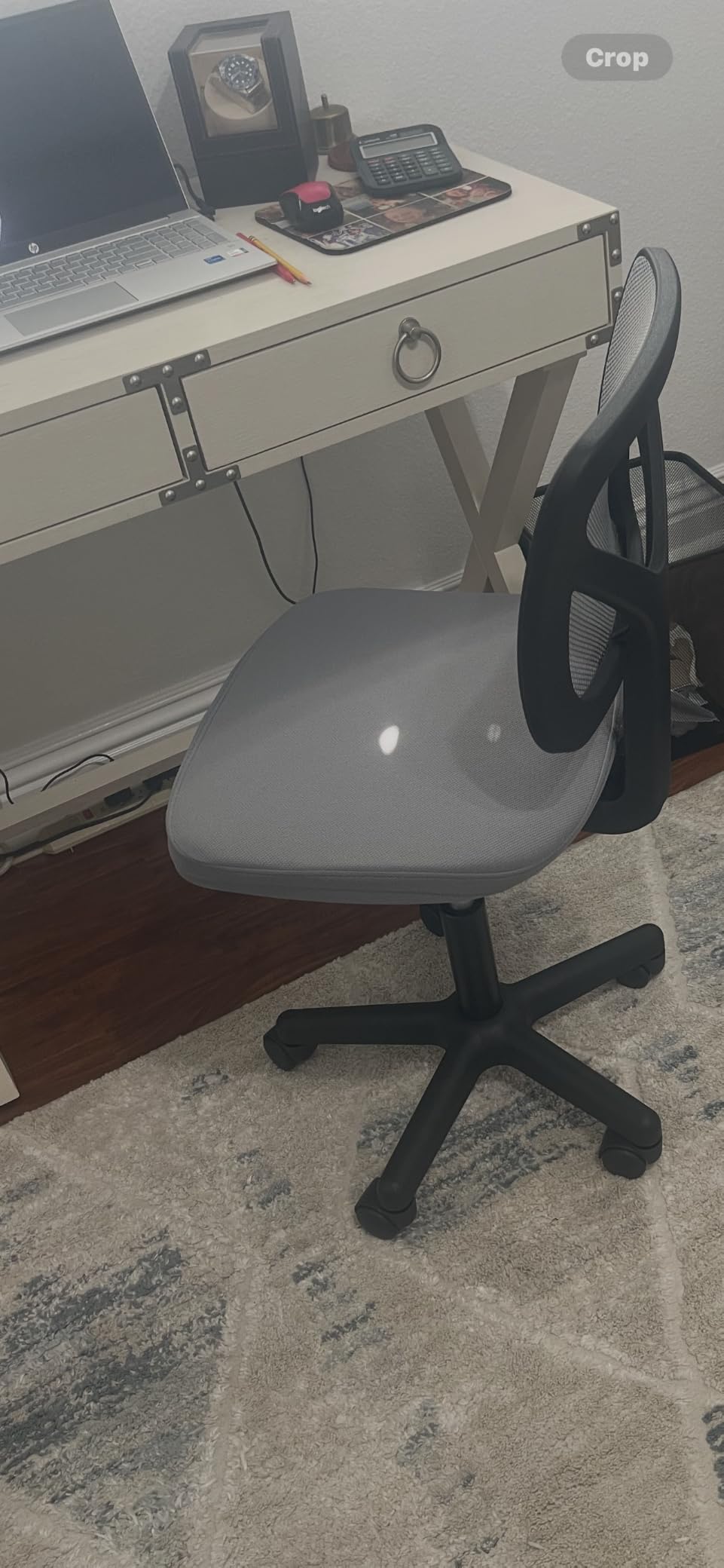
Back support comes from a Y-shaped mesh backrest that follows the lower back curve, which is more than the flat low-backs on several cheaper options. The base is BIFMA certified, rated to 250 pounds, and rolls on quiet polyurethane casters. Assembly is five parts in four steps.
It is also the chair several reviewers bought for children doing homework, and that is a fair use for it. For adults, the honest limitation is that this is a low-back design without head or upper-back support.
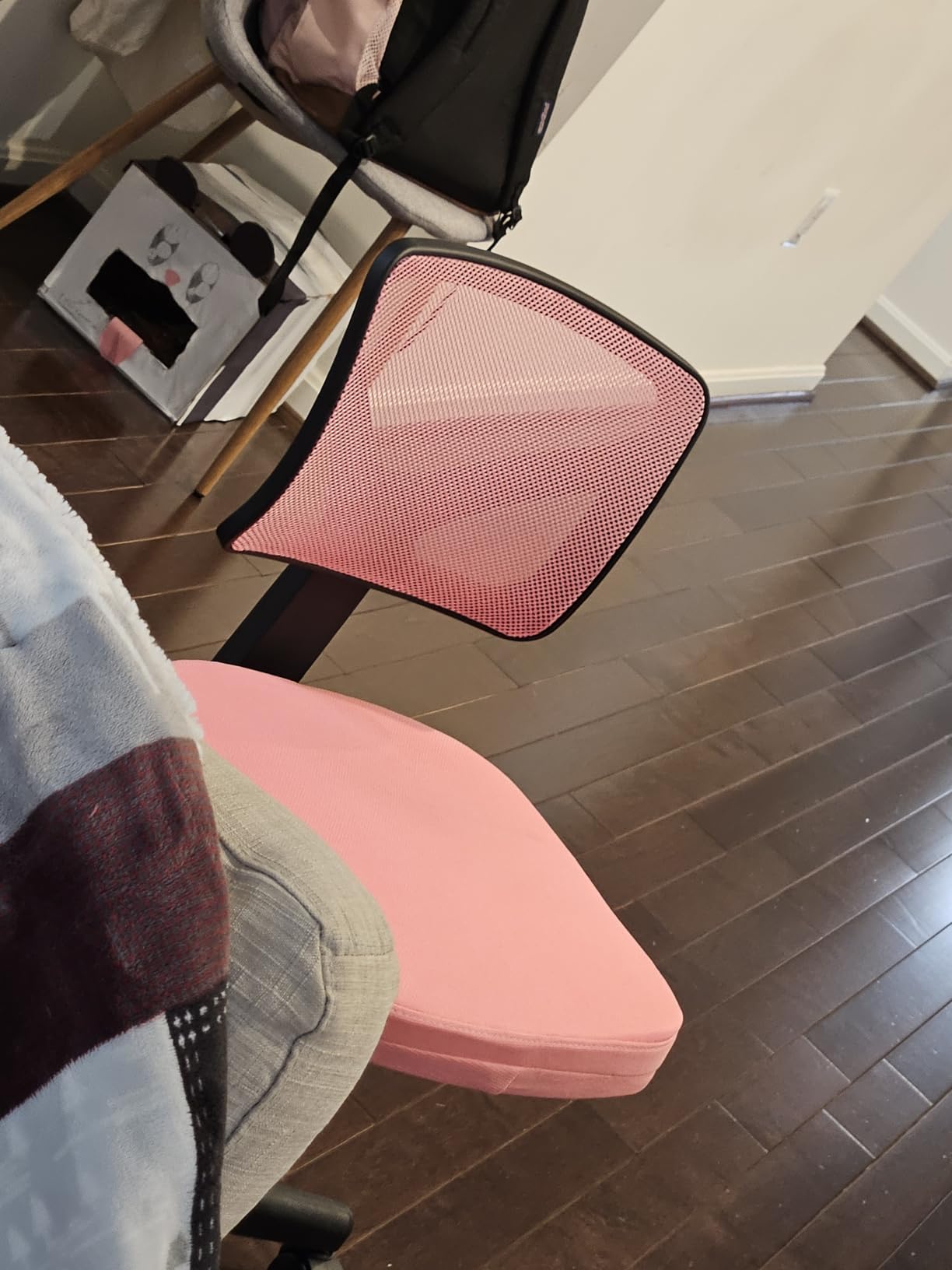
Where 15.94 inches changes the outcome
That floor means an adult at 5’0″ to 5’2″ reaches the ground without a footrest, which removes the pressure under the thighs that causes the end-of-day ache short users describe. Users between 5’3″ and 5’6″ will likely sit near the low end too, leaving plenty of upward travel.
What to know before you buy
The casters do not lock, so the chair can roll away while you type, and the foam cushion is thin enough that some buyers add a memory foam pad. If you are a heavier adult, a thin cushion over that long a day will not be enough.
This is the best office chair for short people under about 5’2″, and a good homework chair for anyone older.
4. Amazon Basics Low Back Mesh Chair: Best Value Pick
Amazon Basics Low Back Office Chair, Breathable Mesh, Height Adjustable, Padded Seat, Rolling Wheels, Swivel, Back Support, Sturdy, 21.25″ D x 22.5″ W x 38″ H, Black
Pneumatic seat height adjustment
Low-back breathable mesh
Weight capacity 275 lb
Item weight 16.8 lb
Pros
- Long-standing category rank with a huge owner base
- Low overall height suits tight rooms
- Breathable mesh keeps heat down
- Padded seat for long sessions
- BIFMA compliant
Cons
- No dedicated lumbar adjustment
- Armrests are fixed with no flip-up option
- Basic recline with no tension control
With more than 21,000 owner reviews and a long-standing position in the home office category, this is the chair most short users already own without knowing it. The low-back profile and low overall height of 38 inches are genuinely helpful in a room where a taller executive chair dominates.
Height adjustment is pneumatic and covers a range that reviewers with shorter frames report as usable. The mesh back keeps airflow good, which matters more for short users than it seems: a smaller body sits lower into the backrest, closer to the seat cushion, where heat collects first.
The padded foam seat is the quiet strength here. At this level most competitors use a thin cushion that compresses within a few months, and reviewers rarely complain about this one. It is rated to 275 pounds and complies with BIFMA, and the whole thing weighs 16.8 pounds.
Adjustment is the trade-off. There is no dedicated lumbar mechanism, the armrests are fixed and cannot flip up, and the recline is basic with no tension control. In other words, you set the height once and leave it.
Who this suits
A student, a first home office setup, or anyone who wants a breathable chair with a real padded seat and does not need to fine-tune anything after day one. For a short user on a budget it is hard to argue with the feedback volume behind it.
Who should look elsewhere
If you have back pain and need the lumbar pad to move, this is the wrong chair. Same story for anyone whose desk is shallow enough that fixed armrests will not clear the underside.
Among the best office chairs for short people, this one wins on value and loses on adjustability, and it is worth being clear about which of those matters more to you.
5. DUMOS Small Desk Chair: Best for Armless Comfort
DUMOS Small Desk Chair, Home Office Chair, Lumbar Support
Armless by design
Seat depth 18.11 in
Overall 34.25 in tall
Capacity 250 lb
Pros
- Highest satisfaction score in the group at 4.7
- Truly armless so it stows under a desk
- Compact 16.33 inch listed width
- 2.5 inch high-density foam cushion
Cons
- No lumbar height or depth adjustment
- Only 34.25 in tall overall
- PU leather runs warm in long sessions
The DUMOS scores highest of the twelve at 4.7 out of 5, with 84 percent of owners giving five stars. That is worth noting before the specs, because a high satisfaction score on a chair this simple tells you the cushion and the footprint are doing their jobs.
It is armless, which is the cleanest solution to the desk clearance problem. No arms means no arms to catch on the underside of a desk, and it means your shoulders are free of anything pressing inward. That directly addresses a pain point short users raise often, where fixed armrests set too wide for narrow shoulders cause shoulder and neck ache that gets blamed on the seat.
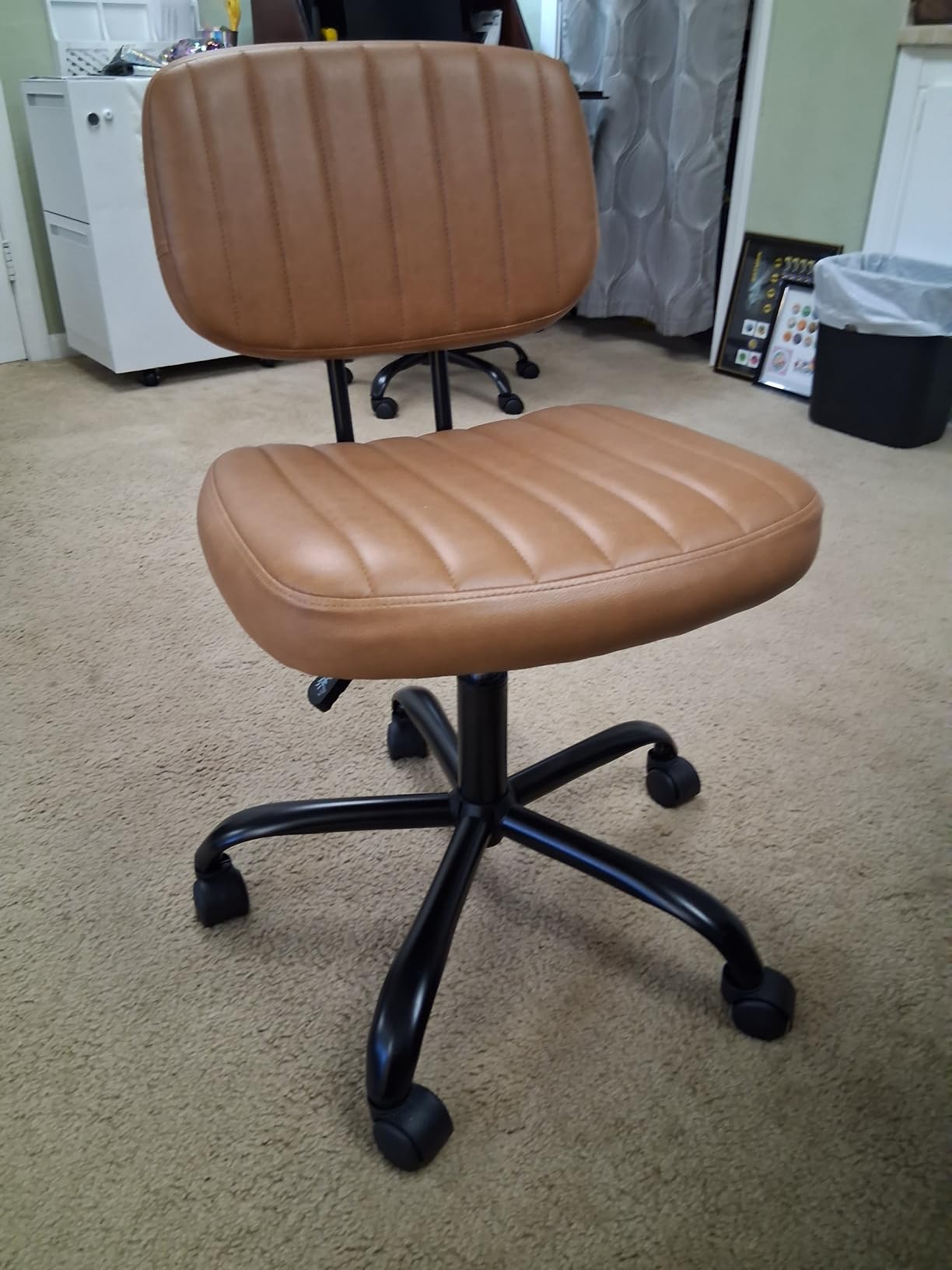
The cushion is 2.5 inches of high-density sponge under twill PU leather, which is thicker than anything else at this tier. The backrest is a padded foam panel on a U-shaped metal frame that gives gentle lumbar support, and the cylinders are SGS certified, tested over 10,000 cycles, with a 250 pound rating.
Overall height is 34.25 inches, so there is no head support and no meaningful upper-back support. Assembly is six steps in roughly ten minutes, with casters and the cushion included.
When armless is the right answer
Armless wins for narrow shoulders, for shallow desks, and for anyone who works at a desk they share or move around. It also removes a whole category of fit problem, because there is no arm width to get wrong.
What you give up
Without arms there is nothing to push off when you stand up, and nothing to rest a wrist during a phone call. The lumbar is fixed with no travel, so if your lower back curves high or low, you cannot correct for it.
PU leather also runs warmer than mesh, which is a real drawback for anyone in a warm room. For a light-frame user the thick foam cushion is a genuine benefit, since more foam means more give before it firms up.
6. OLIXIS Armless Home Office Chair: Best for Washable Seats
OLIXIS Armless Home Office Chair, Ergonomic Small Desk Chair
Seat depth 16.34 in
Item weight 11.9 lb
Removable washable cover
Capacity 250 lb
Pros
- Very small 16.34 inch footprint for compact desks
- Light at 11.9 lb and easy to move alone
- Machine-washable removable seat cover
- Quiet casters that do not scratch hard floors
Cons
- No adjustable lumbar support at all
- Low-back mesh gives limited mid-back support
- Single lever for height only
The OLIXIS is built around the same 16.34 inch footprint as the Sweetcrispy and adds the feature families keep asking about: a fully removable, machine-washable seat cover. If your chair is going to face snacks, pets or a home office that doubles as a craft table, that is worth more than a recline knob.
Seat depth is 16.34 inches, among the shallowest in the roundup, and the high-density foam underneath is comfortable for its class. The backrest uses the same Y-shaped mesh profile, following the spine curve for even pressure.
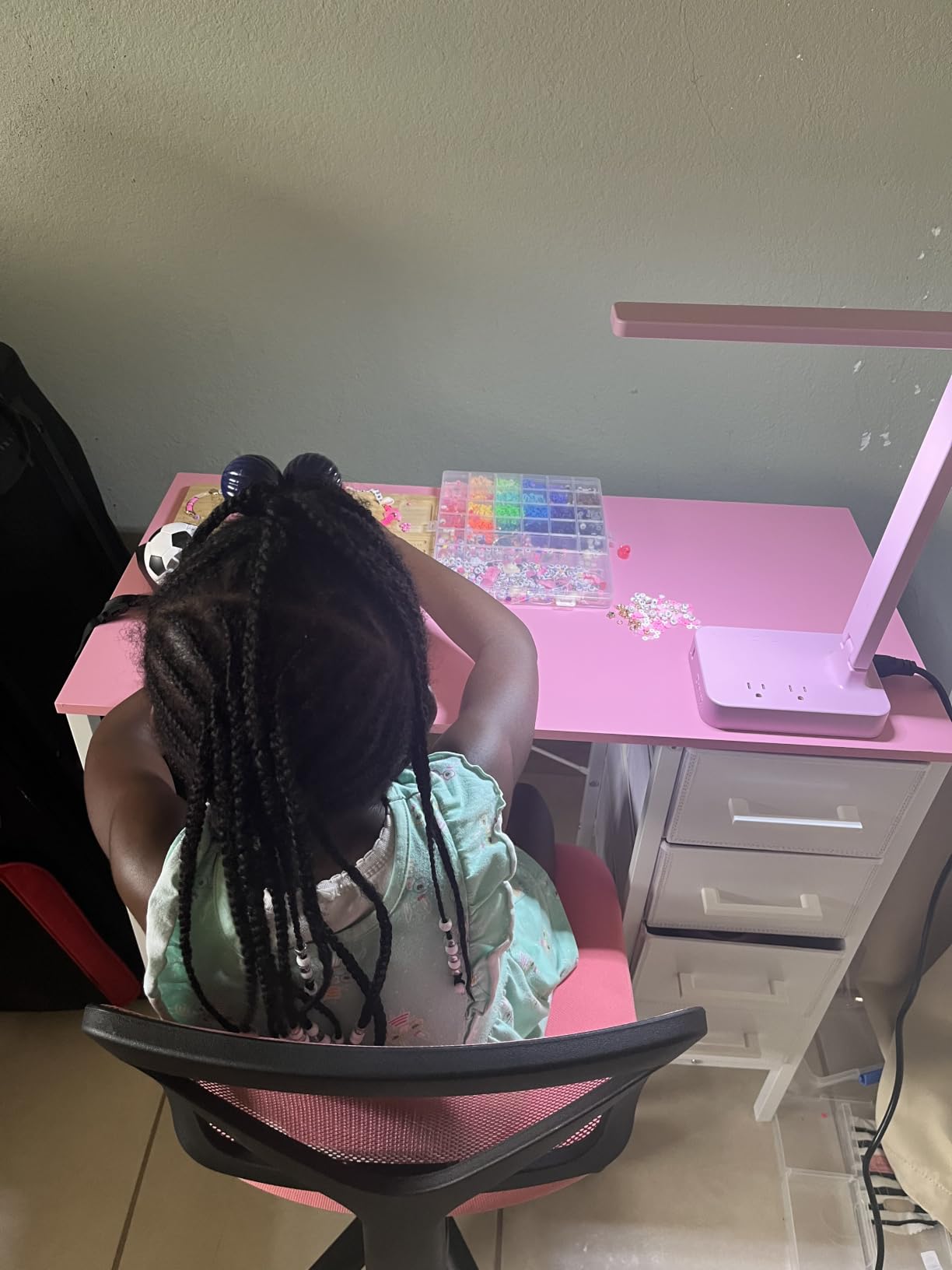
Height adjustment is a single pneumatic lever, and the base is BIFMA standard with five quiet 360 degree casters that glide on hardwood, tile and carpet without marking. Reviewers mention the quiet rolling more than anything else.
Adjustment is the limit. There is no lumbar mechanism, no tilt tension and no recline. The armless silhouette tucks under a standard desk, and setup is five parts in four steps.
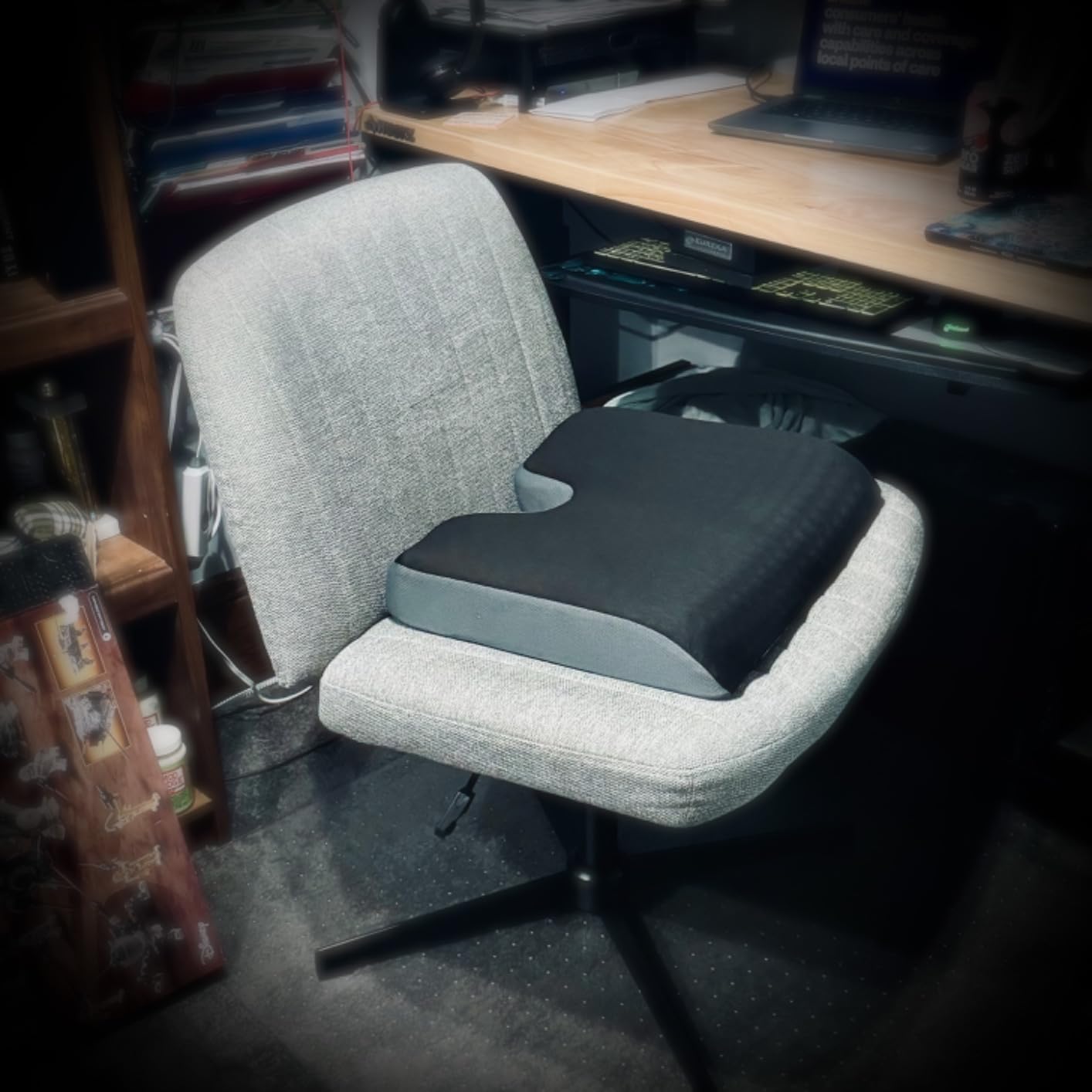
A shallow pan for shorter thighs
A 16.34 inch seat depth leaves a real gap between the front edge and the back of the knee. For someone around 5’2″ that is close to the two to three finger gap you are aiming for, without any adjustment required.
Where it falls short
No lumbar support at all means the Y-shaped backrest is the only thing between your lower back and nothing. That is fine for a few hours of work and thin support over eight.
For a short user in a small room who values washability and clearance over adjustability, this earns its place on the shortlist.
7. Serta Armless Small Home Desk Chair: Best for Shallow Seats
Serta Armless Small Home Desk Chair with Wheels, Ergonomic Mesh Back Chair
Seat depth 16.5 in
Overall height 32.75 in
Item weight 17.6 lb
1-year limited warranty
Pros
- 16.5 inch seat depth matched to shorter thighs
- Armless and low profile
- tucks under most desks
- Breathable mesh back
- Lightweight at 17.6 lb
Cons
- Fixed and gentle lumbar with no adjustment
- 32.75 in total height leaves no upper-back support
- Two people recommended for assembly
Serta builds this one small on purpose. The 16.5 inch seat depth is the second shallowest pan here, and paired with the armless low-profile frame it becomes one of the few chairs on this list where a short user sits with thighs fully supported and nothing digging into the knees.
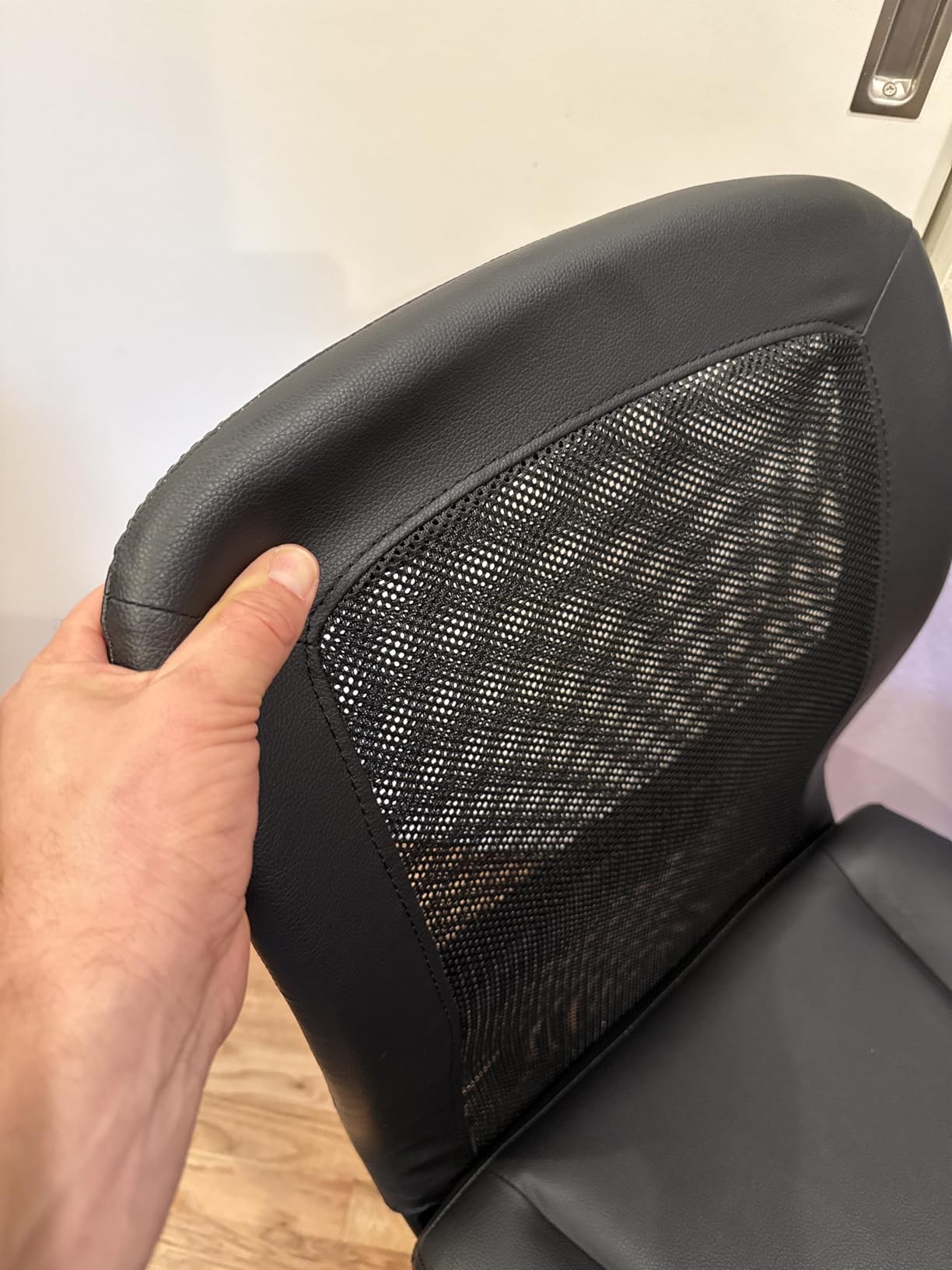
The back is a breathable mesh, which is a genuine advantage over the PU leather options for anyone who runs warm. The seat is a foam-layered faux leather cushion, softer than the DUMOS and thinner than the ProtoArc.
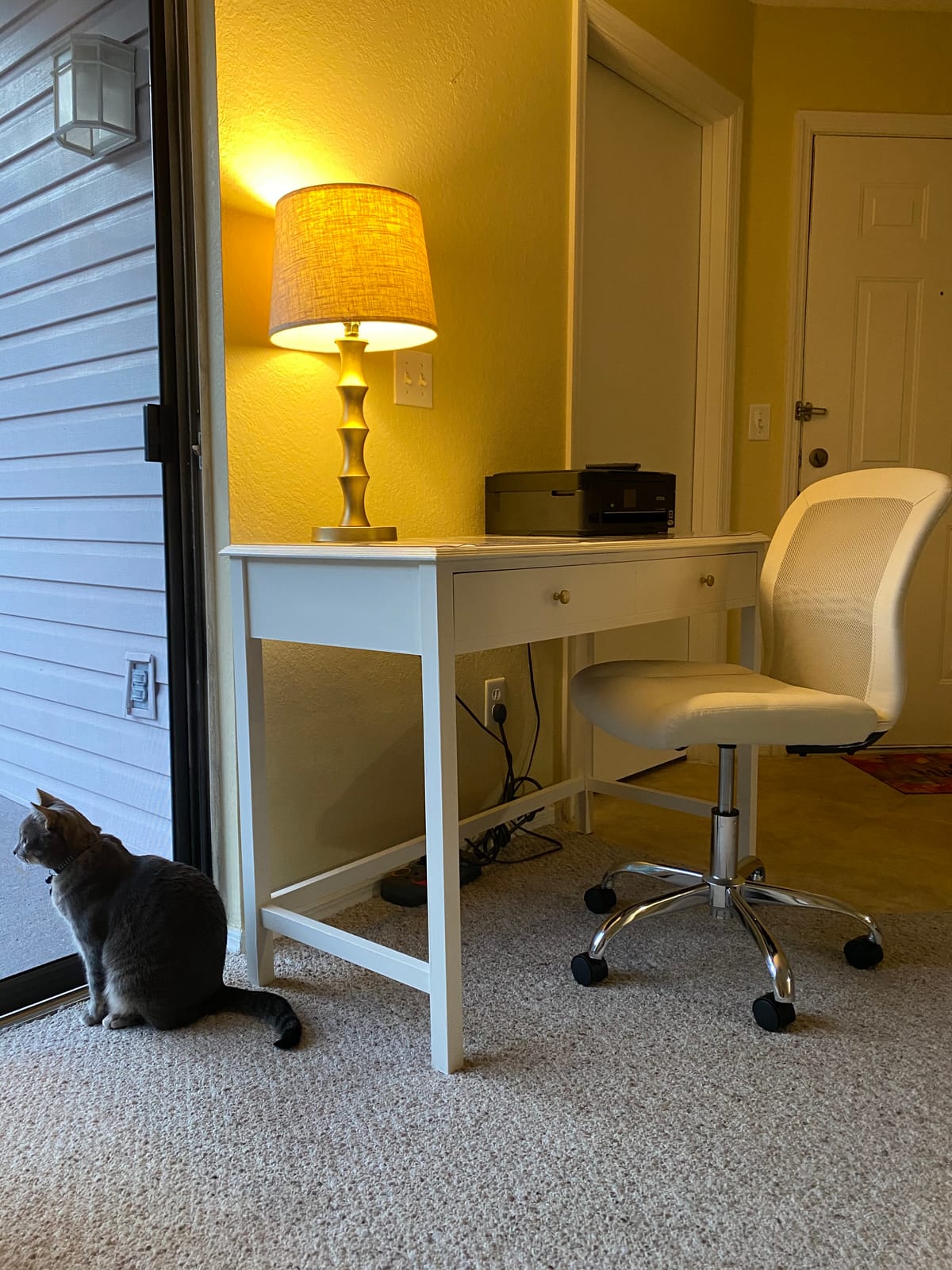
Height adjustment runs off an accessible lever under the seat, and dual-wheel swivel casters roll smoothly. The chair is rated to 275 pounds and carries a 1-year limited warranty, which is thinner coverage than the ProtoArc’s three years or the Office Star’s lifetime parts warranty.
Total height is 32.75 inches, the shortest frame in the roundup. That is excellent for tucking away and poor for anyone who needs upper-back contact, since there is nowhere for a shoulder blade to rest.
A mainline brand with a small footprint
Coming from a familiar name, the Serta carries more expected longevity than an unknown import, and the mesh back will not cling to a shirt the way PU leather can. For a shared desk or a guest room it doubles as a spare chair without taking over the space.
Where the softness costs you
The lumbar is fixed and gentle, which some owners read as comfortable and others read as absent. If your back pain is the main reason you are shopping, this will not be the chair that fixes it.
Assembly is recommended for two people, which is a minor annoyance but worth knowing before the box arrives.
8. NEO CHAIR Mesh Chair with Flip-Up Armrests: Best for Small Desks
NEO CHAIR Office Desk Chair, Ergonomic Mesh with Flip-Up Armrests, Grey
Padded flip-up armrests
Seat depth 19 in
Weight capacity 300 lb
Item weight 18 lb
Pros
- Flip-up arms let the chair tuck under a shallow desk
- Adjustable tilt tension and height
- Mesh back stays cool
- Rated to 300 lb
Cons
- Squeaks from the tilt mechanism when leaning
- 19 inch seat depth is long for a 5 ft frame
- Right armrest can be stiff at first
Flip-up armrests solve the desk clearance problem without giving up arm support, and the NEO CHAIR is an affordable chair that does it with padding. Reviewers describe the arms folding flat enough to slide the chair fully under a small desk, which is the reason this chair shows up so often in short-user threads.
A reviewer at 5’5″ reports that the seat height is a good fit, which matches what the adjustment range suggests. Tilt tension is adjustable and the lumbar support is described as solid, and the mesh back stays cool through long sessions.
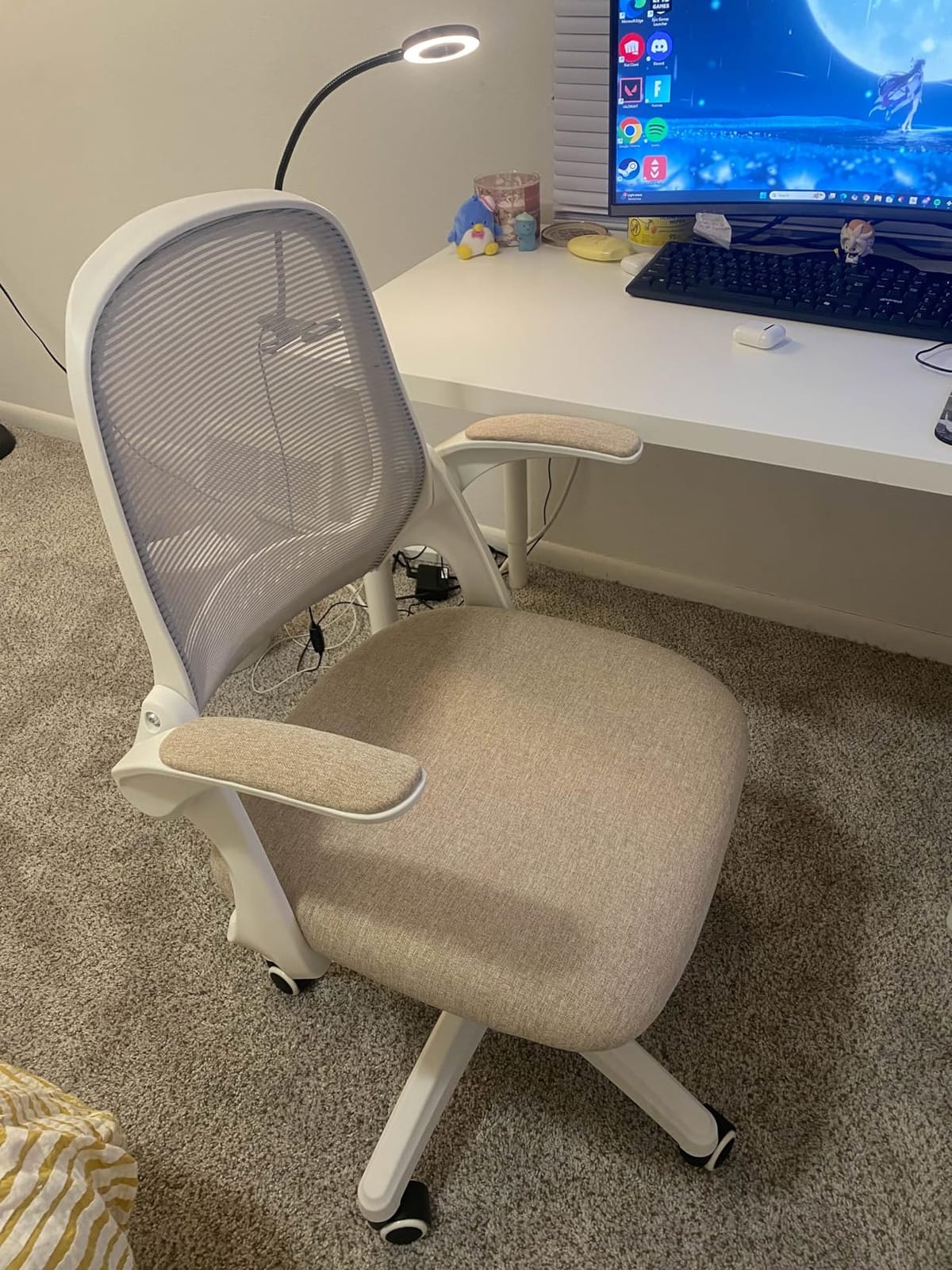
The build uses an SGS-certified gas lift, a wide balanced base and smooth-gliding wheels, rated to 300 pounds with an FSC-certified wood frame inside. Assembly takes about 20 to 30 minutes solo.
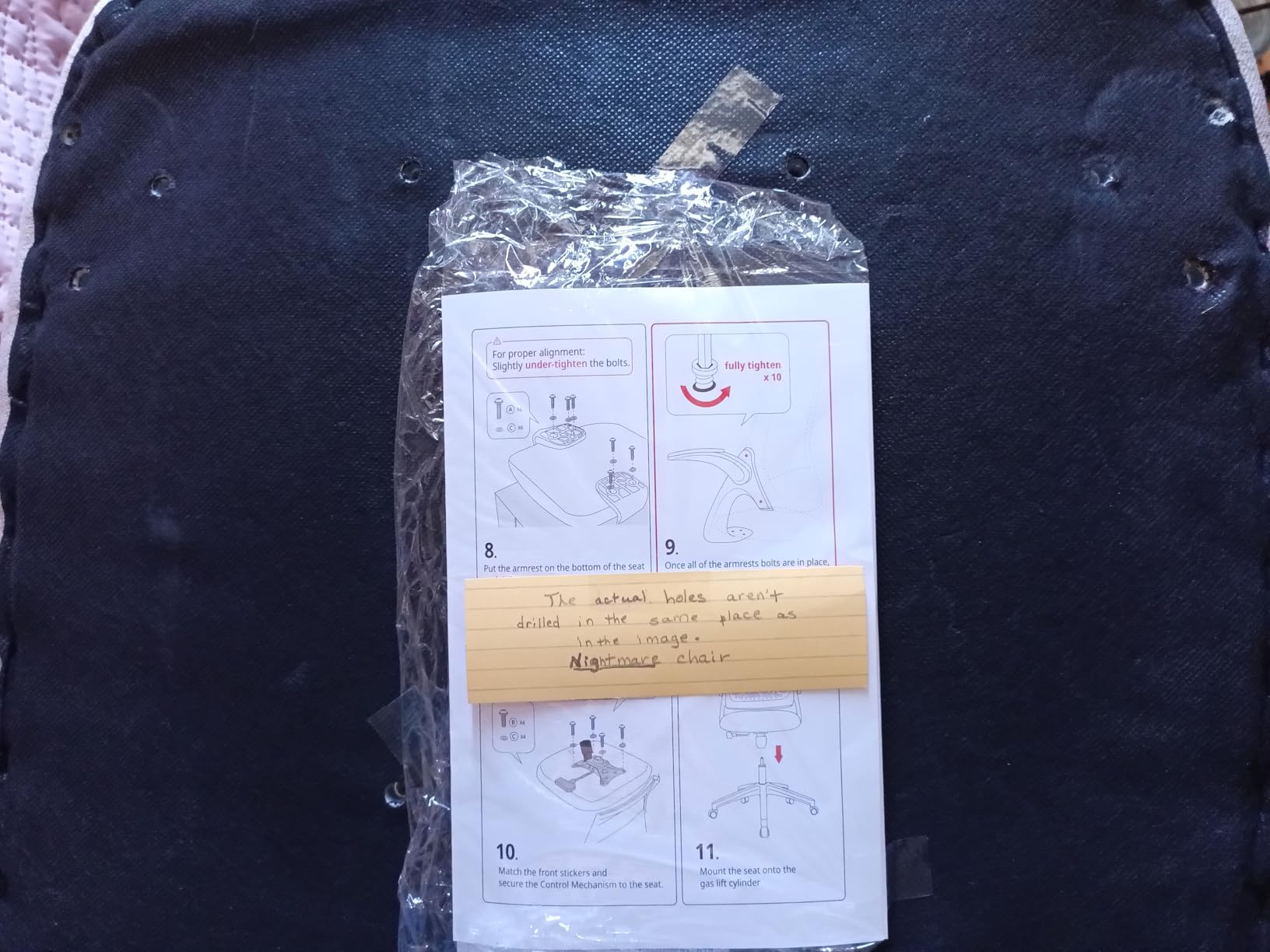
Two drawbacks come up repeatedly. The tilt mechanism squeaks when you lean back, and at least one owner received a replacement control mechanism through customer service. The 19 inch seat depth is also on the long side for a small frame.
Flip-up arms versus no arms
If you want arm support and desk clearance, flip-up arms are the compromise. If you want neither an arm in the way nor a shoulder-width problem, armless is cleaner. This chair sits in between.
Things to check on arrival
Check the tilt mechanism early and sit on it a few times, because a squeak that shows up in the first week sometimes settles and sometimes does not. Confirm the right armrest moves freely before you commit to the chair long-term.
Some shipments arrive with missing washers, so inventory the hardware before assembly rather than halfway through it.
9. Brick Attic PU Leather Desk Chair: Best Executive Style with Flip-Up Arms
Leather Office Chair, PU Home Computer Desk Chairs with Ergonomic Back Support, 360°Swivel Free,Small Gmaing Chair with Wheels and Adjustable Armrests, for Short People Use, Black
90 degree flip-up armrests
Item weight 26 lb
Rocking tilt function
Capacity 275 lb
Pros
- Flip-up arms slide it under a small desk
- Curved padded backrest gives real lumbar support
- Waterproof PU leather wipes clean
- 360 degree swivel and rocking tilt
Cons
- Fixed and non-adjustable lumbar
- High back is tall for a shorter frame
- Solid back traps more heat than mesh
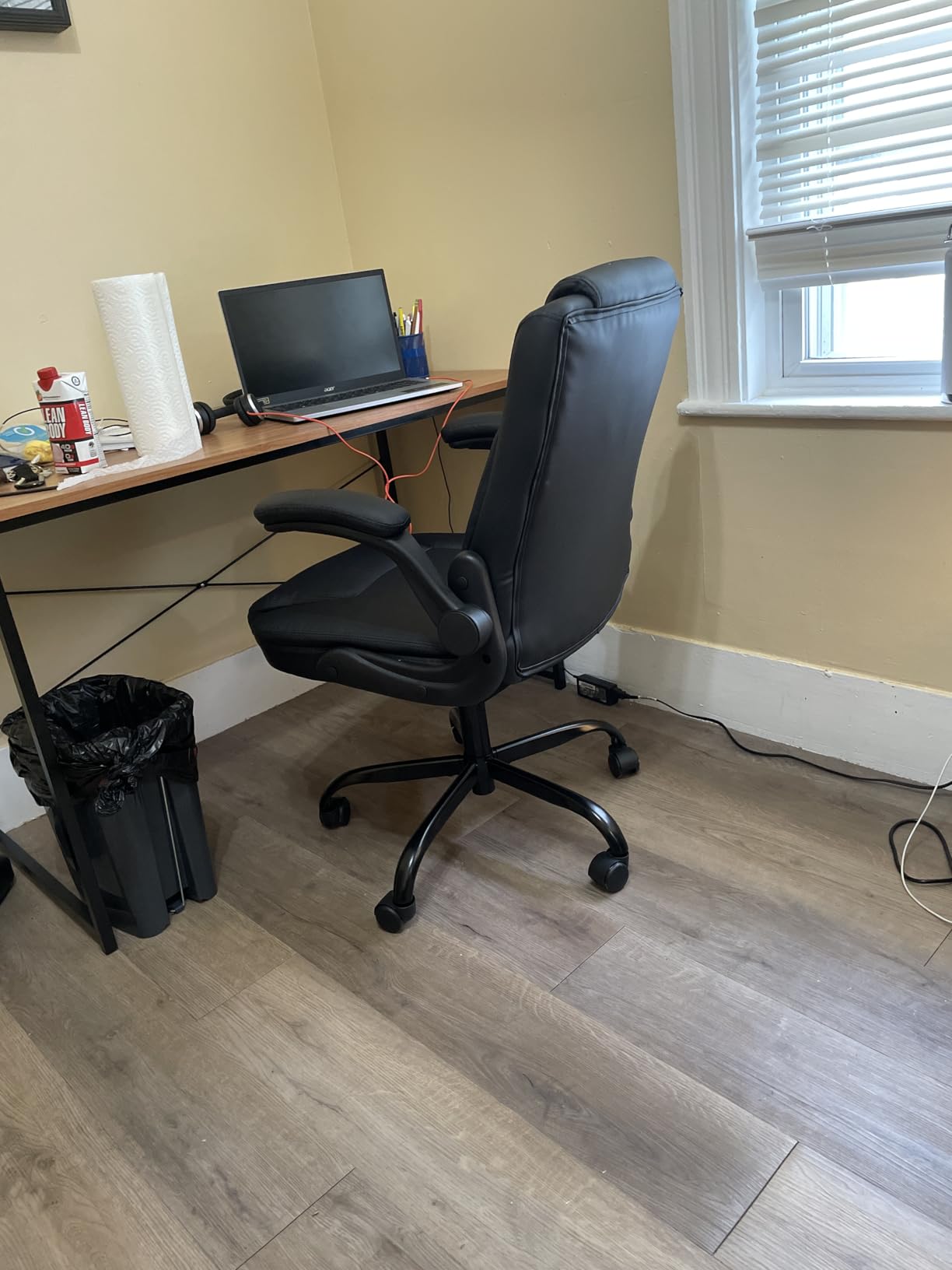
If you want armrests that fold away and a back that supports properly rather than decoratively, this PU leather chair does both. The backrest is curved and padded with ergonomic lumbar shaping, which reviewers consistently rate as more supportive than flat-backed budget chairs.
The arms flip up 90 degrees so the chair tucks under a desk, the base swivels 360 degrees, and a tilt handle engages a rocking function you can push to stop. The upholstery is waterproof and stain-resistant PU leather over high-density sponge.
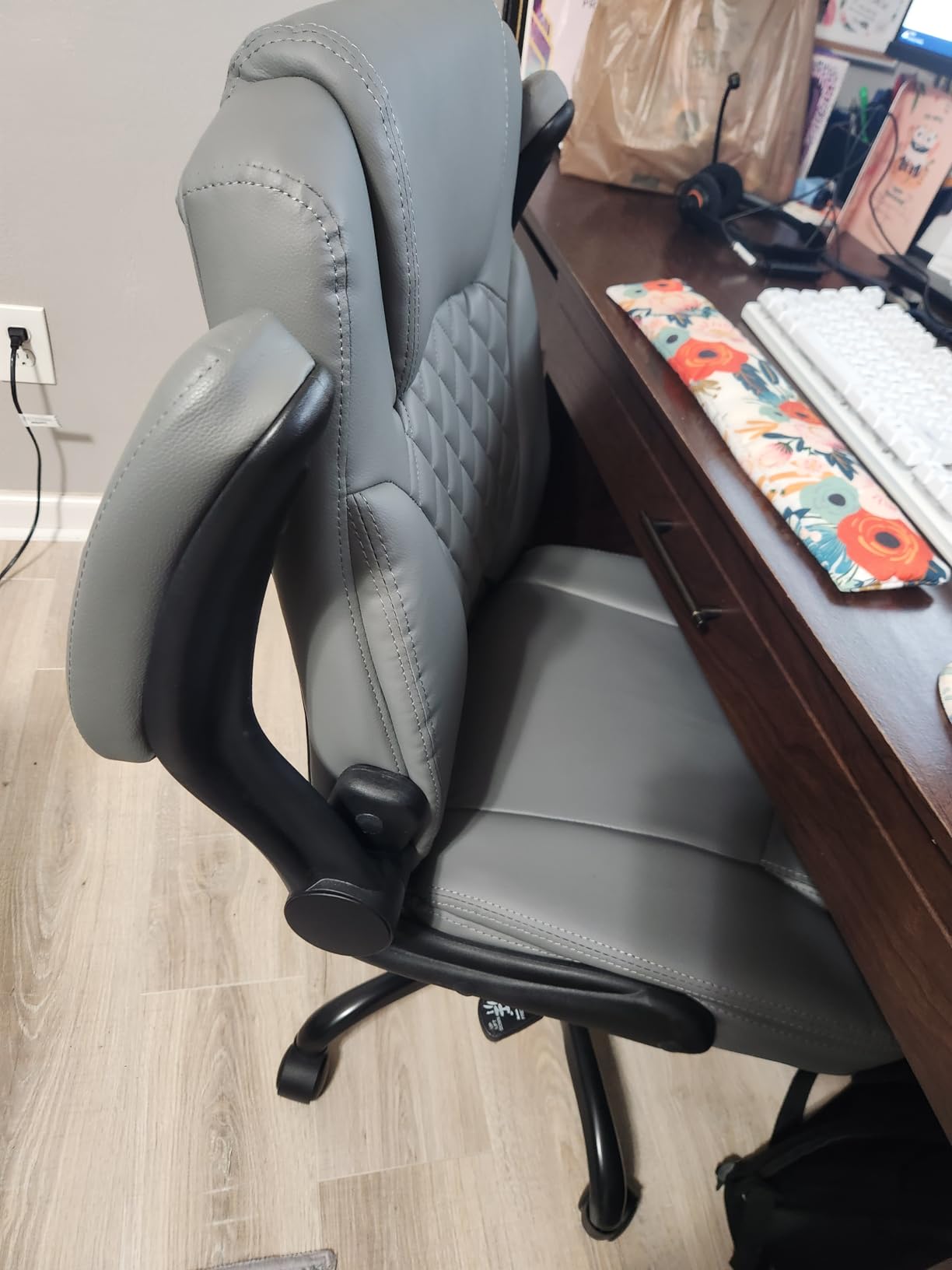
The gas lift is Level 3 certified and the chair is rated to 275 pounds, with heavy duty rubber wheels that owners report as quiet on carpet and hard floors. Assembly needs a video or manual, both supplied.
Here is the honest catch. The listed seat height is 22.4 inches with a 19.3 inch seat depth, and the back is a tall high-back. Reviewers do note that some find the chair bulkier and taller than ideal for very short users, which is the one reason this sits lower on our list.
Who the tall high-back suits
The generous back height works if you want a chair that reads as an executive seat in a home office, and the flip-up arms make it usable at a normal desk. The rocking function is a genuine comfort addition for short users who like to shift position often.
Where it falls short for small frames
A 22.4 inch listed seat height is among the tallest here, and a 19.3 inch seat depth runs longer than the armless picks above it. Users under 5’3″ will want to raise a foot even after dropping the seat to its lowest setting.
The lumbar is fixed with no adjustment, and a solid back holds more heat than mesh over a full day.
10. COMHOMA Mid-Back PU Chair: Best for Rocking and Heavier Frames
COMHOMA Mid-Back Office Chair, Ergonomic PU Desk Chair with Flip up Arms, Small Computer Gaming with Comfy Lumbar Support,Rocking Function,Sturdy Metal Base, Ink Black
Winged mid-back with lumbar
Padded 90 degree flip-up arms
Capacity 300 lb
Item weight 29.1 lb
Pros
- Rated to 300 lb giving more headroom on the weight limit
- Built-in lumbar follows the spine curve
- Flip-up padded arms for desk clearance
- Easy to wipe clean
Cons
- Casters roll poorly and snag on hard floors
- Seat padding thinner than ideal for long sitting
- Slight squeaking can develop
This chair answers the common question of whether a short user has to give up build quality. The metal base is rated to 300 pounds with BIFMA-certified casters and an SGS-certified Class 3 gas lift, which is a higher ceiling than most of the picks above it.
The mid-back is winged with built-in lumbar support following the spine’s natural curve, which reviewers call out as noticeably better than flat-backed budget chairs. The padded arms flip up, the seat rocks, and the whole chair swivels.
Under the PU leather is high-resilience foam over elastic webbing, a combination designed to resist flattening over time. The leather itself is described as scratch-resistant with a diamond-stitched centre panel.
The casters are the main complaint. Owners report that they roll poorly and snag on hard floors, and some report slight squeaking with use. At 29.1 pounds it is also a heavy chair to move around a tight space.
A wider seat for a wider frame
Seat depth is 18.11 inches, which sits in the middle of this group rather than at the shallow end. If you are short and also carry more weight than the 220 pound ProtoArc rating allows, the 300 pound capacity here is a real consideration.
What to weigh up
Comfort is widely praised, so the seat is not the issue. The trade-offs are mechanical: thin padding over long days, casters that catch on hard floors, and a weight that makes this a poor choice for a small room you move around frequently.
For rocking motion plus flip-up arms at a mid price, it is hard to find either feature anywhere else in this roundup.
11. Office Star ProGrid Mesh Manager Chair: Best for Warranty Cover
Office Star ProGrid Breathable Mesh Manager’s Office Chair with Adjustable Seat Height, Multi-Function Tilt Control and Seat Slider, Mid Back, Coal FreeFlex Fabric
Seat depth slider, 19.75 in
Rated 275 lb
Lifetime warranty on parts
Item weight 49 lb
Pros
- Seat depth slider is a real fit advantage
- One-touch controls for tilt depth and height
- Lifetime warranty on cylinder mechanism base and casters
Cons
- Heaviest chair in the roundup at 49 lb
- Wide 27 inch footprint uses more floor space
The warranty is the headline here. Office Star covers the cylinder, control mechanism, base and casters for life, with three years on upholstery fabric and foam. For a chair you intend to keep for a decade, that changes the calculation more than any single feature.
It also has a seat depth slider, the second chair in this roundup with one. One-touch pressurised controls adjust seat tilt, seat depth and seat height together, which saves the round trip through separate levers most chairs need.
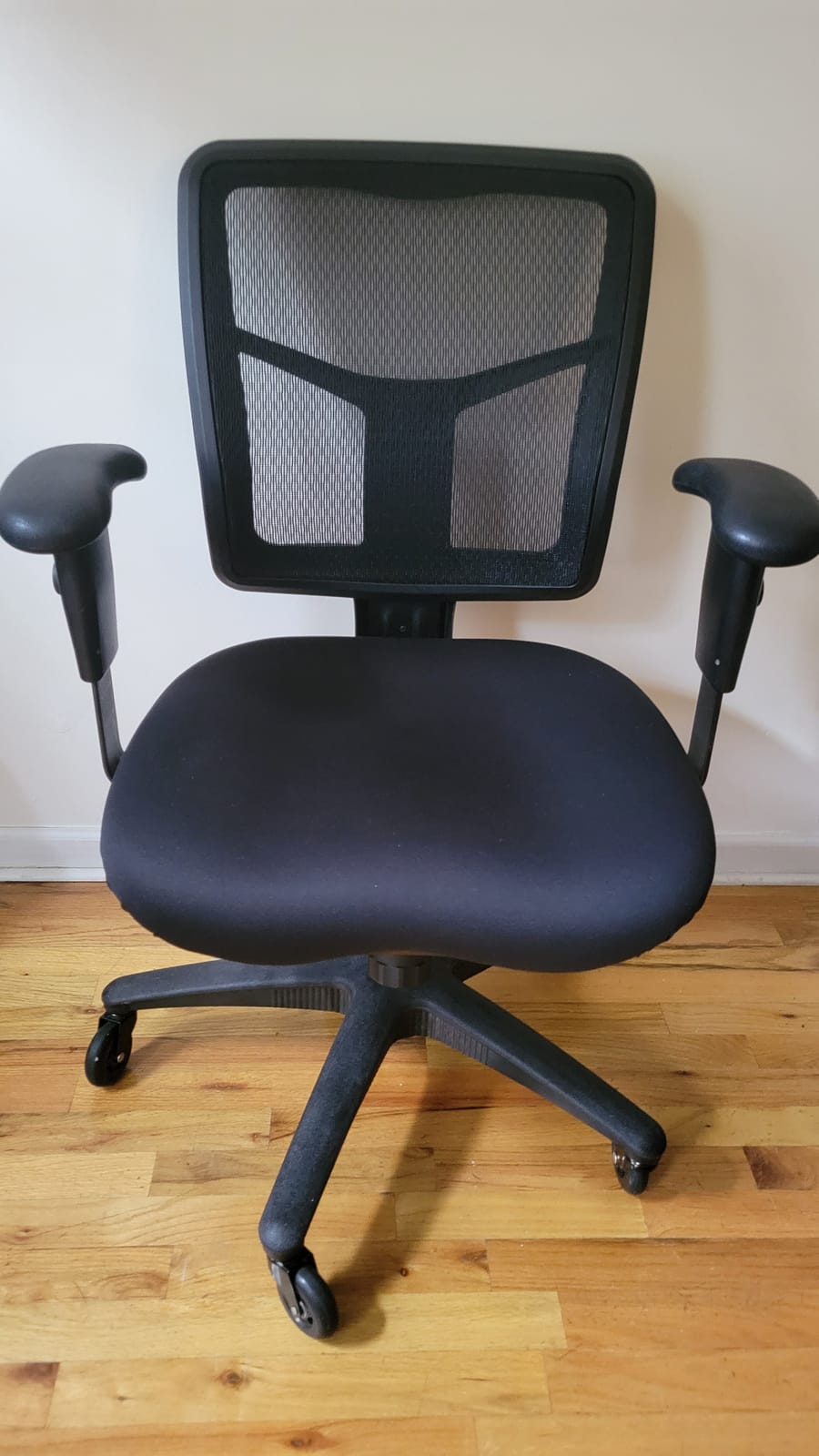
The back is an interweave ProGrid mesh with a wide lumbar adjustment range, and the armrests adjust in height. It meets or exceeds ANSI/BIFMA standards and is approved for commercial use, which is why this kind of chair shows up in shared workspaces rather than homes.
Fit is the honest problem. At 19.75 inches of seat depth and a 27 inch overall width, this is a manager’s chair in physical size, and buyers with very small frames note limited suitability.
When the slider earns its keep
If you share a desk or expect to hand the chair down to someone taller, the slider makes one chair work for two body sizes. That is a genuinely useful feature that most budget chairs simply do not have.
What you pay for the warranty
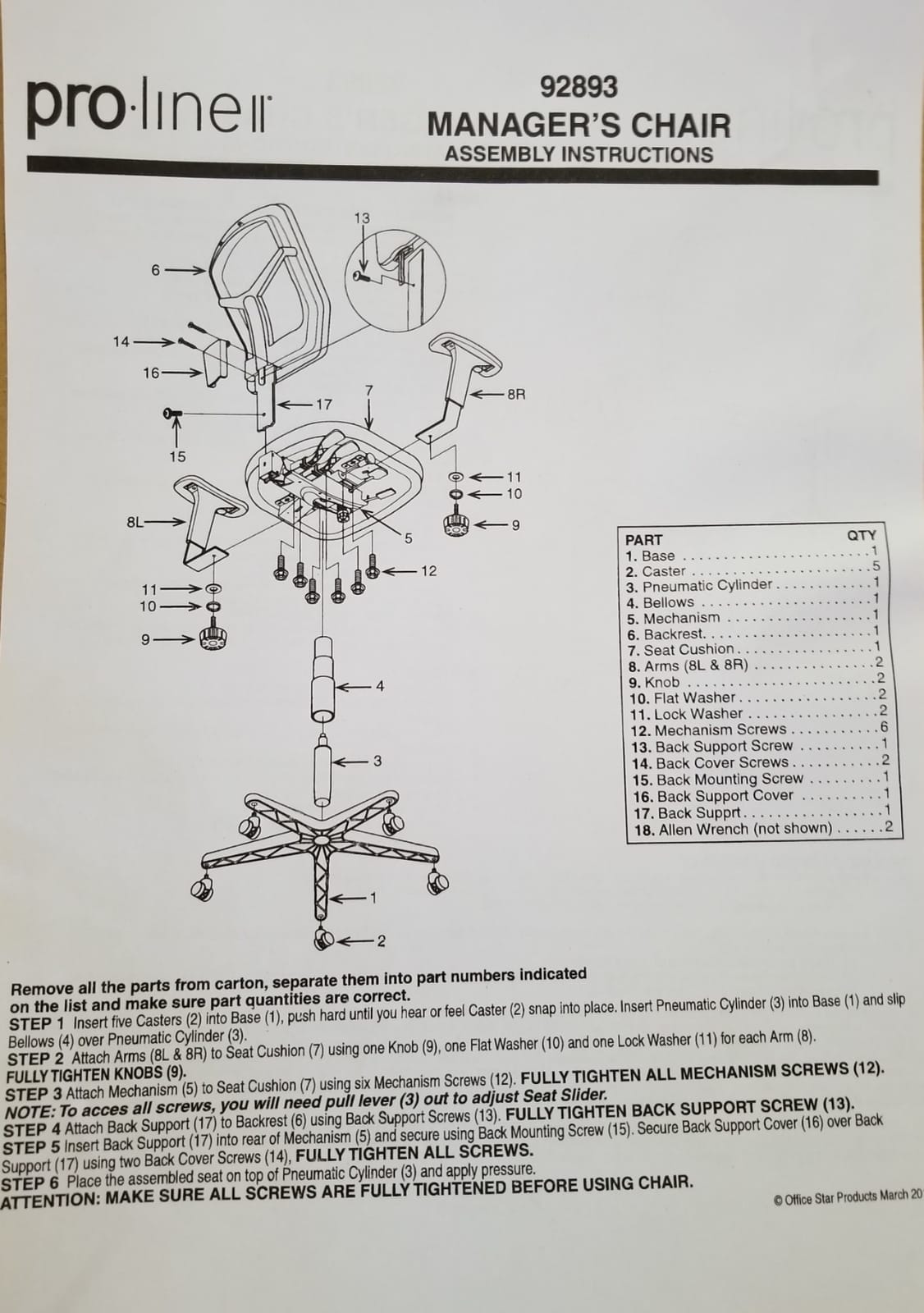
At 49 pounds this is the heaviest chair we list, and the 27 inch width takes real floor space. The bulky frame under the seat also makes assembly a two-person job despite the reassuring spec sheet.
If you are short and want the seat slider without the weight, the ProtoArc at 45 pounds is the same idea in a smaller package.
12. Modway Articulate Ergonomic Mesh Chair: Best for Tilt Control, Not for the Shortest Users
Modway EEI-757-BLK Articulate Ergonomic Mesh Office Chair in Black
Seat height 18-22 in
Seat depth 20 in
Holds 331 lb
Item weight 36 lb
Pros
- Independent seat and back tilt that can be locked
- 6 inch thick contoured mesh cushion
- Height-adjustable arms and backrest
- Highest weight capacity here at 331 lb
Cons
- 18 inch minimum seat height is too tall for the shortest users
- 20 inch seat depth is long for a 5 ft frame
- Armrests and foam reported to degrade around 4 years
We include this chair because of one feature that no other pick here has: independent seat and back tilt, each of which can be locked in place. Sitting for eight to twelve hours, the ability to lock the seat flat while the back reclines is the single best feature for pressure distribution, and long-term owners single it out.
The seat cushion is 6 inches thick, the thickest in this roundup, over a breathable mesh back with passive lumbar support. It holds 331 pounds, the highest rating in the group.
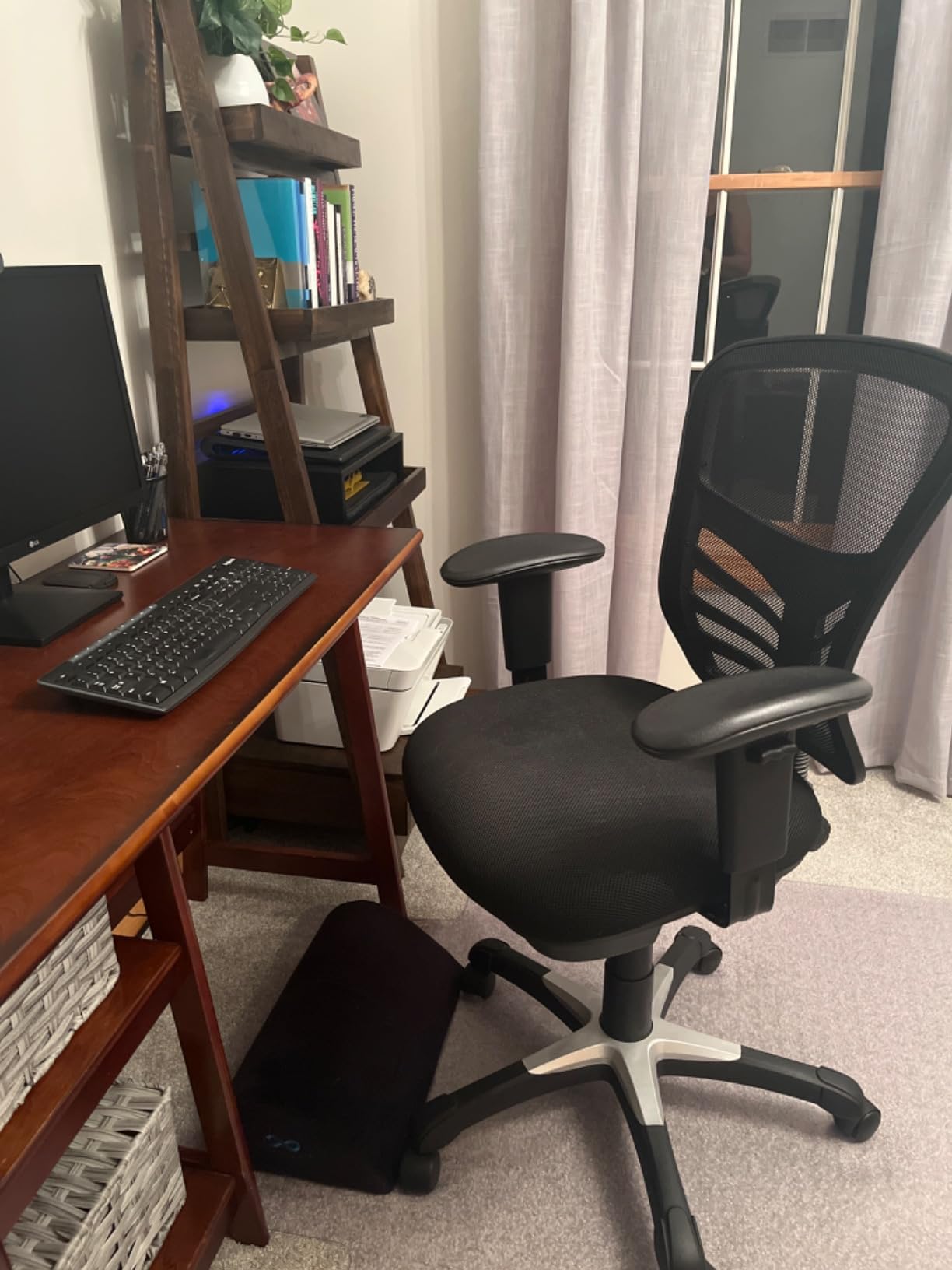
Here is why it sits at the bottom for this particular topic. The seat height range runs from 18 to 22 inches, the highest minimum in the roundup, and the seat depth is 20 inches. Both numbers push against a short frame, and reviewers confirm that the minimum height rules it out for the shortest users.
Durability is also mixed over time. Owners report armrests and seat foam degrading after roughly four years, a height lever that can slip, and base screws that loosen and need periodic retightening.
The tilt lock is worth a lot
If your pain is pressure rather than posture, being able to lock the seat pan flat while the back moves is worth more than an adjustable lumbar. That capability is genuinely rare at this price.
Why it is last on a short-user list
An 18 inch floor plus a 20 inch pan means a footrest and a forward perch. Add the 36 pound weight and the four-year component complaints, and this is a chair for someone nearer 5’8″ than 5’3″.
For the shortest users among the best office chairs for short people, look instead to the Sweetcrispy, the OLIXIS or the Serta.
How to Choose an Office Chair for a Short Frame
Five numbers decide whether a chair fits a short body, and every one of them is published somewhere on the listing or the manual. Here is the order we would check them in.
1. Minimum seat height, first and always
This is the filter that eliminates most chairs before anything else. Your feet need to reach flat with knees at about 90 degrees. The BIFMA G1-2013 ergonomics guideline treats 16 to 21 inches as the standard office adjustment range, which is why so many chairs leave a 5’2″ person dangling.
Rough guide by height: 4’10” to 5’0″ needs a floor below 16 inches, which on this list means the Sweetcrispy at 15.94 inches. 5’0″ to 5’3″ is comfortable from 16 to 17.5 inches. 5’3″ to 5’6″ usually manages at 17 to 18 inches, and above 5’6″ most standard chairs work.
2. Seat depth and the two-finger gap
Sit back against the backrest and slide your hand between the front edge of the seat and the back of your knee. Two to three fingers is the target. Zero means the seat is too deep and pressure goes to the backs of your thighs. More than a full hand means the backrest cannot support you properly.
Fixed pans under 19 inches suit short thighs well. If a chair’s pan is fixed at 20 inches or more, you are choosing between feet flat and back supported, which is the trade-off short users describe most often.
3. Lumbar placement
The lumbar pad needs to land in the small of your back, not between your shoulder blades. Because the pad sits at a fixed distance above the seat, a shorter torso moves the contact point higher relative to the pad. That is why a chair that works at 5’10” pushes into the mid-back at 5’2″.
Look for at least 2 inches of lumbar height travel. If there is none, raising the seat height shifts your whole frame relative to the pad, which sometimes corrects the problem and sometimes does not.
4. Arm width and narrow shoulders
Standard task chairs set armrests around 17 to 18 inches apart, which pushes inward on shoulders narrower than that. Under 16 inches between the armrests is the range to look for, or armless, or flip-up arms that get out of the way entirely.
Shoulder and neck ache that arrives mid-afternoon and is blamed on the seat is often the arms. Narrow shoulders plus a mid-back chair is the worst combination, and the armless picks on this list exist for that reason.
5. Body weight and seat material
This is the variable most guides skip. Foam cushions need body weight to compress into a comfortable shape, and lightweight users report foam seats feeling rock hard because nothing is displacing the foam.
Mesh and webbing seats conform without relying on weight, which is why the mesh chairs here tend to serve a wider range of body sizes. If you weigh under about 120 pounds, prioritise mesh, webbing, or a chair with a thick cushion like the DUMOS, and add a thin memory foam pad if the cushion feels thin. If you weigh over 220 pounds, check the rating, because the ProtoArc caps out at 220 and several others cap at 250.
Headrests: mostly a caution
Most headrests are positioned for a taller spine and push the head forward, which adds load to the neck. The ProtoArc is the exception here, with horizontal and tilt adjustment that lets you set it behind you rather than in front of you. Rule of thumb: if the headrest pushes your chin forward, remove it or leave it down and ignore it.
Footrests: when and how to pick one
A footrest is a legitimate purchase decision, not a compromise, when the chair you love starts above 16 inches. Four criteria matter.
First, height range. The footrest needs to reach from your floor to the gap between the seat’s lowest setting and the floor. Second, platform versus angled. A flat platform keeps your heels down and your toes slightly up, while an angled wedge can create pressure at the back of your knees, which is the problem you are trying to solve.
Third, surface. A textured or contoured top stops your feet sliding forward onto the gas lift, and cheap flat plates are the ones users report sliding across carpet. Fourth, stability. A wide base or a non-slip base beats a narrow one, especially if you push off the footrest when standing up.
Desk height: the failure mode nobody mentions
Once you set a chair correctly for a short frame, a standard 30 inch desk becomes too tall. Your elbows end up above the desk surface and your shoulders round forward to reach the keyboard, which undoes the benefit of the chair entirely.
Typing height should be roughly 8 inches above your seated elbow height. Measure that, then compare it to your desk. If the desk wins, the fix is a keyboard tray, a lower desk, or a chair whose minimum height you have not yet exhausted.
A five-minute in-store fit checklist
Sit down, drop the seat to its lowest setting, and put your feet flat on the floor. Check that both heels touch. Then slide your hand between the seat edge and the back of your knee and count fingers. Then lean fully back and confirm the lumbar pad is in the small of your back, not your mid-back.
Next, set your elbows on the armrests and shrug. If your shoulders rise, the arms are too wide. Finally, stand up and check whether the chair tucks under your desk. If you can push it in past the armrests, you have a desk clearance problem to solve before you buy.
Setting up a chair for a short body
Drop the seat to its lowest point before anything else. Then raise it until your feet are flat, which is usually the first or second notch. Slide the seat pan forward or back until you have a two to three finger gap.
Next, set the lumbar to the lowest comfortable position and adjust the arms so your elbows rest with relaxed shoulders. If the chair has a tilt lock, lock the seat flat and let only the back move. Then check your typing height against the desk before you finish.
About size, weight and refunds
Warranty length varies widely here, from a 1-year limited warranty on the Serta to a lifetime warranty on parts for the Office Star and 3 years on the ProtoArc. For a chair that sits eight hours a day, that spread is worth factoring in before you compare anything else.
Most listings on these products accept returns, so the practical move is to order the one whose numbers fit, sit in it for a week, and return it if your feet cannot reach. Reading about fit is only a proxy for sitting in it. Our guide to office partitions for open workspaces covers the other half of the setup if you are building out a shared area.
Frequently Asked Questions
What is the best office chair for petite people?
The best office chair for petite people is one whose minimum seat height drops to 16 inches or below, whose seat depth is under 19 inches, and whose armrests sit closer than 16 inches apart. In our testing the Sweetcrispy armless mesh chair reaches the lowest seat at 15.94 inches, the BestOffice chair combines a 17.1 inch floor with an 18 inch pan, and the ProtoArc EC200 is the only pick with a sliding seat depth.
What is the chair height for a 5ft person?
A 5 foot person generally wants a seat height between 15 and 17 inches with feet flat on the floor and knees near 90 degrees. The standard office range of 16 to 21 inches leaves the shortest users dangling, which is why a footrest is the usual fallback. Below 16 inches of chair adjustment, a footrest becomes a purchase rather than a workaround.
What are the best desk chairs for people with short legs?
The best desk chairs for people with short legs start with seat height, then check seat depth. Look for a minimum height at or under 17 inches and a pan between 16 and 18 inches so the seat edge does not press into the backs of the knees. On this list the OLIXIS at 16.34 inches and the Serta at 16.5 inches have the shallowest pans.
What is the best office chair for a 5-foot woman?
For a 5 foot frame, a 16 to 18 inch seat height with feet flat is the target, and armrest width matters as much as height because narrow shoulders get pushed by standard arm spacing. An armless chair or one with flip-up arms removes the problem entirely. The DUMOS, OLIXIS and Serta are armless options with the right proportions.
What is the best office chair with footrest for short people?
If your chair cannot go below 16 inches, pick a footrest with a wide base, a textured flat platform rather than a steep wedge, and enough height range to reach your floor. A flat platform keeps heels down and toes up without pressing into the backs of your knees. Wedge-style footrests can create exactly the thigh pressure you are trying to avoid.
What is the best office chair for someone with short height?
Start with minimum seat height, then seat depth, then arm width, in that order. Anything starting above 18 inches will leave a person under 5’3u0022 perching. The strongest all-round option here is the BestOffice mesh chair at a 17.1 inch floor, while the ProtoArc EC200 wins if you need the seat pan to actually shorten.
What are the best office chairs for short people?
The best office chairs for short people are the BestOffice mid-back mesh chair for the lowest floor among full-size models, the ProtoArc EC200 for its sliding seat depth and adjustable lumbar, and the Sweetcrispy armless chair for the lowest seat height overall. Add a footrest if your chair starts above 16 inches, and check that typing height sits about 8 inches above your elbow.
The Best Office Chair for Short People in 2026
The best office chairs for short people come down to four published numbers: minimum seat height, minimum seat depth, lumbar travel and arm width. The BestOffice mid-back mesh chair leads this roundup because its 17.1 inch floor and 18 inch pan cover the largest band of short frames without any adjustment.
Go deeper with the ProtoArc EC200 if you need the seat pan to physically shorten, drop to the Sweetcrispy if you are closer to 5’0″, and skip anything that starts above 18 inches unless you are adding a footrest. Check your typing height against your desk once the chair is set, and that is the whole fit.