
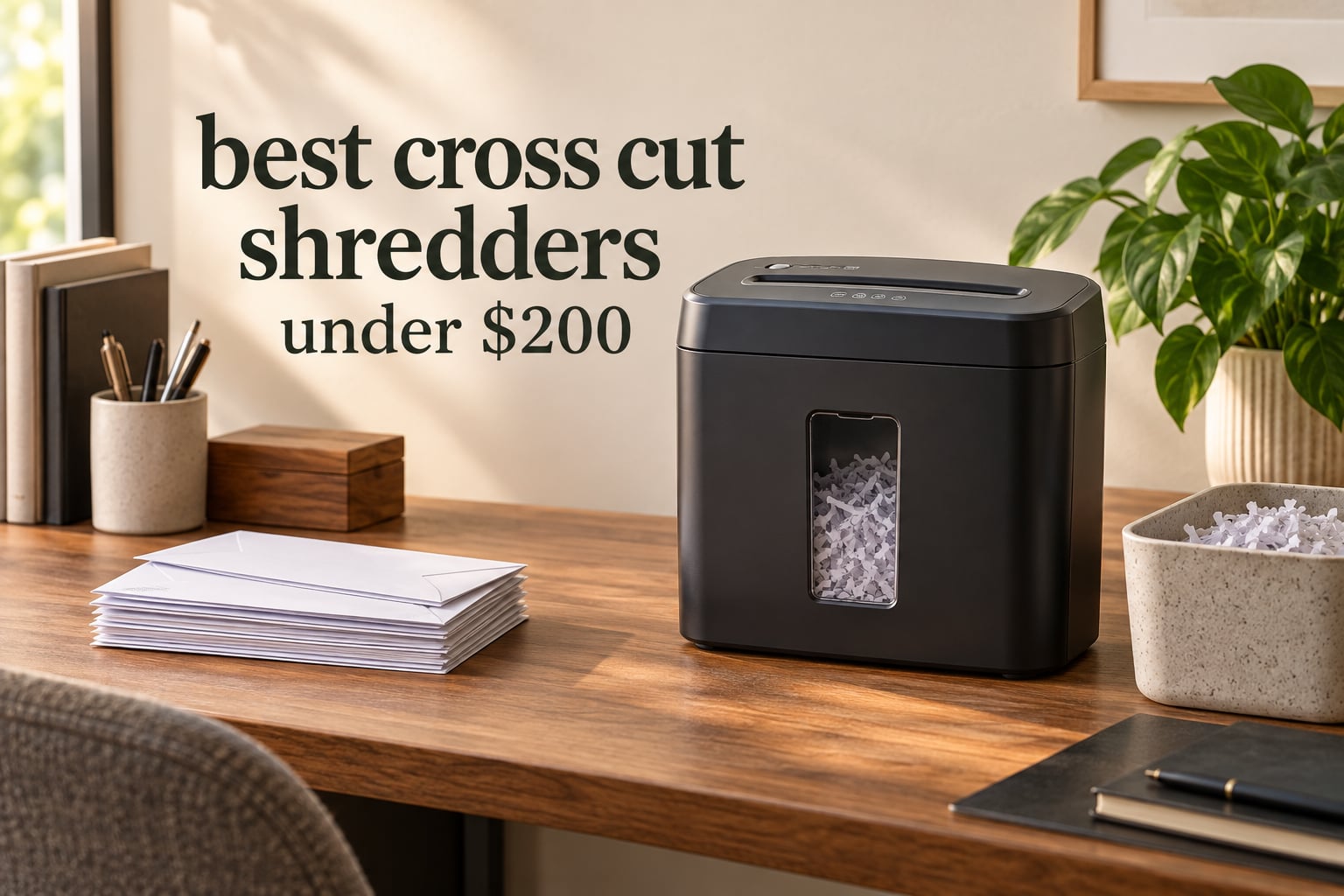
Paper on your desk has a short life. Bank statements, medical bills, credit card offers and tax paperwork all arrive by mail, and most of it goes straight into a recycling bin where it stays readable. A cross cut shredder reduces a sheet to hundreds of small rectangular pieces instead of long strips, which is the cheapest meaningful upgrade you can make to how you handle mail at home.
We spent weeks going through the cross cut shredders available under 200 dollars, reading owner reviews, comparing cutter specifications and looking hard at the failure reports that show up in forums. This guide covers every model we could find in that band, including two micro-cut machines that fit the budget and are worth the comparison.
Short answer: The Bonsaii C237-B is the best cross cut shredder under 200 dollars for most homes, because it packs a P-4 cross cut, credit card shredding and an under-desk footprint into a 6.6-pound body that has held a 4.4-star average across more than 58,000 owner reviews. The Amazon Basics C276-A is the cheapest credible option with a name you can trust, and the Aurora AS890C is the best value if you want proven long-term durability.
One thing to say up front, because it is the objection we hear most. Wirecutter dropped cross cut models from its recommendations in favour of micro cut shredders, arguing that micro cut now costs barely more and produces far smaller pieces. That is a fair point about shred size. For most home mail, though, a cross cut shredder removes the readable text entirely, and it does so for roughly a third of what a micro cut machine costs. We cover the tradeoff in full below.
If you are outfitting an actual office rather than a study, our guide to the best commercial paper shredders for offices covers continuous-duty machines. For heavier home workloads, read the best heavy duty paper shredders for home offices roundup alongside this one.
Table of Contents
Top 3 Picks for Cross Cut Shredders Under 200 Dollars

Bonsaii C237-B 6-Sheet Cross Cut
- P-4 5x14mm cross cut
- 6 sheets per pass
- 3.4 gallon bin
- 4 minute run time
Aurora AS890C 8-Sheet Cross Cut
- 8 sheets per pass
- 8.7 inch throat
- 3.4 gallon basket
- steel enclosure

Amazon Basics C276-A 8-Sheet
- P-4 5x18mm cross cut
- 8 sheets per pass
- 3.7 gallon bin
- 4 mode controls
Quick Overview: Every Cross Cut Shredder We Covered
| Product | Specifications | Action |
|---|---|---|
| Bonsaii C237-B 6-Sheet Cross Cut |
|
Check Latest Price |
| Amazon Basics C276-A 8-Sheet Cross Cut |
|
Check Latest Price |
| Aurora AS890C 8-Sheet Cross Cut |
|
Check Latest Price |
 Bonsaii C275-A 12-Sheet Cross Cut Bonsaii C275-A 12-Sheet Cross Cut |
|
Check Latest Price |
 Fellowes 14C10 14-Sheet Cross Cut Fellowes 14C10 14-Sheet Cross Cut |
|
Check Latest Price |
 Bonsaii C149-C 18-Sheet Cross Cut Bonsaii C149-C 18-Sheet Cross Cut |
|
Check Latest Price |
 BONSEN S3104 20-Sheet Cross Cut BONSEN S3104 20-Sheet Cross Cut |
|
Check Latest Price |
 Locksworth AZ1692VC 6-Sheet Cross Cut Locksworth AZ1692VC 6-Sheet Cross Cut |
|
Check Latest Price |
 Aurora AU870MA 8-Sheet Micro Cut Aurora AU870MA 8-Sheet Micro Cut |
|
Check Latest Price |
 Aurora AU1285MD 12-Sheet Micro Cut Aurora AU1285MD 12-Sheet Micro Cut |
|
Check Latest Price |
1. Bonsaii C237-B 6-Sheet Cross Cut: Best Overall for Most Homes
Bonsaii 6-Sheet Cross Cut Paper Shredder for Home, 3.4 Gal Bin
P-4 cross cut at 5x14mm
6 sheets per pass
3.4 gallon bin
4 minute run time
Pros
- Fits under a desk at 7 x 11.2 x 14 inch
- Shreds cards staples and clips without removing staples
- Over 58k owner reviews at 4.4 stars
- Manual reverse helps clear jams
Cons
- 4 minute run time is short for bulk jobs
- Some owners report repeated overheat cut-offs
- Shred lubricant sheets not included
The Bonsaii C237-B is the model we keep coming back to because it does the small things right. It sits at 7 inches deep by 11.2 inches wide by 14 inches tall, which means it tucks under a desk without stealing legroom, and at 6.6 pounds you can move it between rooms without thinking about it.
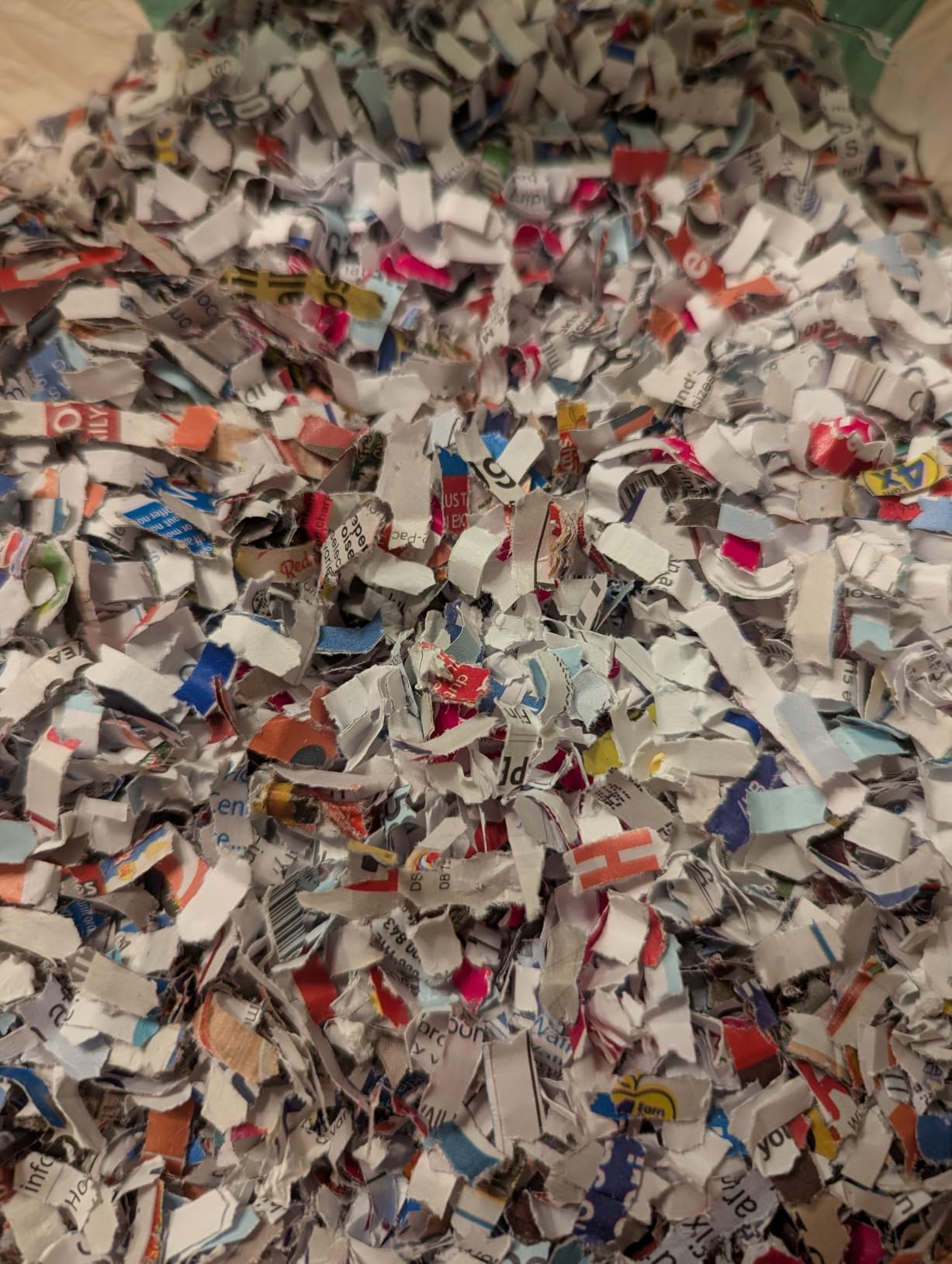
The cut is a genuine P-4 cross cut at 5 x 14mm particles, tighter than many competitors at the same price level. Six sheets go in at once, and it takes staples, paper clips and a credit card without any preparation.
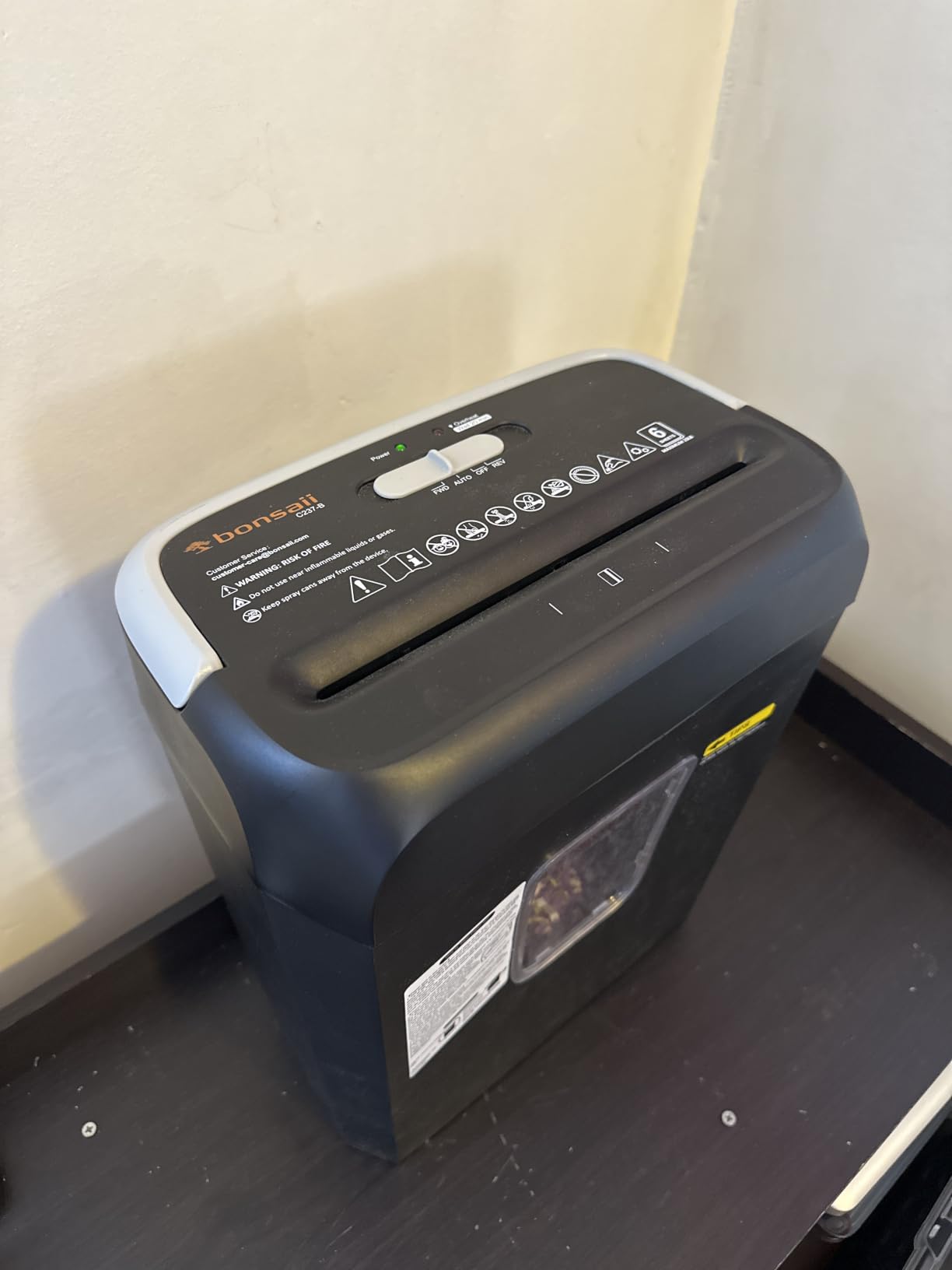
Auto start and stop means you drop the paper and walk away, and a manual reverse control helps you back a stuck sheet out instead of fishing with the power off. The head lifts off the bin so you can carry the whole thing to a larger wastebasket rather than tip shreds across the floor.
The honest weakness is run time. Four minutes of continuous shredding with a 20-minute cooling cycle is short, and a minority of owners report repeated overheat cut-offs during moderate workloads. If you are clearing out years of paperwork in an afternoon, look at the 12-sheet Bonsaii or the BONSEN instead.
What you get for the money
At the entry level of this category, the C237-B is unusually well specified. The clear front window shows fill level, the cutter head stops when you lift it, and the 3.4-gallon bin is a size most competitors at this tier cannot match.
The 1-year warranty is standard rather than generous, and the absence of an oil sheet in the box is a small annoyance. Budget a bottle of shredder lubricant and a pack of bin liners, and this machine behaves like a step up.
Where it falls short
It is not a heavy-duty machine despite the marketing, and treating it like one leads to frustration. Overloading the slot past the rated six sheets is the fastest way to trigger the thermal cutoff.
If your mail volume is high or you shred documents daily rather than occasionally, this is not the pick. It is the pick for a home office that sees a handful of statements a week.
2. Amazon Basics C276-A 8-Sheet Cross Cut: Most Versatile
Amazon Basics 8-Sheet High Security Cross Cut Paper and Credit Card Shredder with P-4 Security, Auto Shut-off, Black
P-4 cross cut at 5x18mm
8 sheets per pass
3.7 gallon bin
70 dB rated
Pros
- Largest review base in the category at over 78k ratings
- Four mode switch with LED status lights
- Automatic overheat shut-off
- Lift-off bin with clear window
Cons
- Noticeably loud at roughly 70 dB
- Feed slot is narrow and untapered
- Works best at 3-4 sheets per pass
- Will not take metal credit cards
The Amazon Basics C276-A is the highest-volume seller in the shredder category, and that matters more than it sounds. With more than 78,000 owner reviews at 4.3 stars, you are buying into a product that has been stress-tested by an enormous number of people, and the failure patterns are well documented.
The cut is a P-4 cross cut producing roughly 5 x 18mm pieces, with a rated capacity of eight sheets. It handles credit cards, staples and small paper clips, and the four-position control switch covers auto/on, off, reverse and forward with LED indicators for power, overheat and overload.
Run time is the weak point: three minutes of shredding followed by a 30-minute cool-down. That is the shortest duty cycle in this roundup alongside the Locksworth, and it is why we rate this as a steady-weekday machine rather than a session machine.
Owners consistently report that feeding three or four sheets at a time is smoother than trying to max out the rated eight, and that the untapered, narrow feed slot takes some getting used to. It will not shred metallic credit cards, which matters if your cards have a chip or a metal foil core.
Why the review count changes the maths
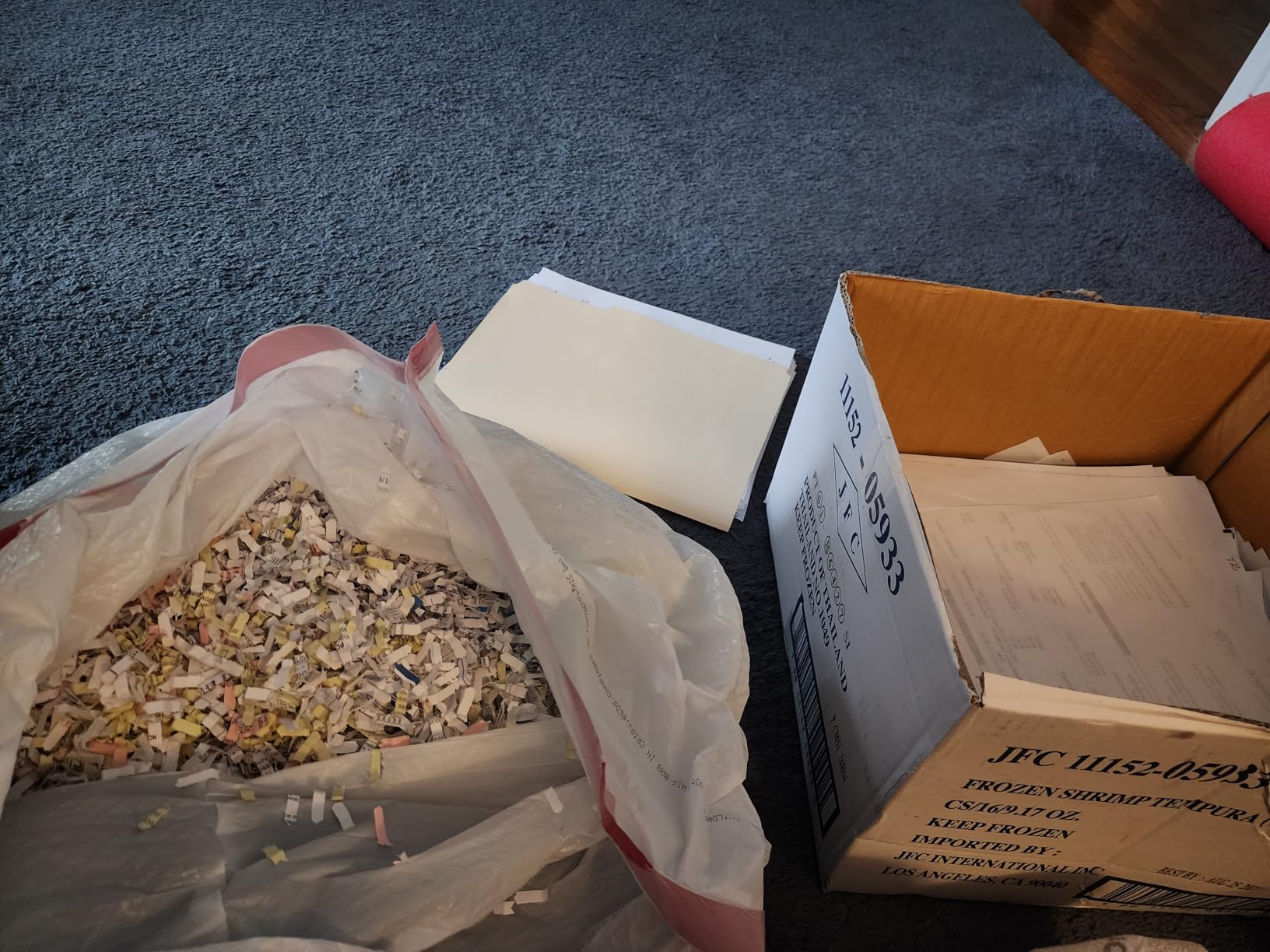
When a product has tens of thousands of reviews, the failure modes stop being hypothetical. The loud operation, the small bin and the narrow slot all show up repeatedly, but none of them are serious defects, and there is no widespread report of cutter failure in the first year.
The 3.7-gallon lift-off bin is roomier than most competitors this size, and the window means you know when to empty it. If you are shredding a mailbox on a Saturday morning, this one will need two bin trips.
Where it falls short
At 70 dB this is one of the louder machines here. In a small apartment where shredding happens during a call, that is a real annoyance rather than a spec-sheet detail.
The three-minute duty cycle rules it out for moving and clean-out jobs. For tax-season backlogs, plan on taking breaks, or spend up on a longer-running model.
3. Aurora AS890C 8-Sheet Cross Cut: Best Value for Long-Term Reliability
Aurora AS890C 8-Sheet Cross-Cut Paper/Credit Card Shredder with Basket
8 sheets per pass
8.7 inch throat width
3.4 gallon basket
Alloy steel enclosure
Pros
- 4.6 star average across nearly 25000 reviews
- Alloy steel enclosure rather than all-plastic body
- Handles card stock cards and staples
- Simple lift-off head for emptying
Cons
- 3.4 gallon basket fills quickly
- Noisy during operation
- Auto-feed sensor sits only in the centre
- US plug and 120V only
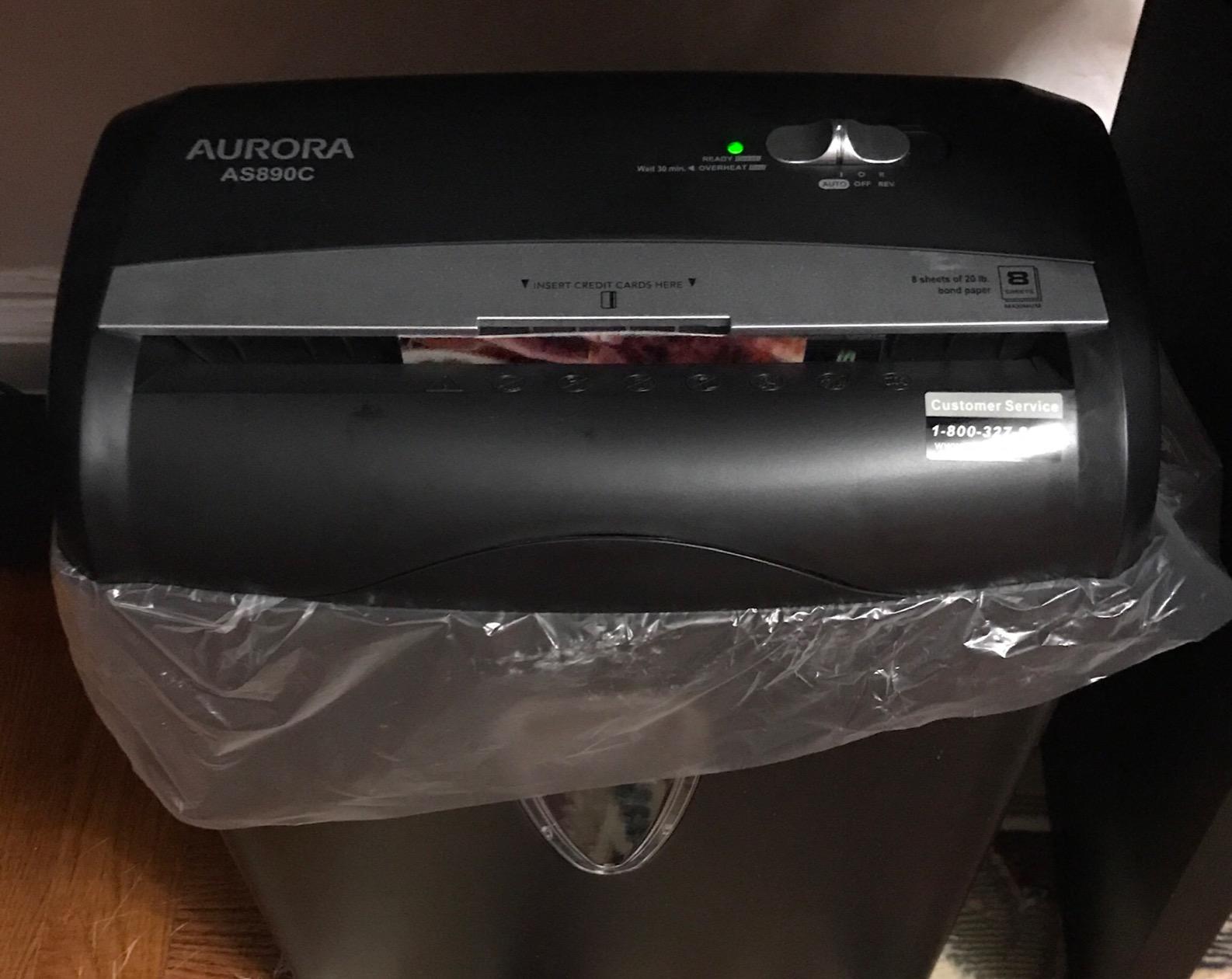
The Aurora AS890C has the highest rating of any cross cut machine in this guide at 4.6 stars across almost 25,000 reviews, and the reviews repeatedly describe it as a machine that simply keeps working. Owners report the same unit still running after a year of heavy use.
The enclosure is alloy steel rather than plastic, which is unusual at this price and explains part of that durability record. The throat is a wide 8.7 inches, so envelopes, statements and folded documents feed in without awkward alignment.
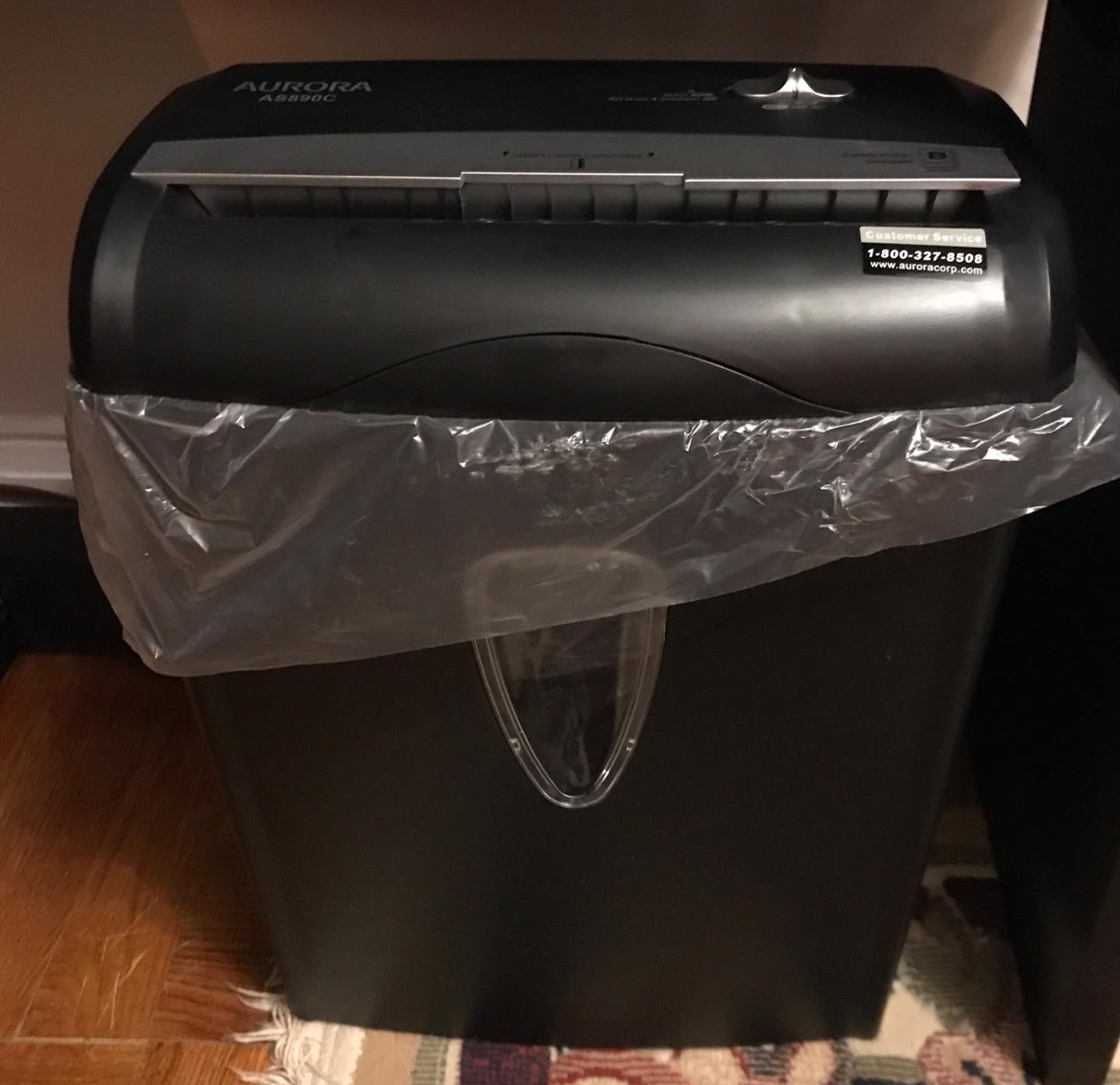
Automatic start and stop handles the feeding, and the portable handle plus lift-off head make the bin easy to carry out. Rated capacity is eight sheets, and it takes credit cards, paper clips and staples without complaint.
Where owners temper the praise is throughput and volume. Best results come from feeding three or four sheets rather than the full eight, and the 3.4-gallon basket needs emptying more often than you would expect from an eight-sheet machine.
Why the steel body matters
Most budget shredders use plastic shells that crack or flex around the cutter head over time. A steel enclosure holds its alignment, which keeps the blade gap consistent and reduces the jams that come from a warped frame.
That is also why second-hand advice on forums tends to favour this model for anyone buying a shredder they expect to keep for a decade rather than a couple of years.
Where it falls short
The auto-feed sensor sits only in the centre of the slot, so small scraps have to be centred or they will sit at the edge ungrabbed. It is a small habit to build, but it is a habit you have to build.
It is loud, and the US plug with 120V-only operation means it is not suited to other voltage standards without a converter. For most buyers that is fine.
4. Bonsaii C275-A 12-Sheet Cross Cut: Best for Mail Stacks and Junk Mail
Bonsaii 12-Sheet Cross Cut Paper Shredder, 5.5 Gal Home Office Heavy Duty Shredder for Paper, Credit Card, Mail, Staples, with Transparent Window, High Security Level P-4 (C275-A)
P-4 cross cut at 5x20mm
12 sheets per pass
21 liter bin
6 minute run time
Pros
- Handles multi-box clean-out jobs
- Patented cooling system supports long sessions
- 5.5 gallon windowed bin holds a lot
- Tucks under a desk at 18.3 inch height
Cons
- Bin plastic feels cheap and flimsy
- Loud while running
- Slower at full 12-sheet batches
- Thick stacks may need pushing
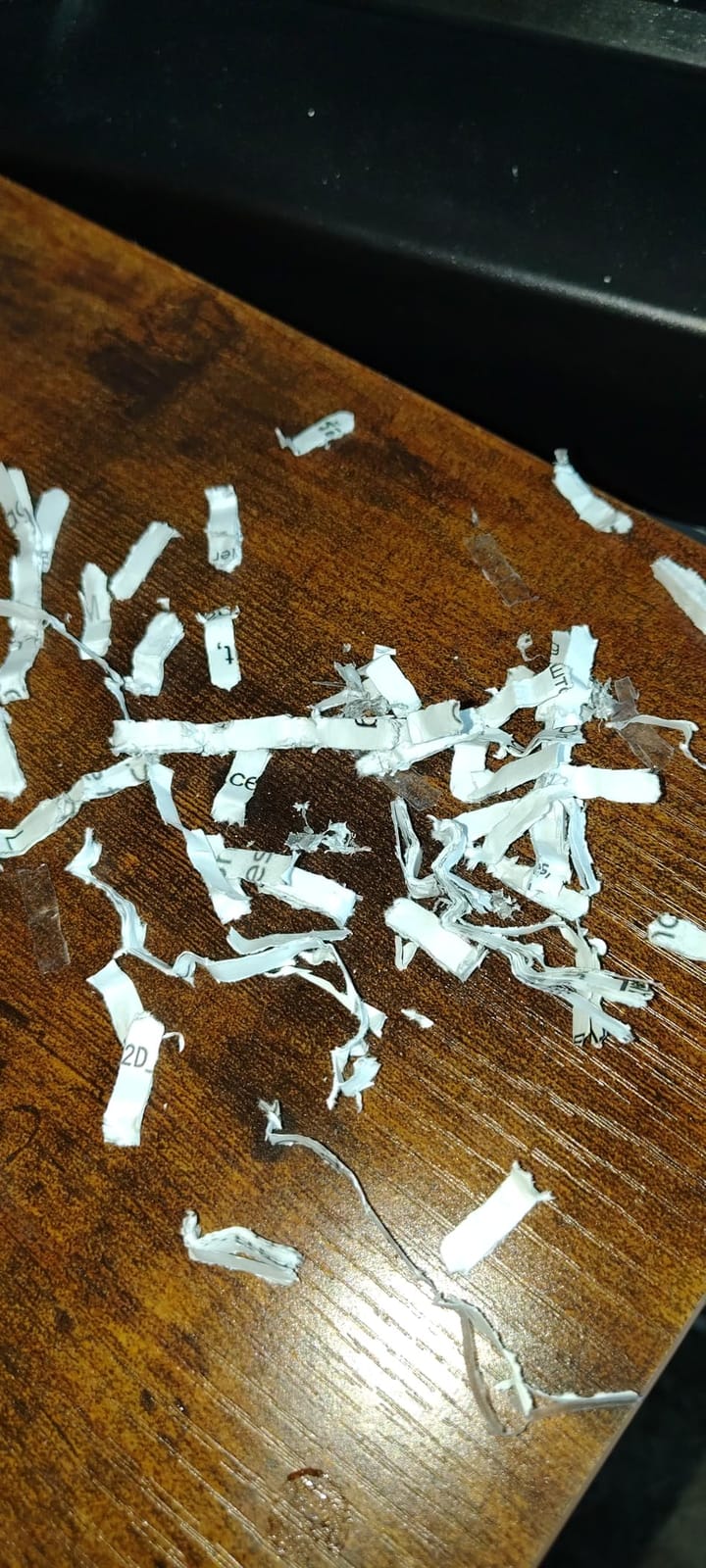
If your paper problem is junk mail rather than confidential documents, the C275-A is built for volume in a way the six-sheet models are not. Twelve sheets per pass at a P-4 cross cut, shredding into 5 x 20mm particles, and a 21-litre windowed bin that holds roughly five times what the compact units swallow.
The patented cooling system gives a rated six minutes of continuous running, and owners report running it for close to an hour in practice while working through six boxes of paperwork. Auto start and stop, manual forward and reverse, and overheat protection round out the controls.
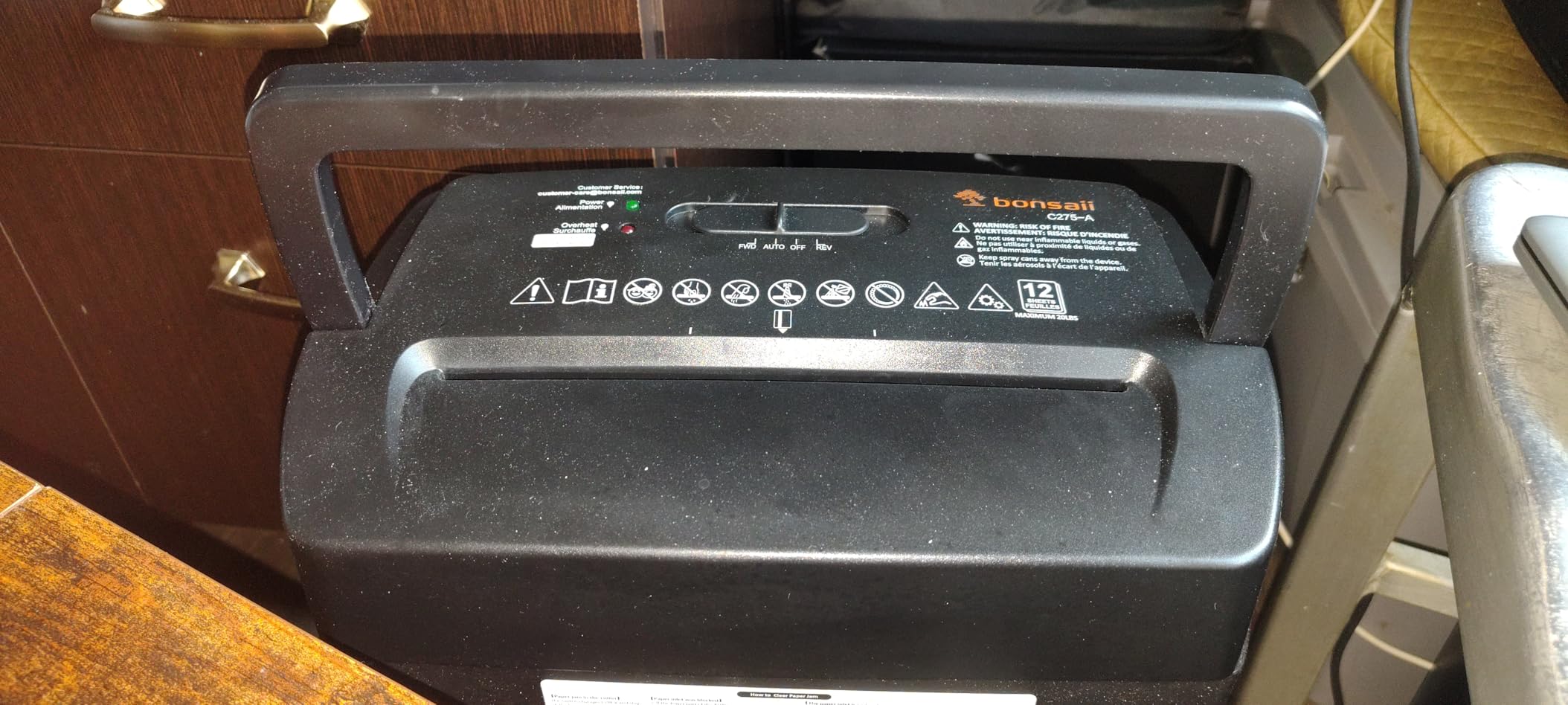
Stapled and folded documents go through without the need to pull staples first, which is a bigger time saver than it sounds when you are working through a filing backlog. The footprint at 12.6 by 7.91 by 18.3 inches still fits under a standard desk.
Throughput drops noticeably at the top of the range. Pushing ten to twelve sheets at once slows the cutters and occasionally needs a nudge, so the practical advice from owners is to feed in batches of five or six and let the machine breathe.
Where this one earns its place
The gap between a six-sheet and a twelve-sheet head is not about security, since both are P-4. It is about how long you sit there. On a clean-out day, the twelve-sheet head turns a two-hour job into something much shorter.
The larger bin is the other quiet win. Fewer emptying trips means fewer spilled shreds, and spilled shreds are the ones that end up back on your floor looking like confetti you have to vacuum.
Where it falls short
At 12 pounds with a plastic bin, this is a budget machine with budget materials. The bin walls flex, and several owners single out the plastic as feeling flimsy even while praising the machine’s work rate.
It is loud, and it does not shred CDs or DVDs. If you have discs to destroy, add a dedicated machine or move up to a micro-cut model with a media slot.
5. Fellowes 14C10 14-Sheet Cross Cut: Best for Shared Rooms
Fellowes 14C10 14-Sheet Cross-Cut Home Office Paper Shredder
P-4 cross cut, 14 sheets per pass
5 gallon pull-out bin
10 minute run time
Patented safety lock
Pros
- Large pull-out bin holds over 250 shredded sheets
- Quiet operation rated for shared workspaces
- Takes unopened junk mail and cards
- 5-year cutter warranty on the cutting head
Cons
- Bulkiest deskside footprint in the roundup
- Heavier than the compact models
- Pricier than the entry-level units
The Fellowes 14C10 is the pick when the shredder lives in a room other people are in. Its listed selling point is quiet operation, and at 14 sheets per pass with a 5 x 1-9/16 inch cross cut it is the most capable deskside machine in this group without becoming a floor-standing unit.
Run time is ten minutes continuous, comfortably longer than the compact models, and the 5-gallon pull-out bin holds over 250 shredded sheets. That bin design is the reason we like it: you slide it out, bag it and slide it back rather than lifting a loose basket and scattering the contents.
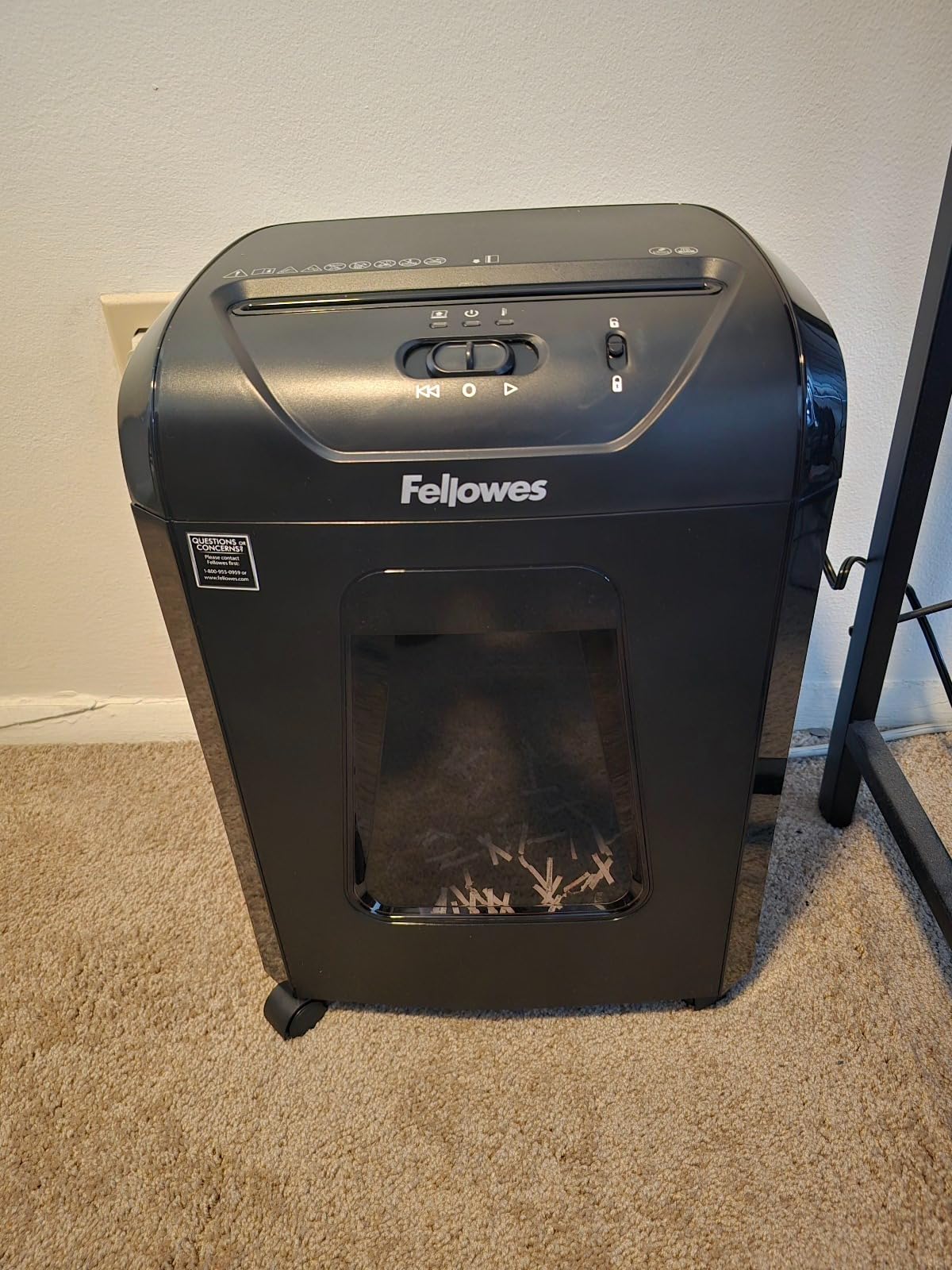
It handles credit cards, staples, paper clips and unopened junk mail, which covers the full spread of what lands in a home mailbox. A patented safety lock disables the machine, and the head stops when lifted.
Warranty is where this model separates itself. You get one year of product and service coverage plus a five-year warranty on the cutter, which is a meaningful signal about expected blade life on a machine sold well below the 200 dollar ceiling.
Why the bin design matters more than the sheet count
Shreds that scatter when you tip a basket are the most common complaint across shredder reviews, and a pull-out bin with a liner eliminates the problem. It is a small engineering choice with a large effect on how often you dread emptying the thing.
The safety lock is the other quiet detail. In a house with a curious toddler or an apartment with a cat, a machine that can be disabled when not in use is worth more than an extra two sheets of capacity.
Where it falls short
At 9.69 by 13.44 by 19.69 inches, it is the largest desktop footprint here, and it will not tuck under a low desk. Plan on a corner of a room rather than under a workstation.
It does not shred CDs or DVDs, and the cross-cut particle size is coarser than the micro-cut models on this list. If you shred sensitive material every day, the security gap matters more.
6. Bonsaii C149-C 18-Sheet Cross Cut: Best for Long Shredding Sessions
Bonsaii 18-Sheet Cross-Cut 60-Min Run Heavy Duty Paper Shredder
18 sheets per pass at P-4
60 minute continuous run time
6 gallon pull-out basket
62 dB rated
Pros
- Up to 60 minutes continuous on an advanced cooling system
- Quiet at 62 dB for a machine this size
- Four casters make it easy to move
- Large 6 gallon basket with fill window
Cons
- Bulky 23 pound floor-standing body
- 21.5 inch height means no under-desk storage
- Casts a shadow against the cheaper units in this list
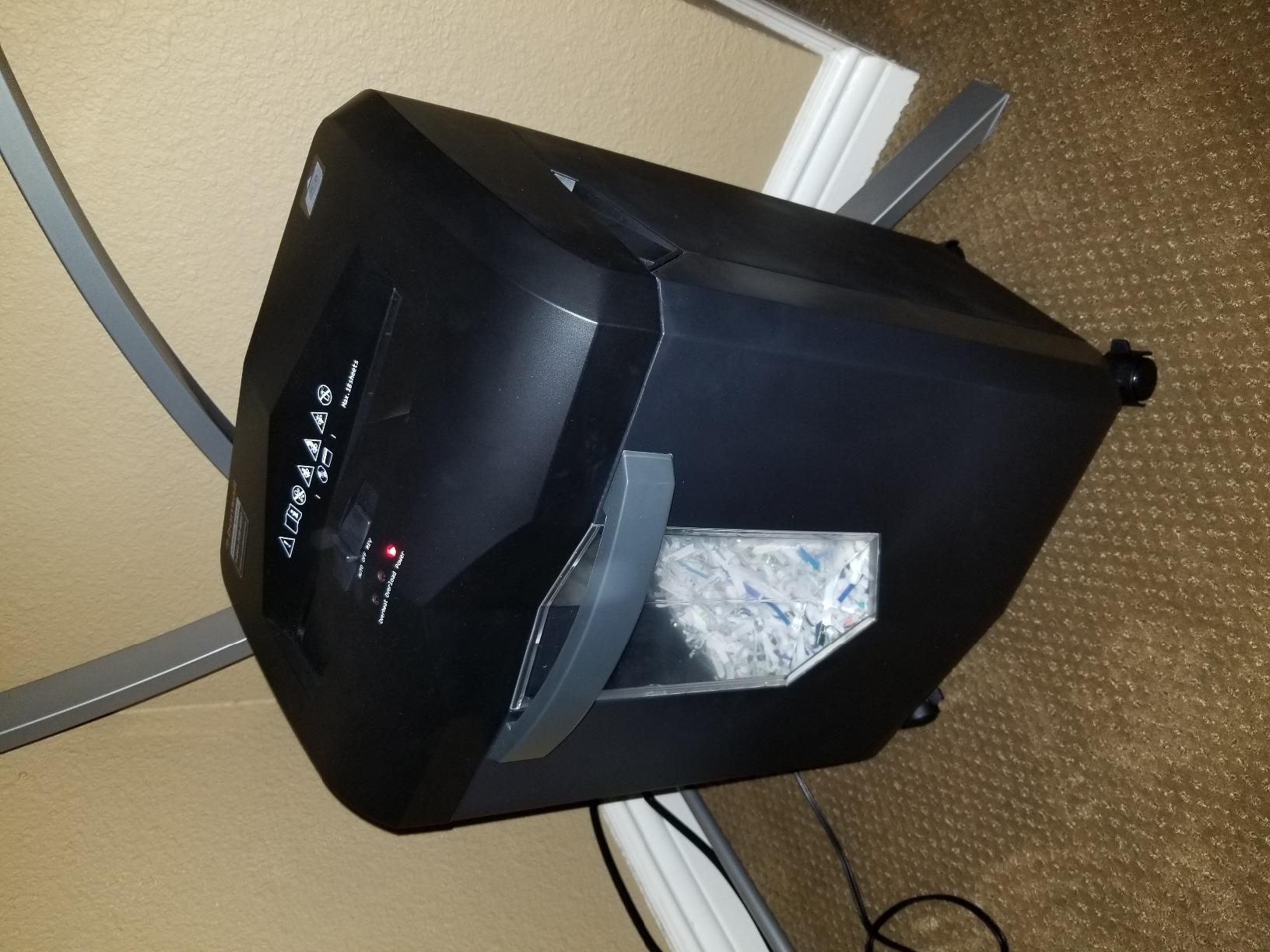
The C149-C is the cross cut machine for a home office that actually generates paperwork, not one that occasionally shreds a statement. Eighteen sheets per pass at P-4 security, producing 5 x 25mm particles, and a rated run time of up to 60 minutes continuous.
That run time is the number that changes daily life. An hour of continuous shredding means you can empty a shoebox of mail in one session without watching for a thermal cutoff, which is exactly the complaint that dominates forum threads about cheaper units dying after seven to ten minutes of use.
At 62 dB it is quieter than most machines in this roundup despite handling 18 sheets, and four casters mean you roll it out for a session and roll it back into a corner afterwards. The 6-gallon pull-out basket has a transparent window so you can see how full it is.
Auto start and stop, auto reverse for jam recovery, and both overheat and overload protection are present. The enclosure is a mix of alloy steel and plastic, which is the usual recipe for this weight class.
Who should buy this one
If you run a small business from home, or you are the person who handles paperwork for an older parent, this is the machine. Sixty minutes of run time means a batch of documents gets processed in one pass rather than in three.
The 62 dB rating also makes it the pick if someone works from the same room. It is a machine you can run without planning around it.
Where it falls short
Size is the dealbreaker for some. At 23.1 pounds and 21.5 inches tall, it needs floor space and cannot go under a desk, so it is a poor fit for a dorm, a small flat or a converted closet office.
The cross-cut particles at 5 x 25mm are the coarsest of the P-4 machines here. That is standard, but if you are destroying identity documents rather than junk mail, read the micro-cut section below before you settle.
7. BONSEN S3104 20-Sheet Cross Cut: Best for Continuous Heavy Work
BONSEN 20-Sheet Cross-Cut P-4 High Security Heavy Duty Paper Shredder
20 sheets per pass
Nitrided steel cutter
6.6 gallon bin on casters
60 dB or less
Pros
- Highest rated in the roundup at 4.7 stars
- Nitrided steel cutters resist blade wear
- 60 plus minutes of continuous jam-resistant shredding
- Quietest rated figure here at 60 dB or less
Cons
- Largest and heaviest unit in the list
- Manual operation mode rather than full auto start/stop
- Smaller review base than the mainstream home models
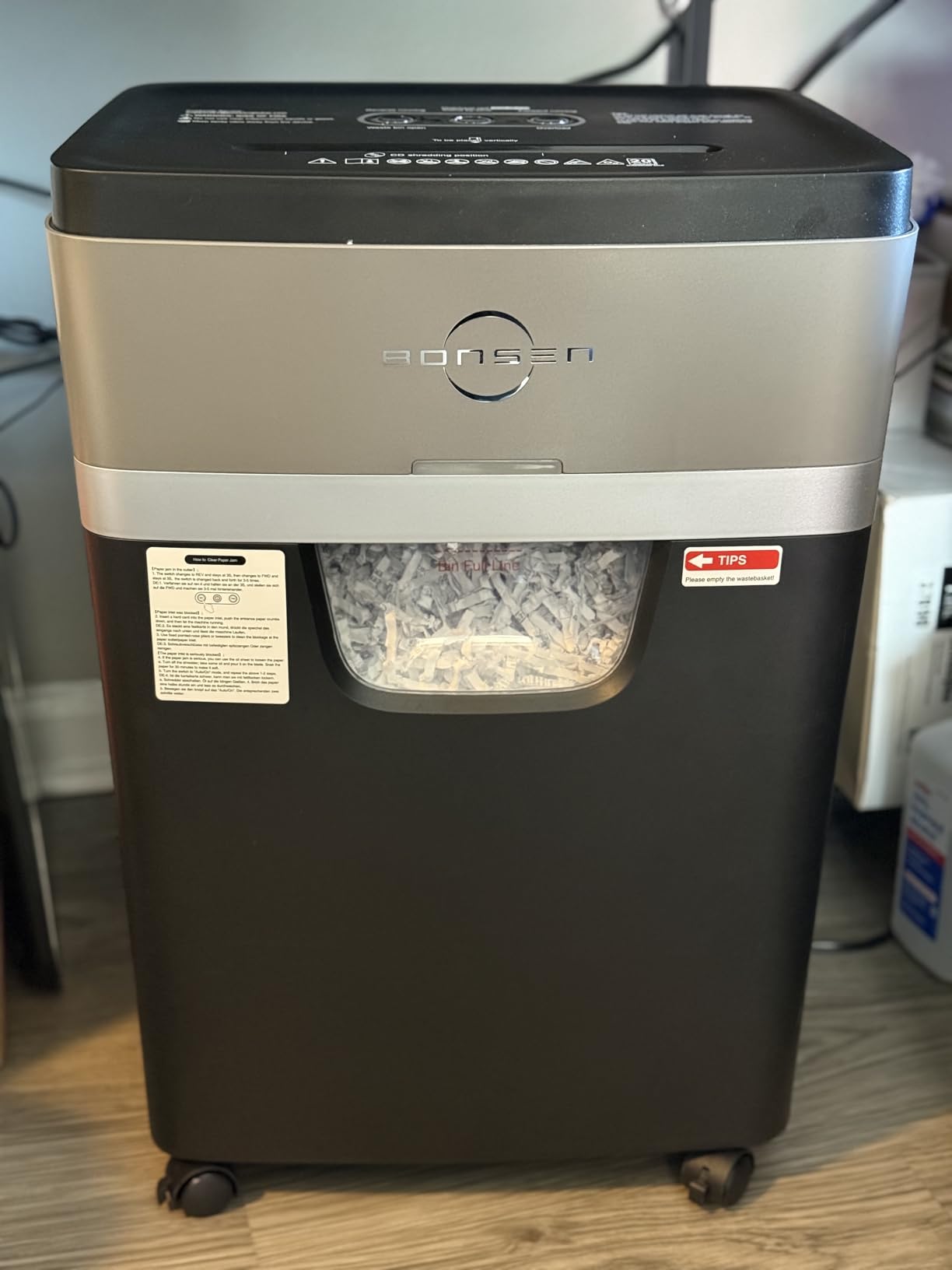
The BONSEN S3104 sits at the top of the under-200-dollar range and is the only machine here that reads like a small commercial unit. Twenty sheets per pass at P-4 security, with a nitrided steel cutter rather than the tool steel used in budget machines.
Nitrided steel is the same class of hardening used on professional cutter heads, and it is the main reason this machine holds an edge when fed cardboard, staples and clips day after day. Run time is more than 60 minutes continuous, supported by an advanced cooling system and a thickened, abrasion-resistant housing.
It is also the quietest option we reviewed, rated at 60 dB or less, which is unusual for a 20-sheet head. The 6.6-gallon pull-out bin sits on casters and holds roughly 520 shredded sheets, so emptying is infrequent even for a home business doing daily runs.
One specification to note carefully: this is a manual operation mode rather than a fully automatic start and stop unit. That means you hold the switch or the sensor is less hands-off than the Bonsaii and Aurora models here, which is a real trade against the cutter quality.
Where the money actually went
At roughly 198 dollars, this machine spends its budget on the cutter head and the cooling system rather than on convenience features. That is the correct allocation if your shredding is work rather than occasional mail clearing.
The manufacturer states that every machine is tested during production, and offers 24-hour customer service. Treat both as claims worth checking against your own experience of the seller.
Where it falls short
It is the largest and heaviest unit in this roundup, at 15.7 by 10.7 by 21.6 inches and over 26 pounds. It needs a corner of a room, and moving it without the casters is not a task.
Its review base of around 1,160 ratings is far smaller than the 78,000 behind the Amazon Basics model. A 4.7 average on a smaller sample tells you less about long-term reliability than the same score would on a widely used product.
8. Locksworth AZ1692VC 6-Sheet Cross Cut: Best for Tight Spaces and Intermittent Use
6-Sheet Shredder for Home Office, 3.43 Gallon Cross Cut Shredder, P-4 High Security Paper Shredders for Credit Card Staple Clip, Portable Handle Design
P-4 cross cut at 5x18mm
6 sheets per pass
3.43 gallon bin
3 year warranty
Pros
- Lowest cost option here with true P-4 cross cut security
- Three year warranty is longer than any rival
- Blades stop immediately if the lid is lifted
- Lift-off top cover and transparent fill window
Cons
- Only 3 minutes of continuous run time before a long cool-down
- 6 sheet capacity is the smallest here
- Newer brand with a much smaller review base
The Locksworth AZ1692VC is the cheapest way to get genuine P-4 cross cut shredding, and the three-year warranty is the best in this roundup. For occasional use in a dorm room or a small apartment, that combination is genuinely hard to argue with.
The cut produces 5 x 18mm particles, same class as the Amazon Basics machine, and it handles credit cards, staples and clips. The 3.43-gallon bin has a transparent window, and the lift-off top cover makes emptying quicker than tipping a loose basket.
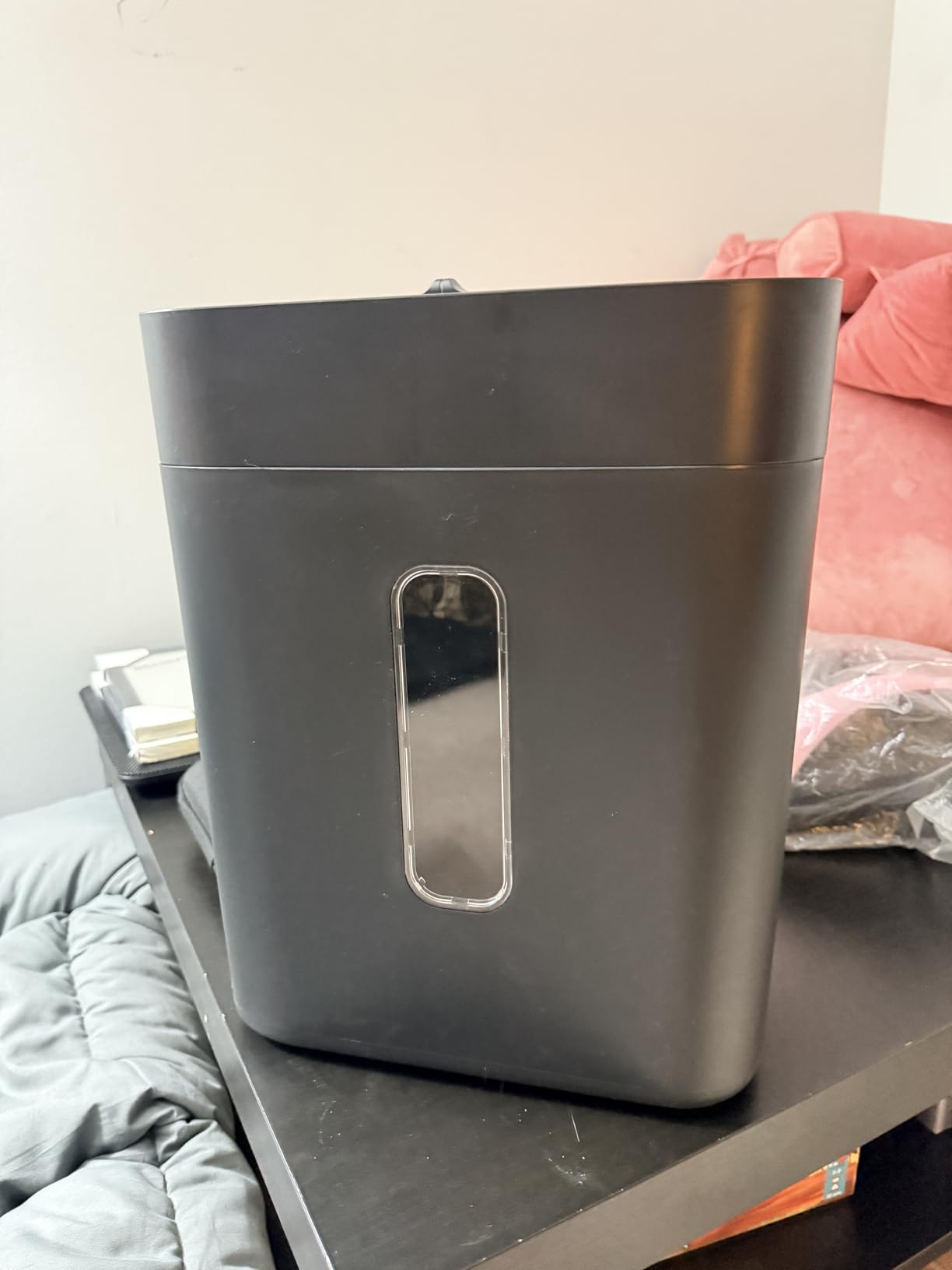
Safety is handled well. The blades stop immediately if you lift the lid while running, which is the single most important feature if there is a child or a pet in the room, and one slide of the reverse control clears most jams. Our picks for the best cut resistant work gloves are worth keeping nearby if you clear jams often.
Run time is the compromise: three minutes of continuous shredding followed by a 60-minute cool-down. That is the shortest duty cycle of any machine here, and it makes this a mail-at-a-time tool rather than a session tool.
Who this is for
Apartment dwellers, students, and anyone who shreds a shoebox of junk mail a month and nothing more. At this usage level the three-minute limit never comes up, and the wide footprint at 14.57 inches across is still compact enough for a desk.
If you are shredding identity documents rather than advertising mail, note that this is cross cut. It removes readable text, but see the micro-cut section before you decide.
Where it falls short
The review base of around 500 ratings is the smallest here, which means you have less evidence about how it performs after two years. Long-term durability in this price bracket is the least predictable quality.
Six sheets per pass is small, and the three-minute runtime means a stack of envelopes takes several rounds with cooling breaks between them. Budget accordingly.
9. Aurora AU870MA 8-Sheet Micro Cut: Best Value in a Higher Security Level
Aurora AU870MA High-Security 8-Sheet Micro-Cut Paper Credit Card Shredder Black
Micro cut at 5/32 by 15/32 inch
8 sheets per pass
3.9 gallon basket
5 minute run time
Pros
- Micro cut particles are effectively impossible to reassemble
- 4.6 star average across nearly 13000 reviews
- Thermal protection with overheat indicator
- Auto start with manual reverse for jam recovery
Cons
- Micro cut packing fills the basket slower by volume
- Taller 17.4 inch body than most 8 sheet models
- Heavier at 11.7 pounds
The AU870MA is here because it makes the case for spending differently rather than saving. It shreds to 5/32 by 15/32 inch micro cut particles at P-4 security, which produces several hundred more pieces per sheet than any cross cut machine in this guide.
That difference is the entire argument Wirecutter makes, and it is correct. A cross cut shredder turns a page into rectangular confetti that cannot be read on its own. Micro cut turns it into confetti small enough that reassembly means tape and patience, which is a materially different security posture for medical and financial records.
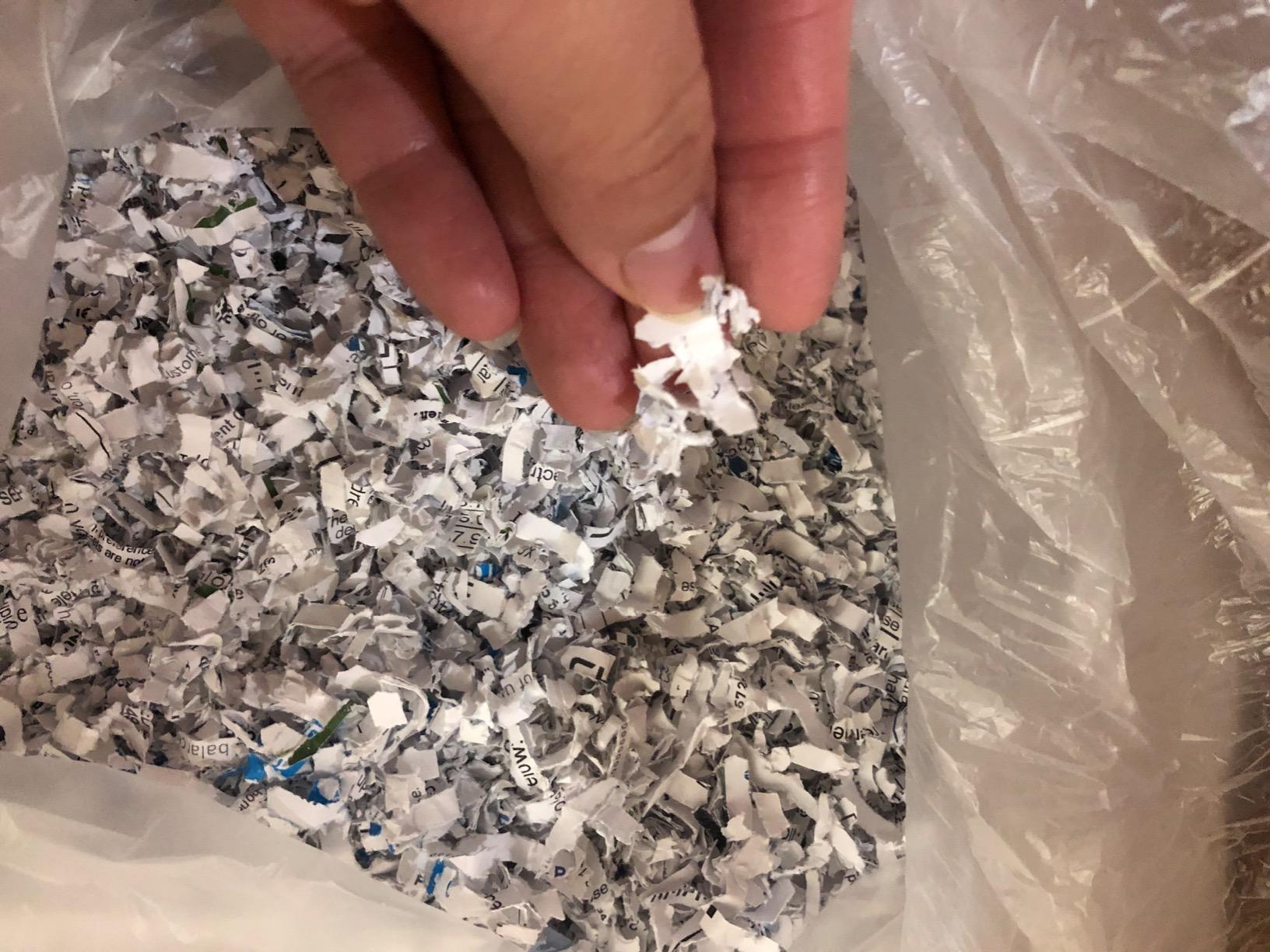
As a machine, it is solid. Eight sheets per pass, a 3.9-gallon basket, auto start, manual reverse, and thermal protection with an auto shut-off and overheat LED. It has held a 4.6 average across nearly 13,000 reviews.
Run time is five minutes continuous, which is longer than the compact cross cut units and shorter than the long-running floor models. The basket fills more slowly by volume because micro cut packs with less air, so you shred more pages for the same basket.
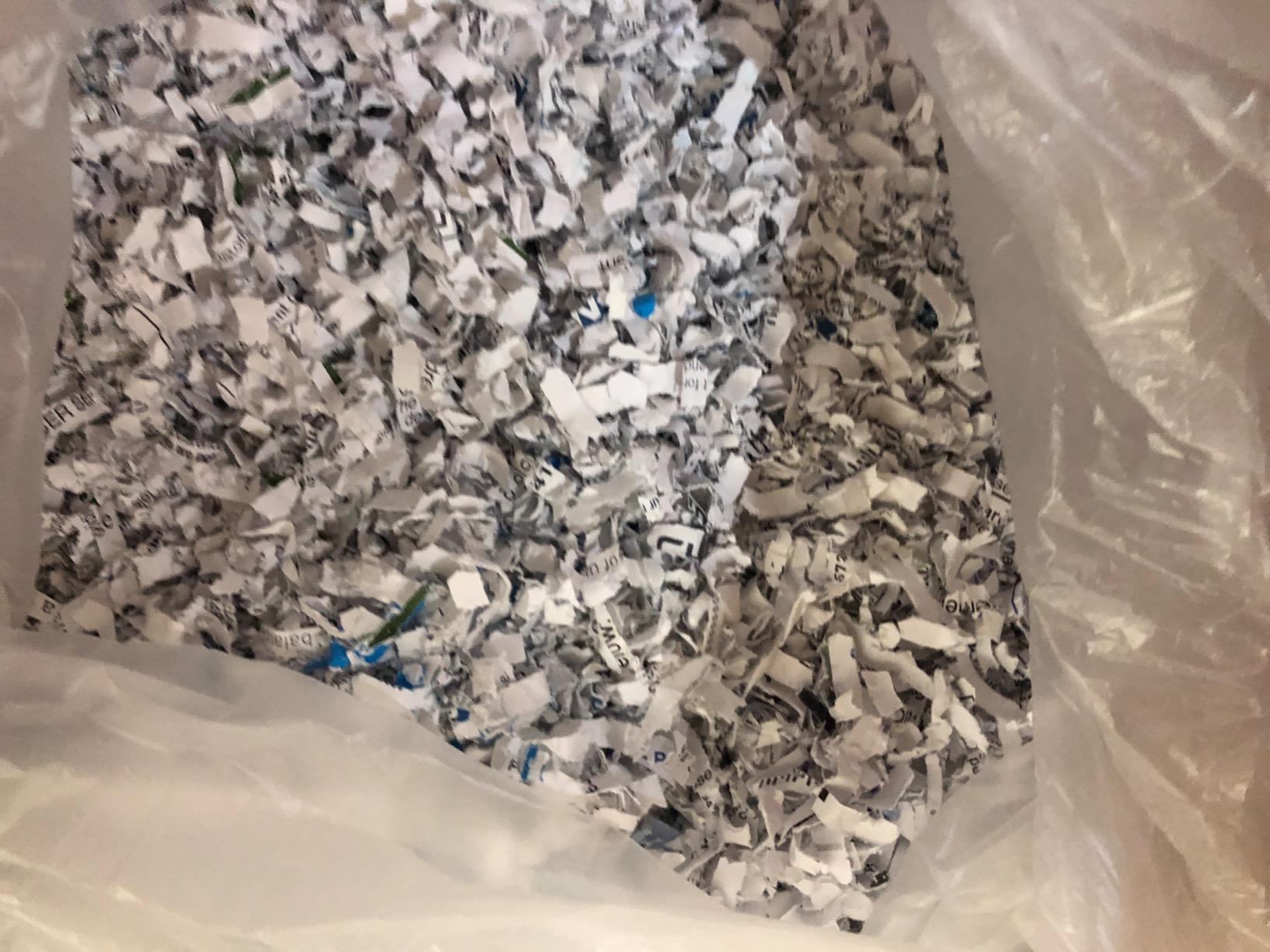
When the extra security is worth it
If you are destroying medical bills, tax returns, loan documents or identity paperwork, micro cut is worth the step up. The reconstruction risk that applies to cross cut shreddings, where a determined person can tape fragments back together, largely disappears here.
For credit card offers, junk mail, utility statements and meeting notes, cross cut already removes readable content and you can keep the cheaper machine. The security difference is real but it is not the difference everyone assumes.
Where it falls short
At 17.4 inches tall it is taller than most eight-sheet home models and will not fit under every desk, and at 11.7 pounds it is not a machine you want to carry between rooms.
It does not shred CDs or DVDs. If discs are part of your disposal routine, the Aurora AU1285MD below is the model that handles them.
10. Aurora AU1285MD 12-Sheet Micro Cut: Best for Media and Compact Spaces
Aurora AU1285MD Compact Desktop-Style High Security 12-Sheet Micro-Cut Paper and CD/Credit Card/Junk Mail Pullout Basket Shredder, White/Black
Micro cut at 5/32 by 15/32 inch
Destroys CDs DVDs and cards
12 sheets per pass
11.8 inch desktop footprint
Pros
- Only option here that destroys CDs and DVDs
- Compact desktop profile fits on a shelf or printer stand
- Anti-jam auto-reverse recovers paper jams
- LED indicators for standby overheat overload and door open
Cons
- Small 1.8 gallon bin against a 12 sheet rating
- Heavy at 17.9 pounds and awkward to lift
- White interior shows dust and grime quickly
The AU1285MD is the only machine in this roundup that destroys CDs and DVDs, and it does so alongside paper, credit cards, junk mail, staples and small clips. For anyone clearing out a stack of old software discs or banking discs, that capability alone justifies the price.
The security is micro cut at P-4, producing 5/32 by 15/32 inch pieces across a 12-sheet head. Anti-jam auto-reverse handles stuck paper, and LED indicators cover standby, overheat, overload and door open so you know why the machine stopped.
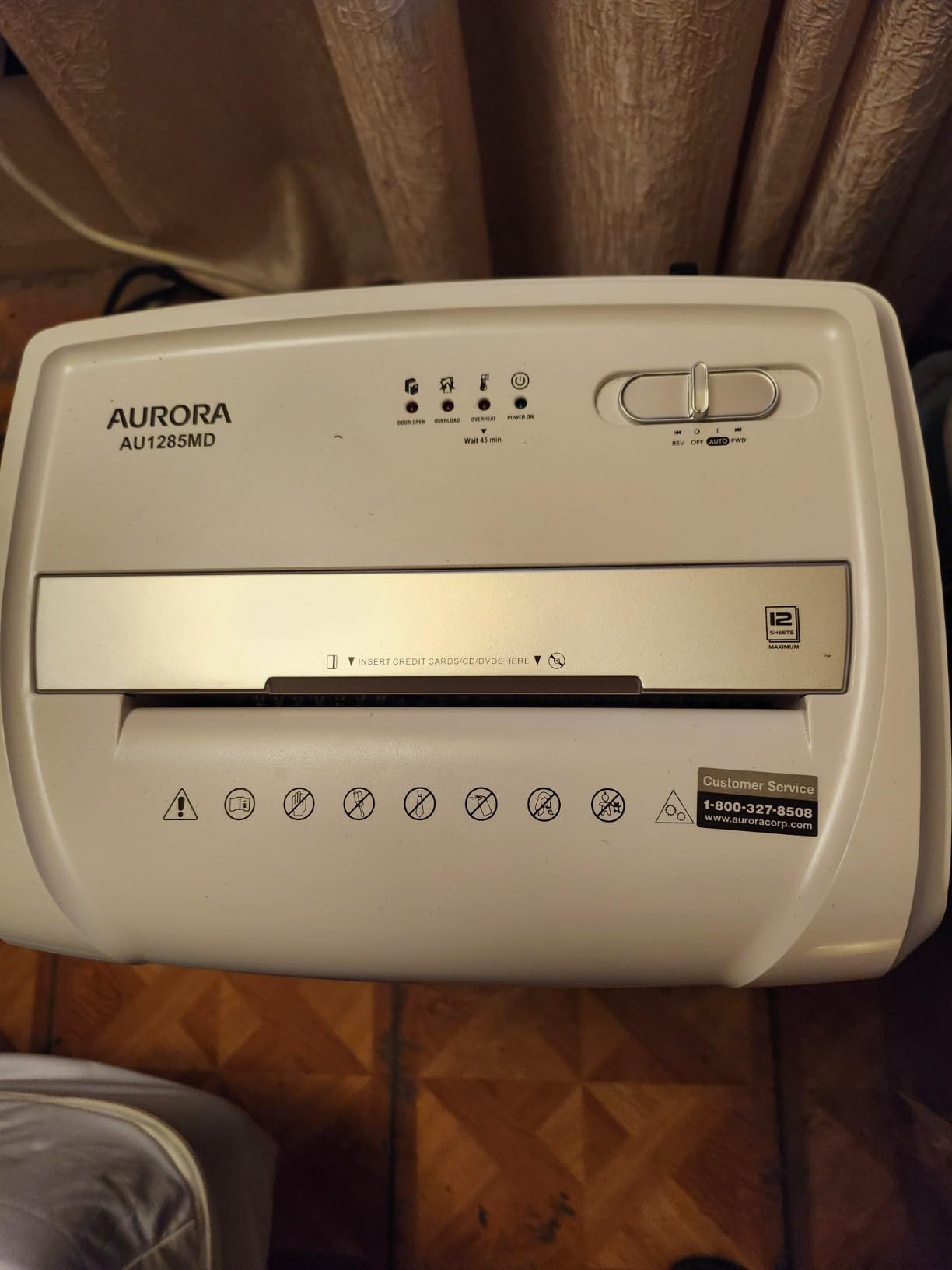
It is also the quietest-feeling unit in this group in owner reports, with several buyers ordering a second one for a different room. The ShredEase angled-feed safety feature is a small thing that makes a real difference when you are feeding junk mail at speed.
The compact 11.8 by 13.2 by 9.9 inch footprint is the appeal. It sits on a shelf or a small printer stand rather than claiming floor space, which is unusual for a 12-sheet machine.
The bin is the compromise
A 1.8-gallon pull-out bin against a 12-sheet rating is a mismatch, and owners complain about it. Micro cut output packs tightly, so the basket fills faster than the sheet rating suggests and needs emptying more often.
Run time is five minutes continuous, so plan a session around two or three batches rather than expecting an hour of continuous work.
Where it falls short
At 17.9 pounds it is the second-heaviest unit here, which makes it awkward to move and awkward to empty if you have to lift the whole basket. The translucent bin shell also shows dust and grime quickly on a white interior.
Its review base is modest at around 620 ratings, so a 4.7 average carries less weight than the same figure on a widely bought model. Treat the feature set as the reason to buy, not the star rating.
How We Picked the Best Cross Cut Shredders
We built this list from every cross cut shredder available in the under-200-dollar band, plus the micro cut machines that compete for the same buyer. Every unit here is reviewed by someone who read a large body of owner feedback rather than a product page alone.
That matters in this category because advertised specifications are unreliable. GearLab’s testing exposed budget shredders that only managed seven sheets against an eight-sheet rating, and produced waffles with visible text on the output. Treat the rated sheet capacity as a ceiling, not a promise.
Six criteria decided our ranking. Sheet capacity against bin volume, measured run time rather than claimed run time, cutter security level, noise rating, physical footprint and warranty length. A machine that scores well on four and badly on the other two was not our top pick.
We also weighted owner-reported failure modes heavily, because shredders fail predictably. Overheat cut-offs, worn cutters within the first year, bins that scatter shreds when emptied and machines that keep running briefly after the last sheet all came up repeatedly in forums, and each one pushed a model down our list.
Cross-Cut vs Micro-Cut: When to Spend More
Here is the honest version of the argument. A cross cut shredder cuts each sheet into hundreds of small rectangular pieces, typically in the 5 x 14mm to 5 x 25mm range depending on the model. A micro cut shredder cuts into pieces under 5/32 inch, several times smaller.
The consequence is that cross cut output can sometimes be reassembled with tape. GearLab flags this directly: credit cards shredded cross cut can be reconstructed, while micro cut cards cannot. If you are destroying identity documents, that is the whole debate.
What the debate usually misses is the gap between strip cut and cross cut. If your current shredder makes long strips, upgrading to any of the models on this list is a large security improvement for a small cost. Many buyers who move from strips to cross cut report that they never think about the shredder again.
Our guidance is simple. Junk mail, utility statements and meeting notes: cross cut is enough. Medical bills, loan documents, tax returns, identity paperwork: spend the extra and go micro cut. The two micro cut models here both fit under 200 dollars, so the decision does not require a budget change.
Buying Guide: Six Criteria That Decide the Buy
Sheet capacity versus bin volume. These two numbers move in opposite directions more often than manufacturers admit. The AU1285MD shreds 12 sheets into a 1.8-gallon bin, while the C149-C shreds 18 sheets into six gallons. Match the bin to how often you want to empty it rather than buying capacity you cannot store.
Run time and duty cycle. This is the most ignored spec and the most common source of dissatisfaction. A three-minute runtime means twenty minutes of waiting if you are doing a filing clean-out. The 60-minute units in this roundup cost more and remove the pause entirely.
Security level. Every P-4 machine here produces cross cut or micro cut output. P-4 is the standard for home and small office use. Below P-4 you are into strip cut territory, which we would not recommend for any document with your name on it.
Noise. Ratings range from 60 dB or less on the BONSEN to 70 dB on the Amazon Basics and Aurora AS890C. In an apartment, a machine that runs while you are on a call is a different product from one that does not.
Footprint. Measure before you buy. Anything under about 15 inches tall can go under a desk. The 18-sheet and 20-sheet units here are floor-standing by design and need a corner of a room.
Warranty and consumables. Most units carry a one-year warranty; the Fellowes adds five years on the cutter, and the Locksworth offers three years overall. Budget for shredder oil and bin liners, since almost none of these machines include them.
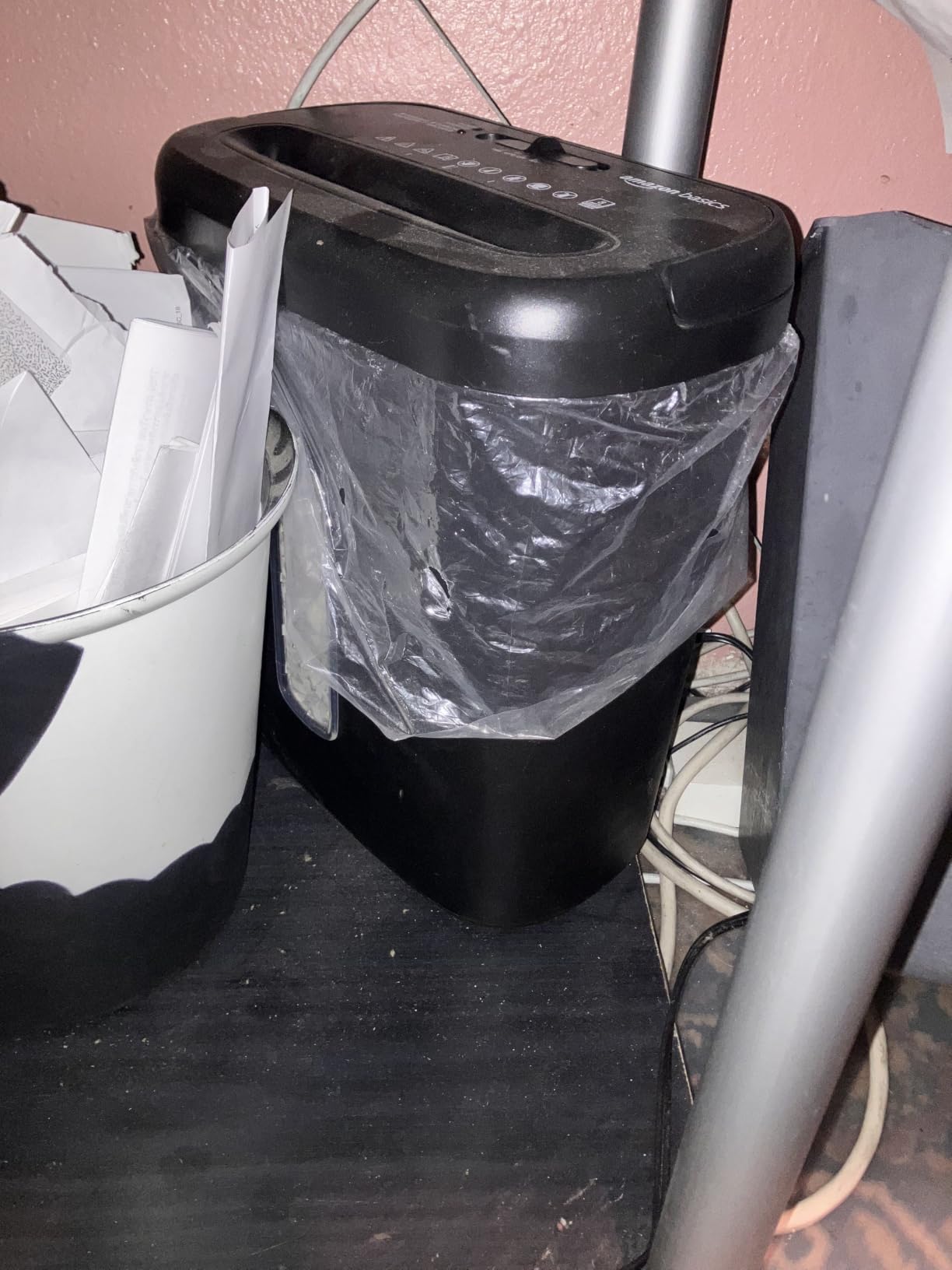
One more practical note on bins. Several owners report that lining a bin with a trash bag can trigger a bin-full sensor and stop the machine. If you prefer lined bins, test it early with the model you buy.
Stopping Overheat Cut-Offs and Clearing Jams
Overheating is the top complaint in this category, and the cause is nearly always the same: running the motor continuously past its duty cycle. Forum users consistently report budget units dying after seven to ten minutes of continuous running despite advertised ratings of twenty minutes or more.
Four habits prevent it. Feed no more than the rated sheet count, ideally less. Let the machine finish a batch before adding more. Keep the cutter oiled, because dry blades drag and generate heat. And watch for the overheat indicator rather than assuming a stopped machine is jammed.
Clearing a jam is usually simpler than it looks. Most machines here have forward and reverse controls, so switch to reverse, hold it for two or three seconds, and the sheet backs out on its own. Unplug before reaching into the slot, and never force the paper with a finger while power is connected. If the machine lives in a shared room, cut resistant sleeves are cheap insurance for the moments you reach past the cutter head.
Do not shred what shredders are not built for. Single-corrugated cardboard works in the 17 to 20-sheet cross cut units but jams smaller ones. Laminate, foil, adhesive-backed paper and metal hardware cause jams on any machine at this price.
Frequently Asked Questions
What is the best cross cut paper shredder for home use?
The Bonsaii C237-B is our top pick for most homes. It delivers a P-4 cross cut at 5x14mm particles, handles six sheets per pass plus credit cards, and fits under a desk at 7 x 11.2 x 14 inches. It holds a 4.4-star average across more than 58,000 owner reviews, which makes its long-term behaviour easy to predict.
What is the best cheap cross cut shredder?
The Amazon Basics C276-A is the cheapest credible option with a large review base. It produces a P-4 cross cut at roughly 5x18mm particles, handles eight sheets per pass, and has shipped units to more than 78,000 reviewers at 4.3 stars. Expect a three-minute runtime and noticeable noise around 70 dB.
What is the best affordable paper shredder?
Affordability depends on volume rather than sticker price. Under 60 dollars covers occasional mail clearing, while 100 to 200 dollars buys a 12 to 20 sheet head with a five to sixty minute run time and a five gallon bin. The Aurora AS890C sits in the middle of that range and is the strongest value for durability.
Is cross cut or micro cut better for home security?
Micro cut is more secure. A cross cut shredder produces rectangular pieces that a determined person can sometimes reassemble with tape, while micro cut produces pieces small enough that reconstruction is impractical. Cross cut still removes all readable text, which is why it suits junk mail and utility statements. For medical, tax and identity documents, micro cut is the safer choice.
What is a good paper shredder that does not overheat?
Longer run time is the direct answer. The BONSEN S3104 runs more than 60 minutes continuous, and the Bonsaii C149-C is rated for 60 minutes, while the compact models run three to four minutes before a long cool-down. Oiling the cutter monthly also cuts heat generation significantly by reducing blade drag.
How do I stop my paper shredder from overheating?
Feed no more than the rated sheet count and let each batch finish before adding more. Oil the cutter head on a monthly schedule so the blades slide freely instead of dragging. Stop the machine the moment the overheat indicator lights rather than trying again immediately. For a cooldown period of 20 to 30 minutes, treat it as the machine’s design rather than a fault.
How do I fix a jammed cross cut shredder?
Most machines here have forward and reverse controls, so switch to reverse and hold for two or three seconds to back the paper out. Unplug the unit before reaching into the slot, then clear blade dust with a reverse flick before switching forward again. Feeding more sheets than the rating causes most jams, so halve the batch size and try again.
What is the average lifespan of a paper shredder?
A well-oiled budget cross cut shredder typically lasts three to five years of home use, with the cutter head usually failing first rather than the motor. Warranty length is a useful proxy: the Fellowes 14C10 carries five years on the cutter while most competitors in this roundup offer one year overall. Heavy daily use shortens that considerably.
How much paper can a cross cut shredder handle at once?
Rated capacity ranges from six sheets on the compact models to twenty on the BONSEN S3104. In practice, budget units perform best at roughly half to two thirds of their rating, so an eight-sheet machine is smoother at four sheets. Exceeding the rating is the main cause of both jams and thermal cut-offs.
Conclusion: The Best Cross Cut Shredders Under 200 Dollars
For most homes, the Bonsaii C237-B is the right first shredder. It is compact, genuinely P-4 secure, handles cards and staples, and has enough owner history behind it that you can predict how it will behave in year three. If your shredding sessions are bigger, step up to the Bonsaii C275-A for volume or the Fellowes 14C10 for a pull-out bin and a five-year cutter warranty.
If you shred identity or medical documents rather than junk mail, spend the difference on micro cut. Both Aurora micro cut models in this guide fit under 200 dollars, so the security upgrade does not require leaving the budget. Check current prices and read the owner reviews for the model that fits your space, then pick one and stop thinking about it.