
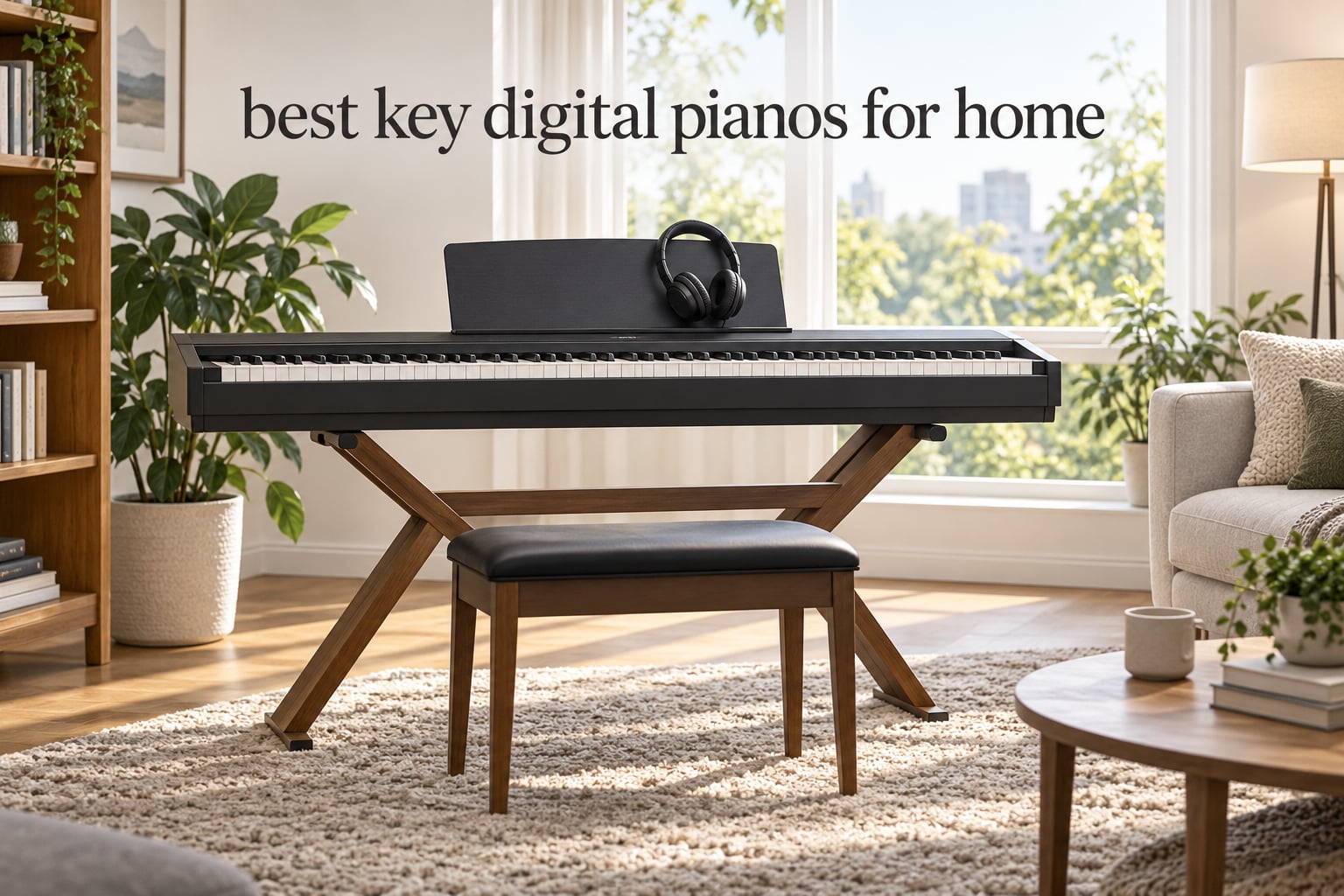
An 88-key digital piano for home is an electronic instrument with the full 88 keys of an acoustic keyboard, built-in stereo speakers, and touch-sensitive keys that change volume and tone with how hard you strike them. It gives you realistic playing feel without the tuning, maintenance, or floor space of an upright or grand.
We spent weeks comparing key feel, sound, speaker direction, weight, and included accessories across twelve models so you can match a piano to the room you actually practise in. Three findings shaped our ranking. Advertised amplifier wattage is a poor guide to loudness. Speakers that fire downward are wasted by a stand with a solid top. And the piano is rarely the whole cost. Adults buying a first instrument can start with our digital piano guide for adults.
Table of Contents
Top 3 Picks for the Best 88 Key Digital Pianos for Home


All 12 Picks at a Glance
| Product | Specifications | Action |
|---|---|---|
| Alesis Recital |
|
Check Latest Price |
| Yamaha P-71 |
|
Check Latest Price |
 Donner DEP-20 Donner DEP-20 |
|
Check Latest Price |
 Roland FP-10 Roland FP-10 |
|
Check Latest Price |
 Donner DDP-100 Donner DDP-100 |
|
Check Latest Price |
 Donner DDP-80 Donner DDP-80 |
|
Check Latest Price |
 Yamaha DGX-670 Yamaha DGX-670 |
|
Check Latest Price |
 Roland FP-30X Roland FP-30X |
|
Check Latest Price |
 Yamaha P225 Yamaha P225 |
|
Check Latest Price |
 Eastar EUP-100 Eastar EUP-100 |
|
Check Latest Price |
 STRICH SDP-120 STRICH SDP-120 |
|
Check Latest Price |
 Best Choice Products 88-Key Set Best Choice Products 88-Key Set |
|
Check Latest Price |
1. Alesis Recital – Best Overall for First-Time Buyers
Alesis Recital Digital Piano 88-Key Semi-Weighted
88 semi-weighted keys
Five voices
Two 20W speakers
128-note polyphony
Pros
- 88 full-size semi-weighted keys with adjustable touch
- Five voices plus chorus and reverb
- Two built-in 20W speakers
- Lesson and split modes
- Skoove and Melodics lessons included
Cons
- Semi-weighted action is lighter than true hammer action
- Sustain pedal not included
- Only five onboard voices
The Recital is the piano I recommend most often to someone starting out, because it has the largest owner base of anything in this group with more than 11,000 reviews at 4.6 stars. That much feedback means other people have already found the oddities.
The compromise is key feel. These are 88 full-size semi-weighted keys with adjustable touch response, not a true hammer action, so they feel lighter than the Yamaha and Roland boards further down. That makes them kinder to a young child and less convincing for classical repertoire.
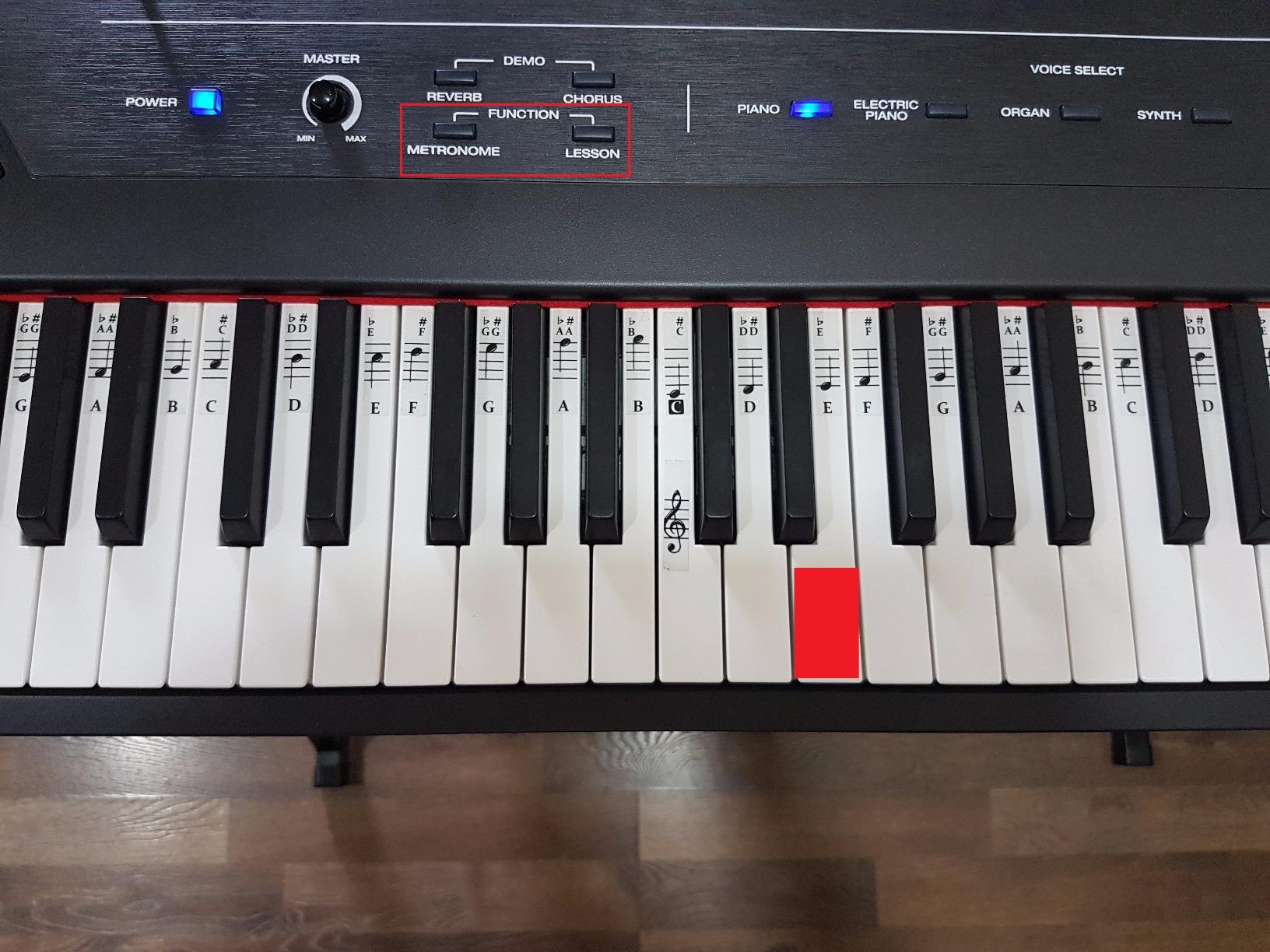
The speakers are the surprise. Two built-in 20W units fill a mid-sized living room, and five voices cover acoustic piano, electric piano, organ, synth, and bass. Lesson and split modes let a teacher and student share one instrument, with 30 days of Skoove content and 100 Melodics virtual lessons included.
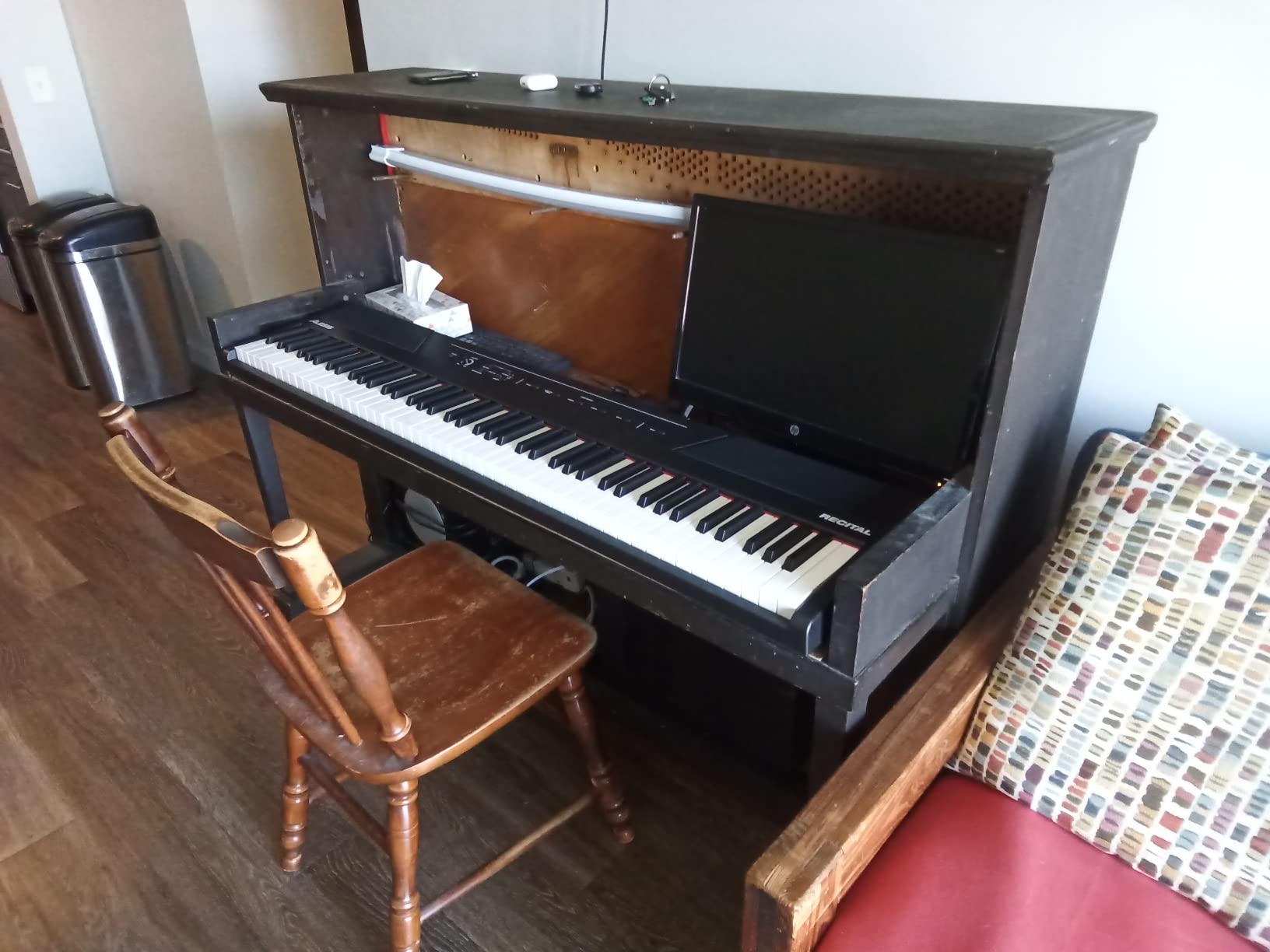
Who the Alesis Recital suits
Beginners, students under about grade 5, and anyone practising in a bedroom or shared apartment where volume matters. The action will not fatigue a small child’s arm, and 128-note polyphony is more than enough unless you layer several instruments at once.
Who should skip it
Skip it if you already play classical repertoire and need graded hammer resistance, or if you want a piano that grows with you for a decade. Five voices means no organ or strings timbres, and the sustain pedal is sold separately.
2. Yamaha P-71 – Best Weighted Action for the Money
YAMAHA P71 88-Key Weighted Action Digital Piano with Sustain Pedal and Power Supply (Amazon-Exclusive)
Weighted hammer action
10 voices
64-note polyphony
Sustain pedal included
Pros
- Genuine weighted hammer action
- Yamaha grand piano sampling
- Light enough to carry to rehearsals
- One-button control layout
- Sustain pedal in the box
Cons
- Speakers are bass-heavy
- Only 10 voices and no organ or Rhodes options
- No onboard recording
The P-71 is the benchmark budget weighted keyboard, and at 4.7 stars across more than 6,600 reviews it holds that title comfortably. Owners report four to six years of reliable daily use, which is the lifespan you want from a first serious instrument.
What you get is real weighted hammer action, with keys resisting at the bottom of the keybed and lightening toward the treble in the way many players compare favorably to entry-level acoustic uprights. That gradient is the one thing you cannot add later.
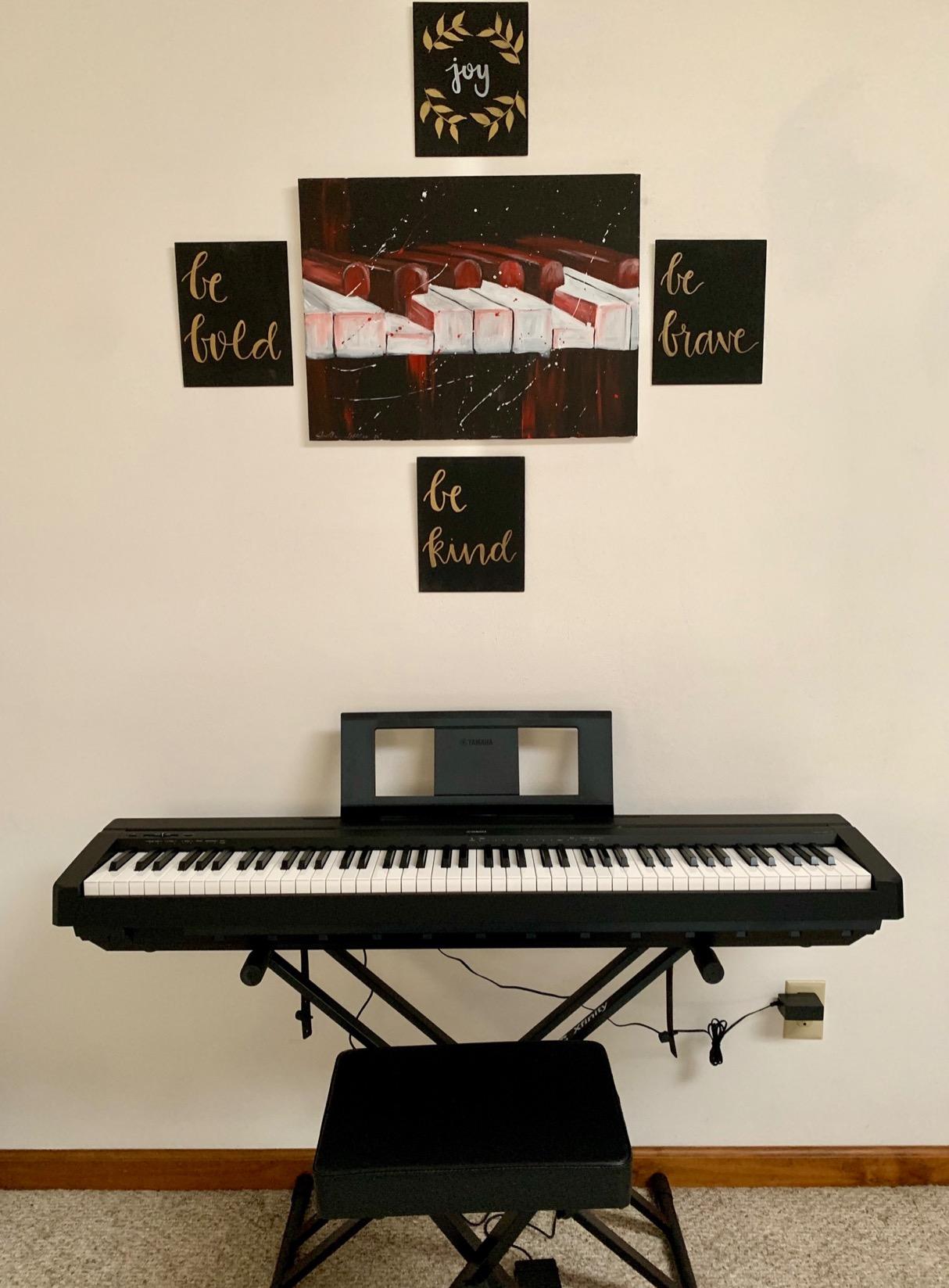
The sound is Yamaha grand piano sampling with a wide dynamic range and full bass, though reviewers repeatedly describe the built-in speakers as bass-heavy and recommend headphones for a balanced tone. At 25 pounds with a sustain pedal and power supply in the box, it is also the easiest piano here to move between rooms or carry to a rehearsal.
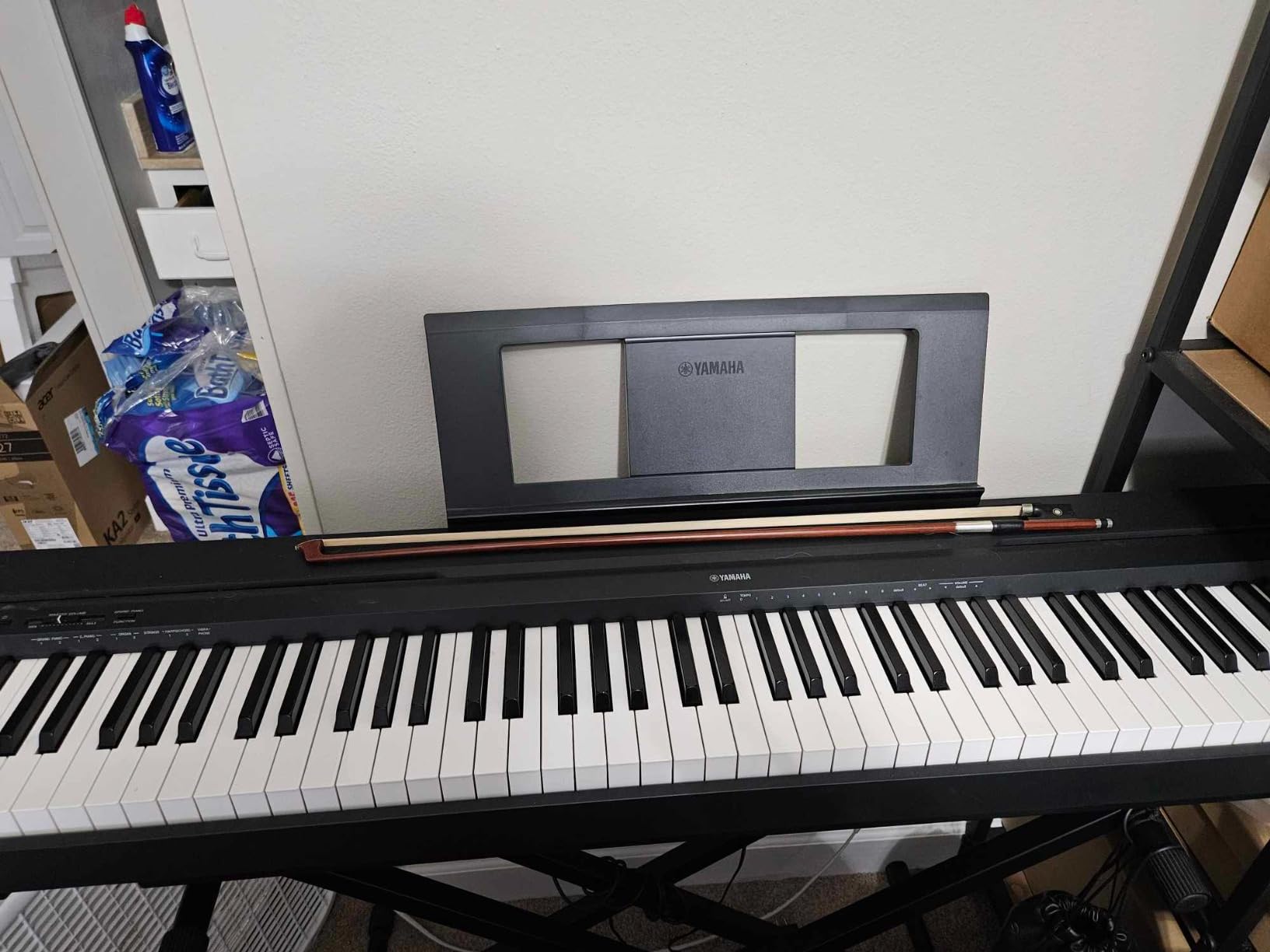
Who the Yamaha P-71 suits
Students past the first year, anyone moving off a 61-key unweighted keyboard, and players who want acoustic-style touch without a furniture cabinet. It also suits small rooms with headphones, since that solves the speaker tone imbalance.
Who should skip it
Skip it if you play organ or want electric piano timbres, because ten voices is a small library with no Rhodes option. Skip it if you want to record straight into a laptop, since MIDI velocity response is compressed in DAW use and there is no onboard recording.
3. Donner DEP-20 – Best for Self-Taught Learners
Donner DEP-20 Beginner Digital Piano 88 Key Full Size Weighted Keyboard, Portable Electric Piano with Sustain Pedal, Power Supply
88 weighted keys
238 tones
Backlit LCD
Two 25W amplifiers
Pros
- Full 88-key weighted action with adjustable touch
- 238 tones plus dual-keyboard mode
- Backlit LCD shows chords and notes
- Two 25W amplifiers with recording
- Pedals included in the box
Cons
- Heavier key resistance than rival entry models
- Piano voices less refined than dedicated instruments
- No stand or bench included
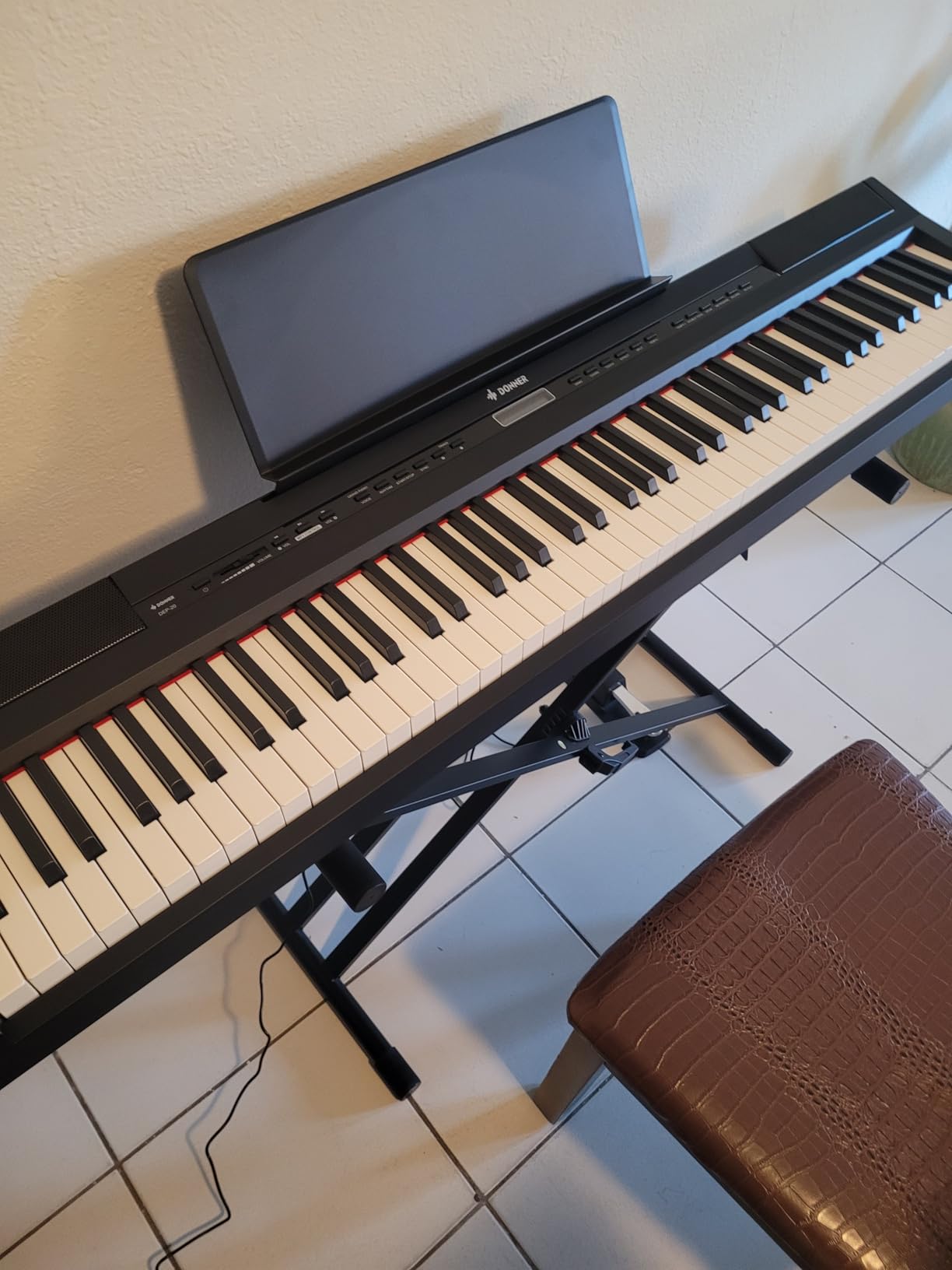
The DEP-20 is built for someone learning alone. The backlit LCD reads out chord names and notation while you play, which is the feature that most changes practice behaviour for a self-taught player. It rates 4.6 stars across more than 2,300 reviews.
The action is fully weighted with adjustable touch response, and this is a genuinely heavier keyboard than most rivals at this level. Reviewers note it takes practice to adjust to, so expect sore fingertips for the first week if you are coming off an unweighted board.
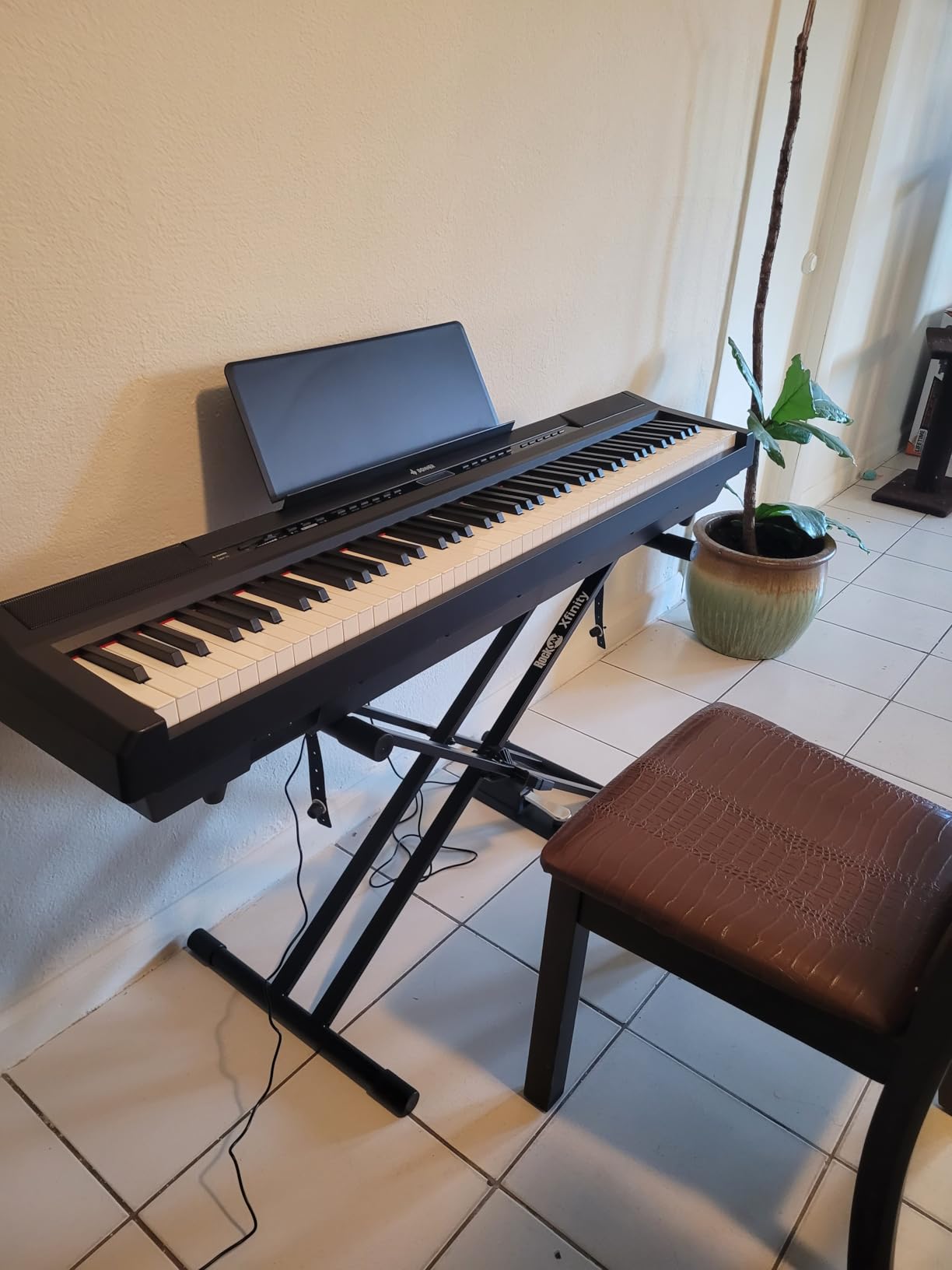
Feature count is the draw: 238 tones, 128-note polyphony, 200 rhythms, dual-keyboard layering, an MP3 player, recording, and MIDI. Two 25W amplifiers are the joint-highest output in this group, so this is one of the few entry boards that pushes sound into a larger living room without distorting.
Who the Donner DEP-20 suits
Self-taught learners working through a method book without weekly lessons, and anyone who wants a lot of timbres to experiment with. The LCD readout makes chord learning far easier, and the included sustain and triangle pedals mean you can play the day it arrives.
Who should skip it
Skip it on a very tight budget, because the missing stand and bench are real extra purchases. Skip it if you want concert grand realism on classical repertoire, since the tone library is broad but the piano voices themselves are less refined.
4. Roland FP-10 – Best Value Action and Sound Pairing
Roland FP-10 Compact 88-Note Digital Piano
SuperNATURAL engine
Ivory-feel keys
USB MIDI
Twin Piano mode
Pros
- Acoustic-feel keyboard with ivory-style keys
- SuperNATURAL engine with responsive tone
- Silent key action for late-night practice
- USB MIDI for recording
- Twin Piano mode for lessons
Cons
- Small built-in speakers
- Stand sold separately
- Fewer voices than the DGX line
The FP-10 is where action quality and sound quality meet at a price most serious home players can justify. Reviewers single out key feel and sound realism as its two strongest attributes, and the 4.5 rating reflects a piano with fewer compromises than the spec sheet suggests.
The keyboard is 88 notes with ivory-feel keys, giving your fingers traction on passages that need it, and the SuperNATURAL Piano engine responds across a wide dynamic range. The key action is quiet enough for late-night practice, which matters enormously in a shared home.
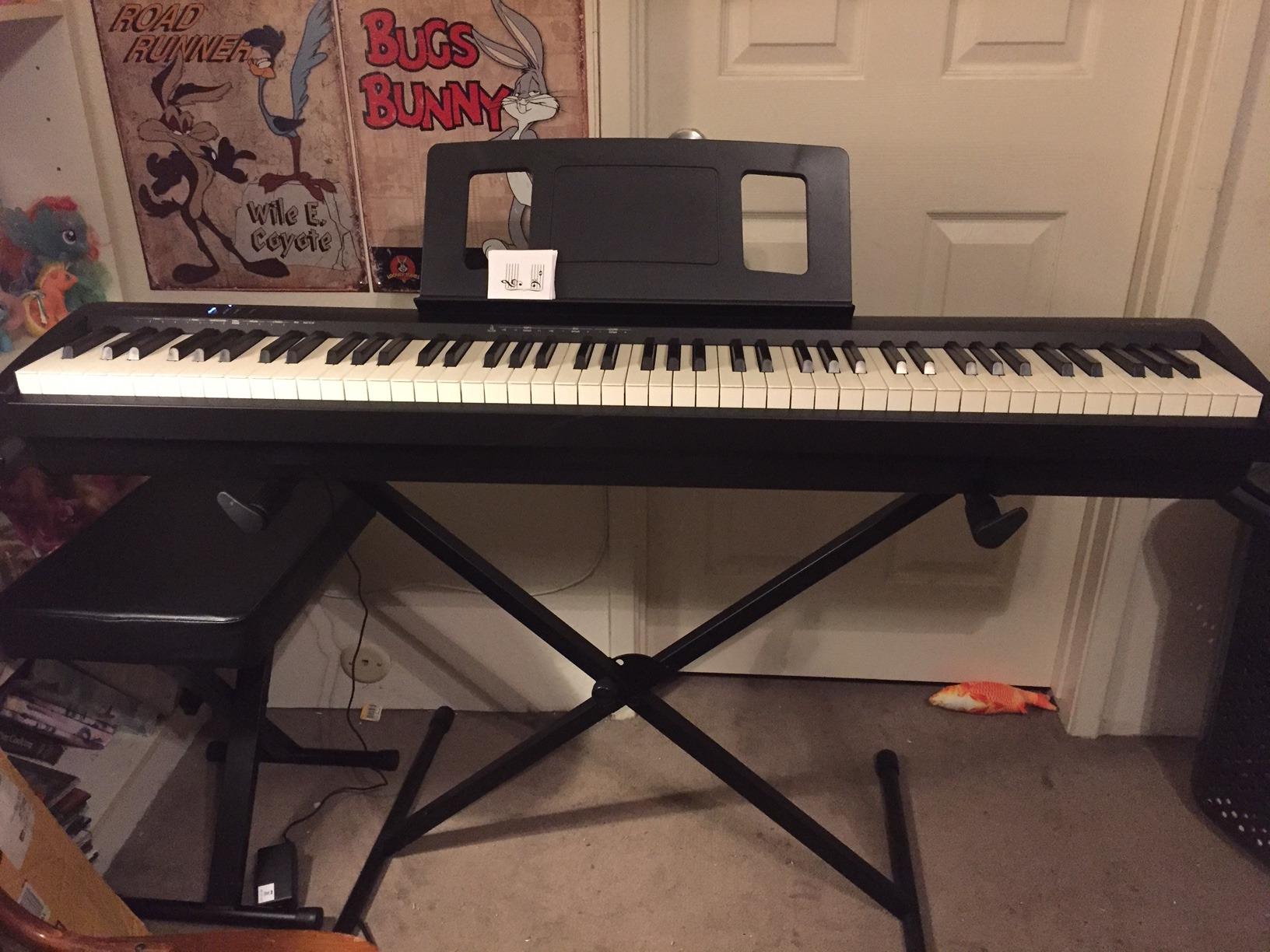
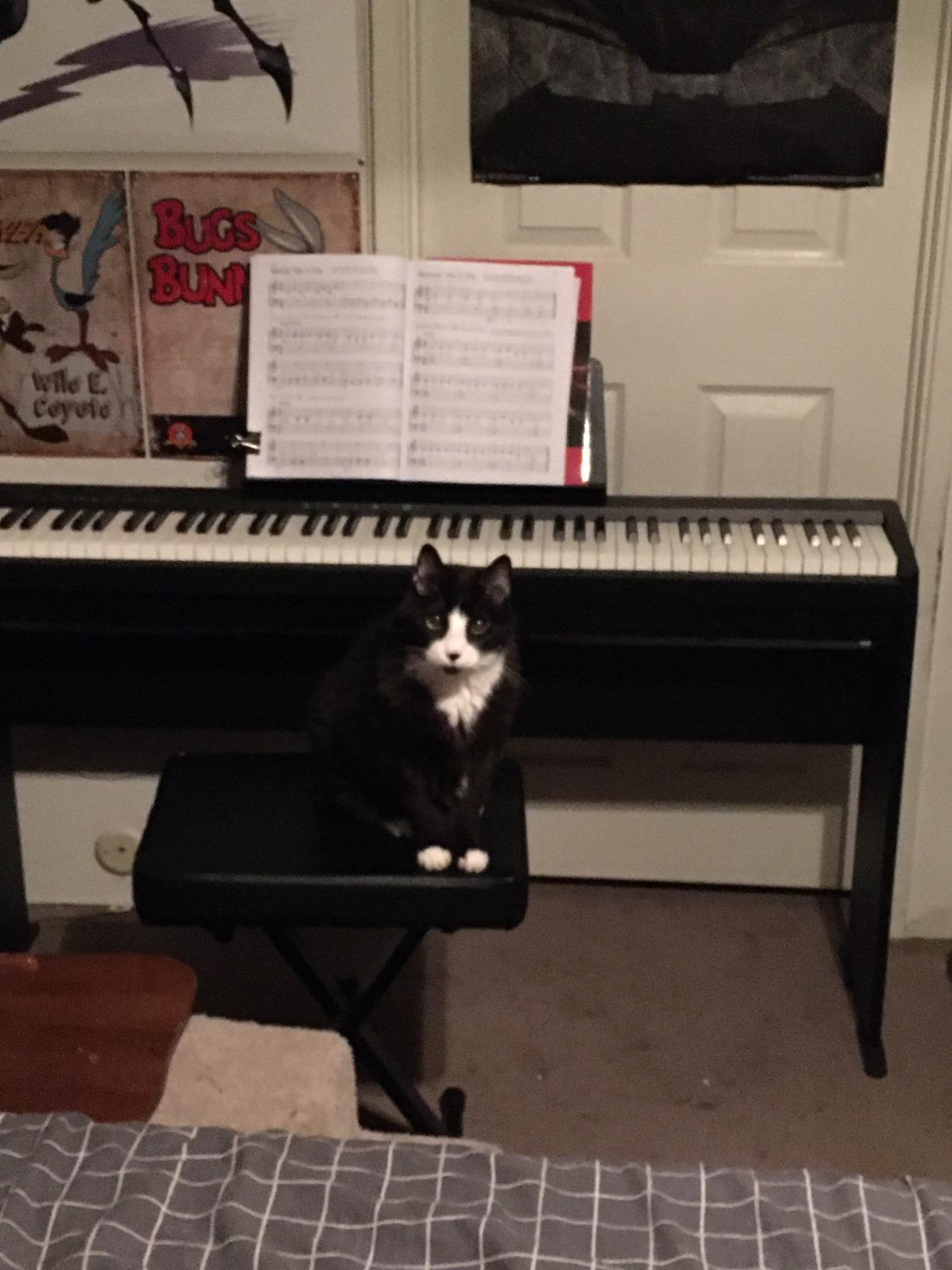
USB MIDI lets you record straight into a DAW or teaching app without extra hardware, and Twin Piano mode splits the keyboard for side-by-side lessons. A DP-2 foot switch and music rest are included. The speakers are the compromise: small, and consistently ranked below higher-tier models, so plan on headphones or external speakers. At 27 pounds it still moves between rooms easily.
Who the Roland FP-10 suits
Students preparing for graded exams, apartment dwellers who practise at night, and anyone recording at home through USB MIDI. If your teacher asks about pedal technique, a three-pedal unit can be added later without replacing the piano.
Who should skip it
Skip it if you want organ sounds or a wide variety of timbres, since onboard voices are fewer than on DGX-series instruments. Skip it if you need speakers good enough to fill a room unaided, and budget separately for a stand.
5. Donner DDP-100 – Best Furniture-Style Starter Set
Donner DDP-100 88-Key Weighted Action Digital Piano for Beginner Bundle with Piano Keyboard Stand, Power Adapter, Triple Pedals, MP3 Function, USB-MIDI, 2 Headphone Jacks Black
Fully weighted 88 keys
Furniture stand and three pedals
USB-MIDI
Dual headphone jacks
Pros
- Fully weighted action with a firm acoustic-like feel
- Wood grain cabinet that looks like an upright
- Stand and three pedals included
- MP3 playback through internal speakers
- USB-MIDI and two headphone jacks
Cons
- Very heavy and two people are needed to move it
- Speakers have a canned digital quality
- Keys are unevenly balanced between registers
The DDP-100 solves what trips up most first-time buyers: the piano arrives with a proper furniture stand and three-pedal set attached. Owners call it a big step up from a keyboard, and the cabinet styling is consistently praised across more than 1,300 reviews at 4.6 stars.
Key feel is firm and fully weighted, closer to an acoustic than the semi-weighted boards here. The drawback is that reviewers report uneven balance between registers, so the transition from the bass section to the treble section is not as smooth as it should be.
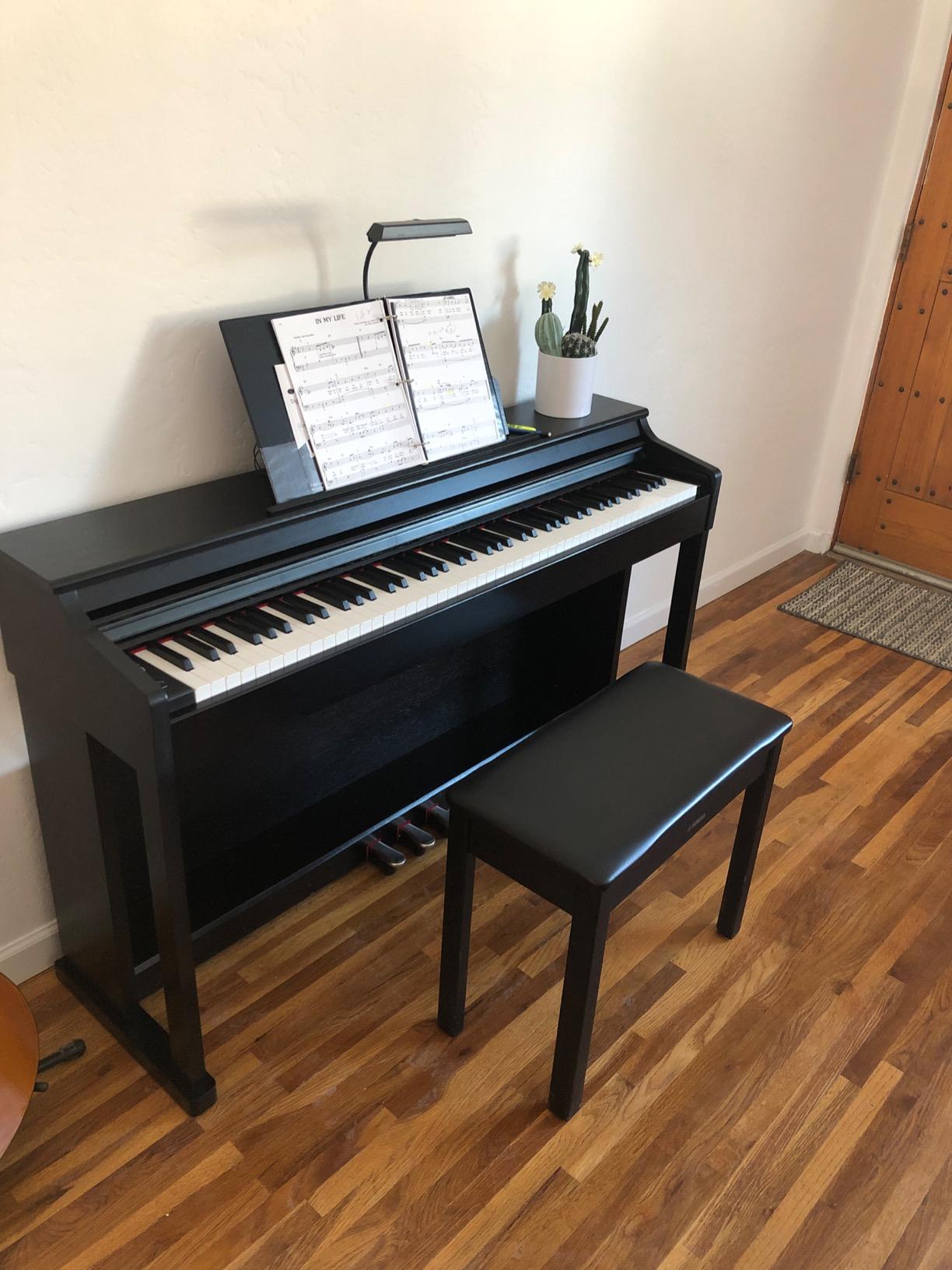
Wood cabinet, sliding key cover, USB-MIDI, and MP3 playback through the internal amplifier give it the look and connectivity of a mid-range upright. Two headphone jacks mean a student and a teacher can both listen, which shows the design was aimed at homes.
Weight is the honest drawback. At 97 pounds with the stand and pedals built in, this is a two-person move and a permanent fixture. Reviewers also describe the internal speakers as noticeably canned, and a bench is not included.
Who the Donner DDP-100 suits
Families who want a piano that looks like furniture in a living room and will not move once placed. It also suits anyone wanting three pedals without buying a pedal unit separately, and students who need real damper pedal control for repertoire.
Who should skip it
Skip it if you live in a flat and might need to relocate the instrument, because the weight makes that a project. Skip it if you care about listening through built-in speakers, and note reports of a squeaky sustain pedal.
6. Donner DDP-80 – Best Heavy-Weight Action With a Full Pedal Set
Donner DDP-80 Digital Piano 88 Key Weighted Keyboard, Full-size Electric Piano for Beginners, with Sheet Music Stand, Triple Pedal, Power Adapter, Supports USB-MIDI Connecting, Retro Wood Color
Heavy hammer action
DREAM sound engine
2x25W speakers
Triple pedals
Pros
- Heavily weighted keys rated above pricier models
- 128-note polyphony with a wide dynamic range
- Wood cabinet that suits home decor
- 24 month warranty
- USB-MIDI for teaching apps and DAWs
Cons
- Only a single piano tone
- Action heavier than most competitors
- No key dust cover
- Minority of units reported losing sound output
The DDP-80 has the heaviest key action in this group, and several intermediate players rate it above models costing considerably more. If acoustic uprights feel right to you and other digital actions feel too light, audition this one first.
Sound comes from an advanced French DREAM engine with 128-note polyphony and a dynamic range that responds naturally to touch. Two 25W stereo surround speakers are the joint-highest output here, with a headphone mode for quieter practice.
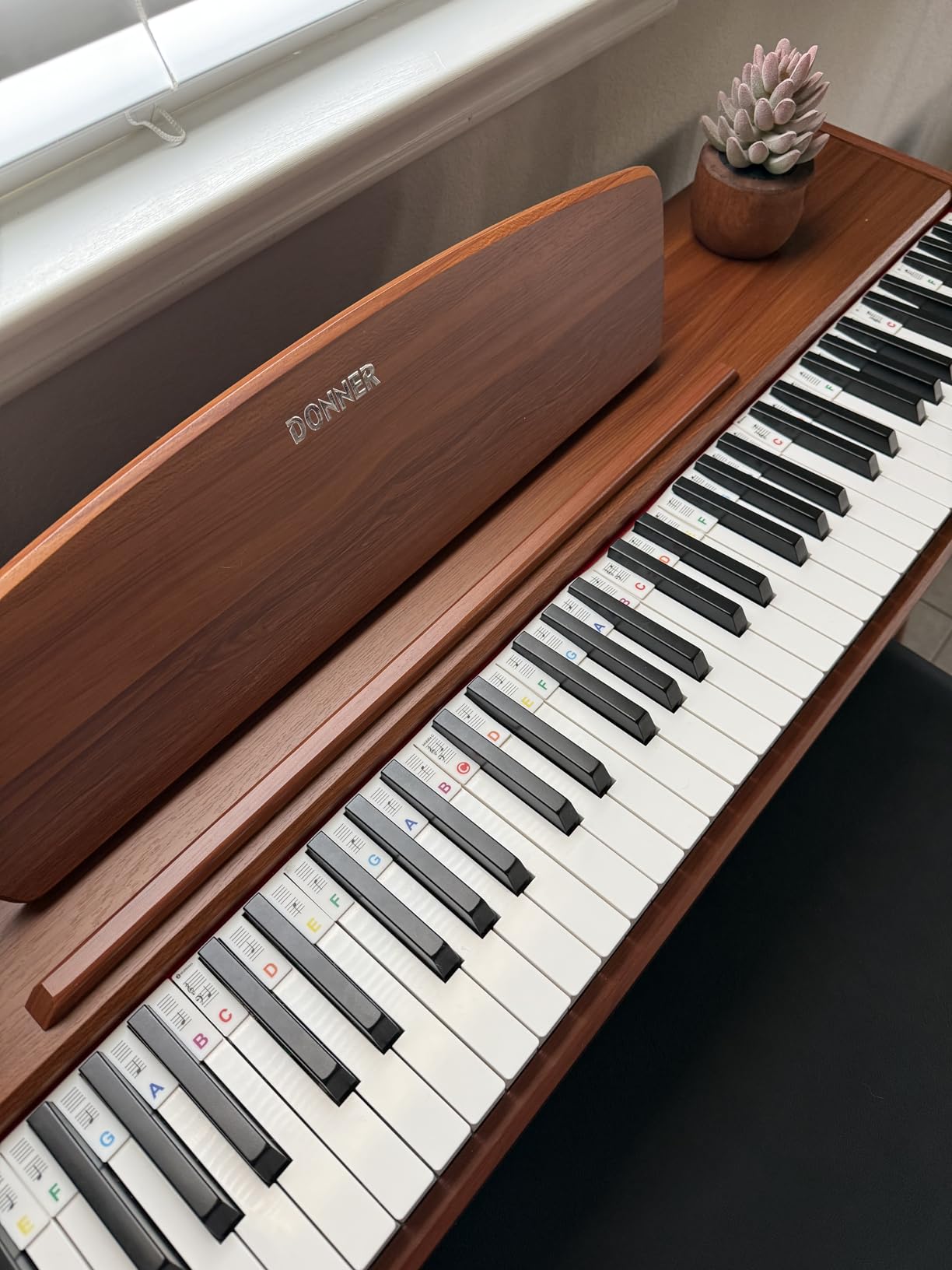
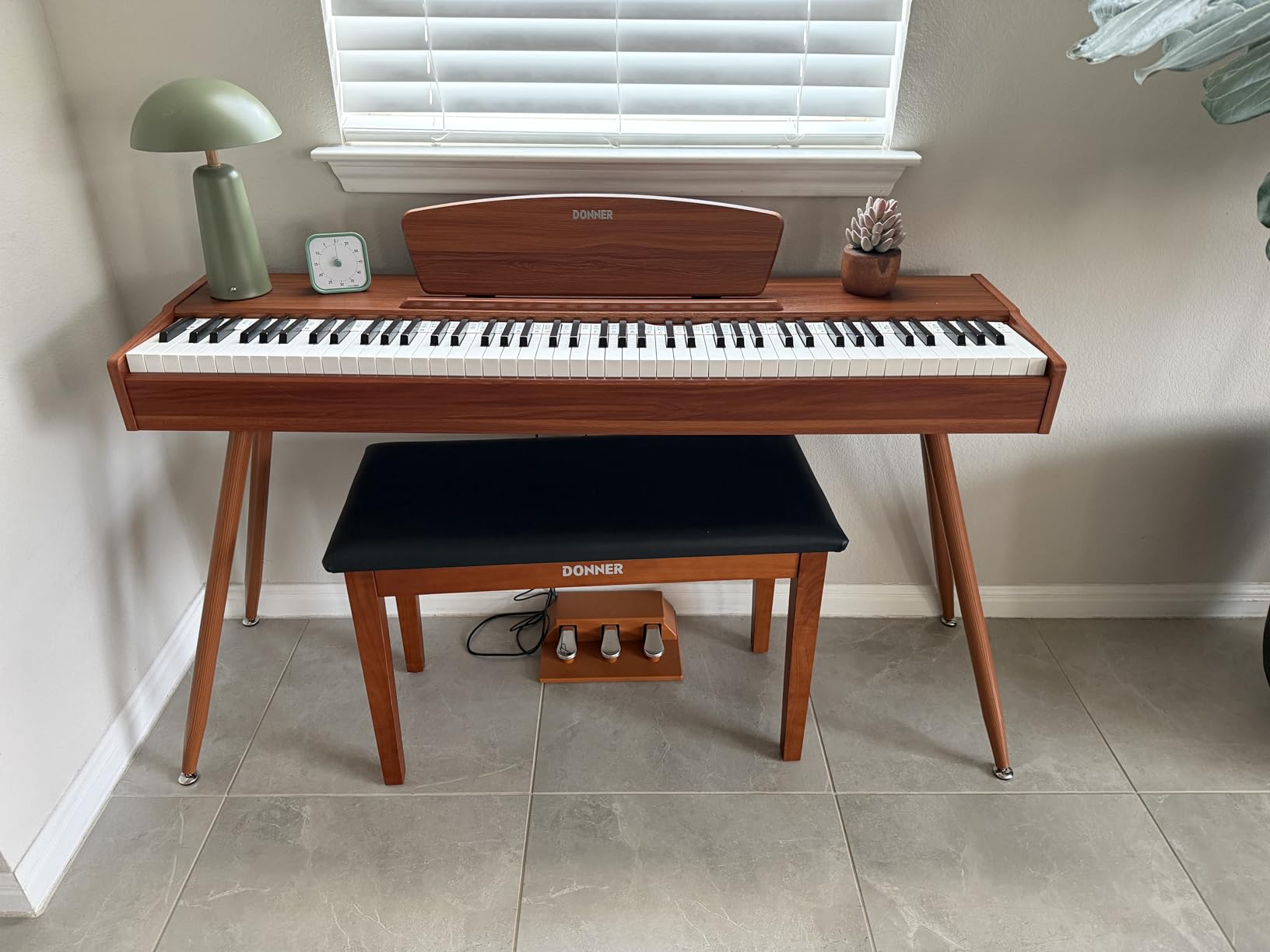
The wood-finish cabinet is designed to blend into a home interior, assembly is straightforward, and the warranty runs 24 months, longer than the one-year cover on most rivals. USB-MIDI connects to teaching apps and a DAW.
Trade-offs are real: only a single piano tone means no organ or synth presets, reviewers note a slightly muddy midrange against an acoustic, there is no key dust cover, and a small share of owners report losing sound output after several months.
Who the Donner DDP-80 suits
Players moving up from a lighter action who want resistance closer to an acoustic, and anyone using USB-MIDI with teaching software. The triple pedal unit and long warranty appeal to students who plan to keep the instrument for years.
Who should skip it
Skip it if you are a complete beginner with light hands, because the action is heavier than almost everything here and frustrates early practice. Skip it if variety matters, since one piano tone is a hard limit.
7. Yamaha DGX-670 – Best Feature Set With Concert Grand Sound
Yamaha DGX-670B 88-Key Weighted Digital Piano, Black
CFX concert grand sampling
630 voices
263 styles
Bluetooth MIDI
Pros
- Action graded heavier in the bass and lighter in the treble
- CFX concert grand stereo sampling
- 630 voices and 263 accompaniment styles
- Bluetooth audio and MIDI
- Microphone input with vocal effects
Cons
- Stand and bench sold separately
- Heaviest unit in this group at 67.7 pounds
- Large feature set can feel complex for beginners
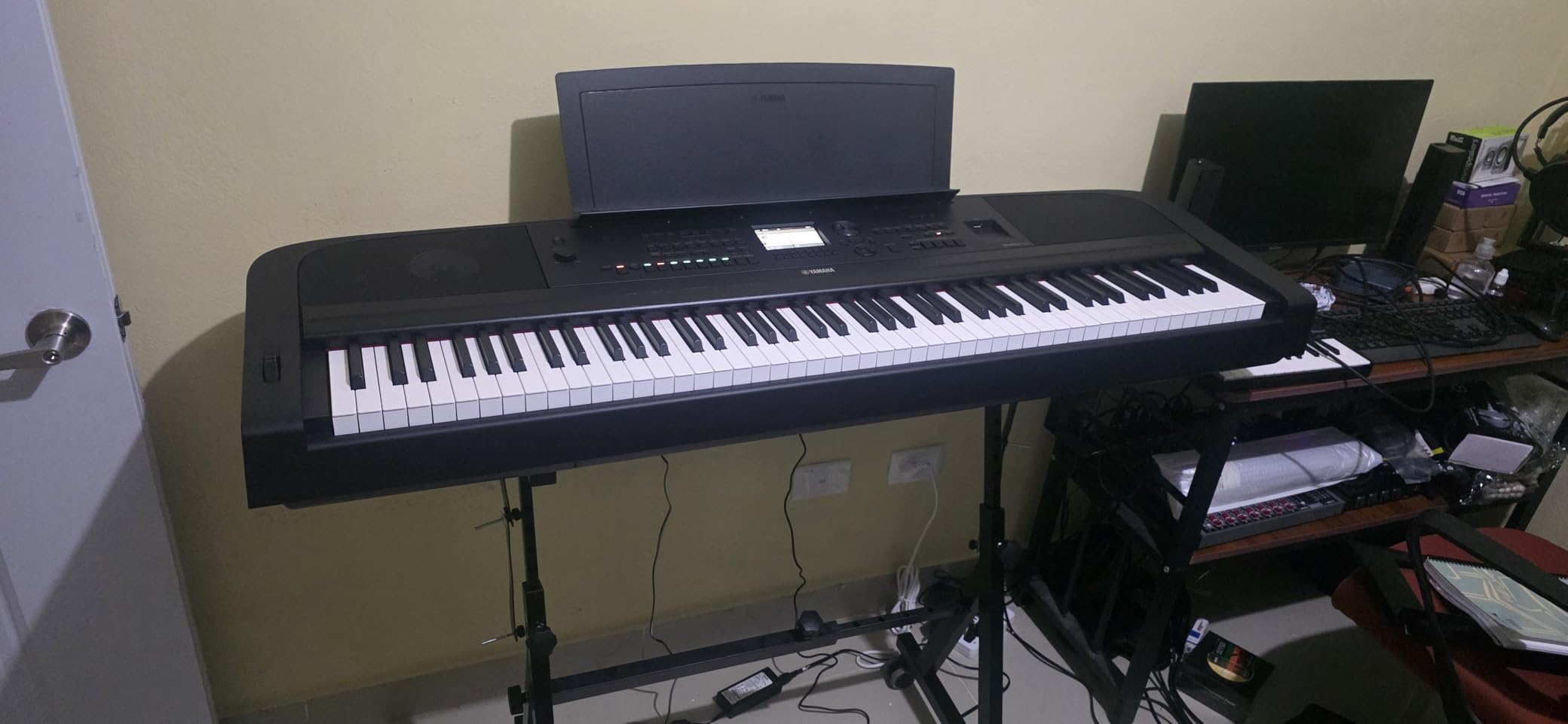
The DGX-670 carries the highest average rating in this group at 4.8 stars, with 89 percent five-star ratings among its 562 reviews. Reviewers cite the CFX grand sound, the key grading, and the accompaniment styles, and the common complaint is that the stand is a separate purchase.
The action is graded properly, heavier in the low keys and lighter in the highs, which is the pattern that lets a player control dynamics the way an acoustic allows. The sound is CFX Full Concert Grand stereo sampling with natural resonance, and it is the most realistically acoustic-sounding engine here.
Then there are 630 voices and 263 automatic accompaniment styles with adaptive response, turning this into something you can write and demo music on. A microphone input with vocal effects lets you sing along, Bluetooth audio and MIDI connect to apps, and the You Are The Artist library displays scrolling sheet music as you play.
Who the Yamaha DGX-670 suits
Songwriters, worship players, home recordists, and anyone wanting concert grand realism with Bluetooth MIDI built in. The microphone input and accompaniment styles also make it a strong shared instrument where two people want to practise together.
Who should skip it
Skip it if you want a simple instrument you can switch on and play, because 630 voices and a dense button layout feel complex to an absolute beginner. At 67.7 pounds it is the heaviest unit listed, so plan its location carefully.
8. Roland FP-30X – Best Bluetooth Practice Setup
Roland FP-30X 88-Note Digital Piano, Black
PHA-4 keyboard
22-watt speakers
Bluetooth audio and MIDI
Desktop setting
Pros
- Upgraded PHA-4 keyboard with acoustic-style touch
- SuperNATURAL engine with wide expression
- Stronger 22-watt speakers than the FP-10
- Bluetooth audio and MIDI
- Desktop optimization setting
Cons
- Does not support Bluetooth headphones
- No stand included
- Heavier than the FP-10 for portable use
The FP-30X is the sweet spot of Roland’s FP-X line, and owners position it there consistently at 4.6 stars across 385 reviews. It takes the FP-10’s well-regarded engine and pairs it with a better keyboard and stronger speakers.
The PHA-4 Standard keyboard has ivory-feel keys and an authentic acoustic-style touch, and the SuperNATURAL engine gives real expression from pianissimo to fortissimo, so quiet classical playing actually sounds quiet rather than compressed.
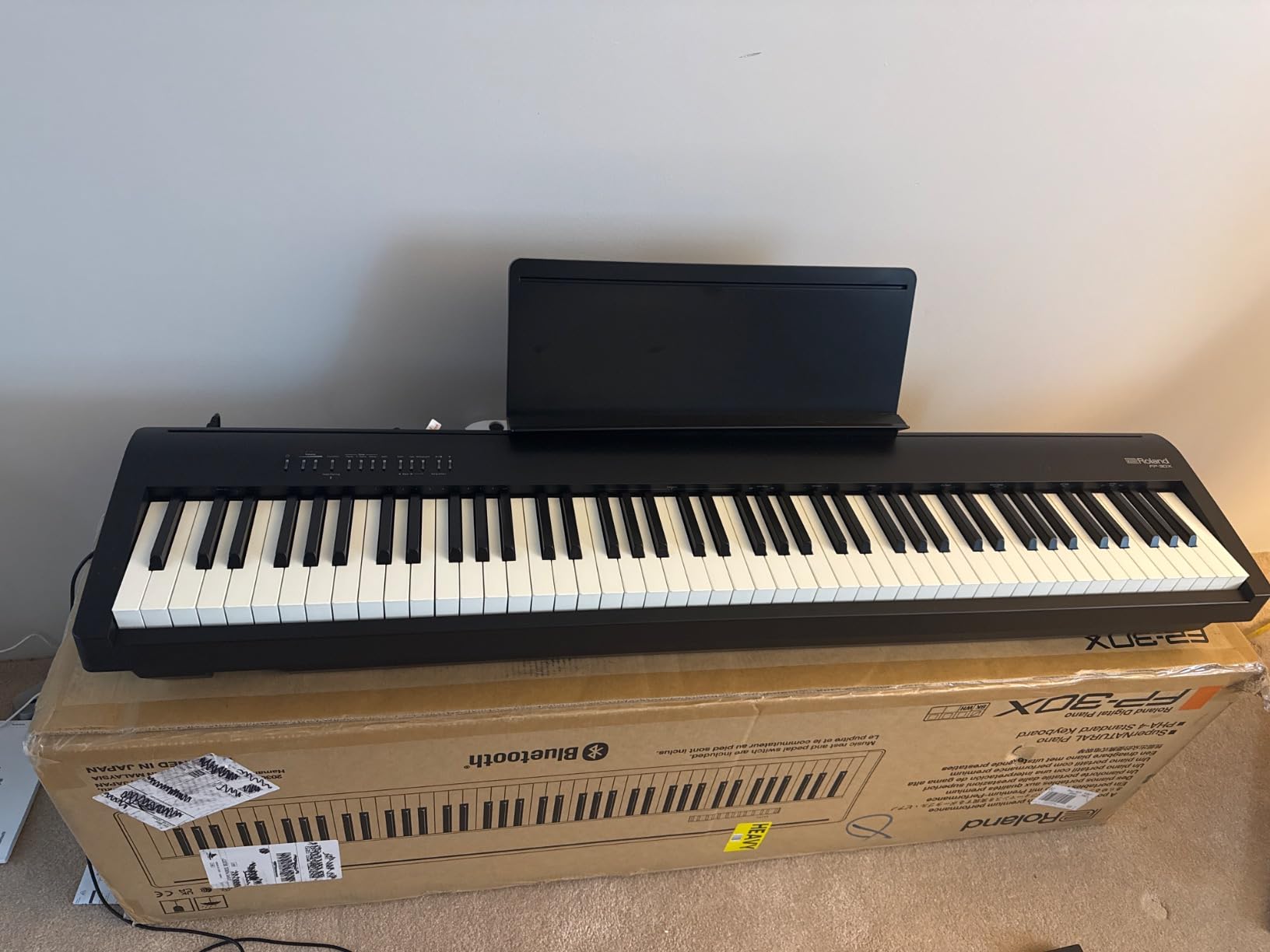
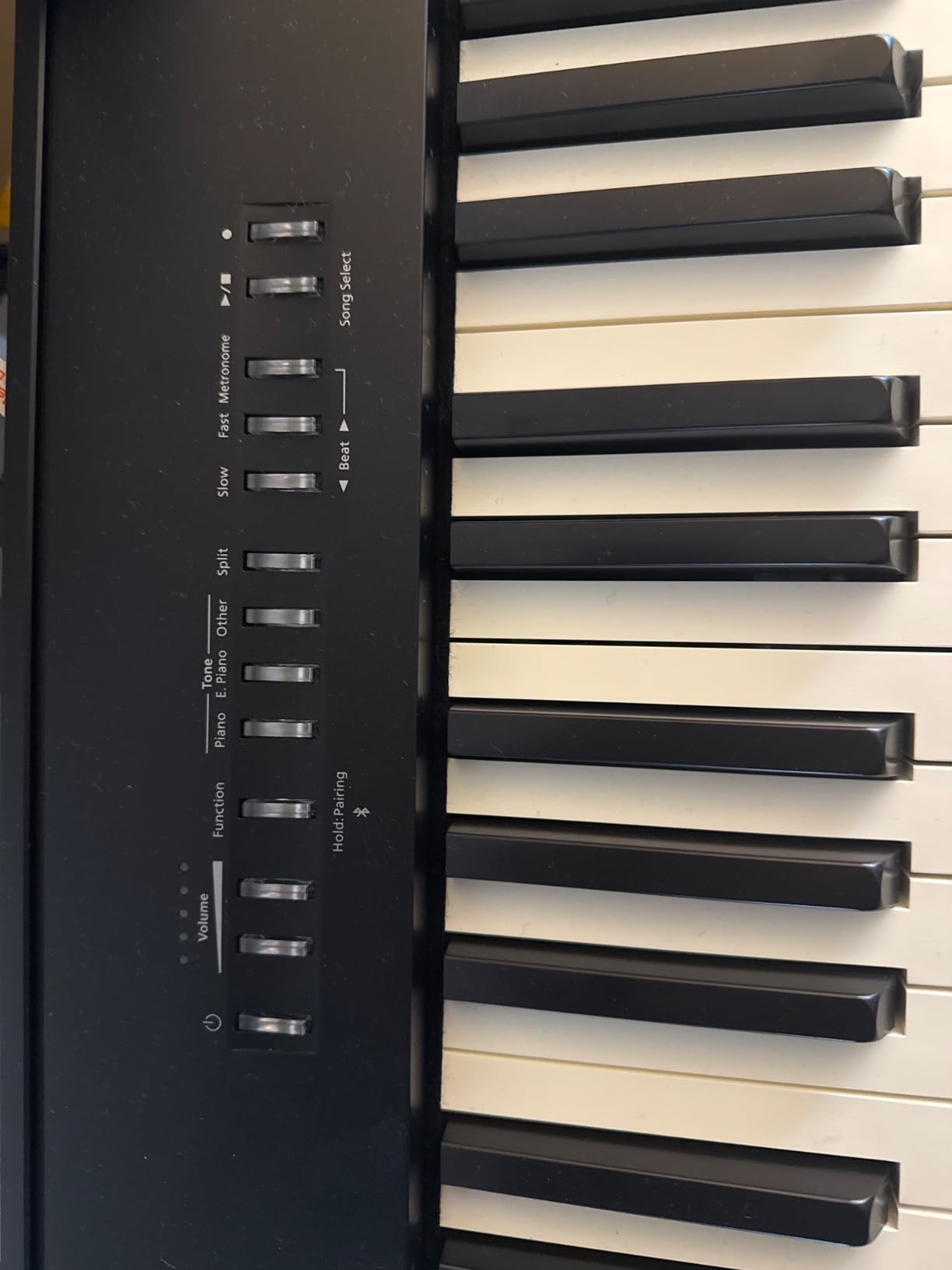
Speakers are 22 watts, enough to fill a bedroom or small practice room without strain, and Bluetooth audio and MIDI let you pipe backing tracks in from a phone and reach lesson apps without cables. Piano Partner 2 support and a desktop optimization setting that adjusts the sound for a table or stand round out a compact package.
One detail catches people out: Bluetooth headphones are not supported, so wireless silent practice needs a wired connection instead.
Who the Roland FP-30X suits
Players who know the FP-10 and want the upgrade, and anyone wanting Bluetooth MIDI plus decent onboard volume in a compact cabinet. At 32.7 pounds the slim profile still fits a smaller room comfortably.
Who should skip it
Skip it if wireless headphones are a requirement or if you need true premium hammer grading, since PHA-4 Standard sits below the top actions on Yamaha and Kawai boards. A stand is not included, so factor that in.
9. Yamaha P225 – Best Lightweight Piano for Moving Between Rooms
Yamaha P225 88-Key Digital Piano with Weighted Keys, Portable Design, Keyboard, Music Rest, Sustain Foot Switch, and Built-In Speakers, Black (P225B)
Graded weighted action
CFX grand voice
24 voices
Two headphone outputs
Pros
- Action graded heavy in the bass and light in the treble
- CFX concert grand voice with rich tone
- Light enough to move between rooms easily
- 24 instrument voices
- Smart Pianist app support
Cons
- No Bluetooth connectivity
- Stand and bench not included
- Fewer voices and accompaniment features than the DGX-670
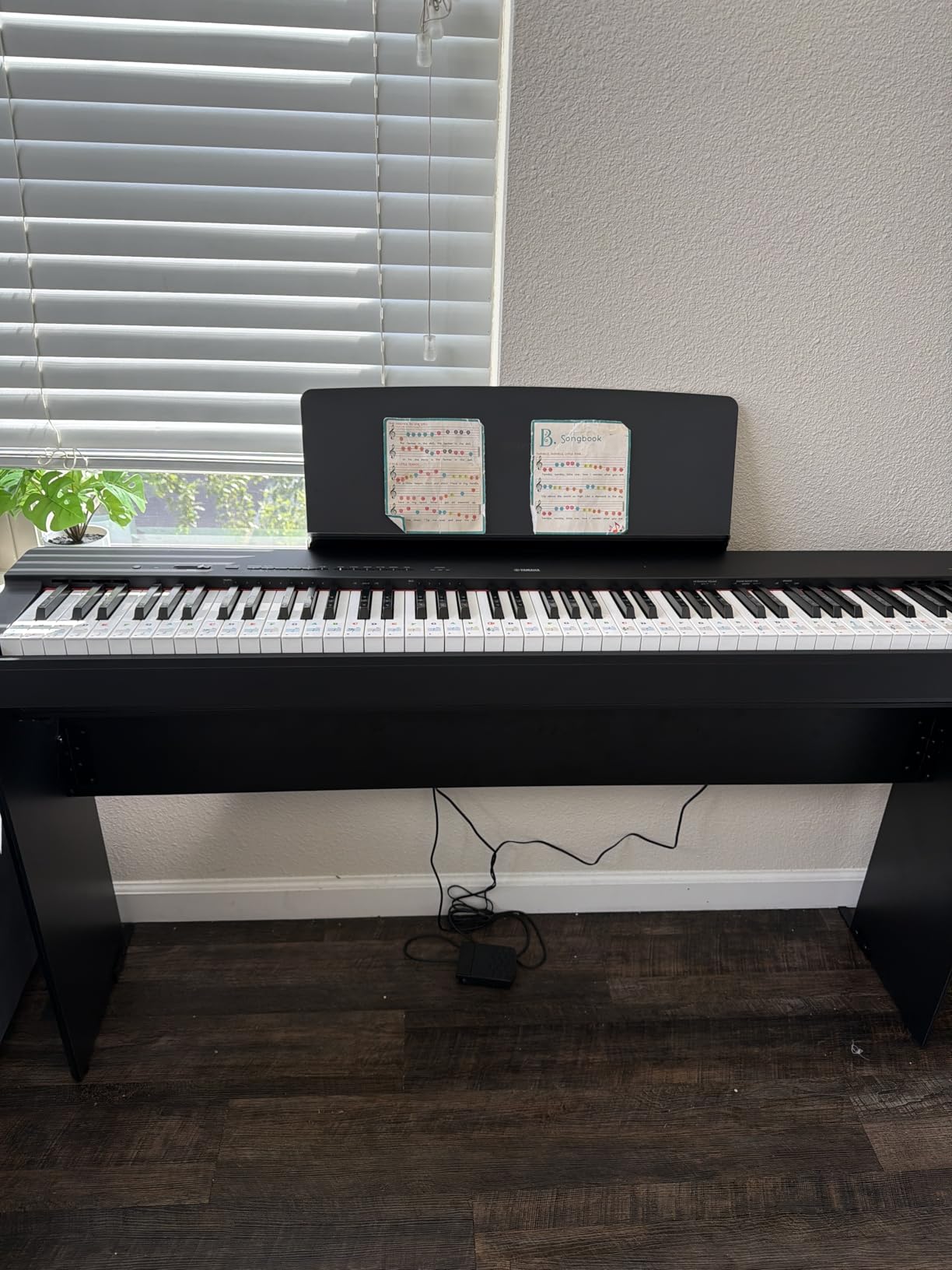
The P225 holds the number one rank in Home Digital Pianos on Amazon, and at 4.7 stars across 352 reviews it is rated as the current-generation successor to the P-71. Owners cite a better action feel and more refined CFX sampling as the improvements that matter.
At 25.4 pounds with graded weighted action, this is the combination most people are looking for: real key weight, a realistic grand voice, and a body you can carry between rooms yourself. That portability matters more than buyers expect in homes where the piano shares a space.
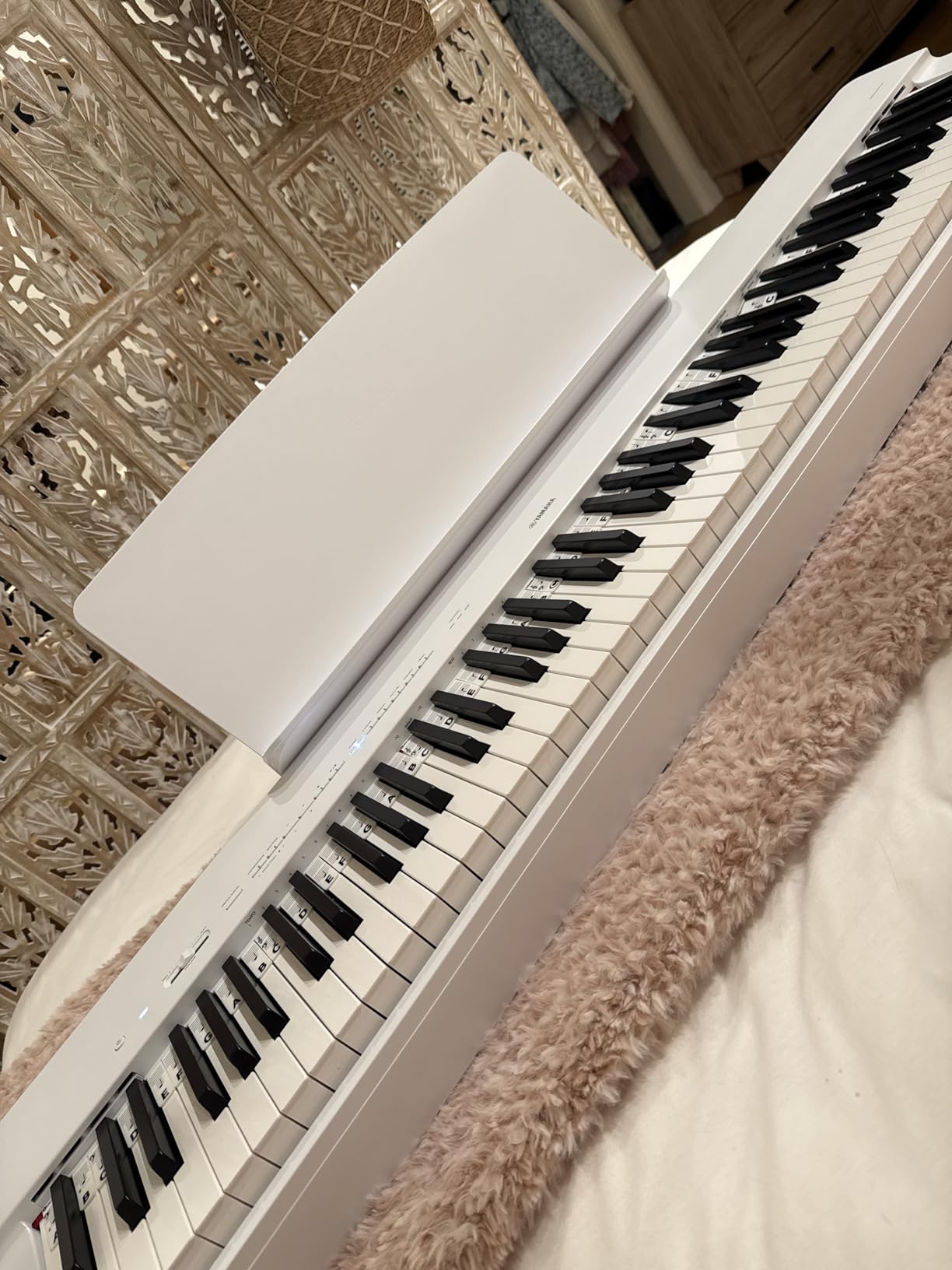
Twenty-four instrument voices cover pianos, organs, strings, and bass without turning into an arranger workstation, and two headphone outputs help when a teacher is in the room. Smart Pianist and Rec’n’Share app support adds guided practice that listens to how you play, closer to real feedback than a metronome. The music rest, sustain foot switch, and power adapter are in the box.
Who the Yamaha P225 suits
Anyone wanting the sound and touch of a Yamaha weighted piano without a heavy furniture cabinet, and students sharing a flat where the instrument moves rooms. It also suits players who want the CFX grand voice for classical repertoire without paying for 630 arranger voices.
Who should skip it
Skip it if you need Bluetooth, because this model has none. Skip it if you want song arrangements or accompaniment styles, and note that stand and bench are separate purchases.
10. Eastar EUP-100 – Best Complete Bundle Out of the Box
Eastar EUP-100 Digital Piano 88 Key Weighted Keyboard Full Size, Home Digital Keyboard Piano Gifts for Beginners Daughter, with Cover, Headphone, Three-Pedal, Wireless Midi & Recording, Retro Wood
Weighted hammer action
Wireless MIDI
Triple pedal
Headphones included
Pros
- Weighted hammer action keys rated well by trained players
- Headphones and triple pedal included
- Wireless MIDI connects to educational apps
- Recording function included
- Wood cabinet doubles as a desk
Cons
- Speaker output distorts slightly at maximum volume
- Bench not included
- Legs are painted rather than solid wood
The EUP-100 is the most complete package here. A protective cover, headphones, and a three-pedal set all ship in the box, which removes the accessory shopping that trips up most first-time buyers. It rates 4.6 stars, though the review base of 99 is the smallest here.
Classically trained players rate the weighted hammer action highly at this level, and wireless MIDI reaches educational apps without cables. Thirteen voices, 128 rhythms, 31 built-in songs, dual voice, auto chord, transpose, and a metronome cover the practice-tool side well.
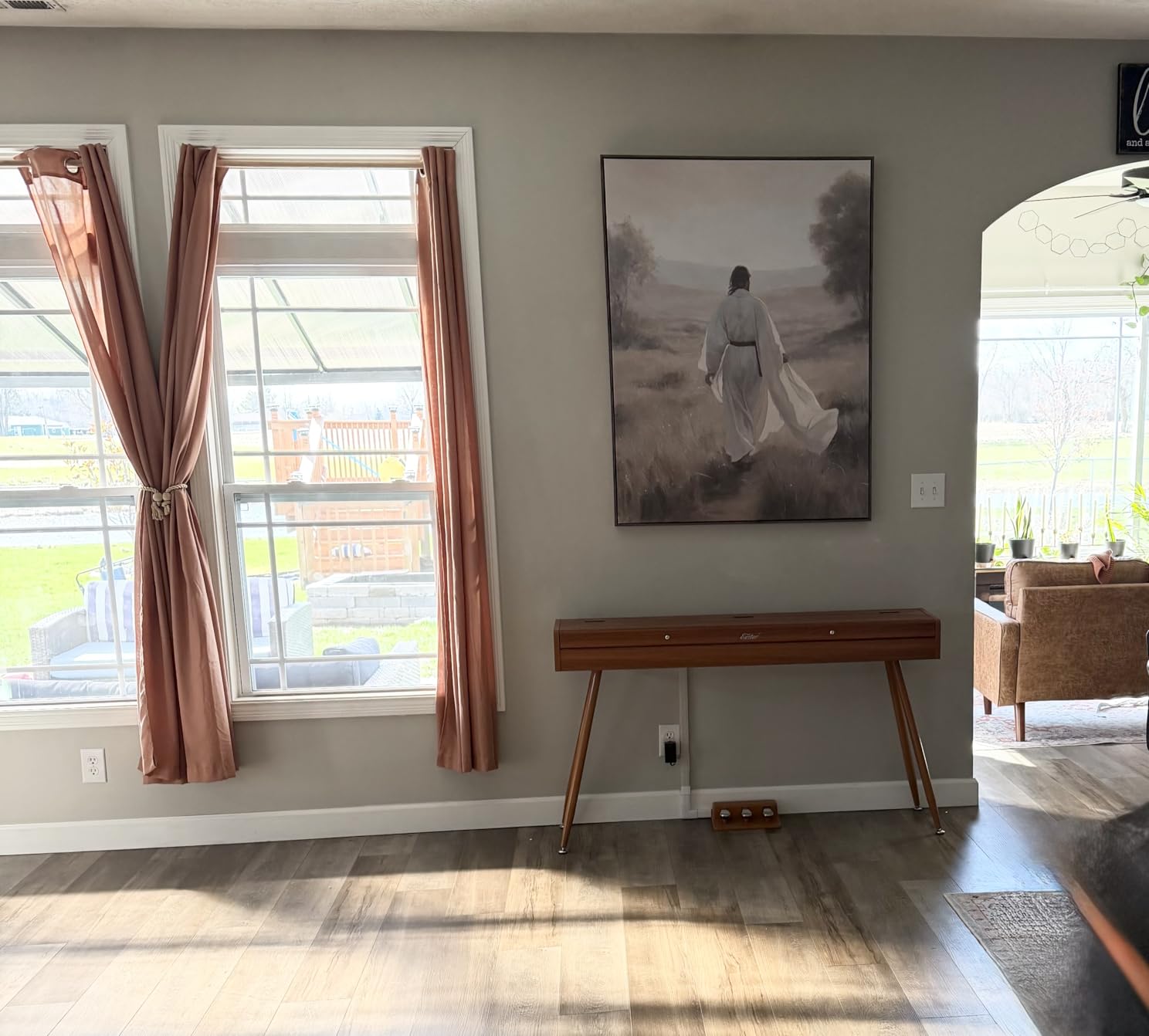
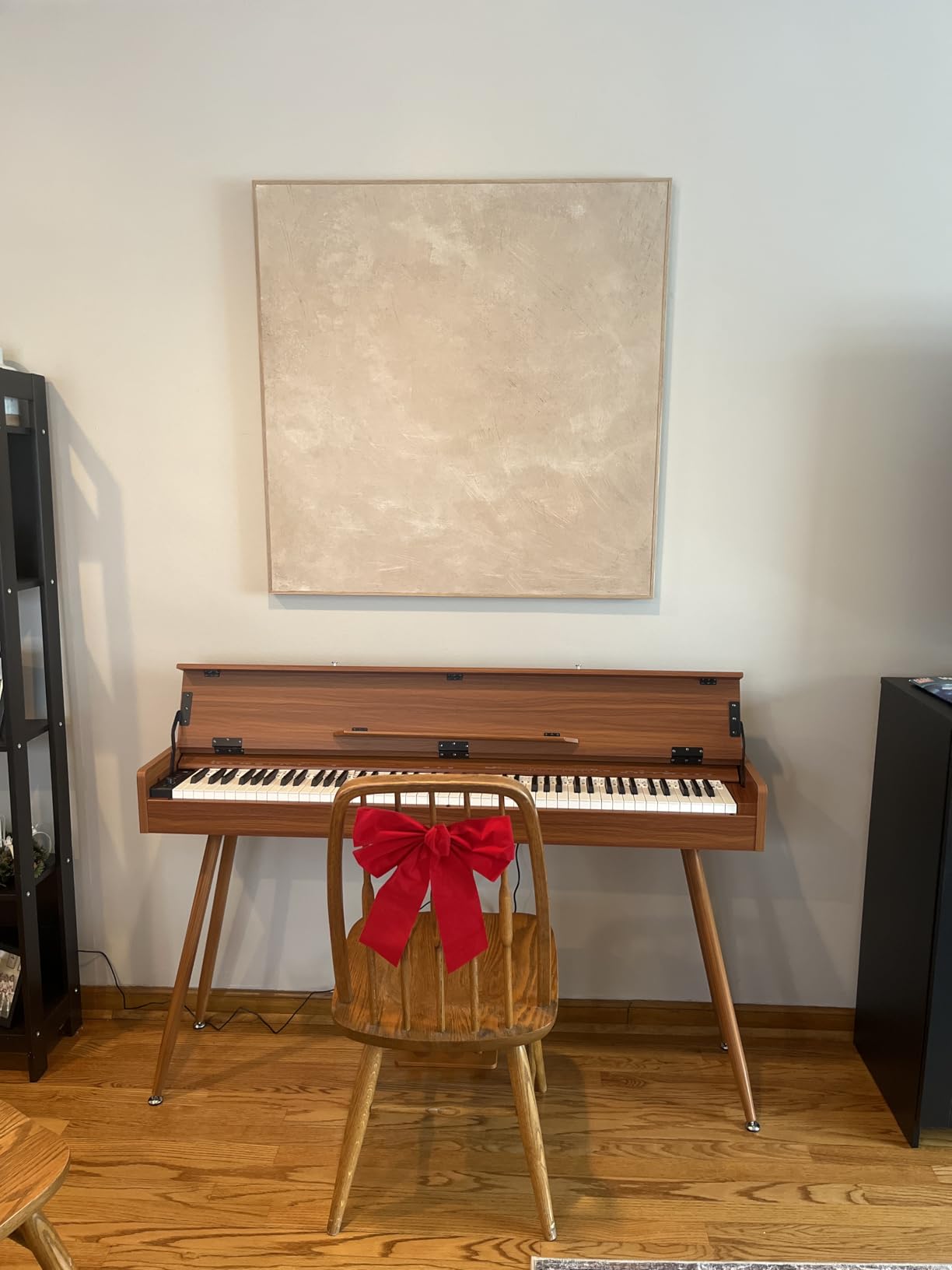
The wood-finish cabinet doubles as a practical desk, so the piano occupies a defined spot rather than floating on a stand, which helps in a living room where furniture placement matters. At 55 pounds it is not a portable instrument.
Who the Eastar EUP-100 suits
Gift buyers and parents setting a child up with a complete first instrument, and anyone who wants wireless MIDI with a desk-style cabinet that looks finished in a home room.
Who should skip it
Skip it if you play loud in an open-plan living space, since reviewers flag distortion at high volume. No bench is included, the legs are painted rather than solid wood, and with 99 reviews the rating is encouraging rather than proven.
11. STRICH SDP-120 – Best Low-Cost Route to Fully Weighted Keys
STRICH 88 Keys Weighted Keyboard with Sustain Pedal, Hammer-Action Digital Piano, 2x15W Built-In Speakers, Full-size Electric Piano Keyboard Supports USB-MIDI/Wireless Connect, SDP-120
Fully weighted hammer action
2x15W speakers
128-note polyphony
Wireless MIDI
Pros
- Fully weighted action at an entry price point
- 128 tones plus 110 demo songs
- Wireless MIDI with USB and audio connections
- Clear LCD display and simple interface
- Sustain pedal included
Cons
- Lowest average rating in this group with a larger share of one-star reviews
- Speakers limited by the 2x15W amplification
- Action and tone depth trail the Yamaha and Roland models
The SDP-120 exists for one reason: fully weighted hammer action at the lowest outlay in this group. At 4.2 stars from 536 reviews it has the lowest average rating here, with 66 percent five-star ratings, so you are trading consistency for the action.
Features are generous for the price: 128 tones, 200 rhythms, 110 demo songs, 128-note polyphony, wireless MIDI plus USB and audio inputs, and a clear LCD display. A sustain pedal is included, and at 20.5 pounds the slim cabinet fits small rooms easily.
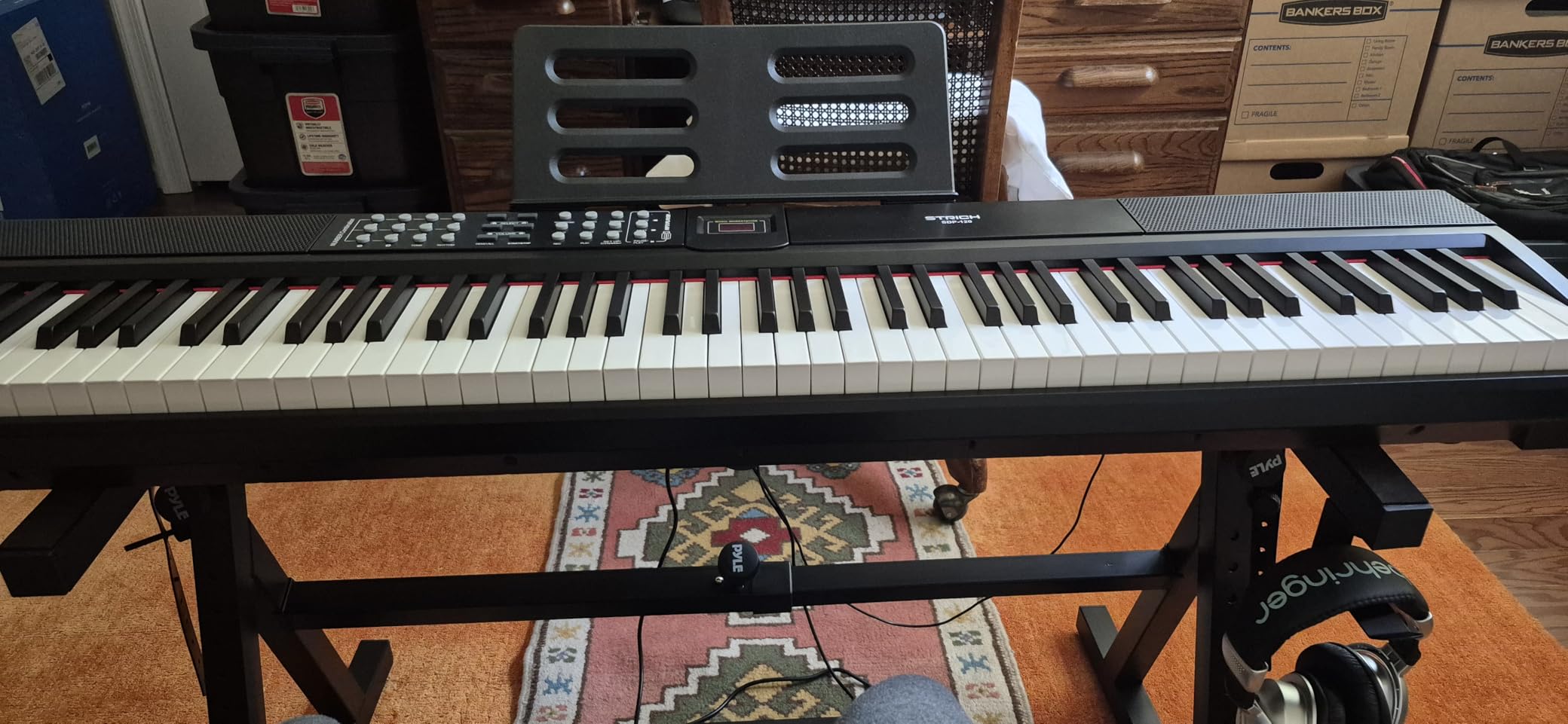
Sound is where the budget shows. Two 15W speakers are the lowest output here and reviewers describe the result as thin, fine for learning chords in a bedroom with headphones but not for a living room. Owners also report a larger share of durability complaints than on rival models, and some accessories may arrive packed in the box rather than fitted.
Who the STRICH SDP-120 suits
A student on a strict budget who has outgrown a semi-weighted keyboard and needs real key weight to continue. It also suits anyone wanting wireless MIDI and a recording-capable practice setup without spending heavily.
Who should skip it
Skip it if you want a piano to keep for many years, given the higher share of one-star reviews. Skip it if you play without headphones in a room larger than a bedroom.
12. Best Choice Products 88-Key Set – Best All-In-One Starter Package
Best Choice Products 88-Key Full Size Digital Piano Electronic Keyboard Set for All Experience Levels w/Semi-Weighted Keys, Stand, Sustain Pedal, Built-In Speakers, 6 Voice Settings – White
88 semi-weighted keys
Folding stand included
Six voices
Sustain pedal included
Pros
- 88 weight-sensitive semi-weighted keys at the lowest outlay
- Compact folding stand and music stand included
- Six voice settings including organ and harpsichord
- Slim footprint that fits small rooms
- Sustain pedal and power adapter included
Cons
- Semi-weighted keys are much lighter than true hammer action
- Thin speakers that can sound harsh
- Touch sensitivity is overly responsive
- Only a 60 day warranty
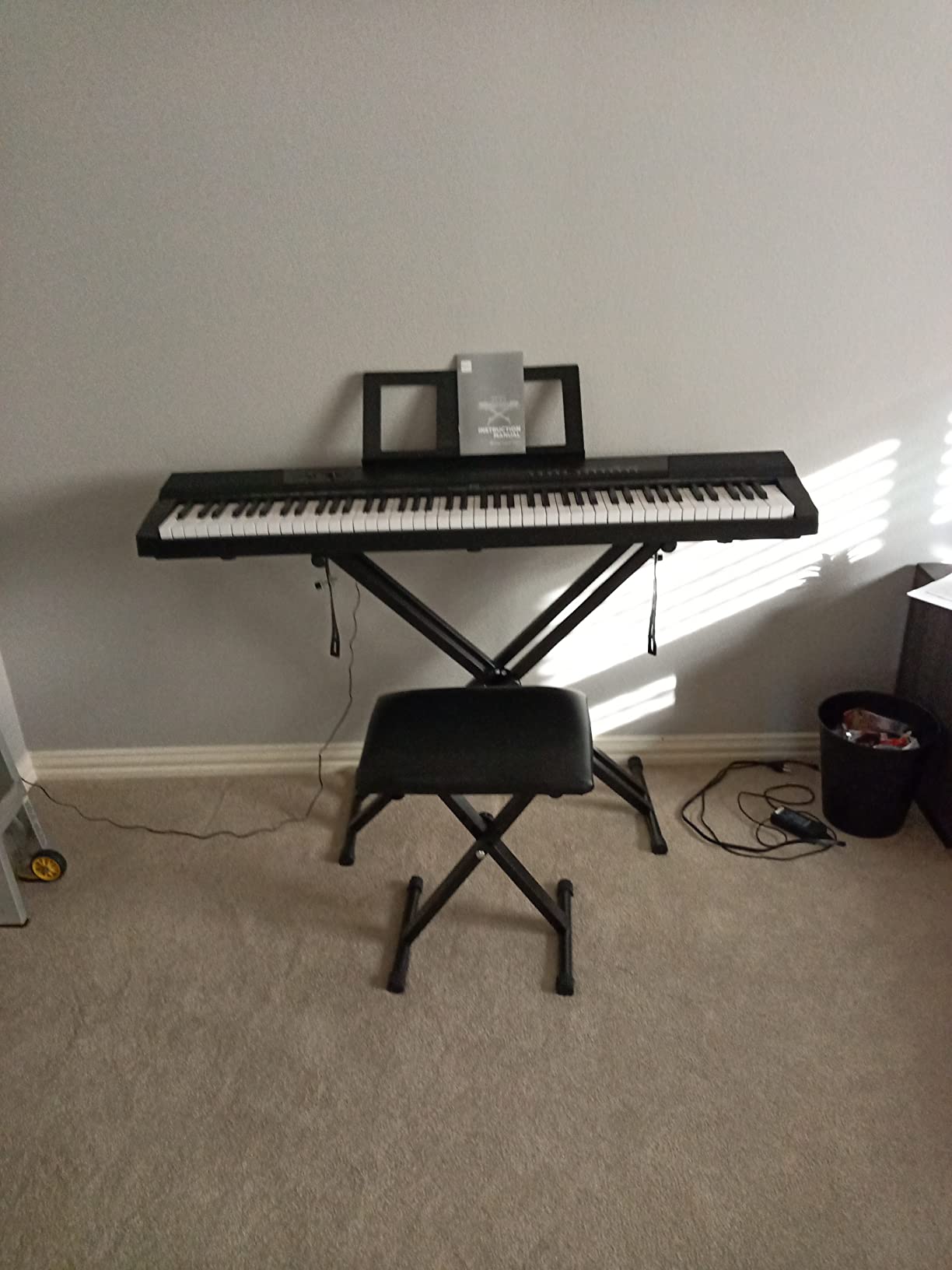
This is the cheapest complete package here, and for a first instrument in a small flat it is genuinely practical. The set includes a compact folding stand, a music stand, a detachable sustain pedal, and a power adapter, so the total cost of ownership problem largely disappears. It rates 4.3 stars across more than 2,200 reviews.
Expect compromises that follow from the price. The keys are weight-sensitive semi-weighted, much lighter than true hammer action, and will not build the finger strength graded keys build. Anyone past about grade 3 feels the difference within a month.
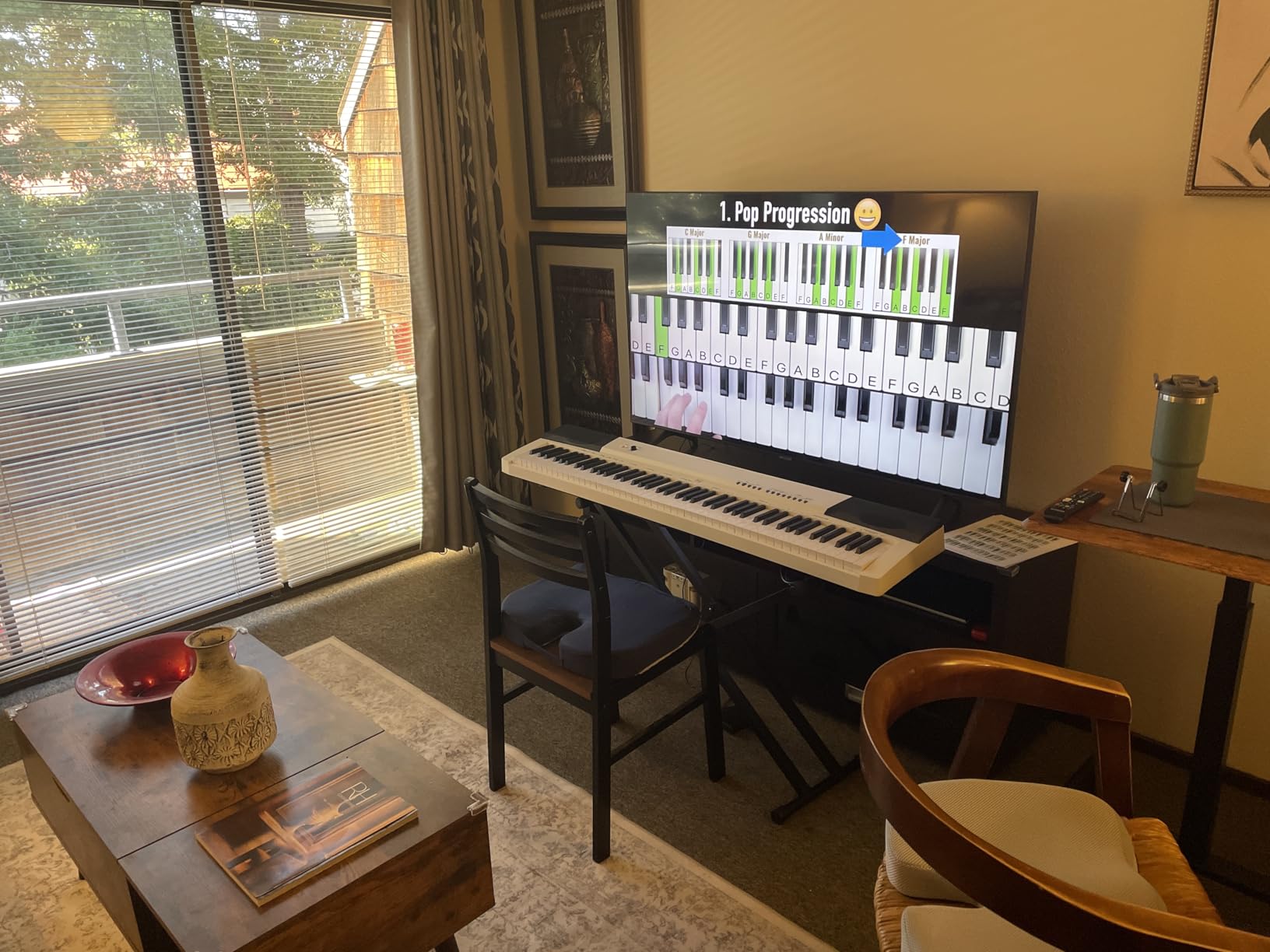
The speaker sound is thin and can turn harsh on the default piano voice, and touch sensitivity is set aggressively so light-handed players over-drive notes easily. Six voice settings including organ and harpsichord are enough for casual practice and light repertoire.
Who the Best Choice Products set suits
A first purchase in a small room where every accessory cost matters, and a child in a beginner method book who is not yet playing repertoire. The folding stand and included pedal mean it is playable the day it arrives.
Who should skip it
Skip it if the player intends to progress past early grades, because the light action becomes the limiting factor. The warranty runs 60 days, far shorter than every other board here, and some owners report power cord failures.
How to Choose an 88-Key Digital Piano for Your Home
Six decisions account for almost every purchase mistake we see. Work through them in order and the model choice takes care of itself.
Do you really need 88 weighted keys?
Yes, if you plan to keep playing beyond the first two years. A 61-key unweighted keyboard cannot train the finger strength or repertoire habits that graded exam work and classical literature require, so you end up relearning technique later. Beginners debate this constantly, and the practical answer is that weighted keys are cheap insurance against a future re-training cost. The exception is a child under about seven, where a lighter semi-weighted board avoids frustration.
Which key action should you buy?
Graded hammer action is the target, because it reproduces the acoustic pattern of heavier bass keys and lighter treble keys. Semi-weighted keys are a legitimate starting point and cost less, but they do not scale with skill. Brands differ more here than spec sheets suggest, which is why auditioning matters more than reading wattage numbers.
Onboard speakers and room size
Match the piano to the room, not the other way round. A bedroom or small practice room is handled comfortably by 15W to 20W per side. An open-plan living room wants 25W per side or external speakers through the line outputs. Crucially, amplifier wattage on its own is a weak predictor of loudness; speaker count, throw direction, and internal limiting matter as much. That point comes up repeatedly on owner forums and is worth trusting over a spec sheet.
Speaker direction is the other trap. On several models the speakers fire downward from the underside of the cabinet, so a solid-topped table or a badly designed stand will physically block them. If you own such a piano, use an open X-stand or a furniture stand with clearance underneath. You can read more about matching stands in our keyboard stand guide.
Bluetooth audio vs Bluetooth MIDI
These solve different problems and a lot of buyers confuse them. Bluetooth audio streams sound from your phone or tablet into the piano’s speakers, which is useful for playing along to backing tracks. Bluetooth MIDI sends note data to apps and software, which is what lesson software and recording need. Several boards here support both, but some support only wired headphones, so check that if silent wireless practice is part of your plan.
The real cost of a home piano setup
Budget for the piano plus a stand, a pedal unit if the board does not include one, a bench, and headphones. Owners regularly report that accessories add 30 to 60 percent on top of the piano price. Two boards here ship with a stand and three pedals, and two include a sustain pedal, which lowers the total. If you need a lighter build, our portable digital piano picks cover that side.
How to audition a piano in a store
Play scales with increasing volume to hear whether key resistance stays even and whether tone distorts at the top. Play the same phrase on two or three boards to compare action weight directly. Listen for key return noise, which is distracting in a quiet home. Check speaker direction and make sure your intended stand will not block it. And rely on the return policy, because the consensus on owner forums is to play what you can and avoid buying blind.
Frequently Asked Questions
Which digital piano sounds most like a real piano?
Among the models reviewed here, the Yamaha DGX-670 comes closest, because it uses CFX Full Concert Grand stereo sampling of Yamaha’s flagship concert grand and a weighted action graded heavier in the bass. The Yamaha P225 uses the same CFX voice in a lighter, more portable cabinet.
What is the best digital piano for home use?
For most homes the Alesis Recital is the strongest starting point: 88 semi-weighted keys, two built-in 20W speakers, and more than 11,000 owner reviews at 4.6 stars. If your room is larger or you play classical repertoire, step up to a weighted action such as the Yamaha P-71 or Yamaha P225.
What is the best digital piano for value for money?
The Roland FP-10 offers the best pairing of key action and sound quality at this level, with ivory-feel keys, the SuperNATURAL Piano engine, and USB MIDI. The weakness is small onboard speakers and a stand sold separately, both of which are straightforward add-on purchases.
Which 88-key piano is the best overall?
There is no single answer for every room, but our default recommendation is the Alesis Recital for beginners and the Yamaha P-71 for players who want true weighted hammer action. For a larger room with a lot of features, the Yamaha DGX-670 is the stronger long-term choice.
Do I need 88 weighted keys to learn piano?
You do not need them in the first months, but you will want them before moving into graded repertoire. Unweighted 61-key keyboards cannot train finger strength or key weighting, so students who start without them often re-learn technique later. Semi-weighted 88 keys are a reasonable middle step for young beginners.
How loud are the speakers on a digital piano?
A bedroom is handled comfortably by 15W to 20W per side, and a mid-size living room usually needs 25W per side or external speakers. Amplifier wattage alone is a poor loudness indicator: speaker count, throw direction, and internal limiting change the result as much as the number on the box.
Conclusion
If you want one default answer to the question of which model belongs in the best 88 key digital pianos for home, it is the Alesis Recital. It has the largest owner base in this group, the loudest speakers relative to its action, and lesson features that make solo practice less lonely. Buyers who want genuine weighted hammer action should take the Yamaha P-71, and buyers in larger rooms who want the most complete instrument should take the Yamaha DGX-670.
Whatever you choose, match the piano to the room, check that your stand will not block downward-firing speakers, and budget for accessories before you buy. Our 88-key keyboard comparisons cover the lighter end of the market if a full piano is more than you need. Updated for 2026, and we will keep revising this list as models change.