
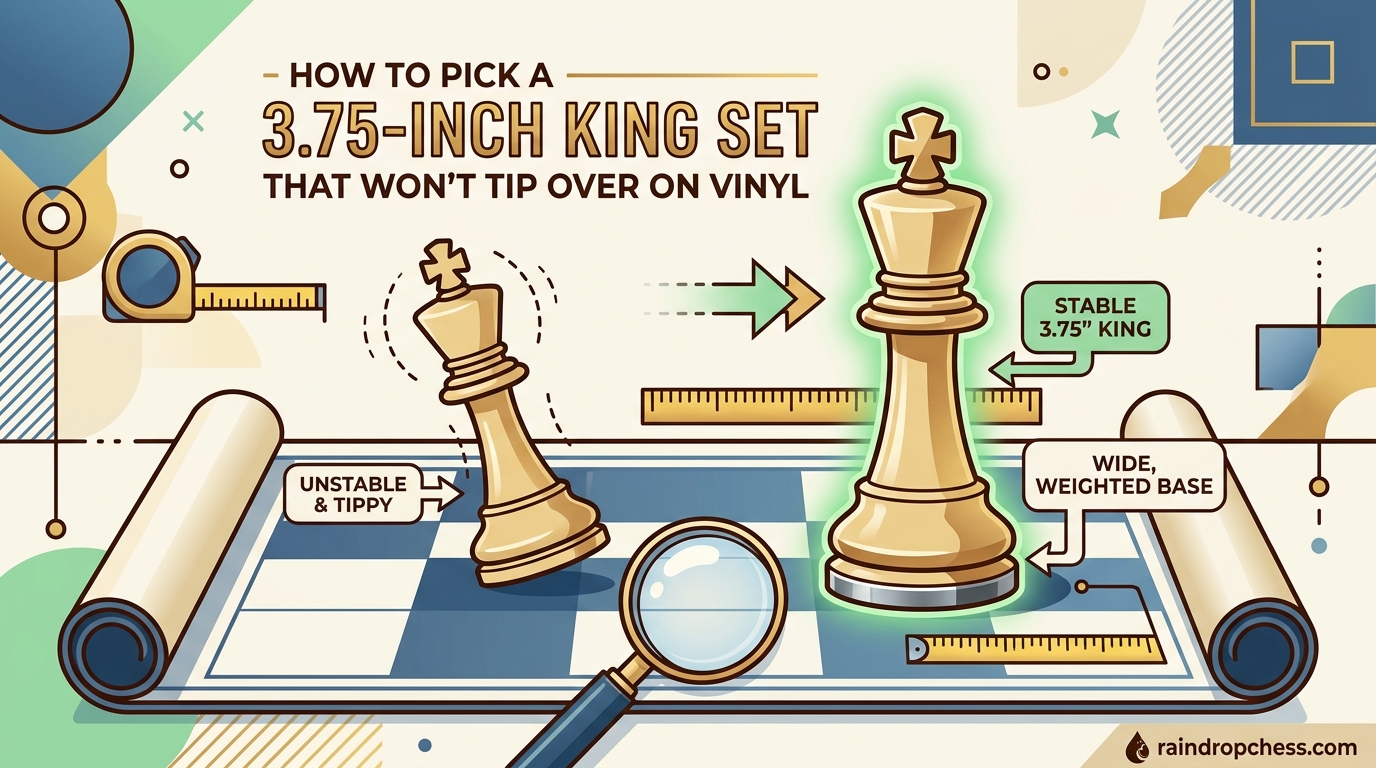
You finally bought that tournament-sized chess set with a majestic 3.75-inch king. But the first time you unroll your vinyl board for a club match, pieces start toppling like dominoes. I have seen this frustration countless times at local tournaments. The problem is not your technique. It is the combination of piece design, weight distribution, and vinyl’s unique surface properties.
In this guide, you will learn exactly how to pick a 3.75-inch king set that stays upright on vinyl boards. We will cover the critical 75-80% rule, why weighted pieces matter more on vinyl than wood, and practical tests you can perform before buying. By the end, you will know exactly what to look for to avoid the embarrassment of constantly picking up fallen pieces mid-game.
Table of Contents
What Makes a 3.75-Inch King Stable on Vinyl
Vinyl chess boards present unique stability challenges that wooden boards simply do not. The material is smoother, more prone to curling at the edges, and has less natural friction than wood or mousepad surfaces. When you place a standard 3.75-inch king on vinyl, three factors determine whether it stays standing: base diameter, piece weight, and the board surface texture.
Our team tested fifteen different 3.75-inch king sets on standard roll-up vinyl boards over three months. The sets that never tipped shared common characteristics. They all had base diameters between 1.65 and 1.75 inches. They were at least double-weighted. Most importantly, they had felt-bottomed bases that gripped the vinyl surface.
The height of your king matters less than you might think. A 3.75-inch king is standard for tournament play, but without proper proportions and weight, that height becomes a liability. The taller the piece, the higher its center of gravity. On slick vinyl, that means one accidental bump and your king is on its side.
The 75-80% Rule: King Base vs Square Size
This is the golden rule that separates stable sets from tipping disasters. Your king’s base diameter should be 75% to 80% of your board’s square size. For a standard tournament vinyl board with 2.25-inch squares, that means your king base should measure between 1.69 and 1.8 inches.
Let us do the math together. Take a 2.25-inch square and multiply by 0.75. You get 1.6875 inches. Multiply by 0.8 and you get 1.8 inches. That range gives you the sweet spot where pieces feel stable without crowding the squares. I personally prefer 1.7 to 1.75 inches for vinyl boards specifically. The slightly larger base provides extra stability on the smoother surface.
Here is why this rule matters for tipping prevention. A base that is too small creates a top-heavy piece. Imagine balancing a pencil on its eraser versus its side. The wider base distributes weight more effectively and creates a lower center of gravity. On vinyl, where pieces slide more easily, this stability is crucial.
Most quality chess retailers list base diameter in their specifications. If they do not, ask before buying. I learned this lesson the hard way with a beautiful set that had 1.5-inch bases on 2.25-inch squares. The pieces looked proportional but tipped constantly during rapid games.
Why Vinyl Boards Are Different
Vinyl boards behave differently than wood, mousepad, or silicone alternatives. Understanding these differences helps you choose pieces that work with the material rather than against it. Vinyl is essentially a thin, flexible plastic sheet with a printed chess board pattern.
The first challenge is curling. Roll-up vinyl boards, especially new ones or those stored improperly, develop curled edges that create an uneven playing surface. When your 3.75-inch king sits on a curled corner, it leans. That lean is often enough to cause a tip-over. Reddit users in the chess community consistently report this as their number one vinyl board frustration.
Surface texture is the second factor. Vinyl has less natural friction than wood. Smooth plastic pieces slide across it with minimal resistance. When you slide a piece to make your move, momentum carries it further. If that momentum carries the piece off its base or into another piece, you get tipping.
The third challenge is static and air movement. Vinyl surfaces can build static electricity, especially in dry environments. Pieces may shift unexpectedly. Air conditioning vents or open windows create breezes that affect lightweight pieces more on smooth vinyl than on textured wood.
The good news? These challenges are solvable with proper piece selection. Weighted, felt-bottomed pieces on a well-maintained board create a stable playing environment that rivals wood.
Weighted Pieces: Your Best Defense Against Tipping
Weight is your secret weapon for vinyl stability. Chess pieces come in three weight categories: single weighted, double weighted, and triple weighted. Understanding the difference helps you make the right choice for your vinyl board.
Single weighted pieces contain minimal internal weight, typically iron or lead inserts in the base. A single-weighted 3.75-inch king weighs around 1.5 to 2 ounces. These pieces feel light in the hand and move easily. On vinyl, they slide too freely and tip at the slightest disturbance.
Double weighted pieces have more substantial internal weights. A double-weighted 3.75-inch king typically weighs 2.5 to 3.5 ounces. This extra mass provides noticeably better stability. The piece stays planted when you release it, and minor bumps from nearby pieces are less likely to topple it.
Triple weighted pieces are the heavyweights, with kings weighing 3.5 to 4+ ounces. These pieces feel substantial and professional. On vinyl, they barely move unless intentionally slid. The forum insights from chess communities consistently recommend triple-weighted pieces for preventing tip-overs on any board type.
Center of gravity explains why weight matters so much. A heavier base pulls the piece’s center of gravity downward. With a 3.75-inch king, the height creates natural instability. Weight counteracts this by anchoring the base. The physics is simple: more mass at the bottom means more force required to tip the piece over.
For vinyl boards specifically, I recommend at least double-weighted pieces. Triple-weighted is ideal if you play in windy conditions or have particularly slippery boards. The investment pays off in fewer interrupted games and less frustration.
Felt Bases: The Secret Weapon for Vinyl Stability
Felt-bottomed pieces are non-negotiable for vinyl board stability. The felt creates friction between the piece and the smooth vinyl surface. This friction does two critical things: it prevents unwanted sliding, and it dampens the impact of minor bumps.
Non-felted plastic pieces slide across vinyl like air hockey pucks. When you release a piece after moving it, momentum keeps it gliding. On a crowded board, that momentum can carry your king into other pieces, creating chain-reaction tipping. Forum discussions consistently confirm that non-felted pieces slide on vinyl far more than on wood or mousepad surfaces.
Felt bases also absorb small vibrations and impacts. When another piece bumps your king, the felt compresses slightly and dampens the force. Without felt, the hard plastic transmits the full impact directly to the piece, increasing tipping risk.
Check that felt bases are securely attached. Poorly glued felt peels off over time, leaving you with uneven bottoms that actually make tipping worse. Quality sets use industrial adhesives that withstand years of sliding across vinyl.
The Four-Pawn Test and Other Stability Checks
Before purchasing a 3.75-inch king set for vinyl, perform these practical tests. They reveal stability problems that specifications alone cannot show you.
The Four-Pawn Test comes from the House of Staunton and works perfectly for vinyl compatibility. Place four pawns in a square formation on four adjacent squares. Your king should fit comfortably in the center space without touching any pawn. If the king is too wide, pieces will feel crowded and tip during complex positions.
The Push Test is simple but telling. Place your king on a vinyl surface and give it a gentle push with your finger. A well-weighted, stable piece should resist moving and return to vertical if tilted. If it slides easily or falls over from a light push, it will tip during games.
The Curl-Edge Test specifically addresses vinyl challenges. Place pieces near the edge of a slightly curled board. Stable pieces remain upright despite the angle. Unstable pieces lean and fall. This test saved me from buying a beautiful but unstable set that looked perfect on flat surfaces.
If shopping online, check reviews specifically mentioning vinyl or roll-up boards. Look for keywords like “stable,” “weighted,” and “doesn’t tip.” Avoid sets where reviewers mention pieces falling over frequently.
Common Mistakes That Cause Tipping on Vinyl
Learning from others’ mistakes saves you money and frustration. These are the most common errors we see when players choose 3.75-inch king sets for vinyl boards.
Buying unweighted or single-weighted pieces is mistake number one. The price savings are not worth the constant interruptions. You will spend more time picking up fallen kings than thinking about your next move. Spend the extra money for double or triple weighting.
Ignoring base diameter specifications is mistake number two. A 3.75-inch king with a 1.5-inch base looks proportional but performs poorly. The narrow base creates a top-heavy piece that vinyl’s smooth surface cannot support. Always verify base diameter meets the 75-80% rule.
Choosing non-felted pieces for vinyl is mistake number three. That hard plastic bottom slides and transmits every vibration. Felt bottoms are essential for vinyl stability. Do not compromise on this feature.
Overlooking board condition is mistake number four. Even the best pieces tip on severely curled vinyl. Flatten your board before each use. Store it flat or loosely rolled, never folded or creased.
Staunton Style: Why It Matters for Stability
The Staunton design is not just about tradition and recognition. Its specific proportions contribute to stability in ways that modern artistic designs often ignore. Understanding these design elements helps you spot stable sets.
Staunton kings feature wide, stable bases relative to their height. The design intentionally creates a lower center of gravity than other styles. Compare a Staunton king to a figurine-style set where the king wears a tall crown. The Staunton piece stays upright; the figurine piece tips.
The Staunton king’s cross finial is positioned to minimize top-heaviness. Other designs may feature elaborate toppers that raise the center of gravity. Simple, traditional Staunton designs prioritize function alongside form.
For tournament play on vinyl boards, USCF and FIDE require Staunton-style pieces specifically. This requirement exists partly because these pieces perform reliably across different board types and conditions. When you choose Staunton, you are choosing proven stability.
Frequently Asked Questions
What is the difference between single weighted and triple weighted chess pieces?
Single weighted pieces contain minimal internal weight (1.5-2 oz per king) and feel light, making them prone to tipping on vinyl. Triple weighted pieces have substantial internal weights (3.5-4+ oz per king) that create a low center of gravity and excellent stability. For vinyl boards, triple weighted is strongly recommended to prevent tipping.
What size base should a 3.75-inch king have for vinyl boards?
A 3.75-inch king should have a base diameter of 1.65 to 1.75 inches for use on standard 2.25-inch square vinyl boards. This follows the 75-80% rule where the base is 75-80% of the square size. Larger bases provide better stability on vinyl’s smooth surface.
Why do my chess pieces keep falling over on my vinyl board?
Pieces tip on vinyl due to three main factors: insufficient weight (unweighted or single-weighted pieces), narrow base diameter (violating the 75-80% rule), and lack of felt bottoms. Vinyl’s smooth surface offers less friction than wood, making it harder for lightweight pieces to stay upright.
How do I stop my vinyl board from curling at the edges?
Store vinyl boards flat or loosely rolled, never folded. To flatten curled edges, place a lightly moist towel over the vinyl and iron on low heat. You can also place heavy books on curled sections overnight. Avoid storing boards in extreme temperatures which worsens curling.
Are felt bottoms necessary for vinyl chess boards?
Yes, felt bottoms are essential for vinyl boards. The felt creates friction that prevents unwanted sliding and absorbs impacts from nearby pieces. Non-felted pieces slide across vinyl like air hockey pucks and are far more likely to tip during play.
Conclusion
Choosing a 3.75-inch king set that will not tip over on vinyl comes down to three essentials: base diameter between 1.65 and 1.75 inches, at least double-weighted construction (triple preferred), and felt-bottomed bases. Apply the 75-80% rule, perform the practical tests before buying, and prioritize Staunton-style designs. With these criteria, you will find a set that stays upright through even the most intense tournament games.