
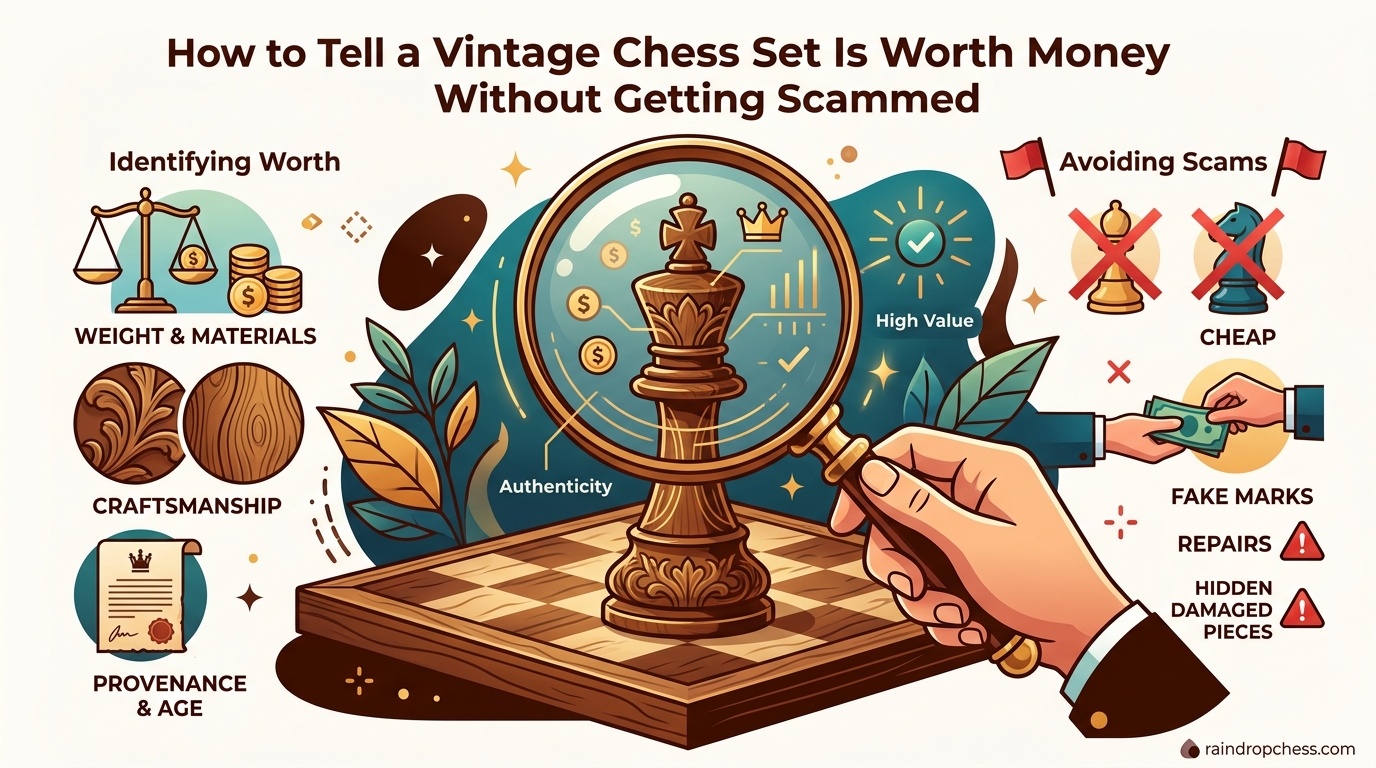
Vintage chess sets can be worth anywhere from fifty dollars to tens of thousands, but determining authentic value requires knowing what to look for and what warning signs should raise immediate suspicion. This comprehensive guide walks you through the complete authentication and valuation process so you can confidently assess your chess set’s worth while avoiding the scams that plague this collectibles market.
Table of Contents
7 Factors That Determine Vintage Chess Set Value
Before you can determine whether your vintage chess set is worth money, you need to understand what drives value in the collector’s market. Unlike modern mass-produced sets sold in toy stores, antique and vintage chess sets derive their worth from a combination of factors that experienced collectors look for during authentication. Each of these seven factors can dramatically influence what a set might fetch at auction or from a private buyer.
1. Materials: The Foundation of Value
The material from which chess pieces are made is often the single biggest determinant of value. Ivory remains the most prized material, particularly elephant ivory from sets manufactured before international trade bans took effect. A complete ivory chess set from a known maker can be worth $2,000 to $10,000 or more, depending on condition and age. Other materials that command premium prices include walrus ivory, bone, and rare ebony and boxwood combinations where the contrasting colors are naturally occurring rather than stained.
Modern materials like plastic, resin, and wood composites generally indicate lower value unless the set comes from a prestigious maker or has significant historical provenance. That said, well-crafted wooden sets from quality manufacturers like Jaques of London or the House of Staunton can still be worth several hundred dollars even in standard materials.
2. Maker and Brand Recognition
Just as with fine watches or furniture, the maker’s reputation significantly impacts value. Jaques of London, established in 1795, is perhaps the most respected name in vintage chess sets, and their pieces command substantial premiums. Other highly regarded makers include John Jaques of Bond Street, Drueke, Lardy (particularly the Swiss-made “Club” sets), and Precision weighted tournament sets.
Learning to recognize maker marks is essential for authentication. These stamps typically appear on the underside of pieces and sometimes on the board itself. Reproductions frequently lack these marks entirely or display them inconsistently. When evaluating a potential purchase or sale, inability to identify any maker should immediately raise questions about the set’s origins.
3. Age and Historical Provenance
Age alone does not guarantee value, but sets manufactured before 1900 become increasingly rare and desirable as the chess collecting hobby matures. Provenance documentation can dramatically increase value by establishing a chain of ownership connected to notable figures, institutions, or historical events. A set with documented ownership history from a known collection or estate sale carries more credibility than anonymous pieces.
Without provenance documentation, estimating age relies on physical examination techniques discussed in the authentication section below. Be deeply skeptical of sellers who make vague claims about age without supporting evidence. Stories like “my grandmother brought this back from Europe in the 1950s” may be true but cannot substitute for actual documentation.
4. Design: Staunton Pattern Dominance
The Staunton pattern, designed by Nathaniel Cook and licensed to Jaques of London in 1849, remains the gold standard for serious chess play and collector interest. The distinctive design with its clear functional distinction between piece types and elegant proportions has been in continuous production for over 175 years, yet original early Staunton sets command significant premiums over modern equivalents.
Pre-Staunton designs, including historical variants like the “Cannon” style popular in East Asia or early European regional patterns, appeal to specialized collectors willing to pay premiums for uniqueness. However, the Staunton pattern’s dominance means that non-Staunton sets require more specialized knowledge to accurately value.
5. Condition and Completeness
A vintage chess set’s condition profoundly affects its market value. Complete sets with all 32 pieces intact command dramatically higher prices than incomplete sets. Missing pieces force collectors to seek replacements that may not match, breaking the visual harmony that makes vintage sets attractive. Even a single missing pawn can reduce value by 20% or more.
Beyond completeness, examine whether pieces retain their original felt bases. Re-felting is common maintenance, but non-original felt can indicate age concealment or previous repair attempts. Surface damage like chips, cracks, or repairs that alter the piece’s structure all diminish value. That said, some collectors accept minor imperfections as evidence of genuine age and正常使用.
6. Craftsmanship and Artistry
Hand-carved pieces from skilled artisans show subtle variations that machine production cannot replicate. During authentication, look for tool marks invisible to casual inspection, slight asymmetries that indicate individual craftsmanship, and the characteristic feel of pieces shaped by experienced hands rather than automated machinery.
Weighted pieces, filled with lead or other materials for improved stability and balance, represent a quality indicator in tournament-grade sets. The weight provides a satisfying tactile experience that casual collectors and players appreciate. Hollow or lightweight pieces often indicate budget production methods that reduce value.
7. Rarity and Collectibility
Some vintage chess sets gain value through sheer rarity. Limited edition releases from major manufacturers, sets produced during specific historical periods with limited supply, or pieces featuring unusual materials no longer available for commercial use all attract collector premiums. Themed sets from franchises or notable designers may also appreciate based on external market demand.
The most valuable vintage chess sets often combine multiple factors: rare materials, prestigious maker, documented provenance, and excellent condition. Sets ticking fewer boxes may still be worth money, but realistic expectations matter. A complete wooden Staunton set from the 1970s in good condition might be worth $200 to $400, while a pre-war ivory Jaques set with provenance could be worth ten times that amount.
The 5-Step Authentication Checklist
Determining whether a vintage chess set is genuinely valuable requires systematic examination. Follow this five-step authentication process to evaluate any set you encounter. While no single indicator provides definitive proof, patterns emerging across multiple checks build a compelling authentication picture.
Step 1: Examine the Bases and Undersides
Authentic vintage chess pieces almost always bear some form of identification on their bases. Turn each piece over and examine the underside carefully under good lighting. Look for:
- Maker stamps, logos, or model numbers
- Handwritten numbers or letters indicating production batches
- Indented marks from the manufacturing process
- Original felt padding and its condition
Many reproductions lack any marks, while counterfeit pieces display poorly replicated stamps. If pieces within the same set show inconsistent marking styles, some may be replacements.
Step 2: Assess Material Authenticity
Verifying material composition requires close observation and physical examination. For ivory identification, hold pieces under natural light and look for the characteristic “engine turning” pattern: fine lines created by the natural growth structure of tusks. Artificial materials like plastic or resin show mold seams, uniform color, and lack this organic texture.
Ivory pieces feel smooth and slightly warm to the touch, while bone feels more granular. If you can examine the interior of any damaged piece, ivory shows a characteristically waxy cross-section, while bone reveals a porous honeycomb structure.
Step 3: Inspect Carving Quality and Wear Patterns
Authentic vintage pieces display wear patterns consistent with decades of regular use. The knight horses’ mouths, bishops’ collars, and rooks’ battlements show smoothing on contact points where players regularly grip pieces. This natural wear appears unevenly and concentrates on elevated surfaces.
Reproductions often feature uniformly sharp details throughout, with no evidence of handling wear. Conversely, artificially aged pieces may show abrasion concentrated on high points rather than natural grip areas. Look for consistent wear depth matching the claimed age of the piece.
Step 4: Check Weight and Balance
Quality vintage chess pieces have substantial weight and satisfying balance. Hold pieces in your hand and compare them to known authentic examples. Hollow pieces, lightweight pieces, or inconsistent weights within a set suggest reproduction or replacement pieces of different origin.
Weighted tournament pieces typically have a deliberate heaviness concentrated in the base for stability. If a piece feels abnormally light for its size, investigate further before accepting claims about its age or value.
Step 5: Verify Board and Piece Proportions
Vintage Staunton sets follow standard proportions that reproduction manufacturers sometimes ignore. The king should stand approximately 3.75 inches tall, and the board’s squares should measure roughly 2 inches, giving a ratio that allows comfortable piece movement without crowding.
Measure the king’s height and compare against this standard. Check whether the base diameter of pieces fits comfortably within a board square without overlapping adjacent squares. Incorrect proportions indicate either modern production or mixing pieces from different sets.
Common Scam Tactics and How to Avoid Them
The vintage chess market attracts scammers who exploit buyers’ limited knowledge about authentication and valuation. Understanding the most prevalent fraud schemes protects you from becoming a victim. The key defensive strategy is patience: legitimate sellers never pressure you for immediate decisions.
Fake Patina and Artificial Aging
The Scam: Sellers artificially age pieces using chemicals, abrasion, or controlled heating to create deceptive surface appearance claiming false antiquity. The pieces may be relatively modern but made to look decades older than they are.
How to Avoid: Real patina develops over decades of handling and concentrates on surfaces that receive regular contact. Fake aging often appears on exposed high points rather than natural grip areas. Run your fingernail gently across suspicious surfaces: artificially applied patina may scrape or flake, while genuine aging cannot be removed without damaging the material beneath.
Reproductions Passed as Authentics
The Scam: Mass-produced reproductions, particularly those marketed as “medieval” or “Viking” style pieces, are presented as genuine antiques. Some unscrupulous sellers buy reproduction pieces and relabel them with fabricated provenance.
How to Avoid: Be extremely skeptical of claims about Lewis Chessmen origins or other historically-themed pieces. Genuine Viking-era chess pieces (circa 800-1100 AD) reside in museums or have documented provenance dating back centuries. If someone offers you a “genuine antique Lewis set,” be highly suspicious. Always research maker stamps and compare against known authentication guides.
Misleading Provenance Stories
The Scam: Emotional narratives about family ownership or estate sale discoveries substitute for actual documentation. The story sounds plausible but cannot be verified, adding perceived value to otherwise ordinary pieces.
How to Avoid: Ask for specific documentation: written records from previous owners, previous appraisals, photographs showing the set at different ages, or official export documentation if coming from another country. Vague stories without verifiable specifics should decrease, not increase, your confidence in the set’s value.
Missing Piece Replacement Schemes
The Scam: Incomplete sets are marketed as complete, with missing pieces replaced by similar-looking pieces from other sources. Buyers discover mismatched weights, colors, or wear patterns after purchase.
How to Avoid: Count pieces carefully and compare against the standard 32-piece count. Examine every piece individually for consistency in weight, color, wear patterns, and marking style. Replacement pieces often differ subtly from originals even when they appear similar at first glance. Ask specifically whether any pieces have been replaced.
Price Manipulation and Urgency Tactics
The Scam: Fake “discounted” prices claiming enormous savings, artificial scarcity (“someone else is interested”), and pressure to complete transactions quickly before you can properly evaluate the purchase.
How to Avoid: Research comparable sales before negotiating. Websites like eBay sold listings, auction records from Bonhams and Christie’s, and dealer catalogs provide accurate market pricing benchmarks. Legitimate sellers never pressure you for immediate decisions. If a deal sounds too good to be true, it almost certainly is.
Red Flag Checklist
Be immediately suspicious when you encounter these warning signs:
- The seller contacts you first offering to buy your set
- Requests payment via wire transfer, gift cards, or cryptocurrency
- Refuses to provide additional photographs or specific details
- Claims urgency requiring immediate payment
- Cannot or will not answer questions about specific piece characteristics
- Price seems too good to be true for the described quality
Where to Get Reliable Appraisals
When you need professional validation of your vintage chess set’s value, knowing where to turn for trustworthy opinions matters. Different appraisal sources offer varying levels of expertise, cost, and appropriate use cases. For significant valuations, seeking multiple independent opinions provides the most reliable picture.
Certified Appraisers
Professional appraisers with recognized certifications like those from the American Society of Appraisers (ASA) or Appraisers Association of America provide documented valuations with legal standing for estate, insurance, and tax purposes. Expect to pay $150 to $500 or more for a comprehensive written appraisal, but you receive documented expertise and professional liability backing.
Finding specialists in chess or broader antiques with chess expertise may require research. Auction houses like Sotheby’s and Christie’s occasionally offer formal appraisal services, or they may provide informal market consultations at no cost while positioning for potential consignment.
Reputable Chess Dealers
Established chess dealers and specialty shops employ staff with deep market knowledge. Companies like the House of Staunton, Jaques of London, and specialized antique dealers can often provide verbal appraisals based on photographs and descriptions at no charge. Their expertise comes from daily market engagement, and they accurately recognize maker marks, materials, and condition factors.
Be aware that dealers may have buying bias since they profit from purchasing below market value. Still, their expertise makes them valuable for initial valuations before committing to sale. Getting a dealer opinion alongside an independent appraisal provides balanced perspective.
Auction Houses
For potentially valuable sets, auction houses offer professional authentication, market-based valuations, and sales execution. Major houses like Bonhams, Sotheby’s, and regional auction firms handle chess sets at various price points. Their specialists can identify fakes, verify attributions, and provide estimate ranges based on recent comparable sales.
Auction sales typically charge consignors 15-25% of the sale price plus fees, so this route makes sense primarily for sets likely to exceed $1,000 in value. Lower-value sets may not justify auction fees, and you may achieve better prices through private sale to collectors.
Online Collector Communities
Fora like Reddit’s r/chessporn and r/Antiques, as well as specialized chess collector forums, provide free peer feedback from knowledgeable enthusiasts. These communities offer quick initial guidance and direction for further research. The best responses come from members who have authenticated many sets and share photographic expertise.
However, online opinions carry no professional liability, and expertise levels vary widely. Use community feedback as one input among several, not as definitive valuation. Never wire money or provide payment information to anyone you meet through online collector communities.
Appraisal Best Practices
Regardless of where you seek valuation, follow these guidelines: always obtain at least two independent opinions before making significant decisions; be suspicious of anyone who contacts you first offering to purchase; photograph your set thoroughly before any appraisal; and never rely on a single source when dealing with valuable items.
Frequently Asked Questions
How to tell if a chess set is valuable?
Examine the material first: ivory commands significant premiums over bone, wood, or modern composites. Check for maker marks identifying brands like Jaques, Drueke, or House of Staunton. Assess condition, focusing on completeness (all 32 pieces present), original state (unrepaired, unfaked), and documentation. Research comparable sales on eBay completed listings, auction records, and dealer catalogs. A complete Staunton-style ivory set from a known maker in good condition typically ranges from $500 to $5,000 or more, while common wooden sets from the 1970s might be worth $100 to $300.
How do I know if my chess set is antique?
Look for maker stamps on piece bases and board undersides. Check for natural patina development that cannot be removed, felt padding (common before 1970s), and inconsistent wear patterns indicating genuine age. Antique sets typically predate 1950 and show hand-carved details with subtle asymmetries. No single indicator guarantees authenticity; rather, multiple consistent factors build confidence. When in doubt, consult a certified appraiser specializing in antiques or a reputable chess dealer.
Is it legal to sell an ivory chess set?
Legal status depends on your jurisdiction and the piece’s specific characteristics. In the United States, the 2016 Ivory Ban prohibits commercial sale of elephant ivory from animals taken after 1989, but items containing less than 200 grams of ivory and verified as antique may qualify for specific exemptions. The regulations are complex and change over time. Some countries have stricter prohibitions, while others permit antique ivory sales. Before selling, research your local laws thoroughly and consult an attorney specializing in antique regulations. The safest approach is working with auction houses experienced in navigating these legal requirements.
What are the most expensive chess sets?
The highest-value vintage sets feature rare materials (particularly pre-ban elephant ivory, walrus ivory, and mammoth ivory), documented provenance connected to notable collectors or institutions, and exceptional craftsmanship from prestigious makers. Pre-1900 Staunton sets from Jaques of London, rare pre-Staunton designs, and themed sets from acclaimed designers command premiums. At major auctions, exceptional examples have sold for $10,000 to over $50,000. However, these represent a tiny fraction of vintage sets in circulation. Most complete antique sets in good condition fall between $500 and $5,000.
Where can I sell my vintage chess set?
Options range from major auction houses to online marketplaces. For sets valued over $1,000, consider consigning to Sotheby’s, Christie’s, or Bonhams, which handle chess sets regularly and have established collector buyer bases. Regional auction houses work for mid-range pieces. Reputable chess dealers often purchase outright or can connect you with interested collectors. Online options include eBay with detailed photography, Ruby Lane for antiques-focused buyers, and specialty collector forums. Always verify buyer credentials, never wire money or pay via gift cards, and insist on secure payment methods like PayPal or escrow services for high-value transactions.