
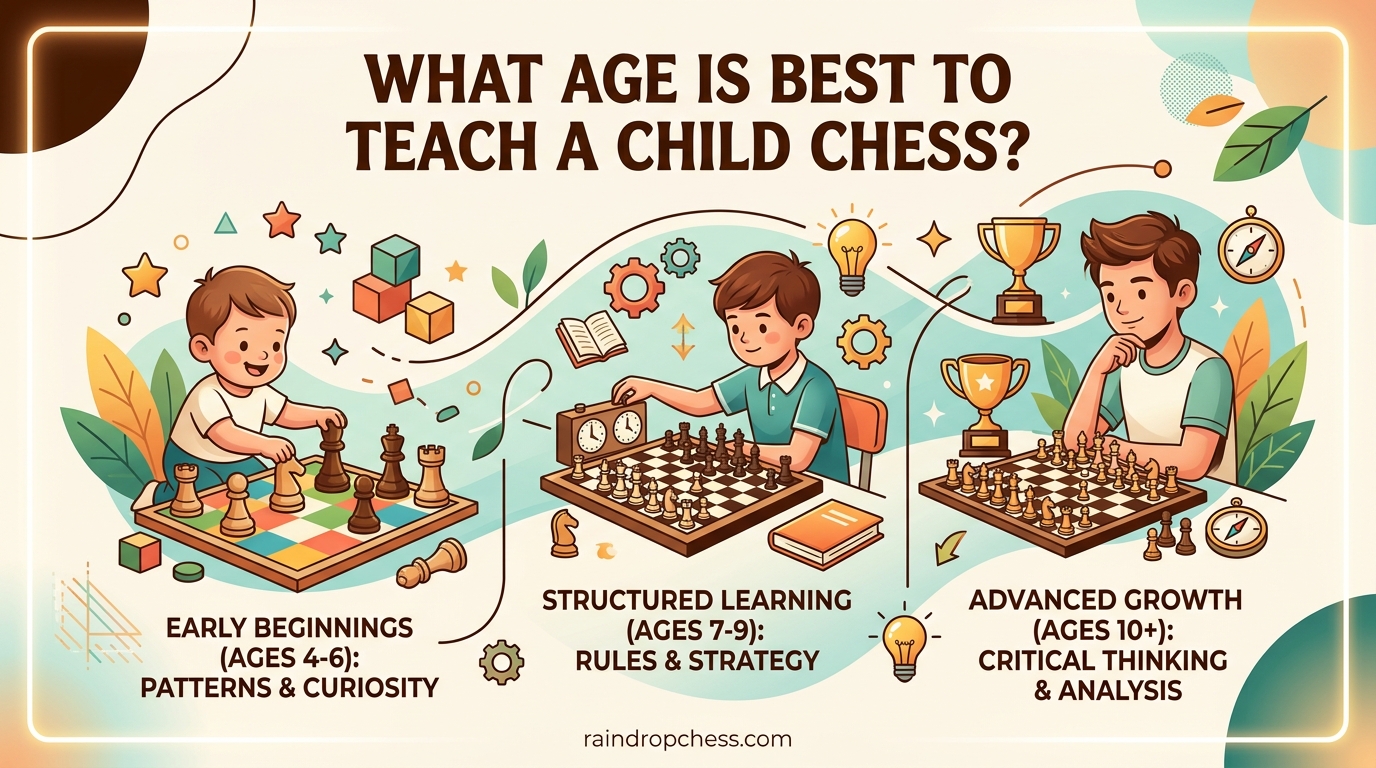
The best age to teach a child chess is typically between 6 and 8 years old. At this age, most children have developed the cognitive skills, attention span, and emotional maturity needed to understand the rules, think strategically, and handle the frustration that comes with losing. That said, there is no single “right” age for every child. Some 4-year-olds grasp the basics with modified approaches, while others may not show interest until age 10 or later.
This guide will help you determine if your child is ready for chess right now. We’ll explore what experts say, what research reveals about cognitive development, and how to recognize readiness signs in your individual child. Whether your child is a precocious 3-year-old or a curious teenager, you’ll find age-specific strategies to make learning chess enjoyable rather than stressful.
Table of Contents
What Experts Agree On: The 6-8 Year Sweet Spot
Chess educators and child development specialists consistently point to ages 6 through 8 as the ideal window for introducing chess. At this stage, children typically possess the working memory to track piece movements, the impulse control to wait their turn, and the abstract thinking skills needed to understand that chess pieces represent different values and powers.
Leontxo Garcia, a leading chess education expert who has advised the European Parliament on chess in schools, emphasizes that starting before age 6 requires significant modifications. Children younger than 6 can learn, but they need simplified approaches that differ dramatically from traditional instruction.
Jesper Hall, chairman of the European Chess Union’s Education Commission, recommends age 7 as the benchmark for introducing the full game. He notes that children at this age can concentrate long enough to play complete games while still viewing chess as play rather than obligation.
What the Research Shows
Studies on chess education reveal nuanced findings about cognitive benefits. While some early research suggested dramatic IQ improvements from chess training, more recent meta-analyses paint a more modest picture. The benefits are real but specific: chess improves working memory, pattern recognition, and concentration skills within the context of the game itself.
Transfer effects to other academic subjects exist but are smaller than initially claimed. The real value of chess lies in teaching children how to think systematically, plan ahead, and learn from mistakes. These metacognitive skills develop most effectively when children are developmentally ready to engage with the game’s complexity.
Famous Players Started at Different Ages
Chess history offers no single template for when champions begin. Magnus Carlsen, the current World Champion, learned at age 5. Bobby Fischer started at 6. Mikhail Botvinnik, one of the greatest players of the 20th century, did not begin until age 12.
These examples illustrate an important truth: early exposure may help, but it is not required for excellence. What matters more than starting age is sustained engagement, quality instruction, and genuine interest.
Is My Child Ready? A Parent’s Readiness Checklist
Age provides a helpful guideline, but individual readiness varies significantly. Use this checklist to assess whether your specific child is prepared to learn chess effectively. The more items you can check, the smoother the learning process will be.
Cognitive Readiness Signs:
- Can remember and follow multi-step instructions (at least 3 steps)
- Understands that actions have consequences
- Can focus on a single activity for 15-20 minutes without constant redirection
- Recognizes basic patterns and can predict simple sequences
- Understands the concept of “taking turns” in other games
Emotional Readiness Signs:
- Can handle losing without complete meltdowns
- Shows curiosity about strategy games or puzzles
- Is willing to sit still for structured activities
- Can delay gratification (waits for treats, accepts “not now”)
- Expresses interest when seeing others play chess
Physical Readiness Signs:
- Has the fine motor skills to move small pieces accurately
- Can distinguish left from right consistently
- Can sit at a table for 20-30 minutes comfortably
If your child meets most cognitive and emotional criteria but lacks interest, wait. Forcing chess on an unwilling child often creates lasting negative associations with the game.
Age-by-Age Breakdown: What Works at Each Stage
Children at different ages need different approaches to chess. This section provides specific guidance for teaching chess from toddlerhood through the teenage years.
Ages 3-4: Pre-Chess Foundation
Most 3 and 4-year-olds are not ready for traditional chess instruction. However, you can build foundational skills that will make later learning easier. Focus on board familiarity and basic concepts rather than rules.
Activities for this age:
- Let them play with pieces as toys, naming each one
- Practice moving pieces along the lines of the board
- Sort pieces by color and type
- Play “chess races” where pieces move to specific squares
- Use stories to describe how pieces move (knights jump like horses)
Never force structured lessons at this age. Keep interactions playful and optional. The goal is positive association, not skill acquisition.
Ages 5-6: Modified Introduction
Many 5 and 6-year-olds can begin learning simplified versions of chess. The key is reducing complexity so children experience success early. Start with just a few pieces rather than the full 32-piece setup.
The minigames approach:
- Start with king and pawn vs king, teaching how pawns move and promote
- Introduce one piece at a time in puzzle format
- Play “capture the flag” where one piece must reach the other side
- Use a giant chessboard if available, making movement physical and visual
- Focus on how pieces move before introducing check or checkmate
Children this age often struggle with the concept of checkmate. Be patient with repeated explanations. Some will grasp it quickly; others need months of exposure before it clicks.
Ages 7-8: Full Game Learning
This is when most children can learn the complete rules of chess. They can handle the cognitive load of remembering how all pieces move while also understanding the objective of checkmate.
Teaching progression for this age:
- Teach piece movements in order of complexity (pawns first, then knights, then others)
- Introduce check and checkmate concepts after piece movement is solid
- Explain special moves (castling, en passant) only after basic play is established
- Play lots of short games rather than few long ones
- Celebrate good moves, not just wins
Seven and 8-year-olds benefit from immediate application. Teach a concept, then play a game focusing on that concept. Abstract lectures without play lose their attention quickly.
Ages 9-12: Skill Development
Children in this age range can begin developing genuine strategic thinking. They understand that chess requires planning multiple moves ahead and can start learning tactical patterns.
Focus areas for this age:
- Basic tactics: forks, pins, skewers, discovered attacks
- Opening principles rather than memorized lines
- Endgame fundamentals: king and pawn vs king, rook endgames
- Notation and game recording
- Tournament participation if interested
This age group often experiences “chess fatigue” if pushed too hard. Watch for signs of burnout and maintain a balance between structured learning and casual play.
Teenagers: Competitive Transition
Teenagers who start chess may actually progress faster than younger beginners. Their improved concentration, abstract reasoning, and self-awareness allow for rapid skill acquisition.
Advantages for teen beginners:
- Longer attention spans for deep calculation
- Ability to study independently using books and videos
- Better emotional regulation during losses
- Understanding of goal-setting and deliberate practice
- Access to online resources and communities
Teenagers starting chess should not feel “behind.” Many successful players began in their teens. The key is consistent practice and finding peers at similar skill levels.
How to Teach Chess at Any Age
The method matters as much as the timing. Even a perfectly age-ready child will struggle with poor instruction. These evidence-based approaches work across age groups with appropriate modifications.
The Minigames Method
Chess educators increasingly recommend starting with simplified positions rather than the full game. This approach, championed by experts like John Foley of ChessPlus, lets children experience success immediately.
Begin with just kings and pawns. Once that is mastered, add one piece at a time. Children learn faster when complexity increases gradually. This method also prevents the overwhelming feeling that causes many children to quit early.
The Giant Chessboard Approach
Physical movement enhances learning for young children. A giant chessboard allows children to walk piece movements, making abstract concepts concrete. This kinesthetic approach is especially effective for ages 4-7.
Some schools and libraries have giant chess sets available. Parents can also create simple grid patterns on the floor using tape. The physical experience of moving like a knight or sliding like a rook builds muscle memory for the rules.
Learning Alongside Your Child
You do not need to be a strong player to teach your child chess. In fact, learning together can be a powerful bonding experience. Many parents report that studying chess with their children created meaningful conversations and shared goals.
If you are a beginner yourself, use online resources like ChessKid or Chess.com’s lessons. These platforms provide structured curricula that guide both parent and child through fundamentals. Your role becomes learning facilitator rather than chess expert.
Online Resources and Apps
Digital tools can supplement in-person instruction effectively. ChessKid remains the gold standard for young learners, with age-appropriate lessons, puzzles, and safety features. For older children, Chess.com and Lichess offer robust learning platforms.
Balance screen time with physical board play. Children need tactile experience with pieces to develop board vision. Apps work best as practice tools between live games.
Common Mistakes Parents Make
Well-meaning parents often undermine their children’s chess development through preventable errors. Avoid these common pitfalls to keep chess enjoyable and productive.
Mistake 1: Starting with the Full Game
Parents often set up all 32 pieces and explain every rule in the first session. This overwhelms most children under age 8. Start simple and add complexity gradually.
Mistake 2: Pushing Too Hard, Too Fast
Chess fatigue is real. When parents treat chess as a competitive advantage to develop, children sense the pressure. Many children who showed initial interest quit entirely when pushed. Let your child set the pace.
Mistake 3: Comparing to Other Children
Every child develops differently. Comparing your child’s progress to siblings, friends, or prodigies creates anxiety. Focus on personal improvement rather than relative standing.
Mistake 4: Emphasizing Winning Over Learning
Children who fear losing stop taking risks. They play conservatively and develop slowly. Celebrate creative moves and good thinking even in losses. Ask “what did you learn?” rather than “why did you lose?”
Mistake 5: Making Chess an Obligation
When chess becomes another chore like piano practice or homework, children resist. Maintain the playful spirit of the game. If your child wants to skip a day, let them. Enthusiasm matters more than consistency at early ages.
Benefits of Chess for Children
While the “chess makes you smarter” claims have been overstated, genuine benefits exist for children who engage with the game. Understanding these benefits helps parents set realistic expectations.
Cognitive Benefits:
Chess strengthens working memory as children must hold multiple piece positions in mind while calculating. It develops pattern recognition as players encounter similar positions repeatedly. The game also improves concentration span as children learn to focus for entire games.
Social-Emotional Benefits:
Perhaps chess’s greatest value lies in teaching emotional regulation. Children must handle losses gracefully, control impulses to move quickly, and persist through difficult positions. These skills transfer to academic and social situations more reliably than chess-specific knowledge.
Character Development:
Chess teaches children that effort produces results. Unlike many activities where innate talent dominates, chess rewards study and practice. Children learn the growth mindset: abilities develop through work, not just birth.
Academic Connections:
While chess will not dramatically raise IQ scores, it does reinforce mathematical thinking through calculation and geometry. It develops reading-like skills as children analyze positions and follow game notation. These connections complement rather than replace traditional education.
When Is It Too Early to Teach Chess?
Children under age 4 are generally not ready for structured chess instruction. Their brains are still developing the working memory and impulse control needed for turn-based strategy games. Attempting formal teaching at this age often frustrates both parent and child.
However, “too early” applies to method more than age. A 3-year-old playing with pieces as toys is building familiarity. A 3-year-old being drilled on piece movements is likely having a negative experience. Keep expectations age-appropriate.
Signs that you may have started too early include:
- Child shows no interest even with playful approaches
- Instructions are forgotten immediately and repeatedly
- Frustration and negative associations develop
- Child cannot sit for even brief structured activities
If you see these signs, stop formal instruction. Reintroduce chess casually in six months or a year. Early negative experiences are harder to overcome than delayed starts.
When Is It Too Late to Start Chess?
It is never truly too late to learn chess. Teenagers and adults who begin can still achieve significant skill and enjoyment. While becoming a grandmaster requires early starts, club player strength and tournament success remain accessible at any age.
The “too late” myth persists because we hear about child prodigies who began at age 3. These stories represent survivorship bias: we hear about the successes but not the many early starters who quit. Many strong tournament players began at 12, 15, or even as adults.
Older beginners have advantages too. Better study habits, self-awareness, and concentration often lead to faster initial progress than young children experience. Teenagers especially can improve rapidly with dedicated practice.
The real question is not “when is it too late?” but “what are my goals?” If you want your child to enjoy chess and develop thinking skills, any age works. If you dream of professional competition, earlier starts provide more time for development. But even then, starting at 10 or 12 leaves plenty of runway for serious achievement.
Frequently Asked Questions
What age should I start teaching kids chess?
Most experts recommend ages 6-8 as the ideal time to teach chess. At this age, children have developed the attention span, working memory, and emotional maturity to understand rules and handle losing. However, some 5-year-olds are ready with modified approaches, and many teenagers learn faster due to better concentration. The key is matching the teaching method to your child’s individual readiness.
Can toddlers learn chess?
Children under age 4 are generally not ready for structured chess instruction. However, toddlers can build familiarity with pieces and boards through play. Focus on board awareness, piece names, and movement patterns rather than rules. Formal instruction should wait until around age 5-6 when cognitive development supports turn-taking and rule-following.
How do I know if my child is ready for chess?
Look for these readiness signs: ability to follow multi-step instructions, understanding that actions have consequences, 15-20 minute attention span for activities, comfort with losing, interest in strategy games or puzzles, and willingness to sit for structured activities. If your child shows most of these traits, they are likely ready regardless of age.
Is it too late to learn chess as a teenager?
It is never too late to learn chess. Teenagers often progress faster than younger beginners due to better concentration, abstract reasoning, and study habits. While becoming a grandmaster requires early starts, achieving club player strength and tournament success remains accessible at any age. Many strong players began in their teens.
What is the 20-40-40 rule in chess?
The 20-40-40 rule suggests dividing your chess study time: 20% on openings, 40% on tactics, and 40% on endgames. This applies to serious students rather than beginners. For children just learning, focus on piece movements, basic tactics, and playing games rather than formal study ratios.
Is chess good for kids?
Chess offers genuine benefits for children including improved working memory, pattern recognition, concentration, and emotional regulation. The game teaches children to plan ahead, consider consequences, and handle losing gracefully. While claims about dramatic IQ increases have been overstated, chess develops important thinking skills and character traits that serve children well in academics and life.
How do I teach chess to a 5 year old?
Use the minigames approach: start with just kings and pawns, then add one piece at a time. Focus on how pieces move before introducing check or checkmate. Keep sessions short (10-15 minutes), playful, and pressure-free. Use stories to explain movements and celebrate effort over results. Stop if frustration appears and try again another day.
Should I force my child to play chess?
No. Forcing chess creates negative associations that often last years or decades. If your child resists, stop formal instruction and reintroduce the game casually later. Many successful players started because they discovered chess themselves, not because parents pushed. Maintain chess as play rather than obligation.
Conclusion: Finding the Right Time for Your Child
The best age to teach a child chess depends on the individual child more than any universal rule. While ages 6-8 represent the developmental sweet spot for most children, successful chess players have started at 3 and at 13.
Focus less on finding the perfect age and more on recognizing readiness signs in your specific child. Use the checklist provided to assess cognitive, emotional, and physical readiness. If your child shows interest and can handle basic requirements, start with simplified minigames. If your child resists or shows frustration, wait and reintroduce later.
Remember that chess should feel like play, not obligation. The goal is not creating prodigies but developing thinking skills and a lifelong enjoyment of the game. Whether your child starts at 4, 8, or 14, the benefits of chess await those who engage with it joyfully.