
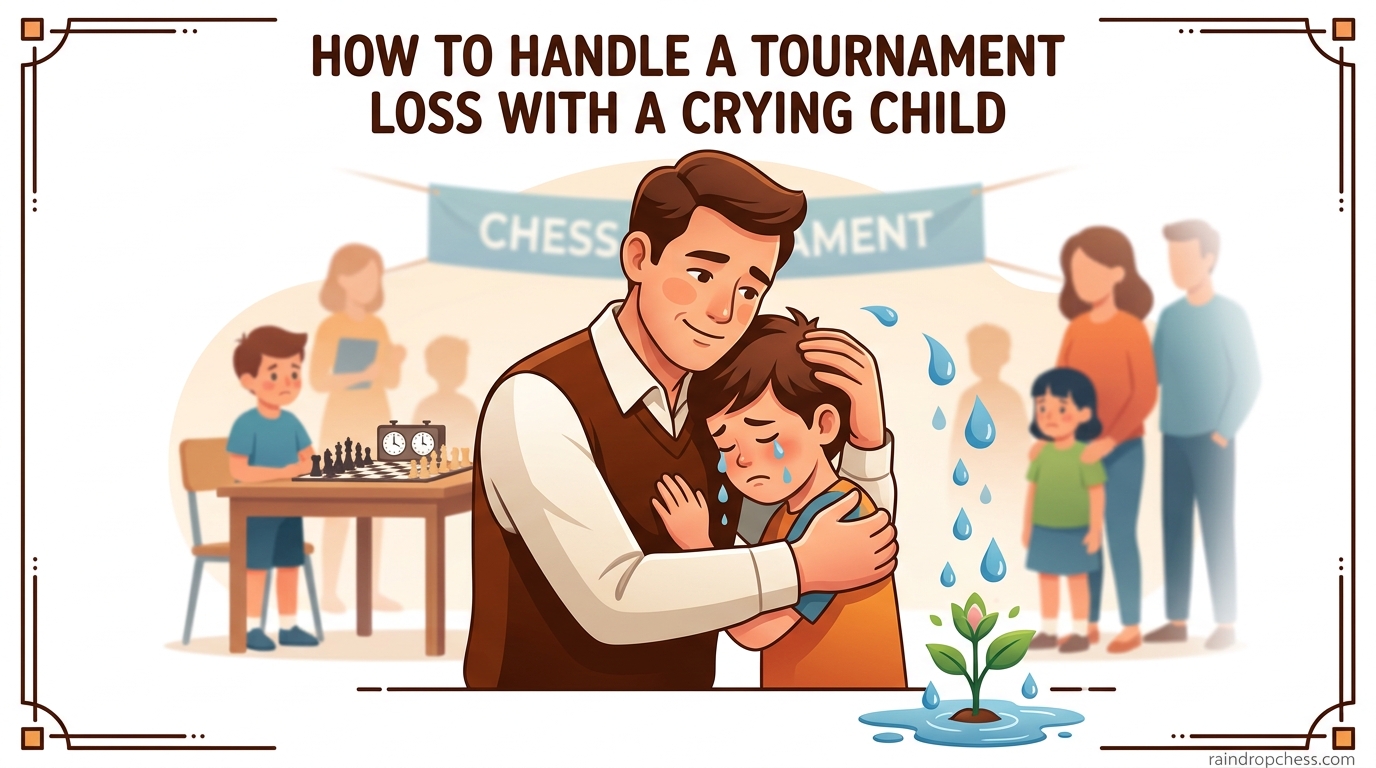
Your child walks off the chess board, eyes red, tears streaming down their face. The tournament hall buzzes with other players, and you feel every parent’s worst fear wash over you. You are not alone. I have watched countless chess parents face this exact moment, and I want you to know something right now: how you respond in this moment matters more than any chess lesson ever will.
Losing at a chess tournament triggers a cascade of emotions in children that adults often underestimate. The pressure of competition, the fear of disappointing parents, and the genuine grief of wanting to win but coming up short all collide at once. This guide gives you a playbook for handling chess tournament losses with a crying child, whether your little one is 5 or 12 years old.
Table of Contents
Stay Calm Yourself First
Before you can help your child, you need to regulate yourself. I know this sounds obvious, but trust me, it is the most critical step. When children see their parents anxiously rushing toward them or projecting worry onto their face, it amplifies their distress. Take one deep breath. Remind yourself that your child is safe, that crying is a normal human response, and that this moment will pass.
The reason your calm matters so much is that children look to adults for cues about how serious a situation is. If you approach with frantic energy, your child interprets this as confirmation that something truly terrible has happened. But if you walk over with steady composure, you signal that the world is still safe, that you are here, and that you have got them.
I often tell parents to think of themselves as an anchor. Your child is bobbing in emotional waters, and you are the fixed point they can cling to. That does not mean suppressing your own feelings entirely. It means putting your own processing on hold for ten minutes while you prioritize your child’s immediate emotional needs.
What to Do RIGHT NOW: 5 Immediate Steps at the Tournament
When your child is actively crying at a chess tournament, here is exactly what to do in the moment. These steps work whether you are at a USCF-rated event or a casual scholastic tournament.
Step 1: Move to a quieter space. The tournament hall with its noise and crowds adds to sensory overload. Find a corner, a hallway, or step outside briefly. This physical change of scenery helps interrupt the emotional spiral and gives your child room to breathe.
Step 2: Get on their level physically. Kneel or sit so you are eye-to-eye with your child. Avoid looming over them. This simple physical positioning signals that you are present with them, not at them.
Step 3: Name what you see without judgment. Say something like, “I can see you are feeling really sad and disappointed right now.” Do not try to fix it immediately. Just acknowledge the emotion. You are not agreeing that the world is ending. You are simply witnessing their experience.
Step 4: Let them cry. Resist the urge to immediately say, “It is okay” or “You did great.” Those phrases, though well-intentioned, can actually invalidate what your child is feeling. Sometimes the best thing you can do is sit quietly and offer a tissue. Your presence is enough.
Step 5: Do not lecture, analyze, or strategize yet. This is not the time to review their games or point out mistakes. Your child’s brain is in emotional overdrive. Reasoning with a crying child rarely works because they literally cannot access the logical parts of their brain in that moment. Save the teaching for later when they have calmed down.
Age-Appropriate Strategies
Ages 5-7: Keep It Simple
For our youngest chess players, emotional regulation is still developing. Children under eight typically think in very concrete terms. They have difficulty with abstract concepts like “you will do better next time” or “winning is not everything.”
At this age, focus on three things: physical comfort, simple language, and distraction. A hug, a quiet voice, and maybe suggesting you both get a drink of water or a small snack works better than lengthy explanations. You might say, “I see you worked really hard on your chess today. That hard work matters.”
For this age group, I recommend avoiding any competitive comparison or ranking talk. Your five or six-year-old does not need to hear about rating changes or tournament standings. They need to know they are loved regardless of whether they won or lost. Keep your post-tournament conversation brief and focused on what they enjoyed about playing.
Ages 8-12: Engage Their Reasoning
Older children can handle more abstract thinking, which means you can actually have a meaningful conversation with them about their experience. They are capable of understanding concepts like growth mindset, learning from mistakes, and emotional regulation in ways younger children cannot grasp.
With this age group, ask open-ended questions. “What was the hardest part of today for you?” or “Is there a move you are proud of from this tournament?” This invites them to process their experience rather than just receiving your verdict on it.
They can also handle more direct conversation about managing emotions. You might say, “Feeling really disappointed after a loss is completely normal. Even professional chess players feel that way. The question is what we do with that feeling.” This validates their experience while also modeling that emotions can be managed.
Avoid comparing your child to other players at this age, even if you are trying to encourage them. Statements like “You should not feel bad because you beat three people” actually minimize what they are feeling. Let them feel their feelings first, then help them put it in perspective.
The Post-Tournament Conversation
Once you are home and emotions have settled, you have a window of opportunity for a deeper conversation. Timing matters here. If you try to have this talk while your child is still visibly upset, it will not land. Wait until they are calm, fed, and rested.
Start by asking permission. “Do you feel like talking about the tournament today?” Some children need hours or even a full day before they are ready. Respect that timeline. Forcing a debrief can backfire.
When they are ready, ask specific questions that get them reflecting rather than you delivering verdicts. “What was one thing you learned today?” or “Was there a moment you felt proud of yourself?” These questions shift focus from outcome to process, which is exactly what you want for long-term development.
Be careful with the phrase “what did you learn.” It can sound dismissive if your child is still grieving. Instead, frame it as curiosity. You are not grading their performance. You are trying to understand their experience. Sometimes the most valuable thing learned at a tournament has nothing to do with chess moves at all.
Finally, share something from your own life. A story about a time you lost at something, how it felt, and what you took from it builds connection and normalizes the experience. Your child does not need a perfect parent. They need an honest one.
Reframing Loss as Learning
Growth mindset work with chess players is not about toxic positivity where we pretend losing feels great. It is about helping children understand that ability develops through effort and that setbacks are information, not identity.
One technique I recommend is asking, “What did the loss teach you?” This works far better than “Losses are good” or “It does not matter if you win.” Your child knows it matters. Rather than contradicting them, you are asking them to extract value from a painful experience.
Another approach is to separate the outcome from the process. Focus on effort, preparation, and attitude rather than the final result. Did your child study chess all week? Did they try new strategies? Did they show good sportsmanship? These are things within their control and they matter.
For children who are particularly hard on themselves, introduce the concept of “yet.” They did not win, yet. They did not solve that puzzle, yet. This small word opens doors instead of closing them. It implies a future where growth is possible, which is exactly what children need to hear after a disappointment.
5 Signs Your Child Needs a Chess Break
Sometimes the healthiest thing you can do is step back from tournament chess entirely. Here are clear signals that your child might need a break, whether for a few weeks, a season, or longer.
They express consistent desire to quit. A single comment after a bad tournament is normal. Repeated statements like “I hate chess” or “I never want to play again” over multiple weeks warrant attention.
Physical symptoms before tournaments. Stomach aches, headaches, trouble sleeping, or other stress-related symptoms appearing before events suggest tournament chess is creating excessive anxiety rather than healthy challenge.
Tournament day becomes dreaded. When your child starts showing dread rather than excitement in the days leading up to a tournament, something has shifted. Chess should be challenging but ultimately enjoyable.
Emotional recovery takes too long. If your child is still visibly upset about a tournament weeks later, the emotional cost may be exceeding the benefits. A break can restore their love for the game.
They are playing for you, not themselves. If your child cannot articulate any personal reason for playing and only mentions making you happy or avoiding disappointment, the intrinsic motivation has been lost.
Building Long-Term Emotional Resilience
Emotional resilience is not built in a single tournament. It develops over years of consistent, age-appropriate experiences with both winning and losing. Your job as a chess parent is to create an environment where growth happens naturally, not through forced lessons.
One of the most powerful things you can do is celebrate effort over outcomes in your regular language. “You worked really hard on that puzzle” instead of “You are so smart.” “I noticed you stayed calm even when that position was tough” instead of “You crushed that game.” These small language shifts compound over time.
Help your child develop their own internal measuring stick. Instead of constantly comparing their performance to others, encourage them to ask, “Am I better than I was last month?” This self-referential focus protects against the emotional damage of constant comparison.
Model resilience yourself. When you face setbacks in your own life, narrate your process out loud. “That did not go how I wanted, and I am feeling frustrated. I am going to take a walk and think about what to do differently.” Your child is learning emotional regulation by watching yours.
Taking Care of Yourself as a Chess Parent
Here is something nobody tells you: watching your child cry at a chess tournament is exhausting. You might feel helpless, worried, frustrated, or even embarrassed. All of those feelings are valid.
Parent self-care during your child’s meltdown is not selfish. It is necessary. If you burn out trying to manage your child’s emotions, you cannot be the steady anchor they need.
After your child has calmed down, give yourself permission to step away briefly. Take five minutes to breathe, walk around the venue, or call a friend who gets it. You cannot pour from an empty cup.
Find your community. Other chess parents who understand the unique pressures of tournament life are invaluable. Share strategies, vent frustrations, and normalize your experience together. You do not have to navigate this alone.
Remember that you are playing a long game. One tournament, one crying episode, one difficult season does not define your child’s chess journey or your parenting. The skills you are teaching now, like emotional regulation and resilience, will serve your child far longer than any rating or trophy.
What to do with a child who cries during sports?
How to deal with a crying child?
Is it normal for kids to cry after chess tournaments?
Should I pull my child from chess if they cry after losses?
What to say to a child who wants to quit chess after a loss?
Final Thoughts
Your child crying at a chess tournament is not a failure. It is a moment of emotional development, and you are there to guide them through it. The strategies in this playbook, from staying calm yourself to knowing when to take a break, give you tools for navigating these difficult moments with confidence.
Remember that your job is not to prevent your child from feeling disappointed. It is to teach them that they can handle disappointment and still be okay. That is the real skill, and it extends far beyond the chessboard into every area of their lives.
Every setback, every loss, every tear is an opportunity to build resilience. You have got this. And your child has got you.