
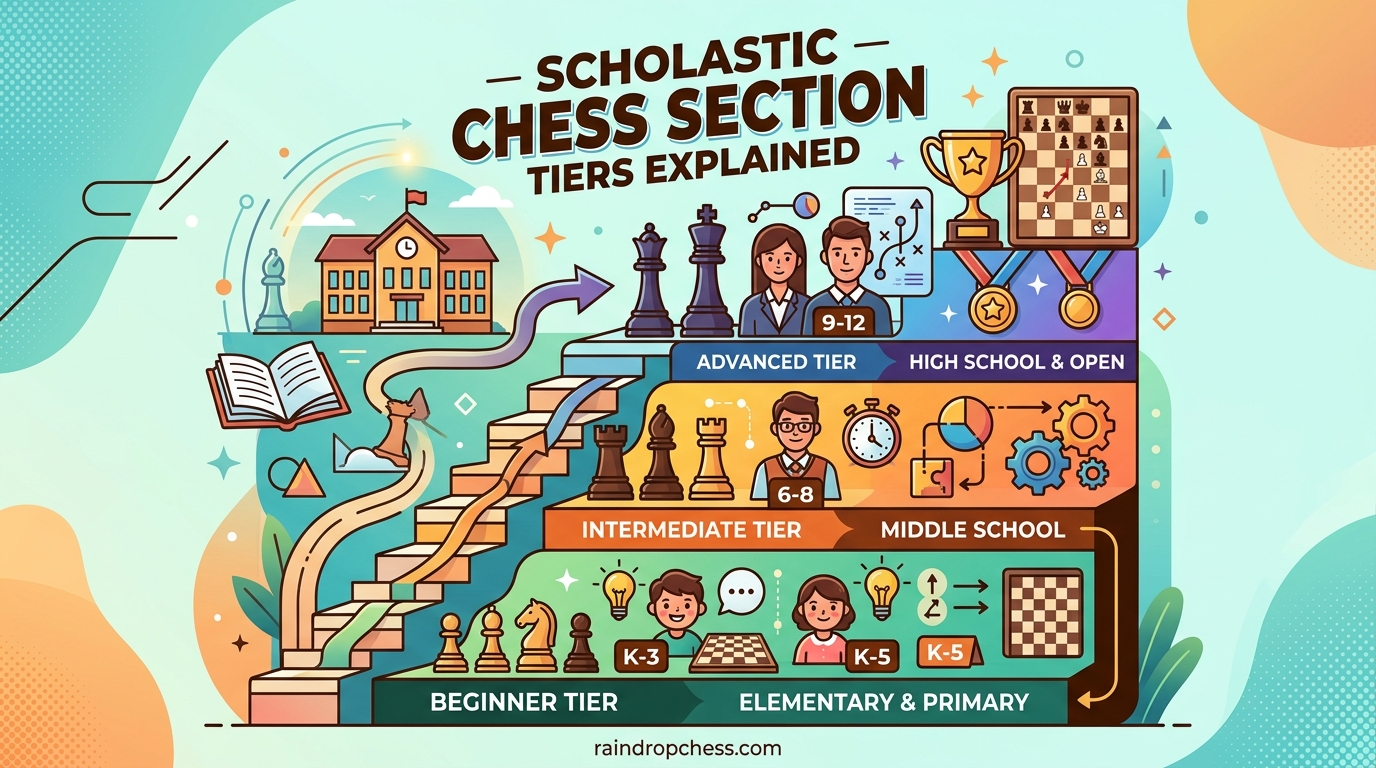
A parent’s complete guide to USCF rating-based tournament sections for young chess players

If your child has been taking chess lessons and you are thinking about entering them into their first scholastic tournament, you have probably run into a confusing maze of terms: U300, U500, U800, K-6, Open Section. What do all these labels mean? And more importantly, how do you know which section your child belongs in?
This guide answers those questions completely. Scholastic chess section tiers are the rating-based divisions that tournaments use to group players of similar skill together. The system exists for one simple reason: a 700-rated second-grader and a 1700-rated high school senior should not be competing against each other for trophies. Section tiers keep games competitive and enjoyable for everyone, from the child who just learned how the pieces move to the aspiring state champion.
Whether your child is unrated and brand new to tournament play, has a Chess.com rating but no USCF rating, or has been playing in rated events for a while, this article will walk you through every section tier, explain the rating thresholds, and help you choose the right division for your young player.
What Are Tournament Sections and Why Do They Exist?
Tournament sections are rating-limited divisions that group chess players by skill level. Each section has a maximum rating threshold, and players whose USCF rating falls below that ceiling are eligible to compete in that division. A section labeled U800, for example, is open to any player rated below 800 — it does not mean everyone in the section is exactly 800.
The U stands for “Under,” and the number is the rating ceiling. So a U300 section is for players rated under 300 (or entirely unrated), a U500 section is for players rated under 500, and so on. This system, used by the United States Chess Federation (USCF), ensures that children compete against opponents of a similar skill level, making every game a meaningful learning opportunity rather than a mismatch.
Key Concept: The “Under” Threshold
The label U500 means Under 500 — not exactly 500 or close to 500, but anything below it. A player rated 487 qualifies. A player rated 512 does not and must play in a higher section such as U800. This is a common point of confusion for parents registering for their first tournament, so double-check your child’s exact USCF rating before selecting a section.
Tournaments use the Swiss System for pairings, which means players are matched against opponents with similar scores and ratings within their section. If your child goes 3-1 in a U500 section, they will be paired against other 3-1 players — not necessarily against the highest-rated player in the room. This is what makes each round exciting: every game matters.
Without sections, a tournament would simply pair everyone together, and the result would be lopsided games where beginners learn very little from playing against advanced players. Sections create a level playing field where every child has a realistic chance to win rounds and earn trophies.
Section Tier Breakdown: From U300 to Championship
Here is a comprehensive overview of the most common scholastic chess tournament sections you will encounter at local and state events. While not every tournament uses all of these divisions, the following table reflects the standard section structure used across the United States.
| Section | Rating Ceiling | Typical Skill Level | Typical Time Control | Who Plays Here |
|---|---|---|---|---|
| U300 | Under 300 / Unrated | True beginners | G/30 or G/30+5 | First-time players, young children in K-2, kids learning piece movement |
| U500 / U600 | Under 500 or Under 600 | Novice | G/30 or G/35+5 | Players with 6 months to 1+ year of lessons, basic tactics awareness |
| U800 / U1000 | Under 800 or Under 1000 | Intermediate | G/45+5 or G/45 | Experienced players who understand opening principles and intermediate tactics |
| U1200 / U1400 | Under 1200 or Under 1400 | Advanced | G/45+5 or G/60 | Strong club players with consistent tactical vision and positional understanding |
| U1800 / Open | Under 1800 / No limit | Expert / Championship | G/60+5 or G/90 | Top scholastic players; many are state-rated experts |
Now let us walk through each section in detail so you know exactly what to expect.
The U300 Section: Where Every Young Chess Journey Begins
The U300 section is the entry point for nearly every young chess player entering their first rated tournament. “U300” means the section is open to any player with a USCF rating under 300, which includes players who have never played a rated game and have no rating at all — this is what “unrated” means.
Most tournaments place all unrated players into the U300 section regardless of age. This is why you will sometimes see a first-grade kindergartner and a ninth-grader in the same bracket: they are both playing their first rated games. The games at this level are often full of creative blunders, brilliant surprising moves, and the kind of pure determination that makes scholastic chess so rewarding to watch.
Time controls at the U300 level are typically G/30 (30 minutes per player for the entire game) or G/30+5 (30 minutes plus a 5-second delay per move). These faster controls keep games moving and are appropriate for players who are still developing their ability to think ahead under time pressure.
Most first-time scholastic players will begin in U300, and that is exactly the right place to start. The goal here is not to win every game — it is to learn what tournament chess feels like, understand the rules thoroughly, and build the confidence to come back for more.
Players in U300 are still building foundational skills: how the pieces move, basic checkmate patterns (king and queen vs. king, two rooks vs. king), the concept of the touch-move rule (once you touch a piece you must move it), and elementary tactics like forks and pins. It is completely normal for games at this level to last the full time control as players work through their thought processes carefully.
The U500 / U600 Section: Novice Players
Once a player has established a rating above 300 (or has demonstrated they are ready for stronger competition), they move into the U500 or U600 section. This division is designed for novice players who have a basic grasp of opening principles, can spot simple tactics, and are beginning to think about their opponents’ plans.
Players at this level have typically been taking chess lessons for six months to two years and have played in several rated games. They understand that the knight belongs on a outpost, that the queen is more powerful than the bishop, and that protecting your king is important — even if they sometimes forget in the heat of a game.
The time control for U500 sections is usually G/35+5 or G/30+5, giving players a bit more time per game to think through more complex positions than they would encounter in U300.
The U800 / U1000 Section: Intermediate Players
The U800 section is where chess starts to get serious. Players here have graduated from “knowing how to play” into “understanding why moves work.” An 800-rated player can typically spot common tactical patterns (double attacks, pins, skewers), has a working knowledge of opening principles beyond just moving pieces toward the center, and begins to understand positional concepts such as controlling open files and weak squares.
The U1000 section extends this further, including players rated up to 999. At this level, games become more structured, and players are beginning to develop their own style — some favor sharp tactical play, others prefer solid positional grinding. The Swiss System pairings do excellent work here, matching aggressive players against other aggressive players and positional players against each other.
Time controls at the U800/U1000 level are typically G/45+5 or G/45, which gives players enough time to calculate tactical sequences and think about middlegame plans.
The U1200 / U1400 Section: Advanced Players
A player rated between 1000 and 1400 is in the advanced category. These players have typically been competing for several years, have a strong tactical foundation, understand opening theory at a basic to intermediate level, and can evaluate positions with reasonable accuracy. Many will have a provisional rating behind them and are approaching (or have achieved) the “Expert” threshold of 2000.
Tournaments with an U1200 section are common at larger scholastic events, while U1400 sections appear at state-level tournaments and above. Games at this level feature genuine strategic battles, where players are thinking not just about the next move but about the plan for the next 10 moves.
U1800 and Open Sections: Championship Level
Above U1400 lies the U1800 section and the Open Section, which has no rating ceiling. The Open Section is where the strongest players in the tournament compete, and at major scholastic events, this section can include players rated well above 2000 — even some with Expert or Master titles.
For the vast majority of young players and their families, the sections up to U1400 will be the relevant ones. The progression from U300 to U1400 represents years of growth, coaching, and tournament experience.
Understanding USCF Chess Ratings
Before your child can be placed in the correct section, you need to understand how the USCF rating system works and where your child’s rating falls. The USCF rating is a number between 100 and 3000+ that represents a player’s estimated skill level based on their game results in rated events.
How the Rating Number Works
A new player’s rating starts as unrated. After playing their first rated game, they receive a provisional rating (sometimes shown with a “p” next to the number, like 347p). This provisional rating is based on only a few games, which means it can fluctuate significantly after each result.
Once a player has completed 25 rated games, their provisional status is removed and they receive a fully established USCF rating. Until that point, tournament directors may place provisional players based on their current provisional number, and the rating should be considered a rough estimate.
Provisional Ratings: What Parents Need to Know
If your child has played fewer than 25 rated games, their rating carries a “p” designation (e.g., 425p). This means the rating is provisional — still being calibrated. During the provisional period, the K-factor (the number that determines how much a game can change your rating) is higher, which means results have a bigger impact on the rating. Do not be alarmed if your child’s provisional rating moves up or down by 50 or more points after a single tournament — this is normal and the rating will stabilize after 25 games.
Where to Find Your Child’s USCF Rating
You can look up any USCF member’s rating on the USCF website using the USCF Member Lookup tool. You will need your child’s USCF member ID (which you received when you registered for their first tournament) or their name and state. The rating page will show their current rating, their provisional status, and their game-by-game history.
Chess.com Rating vs. USCF Rating
This is one of the most common questions from parents, and it causes a lot of confusion. If your child plays online on Chess.com, they will have a Chess.com rating that is calculated from their online games. This number is not the same as a USCF over-the-board (OTB) rating.
Chess.com ratings tend to run approximately 100 to 200 points higher than comparable OTB USCF ratings. A 1200 on Chess.com might translate to roughly a 1000-1100 USCF OTB rating. The reasons for this include differences in the player pool, the faster time controls common online, and the fact that online play allows players to play many more games per day.
What the Rating Numbers Mean in Context
To give you a sense of where different skill levels fall, here is a rough USCF rating scale for competitive K-12 scholastic players:
- Under 300 (U300): True beginners, first-time players, young children in early elementary grades
- 300-599 (U500/U600): Novice players with basic tactical awareness, typically 6 months to 2 years of instruction
- 600-999 (U800/U1000): Intermediate players who understand opening principles and can execute intermediate tactics
- 1000-1399 (U1200/U1400): Advanced players with consistent tactical vision; many are strong club players
- 1400-1799 (U1800): Very strong players; several years of competitive experience
- 1800+ (Open): Expert-level players and above
Percentile distributions shift constantly, but it is worth noting that a significant majority of chess players in the USCF system fall below 1300. Only a small percentage of rated players ever reach the Expert threshold of 2000, and an even smaller number achieve Master status (2200+).
Age-Based vs. Rating-Based Sections
In addition to rating-based sections like U300 and U800, many scholastic tournaments also offer age-based sections designated by grade level. These are the K-3, K-6, and K-12 divisions you may have seen in tournament listings.
How Age-Based Sections Work
K-3 sections are open only to students in kindergarten through third grade, regardless of rating. These sections exist to give young children a peer group based on age, since a second-grader rated 600 is developmentally very different from an eighth-grader rated 600, even if they play at the same skill level.
Similarly, K-6 sections serve students in kindergarten through sixth grade, and K-12 sections are open to all school-age students up to 12th grade. Some tournaments combine age and rating limits (for example, “K-6 Under 800”), which creates a very specific competitive environment.
Rating-Based vs. Age-Based: Which Should You Choose?
For most young players, a rating-based section is the default choice because it ensures the competition is at an appropriate skill level. An age-based section might sound appealing for keeping your child among peers of the same grade, but if the rating range is wide, they could end up playing against much stronger or weaker opponents.
Here are the situations where an age-based section makes more sense:
- Your child is very young (K-2) and there is a specific K-3 section at the tournament
- The age-based section has a rating cap that matches your child’s ability (e.g., K-6 Under 600)
- You specifically want your child to play against others of similar age for social or developmental reasons
In most cases, the tournament listing will make clear whether it is offering rating-based sections, age-based sections, or a combination of both. When in doubt, contact the tournament director and ask for guidance on which section is most appropriate for your child.
Choosing the Right Section for Your Child
The Playing Up Rule
One of the most common questions parents ask is whether their child can play up in a higher section. The answer is generally yes, but the rules vary by tournament.
Playing up means registering your child in a section with a higher rating ceiling than their current rating would normally qualify for. For example, a player rated 650 might choose to play in the U800 section instead of U500 because they want a greater challenge. This is a legitimate and common practice, especially when a child has been consistently scoring near the top of their current section.
Before registering to play up, confirm with the tournament director that it is allowed. Some tournaments have restrictions on playing up, particularly at the youngest age levels or in sections where trophies and rankings are being tracked for state qualification purposes.
Common Mistakes Parents Make
Having guided thousands of families through their first tournaments, we see the same mistakes repeated again and again. Here is how to avoid them:
- Registering in the wrong section based on online ratings: Always confirm your child’s actual USCF OTB rating, not their Chess.com or Lichess rating. If your child is unrated in USCF, they belong in U300 regardless of any online rating.
- Choosing a section that is too high to “win trophies”: It is tempting to put a capable child in a higher section so they can win a trophy more easily, but this is counterproductive. Children learn the most by competing at their appropriate level.
- Not registering early enough: Many scholastic tournaments fill up quickly. Plan to register at least two weeks in advance to secure your spot and have time to choose the right section.
- Missing the rating deadline: Some tournaments use a rating cutoff date for section assignments (often two weeks before the event). If your child’s rating changes after this date, they may still be placed in the section based on their earlier rating.
A First Tournament Checklist for Parents
Attending your first scholastic tournament can feel overwhelming. Here is a practical checklist of what to bring and what to expect:
- Your child’s USCF member ID number (register in advance at uschessplay.com if they are not already members)
- A visual score sheet or notation sheet (some tournaments provide these)
- A clipboard and pen for scorekeeping (notation is required in most rated sections)
- A chess clock if your child has one, though most tournaments provide them
- Snacks, water, and a packed lunch — tournaments can run long, especially if there are more than four rounds
- A book or quiet activity for between rounds — there can be significant waiting time
The most important thing you can do as a parent is create a low-pressure environment. Winning a trophy is wonderful, but the real value of scholastic chess is in the skills your child develops: problem-solving, critical thinking, gracious winning and losing, focus under pressure, and the ability to plan ahead. These benefits show up whether your child goes 4-0 or 0-4 at their first tournament.
Frequently Asked Questions
What does U300 mean in chess tournaments?
U300 means “Under 300” and is a rating-limited section where any player with a USCF rating below 300 (or who is entirely unrated) may compete. It is designed for true beginners and young children just starting in competitive chess. The “U” designation is the standard format used by the USCF to indicate the rating ceiling for a section.
What is the 20-40-40 rule in chess?
The 20-40-40 rule is a general chess improvement guideline (popularized by chess coaches) suggesting that a developing player should spend approximately 20% of their study time on openings, 40% on the middlegame, and 40% on endgame technique. While not a USCF rule, it is frequently cited in chess coaching as a framework for balanced improvement. It is especially relevant for intermediate players in the U800-U1200 range who may be spending too much time memorizing opening lines instead of developing their overall game understanding.
What is a good chess rating for a 13-year-old?
There is no single “good” rating for any age. Competitive K-12 scholastic players range widely from unrated to over 2000. A 13-year-old rated 800-1200 is performing at a solid intermediate level. Ratings above 1400 indicate strong competitive skill for that age group, and any 13-year-old above 1800 is exceptionally talented. What matters far more than the absolute number is whether your child is improving consistently and enjoying the process.
What is a provisional chess rating?
A provisional rating (indicated by a “p” next to the number, such as 347p) is a temporary USCF rating given to players who have completed fewer than 25 rated games. Because it is based on only a small sample of games, the rating is less reliable and changes more dramatically after each result. Once a player completes 25 rated games, the provisional designation is dropped and the rating is considered fully established.
Can my child play up in a higher chess section?
Yes, most scholastic tournaments allow players to “play up” in a higher section than their rating would normally qualify for. For example, a child rated 650 may choose to enter the U800 section for a greater challenge. However, the specific rules vary by tournament, and some events have restrictions (particularly regarding age-based sections or qualification-track events). Always confirm eligibility rules with the tournament director before registering to play up.
How is a Chess.com rating different from a USCF OTB rating?
USCF ratings are earned through over-the-board (OTB) tournaments played in person and are the official ratings used for US Chess Federation events. Chess.com ratings are calculated from online play and tend to run approximately 100 to 200 points higher than comparable OTB USCF ratings due to differences in the player pool, faster time controls online, and the volume of games players can play. When registering for a USCF-rated event, always use your USCF OTB rating, not an online platform rating.
The Bottom Line on Scholastic Chess Section Tiers
Understanding scholastic chess section tiers is one of the most important steps in setting your child up for success in competitive chess. The system exists to ensure that every young player, from the first-time competitor in the U300 section to the aspiring champion in the Open Section, faces appropriately matched opponents and has a genuinely rewarding tournament experience.
The most important thing to remember is this: there is no shame in starting at the bottom. Every accomplished chess player you see at a state championship or national event began exactly where your child will begin — in the U300 section, learning what it feels like to compete, to think under pressure, and to shake their opponent’s hand after a hard-fought game.
As your child plays more tournaments and their rating grows, they will naturally progress through the section tiers. Trust the process, focus on improvement over trophies, and most importantly, let your child lead the way in choosing how far they want to take this wonderful game.
If you have more questions about getting started, check out our scholastic chess resources or find a local chess club near you for weekly play and coaching.