
Chess teaching methods compared can reveal surprising differences in how the world’s greatest players developed their skills. I spent months researching the training approaches of three legendary chess figures. Each developed unique methods that produced world champions. Understanding these differences helps you choose the right path for your own chess improvement.
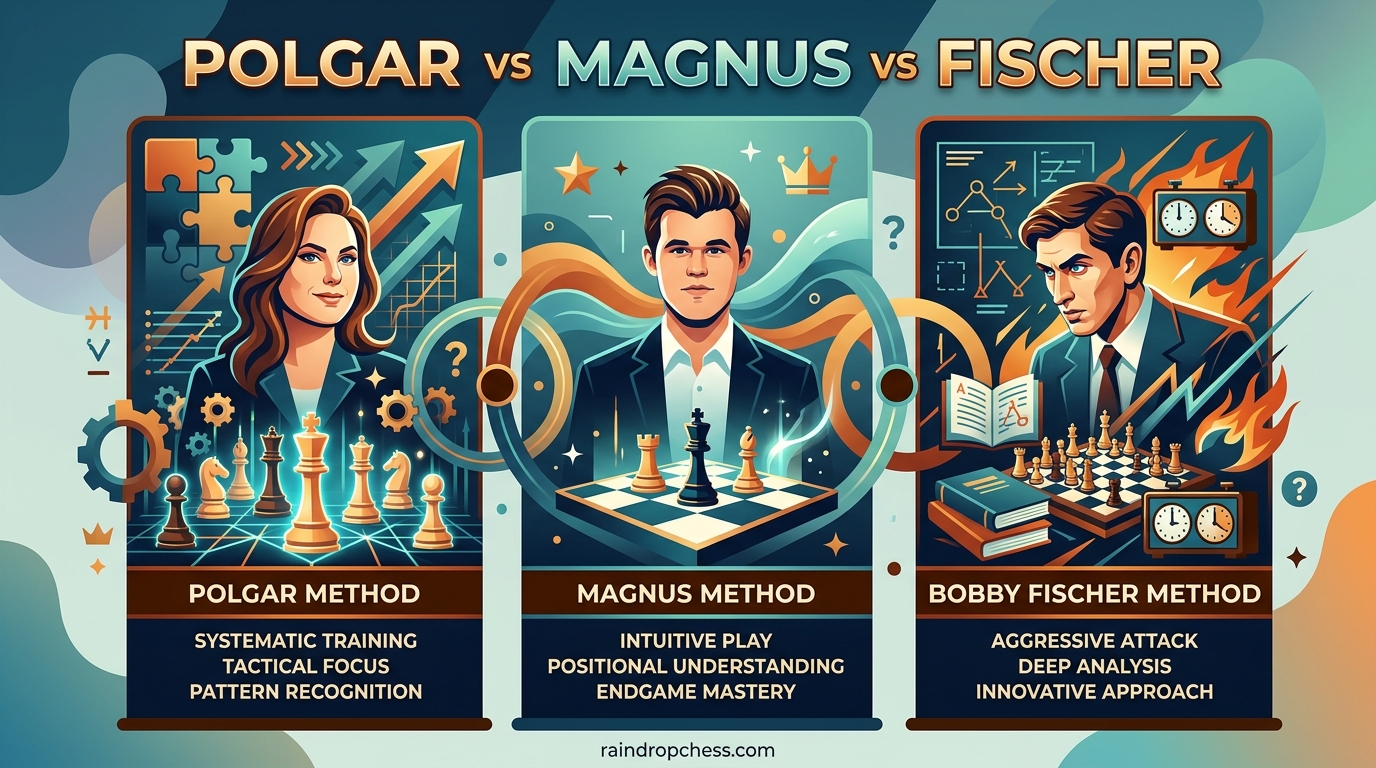
The Polgar Method emphasizes structured logic and practical skills. The Magnus Method relies on intuitive pattern recognition and minimal study. The Bobby Fischer Method pioneered self-directed learning through deep game analysis. These three approaches represent fundamentally different philosophies about how to master chess.
This guide breaks down each methodology with specific techniques, training routines, and practical applications. You will learn which method suits your learning style, skill level, and available time. Whether you are a coach, parent, or player, this comparison gives you actionable insights from chess history’s greatest teachers.
Table of Contents
The Polgar Method: Logic and Practical Mastery
The Polgar Method represents one of chess history’s most successful systematic training approaches. GM Susan Polgar developed this methodology while raising her sisters Judit and Sofia to become chess prodigies. Their father, Laszlo Polgar, believed genius could be created through structured education. The results validated his theory: all three sisters became grandmasters, with Judit reaching the world’s top ten.
This method centers on understanding the logic behind every move. Students learn why one move proves superior to another. The training builds practical skills through structured exercises. Each session combines tactics, positional play, and endgame technique.
Historical Background and Development
The Polgar Method emerged from Hungary in the 1970s. Laszlo Polgar homeschooled his daughters with chess as a core subject. Their daily routine included morning study, afternoon practice games, and evening analysis. This rigorous schedule produced remarkable results. Judit Polgar became the youngest grandmaster ever at age 15.
Susan Polgar later formalized the method through her coaching career and instructional materials. She emphasized creating a comprehensive curriculum accessible to players worldwide. The method evolved from family practice to internationally recognized training system.
Core Principles of the Polgar Method
Understanding the logic behind moves forms the foundation of this approach. Students learn to calculate variations deeply. They evaluate positions based on concrete factors rather than intuition alone. The method teaches players to find the strongest move in real game situations.
Practical skills receive equal emphasis alongside theoretical knowledge. Students practice defending difficult positions. They learn converting advantages into wins. The training develops resilience through exposure to challenging scenarios.
Tactics and strategy merge into cohesive understanding. Students do not memorize patterns mechanically. Instead, they grasp the underlying principles connecting tactical motifs to strategic goals.
Key Training Techniques
Daily tactical training occupies a central role. Students solve puzzles ranging from simple forks to complex combinations. The difficulty progresses gradually based on demonstrated mastery. Pattern recognition develops naturally through repetition.
Game analysis follows every practice session. Students review their games without computer assistance initially. They identify critical moments and calculate alternative lines. This builds independent thinking skills essential for tournament play.
Endgame study receives dedicated attention. The Polgar sisters spent hours mastering rook endgames, pawn structures, and technical conversions. This foundation saved countless half-points in competitive play.
Opening preparation emphasizes understanding over memorization. Students learn typical pawn structures and plans rather than lengthy theoretical lines. This approach creates adaptable players who handle unfamiliar positions confidently.
Training Routine Structure
A typical Polgar Method training day spans 4-6 hours for serious students. Morning sessions focus on new material and puzzle solving. Afternoons involve practice games against stronger opponents. Evenings dedicate time to game analysis and review.
Weekly schedules balance different study areas. Mondays might emphasize tactics. Tuesdays cover endgame technique. Wednesdays explore opening principles. This rotation prevents burnout while ensuring comprehensive development.
The method recommends 15 minutes daily for younger or casual students. Consistency matters more than marathon sessions. Short, regular practice produces better results than occasional intensive study.
Results and Validation
The Polgar sisters’ achievements validate this method’s effectiveness. Judit Polgar defeated eleven world champions including Kasparov, Karpov, and Anand. She reached number eight in the world rankings. Susan and Sofia both earned grandmaster titles.
Susan Polgar’s students continue this success. Her coaching produced numerous national champions and titled players. The method works across different ages and starting skill levels. Schools worldwide adopted her scholastic curriculum.
Research supports the educational benefits. Studies link chess study to improved problem-solving and academic performance. The structured approach builds transferable cognitive skills beyond the chessboard.
The Magnus Method: Intuitive Mastery Through Practice
The Magnus Method reflects a fundamentally different philosophy from the Polgar approach. Magnus Carlsen developed his skills through natural talent combined with focused, efficient practice. His training emphasizes pattern recognition over theoretical study. This approach produced the highest-rated player in chess history.
Carlsen’s method suits players with strong intuitive feeling for positions. It requires less structured time than the Polgar approach. However, it demands consistent engagement with chess puzzles and games.
Carlsen’s Early Development
Magnus Carlsen learned chess at age eight from his father. Unlike the Polgar sisters’ intensive early training, Carlsen developed more casually initially. He showed remarkable natural talent, solving complex puzzles intuitively. His father recognized this gift and supported gradual development.
By age 13, Carlsen earned the grandmaster title. His rise continued steadily. He became world champion in 2013 and has defended the title multiple times. His peak rating of 2882 remains the highest ever achieved.
Carlsen’s training evolved throughout his career. Early years involved substantial game analysis and study. As he matured, he shifted toward lighter maintenance routines. His current approach prioritizes tournament preparation over daily intensive study.
Core Principles of the Magnus Method
Pattern recognition forms the foundation of Carlsen’s strength. He recognizes thousands of positions from previous games. This database in his mind suggests moves without conscious calculation. The method builds this intuitive understanding through extensive exposure to chess positions.
Minimal theory characterizes his approach to openings. Carlsen knows basic principles but avoids deep memorization. He prefers reaching playable middlegames over winning theory battles. This philosophy works for his exceptional calculation and endgame skills.
Deliberate practice matters more than volume. Carlsen focuses on specific weaknesses during training sessions. He solves puzzles targeting particular skills. This efficient approach maximizes improvement per hour spent.
The 20-40-40 Rule Explained
The 20-40-40 rule guides Carlsen’s training allocation. Twenty percent of time goes to openings. Forty percent covers middlegame positions and typical plans. The remaining forty percent focuses on endgames and technical conversions.
This distribution surprises many students who overemphasize opening study. Carlsen’s success demonstrates the wisdom of balanced preparation. Endgame knowledge particularly distinguishes his play. He wins drawn positions and saves lost ones through technical mastery.
The rule adapts to individual needs. Beginners might spend more time on tactics. Advanced players emphasize openings more heavily. The principle of balanced study applies universally.
Key Training Techniques
Puzzle solving occupies central importance in Carlsen’s routine. He solves hundreds of tactics problems regularly. These exercises sharpen calculation and pattern recognition. The focus stays on quality over quantity.
Playing games remains essential. Carlsen plays online blitz between tournaments. These games maintain sharpness and introduce new patterns. Casual play supplements serious study.
Physical fitness supports mental performance. Carlsen trains physically like an athlete. He believes chess demands stamina for long games. This holistic approach distinguishes his methodology.
Computer analysis provides objective feedback. Carlsen reviews games with engines to find improvements. However, he maintains independent judgment rather than blindly following computer suggestions.
Training Routine and Time Commitment
Carlsen practices approximately 3-4 hours daily during training periods. Tournament preparation intensifies this schedule. During off periods, he plays casually online without structured study.
Morning sessions typically involve puzzle solving and opening review. Afternoons include analysis of recent games. Evenings offer lighter activities like online play or reading chess literature.
The method suits players with limited time. Three focused hours produce more benefit than eight distracted hours. Quality concentration determines results more than clock time.
Achievements and Impact
Carlsen’s accomplishments validate his method. He held the world number one ranking for over a decade. His classical world championship reign lasted from 2013 to 2023. He also dominates rapid and blitz formats.
His influence changed chess training philosophy. Many players adopted his balanced approach. The emphasis on endgames and intuition spread throughout the chess world. Young players increasingly模仿 his style.
The Bobby Fischer Method: Self-Study and Analysis
The Bobby Fischer Method pioneered modern self-directed chess learning. Fischer taught himself chess from books at age six. Without formal coaching, he became the youngest grandmaster and later world champion. His approach emphasizes independent study and deep game analysis.
This method suits self-motivated learners with limited access to coaches. It requires discipline and analytical thinking. The rewards include deep understanding and personal playing style development.
Historical Context
Bobby Fischer learned chess in 1940s Brooklyn. His mother bought him a chess set from a candy store. He taught himself from instructions included with the set. Within months, he was winning against adult opponents.
Fischer studied chess books obsessively. He analyzed games of past masters for hours daily. By age 13, he played the “Game of the Century” against Donald Byrne. This brilliancy announced his genius to the world.
He became grandmaster at 15, breaking the age record. In 1972, he defeated Boris Spassky for the world championship. His peak rating of 2785 dwarfed contemporaries. He revolutionized chess preparation and professionalism.
Core Principles of the Fischer Method
Self-study independence defines this approach. Fischer believed players must think for themselves. Coaches might guide but cannot replace independent analysis. This philosophy builds strong analytical skills.
Game analysis occupies central importance. Fischer studied hundreds of master games. He replayed them while covering moves, guessing continuations. This technique developed his calculation and positional understanding simultaneously.
Programmed learning through structured books provides systematic education. Fischer recommended books that teach concepts progressively. Students master fundamentals before advancing to complex material.
Key Training Techniques
Studying one’s own games provides personalized feedback. Fischer analyzed every tournament game extensively. He identified repeated mistakes and patterns. This self-awareness accelerated his improvement.
Book study follows structured progression. Fischer recommended specific books for each level. Beginners start with basic tactics. Intermediate players study positional play. Advanced students master endgame technique.
Checkmate pattern recognition trains finishing skills. Fischer emphasized knowing basic mates cold. Rook versus king, queen versus king, two bishops against king. These foundations prove essential in practical play.
Solitaire chess develops planning skills. Players replay master games, guessing moves before seeing them. This active engagement deepens understanding more than passive reading.
Training Routine Structure
Fischer practiced 8-12 hours daily during peak training periods. He spent mornings studying books and games. Afternoons included practice against strong opponents. Evenings reviewed the day’s games and prepared for tomorrow.
His routine demanded intense concentration. Distractions were eliminated. Chess received total mental commitment during study hours. This focus produced remarkable depth of understanding.
Modern adaptations reduce time requirements. Dedicated students might practice 2-4 hours daily. Consistency matters more than matching Fischer’s marathon sessions. Quality analysis trumps quantity of games played.
Results and Legacy
Fischer’s achievements speak for his method’s effectiveness. He dominated American chess for decades. His 1972 world championship victory had cultural significance beyond chess. He inspired generations of players to pursue chess seriously.
His book “My 60 Memorable Games” remains a classic. “Bobby Fischer Teaches Chess” introduced millions to programmed learning. These materials continue teaching players today.
The self-study approach influenced chess education worldwide. Books became primary teaching tools. Players learned that dedicated independent study produces results. This democratized chess improvement.
Polgar vs Magnus vs Fischer: A Direct Comparison
Chess teaching methods compared directly reveals distinct philosophies about learning. Each approach suits different personality types and circumstances. Understanding these differences helps you select the optimal path for your situation.
The Polgar Method demands structured commitment with coach support. The Magnus Method requires natural talent with efficient practice. The Fischer Method suits independent learners with analytical discipline.
Side-by-Side Comparison
| Aspect | Polgar Method | Magnus Method | Fischer Method |
|---|---|---|---|
| Philosophy | Logic and practical mastery | Intuitive pattern recognition | Self-directed analysis |
| Training Time | 4-6 hours daily | 3-4 hours daily | 2-4 hours (modern adaptation) |
| Coach Required | Yes, strongly recommended | Helpful but not essential | No, self-taught emphasis |
| Key Focus | Tactics + endgames + strategy | 20-40-40 rule balance | Game analysis + book study |
| Best For | Structured learners, youth | Intuitive players, busy adults | Self-motivated, analytical minds |
| Opening Approach | Understanding over memorization | Minimal theory | Deep personal analysis |
| Endgame Priority | High – technical training | Very high – 40% of study | High – book-based mastery |
When to Choose Each Method
Choose the Polgar Method if: You have access to coaching, prefer structured learning, or teach children. This approach produces consistent results across different skill levels. The systematic curriculum builds comprehensive skills.
Choose the Magnus Method if: You have strong intuitive feeling for positions, limited study time, or want efficient improvement. This approach maximizes results per hour invested. It suits busy professionals and naturally talented players.
Choose the Fischer Method if: You lack access to coaches, enjoy independent study, or have analytical personality traits. This method builds deep understanding and personal style. It works for self-motivated learners.
Skill Level Appropriateness
Beginners benefit from Polgar’s structured approach. The method prevents bad habits and builds solid fundamentals. Clear guidance helps novices avoid common pitfalls.
Intermediate players suit any method based on personality. Those wanting structure choose Polgar. Players with intuition prefer Magnus. Analytical types select Fischer.
Advanced players often combine elements. They might use Polgar’s tactical training, Magnus’s endgame focus, and Fischer’s game analysis. Hybrid approaches produce the best results at high levels.
Strengths and Weaknesses Analysis
The Polgar Method excels at producing well-rounded players. Its weakness lies in time requirements and need for coaching support. Students without guidance may struggle.
The Magnus Method maximizes efficiency. Its weakness requires natural talent to succeed. Players lacking intuition may find slower progress than structured alternatives.
The Fischer Method builds deep understanding. Its weakness demands high self-discipline. Students lacking motivation often abandon study. The approach also risks reinforcing misconceptions without external feedback.
Which Method Should You Choose?
Selecting among chess teaching methods compared requires honest self-assessment. Your personality, circumstances, and goals determine the optimal approach. Consider these practical recommendations.
For Beginners (Under 1200 Rating)
Start with Polgar-inspired structured training. Focus on basic tactics and endgames. Solve puzzles daily. Play regular games for practice. Avoid deep opening study until fundamentals solidify.
Parents teaching children should follow the Polgar approach. Fifteen minutes daily produces remarkable results. Consistency matters more than intensity at this level.
For Intermediate Players (1200-1800 Rating)
This level suits method experimentation. Analytical players benefit from Fischer’s game analysis approach. Those with limited time appreciate Magnus’s efficiency. Players with coaching access thrive with Polgar structure.
Consider your primary weakness. Tactical players lacking strategy need Polgar’s balanced approach. Strategic players missing tactics benefit from Magnus’s puzzle emphasis.
For Advanced Players (1800+ Rating)
Combine elements from all three methods. Use Polgar’s tactical training for maintenance. Apply Magnus’s 20-40-40 rule for preparation. Employ Fischer’s deep analysis for serious study.
Advanced players customize routines based on tournament schedules. Heavy study precedes important events. Light maintenance follows tournaments for recovery.
Hybrid Approaches
Most successful modern players combine these methods. They adopt Polgar’s structured curriculum for youth development. They incorporate Magnus’s efficiency for professional training. They apply Fischer’s analytical depth for specific preparation.
Create your personal system. Start with the method matching your personality. Gradually incorporate elements from others. The best approach is one you consistently follow.
Frequently Asked Questions
What is the 20-40-40 rule in chess?
The 20-40-40 rule is a training time allocation guideline associated with Magnus Carlsen’s approach. It suggests spending 20% of study time on openings, 40% on middlegame positions and plans, and 40% on endgames and technical positions. This balanced distribution prevents overemphasis on opening memorization while building strong practical skills.
How did Bobby Fischer train chess?
Bobby Fischer trained through intensive self-study and game analysis. He studied chess books for 8-12 hours daily during peak training. His method involved replaying master games while covering moves and guessing continuations. He analyzed his own tournament games extensively and followed programmed learning through structured books.
How did the Polgar sisters learn chess?
The Polgar sisters learned chess through their father’s structured educational experiment. Laszlo Polgar homeschooled them with chess as a core subject. Their daily routine included morning study, afternoon practice games, and evening analysis. Susan Polgar later formalized this approach into a comprehensive teaching method emphasizing logic and practical skills.
How many hours a day does Magnus Carlsen practice?
Magnus Carlsen practices approximately 3-4 hours daily during training periods. Tournament preparation may increase this amount. During off periods, he plays casual online games without structured study. His approach emphasizes quality focused practice over marathon sessions.
Can I combine different chess training methods?
Yes, combining methods often produces the best results. Many successful players adopt Polgar’s structured curriculum for fundamentals, Magnus’s balanced time allocation for efficiency, and Fischer’s deep analysis techniques. The key is consistency. Choose elements that match your learning style and circumstances, then practice regularly.
Conclusion
Chess teaching methods compared reveal three distinct paths to mastery. The Polgar Method offers structured logic for dedicated students. The Magnus Method provides efficient practice for intuitive players. The Fischer Method enables self-directed learning for analytical minds.
Each method produced world champions. Each suits different personalities and circumstances. Your optimal approach depends on your learning style, available time, and access to coaching.
Start with the method matching your situation. Practice consistently. Adapt as you progress. The journey matters more than the specific path chosen.