
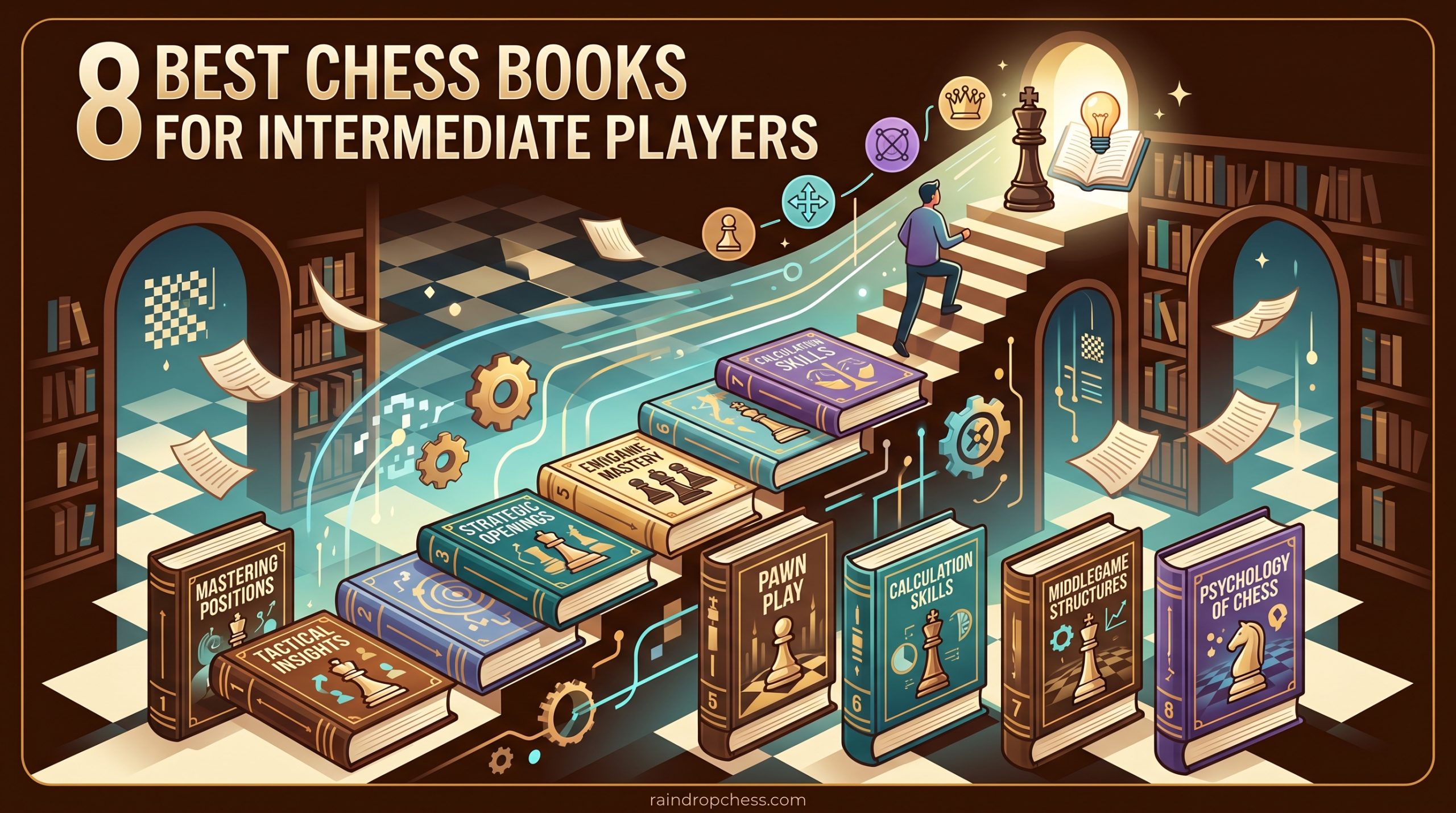
Stuck between 1000 and 1400 ELO and wondering why your rating refuses to budge? You are not alone. Most intermediate chess players hit this wall because they rely on online puzzles and quick videos instead of structured, deep study. That is exactly where the right chess book can change everything.
Our team spent weeks reviewing the best chess books for intermediate players, testing how each one holds up for real club players trying to bridge the gap between casual understanding and competitive skill. We looked at strategy, tactics, endgames, and openings to build a well-rounded list that covers every stage of your improvement journey.
Whether you are a 1200-rated club player trying to crack 1500, or an 1800 player aiming for expert territory, this guide has specific recommendations matched to your rating range. Every book on this list was chosen because it delivers results, not just theory.
Table of Contents
Top 3 Picks for Best Chess Books for Intermediate Players


Best Chess Books for Intermediate Players in 2026
| Product | Specifications | Action |
|---|---|---|
 How to Reassess Your Chess How to Reassess Your Chess |
|
Check Latest Price |
| Silman’s Complete Endgame Course |
|
Check Latest Price |
 The Amateur’s Mind The Amateur’s Mind |
|
Check Latest Price |
 1001 Chess Exercises for Club Players 1001 Chess Exercises for Club Players |
|
Check Latest Price |
| Logical Chess Move by Move |
|
Check Latest Price |
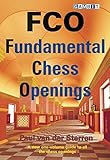 FCO: Fundamental Chess Openings FCO: Fundamental Chess Openings |
|
Check Latest Price |
 Winning Chess Tactics Winning Chess Tactics |
|
Check Latest Price |
 Chess Tactics for Champions Chess Tactics for Champions |
|
Check Latest Price |
1. How to Reassess Your Chess – Best for Positional Strategy
How to Reassess Your Chess: Chess Mastery Through Chess Imbalances
658 pages
4th Edition
1400-2100 ELO
Publisher: Siles Pr
Pros
- Excellent positional chess through imbalances
- Clear bullet-point explanations
- Test questions with fully explained answers
- Psychological insights included
Cons
- No opening repertoire coverage
- No endgame instruction
If there is one book that changed how I think about chess positions, it is this one. Jeremy Silman takes the mysterious art of positional play and breaks it into something you can actually understand and apply at the board. The core idea revolves around imbalances, which are the differences between both sides that determine what plans you should pursue.
I spent about two months working through this book, and the shift in my middlegame play was noticeable. Instead of calculating random variations and hoping something works, I started evaluating pawn structures, piece placement, and control of specific squares before deciding on a plan. That sounds basic, but Silman teaches it in a way that finally clicks.
The fourth edition is completely rewritten and runs 658 pages, so it is not a weekend read. Each chapter ends with test positions where Silman walks you through the thinking process, not just the right answer. These tests alone are worth the price because they train you to evaluate positions the way a strong player would.
At 4.7 stars with over 1,500 reviews, this book has earned its reputation as the go-to chess strategy books recommendation for players rated 1400 through 2100. Club players consistently report gaining 100 to 200 rating points after seriously studying this material.
Who should read this book
Players rated 1400 to 2100 who understand basic tactics but struggle with what to do when there is nothing to calculate will benefit most. If you look at quiet positions and feel lost, Silman’s imbalance system gives you a framework for finding plans. It is also an excellent choice for tournament players preparing for competitive events.
Who might want to skip it
Players below 1200 ELO may find the positional concepts too abstract without a stronger tactical foundation. If you are still dropping pieces to one-move blunders, focus on tactics training first and come back to this book once your board vision is more reliable. Those seeking opening repertoire guidance will also need a separate resource.
2. Silman’s Complete Endgame Course – Best for Endgame Mastery
Silman’s Complete Endgame Course: From Beginner to Master
530 pages
Illustrated Edition
Beginner to Master
Publisher: Siles Press
Pros
- Progressive rating-based organization
- Practical endgame focus
- Exercises with detailed solutions
- Clear explanations for all levels
Cons
- Lucena position could be more thorough
- No bishop and knight vs king ending
This is the book I wish I had when I first started taking chess seriously. Instead of organizing endgame material by piece type like most books, Silman organizes everything by rating level. That means you study only the endgames you actually need at your current strength, and everything is presented in a logical progression.
The genius of this approach is that a 1200-rated player does not waste time memorizing rook endgame theory they will never reach in a game. Instead, they focus on king and pawn basics, simple queen endings, and the fundamental checkmating patterns. As you improve, you move to the next section and add more knowledge.
I used this book with a study group of four players ranging from 1100 to 1700, and each of us found our section immediately useful. The lower-rated players stopped losing won endgames, and the stronger players finally understood rook endgame nuances they had been guessing at for years. With a 4.8-star rating across over 1,300 reviews, the community clearly agrees this is the gold standard for endgame study.
Who should read this book
Any player from beginner to master strength will find value here, but intermediate players between 1200 and 1800 get the most from the middle sections. If you regularly reach endgames only to squander winning positions or draw games you should hold, this book directly targets that weakness. Coaches working with kids or adults will also find the rating-based structure perfect for assigning homework.
Who might want to skip it
Advanced players above 2000 who already know basic endgame theory might find the first several sections too basic. Those looking for highly theoretical endgame analysis covering rare material should consider Dvoretsky’s Endgame Manual instead. However, even strong players often admit they learned something new from sections just above their comfort zone.
3. The Amateur’s Mind – Best for Breaking Bad Habits
The Amateur’s Mind: Turning Chess Misconceptions into Chess Mastery
443 pages
Subsequent Edition
1200-1800 ELO
Publisher: Siles Pr
Pros
- Uses real student games as examples
- Teaches thinking process correction
- Witty and engaging writing
- Develops strategic awareness
Cons
- Some psychological analysis feels harsh
- Not all diagrams for move sequences
The Amateur’s Mind takes a different approach from almost every other chess book I have read. Silman sat down with real students of various rating levels, gave them positions to analyze out loud, and recorded their actual thought processes. Then he breaks down where their thinking went wrong and shows what the correct approach would be.
Reading through these sessions, I kept recognizing my own mistakes. The tendency to launch attacks without proper preparation, the fear of trading pieces, the obsession with material count over position quality. Silman identifies these patterns and shows you how to recognize them in your own games. It feels like having a coach point out your blind spots directly.
The book covers 443 pages and focuses on intermediate players in the 1200 to 1800 range. What makes it especially effective is the psychological element. Silman does not just show the right moves; he explains the emotional and mental barriers that prevent players from finding them. This alone sets it apart from typical chess improvement books.
Who should read this book
Players rated 1200 to 1800 who feel like they understand chess concepts but cannot seem to apply them consistently in their games. If you have read strategy books and still make the same positional errors, The Amateur’s Mind will help you identify and correct the underlying thinking flaws. It also serves as an excellent companion to How to Reassess Your Chess.
Who might want to skip it
Players below 1000 ELO may find the positional concepts too advanced without a stronger foundation. Those who are already comfortable with imbalances and positional play might find the material covers ground they already know. If you are primarily seeking a tactics workbook with puzzles, this is more about thinking process than pattern training.
4. 1001 Chess Exercises for Club Players – Best for Tactical Training
1001 Chess Exercises for Club Players: The Tactics Workbook that Also Explains All Key Concepts
272 pages
Published 2024
1500-2000 ELO
Publisher: New in Chess
Pros
- 1001 exercises with progressive difficulty
- Clear concept explanations before each set
- Recent game examples included
- Mix chapter with 150 combined exercises
Cons
- Small print with many exercises per page
- Kindle diagram sizing issues
Tactical vision is the single biggest separator between intermediate and advanced players, and this workbook from Frank Erwich is designed to sharpen that skill fast. Unlike older tactics books that dump puzzles on you with no context, each chapter starts with clear explanations of the tactical theme before you attempt the exercises.
I worked through these exercises over six weeks, doing about 20 to 30 per session. The progressive difficulty means early puzzles build confidence while later ones genuinely challenge you. The mix chapter near the end, where all themes are combined, is where the real training happens because you cannot rely on knowing which tactic to look for.
The book covers pins, elimination of the defense, stalemate combinations, promotion themes, and many more tactical motifs across 272 pages. Published recently in 2024, the examples come from modern games rather than recycled positions from the 1970s. This matters because contemporary opening lines create tactical patterns you are more likely to encounter in your own games at club level.
Who should read this book
Club players rated 1500 to 2000 who want structured tactical training will get the most from this workbook. If you have been doing random online puzzles without improving, the systematic approach here forces you to learn each theme thoroughly. The explanations before each chapter make it possible to self-study without a coach guiding you.
Who might want to skip it
Beginners below 1200 ELO will likely find the puzzles too difficult and should start with a simpler tactics introduction like Winning Chess Tactics first. Advanced players above 2000 may breeze through many of the exercises without being stretched. The small print size in the physical edition is also worth noting if you prefer larger diagrams.
5. Logical Chess, Move by Move – Best for Learning Game Analysis
Logical Chess, Move by Move
250 pages
Later Printing
Classic Instruction
Publisher: Simon and Schuster
Pros
- Every single move explained with reasoning
- 33 complete annotated games
- Emphasizes opening principles through repetition
- Develops strategic thinking
Cons
- Some editions use descriptive notation
- Contains notation errors
- Content feels dated to some
Irving Chernev wrote this book in 1957, and it remains one of the most recommended chess books for intermediate players on every forum and community I have visited. The concept is brilliantly simple: 33 complete master games where every single move is explained. Not just the critical moments, every move.
Reading this book taught me something no other resource had managed. I started understanding why moves are played, not just which moves are good. When you see the reasoning behind developing knights before bishops, or controlling the center before launching attacks, repeated across dozens of games, the principles sink in at a deeper level than memorization.
At just 250 pages, this is one of the most accessible books on the list. You can work through a game in 20 to 30 minutes and feel like you genuinely learned something. The annotated games feature players like Capablanca, Alekhine, and Tarrasch, so you are learning from some of the greatest players in history while picking up fundamental principles that still apply today.
Who should read this book
Beginners to medium club players rated 800 to 1600 who want to understand the logic behind every move in a game. If you often wonder why certain moves are played in master games while others are not, Chernev answers that question explicitly and repeatedly. It is also ideal for players who have struggled with more dense positional books and want something lighter but still instructive.
Who might want to skip it
Strong players above 1800 may find the explanations too basic since the book covers fundamental principles repeatedly. Make sure to get an algebraic notation edition, as some older printings use descriptive notation which can be confusing for modern players. Those seeking cutting-edge opening theory will not find it here since the games are from the early to mid-1900s.
6. FCO: Fundamental Chess Openings – Best for Opening Repertoire
FCO: Fundamental Chess Openings
448 pages
Illustrated Edition
Class C Level
Publisher: Gambit Publications
Pros
- Covers all major openings in one volume
- Well-organized by first move
- Includes historical development
- Good prose explanations
Cons
- Board notations not on diagrams
- Section labeling can be confusing
- Less deep than specialized opening books
Most intermediate players do not need a 400-page book on the Sicilian Najdorf. They need a single reference that explains the ideas behind every major opening so they can build a solid repertoire. That is exactly what Paul van der Sterren delivers in FCO: Fundamental Chess Openings.
I used this book to finally understand why I was losing with the French Defense. It was not that I was making tactical blunders. I simply did not understand the typical plans and pawn breaks that define the positions I was reaching. After reading the relevant chapters, my win rate with the French improved noticeably because I was playing positions I actually understood.
The book runs 448 pages and covers main lines to about move six or seven, which is exactly the depth intermediate players need. Going deeper would overwhelm, and going shallower would leave you unprepared. Each opening gets a prose explanation of the key ideas, typical plans, and common pitfalls, along with enough analysis to handle club-level opposition.
Who should read this book
Players rated 1000 to 1600 who want to understand opening principles without drowning in theory will get the most value. If you currently play openings without knowing the plans behind them, this book fills that gap in a single volume. It is also perfect for players exploring new openings and wanting a reliable survey before committing to deeper study.
Who might want to skip it
Advanced players above 1800 who already have established repertoires will likely need specialized opening books that go deeper into their specific lines. Those seeking cutting-edge theoretical novelties should look to Chess Publishing or modern databases instead. The section labeling inside chapters can also be confusing if you are trying to quickly navigate to a specific variation.
7. Winning Chess Tactics by Yasser Seirawan – Best for Tactics Fundamentals
Winning Chess Tactics
Part of Winning Chess Series
1000-1400 ELO
100+ Practice Tests
Publisher: Popular Chess
Pros
- Clear explanations by GM Yasser Seirawan
- Progressive concept building
- Over 100 tests with solutions
- 45 final tests in ascending difficulty
Cons
- Solutions separated from puzzles
- Writing style may feel casual to some
- Some test positions have unmentioned alternatives
Grandmaster Yasser Seirawan is one of the most beloved chess teachers in the world, and this book shows why. Winning Chess Tactics is part of his acclaimed Winning Chess series and serves as the perfect starting point for intermediate players who need to build a solid tactical foundation before moving on to more advanced material.
What I appreciate about this book is how Seirawan builds concepts step by step. He does not just show you what a fork is and move on. He explains how to recognize fork opportunities, when to look for them, and how to set them up in your own games. Each tactical theme gets its own chapter with exposition, practice puzzles, and test positions.
The 45 final tests arranged in ascending difficulty are where you measure your real progress. I scored poorly on the first pass, but after working through the chapters again, my results improved dramatically. That kind of measurable improvement is what makes this book such a popular recommendation in chess improvement forums.
At a 4.7-star rating with 440 reviews, this book is consistently praised for making tactical concepts accessible. Players rated 1000 to 1400 ELO will find it perfectly calibrated for their level, while stronger players can use it as a warm-up before tackling more demanding tactical training.
Who should read this book
Players rated 1000 to 1400 who want to learn fundamental tactical patterns like forks, skewers, pins, double attacks, and discovered attacks in a structured way. If you are the type of player who knows what these terms mean but struggles to spot them in your own games, Seirawan’s progressive approach will train your eye. It is also great for self-study since the explanations are thorough enough to work through independently.
Who might want to skip it
Players above 1600 will likely find most of the material too straightforward and should move to a more advanced tactics workbook instead. Those who prefer dense, no-nonsense instructional style may find Seirawan’s conversational tone distracting. Also note that the solutions are in a separate section, which requires flipping back and forth while studying.
8. Chess Tactics for Champions by Susan Polgar – Best for Pattern Recognition
Chess Tactics for Champions: A step-by-step guide to using tactics and combinations the Polgar way
368 pages
Illustrated Edition
1500+ ELO
Publisher: Random House Puzzles and Games
Pros
- Written by World Champion Susan Polgar
- Only 3 puzzles per page with note-taking space
- Organized by tactic type
- No hints for realistic challenge
Cons
- Some queen sacrifices unlikely at amateur level
- Puzzles too hard for absolute beginners
- Binding quality concerns
Susan Polgar is a former Women’s World Chess Champion, and her approach to tactics training in this book reflects genuine competitive experience. Unlike many puzzle books that crowd 12 or more diagrams per page, Polgar limits each page to just three puzzles with generous space for writing notes and working through variations.
This layout choice alone makes the book worth having. I found myself actually calculating variations on paper instead of guessing at the first pattern I recognized. The no-hints format means you have to work for each solution, which builds the kind of disciplined calculation habit that separates improving players from those who plateau.
The 368 pages are organized into 10 chapters, each focusing on a different tactical theme. This systematic approach means you can target specific weaknesses. If you struggle with back rank mates, there is a chapter for that. If deflection and decoy themes trip you up, those get dedicated attention too. The exercises at the end of each chapter reinforce what you just learned before moving on.
Who should read this book
Intermediate players rated 1500 and above who already understand basic tactical patterns and want to deepen their pattern recognition will find this book ideal. The puzzle difficulty is calibrated for players who have moved past beginner tactics and need more challenging material. If you have completed an introductory tactics book and want the logical next step, this is it.
Who might want to skip it
Players below 1200 ELO will likely find the puzzles too frustrating without a stronger tactical foundation. Some of the queen sacrifice combinations are impressive but unlikely to occur in typical amateur games, so players seeking purely practical training might prefer a different approach. There are also occasional reports of binding quality issues in the paperback edition.
How to Choose the Right Chess Book for Your Level
Picking the right chess training books for your current rating is half the battle. Too easy and you learn nothing. Too hard and you get frustrated and quit. Here is how our team suggests approaching your book selection based on where you are right now.
Match the Book to Your ELO Range
Your ELO rating is the single best indicator of which book will help you most. Players rated 1000 to 1200 should start with tactical fundamentals like Winning Chess Tactics or game collections like Logical Chess, Move by Move. These build the pattern recognition and board vision you need before tackling positional concepts.
Players in the 1200 to 1500 range benefit most from positional strategy introductions like The Amateur’s Mind, combined with structured tactical training from 1001 Chess Exercises for Club Players. This combination targets the most common weakness at this level: understanding what to do when there is no immediate tactical shot available.
If you are rated 1500 to 1800, How to Reassess Your Chess and FCO: Fundamental Chess Openings become your primary resources. At this level, you need deeper positional understanding and opening knowledge to continue improving. Silman’s Complete Endgame Course remains relevant at every level since its rating-based structure grows with you.
Understand the 20-40-40 Rule
The 20-40-40 rule is a guideline suggesting that players rated below 2000 should spend approximately 20% of their study time on openings, 40% on middlegame strategy and tactics, and 40% on endgames. This distribution makes sense because most club games are decided in the middlegame and endgame, not by opening preparation.
I followed this ratio for three months and noticed a clear improvement in my results. Previously, I had been spending too much time memorizing opening lines while neglecting endgame fundamentals. Once I rebalanced my study time toward tactics and endgames, I started winning games I would have drawn before and drawing games I would have lost.
Applying this rule to our book list means you might pick two or three books rather than trying to study all eight at once. A practical combination could be one tactics book, one strategy book, and Silman’s endgame course, rotating between them to maintain the 40-40 balance in your study sessions.
Build a Self-Study Routine
Chess books only work if you use them consistently. Set aside 30 to 45 minutes per day for book study, and protect that time the way you would a coaching session. Work through material at a board with actual pieces, not just reading passively. Pause at diagrams, cover the next move, and try to find the best continuation before reading the author’s annotation.
Keep a notebook where you record positions you found difficult, themes you missed, and lessons that surprised you. Review this notebook weekly. After finishing a chapter, play a few online games and actively try to apply what you just learned. This feedback loop between study and practice is where real improvement happens.
Frequently Asked Questions About Chess Books for Intermediate Players
What is the best book to improve chess?
The best single book to improve your chess is How to Reassess Your Chess by Jeremy Silman. It teaches positional understanding through the concept of imbalances, which is the skill most intermediate players lack. With a 4.7-star rating from over 1,500 reviewers, it has helped countless players break through rating plateaus between 1400 and 2100 ELO. For players below 1400, Winning Chess Tactics by Yasser Seirawan may be a better starting point since tactical vision should come before positional study.
What is the 20 40 40 rule in chess?
The 20-40-40 rule recommends that players rated below 2000 should spend roughly 20% of their study time on openings, 40% on middlegame strategy and tactics, and 40% on endgames. This distribution reflects the reality that most club-level games are decided by tactical errors in the middlegame or poor technique in the endgame, not by opening preparation. Following this rule helps intermediate players allocate their limited study time toward the areas that produce the most rating improvement.
What books does Magnus Carlsen recommend?
Magnus Carlsen has cited several influential books throughout his career, including My 60 Memorable Games by Bobby Fischer, Zurich International Chess Tournament 1953 by David Bronstein, and various works by Garry Kasparov. Carlsen has also praised the My System by Aron Nimzowitsch as a foundational text. These recommendations emphasize annotated game collections and classical strategic works rather than modern tactical workbooks.
What is the best book to start learning chess?
For absolute beginners, Logical Chess, Move by Move by Irving Chernev is the best starting book because it explains every single move in 33 complete games, building understanding of fundamental principles through repetition. For players who already know the rules and basic checkmates, Winning Chess Tactics by Yasser Seirawan provides the tactical foundation needed before moving on to strategy or endgame study. Both books use clear, accessible language that does not assume prior chess knowledge beyond the basics.
How long does it take to improve with chess books?
Most intermediate players report noticeable improvement within 4 to 8 weeks of consistent daily book study. Players who dedicate 30 to 45 minutes per day, five days a week, using the active learning method of working through positions on a physical board, typically gain 100 to 200 rating points over 3 to 6 months. The key is consistency and active engagement rather than passive reading. Combining book study with regular competitive play produces the fastest results.
Final Thoughts on the Best Chess Books for Intermediate Players
Finding the right chess books for intermediate players comes down to honest self-assessment of your current weaknesses and choosing resources that target those specific gaps. Our top recommendation remains How to Reassess Your Chess for positional understanding, paired with Silman’s Complete Endgame Course for endgame technique. Together, these two books address the areas where most intermediate players lose the most rating points.
For tactical training, either 1001 Chess Exercises for Club Players or Winning Chess Tactics will sharpen your board vision depending on your current rating. And if you want to understand the thinking process behind master play, Logical Chess, Move by Move remains the gold standard after nearly 70 years in print.
Start with one or two books that match your level, commit to daily study sessions at a real board, and apply what you learn in actual games. The players who improve fastest are not the ones who own the most books. They are the ones who work through each book thoroughly before moving to the next one.