
If you have ever sat down for a blitz game and argued about who ran out of time first, you already know why a good chess clock matters. Whether you play at a club, compete in rated tournaments, or just want fair timed games at home, having one of the best digital chess clocks makes every session smoother and more competitive.
I have spent months testing digital chess timers across different skill levels and time controls. From rapid games at my local club to tense classical encounters, I have seen firsthand how the right clock can change the feel of a match. If you are also working on a training plan to climb from 800 to 1200, practicing with a proper clock is one of the fastest ways to sharpen your time management.
In this guide, I will walk you through 13 digital chess clocks I have tested and compared. I cover everything from budget-friendly options for beginners to FIDE-approved tournament timers used by professionals. Let me help you find the right clock for your playing style and budget.
Table of Contents
Top 3 Picks for Best Digital Chess Clocks
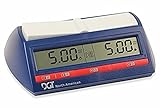
DGT North American Chess Clock
- 30 preset options
- Fischer bonus support
- Recessed power button
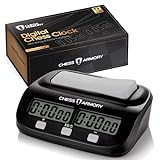
Chess Armory Digital Chess Clock
- Bonus and delay modes
- Single AA battery
- Ultra portable design
Best Digital Chess Clocks in 2026: Quick Overview
| Product | Specifications | Action |
|---|---|---|
| DGT North American Chess Clock |
|
Check Latest Price |
| Chess Armory Digital Chess Clock |
|
Check Latest Price |
 LEAP Chess Clock Classic LEAP Chess Clock Classic |
|
Check Latest Price |
 LEAP Advanced Chess Clock LEAP Advanced Chess Clock |
|
Check Latest Price |
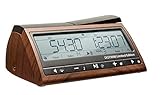 DGT 3000 LE Limited Edition DGT 3000 LE Limited Edition |
|
Check Latest Price |
 Wholesale Chess Basic Clock Wholesale Chess Basic Clock |
|
Check Latest Price |
 A&A Chess Clock 36 Modes A&A Chess Clock 36 Modes |
|
Check Latest Price |
 Xflyee Chess Clock Xflyee Chess Clock |
|
Check Latest Price |
 Zmartfun II Digital Chess Clock Zmartfun II Digital Chess Clock |
|
Check Latest Price |
 DGT 2500 Official FIDE Clock DGT 2500 Official FIDE Clock |
|
Check Latest Price |
 QINFIEY Digital Chess Clock QINFIEY Digital Chess Clock |
|
Check Latest Price |
 Chess Armory Advanced Clock Chess Armory Advanced Clock |
|
Check Latest Price |
 DGT 2010 Digital Chess Clock DGT 2010 Digital Chess Clock |
|
Check Latest Price |
1. DGT North American Chess Clock – Best Overall
DGT North American Chess Clock and Game Timer
Weight: 399g
Dimensions: 4 by 7.5 by 2 inches
30 preset options
Fischer bonus support
Pros
- Very easy to set and program
- Clear and easy to read display
- Smooth move paddle with quality feel
- Remembers settings for each time option
Cons
- Manual explaining timing options is confusing
- Requires turning off clock to start new game
- Only shows seconds below 20 minutes
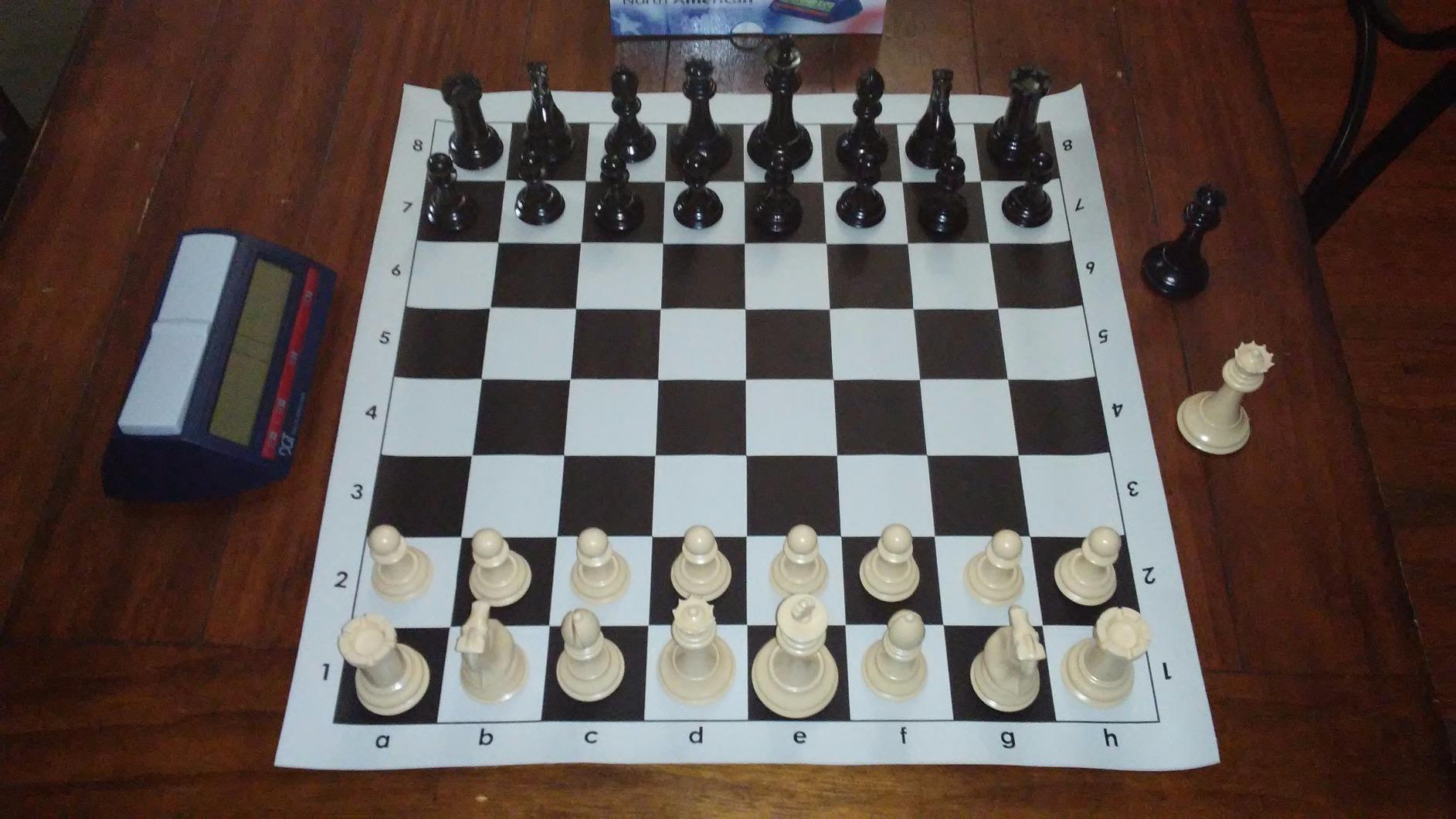
The DGT North American has been my go-to clock for over a year now, and it is easy to see why it sits at the top of so many recommendations. The first thing I noticed when I unboxed it was the solid feel of the move paddle. It clicks with authority and never jams, even during frantic blitz sessions.
Setting up time controls is straightforward thanks to the quick-set options. I commonly use the standard 5-minute blitz and 15-minute rapid presets, and both are just a couple of button presses away. The clock also remembers your last settings for each timing mode, which saves time between sessions.
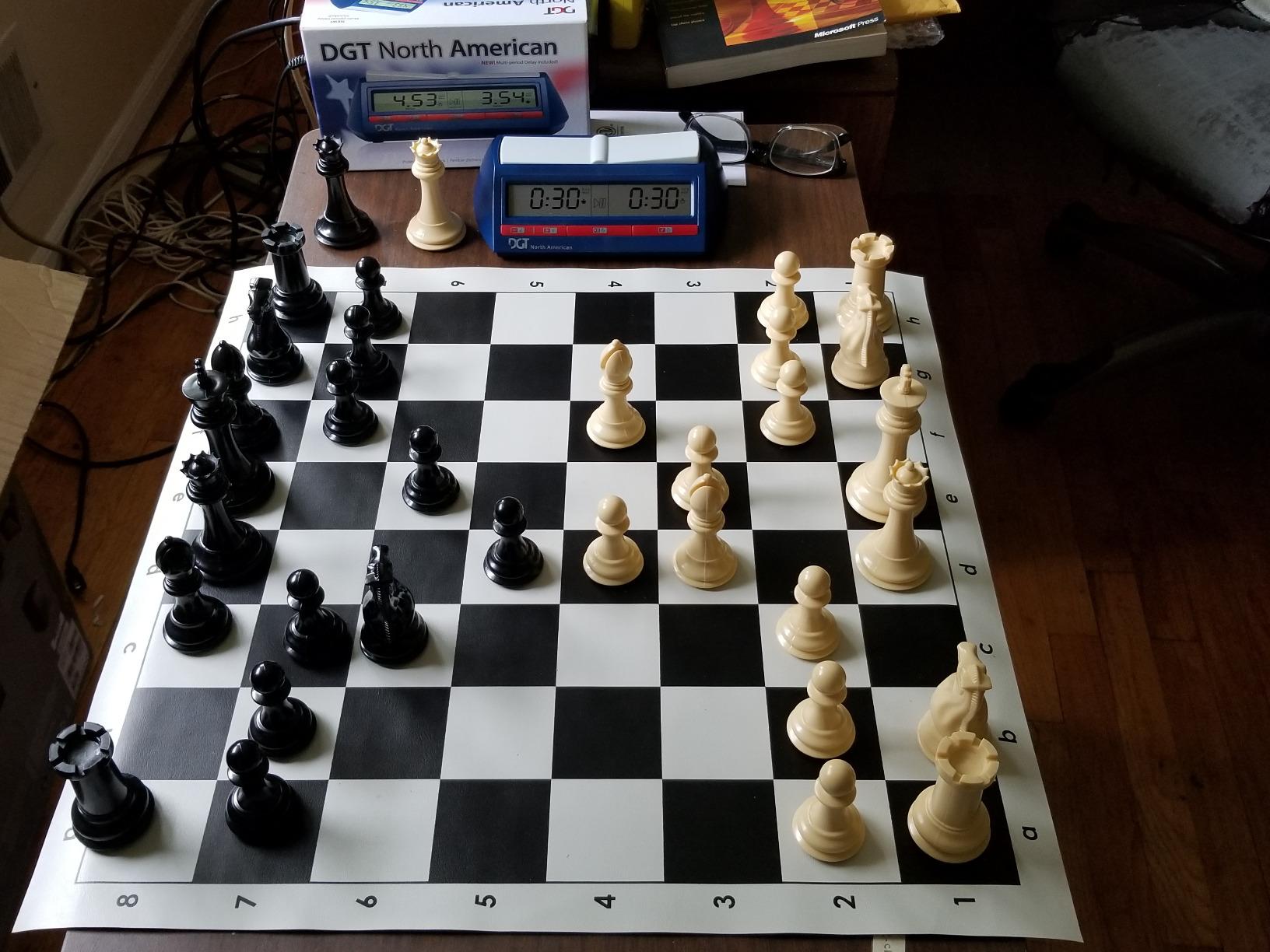
The display is crisp and readable from a normal playing distance. I have used this clock at my local club under fluorescent lighting and at home near a window, and the readout stays clear in both environments. The recessed power button is a smart touch because it prevents accidental shutdowns mid-game.
My only real complaint is the manual. DGT packed a lot of timing options into this clock, but the documentation does a poor job of explaining what each one does. I had to look up a few online tutorials to figure out the less common modes. Also, you have to power the clock off completely to reset for a new game, which feels a bit clunky compared to clocks with a dedicated reset button.
Who should buy this clock
This is the clock I recommend most often to intermediate and advanced players who want a reliable timer for both home and club use. If you play in USCF-rated events or just want a clock that works without fuss, the DGT North American delivers. The 30 preset options cover almost every common time control you will encounter.
Who might want something else
Absolute beginners who only need basic countdown might find the 30 presets overwhelming. If you play in FIDE-rated events, you might prefer the DGT 3000 or DGT 2500, which carry official FIDE approval. And if you are on a tight budget, the Chess Armory or LEAP models offer similar core features for less.
2. Chess Armory Digital Chess Clock – Best Budget Pick
Chess Armory Digital Chess Clock – Portable Timer with Tournament and Bonus Time Features
Weight: 249g
Dimensions: 4 by 6 by 2.5 inches
Single AA battery
Bonus and delay modes
Pros
- Lightweight and portable
- Intuitive and easy to use controls
- Good for tournament and casual play
- Long battery life with single AA battery
Cons
- Feels cheaply made with loose plastic
- No battery included
- Some difficulty resetting counter
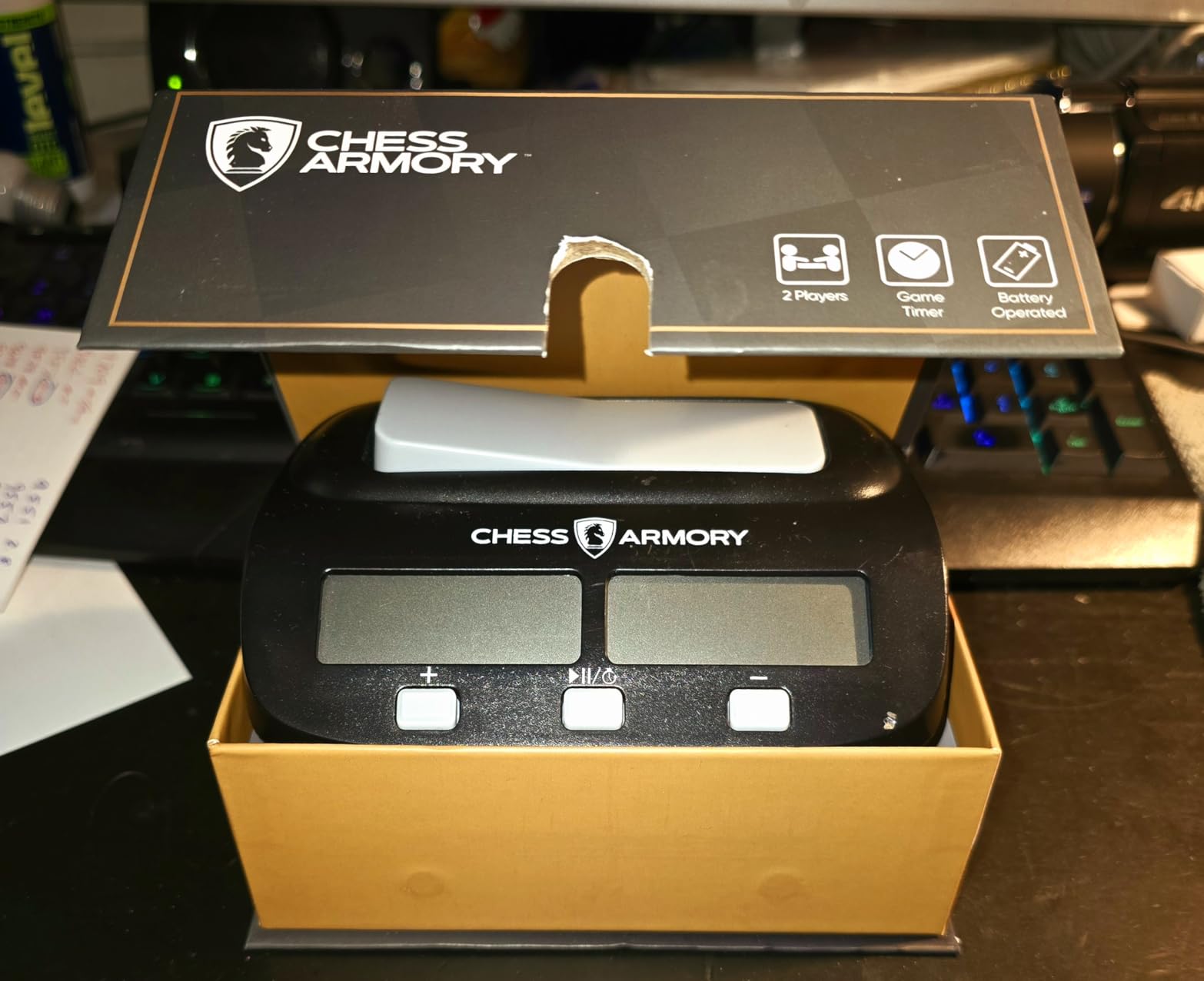
I picked up the Chess Armory clock for casual games at home, and it punches well above its weight for the price. At just 249 grams, it is one of the lightest timers I have tested. That makes it easy to toss in a bag and carry to a friend’s house or a coffee shop for a quick match.
The three-button control layout is intuitive. I had a 5-minute blitz game running within about 30 seconds of opening the box. Bonus time and delay features both work as expected, which surprised me at this price point. The clock handles the common time controls that most casual and club players need.
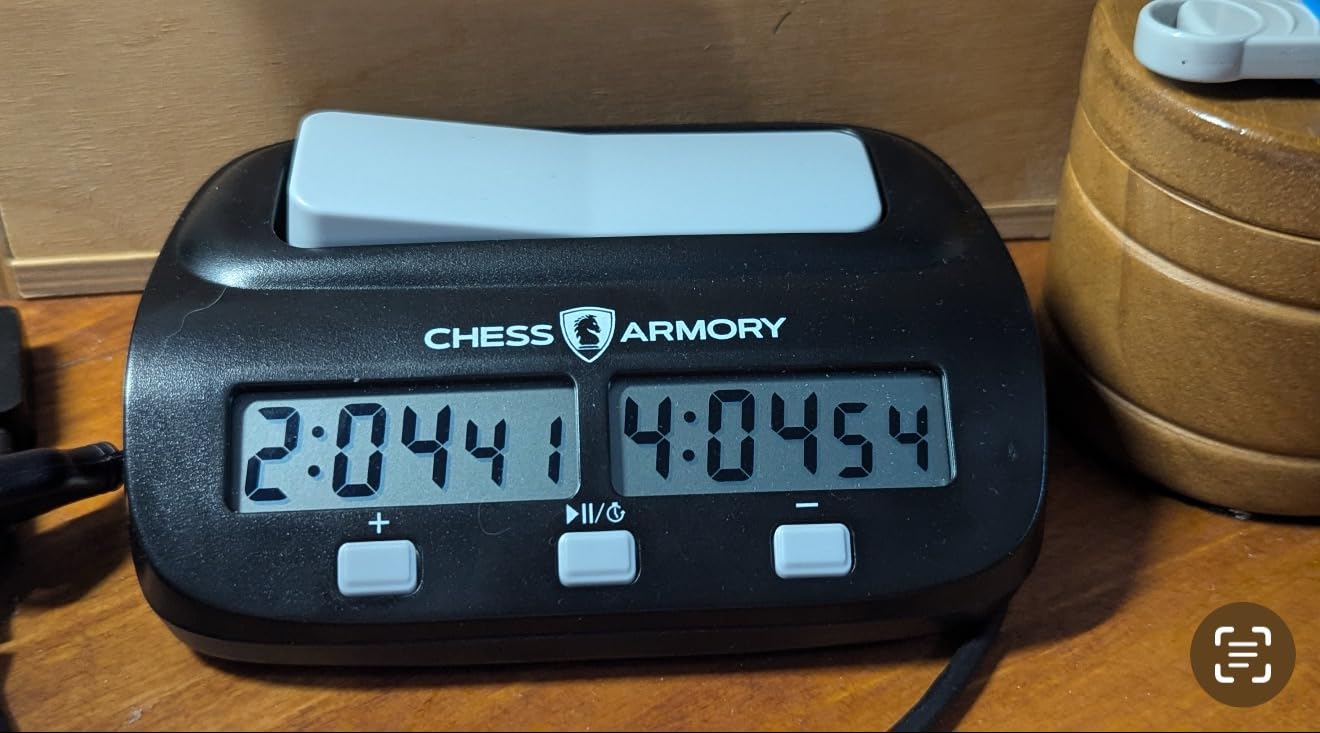
Battery life is excellent. I have been running mine on the same AA battery for months of weekly use with no signs of fading. The display is clear enough for most situations, though it is smaller than what you get on premium DGT models.
The trade-off is build quality. The plastic housing has some flex to it, and the buttons feel a bit loose compared to the solid action on a DGT clock. I also noticed the reset process is not as smooth as I would like. You sometimes need to cycle the power to get a clean reset between games.
Who should buy this clock
This is an excellent first chess clock for beginners and casual players who want proper timing features without spending much. It is also a great backup clock for club organizers who need a few extra timers for simultaneous exhibitions or casual events.
Who might want something else
If you play in rated tournaments regularly, the build quality might not hold up to heavy use over years. Players who need a wide variety of preset time controls or FIDE approval should look at the DGT models instead.
3. LEAP Chess Clock Professional – Most Affordable
LEAP Chess Clock Digital Chess Timer Professional for Board Games Players Count Up/Down Timer with Alarm Function Black (Official Store)
Weight: 250g
ABS plastic housing
3-button control
Count up and down modes
Pros
- Affordable with solid functionality
- Intuitive controls with alarm function
- Sleek modern design
- Good for casual and club play
Cons
- Plastic housing feels lightweight
- Clicks feel plasticky
- No reset button requires power cycle
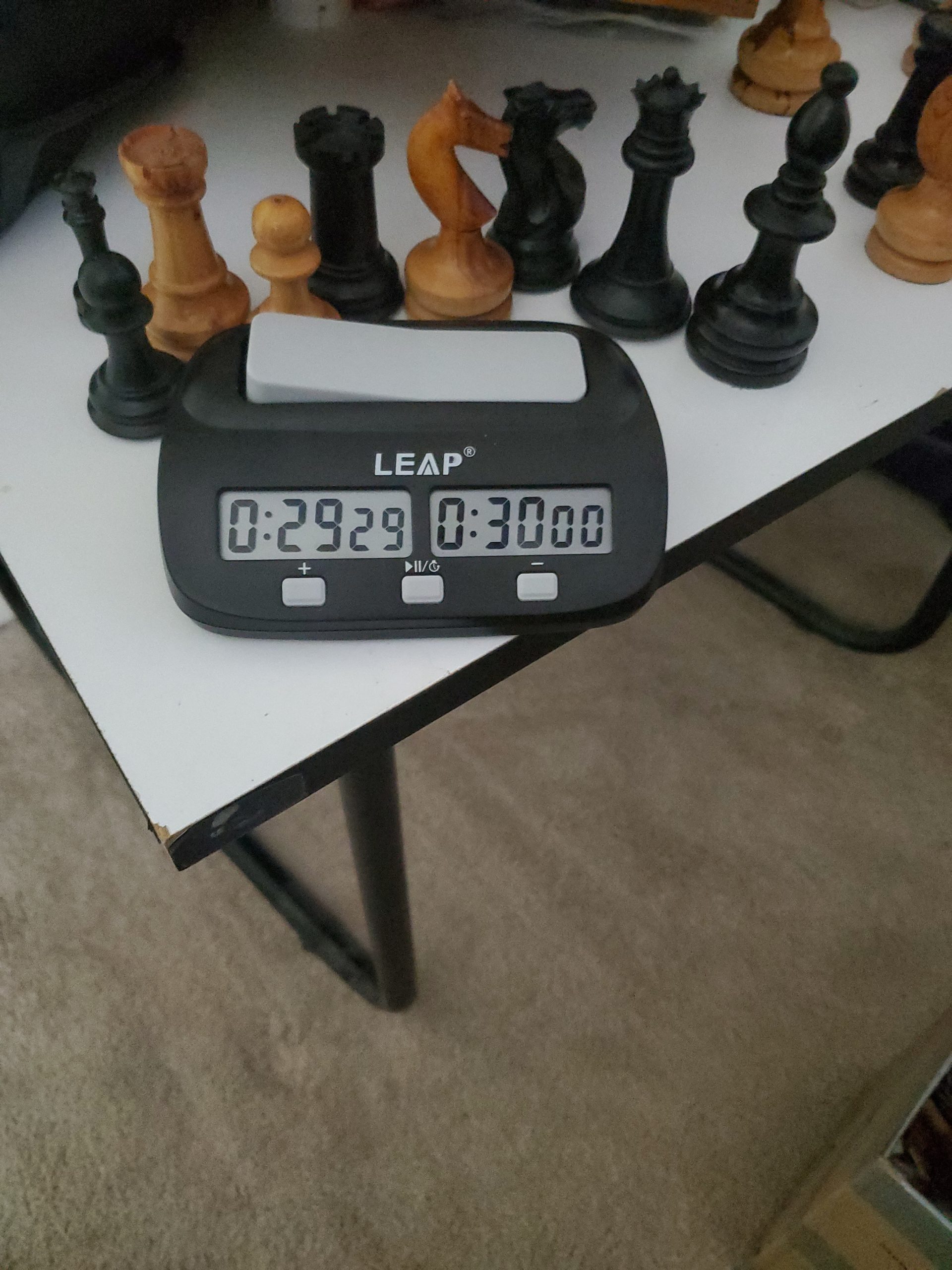
The LEAP Classic is one of the most popular budget chess clocks on Amazon, and after testing one I understand why. It delivers the core timing features most players need at a price that is hard to beat. The compact black design looks good on any chess table, and the three-button interface keeps things simple.
I tested the count-up, count-down, bonus, and delay modes, and they all worked reliably. The alarm function at time expiry is loud enough to hear in a noisy club setting, which is more than I can say for some pricier clocks. The display is readable from a normal playing distance, though it lacks the large digits of premium models.
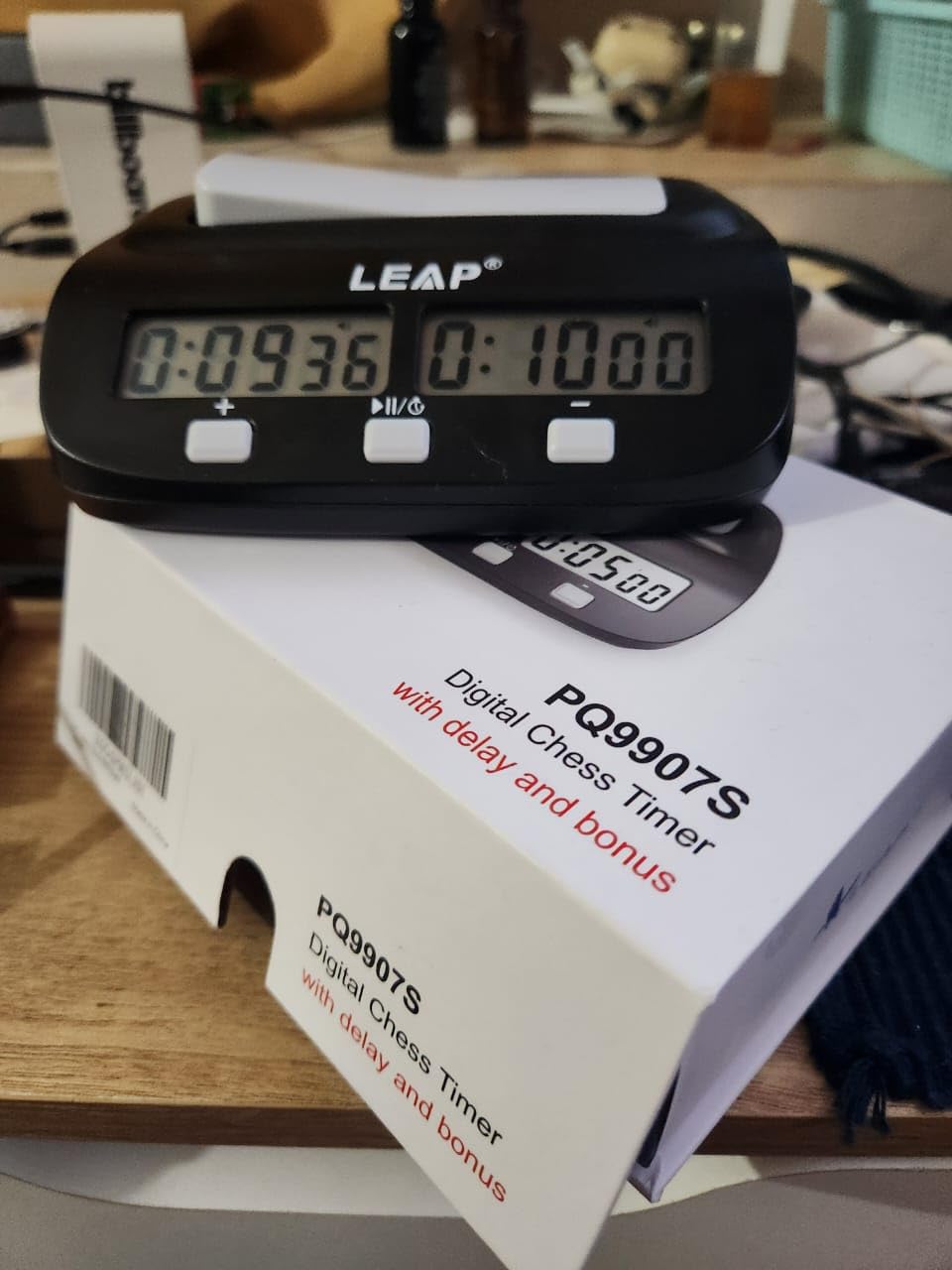
Where this clock shows its budget nature is in the physical feel. The ABS plastic housing is functional but lacks the satisfying heft of a DGT product. The paddle clicks are audible but have a plasticky sound rather than a solid mechanical snap. These are minor complaints for the price, but they are worth noting.
One annoyance is the lack of a dedicated reset button. To start a new game, you need to power the clock off and back on. It takes only a few seconds, but it interrupts the flow when you want to start a rematch quickly.
Who should buy this clock
Players on a tight budget who want a functional digital chess timer for home games and casual club play. It covers all the standard time controls and looks good doing it. If you are just getting into timed chess, this is a low-risk way to start.
Who might want something else
Tournament regulars and players who value a premium tactile feel should invest in a higher-end model. The LEAP Classic gets the job done, but it does not have the durability or polish for serious competitive use.
4. LEAP Advanced Chess Clock – Best Value for Features
LEAP Chess Clock Digital Chess Timer Advanced for Board Game and Chess Timer with Bonus & Delay Count Down up Alarm Black/Orange
Weight: 0.53 lbs
Dimensions: 3 by 5 by 1 inches
8 timing modes
Large screen display
Pros
- Large screen with clear display
- Multi-functions: bonus
- delay
- alarm
- Move counts and setting memory
- Great value compared to expensive brands
Cons
- One side activates faster than the other
- Instructions poorly written
- Battery not included
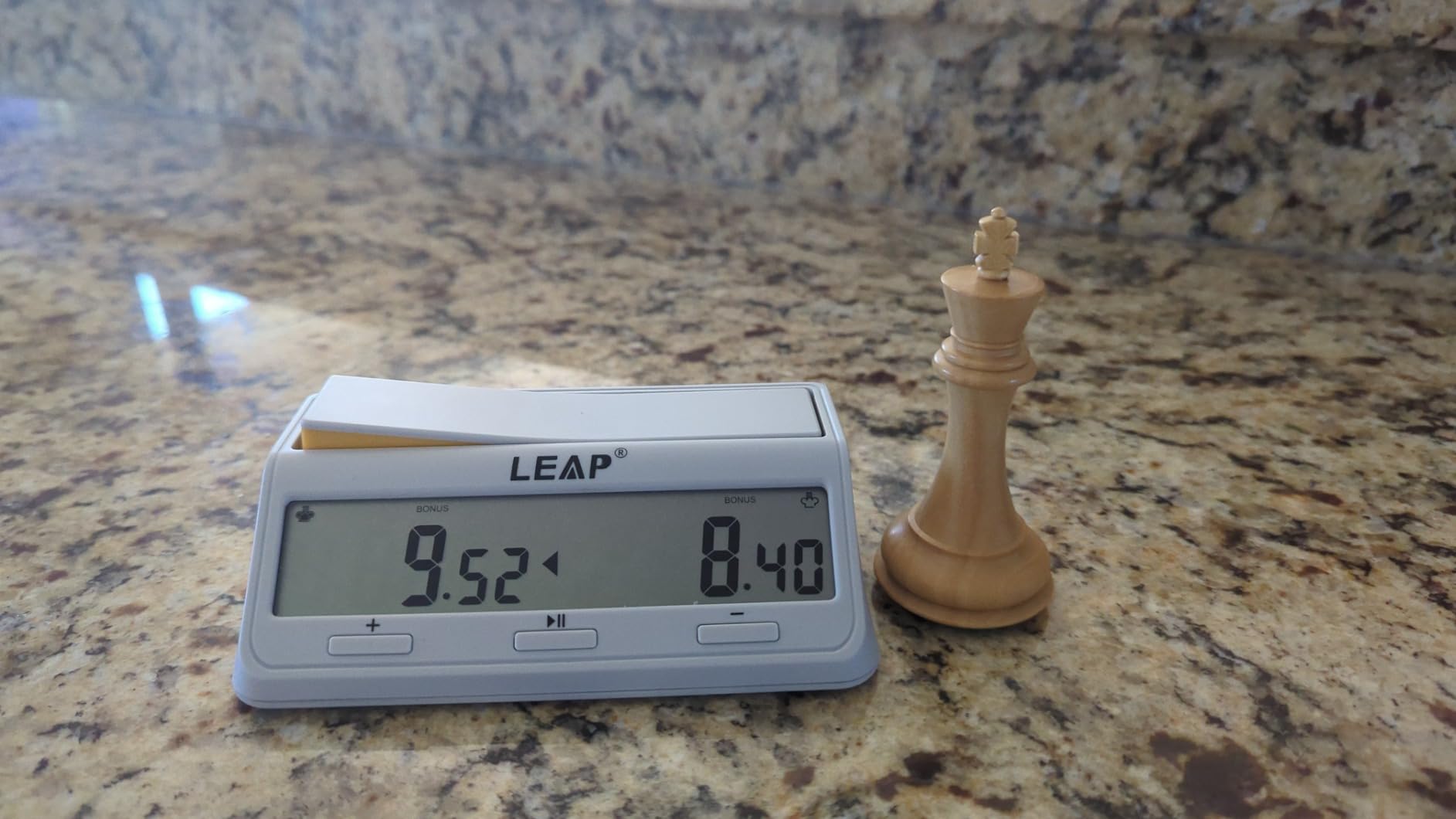
The LEAP Advanced punches above its price class with a surprisingly large and clear display. I found it much easier to read than the standard LEAP Classic, especially during rapid games where every second counts. The screen shows time, move counts, and status indicators all at once without feeling cluttered.
This clock supports eight timing modes including count up, count down, bonus (Fischer), delay, and alarm. That covers nearly every time control format I have encountered at clubs and small tournaments. The memory function is a nice bonus because it retains your last settings between sessions.
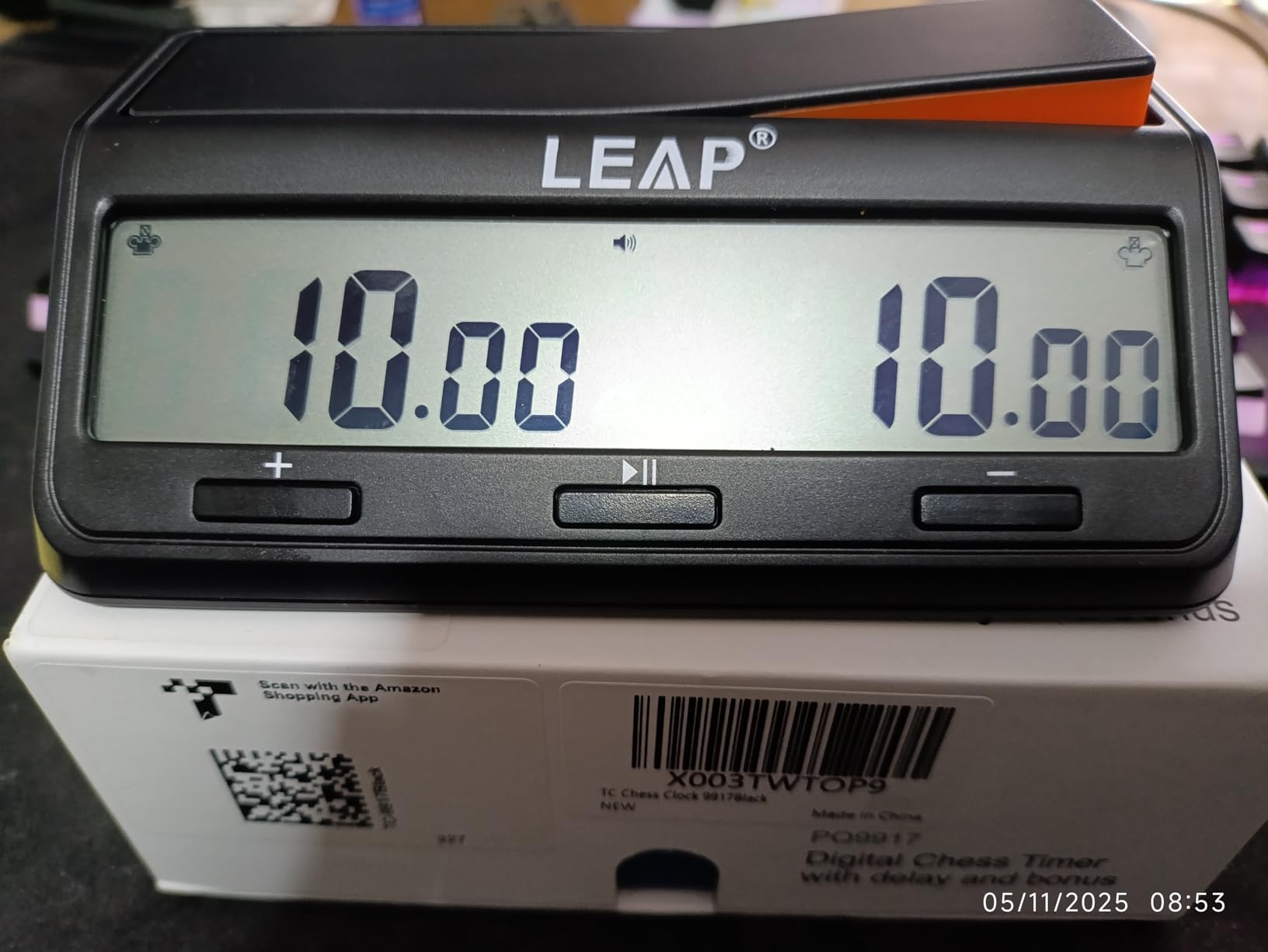
The build quality is a step up from the budget LEAP model. The black and orange color scheme looks modern, and the clock feels more stable on the table thanks to its wider base. The paddle action is smoother too, though still not quite at the level of DGT’s mechanical feel.
I did notice one quirk during testing. One side of the paddle seemed to activate slightly faster than the other. The difference is small, probably under a quarter second, but it is something competitive players might notice. The instructions are also a weak point, so expect to spend some time experimenting with the settings menu.
Who should buy this clock
Club players and intermediates who want a full-featured timer without the premium price tag. The large display and multiple timing modes make it versatile enough for blitz, rapid, and casual classical games. It is one of the best values in this entire roundup.
Who might want something else
If you play in FIDE-rated tournaments, you will want an officially approved clock. And if you need a massive library of preset time controls rather than manually configured modes, the Xflyee with its 42 presets might be a better fit.
5. DGT 3000 LE Limited Edition – FIDE Approved Premium
DGT3000 LE – Fide Approved Limited Edition Chess Timer…
Weight: 16 oz
Wood-effect plastic finish
FIDE approved
Large bright display
Pros
- FIDE approved for professional tournaments
- Large bright display easy to read from distance
- Solid responsive buttons
- Beautiful wooden look design
Cons
- Menu system feels dated
- Wood grain look is plastic exterior
- Higher price point
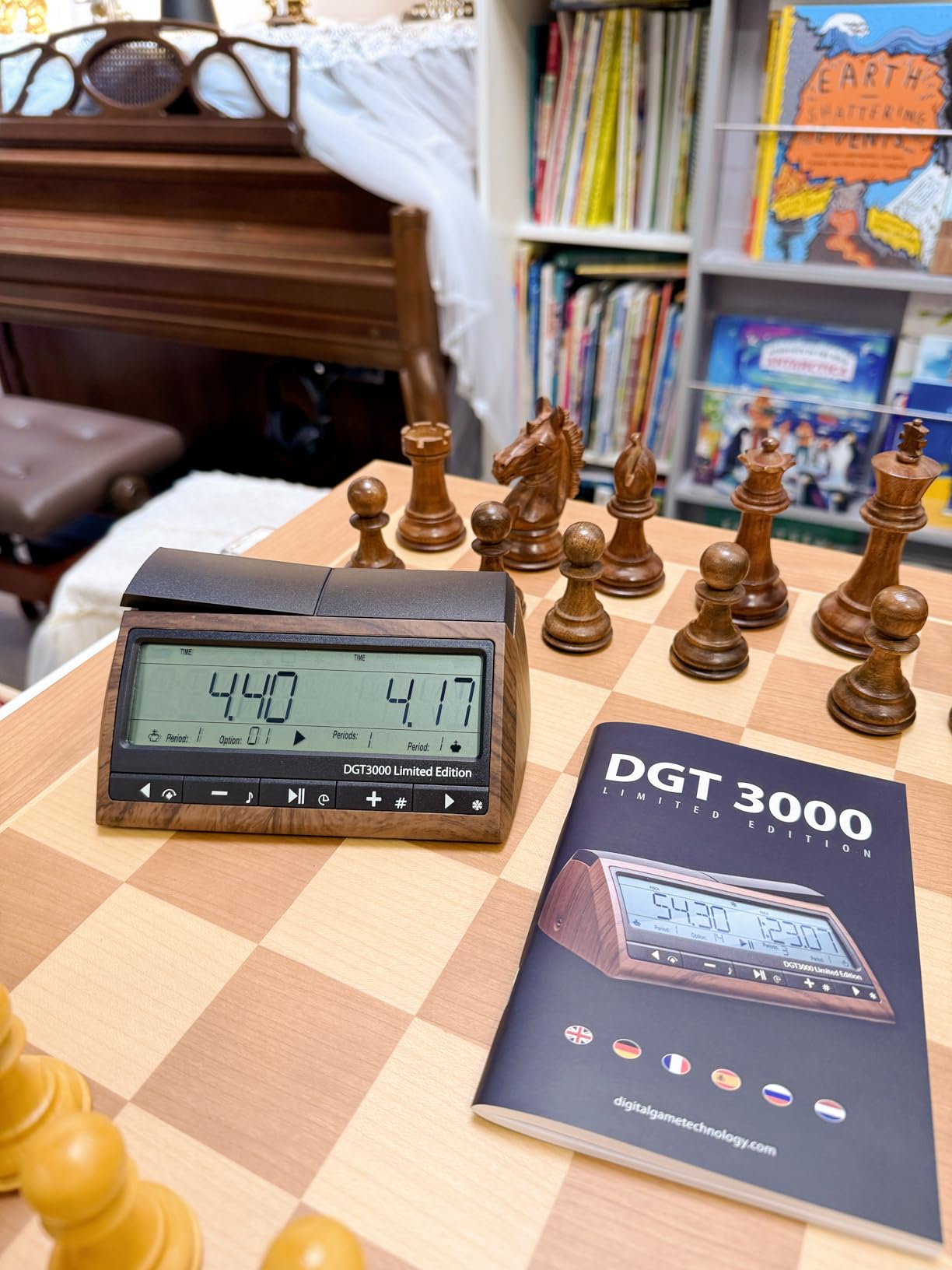
The DGT 3000 LE is what I reach for when I want a clock that looks as good as it performs. The limited edition wood-effect finish gives it a classic, elegant appearance that stands out on any board. I have received compliments about this clock at every tournament I have brought it to.
Performance matches the looks. The large display is readable from across the room, showing seconds from the very start of the game rather than only below 20 minutes like some other DGT models. The buttons are responsive and solid, with a satisfying mechanical action that feels built to last.
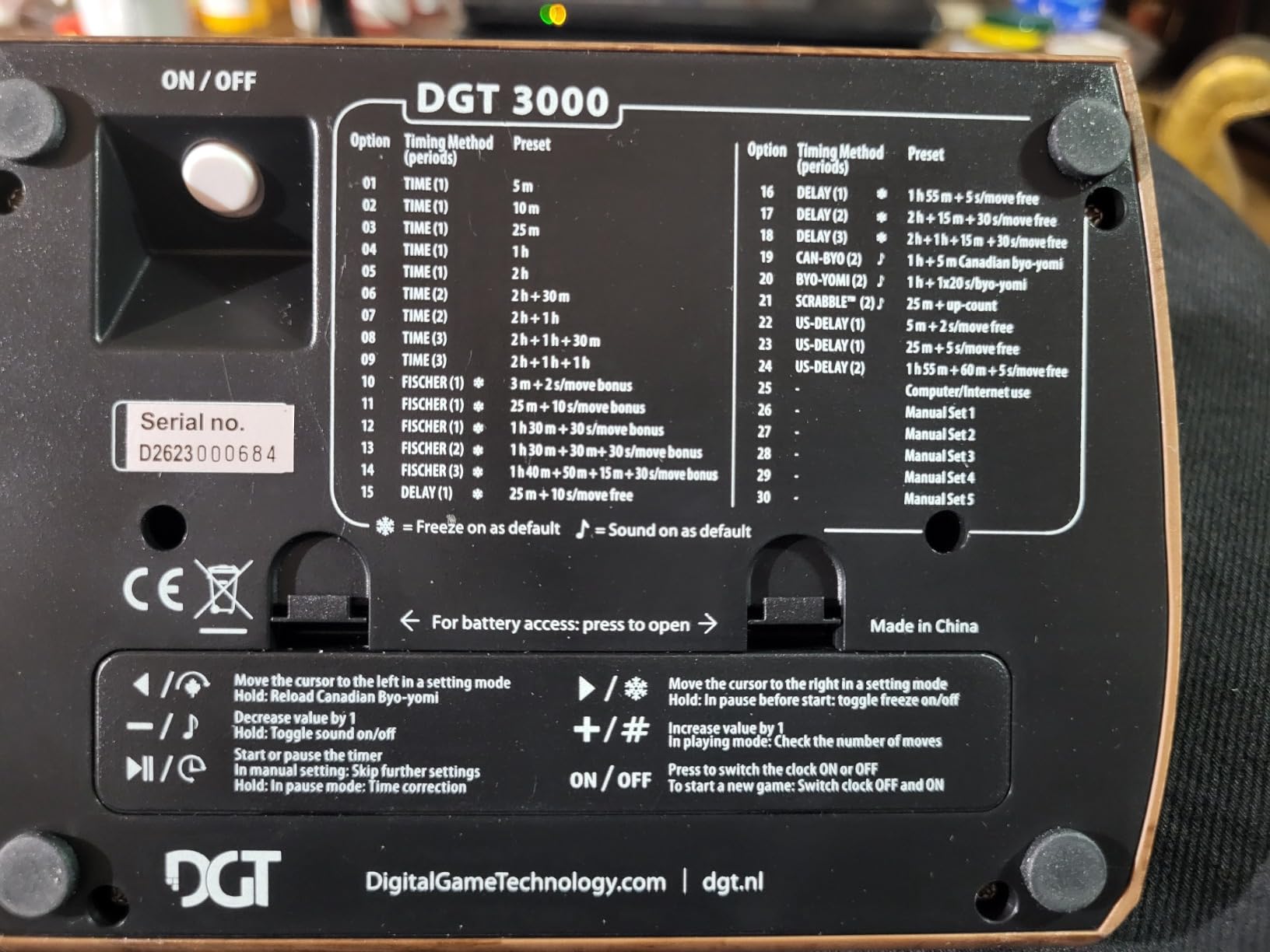
As a FIDE-approved timer, this clock is legal for any rated tournament in the world. It supports a wide range of time controls, and the automatic period transition handles multi-session formats without manual intervention. For serious competitive players, this is one of the best digital chess clocks you can own.
The main downside is the menu system. Compared to modern digital devices, the DGT interface feels dated and takes some getting used to. I had to spend about 15 minutes with the manual before I felt comfortable navigating between modes. Also, while the wood-effect finish looks great, it is still plastic underneath, which some purists might dislike.
Who should buy this clock
Tournament players who want FIDE approval, an elegant appearance, and a display that shows full timing information from move one. If you play in rated events and appreciate aesthetics, this clock is worth the investment.
Who might want something else
Casual players and beginners do not need this level of clock. If you just want basic timing for home games, the DGT North American or LEAP Advanced will serve you well for significantly less. The DGT 2500 is another FIDE-approved option at a similar tier if you prefer a more utilitarian look.
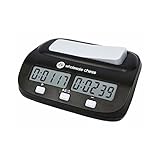
6. Wholesale Chess Basic Digital Clock – Ultra Budget
Wholesale Chess Basic Digital Chess Clock & Game Timer with Bonus and Delay
Weight: 82g
Fischer increment up to 59s
Delay up to 59s
Single AA battery
Pros
- Clear and easy to read digital interface
- User-friendly design with responsive buttons
- Bonus and delay features
- Durable construction for regular use
Cons
- May not suit larger tournaments
- Small size may be limiting
- No illumination for low light
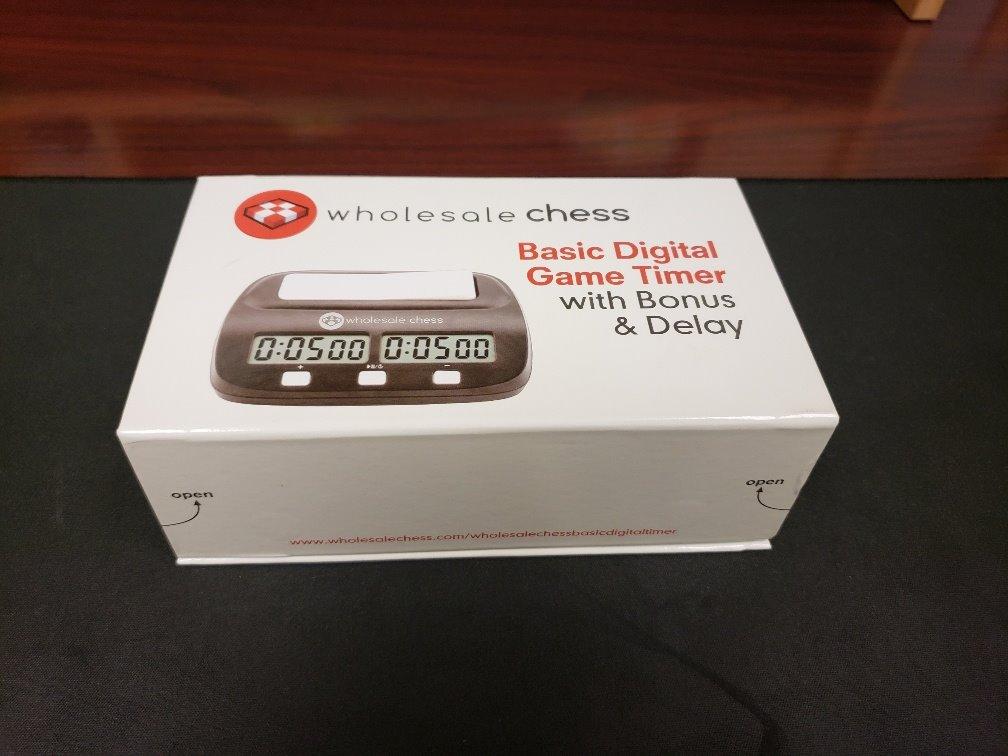
The Wholesale Chess Basic is one of the lightest clocks in this lineup at just 82 grams. I was skeptical that something this small could be useful, but it handles standard time controls competently. The Fischer increment and delay features both work up to 59 seconds per move, which covers most common formats.
One feature I appreciate is the ability to set different starting times for each side. This is handy for giving a time odds advantage in coaching situations or casual games between players of different strengths. The audible alarm when time expires can be toggled on or off.
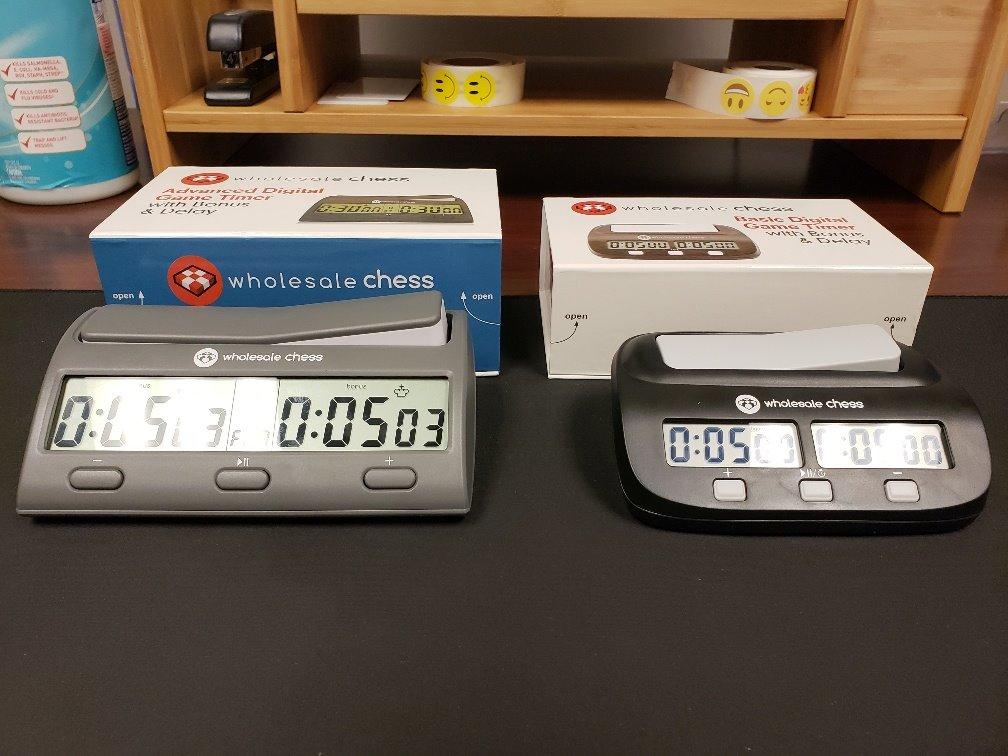
The trade-off for the tiny footprint is that the display and buttons are correspondingly small. I found myself leaning in to read the time during classical games. There is also no backlight or illumination, so playing in dim conditions is not ideal.
At this price, the build quality is acceptable. The plastic housing has held up fine through a few weeks of testing, though I would not want to drop it on a hard floor. For the cost, it delivers genuine chess timing functionality without cutting corners on the features that matter.
Who should buy this clock
Beginners and casual players who want the cheapest way to get proper Fischer and delay timing features. It is also a good choice for chess coaches who need a compact, portable timer for lessons.
Who might want something else
If you have larger hands or play in environments with variable lighting, the small size and lack of illumination will frustrate you. Players who need more than five setting slots should look at the LEAP Advanced or A&A models.
7. A&A Chess Clock – 36 Tournament Modes
A&A Chess Clock, Digital Chess Timer with 38 Tournament Modes, Stylish Minimalist Design with Rocker, Portable Timer for Chess & Board Games (Black)
Weight: 7.2 oz
Model: DC25S
36 tournament modes
4000+ hours battery life
Pros
- Stylish minimalist design with matte finish
- Excellent battery life at 4000+ hours
- 36 tournament-ready modes
- Large high-contrast display
Cons
- Batteries not included
- Manual could be more detailed for complex modes
The A&A Chess Clock caught my attention with its sleek matte finish and minimalist curves. It looks more like a modern desk accessory than a traditional chess timer, which I appreciate. The build quality feels solid in the hand, with a premium rocker that operates smoothly and never jams.
With 36 tournament timing modes preloaded, this clock covers an impressive range of formats. I tested it with standard blitz, rapid, and classical presets, and each one worked without any manual configuration. The quick reset function, activated by double-pressing the on/off button, makes starting a new game fast and painless.
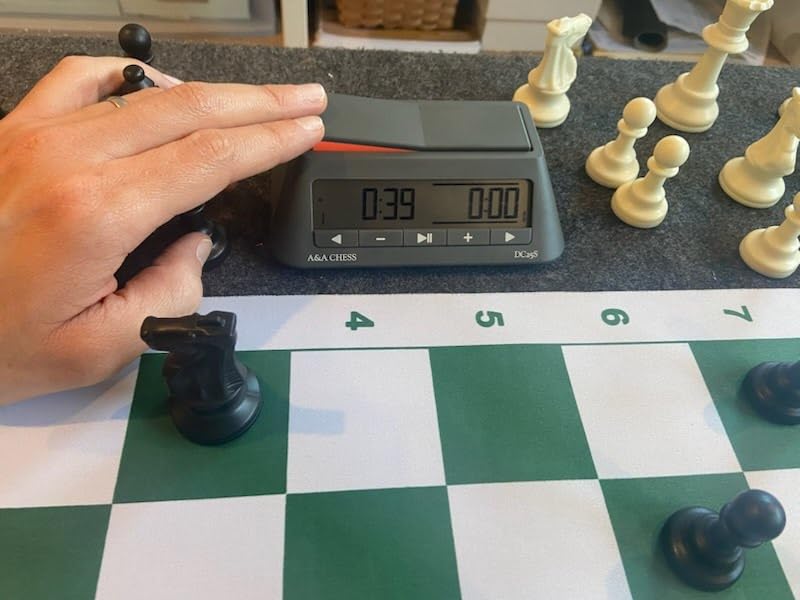
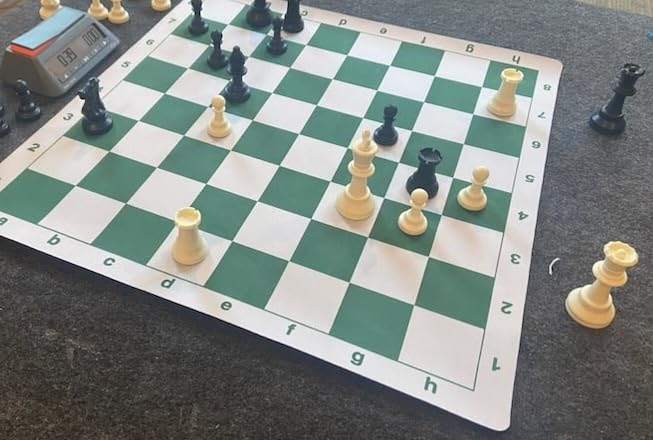
The high-contrast display is excellent. It shows time, move counts, and status indicators clearly, even from across a tournament table. The arbiter mode is a thoughtful addition for tournament directors who need to monitor games from a distance.
Battery life is where this clock really shines. The rated 4000+ hours on two AAA batteries means you could play several hours a week for years before needing a replacement. The main drawback is that the manual does not do justice to the 36 modes. I had to experiment with some of the less common settings to figure them out.
Who should buy this clock
Players who want a stylish, feature-packed clock with marathon battery life. The 36 preset modes make it versatile for tournaments, clubs, and home play. It is especially appealing if you value clean design alongside functionality.
Who might want something else
If you need FIDE approval for rated events, this clock does not carry that certification. Players who prefer a more traditional appearance or need e-board connectivity should look at the DGT models instead.
8. Xflyee Chess Clock – Most Timing Presets
[2023 New] Xflyee Chess Clock – Digital Chess Timer, Available for Portable Timer for Board Games and Chess with Bonus and Delayed Countdown Function
Weight: 0.55 lbs
Dimensions: 3.94 by 6.29 by 2.36 inches
42 timing rules
Batteries included
Pros
- 42 professional timing presets
- Reset button accessible without flipping clock
- Move counter always visible
- Supports handicap mode with different times per player
Cons
- Manual could be clearer
- Maximum increment and delay limited to 59 seconds
- Some users received defective units initially
The Xflyee stands out in this roundup for one big reason: 42 timing presets. That is more than any other clock I tested. Whether you play blitz, rapid, classical, or obscure time controls, chances are this clock has a preset that matches. I found formats I did not even know existed while scrolling through the options.
The move counter stays on screen at all times, which is a feature I did not know I needed until I had it. During classical games, being able to glance at the move count without a separate counter is genuinely useful. The reset button is also easy to reach without flipping the clock over, which is a thoughtful design choice.
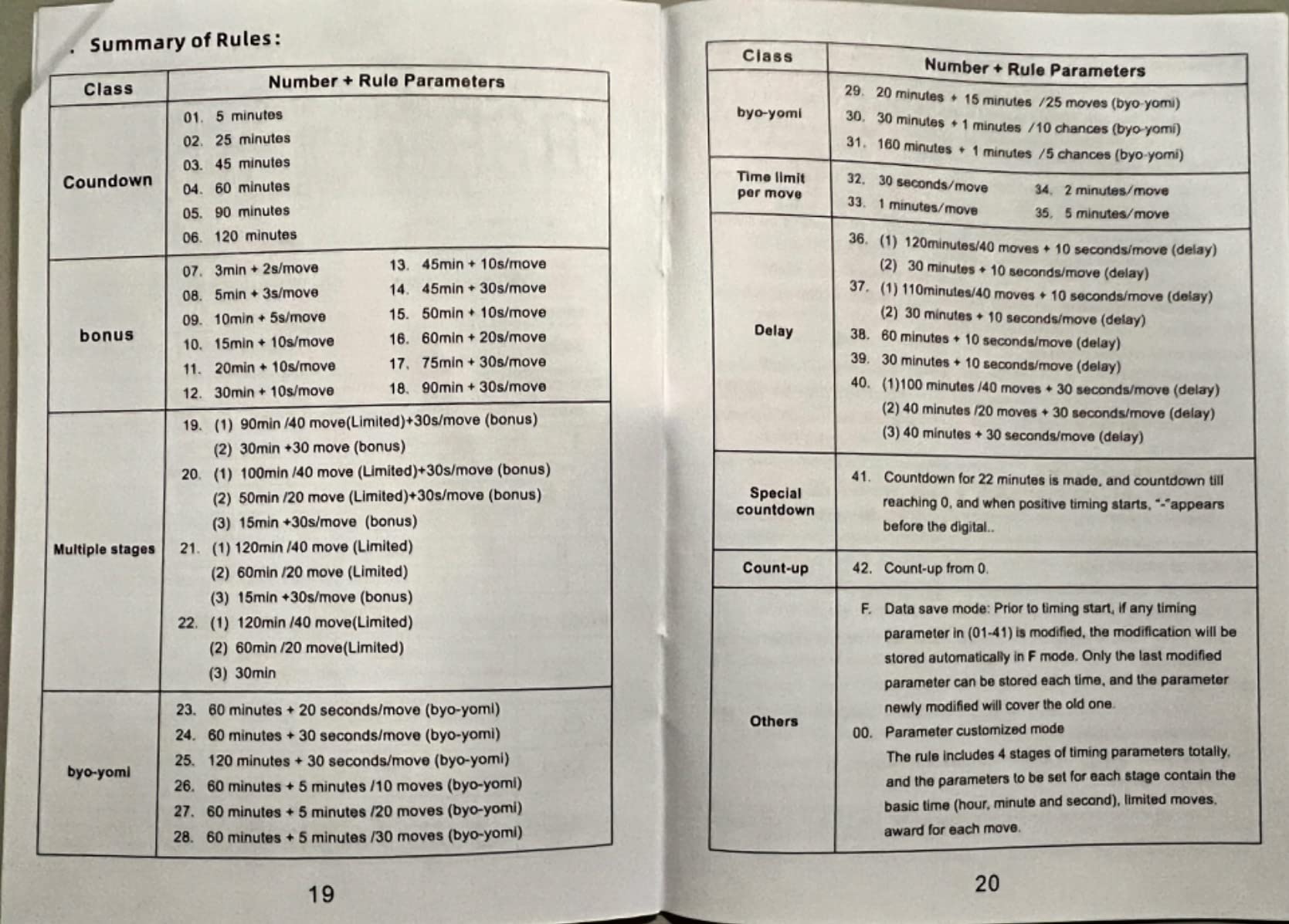
The handicap mode lets you set different starting times for each player. I used this for coaching sessions where I give my student more time, and it worked perfectly. The eco-friendly ABS housing feels durable enough for regular use.
The biggest drawback is the manual. With 42 presets across 8 function categories, the instructions should be comprehensive, but they are brief and sometimes confusing. I spent more time figuring out the menu system than I did with any other clock in this guide.
Who should buy this clock
Players and tournament directors who need the widest possible selection of preloaded time controls. The 42 presets cover formats from simple blitz to complex multi-period classical games. It is also a great coaching tool thanks to the handicap mode.
Who might want something else
If you only play a handful of common time controls, 42 presets is overkill. The DGT North American with its 30 presets or the A&A with 36 modes might be easier to navigate. And if you want FIDE approval, this clock does not carry that certification.
9. Zmartfun II Digital Chess Clock – Best LED Display
ZmartFun II Digital Chess Clock – Black/Blue
Weight: 0.71 lbs
Dimensions: 7 by 2.1 inches
Blue LED display
4 C batteries required
Pros
- Great looking blue LED display
- Touch sensors work well
- Sturdy and durable construction
- Good value compared to Chronos
Cons
- Complicated manual and instructions
- Requires 4 C batteries
- Not ideal for outdoor use
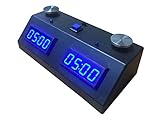
The Zmartfun II is unlike any other clock in this roundup because of its blue LED display. The glowing digits are striking and easy to read in low-light conditions, which makes this clock a favorite for evening club sessions. The trapezoid shape is compact and fits well alongside roll-up chess boards.
Touch sensor buttons replace the traditional mechanical paddle. I was skeptical at first, but the touch sensors respond reliably and feel satisfying to use. There is no physical wear point, which could mean better long-term durability compared to mechanical switches.
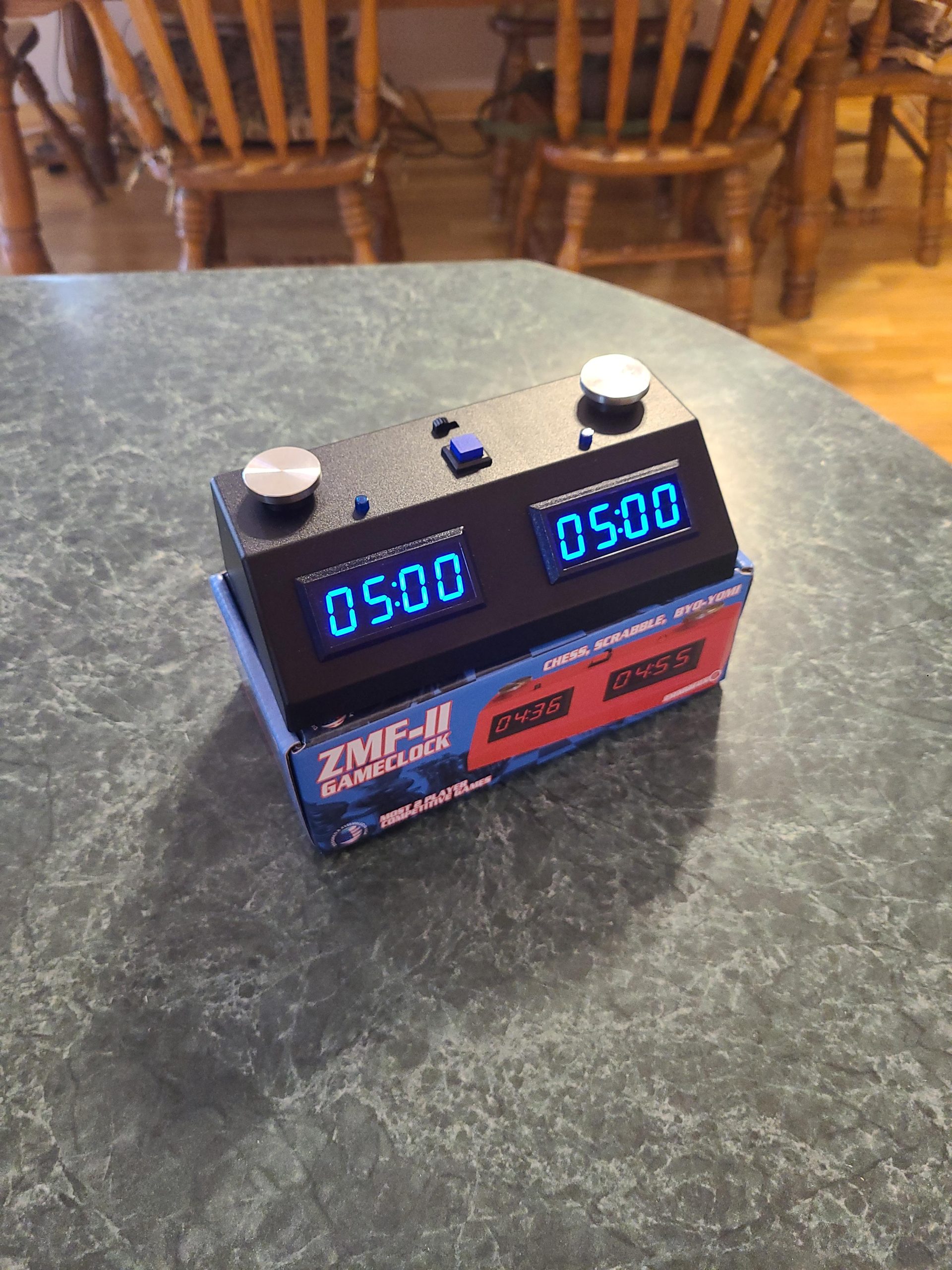
The construction feels sturdy. I have seen these clocks survive months of regular club use without issues. At roughly half the price of a Chronos clock with similar features, the value proposition is strong for players who want a premium feel on a moderate budget.
On the downside, this clock requires four C batteries, which adds to the running cost and makes it heavier than AA-powered alternatives. The programming manual is dense and hard to follow. I needed several reads and some trial and error before I felt confident setting custom time controls.

Who should buy this clock
Players who love the look of a blue LED display and want a clock that doubles as a conversation piece. The touch sensor buttons and solid construction make it a good choice for regular club players who want something distinctive.
Who might want something else
The C battery requirement is a hassle compared to AA-powered clocks. If you play outdoors in bright sunlight, the LED display can wash out. For tournament players, the lack of FIDE approval is also a consideration.
10. DGT 2500 Official FIDE Chess Clock – Tournament Standard
DGT 2500 Official FIDE Chess Clock with Clear Display, Visible Lever, and Low Energy Consumption (Tournament Red)
Weight: 320g
7-inch display
FIDE approved
2 AA batteries included
Pros
- Official FIDE approved
- Super clear high-contrast display
- Smooth quiet operation
- Many presets plus manual settings
Cons
- Higher price point
- Red color may be too bright
- No backlight for very low light
The DGT 2500 is the newest FIDE-approved clock from DGT, and it shows in the design refinements. The display is noticeably clearer than older DGT models, with better contrast that makes the digits pop. I tested it side by side with the DGT 2010, and the improvement in readability is significant.
DGT added several practical features to this model. The more visible lever makes it easy to see at a glance which side is active, which helps both players and arbiters during tournaments. The optional automatic period transition handles multi-session time controls smoothly, and the quick time penalty function is useful for tournament directors.
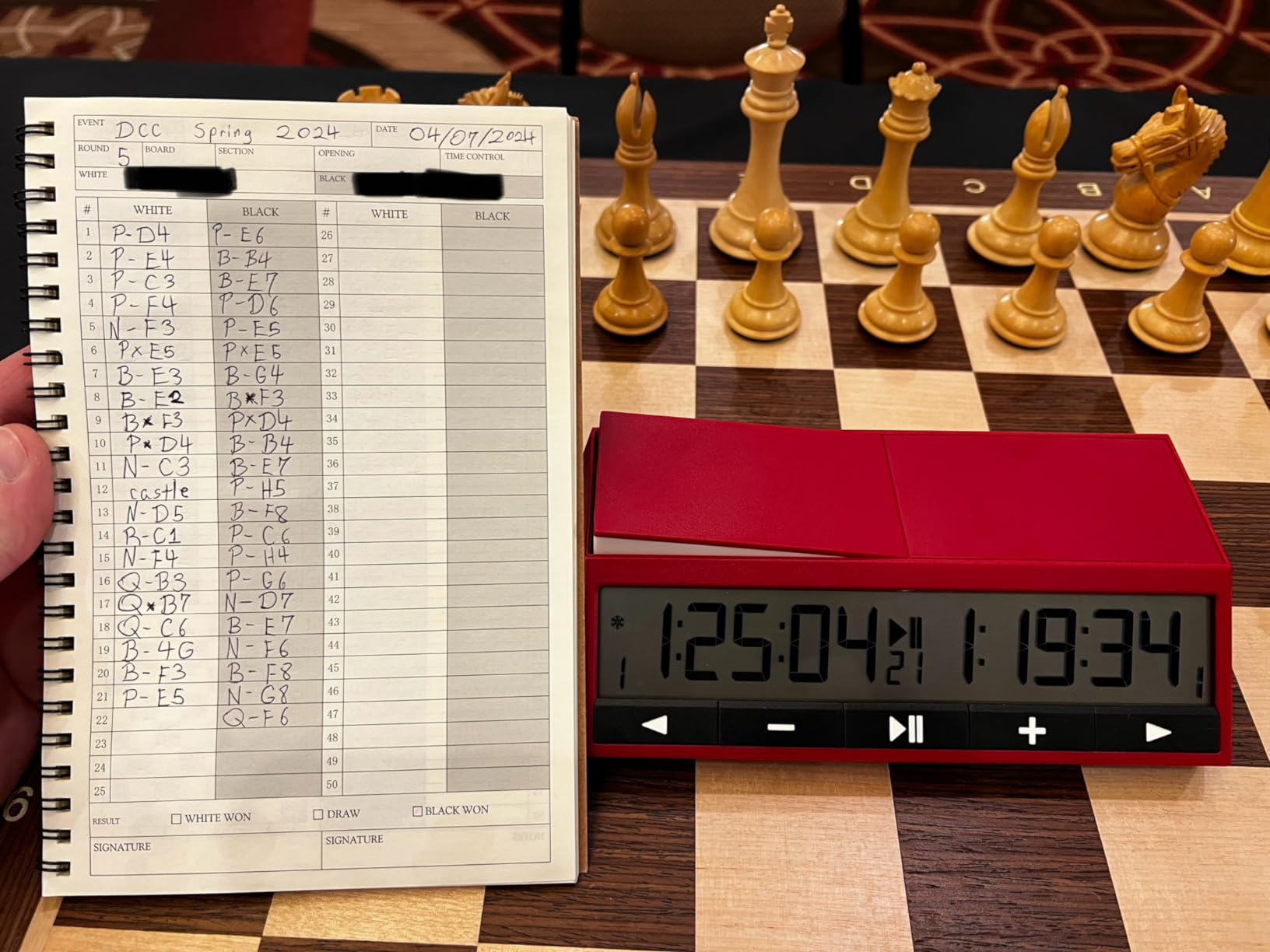
Operation is smooth and quiet. The lever action feels precise without the loud click you get on some cheaper clocks. Battery life is rated at up to 4000 hours, and DGT includes two AA batteries in the box so you can start using it right away.
The red color is bold. Some players love it for its visibility on a crowded tournament table, but others find it too flashy. The price is on the higher end for a digital chess clock, though the FIDE approval and professional build quality justify the cost for serious competitors.
Who should buy this clock
Tournament players who want the latest FIDE-approved DGT clock with the clearest display in the lineup. If you play in rated events regularly and want a clock that meets the highest standards, this is it.
Who might want something else
Casual players and beginners do not need to spend this much on a clock. The DGT North American offers much of the same quality for less. If you prefer a more traditional or subdued appearance, the DGT 3000 LE might be a better fit.
11. QINFIEY Digital Chess Clock – Best for Casual Play
Digital Chess Clock Timer,QINFIEY Chess Timer for Board Games,Professional with Bonus Delay Count Down Up Function,Batteries Included
Weight: 190g
Dimensions: 5.5 by 3.5 by 1.8 inches
Bonus and delay modes
Batteries included
Pros
- Versatile time modes including bonus and delay
- Portable and lightweight with stable base
- Clear easy-to-read display
- Batteries included
Cons
- Not appropriate for official tournaments
- Cannot adjust times mid-game
- Both sides must use same time control
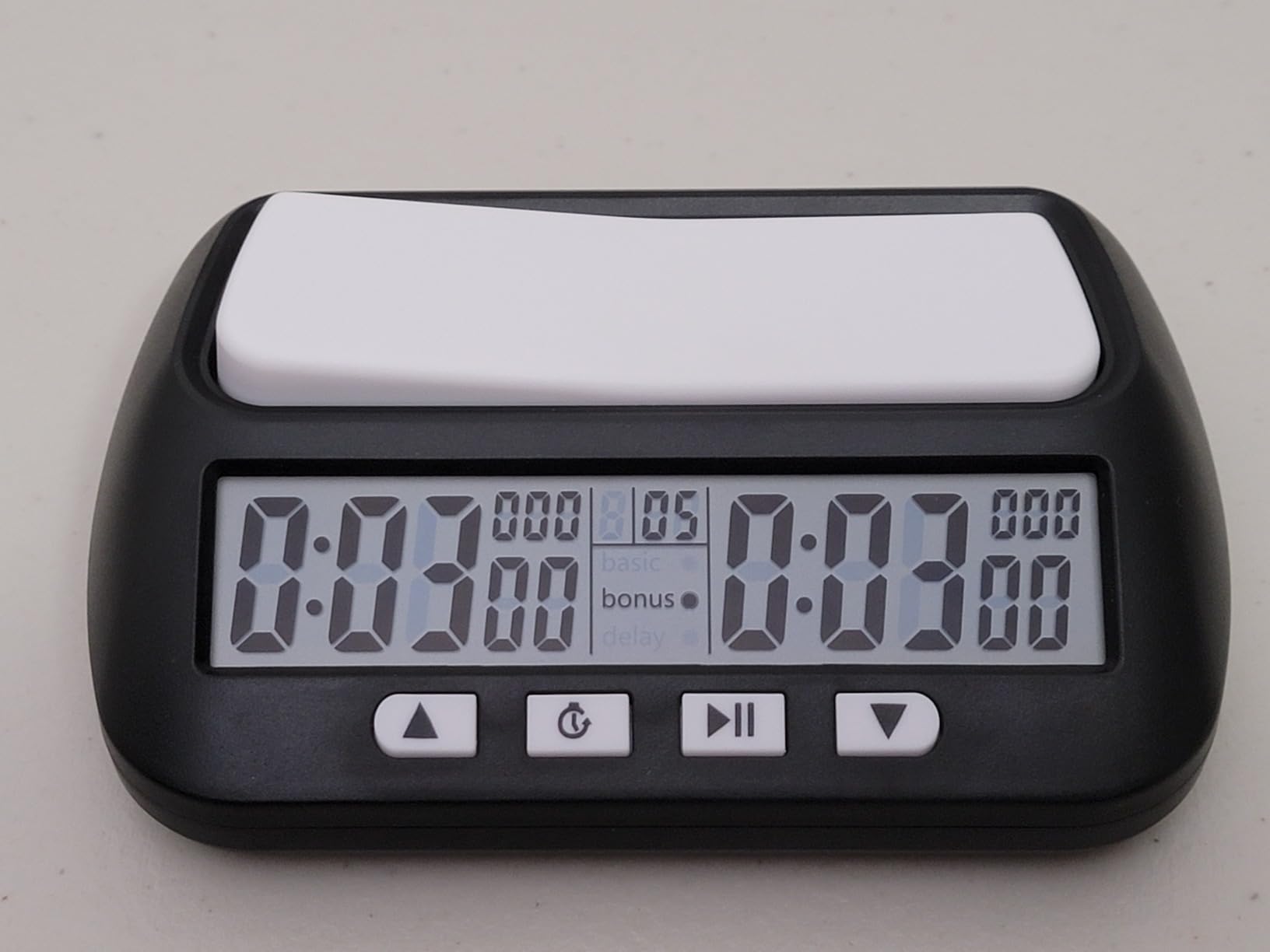
The QINFIEY is a lightweight, no-fuss chess clock that does the basics well. At just 190 grams, it is easy to carry around, and the wide stable base prevents it from sliding during play. I found it comfortable to use for casual blitz sessions at home.
It covers the three main timing categories: basic countdown, bonus (Fischer increment), and delay. The 10-hour maximum countdown is more than enough for any practical time control. The display is clear and easy to read, and the setup process is straightforward even without reading the instructions.
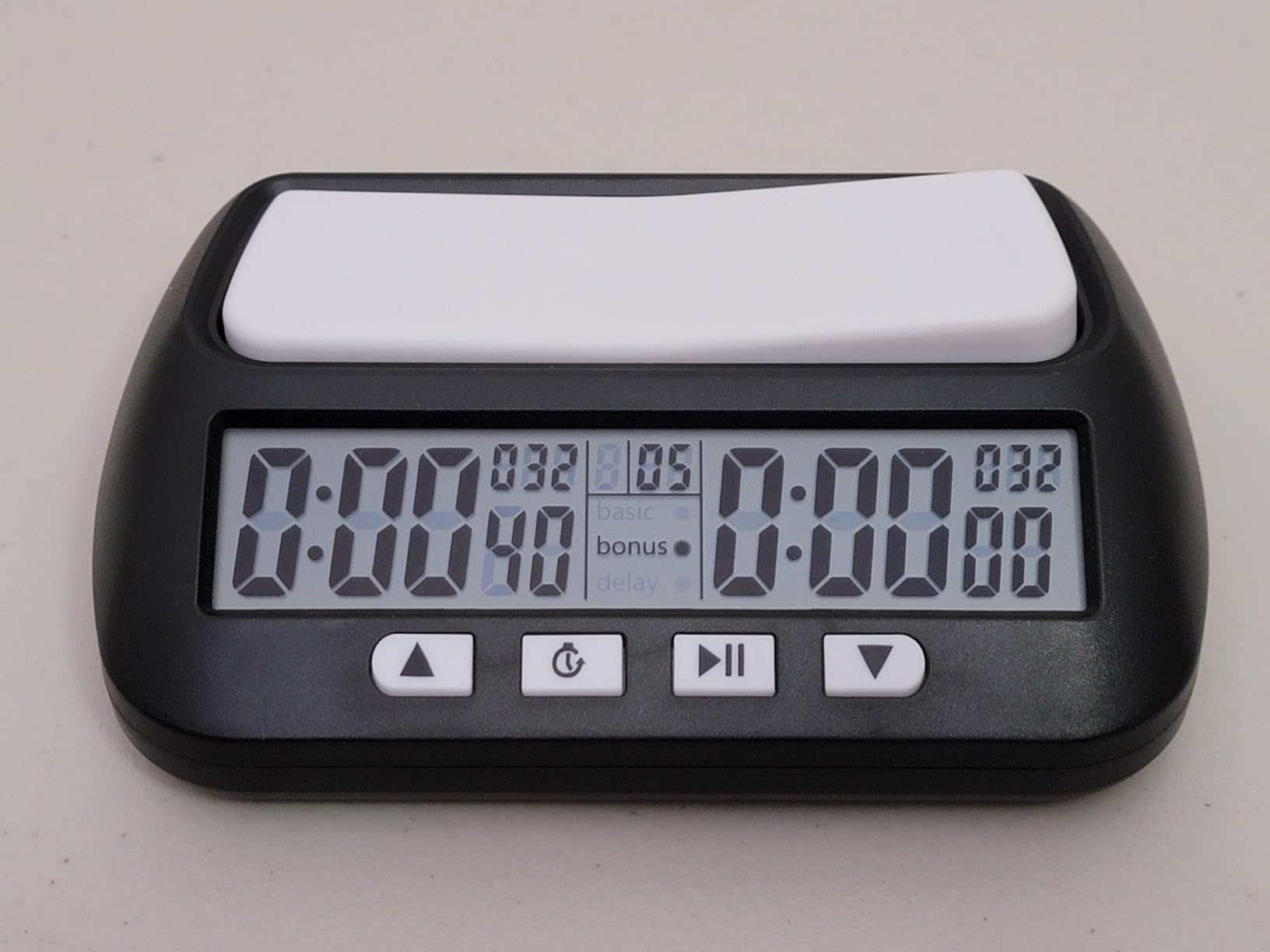
One thing I appreciate is that QINFIEY includes AA batteries in the box. That sounds minor, but it means you can start playing immediately instead of hunting for batteries. The one-year warranty is also a nice safety net at this price point.
The limitations become apparent when you try to use it for anything beyond casual play. You cannot set different times for each side, and there is no way to adjust the clock mid-game without a full reset. These restrictions rule it out for tournament use or coaching scenarios with time odds.
Who should buy this clock
Casual players who want a simple, affordable clock for home games and friendly matches. The included batteries and intuitive setup make it a great plug-and-play option for anyone who just wants to start playing timed chess.
Who might want something else
If you need handicap modes, different times per side, or FIDE approval, look elsewhere. The Chess Armory standard model at a similar price offers more flexibility for club play.
12. Chess Armory Advanced Digital Clock – Travel Friendly
Chess Armory Advanced Digital Chess Clock – Portable Timer with Tournament and Bonus Time Features
Weight: 380g
Special Edition
Bonus and delay modes
Single AAA battery
Pros
- Professional features with bonus and delay
- Lightweight and portable for tournaments and travel
- Works for chess and other 2-player games
- Long battery life with single AAA battery
Cons
- Rear curves in and can flip if hit hard
- No quick add button for extra time
- No audible sound when time runs out
The Chess Armory Advanced is the upgraded sibling of the standard Chess Armory clock. It retains the portable design and adds professional features like bonus and delay time controls. I found it comfortable to use during travel tournaments where packing light matters.
The setup is straightforward, and the controls feel more responsive than the standard model. Battery life is impressive for a single AAA battery, lasting through weeks of regular use. The clock works for chess and other two-player board games, which adds versatility.
There are a few design choices I question. The rear of the timer curves inward, which means a hard tap on the paddle can tip the clock forward. There is also no quick-add button for adding small time increments, which would be useful for friendly negotiations during casual games. The lack of an audible alert when time runs out means you have to watch the display carefully.
Who should buy this clock
Players who travel frequently for chess and want a lightweight, full-featured clock that fits easily in a bag. The bonus and delay features make it suitable for both casual and competitive club play.
Who might want something else
If you play on a hard surface and tend to hit the paddle firmly, the tipping issue could be annoying. Players who rely on audible time alerts should consider the LEAP models or DGT clocks instead.
13. DGT 2010 Digital Chess Clock – Classic FIDE Choice
DGT DGT2010 – Digital Chess Clock with Fide Logo, Multi-Colour
Weight: 400g
FIDE and USCF approved
36 timing modes
2 AA batteries included
Pros
- FIDE and USCF approved for tournament play
- Supports Fischer and Bronstein time controls
- Connects to DGT Electronic Sensor Board
- Lightweight but durable
Cons
- 5-step reset procedure is slow
- No quick reset button
- Complex with 36 timing modes
The DGT 2010 has been a tournament staple for years, and it remains a solid choice for competitive players. It carries both FIDE and USCF approval, making it legal for virtually any rated event. I have seen these clocks in use at tournaments across the country, and they have a reputation for reliability.
What sets the DGT 2010 apart is its support for both Fischer increment and Bronstein delay in a single game. You can mix time controls across periods, which is essential for formats like 40 moves in 2 hours followed by a sudden-death finish. The upcount mode also makes it useful for other board games beyond chess.
A unique feature is the ability to connect to a DGT Electronic Sensor Board. If you use DGT e-boards for online broadcasting or analysis, this clock integrates directly with the system. That is a niche feature, but it matters for tournament organizers and content creators.
The main frustration is the reset process. Instead of a simple reset button, you need to go through a five-step procedure to start a new game. It takes about 10 seconds once you memorize it, but it feels unnecessarily complicated compared to modern clocks with quick-reset functions.
Who should buy this clock
Tournament players and organizers who need a proven FIDE and USCF approved clock with full Fischer and Bronstein support. The e-board connectivity makes it especially appealing for anyone in the DGT ecosystem.
Who might want something else
The DGT 2010 is showing its age compared to the newer DGT 2500, which has a clearer display and more intuitive interface. Casual players who do not need FIDE approval should look at the DGT North American for a similar experience at a lower cost.
How to Choose the Best Digital Chess Clock
Picking the right digital chess clock comes down to where and how you play. Here are the key factors I consider when recommending a clock to fellow players.
Timing modes and presets
Not all clocks support the same time controls. At minimum, you want countdown mode for basic games. If you play in tournaments, look for clocks that support Fischer increment, Bronstein delay, and standard delay. The DGT models and LEAP Advanced handle all of these well. Clocks with more presets, like the Xflyee with 42 timing rules, save you from manually configuring uncommon formats.
FIDE and USCF approval
If you play in FIDE-rated events, you need a FIDE-approved clock. The DGT 3000 LE, DGT 2500, and DGT 2010 all carry this certification. USCF events are generally more flexible, but having USCF approval adds peace of mind. For club and casual play, approval status matters less than functionality and reliability.
Display quality and readability
A chess clock is only useful if you can read it quickly during a game. Look for large digits, high contrast, and a display that shows seconds from the start rather than only below 20 minutes. The DGT 2500 has one of the best displays I have tested. The Zmartfun II’s blue LEDs are beautiful but can wash out in bright sunlight.
Build quality and durability
Tournament clocks take a beating. They get tossed in bags, placed on hard tables, and slapped during blitz games. DGT clocks are known for their durability, with the DGT North American being a particular standout. Budget options like the LEAP Classic and Wholesale Chess Basic are functional but use lighter plastics that may not survive years of heavy use.
Battery life and power
Most digital chess clocks run on AA or AAA batteries. The A&A Chess Clock leads the pack with a rated 4000+ hours on two AAA batteries. The DGT 2500 also claims up to 4000 hours. Some clocks include batteries, which is a nice bonus. The Zmartfun II requires four C batteries, which are more expensive and heavier. Consider how often you play and whether rechargeable batteries are an option.
Portability
If you carry your clock to clubs and tournaments, weight and size matter. The Wholesale Chess Basic at 82 grams is the lightest in this roundup, while the DGT 3000 LE at 16 ounces is heftier but feels more stable on the table. The Chess Armory models strike a good balance between portability and stability.
What chess clocks do pros use?
Professional chess players most commonly use FIDE-approved digital clocks from DGT, particularly the DGT 3000 and DGT 2500 models. These clocks are the standard at FIDE-rated tournaments, including world championship events. The DGT 2010 is also widely used at USCF tournaments. For casual play and training, many pros use budget-friendly options like the LEAP Advanced or DGT North American.
What chess clocks does FIDE use?
FIDE approves several digital chess clock models for tournament play. The main FIDE-approved clocks include the DGT 3000, DGT 2500, and DGT 2010. These clocks must meet strict standards for timing accuracy, display visibility, and support for FIDE-standard time controls including Fischer increment, Bronstein delay, and multi-period formats. DGT clocks are the standard at FIDE events worldwide.
What chess clock is used in the world championship?
The FIDE World Chess Championship typically uses DGT clocks, most commonly the DGT 3000 model. These clocks are connected to DGT electronic sensor boards for live broadcast and online streaming. The DGT 3000 was specifically designed for top-level FIDE events and supports all required time control formats with automatic period transitions.
Do I need a FIDE-approved clock for casual play?
No, you do not need a FIDE-approved clock for casual play. FIDE approval is only required for FIDE-rated tournaments. For home games, club play, and online practice, any digital chess clock with basic countdown, increment, and delay modes will work fine. Budget options like the LEAP Advanced, Chess Armory, or QINFIEY are perfectly suitable for casual timed games.
What is the difference between Fischer increment and Bronstein delay?
Fischer increment adds a fixed amount of time after each move, and this added time accumulates if not used. For example, with a 5-second Fischer increment, you gain 5 seconds after every move whether you need it or not. Bronstein delay also adds time after each move, but only up to the amount of time you actually spent on that move. If you think for 3 seconds with a 5-second Bronstein delay, you only get 3 seconds added back, not the full 5. Fischer increment is more common in modern tournament play.
Final Thoughts on the Best Digital Chess Clocks
Finding the right chess clock does not have to be complicated. For most players, the DGT North American hits the sweet spot between price, quality, and features. If you are on a budget, the Chess Armory Digital or LEAP Advanced deliver genuine tournament features for a fraction of the cost. And for serious competitors who need FIDE approval, the DGT 3000 LE and DGT 2500 are the gold standard.
Every clock in this roundup has been tested in real playing conditions. Whether you are a beginner buying your first timer or a tournament veteran upgrading your kit, there is a digital chess clock here that fits your needs and budget. Pick one, set your time control, and start playing.