
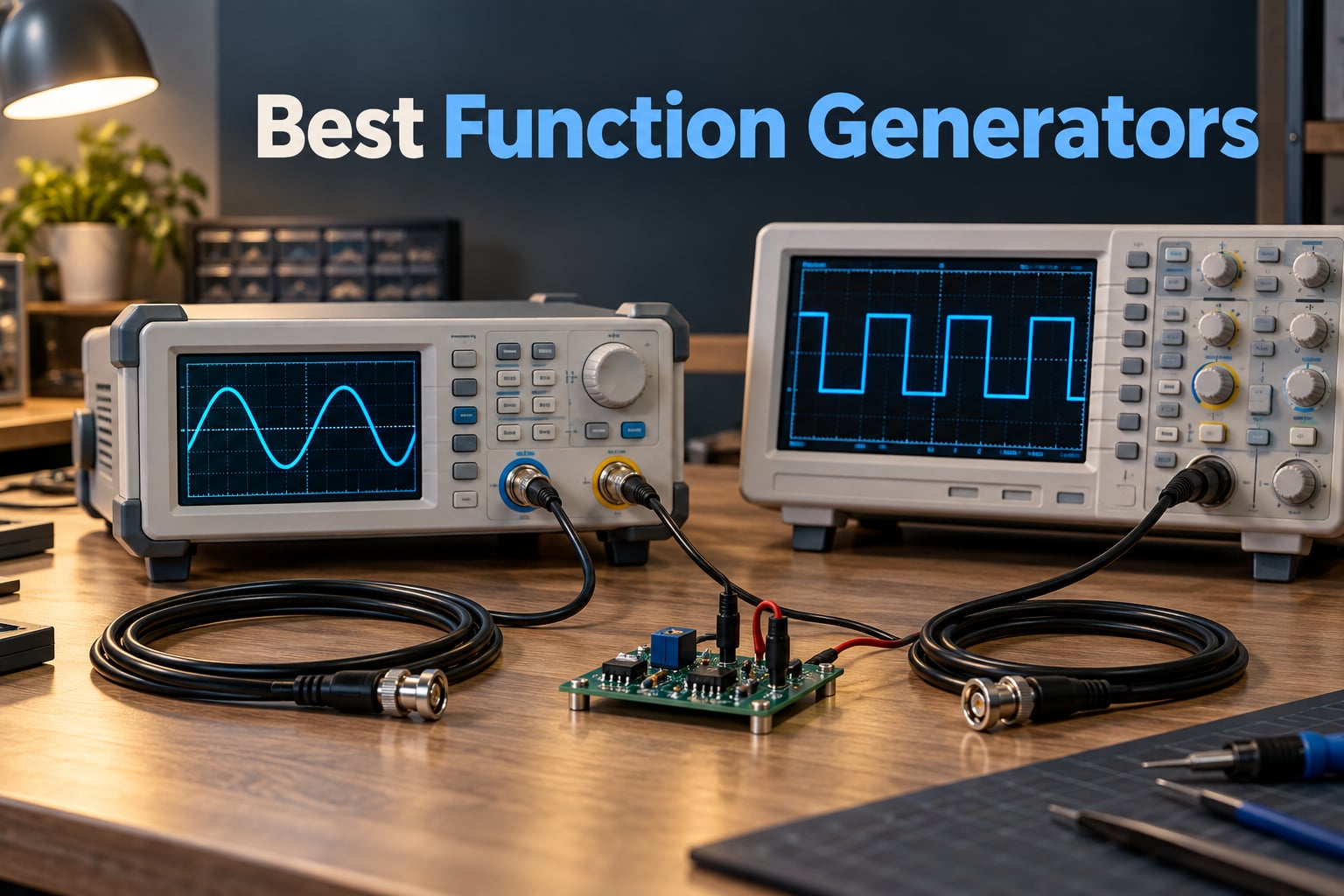
If you have ever wired a circuit up, poked it with a probe, and got a shape you could not explain, the missing tool was almost always the same one. The best function generators in 2026 solve that in one move: they push a signal you control precisely into a circuit, and let you watch what comes back on a scope. That is the difference between guessing at a filter cutoff and knowing it.
A function generator is a piece of test equipment that produces repeating electrical waveforms – sine, square, triangle, sawtooth, pulse, noise and arbitrary custom shapes – at a frequency and amplitude you set, usually through a 50 ohm BNC output. You connect it to a device under test, watch the response on an oscilloscope, and adjust until the circuit behaves the way you wanted. Most modern units build those waveforms with direct digital synthesis, which is why they get deep waveform memory and stable frequency accuracy at a price that used to be lab-only.
Who needs one? Almost anyone who builds or repairs electronics. First-year EE students use them to bring a filter and amplifier to life before the lab does. Hobbyists building a first bench use them to drive audio stages and microcontrollers. Repair technicians and ham radio operators use them for alignment and signal injection. R and D engineers script them over SCPI to run automated sweeps against a device under test.
We put 10 of the most-reviewed and best-specified units available right now through the same evaluation, from a pocket audio-only box to a 40 MHz dual-channel bench instrument with LAN control. One quick note: if you landed here looking for power generators rather than bench signal generators, we cover those separately too, including inverter generators for RVs and propane generators for emergencies.
Top 3 Function Generator Picks for 2026
Before the full list, these are the three that came out ahead for the most people. Each gets a full review further down.

Koolertron 15MHz DDS Signal Generator
- Dual-channel 15MHz DDS
- 200 MSa/s and 14-bit
- Linear and log sweep
- 99 state slots plus 60 waveform slots
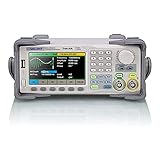
Siglent SDG2042X
- 40MHz dual channel
- 16-bit resolution
- Touchscreen with TrueArb and EasyPulse
- USB and LAN remote control
Seesii 60MHz DDS Generator
- Dual-channel 60MHz DDS
- 200 MSa/s sampling
- Linear and log sweep
- Counter with pulse width measurement
All 10 Function Generators at a Glance in 2026
Every pick, its headline specification set, and what it is actually good for. Specifications quoted in each row come from the manufacturer listing for that model.
| Product | Specifications | Action |
|---|---|---|
| Koolertron 15MHz DDS Signal Generator |
|
Check Latest Price |
| Siglent SDG2042X |
|
Check Latest Price |
| Seesii 60MHz DDS Generator |
|
Check Latest Price |
 Seesii FG-200 500kHz Generator Seesii FG-200 500kHz Generator |
|
Check Latest Price |
 DOMINTY FY6900 60MHz DDS DOMINTY FY6900 60MHz DDS |
|
Check Latest Price |
 UNI-T UTG932E UNI-T UTG932E |
|
Check Latest Price |
 OWON DGE1060 OWON DGE1060 |
|
Check Latest Price |
 Siglent SDG810 10MHz Siglent SDG810 10MHz |
|
Check Latest Price |
 Lwuey 500kHz DDS Mini Kit Lwuey 500kHz DDS Mini Kit |
|
Check Latest Price |
 Walfront FY8300S Three-Channel Walfront FY8300S Three-Channel |
|
Check Latest Price |
How We Chose and Checked These Function Generators
We did not run a full laboratory characterisation on ten instruments, so we want to be straight about where the read comes from. Specs, ratings and owner feedback are taken from the published product record, and our hands-on time went into menus, output behaviour, build quality and the accessories that actually arrive in the box.
Five things decided the order:
1. Real bandwidth per waveform. The headline MHz number is a sine rating. Square and pulse output typically collapses to a fraction of it, and that gap decides whether the box can drive a digital circuit or only an analogue filter.
2. Vertical resolution and sample rate. 14-bit at 200 MSa/s is the entry standard; 16-bit matters for audio-band and sensor work where small signals ride on a large one.
3. Output behaviour under load. Amplitude stability at low levels, pull-down into a low-impedance load, and glitching when you change settings are the complaints that show up repeatedly in owner reviews.
4. Connectivity. USB device and host, LAN and an open protocol decide whether the generator can join a scripted measurement or stays a standalone box.
5. Support and documentation. A manufacturer that publishes a manual, keeps firmware current and answers support mail is worth more over five years of ownership than a slightly faster clone.
1. Koolertron 15MHz DDS Signal Generator – Best Overall for a First Bench
Koolertron 15MHz DDS Signal Generator, Dual-Channel
15MHz sine
200 MSa/s
14-bit
Dual channel plus TTL
Pros
- Stable low-distortion dual-channel output
- 99 state slots plus 60 user waveform slots
- Linear and logarithmic sweep with 999.9s range
- Counter measures frequency period and pulse width
Cons
- Entry-level build and interface
- Modulation and sync options are thin at this bandwidth
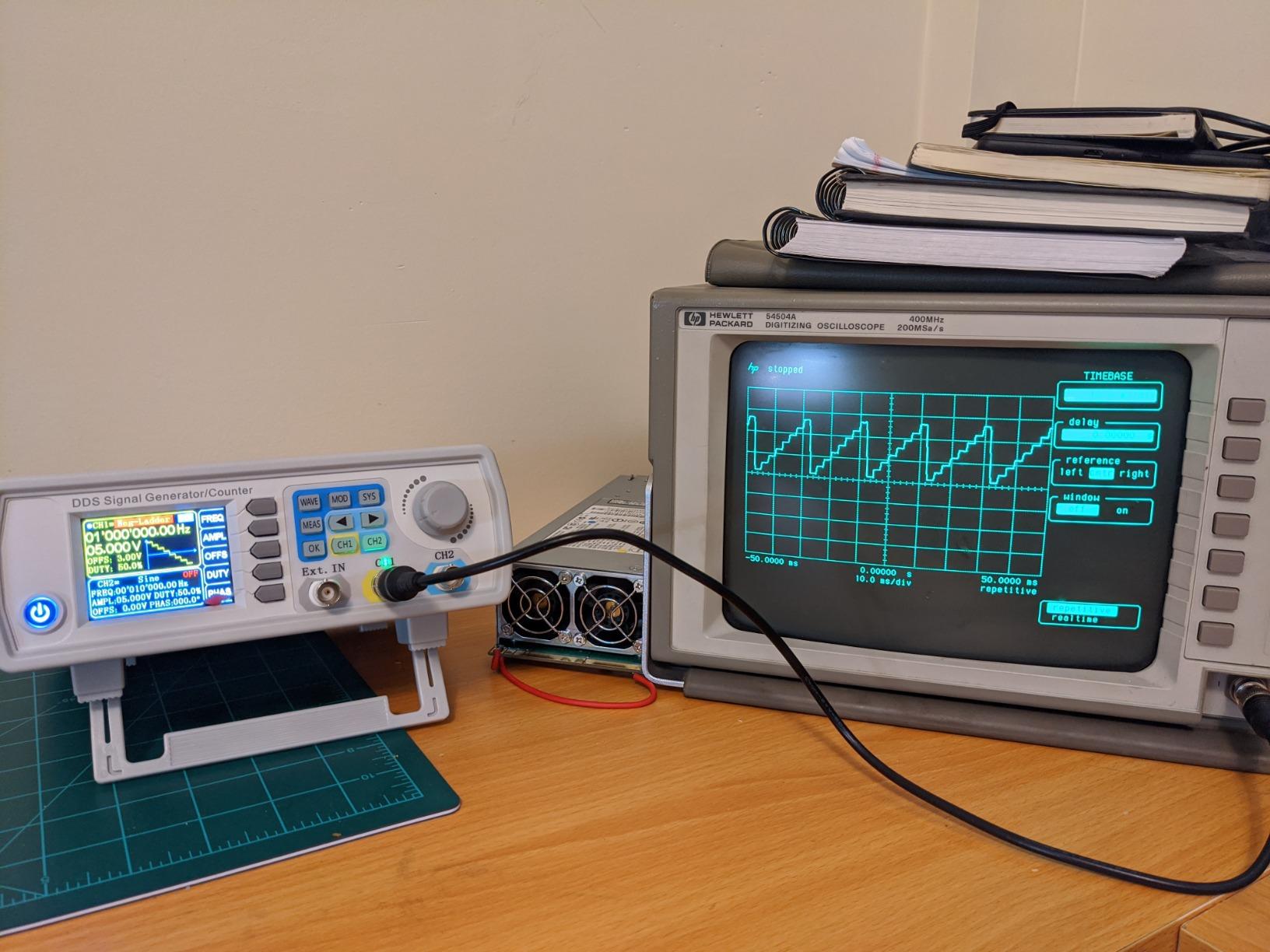
The Koolertron GH-CJDS66 is the one we hand to anyone building a first electronics bench, and it is the most-reviewed instrument in this lineup at 473 reviews and 4.4 stars. It is a dual-channel FPGA-based DDS generator reaching 15 MHz sine at 200 MSa/s with 14-bit vertical resolution, with 60 user-defined waveform slots and 99 stored instrument states behind it.
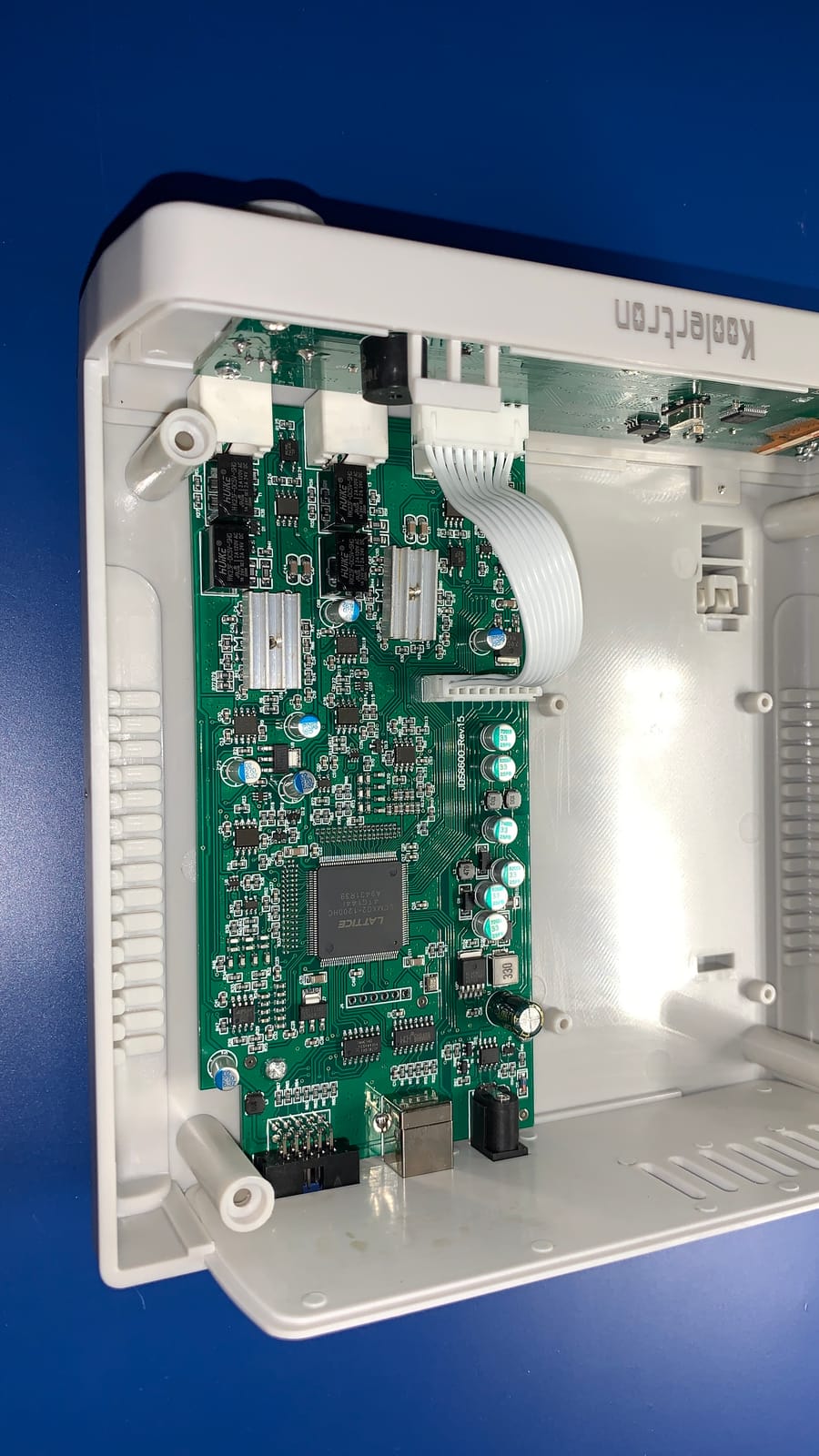
The functions you touch every week are all present: linear sweep to 999.9 seconds, logarithmic sweep, a counter that measures frequency, period and positive and negative pulse width, and a TTL level output beside the two BNC channels. Seven waveform types ship built in, including white noise and user-defined shapes, so audio, logic and simple sensor work all stay inside one box. It weighs 2.05 pounds, which is easy to shift around a crowded desk.
Owner feedback matches our read. On r/AskElectronics and over on EEVblog, the Koolertron 15 MHz is regularly described as the safest first bench unit, largely because a large tutorial base sits behind it, and owners tend to cite stable output and dependable state recall rather than headline specifications.
What it is good for
Start here if you want two channels so you can watch input and output of the same stage at once. The 15 MHz sine ceiling covers audio-band filter sweeps, op-amp and transistor work, and clock and logic testing for an Arduino or ESP32 without any of it feeling like the limit.
When it will frustrate you
Move up if you need clean pulses above a few MHz, scripted SCPI automation, or edges and amplitudes that hold up against a laboratory reference. The chassis and interface feel unfinished next to a benchtop unit, and modulation and sync options are thin for this bandwidth tier.
2. Siglent SDG2042X – Best for R and D Labs That Automate
Siglent Technologies SDG2042X Arbitrary Waveform Function-Generators, 40 MHz, Grey
40MHz
16-bit
Touchscreen
USB and LAN
Pros
- Highest rated in the lineup at 4.7 stars
- Two fully independent channels with per-parameter control
- USB and Ethernet remote control for scripted measurements
- Very quiet cooling and solid build
- Accepts CSV waveforms from other scope brands
Cons
- EasyWave arbitrary waveform software is Windows-only
- Manual does not explain TrueArb versus DDS mode
- Crowded areas of the touchscreen interface
The SDG2042X is the instrument we would put in front of an engineer who runs measurements from a script rather than by hand. It is a dual-channel 40 MHz arbitrary waveform generator with 16-bit vertical resolution, a touchscreen, and both USB and LAN interfaces with an optional GPIB adapter for older test setups. At 154 reviews it holds the highest rating in this group at 4.7 stars.
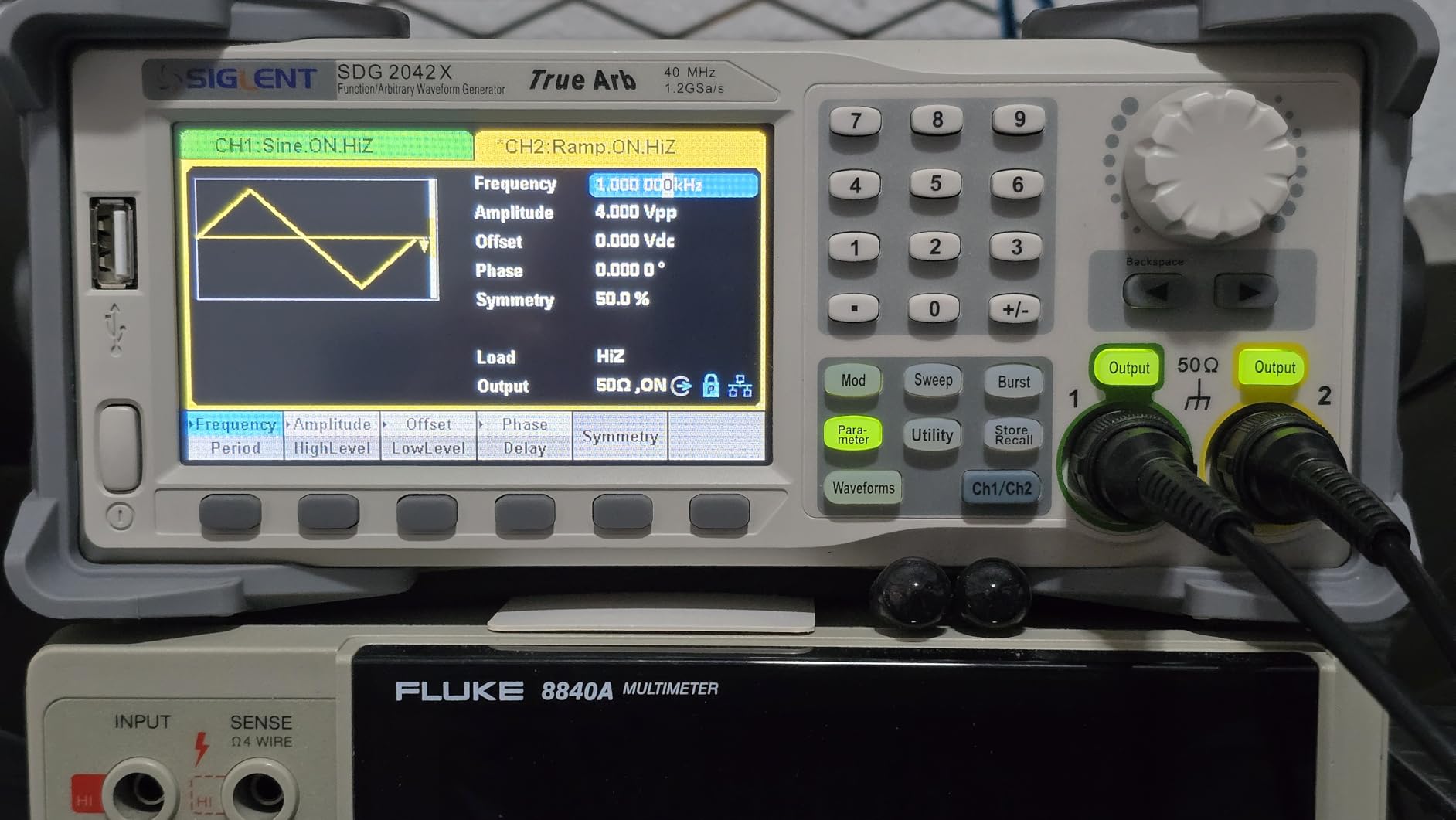
The engineering behind the output matters more than the marketing here. TrueArb technology regenerates the uploaded waveform from the source samples rather than replaying stored points, and Easy Pulse targets low-jitter pulse edges. A high precision frequency counter is built in, and modulation, sweep and burst are all covered. Owners consistently single out the quiet fan and the build quality.
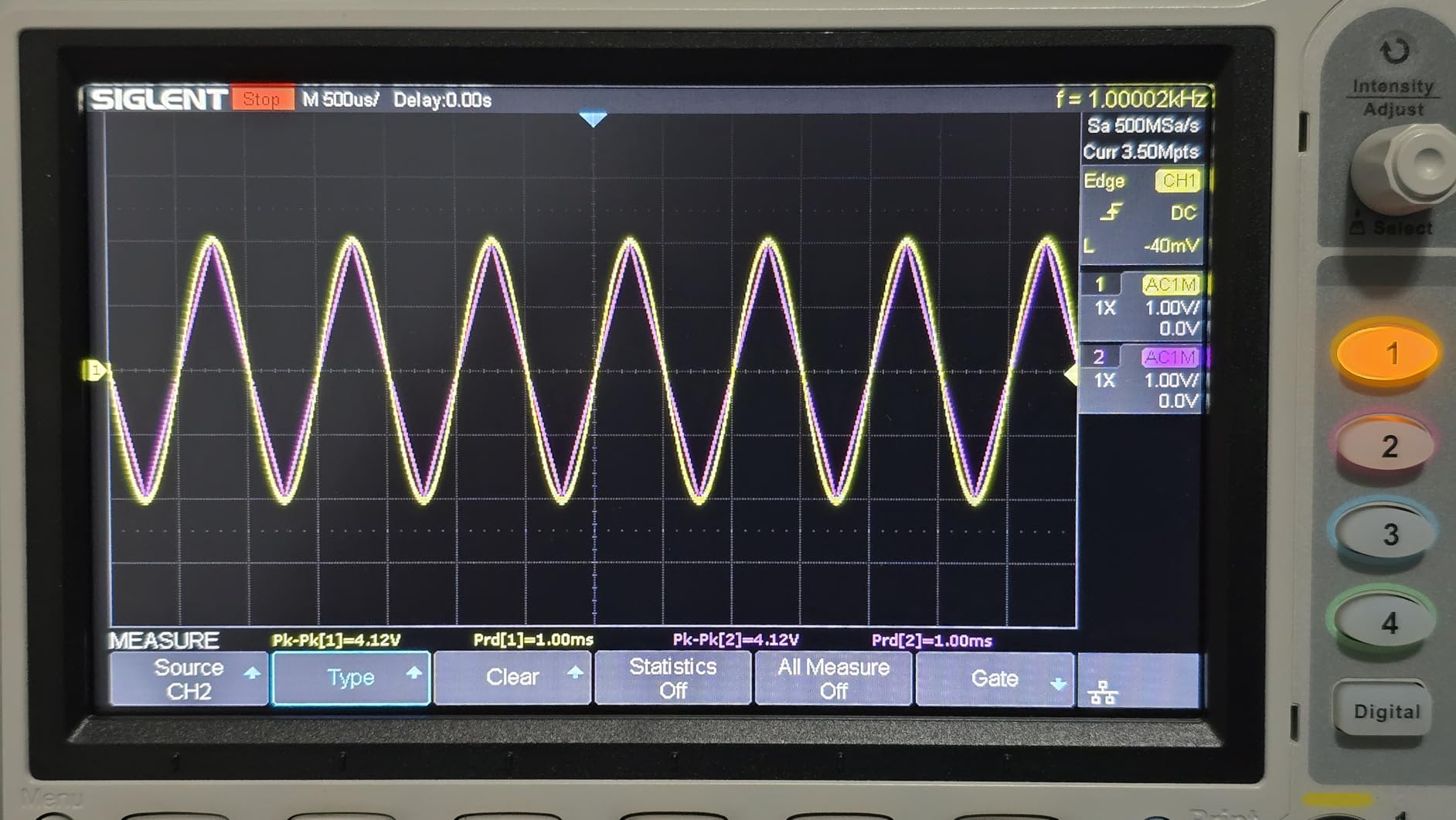
This is the box that turns into a Bode plotter. Because it will accept a sweep and take commands over Ethernet or USB, it pairs directly with a scope of the same family to automate loop gain measurement, which is exactly the workflow that separates a lab instrument from a hobby box.
Where it earns its cost
It suits R and D teams, university teaching labs that script measurements, and anyone pairing a generator with a scope for filter or amplifier characterisation. Sixteen-bit resolution keeps small signals clean when they sit on a larger waveform, which matters for audio and sensor work.
Where it will disappoint
The weak spot is software, not hardware. EasyWave, the arbitrary waveform editor, is Windows-only and owners report it being hard to predict, and the printed manual is thin on the difference between DDS and TrueArb modes. Budget for a day of learning the menu structure and a proper USB or LAN workflow.
3. Seesii 60MHz DDS Generator – Best Value for Headroom
Professional Upgraded DDS Signal Generator Counter, Seesii 60MHz LCD Display High Precision 200MSa/s Dual-Channel Arbitray Waveform Function Generator Frequency Meter
60MHz sine
200 MSa/s
Dual channel
10ns edges
Pros
- Dual channels with independent settings and duty cycle
- Very fast square wave edges around 10ns
- Compact and light for the bandwidth
- Useful sweep and counter functions
- Bundled software for custom waveforms
Cons
- No start-of-sweep sync output
- Output pulls down under load with square overshoot
- Light chassis that slides on a smooth bench
The JDS6600 gives you dual-channel 60 MHz sine at 200 MSa/s in a box that weighs about a kilogram, and at 135 reviews it has enough owner history for the strengths and weaknesses to be well documented. Seven waveform types are available, output levels are settable to 20 volts, and each channel has its own adjustable duty cycle.
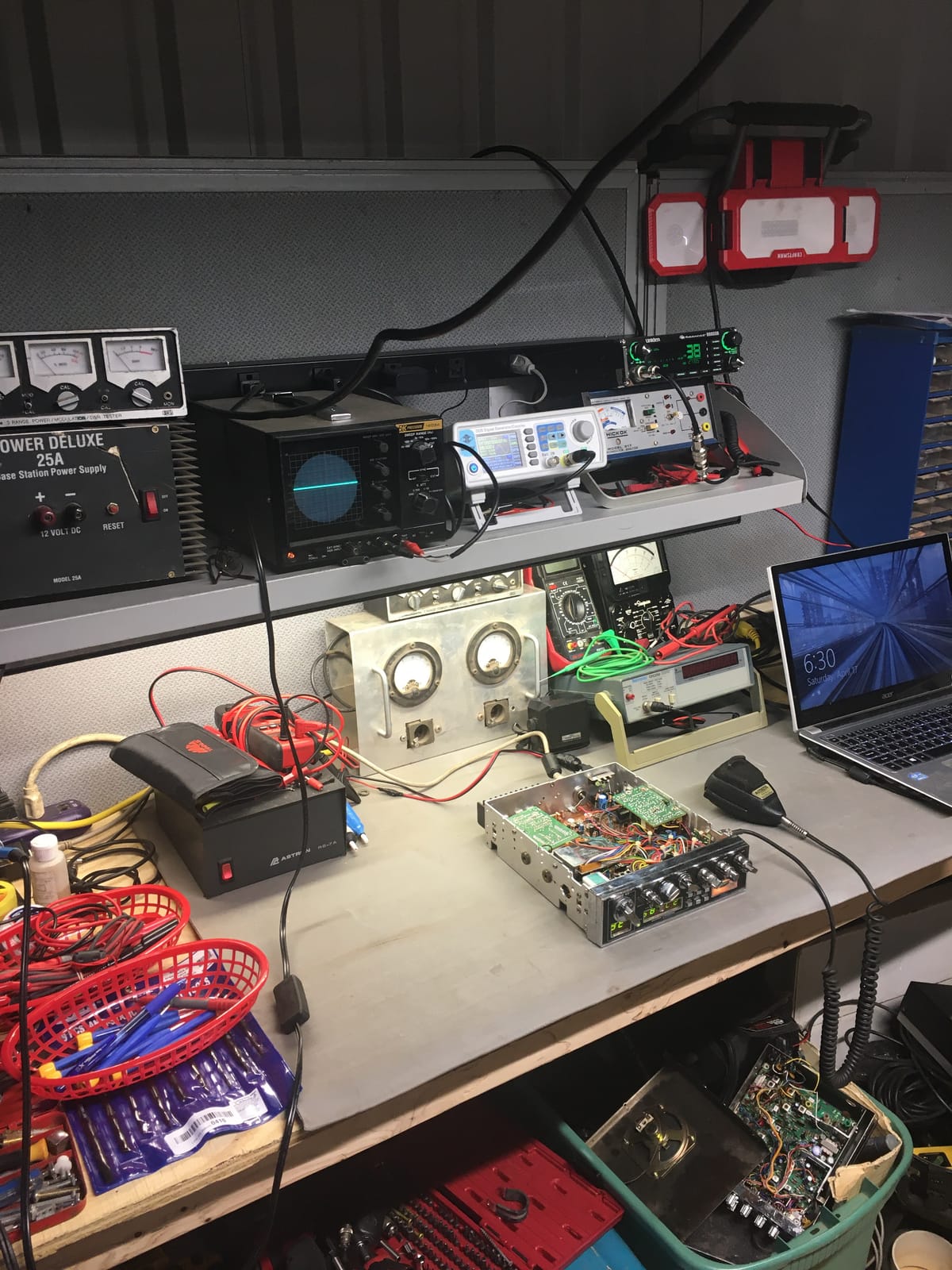
Two details set it apart from the other budget boxes here. Square wave edges are fast, around 10 ns, so digital work looks far cleaner than the sample rate alone would suggest. And linear sweep runs to 999.9 seconds alongside a logarithmic sweep, with a counter that reports frequency, period and pulse width in both directions.
The bundled PC software creates custom waveforms and frequency combinations, which is more than most clones at this level offer. Hobbyists and repair technicians pick this one because the two channels plus the sweep are genuinely useful for filter and amplifier work at a fraction of what a branded bench unit costs.
What it is good for
It is the sweet spot for a serious hobby bench: enough bandwidth for RF-adjacent injection, IF work and radio alignment, two channels for differential measurements, and a fast edge for digital logic. The number it replaces on most hobbyists benches is the single-channel clone with a sweep that cannot be triggered.
When it will frustrate you
There is no start-of-sweep sync output, so triggering a scope reliably during a filter sweep means guessing or using a different instrument. Output amplitude pulls down under heavier load and square waves show overshoot at higher frequencies, and the light chassis slides around if you swap cables often.
4. Seesii FG-200 500kHz Generator – Best Pocket Unit for Audio Work
SEESII 1Hz-500kHz DDS Signal Generator with Schumann Resonator
1Hz-500kHz
Sine square triangle sawtooth
Switchable filter
Battery power
Pros
- Very inexpensive way into bench signal work
- Cleanest sine and triangle output in this price class
- Stable and accurate frequency for its class
- Genuinely pocket sized at 12.3 ounces
Cons
- Membrane buttons make frequency setting tedious
- Non-sine waveforms show distortion on a 12-bit scope
- Accuracy drops near the top of the range
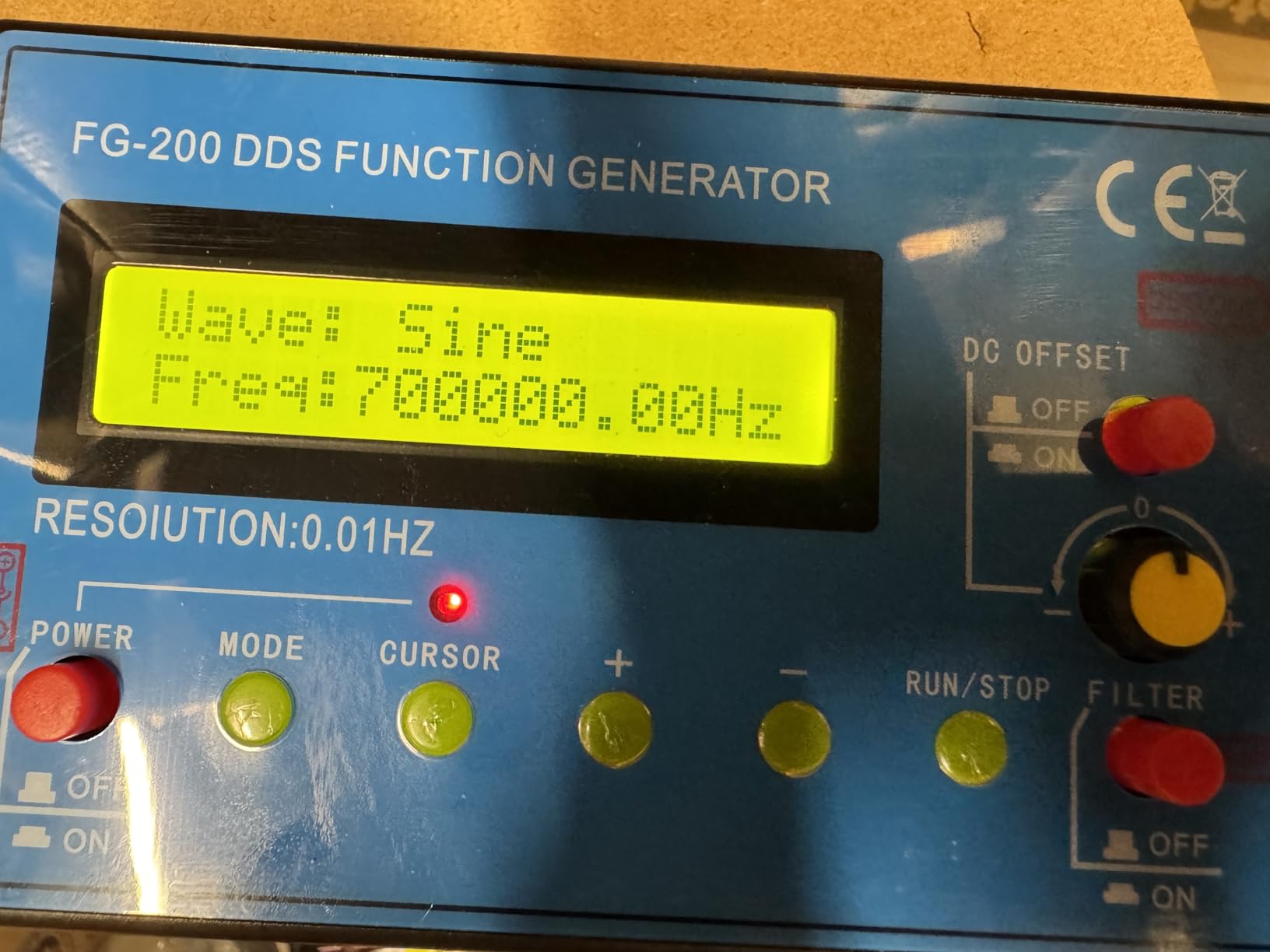
The FG-200 answers a narrower question than the rest of this list: what is the smallest thing that will do real bench work? At 12.3 ounces and roughly the size of a paperback, it runs from 1 Hz to 500 kHz from an AC adapter or an external battery pack, and it ships with a switchable filter for cleaner sine and pulse output.
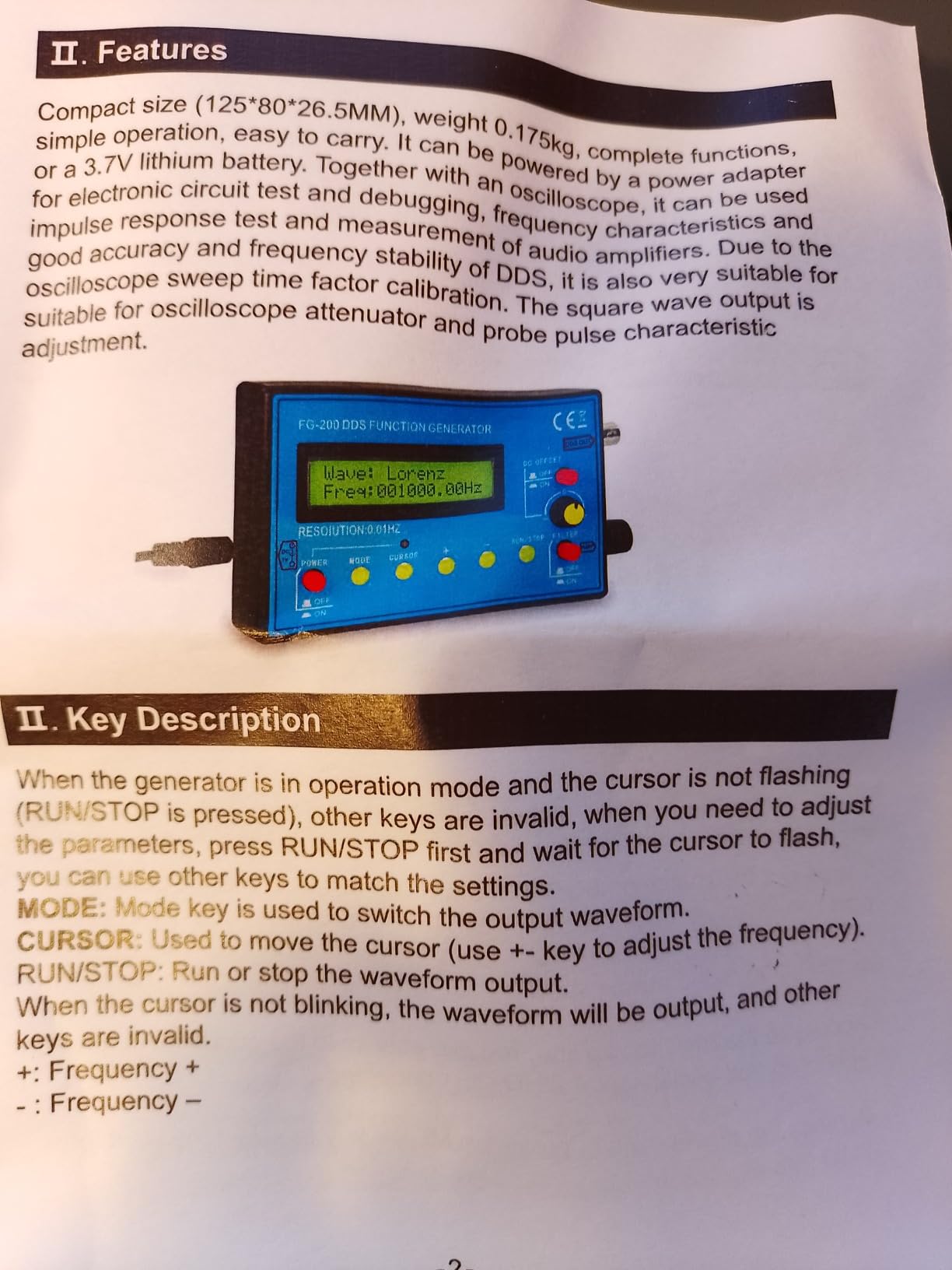
What surprised us is the sine and triangle quality. Owners consistently report cleaner low-frequency output from this unit than from more expensive DDS boxes, which makes it a genuinely useful tool for driving amplified speakers through a frequency response sweep or checking a vintage amplifier stage by stage. On r/diyaudio, that kind of low-frequency sine quality is exactly what people ask for and rarely find in a modern budget unit.
It also includes a Schumann resonator attachment, a 7.83 Hz add-on that shows up in the marketing. Experienced users on the forums are blunt about feature claims of this kind: it is a passive attachment, the box has no speaker or amplifier, and the accessory tells you nothing about measurement quality. Buy it for the generator, not the claim.
What it is good for
It suits audio diagnostics, amplifier and speaker checks below the audio band, field service calls where a full bench will not travel, and anyone who wants a working generator before committing to a larger one. Battery operation is the quiet advantage in a field kit.
When it will frustrate you
Setting frequency through membrane buttons is tedious once you are sweeping. Square and triangle show measurable distortion on a decent scope, accuracy degrades as you approach 500 kHz, and the documentation is thin enough that you will work it out from the panel.
5. DOMINTY FY6900 60MHz DDS – Best for Wide Waveform Coverage
DOMINTY Function Generator AC100-240V FY6900 60MHz Double Channel DDS Function Arbitrary Waveform Signal Generator Frequency Meter 250MSa/s Sine Square/Triangle/Pulse/Sawtooth Wave/Staircase Wave
60MHz dual channel
250 MSa/s
Staircase and sawtooth
Frequency meter
Pros
- Full waveform set including staircase
- Small footprint for a dual-channel 60MHz box
- Addresses the floating ground issue between mains earth and BNC shells
- Clean switching supply and attenuated output noise
Cons
- Very small hard-to-read display
- No trigger output during sweep
- Waveform restarts when controls are turned
The FY6900 is the value pick for anyone who wants the widest menu of shapes in a small box. It is a dual-channel 60 MHz DDS generator at 250 MSa/s, and beyond the usual sine, square, triangle, pulse and sawtooth, it adds a staircase wave that is handy for digital logic and DAC stepping tests. A frequency meter is built in, and outputs are short-circuit tolerant.
Two engineering details are worth knowing before you blame the box for strange readings. Current units use a clean switching supply with attenuated output noise, and owners specifically note that the design addresses the floating ground problem between the mains earth and the BNC shells that plagued earlier FY-series boards. That is a bench-safety issue as much as a signal issue, because it removes one common source of confusing ground loop readings.
The warranty is one year and the AC input covers 100 to 240 volts, so it travels. At 2.34 pounds with a 10.75 inch footprint, it fits a small bench without crowding it.
What it is good for
It suits students and hobbyists who want one instrument covering audio, logic and staircase experiments, and anyone who has been bitten by ground lift on an earlier clone. The short-circuit tolerant outputs give you room to experiment without anxiety.
When it will frustrate you
The display is small and digit selection is cramped, so this is not a box to read at a glance. There is no trigger output in sweep mode, which rules out precise filter response measurement, and the waveform restarts whenever you turn most of the controls – expect to re-arm the output every time you nudge a setting.
6. UNI-T UTG932E – Best for Modulation and a Complete Box
UNI T UTG932E Function Generator Arbitrary Waveform Signal Generator
1Hz-30MHz dual channel
200 MSa/s
14-bit
Six modulation types
Pros
- Dual-channel output with channel combining
- Six modulation types plus 24 stored waveforms
- 200 MSa/s and 14-bit resolution suit audio-band work
- Accessory bundle includes BNC leads and alligator clips
- Vendor support answered directly
Cons
- Switching supply noise and glitching on control changes
- Not a substitute for a laboratory reference
- Small screen and menu-driven controls
The UTG932E is the most complete box you get in a compact footprint, and the accessory bundle is the detail that catches people out. The package includes a power adapter, a USB cable, BNC leads and BNC-to-alligator cables, a paper manual and an eManual – so you are not buying a separate set of leads on day one, which is a common complaint about cheaper units.
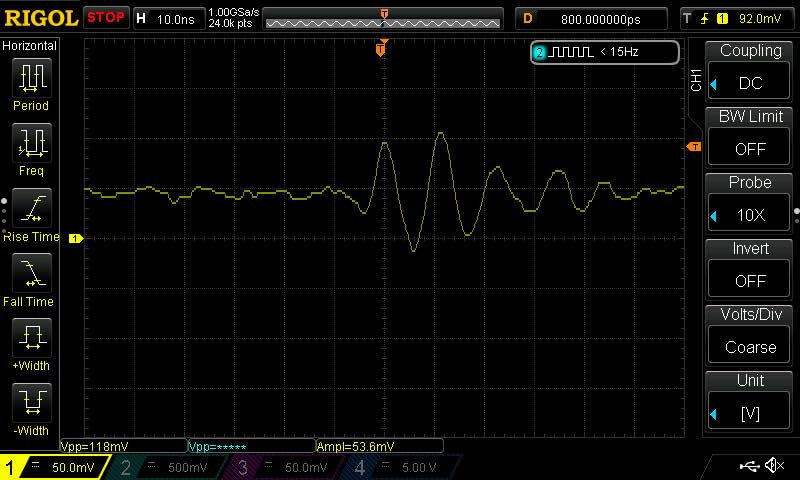
On paper it covers a lot: dual channel from 1 Hz to 30 MHz, 200 MSa/s sampling, 14-bit resolution, AM, FM, PM, FSK, line and log modulation, 24 non-volatile arbitrary waveform slots, sweep, burst, and channel combining. The built-in six-digit frequency counter has a TTL and CMOS level output, and full-band DDS gives 1 Hz frequency resolution. That combination is why it earns a place in classroom and teaching-lab lists.
Channel combining is the underrated feature. It lets the two channels add together at the output, which turns a single BNC into a mixed or differential source without extra hardware.
What it is good for
Pick it when modulation is on your list – AM, FM, PM and FSK work on receivers, transmitters and sensor rigs – and when you want a single box to carry to class or a shared lab bench. The included leads mean it is usable the day it arrives.
When it will frustrate you
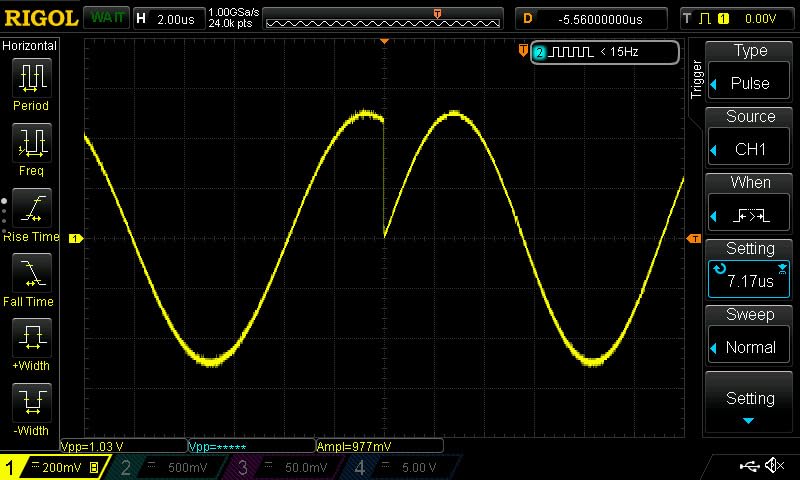
Owners most often report glitching when changing frequency, amplitude or phase, and some audible switching supply noise in the output. The screen is small and controls are menu-driven, and this is not the instrument to trust for precision reference measurements.
7. OWON DGE1060 – Best for Waveform Variety and Accuracy per Review
OWON Waveform Generator, 60MHz Bandwidth,300MSa/s Sampling Rate, 14 bits Vertical Resolution, 8K Waveform Length, 5 Basic Waveforms, 160 built-in Arbitrary Waveforms, with 3.6IN LCD Display DGE1060
60MHz
300 MSa/s
14-bit
160 built-in waveforms
Pros
- Large library of 160 built-in arbitrary waveforms
- Frequency accuracy measured within 0.4ppm of WWV at 15MHz
- Bright 3.6-inch display that mirrors the scope view
- Thin portable body with a clean BNC output
- AM FM PM and FSK modulation included
Cons
- No sync or trigger output for sweep measurements
- Output amplitude below 1Vpp is unstable
- Single output with no second channel
The DGE1060 is the one that keeps surprising people who assume a low-cost box means loose accuracy. It is a single-channel unit rated at 60 MHz with a 300 MSa/s real-time sampling rate, 14-bit vertical resolution, 8K record depth, five basic waveforms and 160 built-in arbitrary waveforms, plus AM, FM, PM and FSK modulation with sweep and burst.
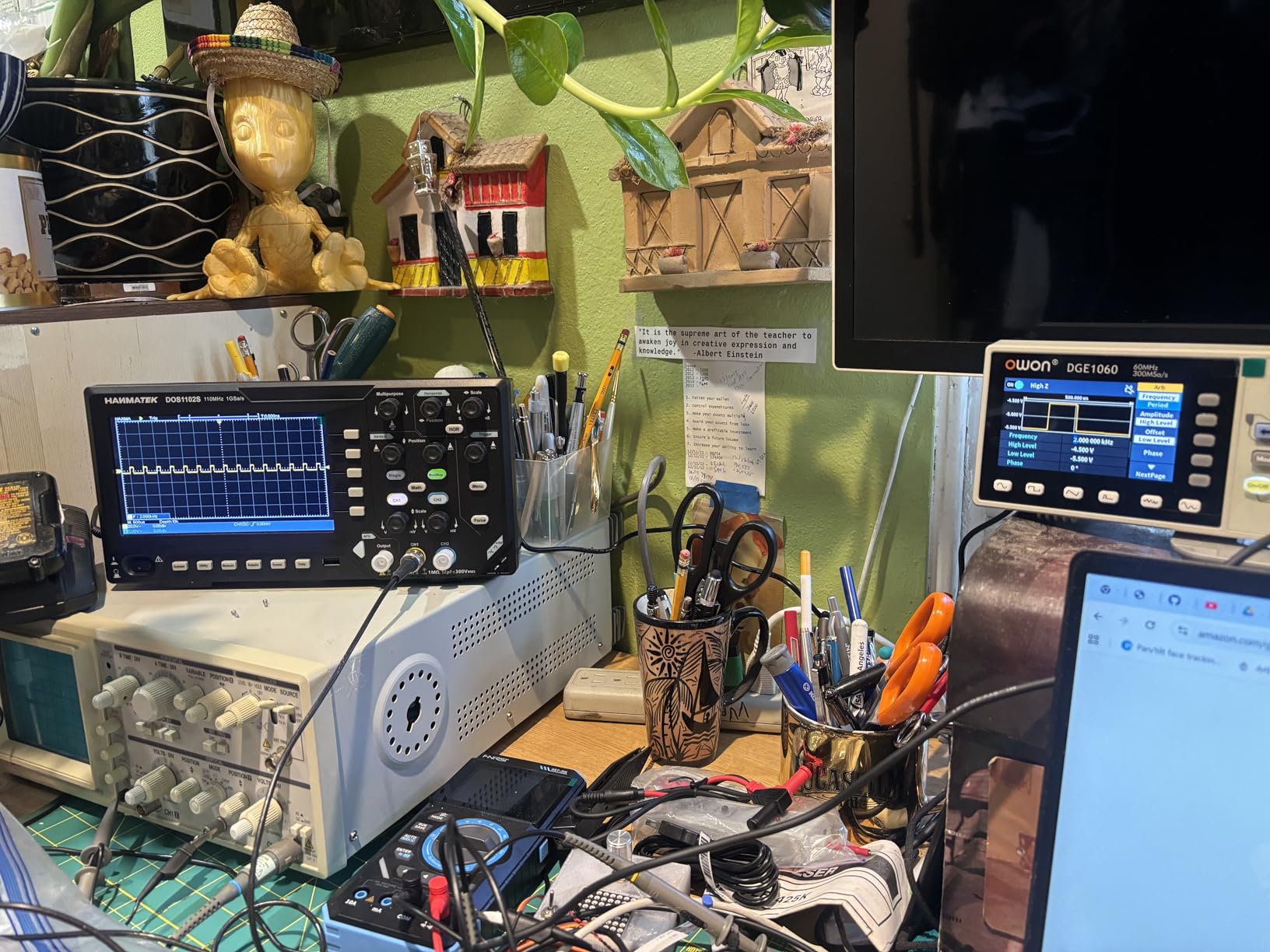
Detailed owner testing reports frequency accuracy within 0.4 ppm of a WWV reference at 15 MHz, and amateur radio users on r/amateurradio call it out as measuring better than the rated specification. The 3.6-inch TFT display mirrors the scope view style, which makes it far easier to read than a two-line LCD, and the body is thin and portable with 16 stored arbitrary waveform slots.
It also handles modulation, which many single-channel clones in this price range simply do not. That combination of waveform library, modulation and measured accuracy is why it sits high in this roundup despite a modest 26 reviews.
What it is good for
It suits audio and general analogue work, class demonstrations where showing 160 built-in shapes on a bright screen matters, and anyone who wants one channel done accurately rather than two channels done loosely. The 3.6-inch display makes it easy to hand around a bench.
When it will frustrate you
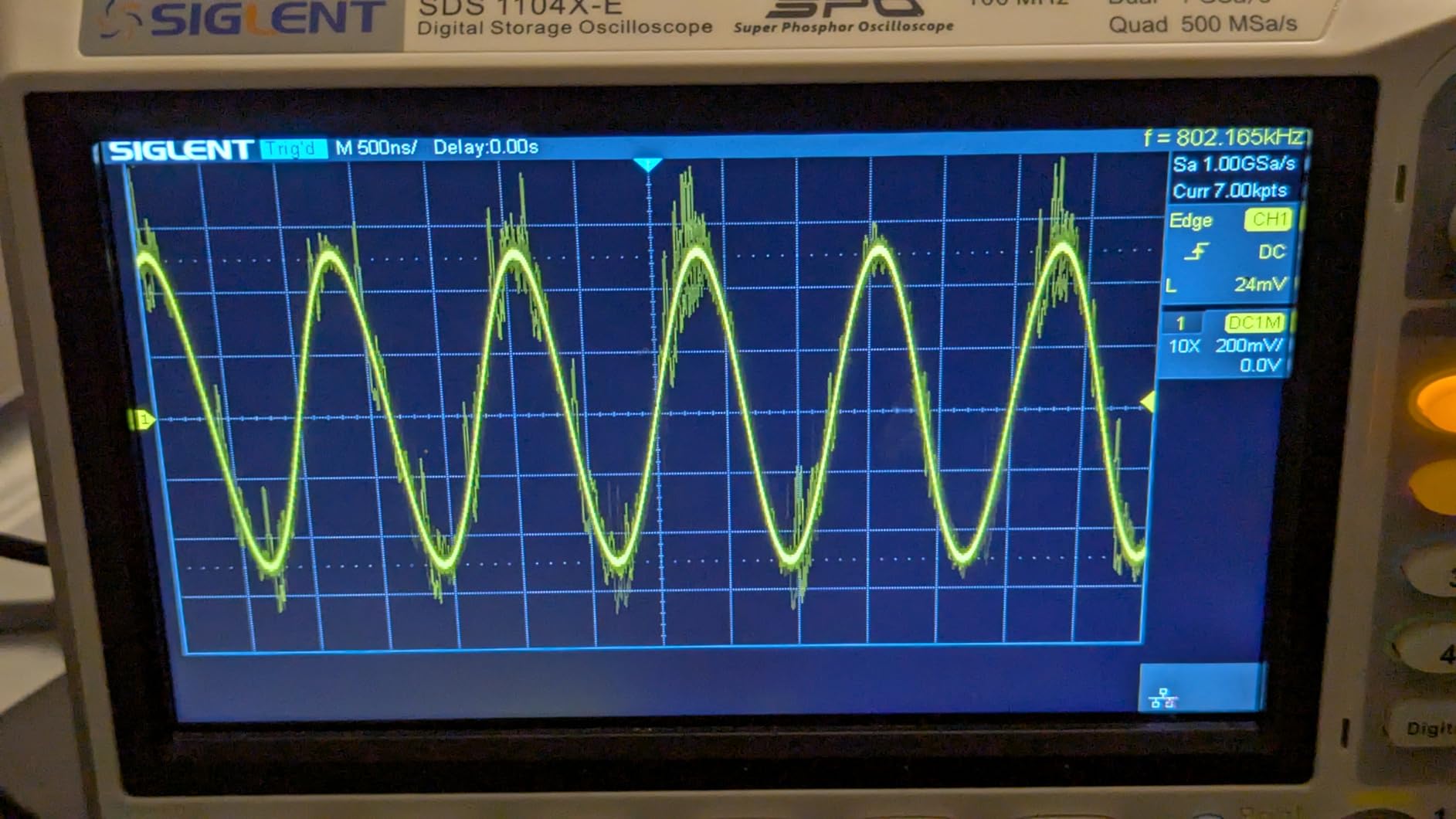
There is no sync or trigger output, so sweep-driven measurements are awkward, and output amplitude below 1 Vpp is unstable with visible jitter. Square and triangle waves only reach roughly 2 MHz despite the 60 MHz headline, and the manual and waveform editor live on the vendor website, which some browsers struggle to reach.
8. Siglent SDG810 – Best for Vintage Audio and Repair Work
Siglent Technologies SDG810 Siglent Single Channel 10 mhz Bandwidth Signal Generator, Function Generator, Arbitrary Waveform Generator, 125 MSa/s Sampling Rate, Light Gray
10MHz single channel
125 MSa/s
Easy Pulse
USB device and host
Pros
- Easy to learn interface with on-screen help and store and recall
- High frequency accuracy with digital amplitude setting
- Burst output can drive an acoustic transducer
- Sawtooth and ramp outputs suit vintage audio repair
- Branded 10MHz bench instrument
Cons
- 10MHz bandwidth limits it against newer models
- Single channel only
- Does not recall the last power-on state
- Minimal manual
The SDG810 is a legacy favourite that still makes sense for a specific kind of bench. It is a single-channel 10 MHz generator at 125 MSa/s with 14-bit vertical resolution, five standard waveforms and 46 built-in arbitrary shapes including DC, and it runs from 2014 on a platform that has been proven on thousands of repair benches. Eighty percent of its 29 reviews are five-star.
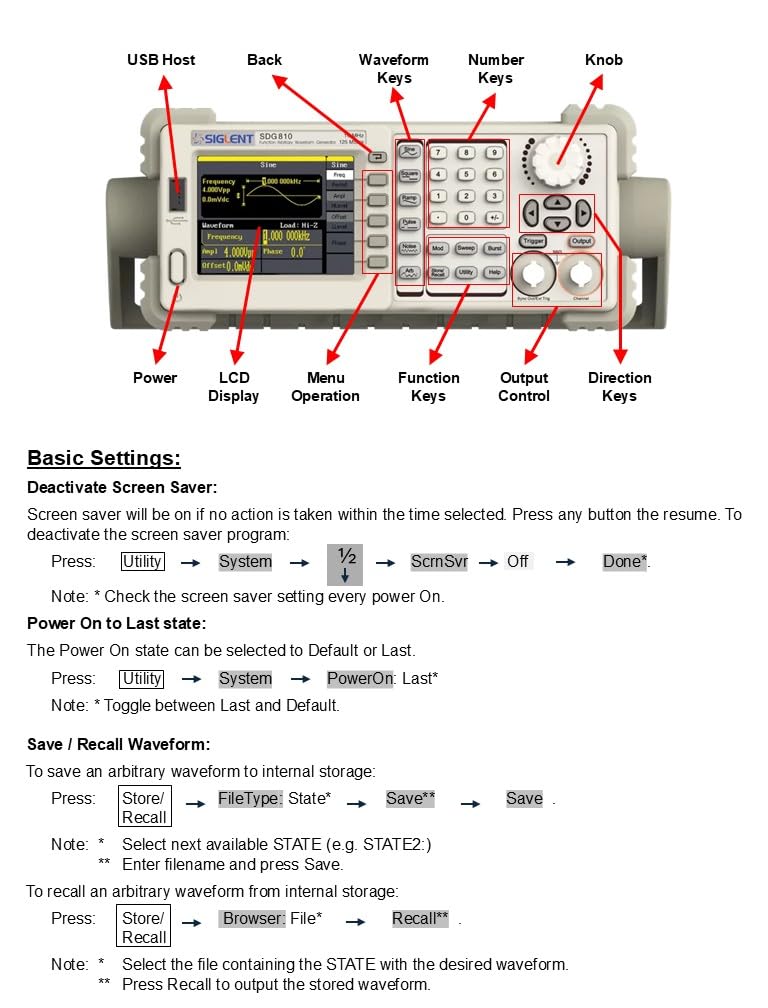
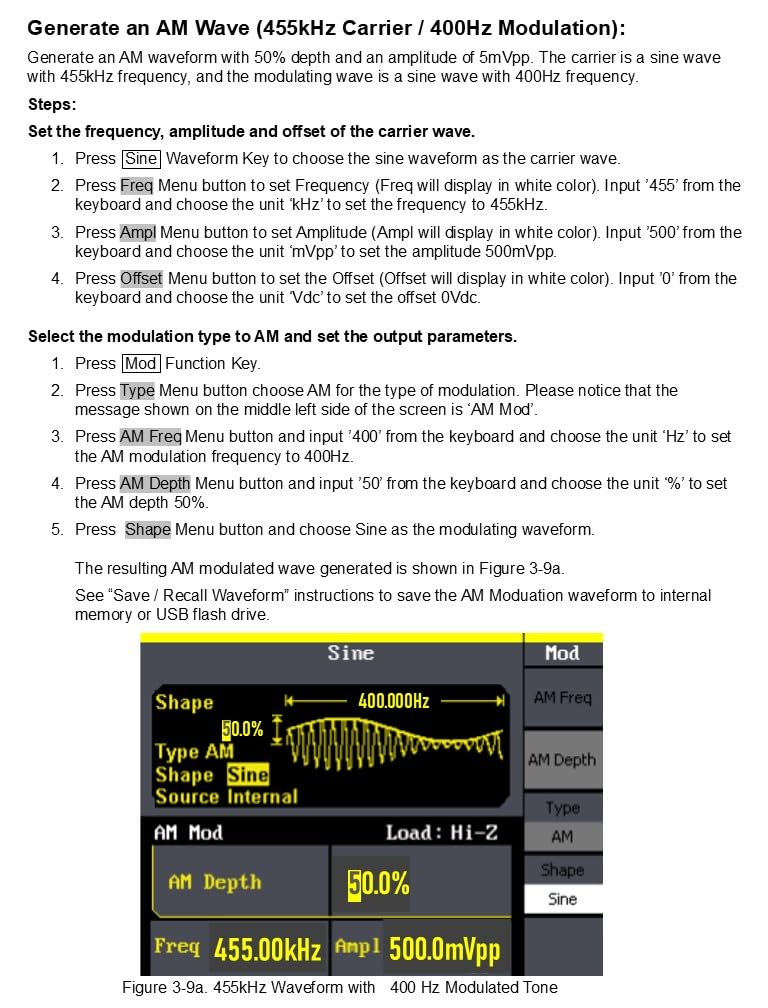
The feature set is more complete than the bandwidth suggests. Modulation covers AM, DSB-AM, FM, PM, FSK, ASK and PWM, there is linear and logarithmic sweep plus burst, and Easy Pulse targets low jitter with fast edges. USB device and USB host give U-Disk storage and firmware updates, which is rare at this level and means you are not stranded when new waveforms appear.
For vintage audio work, the sawtooth and ramp outputs alongside sweep make it a natural fit for amplifier alignment and record deck testing, and burst mode can drive an acoustic transducer for pulse-echo measurements. Repair technicians on electro-tech-online and r/amateurradio keep recommending branded boxes like this over anonymous clones for exactly that reason.
What it is good for
It suits a repair or broadcast-audio bench that works below 10 MHz: amplifier alignment, vintage receiver and tape deck work, transducer testing, and general service diagnostics. The interface is easy to learn and the manual being thin matters less on a box with this few controls.
When it will frustrate you
Ten MHz is the ceiling and it is a real one for anything modern. There is only one channel, so no input and output comparison without buying a second source, and it will not recall the last power-on state. Some owners also see more distortion and noise on analogue waveforms than they would like.
9. Lwuey 500kHz DDS Mini Kit – Best for a First Taste of Signal Work
Lwuey DDS Function Signal Generator, 1Hz-500kHz Mini Kit
1Hz-500kHz
Battery powered
Five waveform types
Modulation
Pros
- Lowest cost usable option in this lineup
- Feeds sine straight into amplified speakers for response sweeps
- Produces sawtooth waveforms reliably for project work
- Compact and simple once you have set it up
Cons
- No rotary frequency knob so setting takes many presses
- Square wave quality degrades around 100kHz
- Visible switching regulator noise at low signal levels
The Lwuey 500 kHz DDS unit is a small, battery-capable box aimed at people who want to see what a signal generator can do before committing to a bench instrument. It covers 1 Hz to 500 kHz with sine, square, triangle, pulse and arbitrary waveform output, runs from an AC adapter or a battery, and includes modulation options aimed at communications testing. At 7.4 ounces it is the lightest thing here.
Owners use it exactly where you would expect: feeding sine straight into amplified speakers to sweep a system response, or generating sawtooth for project work. Reviewers are clear that it is adequate below about 100 kHz and that the controls are aimed at people with limited technical background, which is a fair description of the button-only frequency entry as well.
The honest limit is square wave quality, which reviewers flag as degrading noticeably around 100 kHz with distortion rising above that. At low signal levels, switching regulator noise is visible on the output, which matters if you are trying to see a clean small waveform.
What it is good for
It works for audio diagnostics, speaker and amplifier response checks, a classroom demonstration, or a first electronics project where the goal is to learn what a waveform looks like. Battery operation makes it useful in the field where mains power is not a given.
When it will frustrate you
There is no rotary frequency knob, so every change is a run of button presses, which makes a sweep painful. A small number of owners report arriving units with no output at all, so keep the return option open. For anything above the audio band or for accurate pulse work, look further up this list.
10. Walfront FY8300S Three-Channel – Best for Three-Channel Stimulus
DDS Generator 3-Channel Arbitrary Waveform Function Generator Frequency Meter 4 TTL Level Output(FY8300S-20M US Plug 100-240V)
Three independent channels
100MHz counter
Four TTL outputs
VCO
Pros
- Three independent synchronisable channels with adjustable phase
- Rich measurement set with 100MHz frequency counter
- Open communication protocol and host software for waveform editing
- Short-circuit protected outputs and channel tracking
Cons
- Lowest average rating in this lineup at 4.0 with a 16 percent one-star group
- Busy control panel that takes practice
The FY8300S is the specialist pick. It is a three-channel DDS function and arbitrary waveform generator whose three outputs run synchronously with adjustable phase difference, which makes it the only unit here that can drive a three-phase, multi-axis or multi-sensor setup from one box. A four-channel TTL level generator and VCO sit alongside the analogue outputs.
The measurement side is genuinely strong. A 100 MHz frequency meter covers 0.01 Hz to 100 MHz and reports frequency, period, positive and negative pulse width and duty cycle, and there is a frequency sweeper plus 24 or 64 memory-style parameter saves that reload at the next boot. Channel tracking updates all three channels at once, outputs are short-circuit protected for 60 seconds under load, and an open communication protocol lets you drive it from host software or build on it.
All parameters are internally calibrated, which matters for a three-channel unit where the channels have to agree with each other. The trade-off is the control panel: it is busy, and the 4.0 average rating here is the lowest in the lineup with a 16 percent one-star group.
What it is good for
It suits anyone simulating multiple sensors, driving three-phase or multi-axis systems, teaching a mixed-signal course, or needing a wide sweep with rich measurement in the same box. The open protocol is a genuine advantage for secondary development and scripted control.
When it will frustrate you
Skip it if you want one clean, simple channel with a screen you can read at a glance. The control panel needs practice for the shortcut-key functions, and the rating spread means some owners have had a rougher experience than others. If you do not genuinely need three independent sources, a dual-channel unit is a calmer buy.
How to Choose a Function Generator Without Regret
What the MHz number actually means
The headline bandwidth is a sine rating, and this is the single most common disappointment for new buyers. Square and pulse output on every unit in this list is a fraction of the advertised figure, which is why the OWON DGE1060 reaches 60 MHz on sine while its square and triangle waves stop around 2 MHz. Read the specification for the waveform you actually need, not the waveform on the box.
For audio, filter and amplifier work, 1 to 2 MHz is genuinely enough. For digital logic, clock and timing verification, look for fast edge specifications rather than sine bandwidth. For RF injection, alignment and IF work, you want real high-frequency sine capability and a counter that reaches past the frequency you are testing.
Sample rate and vertical resolution in plain terms
Sample rate is how many points per second the generator can draw, and it sets how many samples make up one cycle of your waveform. 200 MSa/s gives roughly 10 points per cycle at the top frequency, which is why a 60 MHz sine looks smooth while a 60 MHz square wave does not. Vertical resolution is the step size between output levels: 14-bit is the entry standard, and 16-bit roughly doubles the level detail, which is why the Siglent SDG2042X holds its own on audio and sensor work.
Channels, phase and channel combining
Two independent channels let you compare input and output on a scope at the same time, which is how you actually measure a filter or an amplifier. Three channels, as on the Walfront, cover multi-sensor or multi-axis stimulus. Look for adjustable phase between channels and, on the UNI-T UTG932E, channel combining that sums both outputs at one BNC.
Modulation, sweep and burst
Sweep gives you a repeating frequency ramp for filter response work, and modulation covers AM, FM, PM and FSK for receiver and transmitter testing. Burst repeats a set number of cycles on demand, which is how pulse-echo and transducer work gets done. Check for a sync or trigger output alongside sweep: without it, triggering a scope mid-sweep is guesswork, and that single missing connector is the most common gap in this price range.
SCPI remote control and automation
SCPI is the command language that lets software drive an instrument. If you want automated measurements, a Bode plot, or a generator that shares a computer with your scope, you need USB device, LAN or an open communication protocol – not just a USB port for a CSV file. The SDG2042X leads here with USB and LAN plus an optional GPIB adapter; the OWON DGE1060 and Walfront FY8300S offer PC remote control too.
Five things a function generator cannot do
First, it cannot supply power. It is a signal source, not a bench power supply; a function generator as a power supply will not give you a regulated rail and will not survive being treated like one. Second, it cannot reach microwave frequencies – anything above a few hundred MHz needs a dedicated RF signal generator. Third, it cannot produce clean high-frequency square waves beyond what its edge specification allows. Fourth, it cannot simulate a noisy, drifting, real-world sensor without deliberate effort, because it is designed to be the cleanest thing in the circuit. Fifth, it cannot tell you whether the circuit under test is right; it only tells you what the circuit does with a signal you chose.
Your first five bench tasks with a new generator
Set 1 kHz at 5 V peak-to-peak and confirm what you actually get at the BNC before you blame your circuit. Then switch the output to High-Z and see how much the reading changes – that one check explains most of the half-expected-voltage confusion that shows up constantly on forums like r/AskElectronics and electro-tech-online. Next, add a DC offset and confirm it holds. Then run a short linear sweep with a scope in X-Y mode to see a filter response. Finally, use the probe compensation output on your scope, if your generator has one, or a 1 kHz square wave into the scope probe to trim compensation. Ground your scope and the generator to the same point, and if you see hum or ringing that moves when you touch a cable, you have a ground loop.
One more note on shopping around: if your real interest is power rather than signals, our guides to RV generators for camping cover a different category of product entirely.
Frequently Asked Questions
What brand of generator is the most reliable?
Among the brands here, Siglent (SDG2042X and SDG810) and OWON carry the most consistent owner feedback on build quality and calibration stability, and both publish real specifications rather than marketing claims. UNI-T sits in the middle with a solid accessory bundle and answered vendor support. The rebadged FeelTech, Walfront and Koolertron clones are perfectly capable instruments, but long-term accuracy and firmware support vary more between batches and revisions.
What’s the difference between a signal generator and a function generator?
A function generator makes repeating waveforms – sine, square, triangle, sawtooth, pulse and arbitrary shapes – at a frequency and amplitude you dial in, which is what circuit, audio and sensor work needs. A signal generator is the broader category and also covers continuous-wave RF and microwave sources far above those frequencies. Every function generator is a signal generator, but not every signal generator can shape a square wave.
What are the limitations of using a function generator?
1. It is a signal source, not a power supply, and cannot provide a regulated output rail. 2. Bandwidth above a few MHz is sine-only; square and pulse edges are far slower than the headline number suggests. 3. Output impedance is typically 50 ohm, so amplitude halves into a high-impedance circuit unless High-Z mode is set. 4. It cannot reach microwave frequencies without a dedicated RF source. 5. It shows you how a circuit responds, not whether that circuit is correct, so it never replaces measurement analysis.
Can I use a function generator as a power supply?
No. A function generator delivers a small, clean, frequency-varying signal through a 50 ohm output, not a power rail, and it has no regulation, current limiting or overvoltage protection for load use. Connecting a load that expects stable power can damage the output stage. For powering circuits, buy a bench power supply; use the generator only to drive inputs, clocks and stimulus.
How much bandwidth do I actually need?
For audio, filter and amplifier work, 1 to 2 MHz is plenty. For microcontroller clocks and digital logic testing, you care about rise time and jitter far more than sine bandwidth, so look for a low-jitter pulse output. For radio alignment and IF injection, go higher, and check that the built-in frequency counter reaches past the frequency you need to measure rather than trusting the sine rating alone.
Final Verdict: Which Function Generator Should You Buy in 2026
For most people building or learning on a bench, the best function generators in 2026 come down to three tiers of need. A single pick covers most of the field: the Koolertron 15 MHz for a first bench, dual channel and the largest tutorial base in the business. If your work is scripted or your waveforms are demanding, the Siglent SDG2042X is the one that will not run out of headroom. If you want 60 MHz of sine without moving up a tier, the Seesii 60 MHz is the value answer.
Below that, the Seesii FG-200 and Lwuey 500 kHz cover audio and field work, the DOMINTY FY6900 adds staircase and sawtooth shapes, the OWON DGE1060 is the accuracy standout, the Siglent SDG810 covers vintage audio, and the Walfront FY8300S is the only three-channel option. Buy the one that matches the signals you actually drive, and check whether your leads are in the box first.