
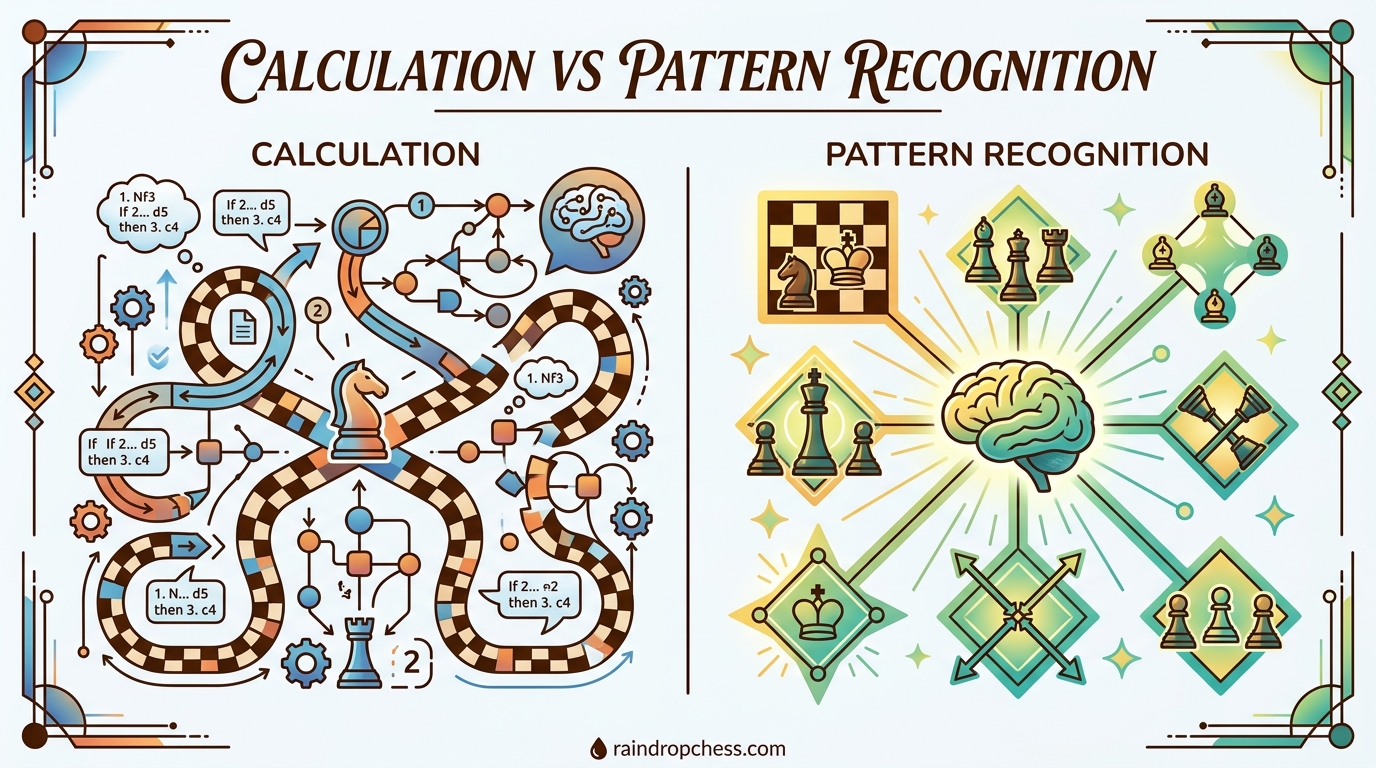
Every chess player eventually faces the same crossroads: should you spend your training time sharpening your ability to calculate deep variations, or should you invest in building a larger library of recognizable patterns? The honest answer depends almost entirely on your current rating level. What works for a Grandmaster can be a waste of time for a 1200-rated player, and vice versa. In this article, we break down exactly how the balance shifts across rating brackets, explain the science behind chunking theory, and give you a practical training framework built around the 40-40-20 rule.
Table of Contents
What Is Calculation in Chess?
Chess calculation is the deliberate, step-by-step process of working through possible moves and their resulting positions. When you calculate, you are not guessing or relying on instinct. You are actively generating candidate moves, visualizing where pieces will be several moves ahead, and evaluating the resulting positions to determine which move is best.
The process follows a structured algorithm that most chess coaches teach early: first identify checks, captures, and threats (the CCT scan), then generate your candidate moves, then explore each variation like a tree of possibilities, pruning branches that lead nowhere. A strong calculator can hold multiple parallel lines in memory, visualize board positions without touching the pieces, and evaluate complex positions with remarkable accuracy.
Calculation is time-intensive. It demands sustained focus and mental energy, which is why time controls drastically affect how much calculation players can actually perform. In blitz or bullet chess, there is simply no time to calculate deeply. This is precisely why the calculation versus pattern recognition debate connects so directly to time control and rating level.
Skilled calculators often describe the process as “seeing around corners” of the position. They build a mental model of the position’s tactical and strategic features and then systematically explore how those features change under different move orders. Grandmasters can calculate up to 15 to 20 moves deep in critical positions, but this capability does not appear overnight. It is developed over thousands of hours of deliberate practice.
What Is Pattern Recognition in Chess?
Pattern recognition in chess is the ability to instantly or near-instantly identify familiar configurations of pieces, tactical motifs, and positional structures. Rather than calculating from first principles, a player with well-developed pattern recognition simply “sees” that a position contains a fork, a pin, a back-rank mate threat, or a positional weakness worth exploiting.
The cognitive science behind this skill is called chunking theory. Chess masters do not remember individual piece positions the way a beginner does. Instead, they encode groups of pieces into unified “chunks” in long-term memory. A master sees a standard kingside attack structure and instantly recognizes it as a familiar pattern with known plans, typical piece placements, and common tactical ideas.
The Chunking Numbers: Research in cognitive science suggests that Grandmasters carry roughly 50,000 memorized patterns in long-term memory. Masters (2200-2400) hold around 30,000 chunks. By contrast, an intermediate player (1400-1600) may have only 5,000 to 10,000 recognizable patterns. This vast library of recognized configurations is what allows top players to evaluate positions so much faster than everyone else.
Pattern recognition functions as a kind of autopilot for chess. When you encounter a position you have seen before, your brain does not need to recalculate from scratch. Instead, it pulls up the stored solution, the typical plan, or the known tactical sequence. This is why pattern recognition is so critical in faster time controls. You cannot calculate in 30 seconds, but you can absolutely spot a queen fork in 30 seconds if it is a pattern you have seen hundreds of times before.
Tactical motifs are the building blocks of pattern recognition. Common patterns include forks, pins, discovered attacks, skewers, back-rank mates, removing the defender, Zwischenzug (intermediate move), and many more. The more of these motifs your brain has catalogued, the faster you can identify when one is about to appear in a game. Elite players do not “calculate” basic tactical sequences; they simply see them because the pattern is already stored in memory.
The 40-40-20 Rule: A Framework for Understanding the Balance
The 40-40-20 rule offers a useful mental framework for understanding exactly how calculation and pattern recognition relate to overall chess skill. The breakdown suggests that a chess player’s overall ability breaks down roughly into three components:
- 40% Pattern Recognition (memory, chunking, pattern library)
- 40% Calculation (searching variations, visualization, depth)
- 20% Positional Evaluation (understanding imbalances, plans, structure)
This is a simplification of a vastly complex skill, but it provides an essential insight: calculation and pattern recognition are not competitors. They are partners. Neither one alone is sufficient for serious chess improvement. A player who only calculates without building a pattern library will waste enormous amounts of time analyzing positions that a more experienced player would recognize immediately. Conversely, a player who relies entirely on pattern recognition will eventually hit a ceiling, unable to solve the novel positions that arise at higher levels.
The 40-40-20 rule also explains why the answer to “which matters more” changes with rating. At lower levels, pattern recognition (the 40% chunk component) is disproportionately underdeveloped compared to what the position demands. This means improving pattern recognition yields immediate, massive returns. At higher levels, both components are well-developed, and the decisive factor becomes the ability to go deeper in calculation and to solve novel problems that fall outside known patterns.
Which Skill Matters More at Your Rating?
This is the question that matters most for your improvement. Here is the detailed breakdown by rating bracket, showing how the emphasis shifts as you climb the rating ladder.
| Rating Range | Dominant Skill | Key Focus Areas |
|---|---|---|
| Pattern Recognition | Learn basic tactical motifs: fork, pin, skewer, back-rank mate | |
| Pattern Recognition | Expand motif library to 100+ patterns; start combinations | |
| Both, slight PR edge | Deepen pattern knowledge; begin structured calculation training | |
| Both equally | Balanced training required; novel positions appear frequently | |
| Calculation | Deep visualization; solving positions outside known patterns |
Under 1000 (Beginners): Pattern Recognition Dominates
If you are rated below 1000, your single most valuable investment is building your tactical pattern library. At this level, opponents rarely execute complex multi-move combinations. They miss forks, overlook simple pins, and fail to exploit hanging pieces. If you can recognize a fork when it appears on the board, you will win games that your opponents simply hand to you. Focus on learning the fundamental tactical motifs and drilling them through simple puzzle sets until they are automatic.
1000 – 1400 (Novices): Still Pattern Recognition
Between 1000 and 1400, you are still building the foundation of your pattern library. The positions you encounter are increasingly complex, but they are still largely composed of recognizable tactical and strategic elements. The players who break through this range quickly are the ones who have put in the hours building pattern recognition through puzzle training and deliberate study of combinations. Calculation at this level helps, but it rarely helps as much as simply knowing more patterns.
1400 – 1800 (Intermediate): The Crossover Begins
Above 1400, something interesting happens. Positions become less obvious. Opponents start defending better, and simple one-move tactics are no longer available on every move. This is when calculation starts to matter more. You will encounter positions where there is no obvious tactical shot, where the best move requires exploring several variations and evaluating which leads to the most favorable position. Pattern recognition remains critical, but you can no longer rely on it alone. Structured calculation training should begin entering your routine at this stage.
1800 – 2000 (Advanced): Both Skills Are Essential
At the advanced level, both calculation and pattern recognition are well-developed in strong players. The gap between 1800 and 2000 is often not about having better patterns or deeper calculation. It is about the consistency and reliability of both. You need a broad enough pattern library to spot non-obvious tactical opportunities, and you need strong enough calculation to work through the complex, multi-variant positions that arise at this level. Neither skill can be neglected.
2000+ (Expert / GM): Calculation Becomes Decisive
Above 2000, players have already built extensive pattern libraries. What separates the GM from the IM, and the IM from the Expert, is almost entirely the ability to calculate deeper, evaluate more accurately, and solve novel positions that fall outside any recognizable pattern. At the highest levels, the best calculator typically wins the game. Pattern recognition handles the routine positions; calculation decides the critical moments.
Seeing Both Skills in Action: Practical Examples
To make these abstractions concrete, let us look at three illustrative positions demonstrating each skill in action.
Example 1: Pattern Recognition Wins Immediately
Imagine a position where your knight sits on f7, defended by the enemy king. Your rook on h1 is untrained and far from the action. Your queen sits on d1, and the opponent’s king is boxed in on g8. You simply move your queen to d8, delivering checkmate. No calculation required. A player who has seen the back-rank mate pattern (or in this case, a variation of it) recognizes it instantly. For a player without this pattern stored in memory, calculating it would take time, but a pattern-recognition-equipped player sees it in under a second. This is why beginners who learn tactical motifs immediately start converting positions they previously missed.
Example 2: Calculation Required
Consider a complex middle-game position with no obvious tactics available, several pieces still on both sides, and multiple move orders to consider for the pawn break. There is no recognized tactical motif at first glance. You must explore multiple candidate plans, calculate 4 to 6 move sequences for each, evaluate the resulting pawn structures, and assess which gives your side the most long-term compensation. This is a calculation-intensive position. Pattern recognition helps you narrow the candidate moves, but only deep, systematic calculation yields the correct answer. Positions like these appear frequently in the games of players rated 1600 and above.
Example 3: Both Skills Working Together
A position where you recognize the familiar “arabian mate” pattern (your knight and rook coordinate to trap the enemy king on the edge of the board), but the path to set it up requires calculating a sequence of 4 forced moves to get the king to the right square. The pattern tells you where you are trying to go; the calculation tells you the specific move order to get there. This is the most common real-world scenario in advanced chess. Pattern recognition identifies the goal, and calculation provides the road map to achieve it.
How to Train Both Skills Effectively
Understanding the theory is useless without a practical training plan. Here is how to develop both skills, tailored to your current rating level.
Training Pattern Recognition
Pattern recognition is built through repetition and variety. The goal is to encode as many tactical motifs and positional patterns into long-term memory as possible. The most effective tools for this are puzzle trainers that emphasize themed tactical problems (CT-Art, Chess Tactics Pro, Lichess puzzles by theme). Focus on one motif at a time until you can spot it instantly in any position. Solve 10 to 20 problems per motif before moving on. Puzzle Rush and similar timed formats are excellent for building recognition speed.
Training Calculation
Calculation training requires slow, deliberate work with no time pressure. The gold standard is long-party analysis: take a complex position from a game or puzzle, set up the pieces, and work through all candidate moves and their variations on a physical board or a analysis board without touching the pieces. Write down your lines. Then verify against engine analysis or a chess coach’s feedback. Blindfold chess training (calculating moves without seeing the board) is also extremely effective for developing visualization depth. Start with 2 to 3 move sequences and gradually extend to 6 to 8 moves deep.
A Balanced Training Schedule by Rating
Under 1400: 80% pattern recognition training, 20% calculation. Solve themed puzzles daily. Calculation work should be light and limited to analyzing your own games to find missed tactics.
1400 – 1800: 60% pattern recognition, 40% calculation. Increase puzzle difficulty. Add 15-20 minutes of long-party analysis several times per week.
1800 – 2000: 50% pattern recognition, 50% calculation. Balanced training is essential. Incorporate both rapid puzzle sessions and deep analytical work equally.
2000+: 30% pattern recognition (maintenance), 70% calculation. At this level, you are refining your ability to solve novel, complex positions. Heavy analytical work with engines and coaches yields the best returns.
The Over-Reliance Trap: Many players develop one skill at the expense of the other. Beginners who only play blitz never build deep calculation ability. Advanced players who grind tactics puzzles endlessly hit a ceiling because they can never solve positions outside their pattern library. Audit your training regularly. If you win most of your games through tactics but lose when tactics are not available, you need more calculation work. If you find yourself calculating the same tactical shot for 3 minutes every time it appears, you need more pattern recognition drilling.
Frequently Asked Questions
What is the 40-40-20 rule in chess?
The 40-40-20 rule suggests that chess skill breaks down into approximately 40% pattern recognition (memory/chunks), 40% calculation (searching variations), and 20% positional evaluation. This framework helps players understand where to focus their training at their specific rating level.
How many patterns does a GM know?
Research suggests Grandmasters carry roughly 50,000 memorized patterns (chunks) in long-term memory, compared to about 30,000 for Masters and far fewer for intermediate players. This vast library of patterns is what allows top players to evaluate positions so quickly.
Which is more important for beginners?
Pattern recognition is significantly more important for beginners and novice players (under 1400 rating). Learning tactical motifs like forks, pins, and skewers allows newer players to spot winning combinations immediately rather than spending minutes calculating positions they do not yet recognize.
How does blitz differ from classical chess in skill emphasis?
Blitz chess places far heavier emphasis on pattern recognition because there is no time for deep calculation. Classical chess rewards calculation because players have time to explore variations thoroughly. Improving pattern recognition will yield faster improvement in blitz; improving calculation yields faster improvement in slow time controls.
Conclusion: The Ratio Is Personal, But Predictable
The debate between calculation and pattern recognition is not really a debate at all. Both skills are essential components of chess mastery, and the question is not which one matters more in isolation, but rather which one matters more at your current rating level. If you are under 1400, build your pattern library first. If you are above 1800, invest heavily in deepening your calculation ability. If you are in the middle ranges, develop both in balanced proportion.
Study the 40-40-20 rule, audit your current training, and adjust your ratio. The path from beginner to Grandmaster is essentially a journey from pure pattern recognition toward ever-deeper calculation, with both skills growing in parallel. Start today with the skill that is currently holding you back the most.